III.—Description of the Damage To the Ship and of its Gradual and Final Effect, with Observations Thereon.
Reading edition
The damage done to the ship was as follows:
EXTENT OF THE DAMAGE.
The collision with the iceberg, which took place at 11.40 p. m., caused damage to the bottom of the starboard side of the vessel at about 10 feet above the level of the keel, but there was no damage above this height. There was damage in—
The forepeak, No. 1 hold, No. 2 hold, No. 3 hold, No. 6 boiler room, No. 5 boiler room.
The damage extended over a length of about 300 feet.
TIME IN WHICH THE DAMAGE WAS DONE.
As the ship was moving at over 20 knots, she would have passed through 300 feet in less than 10 seconds, so that the damage was done in about this time.
THE FLOODING IN FIRST TEN MINUTES.
At first it is desirable to consider what happened in the first 10 minutes.
The forepeak was not flooded above the orlop deck—i.e., the peak tank top, from the hole in the bottom of the peak tank.
In No. 1 hold there was 7 feet of water.
In No. 2 hold five minutes after the collision water was seen rushing in at the bottom of the firemen's passage on the starboard side, so that the ship's side was damaged abaft of bulkhead B sufficiently to open the side of the firemen's passage, which was 3-1/2 feet from the outer skin of the ship, thereby flooding both the hold and the passage.
In No. 3 hold the mail room was filled soon after the collision. The floor of the mail room is 24 feet above the keel.
In No. 6 boiler room, when the collision took place, water at once poured in at about 2 feet above the stokehold plates, on the starboard side, at the after end of the boiler room. Some of the firemen immediately went through the water-tight door opening to No. 5 boiler room because the water was flooding the place. The water-tight doors in the engine rooms were shut from the bridge almost immediately after the collision. Ten minutes later it was found that there was water to the height of 8 feet above the double bottom in No. 6 boiler room.
No. 5 boiler room was damaged at the ship's side in the starboard forward bunker at a distance of 2 feet above the stokehold plates, at 2 feet from the water-tight bulkhead between Nos. 5 and 6 boiler rooms. Water poured in at that place as it would from an ordinary fire hose. At the time of the collision this bunker had no coal in it. The bunker door was closed when water was seen to be entering the ship.
In No. 4 boiler room there was no indication of any damage at the early stages of the sinking.
GRADUAL EFFECT OF THE DAMAGE.
It will thus be seen that all the six compartments forward of No. 4 boiler room were open to the sea by damage which existed at about 10 feet above the keel. At 10 minutes after the collision the water seems to have risen to about 14 feet above the keel in all these compartments except No. 5 boiler room. After the first ten minutes the water rose steadily in all these six compartments. The forepeak above the peak tank was not filled until an hour after the collision, when the vessel's bow was submerged to above C deck. The water then flowed in from the top through the deck scuttle forward of the collision bulkhead. It was by this scuttle that access was obtained to all the decks below C down to the peak tank top on the orlop deck.
At 12 o'clock water was coming up in No. 1 hatch. It was getting into the firemen's quarters and driving the firemen out. It was rushing round No. 1 hatch on G deck and coming mostly from the starboard side, so that in 20 minutes the water had risen above G deck in No. 1 hold.
In No. 2 hold about 40 minutes after the collision the water was coming in to the seamen's quarters on E deck through a burst fore and aft wooden bulkhead of a third-class cabin opposite the seamen's wash place. Thus, the water had risen in No. 2 hold to about 3 feet above E deck in 40 minutes.
In No. 3 hold the mail room was afloat about 20 minutes after the collision. The bottom of the mail room which is on the orlop deck, is 24 feet above the keel.
The water-tight doors on F deck at the fore and after ends of No. 3 compartment were not closed then.
The mail room was filling and water was within 2 feet of G deck, rising fast when the order was given to clear the boats.
There was then no water on F deck.
There is a stairway on the port side on G deck which leads down to the first-class baggage room on the orlop deck immediately below. There was water in this baggage room 25 minutes after the collision. Half an hour after the collision water was up to G deck in the mail room.
Thus the water had risen in this compartment to within 2 feet of G deck in 20 minutes, and above G deck in 25 to 30 minutes.
No. 6 boiler room was abandoned by the men almost immediately after the collision. Ten minutes later the water had risen to 8 feet above the top of the double bottom, and probably reached the top of the bulkhead at the after end of the compartment, at the level of E deck, in about one hour after the collision.
In No. 5 boiler room there was no water above the stokehold plates, until a rush of water came through the pass between the boilers from the forward end, and drove the leading stoker out.
It has already been shown in the description of what happened in the first 10 minutes, that water was coming into No. 5 boiler room in the forward starboard bunker at 2 feet above the plates in a stream about the size of a deck hose. The door in this bunker had been dropped probably when water was first discovered, which was a few minutes after the collision. This would cause the water to be retained in the bunker until it rose high enough to burst the door which was weaker than the bunker bulkhead. This happened about an hour after the collision.
No. 4 boiler room.—One hour and 40 minutes after the collision water was coming in forward, in No. 4 boiler room, from underneath the floor in the forward part, in small quantities. The men remained in that stokehold till ordered on deck.
Nos. 3, 2, and 1 boiler rooms.—When the men left No. 4 some of them went through Nos. 3, 2, and 1 boiler rooms into the reciprocating engine room, and from there on deck. There was no water in the boiler rooms abaft No. 4 one hour 40 minutes after the collision (1.20 a. m.), and there was then none in the reciprocating and turbine engine rooms.
Electrical engine room and tunnels.—There was no damage to these compartments.
From the foregoing it follows that there was no damage abaft No. 4 boiler room.
All the water-tight doors aft of the main engine room were opened after the collision.
Half an hour after the collision the water-tight doors from the engine room to the stokehold were opened as far forward as they could be to No. 4 boiler room.
FINAL EFFECT OF THE DAMAGE.
The later stages of the sinking can not be stated with any precision, owing to a confusion of the times which was natural under the circumstances.
The forecastle deck was not under water at 1.35 a. m. Distress signals were fired until two hours after the collision (1.45 a. m.). At this time the fore deck was under water. The forecastle head was not then submerged though it was getting close down to the water, about half an hour before she disappeared (1.50 a. m.).
When the last boat, lowered from davits (D), left the ship, A deck was under water, and water came up the stairway under the boat deck almost immediately afterwards. After this the other port collapsible (B), which had been stowed on the officers' house, was uncovered, the lashings cut adrift, and she was swung round over the edge of the coamings of the deckhouse on to the boat deck.
Very shortly afterwards the vessel, according to Mr. Lightoller's account, seemed to take a dive, and he just walked into the water. When he came to the surface all the funnels were above the water.
Her stern was gradually rising out of the water, and the propellers were clear of the water. The ship did not break in two, and she did, eventually, attain the perpendicular, when the second funnel from aft about reached the water. There were no lights burning then, though they kept alight practically until the last.
Before reaching the perpendicular, when at an angle of 50° or 60°, there was a rumbling sound which may be attributed to the boilers leaving their beds and crashing down on to or through the bulkheads. She became more perpendicular and finally absolutely perpendicular, when she went slowly down.
After sinking as far as the after part of the boat deck she went down more quickly. The ship disappeared at 2.20 a. m.
OBSERVATIONS.
I am advised that the Titanic as constructed could not have remained afloat long with such damage as she received. Her bulkheads were spaced to enable her to remain afloat with any two compartments in communication with the sea. She had a sufficient margin of safety with any two of the compartments flooded which were actually damaged.
In fact, any three of the four forward compartments could have been flooded by the damage received without sinking the ship to the top of her bulkheads.
Even if the four forward compartments had been flooded the water would not have got into any of the compartments abaft of them though it would have been above the top of some of the forward bulkheads. But the ship, even with these four compartments flooded, would have remained afloat. But she could not remain afloat with the four compartments and the forward boiler room (No. 6) also flooded.
The flooding of these five compartments alone would have sunk the ship sufficiently deep to have caused the water to rise above the bulkhead at the after end of the forward boiler room (No. 6) and to flow over into the next boiler room (No. 5), and to fill it up until in turn its after bulkhead would be overwhelmed and the water would thereby flow over and fill No. 4 boiler room, and so on in succession to the other boiler rooms till the ship would ultimately fill and sink.
It has been shown that water came into the five forward compartments to a height of about 14 feet above the keel in the first 10 minutes. This was at a rate of inflow with which the ship's pumps could not possibly have coped, so that the damage done to these five compartments alone inevitably sealed the doom of the ship.
The damage done in the boiler rooms Nos. 4 and 5 was too slight to have hastened appreciably the sinking of the ship, for it was given in evidence that no considerable amount of water was in either of these compartments for an hour after the collision. The rate at which water came into No. 6 boiler room makes it highly probable that the compartment was filled in not more than an hour, after which the flow over the top of the bulkhead between 5 and 6 began and continued till No. 5 was filled.
It was shown that the leak in No. 5 boiler room was only about equal to the flow of a deck hose pipe about 3 inches in diameter.
The leak in No. 4, supposing that there was one, was only enough to admit about 3 feet of water in that compartment in 1 hour 40 minutes.
Hence the leaks in Nos. 4 and 5 boiler rooms did not appreciably hasten the sinking of the vessel.
The evidence is very doubtful as to No. 4 being damaged. The pumps were being worked in No. 5 soon after the collision. The 10-inch leather special suction pipe which was carried from aft is more likely to have been carried for use in No. 5 than No. 4 because the doors were ordered to be opened probably soon after the collision when water was known to be coming into No. 5. There is no evidence that the pumps were being worked in No. 4.
The only evidence possibly favorable to the view that the pipe was required for No. 4, and not for No. 5, is that Scott, a greaser, says that he saw engineers dragging the suction pipe along one hour after the collision. But even as late as this it may have been wanted for No. 5 only.
The importance of the question of the damage to No. 5 is small because the ship as actually constructed was doomed as soon as the water in No. 6 boiler room and all compartments forward of it entered in the quantities it actually did.
It is only of importance in dealing with the question of what would have happened to the ship had she been more completely subdivided.
It was stated in evidence that if No. 4 had not been damaged or had only been damaged to an extent within the powers of the pumps to keep under, then, if the bulkheads had been carried to C deck, the ship might have been saved. Further methods of increased subdivision and their effect upon the fate of the ship are discussed later.
Evidence was given showing that after the water-tight doors in the engine and boiler rooms had been all closed, except those forward of No. 4 group of boilers, they were opened again, and there is no evidence to show that they were again closed. Though it is probable that the engineers who remained below would have closed these doors as the water rose in the compartments, yet it was not necessary for them to do this, as each door had an automatic closing arrangement which would have come into operation immediately a small amount of water came through the door.
It is probable, however, that the life of the ship would have been lengthened somewhat if these doors had been left open, for the water would have flowed through them to the after part of the ship, and the rate of flow of the water into the ship would have been for a time reduced as the bow might have been kept up a little by the water which flowed aft.
It is thus seen that the efficiency of the automatic arrangements for the closing of the water-tight doors, which was questioned during the inquiry, had no important bearing on the question of hastening the sinking of the ship, except that, in the case of the doors not having been closed by the engineers, it might have retarded the sinking of the ship if they had not acted. The engineers would not have prevented the doors from closing unless they had been convinced that the ship was doomed. There is no evidence that they did prevent the doors from closing.
The engineers were applying the pumps when Barrett, leading stoker, left No. 5 boiler room, but even if they had succeeded in getting all the pumps in the ship to work they could not have saved the ship or prolonged her life to any appreciable extent.
EFFECT OF SUGGESTED ADDITIONAL SUBDIVISION UPON FLOATATION.
Water-tight decks.—It is in evidence that advantage might be obtained from the point of view of greater safety in having a water-tight deck.
Without entering into the general question of the advantage of water-tight decks for all ships, it is desirable to form an opinion in the case of the Titanic as to whether making the bulkhead deck water-tight would have been an advantage in the circumstances of the accident, or in case of accident to ships of this class.
I am advised that it is found that with all the compartments certainly known to have been flooded, viz., those forward of No. 4 boiler room, the ship would have remained afloat if the bulkhead deck had been a water-tight deck. If, however, No. 4 boiler room had also been flooded the ship would not have remained afloat unless, in addition to making the bulkhead deck water-tight, the transverse bulkhead abaft of No. 4 boiler room had been carried up to D deck.
To make the bulkhead deck effectively water-tight for this purpose it would have been necessary to carry water-tight trunks round all the openings in the bulkhead deck up to C deck.
It has been shown that with the bulkhead abaft No. 5 boiler room carried to C deck the ship would have remained afloat if the compartments certainly known to have been damaged had been flooded.
I do not desire to express an opinion upon the question whether it would have conduced to safety in the case of the Titanic if a water-tight deck had been fitted below the water line, as there may be some objections to such a deck. There are many considerations involved, and I think that the matter should be dealt with by the bulkhead committee for ships in general.
Longitudinal subdivision.—The advantages and disadvantages of longitudinal subdivision by means of water-tight bunker bulkheads were pointed out in evidence.
While not attempting to deal with this question generally for ships, I am advised that if the Titanic had been divided in the longitudinal method, instead of in the transverse method only, she would have been able, if damaged as supposed, to remain afloat, though with a list which could have been corrected by putting water ballast into suitable places.
This subject is one, however, which again involves many considerations, and I think that for ships generally the matter should be referred to the bulkhead committee for their consideration and report.
Extending double bottom up the sides.—It was shown in evidence that there would be increased protection in carrying the double bottom higher up the side than was done in the Titanic, and that some of the boiler rooms would probably not then have been flooded, as water could not have entered the ship except in the double bottom.
In the case of the Titanic I am advised that this would have been an advantage, but it was pointed out in evidence that there are certain disadvantages which in some ships may outweigh the advantages.
In view of what has already been said about the possible advantages of longitudinal subdivision, it is unnecessary further to discuss the question of carrying up the double bottom in ships generally. This matter should also be dealt with by the bulkhead committee.
Water-tight doors.—With reference to the question of the water-tight doors of the ship, there does not appear to have been any appreciable effect upon the sinking of the ship caused by either shutting or not shutting the doors. There does not appear to have been any difficulty in working the water-tight doors. They appear to have been shut in good time after the collision.
But in other cases of damage in ships constructed like the Titanic, it is probable that the efficiency of the closing arrangement of the water-tight doors may exert a vital influence on the safety of the ship. It has been represented that in future consideration should be given to the question—
as to how far bulkhead should be solid bulkheads, and how far there should be water-tight doors, and, if there should be water-tight doors, how far they may or may not be automatically operated.
This again is a question on which it is not necessary here to express any general opinion, for there are conflicting considerations which vary in individual cases. The matter, however, should come under the effective supervision of the board of trade much more than it seems to come at present, and should be referred to the bulkhead committee for their consideration with a view to their suggesting in detail where doors should or should not be allowed, and the type of door which should be adopted in the different parts of ships.
S.S. "TITANIC."
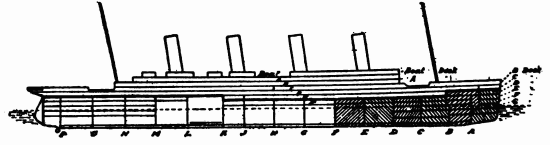
NOTE.—The vertical letters signify the different decks. The horizontal letters signify the water-tight bulkheads. The heavy line shows the top of the water-tight bulkheads. The crosshatched compartments are those opened to the sea at the time of the collision with the iceberg.