LORD STRANLEIGH ABROAD. (continued 3)
Reading edition
“Miss Armstrong, you are the most efficient individual I ever met.”
“You are very complimentary, Mr. Stranleigh, because, like the various meals you have enjoyed in different parts of the world, you must have met a great many people. To enhance myself further in your eyes, I may add that I have brought another much-needed accomplishment to the farm. I am an expert accountant, and can manage business affairs in a way that would startle you, and regarding this statement of mine, I should like to ask you, hoping you won’t think I am impertinent, are you a rich man?”
Stranleigh was indeed startled—she had succeeded in that—and he hesitated before he answered—
“I am considered reasonably well off.”
“I am very glad to hear it, for it has been the custom of my father, who is not a good business man, to charge boarders two or three dollars a week when they come with their guns and fishing tackle. Now, we are in a unique position. We have the advantage of being free from competition. The hotels of New York are as thick as blackberries. They meet competition in its fiercest form, yet the prices they charge are much more per day than we charge for a month. I am determined that our prices shall be equal to New York prices, but I think it is only fair to let any customer know the fact before he is called upon to pay his bill.”
“A very excellent arrangement,” said Stranleigh, heartily, “and in my case there will be an additional account for medical services. Will that be on the basis of professional charges in London, New York, Vienna, Berlin, or Lausanne?”
“Not on the basis of Lausanne, certainly, for there an excellent doctor is contented with a fee of five francs, so if you don’t object, I’ll convert francs into dollars.”
“My admiration for your business capacity is waning, Miss Armstrong. If this is to be an international matter, why choose your own country instead of mine? Transpose your francs into pounds, Professor. There are five francs in a dollar, but five dollars in a pound sterling. Let me recommend to you my own currency.”
“A very good idea, Mr. Stranleigh,” rejoined Miss Armstrong, promptly. “I shall at once take it into consideration, but I hope you won’t be shocked when the final round-up arrives.”
“I shall have no excuse for astonishment, being so honestly forewarned, and now that we are conversing so internationally, I’d like to carry it a little further. In Italy they call an accident a ‘disgrazia,’ and when you read in an Italian paper that a man is ‘disgraced,’ you realise that he has met with an accident. Then the account ends by saying that the patient is guaranteed curable in two days, or a week, or a month, as the case may be. How long, then, doctor, must I rest under this ‘disgrace’?”
“I should say a week, but that’s merely an off-hand guess, as I suppose is the case with the estimate of an Italian physician.”
“I hope your orders won’t be too strict. By the way, has my luggage arrived?”
“It is all in the large room upstairs, but if you have any designs upon it, you are disobeying orders.”
“I must get at a portmanteau that is in one of the bundles.”
“I will fetch what you want, so don’t worry about that, but come and sit on the verandah once more.”
Stranleigh protested, and finally a compromise was arrived at. Miss Armstrong would whistle for Jim, and he would do the unpacking. She saw a shade of distrust pass over Stranleigh’s face, and she reassured him that Jim was the most honest and harmless man in the world, except, perhaps, where sheriffs were concerned.
“Now,” she continued, when he had seated himself, “you have talked enough for one day, so you must keep quiet for the rest of the afternoon. I will do the talking, giving you an explanation of our brigandish conduct.”
“I shall be an interested listener,” said Stranleigh, resignedly. “But permit me, before silence falls, to ask what you may regard an impertinent question. Do you smoke?”
“Goodness, no!” she replied, with widely opened eyes.
“Many ladies do, you know, and I thought you might have acquired the habit during your travels abroad. In that case, I should have been delighted to offer you some excellent cigarettes from my portmanteau.”
Jumping up, the girl laughed brightly.
“Poor man! I understand at last. You shall have the cigarettes in less than five minutes. Give me your keys, please.”
“That particular piece of luggage is not locked. I am so sorry to trouble you, but after such a memorable dinner——”
“Yes, yes; I know, I know!” she cried, as she vanished.
“Interesting girl, that,” murmured Stranleigh to himself, “and unusually accomplished.”
He listened for a whistle, but the first break in the silence was the coming of Miss Armstrong, holding a box of cigars in one hand and a packet of cigarettes in the other.
“Then you didn’t call for help, after all,” said Stranleigh, a shade of reproach in his tone.
“Oh, it was quite easy. By punching the bundles I guessed what they contained, and soon found where the portmanteau was concealed. Now, light up,” she continued, “lean back, and smoke. I’ll do the talking. My father, as I’ve told you, is a very poor business man, and that is why I endeavoured to acquire some knowledge of affairs. He is generous and sympathetic, believing no evil of anyone, consequently he is often imposed upon to his financial disadvantage. Our position as father and daughter is the reverse of what is usual in such relationships. I attempt to guide him in the way he should go, and as a general thing he accepts my advice and acts upon it, but on the occasion of which I speak, I was at work in New York, and knew nothing of the disastrous contract into which he had entered, until it was too late.
“I always come West and spend the vacation on the ranch, and this time brought with me all the money I had saved, but it proved insufficient to cope with the situation. In his early days my father was a mining engineer. He was successful, and might have been a very rich man to-day if—— But that ‘if’ always intervened. Nevertheless, he accumulated money, and bought this ranch, determined to retire.
“The lower part of the ranch is good grazing ground, but the upper or western part is rocky, rising to the foothills. My father was not a success as a rancher, partly because we are too far from the markets, and partly because he chose as cowboys men who did not understand their business. I told you that my father is a sympathetic man. No one ever appealed to him in vain. He has always been very popular, but it seems to me that his friends are always poorer than himself. Thus it came about that miners who knew him, and were out of work, applied for something to do, and he engaged them as cowboys, until he had half a dozen on his pay roll, and thus began the gradual loss of his money. These men were excellent as miners, but useless as cowboys, and there was no one here to teach them their duties, my father being himself a miner. It seemed, then, a dispensation of Providence that as he rambled over the western part of his property he struck signs of silver. He was not mistaken in his prospecting. He and the cowboys took hilariously to their old trade, and worked away at the rocks until all his money was gone.”
“Did they find any real silver?” asked Stranleigh, interested.
“Oh yes, plenty of it,” answered the girl. “It is evident they have opened a very rich mine.”
“Then where is the difficulty?”
“The difficulty is the want of machinery, which there is no capital to purchase. My father tried to get that capital in this district, but there is very little ready money to be obtained out here. He enlisted the interest of Mr. Ricketts, a lawyer in Bleachers, and reputed the only rich man in the town. Ricketts came to the ranch with a mining engineer, and they examined the opening. Seemingly they were not impressed with the contents, and Ricketts advised my father to go East and form a company.
“My father explained his financial situation, and Ricketts, with apparent generosity, offered to lend him five thousand dollars on his note, to be paid on demand, with the ranch as security. Thus my father put himself entirely in the other’s power. Ricketts gave him the address of a lawyer in Chicago, who, he said, would be of assistance to him. The latest word we received from my father is that this lawyer, in one way or another, has got hold of all his money. Father telegraphed to Ricketts for help, which was refused. So he left Chicago on foot, determined to walk home, since he had not even money enough left to pay his fare home. Where he is at present, we have no idea, except that he is making for this ranch.
“Ricketts at once took action to sell the ranch. Apparently he is quite within his legal rights, but there are formalities to be gone through, and one of these is the arrival of the sheriff to seize the property. That arrival the men, headed by Jim, are determined to prevent, and now, perhaps, you understand why you rode into danger when you came from Bleachers this morning.
“When I learnt of my father’s predicament, I went out to Bleachers to see Mr. Ricketts, offering him what money I had brought from New York if he would hold his hand for a year. He refused, and from his conversation I realised he was determined to secure the ranch for himself, and I believe the whole transaction is a plot toward that end.”
“Then the mine must be a valuable one?”
“I am sure it is; indeed, my father could make no mistake in that matter.”
“Well, the position seems very simple after all. What you need, Miss Armstrong, is a change of creditors. You want a creditor who is not in a hurry for his money. In other words, if you could transfer that debt, you would be out of immediate danger. Would you allow me to go into Bleachers to-morrow, and see Mr. Ricketts?”
“Most decidedly not!”
“How much money did you bring with you from New York?”
“Two thousand dollars.”
“I brought just twice that amount, so I think the affair may be arranged, and you can go to Ricketts to-morrow, and take up the note. I think perhaps you had better have five thousand five hundred dollars with you, as there will certainly be some interest and expenses to pay, for if the case is as you state it, Ricketts will be reluctant to part with the document. Is there another lawyer in Bleachers?”
“Yes.”
“Well, get him to accompany you, and make formal tender of the money.”
The girl had reddened while he was speaking, and now she said, in tones of distress—
“I fear you completely misunderstood my object in telling you of my difficulties. My object was not to borrow money, but to explain why Jim Dean shot at you.”
“Oh, I understand perfectly why you spoke as frankly as you did, and I am very much obliged to you for doing so, but you must have no diffidence in accepting the money. It is purely a business transaction, and, as you say, you are a business woman. Therefore, as a matter of business, it would be folly to reject an offer that is to our mutual advantage. The security is ample.”
“That is true, Mr. Stranleigh, but, you see, I have no power, no authority, to give this ranch as security; it belongs to my father.”
“True; but you are not nearly so competent a business woman as you would have me believe. You will receive from Ricketts your father’s promissory note. That you will hand to me, then I shall be your debtor for two thousand dollars. Those two thousand dollars I shall pay as soon as I get some money from New York, and your father will become my debtor for five thousand dollars. All perfectly simple, you see. In the first instance I trust you for three thousand dollars, and in the second instance you trust me for two thousand dollars. After I have paid you the two thousand dollars, I hold the note, and can sell you up whenever I please. I give you my word I won’t do that, though even if I did you would be no worse off than you are now.”
“Very well, Mr. Stranleigh; I will take the money.”
It was several days later when Miss Armstrong returned from Bleachers. Her first interest was to satisfy herself of the patient’s progress. He had been getting on well.
“You are an admirable physician, Miss Armstrong,” he said. “Now let me know whether you are equally capable as a financier.”
“I have failed completely,” she answered, dejectedly. “Mr. Ricketts has refused the money.”
“Did you take the other lawyer with you?”
“Yes.”
“What did he say?”
“He said Ricketts had no right to refuse, but a different question has arisen. The guide who accompanied you to the ranch brought back news of the shooting. Ricketts guessed at once why you were shot at, and the sheriff has signed an affidavit, or some such instrument, to show that his life, and his men’s lives, are in danger if they go to seize the property, so this complication has been overcome by some order from the legislature, and the personal seizure is waived. The sale is announced to take place in Bleachers two weeks from to-day. Mr. Timmins—that is the other lawyer—fears that Ricketts is within his rights in refusing the money at this stage.”
“This is all very interesting, Miss Armstrong, but we have a fortnight to turn round in.”
“Yes; that is so.”
“I am delighted, for now I shall have the pleasure of trying a fall with the estimable Mr. Ricketts.”
VI.—THE BUNK HOUSE PRISONER.
As the wound in his shoulder healed, Stranleigh began to enjoy himself on the ranch. He was experiencing a life entirely new to him, and being always a lover of waving woods and rushing waters, even in the tamed state which England presents, he keenly appreciated these natural beauties in the wilderness, where so-called human improvements had not interfered with them. Without attempting to indulge in the sport for which he had come, he wandered about the ranch a good deal, studying its features, and at the same time developing an appetite that did justice to the excellent meals prepared for him. He visited Jim Dean, who had shot him, and tried to scrape acquaintance with his five aiders and abettors in that drastic act, but they met his advances with suspicion, naturally regarding him as a tenderfoot, nor were they satisfied that his long residence among them was as friendly as he evidently wished it to appear.
The men resided in a huge bunk house, which consisted of one room only, with a shack outside where the cooking was done. In the large room were a dozen bunks; half of them in a very dishevelled state, giving sleeping accommodation for the company, while the other half were ready in case of an accession of help, should the mine prosper.
The cabin was as securely built as a fortress, of the rugged stone which had been blasted from the rocks in opening the mine. The mine itself was situated about five hundred yards to the south of this edifice, but instead of being dug downwards, as Stranleigh expected, it extended westward on the level toward the heart of the mountain, so that a rudely built truck could carry out the débris, and dump it down the steep hill. To his æsthetic fancy this seemed a pity, because a short distance south from the opening of the mine, the river formed a cascade descending a hundred feet or more; a cascade of entrancing beauty, whose loveliness would be more or less destroyed as the mining operations progressed.
The rising sun illumined the tunnel to its final wall, and Stranleigh found no difficulty in exploring it to the remotest corner. He passed the abandoned truck partly turned over beside an assortment of picks, shovels, hand-drills and the like. To his unpractised eye there was no sign of silver on walls, floor or ceiling. At the extreme end was piled up a quantity of what appeared to be huge cartridges.
Before entering the cavern he had noticed three or four of the miners standing in front of the bunk house, evidently watching him, but he paid no attention to them, and while he was inside, the roar of the cataract prevented him from hearing approaching footsteps. As he came out to the lip of the mine, he found Jim and three others waiting for him. Each had a rifle on his shoulder.
“Inspecting the property?” said Jim, casually.
“Yes,” replied Stranleigh.
“What do you think of it?”
“My opinion would be of very little value. I know nothing of mining.”
“The deuce you don’t!” said Jim. “What are you doing with that lump of rock in your hand?”
“Oh, that,” said Stranleigh, “I happened to pick up. I wanted to examine it in clear daylight. Is there silver in it?”
“How should I know?” replied Jim, gruffly. “I’m not a mining engineer. I only take a hand at the drill or the pick, as the case may be. But when you throw that back where you got it, throw it carefully, and not too far.”
“I don’t intend to throw it,” said Stranleigh. “I’m going to take it down to the house.”
“Oh, you think you’re not going to throw it, but you are. We’ve just come up to explain that to you.”
“I see. If it is compulsory, why shouldn’t I throw it as far as I can?”
“Because,” explained Jim, politely, “there’s a lot of dynamite stored in the end of that hole, and dynamite isn’t a thing to fool with, you know.”
Stranleigh laughed.
“I rather fancy you’re right, though I know as little about dynamite as I do about mines. But to be sure of being on the right side, I will leave the tossing of the stone to you. Here it is,” whereupon he handed the lump of rock to Jim, who flung it carelessly into the mine again, but did not join in his visitor’s hilarity.
“You seem to regard me as a dangerous person?”
“Oh, not at all, but we do love a man that attends to his own business. We understood that you came here for shooting and fishing.”
“So I did, but other people were out shooting before I got a chance. A man who’s had a bullet through his shoulder neither hunts nor fishes.”
“That’s so,” admitted Jim, with the suavity of one who recognises a reasonable statement, “but now that you are better, what do you come nosing round the mine for? Why don’t you go on with your shooting and your fishing?”
“Because Mr. Armstrong was to be my guide, and he, I regret to say, has not yet returned home. As he is tramping from Chicago to the ranch, no one knows when he will put in an appearance.”
“Well, Mr. Stranleigh, we are plain, ordinary backwoods folks, that have no reason for loving or trusting people who come from the city, as you do. You say that shooting is your game. Now, we can do a bit of shooting ourselves, and I tell you plainly that if any stranger was found prowling around here, he’d have got a bullet in a more vital spot than you did. Do you understand me?”
“Your meaning, sir, is perfectly plain. What do you want me to do? Go away from here before Mr. Armstrong returns?”
“No; we don’t say that, but we draw an imaginary line, such as they tell me the equator is, past this end of the farm house, and we ask you not to cross it westward. There’s all the fishing you want down stream, but there’s none up here by the waterfall, neither is there any game to shoot, so you see we’re proposing no hardship if your intentions are what you say they are.”
“Sir, you speak so beautifully that I must address you less familiarly than I am doing. My own name is Ned, but few take the liberty of calling me by that title. I don’t know that I should like it if they did. You are already aware, perhaps, that I answer to the name of Stranleigh. May I enquire what your name is?”
“I’m James Dean.”
“Ah, the Dean of the Faculty? You are leader of this band of brothers?”
“In a manner of speaking, yes.”
“Are they unanimous in restricting my liberty on this ranch?”
“You bet!”
“You’ve no right to do such a thing, and besides, it is inhospitable. I came to this ranch properly accredited, with a letter of introduction to Mr. Armstrong. He happens to be away; if he had been here, and I had seen that my visit was unwelcome to him, I should instantly have taken my leave, but I refuse to have my liberty restricted by Mr. Armstrong’s hired men.”
“That’s exactly where you’re wrong, Mr. Stranleigh. In the first place, we’re not hired men; we’re Mr. Armstrong’s partners, and we don’t restrict your liberty on the ranch.”
“A partner contributes his share to the expenses of the combination. I understand Mr. Armstrong bears the burden alone.”
“We contribute our labour, which is cash in another form, therefore whether Mr. Armstrong is here, or whether he is away, we mean to defend our property. So when you cross the imaginary line I spoke of, you are trespassing, and no jury will convict a man who shoots a trespasser after he has been fully warned, as we warn you.”
“Well, Mr. Dean, I admit that you have right on your side, even if there is not much wisdom at the back of it. There is just one more thing I should like to know. Why do you treat me as an enemy?”
“As a possible enemy,” corrected Dean.
“As a possible enemy, then?”
“Because we don’t like your actions, and we don’t think much of you. You’re a city man, and we don’t trust any such.”
“But Mr. Banks, who gave me the letter to your chief, is not only a city man, but a lawyer. He has been here, and spoke highly of his reception.”
“That was before the mine was opened, and as for being a lawyer, we hate ’em, of course, but they’re like rattlesnakes. In some seasons of the year they are harmless. The opening of the silver mine opened the rattlesnake season, and that’s why this lawyer snake in Bleachers is trying to cheat Armstrong out of his ranch. He came over here with a mining engineer and learnt the whole value of the ground. How do we know you’re not a mining engineer?”
“I regret to say I’m nothing so useful.”
“And didn’t you send Miss Armstrong into Bleachers to see that villain Ricketts? What connection have you with him?”
“None at all, Mr. Dean. I never saw Ricketts in my life, and never heard of him before the day you mistook me for the sheriff.”
Dean glanced at his companions, who had taken no part in the colloquy, but who listened with an interest at once critical and suspicious. It was evident that their distrust could not be dissipated, or even mitigated, by strenuous talk, and for a moment Stranleigh was tempted to tell them that he had lent three thousand dollars to Miss Armstrong, in the hope that this money, added to her own, would gain some sort of concession from the obdurate lawyer. But he remembered that the girl was in constant communication with these men, and if she had not already informed them of his futile assistance, it was because she did not want them to know.
Dean pondered for a few moments before he spoke. He seemed to have gathered in the purport of his men’s thoughts without the necessity for words. At last he said:
“May I take it you agree hereafter to attend to your own business?”
Stranleigh laughed.
“There would be no use in my making that promise, for I have never in my life attended to my own business. My business affairs are all looked after by men who are experts. They live in New York and in London, and although I make a decision now and then, I do that as seldom as possible. It fatigues me.”
“So you are a loafer?”
“That’s it exactly, Mr. Dean, and I freely give you my promise not to loaf about your silver mine.”
“Are you so rich as all that?”
“You are not consistent, Mr. Dean. How can you ask me to attend to my business if you do not attend to yours? Whether I am rich or poor is none of your affair?”
“Quite true,” agreed Jim, nonchalantly, “we will let it go at that.”
Stranleigh, with a smile, bowed courteously to the group.
“I wish you a very good day,” he said, and turning, strolled down to the house at a leisurely gait, quite in keeping with his self-declared character of loafer. His back offered an excellent target, but no man raised his rifle, and Stranleigh never looked over his shoulder, never hurried a step, but walked as one very sure of himself, and in no fear of attack.
“Stuck up cuss,” said Jim to his comrades. “I’d like to take that chap down a peg. Let’s get back to the bunk house and talk it over,” so they, too, left the pit mouth, and returned to their cabin.
When the Earl of Stranleigh entered the house, he was accosted by Miss Armstrong, on whose fair face were traces of deep anxiety, which his lordship thought were easily accounted for by the fact that the homestead was to be sold in less than a fortnight.
“I have been anxious to see you, Mr. Stranleigh,” she said. “Won’t you come out on the verandah where we can talk?”
“With great pleasure, Miss Armstrong.”
When they were seated, she continued—
“You have been talking with the men?”
“Yes; we had a little chat together.”
“Did they tell you anything of their intentions?”
“No; except in so far as they were determined not to let me examine the mine.”
“Ah; they have distrusted you from the first. Did you insist on visiting it?”
“I have visited it.”
“Without asking one of them to accompany you?”
“I regarded them as hired men. They say they are your father’s partners.”
“So they are.”
“Ah, well, if that is really the case, I must apologise to them. I thought when you ordered Dean to bring in my luggage, and he obeyed with such docility, that he was your servant. I intended to offer him some money for that service, but I suppose I must not.”
“Certainly not. Those men will do anything for a friend, but nothing for one of whom they are suspicious. Their distrust, once aroused, is not easily removed. I am sure, however, you were tactful with them.”
Stranleigh smiled ruefully.
“I am not so certain of that myself. I fear I failed in diplomacy.”
“I do wish my father were here,” she said, ignoring his last remark. “I am very much worried about the men.”
“What do they know of your trouble with that man Ricketts?”
“They know all about it, and they now threaten to march into Bleachers in a body and, as we say, shoot up the town, including Ricketts, of course.”
“When do they intend to do this?”
“On the day of the auction sale.”
“Don’t they understand that that would be futile?”
“It would cause an infinite amount of harm, and ultimately might result in their being wiped out themselves. Not that Bleachers could do such a thing, but because they would be pitting themselves against the United States Government, which is a mere name to those men, carrying no authority. All their lives have been spent in camps, where the only law is that of the mob. I have tried my best to influence them, but they regard me merely as a woman, and a woman from the East at that, who has no knowledge of practical affairs, so I have every reason for wishing my father were here.”
“I should not trouble about that if I were you, Miss Armstrong. If they intended to carry out their resolution to-morrow, or next day, there might be reason for anxiety, but we have luckily plenty of time in which to act. The one immediate thing is to find your father. I’ll undertake that task. He’s travelling somewhere between here and Chicago, on foot. May I see the latest letter he wrote you?”
The girl brought it to him.
“Might I take this with me?”
“Yes. What do you intend to do?”
Stranleigh smiled.
“Oh, I never do anything. As I was telling your men, who wished me to mind my own business, I always have people to do that for me. I am a great believer in the expert. Now, America seems to be the land of experts, and the man to deal with this case is Detective Burns, of New York. I shall get into touch with him by telegraph, and if he cannot attend to the matter himself, he will select the best substitute that is to be had, and as Burns and his men invariably track down anyone they want, even though he be seeking to elude them, it will be an easy task to find your father, who is tramping the straightest possible line between Chicago and this ranch. I shall give instructions for two or three hundred dollars to be handed to Mr. Armstrong, with directions to take the next train to Bleachers, as we need his presence here. I shall do nothing but send a telegram, and Mr. Burns will do the rest. Now, if you will assist me by ordering out my horse, I shall be ready to start within ten minutes. I’d order the horse myself, but I don’t think your men would obey me.”
In less than the time mentioned, Jim brought the horse to the door. All his men were standing in front of their cabin, looking on. They quite naturally believed that their guest had taken alarm, and was making off to some district where he would be in less danger. When his lordship came downstairs and out to the front, Jim was overcome with astonishment. His lordship was accoutred amazingly, after the fashion of the English horseman. He had dressed himself in a riding costume such as an English gentleman would wear at home. Jim and his comrades had never seen such an outfit before, and they greeted his appearance with a roar of laughter.
Stranleigh sprang into his saddle with the agility of a cowboy, and smiling good-humouredly at his audience, raised his hat to them, and rode off.
As Stranleigh’s horse entered the forest the young man began to ponder over the problem that confronted him. When the unfortunate Armstrong borrowed money from Ricketts, he had, of course, fully explained the situation. The lender had examined the property in company with a mining engineer, and this expert doubtless took away with him some ore to analyse at his leisure. Ricketts, being in possession of the engineer’s estimate of the pit’s value, had probably formed a syndicate, or perhaps made arrangements with other capitalists, to see him through with the speculation. Undoubtedly Ricketts expected no competition when the estate was put up at auction, but if he was a shrewd man, as was almost certain to be the case, events had occurred which might stimulate thought regarding his position.
Miss Armstrong had ridden out to Bleachers, having in her possession five thousand dollars, the face value of the notes. Ricketts would wonder how she had obtained the money. She possessed only two thousand dollars on her first visit, as he knew from the fact that she had offered it to him for refraining from action until her father returned. Who could have given her the extra three thousand? Whoever had done so must have known the girl could offer no security for its repayment. He was therefore a rich man, or he could not afford to throw away a sum so considerable.
It was likely that such reflections as these had put Ricketts on the alert, and the sudden advent in Bleachers of a smartly costumed stranger, a stranger coming from the direction of the ranch, would almost certainly convince Ricketts that here was his opponent. In Bleachers, too, each inhabitant very probably knew every one else’s business. That he could elude the astute Ricketts was therefore exceedingly doubtful, and Stranleigh already knew enough about the lawlessness of the district to believe that he might ride into considerable danger. In that sparsely-settled country, people were not too scrupulous in their methods of getting rid of an enemy.
He wondered how far down the line the next town was, for he was certain that any telegraphing he did from Bleachers would speedily be known to Ricketts. Would it be possible to deflect his course, and make for the next station eastwards? He possessed no map of the State, however, and there was little chance of meeting anyone, so there seemed nothing for it but to push on to Bleachers.
At this point his meditations were interrupted by the dimly heard sound of horses’ hoofs on the trail behind him. He pulled up and listened. Pausing for a few minutes, he heard nothing more, and so went on again, with an uneasy feeling of being followed. He determined not to camp out when night overtook him, but to hurry on until he reached Bleachers. He had made a two days’ journey to reach the ranch, but that was because the laden mules were slow. Before dark he would be on the high road, and after that he could not lose his way. After all, perhaps it was better to reach Bleachers at night, and trust to rousing up the people in the one tavern of the place.
It was after midnight when his task was accomplished, and having seen to the accommodation of a very tired and hungry horse, Stranleigh threw himself down, dressed as he was, upon the bed to which he was shown by a sleepy ostler. He had had quite enough equestrian exercise for one day.
Ten o’clock had struck next morning before he woke, and went down to breakfast. His mind had become clarified, and he knew now exactly what he meant to do. To avoid the cognizance of Ricketts was impossible; of that he was certain. His first object, then, was to draw a red herring across the trail, so he enquired from the hotel-keeper the whereabouts of Ricketts’ office, and was directed to it.
He crossed the street and ascended a stair. Ricketts kept neither clerk nor office boy, so Stranleigh knocked at the door, was gruffly commanded to enter, and obeyed.
Silas A. Ricketts was seated at a large table strewn with books and legal-looking documents, and he stared in astonishment at the figure which presented itself. He, like the men on the ranch, had never seen such a costume before.
“Are you Mr. Ricketts?” asked his lordship.
“Yes, sir.”
“My name is Stranleigh. I took the liberty of calling upon you to learn, if possible, the whereabouts of Mr. Stanley Armstrong.”
“Why should I know anything of his whereabouts?” demanded Ricketts.
“Permit me to explain——”
“Now, before we go any further,” interrupted the lawyer, “I want you to know that this is a business office, and I’m a business man. My time is valuable. I thought when you came in that you were a client. If you have come here for aimless gossip, I’m not your man. I have my own affairs to look after.”
“You state the case very lucidly, Mr. Ricketts, and I congratulate your clients. My own time is far from precious, for I’m here after sport. How valuable is your time? How much does an hour’s conference with you cost?”
“It all depends on the business transacted.”
“I can’t agree with you, Mr. Ricketts. An hour is an hour. I want to buy sixty minutes of your time and attention. What do you ask for it?”
“Five dollars!” snapped Ricketts.
Stranleigh drew forth a five-dollar bill, and placed it on the table.
“May I sit down?” he enquired. “No healthy man should be tired in the morning, but I endured a long horseback ride yesterday, and had an indifferent night’s rest.”
“Where did you come from?”
“I have been living for the past few days at Armstrong’s ranch.”
“Are you the man who was shot last week?”
“Yes; by mistake for your estimable sheriff I understand. You see, I came here from New York with a letter of introduction to Mr. Armstrong, being told that I might enjoy some good fishing and a little shooting, while Armstrong was described as a most admirable guide to these sports. I waited at the ranch day after day, hoping that Armstrong would return, but nobody seems to know yet where he is, or when he will return, so I came out here, hoping to get into telegraphic communication with him. I’m well enough now to take part in the chase, and I am loth to return to New York without having had any sport.”
“I still don’t understand why you come to me about the matter.”
“I was told by his daughter that Armstrong had written to you. She does not know in the least where he is, and so on the chance of your having received a recent letter, I have called to enquire.”
“I see. Armstrong’s letter to me was written from Chicago. It was a request for money. I had already loaned him a considerable sum and was unable to accede to his further demand. I answered to this effect, but have heard no more from him. It is likely that his own people have received word since the letter to me was written. Of course, you don’t know the date of their last letter from him?”
“Yes, I do,” said Stranleigh, “I have the letter with me. It contains all the data of which Miss Armstrong is possessed, and she gave me the letter to assist me in my search.”
He drew the letter from his pocket, and showed the date to the lawyer, who consulted his file, and then said—
“It is just as I expected. That letter was written ten days later than the one I received. Sorry I am unable to give you any definite assistance, Mr. Stranleigh.”
Stranleigh rose.
“I am sorry also. I suppose there wouldn’t be much use in telegraphing to the address he gives in Chicago?”
“I see no object in that. The place is probably a boarding-house, and he’s not there.”
“Thank you, Mr. Ricketts. Good morning.”
Stranleigh went slowly down the steep stairs, and reaching the sidewalk, almost fell into the arms of Jim Dean. Here, then, was the man who had been following him.
“Good morning, Mr. Dean.”
“Morning,” snarled Jim, briefly.
“I’ve just been up to see Mr. Ricketts, whom I think you mentioned the other day.”
“So I supposed,” agreed Dean.
“I expected to get some information from him about Mr. Armstrong, but he doesn’t appear to know very much.”
“Well, you’re the first man I ever heard say that S. A. Ricketts doesn’t know very much, but I think by and by you will find that others know a great deal.”
“Perhaps they know a great deal that is not so; there’s a lot of knowledge of that kind lying around loose.”
“Very likely,” remarked Jim, laconically, then turned on his heel and walked down the street, while Stranleigh went towards the depôt to enlist the services of a telegraph operator, and learn when the next train left for the east.
Stranleigh found the telegraph operator dozing in a wooden chair tilted back against the wall, his soft hat drawn over his eyes, his feet resting on a rung of the chair. It was a hot day, and the commercial inactivity of Bleachers called for very little exertion on the part of the telegraphist. The young man slowly roused himself as the door opened and shut. His unexpected customer nodded good morning to him.
“Could you oblige me with some forms?” asked the newcomer.
“Forms? Forms of what?” The operator’s feet came down with a crash on the board floor as he rose from his chair.
“Well, telegraph blanks, perhaps I should have said.”
“Oh, certainly.”
The young man fished one out from a drawer, and flung it on the counter.
“This will do excellently for a beginning,” said Stranleigh, “but you’d better let me have a dozen to go on with.”
The young man was waking up. He supplied the demand, and with ever-increasing amazement, watched his client write.
Stranleigh gave the New York detective particulars in great detail so far as he possessed them, asked him to spare no expense, and requested that Armstrong, when found, should be presented with two hundred dollars or more, as he required, with admonition to take the first train home, where his presence was urgently needed.
“Great Scott!” cried the operator, “is that all one message?”
“Yes,” said Stranleigh.
“Where is it going?”
“I’ve written the address as plainly as I can. It’s going to New York.”
“I say, stranger,” protested the telegraphist, “have you any idea what it costs to send a message across the Continent to New York?”
“No, I haven’t, but I expect to be in possession of that information as soon as you have mastered my handwriting, and counted the words.”
The operator was practically speechless when he reached the end of his enumeration, but after making a note on the pad, he was sufficiently recovered to remark—
“Say, stranger, you’ll have to dig up a pretty big wad to pay for this. We don’t give credit in a Western Union office.”
“I shouldn’t think of asking credit from a downtrodden monopoly,” said Stranleigh, pulling out his pocket book, and liquidating his debt. “You ought to be happy if you get a percentage.”
“Worse luck, I don’t.”
“Well, I think you’re entitled to one. I’ve given a fee this morning and received no particular equivalent for it. Do you, being a useful man, object to accepting a five-dollar bill?”
“Not on your life!” assented the operator with great earnestness.
Stranleigh passed it over.
“I’m expecting a reply. At what time shall I call for it?”
“You don’t need to call, Mr. Stranleigh. When it comes, I’ll lock up the office, and find you if you’re anywhere in town.”
“I’m stopping over at the tavern.”
“All right; you’ll get it.”
“Thanks. Good morning.”
“See you later,” said the now thoroughly-awakened operator, and Stranleigh proceeded to the railway station. He took the next train to the nearest town east, and there did some more telegraphing, but this time the message was in cypher, and it was addressed to his agent in New York. Translated, it read—
“Send me at once by express, registered and insured, twenty thousand dollars in currency, made up of five dollar, ten dollar, and hundred dollar bills.”
The address was fully written out in plain English. He found there was time for a satisfactory lunch before the west-bound train arrived, and he partook of it in the chief hotel, whose accommodation was much superior to that of the Bleachers tavern.
On his return to headquarters, he called in at the telegraph office. The young man in charge, at once recognising him, announced—
“Nothing doing. The moment anything comes I’ll take it over to the tavern. Say, is there anything secret about that telegram you sent?”
“No; why do you ask?”
“Well, Mr. Ricketts, a lawyer here, came in about ten minutes ago, and described you, and wanted to know if you had sent a telegram.”
“What did you say to him?”
“I said nobody had sent a telegram, and that I knew nothing of you. He seemed powerful anxious, and offered me a dollar to let him know if you telegraphed anything. I went over to the tavern to tell you about it, but they said you hadn’t been in since breakfast.”
“I suppose you haven’t many chances of picking up an extra dollar in Bleachers?”
“No; I haven’t. Ricketts is always mighty curious about anyone who arrives here, but I never knew him offer a cent for information before.”
“I’m very much obliged to you. You go right over to Ricketts’ office and pick up his dollar, but don’t say I gave you the advice. By the way, wouldn’t you be breaking the rules of the Western Telegraph Company if you divulged the purport of any message that passed through your hands?”
A look of trouble, almost of fear, came over the young man’s face.
“If a telegram is secret,” he said, “the sender usually writes it in cypher.”
“Quite so, but even in that case wouldn’t you be punished if it became known that you had shown Mr. Ricketts a private despatch entrusted to your care?”
“Certainly,” admitted the telegraphist, exhibiting more and more uneasiness, “but I have not shown your telegram to anybody, and what I told you was entirely in confidence.”
“Oh, you need have no fear of my rounding on you. I am merely endeavouring to put you in possession of that dollar without getting your neck in a noose. Don’t you see that you are placing yourself entirely at Mr. Ricketts’ mercy?”
“But you,” protested the frightened young man, “advised me to do so.”
“Undoubtedly. I want you to get that dollar, but not to place yourself in jeopardy. From what I saw of Ricketts this morning, I should not like to be in his power, yet his dollar is just as good as any other man’s dollar, and I want you to detach it from him with safety, and profit to yourself. Let me have another telegraph blank.”
Stranleigh wrote rapidly—
“Pinkerton Detective Agency, Chicago.
“I want to be put into communication with Stanley Armstrong, who left Chicago on foot ten days ago, for the West, and I am willing to pay one hundred dollars for the job.
“Edmund Stranleigh.
“White’s Hotel, Bleachers.”
“There,” said Stranleigh, passing over the sheet to the operator, “you show that to our inquisitive friend Ricketts, but don’t send it over the line.”
Stranleigh slept that night at White’s Hotel, and shortly after breakfast next morning the telegraph clerk came across with a very satisfactory telegram from New York. The sender could not positively predict the finding of Armstrong, but anticipated no difficulty in the task.
Stranleigh paid his bill at the hotel, ordered out his horse, and trotted off towards the ranch. He saw no more of Ricketts, who, if on any trail, was following the wrong one.
Dusk had fallen as he was about to emerge into the clearing which in daylight would have afforded him a sight of Armstrong’s house. Suddenly and stealthily he was surrounded by six armed men, and the voice of Jim Dean broke the stillness.
“Good evening, Mr. Stranleigh. I must ask you to get down from your horse.”
“Willingly,” replied the rider. “I confess I have had enough equestrian exercise for one day.”
“We have supper ready for you at the bunk house.”
“Why at the bunk house? I am perfectly satisfied with the fare that Mr. Armstrong’s family provides.”
“We’d like a little conversation with you, and the conversation must take place in private.”
“In that case, Mr. Dean, you could hardly find a better spot than this.”
“We’re a kindly set of chaps, and couldn’t think of keeping a hungry man out here.”
“But I’m not very hungry. I took a pocketful of sandwiches with me from the tavern.”
“Nevertheless, you are coming with us, either peaceably, or by force, whichever you choose.”
“Oh, quite willingly, of course. I should be ungrateful if I gave you any unnecessary trouble, while accepting your hospitality. I may add that I am unarmed, so if you keep your guns in readiness you need fear no reprisal on my part.”
“That’s all right,” responded Jim. “We’re not easily scared, but are prepared to protect ourselves should you try any funny business.”
“Is Peter going to take my horse to the farm?”
“Sure; your horse will be put in its old quarters, and will be well taken care of.”
“Then I should be glad if Peter would oblige me by telling Miss Armstrong that I have arrived safely, and will give her an account of my journey when next I have the pleasure of meeting her.”
“‘I may add that I am unarmed, so if you keep your guns in readiness you need fear no reprisal on my part.’”
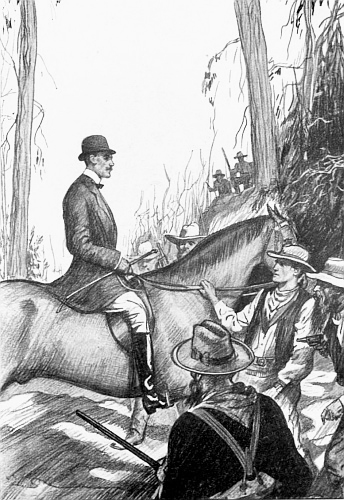
Lord Stranleigh Abroad] [Page 242.
“I’m afraid Peter can’t carry any messages; indeed, it’s not at all necessary. I’ve told Miss Armstrong that your horse will be brought back, and that I saw you off on the east-bound train, which is quite true. You’ve brought back the horse, and you did go east on the train. Miss Armstrong thinks you have become tired of waiting for her father, and that you’ve gone either to Chicago or New York.”
“Am I to regard myself as your prisoner, then?”
“Prisoner is an ugly word, and we are not entitled to call ourselves gaolers, but if you wouldn’t mind looking on it in that way, it’s all the same to us.”
“Well, truthful Jim, I’m your man in every sense of the word. Let us begin our amicable journey. I yearn for the bunk house.”
“You will keep silent? No shouting or calling for help? There’s no help to be had anyhow, and a noise would merely alarm the women.”
“I recognise the necessity for silence, and I shall make no outcry. Indeed, my whole future conduct while with you will be governed by the strictest secrecy. When I get tired of the bunk house I shall merely cut all your throats while you are asleep, and will do it in the quietest and gentlest manner.”
Jim laughed.
“I guess we can take care of our throats, but I’m much obliged for the suggestion, which may come in handy if you get funny, as I said before.”
They reached the bunk house by a circuitous route. A fine fire of logs was blazing on the ample hearth, for even in summer a fire was good to look at when night came on, at that elevation.
When Stranleigh sat down to supper, he regretted more than ever the civilised fare of the farm house. The menu was rough, but plentiful, and they all sat together at the long table. A meal was a serious event, and they partook of it in silence. It was evident that the men were going to adopt full precautions, for while they supped one of them sat by the door, a rifle over his knees. He came in for the second course, and another took his place. After the table was cleared, they all sat round the big fire, and smoked.
Remembering that the best tobacco in the world came from the south-east of their country, the aroma of the weed they had chosen was not as grateful to Stranleigh’s nostrils as might have been expected, so partly for good fellowship, and partly for his own protection, he presented each with a fine Havana cigar, such as would be welcomed in a London club, where pipes are not permitted. The men amiably accepted this contribution, but each put the cigar in his pocket against a future occasion, and went on with his pipe. Cheap as was the tobacco they were using, it was naturally scarce among men who had received no money for some months.
“I don’t wish to appear unduly inquisitive,” began their guest, “but now that we have all night before us, would you mind telling me why I am thus taken charge of by strangers on whom I have no claim?”
“There are several reasons,” replied Jim, who was always the spokesman for the company, “and we are quite willing to mention them. You appear to be a person of some intelligence——”
“Thanks,” interjected Stranleigh.
Jim went on, unheeding the interruption—“and so perhaps you know that we suspect you of being in cohoots with Ricketts.”
“Does ‘cohoots’ mean co-partnership?”
“Something of that sort. You partly persuaded us that wasn’t so, but I followed you to make sure. Perhaps you remember that I caught you coming out from Ricketts’ office. You made for that office the moment you reached Bleachers.”
“Pardon me, but I went first to the hotel.”
“Yes; and you enquired there where Ricketts hung out.”
“Certainly; but that’s in my favour. It showed that so far from being in the employ of the lawyer, I didn’t even know where he lived.”
“It was a good bluff.”
“It’s very circumstantial evidence of my innocence. But for the sake of argument, I will admit that I am in ‘cohoots,’ as you call it, with the estimable Ricketts. What next?”
“The next thing is that you learnt from Miss Armstrong of our intention to go into Bleachers and shoot up the town, including Ricketts.”
“That is true.”
“You didn’t like the plan and said so.”
“That also is correct.”
“You said it should be stopped, not knowing the ways of this country.”
“Certainly. Desirable as may be the shooting up of Bleachers, the odds are too strongly against you.”
“Oh, we’ll chance that. But the next thing you do is to put your funny clothes on, get out your horse, and ride directly to Mr. Ricketts. You are an informer.”
“An informer is always a despicable character, Mr. Dean. What’s the next item in the indictment?”
“Don’t you think that’s enough? Men have been hanged for less. An informer is the most poisonous wretch in the world except a horse thief.”
“Then I am in danger of being hanged?”
“You sure are.”
“Isn’t there any way in which I can compound my felony?”
“Well, I don’t quite know what confounding a felony is, but you’re the sleekest fellow I ever met, and if you think you can palaver us to let you go, you’ve made the mistake of your life.”
“I shouldn’t think of attempting such a thing. I am merely endeavouring to discover your state of mind. You’re strong on muscle, Jim, and I admire your build, but I’m beginning to doubt whether your brain equals your frame. There was a time when your equipment would have been victorious, but those days are long since past. Nowadays it’s brain that wins every time, and in every country. Physical force has had to give way before it. Jimmy, my boy, you’re out of date.”
“Brain isn’t going to help you any,” said Dean, evidently annoyed by these strictures on his mentality.
“Perhaps it won’t, but if there was a corresponding brain in your head, I’d appeal to it, and probably win. Are all your men here as stupid as you, Jim?”
Jim rose up from his chair, a forbidding frown on his brow.
“Look here, stranger,” he called out, “I’ve had enough of that line of talk.”
“Oh no, you haven’t. Please sit down. This line of talk is only beginning, and I say, Jim, lay aside that pipe, and smoke the Havana cigar. It will put reason into your head if anything will.”
Some of the company laughed, and Jim sat down, seeing that his opponent failed to show any fear at his captors’ threatening attitude. He tried to change the course of the conversation into a less personal channel.
“You see, Mr. Stranleigh, we’re short on tobacco, and I want to keep this cigar until to-morrow. I can tell by the smell it’s a good one.”
“That’s all right,” said Stranleigh, “I have plenty more of them down at the house, and when they are finished, I’ll telegraph east for a fresh supply. If you will let me know your favourite brand of tobacco, I’ll order a ton of it at the same time.”
For a moment Jim’s eyes twinkled, then they narrowed into their usual caution.
“Was that what you meant by confusing a penalty? Well, stranger, it doesn’t go here. We ain’t to be bought, even by a ton of tobacco.”
“I hadn’t thought of either buying or bribing you,” said Stranleigh, “therefore we will get back to our original subject, the difference between brain and muscle. I see here on the table a pack of cards in a deplorably greasy condition. If you were playing a game with an opponent who was beating you, would you shoot him?”
“Yes,” promptly replied Jim, “if I found he was cheating.”
“Whereupon his friends would lynch you.”
“A cheater hasn’t any friends.”
“Jim, I shouldn’t like to sit down to a game with you. You would shoot first, and think afterwards, while I, being unarmed, should be at a disadvantage. That, indeed, is just what you are doing now. If you succeed in holding me here you will spoil my game. What I propose to do is not to attack Ricketts with a gun, but to learn his style of play, and beat him at it. Any confounded fool can shoot off a gun; there’s no credit in that. It’s a coward’s trick.”
“You say we’ll spoil your game. You may bet your life we will. You daren’t tell us what it is.”
“Oh yes, I dare, because I have a trick that will quite delude you.”
“I know you’ll try to do that.”
“Exactly. Well, my trick is to tell the truth. The situation is very simple. That morning when from the pit mouth you warned me off the premises, I found Miss Armstrong very much worried because she had learned of your intention to shoot up the town, and could not persuade you to abandon so foolish a project. It then became my duty to prevent you doing what you proposed.”
“Do you think you can?”
“Of course; I knew it was no use attempting to reason with you, so the instant necessity was to get one man of common sense to counteract the stupidity of the bunk house. That I set out to do. I rode to Bleachers, called on Lawyer Ricketts, paid him five dollars down for whatever knowledge he could give me concerning the whereabouts of Mr. Armstrong. He could give me none that I did not already possess. He kept the five dollars, though. You saw me go off in the train. I merely went to the next town, to do some telegraphing that might be more or less secret from Ricketts. A detective agency will find Mr. Armstrong, and hand him two hundred dollars, asking him at the same time to make for home by the earliest train. Then, unless I’m much mistaken, Mr. Armstrong will see the idiocy of what you propose, and will prevent you from carrying out your scheme.”
Jim pondered over this announcement for some minutes. At last he broke the silence.
“What you say may be true, but I don’t believe a word of it. It’s more likely Ricketts is your boss, and you went in to report to him and tell him what we intended to do. Then he’ll see that Bleachers is prepared to meet us.”
“Yes; that would be a simple way of turning the trick. There are good points about it, but it happens not to be my way, as you will learn in a few days when Mr. Armstrong returns.”
Again Jim meditated for a while, and finally rose, walked to the further end of the room, and engaged for some minutes in earnest cogitation with his fellows, carried on in tones so low that Stranleigh could not hear. Resuming his seat, he spoke with deliberation—
“You want us to believe that you are a friend of Mr. Armstrong?”
“I don’t care whether you believe it or not. I can hardly be a friend of Stanley Armstrong, because I’ve never seen him.”
“Well, we’ll put your good intentions to the test. When Mr. Armstrong gets here, he will have no money. Stony broke, that’s what he is. Now, unless we shoot ’em up in Bleachers when they try to sell his place, Armstrong will lose it. We take it you are a rich man. Will you promise to lend him enough money to hold this ranch, and run the mine?”
“No; I won’t,” said Stranleigh, with decision.
“All right. Then you stay here until you cough up that cash. Even if Armstrong comes, he will never know you’re here, because we shall tell him that you’ve gone East. Nobody else knows where you are, so there isn’t any chance of a search being made.”
“This is rank brigandage,” remarked Stranleigh.
“I guess that’s the right title, but a man who brags so much of his brains as you do, ought to see that if we’re ready to shoot up a town, we won’t stop at such a trifle as brigandage.”
“That’s so. And now, gentlemen, I’m tired after my long journey, and I think we’ve talked a great deal to very little purpose, so if you’ll show me what bunk I am to occupy, I’ll turn in.”
“There are six unused bunks, Mr. Stranleigh, and you can take your choice. There’s nothing mean about us.”
Stranleigh made his selection, and rough as the accommodation was, he slept as soundly as ever he had done in his London palace, or his luxurious yacht.
Although the Earl of Stranleigh was naturally an indolent man, the enforced rest of the next few days grew very irksome. He had expected the guard set over him to relax as time went on, but this was not the case. The genial Jim saw to that, and it was soon evident to Stranleigh that Dean ruled his company with an iron hand. Such casual examination of the premises as he was able to make impressed him more and more with the difficulty of escape. Had the structure been built of logs, there might have been some hope, but the imperviousness of the thick stone walls was evident to the most stupid examiner. The place was lit in daytime by two slits, one at each gable, which were without panes, and narrow, so that they might as much as possible keep out the rain. No man could creep through, even if he could reach the height at which they were placed. During the day the stout door, fit to encounter a battering ram, was open, but a guard sat constantly at the sill, with a rifle across his knees. At night it was strongly locked. Stranleigh was handicapped by the fact that heretofore he had never been required to think out any difficult problem for himself. He had merely to give the order, and other people did his thinking for him, and when a plan was formed, there were others to carry it out, being well paid for doing so. Thus it happened that the means of escape were so obvious that a ten year old boy might have discovered them.
Each evening passed very pleasantly, for Stranleigh was a good story-teller, and had many interesting tales to relate. In spite of the fact that his gaolers were unanimous in their opinion that Stranleigh was a useless encumbrance upon earth, they began rather to like him. One night Stranleigh asked Jim if anything had yet been heard of Mr. Armstrong, and Dean, after hesitating a moment, replied that there was so far no news of him or from him.
“I’m sorry for Armstrong,” said Stranleigh, more as if talking to himself than to anyone else. “Poor fellow, away from home all this time, and yet compelled to support six stalwart loafers without commonsense enough to do the obvious thing.”
“What is the obvious thing?” asked Dean.
“Why, to work, of course. There’s your mine; you’ve got plenty of dynamite to go on with, and yet you lounge about here not earning enough to keep yourselves in tobacco. If there is silver in that hole, you could by this time have had enough out to buy the ranch and furnish your own working capital. You say you are partners in the scheme, but you seem to be merely a blunderheaded lot of hired men, determined not to do any work.”
Jim answered with acerbity—
“If you weren’t a fool you’d know we’d gone already as far as hand work can go. We need a steam engine and a crusher.”
“A steam engine?” echoed Stranleigh. “What on earth would you have to pay for coal, with railway haulage, and the cost of getting it out here from the line? Why, right there, rushing past you, is all the power you need. You’ve only to make a water-wheel, with a straight log, thrown across the falls as axle, and there you are. Pioneers have done that sort of thing since civilisation began, and here you don’t need even to build a dam.”
Jim was about to make an angry retort when the company were scattered by a roar and a heavy fall of soot on the log fire. The chimney was ablaze, but that didn’t matter in the least, as the house was fireproof. In a short time the flames had died out, and the party gathered round the fire once more.
“Well,” said Jim, “go on with your pretty advice.”
Stranleigh replied dreamily, gazing into the fire.
“Oh, well, I think my advice doesn’t amount to much, as you hinted. It is none of my affair. You are a most capable body of men, I have no doubt, only the fact has been concealed from me up to date. I find I am developing the vice of talking too much, so I’m going to turn in. Good-night!”
But the fall of soot had suggested to Stranleigh a method of escape.
VII.—THE END OF THE CONTEST.
A wood fire is an evanescent thing, having none of the calm determination of coal combustion. A wood fire requires constant replenishing, and that in the bunk house did not receive this attention. When the men, tired with doing nothing, overcome by the lassitude enduring an empty day had caused, turned into sleep, the wood fire, left to itself, crumbled into a heap of ashes. The guarding of Stranleigh became more perfunctory as time passed. He proved to be a model prisoner, and usually the sentinel at the door fell into peaceful slumber as night wore on. On the particular evening Stranleigh chose for his attempt, Jim Dean sat on the chair against the door. Jim’s jaw worked so much during the day, he talked so incessantly, emptying his mind of all it contained, that he was naturally exhausted when his turn for watching came. Each of the men slumbered more or less soundly at his post, but the confident Jim outdid them all, so Stranleigh selected him as the man destined to hold the empty bag.
It was two hours after midnight when his lordship slipped down from his bunk. The fire had long since gone out, and the stone chimney was reasonably cool. The climbing of that ample flue presented no difficulty to an athletic young man who in his time had ascended the Matterhorn. The inside of the chimney offered to the amateur sweep walls of rough stone, which projected here and there, forming an effective, if unequal ladder. He attained the top with such ease that he wondered he had remained so long a prisoner. Descending the roof silently, he let himself down to the top of the lean-to which acted as kitchen and supply store, and dropped from that elevation lightly to the ground. It was a night of clear moonlight, and Stranleigh smiled to think how nearly he must represent the popular idea of the devil, covered as he was with soot from head to foot.
He made directly down the hill to the farm house by the stream, and risked a few minutes of time in washing his face in the rapid current. He now took off his boots, the better to enact the part of burglar. The doors of the house, he knew, were never locked. First he secured his favourite magazine rifle and a large quantity of cartridges, then as, after all, he was entitled to the board he paid for, he penetrated softly to the kitchen. Here he secured a couple of loaves of bread and a cooked ham, together with some other things he wanted, including a supply of tobacco, and thus overloaded as he had rarely been in his life before, he stole softly outside, slipped his feet into his boots, and slowly climbed the hill to the silver cavern. Depositing within his goods and chattels, he examined his store carefully to learn whether there was anything more he needed to stand a siege.
Bright as was the moonlight outside, the cavern was pitch dark, so Stranleigh determined on another expedition to the house, and he brought back a bunch of candles and an armful of bedclothes.
“Now for the night’s work,” he said to himself, and having lit a candle, which he placed at the remote end of the cave, he began picking up stones, and with them building a wall across the mouth of the pit. No Roman wall was ever built with such care, and no Roman wall ever contained within itself such possibilities of wholesale obliteration, because the structure was intersticed with sticks of dynamite, which Stranleigh carried with the most cautious tenderness from the rear to the front of the cavern. When his task was completed the moon had gone down, and the misty, luminous grey of the eastern sky betokened the approach of dawn. The young man was thoroughly tired, and with a sigh of relief he stretched himself out on the bedclothes he had brought from the house.
The early sun shining on his face awakened him. He knew from experience that the bunk house men were not afflicted with the vice of early rising. There was no aperture in their habitation, unless the door was open, through which the sun might shine upon them. He was therefore not surprised that no one was visible anywhere near the sleeping quarters. So he breakfasted in peace, alternating slices of bread with slices of ham, thus constructing some admirable sandwiches.
A providential jug, which doubtless in its time had contained whisky, was one of the utensils left when the mine was abandoned. Stranleigh took this, and stepping over the dangerous wall, filled it three or four times at the rushing cataract, rinsing out all indication of its former use. He brought it back, filled with very clear and cold water. He could not help thinking as he returned what an excellent place the waterfall would be for the washing of dishes, if a person ran the risk of standing upon spray-drenched, slippery rock ledges.
Stranleigh sat down where he could see the enemy’s quarters, and carefully examined his rifle, assured himself that the magazine was full, then with the weapon over his knees in the fashion adopted by his recent gaolers, watched the bunk house patiently, wishing he had a morning paper to while away the time.
The laggard sentinel was the first to rouse himself. The broad door opened, and Jim Dean, palpably bewildered, stepped out. With hand shading his eyes he minutely examined the landscape, slowly turning his head from left to right as he scrutinised the distant horizon and the ground intervening. Stranleigh, kneeling, rested his rifle on the top of the wall, and as Jim’s left ear, a rather prominent feature, became fully visible, the young man fired.
Jim’s action instantaneously verified the Indian romances of Stranleigh’s youth. He sprang clear up into the air and clapped a hand upon his wounded ear. He was at that moment the most astonished man on the western hemisphere. His first instinct being to bolt for cover, he did so without pausing to close the door, which opened outwards, and this broad piece of woodwork now offered a much more prominent target than Jim’s ear had done a moment before.
Stranleigh, exercising a care that seemed unnecessary with so big a target, fired out the cartridges of his magazine, then immediately restocked it, and shot away the second charge. Putting in a third load, he sat there with his customary nonchalance, awaiting the turn of events. In that clear atmosphere, and with his sharp vision, he saw that he had accomplished his intention, and had punctured the letter “S” on the panel of the open door.
Meanwhile, there was commotion in the bunk house. The first sharp report, accompanied by Jim’s yell, woke every man within. The subsequent fusilade engendered a belief that the enemy was in possession of a Maxim gun, and brought every man to the floor, thankful that he was under better cover than if he stood behind the door, through the panel of which all the bullets had penetrated.
“How did he escape?” demanded one, addressing Jim, who was holding his left hand to his ear.
“I don’t know,” said the wounded man ruefully. “You can search me.”
“Seems from that shooting that we’d better search outside. What in the fiend’s name made him batter the door?”
“Sorry he left us, I suppose,” muttered Dean, grimly. “Knocking because he wanted to come in again.”
“How did he get his gun?”
“Hanged if I know,” said the questioned man, impatiently.
“But you were on guard. You ought to know something about it.”
“Look here,” said Jim. “There’s no use in talking. He got out some way, and he’s got his gun some way. He’s holding us up, and we must make terms with him.”
“But where is he?”
“I tell you I don’t know! The bullet came from the direction of the mine. Now, one of you boys throw up your hands, and go outside and hail him.”
At this command, Jim met the first rebellion against his authority.
“Go outside yourself. It is you who have brought all this upon us. You shot him through the shoulder; you proposed capturing him, and it was you who fell asleep last night and let him escape.”
Jim did not combat their charges.
“All right,” he said. “I’ll go out, and you sit here and shiver while I enjoy a little conversation with him.”
Raising his hands above his head, Dean stepped across the threshold into the open, and stood like an oriental about to begin his prayers. He saw at once the wall that had been built during the night, and then caught sight of Stranleigh standing behind it. Pulling out a white handkerchief, and waving it, Dean proceeded towards the mine.
“Have you got a revolver?” shouted Stranleigh.
“No,” answered Dean.
“Then put down your hands, and approach as a Christian should.”
Jim obeyed.
“Now stand where you are,” said Stranleigh, when the other was within four or five yards of the wall. “I see your ear is bleeding. That was rather a neat shot of mine, don’t you think?”
“It was,” admitted Dean, without enthusiasm.
“When you shot at my shoulder, you had a bigger mark.”
“Oh, not so very much,” growled Dean. “My ears are celebrated for their size.”
“You’d better wrap it up in this handkerchief,” commented Stranleigh, rolling it up in a ball, and flinging it towards Jim. The wounded man tied it round his voluminous ear.
“And now,” said Stranleigh, “get through with your parley as soon as possible, then go to Miss Armstrong, who will very expertly attend to your hurt. But in order to win the privilege of surgical treatment, you must recognise that you are a prisoner.”
“A prisoner?” echoed Dean.
“Certainly. You must give me your word you will say nothing to Miss Armstrong to show that I have had a hand in the game. Make whatever excuse you like for the disaster, and then get back to the bunk house, tell your fellows the condition of the game as far as we have gone. I will allow you five minutes after your return to show those chaps the letter ‘S’ I have perforated in the door. They are a very unbelieving lot, and I wish to gain their affection and respect. Without hurting anybody I mean to prove that I am a dead shot. I’m well provisioned here, and prepared to stand a siege. Until Mr. Armstrong returns, not one of you will be allowed outside the châlet. Don’t be misled by the fact that you outnumber me six to one. I hold a magazine rifle, possess an ample supply of ammunition, and have just given evidence of the rapidity with which reloading can be performed.”
“Yes,” said Dean, meditatively, “your position would be bull strong and hog tight, if you had a chum with you who could shoot as well as you do. But as it is, you’ve nobody to relieve you, and a man must sleep. It will only take one of us to defeat you. We’ve no magazine rifles and don’t need none. I’ll undertake the job myself.”
“How do you propose to do it?”
“That would be telling,” said Jim, craftily.
“Why not?” answered Stranleigh. “I’m placing my cards on the table. Why don’t you do the same? I’m not yearning for war and bloodshed, but have inaugurated a sort of Hague tribunal. There were two things I determined to accomplish when I broke jail. I hope that wounded ear hasn’t impaired your hearing, so that you may listen with attention. It’s always as well to know what your enemy desires.”
“I’m listening,” said Jim.
“The first thing was to shoot you through the leg or the arm or the ear, choosing some spot that was not vital. This in return for your shooting me. One good turn deserves another, you know. That part of my programme I have accomplished.”
“What’s the other part?”
“The second is to keep you gentlemen in prison just as long as you kept me in prison. One good imprisonment deserves another. Now will you tell me what you intend to do?”
“No; I won’t.”
“That’s mean of you, Jim; secretive, over-cautious and that sort of thing. I’m not so chary and so will give you the information. There are only two portions of the night during which you can come out unnoticed; before the moon rises and after it sets. You will steal out and take up a position where you can see the barricade when day begins to dawn. You’ll need to chose a spot a long way off, because the explosion, when it comes, will wreck everything in the neighbourhood.”
“What explosion?”
“The dynamite explosion. This wall is built of rock intersticed with those dynamite cartridges of yours. It is very likely you will obliterate the farm-house.”
“I’ll obliterate you, anyway.”
“Quite so, but at a tremendous cost, because whatever the fate of Mr. Armstrong’s residence, the doom of the bunk house is certain. You may be outside that danger, but you won’t be free of another. You suppose, doubtless, that I shall be asleep in the cavern. As a matter of fact I shall be sleeping placidly under the stars, quite out of reach of the main disaster. Your first shot will awaken me. Now, it is by no means certain that your first shot will send off the dynamite. You may have to fire half a dozen times, and your best rifle is an old breech-loader. I use smokeless powder, and you don’t. I could pepper away at you for half an hour and you’d never know where the bullets were coming from. The smoke from your rifle would give you away at once. When I fire at you next time, Jim, I shall aim at a more vital point, because, my dear boy, the person who sets off that dynamite is a murderer. So before you put your plan into operation, just consult your comrades and explain to them its disadvantages.”
Dean stood there meditating for a few moments before he spoke.
“I’m very much obliged to you,” he said at last, “for telling me what you mean to do. We’ll change that plan a little, and come out of the bunk house together. We’ll search the country for you, and so won’t need to blow up the mine.”
“That’s a much more humane expedient, and will prevent unnecessary loss of life. I shall be lying quiet under whatever cover I can find. Your crowd will perambulate the locality, and I may remind you that you are no lightfooted Cinderellas. A herd of elephants would make less noise. I shall see you long before you see me, and I leave the result to your own imagination. And now, Jimmy, take the advice of a true friend. Your time to act was when you were snoring at that door and I was climbing the chimney. Once you allowed me to get my rifle, you had permitted opportunity to pass you, because I am a good shot, and I came West in order to shoot. When a person accustomed to downy beds of ease slumbers peacefully, as I did this morning, on hard and jagged rocks thinly disguised by a blanket, with my right ear against a dynamite cartridge, there’s nothing the matter with his nerves, is there?”
“No; there isn’t,” said Dean, with conviction.
“Now, what you chaps want is not a battle, but an armistice. Leave well enough alone, I say, and accept the status quo. If you remain in the bunk house, you are as safe as in a Presbyterian church.”
Jim did not reply, but deliberated, his open palm against his bandaged ear.
“Hurt?” asked Stranleigh.
“Yes, it does,” admitted Jim, ruefully.
“Well, my shoulder hurt a good deal after you fired at me. Now, I’ll tell you what I’ll do, Jim. Next time I shoot at you, I’ll take the other ear. You’re determined to prove yourself a brigand, or a pirate, or something of that sort, and as pirates always wear earrings, that will put you in a position to adopt them. What do you say to my proposal for an armistice?”
“I can’t answer for the rest of the boys without consulting them. If we need an armistice or a status quo, why, I suppose we ought to have them.”
“All right. If your ear hurts, the sooner you get it attended to, the better. You go directly down to the house and see Miss Armstrong, and you can reflect upon the situation while she is dressing the wound. Deep thinking will take your mind from the pain. Then go up and consult the company. Come and let me know what they decide. Meanwhile, I’ll guarantee that no one comes out of that bunk house without being shot at.”
“Mr. Stranleigh, I’ll do what you say, but I’ll change the order. I’ll go first to our shack, and warn the boys. That’s only fair, for they’re watching from that door, and if they see me going to the house they may think it’s all right, and come outside. After talking with them, I’ll visit Miss Armstrong, and then come back here to tell you what the boys say.”
“Yes, Jim; that’s a better plan than mine. But first give me your word that you will take no advantage of this respite until war. An armistice, you know, is a cessation of hostilities.”
“You mean that there will be no shenanigan? I give you my word.”
The wounded man made his way to the bunk house. Shortly afterwards Stranleigh saw him emerge, and go towards the homestead. After a longer interval he came slowly up towards the fortress, his ear neatly bandaged in white linen, which showed up, as one might say, like a small flag of truce.
“Well, what did Miss Armstrong say about the wounded ear?”
“She says it’s about as serious as the sting of a bee, and won’t hurt much longer than that would, and will be cured nearly as soon.”
“That’s first-rate, and relieves my conscience, which has been troubling me, because I’d much rather smite a man on the ear with my fist than with a bullet. For the same reason I hope you found your messmates undergoing a spasm of common sense.”
“They agreed with me that it wasn’t very healthy to take outdoor exercise for a while. If we decide to begin fighting again, we’ll give you twelve hours’ notice. Will that suit you?”
“I don’t know that it does, quite. I want you to promise that you will not break loose either until Mr. Armstrong returns, or the auction is over.”
“The boys wouldn’t agree to that, Mr. Stranleigh. We’re bound to attend that auction.”
Stranleigh sighed.
“Very good,” he conceded. “I must content myself with what you offer. I accept your proposal, for I feel certain that Mr. Armstrong will return before the ranch is sold. So good-bye. Give my love to the boys.”
Stranleigh watched the retreating figure until it disappeared into the bunk house. A moment later the perforated door was drawn shut, and then he rolled up the bedclothes into a bundle, and deposited it at the further end of the cavern. This done, he took his rifle under his arm, crossed the barricade, and strolled down to the farm-house. Miss Armstrong greeted him with surprise.
“I thought you had gone to New York,” she said.
“I took the train east, but only to the next station from Bleachers.”
“You’ve not been stopping at that wretched hotel in Bleachers ever since?”
“Oh no; I received a pressing invitation from some friends of mine to be their guest, with a prospect of a little shooting, so I’ve been staying with them ever since.”
“Did you have a pleasant time?”
“Oh, excellent, and I heard more entertaining stories than ever I listened to in a similar period.”
“Good shooting?”
“First rate. Limited in quantity, but of finest quality. Indeed, I may boast of a record; I hit everything I aimed at. Camp fare, however, left a good deal to be desired, so you may imagine how glad I am to return.”
“I’m very pleased to have an opportunity of giving you something better. How would you like some nice broiled trout, freshly caught this morning?”
“Oh, heavenly!” cried Stranleigh, enthusiastically. “I haven’t had anything but bread and salt pork since I saw you. Who caught the trout?”
“I did. I went down the river early this morning. I must have had a premonition that you would return, famished for trout, and I had quite an adventure, or rather, plunged into a mystery which I have not yet solved. I heard the sound of firing; first a single shot, then a fusilade. I could not tell from whence the sound came. I hurried home with my basket, but there was no one in sight. After a while Jim came in, very much crestfallen, it seemed to me, with his ear tied up clumsily in a handkerchief. He had been shot through the ear, and of course I came to his aid at once. With a woman’s curiosity, I asked him how the accident happened. Now, one of Jim’s infirmities is that he can only tell the truth when it suits his convenience.”
“Many of us are like that,” said Stranleigh.
“Well, this time it didn’t suit his convenience.”
“What did he say?”
“That the boys were having a sort of shooting match. I told him I had heard the firing, and feared that there had been a battle of some sort. He said it was the first shot that did for him. They had some bet on as to who could fire the quickest at a flying mark. In his hurry to get ready he had mishandled his gun, and sent a bullet through his ear. The other men had then fired almost simultaneously.”
“Miss Armstrong, I fear you are too sceptical. Why shouldn’t that be a true story?”
“Mr. Stranleigh, you quite underrate my intelligence. The wound in Jim’s ear was not caused by the gun he held. In the first place, his ear would have been blackened with gunpowder, and likely would have been partly torn off. Secondly, a mishandled gun would have fired upwards. The bullet that wounded him was fired from a distance by someone higher up than the spot where Jim stood. The wound was clean cut, slightly inclining downwards. Besides all that, Jim’s bullet, coming from an old-fashioned rifle, would make a bigger hole. I know that, for you remember I tended your shoulder, through which his bullet had gone.”
“By Jove, Miss Armstrong, if Sherlock Holmes had a daughter, she would be just about your age. Was there anything else?”
“Yes; I looked at the handkerchief in which he had bound his ear. It was of a finer cambric than we have ever seen in this district, or indeed, than I have seen anywhere else. The corner was embroidered with a very delicately-worked crest.”
“A crest?” said Stranleigh, rather breathlessly.
“I asked Jim where he had got this handkerchief. He seemed confused, but said he had always had it. Bought it once at a five-cent store in Denver.”
Stranleigh could not refrain from laughing.
“You think it cost more than five cents?”
“Yes; I am sure it cost more than twenty-five.”
“Perhaps he stole it?”
“Jim might shoot a man, but he’d never steal.”
“I think that when you discover the owner of that handkerchief, you will have solved the mystery,” remarked Stranleigh calmly.
“I think so, too,” said the girl quietly. “Now I am going to cook your trout.”
The three days following were among the most enjoyable Stranleigh had ever spent. He asked Miss Armstrong to show him the portion of the river in which she had caught those delicious trout. Heretofore, she had used a baited hook when fishing, landing her spoil with a trout pole, but now she was to be initiated in the delicate mysteries of fly fishing. Stranleigh remembered the story told of an English official sent to view the debateable land adjoining the far western boundary of Canada who reported the territory useless, because the fish wouldn’t rise to the fly. He wondered what lure the official used, for here they rose readily enough, and fought like demons until Miss Armstrong deftly lifted them from the water in the new-fangled landing net, the like of which she had never seen before.
But in spite of the excellent sport he was enjoying, Stranleigh became more and more anxious as time went on. Nothing had been heard from Stanley Armstrong. The fisher began to fear that the detective had failed in his search. On the morning of the fourth day he dressed in his ordinary tweed suit. The riding costume attracted more attention than was altogether convenient. He put in his pocket an automatic revolver of the latest construction; light, accurate and deadly. The day of the auction was drawing uncomfortably near, and he was determined that his journey should not be interrupted, as his former ride had been. Aside from this, he expected to carry with him a large amount of money, and if any word of that got abroad, he knew a holdup was quite within the range of possibility. The coterie confined in the bunk house would doubtless learn that they were their own gaolers, and with that gang once free upon the landscape, he anticipated interruption which, if successful, would completely nullify his plans.
“Are you going fishing to-day?” asked Miss Armstrong, when he came downstairs. He had appeared unexpectedly soon that morning. The young woman was always an early riser.
“Fishing!” echoed Stranleigh. “Yes, in a manner of speaking. Isn’t there a text which refers to fishers of men? I’m going fishing for your father. We should have had him here before this, but now the need of him becomes imperative. I imagine that a telegram awaits me in Bleachers. If not, I must communicate with New York, and wait for a reply.”
Stranleigh walked up the hill to the bunk house, and rapped at the panel with the butt of his riding whip. Dean himself threw open the door, and he could not conceal his astonishment at seeing the young man standing there, apparently unarmed.
“Good morning, Jim,” said Stranleigh cordially.
“I wish to enjoy a few minutes’ conversation with the company before leaving for Bleachers.”
“None of the company are out of their bunks yet, except myself, but I guess they’re wide enough awake to hear what you say. Won’t you come inside?”
“Thank you,” said Stranleigh, stepping across the threshold; then, to the sleeping beauties—“The top of the morning to you! Early to bed and late to rise, makes a man healthy, wealthy, and wise. Has wisdom come to you since I left? Do you still intend to shoot up Bleachers on auction day?”
“You bet we do,” said Dean.
Stranleigh seated himself upon the chair he had formerly occupied.
“How did you propose to get out?”
“By the same way you escaped,” responded Dean with determination.
“What an inconvenient exit! I speak from sooty experience. Why not have gone by the doorway?”
“We didn’t want to get shot,” said Jim.
“There was no danger of that. I have been spending my days in fishing, and my nights in sound sleep.”
“Do you mean to say,” cried Jim, “that there’s been nobody on guard?”
“No; you’ve been as free as air to go where you pleased.”
Dean laughed heartily, and the others joined him. The joke was on them, but they seemed to enjoy rather than resent it.
“You were right about brain and muscle,” observed Jim at last.
Stranleigh ignored the compliment.
“I’ve got a proposal to make to you men,” he went on. “I’m off to Bleachers to do some telegraphing, trying to learn the whereabouts of Mr. Armstrong, who has not yet put in an appearance. The sale takes place day after to-morrow.”
“‘Put down your hands and approach as a Christian should.’”
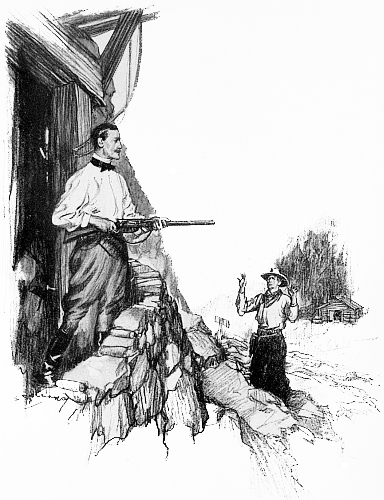
Lord Stranleigh Abroad] [Page Chapter VII.
Stranleigh paused in his recital. He noticed a stealthy movement among the bunkers. He had observed that the first to sit up cast a longing glance at the rifles stacked in the corner, and it seemed to him that a simultaneous rush towards them was going to take place.