LORD STRANLEIGH ABROAD. (continued 2)
Reading edition
“Where shall we go?” asked the latter.
“Drive to the place where you found us,” said his passenger, and there they went. On the way thither, neither spoke, but at a sign from Challis, Stranleigh stopped the car.
“You must not think,” began the former, “that my wife did not wish to come. I know from the expression of her eyes that she did. Her reason for declining was one that I imagine any woman would consider adequate, and any man the reverse.”
“I am an exception so far as the men are concerned,” said Stranleigh, coming much nearer the truth than he suspected, “for I am sure that whatever motive actuated Mrs. Challis, it was commendable and right.”
“Thank you,” responded the other. “I am with you there. It is all a matter of clothes. My wife possesses no costume suitable for a motor excursion.”
“In that case,” cried Stranleigh impulsively, “the defect is easily remedied. I have saved a bit from the ample salary Mr. Ponderby allows me, and if I may offer you——”
“I could not accept anything,” interrupted Challis.
“Merely a temporary loan, until the grist mill begins operations.”
Challis shook his head.
“That mill will never grind again with the water that is past, nor the water that is to come. Fulmer has gone smash, and I could not accept a loan that I do not see my way to repay. Nevertheless, I appreciate fully the kindness of your offer, and if you don’t mind, I will tell you how I got myself entangled, for there is no use in concealing from you what you must already have seen—that I am desperately poor, so much so that I sometimes lose courage, and consider myself a failure, which is not a pleasant state of mind to get into.”
“Oh, I’ve often felt that way myself,” said Stranleigh, “but nobody’s a failure unless he thinks he is. You strike me as a capable man. You have youth and energy, and added to that, great good luck. I’m a believer in luck myself.”
This commendation did not chase the gloom from the face of Challis.
“You have knocked from under me,” he said, “the one frail prop on which I leaned. I have been excusing myself by blaming the run of horrid bad luck I have encountered.”
Stranleigh shook his head.
“You can’t truthfully say that,” he rejoined quietly, “while you have had the supreme good fortune to enlist the affection of so clever and charming a wife.”
The gloom disappeared from Challis’s countenance as the shadow of a cloud at that moment flitted from the surface of the lake. He thrust forth his hand, and there being no onlookers, Stranleigh grasped it.
“Shake!” cried Challis. “I’ll never say ‘ill-luck’ again! I wish she had come with us.”
“So do I,” agreed Stranleigh.
“I’d like her to have heard you talk.”
“Oh, not for that reason. I’d like her to enjoy this scenery.”
“Yes, and the deuce of it is, she practically owns the scene. Look at that house across the lake.”
“A mansion, I should call it.”
“A mansion it is. That’s where my wife came from. Think of my selfishness in taking her from such a home to wretched rooms in a cottage, and abject poverty.”
“I prefer not to think of your selfishness, but rather of her nobility in going. It revives in a cynical man like myself his former belief in the genuine goodness of the world.”
“It all came about in this way,” continued Challis. “I graduated at a technical college—engineering. I began work at the bottom of the ladder, and started in to do my best, being ambitious. This was appreciated, and I got on.”
“In what line?” asked Stranleigh.
“In a line which at that time was somewhat experimental. The firm for which I worked might be called a mechanical-medical association, or perhaps ‘surgical’ would be a better term. We had no plant, no factory; nothing but offices. We were advisers. I was sent here and there all over the country, to mills that were not in a good state of health; dividends falling off, business declining, competition too severe, and what-not. I looked over the works, talked with managers and men, formed conclusions, then sent a report to my firm containing details, and such suggestions as I had to offer. My firm communicated with the proprietor of the works accordingly, and collected its bill.”
“That should be an interesting occupation,” said Stranleigh, whose attention was enlisted.
“It was. One day, I was sent up here to inspect the factory of Stanmore Anson, a large stone structure which you could see from here were it not concealed by that hill to the right. It has been in the Anson family for three generations, and had earned a lot of money in its time, but is now as old-fashioned as Noah’s Ark. It was cruelly wasteful of human energy and mechanical power. It should have had a set of turbines, instead of the ancient, moss-grown, overshot waterwheels. The machinery was out of date, and ill-placed. The material in course of manufacture had to go upstairs and downstairs, all over the building, handled and re-handled, backward and forward, instead of passing straight through the factory, entering as raw material, and coming out the finished product. I reported to my firm that the establishment needed a complete overhauling; that it ought to have new machinery, but that if it was compulsory to keep the old machines at work, they should be entirely rearranged in accordance with the sketch I submitted, so that unnecessary handling of the product might be avoided. I set down the minimum expense that must be incurred, and also submitted an estimate covering the cost of turbines and new machinery, which I admit was large in the bulk, but really the most economical thing to do.”
“I see. And the old man objected to the expense, or perhaps had not the necessary capital to carry out your suggestion? What sort of a person is he? Unreasonable, I suppose you consider him?”
“Strangely enough, I never met him in my life.”
“And you married his daughter?”
“Had to. I was determined to take the girl away, whether I reformed the factory or not, and here you see where good luck and the reverse mingled. When I arrived at Mr. Anson’s factory, the old man was in New York, for the purpose, as I learned, of raising a loan, or of selling the property, neither of which projects was he able to carry out.”
“That was his misfortune, rather than his fault, wasn’t it?”
“In a way, yes; still, the Trust had offered him a reasonable figure for his factory. He not only refused, but he fought the Trust tooth and nail, thinking that with low taxation, and country wages, he could meet the competition, which, of course, with the factory in its present state, he could not do. The fact that he was up against the Trust became well known, so that he could neither borrow nor sell. While in New York, he called several times on Langdon, Bliss, and Co., the firm that employed me. When my report came in and was read to him, I understand he fell into a tremendous rage, and characterised our company as a body of swindlers. Mr. Langdon ordered him out of the office.
“That was the first spoke in my wheel. Mr. Langdon was a capable man, always courteous and very calm when dealing with his fellows, so I am sure that my father-in-law must have been exceedingly violent when he provoked Langdon to vocal wrath. I judge that Langdon, when he recovered from his outbreak, regretted it extremely, and was inclined to blame me for rather muddling the affair of Anson’s mill. I may say that I had been placed in rather a difficult position. The proprietor was absent, and had not taken his foreman into his confidence, therefore this foreman put difficulties in the way of investigation. The employees were suspicious, not knowing what this research by a stranger meant, so I went to Anson’s house, hoping to find there someone with sufficient authority to enable me to get the information I must have.
“I met Mrs. Anson, a kindly woman, but realised in a moment that no authority had been delegated to her. She appeared afraid to suggest anything, but called in her only daughter to assist at our conference. The girl at once said she would accompany me to the mill, and did so. I shall never forget with what infinite tact and persuasiveness she won over the foreman, and it was quite evident that the workmen all knew and liked her, for her very presence appeared to dissipate distrust. I saw Miss Anson home, and it seemed, as my investigations progressed, many conferences became more and more necessary. You’re a young man, and doubtless you know how it is yourself.”
“As a matter of fact, I don’t,” interjected Stranleigh, “but I can guess.”
“Well—your guess is right. We had no difficulty with Mrs. Anson, but both mother and daughter were uneasy about how the father would take it. I wrote him what I hoped was a straightforward letter, putting the case to him as man to man. He answered with a very brief and terse letter that left me no doubt regarding his opinion, but my own communication had arrived at an unfortunate time; the day after he had been ordered out of our office. He at once enclosed my letter to Mr. Langdon, saying in effect:—
“‘This is the sort of man you sent like a wolf in sheep’s clothing to my home.’”
“Langdon telegraphed, asking if this was true. I, of course, had to admit it was, with the result of instant dismissal. I never would have let either mother or daughter know about this, but my reticence was vain, for Mr. Anson wrote a stinging letter to his daughter saying she could do what she pleased about marrying me, but that he had secured my dismissal. It is strange,” Challis murmured reflectively, speaking more to himself than to his companion, “it is strange that a father rarely recognises that when he comes to a difference with one of his children, he is meeting, in part at least, some of his own characteristics. I wonder if I shall ever be so unreasonable as——”
Stranleigh’s eye twinkled as he remembered how firm the girl had been in refusing the automobile invitation, yet giving no explanation of that refusal.
“What Gertrude said to me was, holding her head very proudly: ‘I have received my father’s permission to marry you, and if you are ready for an immediate ceremony, I am willing.’
“We were married before the old man returned from New York.”
“Has there been no further communication between Mr. Anson and yourself?”
“On my part, yes; ignored by him. It was Gertrude who wished to stay in Altonville. She knew a financial crisis was threatening her father, and she hoped that in some way I should be able to advise him. That was not to be. She requested permission to take away her belongings. This was refused. Everything she possessed, Mr. Anson said, had been purchased with his money. They remained at his home, and she was welcome to use them at his house, any time she chose to return, but having exchanged his care for that of another man, it was the other man’s duty to provide what she needed. This ended our communication, and brings us to the present moment.”
“Can you drive a car?” asked Stranleigh.
“Yes.”
“The immediate question strikes me as being that of wearing apparel. I propose to return with at least a box full. I don’t like to be baffled, and I wish Mrs. Challis to come out with us for a run. Will you exchange seats, and drive me down to the mill?”
“You’re up against a tough proposition,” demurred Challis.
“A proposition usually gives way if you approach it tactfully, as Miss Anson approached the manager. If you have never seen her father, he will not recognise you, so let us call at the mill.”
“He would not recognise me, but the foreman would, also many of the men.”
“We must chance that.”
The two young men exchanged seats, and Challis at the wheel, with more caution than ever Stranleigh used, sent the car spinning down the slightly descending road by the margin of the lake, until they came to the water level. No word was spoken between them, but his lordship studied with keen scrutiny from the corner of his eye, the profile of the intent driver. He was immensely taken with the young man, and meditated on the story to which he had listened. The effect left on his mind by that recital surprised him. It was a feeling of sympathy with the old man who had acted so obstreperously, and gradually he placed this feeling to the credit of Challis, who had shown no rancour against his father-in-law, either in word or tone. Yes; he liked Challis, and was sorry for the elderly Anson, one evidently advanced in years, battling against forces that were too much for him, stubbornly using antiquated methods in a world that had out-grown them; the muzzle-loader against the repeating rifle. These two men should be pulling together.
“There’s the factory,” said Challis, at last, and Stranleigh, looking up, beheld further down the valley a three-storied structure, unexpectedly huge, built apparently for all the ages. There was no sign of activity about it; but the roar of waters came to their ears; idle waters, nevertheless, that were turning no wheels, the muffled sound of an unimpeded minor cataract.
“By Jove!” cried Stranleigh, jumping out as the car stopped.
Challis said nothing, but an expression of deep anxiety darkened his countenance. There were plastered here and there on the stone walls great white posters, bearing printing like the headings of a sensational newspaper, magnified several hundred times.
AUCTION SALE.
BY ORDER OF THE BANKRUPTCY COURT,
that desirable property known as Anson’s Mill, fully equipped with machinery, in condition for immediate use, with never-failing water power, which at slight expense may be enormously increased; together with ten acres of freehold land; without reserve to the highest bidder; on the Seventeenth of November!
“A desirable property,” said Challis, sadly, “which nobody desires except the Trust, and probably it cares nothing about it now.”
“You forget that it is desired by Stanmore Anson.”
“I am afraid that even he is tired of it by this time. I am sorry, but I feared it was inevitable.”
Stranleigh looked up at him.
“Could you make this factory pay, if it were given into your charge?”
“Not in its present condition.”
“I mean, of course, with your recommendations carried out. If the mill, free from all encumbrances, filled with modern machinery, rightly placed, were put under your management, could you make it pay?”
Challis did not answer for some moments. His brow was wrinkled in thought, and he seemed making some mental calculations.
“There would need to be a suitable amount of working capital——”
“Yes, yes; all that is understood. Could you make it pay?”
“I am almost sure I could, but there is that incalculable factor, the opposition of the Trust.”
“Damn the Trust!” cried Stranleigh. “I beg your pardon; I should have said, blow the Trust! I thought I had lost the power of becoming excited, not to say profane. It must be the exhilarating air of America. The sale is a good way off yet, and I think it will be further off before I get through with it. If you will accept the management, and your father-in-law proves at all reasonable, I guarantee to find the necessary money.”
“You mean that, Mr. Ponderby——”
“Exactly. I am his chief business adviser, as well as his only chauffeur. But we are forgetting the matter in hand. We must rescue the wardrobe of Mrs. Challis. Drive on to the mansion. You know the way, and I don’t.”
“I’m a warned-off trespasser, but here goes.”
“You won’t be called on to trespass very much. You’re my chauffeur, pro tem. Perhaps you won’t need to enter the house at all. I shall see Mrs. Anson before I meet her husband, if possible, and will try to persuade her to give me the wardrobe.”
“She would not have the courage to do that without her husband’s permission, and he will never give it.”
“We’ll see about that. Ah, the mill is not the only piece of property to be sold!”
They had turned into a well-shaded avenue, to the massive stone gate-pillars of which were attached posters similar to those at the mill, only in this case it was “This valuable, desirable and palatial residence,” with the hundreds of acres of land attached, that were to be knocked down by the auctioneer’s hammer.
“I might have known,” commented Stranleigh, “that if Mr. Anson was bankrupt at his mill, he was also bankrupt at his house.”
They drew up at the entrance. Stranleigh stepped down, and rang the bell, Challis remaining in the car. Shown into the drawing-room, the visitor was greeted by a sad-looking, elderly woman.
“Mrs. Anson,” said the young man, very deferentially, “I expect your forgiveness for this intrusion on my part when I say that I am here in some sense as an ambassador from your daughter.”
“From my daughter!” gasped the old lady in astonishment. “Is she well, and where is she?”
“She is very well, I am glad to say, and is living with her husband over in the village.”
“In her last letter she said her husband was taking her to New York. There had been a—misunderstanding.” The old lady hesitated for a moment before using that mild term. “On the day her letter was received, I went to the hotel at which they were stopping, and was told by the landlord they had gone, he did not know where. Do you tell me they have been living in Altonville all the time?”
“I think so, but cannot be sure. I met Mr. and Mrs. Challis for the first time only a week ago.”
“I hope she is happy.”
“She is,” said Stranleigh confidently, “and before the day is done her mother will be happy also.”
Mrs. Anson shook her head. She was on the verge of tears, which Stranleigh saw and dreaded. So he said hurriedly:
“You will select me what you think she should have at once, and I will take the box or parcel to Altonville in my car.”
“When at last her father saw that everything we possessed must be sold,” rejoined Mrs. Anson, “he packed up in trunks what belonged to Gertrude, and as we could not learn where to send them, Mr. Asa Perkins, a friend of ours, who lives in Boston, lent us a room in which to store the things, and they are there now.”
“How odd!” exclaimed Stranleigh. “I met Mr. Perkins just before he left his summer residence, and took the place furnished, acting for the present tenant. It is much too large for him, and some of the rooms are locked. Do you happen to have the key?”
“No; it is in the possession of the housekeeper. She is there still, is she not?”
“Yes; I took the house as it stood, servants and all.”
“I’ll write a note to the housekeeper, then. What name shall I say?”
“Please write it in the name of Mr. Challis. He’s outside now, in my car.”
“May I bring him in?” she asked, eagerly.
“Certainly,” said Stranleigh, with a smile. “It’s your house, you know.”
“Not for long,” she sighed.
“Ah,——” drawled Stranleigh, “Mr. Challis and I propose that this sale shall not take place. If I may have a short conversation with your husband, I think we shall come to terms.”
An expression of anxiety overspread her face.
“Perhaps I had better not ask Jim to come in,” she hesitated.
“Your husband does not know him, and I would rather you did not tell him who is with me. Just say that Henry Johnson and a friend wish to negotiate about the factory.”
Stanmore Anson proved to be a person of the hale old English yeoman type, as portrayed by illustrators, although his ancestors originally came from Sweden. His face was determined, his lips firm, and despite his defeats, the lurking sparkle of combat still animated his eyes.
“Before we begin any conversation regarding a sale,” he said, “you must answer this question, Mr. Johnson. Are you connected in any way, directly or indirectly, with the G.K.R. Trust?”
“I am not connected with it, directly or indirectly.”
“You state that on your honour as a man?”
“No; I simply state it.”
“You wouldn’t swear it?”
“Not unless compelled by force of law.”
“Then I have nothing further to say to you, sir.”
The old man seemed about to withdraw, then hesitated, remembering he was in his own house. Stranleigh sat there unperturbed.
“You have nothing further to say, Mr. Anson, because two thoughts are sure to occur to you. First, a man whose word you would not accept cannot be believed, either on his honour or his oath. Second, the Trust doesn’t need to send an emissary to you; it has only to wait until November, and acquire your factory at its own figure. No one except myself would bid against the Trust.”
“That’s quite true,” agreed Anson. “I beg your pardon. What have you to propose?”
“I wish to know the sum that will see you clear and enable you to tear down those white posters at the gates, and those on the mill.”
Stanmore Anson drew a sheet of paper from his pocket, glanced over it, then named the amount.
“Very good,” said Stranleigh, decisively. “I’ll pay that for the mill and the ten acres.”
“They are not worth it,” said Anson. “Wait till November, and even though you outbid the Trust, you’ll get it at a lower figure.”
“We’ll make the mill worth it. You may retain the residence and the rest of the property.”
“There is but one proviso,” said the old man. “I wish to name the manager.”
“I regret I cannot agree to that, Mr. Anson, I have already chosen the manager, and guarantee that he will prove efficient.”
“I’ll forego your generous offer of the house and property if you will allow me to appoint the manager.”
“I am sorry, Mr. Anson, but you touch the only point on which I cannot give way.”
“Very well,” cried Anson, angrily, his eyes ablaze. “The arrangement is off.”
Both young men saw that Stanmore Anson was indeed difficult to deal with, as his ancestors had been in many a hard-fought battle.
“Wait a moment! Wait a moment!” exclaimed Challis. “This will never do. It is absurd to wreck everything on a point so trivial. I am the man whom Mr. Johnson wishes to make manager. I now refuse to accept the position, but if the bargain is completed, I’ll give Mr. Anson and his manager all the assistance and advice they care to receive from me, and that without salary.”
“Be quiet, Challis!” cried Stranleigh.
“Challis! Challis!” interrupted the old man, gazing fiercely at his junior. “Is your name Challis?”
“Yes, sir.”
“You’re not my son-in-law?”
“I am, sir.”
“I did you a great injustice,” admitted Anson. “No man has a right to deprive another of his livelihood. I have bitterly regretted it. It is you I wish appointed manager.”
“Challis,” said Stranleigh, “take the car, and bring your wife. Say her father wishes to see her.”
Challis disappeared, and in an incredibly short space of time, during which Anson and Stranleigh chatted together, the door opened, and Gertrude Challis came in.
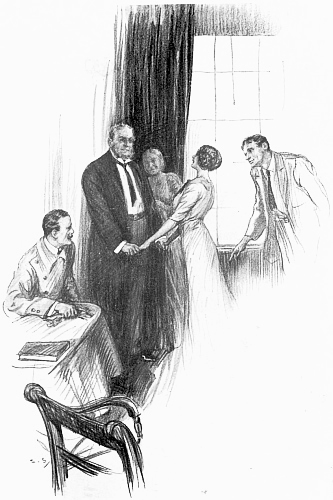
“Father,” she cried, “Jim says he’s going to scrap all the machinery in the factory. Shall we throw our differences on that scrap-heap?”
The old man gathered her to his breast, and kissed her again and again. He could not trust his voice.
“‘Shall we throw our differences on that scrap-heap?’”
Lord Stranleigh Abroad] [Page 124.
IV.—THE MAD MISS MATURIN.
“Would you like to meet the most beautiful woman in America?” asked Edward Trenton of his guest.
Lord Stranleigh drew a whiff or two from the favourite pipe he was smoking, and the faint suggestion of a smile played about his lips.
“The question seems to hint that I have not already met her,” he said at last.
“Have you?”
“Of course.”
“Where?”
“In every town of any size I ever visited.”
“Oh, I daresay you have met many pretty girls, but only one of them is the most beautiful in America.”
Again Stranleigh smiled, but this time removed his pipe, which had gone out, and gently tapped it on the ash tray.
“My dear Ned,” he said at last, “on almost any other subject I should hesitate to venture an opinion that ran counter to your own experience, yet in this instance I think you wrong the great Republic. I am not very good at statistics, but if you will tell me how many of your fellow-countrymen are this moment in love, I’ll make a very accurate estimate regarding the number of most beautiful women there are in the United States.”
“Like yourself, Stranleigh, I always defer to the man of experience, and am glad to have hit on one subject in which you are qualified to be my teacher.”
“I like that! Ned Trenton depreciating his own conquests is a popular actor in a new rôle. But you are evading the point. I was merely trying in my awkward way to show that every woman is the most beautiful in the world to the man in love with her.”
“Very well; I’ll frame my question differently. Would you like to meet one of the most cultured of her sex?”
“Bless you, my boy, of course not! Why, I’m afraid of her already. It is embarrassing enough to meet a bright, alert man, but in the presence of a clever woman, I become so painfully stupid that she thinks I’m putting it on.”
“Then let me place the case before you in still another form. Would your highness like to meet the richest woman in Pennsylvania?”
“Certainly I should,” cried Stranleigh, eagerly.
Trenton looked at him with a shade of disapproval on his brow.
“I thought wealth was the very last qualification a man in your position would care for in a woman, yet hardly have I finished the sentence, than you jump at the chance I offer.”
“And why not? A lady beautiful and talented would likely strike me dumb, but if she is hideously rich, I may be certain of one thing, that I shall not be asked to invest money in some hare-brained scheme or other.”
“You are quite safe from that danger, or indeed from any other danger, so far as Miss Maturin is concerned. Nevertheless, it is but just that you should understand the situation, so that if you scent danger of any kind, you may escape while there is yet time.”
“Unobservant though I am,” remarked Stranleigh, “certain signs have not escaped my notice. This commodious and delightful mansion is being prepared for a house-party. I know the symptoms, for I have several country places of my own. If, as I begin to suspect, I am in the way here, just whisper the word and I’ll take myself off in all good humour, hoping to receive an invitation for some future time.”
“If that’s your notion of American hospitality, Stranleigh, you’ve got another guess coming. You’re a very patient man; will you listen to a little family history? Taking your consent for granted, I plunge. My father possessed a good deal of landed property in Pennsylvania. This house is the old homestead, as they would call it in a heart-throb drama. My father died a very wealthy man, and left his property conjointly to my sister and myself. He knew we wouldn’t quarrel over the division, and we haven’t. My activity has been mainly concentrated in coal mines and in the railways which they feed, and financially I have been very fortunate. I had intended to devote a good deal of attention to this estate along certain lines which my father had suggested, but I have never been able to do so, living, as I did, mostly in Philadelphia, absorbed in my own business. My sister, however, has in a measure carried out my father’s plans, aided and abetted by her friend, Miss Constance Maturin. My sister married a man quite as wealthy as herself, a dreamy, impractical, scholarly person who once represented his country as Minister to Italy, in Rome. She enjoyed her Italian life very much, and studied with great interest the progress North Italy was making in utilising the water-power coming from the Alps. In this she was ably seconded by Miss Maturin, who is owner of forests and farms and factories further down the river which flows past our house. Her property, indeed, adjoins our own, but she does not possess that unlimited power over it which Sis and I have over this estate, for her father, having no faith in the business capacity of woman, formed his undertakings into a limited liability company where, although he owned the majority of stock during his life, he did not leave his daughter with untrammelled control. Had the old man known what trouble he was bequeathing to his sole heir, I imagine he would have arranged things a little differently. Miss Maturin has had to endure several expensive law-suits, which still further restricted her power and lessened her income. So she has ceased to take much interest in her own belongings, and has constituted herself adviser-in-chief to my dear sister, who has blown in a good deal of money on this estate in undertakings that, however profitable they may be in the future, are unproductive up to date. I am not criticising Sis at all, and have never objected to what she has done, although I found myself involved in a very serious action for damages, which I had the chagrin of losing, and which ran me into a lot of expense, covering me with injunctions and things of that sort. No rogue e’er felt the halter draw, with a good opinion of the law, and perhaps my own detestation of the law arises from my having frequently broken it. If this long diatribe bores you, just say so, and I’ll cut it short.”
“On the contrary,” said Stranleigh, with evident honesty, “I’m very much interested. These two ladies, as I understand the case, have been unsuccessful in law——”
“Completely so.”
“And unsuccessful in the projects they have undertaken?”
“From my point of view, yes. That is to say, they are sinking pots of money, and I don’t see where any of it is coming back.”
“Of what do these enterprises consist?”
“Do you know anything about the conservation controversy now going on in this country?”
“I fear I do not. I am a woefully ignorant person.”
“My father had ideas about conservation long before the United States took it up. It is on these ideas that Sis has been working. You preserve water in times of flood and freshet to be used for power or for irrigation throughout the year. Her first idea was to make a huge lake, extending several miles up the valley of this river. That’s where I got into my law-suit. The commercial interests down below held that we had no right to put a huge concrete dam across this river.”
“Couldn’t you put a dam on your own property?”
“It seems not. If the river ran entirely through my own property, I could. Had I paid more attention to what was being done, I might perhaps have succeeded, by getting a bill through the Legislature. When I tried that, I was too late. The interests below had already applied to the courts for an injunction, which, quite rightly, they received. Attempting to legalise the action, not only did I find the Legislature hostile, but my clever opponents got up a muck-raking crusade against me, and I was held up by the Press of this State as a soulless monopolist, anxious to increase my already great wealth by grabbing what should belong to the whole people. The campaign of personal calumny was splendidly engineered, and, by Jupiter! they convinced me that I was unfit for human intercourse. Tables of statistics were published to prove how through railway and coal-mine manipulation I had robbed everybody, and they made me out about a hundred times richer than I am, although I have never been able to get any of the excess cash. Sermons were preached against me, the Pulpit joining the Press in denunciation. I had no friends, and not being handy with my pen, I made no attempt at defence. I got together a lot of dynamite, blew up the partially-constructed dam, and the river still flows serenely on.”
“But surely,” said Stranleigh, “I saw an immense dam on this very river, when you met me at Powerville railway station the other day?”
Trenton laughed.
“Yes; that was Miss Maturin’s dam.”
“Miss Maturin’s!” cried Stranleigh in astonishment.
“It was built years ago by her father, who went the right way about it, having obtained in a quiet, effective way, the sanction of legislature. Of course, when I say it belongs to Miss Maturin, I mean that it is part of the estate left by her father, and the odd combination of circumstances brought it about that she was one of my opponents in the action-at-law, whereas in strict justice, she should have been a defendant instead of a plaintiff. The poor girl was horrified to learn her position in the matter, and my sister was dumbfounded to find in what a dilemma she had placed me. Of course, the two girls should have secured the advice of some capable, practical lawyer in the first place, but they were very self-confident in those days, and Sis knew it was no use consulting her husband, while her brother was too deeply immersed in his own affairs to be much aid as a counsellor.
“Well, they kept on with their conservation scheme after a time, and both on this property and on Miss Maturin’s, dams have been erected on all the streams that empty into the river; streams on either side that take their rise from outlying parts of the estate. They have built roads through the forest, and have caused to be formed innumerable lakes, all connected by a serviceable highway that constitutes one of the most interesting automobile drives there is in all the United States; a drive smooth as a floor, running for miles through private property, and therefore overshadowed by no speed limit.”
“By Jove, Ned,” exclaimed Stranleigh, “you must take me over that course.”
“I’ll do better than that, my boy. Constance Maturin is one of the best automobilists I know, and she will be your guide, for these dams are of the most modern construction, each with some little kink of its own that no one understands better than she does. There is a caretaker living in a picturesque little cottage at the outlet of every lake, and in each cottage hangs a telephone, so that no matter how far you penetrate into the wilderness, you are in touch with civilisation. From this house I could call up any one of these water-wardens, or send out a general alarm, bringing every man of the corps to the ’phone, and the instructions given from here would be heard simultaneously by the whole force. I think the organisation is admirable, but it runs into a lot of money.”
“‘But what good came of it at last, Quoth little Peterkin,’”
asked Stranleigh. “Do these artificial lakes run any dynamos, or turn any spindles? Now tell me all about the war, and what they dammed each streamlet for.”
“Ah, you have me there! The ladies have not taken me into their counsel: I’ve got troubles enough of my own. One phase of the subject especially gratifies me: their activities have in no instance despoiled the landscape; rather the contrary. These lakes, wooded to their brims, are altogether delightful, and well stocked with fish. A great many of them overflow, causing admirable little cascades, which, although not quite so impressive as Niagara, are most refreshing on a hot day, while the cadence of falling waters serves as an acoustic background to the songs of the birds; a musical accompaniment, as one might call it.”
“Bravo, Ned; I call that quite poetical, coming as it does from a successful man of business. I find myself eager for that automobile ride through this forest lakeland. When do you say Miss Maturin will arrive?”
“I don’t know. I expect my sister will call me up by telephone. Sis regards this house as her own. She is fond of leaving the giddy whirl of society, and settling down here in the solitude of the woods. I clear out or I stay in obedience to her commands. You spoke of a house-party a while ago. There is to be no house-party, but merely my sister and her husband, with Miss Maturin as their guest. If you would rather not meet any strangers, I suggest that we plunge further into the wilderness. At the most remote lake on this property, about seven miles away, quite a commodious keeper’s lodge has been built, with room for, say, half a dozen men who are not too slavishly addicted to the resources of civilisation. Yet life there is not altogether pioneering. We could take an automobile with us, and the telephone would keep us in touch with the outside world. Fond of fishing?”
“Very.”
“Then that’s all right. I can offer you plenty of trout, either in pond or stream, while in a large natural lake, only a short distance away, is excellent black bass. I think you’ll enjoy yourself up there.”
Stranleigh laughed.
“You quite overlook the fact that I am not going. Unless ejected by force, I stay here to meet your sister and Miss Maturin.”
For a moment Trenton seemed taken aback. He had lost the drift of things in his enthusiasm over the lakes.
“Oh, yes; I remember,” he said at last. “You objected to meet anyone who might wish you to invest good money in wild-cat schemes. Well, you’re quite safe as far as those two ladies are concerned, as I think I assured you.”
Ned was interrupted, and seemed somewhat startled by a sound of murmured conversation ending in a subdued peal of musical laughter.
“Why, there’s Sis now,” he said, “I can tell her laugh anywhere.”
As he rose from his chair, the door opened, and there entered a most comely young woman in automobile garb, noticeably younger than Trenton, but bearing an unmistakable likeness to him.
“Hello, Ned!” she cried. “I thought I’d find you here,” then seeing his visitor, who had risen, she paused.
“Lord Stranleigh,” said Trenton. “My sister, Mrs. Vanderveldt.”
“I am very glad to meet you, Lord Stranleigh,” she said, advancing from the door and shaking hands with him.
“Why didn’t you telephone?” asked her brother.
His sister laughed merrily.
“I came down like a wolf on the fold, didn’t I? Why didn’t I telephone? Strategy, my dear boy, strategy. This is a surprise attack, and I’d no wish that the garrison, forewarned, should escape. I am sure, Lord Stranleigh, that he has been descanting on the distraction of the woods and the camp, or perhaps the metropolitan dissipation of Philadelphia, depending on whether the yearning for sport, or his business in town was uppermost in his mind.”
“My dear Sis,” cried Ned with indignation, “that is a libellous statement. I never so much as mentioned Philadelphia, did I, Stranleigh? You can corroborate what I say.”
“I’m not so sure about that,” said Stranleigh, lightly. “Your attempt to drag me into your family differences at this point of the game is futile. I’m going to lie low, and say nothing, as Brer Rabbit did, until I learn which of you two is the real ruler of this house. I shall then boldly announce myself on the side of the leader. My position here is much too comfortable to be jeopardised by an injudicious partisanship.”
“As for who’s boss,” growled Ned, “I cravenly admit at once that Sis here is monarch of all she surveys.”
“In that case,” rejoined Stranleigh, heaving a deep sigh of apparent relief, “I’m on the side of the angels. Mrs. Vanderveldt, he did mention Philadelphia and his office there, speaking much about business interests, coal-mines, and what not, during which recital I nearly went to sleep, for I’m no business man. He also descanted on the lakes and the waterfalls and the fishing, and on trout and black bass, and would doubtless have gone on to whales and sea-serpents had you not come in at the opportune moment. Please accept me as your devoted champion, Mrs. Vanderveldt.”
“I do, I do, with appreciation and gratitude,” cried the lady merrily. “I’ve long wished to meet you, Lord Stranleigh, for I heard such glowing accounts of you from my brother here, with most fascinating descriptions of your estates in England, and the happy hours he spent upon them while he was your guest in the old country. I hope we may be able to make some slight return for your kindness to this frowning man. He is always on nettles when I am talking; so different from my husband in that respect.”
“Poor man, he never has a chance to get a word in edgewise,” growled Ned. “My soul is my own, I’m happy to say.”
“Ah, yes,” laughed the lady, “pro tem. But although I am saying so much for myself, I speak with equal authority for my friend Constance Maturin.”
“Did you bring her with you, or is she coming later?” asked Trenton with some anxiety.
“She is here, dear brother, but I could not induce her to enter this room with me. Doubtless she wishes to meet you alone. She is a dear girl, Lord Stranleigh, and it will be my greatest joy to welcome her as a sister-in-law.”
A warm flush was added to the frown on her brother’s brow, but he made no remark.
“Gracious me!” cried the lady, laughing again “have I once more put my foot in it? Why Ned, what a fine confidential friend you are. If I were a young man, and so sweet a girl had promised to marry me, I should proclaim the fact from the house-tops.”
“You wouldn’t need to,” groaned Ned, “if you had a sister.”
“Never mind him,” said Stranleigh, “you have betrayed no secret, Mrs. Vanderveldt. His own confused utterances when referring to the young lady, rendered any verbal confession unnecessary. I suspected how the land lay at a very early stage of our conversation.”
“Well, I think he may congratulate himself that you do not enter the lists against him. You possess some tact, which poor Ned has never acquired, and now I’ll make him sit up by informing him that Connie Maturin took a special trip over to England recently, in order to meet you.”
“To meet me?” cried Stranleigh in astonishment.
“Yes, indeed, and an amazed girl she was to learn that you had sailed for America. She came right back by the next boat. She has a great plan in her mind which requires heavy financing. My brother here isn’t rich enough, and I, of course, am much poorer than he is, so she thought if she could interest you, as the leading capitalist of England——”
“Good heavens, girl,” interrupted Ned, the perspiration standing out on his brow, “do show some consideration for what you are saying! Why, you rattle on without a thought to your words. Lord Stranleigh just made it a proviso that——. Oh, hang it all, Sis; you’ve put your foot in it this time, sure enough.”
The lady turned on him now with no laughter on her lips, or merriment in her tone.
“Why, Ned, you’re actually scolding me. I promised Connie Maturin to help her, and my way of accomplishing anything is to go directly for it.”
“Oh, heaven help me,” murmured Ned, “the law courts have already taught me that.”
“Mrs. Vanderveldt,” said the Earl of Stranleigh, very quietly, “please turn to your champion, and ignore this wretched man, whose unnecessary reticence is finding him out.”
The only person to be embarrassed by this tangle of concealments and revelations was Constance Maturin, who had indulged in neither the one nor the other. The Earl of Stranleigh found it difficult to become acquainted with her. She seemed always on her guard, and never even approached the subject which he had been given to understand chiefly occupied her thoughts.
On the day set for their automobile ride, Miss Maturin appeared at the wheel of the very latest thing in runabouts; a six-cylindered machine of extraordinary power, that ran as silently and smoothly as an American watch, and all merely for the purpose of carrying two persons. Stranleigh ran his eye over the graceful proportions of the new car with an expert’s keen appreciation, walking round it slowly and critically, quite forgetting the girl who regarded him with an expression of amusement. Looking up at last, he saw a smile playing about her pretty lips.
“I beg your pardon,” he said.
“I’m not sure that I shall grant it,” she replied, laughing. “To be ignored in this callous fashion for even the latest project of engineering, is not in the least flattering.”
“Not ignored, Miss Maturin,” said Stranleigh, “for I was thinking of you, although I may have appeared absorbed in the machine.”
“Thinking of me!” she cried. “You surely can’t expect me to believe that! The gaze of a man fascinated by a piece of machinery is quite different from that of a man fascinated by a woman. I know, because I have seen both.”
“I am sure you have seen the latter, Miss Maturin. But what I have just been regarding is an omen.”
“Really? How mysterious! I thought you saw only an automobile.”
“No, I was looking through the automobile, and beyond, if I may put it that way. I am quite familiar with the plan of this car, although this is the first specimen that I have examined. The car is yours by purchase, I suppose, but it is mine by manufacture. Your money bought it, but mine made it, in conjunction with the genius of a young engineer in whom I became interested. Perhaps you begin to see the omen. Some time ago I was fortunate enough to be of assistance to a young man, and the result has been an unqualified success. To-day perhaps I may be permitted to aid a young woman with a success that will be equally gratifying.”
Stranleigh gazed steadily into the clear, honest eyes of the girl, who returned his look with a half-amused smile. Now she seemed suddenly covered with confusion, and flushing slightly, turned her attention to the forest that surrounded them. Presently she said—
“Do you men worship only the god of success? You have used the word three or four times.”
“Most men wish to be successful, I suppose, but we all worship a goddess, too.”
“I’m sorry,” said Miss Maturin, “that Mrs. Vanderveldt mentioned my search for a capitalist. I have abandoned the quest. I am now merely your guide to the lakes. Please take a seat in this automobile of yours, Lord Stranleigh, and I will be your conductor.”
The young man stepped in beside her, and a few moments later they were gliding, rather than running over a perfect road, under the trees, in a machine as noiseless as the forest. The Earl of Stranleigh had seen many beautiful regions of this world, but never any landscape just like this. Its artificiality and its lack of artificiality interested him. Nothing could be more businesslike than the construction of the stout dams, and nothing more gently rural than the limpid lakes, with the grand old forest trees marshalled round their margins like a veteran army that had marched down to drink, only to be stricken motionless at the water’s edge.
It seemed that the silence of the motor-car had enchanted into silence its occupants. The girl devoted her whole attention to the machine and its management. Stranleigh sat dumb, and gave himself up to the full enjoyment of the Vallombrosic tour.
For more than half an hour no word had been spoken; finally the competent chauffeur brought the auto to a standstill at a view-point near the head of the valley, which offered a prospect of the brawling main stream.
“We have now reached the last of the lakes in this direction,” she said quietly. “I think your automobile is admirable, Lord Stranleigh.”
The young man indulged in a deep sigh of satisfaction.
“As a landscape gardener on a marvellous scale, you are without a competitor, Miss Maturin.”
The girl laughed very sweetly.
“That is a compliment to nature rather than to me. I have merely let the wilderness alone, so far as road-making and dam-building would allow me.”
“In that very moderation lies genius—the leaving alone. Will you forgive the inquisitiveness of a mere man whom you suspected at our outset of success-worship, if he asks what practical object you have in view?”
“Oh, I should have thought that was self-evident to an observant person like yourself,” she said airily. “These lakes conserve the water, storing it in time of flood for use in time of scarcity. By means of sluices we obtain partial control of the main stream.”
“You flatter me by saying I am observant. I fear that I am rather the reverse, except where my interest is aroused, as is the case this morning. Is conservation your sole object, then?”
“Is not that enough?”
“I suppose it is. I know little of civil engineering, absorbing craft though it is. I have seen its marvels along your own lines in America, Egypt, India, and elsewhere. As we progressed I could not help noticing that the dams built to restrain these lakes seemed unnecessarily strong.”
A slight shadow of annoyance flitted across the expressive countenance of Constance Maturin, but was gone before he saw it.
“You are shrewder than you admit, Lord Stranleigh, but you forget what I said about freshets. The lakes are placid enough now, but you should see them after a cloud-burst back in the mountains.”
“Nevertheless, the dams look bulky enough to hold back the Nile.”
“Appearances are often deceitful. They are simply strong enough for the work they have to do. American engineering practice does not go in for useless encumbrance. Each dam serves two purposes. It holds back the water and it contains a power-house. In some of these power-houses turbines and dynamoes are already placed.”
“Ah, now I understand. You must perceive that I am a very stupid individual.”
“You are a very persistent person,” said the young woman decisively.
Stranleigh laughed.
“Allow me to take advantage of that reputation by asking you what you intend to do with the electricity when you have produced it?”
“We have no plans.”
“Oh, I say!”
“What do you say?”
“That was merely an Anglicised expression of astonishment.”
“Don’t you believe me?”
“No.”
They were sitting together on the automobile seat, deep in the shade of the foliage above them, but when he caught sight of the indignant face which she turned towards him, it almost appeared as if the sun shone upon it. She seemed about to speak, thought better of it, and reached forward to the little lever that controlled the self-starting apparatus. She found his hand there before she could carry out her intention.
“I am returning, Lord Stranleigh,” she said icily.
“Not yet.”
She leaned back in the seat.
“Mr. Trenton told me that you were the most polite man he had ever met. I have seldom found him so mistaken in an impression.”
“Was it a polite man you set out to find in your recent trip to Europe?”
As the girl made no reply, Stranleigh went on—
“My politeness is something like the dams we have been considering. It contains more than appears on the surface. There is concealed power within it. You may meet myriads of men well qualified to teach me courtesy, but when this veneer of social observance is broken, you come to pretty much the same material underneath. I seldom permit myself the luxury of an escape from the conventions, but on rare occasions I break through. For that I ask your pardon. Impressed by your sincerity, I forgot for the moment everything but your own need in the present crisis.”
“What crisis?” she asked indignantly.
“The financial crisis caused by your spending every available resource on this so-called conservation policy. To all intents and purposes you are now a bankrupt. Mrs. Vanderveldt has contributed all she can, and both you and she are afraid to tell her brother the true state of the case. You fear you will get little sympathy from him, for he is absorbed in coal-mines and railways, and both of you have already felt his annoyance at the law-suit in which you have involved him. Hence your desperate need of a capitalist. A really polite man would be a more pleasant companion than I, but he is not worth that, Miss Maturin!”
Stranleigh removed his hand from the lever long enough to snap fingers and thumb, but he instantly replaced it when he saw her determination to start the machine.
“The man of the moment, Miss Maturin, is a large and reckless capitalist. I am that capitalist.”
He released his hold of the lever, and sat upright. The sternness of his face relaxed.
“Now, Miss Maturin, turn on the power; take me where you like; dump me into any of those lakes you choose; the water is crystal clear, and I’m a good swimmer,” and with this Stranleigh indulged in a hearty laugh, his own genial self once more.
“You are laughing at me,” she said resentfully.
“Indeed I am not. Another contradiction, you see! I am laughing at myself. There’s nothing I loathe so much as strenuousness, and here I have fallen into the vice. It is the influence of that brawling river below us, I think. But the river becomes still enough, and useful enough, when it reaches the great lake at Powerville, which is big enough to swallow all these little ponds.”
The girl made no motion towards the lever, but sat very still, lost in thought. When she spoke, her voice was exceedingly quiet.
“You complimented Nature a while ago, intending, as I suppose, to compliment me, but I think after all the greater compliment is your straight talk, which I admire, although I received it so petulantly. I shall make no apology, beyond saying that my mind is very much perturbed. Your surmise is absolutely correct. It isn’t that I’ve spent the whole of my fortune and my friend’s fortune in this conservation scheme. It is because I have built a model city on the heights above Powerville. I was promised assistance from the banks, which is now withheld, largely, I suspect, through the opposition of John L. Boscombe, a reputed millionaire. To all intents and purposes Boscombe and I are the owners of Powerville and the mills there, but although this place was founded and built up by my father, I am a minority stock-holder, and powerless. Boscombe exercises control. Any suggestions or protests of mine are ignored, for Boscombe, like my father, has little faith—no faith at all, in fact—in the business capacity of a woman.
“I have tried, as I hinted, to enlist the co-operation of other capitalists, but experience has taught me that any appeal is futile that does not impinge directly upon cupidity. If there is the least hint of philanthropy in the project, every man of money fights shy of it.”
“I am an exception,” said Stranleigh, eagerly. “Philanthropy used to be a strong point with me, though I confess I was never very successful in its exercise. What humanitarian scheme is in your mind, Miss Maturin?”
Again she sat silent for some moments, indecision and doubt on her fair brow. Presently she said, as if pulling herself together—
“I will not tell you, Lord Stranleigh. You yourself have just admitted disbelief, and my plan is so fantastic that I dare not submit it to criticism.”
“I suppose your new city is in opposition to the old town down in the valley? You alone are going to compete with Boscombe and yourself.”
“That is one way of putting it.”
“Very well, I am with you. Blow Boscombe! say I. I’ve no head for business, so I sha’n’t need to take any advice. I shall do exactly what you tell me. What is the first move?”
“The first move is to set your brokers in New York at work, and buy a block of Powerville stock.”
“I see; so that you and I together have control, instead of Boscombe?”
“Yes.”
“That shall be done as quick as telegraph can give instructions. What next?”
“There will be required a large sum of money to liquidate the claims upon me incurred through the building of the city.”
“Very good. That money shall be at your disposal within two or three days.”
“As for security, I regret——”
“Don’t mention it. My security is my great faith in Ned Trenton, also in yourself. Say no more about it.”
“You are very kind, Lord Stranleigh, but there is one thing I must say. This may involve you in a law-suit so serious that the litigation of which Ned complains will appear a mere amicable arrangement by comparison.”
“That’s all right and doesn’t disturb me in the least. I love a legal contest, because I have nothing to do but place it in the hands of competent lawyers. No personal activity is required of me, and I am an indolent man.”
The second part of the programme was accomplished even sooner than Stranleigh had promised, but the first part hung fire. The brokers in New York could not acquire any Powerville stock, as was shown by their application to Miss Maturin herself, neither had their efforts been executed with that secrecy which Stranleigh had enjoined. He realised this when John L. Boscombe called upon him. He went directly to the point.
“I am happy to meet you, Lord Stranleigh, and if you’ll excuse me, I’d like to say that you are more greatly in need of advice at this moment than any man in America.”
“You are perfectly right, Mr. Boscombe. I am always in need of good advice, and I appreciate it.”
“An application was made to me from New York for a block of stock. That stock is not for sale, but I dallied with the brokers, made investigations, and traced the inquiry to you.”
“Very clever of you, Mr. Boscombe.”
“I learn that you propose to finance Miss Constance Maturin, who is a junior partner in my business.”
“I should not think of contradicting so shrewd a man as yourself, Mr. Boscombe. What do you advise in the premises?”
“I advise you to get out, and quick, too.”
“If I don’t, what are you going to do to me?”
“Oh, I shall do nothing. She will do all that is necessary. That woman is stark mad, Lord Stranleigh. Her own father recognised it when he bereft her of all power in the great business he founded. If she had her way, she’d ruin the company inside a year with her hare-brained schemes; love of the dear people, and that sort of guff.”
“I am sorry to hear that. I noticed no dementia on the part of Miss Maturin, who seemed to me a most cultivated and very charming young lady. You will permit me, I hope, to thank you for your warning, and will not be surprised that I can give you no decision on the spur of the moment. I am a slow-minded person, and need time to think over things.”
“Certainly, certainly; personally I come to sudden conclusions, and once I make up my mind, I never change it.”
“A most admirable gift. I wish I possessed it.”
Lord Stranleigh said nothing of this interview to Constance Maturin, beyond telling her that the acquisition of stock appeared to be hopeless, as indeed proved to be the case.
“Boscombe must be a stubborn person,” he said.
“Oh, he’s all that,” the girl replied, with a sigh. “He cares for one thing only, the making of money, and in that I must admit he has been very successful.”
“Well, we’ve got a little cash of our own,” said Stranleigh, with a laugh.
Miss Maturin and Mrs. Vanderveldt celebrated a national holiday by the greatest entertainment ever given in that district. The mills had been shut down for a week, and every man, woman and child in the valley city had been invited up to the new town on the heights. There was a brass band, and a sumptuous spread of refreshments, all free to the immense crowd. The ladies, for days before, visited everyone in the valley, and got a promise of attendance, but to make assurance doubly sure, an amazing corps of men was organised, equipped with motor cars, which scoured the valley from Powerville downwards, gathering in such remnants of humanity as for any reason had neglected to attend the show. Miss Maturin said she was resolved this entertainment should be a feature unique in the history of the State.
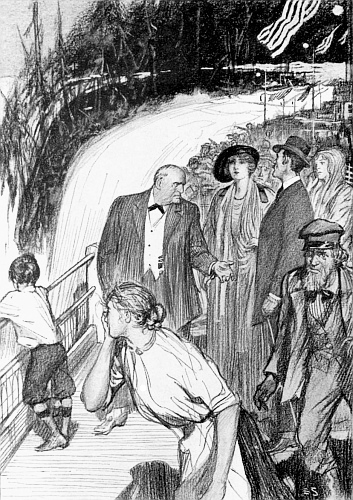
The shutting down of the mills had caused the water in the immense dam to rise, so that now the sluices at the top added to the picturesqueness of the scene by supplying waterfalls more than sixty feet high, a splendid view of which was obtainable from the new city on the heights. Suddenly it was noticed that these waterfalls increased in power, until their roar filled the valley. At last the whole lip of the immense dam began to trickle, and an ever augmenting Niagara of waters poured over.
“Great heavens!” cried Boscombe, who was present to sneer at these activities, “there must have been a cloud-burst in the mountains!”
He shouted for the foreman.
“Where are the tenders of the dam?” he cried. “Send them to lower those sluices, and let more water out.”
“Wait a moment,” said Constance Maturin, who had just come out of the main telephone building. “There can be no danger, Mr. Boscombe. You always said that dam was strong enough, when I protested it wasn’t.”
“So it is strong enough, but not——”
“Look!” she cried, pointing over the surface of the lake. “See that wave!”
“Suffering Noah and the Flood!” exclaimed Boscombe.
As he spoke, the wave burst against the dam, and now they had Niagara in reality. There was a crash, and what seemed to be a series of explosions, then the whole structure dissolved away, and before the appalled eyes of the sight-seers, the valley town crumpled up like a pack of cards, and even the tall mills themselves, that staggered at the impact of the flood, slowly settled down, and were engulfed in the seething turmoil of maddened waters.
“‘This,’ he cried, ‘is murder.’”
Lord Stranleigh Abroad] [Page 163.
For a time no voice could be heard in the deafening uproar. It was Boscombe who spoke when the waters began to subside.
“This,” he cried, “is murder!”
He glared at Constance Maturin, who stood pale, silent and trembling.
“I told you she was mad,” he roared at Stranleigh. “It is your money that in some devilish way has caused this catastrophe. If any lives are lost, it is rank murder!”
“It is murder,” agreed Stranleigh, quietly. “Whoever is responsible for the weakness of that dam should be hanged!”
V.—IN SEARCH OF GAME.
The warm morning gave promise of a blistering hot day, as Lord Stranleigh strolled, in his usual leisurely fashion, up Fifth Avenue. High as the thermometer already stood, the young man gave no evidence that he was in the least incommoded by the temperature. In a welter of heated, hurrying people, he produced the effect of an iceberg that had somehow drifted down into the tropics. The New York tailor entrusted with the duty of clothing him quite outdistanced his London rival, who had given Lord Stranleigh the reputation of being the best-dressed man in England. Now his lordship was dangerously near the point where he might be called the best-dressed man in New York, an achievement worthy of a Prince’s ambition.
His lordship, with nothing to do, and no companionship to hope for, since everyone was at work, strolled into the splendour of the University Club and sought the comparative coolness of the smoking room, where, seating himself in that seductive invitation to laziness, a leather-covered arm chair, he began to glance over the illustrated English weeklies. He had the huge room to himself. These were business hours, and a feeling of loneliness crept over him, perhaps germinated by his sight of the illustrated papers, and accentuated by an attempted perusal of them. They were a little too stolid for a hot day, so Stranleigh turned to the lighter entertainment of the American humorous press.
Presently there entered this hall of silence the stout figure of Mr. John L. Banks, senior attorney for the Ice Trust, a man well known to Stranleigh, who had often sought his advice, with profit to both of them. The lawyer approached the lounger.
“Hello, Banks, I was just thinking of you, reflecting how delightful it must be in this weather to be connected, even remotely, with the ice supply of New York.”
Mr. Banks’s panama hat was in one hand, while the other drew a handkerchief across his perspiring brow.
“Well, Stranleigh, you’re looking very cool and collected. Enacting the part of the idle rich, I suppose?”
“No, I’m a specimen of labour unrest.”
“Perhaps I can appease that. I’m open to a deal at fair compensation for you. If you will simply parade the streets in that leisurely fashion we all admire, bearing a placard ‘Pure Ice Company,’ I’ll guarantee you a living wage and an eight hours’ day.”
“Should I be required to carry about crystal blocks of the product?”
“No; you’re frigid enough as it is. Besides, ice at the present moment is too scarce to be expended on even so important a matter as advertisement.”
Banks wheeled forward an arm chair, and sat down opposite his lordship. A useful feature of a panama hat is its flexibility. You may roll one brim to fit the hand, and use the other as a fan, and this Banks did with the perfection of practice.
“What’s the cause of the unrest, Stranleigh?”
“Thinking. That’s the cause of unrest all the world over. Whenever people begin to think, there is trouble.”
“I’ve never noticed any undue thoughtfulness in you, Stranleigh.”
“That’s just it. Thinking doesn’t agree with me, and as you hint, I rarely indulge in it, but this is a land that somehow stimulates thought, and thought compels action. Action is all very well in moderation, but in these United States of yours it is developed into a fever, or frenzy rather, curable only by a breakdown or death.”
“Do you think it’s as bad as all that?”
“Yes, I do. You call it enterprise; I call it greed. I’ve never yet met an American who knew when he’d had enough.”
“Did you ever meet an Englishman who knew that?”
“Thousands of them.”
Banks laughed.
“I imagine,” he said, “it’s all a matter of nomenclature. You think us fast over here, and doubtless you are wrong; we think you slow over there, and doubtless we are wrong. I don’t think we’re greedy. No man is so lavish in his expenditure as an American, and no man more generous. A greedy man does not spend money. Our motive power is interest in the game.”
“Yes; everyone has told me that, but I regard the phrase as an excuse, not as a reason.”
“Look here, Stranleigh, who’s been looting you? What deal have you lost? I warned you against mixing philanthropy with business, you remember.”
Stranleigh threw back his head and laughed.
“There you have it. According to you a man cannot form an opinion that is uninfluenced by his pocket. As a matter of fact, I have won all along the line. I tried the game, as you call it, hoping to find it interesting, but it doesn’t seem to me worth while. I pocket the stakes, and I am going home, in no way elated at my success, any more than I should have been discouraged had I failed.”
Leaning forward, Mr. Banks spoke as earnestly as the weather permitted.
“What you need, Stranleigh, is a doctor’s advice, not a lawyer’s. You have been just a little too long in New York, and although New Yorkers don’t believe it, there are other parts of the country worthy of consideration. Your talk, instead of being an indictment of life as you find it, has been merely an exposition of your own ignorance, a sample of that British insularity which we all deplore. I hope you don’t mind my stating the case as I see it?”
“Not at all,” said Stranleigh. “I am delighted to hear your point of view. Go on.”
“Very well; here am I plugging away during this hot weather in this hot city. Greed, says you.”
“I say nothing of the kind,” replied his lordship calmly. “I am merely lost in admiration of a hard-working man, enduring the rigours of toil in the most luxurious club of which I have ever been an honorary member. Let me soften the asperities of labour by ordering something with ice in it.”
The good-natured attorney accepted the invitation, and then went on—
“We have a saying regarding any futile proposition to the effect that it cuts no ice. This is the position of the Trust in which I am interested. In this hot weather we cut no ice, but we sell it. Winter is a peaceable season with us, and the harder the winter, the better we are pleased, but summer is a time of trouble. It is a period of complaints and law-suits, and our newspaper reading is mostly articles on the greed and general villainy of the Trust. So my position is literally that of what-you-may-call-him on the burning deck, whence almost all but he have fled to the lakes, to the mountains, to the sea shore. Now, I don’t intend to do this always. I have set a limit of accumulated cash, and when I reach it I quit. It would be high falutin’ if I said duty held me here, so I will not say it.”
“A lawyer can always out-talk a layman,” said Stranleigh, wearily, “and I suppose all this impinges on my ignorance.”
“Certainly,” said Banks. “It’s a large subject, you know. But I’ll leave theory, and come down to practice. As I said before, you’ve had too much of New York. You are known to have a little money laid by against a rainy day, so everybody wants you to invest in something, and you’ve got tired of it. Have you ever had a taste of ranch life out West?”
“I’ve never been further West than Chicago.”
“Good. When you were speaking of setting a limit to financial ambition, I remembered my old friend, Stanley Armstrong, the best companion on a shooting or fishing expedition I ever encountered. It is not to be wondered at that he is an expert in sport, for often he has had to depend on rod and gun for sustenance. He was a mining engineer, and very few know the mining west as well as he does. He might have been a millionaire or a pauper, but he chose a middle course, and set his limit at a hundred thousand pounds. When land was cheap he bought a large ranch, partly plain and partly foothills, with the eternal snow mountains beyond. Now, if you take with you an assortment of guns and fishing rods, and spend a month with Stanley Armstrong, your pessimism will evaporate.”
“A good idea,” said Stranleigh. “If you give me a letter of introduction to Mr. Armstrong, I’ll telegraph at once to be sure of accommodation.”
“Telegraph?” cried the lawyer. “He’d never get your message. I don’t suppose there’s a telegraph office within fifty miles. You don’t need a letter of introduction, but I’ll write you one, and give your name merely as Stranleigh. You won’t have any use for a title out there; in fact, it is a necessary part of my prescription that you should get away from yours, with the consequences it entails. Not that you’re likely to come across would-be investors, or any one with designs on your wealth. As for accommodation, take a tent with you, and be independent. When I return to my office, I’ll dictate full instructions for reaching the ranch.”
“Is it so difficult of access as all that?”
“You might find it so. When you reach the nearest railway station, which is a couple of days’ journey from the ranch, you can acquire a horse for yourself, and two or three men with pack mules for your belongings. They’ll guide you to Armstrong’s place.”
Stranleigh found no difficulty in getting a cavalcade together at Bleachers’ station, an amazingly long distance west of New York. A man finds little trouble in obtaining what he wants, if he never cavils at the price asked, and is willing to pay in advance. The party passed through a wild country, though for a time the road was reasonably good. It degenerated presently into a cart-track, however, and finally became a mere trail through the wilderness. As night fell, the tent was put up by the side of a brawling stream, through which they had forded.
Next morning the procession started early, but it was noon before it came to the clearing which Stranleigh rightly surmised was the outskirts of the ranch. The guide, who had been riding in front, reined in, and allowed Stranleigh to come alongside.
“That,” he said, pointing down the valley, “is Armstrong’s ranch.”
Before Stranleigh could reply, if he had intended doing so, a shot rang out from the forest, and he felt the sharp sting of a bullet in his left shoulder. The guide flung himself from the saddle with the speed of lightning, and stood with both hands upraised, his horse between himself and the unseen assailant.
“Throw up your hands!” he shouted to Stranleigh.
“Impossible!” was the quiet answer, “my left is helpless.”
“Then hold up your right.”
Stranleigh did so.
“Slide off them packs,” roared the guide to his followers, whereupon ropes were untied on the instant, and the packs slid to the ground, while the mules shook themselves, overjoyed at this sudden freedom.
“Turn back!” cried the guide. “Keep your hand up, and they won’t shoot. They want the goods.”
“Then you mean to desert me?” asked Stranleigh.
“Desert nothing!” rejoined the guide, gruffly.
“We can’t stand up against these fellows, whoever they are. We’re no posse. To fight them is the sheriff’s business. I engaged to bring you and your dunnage to Armstrong’s ranch. I’ve delivered the goods, and now it’s me for the railroad.”
“I’m going to that house,” said Stranleigh.
“The more fool you,” replied the guide, “but I guess you’ll get there safe enough, if you don’t try to save the plunder.”
The unladen mules, now bearing the men on their backs, had disappeared. The guide washed his hands of the whole affair, despite the fact that his hands were upraised. He whistled to his horse, and marched up the trail for a hundred yards or so, still without lowering his arms, then sprang into the saddle, fading out of sight in the direction his men had taken. Stranleigh sat on his horse, apparently the sole inhabitant of a lonely world.
“That comes of paying in advance,” he muttered, looking round at his abandoned luggage. Then it struck him as ridiculous that he was enacting the part of an equestrian statue, with his arm raised aloft. Still, he remembered enough of the pernicious literature that had lent enchantment to his early days, to know that in certain circumstances the holding up of hands was a safeguard not to be neglected, so he lowered his right hand, and took in it the forefinger of his left, and thus raised both arms over his head, turning round in the saddle to face the direction from whence the shots had come. Then he released the forefinger, and allowed the left arm to drop as if it had been a semaphore. He winced under the pain that this pantomime cost him, then in a loud voice he called out:
“If there is anyone within hearing, I beg to inform him that I am wounded slightly; that I carry no firearms; that my escort has vanished, and that I’m going to the house down yonder to have my injury looked after. Now’s the opportunity for a parley, if he wants it.”
He waited for some moments, but there was no response, then he gathered up the reins, and quite unmolested proceeded down the declivity until he came to the homestead.
The place appeared to be deserted, and for the first time it crossed Stranleigh’s mind that perhaps the New York lawyer had sent him on this expedition as a sort of practical joke. He couldn’t discover where the humour of it came in, but perhaps that might be the density with which his countrymen were universally credited. Nevertheless, he determined to follow the adventure to an end, and slipped from his horse, making an ineffectual attempt to fasten the bridle rein to a rail of the fence that surrounded the habitation. The horse began placidly to crop the grass, so he let it go at that, and advancing to the front door, knocked.
Presently the door was opened by an elderly woman of benign appearance, who nevertheless regarded him with some suspicion. She stood holding the door, without speaking, seemingly waiting for her unexpected visitor to proclaim his mission.
“Is this the house of Stanley Armstrong?” he asked.
“Yes.”
“Is he at home? I have a letter of introduction to him.”
“No; he is not at home.”
“Do you expect him soon?”
“He is in Chicago,” answered the woman.
“In Chicago?” echoed Stranleigh. “We must have passed one another on the road. I was in Chicago myself, but it seems months ago; in fact, I can hardly believe such a place exists.” The young man smiled a little grimly, but there was no relaxation of the serious expression with which the woman had greeted him.
“What was your business with my husband?”
“No business at all; rather the reverse. Pleasure, it might be called. I expected to do a little shooting and fishing. A friend in New York kindly gave me a letter of introduction to Mr. Armstrong, who, he said, would possibly accompany me.”
“Won’t you come inside?” was her reluctant invitation. “I don’t think you told me your name.”
“My name is Stranleigh, madam. I hope you will excuse my persistence, but the truth is I have been slightly hurt, and if, as I surmise, it is inconvenient to accept me as a lodger, I should be deeply indebted for permission to remain here while I put a bandage on the wound. I must return at once to Bleachers, where I suppose I can find a physician more or less competent.”
“Hurt?” cried the woman in amazement, “and I’ve been keeping you standing there at the door. Why didn’t you tell me at once?”
“Oh, I think it’s no great matter, and the pain is not as keen as I might have expected. Still, I like to be on the safe side, and must return after I have rested for a few minutes.”
“I’m very sorry to hear of your accident,” said Mrs. Armstrong, with concern. “Sit down in that rocking-chair until I call my daughter.”
The unexpected beauty of the young woman who entered brought an expression of mild surprise to Stranleigh’s face. In spite of her homely costume, a less appreciative person than his lordship must have been struck by Miss Armstrong’s charm, and her air of intelligent refinement.
“This is Mr. Stranleigh, who has met with an accident,” said Mrs. Armstrong to her daughter.
“Merely a trifle,” Stranleigh hastened to say, “but I find I cannot raise my left arm.”
“Is it broken?” asked the girl, with some anxiety.
“I don’t think so; I fancy the trouble is in the shoulder. A rifle bullet has passed through it.”
“A rifle bullet?” echoed the girl, in a voice of alarm. “How did that happen? But—never mind telling me now. The main thing is to attend to the wound. Let me help you off with your coat.”
Stranleigh stood up.
“No exertion, please,” commanded the girl. “Bring some warm water and a sponge,” she continued, turning to her mother.
She removed Stranleigh’s coat with a dexterity that aroused his admiration. The elder woman returned with dressings and sponge, which she placed on a chair. Stranleigh’s white shirt was stained with blood, and to this Miss Armstrong applied the warm water.
“I must sacrifice your linen,” she said calmly. “Please sit down again.”
In a few moments his shoulder was bare; not the shoulder of an athlete, but nevertheless of a young man in perfect health. The girl’s soft fingers pressed it gently.
“I shall have to hurt you a little,” she said.
Stranleigh smiled.
“It is all for my good, as they say to little boys before whipping them.”
The girl smiled back at him.
“Yes; but I cannot add the complementary fiction that it hurts me more than it does you. There! Did you feel that?”
“Not more than usual.”
“There are no bones broken, which is a good thing. After all, it is a simple case, Mr. Stranleigh. You must remain quiet for a few days, and allow me to put this arm in a sling. I ought to send you off to bed, but if you promise not to exert yourself, you may sit out on the verandah where it is cool, and where the view may interest you.”
“You are very kind, Miss Armstrong, but I cannot stay. I must return to Bleachers.”
“I shall not allow you to go back,” she said with decision.
Stranleigh laughed.
“In a long and comparatively useless life I have never contradicted a lady, but on this occasion I must insist on having my own way.”
“I quite understand your reason, Mr. Stranleigh, though it is very uncomplimentary to me. It is simply an instance of man’s distrust of a woman when it comes to serious work. Like most men, you would be content to accept me as a nurse, but not as a physician. There are two doctors in Bleachers, and you are anxious to get under the care of one of them. No—please don’t trouble to deny it. You are not to blame. You are merely a victim of the universal conceit of man.”
“Ah, it is you who are not complimentary now! You must think me a very commonplace individual.”
She had thrown the coat over his shoulders, after having washed and dressed the wound. The bullet had been considerate enough to pass right through, making all probing unnecessary. With a safety-pin she attached his shirt sleeve to his shirt front.
“That will do,” she said, “until I prepare a regular sling. And now come out to the verandah. No; don’t carry the chair. There are several on the platform. Don’t try to be polite, and remember I have already ordered you to avoid exertion.”
He followed her to the broad piazza, and sat down, drawing a deep breath of admiration. Immediately in front ran a broad, clear stream of water; swift, deep, transparent.
“An ideal trout stream,” he said to himself.
A wide vista of rolling green fields stretched away to a range of foothills, overtopped in the far distance by snow mountains.
“By Jove!” he cried. “This is splendid. I have seen nothing like it out of Switzerland.”
“Talking of Switzerland,” said Miss Armstrong, seating herself opposite him, “have you ever been at Thun?”
“Oh, yes.”
“You stopped at the Thunerhof, I suppose?”
“I don’t remember what it was called, but it was the largest hotel in the place, I believe.”
“That would be the Thunerhof,” she said. “I went to a much more modest inn, the Falken, and the stream that runs in front of it reminded me of this, and made me quite lonesome for the ranch. Of course, you had the river opposite you at the Thunerhof, but there the river is half a dozen times as wide as the branch that runs past the Falken. I used to sit out on the terrace watching that stream, murmuring to its accompaniment ‘Home, sweet Home.’”
“You are by way of being a traveller, then?”
“Not a traveller, Mr. Stranleigh,” said the girl, laughing a little, “but a dabbler. I took dabs of travel, like my little visit to Thun. For more than a year I lived in Lausanne, studying my profession, and during that time I made brief excursions here and there.”
“Your profession,” asked Stranleigh, with evident astonishment.
“Yes; can’t you guess what it is, and why I am relating this bit of personal history on such very short acquaintance?”
The girl’s smile was beautiful.
“Don’t you know Europe?” she added.
“I ought to; I’m a native.”
“Then you are aware that Lausanne is a centre of medical teaching and medical practice. I am a doctor, Mr. Stranleigh. Had your wound been really serious, which it is not, and you had come under the care of either physician in Bleachers, he would have sent for me, if he knew I were at home.”
“What you have said interests me very much, Miss Armstrong, or should I say Doctor Armstrong?”
“I will answer to either designation, Mr. Stranleigh, but I should qualify the latter by adding that I am not a practising physician. ‘Professor,’ perhaps, would be the more accurate title. I am a member of the faculty in an eastern college of medicine, but by and by I hope to give up teaching, and devote myself entirely to research work. It is my ambition to become the American Madame Curie.”
“A laudable ambition, Professor, and I hope you will succeed. Do you mind if I tell you how completely wrong you are in your diagnosis of the subject now before you?”
“In my surgical diagnosis I am not wrong. Your wound will be cured in a very few days.”
“Oh, I am not impugning your medical skill. I knew the moment you spoke about your work that you were an expert. It is your diagnosis of me that is all astray. I have no such disbelief in the capacity of woman as you credit me with. I have no desire to place myself under the ministrations of either of those doctors in Bleachers. My desire for the metropolitan delights of that scattered town is of the most commonplace nature. I must buy for myself an outfit of clothes. I possess nothing in the way of raiment except what I am wearing, and part of that you’ve cut up with your scissors.”
“Surely you never came all this distance without being well provided in that respect?”
“No; I had ample supplies, and I brought them with me safely to a point within sight of this house. In fact, I came hither like a sheik of the desert, at the head of a caravan, only the animals were mules instead of camels. All went well until we came to the edge of the forest, but the moment I emerged a shot rang out, and it seemed to me I was stung by a gigantic bee, as invisible as the shooter. The guide said there was a band of robbers intent on plunder, and he and the escort acted as escorts usually do in such circumstances. They unloaded the mules with most admirable celerity, and then made off much faster than they came. I never knew a body of men so unanimous in action. They would make a splendid board of directors in a commercial company that wished to get its work accomplished without undue discussion.”
The girl had risen to her feet.
“And your baggage?” she asked.
“I suppose it is in the hands of the brigands by this time. I left it scattered along the trail.”
“But, Mr. Stranleigh, what you say is incredible. There are no brigands, thieves or road agents in this district.”
“The wound that you dressed so skilfully is my witness, and a witness whose testimony cannot be impugned on cross-examination.”
“There is a mistake somewhere. Why, just think of it; the most energetic bandit would starve in this locality! There is no traffic. If your belongings were scattered along the trail, they are there yet.”
“Then why shoot the belonger of those belongings?”
“That’s just what I must discover. Excuse me for a moment.”
She passed through the house, and the young man heard a shrill whistle blown, which was answered by a call some distance away. The girl returned, and sat down again, her brow perplexed, and presently there came on to the platform a stalwart, good-natured looking man, dressed in what Stranleigh took to be a cowboy costume; at least, it was the kind of apparel he had read about in books of the Wild West. His head was covered with a broad-brimmed slouch hat, which he swept off in deference to the lady.
“Jim,” she said, “did you hear any shooting out by the Bleachers trail about an hour ago?”
“No, Ma’am; I can’t say that I did, except a rifle I shot off.”
“That you shot off! What were you shooting at?”
“Well,” said Jim, with a humorous chuckle, “I guess perhaps it was this gentleman.”
“Why did you wish to murder me?” asked Stranleigh, with pardonable concern.
“Murder you, sir? Why, I didn’t try to murder you. I could have winged you a dozen times while you were riding down to the house, if I’d wanted to. Where were you hit?”
“In the left shoulder.”
“Then that’s all right. That’s what I aimed to do. I just set out to nip you, and scare you back where you came from.”
“But why?” insisted the perplexed Stranleigh.
“You came along with a posse behind you, and I thought you were the sheriff, but I wouldn’t kill even a sheriff unless I had to. I’m the peaceablest man on earth, as Miss Armstrong there will tell you.”
“If that’s your idea of peace,” said Stranleigh, puzzled, “I hope next time I’ll fall among warlike people.”
Jim grinned. It was Miss Armstrong who spoke, and, it seemed to Stranleigh, with unexpected mildness, considering she knew so much of the Eastern States and Europe.
“I understand,” she said, “but next time, Jim, it will be as well merely to fire the gun, without hitting anybody.”
“Oh,” explained Jim, in an off-hand manner, “our folk don’t pay any attention to the like of that. You’ve got to show them you mean business. If this gentleman had come on, the next shot would have hit him where it would hurt, but seeing he was peaceable minded, he was safe as in a church.”
“Is the baggage where he left it?”
“Certainly, Ma’am; do you wish it brought here?”
“Yes; I do.”
“All right, Ma’am; I’ll see to that. It’s all a little mistake, sir,” he said amiably, as he turned to Stranleigh. “Accidents will happen in the best regulated family, as the saying goes,” and with a flourish of the hat he departed.
Miss Armstrong rose as if to leave the verandah. As she did so Stranleigh said in a tone of mild reproach:
“I confess I am puzzled.”
“So am I,” replied the girl, brightly. “I’m puzzled to know what I can offer you in the way of books. Our stock is rather limited.”
“I don’t want to read, Miss Armstrong, but I do want to know why there is such a prejudice here against a sheriff. In the land I came from a sheriff is not only regarded with great respect, but even with veneration. He rides about in a gilded coach, and wears magnificent robes, decorated with gold lace. I believe that he develops ultimately into a Lord Mayor, just as a grub, if one may call so glorious a personage as a sheriff a grub, ultimately becomes a butterfly. We’d never think of shooting a sheriff. Why, then, do you pot at sheriffs, and hit innocent people, out here?”
The girl laughed.
“I saw the Lord Mayor of London once in his carriage, and behind it were two most magnificent persons. Were they sheriffs?”
“Oh, dear no; they were merely flunkeys.”
“Our sheriffs are elected persons, drawn from the politician class, and if you know America, you will understand what that means. Among the various duties of a sheriff is that of seizing property and selling it, if the owner of that property hasn’t paid his debts.”
“They act as bailiffs, then?”
“Very likely; I am not acquainted with legal procedure. But I must go, Mr. Stranleigh, for whatever the position of a sheriff may be, mine is that of assistant to my mother, who is just now preparing the dinner, a meal that, further East, is called lunch. And now, what would you prefer to read? The latest magazine or a pharmaceutical journal?”
“Thank you, Miss Armstrong; I prefer gazing at the scenery to either of them.”
“Then good-bye until dinner time,” whereupon she disappeared into the house.
The meal proved unexpectedly good. There was about it an enticing freshness, and a variety that was surprising when the distance from the house to the nearest market was considered. Stranleigh could not remember any repast he had enjoyed so much, although he suspected that horseback exercise in the keen air had helped his appreciation of it. When he mentioned his gratification at so satisfactory a menu, the girl smiled.
“Plain living and lofty thought is our motto on the ranch,” she said.
“This is anything but plain living,” he replied, “and I consider myself no mean judge in such matters. How far away is your market town?”
“Oh, a market is merely one of those effete contrivances of civilisation. What you buy in a market has been handled and re-handled, and artificially made to look what it is not. The basis of our provender is the farm. All round us here is what economists call, in a double sense of the term, raw material. Farm house fare is often what it should not be because art belongs to the city while nature belongs to the farm. To produce a good result, the two must be united. We were speaking just now of Thun. If, leaving that town, you proceed along the left hand road by the lake, you will arrive at a large institution which is devoted entirely to the art of cookery. The more I progressed with my studies at Lausanne, the more I realised that the basis of health is good food, properly prepared. So I interrupted my medical studies for a time, entered that establishment, and learned to cook.”