Volume 6 — W. (continued 2)
Reading edition
Whitehouse’s court, St. Thomas’s street, Southwark.†
White Lion alley, Birching lane, Cornhill.*
White Lion court, 1. Addle hill, Thames street.* 2. Barbican, Aldersgate street.* 3. Barnaby street, Southwark.* 4. Birching lane.* 5. Blossom’s street, Norton Falgate.* 6. Broad street by the east end of Throgmorton street.* 7. Carpenter’s yard, London wall.* 8. Charterhouse lane, near Smithfield.* 9. Corn hill.* 10. Fleet street.* 11. New street: 12. Newtoners lane: 13. Petticoat lane, Whitechapel.* 14. in the Savoy.* 15. Throgmorton street, Lothbury.* 16. Tower street.*
White Lion street, 1. Norton Falgate, by Shoreditch.* 2. St. George’s Fields.* 3. Rag Fair.*
White Lion wharf, Thames street.*
White Lion yard, 1. Barnaby street, Southwark.* 2. Narrow street, Limehouse.* 3. Norton Falgate.* 4. Upper Shadwell.*
White Rose alley, Whitecross street, Cripplegate.*
White Rose court, Coleman street.*
White row, Bell lane, Spitalfields.
Whitening ground, near Maiden lane: 2. Morgan’s lane, Southwark.
White Swan coach yard, Blackman street.*
White Swan court, Newgate street.*
White Swan stairs, near Thames street.*
White Swan yard, Shoreditch.*
White’s alley, 1. Bond’s stables, by Fetter lane.† 2. St. Catharine’s court, St. Catharine’s.† 3. Chancery lane.† 4. Between Swan alley, and Great Bell alley, Coleman street.† 5. Holbourn.† 6. Little Moor fields.† 7. Long ditch, Westminster.† 8. Middle Moor fields.†
White’s court, Vine yard, St. Olave’s street.†
White’s ground, Crucifix lane, Barnaby street, Southwark.†
White’s rents, Fore street, Limehouse.†
White’s row, Baker’s row.†
White’s street, 1. Blackman street.† 2. Houndsditch.† 3. Rotherhith.† 4. Horselydown.† 5. Pelham street, Spitalfields.†
White’s yard, 1. East Smithfield.† 2. Green walk, Southwark.† 3. Lamb alley.† 4. Rosemary lane.† 5. Whitecross street.†
Whiting’s alley, 1. Morgan’s lane.† 2. near Tooley street, Southwark.†
Whittal’s rents, Long lane.†
Whittington’s Almshouse, Sir Richard Whittington several times Mayor of this city, about the year 1413, founded a college on the north side of the church of St. Michael Pater Noster, for a master, four fellows, clerks, choristers, &c. together with an almshouse for thirteen poor men; one of whom to be tutor, with a salary of 1s. 4d. per week, and the twelve others 1s. 2d. each, with necessary provisions. The college was dissolved by act of parliament in the reign of Edward VI. but the almshouse situated upon College hill still remains under the direction of the mercers company; who, besides a handsome room for the use of each of the pensioners, allow them 3s. 10d. per week, and the men every third year coats and breeches, and the women, who are now also admitted, have gowns and petticoats. Stow’s Survey.
Whore’s Nest, Harrow corner.||
Wickham’s court, Great Wild street.†
Widegate alley, Bishopsgate street without.
Wigan’s court, Church lane, Limehouse.†
Wigan’s key, Thames street.†
Wightman’s alley, St. John’s street, Smithfield.†
Wigmore row, Marybone fields.
Wigmore street, Wellbeck street, near Marybone fields.
Wilday’s wharf, Cock hill, Ratcliff.†
Wild court, Great Wild street.†
Wilderness lane, Salisbury court, Fleet street.
Wildernessrow, Chelsea.
Wild-goose alley, Thames street.*
Wild’s passage, Drury lane.†
Wild’s rents. Long lane Southwark.†
Williams’s court, New Gravel lane.†
Dr. Williams’s Library, in Redcross street, Cripplegate, for the use of the dissenting ministers, of the presbyterian, independant and baptist persuasions, was founded by Daniel Williams, D. D. a presbyterian divine, who in 1711, among other considerable legacies, bequeathed his valuable collection of books and manuscripts for the above purpose, with a handsome salary for a librarian and a housekeeper, in pursuance of his will a neat building was erected in Redcross street, with a genteel apartment for the librarian, &c. and a spacious room capable of containing 40,000 volumes. The original library has been augmented by many thousand volumes presented to it.
This library is under the direction of twenty-three trustees, fourteen of whom are ministers, and nine of them lay gentlemen; but all of the presbyterian denomination: with a secretary and a steward.
In this library is a register, wherein parents may enter the birth of their children. This is of the greater use to the dissenters, as few or none of the dissenting meeting houses have any register of christenings, and as a great body of them do not allow of the baptising of infants. Here also are some curiosities, as an Egyptian mummy, and a glass bason, which held the water wherewith Queen Elizabeth was baptized. This last is kept in a bag, whereon is fixed a paper that shews how this bason came into the possession of the managers of the library.
Williams’s rents, Millbank, Westminster Horseferry.†
Willifrid’s rents, Shad Thames, Horselydown.†
Willow street, Bank-side, Southwark.‡
Willow-tree alley, 1. Nightingale lane.‡ 2. Wapping dock.‡
Willow-tree court, 1. Charter House lane.‡ 2. Lower Shadwell.‡
Willow-tree yard, Maudlin’s rents.‡
Wilson’s alley, Fore street, Lambeth.†
Wilson’s court, Rosemary lane, Little Tower Hill.†
Wiltshire lane, East Smithfield.
Wimbleton, a village in Surrey, three miles south of Putney church, where Ethelbert King of Kent was defeated in a battle by Ceaulin the West Saxon, in the year 568. Wimbleton house stands about half a mile south from the road on Wimbleton common; it was built by Sir Thomas Cecil, son of the Lord Treasurer Burleigh, in the year 1588, and was afterwards General Lambert’s, who had here the finest flower garden in England. The manor of Wimbleton was purchased by Sarah Churchill, Duchess Dowager of Marlborough, who left it to the late John Spencer, Esq; brother to the late Duke of Marlborough, together with a fine seat she built here, which is adorned with a grand terrace walk, that extends from the house to the seat of Sir Abraham Janssen, Bart. and has a fine prospect to the south. Wimbleton common or heath which is supposed to be as high as Hampstead heath, is about a mile each way, and is adorned on the sides with several handsome seats.
Wimple mews, Wimple street.
Wimple street, Henrietta street.
Winchester court, Monkwell street, near Cripplegate.
Winchester street, 1. by Broad street, so called from the Mansion house of the Earls of Winchester there, built by Sir William Pawlet Knt. created Earl of Wilts, and Marquis of Winchester, Lord High Treasurer of England in the reign of Edward VI. Maitland. 2. St. Mary Overies, from the palace of the Bishops of Winchester.
In its neighbourhood were the licensed stews under the jurisdiction of the Bishop, whence the common prostitutes were called Winchester geese. Maitland. The name of stews was given to lewd houses from the fishponds near this place.
Winchester yard, Winchester street, St. Mary Overies.
Wincle court, Pallmall.
Windelow’s court, Black Friars.†
Windmill alley, 1. St. Margaret’s hill.* 2. Whitechapel.☐
Windmill bank, Isle of Dogs, so called from windmills there.
Windmill court, 1. Coleman street.* 2. Pie corner, near Smithfield.* 3. Snow hill.*
Windmill hill, 1. Hatton wall: 2. Leather lane, Holbourn: 3. near Upper Moorfields. This last hill was raised by above a thousand cart loads of human bones, brought from St. Paul’s Charnel house and laid there in the year 1549, which being soon after covered with street dirt from the city, the place was converted into a lay stall, whereby the ground was so raised, that three windmills were erected upon it, whence it obtained its present name. Maitland.
Windmill Hill row, Upper Moorfields.☐
Windmill lane, Whitechapel.☐
Windmill street, 1. Haymarket*: 2. Tottenham Court road.
Windmill yard, Coleman street.*
Windsor, so called from its winding shore, is a pleasant, and well inhabited borough, twenty-three miles from London, agreeably situated on the south bank of the Thames, in the midst of delightful vallies. Its church is a spacious ancient building situated in the High street of the town, in which is also the town house, a neat regular edifice built in 1686, and supported with columns and arches of Portland stone; at the north end is placed in a niche the statue of Queen Anne, in her royal robes, with the globe and other regalia; and underneath, in the freeze of the entablature of the lesser columns and arches, is the following inscription in gold letters:
Anno Regni VIº. Dom. 1707. Arte tua, sculptor, non est imitabilis Anna; Annæ vis similem sculpere? sculpe Deam S. Chapman, Prætore.
And in another niche on the south side is the statue of Prince George of Denmark, her Majesty’s royal consort, in a Roman military habit, and underneath is the following inscription:
Serenissimo Principi Georgia Principi Daniæ, Heroi omni sæculo venerando, Christophorus Wren, Arm. Posuit. MDCCXIII.
In the area, underneath the town hall the market is kept every Saturday and is plentifully supplied with corn, meat, fish, and all other provisions.
Besides the castle, the chief ornament of the place; many gentlemen of fortune and family constantly reside in the town and its neighbourhood. The Duke of St. Albans has a handsome large house on the east part of the town, with pleasant gardens that extend to the park: and at the south side of the town is Sir Edward Walpole’s house, a neat regular edifice with large gardens beautifully laid out and designed; where Marshal Bellisle resided for some time while a prisoner in England, during the last war.
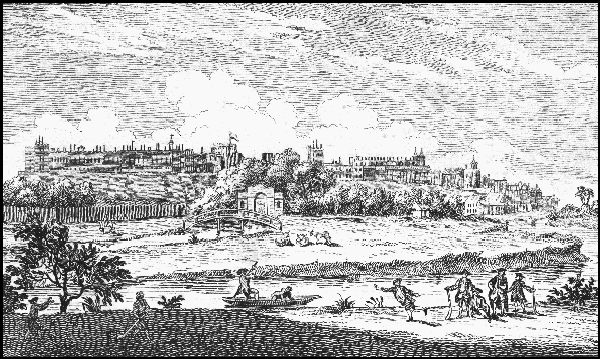
Windsor Castle, the most delightful palace of our Sovereigns, was first built by William the Conqueror soon after his being established on the throne of this kingdom, on account of its pleasant and healthful situation, and as a place of security; it was greatly improved by Henry I. who added many additional buildings, and surrounded the whole with a strong wall. Our succeeding Monarchs resided in the same castle, till King Edward III. caused the ancient building to be taken down; erected the present stately castle, and St. George’s chapel; inclosed the whole with a strong wall or rampart of stone, and instituted the most noble order of the garter.
S. Wale del. B. Green sculp. Windsor Castle.
It may be proper to observe, that William of Wickham, afterwards Bishop of Winchester, was principally employed by Edward III. in building this castle, and when he had finished it, he caused this doubtful sentence to be cut on one of the towers:
This made Wickham.
which being reported to the King, as if that prelate had assumed to himself the honour of building this castle, that Bishop would probably have fallen under his Majesty’s displeasure, had he not readily assured his royal master, that he meant it only as an acknowledgment, that this building had made him great in the favour of his Prince; and had occasioned his being raised to his present high station.
Great additions were in succeeding times made to the castle, by several of our Monarchs, particularly by Edward IV. Henry VII. Henry VIII. Elizabeth, and Charles II. This last Prince soon after the restoration, entirely repaired the castle, and though it had suffered greatly by plunder and rapine, in the preceding times of national disorder, he restored it to its ancient splendor. As that Prince usually kept his court there during the summer season, he spared no expence in rendering it worthy the royal residence; he entirely changed the face of the upper court; he enlarged the windows and made them regular, richly furnished the royal apartments, and had them decorated with large and beautiful paintings, and erected a large magazine of arms.
In short, King Charles II. left little to be done to the castle except some additional paintings in the apartments, which were added by his successors James II. and William III. in whose reign the whole was completed.
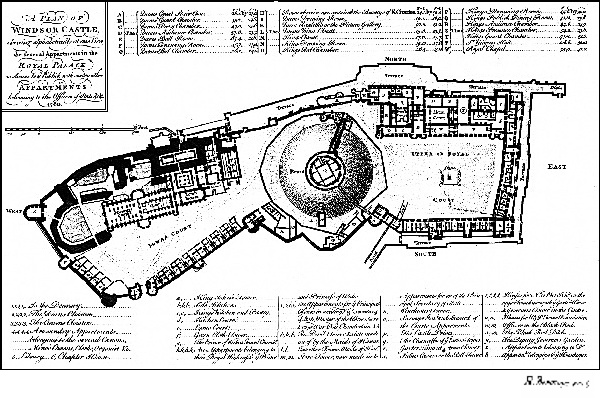
This stately and venerable castle is divided into two courts or wards, with a large round tower between them called the middle ward, it being formerly separated from the lower ward by a strong wall and drawbridge. The whole contains above twelve acres of land, and has many towers and batteries for its defence: but length of time have abated their strength, and the happy union that subsists between the Prince and people, has made it unnecessary to keep these fortifications in perfect repair.
The castle is situated upon a high hill, which rises by a gentle ascent, and enjoys a most delightful prospect around it, in the front is a wide and extensive vale, adorned with corn fields and meadows, with groves on either side, and the calm smooth water of the Thames running through it, and behind it are every where hills covered with woods, as if dedicated by nature, for game and hunting.
On the declivity of the hill is a fine terrace faced with a rampart of free stone, 1870 feet in length. This may justly be said to be one of the noblest walks in Europe, both with respect to the strength and grandeur of the building, and the fine and extensive prospect over the Thames of the adjacent country on every side, where from the variety of fine villas scattered about, nature and art seem to vie with each other in beauty.
From this terrace you enter a beautiful park, which surrounds the palace, and is called the little or house park, to distinguish it from another adjoining, which is of a much larger extent. This little park is four miles in circumference, and surrounded by a brick wall. The turf is of the most beautiful green, and it is adorned with many shady walks; especially that called Queen Elizabeth’s, which, on the summer evenings is frequented by the best company. A fine plain on the top of the hill was made level for bowling in the reign of King Charles II. and from hence is the like extended prospect over the Thames, and the same beautiful and well cultivated country. The park is well stocked with deer and other game, and the keeper’s lodge at the farther end is a delightful habitation.
But to return to the castle. In the upper court is a spacious and regular square, containing on the north side the royal apartments, and St. George’s chapel and hall, on the south and the east sides are the royal apartments, those of the Prince of Wales, and the great officers of state, and in the centre of the area is an equestrian statue in copper of King Charles II. in the habit of one of the Cæsars, standing on a marble pedestal, adorned with various kinds of fruit, fish, shipping and other ornaments. On the east side is the following inscription on a shield:
CAROLO Secundo. Regum Optimo, Domino suo clementissimo. Tobias Rustat Hanc Effigiem humilime Dedit et Dedicavit, Anno Domini Mdclxxx.
The Round tower, which forms the west side of this upper court, contains the Governor’s apartments. It is built on the highest part of the mount, and there is an ascent to it by a large flight of stone steps: these apartments are spacious and noble, and among the rest is a guard-room or magazine of arms. King Charles II. began to face this mount with brick, but only compleated that part next the court.
The Lower court is larger than the other, and is in a manner divided into two parts by St. George’s chapel, which stands in the centre. On the north, or inner side are the several houses and apartments of the Dean and canons of St. George’s chapel, with those of the minor canons, clerks and other officers; and on the south and west sides of the outer part, are the houses of the poor knights of Windsor. In this court are also several towers belonging to the officers of the crown, when the court is at Windsor, and to the officers of the order of the garter.
The royal apartments are on the north side of the Upper court, and are usually termed the Star building, from a star and garter in gold in the middle of the structure, on the out side next the terrace.
The entrance into the apartments is through a handsome vestibule, supported by columns of the Ionic order, with some antique bustos in several niches; from hence you proceed to the great staircase, which is finely painted with several fabulous stories from Ovid’s Metamorphoses: In the dome Phaeton is represented desiring Apollo to grant him leave to drive the chariot of the sun; in large compartments on the staircase, are the transformation of Phaeton’s sisters into poplar trees, with this inscription, Magnis tamen excidit Ausis; and Cycnus changed into a swan. In several parts of the ceiling are represented the signs of the Zodiac supported by the winds, with baskets of flowers beautifully disposed: at the corners are the four Elements each express’d by a variety of figures. Aurora is also represented with her nymphs in waiting, giving water to her horses. In several parts of the staircase are the figures of Music, Painting, and the other sciences. The whole is beautifully disposed and heightened with gold, and from this staircase you have a view of the back stairs painted with the story of Meleager and Atalanta.
I. Having ascended the staircase, you enter first into the Queen’s guard chamber, which is compleatly furnished with guns, pistols, bayonets, pikes, swords, &c. beautifully ranged and disposed into various forms, as the star and garter, the royal cypher, and other ornaments. On the cieling is Britannia in the person of Queen Catharine of Portugal, consort to King Charles II. seated on a globe, bearing the arms of England and Portugal, with the four grand divisions of the earth Europe, Asia, Africa, and America, attended by deities, making their several offerings. On the outer part of this beautiful group, are the signs of the Zodiac, and in different parts of the cieling are Minerva, Mars, Venus, and other heathen deities, with Zephyrs, Cupids, and other embellishments properly disposed; over the chimney is a portrait of Prince George of Denmark on horseback, by Dahl; with a view of shipping by Vandewell.
II. You next enter the Queen’s presence chamber, where Queen Catharine is represented attended by Religion, Prudence, Fortitude and other Virtues: she is under a curtain spread by Time, and supported by Zephyrs, while Fame sounds the happiness of Britain; below, Justice is driving away Envy, Sedition, and other evil genii. The room is hung with tapestry, containing the history of the beheading of St. Paul, and the persecution of the primitive Christians; and adorned with the pictures of Judith and Holofernes, by Guido Reni; a Magdalen, by Sir Peter Lelly; and a Prometheus by young Palma.
III. On entering the Queen’s audience chamber, you see the cieling painted with Britannia in the person of Queen Catharine, in a carr drawn by swans to the temple of Virtue, attended by Flora, Ceres, Pomona, &c. with other decorations heightened with gold. The canopy is of fine English velvet, set up by Queen Anne; and the tapestry was made at Coblentz in Germany, and presented to King Henry VIII. The pictures hung up in this room, are, a Magdalen by moonlight, by Carracci; St. Stephen stoned, by Rotterman; and Judith and Holofernes, by Guido Reni.
IV. On the cieling of the ball room King Charles II. is represented giving freedom to Europe by the figures of Perseus and Andromeda; on the shield of Perseus is inscribed Perseus Britannicus, and over the head of Andromeda is wrote Europa Liberata, and Mars attended by the celestial deities, offers the olive branch. On the coving of this chamber is the story of Perseus and Andromeda, the four seasons, and the signs of the Zodiac, the whole heightened with gold. The tapestry, which was made at Brussels, and set up by King Charles II. represents the seasons of the year; and the room is adorned with the following pictures, the Roman Charity, after Tintoret; Duns Scotus, by Spagnoletto; a Madona, by Titian; Fame, by Palmegiani, the Arts and Sciences, also by Palmegiani; and Pan and Syrinx by Stanick.
V. The next room you enter is the Queen’s drawing room, where on the cieling is painted the assembly of the gods and goddesses, the whole intermixed with cupids, flowers, &c. and heightened with gold. The room is hung with tapestry representing the twelve months of the year, and adorned with the pictures of Lot and his daughters, after Angelo; Lady Digby, wife of Sir Kenelm Digby, by Vandyke; a sleeping Venus, by Poussin; a family in the character of Mark Anthony and Cleopatra, by de Bray; a Spanish family, after Titian; and a flower piece by Varelst.
VI. In the Queen’s bed-chamber, the bed of state is rich flowered velvet made in Spitalfields, by order of Queen Anne, and the tapestry, which represents the harvest season, was also made at London, by Poyntz. The cieling is painted with the story of Diana and Endymion, and the room is adorned with the pictures of the Holy family, by Raphael; Herod’s cruelty by Giulio Romano; and Judith and Holofernes, by Guido.
VII. The next is the room of Beauties, so named from the portraits of the most celebrated beauties in the reign of King Charles II. they are fourteen in number, viz. Lady Ossory, the Duchess of Somerset, the Duchess of Cleveland, Lady Gramont, the Countess of Northumberland, the Duchess of Richmond, Lady Birons, Mrs. Middleton, Lady Denham and her sister, Lady Rochester, Lady Sunderland, Mrs. Dawson, and Mrs. Knott. These are all original paintings drawn to great perfection by Sir Peter Lelly.
VIII. In the Queen’s dressing room are the following portraits, Queen Henrietta Maria, wife to King Charles I. Queen Mary, when a child, and Queen Catharine; these three are all done by Vandyke; the Duchess of York, mother to Queen Mary and Queen Anne, by Sir Peter Lelly.
In this room is a closet wherein are several paintings, and in particular a portrait of the Countess of Desmond, who is said to have lived to within a few days of an hundred and fifty years of age; also a portrait of Erasmus and other learned men. In this closet is likewise the banner of France annually delivered on the second of August by the Duke of Marlborough, by which he holds Blenheim house built at Woodstock in Oxfordshire in the reign of Queen Anne, as a national reward to that great General for his many glorious victories over the French.
IX. You are next conducted into Queen Elizabeth’s or the picture gallery, which is richly adorned with the following paintings: King James I. and his Queen, whole lengths, by Vansomer; Rome in flames, by Giulio Romano; a Roman family, by Titian; the Holy family, after Raphael; Judith and Holofernes, by Tintoret; a night piece, by Skalkin; the pool of Bethesda, by Tintoret; a portrait of Charles VI. Emperor of Germany, by Sir Godfrey Kneller; the wise men making their offerings to Christ, by Paulo Veronese; two usurers, an admired piece, by the famous blacksmith of Antwerp; Perseus and Andromeda, by Schiavone; Aretine and Titian, by Titian; the Duke of Gloucester, a whole length by Sir Godfrey Kneller; Prince George of Denmark, a whole length by Dahl; King Henry VIII. by Hans Holbein; Vandanelli, an Italian statuary, by Correggio; the founders of different orders in the Romish church, by Titian and Rembrant; a rural piece in low life, by Bassano; a fowl piece, by Varelst; the battle of Spurs near Terevaen in France, in 1513, by Hans Holbein; two views of Windsor Castle, by Wosterman, and two Italian markets, by Michael Angelo. In this room is also a curious amber cabinet, presented by the King of Prussia to Queen Caroline.
There is here likewise Queen Caroline’s china closet, filled with a great variety of curious china elegantly disposed, and the whole room is finely gilt and ornamented; over the chimney are the pictures of Prince Arthur, and his two sisters, the children of King Henry VII. by Holbein; and in this closet is also a fine amber cabinet, presented to Queen Anne, by Dr. Robinson, Bishop of London, and plenipotentiary at the congress of Utrecht.
X. From this gallery a return is made to the King’s closet, the cieling of which is adorned with the story of Jupiter and Leda. Among the curiosities in this room is a large frame of needle work, said to be wrought by Mary Queen of Scots, while a prisoner in Fotheringhay castle; among other figures, she herself is represented supplicating for justice before the Virgin Mary, with her son, afterwards King James I. standing by her; in a scrawl is worked these words Sapientiam amavi et exquisivi a juventute mea. This piece of work, after its having lain a long time in the wardrobe, was set up by order of Queen Anne. The pictures are, a Magdalen, by Carracci; a sleeping cupid, by Correggio; contemplation, by Carracci; Titian’s daughter, by herself; and a German Lady, by Raphael.
XI. You are next conducted into the King’s dressing room, where the cieling is painted with the story of Jupiter and Danae; and adorned with the pictures of the birth of Jupiter, by Giulio Romano; and of a naked Venus asleep, by Sir Peter Lelly.
XII. On leaving the above room, you are conducted into the King’s bed chamber, which is hung with tapestry representing the story of Hero and Leander; the bed of state, which was set up in the reign of King Charles II. is of fine blue cloth, richly embroidered with gold and silver; and on the cieling that Prince is represented in the robes of the garter, under a canopy supported by Time, Jupiter and Neptune, with a wreath of laurel over his head, and he is attended by Europe, Asia, Africa, and America, paying their obedience to him. The paintings are, King Charles II. when a boy, in armour, by Vandyke; and St. Paul stoned at Lystra, by Paulo Veronese.
XIII. The cieling of the King’s drawing room, which is next seen, is finely painted with King Charles II. riding in a triumphal carr, drawn by the horses of the sun, attended by Fame, Peace, and the polite arts; Hercules is driving away Rebellion, Sedition and Ignorance; Britannia and Neptune, properly attended, are paying obedience to the Monarch as he passes; and the whole is a lively representation of the restoration of that Monarch, and the introduction of arts, and sciences in these kingdoms. In the other parts of the cieling are painted the labours of Hercules, with festoons of fruit and flowers, the whole beautifully decorated in gold and stone colour. The pictures hung up in this room are, a converted Chinese, by Sir Godfrey Kneller; the Marquis of Hamilton, after Vandyke, by Hanneman; Herodias’s daughter, by Carlo Dolci; a Magdalen, by Carlo Dolci; and a Venetian Lady, by Titian.
XIV. You next enter the King’s drawing room, where the painted cieling represents the banquet of the gods, with a variety of fish and fowl. The pictures hung up here are, the portraits of his present Majesty, and the late Queen Caroline, whole lengths; Hercules and Omphale, Cephalus and Procris, the birth of Venus, and Venus and Adonis, the four last by Genario; a naval triumph of King Charles II. by Verrio; the marriage of St. Catharine, by Dawkers; nymphs and satyrs, by Rubens and Snyders; hunting the wild boar, by Snyders; a picture of still life, by Girardo; the taking of the bears, by Snyders; a night piece, being a family singing by candle light, by Quistin; a Bohemian family, by de Brie; divine love, by an unknown hand; and Lacy, a famous comedian in King Charles the Second’s time, in three characters, by Wright.
Many of the paintings in this room are best seen at noon by the reflection of the sun; the carving of this chamber is very beautiful, representing a great variety of fowl, fish and fruit, done to the utmost perfection on lime wood, by Mr. Gibbons, a famous statuary and carver in the reign of King Charles II.
XV. In the King’s audience chamber, the canopy, which was set up in the reign of King Charles II. is of green velvet, richly embroidered with gold, and on the cieling is represented the establishment of the church of England at the restoration, in the characters of England, Scotland and Ireland, attended by Faith, Hope, Charity, and the Cardinal Virtues; Religion triumphs over Superstition and Hypocrisy, who are driven by cupids from before the face of the church, all which are represented in their proper attitudes, and highly finished. The pictures hung up in this room are, our Saviour before Pilate, by Michael Angelo; the Apostles at our Saviour’s tomb, by Scavoni; Peter, James and John, by Michael Angelo; and the Duchess of Richmond, by Vandyke.
XVI. The King’s presence chamber is hung with tapestry containing the history of Queen Athaliah, and the cieling is finely adorned with painting, Mercury is represented with an original portrait of King Charles II. which he shews to the four quarters of the world introduced by Neptune; Fame declaring the glory of that Prince, and Time driving away Rebellion, Sedition, and their companions. Over the canopy is Justice in stone colour, shewing the arms of Britain to Thames and the river nymphs, with the star of Venus, and this label, Sydus Carolynum, at the lower end of the chamber is Venus in a marine carr drawn by tritons and sea-nymphs. The portraits hung up are, Henry Duke of Gloucester, brother to King Charles II. and his governess the Countess of Dorset, both by Vandyke; and father Paul, by Tintoret.
XVII. The King’s guard chamber, which you next enter, is a spacious and noble room, in which is a large magazine of arms, consisting of some thousands of pikes, pistols, guns, coats of mail, swords, halberts, bayonets, and drums, disposed in a most curious manner in colonades, pillars, circles, shields, and other devices by Mr. Harris, late master gunner of this castle; the person who invented this beautiful arrangement of arms, and placed those in the great armoury in the Tower of London. The cieling is finely painted in water-colours: in one circle is Mars and Minerva, and in the other Peace and Plenty. In the dome is also a representation of Mars, and over the chimney piece is a picture of Charles XI. King of Sweden, on horseback, as big as the life, by Wyck.
At an installation, the Knights of the garter dine here in great state in the absence of the Sovereign.
XVIII. You next enter St. George’s chamber, which is particularly set apart to the honour of the most illustrious order of the garter, and is perhaps one of the noblest rooms in Europe, both with regard to the building and the painting, which is here performed in the most grand taste. In a large oval in the centre of the ceiling King Charles II. is represented in the habit of the order, attended by England, Scotland and Ireland; Religion and Plenty hold the crown of these kingdoms over his head; Mars and Mercury, with the emblems of war and peace stand on each side. In the same oval Regal Government is represented upheld by Religion and Eternity, with justice attended by Fortitude, Temperance and Prudence, beating down Rebellion and Faction. Towards the throne is represented in an octogon St. George’s cross incircled with the garter, within a star or glory supported by Cupids, with the motto,
Honi soit qui mal y pense.
and besides other embellishments relating to the order, the Muses are represented attending in full consort.
On the back of the state, or Sovereign’s throne, is a large drapery, on which is painted St. George encountering the dragon, as large as the life, and on the lower border of the drapery is inscribed,
Veniendo restituit rem,
in allusion to King William III. who is painted in the habit of the order, sitting under a royal canopy, by Sir Godfrey Kneller. To the throne is an ascent by five steps of fine marble, to which the painter has added five more, which are done with such perfection as to deceive the sight, and induce the spectator to think them equally real.
This noble room is an hundred and eight feet in length, and the whole north side is taken up with the triumph of Edward the Black Prince, after the manner of the Romans. At the upper part of the hall is Edward III. that Prince’s father, the conqueror of France and Scotland, and the founder of the order of the garter, seated on a throne, receiving the Kings of France and Scotland prisoners; the Black Prince is seated in the middle of the procession, crowned with laurel; and carried by slaves; preceded by captives, and attended by the emblems of Victory, Liberty, and other ensignia of the Romans, with the banners of France and Scotland displayed. The painter has given a loose to his fancy by closing the procession with the fiction of the Countess of Salisbury, in the person of a fine lady, making garlands for the Prince, and the representation of the merry wives of Windsor.
At the lower end of the hall is a noble music gallery, supported by slaves, larger than the life, in proper attitudes, said to represent a father and his three sons, taken prisoners by the Black Prince in his wars abroad. Over this gallery on the lower compartment of the ceiling is the collar of the order of the garter fully displayed. The painting of this room was done by Verro, and is highly finished and heightened with gold.
XIX. You are next conducted to St. George’s or the King’s chapel, which is no less royally adorned. On the ceiling is finely represented our Lord’s ascension; and the altar-piece is adorned with a noble painting of the last supper. The north side of the chapel is ornamented with the representation of our Saviour’s raising Lazarus from the dead, his curing the sick of the palsy, and other miracles, beautifully painted by Verro; and in a group of spectators the painter has introduced his own effigy, with those of Sir Godfrey Kneller, and Mr. Cooper, who assisted him in these paintings. The east end of this chapel is taken up with the closets belonging to his Majesty and the Royal family. The canopy, curtains, and furniture are of crimson velvet, fringed with gold; and the carved work of this chapel, which is well worthy the attention of the curious, is done by that famous artist Gibbons, in lime-tree, representing a great variety of pelicans, doves, palms, and other allusions to scripture history, with the star and garter, and other ornaments finished to great perfection.
From St. George’s chapel you are conducted to the Queen’s guard chamber, the first room you entered; for this is the last of the state apartments at present shown to the public; the others being only opened when the court resides at Windsor. They consist of many beautiful chambers, adorned with the paintings of the greatest masters.
In passing from hence the stranger usually looks into the inner or horn court, so called from a pair of stag’s horns of a very extraordinary size, taken in the forest and set up in that court, which is painted in bronze and stone colour. On one side is represented a Roman battle, and on the opposite side a sea fight, with the images of Jupiter, Neptune, Mercury and Pallas; and in the gallery is a representation of King David playing before the ark.
From this court a flight of stone steps lead to the King’s guard chamber; and in the cavity under these steps, and fronting this court, is a figure of Hercules also in stone colours. On a dome over the steps, is painted the battle of the Gods, and on the sides of the stair case is a representation of the four ages of the world, and two battles of the Greeks and Romans in fresco.
St. George’s chapel, among the buildings of this noble palace we have mentioned the chapel of St. George situated in the middle of the lower court. This antient structure, which is now in the purest style of Gothic architecture, was first erected by King Edward III. in the year 1337, soon after the foundation of the college, for the honour of the order of the garter, and dedicated to St. George, the patron of England; but however noble the first design might be, King Edward IV. not finding it entirely completed, enlarged the structure and designed the present building, together with the houses of the dean and canons, situated on the north and west sides of the chapel; the work was afterwards carried on by Henry VII. who finished the body of the chapel, and Sir Reginald Bray, knight of the garter, and the favourite of that King, assisted in ornamenting the chapel and compleating the roof.
The architecture of the inside has always been esteemed for its neatness and great beauty, and in particular the stone roof is reckoned an excellent piece of workmanship. It is an ellipsis supported by Gothic pillars, whose ribs and groins sustain the whole ceiling, every part of which has some different device well finished, as the arms of Edward the Confessor, Edward III. Henry VI. Edward IV. Henry VII. and Henry VIII. also the arms of England and France quarterly, the cross of St. George, the rose, portcullis, lion rampant, unicorn, &c. In a chapel in the south isle is represented in ancient painting, the history of John the Baptist, and in the same isle are painted on large pannels of oak, neatly carved and decorated with the several devices peculiar to each Prince, the portraits at full length of Prince Edward, son to Henry VI. Edward IV. Edward V. and Henry VII. In the north isle is a chapel dedicated to St. Stephen, wherein the history of that saint is painted on the pannels and well preserved. In the first of these pannels St. Stephen is represented preaching to the people; in the second he is before Herod’s tribunal; in the third he is stoning; and in the fourth he is represented dead. At the east end of this isle is the chapter house of the college, in which is a portrait at full length, by a masterly hand, of the victorious Edward III. in his robes of state, holding in his right hand a sword, and bearing the crowns of France and Scotland, in token of the many victories he gained over those nations. On one side of this painting is kept the sword of that great and warlike Prince.
But what appears most worthy of notice is the choir. On each side are the stalls of the Sovereign and Knights companions of the most noble order of the garter, with the helmet, mantling, crest, and sword, of each Knight set up over his stall on a canopy of antient carving curiously wrought, and over the canopy is affixed the banner or arms of each Knight properly blazon’d on silk, and on the back of the stalls are the titles of the Knights, with their arms neatly engraved and blazoned on copper. The Sovereign’s stall is on the right hand of the entrance into the choir, and is covered with purple velvet and cloth of gold, and has a canopy and compleat furniture of the same valuable materials; his banner is likewise of velvet, and his mantling of cloth of gold. The Prince’s stall is on the left, and has no distinction from those of the rest of the Knights companions, the whole society, according to the statutes of the institution, being companions and collegues, equal in honor and power.
The altar-piece was soon after the restoration, adorned with cloth of gold and purple damask by King Charles II. but on removing the wainscot of one of the chapels in 1707, a fine painting of the Lord’s supper was found, which being approved of by Sir James Thornhill, Verrio, and other eminent masters, was repaired and placed on the altar-piece.
Near the altar is the Queen’s gallery, for the accommodation of the ladies at an installation.
In a vault under the marble pavement of this choir, are interred the bodies of Henry VIII. and Jane Seymour his Queen, King Charles I. and a daughter of the late Queen Anne. In the south isle, near the door of the choir, is buried Henry VI. and the arch near which he was interred was sumptuously decorated by Henry VIII. with the royal ensigns and other devices, but they are now much defaced by time.
In this chapel is also the monument of Edward Earl of Lincoln, Lord high Admiral of England in the reign of Queen Elizabeth, erected by his Lady, who is also interred with him. The monument is of alabastar, with pillars of porphyry.
Another, within a neat screen of brass work, is erected to the memory of Charles Somerset, Earl of Worcester, and Knight of the garter, who died in 1526, and his lady, daughter to William Earl of Huntingdon.
A stately monument of white marble erected to the memory of Henry Somerset, Duke of Beaufort, and Knight of the garter, who died in 1699. There are here also the tombs of Sir George Manners, Lord Roos; that of the Lord Hastings, Chamberlain to Edward IV. and several others.
Before we conclude our account of this ancient chapel, it will be proper to observe that King James II. made use of it for the service of popery, and mass being publicly performed there, it has ever since been neglected and suffered to run to ruin; and being no appendage to the collegiate church, waits the royal favour to retrieve it from the disgrace of its present situation. Delices de Windsore.
With respect to the royal foundations in this castle, they are the most noble order of the garter, which consists of the Sovereign and twenty-five Knights companions: the royal college of St. George, which consists of a dean, twelve canons, seven minor canons, eleven clerks, an organist, a verger, and two sacrists; and the alms-knights, who are eighteen in number; viz. thirteen of the royal foundation, and five of the foundation of Sir Peter le Maire, in the reign of King James I.
A PLAN OF WINDSOR CASTLE
Of the Knights of the Garter. Windsor Castle being the seat of this most illustrious order, it may be expected that we should here give some account of it. The order of the garter was instituted by Edward III. in the year 1349, for the improvement of military honour, and the reward of virtue. It is also called the order of St. George, the patron of England, under whose banner the English always went out to war, and St. George’s cross was made the ensign of the order. The garter was, at the same time, appointed to be worn by the Knights on the left leg, as a principal mark of distinction, not from any regard to a Lady’s garter, “but as a tye or band of association in honour and military virtue, to bind the knights companions strictly to himself and each other, in friendship and true agreement, and as an ensign or bage of unity and combination, to promote the honour of God, and the glory and interest of their Prince and Sovereign.” At that time King Edward being engaged in prosecuting, by arms, his right to the crown of France, caused the French motto HONI SOIT QUI MAL Y PENSE, to be wrought in gold letters round the garter, declaring thereby the equity of his intention, and at the same time retorting shame and defiance upon him who should dare to think ill of the just enterprize in which he had engaged, for the support of his right to that crown.
The installation of a Knight of this most noble order consists of many ceremonies established by the royal founder, and the succeeding Sovereigns of the order, the care of which is committed to Garter king at arms, a principal officer of the order, appointed to support and maintain the dignity of this noble order of knighthood.
On the day appointed for the installation, the Knights commissioners appointed by the Sovereign to instal the Knights elect, meet in the morning, in the great chamber in the dean of Windsor’s house, dressed in the full habit of the order, where the officers of the order also attend in their habits; but the Knights elect come thither in their under habits only, with their caps and feathers in their hands.
From hence the Knights walk two and two in procession to St. George’s chapel, preceded by the poor knights, prebends, heralds, pursuivants, and other officers of the order, in their several habits; being arrived there, the Knights elect rest themselves in chairs behind the altar, and are respectively introduced into the chapter house, where the Knights commissioners (Garter and the other officers attending) invest them with the surcoat or upper habit of the order, while the register reads the following admonition: “take this robe of crimson to the increase of your honour, and in token or sign of the most noble order you have received, wherewith you being defended, may be bold, not only strong to fight, but also to offer yourself to shed your blood for Christ’s faith, and the liberties of the church, and the just and necessary defence of them that are oppressed and needy.” Then Garter presents the crimson velvet girdle to the commissioners, who buckle it on, and also girds on the hanger and sword.
The procession of each Knight elect separately is afterwards made into the choir attended by the Lords commissioners, and other companions of the order, and preceded by the poor knights, prebends, &c. as before, Garter in the middle carrying on a crimson velvet cushion, the mantle, hood, garter, collar, and george, having the register on his right hand, who carries the New Testament, and the oath fairly written on parchment, and the black rod on his left. On entering the choir, after reverence made to the altar, and the Sovereign’s stall, the Knights are conducted to their several stalls, under their respective banners, and other ensigns of honour. The Knights elect then take the oath, and are compleatly dressed, invested with the mantle of the order, and the great collar of St. George, which is done with great state and solemnity.
After the installation, the Knights make their solemn offerings at the altar, and prayers being ended, the grand procession of the Knights is made from the choir in their full habits of the order, with their caps frequently adorned with diamonds and plumes of feathers, on their heads, round the body of the church, and passing out at the south door, the procession is continued in great state through the courts of the castle into St. George’s hall, preceded by his Majesty’s music; in the following order, the poor knights of Windsor; the choir of St. George’s chapel; the canons, or prebends of Windsor, the heralds, and pursuivants at arms; the dean of Windsor, register of the order, with garter king at arms on his right hand, and on his left the black rod of the order; the Knights companions, according to their stalls, their trains supported by the choristers of St. George’s chapel.
The Knights having for some time rested in the royal apartments, a sumptuous banquet is prepared, if the Sovereign be present, in St. George’s hall, and in his absence, in the great guard chamber next adjoining, and the Knights are introduced and dine with great state in the habits of the order, the music attending. Before dinner is ended, Garter king at arms proclaims the style and dignity of each Knight, after which the company retire, and the evening is closed with a ball for the ladies in the royal lodgings. For the farther illustration of the preceding account of Windsor Castle, we have given a plan of it, which shews the exact disposition of the whole, and the situation of its several parts with regard to each other. The perspective view is taken from
Windsor great park and forest. As we have already described the town of Windsor, the little park and castle, and given some account of the order of Knights of the garter, we are naturally led to mention the great park, which lies on the south side of the town and opens by a noble road in a direct line to the top of a delightful hill at near thee miles distance. This road leads through a double plantation of trees on each side, to the ranger’s or keeper’s lodge, at present the residence of his Royal Highness the Duke of Cumberland, who has greatly improved the natural beauties of the park, and by large plantations of trees, extensive lawns, new roads, canals, and rivers, has rendered this villa an habitation worthy of a Prince.
The great park is fourteen miles in circumference, and is well stocked with deer and other game; many foreign beasts and birds are here also kept by his Royal Highness, who is continually adding new improvements. The new erected building on Shrub’s hill, adorned beneath with the prospect of the most beautiful verdure, and a young plantation of trees, is very elegant, and promises in a short time to afford the most delightful rural scene, the noble piece of water below, produced at a great expence from a small stream, is now rendered capable of carrying barges and boats of pleasure. Over this river, which terminates in a grotto, and large cascade, his Royal Highness has erected a bridge on a noble and bold plan, it consisting of one single arch 165 feet wide.
But his Royal Highness’s attention is not confined to the park alone; but in like manner extends to the adjoining forest, which is of great extent, and was appropriated to hunting and the residence of the royal game by William the Conqueror, who established many laws and regulations for the preservation of the deer, that are still observed. In this extensive tract of land are several pleasant towns and villages, of which Wokingham, situated near the center of the forest, is the principal, and though the soil is generally barren and uncultivated, yet it is finely diversified with hills and vales, woods and lawns, and interspersed with pleasant villas. These rural scenes are finely painted by Mr. Pope, who resided here when he wrote his Windsor forest, and was himself a native of the place, being born at Binfield.
Here waving groves and chequer’d scenes display, And part admit, and part exclude the day; There, interspers’d in lawns and op’ning glades, There trees arise, that shun each others shades. Here in full light the russet plains extend; There wrapt in clouds the blueish hills ascend; Ev’n the wild heath displays her purple dyes, And ’midst the desart, fruitful fields arise, That crown’d with tufted trees and springing corn, Like verdant isles the sable waste adorn.
Among the many fine villas which are in this forest we shall only here mention Cranborne lodge, which now belongs to the Duke of Cumberland, as keeper of the forest. It is large and well built, and is happily situated, it commanding an extensive prospect over a fine plain, and a rich country, that forms a most beautiful landscape.
Windsor court, 1. Drury lane: 2. Little Knightrider street, by Addle hill: 3. Monkwell street, by Silver street, near Cripplegate: 4. in the Strand.
Wine Licence Office, in Arundel street in the Strand. This office is under the management of five commissioners, who grant licences to the several retailers of wine in all parts of the kingdom, except to the free vintners of London.
Wine Office court, in Fleet street, leading into Gough’s square.
Wine street, 1. Fore street, Limehouse: 2. Liquor Pond street, Leather lane.
Wine yard, Long alley, Moorfields.
Wingfield’s court, Three Colts street, Limehouse.†
Wingoose alley, Thames street.†
S. Wale delin. F. Vivares sculp. A Scene in Wooburn Farm.
Winkworth’s buildings, Austin Friars, Broad street.†
Winsley street, Oxford street.†
Winston’s court, Silver street, Wood street.†
Wisdoms alley, Millbank, Westminster.
Wise’s court, Wheeler street, Spitalfields.†
Wiseman’s alley, Brook street.†
Wiseman’s court, Gardeners lane.†
Witchellor’s yard, Thames street.†
Wither-rush court, Whitecross street.
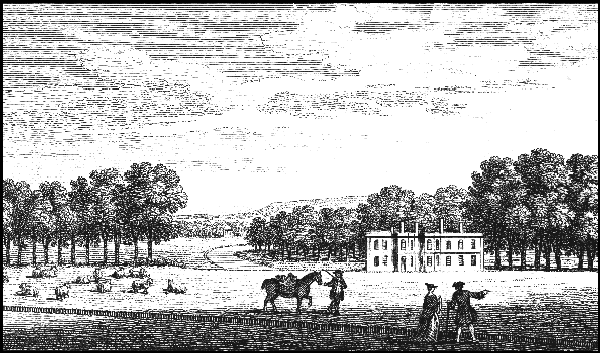
Woburn Farm, the seat of the late Philip Southcote, Esq; it joins to the Earl of Portmore, just beyond it. ’Tis what the French call a Ferme ornée, but perhaps it is rather too much ornamented for the simple plainness of a farm; it is altogether however a very pleasing place. It has a deal of variety and many prospects which are remarkably beautiful and picturesque. Indeed, there are few places within the same distance from London which afford such a variety of fine landscapes.
Wood street, 1. a long street extending from Cheapside to Cripplegate; in this street is one of the two city compters: 2. Hare street, Spitalfields: 3. North street, Westminster.
Wood wharf, 1. Northumberland street, in the Strand: 2. near Broken wharf, Thames street: 3. Millbank, Westminster: 4. Wapping.
Wood yard, 1. Back street, Lambeth: 2. Brick lane: 3. Church lane, Houndsditch: 4. Gravel lane, Houndsditch: 5. Long acre: 6. Maze pond, Southwark: 7. Moses and Aaron alley, Whitechapel: 8. Ratcliff highway.
Woodford, a village near Chingfield in Essex, derived its name from a ford in Epping forest, where now is Woodford bridge.
Woodroff lane, Crutched Friars.†
Wood’s Almshouse, adjoins to that of Gibson’s at Ratcliff, and was founded by Toby Wood, of Lincoln’s Inn, Esq; in the year 1613, for six decayed coopers, who have an allowance of 6l. per annum, and thirty bushels of coals each.
Wood’s alley, Harrow alley.†
Wood’s Close, a street which extends from the end of St. John’s street almost to the turnpike in Islington road.†
Wood’s court, 1. Norton falgate by Shoreditch.† 2. Oxford street.†
Wood’s mews, Tyburn lane.†
Wood’s yard, 1. Norton falgate, by Shoreditch.† 2. Redcross street.†
Woodstock court, Charing Cross.
Woodstock mews, Woodstock street.
Woodstock street, Oxford street.
Woolham’s yard, Gray’s Inn lane, Holborn.†
Woolis’s court, in the Minories.†
Woolmen, a company probably of great antiquity, though they have no charter, and are a community only by prescription. They have a master, two wardens, and eleven assistants; but neither hall nor livery.
Woolpack alley, Houndsditch.*
Woolpack yard, Kent street, Southwark.*
Woolstaple lane, New Palace yard, so called from the woolstaple formerly held there. Stow.
Worcester Place, Thames street.
Worcester Place lane, Thames street.
Worcester street, 1. Old Gravel lane, Ratcliff Highway: 2. in the Park Southwark; 3. Peter street.
World’s-end bridge, St. Olave’s street, Southwark.
World’s-end yard, Old Horselydown lane, Southwark.
Worley’S court, Redgate court, in the Minories.†
Wormwood street, extends from Bishopsgate street to Broad street.
Worrel’s rents, Cherry-tree alley, Golden lane.†
Worship street, near Upper Moorfields.
Worsley’s yard, Field lane, the bottom of Holbourn hill.†
Wray’s court, Cross lane, Parker’s lane.†
Sir Christopher Wren, the celebrated architect, many of whose most excellent works of this kind are described in several places of this work, and views of them given, has on this account an equal claim to our regard in this place, with Inigo Jones, his competitor in the same path of fame, some account of whom we have already given under his name.
Sir Christopher was descended from a branch of the ancient family of the Wrens, of Binchester in the bishoprick of Durham. He was grandson of Mr. Francis Wren, citizen of London, and son of Christopher Wren, dean of Windsor, a younger brother of doctor Matthew Wren, successively Bishop of Hereford, Norwich, and Ely. He was born at London October the eighth 1632, and became gentleman commoner of Wadham college in Oxford, where he took the degree of bachelor of arts, March the eighteenth 1650, and that of master December the eleventh 1653, and the same year was chosen fellow of Allsouls college there. While he was very young he discovered a surprising genius for the mathematics; in which science he made great advancement before he was sixteen years old, as Mr. Oughtred informs us in the preface to the third edition of his Clavis Mathematica, printed at Oxford in 1652. August the seventh 1652, he was made professor of astronomy at Gresham college in London. In the beginning of July 1658, he communicated to Doctor Wallis several papers concerning the Cycloide which were published by Doctor Wallis 1659, in his treatise de Cycloide. In February 1660, Mr. Wren resigned his professorship at Gresham college, upon being chosen to the Savilian professorship of astronomy in Oxford. The same year he was sent for by order of King Charles the Second, to assist Sir John Denham, surveyor of his Majesty’s works. September the twelfth 1661 he was created Doctor of laws, and May twenty 1663, was elected fellow of the Royal Society; in the history of which society by Doctor Sprat, we have an account of some of his discoveries in philosophy and mathematics made before the year 1667, the most considerable of which is his Doctrine of Motion, which is the best of all others for establishing the first principles of philosophy by geometrical demonstrations. He also published a History of Seasons, in which he proposed to comprehend a diary of wind, weather, and other conditions of the air, as to heat, cold, and weight, which might be of admirable use if constantly pursued and derived down to posterity. He also contrived a thermometer to be its own register, and an instrument to measure the quantities of rain that fall, and he devised many subtle ways for the easier finding the gravity of the atmosphere. Some discoveries in the Pendulum are to be attributed to him, and he has invented many ways to make astronomical observations more easy and accurate. He added many devices and improvements to telescopes, and improved the theory of dioptrics, it being a question among the problems of navigation, to what mechanical power, sailing against the wind especially, was reducible, he shewed it to be a wedge. The geometrical mechanics of rowing he shewed to be a Vectis, on a moving or cedent Fulcrum. He invented a curious and speedy way of etching, and has started several things towards the emendation of water-works. He was the first inventor of drawing pictures by microscopical glasses. He found out long-liv’d lamps, and registers of furnaces for keeping a perpetual temper in order to various uses, as hatching eggs, insects, production of plants, chemical preparations, imitating nature in producing fossils and minerals, keeping the motion of watches equal in order to longitude and astronomical uses, and infinite other advantages. He was the first author of the noble anatomical experiment of injecting liquors into the veins of animals, an experiment now well known. It were easy to enumerate a great number of other inventions and improvements of his, from Doctor Sprat’s account of them, but these may suffice as a specimen.
In 1665 Sir Christopher Wren travelled into France, and about the same year was one of the commissioners for the reparation of St. Paul; and in September the same year drew up a model for rebuilding the city of London after the fire in the beginning of that month. Upon the decease of Sir John Denham, who died in March 1668, he was made Surveyor-general of his Majesty’s works. In 1669, he finished the magnificent theatre at Oxford, April the ninth 1673, he resigned his professorship of astronomy at Oxford, and some time after married the daughter of Sir Thomas Coghill of Bletchington in Oxfordshire, by whom he had only one son named Christopher. His wife dying in childbed, he afterwards married Jane daughter of William Lord Fitz-Williams, Baron of Lifford in Ireland, by whom he had two children, a son William, and a daughter Jane. In 1680 he was chosen president of the Royal Society. He was one of the commissioners of Chelsea college, and twice member of parliament, first for Plymouth in Devonshire, in 1685; and in 1700, for Melcomb Regis in Devonshire. In 1718 he was removed from his place of Surveyor-general. He died February the twenty-fifth 1723, in the ninety-first year of his age, and was interred in the vault under St. Paul’s. He was the author of several treatises on different subjects. Amongst the works of architecture of his designing are the cathedral of St. Paul’s, the churches of St. Stephen Walbrook and St. Mary le Bow, the Monument, the palace of Hampton court, Chelsea college, and Greenwich hospital, &c. an account of all which see under their several names in this work.
Wrestley’s court, London wall.†
Wright’s rents, 1. Barnaby street, Southwark.† 2. Ratcliff highway.†
Wright’s street, Rotherhith.†
Wright’s yard, New Marten’s street, near East Smithfield.†
Wrotham, or Wortham, a town in Kent, twenty-five miles from London, and three miles and a half from West Malling, received its name from the great quantity of the herb wort, which grows near it. It has a very large church, in which are sixteen stalls supposed to have been made for the clergy who attended the Archbishops of Canterbury, to whom the manor formerly belonged, and who had a palace here, till Simon Islip the Archbishop in the fourteenth century, pulled it down, and built another at Maidstone; the rectory is however still reckoned one of the best livings in Kent. It has a market on Tuesdays.
Wych street, Drury lane.
Wych’s court, Wych street.†
Wynam’s court, Great Russel street.†