Volume 6 — T.
Reading edition
Tabernacle yard, 1. Petticoat lane: 2. Wheeler street, Spitalfields.
Tackle Block court, at the Hermitage, Wapping.
Tackle Porters. See the article Porters.
Talbot court, 1. Fleet street.* 2. Gracechurch street.* 3. Little Eastcheap.* 4. Portpool lane, Leather lane.*
Talbot inn yard, St. Margaret’s hill.*
Tallow Chandlers, a company incorporated by letters patent granted by King Edward IV. in the year 1463.
This society anciently dealt not only in candles; but in oil, vinegar, butter, hops and sope; when great frauds being committed by adulterating oil, they were impowered by Act of Parliament to search for, and destroy, all that should be found bad; but no reward being allowed to the searchers, it was soon neglected.
This company has a master, four wardens, and thirty-eight assistants; with a livery of one hundred and seventy members, who when admitted pay a fine of 15l. each.
They have a handsome hall on the west side of Dowgate hill; it is a large building with piazzas formed by arches and columns of the Tuscan order.
Tally Court in the Exchequer. See the article Exchequer.
Tan alley, 1. Godder’s rents, Wheeler street, Spitalfields: 2. Long lane, Southwark.
Tan yard, Whitecross street.
Tanfield court, inner Temple.†
Tanner’s row, Montague street.†
Tanner’s yard, 1. Five Feet lane, Barnaby street: 2. Marsham street.†
Tarplet’s yard, Narrow street, Limehouse.†
Tarre’s wharf, Durham yard, in the Strand.†
Tart’s court, Smithfield.†
Tash court, Tash street.†
Tash street, Grays Inn lane.†
Tattle street, Little Grays Inn lane.||
Tavistock court, near Covent Garden.
Tavistock street, Covent Garden. The above court and this street were built upon the ground where the Dukes of Bedford had their house and gardens, till the year 1704, and took this name from his title of Marquis of Tavistock. Maitland.
Taxter’s rents, Rotherhith Wall.†
Tax Office, in New Palace yard, is under the direction of six commissioners, each of whom has 500l. per annum: under whom is a comptroller of duties on houses who has 200l. a year, and his clerk 50l. ten general surveyors who have 100l. per annum each; 163 surveyors of counties who have 50l. a year in England, and 40l. a year in Wales; a secretary, who has 90l. a year; an assistant secretary, who has 60l. a year; a sollicitor, who has 100l. a year; and two clerks, one of 60l. per annum, and the other of 50l.
Taylor’s court, Bow lane, Cheapside.†
Taylor’s yard, St. Giles’s street.†
Teed’s yard, Worcester street.†
Teem’s rents, Cowcross.†
Temple, two of the inns of court, thus denominated from the edifice being founded by the knights Templars in England, who had first a house in Holborn, and afterwards settled here in the reign of Henry II. when it was dedicated to God and the Blessed Virgin in the year 1185, by Honorius, patriarch of the church of the holy Resurrection in Jerusalem.
These Templars took their rise in the following manner, several of the crusaders settled at Jerusalem, about the year 1118, formed themselves into an uniform militia, under the name of Templars, or knights of the Temple, a name they assumed from their being quartered near a church built on the spot where Solomon’s temple had stood.
These first guarded the roads, in order to render them safe for the pilgrims who came to visit the Holy Sepulchre, and sometime after they had a rule appointed them by Pope Honorius II. who ordered them to wear a white habit; and soon after they were farther distinguished by having crosses made of red cloth on their upper garments. In a short time many noblemen in all parts of Christendom became brethren of this order, and built themselves temples in many cities and great towns in Europe, and particularly in England, where this in Fleet street was their chief house.
In the thirteenth century the Templars in Fleet street, were in so flourishing a situation that they frequently entertained the nobility, the Pope’s nuncio, foreign embassadors, and even the King himself; and many parliaments and great councils have been held there.
However in the year 1308 all the Templars both in England, and the other parts of Christendom, were apprehended and committed to prison, and five years after Edward II. gave Aimer de la Valence, Earl of Pembroke, this house of the Templars, with all their possessions within the city of London. At his death it reverted to the crown, and in 1324, was given to the knights Hospitallers of the order of St. John of Jerusalem, who had driven the Turks out of the isle of Rhodes, and had their chief house where St. John’s square is now situated. These knights soon after let this edifice to the students of the common law, in whose possession it has remained ever since.
The Temple which contained all that space of ground from the White Friars westward to Essex house, is divided into two inns of court, the Inner Temple, and the Middle Temple. These inns have separate halls, but both houses resort to the Temple church: And yet the buildings which have been erected at very different times, with very little order or regularity are perfectly united, and it is impossible for a stranger to know where the Inner Temple ends and the Middle Temple begins, except at the entrances, which are the only visible fronts to the street. Backwards there are many courts of handsome new built houses, and behind them, the buildings of the Temple have gardens and walks fronting the Thames. That side lies open and airy, and enjoys a delightful prospect into Surry.
The Middle Temple gate, next Fleet street is built in the stile of Inigo Jones, It was erected in 1684, and there is here a graceful front; but it is extremely narrow, and cannot be called the front of so vast a building, or rather number of separate buildings, as the Temple. It is of brick-work, with four large stone pilasters of the Ionic order, and a handsome pediment with a round in the middle in which is inscribed in large capitals SURREXIT IMPENSIS SOCIETAT. MED. TEMPLI, MDCLXXXIV. and beneath, just over the arch, the figure of a holy lamb.
In the treasury chamber of the Middle Temple is preserved a great quantity of armour, which belonged to the knights Templars, consisting of helmets, breast and back pieces, together with several pikes, a halbard, and two very beautiful shields, with iron spikes in their centers, of the length of six inches in diameter, and each of about twenty pounds weight. They are curiously engraved, and one of them richly inlaid with gold: the insides are lined with leather stuffed, and the edges adorned with silk fringe; and broad leathern belts are fixed to them, for the bearers to sling them upon their shoulders.
In garden court in the Middle Temple is a library founded by the will of Robert Ashley, Esq; in the year 1641, who bequeathed his own library for that purpose, and 300l. to be laid out in a purchase, for the maintenance of a librarian, who must be a student of the society, and be elected into that office by the benchers. Mr. Ashley also bequeathed all his furniture to be disposed of for the benefit of his library.
The number of volumes in the year 1738 amounted to 3982, in most branches of literature; but more especially in law and parliamentary affairs; and as it is continually encreasing, by the benefactions of authors and others, it will probably become a numerous, and very valuable collection.
This library is duly kept open (except in the dead time of the long vacation) from ten in the morning till one in the afternoon, and from two in the afternoon till six in summer, and four in winter.
The Inner Temple is situated to the east of Middle Temple gate, and has a cloister, a larger garden, and more spacious walks than the other. This society consists of benchers, barristers and students; the former of whom, as governors at commons have their table at the upper end of the hall, and the barristers and students in the middle. Anciently at these entertainments their bread served instead of plates, and they had no other drinking vessels than wooden cups; but at present they are allowed trenchers for their meat, and coarse green earthen pots for their liquor. However, though the antient custom of using mean vessels still prevails, yet there are few who fare better.
All the members of the society who have chambers, are obliged to be in commons a fortnight every term, for which they pay about 10s. a week. Sixteen of these terms, with a regular course of study, qualifies a student for the bar.
Upon the admission of a member, the fees of the house are 3l. 6s. 8d. which, with other disbursements, amount to 4l. 2d.
The parliament, wherein the affairs of the society are treated is commonly held twice every term.
The officers and servants of the house are, a treasurer, a sub-treasurer, a steward, a chief and three under butlers, an upper and under cook, a pannierman, a gardener, two porters, and two wash pots.
The Middle Temple, which joins to the Inner Temple on the west, is thus denominated from its having been the middle or central part of the antient Temple or Priory of knights Templars. The chief officer of this house, like that of its neighbour, is a treasurer, who is annually elected from among the benchers, and whose office is to admit students; to assign them their chambers, and to receive and pay all the cash belonging to the society.
The officers and governors of this inn, are in all respects like that of the Inner Temple, except the charge of admission, which is 5l. and the time to qualify a student for the bar, instead of sixteen terms in that, is twenty-eight in this.
The print exhibits the entrance of the Middle Temple, which is elegant, together with the east side of Temple Bar, as it appears from the end of Chancery lane in Fleet street, the situation of the Temple along the side of the river is very fine, yet nothing can be more void of harmony or decoration than the buildings of which it is composed, owing chiefly to the division and subdivision of property, which renders regularity next to impossible. The thing most worthy of notice in the Temple is the old church which belonged to the knights Templars of Jerusalem. You enter it through a circular tower of Saxon architecture in which are buried some Knights Templars, whose figures lying on the ground are preserved by iron rails. The church is purely Gothic, and it is great pity that the altar, pulpit, organ, gallery, &c. had not been kept in the same stile of architecture. This would have made it as regular though not so rich, as the chapel of Henry the seventh.
But the temple church requires a more particular description. We shall therefore trace it from its origin, and describe its several parts.
The first church here was founded in the year 1185, by the knights Templars; it was dedicated to the Virgin Mary, but was more generally called by the name of the founders, than the protectress. In 1240, the old structure was taken down, and another erected after the same model. The present edifice was one of those that escaped the fire of London in 1666; but in 1695 the south-west part was new built, and in 1706 the whole was thoroughly repaired.
The whole edifice is stone firmly put together and enriched with ornaments. It consists of a long body with a turret, and a round tower at the west end, that has much the air of a piece of fortification. The length of the church from the altar to the screen is eighty-three feet, its breadth sixty feet; and the height of the roof thirty-four. The round tower is forty-eight feet high; its diameter at the floor, fifty-one feet, and its circumference 160 feet.
The windows which enlighten the body of the church are large and well proportioned. They are composed of three Gothic arches, a principal, and a lower on either side. These windows stand so close that there are but very slender piers left between them to support a very heavy roof; they are therefore strengthened with buttresses; but these buttresses, as in most other Gothic structures, exclude more light than the piers would have done, had they been larger, and the windows considerably smaller.
The tower which is very massy, has few windows, and those small, yet there are buttresses carried up between them; the top is crowned with plain square battlements, and from the center rises a fane.
The turret upon the body of the church is small and plain, and serves to receive a bell. In short, what can be seen of the outside has a venerable aspect, but nothing either grand or elegant: the principal beauties are to be seen within.
On entering the round tower, you find it supported with six pillars, wainscotted with oak six feet high, and adorned all round, except the east part, which opens into the church, with an upper and lower range of small arches, and black apertures; but what is most remarkable in this part, is, that there are here the tombs of eleven of the knights Templars who lie interred here; eight of which, are covered with the figures of armed knights; of these five, to shew the veneration they had for the cross of Christ, lie cross legged; and these had made a vow, to go to the Holy Land, in order to make war on the infidels. Three of these are the tombs of the Earls of Pembroke, William Marshal the elder, who died in 1219; his son, who died in 1231, and Gilbert Marshal, his brother, who was slain in a tournament at Hertford in 1241, The other effegies lie strait legged; and the rest of the tombs are only coped stone; but both the effegies and these stones are all gray marble.
This tower is divided from the body of the church by a very handsome screen in the modern taste; which will be described hereafter. On passing this screen we find the church has three roofs supported by tall and slender pillars of Sussex marble. The windows are also adorned with small neat pillars of the same stone, and the floor paved with black and white marble. The isles are five in number; three, as usual, running east and west, and two cross isles.
The walls are neatly wainscotted with oak above eight feet high, and the alterpiece, which is of the same wood, is much higher, finely carved, and adorned with four pilasters and two columns of the Corinthian order: it is also ornamented with cherubims, a shield, festoons, fruit and leaves. The pulpit, which is placed near the east end of the middle isle, is finely carved and veniered; the sounding board is pendant from the roof, and enriched with several carved arches, a crown, festoons, cherubims and vases.
The screen at the west end of the isles is like the alterpiece, of wainscot, and adorned with ten pilasters of the Corinthian order, with three portals and pediments. The organ gallery, over the middle gallery is supported by two fluted Corinthian columns, and ornamented with an entablature and a compass pediment, with the King’s arms well carved. Near the pediment on the south side is an enrichment of cherubims and a carved figure of a Pegasus, the badge of the society of the Inner Temple, and in the pediment on the north side an enrichment of cherubims, and the figure of a Holy Lamb, the badge of the society of the Middle Temple: for though these two houses have one church, they seldom sit promiscuously there; but the gentlemen of the Inner Temple on the south, and those of the Middle Temple northward from the middle isle.
In the church are the tombs of many judges, masters in chancery, and eminent lawyers.
Since the reign of Henry VIII. there has been a divine belonging to this church named a master, or custos, who is constituted by his Majesty’s letters patent, without institution or induction. Besides the master, there is a reader, who reads divine service twice a day, at eight o’clock in the morning, and at four in the afternoon. Formerly they had a fixed lecturer for Sundays in the afternoon; who had 80l. a year from each house, convenient lodging, and his diet at the benchers table; but of late the lecture is carried on by various preachers appointed and paid by the treasurers of the two houses.
Temple Bar, at the end of Fleet street, and at the extremity of the liberties of the city, is a very handsome gate, where anciently were only posts, rails, and a chain, such as are now at Holbourn, Smithfield, and Whitechapel-bars. Afterwards a house of timber was erected across the street, with a narrow gateway, and an entry through the south side of it. But since the fire of London, the present structure was erected, and is the only gate at the extremity of the city liberties.
This gate is a very noble one, and has two posterns, one on each side, for the advantage of foot passengers. It is built entirely of Portland stone, of Rustic work below, and of the Corinthian order. Over the gateway on the east side, in two niches are stone statues of Queen Elizabeth and King James I. with the King’s arms over the keystone, and on the west side, are the statues of King Charles I. and King Charles II. in Roman habits.
Since the erection of this gate it has been particularly distinguished by having the heads of such as have been executed for high treason placed upon it.
Temple key, Thames street.☐
Temple lane, White Friars.☐
Temple mews, Fleet street.☐
Temple stairs, Temple lane.☐
Temple street, White Friars.☐
Ten Bell court, Snow hill.*
Tench street, Bird street, Wapping.†
Tenderdown street, Hanover square.
Ten Feet way, Nightingale lane, East Smithfield.
Tennis court, 1. Church entry, Black Friars: 2. High Holbourn: 3. Middle row, Holborn.
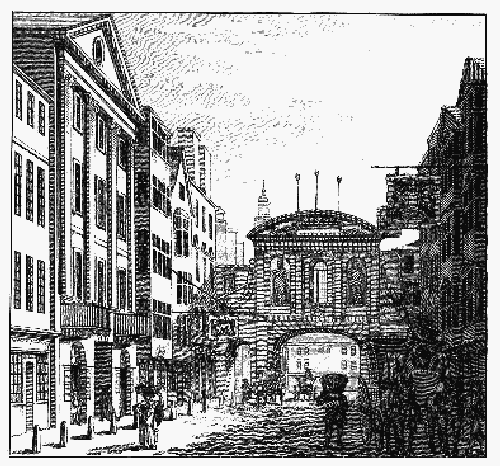
S. Wale delin. E. Rooker sc. Entrance into the Temple & Temple Bar.
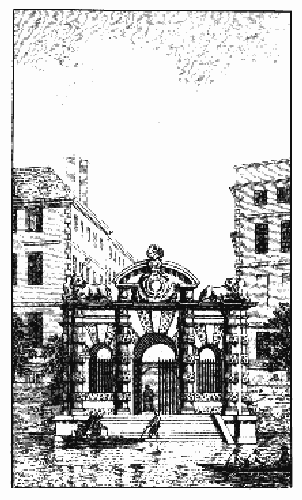
S. Wale delin. E. Rooker sc. York Stairs.
Tenths Office, in the Temple. In this office is a receiver of the tenths and his clerk, and a comptroller of the first fruits and tenths.
Tenter alley, 1. Little Moorfields.☐ 2. Tooly street, Southwark.☐
Tenter Ground alley, Castle street.☐
Tenter grounds, Curtain row, Norton Falgate: 2. Gravel lane: 3. Hog lane, Shoreditch.
The Tents, near Maze pond, Snow fields.
Terras walk, York buildings.
Territs court, Duck lane, Smithfield.† 2. Islington.†
Thacket’s court, Bishopsgate street without.†
Thackham’s court, Vine street, by Chandois street.†
Thames. As this river is the principal source of the wealth of this metropolis, and as the Lord Mayor’s jurisdiction over it is very extensive, a particular description of it in this place can be neither improper nor unnecessary.
The Thames if considered with respect to its course and navigation, is not to be equalled by any other river in the known world. It rises from a small spring near the village of Hemble, in the parish of Cubberly or Coberley, a little to the south-west of Cirencester in Gloucestershire; and taking its course eastward, becomes navigable at Lechlade for vessels of fifty tons, and there receives the river Colne about 138 miles from London. From Lechlade it continues its course north-east to Oxford, where it receives the Charwel; after which it runs south-east to Abingdon, and from thence to Dorchester, where it receives the Thame, and continues its course south-east by Wallingford to Reading, flowing through Berkshire, Buckinghamshire, Surry, Middlesex, Essex and Kent, and washing the towns of Henly, Marlow, Maidenhead, Windsor, Eaton, Staines, Chertsey, Weybridge, Shepperton, Walton, Sunbury, Hampton, Thames Ditton, Kingston, Twickenham, Richmond, Shene, Isleworth, Kew, Brentford, Mortlake, Barnes, Chiswick, Hammersmith, Putney, Fulham, Wandsworth, Battersea, Chelsea, and Lambeth, from whence both shores may be termed a continued city, through Westminster, Southwark, and the city of London, Horselydown, Wapping, Rotherhith, Shadwell, Ratcliff, Limehouse, almost to Deptford, and Greenwich; and from thence this river proceeds to Woolwich, Erith, Grays, Gravesend and Milton.
It is impossible to represent the beauties with which the banks of this noble river are embellished from Windsor to London; the numerous villages on both its banks being all along adorned with the magnificent houses and fine gardens of the nobility.
A person unaccustomed to the sight, cannot behold without surprise the vast number of barges and boats, as well of pleasure as of burden, above bridge, continually passing and repassing for the convenience and supply of the towns and counties washed by its gentle stream; and much more observe the vast fleets which constantly appear below bridge, carrying away the manufactures of Britain and bringing back the produce of the whole earth.
We should be inexcusable, if we did not here introduce Sir John Denham’s fine description of this river, in his Cooper’s Hill, as it would be difficult to say any thing so just, and impossible to say any thing so well upon the subject.
My eye descending from the hill surveys Where Thames among the wanton valleys strays. Thames, the most lov’d of all the Ocean’s sons, By his old sire to his embraces runs, Hasting to pay his tribute to the sea, Like mortal life to meet eternity. Tho’ with those streams he no resemblance hold, Whose foam is amber, and their gravel gold; His genuin and less guilty wealth t’explore, Search not his bottom, but survey his shoar; O’er which he kindly spreads his spacious wing, And hatches plenty for th’ ensuing spring. Nor then destroys it with too fond a stay, Like mothers which their infants overlay. Nor with a sudden and impetuous wave, Like profuse Kings, resume the wealth he gave. No unexpected inundations spoil The mower’s hopes, nor mock the plowman’s toil: But godlike his unwearied bounty flows; First loves to do, then loves the good he does. Nor are his blessings to his banks confin’d, But free and common as the sea or wind; When he to boast, or to disperse his stores Full of the tributes of his greateful shores Visits the world, and in his flying tow’rs Brings home to us, and makes both Indies ours; Finds wealth where ’tis, bestows it where it wants, Cities in deserts, woods in cities plants. So that to us nothing, no place is strange, While his fair bosom is the world’s exchange. O could I flow like thee, and make thy stream My great example, as it is my theme! Tho’ deep yet clear, tho’ gentle, yet not dull, Strong without rage, without o’erflowing full. Heav’n her Eridanus no more shall boast, Whose fame in thine, like lesser currents lost.
The great advantage of this river is the tides flowing above seventy miles up it, twice in every twenty-four hours, and hence arises its great convenience with respect to trade and navigation; and as the tide is influenced by the moon, so each tide is twenty-four minutes later than that before, and therefore wants but twelve minutes of a whole hour in twenty-four: by this rule the return of the tide at any distance from the new or full moon may be easily computed by the following tide table at London Bridge.
Time of high-water at London
N. Moon. F. Moon. Hour. Min. 3
1 3 48
2 4 31
3 5 14
4 6 52
5 6 30
6 7 3
7 7 36
8 8 24
9 9 27
10 10 30
11 11 28
12 12 26
13 1 19
14 2 12
Any person who wants to be informed when it will be high-water at London Bridge may by this table be immediately satisfied if he does but know how many days it is since the last new or full moon; for supposing it is the eighth day after, by looking at 8 in the first column he finds the tide on that day is at the 8th hour and 24 minutes, or twenty-four minutes past eight o’clock.
The Lord Mayor’s jurisdiction over the river Thames extends from Colne ditch, a little to the westward of Staines bridge, to Yendal or Yenleet, to the east, including part of the rivers Medway and Lea, and his Lordship has a deputy or substitute named the water bailiff, whose office is to search for, and punish, all offenders who infringe the laws made for the preservation of the river and its fish. Eight times in the year the Lord Mayor and aldermen sit in person in the four counties of Middlesex, Surry, Kent, and Essex, in order to maintain the rights and privileges of this river, and to charge four juries by oath to make inquisition after all offences committed on the river in order to proceed to judgment against those who are found guilty.
The laws with respect to fishing and preserving the fry and spawn are very numerous, among which are the following:
No fisherman shall use any net under two inches and a half in the mesh above Richmond Crane, nor any net in the work called beating of the bush, flag or reed, of less than three inches in the mesh; nor use any weights or stones to their nets, upon the forfeiture of 2l. for each offence.
That no pike net or other net or engine be drawn over the weeds for catching of pikes by any fisherman within the jurisdiction of the Lord Mayor, by reason it is destructive to, and occasions the driving of all the other fish out of the western rivers, that would otherwise lie, spawn, and breed in the weeds, upon the same penalty of 2l. for every such offence.
That no fisherman shall bend any net by anchors, or otherwise, across the channel, or so as to draw another net into it, whereby the spawn of barbel and other fish may be destroyed, upon the forfeiture of the same sum for each offence.
That no such person shall draw any net for salmon of less than three inches in the mesh, from the 10th of March, till the 14th of September, in any part of the river of Thames, from Kew pile westward, to the city of London mark Stone above Stains bridge, upon forfeiture of 2l. for every offence.
That no person shall take or sell any fish contrary to the ancient assize: pike, fourteen inches; barbel, twelve inches; salmon, sixteen inches; trout, eight inches; tench, eight inches; roach, six inches; dace, six inches; and flounders, six inches.
That every fisherman shall have on his boat both his christian and surname, and the name of his parish legibly painted, where any one may see it; on the forfeiture of 1l. for every offence.
No person whatsoever shall fish for smelts or shads, or any other fish whatsoever, or lay leaps, or rods, for eels in any place within the Lord Mayor’s jurisdiction, without a licence from the water bailiff, who shall appoint the proper seasons for fishing: And that upon every such occasion all the fishermen shall upon due summons or notice given, repair to the water bailiff at the chapel at Guildhall, to take out their several licences for going to fish, and to hear the ordinances for the preservation of the fisheries publicly read, that they may be the better able to preserve and keep them; and that none go out to fish without such a licence; and that every fisherman offending herein shall pay 5l. for every such offence.
For the better preventing the use of unlawful nets or engines it is farther ordained, that any person or persons authorized by the water bailiff may enter any fishermens boats or vessels, to view and search for all unsizeable nets and engines, and for any fish they shall suspect to be taken contrary to the laws of this kingdom; to seize and carry such nets to the water bailiff, with the names of the offenders, that they may be brought to justice; likewise to seize the fish taken contrary to law, and distribute it among the poor; and whosoever shall resist or disturb the water bailiff, or his deputies, in their searching for and seizing unlawful nets, engines, or fish, shall forfeit twenty marks.
Tho’ the Thames is said to be navigable an hundred and thirty eight miles above bridge, yet there are so many flats in that course, that in the summer season the navigation westward would be entirely put a stop to when the springs are low, were it not for a number of locks or machines made of wood, placed quite across the river, and so contrived as to confine the current of water as long as found convenient; that is, till the water rises to such a height as to allow depth enough for the barges to pass over the shallows; which being effected, the confined water is set at liberty, and the loaded vessel proceeds on its voyage, till another shoal requires the same contrivance to carry it forward: but though this is a very great convenience yet it is attended with considerable expence; for a barge passing from Lechlade to London pays for passing through these locks 13l. 15s. 6d. and from Oxford to London 12l. 18s. This charge is however only in summer when the water is low: and there is no lock on this river from London Bridge to Bolter’s lock, that is for the space of fifty-one miles and an half above bridge.
Thames street, is of a prodigious length, it extending from Black Friars to Tower Dock. It is the first street that lies parallel to the Thames, on its north bank, and is chiefly inhabited by wholesale dealers.
Thatch’d alley, Chick lane.
Thatch’d House alley, in the Strand.
Thatch’d House court, St James’s street.
Thavie’s Inn, near the west end of St. Andrew’s church Holbourn, is one of the inns of chancery, and is thus named from its founder John Thavie, who liv’d in the reign of Edward III. It is a member of Lincoln’s inn, and has been lately rebuilt in a very handsome manner.
This house is governed by a principal and eleven ancients, who, with the other members, are to be ten days in commons in issuable terms, and in each of the rest a week.
Thavie’s Inn court, Thavie’s inn.
Thavie’s Inn passage, Thavie’s inn.
Theatres, there are only two theatres in this metropolis worthy of notice, and these have no fronts to the street. They are both under his Majesty’s companies of comedians, and no new play can be acted in either without the approbation of the Lord Chamberlain, as well as the managers. Drury Lane house appears to be best calculated for the advantage of speaker and hearer, that of Covent Garden for splendor and magnificence. Besides these there is also a theatre for the exhibition of operas, call’d the Opera house, in the Haymarket.
Theatre court, Vinegar yard, Drury lane.
Theobalds, a pleasant village in Cheshunt parish in Hertfordshire, situated by the New River. Here the great Lord Burleigh built a magnificent seat, the gallery, says Hentzner in his Itinerarium, was painted with the genealogy of the Kings of England, and from thence was a descent into the garden, which was encompassed with a ditch filled with water, and large enough to have the pleasure of rowing in a boat between the shrubs; it was adorned with a great variety of trees and plants, labyrinths made with much labour, a jet d’eau with its bason of white marble, and with columns and pyramids. In the summer house, the lower part of which was built semicircularly, were the twelve Roman Emperors in white marble, and a table of touchstone; the upper part of it was set round with leaden cisterns, into which water was conveyed through pipes. This seat the Lord Burleigh gave to his younger son Sir Robert Cecil, in whose time King James I. staying there for one night’s refreshment, as he was coming to take possession of the crown of England, he was so delighted with the place that he gave him the manor of Hatfield Regis in exchange for it, and afterwards enlarged the park, and encompassed it with a wall ten miles round. This palace he often visited, in order to enjoy the pleasure of hunting in Enfield Chase and Epping Forest, and at last died there. In the civil wars it was however plundered and defaced; it being the place from whence King Charles I. set out to erect his standard at Nottingham: King Charles II. granted the manor to George Monk, Duke of Albemarl; but it reverting again to the crown, for want of heirs male, King William III. gave it to William Bentinck, whom he created Earl of Portland, from whom it descended to the Duke his grandson: the great park, a part of which was in Hertfordshire, and a part in Middlesex, is now converted into farms.
Here are several houses belonging to persons of distinction, and in this neighbourhood Richard Cromwell, who had been protector, but abdicated, passed the last part of his life in a very private manner.
Theobald’s court, 1. in the Strand: 2. Theobald’s row.†
Theobald’s row, Red Lion street, Holbourn.†
Thieving lane, King street, Westminster. So called from thieves passing that way to the Gatehouse prison, during the continuance of the sanctuary. Maitland.
Thistleworth, or Isleworth. See Isleworth. Maitland.
St. Thomas Apostles, a church which stood where the cemetry is now in Queen street, Cheapside, and was of great antiquity, since we have an account of the state thereof so early as the year 1181. It owes its name to its dedication to St. Thomas the Apostle.
This church being destroyed by the dreadful fire of London in 1666, and not rebuilt, the parish was by act of parliament united to the church of St. Mary Aldermary, which is become the place of public worship for both, whereby the incumbent’s profits are considerably increased.
St. Thomas of Acars, or Acons, an hospital formerly situated where Mercers chapel now stands in Cheapside. This hospital was under this name dedicated to St. Thomas a Becket archbishop of Canterbury, probably upon the following occasion: when the city of Acars or Acon in the Holy Land was besieged by the Christians, an Englishman, chaplain to Radulphus de Diceto, dean of London, going to Jerusalem, bound himself by a vow that if he should prosperously enter Acon he would build a chapel to St. Thomas the Martyr at his own charge, and also procure a church-yard to be consecrated there to the honour of that supposed Martyr; this he actually performed, when many resorting to his chapel, he took the character of prior, and employed himself sometimes in fighting as a soldier, and at others, in burying the bodies of such as died either naturally or were slain by the enemy. Maitland.
Matthew Paris however says that the order of St. Thomas was instituted by Richard surnamed Cœur de Lyon, after the surprisal of Acars, in honour of Thomas a Becket; that they held the rule of St. Augustine, and wore a white habit, and a full red cross, charged in the middle with a white scallop, and that Peter de Rupibus, bishop of Winchester, being in the Holy Land, caused the patriarch of Jerusalem to direct that the brethren of this church should be under the order of the Templars. M. Paris in vita Hen. III.
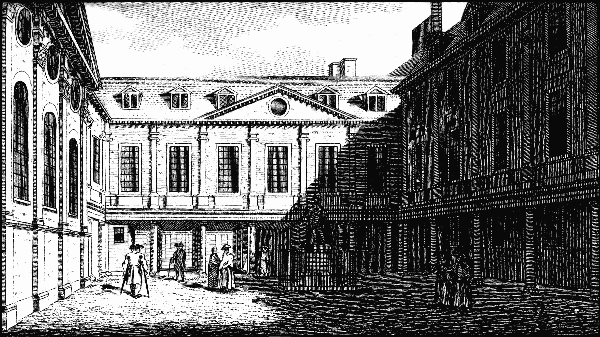
S. Wale delin. Elliot. sculp. St. Thomas’s Hospital.
However it is evident, that as the Templars and other orders, formed societies in England in imitation of those founded in Palestine, so this in Cheapside was founded in imitation of that at Acon, and therefore had the same name.
The revenue of this hospital, when it was surrendered to Henry VIII. amounted to 277l. 3s. 4d. per annum. The edifice was soon after purchased by the Mercer’s company. The image of Thomas a Becket however stood over the gate, till the beginning of the reign of Queen Elizabeth, when somebody threw it down, broke it, and stuck up a writing on the church door, reflecting on those who placed it there. See the article Mercers.
Thomas court, 1. Benjamin street: 2. Tackle Block court, Wapping.
St. Thomas’s Hospital, on the east side of the street called the Borough in Southwark, is a very noble and extensive charity, for the reception of the necessitous sick and wounded.
As to the origin of this hospital, it is to be observed, that the priory of St. Mary Overies being destroyed by fire in the year 1207, the canons erected at a small distance an occasional edifice to answer the same purpose, till their monastery could be rebuilt; which being accomplished, Peter de Rupibus, Bishop of Winchester, for the greater convenience of air and water, pulled it down in 1215, and erected it in a place where the prior of Bermondsey had two years before built an almonry, or almshouse, for the reception of indigent children, and necessitous proselytes; and having dedicated the new structure to St. Thomas the Apostle, he endowed it with land to the value of 343l. a year: from which time it was held of the abbot of Bermondsey, and ever since an hospital has continued in the same place.
In 1428, one of the abbots granted the foundation lands to Nicholas Buckland, the master of the hospital, and in that condition they remained, till at the dissolution of religious houses in the reign of Henry VIII. this fell with the rest.
In the year 1551 the Lord Mayor and Citizens having purchased of King Edward VI. the manor of Southwark, with its appurtenances, for the sum of 647l. 2s. 1d. a part whereof being this hospital, the city immediately repaired and enlarged it at the expence of about 1100l. and in November following receiving into it two hundred and sixty poor sick and helpless objects, the hospital still retained its antient name, St. Thomas’s, and in 1553 the King incorporated a society of persons for its government, in common with the two other great charities, Bridewell and Christ’s Hospital.
Though the great fire of London in 1666 spared this hospital, it destroyed a great part of its possessions, and two others which happened a few years after in Southwark added to the distress. By these accidents the hospital of St. Thomas was almost reduced to ruin. The building was old, and wanted great repairs, and the funds that should have supported it were exhausted; but the benevolence of the principal persons in the city interposed for its preservation; the governors in 1699 set on foot a voluntary subscription, which they opened by large donations from themselves and their friends, and the public followed the example. The building was begun upon a larger and more commodious plan, and erected at different times by the assistance of different benefactors, till it became entirely completed, and consists in the whole of three quadrangles or square courts.
Next the street is a handsome pair of large iron gates, with a door of the same work on each side for the convenience of foot passengers. These are fastened on the sides to a stone pier, on each of which is a statue representing one of the patients. These gates open into a very neat square court, encompassed on three sides with a colonade, surrounded with benches next the wall, for people to sit down. On the south under an empty niche is the following inscription,
This building on the south side of this court, containing three wards, was erected at the charge of Thomas Frederick of London, Esq; a worthy governor and liberal benefactor to this hospital, Anno 1708.
Under the same kind of niche on the opposite side is this inscription,
This building on the north side of this court, containing three wards, was erected at the charge of Thomas Guy, Esq; Citizen and Stationer of London, a worthy governor and bountiful benefactor to this hospital, Anno 1707.
The centre of the principal front, which is on the west side, facing the street, is of stone. On the top is a clock under a small circular pediment, and beneath that a niche with a statue of Edward VI. holding a gilt sceptre in his right hand, and the charter in his left. A little lower in niches on each side is a man with a crutch, and a sick woman: and under them, in other niches, a man with a wooden leg, and a woman with her arm in a sling: over the niches are festoons, and between the last mentioned figures the King’s arms in relievo. Under which is the following inscription,
King Edward the Sixth, of pious memory, in the year of our Lord 1552 founded and endowed this Hospital of St. Thomas the Apostle, together with the Hospital of Christ and Bridewell in London.
Underneath is a spacious passage down several steps into the second court, which is by far the most elegant. It has colonades like the former, except at the front of the chapel which is on the north side, and is adorned with lofty pilasters of the Corinthian order, placed on high pedestals which rise from the ground, and on the top is a pediment, as there is also in the centre of the west and east sides: and above the piazzas the fronts of the wards are ornamented with handsome Ionic pilasters.
In the midst of this court is a good brass statue of King Edward VI. by Mr. Scheemakers, and behind him is placed upon a kind of small pedestal his crown laid upon a cushion. This statue is surrounded with iron rails, and stands upon a lofty stone pedestal, upon which is the following inscription in capitals:
This statue Of King Edward the Sixth, A most excellent Prince, Of exemplary Piety and Wisdom above his years; The glory and ornament of his age, and most munificent founder Of this hospital, Was erected at the expence Of Charles Joyce, Esquire, in the year mdccxxxvii.
On the opposite face of the pedestal is the same inscription in Latin.
In the middle of the east side of this court is a spacious passage into the next, the structure above being supported by rows of columns. The buildings in the third court are older than the others, and are entirely surrounded with a colonade, above which they are adorned with a kind of long slender Ionic pilasters, with very small capitals. In the centre is a stone statue of Robert Clayton, Esq; dressed in his robes as Lord Mayor, surrounded with iron rails, upon the west side of the pedestal is his arms in relievo, and on the south side the following inscription:
To Sir Robert Clayton, knight, born in Northamptonshire, Citizen and Lord Mayor of London, president of this hospital, and vice president of the new work-house, and a bountiful benefactor to it; a just magistrate, and brave defender of the liberty and religion of his country. Who (besides many other instances of his charity to the poor) built the girls ward in Christ’s hospital, gave first toward the rebuilding of this house 600l. and left by his last will 2300l. to the poor of it. This statue was erected in his life time by the governors, An. Dom. mdcci. as a monument of their esteem of so much worth; and to preserve his memory after death, was by them beautified Anno Dom. mdccxiv.
By this noble charity many hundred thousand of the poor have since its foundation received relief, and been cured of the various disorders to which human nature is subject; and though the estates at first belonging to this foundation were ruined, yet by the liberal munificence of the citizens since that time, the annual disbursements have of late amounted to near 8000l. The house contains nineteen wards, and 474 beds, which are constantly kept filled, and they have always a considerable number of out-patients.
The number of governors in this and the other city hospitals are unlimited, and therefore uncertain. They chuse their own officers and servants, both men and women: these are a president, a treasurer, an hospitaller or chaplain, four physicians, three surgeons, an apothecary, a clerk, a steward, a matron, a brewer and butcher, a cook, assistant and servant, an assistant clerk in the compting house, two porters, four beadles, nineteen sisters, nineteen nurses, nineteen watch-women, a chapel clerk and sexton, and one watchman.
St. Thomas’s lane, Drury lane.*
Thomas’s rents, Fore street, Limehouse.
St. Thomas’s Southwark, on the north side of St. Thomas’s street was erected for the use of the above hospital, from which it is denominated; but the number of houses and inhabitants having greatly increased in the precinct of that hospital, it was judged necessary to make the church parochial for the use of the inhabitants, and to erect a chapel in the hospital for the use of the patients. This church is therefore neither a rectory, vicarage, nor donative, but a sort of impropriation in the gift of the hospital.
This church is a plain brick building enlightened by one series of large windows, and the corners strengthened and adorned with rustic, as is the corners of the tower. The principal door has a cornice supported by scrolls and a circular pediment, and the tower, instead of a balustrade, is crowned with a blocking course of the Attic kind.
St. Thomas’s street, near St. Thomas’s hospital, in the Borough, Southwark.
Thomas street, 1. Coverleads Fields, Spitalfields. 2. Gainsford street, Horselydown lane: 3. Shoreditch Fields: 4. Virginia row, East Smithfield.
Thompson’s rents, 1. Halfmoon alley.† 2. London Wall.†
Thompson’s yard, upper ground, Southwark.†
Thrall street, Spitalfields.
Threadneedle alley, Little Moorfields.
Threadneedle street, extends from Princes street opposite the Lord Mayor’s mansion-house, and running by the back of the Royal Exchange, reaches into Bishopsgate street.
Three Anchor alley, Shoe lane, Fleet street.*
Three Bell alley, Whitechapel.*
Three Bowl alley, Moorfields.*
Three Bowl court, Houndsditch.*
Three CCC court, Garlick hill, Thames street.*
Three Colts alley, 1. near Bishopsgate street within.* 2. Cinnamon street.*
Three Colts court, Three Colts street Limehouse.*
Three Colts corner, St. John street.*
Three Colts lane, Air street, Spitalfields.*
Three Colts street, Limehouse.*
Three Colts yard, 1. Crutched Friars, near Tower Hill.* 2. London Wall.* 3. Mile-end.* 4. Three Colts street.*
Three Compasses alley, East Smithfield.*
Three Compasses court, near Brook street.*
Three Coney walk, Butt’s street, Lambeth.*
Three Crane court, Southwark.*
Three Crane lane, Thames street.*
Three Crane stairs, at the bottom of Queen street, Cheapside.*
Three Cranes, a street by Thames street.
Three Crane wharf, three Crane stairs.
Three Crown court, 1. in the Borough.* 2. Castle street.* 3. Foster lane, Cheapside.* 4. Garlick hill, Thames street. 5. In the Minories.* 6. Poor Jewry lane, Aldgate.* 7. Wheeler street, Spitalfields.* 8. White’s alley, Little Moorfields.*
Three Crown yard, Bride lane, Fleet street.
Three Cup alley, 1. Dean street.* 2. Shoreditch.*
Three Cup yard, Bedford street.*
Three Dagger court, 1. Fore street, Crippelgate.* 2. Old Change.*
Three Diamonds court, Hosier lane, Smithfield.
Three Falcons alley, St. Margaret’s hill.*
Three Falcons court, 1. Fleet street.* 2. St. Margaret’s hill.*
Three Fox court, 1. Clements lane.* 2. Long Acre.* 3. Long lane, Smithfield.* 4. Narrow street, Ratcliff.* 5. Three Fox yard.*
Three Fox yard, Ratcliff.*
Three Griffin yard, Aldgate street.*
Three Gun lane, Three Colts street, Lambeth.*
Three Hammer alley, Green alley, Tooley street.*
Three Hats alley, Horselydown lane.*
Three Herrings court, 1. Creechurch lane, Leadenhall street.* 2. Long Acre.* 3. Redcross street, Crippelgate.* 4. St. Thomas’s in the Borough.*
Three Hoop yard, Holiwell street.*
Three Horseshoe alley, Old street, Upper Moorfields.*
Three Horseshoe court, 1. Chick lane, Smithfield.* 2. Giltspur street, without Newgate.* 3. Long lane, Smithfield.* 4. Whitecross street, Cripplegate.*
Three Horseshoe yard, James’s street.*
Three King’s court, 1. Chandois street.* 2. Clement’s lane.* 3. Fleet street.* 4. King street, Covent Garden.* 5. Lombard street.* 6. in the Minories.* 7. Whitecross street, Cripplegate.*
Three King’s yard, David street, Grosvenor square.*
Three Leg alley, East Harding street, by Shoe lane, Fleet street.*
Three Leg court, Whitecross street, Cripplegate.*
Three Link alley, Fashion street, Spitalfields.*
Three Mariners court, Fleet street, Spitalfields.*
Three Mariners stairs, Rotherhith.*
Three Moulds court, Cherry-tree alley.*
Three Needle alley, Moorfields.*
Three Nuns alley, Threadneedle street.*
Three Nuns court, Threadneedle street.*
Three Nuns yard, Whitechapel.*
Three Oaks lane, Horselydown.*
Three Pigeons alley, Hockley in the Hole.*
Three Pigeons court, 1. Barbican, Aldersgate street.* 2. Jewin street, Aldersgate street.* 3. Moorfields.*
Three Sisters court, St. Catharine’s court, by the Tower.*
Three Slipper court, Bishopsgate street.*
Three Step alley, Rotherhith.
Three Stills court, Bishopsgate without.*
Three Tuns alley, 1. Bishopsgate street without.* 2. Cowcross, Smithfield.* 3. London wall.* 4. St. Margaret’s hill, Southwark.* 5. Petticoat lane, Whitechapel.* 6. Thames street.* 7. Tothill street, Westminster.* 8. White street by Kent street, Southwark.*
Three Tuns court, 1. Crooked lane.* 2. Brown’s street.* 3. Halfmoon alley.* 4. Hart street, Mark lane.* 5. Ivy lane, Newgate street.* 6. St. Margaret’s hill, Southwark.* 7. St Michael’s lane, Great Eastcheap.* 8. Moorfields.* 9. Nightingale lane East Smithfield.* 10. Old Castle street, Wentworth street.* 11. Redcross street, Cripplegate.* 12. Threadneedle street.*
Three Tuns yard, Cloth fair, Smithfield.*
Three Twisters alley, Bunhill row.*
Thrift street, Soho.†
Thrift’s alley, Spring street.†
Throgmorton street, extends from Broad street to the end of Bartholomew lane.
Throwsters yard, Lamb alley.
Thrum street, King street, Cheapside.
Thrum yard, Sutton street.
Thunderbolt alley, Windmill row. Upper Moorfields.
Thwait’s rents, Newington Causeway.†
Tichbourn court, 1. Holbourn.† 2. Vine yard, Drury lane.†
Tichfield street, 1. Chapel street: 2. Margaret street.†
Tidewaiters court, Little Minories.
Tilbury, or West Tilbury, a very ancient town in Essex, situated near the Thames; here the four proconsular ways made by the Romans, crossed each other, and in the year 630, this was the see of a bishop named Ceadda, who converted the East Saxons, In the reigns of Edward I. Edward II. and Edward III. it was held of the crown by the family of the Tilburies, and from them probably took its name. It is situated by level unhealthy marshes called the Three Hundreds, which are rented by the farmers, salesmen and grazing butchers of London, who generally stock them with Lincolnshire and Leicestershire weathers, which are sent hither from Smithfield in September and October, and fed here till Christmas or Candlemas; and this is what the butchers call right marsh mutton.
Tilbury fort, is situated in the marsh on the bank of the Thames, at some distance from the above town, from which it took its name, and is placed opposite to Gravesend. It is a regular fortification, and may justly be termed the key of the city of London. The plan was laid by Sir Martin Beckman, chief engineer to King Charles II. who also designed the works at Sheerness. It was intended to be a pentagon, but the water bastion was never built.
The foundation is laid upon piles driven down in two ranges, one over the other, which reach below the channel of the river, and the lowermost being pointed with iron, enter the solid chalk rock, which extends under the Thames and joins to the chalk hills on the other side. The esplanade of the sort is very large, and the bastions which are faced with brick are said to be the largest of any in England. It has a double moat, the innermost of which is 180 feet broad; with a good counterscarp, a covered way, ravelins, and terails. On the land side are also two small redoubts of brick; but its chief strength on that side consists in its being able to lay the whole level under water, and by that means to render it impossible for an enemy to carry on approaches that way.
On the side next the river is a very strong curtain, with a noble gate, called the water-gate in the middle, and the ditch is palisadoed. Before this curtain is a platform in the place of a counterscarp, on which are planted 106 cannon, carrying from 24 to 46 pounds each, besides smaller ones planted between them; and the bastions and curtains are also planted with guns. Here likewise is a high tower called the blockhouse, which is said to have been built in the reign of Queen Elizabeth.
Tilers and Bricklayers, a fraternity of considerable antiquity, though it was not incorporated till the year 1568, when Queen Elizabeth granted them letters patent.
This company consists of a master, two wardens, thirty-eight assistants, and 103 liverymen, who, upon their admission, pay a fine of 12l.
They have a convenient hall in a court in Leadenhall street. Maitland.
Tilt yard, Whitehall. So called from the tilts and tournaments formerly used there. Maitland.
Tin Plate Workers, a company incorporated by letters patent granted by King Charles II. in the year 1670; by the name of the master, wardens, assistants and commonalty of the art and mystery of Tin Plate Workers, alias Wire Workers of the city of London.
This fraternity is governed by a master, two wardens, and twenty assistants; but has neither hall nor livery. Maitland.
Tinderbox alley, Norton Falgate.
Tinderbox court, White Lion yard.
Tite’s alley, Limehouse.†
Tittenhanger, three miles south-east of St. Albans, is situated near Colney, and is a very handsome seat belonging to Sir Henry Pope Blunt, Bart.
Titmouse alley, Farmer’s street, Shadwell.
Titus’s court, Holbourn hill.†
Tobaccopipe alley, 1. Little St. Anne’s lane.* 2. Sun yard, Nightingale lane, East Smithfield.*
Tobaccopipe Makers, a company incorporated by letters patent, granted by King Charles II. in the year 1663.
They are governed by a master, two wardens, and eighteen assistants; but have neither hall nor livery. Maitland.
Tobaccopipe yard, Old Gravel lane, Ratcliff Highway.*
Tobacco Roll court, 1. Gracechurch street*, 2. Long alley, Moorfields.*
Tobacco Roll yard, Sun yard, Nightingale lane.*
Tokenhouse yard, 1. Leadenhall street: 2. A very handsome place in Lothbury, chiefly inhabited by merchants.
Tom’s yard, Whitechapel.†
Tongue’s alley, Whitechapel.†
Tongue’s yard, Whitechapel.†
Tonson’s wharf, Puddle Dock.†
Tooley’s gate, Tooley street.†
Tooley’s gate yard, Tooley street.†
Tooley’s stairs, Tooley street.†
Tooley street, the first street in Southwark next London Bridge.†
Tooley’s Watergate, Tooley street.†
Tooley’s Watergate stairs, Tooley street.†
Torment hill, Broadway.
Tothil court, Tothil street.
Tothilfields, Peter street, Westminster.
Tothilfields School, situated in Rochester row, Tothilfields, was founded by Emery Hill, Esq; in the year 1667, for the instruction of twenty boys of the parish of St. Margaret, Westminster, in english, latin, writing and arithmetic. Maitland.
Tothil Side, Tothilfields.
Tothil street, Broad Sanctuary, Westminster.
Tottenham Court, a pleasant village situated between St. Giles’s and Hampstead.
Tottenham court road, St. Giles’s.
Tottenham High Cross, a village on the west side of the river Lea, five miles north-east from London in the road to Ware. David King of Scotland being possessed of this manor, after it had belonged to the Earls of Northumberland and Chester, gave it to the monastery of the Trinity in London; but Henry VIII. granted it to William Lord Howard of Effingham, who being afterwards attainted, it reverted again to the King, who then granted it to the dean and chapter of St. Paul’s to whom it still belongs. The present Earl of Northumberland and the Lord Colerain have seats here, and there are also a great number of pretty houses belonging to the citizens of London, the church stands on a hill, which has a little river called the Mosel at the bottom, to the west, north and east.
The parish is divided into four wards, viz. 1. Nether ward, in which stands the parsonage and vicarage: 2. Middle ward, comprehending Church end, and Marsh street. 3. High Cross ward, containing the hall, the mill, Page green, and the High cross; and 4. Wood Green ward, which comprehends all the rest of the parish, and is bigger than the three other wards put together.
The cross, which gives name to the place, was once much higher than it is at present, and upon that spot Queen Eleanor’s corps was rested, when on the road from Lincolnshire to London. St. Loy’s well, in this parish, is said to be always full, and never to run over; and the people report many strange cures performed at Bishop’s Well. In 1596, an almshouse was founded here by one Zancher, a Spaniard, the first confectioner ever known in this kingdom. Here are also a free-school, and a charity school for twenty-two girls, who are cloathed and taught.
Tower of London, on the east side of the city, near the Thames. This edifice, at first consisted of no more than what is at present called the White Tower; and without any credible authority, has been vulgarly said to have been built by Julius Cæsar; though there is the strongest evidence of its being marked out, and a part of it first erected by William the Conqueror in the year 1076, doubtless with a view to secure to himself and followers a safe retreat, in case the English should ever have recourse to arms to recover their liberties. That this was the Conqueror’s design, evidently appears from its situation on the east side of London, and its communication with the Thames, whence it might be supplied with men, provisions, and military stores, and it even still seems formed for a place of defence rather than offence.
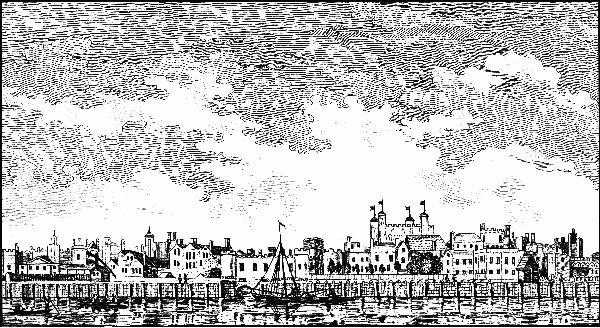
S. Wale delin. Elliot sculp. The Tower.
However the death of the Conqueror in 1087, about eight years after he had begun this fortress, for some time prevented its progress, and left it to be completed by his son William Rufus, who in 1098 surrounded it with walls, and a broad and deep ditch, which was in some places 120 feet wide, several of the succeeding Princes added additional works, and Edward III. built the church.
Since the restoration, it has been thoroughly repaired: in 1663 the ditch was scoured; all the wharfing about it was rebuilt with brick and stone, and sluices made for letting in and retaining the Thames water as occasion may require: the walls of the White Tower, have been repaired; and a great number of additional buildings have been added. At present, besides the White Tower, are the offices of Ordnance, of the Mint, of the keepers of the records, the jewel office, the Spanish armoury, the horse armoury, the new or small armoury, barracks for the soldiers, handsome houses for the chief officers residing in the Tower, and other persons; so that the Tower now seems rather a town than a fortress. Lately new barracks were also erected on the Tower wharf; and the ditch was in the year 1758, railed round to prevent for the future those melancholy accidents which have frequently happened to people passing over Tower Hill in the dark.
The Tower is in the best situation that could have been chosen for a fortress, it lying only 800 yards to the eastward of London Bridge, and consequently near enough to cover this opulent city from invasion by water. It is to the north of the river Thames, from which it is parted by a convenient wharf and narrow ditch, over which is a drawbridge, for the readier taking in or sending out ammunition and naval or military stores. Upon this wharf is a line of about sixty pieces of iron cannon, which are fired upon days of state.
Parallel to this part of the wharf upon the walls is a platform seventy yards in length called the Ladies line, from its being much frequented in summer evenings by the ladies, as on the inside it is shaded with a row of lofty trees, and without affords a fine prospect of the shipping, and of the boats passing and repassing the river. The ascent to this line is by stone steps, and being once upon it, you may walk almost round the Tower walls without interruption, in doing which you will pass three batteries, the first called the Devil’s battery, where is a platform, on which are mounted seven pieces of cannon: the next is named the Stone battery, and defended by eight pieces of cannon; and the last, called the Wooden battery is mounted with six pieces of cannon: all these are brass, and nine pounders.
But to return to the wharf, which is divided from Tower Hill at each end, by gates opened every morning for the convenience of a free intercourse between the respective inhabitants of the tower, the city, and its suburbs. From this wharf is an entrance for persons on foot over the drawbridge, already mentioned; and also a water-gate under the Tower wall, commonly called Traitor’s Gate, through which it has been customary, for the greater privacy, to convey traitors and other state prisoners by water, to and from the Tower: the water of the ditch having here a communication with the Thames, by means of a stone bridge on the wharf. However the Lords committed to the Tower for the last rebellion, were publicly admitted at the main entrance. Over this water-gate, is a regular building terminated at each end by a round tower, on which are embrasures for cannon, but at present none are mounted there. In this building are an infirmary, a mill, and the water-works that supply the Tower with water.
The principal entrance into the Tower is by two gates to the west, one within the other, and both large enough to admit coaches and heavy carriages. Having passed thro’ the first of these you proceed over a strong stone bridge, built over the ditch, which on the right-hand leads to the lions tower, and to a narrow passage to the draw bridge on the wharf, while on the left-hand is a kind of street in which is the Mint. The second gate is at a small distance beyond the lions tower, and is much stronger than the first, it has a portcullis to let down upon occasion, and is guarded not only by some soldiers, but by the warders of the Tower, whose dress and appearance will be immediately described.
The Officers of the Tower. The principal of these to whom the government of the Tower is committed, are, first the Constable of the Tower, who has 1000l. per annum, and is usually a person of quality, as his post at all coronations and state ceremonies, is of the utmost importance, and as the crown and other regalia are in his custody: he has under him a Lieutenant, and a deputy Lieutenant; these officers are likewise of great dignity; the first has 700l. a year, and the last, who is commonly called the Governor of the Tower, has 1l. a day. The other officers are, a tower-major, a chaplain, a physician, a gentleman-porter, a yeoman-porter, a gentleman-jailer, four quarter-gunners, and forty warders, who wear the same uniform as the King’s yeomen of the guard. They have round flat crowned caps, with bands of party-coloured ribbands: Their coats, which are of a particular make, but very becoming, have large sleeves, and very full skirts gathered round, somewhat in the manner of a petticoat. These coats are of fine scarlet cloth, laced round the edges and seams with several rows of gold lace, and girt round their waists with a broad laced girdle. Upon their breasts and backs they wear the King’s silver badge, an embroidered thistle and rose, and the letters G. R. in very large capitals.
The ceremony at opening and shutting the gates. This is done every morning and night with great formality. A little before six in the morning in summer, and as soon as it is well light in winter, the yeoman-porter goes to the Governor’s house for the keys, and from thence proceeds back to the innermost gate, attended by a serjeant and six of the main guard. This gate being opened to let them pass, is again shut; while the yeoman-porter and the guard proceed to open the outermost gates, at each of which the guards rest their firelocks, as do the spur-guard, while the keys pass and repass. The yeoman-porter then returning to the innermost gate, calls to the warders in waiting to take in King George’s keys; whereupon the gate is opened, and the keys lodg’d in the warders hall, till the time of locking them up again, which is usually about ten or eleven at night, with the same formality as when opened. After they are shut, the yeoman and guard proceed to the main guard, who are all under arms, with the officers upon duty at their head. The usual challenge from the main guard is, Who comes here? To which the yeoman-porter answers The keys. The challenger returns Pass keys, and the officer orders the guard to rest their firelocks; upon which the yeoman-porter says, God save King George, and Amen is loudly answered by all the guard. The yeoman-porter then proceeds with his guard to the Governor’s, where the keys are left; after which no person can go out, or come in upon any pretence whatsoever till the next morning, without the watch-word for the night, which is kept so secret, that none but the proper officers, and the serjeant upon guard, ever come to the knowledge of it; for it is the same on the same night, in every fortified place throughout England. But when that is given by any stranger to the centinel at the spur-guard, or outer gate, he communicates it to his serjeant, who passes it to the next on duty, and so on till it comes to the Governor, or commanding officer, by whom the keys are delivered to the yeoman-porter, who, attended as before, the main guard being put under arms, brings them to the outer gate, where the stranger is admitted, and conducted to the Governor; when having made known his business, he is conducted back to the outer gate; and dismissed, the gate shut, and the keys delivered again with the same formality as at first. It is happy for us that all this seems mere form and parade; but it is however fit that all this ceremony should be duly observed.
The Lions Tower. In examining the curiosities of the Tower, it will be proper to begin with those on the outside the principal gate, the first thing a stranger, usually goes to visit is the wild beasts, which from their situation first present themselves: for having entered the outer gate, and passed what is called the spur-guard, the keeper’s house presents itself before you, which is known by a painted lion on the wall, and another over the door which leads to their dens; and by ringing a bell, and paying six pence each person, you may easily gain admittance.
At your entrance, you come to a range of dens in the form of an half moon. These dens are rooms about twelve or thirteen feet high, divided into two apartments, the upper and the lower. In the upper apartment the beasts generally live in the day, and at night retire into the lower to rest: you view them through large iron grates, like those before the windows of a prison; so that you may see them with the utmost safety, be they ever so savage. Some of these dens are empty, and other inhabited by lionesses of different ages, who are here kept with the utmost care, particularly while young; for hardly any creature is more tender than a lion’s whelp, and they would here infallibly perish, were they not immediately taken from their dams as soon as whelped; for even in Barbary, where they are a part of the inhabitants of the woods and forests, many of them die in strong convulsions, from the pain they suffer in breeding their teeth. Those bred in the Tower are kept twelve months in a warm room, and fed mostly with milk diet, before they are put into their dens: when about five or six weeks old, they are as gentle as a lamb; but it is observed, that their savage nature gradually increases with their growth, which at three years is at the full, and then they seem as fierce as those brought from abroad.
The first they shew is Dido, a beautiful lioness, about twelve years of age; and the next is a young lioness from Africa, that used to play with her keeper like a puppy. She was taken by a negroe boy, as she was drinking in the river Gambia, on the coast of Africa, when no bigger than a cat; for the boy being sent to fetch water, found her without her dam, and carried her home: but the dam afterwards coming in search of her, and not finding her, ran roaring about, and killed several negroes, the cattle and every living thing that came in her way. The boy and the lioness were bought by the French, but being taken in their passage to Europe, were sent to the Tower, where she seemed incredibly fond of the young negroe.
After having seen another lioness or two, you are conducted to another range, where you are shewn a fine leopard, and three most beautiful tygers. The tyger, in shape resembles a cat, only is much larger, and when wild is extremely fierce and ravenous, it lurks in the woods, and seizes its prey by a sudden spring, and men in traversing the desarts, are frequently surprized by this animal. These tygers are finely spotted or streaked with black upon a yellowish ground. They are full of play, and leap a prodigious height, when, like a cat, they are playing their gambols. As to the leopard, he is a most beautiful creature; his colour is a shining yellow, finely interspersed with bright spots. No description can give the reader a complete idea of these beasts; for every image that words can convey, must fall short of that original beauty stamped upon them by nature.
Having satisfied your curiosity with the sight of these extraordinary beasts, you are shewn a variety of birds, among which is a golden eagle, a noble bird that has been kept here above ninety years; besides which there are other eagles from different countries, all of them having something different in their shape or colour, by which a curious observer may easily distinguish them.
You are next shewn an horned owl, which is a very surprizing bird, and as there is not perhaps such another in England, we shall give a particular description of it. Its head seems full as big as that of a cat, and its eyes, which are large, have circles round them of a bright shining gold colour. The feathers that compose the horns begin just above the eyes, and rise intermixed with a little white; but as they extend beyond the head, become of a red brown clouded with a more dusky colour, and are tipp’d with black. The spaces round the eyes, which compose the face, are of a light brown, confusedly mixed with orange colour, gradually becoming more dusky as it borders on the eyes. The top of the head, neck, back, wings, and upper side of the tail are of a dark brown, spotted and intermixed with some confused transverse small lines of ash colour and reddish. The great wing-feathers, and the tail, are barred across with dusky bars of half an inch in breadth, more or less; but between the back and wings the feathers are of an ash colour. The fore part of the neck and breast are a bright brown, inclining to orange, which gradually grows fainter on the sides. This brown part is spotted with pretty large dark spots, and intermixed between them, with the same dusky colour. The middle of the breast, belly, thighs, and under side of the tail are a faint ash colour, pretty regularly barred transversely with dusky lines; and the inside of the wings are coloured and variegated in the same manner: the legs and toes, almost to the ends are covered with light ash coloured feathers, and the ends of the toes and the claws, are of a dark horn colour, and very strong and sharp.
From these extraordinary birds you are conducted to a den where you are shewn the Great Pompey, the finest and largest lion ever seen in England; he is about twelve years of age, and of a noble and majestic appearance. His head is large, and his neck covered with a long shagged mane that reaches to his shoulders. He is of a yellowish colour, and about four feet high; his body is small in proportion to his head; but his legs have the appearance of amazing strength; his large muscles being very visible. The bones of his fore-legs seem about the thickness of a man’s wrist, and his fore-feet are armed with five prodigious claws, sheathed like those of a cat, with which he seizes his prey like that animal; but his hinder feet have only four. He seems very gentle and tractable to his feeder, and will lie down and let him play with him like a spaniel.
You are next shewn what your guides call their school of apes, which consists of two apes from Turky, and two Egyptian night-walkers. Of the largest of these creatures they will tell you abundance of surprizing stories. There are also one or two man tygers, a man of the wood, a Guinea racoon, much more beautiful than those brought from America; a jackal, a fine tyger cat, two large hyenas, a male and a female, and a very uncommon beast which the keeper calls the whistler of the woods. This is a beautiful little creature of the size of a badger, brought from Guinea, and receives her name from her counterfeiting in the woods the whistling and chirping of birds, by which she allures them to her, and so makes them her prey.
These animals are all regularly fed with proper food, and attended with all possible care.
But to proceed; the next place worthy of observation is the Mint, which comprehends near one third of the Tower, and contains houses for all the officers belonging to the coinage. See the article Mint.
The white Tower, on passing the principal gate you see the White Tower, built, as has been already said, by William the Conqueror. This is a large, square, irregular stone building, situated almost in the centre, no one side answering to another, nor any of its watch towers, of which there are four at the top, built alike. One of these towers is now converted into an observatory.
The building itself consists of three very lofty stories, under which are spacious and commodious vaults, chiefly filled with saltpetre. It is covered on the top with flat leads, from whence there is an extensive and delightful prospect.
In the first story are two noble rooms, one of which is a small armoury for the sea service, it having various sorts of arms very curiously laid up, for above 10,000 seamen. In the other room are many closets and presses, all filled with warlike engines and instruments of death. Over this are two other floors, one principally filled with arms; the other with arms and other warlike instruments, as spades, shovels, pick-axes, and cheveaux de Frize. In the upper story are kept match, sheep-skins, tanned hides, &c. and in a little room called Julius Cæsar’s chapel are deposited some records, containing perhaps the ancient usages and customs of the place. In this building are also preserved models of the new invented engines of destruction that have from time to time been presented to the government.
On the top of one of the towers is a large cistern or reservoir for supplying the whole garrison with water; it is about seven feet deep, nine broad, and about sixty in length, and is filled from the Thames by means of an engine very ingeniously contrived for that purpose.
The Spanish Armoury. Near the south-west angle of the White Tower is the Spanish armoury, in which are deposited the spoils of what was vainly called the Invincible Armada, in order to perpetuate to latest posterity the memory of that signal victory obtained by the English over the whole naval power of Spain in the reign of Philip II. which will ever render the glorious name of Queen Elizabeth dear to Britons: for of 132 ships that arrived in the British channel; scarce 70 of them returned home, and of 30,000 men on board, upwards of 20,000 were either killed, drowned, or made prisoners in England, such was the fate of this vain-glorious enterprize!
The trophies preserved here of this memorable victory, with some other curiosities are,
1. A Spanish battle-ax, so contrived as to strike four holes in a man’s skull, at once; it has besides a pistol in its handle with a match-lock.
2. The Spanish General’s halbert, covered with velvet. All the nails are double gilt, and on the top is the pope’s head, curiously engraven.
3. The Spanish morning star; a destructive engine in the form of a star; of which there were many thousands on board, and all of them with poisoned points; designed to strike at the English, in case they boarded them.
4. Thumb screws, of which there were several chests full on board the Spanish fleet. The use they were intended for is said to have been to extort confession from the English where their money was hid, had they prevailed.——Certain it is, that; after the defeat, the whole conversation of the court and country turned upon the discoveries made by the Spanish prisoners of the racks, the wheels, and the whips of wire, with which they were to scourge the English of every rank, age, and sex. The most noted hereticks were to be put to death; those who survived were to be branded on the forehead with a hot iron; and the whole form of government, both in church and state, was to be overturned.
5. A Spanish poll-ax, used in boarding of ships.
6. Spanish halberts, or spears, some of them curiously engraved and inlaid with gold.
7. Spanish spadas, or long swords, poison’d at the points, so that if a man received but ever so slight a wound, it would prove certain death.
8. Spanish cravats, as they are called; these are engines of torture, made of iron, and put on board to lock the feet, arms, and heads of English Hereticks together.
9. Spanish bilboes, also made of iron, to yoke the English prisoners two and two.
10. Spanish shot, which are of four sorts; spike-shot, star-shot, chain-shot, and link-shot; all admirably contrived, as well for the destruction of the masts and rigging of ships, as for sweeping the men off the decks.
11. The banner, with a crucifix upon it, which was to have been carried before the Spanish General. Upon it is the Pope’s benediction before the Spanish fleet sailed; for the Pope, it is said, came to the water side, and seeing the fleet, blessed it, and stiled it Invincible.
12. An uncommon piece of arms, being a pistol in a shield, so contrived that the pistol might be fired, and the body covered at the same time. It is to be fired by a match-lock, and the sight of the enemy taken through a little grate in the shield, which is pistol proof.
13. The Spanish rançeur, made in different forms, and intended either to kill the men on horseback, or to pull them off their horses. At the back is a spike, which your attendants say, was to pick the roast beef out of the Englishmen’s teeth. And on one of them is a piece of silver coin, which they intended to make current in England. On this coin are three heads, suppos’d to be the Pope’s, Philip the II’s and Queen Mary’s.——This is a curiosity which most Spaniards who arrive in London come to see.
14. The Spanish officers lances finely engraved. These were formerly gilt, but the gilding is now almost worn off with cleaning. ’Tis said, that when Don Pedro de Valdez, a captain of one of the Spanish ships that was taken, passed his examination before Lord Burleigh, he told his Lordship, that those fine polish’d lances were put on board to bleed the English with; to which that Nobleman, merrily replied, that, if he were not mistaken, the English had performed that operation better on their good friends the Spaniards with worse instruments.
15. The common soldiers pikes eighteen feet in length, pointed with long sharp spikes, and shod with iron; designed to keep off the horse, to facilitate the landing of their foot.
16. The last thing shewn of these memorable spoils, is the Spanish General’s shield, not worn by him; but carried before him as an ensign of honour. Upon it are depicted in most curious workmanship, some of the labours of Hercules, and other allegories which seem to throw a shade upon the boasted skill of modern artists. This was made near an hundred years before the art of printing was known in England: and upon it is the following inscription in Roman characters, ADVLTERIO DEIANIRA CONSPURCANS OCCIDITR CACVS AB HERCVL. OPPRIMITVR 1379.
17. The other curiosities deposited here, are Danish and Saxon clubs, weapons which each of those people are said to have used in their conquest of England. These are, perhaps, curiosities of the greatest antiquity of any in the Tower, they having lain there above 850 years. The warders call them the Womens weapons, because, say they,
“the British women made prize of them, when, in one night, they all conspired together, and cut the throats, of 35,000 Danes; the greatest piece of secrecy the English women ever kept, for which they have ever since been honoured with the right-hand of the man, the upper end of the table, and the first cut of every dish of victuals they happen to like best.”
The massacre of the Danes, was not however performed by the women alone, but by the private orders of Ethelred II. who in 1012, privately commanded his officers to extirpate those cruel and tirannical invaders.
18. King Henry the VIII’s walking staff, which has three match-lock pistols in it, with coverings to keep the charges dry.
“With this staff, the warders tell you, the King sometimes walked round the city, to see that the constables did their duty; and one night, as he was walking near the bridge foot, the constable stopt him to know what he did with such an unlucky weapon, at that time of the night. Upon which the King struck him; but the constable calling the watch-men to his assistance, his Majesty was apprehended, and carried to the Poultry Compter, where he lay till morning, without either fire or candle. When the keeper was informed of the rank of his prisoner, he dispatched a messenger to the constable, who came trembling with fear, expecting nothing less than to be hanged, drawn and quartered: but instead of that, the King applauded him for his resolution in doing his duty, and made him a handsome present. At the same time he settled upon St. Magnus’s parish an annual grant of 23l. and a mark, and made a provision for furnishing thirty chaldron of coals and a large allowance of bread annually for ever, towards the comfortable relief of his fellow prisoners and their successors; which, the warders say, is paid them to this day.”
19. A large wooden cannon called Policy, because, as we are informed, when King Henry VIII. besieged Bulloign, the roads being impassable for heavy cannon, he caused a number of these wooden ones to be made, and mounted on proper batteries before the town, as if real cannon; which so terrified the French commandant, that he gave up the place without firing a shot.——The truth is, the Duke of Suffolk, who commanded at this siege under the King, soon made himself master of the lower town; but it was not till seven weeks afterwards that the upper town capitulated, in which time the English sustained great loss in possessing themselves of the Bray. The warders must therefore be greatly mistaken in their account of this piece.
20. The ax with which Queen Anne Bullen, the mother of Queen Elizabeth, was beheaded, on the 19th of May 1536. The Earl of Essex, Queen Elizabeth’s favourite, was also beheaded with the same ax.
21. A small train of ten pieces of pretty little cannon, neatly mounted on proper carriages, being a present from the foundery of London to King Charles I. when a child, to assist him in learning the art of gunnery.
22. Weapons made with the blades of scithes fixed strait to the end of poles. These were taken from the Duke of Monmouth’s party, at the battle of Sedgemoore, in the reign of James II.
23. The partizans that were carried at the funeral of King William III.
24. The perfect model of the admirable machine, the idea of which was brought from Italy by Sir Thomas Lombe, and first erected at Derby, at his own expence, for making orgazine or thrown silk. This model is well worth the observation of the curious.
You now come to the grand storehouse, a noble building to the northward of the White Tower, that extends 245 feet in length, and 60 in breadth. It was begun by King James II. who built it to the first floor; but it was finished by King William III. who erected that magnificent room called the New, or Small Armoury, in which that prince, with Queen Mary, his consort, dined in great form, having all the warrant workmen and labourers to attend them, dressed in white gloves and aprons, the usual badges of the order of masonry.
This structure is of brick and stone, and on the north side is a stately door case adorned with four columns, with their entablature and triangular pediment of the Doric order, and under the pediment are the King’s arms, with enrichments of trophy work.
The Small Armoury. To this noble room you are led by a folding door adjoining to the east end of the Tower chapel, which leads to a grand staircase of fifty easy steps. On the left-side of the uppermost landing-place is the workshop, in which are constantly employed about fourteen furbishers, in cleaning, repairing, and new placing the arms.
On entering the armoury you see what they call a wilderness of arms, so artfully disposed, that at one view you behold arms for near 80,000 men, all bright, and fit for service at a moment’s warning: a sight which it is impossible to behold without astonishment, and besides those exposed to view, there were before the present war sixteen chests shut up, each chest holding about 1200 muskets. Of the disposition of the arms no adequate idea can be formed by description; but the following account may enable the spectator to view them to greater advantage, and help him to retain what he sees.
The arms were originally disposed in this manner by Mr. Harris, who contrived to place them in this beautiful order both here and in the guard chamber of Hampton Court. He was a common gunsmith, but after he had performed this work, which is the admiration of people of all nations, he was allowed a pension from the crown for his ingenuity.
The north and south walls are each adorned with eight pilasters, formed of pikes sixteen feet long, with capitals of the Corinthian order composed of pistols.
At the west end, on the left-hand, as you enter, are two curious pyramids of pistols, standing upon crowns, globes, and scepters, finely carved and placed upon pedestals five feet high.
At the east, or farther end, in the opposite corner are two suits of armour, one made for that warlike prince Henry V. and the other for his son Henry VI. over each of which is a semicircle of pistols: between these is represented an organ, the large pipes composed of brass blunderbusses, the small of pistols. On one side of the organ is the representation of a fiery serpent, the head and tail of carved work, and the body of pistols winding round in the form of a snake; and on the other an hydra, whose seven heads are artfully combined by links of pistols.
The inner columns that compose the wilderness, round which you are conducted by your guides, are,
1. Some arms taken at Bath in the year 1715, distinguished from all others in the Tower, by having what is called dog locks; that is, a kind of locks with a catch to prevent their going off at half-cock.
2. Bayonets and pistols put up in the form of half moons and fans, with the imitation of a target in the center made of bayonet blades. These bayonets, of which several other fans are composed, are of the first invention, they having plug handles which go into the muzzle of the gun, instead of over it, and thereby prevent the firing of the piece, without shooting away the bayonet. These were invented at Bayonne in Spain, and from that place take their name.
3. Brass blunderbusses for sea service, with capitols of pistols over them. The waves of the sea are here represented in old fashioned bayonets.
4. Bayonets and sword-bayonets, in the form of half moons and fans, and set in carved scollop-shells. The sword-bayonet is made like the old bayonet, with a plug handle, and differs from it only in being longer.
5. The rising sun irradiated with pistols set in a chequered frame of marine hangers of a peculiar make, having brass handles, and a dog’s head on their pommels.
6. Four beautiful twisted pillars formed of pistols up to the top, which is about twenty-two feet high, and placed at right angles; with the representation of a falling star on the cieling exactly in the middle of them, being the center of this magnificent room. Into this place opens the grand staircase door, for the admission of the royal family, or any of the nobility, whose curiosity leads them to view the armoury; opposite to which opens another door into the balcony that affords a fine prospect of the parade, the Governor’s house, the Surveyor General’s, the Storekeeper’s, and other general officers in the Tower.
7. The form of a large pair of folding gates made of serjeant’s halberts, of an antique make.
8. Horsemen’s carbines, hanging very artificially in furbeloes and flounces.
9. Medusa’s head, vulgarly called the witch of Endor, within three regular ellipses of pistols, with snakes. The features are finely carved, and the whole figure contrived with the utmost art. This figure terminates the north side.
10. Facing the east wall, as you turn round, is a grand figure of a lofty organ, ten ranges high, in which are contained upwards of two thousand pair of pistols.
11. On the south side, as you return, the first figure that attracts attention is Jupiter riding in a fiery chariot drawn by eagles, as if in the clouds, holding a thunderbolt in his left hand, and over his head is a rainbow, this figure is finely carved, and decorated with bayonets.
The figures on this side answer pretty nearly to those on the other, and therefore need no farther description, till you come again to the centre; where, on each side the door leading to the balcony, you see,
12. A fine representation in carved work, of the star and garter, thistle, rose and crown, ornamented with pistols, &c. and very elegantly enriched with birds, &c.
13. The arms taken from Sir William Perkins, Sir John Friend, Charnock, and others concerned in the assassination plot, in 1696; among which they shew the very blunderbuss with which they intended to shoot King William near Turnham Green, in his way to Hampton Court: also the carbine with which Charnock undertook to shoot that Monarch, as he rode a hunting.
14. Lastly, the Highlanders arms, taken in 1715, particularly the Earl of Mar’s fine piece, exquisitely wrought, and inlaid with mother of pearl: also a Highland broad sword, with which a Highlander struck General Evans, and at one blow cut him through the hat, wig, and iron skull cap; on which that General is said to have shot him dead; others say he was taken prisoner, and generously forgiven for his bravery. Here is also the sword of justice, with a sharp point, and the sword of mercy, with a blunt point, carried before the Pretender on his being proclaimed King of Scotland, in 1715. Here are likewise some of the Highlanders pistols, the barrels and stocks being all iron; also a Highlander’s Loughabor ax, with which it is said Col. Gardner was killed at the battle of Preston Pans.
A discerning eye will discover a thousand peculiarities in the disposition of so vast a variety of arms, which no description can reach, and therefore it is fit that every one who has a taste for the admirable combinations of art, should gratify it with the sight of the noblest curiosities of this kind in the whole world.
The Royal Train of Artillery. Upon the ground floor under the small armoury, is a large room of equal dimensions with that, supported by twenty pillars, all hung round with implements of war. This room which is twenty-four feet high, has a passage in the middle sixteen feet wide.
At the sight of such a variety of the most dreadful engines of destruction, before whose thunder the most superb edifices, the noblest works of art, and numbers of the human species, fall together in one common undistinguished ruin, one cannot help wishing that these horrible inventions had still lain, like a false conception, in the womb of nature, never to have been ripened into birth. But when, on the other hand, we consider, that with us they are not used to answer the purposes of ambition; but for self defence and in the protection of our just rights, our terror subsides, and we view these engines of devastation with a kind of solemn complacency, as the means providence has put into our hands for our preservation.
1. You are shewn two large pieces of cannon employed by Admiral Vernon before Carthagena; each of which has a large scale driven out of their muzzles by balls from the castle of Bocca Chica.
2. Two pieces of excellent workmanship, presented by the city of London to the young Duke of Gloucester, son to Queen Anne, to assist him in learning the art of war.
3. Four mortars in miniature, for throwing hand granadoes, invented by Col. Brown. They are fired with a lock like a common gun, but have not yet been introduced into practice.
4. Two fine brass cannon taken from the walls of Vigo in 1704, by the late Lord Cobham. Their breeches represent lions couchant, with the effigy of St. Barbara, to whom they were dedicated.
5. A petard for bursting open the gates of a city or castle.
6. A large train of fine brass battering cannon, 24 pounders.
7. Some cannon of a new invention from 6 to 24 pounders. Their superior excellence consists, first, in their lightness, the 24 pounders not weighing quite 1700 weight, whereas formerly they weighed 5000; the rest are in proportion; and secondly, in the contrivance for leveling them, which is by a screw, instead of beds and coins. This new method is more expeditious, and saves two men to a gun, and is said to be the invention of his Royal Highness the Duke of Cumberland.