P. (continued 2)
Reading edition
Others imagine that it was called le Poor, from the neighbouring friary of St. Austin, where reigned an affected poverty. A church stood upon the same spot before the year 1181, and the present edifice which escaped the fire in 1666, is supposed to have been built about the year 1540.
This Gothic structure, instead of being an ornament to the street in which it is placed, as all public buildings ought to be, is a very great deformity; the building 183itself is mean, one of its corners being thrust as it were into the street, renders it narrow, obstructs the passage, and destroys the vista. This structure is of very considerable breadth in proportion to its length; it being fifty-four feet long, and fifty-one broad: the height to the roof is twenty-three feet, and that of the tower and turret seventy-five. The body is plain and unornamented; the windows are very large; and the dial is fixed to a beam that is joined on one end to a kind of turret, and extends like a country sign post, across the street; a very rude and aukward contrivance. The tower, which rises square, without diminution, is strengthened at the corners with rustic; upon this is placed a turret, which consists of strong piers at the corners arched over, and covered with an open dome, whence rises a ball and fane.
The advowson of this church appears to have been all along in the Dean and Chapter of St. Paul’s. The tithes at present amount to 130l. a year; and the other profits by annual donations settled upon the Rector, amount to about as much more.
Peter’s court, 1. Ironmonger row. 2. St. 184Martin’s lane, Charing cross. 3. Peter lane. 4. Rosemary lane.
Peter’s hill, 1. Knightrider street. 2. Saffron hill.
St. Peter’s hill, Thames street, so called from the following church.
Peter’s Key alley, Cow cross, Smithfield.
Peter’s lane, St. John street, Smithfield.
St. Peter’s Paul’s wharf, stood at the south east corner of St. Peter’s hill, in Thames street, in Queenhithe ward, and was anciently denominated St. Peter’s Parva, or the Little, from its small dimensions. This church being destroyed with most of the others, by the fire of London, and not rebuilt, its parish is annexed to the church of St. Bennet Paul’s wharf.
Peter’s street, 1. Bandy leg walk, Deadman’s place. 2. Bloomsbury. 3. Halfmoon alley, Bishopsgate street. 4. In the Mint. 5. Stratton’s ground, Westminster. 6. Turnmill street, Cow cross. 7. Vere street, Claremarket. 8. Soho. 9. Westminster.
St. Peter’s Westminster. See the article Abbey Church of Westminster.
St. Peter’s yard, 1. Deadman’s place, Southwark. 2. In the Minories.
Petersham, a small village in Surry, near the 185New Park, and a little to the south of Richmond hill. Here stood a delightful seat built by the late Earl of Rochester, Lord High Treasurer in the reign of King James II. This fine house was burnt down in the year 1720, so suddenly that the family, who were all at home, had scarcely time to save their lives. Nor was the house, tho’ exquisitely finished both within and without, the greatest loss sustained; the noble furniture, the curious collection of paintings, and the inestimable library of the first Earl of Clarendon, Lord High Chancellor of England, and author of the History of the Rebellion, were wholly consumed; and among other valuable pieces, several manuscripts relating to those times, and to the transactions in which the King his Master, and himself were engaged both at home and abroad; besides other curious collections made by that noble Author in foreign countries.
On the ground where his house stood, the Earl of Harrington erected another, after one of the Earl of Burlington’s designs. The front next the court is very plain, and the entrance to the house not very extraordinary: but the south front next the garden, is bold and regular, and the apartments on that side, chiefly 186designed for state, are extremely elegant.
The gardens were before crowded with plantations near the house; but they are now laid open in lawns of grass: the kitchen garden, before situated on the east side of the house, is removed out of sight, and the ground converted to an open slope of grass, leading up to a terrace of great length; from which is a prospect of the river Thames, the town of Twickenham, and of all the fine seats round that part of the country. On the other side of the terrace, is a plantation on a rising ground; and on the summit of the hill is a fine pleasure house, which on every side commands a prospect of the country for many miles.
Petticoat lane, extends from Whitechapel into Spitalfields. On both sides of this lane were anciently hedges, and rows of elm trees, and the pleasantness of the neighbouring fields induced several gentlemen to build their houses here, among whom was the Spanish ambassador, whom Strype supposes to be Gondomar: but at length many French refugees settling in that part of the lane near Spitalfields in order to follow their trades, which in general was weaving of silk, it soon became a row of contiguous buildings. 187This lane is very long and very disagreeable, both on account of its nastiness and offensive smells, it being the chief residence of the horners, who prepare horns for other petty manufacturers.
Petticoat square, Petticoat lane.
Petty Bag Office, next the Rolls chapel, Chancery lane. The clerks in this office, who are three in number, are under the Master of the Rolls, and make all patents for customers, comptrollers, and congé d’elires: they also summon the Nobility, Clergy, Knights, Citizens, and Burgesses to parliament, &c. This office takes its name from each record being there put into a little bag.
Petty Canons of St. Paul’s. See the article Canons.
Petty Canons alley, St. Paul’s Church yard.
Petty France, Tothill street, Westminster; thus named from its being at first inhabited by the people of that nation.
Petty France alley, Old Bethlem; so called from Petty France there, now called New Broad street, which was originally inhabited chiefly by the French.
Petty Wales yard, Halfmoon alley.
Petty’s court, Hanoway street, Tottenham court road.†
188Pewterers, a company incorporated by letters patent, granted by King Edward IV. in 1474.
In the year 1534, the Wardens of the Pewterers company, or their deputies, were impowered by act of parliament to have the inspection of pewter in all parts of the kingdom, in order to prevent the sale of the base pewter, and the importation of pewter vessels from abroad. As a farther encouragement, all Englishmen are by that act strictly enjoined, not to repair to any foreign country to teach the art or mystery of pewterers, on pain of disfranchisement: and for the more effectually preventing the art being carried abroad, no Pewterer is to take the son of an alien as an apprentice.
This corporation has a Master, two Wardens, twenty-eight Assistants, and seventy-eight Liverymen, who on their admission pay 20l.
Their hall is in Lime street, almost facing the west end of Cullum street.
Pewter Platter alley, Grace church street.*
Pheasant court, Cow lane, Snow hill.*
Pheasant Cock court, Angel alley, Houndsditch.*
Phenix alley, Long Acre.*
Phenix court, 1. Butcher row.* 2. High 189Holborn.* 3. Newgate street.* 4. Old Change, Cheapside.*
Phenix street, 1. Dyot street, St. Giles’s.* 2. Hog lane, St. Giles’s.* 3. Monmouth street, Spitalfields.*
Phenix yard, Oxford street.*
Philip lane, London wall.*
Philip’s court, Grub street.†
Philip’s rents, 1. Lincoln’s Inn Fields.† 2. Maze pond street, Southwark.†
Philip’s yard, Still alley, Houndsditch.†
Philpot lane, Fenchurch street.†
Phips’s alley, Shoreditch.†
Physicians. There was no legal restraint on the practice of physic, till the third year of King Henry VIII. when it was enacted that none should practise physic or surgery within the city of London, of seven miles round, unless he were first examined, and approved by the Bishop of London, or the Dean of St. Paul’s, (who should call to his assistance four Doctors of physic, and for surgery, other expert persons in that faculty) upon pain of forfeiting 5l. for every month such persons should practise physic or surgery, without being thus admitted.
Seven years after this law, the Physicians were incorporated into a college or society; allowed a common seal, and the power of annually chusing a President, to 190govern all of that faculty: they were permitted to purchase lands and tenements, and to make statutes and ordinances for the government and correction of the college, and of all persons practising physic within seven miles of the city: it was also enacted that none, either within the city, or that compass, should practise, unless first allowed by the President and the Fellows, upon pain of forfeiting 5l. for every month: that four persons be chosen annually for the examination and government of all the Physicians of the city, and suburbs within seven miles round, and to punish them for their offences in not performing, making, and neglecting their medicines and receipts, by fines and imprisonments: and that neither the President, nor any of the members of the college, should be summoned upon juries, &c.
At their first institution there were but thirty Fellows belonging to the college; but at their request, King Charles II. augmented their number to forty; and King James II. considering the great increase of this city in its buildings and inhabitants, was pleased to increase the number to eighty, which they were not to exceed. Before this last charter, none could be admitted a Fellow of the college, if he had not taken his degree of Doctor in one of 191the universities; but now all who have taken their degree in any foreign university, are qualified to become Fellows.
The college has still great power in obstructing the practise of those who are not of their body; yet by connivance or favour, others practise physic; tho’ by law, if any one not so qualified, undertakes a cure, and his patient dies under his hand, he is deemed guilty of felony.
To this college belong a President, four Censors, and twelve Electors. The President is the principal member, and is annually chosen out of the society.
The four Censors have, by charter, authority to survey, correct and govern all Physicians, or others, that shall practise within their jurisdiction, and to fine and imprison for offences as they shall see cause. They may convene any Physician or practitioner before them, and examine him concerning his skill in physic, and if he does not appear to their summons, or upon his appearance refuses to answer, he may be fined for every default, any sum not exceeding forty shillings; or if any administer unwholsome and noxious medicines, he may be fined according to discretion, net exceeding 10l. or imprisoned, not exceeding fourteen 192days, unless for nonpayment of the fine, when it shall be lawful to detain him in prison until it be paid.
College of Physicians. This society had their first college in Knightrider street, which was the gift of Dr. Linacre, Physician to King Henry VIII. from whence they afterwards removed to Amen Corner, where they had purchased an house. Here the great Dr. Harvey, who immortalized his name by discovering the circulation of the blood, built them a library and public hall in the year 1652, which he granted for ever to the college, with his library, and endowed it with his estate, which he resigned to them while living, assigning a part of it for an anniversary oration, in commemoration of their benefactors, and to promote a spirit of emulation in succeeding generations. However, this edifice being consumed by the fire of London, and the ground being only upon lease, the Fellows erected the present structure.
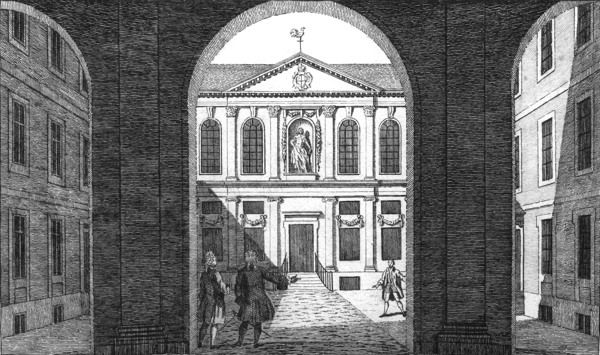
College of Physicians. S. Wale delin. J. Taylor sc.
The College of Physicians is a very noble edifice, situated near the north west corner of Warwick lane. It is built with brick and stone.
The entrance, which is grand, is under an octangular theatre, finishing in a dome, with a cone on the top, 193making a lantern to it. The inside is elegant, finely enlightened and very capacious. This was built by Sir Christopher Wren. The arches represented in the print are under the theatre thro’ which you enter the area. The central building, which is well worthy of observation, is the design of Inigo Jones, and contains the library and other rooms of state and convenience. The ascent to the door is by a flight of steps, and in the under part is a basement story. The whole front is decorated with pilasters of the Ionic and Corinthian orders; and on one side over the door case, is the statue of King Charles II. placed in a niche, and in the other side that of Sir John Cutler. The buildings at the two sides of the court are uniform, and have the window cases handsomely ornamented. The orders are well executed, and the whole edifice both beautiful and commodious.
The College of Physicians is a building of great delicacy, and eminently deserves to be considered among the noblest ornaments of this city, is yet so unlucky in its situation, in a narrow and dirty part of the lane, that it can never be seen to advantage.
There is here a hall, in which the Physicians sit to give advice to the poor 194gratis; a committee room; a library, furnished with books by Sir Theodore Mayerne and the Marquis of Dorchester, who was one of the Fellows; a great hall for the quarterly meetings of the Doctors, adorned with pictures and sculpture; a theatre for anatomical dissection; a preparing room, where there are thirteen tables, containing all the muscles in the human body; and over all garrets to dry the herbs for the use of the dispensatory.
Piccadilly, Haymarket. There were formerly no houses in this street, and only one shop for Spanish ruffs, which was called the Piccadilly or Ruff shop. At present there are several noble houses in it. See Devonshire House, Burlington House. The last house built in Piccadilly is the Earl of Egremont’s. It is of stone, and tho’ not much adorned, is elegant and well situated for a town house, having a fine view over the Green Park, which would be still more extended if the houses on each side were set farther back.
Pickax street, Aldersgate street.
Pickering’s court, St. James’s street.†
Pickleherring stairs, Pickleherring street, Southwark.
Pickleherring street, near Horselydown, Southwark.
Picture yard, Back lane, near Rag Fair.
195Pie-corner, Giltspur street, Smithfield.
Piepowder court, a court of record incident to a fair, as a court baron is to a manor; it is derived from the French pié poudre, and is said to be so called from its expeditious proceedings in the decision of all controversies that happen in fairs; since for the encouragement of all traders, justice is supposed to be as quickly administered as dust can fall from the feet. Coke’s Institutes.
During the time of Bartholomew fair, this court is held in Cloth fair by the city of London and Mr. Edwards, for hearing and determining all differences committed against the tenor of the proclamation made by the Lord Mayor, on the eve of old St. Bartholomew, for the better regulation of that fair.
Pierpoint’s rents, Islington.†
Pierpoint’s row, Islington.†
Pig court, St. Catharine’s lane.*
Pig street, extends from Threadneedle street to Broad street.
Pillory lane, 1. Butcher row. 2. Fenchurch street.
Pin alley, near Rosemary lane.
Pinder’s alley, Shoreditch.†
Pinder’s court, Gray’s Inn lane.†
Pineapple court, Woolpack alley, Houndsditch.*
196Pinners, or Pinmakers, a company incorporated by letters patent granted by King Charles I. in the year 1636.
They consist of a Master, two Wardens, and eighteen Assistants; but have no livery.
Their hall is situated near the southeast corner of Great Winchester street, Broad street: and is most noted for being let out for a meeting of Independents, who meet there every Sunday morning. This is the only Independent meeting in London, where the audience are not Calvinists. In the afternoon it is a meeting for a congregation of general Baptists.
Pinner’s alley, Shoreditch.
Pinners court, Broad street, leading to Pinners hall.
Pipe alley, Broad way, Westminster.
Pipemakers alley, 1. Great St. Anne’s lane. 2. Whitecross street, Cripplegate.
Pipe Office, in Gray’s Inn lane, an office of the Treasury, in which all accounts and debts due to the King are drawn out of the Remembrancer’s office, and charged in a great roll made up like a pipe.
The chief officers are, the Clerk of the Pipe, and the Comptroller of the Pipe. The former makes leases of the King’s lands, on his being warranted so to do by the Lords Commissioners of the Treasury, 197or the Chancellor of the Exchequer: and these leases are sometimes directed to be made under the Great Seal, but for the most part pass the Exchequer: he has under him a Deputy, and eight Attornies, the two first of whom are Secondaries.
All accounts that pass the Remembrancer’s office, are brought to the office of the Clerk of the Pipe, and remain there, to the end if there be any determined debt due by any accomptant or other person, in any such account, it may be inserted in the great roll or the pipes thereof, and taken verbatim by the Comptroller of the Pipe into his roll, and process may be made by him for the recovery thereof by a writ called the Summons of the Pipe, which is in the nature of a levari facias.
All tallies that vouch the payments contained in such accounts, are examined and allowed by the Chief Secondary in the Pipe, and remain for ever after in this office.
The Comptroller of the Pipe writes in his roll all that is in the great roll; and nothing entered in the great roll can be discharged without his privity. He also writes out the summons twice every year to the sheriffs, to levy the debts charged in the great roll of the pipe. 198Chamberlain’s Present State. He has under him a Deputy Comptroller, and a Clerk.
Pipe yard, Bristol street, Puddle dock.
Piper’s ground, College street.
Pissing alley, St. John’s street, Smithfield.‖
Pitcher’s court, White’s alley, Coleman street.†
Pitfield street, Hoxton.†
Pitman’s alley, Gardener’s lane, Westminster.†
Plaisterers, a company incorporated by letters patent, granted by King Henry VIII. in the year 1501, and confirmed by a charter granted by Charles II. in 1667, by the name of The Master, and Wardens of the guild or fraternity of the blessed Mary, of Plaisterers, London.
This company is governed by a Master, two Wardens, and thirty-two Assistants, and has seventy-seven Liverymen, who upon their admission pay a fine of 8l. They have a neat hall on the north west side of Addle street.
Plaistow, a village in Essex, in the parish of West Ham.
Plaistow, a village near Bromley in Kent.
Plantation Office in the treasury. See 199the article Trade and Plantation Office.
Playhouse passage, 1. Bow street; leading to Covent Garden playhouse. 2. Drury lane, leading to the playhouse there.
Playhouse yard, 1. Black Friars, where a playhouse was formerly situated. 2. Whitecross street, Old street, where, according to Maitland, the first playhouse in London was erected; on the east side of that yard are still to be seen the ruins of the theatre.
Clerk of the Pleas Office, in Lincoln’s Inn. In this office all the officers of the Exchequer, and other privileged persons, as debtors to the King, &c. are to have their privilege to plead, and be impleaded as to all matters at the common law: and the proceedings are accordingly by declarations, pleas, and trials as at the common law; because they should not be drawn out of their own court, where their attendance is required. In this office are four sworn Attornies. Chamberlain’s Present State.
Common Pleas. See Court of Common Pleas.
Plough alley, 1. Bankside, Southwark.* 2. Barbican.* 3. Carey street, Lincoln’s Inn Fields.* 4. Wapping.
200Plough court, 1. Fetter lane. 2. Gray’s Inn lane.* 3. Lombard street.*
Plough and Harrow walk, Nag’s Head Buildings, Hackney road.*
Ploughman’s rents, 1. Cow cross, near Smithfield.† 2. Turnmill street.†
Plough street, Whitechapel.*
Plough yard, 1. Barnaby street, Southwark.* 2. Brown’s gardens, St. Giles’s.* 3. Holborn hill.* 4. Harrow yard, Green bank.* 5. Seething lane, Tower street.* 6. Tower ditch.*
Plough yard School, in Plough yard, Seething lane, was founded by James Hickson, Esq; about the year 1689, for the education of twenty boys; for the instruction of whom he allowed the head Master 20l. per annum, a dwelling house, and two chaldrons of coals yearly; and to a Writing Master 8l. a year. Fourteen of the children are to be of the parish of Allhallows, Barking, and six of the hamlet of Wapping. Maitland.
Plumbers, a company incorporated by letters patent granted by King James I. in the year 1611. This corporation is governed by a Master, two Wardens, and twenty-four Assistants; with a livery of fifty-seven members, who upon their admission pay a fine of 10l. They have a 201small hall in Chequer yard, Dowgate hill. Maitland.
Plumber’s court, High Holborn.†
Plumtree court, Plumtree street, Shoe lane.†
Plumtree square, Plumtree street, St. Giles’s.
Plumtree street, 1. St. Giles’s. 2. Shoe lane.†
Poland court, Poland street.
Poland street, Oxford street.
Poland yard, Oxford street.
Pollin’s street, Hanover street.
The Pond yard, Bankside, Southwark.
Poor Jewry lane, Aldgate; so called from its being inhabited by the Jews, on their return to England, after being expelled the kingdom by Edward I. See Old Jewry.
Pope’s Head alley, 1. Broad street.* 2. A neat passage from Cornhill into Lombard street, next to ‘Change alley.*
Pope’s Head court, in the Minories.*
Popish Chapels, of these there are but few in the city of London; for as Popery is esteemed inconsistent with the liberties of a free people, they are therefore in a manner confined to the ambassadors, who keep them open for those of their own religion. These are,
2021. In Butler’s alley meeting house, Grub street.
2. Imperial ambassador’s, Hanover square.
3. Portuguese ambassador’s chapel.
4. Sardinian ambassador’s chapel, by Lincoln’s Inn Fields.
5. Venetian ambassador’s chapel, Suffolk street.
Poplar, a hamlet of Stepney, is situated on the Thames to the east of Limehouse, and obtained its name from the great number of poplar trees that anciently grew there. The chapel of Poplar was erected in the year 1654, when the ground upon which it was built, together with the church yard, were given by the East India company, and the edifice erected by the voluntary contributions of the inhabitants and others; since which time that Company has not only allowed the Minister a convenient dwelling house, with a garden and field containing about three acres, but has allowed him 20l. per annum during pleasure; wherefore this chapel for want of an endowment continues unconsecrated.
Poplar Marsh, called the Isle of Dogs, from the great noise made by the King’s hounds that were kept there during the residence of the royal family at Greenwich, is rather an isthmus than an island, 203and is reckoned one of the richest spots of ground in England; for it not only raises the largest cattle, but the grass it bears is esteemed a great restorative of all distempered cattle.
Here are two almshouses besides an hospital belonging to the East India company.
Popler’s alley, Greenbank.†
Poppet court, Shoe lane, Fleet street.
Popping’s alley, Fleet street.†
Popping’s court, Popping’s alley, Fleet street.†
Porridge pot alley, Aldersgate street.*
Porters. The London porters are divided into brotherhoods, and consist of four sorts, viz. Companies porters, Fellowship porters, Ticket porters, and Tackle porters.
I. The companies porters land and ship off all goods and merchandizes exported and imported to and from all parts near the west side of the Sound, in the Baltic sea, Germany, Holland, France, Spain, Italy, Turkey, and towards or beyond the Cape of Good Hope.
II. Fellowship porters, whose business is to land, ship off, carry or house, all merchandize, as corn, salt, coals, and other commodities, measurable by dry measure. They are upward of 700 in number, and their chief governor is the Alderman of 204Billingsgate ward. Their quarterage is 12d. whereas the Ticket porters pay but 4d. each.
There is a very remarkable custom among the Fellowship porters, which is as follows, viz.
By an act of Common Council, a sermon is preached to them, in the parish church of St. Mary at Hill, the next Sunday after every Midsummer day; when overnight they furnish the merchants and families about Billingsgate with nosegays, and in the morning they proceed from their place of meeting in good order, each having a nosegay in his hand: walking through the middle isle to the communion table, every one offers something into the two basons, for the relief of the poor, and towards the charges of the day; and after they have passed, the deputy, the merchants, their wives, children, and servants walk in order from their seats, and bestow their offerings also; which is a ceremony of much variety. The charges of their nosegays have amounted sometimes to near 20l. in one year.
III. The Ticket porters land and ship off goods imported or exported to all parts of America, &c. and house all merchants goods, metals, &c. They give ample security for their fidelity and 205honesty, and such as employ them need only take notice of their names stamped on a ticket that hangs at their girdles; that upon complaint being made to their Governor, satisfaction may be given to such as have been injured by them.
IV. Tackle porters are such of the Ticket porters as are furnished with weights, scales, &c. and their business is to weigh goods.
Rates taken by Porters for shipping, landing, houseing and weighing.
Sugar the hogshead, 3d.—For weighing 4d.
Sugar the tierce or barrel, 2d.—For weighing 3d.
Sugar the butt, 6d.—For weighing 8d.
Cotton, wool, the bag, 3d.—The same for weighing.
Ginger, the bag, 1d.—The same for weighing.
Melasses, the hogshead, 3d.—For weighing 4d.
Logwood, the ton, 1s.—The same for weighing.
Fustick, the ton, 1s.—The same for weighing.
206Young fustick, the ton, 1s. 6d.—The same for weighing.
Lignum rhodium, the ton, 1s. 6d.—The same for weighing.
Lignum vitæ, the ton, 1s.—The same for weighing.
Tobacco, the hogshead, 2d.—The same for weighing.
Tobacco, the bundle, 1d.—The same for weighing.
Danish, or Swedish iron, the ton, 1s.—The same for weighing.
Narva and Riga hemp, the bundle, 6d.—The same for weighing.
Any porter has the liberty of bringing goods into London; but may not carry any out of the city, or from one part of it to another, unless he be a freeman; otherwise he is liable to be arrested.
Porters alley, Basinghall street.
Porters block, Smithfield bars.
Porter’s court, Basinghall street.†
Porter’s field, Porter’s street.†
Porters key, Thames street.
Porter’s street, 1. Blossom’s street.† 2. Newport market.†
Porter’s yard, 1. Holiwell lane, Shoreditch.† 2. Whitecross street, Cripplegate.†
Portland street, Oxford street.
207Portpool lane, extends from Gray’s Inn lane to Leather lane.
Portsmouth corner, Lincoln’s Inn Fields.
Portsoken Ward. The word Portsoken, according to Maitland, signifies a franchise at the gate: this ward is therefore situated entirely without Aldgate, and contains all Whitechapel as far as the bars; Petticoat lane, Houndsditch and the Minories. It is bounded on the east, by the parishes of Spitalfields, Stepney, and St. George’s in the east; on the south by Tower hill; on the west by Aldgate ward, from which it is separated by the city wall; and on the north by Bishopsgate ward.
Its principal streets are, Whitechapel up to the bars, the Minories, and Houndsditch; and its most remarkable buildings, the parish churches of St. Botolph’s Aldgate, and Trinity Minories,
This ward is governed by an Alderman and five Common Council men, including the Alderman’s Deputy; twenty-two inquest men, five scavengers, five constables, and a beadle. The jurors returned by the wardmote inquest serve in the several courts of Guildhall in the month of January. Maitland.
Portugal row, 1. St James’s street. 2. Lincoln’s Inn Fields.
208Portugal street, 1. Piccadilly. 2. Searle’s street, Carey street.
General Post Office, a handsome and commodious building near the south west extremity of Lombard street, facing Pope’s Head alley.
Of what antiquity the post is in this kingdom, is not easy to determine. Anciently the management of the foreign mails was under the direction of a stranger, who by the permission of the government was chosen by the foreigners dwelling in this city, who even pretended to have a right by prescription of chusing their own post master. However, in the year 1568 a difference arising between the Spaniards and Flemings in London, each chose their separate post master; and this contest occasioned a representation from the citizens to the Privy Council, to beseech her Majesty Queen Elizabeth, to fill that important post with one of her English subjects.
By the first accounts we find of the posts established for the convenience of this kingdom, it appears to have been managed by several private officers, who had their respective districts. But great inconveniences arising from their different methods of proceeding, they were suppressed, and a certain number of public 209officers erected in their room: but these also not answering the end proposed, a General Post Office was erected by act of parliament in the 12th of King Charles II. in the year 1660, to be kept within the city of London, under the direction of a Post Master appointed by the King.
By this act the General Post Master was impowered to appoint post houses in the several parts of the country hitherto unprovided, both in post and by-roads: the postage of letters to and from all places therein mentioned was not only ascertained, but likewise the rates of post horses to be paid by all such as should ride post.
At length, upon the union of the kingdoms of England and Scotland, a General Post Office was established by act of parliament in the year 1710, not only for the united kingdom of Great Britain, but likewise for that of Ireland, and her Majesty’s plantations in North America and the West Indies.
The office of Post Master is at present under the direction of two Commissioners who have 2000l. per annum, and are assisted by a Secretary of 200l. a year, who has four Clerks, two of 60l. a year, one of 50l. and one of 30l.
210The other officers under the direction of the Post Master General are, a Receiver General, who has 300l. per annum, under whom are two clerks, who have 50l. a year each.
An Accomptant General who has 300l. per annum, and has a Deputy of 90l. a year, and three Clerks who have 50l. a year each.
A Comptroller of the inland office who has 200l. a year, and has a Deputy of 90l. a year. A Solicitor to the post office who has 200l. a year; a Resident Surveyor, who has 300l. a year; and two Inspectors of the mis-sent letters who have 100l. a year each.
Six Clerks of the roads, viz. Chester, 100l. per annum; Assistant, 60l. West, 60l. and Assistant, 60l. North, 60l. a year, and Assistant, 60l. Bristol, 60l. a year, and Assistant 60l. Yarmouth, 60l. a year, and Assistant, 60l. Kent, 60l. a year, and Assistant, 50l. Notwithstanding the smallness of these salaries; the perquisite of franking news papers, &c. into the country renders the profits of the Clerks of the roads very considerable.
A Court Post who has 2l. a day; and a deliverer of the letters to the House of Commons, who has 6s. 8d. a day.
There is also a Clerk of the by-nights, 211who has 60l. a year, and his Assistant, 60l. Ten sorters, seven of whom have 50l. a year, and three 40l. a year each, seven, supernumerary sorters, three at 30l. and four at 25l. each. A window man and alphabet keeper, who has 60l. a year; and several other officers and servants, among whom are sixty-seven letter carriers at 11s. a week.
In the foreign office is a Comptroller, who has 150l. a year; an alphabet keeper, who has 100l. per annum, a Secretary who has 50l. a year; and six Clerks, five of whom have 50l. a year each, and one 40l. a year.
Rates for carrying Letters by the Post, to any part of Great Britain and Ireland.
Double letters to be paid twice as much as single, treble letters three times as much, and the ounce four times as much as single letters.
Every single letter not exceeding one sheet, to or from any place not exceeding eighty miles, 3d.
Every single letter above eighty miles, 4d.
Every single letter from London to Berwick, or from Berwick to London, 4d.
212Every single letter from Berwick to any place within forty miles distance, 3d.
Carriage of every single letter a greater distance than one hundred and forty miles 6d.
The port of every single letter to or from Edinburgh, and to and from Dumfries or Cockburnsperth, and between either of those places and Edinburgh, not coming from on ship-board, 6d.
The port of every single letter from Edinburgh to or from any place within fifty miles distance in Scotland, 2d.
The port of every single letter a farther distance, and not exceeding eighty miles within Scotland, 3d.
The port of every single letter above eighty miles within Scotland, 4d.
Between Donachaddee in Ireland and Port-Patrick in Scotland for port of letters and packets (over and above the inland rates) to be paid at the place where delivered; single letter, 2d.
The carriage of every single letter from England to Dublin, in Ireland, or from Dublin into England, 6d.
The carriage of every single letter from Dublin to any place within forty miles distance, or from any place within the like distance to Dublin, 2d.
213The carriage of every letter a farther distance than forty miles, 4d.
And for the port of all and every the letters and packets directed or brought from on ship-board, over and above the said rates, 1d.
The several rates for the carriage of Letters, Packets, and Parcels; to or from any parts or places beyond the seas, are as follow; viz.
Double letters to be paid for twice as much as single, treble letters three times as much, the ounce four times as much as the single letters.
All letters and packets coming from any part of France to London. Single 10d.
All letters or packets passing from London through France, to any part of Spain or Portugal (port paid to Bayonne) and from Spain and Portugal through France to London, 1s. 6d. single, double 3s.
All letters and packets passing from London through France, to any part of Italy or Sicily by the way of Lyons, or to any part of Turky, by the way of Marseilles, and from any of those parts thro’ France to London. Single 1s. 3d.
214All letters and packets coming from any part of the Spanish Netherlands to London. Single 10d.
All letters and packets passing from London through the Spanish Netherlands to any part of Italy or Sicily (port paid to Antwerp), and from any port of Italy or Sicily, through the Spanish Netherlands unto London. Single 1s.
All letters and packets passing from London through the Spanish Netherlands to any part of Germany, Switzerland, Denmark, Sweden, and all parts of the North, and from any of those parts through the Spanish Netherlands unto London. Single 1s.
All letters and packets passing from London through the Spanish Netherlands to any part of Spain or Portugal; and from any part of Spain or Portugal, through the Spanish Netherlands to London. Single 1s. 6d.
All letters and packets passing from any part of the United Provinces to London. Single 10d.
All letters and packets passing from London through the United Provinces, for any part of Italy or Sicily, and from any part of Italy or Sicily, through the United Provinces, to London. Single 1s.
215All letters and packets passing from London through the United Provinces, to any part of Germany, Switzerland, Denmark, Sweden, and all parts of the North; and from any of those parts and places, through the United Provinces, to London. Single 1s.
All letters and packets passing from London through the United Provinces, to any part of Spain or Portugal; and from any part of Spain or Portugal, through the United Provinces, to London. Single 1s. 6d.
All letters and packets passing from London through the Spanish Netherlands or the United Provinces, to Hamburgh (port paid to Antwerp or Amsterdam) and from Hamburgh through the Spanish Netherlands, or the United Provinces, to London. Single 10d.
All letters and packets passing between London, Spain, or Portugal, by packet boats. Single 1s. 6d.
All letters and packets passing from London to Jamaica, Barbadoes, Antigua, Montserrat, Nevis, and St. Christopher’s, in America, and from any of those parts to London. Single 1s. 6d.
All letters and packets from London to New York, in North America, and from thence to London. Single 1s.
216All letters and packets from any part of the West Indies, to New York aforesaid. Single 4d.
All letters and packets from New York to any place within sixty English miles thereof, and thence back to New York. Single 4d.
All letters and packets from New York to Perth Amboy, the chief town in East New Jersey, and to Bridlington, the chief town in West New Jersey, and from each of those places back to New York, and from New York to any place not exceeding one hundred English miles, and from each of those places to New York. Single 6d.
All letters and packets from Perth Amboy and Bridlington, to any place not exceeding sixty English miles, and thence back again. Single 4d.
All letters and packets from Perth Amboy and Bridlington, to any place not exceeding one hundred English miles, and thence back again. Single 6d.
All letters and packets from New York to New London, the chief town in Connecticut in New England, and to Philadelphia, the chief town in Pensilvania, and from those places back to New York. Single 9d.
217All letters and packets from New London and Philadelphia, to any place not exceeding sixty English miles, and thence back again. Single 4d.
All letters and packets from New York and Philadelphia, to any place not exceeding one hundred English miles, and so back again. Single 4d.
All letters and packets from New York aforesaid, to Newport the chief town in Rhode Island, and Providence Plantation in New England, and to Boston, the chief town in Massachusett’s bay, in New England aforesaid; and to Portsmouth, the chief town in New Hampshire, in New England aforesaid; and to Annapolis, the chief town in Maryland, and from every of those places to New York. Single 1s.
All letters and packets from Newport, Boston, Portsmouth, and Annapolis aforesaid, to any place not exceeding sixty English miles, and thence back again. Single 4d.
All letters and packets from Newport, Boston, Portsmouth, and Annapolis aforesaid, to any place not exceeding one hundred English miles, and thence back again. Single 6d.
All letters and packets from New York 218aforesaid, to the chief offices in Salem and Ipswich, and to the chief office in Piscataway, and to Williamsburgh, the chief office in Virginia, and from every of those places to New York. Single 1s. 3d.
All letters and packets from the chief offices in Salem, Ipswich, and Piscataway, and Williamsburgh aforesaid, to any place not exceeding sixty English miles, and thence back again. Single 4d.
All letters and packets from the chief offices in Salem, Ipswich, Piscataway, and Williamsburgh aforesaid, not exceeding one hundred English miles, and thence back again. Single 6d.
All letters and packets from New York aforesaid, to Charles Town, the chief town in North and South Carolina, and from Charles Town aforesaid to New York. Single 1s. 6d.
All letters and packets from Charles Town aforesaid, to any place not exceeding sixty English miles, and thence back again. Single 4d.
All letters and packets from Charles Town aforesaid, to any place not exceeding one hundred English miles, and thence back again. Single 6d.
219Post letters may be sent from London every night to
Abingdon
Ampthill
Ashburton
Attleborough
Bath
Beccles
Beconsfield
Birmingham
Bridgewater
Bristol
Bromsgrove
Burntwood
Bury St. Edmunds
Cambridge
Campden
Canterbury
Chatham
Chelmsford
Chertsey
Chester
Chipping Norton
Cirencester
Claremont
Cobham
Colchester
Croydon
Darking
Dartford
Deal
Derby
Dover
Enfield
Epsom
Esher in Surry
Evesham
Exeter
Faringdon
Feversham
Gerard’s Cross
Gloucester
Gravesend
Grays
Guildford
Ham in Surry
Hampton Court
Hampton Town
Hamwick in Surry
Hanworth
Harborough
Hertford
High Wickham
Ingateston
Ipswich
Isleworth
220Kelvedon
Kingston
Kingston Wick
Lalam
Leatherhead
Leicester
Littleton
Liverpool
Loughborough
Lowstoff
Lynn
Maidstone
Manchester
Middlewich
Moulsey in Surry
Namptwich
Newmarket
Newport Pagnell
Northampton
Northwich
Norwich
Nottingham
Oxford
Petersham
Plymouth
Portsmouth
Prescot
Queenborough
Richmond
Ripley
Rochester
Royston
Rumford
Sandwich
Saxmundham
Shepperton
Shiffnal
Shrewsbury
Sittingbourn
Southall
Stafford
Stoke in Norfolk
Stone
Sunbury
Taunton
Teddington
Thame
Thames Ditton
Thanet
Thetford
Tiverton
Twickenham
Uxbridge
Walsall
Walton
Warrington
Wellington
Wells
Weybridge
Windham in Norfolk
Windsor
221Wingham in Kent
Witham
Witton
Wolverhampton
Woodburn
Worcester
Yarmouth
Tunbridge bag every night from Midsummer to Michaelmas only
Bags for the following towns are dispatched Mondays, Tuesdays, Thursdays, and Saturdays; and the returns are delivered Mondays, Wednesdays, Thursdays, and Saturdays; Arundel, Brighthelmston, Chichester, East Grinstead, Godalmin, Haslemere, Lewes, Midhurst, Petworth, Ryegate, Steyning, Shoreham.
On Mondays.] To France, Spain, Italy, Germany, Flanders, Sweden, Denmark.
On Tuesdays.] To Holland, Germany, Sweden, Denmark, Ireland, Scotland, and all parts of England and Wales.
N.B. One Tuesday the packet goes to Lisbon, and the next Tuesday to the Groyn, and so on.
On Thursdays.] To France, Spain, Italy, and all parts of England and Scotland.
On Fridays.] To Flanders, Germany, Italy, Sweden, Denmark, Holland.
On Saturdays.] To all parts of England, Wales, Scotland, and Ireland.
Letters are returned from all parts of 222England and Scotland certainly, every Monday, Wednesday and Friday; and from Wales every Monday and Friday. But their coming from foreign parts is more uncertain on account of the seas.
Post Office court, a small but neat court in Lombard street, in which is the post office.
Postern passage, Shoemaker row.
Postern, Bakers row.
Postern Gate, an ancient gate which stood at the east end of Postern row on Tower hill. It was erected soon after the Conquest in a beautiful manner with stones brought from Kent and Normandy, for the convenience of the neighbouring inhabitants, both within and without the walls; but in the second year of the reign of Richard I. William Longchamp, Bishop of Ely, and Chancellor of England, having resolved to enlarge and strengthen the Tower of London with an additional fortification, he caused a part of the city wall, which extended about 300 feet from the Tower to this gate, to be taken down, in order to make way for a strong wall and a spacious ditch: by which means the postern being deprived of its support on that side, fell down in the year 1440. It was afterwards replaced by a mean building of timber, laths and loam, with a 223narrow passage; but this also decayed, and has been many years removed quite away; nothing remaining at present to preserve the name, but a few posts to guard a narrow foot way from the encroachments of horses and carriages.
A little to the south of the place where the gate stood, is a descent by several stone steps to an excellent spring, much admired, which is still called the Postern Spring.
Postern row, a row of houses on Tower hill, leading from the place where the postern gate formerly stood.
Potters fields, 1. Back lane, Southwark. 2. Pickleherring lane.
Pottlepot alley, St. Catharine’s by the Tower.*
Poverty lane, Brook street.‖
Poultney court, Cambridge street.
Poulton’s court, near Broad street.†
Poulterers, a company incorporated by letters patent granted by Henry VII. in the year 1504.
They have a Master, two Wardens, twenty-three Assistants, and a livery of an hundred and six members, who on their admission pay a fine of 20l. but they have no hall.
Poultry, a street which extends from the Mansion house to Cheapside, and was so denominated from the Poulterers stalls 224which anciently extended along that street from Stocks market. Maitland. See Scalding alley.
Poultry Compter, one of the city prisons, so denominated from its use and situation: for this prison belonging to one of the Sheriffs, Maitland supposes, might possibly be named the Compter, from the prisoners being obliged to account for the cause of their commitment before their discharge: and the addition of Poultry is added from its situation in that street, to distinguish it from the Compter in Wood street.
For an account of the several officers belonging to the two Compters, see the article Compter.
Powdered Beef court, Cabbage lane.
Powell’s alley, Chiswell street, Moorfields.†
Powell’s court, Queen street.†
Powell’s yard, Upper Ground street, Southwark.†
Prat’s wharf, Millbank, Westminster Horseferry.†
Prebends of St. Paul’s. See the article Canons.
Precentor or Chanter of St. Paul’s, an officer who superintends the church music, and has a sub-chanter to officiate in his absence. To him belongs the second stall on the north side of the choir: he is perpetual Rector of the church of 225Stortford, proprietor of the same, and patron of the vicarage. Newc. Repert.
Prerogative Court in Doctors Commons; this court is thus denominated from the prerogative of the Archbishop of Canterbury; who by a special privilege beyond those of his suffragans, can here try all disputes that happen to arise concerning the last wills of persons within his province, who have left goods to the value of 5l. and upwards, unless such things are settled by composition between the metropolitan and his suffragans; as in the diocese of London, where it is 10l.
This court, which was formerly held in the consistory of St. Paul’s, is kept in Doctors Commons in the afternoon, the next day after the court of Arches. The Judge is attended by the Register and his Deputy, who sets down the decrees and acts of the court, and keeps the records.
Prerogative Office in Doctors Commons, an office belonging to the above court, in which copies of all wills deposited in the office are wrote in large folio volumes, and any person may have the privilege of searching a particular will for a shilling, and of having a copy of the 226whole, or of any part of it, for a moderate fee.
The places belonging to this court are in the gift of the Archbishop of Canterbury.
Presbyterians, a considerable body of Protestant dissenters; their religious sentiments are in general pretty far from Calvinism, they have now scarcely any resemblance to the church of Scotland; and every congregation in this city, is in a manner as independent of each other as the independents themselves. The meeting houses within the bills of mortality are as follows:
1. Bethnal green. 2. Broad street, Wapping. 3. Brook house, Clapton. 4. Church street, Hoxton. 5. Crosby square, Bishopsgate street. 6. Crown court, Russel street. 7. Founders hall, Lothbury. 8. Grafton street, Seven dials. 9. Gravel lane, Houndsditch. 10. Great St. Thomas Apostle’s. 11. Hanover street, Long Acre. 12. King John’s court, Bermondsey. 13. King’s Weigh-house, Little Eastcheap. 14. Leather lane, Holborn. 15. Little Carter lane. 16. Little Eastcheap, near Tower street. 17. Little St. Helen’s Bishopsgate street. 18. Long ditch, Westminster. 19. Maiden lane, Deadman’s 227place. 20. Middlesex court, Bartholomew close. 21. Mourning lane, Hackney. 22. New Broad street, London wall. 23. Near Nightingale lane. 24. Old Jewry, Poultry. 25. Parish street, Horselydown. 26. Poor Jewry lane, near Aldgate. 27. Queen street, near Cuckolds point. 28. Rampant lion yard, Nightingale lane. 29. Ryder’s court, near Leicester fields. 30. Salisbury street, Rotherhithe. 31. St. Thomas, Southwark. 32. Salters hall, Swithin’s lane. 33. Shakespear’s walk, Upper Shadwell. 34. Silver street, Wood street. 35. Spitalfields. 36. Swallow street, Piccadilly. 37. Windsor court, Monkwell street.
Prescot court, St. John’s street, Smithfield.†
Prescot street, Goodman’s fields.†
Preston’s yard, in the Minories.†
Price’s alley, 1. Brewer’s street. 2. Knave’s Acre, Wardour street.† 3. Queen street, in the Park, Southwark.†
Price’s buildings, Gravel lane.†
Price’s court, Gravel lane.†
Price’s yard, Long lane.†
Priest’s alley, 1. Foster lane, Cheapside.† 2. Tower hill.†
Priest’s yard, Dancing lane, Southwark.†
Primrose alley, 1. Bishopsgate street. 2. 228Long alley, Moorfields. 3. St. Mary Overies dock, Southwark.
Primrose Hill, a very pleasant hill between Kilburn and Hampstead; also called Green Berry Hill, from the names of the three assassins of Sir Edmundbury Godfrey, who brought him hither after they had murdered him at Somerset house.
Primrose row, Primrose alley.
Primrose street, Bishopsgate street.
Prince’s court. Several of these courts and streets received their name, as well as those of King street and Queen street, after the restoration, in honour of the return of the royal family. 1. Duke street, St. James’s. 2. Drury lane. 3. Gravel lane, Southwark. 4. Hedge lane, Charing Cross. 5. Long Ditch, Westminster. 6. Lothbury. 7. Newport market. 8. Old Gravel lane, Ratcliff highway. 9. Tower hill. 10. Wentworth street.
Prince’s square, Ratcliff highway, is a neat square, principally inhabited by the families of gentlemen who belong to the sea. Its chief ornament is the church and church yard belonging to the Swedes, surrounded with iron rails and well planted with trees. The front of the church is carried up flat with niches and ornaments, and on the summit is a pediment. 229The body is divided into a central part projecting forwarder than the rest, and two sides. The central part has two tall windows, terminated by a pediment, and in the midst of that is an oval window; but in the sides there is only a compartment below with a circular window above. The corners of the building are wrought in a bold, plain rustic. The tower rises square from the roof, and at the corners are placed urns with flames: from thence rises a turret in the lanthorn form with flaming urns at the corners: this turret is covered with a dome, from which rises a ball, supporting the fane, in the form of a rampant lion.
Prince’s stairs, Rotherhith.
Prince’s street, 1. St. Anne’s street, Soho. 2. Barbican. 3. Brick lane, Spitalfields. 4. Charles street, Old Gravel lane, Ratcliff. 5. Drury lane. 6. Duke street, St. James’s. 7. Duke street, Southwark. 8. Hanover square. 9. Little Queen street. 10. Oxford street. 11. Queen street. 12. Ratcliff Highway. 13. Red Lion square, Holborn. 14. Rotherhith Wall. 15. Sun Tavern fields, Shadwell. 16. The west end of Threadneedle street; first built by act of Parliament after the fire of London, in which it was called by this name before 230it was erected. 17. Upper Moorfields. 18. Whitcomb street, Hedge lane. 19. Wood street, Spitalfields.
Printing House lane, leading to the King’s printing house in Black friars.
Printing House street, Water lane.
Printing House yard, 1. Water lane. 2. By White’s alley, Coleman street; thus named from a large printing house there for woollens.
Pritchard’s alley, Fair street, Horselydown.†
Privy Council, held at the Cockpit. This great and honourable assembly meet in order to consult upon those measures that are most likely to contribute to the honour, defence, safety and benefit of his Majesty’s dominions.
The members of this body are chosen by the King, and are, or ought to be distinguished by their wisdom, courage, integrity, and political knowledge. A Privy Counsellor, though but a Gentleman, has precedence of all Knights, Baronets, and the younger sons of all Barons and Viscounts. They sit at the council board bareheaded, when his Majesty presides; at all debates the lowest delivers his opinion first; and the King last of all declares 231his judgment, and thereby determines the matter in debate.
Privy Garden, Whitehall, was formerly used as a private garden, though it extended almost to the Cockpit. The wall joined the arch still standing by the Cockpit, and ran on in a line to King street. Plan of London drawn in Queen Elizabeth’s time.
Privy Garden stairs, Privy Garden.
Privy Seal Office, Whitehall. An office under the government of the Lord Privy Seal, a great officer, next in dignity to the Lord President of the Council, who keeps the King’s privy seal, which is set to such grants as pass the great seal of England. The Lord Privy Seal has a salary of 3000l. per annum. Under him are three Deputies, a Secretary, and three Clerks; but these Clerks have no salaries; they have however considerable fees, and 30l. a year board wages.
Probin’s yard, Blackman street, Southwark.†
Protonotaries, or Prothonotaries, in the court of Common Pleas. The word is derived from Protonotarius, a chief Notary or Clerk; and they are accordingly the chief Clerks of this court. 232They enter and enrol all declarations, pleadings, assizes, judgments, and actions; and make out judicial writs, &c. for all English counties, except Monmouth. They are three in number, and have each separate offices, one in the Middle Temple, another in King’s Bench Walks, and the other in Searle’s court, Lincoln’s Inn. In these offices all the Attorneys of the court of Common Pleas enter their causes.
Each of these Protonotaries has a Secondary, whose office is, to draw up the rules of court, and these were formerly the ancientest and ablest Clerks or Attorneys of the court.
Protonotary’s, or Prothonotary’s Office in Chancery, is kept in Middle Temple lane, and is chiefly to expedite commissions for embassies.
Providence court, North Audley street.
Providence yard, Peter street, Westminster.
Prujean’s court, in the Old Bailey.†
Pruson’s island, Near New Gravel lane.†
Pudding lane, Thames street. In this lane the fire of London broke out, at a house situated exactly at the same distance from the Monument as that is high. Upon this house, which is rebuilt in a very 233handsome manner, was set up by authority the following inscription:
‘Here by the permission of Heaven, Hell broke loose upon this protestant city, from the malicious hearts of barbarous papists, by the hand of their agent Hubert: who confessed, and on the ruins of this place declared his fact, for which he was hanged, viz. That here began the dreadful fire, which is described and perpetuated, on and by the neighbouring pillar, erected 1681—in the mayoralty of Sir Patience Ward, Knt.’
But the inhabitants being incommoded by the many people who came to look at the house, and read this board, it was taken down a few years ago.
Puddle dock, Thames street. There was anciently a descent into the Thames in this place, where horses used to be watered; who raising the mud with their feet, made the place like a puddle; from this circumstance, and from a person named Puddle dwelling there, this dock, according to Maitland, obtained its present name.
Puddle Dock hill, Great Carter lane.
Puddle Dock stairs, Puddle dock.
Pultney court, Little Windmill street.
234Pultney street, 1. Brewer’s street.† 2. Knave’s Acre.†
Pump alley, 1. Brown’s street.☐ 2. Gardener’s lane, Petty France, Westminster.☐ 3. Green bank, Wapping.☐ 4. Perkins’s rents, Peter street, Soho.☐ 5. Quaker street, Spitalfields.☐ 6. Queen street in the Park, Southwark.☐ 7. Red lion street, Wapping dock.☐ 8. Near Whitecross street, Cripplegate.☐
Pump court, 1. Bridgewater gardens.☐ 2. Charing Cross.☐ 3. Crutched Friars.☐ 4. Glasshouse yard.☐ 5. Holland street.† 6. Jacob’s street, Mill street.☐ 7. Inner Temple.☐ 8. Long alley, Shoreditch.☐ 9. The Minories.☐ 10. Noble street, Foster lane.☐ 11. Rose and Crown court.☐ 12. Portpool lane.☐ 13. Queenhithe.☐ 14. Three Foxes court, Longlane, Smithfield.☐ 15. White Hart yard, Drury lane.☐ 16. White’s alley.☐
Pump yard, 1. Near Aldersgate Bars.☐ 2. Church lane.☐ 3. Golden lane.☐ 4. Gravel lane.☐ 5. King John’s court, Southwark.☐ 6. Newington Butts.☐ 7. In the Orchard, Ratcliff.☐ 8. Pump alley, Chequer alley.☐ 9. Three Colts street.† 10. Whitehorse alley, Cow Cross.☐
Punch Bowl alley, Moorfields Quarters.*
Punch court, Thrall street, Spitalfields.
235Purford. See Pyrford.
Purse court, 1. Fore street, Cripplegate.* 2. Old Change, Cheapside.*
Putney, a village in Surry, situated on the Thames, five miles south west of London, famous for being the birth place of Thomas Cromwell Earl of Essex, whose father was a blacksmith here. About this village the citizens of London have many pretty seats; and on Putney Heath is a public house, noted for polite assemblies, and in the summer season for breakfasting and dancing, and for one of the pleasantest bowling greens in England. Here is an old church erected after the same model with that of Fulham, on the opposite shore, and they are both said to have been built by two sisters.
That part of Putney which joins to the Heath, commands a fine view both up and down the river Thames.
Pye corner, Smithfield.
Pye garden, near Willow street, Bank side, Southwark.
Pye street, Westminster.
Pyrford, or Purford, in Surry, the fine seat of the late Denzil Onslow, Esq; situated two miles from Guilford, on the banks of the Wey. It is rendered extremely pleasant, by the beautiful intermixture of wood and water, in the park, 236gardens, and grounds adjoining. By the park is a decoy, the first of the kind in this part of England.
