Volume 4 — LONDON AND ITS ENVIRONS DESCRIBED, &c. (continued 3)
Reading edition
No officers or servants are permitted upon pain of expulsion to take of any tradesmen, patients, or other persons, any fee, reward, or gratuity of any kind, directly or indirectly, for any service done, or to be done, on account of this hospital.
Every Governor is intitled to send one in-patient at a time, and out-patients without limitation. Subscribers of smaller sums may likewise send what number of out-patients they please. All subscriptions 158are during pleasure, and any small sums from well-disposed persons will be thankfully received; but in order to carry on this undertaking, all persons are desired to pay their subscription at the time of subscribing.
The poor objects recommended as in-patients, if there are beds empty, are received at any hour without difficulty or expence, and are supplied with advice, medicine, diet, washing, lodging, and every comfortable assistance during their cure; nor is any security required against future contingencies, they being, in case of death, buried at the expence of the charity, if not removed by their friends. All out-patients have advice and medicines administered from eleven till one.
All accidents, whether recommended or not, are received at any hour of the day or night.
This is the plan of this noble charity; and though this work has subsisted but eighteen years, yet such has been the extraordinary encouragement given to it, that since the 3d of November 1740, to the 1st of January 1759, the sums generously contributed to its support amount to 79,153l. a great part of which is laid out in government securities. But what is still more extraordinary, 137,252 distressed 159objects have been relieved at this hospital; and from labouring under the oppression of some of the most malignant diseases, and unhappy accidents, have been reinstated in their honest and industrious capacities of working, and, so far as our observation reaches, their morals much amended, whereby the public again enjoy the benefit of their labour, and they, and their poor families, are preserved from perishing, and prevented from being an incumbrance to the community. And, notwithstanding the great number of objects relieved by this charity, it has not lessened the number of patients relieved by other hospitals.
The subscribers are desired to take notice, that if any patients do not conform to the rules of the house, or are guilty of any misbehaviour, they will be discharged, and never more relieved by this charity: and not to send any patient unable to walk, till they are first assured of room in the house; and when they recommend an in-patient, whose settlement is in the country, it is further requested, that they will satisfy the house committee, concerning the removal of such patient, when cured or judged incurable.
“No persons of known ability to pay for their cure, are allowed to partake of 160this charity; nor any with infectious distempers, or deemed incurable by the Physicians and Surgeons, or any in consumptive or asthmatic condition, are admitted into the house, being more capable, of relief as out-patients.”
The patients, being admitted without any expence, are required to be constant in their attendance on the Physicians, or Surgeons, at the hospital, before eleven o’clock; and, at nine o’clock, to return thanks at the chapel, and at the weekly committee next after their cure; and those only who attend their cure, and return thanks, will receive a certificate thereof, which will entitle them to future relief. The Account published by order of the Governors in 1759.
London Lying in Hospital, at Shaftesbury house, on the east side of Aldersgate street; an edifice built with brick and ornamented with stone, in a most noble and elegant taste. The front to the street is adorned with Ionic pilasters; the door is arched, and has a balcony supported by scrolls. This opens into a small area encompassed with buildings, within which are accommodations for the patients. This house, which was built by the masterly hand of Inigo Jones, was formerly the residence of the Earls of Shaftesbury, and deserves a much better situation. The polite part of the town is now so far removed from hence, that this edifice is neither known nor admired so much as it deserves. This structure, having been converted to several mechanic uses, was going to decay, but has, however, been thoroughly repaired, and happily applied to this noble charity; and in this house, support and every necessary accommodation and assistance are furnished for married women in the last stage of their pregnancy, time of labour, and month of lying-in.
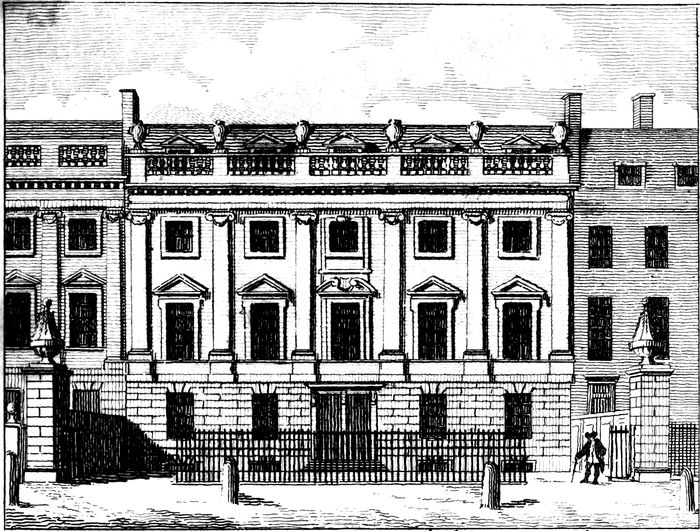
The Centre of the West Side of Lincoln’s Inn Fields, late the Duke of Ancaster’s, by Inigo Jones.
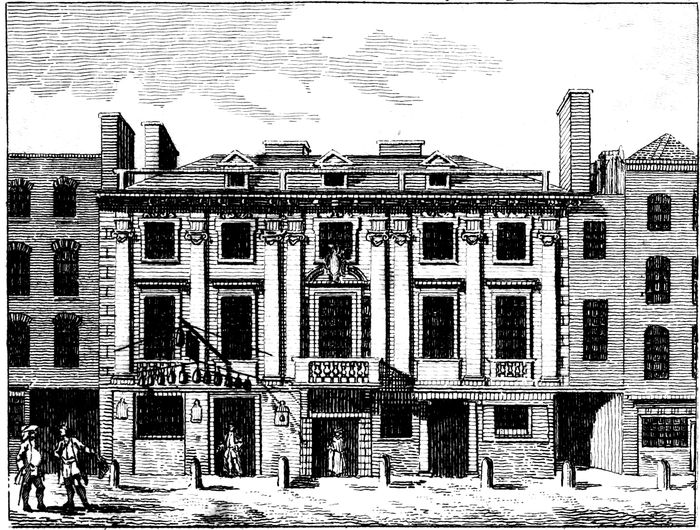
Shaftesbury House, now the Lying-in Hospital, by Inigo Jones.
161This excellent charity was instituted on the 30th of March 1750, by several generous and humane persons; and has met with suitable encouragement from many of both sexes, who justly deserve that character. But so many distressed objects daily present themselves for the relief of this charity, which has been attended with a more than ordinary expence, by the reception of the wives of many seamen and soldiers in the public service, that its income, supported only by voluntary contributions, is not equal to its wants; and therefore the Governors find it still necessary to apply for the assistance of the charitable and humane. The conditions are,
162I. Such persons as subscribe thirty guineas are Governors for life, and may recommend one pregnant woman to be upon the books at a time.
II. Those who subscribe five or three guineas per annum, are Governors so long as they continue their subscriptions, and intitled to recommend as in the first article.
III. Annual Governors may make up their subscriptions thirty guineas, within one year from their last payment, and thereupon become Governors for life.
IV. All ladies are at liberty in all elections of officers, to vote by proxy signified in writing.
N. B. All lesser benefactions are thankfully received. And for the satisfaction of the public, that the women are well and properly taken care of, ladies, though not Governesses, are permitted to go into the wards.
Rules of the Hospital.
A general court of the Governors is held four times a year; namely, in the months of March, June, September, and December, to receive the report of the quarterly committees, elect a new committee, and transact such other business as may then be laid before them.
A house committee is appointed at 163every general quarterly court, consisting of thirteen Governors, three of whom are a quorum. This committee meets every Tuesday morning at eleven o’clock in the forenoon, at the hospital, to receive and discharge women, inspect the diet and provisions, order any furniture and conveniences that may from time to time be wanted, and to examine into and regulate the conduct of all the servants and patients of the house. These committees are to make their reports to the general quarterly courts.
The number of beds at present in the hospital is thirty-three.
A Physician, a Man-midwife, and a Surgeon in ordinary, attend daily at the hospital; besides whom the house is supplied with a Physician and Man-midwife extraordinary, a Surgeon extraordinary, and an apothecary, who supplies the patients with such medicines as shall be found necessary in their respective cases. And that the patients may not want necessary comfort under their afflictions, a Clergyman has undertaken the kind and charitable office of attending the house as Chaplain, baptizes the children born there, churches the women, and reads prayers publickly twice a week. All these gentlemen attend without fee or reward.
164A matron, who is a skilful midwife, constantly resides in the hospital, and acts as such in all natural and easy labours.
There are a sufficient number of nurses and other servants to take care of the lying-in women, and do the common business of the house.
Also a beadle, who constantly resides at the hospital, to be ready to go on all messages, on sudden emergencies, and summon the Governors, &c.
Note, the servants of the house are forbid to take any fee or reward from the lying-in women, on any pretence whatsoever, on pain of being discharged.
Married women admitted into this hospital, must previously produce a certificate of their marriage from a lawful Minister, or in case they cannot, then an affidavit of their being married, and the time when and the place where, and also of the settlement of their husbands, and by what means such settlement was obtained. And no woman is to be taken into the house, who hath any contagious distemper, or has been accustomed to receive alms of a parish.
Such gentlemen and ladies as chuse to favour this laudable charity, are desired to send their subscriptions, with their names and places of abode, to the Treasurer, Charles Maynard, Esq; in Aldersgate 165street; to Messrs. Vere, Glyn, and Halifax, bankers, in Birchin lane; or to the weekly committee, on Tuesday in the forenoon, at the said hospital, where proper receipts will be given,
Account of Women delivered, from the institution of the hospital to the 17th Jan. 1758.
Women delivered, 19 of whom had twins, and one delivered of three children 1914
Children born 1935
Males 961
Females 974
1935
Monies received from the institution of the hospital to the 13th. Jan. 1758 7010 13 0¾
Monies expended from the institution of the hospital to 29th Sept. 1757 5774 3 6
£1000 Old South Sea annuities, which cost 1064 12 6
Cash in Treasurer’s hands 171 17 0¾
7010 13 0¾
The account published by order of the Governors.
166See an account of the other hospitals of the same kind, under the articles Lying-in Hospital in Brownlow street, and Lying-in Hospital for unmarried as well as married women in Duke street.
London ’Prentice yard, in the Minories.*
London Stone, a very great piece of antiquity, that has been carefully preserved from age to age, and is mentioned by the same name so early as in the time of Ethelstan, King of the West Saxons.
This stone, which stands close under the south wall of St. Swithin’s church, was formerly a little nearer the channel facing the same place, and being fixed very deep in the ground was so strongly fastened by bars of iron, as to be in no danger from the carriages.
It seems very surprizing that so great a piece of antiquity has been constantly preserved with such care, and yet so little has been said of it, that the original cause of its erection, and the use for which it was intended, are entirely unknown. A very ingenious author observes, that as London appears to have been a Roman city, it will be no improbable conjecture, that this stone was the center, from whence they extended its dimensions, and might serve as the standard at which they began to compute their miles. Of this 167opinion was also Mr. Maitland, and the great Sir Christopher Wren, who grounded his conjecture upon proofs which are not every day to be obtained, for by rebuilding many of the churches after the fire of London, he had an opportunity of discovering and tracing the ancient boundaries of London, with a greater nicety than is ever to be expected again: on clearing the foundations of St. Mary le Bow in Cheapside, he found, upon opening the ground, the walls with the windows and pavement of a Roman temple, entirely buried under the level of the present street; this temple stood about forty feet backwards; but having occasion to bring the steeple of the new church to range with the high street, he again began to dig through the made ground, till having proceeded eighteen feet deep, to his surprize he discovered a Roman causeway of rough stone four feet thick, close and well rammed, with Roman brick and rubbish at the bottom, all firmly cemented; he was therefore of opinion, that this was the northern boundary of the Roman colony, and that the breadth from north to south was from this causeway, now Cheapside, to the Thames; the extent east and west from Tower hill to Ludgate: the principal or Prætorian Way, 168he supposed to be Watling street; whence London Stone appears to have been nearly in the center of the ancient city before it was destroyed by Boadicea, and when it was not encompassed with walls. Curiosities of London and Westminster. Parentalia.
London street, 1. A spacious, handsome, and well-built street, on the south side of Fenchurch street. 2. Mill street, Rotherhith. 3. Rose lane, Ratcliff.
London Wall, the wall which formerly surrounded the city of London, as a defence against the attacks of an enemy. It was strengthened with lofty towers, and had originally only four gates, tho’ the making of new roads has increased the number to seven, which are now standing, viz. Aldgate, Bishopsgate, Moorgate, Cripplegate, Aldersgate, Newgate, and Ludgate. See each of these described in their proper places.
This wall, which is by some supposed to have been built by Constantine the Great, and by others by his mother Helena, was probably not erected till the time of Valentinian I. about the year 368. Britain had been reduced to very great misery, by the joint attacks of the Scots, Picts, Attacots, Saxons, and Franks; and the Romans, till the arrival of Theodosius 169the Elder, were defeated in several engagements: but that General having routed some parties of the enemy, entered the city of London in triumph. And we are told by Am. Marcel, lib. 27. that Theodosius, by repairing some cities and castles, and fortifying others, left every thing in so good a situation, that peace was preserved in Britain till the departure of the Romans in the reign of the Emperor Honorius.
Dr. Woodward, in the year 1707, had an opportunity of narrowly observing its fabrick and composition, by a part of the wall near Bishopsgate being pulled down, to make way for new buildings; and this learned antiquary observes, that “From the foundation, which lay eight feet below the present surface, quite up to the top of the oldest part, which was in all near ten feet, it was compiled alternately of layers of broad flat bricks and rag-stones. The bricks lay in double ranges, and each brick being but one inch and three tenths in thickness, the whole layer, with the mortar, exceeded not three inches. The layers of stone were not two feet thick of our measure. It is probable they were intended for two of the Roman, their rule being somewhat shorter than ours. 170To this height the workmanship was after the Roman manner, and these were the remains of the ancient wall. In this it was very observable, that the mortar was so very firm and hard, that the stone itself as easily broke. It was thus far, from the foundation upwards, nine feet in thickness. The above broad thin bricks were all of Roman make, and of the very sort we learn from Pliny, that were in common use among the Romans. Measuring some of these (says Mr. Woodward) I found them seventeen inches and four tenths in thickness, and eleven inches and six tenths in breadth.
“The old wall, on its being repaired, was carried up of the same thickness to eight or nine feet in height; or if higher, there was no more of that work now standing. All this was apparently additional, and of a make later than the other part underneath it, which was levelled and brought to a plane for the raising of this new work upon it. The outside, or that towards the suburbs, was faced with a coarse sort of stone, not compiled with any great care or skill, nor disposed into a regular method; but on the inside there appeared more marks of workmanship 171and art. At the bottom were five layers composed of flint and free stone; though they were not so in all parts, yet in some the squares were near equal, about five inches diameter, and ranged in a quincunx order. Over these were a layer of brick, then of hewn free stone, and so alternately brick and stone to the top. These bricks, of which there were four courses, were of the shape of those now in use, but much larger, being near eleven inches in length, five in breadth, and somewhat above two and a half in thickness. There was not one of the Roman bricks above mentioned in all this part, nor was the mortar here near so hard, as in that below; but from the description may be easily collected, that this part when first made, with so various and orderly a disposition of the materials, flint, stone, and brick, could not but carry a very handsome aspect. Whether this was done at the expence of the Barons in the reign of King John; or of the citizens in the reign of King Henry III. or of King Richard II. or at what other time, I cannot take upon me to ascertain, from accounts so defective and obscure as are 172those which at this day remain of this affair.
“Upon the additional work now described, was raised a wall wholly of brick, only that it terminating in battlements, these were topped with copings of stone. It was two feet four inches in thickness, and somewhat above eight feet in height. The bricks of these were of the same module and size with those of the part underneath, How long they have been in use is uncertain.” Woodward’s Roman Antiquities, and Present State of London.
A tower of the same construction, twenty-six feet in height, is still remaining, and is situated almost opposite the end of Gravel lane, on the west side of Houndsditch, tho’ much decayed. There is a door within the wall of this tower, in Shoemaker row, fronting the passage into Duke’s Place. Mr. Maitland observes, that in searching for this tower, about eighty paces south east, towards Aldgate, he discovered another of the same construction, twenty-one feet high, perfectly found, and much more beautiful than the former; the bricks being as found as if but newly laid, while the stones in most parts are become a sacrifice to time. 173Mr. Maitland also observes, that on the south of Aldgate, at the lower end of a street denominated the Vineyard, is the basis of another Roman tower, about eight feet high, which supports a new building of three stories in height. He conjectures, that the wall, when first erected, was about twenty-two feet high, and the towers about forty feet; and adds, that the ancients thought it so necessary to preserve them from ruin and all incumbrances, that they made an act, that no tenement should be erected nearer the walls, than the distance of sixteen feet.
The remains of the walls are at present much more extensive than is generally imagined. They still subsist in part between the houses on the east side of Poor Jewry lane, and the Minories, almost all the way along the back of Houndsditch, from Aldgate to Bishopsgate. The ruins of the wall are from thence visible to every passenger in the street, from where Little Moorgate lately stood to the end of Aldermanbury, and from thence extending behind the houses, it reaches to Cripplegate; from whence it extends on the back of St. Giles’s church, and runs along the back of the houses in Crowder’s well alley, where several lofty towers are still to be seen, and is visible almost to Aldersgate; 174from thence it extends along the back of the houses in Bull and Mouth street; but from thence little of it is to be seen till we come to Newgate; after which it in some places rises to a considerable height, and extends in a pretty regular line on the back of the houses in the Old Bailey almost to Ludgate.
London Wall, a long street, so called from its fronting the city wall; it having a range of houses on the south, and the ruins of the wall on the north. This street, which extends from Wormwood street to Cripplegate, is the only place where the wall is not concealed by buildings: but here the wall may be justly considered as a nuisance, it being little better than a disagreeable heap of rubbish, in which hardly any of the Roman structure is now to be seen.
London Workhouse, a large and commodious brick building, at the south east corner of Half Moon alley in Bishopsgate street, was founded by act of Parliament in the year 1649, for the relief and employment of the poor, and the punishing of vagrants and other disorderly persons, within the city and liberties of London. However, in the year 1662, the continual increase of the poor, and the defects in the laws relating to the settlement of them, 175occasioned another act, by which the Governors were constituted a body corporate with a common seal; the Lord Mayor for the time being was appointed President, and the President and Governors were allowed to purchase lands or tenements to the annual value of 300l. The Common Council were allowed to rate the several parishes of the city for the support of this workhouse, and on this account a considerable sum is paid by each parish, raised on the inhabitants by a regular assessment. Besides which, this charity has received many considerable benefactions.
However, it was agreed by the Governors, that no child should be received from any benefactor who gave a less sum than 50l. but whoever gave 70l. might put in a child from any place he thought fit. Account of this Corporation published in 1713.
The several parishes, besides their assessments, formerly paid 1s. a week for parish children; but in 1751 the Governors came to a resolution, that no more children paid for by the parishes to which they belong, should be taken into the house; and since that time it has been resolved, that only such children should be taken in, as were committed by the 176Magistrates of the city, found begging in the streets, pilfering on the keys, or lying about in glass houses and uninhabited places: the receptacles of the wretched and the wicked.
These once poor abandoned children are educated according to the usage of the church of England, and meet at six in the morning and evening in a large room, which serves them both for a chapel and dining room, where they hear prayers: they are taught the Catechism; have a Minister who attends upon them; and on Sundays they all go to church at Great St. Helen’s. A part of the day is appropriated to their learning to read, write, and to their obtaining some knowledge of arithmetic; the rest of their time is spent in weaving nets for the British fishery; and the girls are employed in sewing, knitting, and other labour, by which they are qualified for service. The boys making twenty-five yards of netting a week, at 1s. 6d. for twenty yards; and, as an encouragement to industry, every boy who makes above twenty-four yards, receives a penny a week. There are here seldom less than four hundred children thus employed, all of whom are dressed in russet cloth, and wear a round badge upon their breasts, representing a poor 177boy and a sheep, with the motto, God’s providence is our inheritance.
These children thus saved from the miseries of vice and beggary; from becoming pick-pockets and house-breakers, and from ending their days at the gallows; after being thus instructed and inured to labour, are put out apprentice, the boys to the sea service or to trades, and the girls to service in honest families.
It will be no unpleasing amusement, if we here give the speech of John Trusty, one of these poor boys, to her Majesty Queen Anne, upon her coming to dine at Guildhall, on Thursday the 29th of October 1702, the Lord Mayor’s day; nor can we better conclude what we have said of these children.
“May it please your most excellent Majesty, to pardon this great presumption in us poor children, who throw ourselves at your royal feet, among the rest of your glad subjects, that here in crouds appear to behold your sacred Majesty.
“We, Madam, have no fathers, no mothers, no friends; or, which is next to none, those who, through their extreme poverty, cannot help us. God’s providence is our inheritance [pointing to the motto on his breast.] All the support 178we have is from the unexhausted charities of your loyal citizens of London, and others your good subjects, and the pious care of our Governors, who are now teaching our little hands to work, and our fingers to spin.
“These threads, Madam, [holding out some yarn, which he held in his hand] are some of the early fruits of our industry. We are all daily employed on the staple manufacture of England, learning betimes to be useful to the world. And there seemed nothing wanting to complete our happiness, but the opportunity which this day affords us, of being the objects of your tender pity and compassion. One gracious smile from your Majesty on this new foundation will make us live——and live to call you blessed.
“And may God Almighty long preserve your Majesty, for the good of these your kingdoms, and your Royal Consort the Prince. So pray we, your little children: and let all your people say, Amen.”
In another part of the house, called the Keeper’s Side, are kept beggars, vagrants, dissolute and abandoned sturdy fellows, who have no honest means of support; and the lewd women who are taken up in the 179streets, where they spread debauchery and contagion among unwary youth: all these are kept to hard labour, and employed in beating of hemp and washing of linen. Many of these have been brought to a sense of their crimes, while others have voluntarily transported themselves to the plantations.
All these are not only supported, but in case of sickness, broken limbs, sores, or wounds, have advice, physic and surgery gratis.
Some years ago the Governors built a very large, strong and useful building, with three long rooms or galleries one over another, which are filled with boys and girls at work, who have a proper number of men and women to instruct them. They have here also a large and convenient brewhouse for brewing their own drink, and over that a malthouse. In short, every thing here is managed with the greatest prudence and œconomy. Maitland.
London Workhouse yard, by the London Workhouse in Bishopsgate street.
Long Acre, so called from its being built on a long narrow piece of ground, anciently called The Seven Acres. It begins at Drury lane, by the end of Great Queen street, and reaches to St. Martin’s lane.
180Long Alley, 1. Black Friars. 2. Cable street. 3. Moor fields. 4. In the Strand.
Long Bow String Makers, a company by prescription, and not by charter: but which still subsists, though bows and arrows have been so long out of use. It has, however, a coat of arms, and is governed by two Wardens and nineteen Assistants; but this fraternity have neither hall nor livery. Maitland.
Long Cellar court, 1. Lower East Smithfield. 2. St. Catharine’s.
Long court, near Whitechapel.
Long ditch, Tothill street, Westminster. This street took its name from a water course there so called. Maitland.
Long lane, 1. Aldersgate street. 2. Barnaby street. 3. Shoreditch.
Long walk, 1. Christ’s hospital. 2. Cross Keys court, Whitecross street, Cripplegate. 3. King John’s court, Barnaby street.
Long’s alley, Roper lane in Crucifix lane, Barnaby street.†
Long’s court, 1. Jamaica street, Rotherhith.† 2. Near Leicester fields.†
Long’s yard, 1. East Smithfield.† 2. In the Green Walk.†
Looker’s court, King’s street, Oxford street.†
Loom alley, Old Bethlem.
181Lord Mayor. See Lord Mayor.
Lord Mayor’s court. See Lord Mayor’s Court.
Lord Mayor and Aldermens Court. Also see under the article Mayor.
House of Lords, an edifice situated near Westminster Hall, by the Painted Chamber and Court of Requests. The print represents the stairs up which his Majesty enters, and adjoining is the office of ordnance.
Formerly the parliaments of England were held in Westminster Hall; but King Richard II. having occasion to call one in the year 1397, when that building was in a very ruinous condition, erected an house on purpose in the middle of the palace court, at a small distance from the gate of the old Hall. This was a plain and mean structure, open to the common people, that all might hear what passed; while the King’s person, and those assembled there for the service of the nation, were secured by a guard of archers maintained at the public expence. Two years after, Westminster Hall being rebuilt and sufficiently accommodated for the meeting of this great assembly, they met there again; till at length a taste for regularity and magnificence increasing with our improvements in arts, this noble room was 182taken for the great assembly of the national senate.
This room is spacious, lofty, and every thing within it is disposed with great regularity. It is hung with tapestry, representing the defeat of the Spanish armada, which is shewn in various designs; as, the first appearance of the Spanish fleet; the several forms in which it lay at different times on our coasts, and before the comparatively handful of English which pursued it; the place and disposition of the fleets when engaged; and, in fine, its departure. These are the great subjects. The whole is excellently performed, and as the materials in that original state are perishable, the late Mr. Pine has perpetuated them in very fine engravings. English Architecture. These designs are certainly well adapted to the place, as they perpetually present to view the importance of our navy, on which our principal strength depends.
At the upper end of the room is the throne, upon which the King is seated on solemn occasions, in his robes, with the crown on his head, and adorned with all the ensigns of majesty.
On the right hand of the throne is a seat for the Prince of Wales, and on the 183left, for the next person of the Royal Family.
Behind the throne are places for the young Peers who have no votes in the house.
At a small distance below the throne, on the King’s right hand, are the seats of the two Archbishops, and a little below them the bench of Bishops. On the opposite side of the house, sit those Peers who rank above Barons; the President of the King’s Council, and the Lord Privy Seal, if they are Barons, here sit above all Dukes, Marquises, and Earls; and the Marshal, Lord Steward, and Lord Chamberlain, sit above all others of the same degree of nobility with themselves.
Just before the throne are the woolpacks across the room, on which are seated the Dignitaries of the law. The Lord High Chancellor, or Keeper of the Great Seal, sits on that nearest the throne, with his great seal and mace by him; he is Speaker of the house of Lords. On the other two woolpacks which are placed parallel to this, sit the Lord Chief Justice, the Master of the Rolls, and the other Judges. These have no vote in the house, but they are advised with in points of law, on all occasions wherein a knowledge of the laws is necessary. The reason 184why all these sages are placed on woolpacks, may probably be to remind them of the great importance of wool and sheep to this nation.
The Clerk of the Crown, who is concerned in all writs of Parliament, and the Clerk of the Parliament, who records every thing done there, sit on a form behind a table.
Without the bar sits the King’s first Gentleman Usher, called the Black Rod, from a black wand he carries in his hand. Under him is a Yeoman Usher, who waits at the inside of the door, a Crier without, and a Serjeant at Mace, who always attends the Lord Chancellor.
When the King is present with the crown on his head, the Lords sit uncovered, and the Judges stand till his Majesty gives them leave to sit.
In the King’s absence the Lords, at their entrance, do reverence to the throne, as is done by all who enter the presence chamber. The Judges then may sit, but may not be covered, till the Lord Chancellor or Keeper signifies to them, that the Lords give them leave to be so. The King’s Counsel and Masters in Chancery also sit; but may on no account be covered.
Upon the days when the King goes in 185state to the house, either at the opening or breaking up of the sessions, the Park guns are discharged; and his Majesty arriving at the house of Lords, enters a room adjoining to it, called the Prince’s Chamber, where he puts on his robes and crown, and from thence is conducted into the house by the Lord Chamberlain, where all the Lords are dressed in their scarlet robes, and being seated on the throne, sends for the Commons by the Gentleman Usher of the Black Rod. On their appearing, his Majesty’s speech is read by the Lord Chancellor to this grand united Assembly; after which his Majesty returns in the same manner as he came, in his state coach drawn by eight fine horses, attended by his guards, and the guns firing.
A stranger cannot any way form a more just notion of the dignity of the English nation, than by attending this noble and august Assembly, when the King is present, with the crown upon his head, and not only his Majesty, but all the Lords are in their robes, and the Commons attending without the bar.
This house, in conjunction with the King and Commons, has the power not only of making and repealing laws; but of constituting the supreme judicature of the 186kingdom; the Lords here assembled take cognizance of treasons and high crimes committed by their Peers, and others; try all who are impeached by the Commons; and acquit or condemn without taking an oath, only laying the right hand upon their breasts, and saying Guilty, or Not guilty upon my honour. They receive appeals from all other courts, and even sometimes reverse the decrees of Chancery: and from this highest tribunal lies no appeal.
All the Lords Spiritual and Temporal have the peculiar privilege of appointing proxies to vote in their stead, when from sickness or any other cause, they cannot conveniently appear: but such as would make proxies are obliged, at the beginning of every Parliament, to enter them in person.
The Lords give their suffrages or votes, beginning at the puisne, or lowest Baron, and then proceeding in a regular series, every one answering apart, Content, or Not content. If the affirmatives and negatives are equal, it passes in the negative, the Speaker not being allowed a voice, unless he be a Peer of the realm. Chamberlain’s Present State. See House of Commons.
Loriners, or Bitt-makers, appear to have been an ancient company, though they 187were not incorporated by letters patent till the tenth of Queen Anne, in the year 1712, by the name of The Master, Wardens, Assistants, and Commonalty of Lorimers, London. They are governed by a Master, two Wardens, and twenty-four Assistants, with a livery of sixty-nine members.
They have a small but convenient hall, adjoining to London Wall, at the end of Basinghall street.
Lothbury, extends from Cateaton street to Throgmorton street. This street, which Mr. Stow says was anciently called Lathbery and Loadbery, he imagines took its name from its being chiefly possessed by founders, who cast candlesticks, chafing dishes, &c. which they afterwards turned with the foot to make them smooth and bright; and making a loathsome noise in the opinion of the passengers who were unused to it, the street was thence called Loathbury: but it more probably took its name from these things being turned by the lath, as they evidently were, even from his description; and that Lathbery was afterwards corrupted to Loathbury.
Love court, 1. George alley, Shoe lane. 2. Gravel lane. 3. Love lane, Mutton lane. 4. Old Horselydown. 5. Petticoat lane. 6. St. Olave street.
188Love lane, 1. Bank side, Southwark. 2. Broad Sanctuary. 3. Old Gravel lane. 4. Rotherhith Wall. 5. Thames street. 6. Willow street, Bank side. 7. Wood street, Cheapside.
Lovel’s court, Pater noster row, so called from the family of the Lovels, who had a large house in Ivy lane, called Lovel’s Inn, which formerly belonged to the Earls of Britain. Stow.
Lovel’s rents, Gravel lane.†
Lovel’s yard, Whitecross street, Old street.†
Lover Gun alley, Green Bank, Wapping.
Love’s yard, Old Horselydown lane.†
Low Leyton or Leighton, a village pleasantly situated on the side of a hill near Walthamstow, at the foot of which runs the river Lee. In this parish are several handsome seats belonging to wealthy citizens, and other gentlemen; especially the ancient manor house and seat of Ruckholts, which some time ago belonged to Benjamin Collyer, Esq; of whom it was purchased by the Earl Tylney: but of late years this seat has been deserted by its owners, and not long since was converted into a public breakfasting house, and so continued for about six years, during which it was much frequented by gentlemen 189and ladies. But it is now pulled down, and the materials sold.
Goring House, also called the Forest House, is loftily situated fronting the forest. It once belonged to the Abbot of Waltham, and afterwards came to the Gorings Earls of Norwich; after which it was in the possession of Sir Gilbert Heathcote, whole descendant sold it to Mr. Bosanquet of London, merchant.
The beautiful seat of the late Sir Fisher Tench, Bart. is a more modern structure, adorned with large and delightful gardens, with plantations, walks, groves, mounts, and canals stocked with fish and fowl: but Sir Fisher’s successors have lately sold it to Mr. John Stanniland of London, haberdasher.
The manor house of Leyton has a fine prospect over the marsh and river towards Hackney; this, together with a paddock, was sold by Mr. David Gansel, Lord of the manor, to the late Sir John Strange, who improved this seat with additional buildings and handsome gardens; but his son John Strange, Esq; has lately parted with his interest in it to Mr. Bladen.
This parish is washed on one side by the river Lee or Ley, from which the village obtains its name, and rises in a gentle ascent for about two miles, from the river 190to Waltham Forest: on which side lies one ward of the parish called Leyton Stone, in a pleasant and healthful situation, insomuch that the number of the inhabitants being greatly increased, a chapel of ease has been lately built for their convenience.
The parish church is a small building consisting of a chancel and two isles. It is dedicated to the Virgin Mary; and the patronage of the vicarage is vested in Mr. Gansel.
Lower court, Little Minories.
Lower Gun alley, Green Bank, Wapping.
Lower Shadwell, near Shadwell dock.
Lower street, 1. East Smithfield. 2. Islington. 3. Shadwell.
Lower Turning lane, Shadwell.
Lower Well alley, Green Bank, Wapping.
Lower Wet Dock, near Deptford.
Lower’s yard, Long Walk, King John’s court.†
Lowman’s pond, a narrow street or lane in Southwark, so called from its being built on a spot which was before a pond. In this street is the house of ——— Clark, Esq; the front of which faces the garden. It is remarkable, that this front, which has a mixture of Gothic and modern architecture, is completely covered with 191flints and shells; as are also the garden walls, which are crowned with little turrets of grotto work; the garden is laid out with great order, and every thing has a neat, whimsical, and grotesque appearance.
Lowman’s street, Gravel lane.†
Lucas’s alley, Quaker street, Spitalfields.†
Lucas’s street, Rotherhith.†
Lucas’s yard, Cock alley, Wapping.†
Ludgate, is situated 797 feet south of Newgate, and according to Geffry of Monmouth, took its name from King Lud; but as that historian has justly forfeited all credit among the learned, his assertion has no weight; for it is certain that the ancient Britons had no walled towns. The name of this gate is therefore with much greater propriety derived from its situation near the rivulet Flood, Flud, Vloet, Fleote or Fleet, which ran into Fleet Ditch.
The present gate was erected in the year 1586, with the statue of Queen Elizabeth on the west front, and those of the pretended King Lud, and his two sons Androgeus and Theomantius or Temanticus on the east. Strypes edit. of Stow.
Ludgate Prison. This gate was in the year 1373, constituted a prison for poor 192debtors, who were free of the city, and was afterwards greatly enlarged by Sir Stephen Forster. This gentleman had been a poor prisoner, and was begging at the gate, when a rich widow going by, asked him what sum would procure his discharge? To which he replied, Twenty pounds. This sum, which at that time was a very considerable one, she generously disbursed; and taking him into her service, he, by his indefatigable application to business, and his obliging behaviour, gained the affections of his mistress, and married her; after which he had such extraordinary success in trade, that he became Lord Mayor of London, and was honoured with Knighthood. Sir Stephen, in the midst of his great prosperity, thought of the place of his confinement, and having acquainted his Lady with a design he had formed of enlarging the prison, she also resolved to contribute to its execution. They caused several of their houses near the gate to be pulled down, and in their stead erected a strong, square stone building, containing the following rooms, viz. the porch, the paperhouse, the watch-hall, the upper and lower lumberies, the cellar, the long ward, and the chapel, in which last there is the following inscription:
193“This chapel was erected and ordained for the divine worship and service of God, by the Right Honourable Sir Stephen Forster, Knight, some time Lord Mayor of this honourable city, and by Dame Agnes his wife, for the use and godly exercise of the prisoners in this prison of Ludgate, anno 1454.”
These worthy founders not only settled a salary for a Chaplain of this prison, which our author supposes is in the hands of the Lord Mayor and Court of Aldermen, or some others by their appointment; but ordered that all the rooms in these additional buildings should be for ever free to all unfortunate citizens, and that they, on providing their own bedding, should pay nothing at their discharge for lodging or chamber rent: but the avaricious keepers have long ago broke thro’ this appointment, and contrary to the express orders of the donor, take rent for the rooms he built for the sole use of the poor.
As the domestic government of this prison is very singular and remarkable, we shall give a compendious account of it, from a work published some time ago, by one who had been long a prisoner there.
For the government of the prison, and the punishment of crimes and misdemeanors 194committed therein, the master keeper and prisoners chuse from among themselves a reader of divine service; an upper steward, called the master of the box; an under steward; seven assistants, who by turns officiate daily; a running assistant; two church-wardens; a scavenger; a chamberlain; a running post; and the criers or beggars at the grates, who are generally six in number.
The reader is chosen by the master keeper, stewards, and assistants, and not at a general election, as the other officers are. Besides reading prayers, he was formerly obliged to ring the bell twice a day for prayers, and also for the space of a quarter of an hour before nine at night, as a warning for all strangers to depart the prison; but on account of the dignity of his office, he is now exempted from these servile employments, and others in his stead are appointed to perform them. The reader’s salary is 2s. 8d. per month; a penny of every prisoner at his entrance, if his garnish amount to sixteen pence; and a dish of meat out of the Lord Mayor’s basket.
The upper steward, or master of the box, is by all the prisoners held in equal esteem with the keeper of the prison. To him is committed the keeping of all the 195several orders of the house, with the accounts of cash received upon legacies; the distribution of all the provisions sent in by the Lord Mayor, and others; and the cash received by garnish and begging at the grates, which he weekly lays out in bread, candles, and other necessaries. He also keeps a list of all the prisoners, as well those that are upon the charity, as those that are not; to each of whom, by the aid of the assistant for the day, he distributes their several proportions of bread and other provisions. He receives the gifts of the fishmongers, poulterers, and other market people, sent in by the clerk of the market, by the running post, for which he gives a receipt; and afterwards, in the presence of the assistant for the day, exposes all to sale to the charity men, by way of market; and the money arising thereby is deposited in the common stock.
This officer, with the under steward, assistants, and church-wardens, are elected monthly by the suffrages of the prisoners; but all the other officers, except the chamberlain, are appointed by the master keeper, stewards, and assistants. These frequent elections are designed to prevent frauds and abuses in the respective officers; but when they are known to be men of probity, they are generally re-elected, 196and often continue in their posts many months.
The under steward is an assistant to the upper steward, in whose absence or indisposition, he performs the several functions of his office.
The assistants, who are seven in number, are chosen monthly with the stewards, and one of them officiates daily. His business is, to attend in the hall, to enter all charities, and keep an account of the money taken out of the boxes, which are opened at five o’clock in the afternoon, and at nine at night. This money he pays to the upper steward, at the passing of whose accounts the stewards are auditors.
Every person nominated for the office of an assistant, on refusing to serve, forfeits one shilling to the use of the public, or instead thereof is put in fetters for three days. The officiating assistant is invested with the power of a magistrate, and can commit a prisoner to the stocks or shackles, for the abuse of any person. He is to see the cellar cleared every night, by ten o’clock, of all the prisoners; for which he receives 6d. out of the charity money; 2d. of which is for his own use; 2d. for the upper steward; and 2d. for the running assistant. This office was anciently 197in such esteem, that the assistant at his entering upon it, used to be ushered into the hall at eight o’clock at night, by forty or fifty great candles lighted, and carried by so many prisoners.
The running assistant attends upon the criers at the grates to change money; he opens the boxes; puts up candles in their respective places; attends upon the stewards and assistants; looks after the clock; rings the bell for prayers, and is crier at the sale of provisions. His salary is 4s. 8d. per month, and an eighth part of the garnish.
The church-wardens are chosen from among the youngest prisoners. The upper warden’s business is to call to prayers on Sundays, after the bell has done ringing; and the under warden’s is to call the prisoners to prayers all other days. They likewise take cognizance of all persons upon the charitable foundation; who in default of attendance are fined one penny each. For this service the under warden has a salary of 4d. per month; and when duly elected, the penalty for not serving is 4d.
The scavenger’s office is to keep clean the prison, and to fetter, or put offenders in the stocks: for which he is intitled to receive one penny from each criminal, together 198with a salary of 5s. 8d. per month, and 2d. out of every sixteen pence of the garnish money.
The chamberlain, who is chosen by the keeper of the prison, takes care of all the bedding and linen belonging to the keeper; places men at their coming in; furnishes them with sheets, and gives notice to the strangers to leave the prison by ten o’clock at night. This officer was formerly obliged to make the charity mens beds, for which he received two pence a month.
The running post’s employment is fetching in a basket the broken meat from the Lord Mayor’s table, provisions from the clerk of the market, private families, and charities given in the streets; which when so inconsiderable as not to admit of being divided among them all, are publicly sold, as before. The salary annexed to this office is 4s. a month; one penny out of each man’s dividend, and one penny out of every sixteen pence of garnish money.
The criers are six in number; two of whom daily beg at the grates: he at the grate within, is allowed one fourth of what is given, and he at that on Blackfriars side, one half of what is given there.
199The Monday after every monthly election, the accounts are audited and passed, and the balance divided; but if it amounts to 3s. 4d. per man, the keeper of the prison, says our author, arbitrarily extorts from each prisoner 2s. 4d. without the least colour of right: but if the dividend rises not so high, he then only takes 1s. 2d. the other moiety of the 2s. 4d. being charged to the prisoners account, to be paid at the time of his discharge. Another great grievance the prisoners labour under, is, their being obliged to pay the turnkey 12s. per month, for no other service than that of opening the door to let in gifts and charities sent to the prison, which often amount to little more than what he receives. Johnson’s Description of Ludgate.
It is, however, necessary to inform the reader, that this account was printed many years ago; and indeed it is to be hoped that these grievances are already remedied; if they are not, it is high time that they were; for here justice and humanity loudly call for a reformation.
The annual sums paid to this prison by the several companies, and other regular benefactions, amount to upwards of 62l. besides a hind quarter of beef and a peck of oatmeal from the tallow chandlers 200company; nineteen stone of beef and five dozen of bread from the ironmongers company, and the provisions sent in by the Lord Mayor and other benefactors.
The fees to be taken by the keeper of Ludgate, and the turnkeys under him, allowed of, and confirmed at a court of Aldermen, held on the 19th of January 1686.
At the coming in of every prisoner 1s. to the turnkey, and 2d. to the officer who conducts him thither.
The keeper finding and providing beds, bedding, mats and cords, sheets, blankets, and coverlets, the prisoners pay him for the bed lodging 3d. per night; for the second lodging 2d. and for the third or meanest lodging 1d. per night.
The keeper is to provide clean sheets every month for all his beds, and the prisoners who lie in them are to pay monthly to the chamberlain for washing them, 8d. between them, and no more.
But when the prisoners find their own beds and bedding, which the keeper is by no means to hinder, the prisoner is only to pay 3d. per week for bed-room; or for chamber-room 4d. at the most per week; and not above two to lie in a bed.
If the prisoner by his inability can go 201no farther than a couch, he is to pay only one penny per week for chamber-room, and only one penny per week for lamps and candles, which the keeper is to provide.
For every prisoner’s discharge the keeper is to receive 2s. and no more. For all actions and writs against him he is to pay the keeper only 1s. and not 1s. for every action, and 2s. 6d. for every writ, as was formerly taken.
The keeper shall not presume to take any other fees upon any pretence, demand, or allowance whatsover, for execution-money, action-money, or writ-money.
By the following account the reader may see how these orders are now obeyed.
The charges of prisoners at their entrance into Ludgate; and dismission from thence.
A freeman of London being arrested by an action entered in either of the Compters, may refuse to go thither, and insist on being carried immediately to Ludgate; but the officers will extort from him 4 or 5s. as their fee for carrying him thither, though their due is but 2d.
On his being brought to Ludgate, the turnkey enters his name and addition in a book kept for that purpose; for which entry the prisoner pays 1s. 2d. after which 202the chamberlain furnishes him with a lodging at the rate of 1d. 2d, or 3d. per night; but demands 1s. 6d. for sheets; and before he goes to rest, his fellow prisoners demand 4s. for garnish, which, if he does not pay, his cloaths are privately taken from him at night, and not returned till he has raised the money the next day. The steward also demands 1s. 6d. of him for coals, candles, and the use of the house.
He is however allowed the liberty of going abroad; which he may do either with a keeper, or upon giving good security to return at night. If he goes out with a keeper, he must pay 2s. 6d. to the head turnkey, and 1s. 6d. to the keeper who attends him; and every day he goes abroad afterwards, 1s. to the keeper, and as much to the turnkey. A bond is also given for the payment of his lodging to the master keeper, for which the turnkey takes at least 5s. as his fee.
If the prisoner pays the debt, and discharges all other actions against him in either Compter, he, upon his dismission, pays 2s. to the master keeper; 1s. 2d. to the turnkey; 1s. for every action entered against him; and if he is charged in execution, 2s. 6d. for every action against him. These fees and his lodging sometimes 203amount to as much as the debt. Maitland, the last edit. printed in 1757.
Ludgate hill, a spacious and handsome street, which extends from Ludgate down to Fleet bridge.
Ludgate street, begins at the west end of St. Paul’s, and ends at Ludgate. It is a very spacious and handsome street, chiefly inhabited by silk mercers and woollen drapers.
St. Luke’s, in Old street, was erected on account of the great increase of buildings in the parish of St. Giles, Cripplegate; for notwithstanding there being a chapel of ease, and several meeting-houses, the parish church could not contain half the inhabitants who were desirous of assembling there to attend divine worship. The Commissioners for erecting the fifty new churches taking this into consideration, purchased a piece of ground in this parish, and erected one of those churches upon it; after which the inhabitants applying to Parliament, had the Middlesex liberty of St. Giles appointed for the parish; and by the same act 3500l. was granted to be laid out in fee simple, for the support of a Rector, besides the profits of which the church-wardens were to pay him annually 120l. to be raised by burial fees.
204The church was finished in 1732, and was consecrated the next year on St. Luke’s day, when the name of that saint was given as its patron. Though the building is convenient and well enlightened with two rows of windows, it is a very singular structure. In the center of the west front is the entrance, adorned with coupled Doric pilasters; and to this door is an ascent by a small strait flight of steps. Over the entrance is a round window, and on each side a small tower covered with a dome, and ornamented with two windows in front, one of the usual form, and another over it, answering to that over the door. The tower is carried up square, and behind it the roof of the church forms to the west a kind of pediment, broken by the rise of the tower to which it joins on each side. The uppermost stage of the tower diminishes very considerably, and this, which is the base of an obelisk, supports on each side a dial. From hence rises, as a steeple, a fluted obelisk, which reaches to a great height, diminishing slowly, and being of a considerable thickness towards the top, the upper edges are sloped off. In short, the whole is terminated by a ball and fane.
The advowson of this church is in the Dean and Chapter of St. Paul’s, and it is 205not to be held in commendam; all licences and dispensations for that purpose being declared void by the act abovementioned.
St. Luke’s Hospital for lunatics, a neat and very plain structure, at the north end of Moorfields. Nothing is here expended in ornament, and we only see a building of considerable length plaistered over and whitened, with ranges of small square windows, on which no decorations have been bestowed.
This hospital, which takes its name from its being situated in St. Luke’s parish, is supported by private subscriptions, and is designed as an improvement upon Bethlem, which was incapable of receiving and providing for the relief of all the unhappy objects for whom application was made.
Some of the reasons for setting on foot this kind and generous design, were, the expence and difficulty attending the admission of a patient into the hospital of Bethlem, which had discouraged many applications for the benefit of that charity, particularly on the behalf of the more necessitous objects, and of such who resided in the remote parts of this kingdom. By this unavoidable exclusion and delay many useful members have been lost to society, either by the disease gaining 206strength beyond the reach of physic, or by the patients falling into the hands of persons unskilled in the treatment of this disorder. And many of the unhappy persons afflicted with it, have from this delay, and the want of being put under the care of those experienced in guarding against their attempts, frequently committed the most fatal acts of violence on themselves, their relations and attendants. Had they joined this to Bethlem hospital, it would have deprived it of two of its principal advantages, the being under the immediate inspection and government of its own patrons and supporters; and of introducing more gentlemen of the faculty to the study and practice of one of the most important branches of physic.
In this hospital patients are taken in according to the order of time in which the petitions of their friends have been delivered to the Secretary, without favour or partiality. They are even admitted without any expence, except only such as are parish poor must have their bedding provided, and this they are at liberty to take away at their discharge.
On the admission of every patient, two responsible housekeepers, residing within the bills of mortality, must enter into a bond to the Treasurer for the time being, 207in the penalty of 100l. to take away such patient within seven days after notice given them for that purpose by the committee, or their Secretary. These securities must leave their names with their places of abode in writing, delivered to the Secretary at least four days before such admission, and must be approved of by the committee: but no Governor is to be security for any patient.
The patients in this hospital are not exposed to public view; and no money received for the use of this charity, is expended in entertaining the general court of committee at any of their meetings.
But no person is to be admitted who has been a lunatic above twelve calendar months; or has been discharged as incurable from any other hospital for the reception of lunatics; or who has the venereal disease; is troubled with epileptic or convulsive fits, or is deemed an ideot; nor any woman with child.
The general committee receive immediately into the hospital any patient who shall have been discharged cured, in case such patient relapses within two months. The general committee also take in by rotation such patients as are discharged uncured; but each of them is to pay 5s. per week, till the charity is enabled to lessen 208that expence: but the number of these in the house are not to exceed twenty.
An abstract of the rules with respect to the Governors, &c.
I. Every person paying twenty guineas or upwards, or paying five guineas, and signing an agreement to pay the same sum for the four next succeeding years, is admitted a Governor, except all persons acting as Physician, Surgeon, Apothecary, or Secretary to this hospital, (other than the six Apothecaries declared Governors at the general meeting held on the 29th of June 1750.)
II. For transacting the business of this hospital, a general court is held twice every year, viz. on the second Wednesday in the months of February and August, and at such general courts as are herein after mentioned, and every general court consists of nine Governors.
III. At the general court held annually on the second Wednesday in the month of February, one President, four Vice-Presidents, a Treasurer, a general Committee, Physician, Surgeon, Apothecary, and Secretary, are elected for the year ensuing. And no person acting as Physician, Surgeon, or Apothecary to any other hospital or infirmary, can be Physician, Surgeon, or Apothecary to this hospital.
209IV. All questions are determined by the majority of Governors present, on holding up of hands, or by a division, or by a ballot, in case it is required by seven or more Governors before a division is begun; and in all cases of an equality of votes, the person presiding for the time being has the casting vote. In all debates the person speaking stands up, and addresses himself to the chair, and no person is to speak more than once to the same question without leave.
V. At the general court to be held annually on the second Wednesday in August, a special committee of seven Governors, who are not of the general committee, are appointed to audit and examine the several accounts relating to this hospital, and report their opinion of such accounts to the general court held on the second Wednesday in February following,
VI. The President has power to order special general courts to be summoned as often as he thinks necessary: and, upon every vacancy in the office of Treasurer, Physician, Surgeon, Apothecary, or Secretary, a general court is summoned to meet, in order to fill up the vacancy. But no person is intitled to vote at such general court, unless he has paid his subscription 210money on or before the day in which the vacancy is declared.
VII. The general committee consists of the President, Vice-Presidents, and Treasurer for the time being, and of the five Governors named as lessees in the lease of the ground on which the hospital is built, and of all persons who have paid 100l. or upwards for the use of the hospital; and of such twenty-four Governors residing within the bills of mortality, as are annually elected for that purpose at the general court held on the second Wednesday in February, of which committee five at least are necessary to do business. They meet one stated day in every month, or oftener if they see convenient, and at such other times as the Treasurer, or any sub-committee for the time being appoint. And have power to hire, govern, and discharge the domestic servants of this hospital, to keep the buildings properly repaired, and purchase provisions, furniture, and other necessaries for the same: To admit and discharge patients: To see that the several books relating to the hospital be regularly kept: That all debts, legacies, annual subscriptions, and other revenues of this hospital be received and recovered as the same shall respectively become due: That all 211moneys in the hands of the Treasurer, above what is necessary in the opinion of the said committee for defraying the current expences of the hospital, be from time to time placed out in transferable government securities, and no other, in the names of the Treasurer for the time being, and two of the Vice-Presidents, or of two such other Governors as the general court shall appoint for that purpose: and that all just demands be regularly discharged at least once in six months. The committee have power to relieve any patient at his or her discharge with any sum not exceeding 20 s.
VIII. For the more easy dispatch of business, this committee has power to summon sub-committees, one of which is called the house committee; and such sub-committees have power to summon the general committee as often as they think proper.
IX. All purchases of provisions, and other materials for the use of the hospital, are to be made as often as possible by contract. But no contract is to be made by which any member of the committee is directly or indirectly concerned,
X. A book intitled The Visitor’s book, is kept in the hospital, for the Governors to enter complaints of any neglect or misconduct 212in the officers or servants, these complaints being signed by such Governor’s name, are taken into consideration, and redressed by the committee.
XI. The Physician, who is allowed to have the liberty of pupils, attends every committee day, and one other day in the week, and as often otherwise as there is occasion. The Surgeon also attends the hospital every weekly committee day, and as often as there is occasion; and the six Apothecaries who generously attend and administer their medicines gratis, are there monthly by rotation, attending every weekly committee day, and two other days in the week, and as often at other times as there is occasion.
XII. That every officer or servant who shall take any fee, gratuity or reward, directly or indirectly, from any tradesman or other person dealing with this hospital, patient, or friend of any patient, in respect of any service done or to be done, shall forthwith be discharged, and rendered incapable of being received again into the service of this hospital. Except that it shall be lawful for the Secretary of this hospital, upon his waiting on every Governor with a staff and a printed copy of the rules and orders of this hospital, to accept of a fee not exceeding one guinea.
213Before we conclude this article it is proper to observe, that though this hospital was opened so lately as the 30th of July 1751, yet so great has been the encouragement it has met with, that on the 18th of August 1758, the clear estate of the hospital amounted to 14,502l. of which 14,200l. were in three per cent. East India annuities. At that time the number of discharged cured, amounted to 247, and those uncured to 138. Fifty patients were in the house; besides 20 patients who had been before discharged, and received again at 5s. per week.
Lukener’s lane, Drury lane.†
Lumber court, West street, Soho.
Lumley’s Almshouse, in Pest-house fields, near Old street, was erected by the Viscountess Lumley, in the year 1672, for the accommodation of six poor women of the parishes of Bishopsgate and Aldgate; to each of whom she granted an allowance of 4l. and twelve bushels of coals per annum.
Lumley’s court, in the Strand.†
Lumley’s street, Marsham street.†
Lunn’s court, White’s yard.†
Lutkin’s corner, Mill street.†
Lying-in Hospital, for married women, in Brownlow street, Long Acre. Amidst the variety of charities that are the distinction 214and glory of this age and nation, perhaps none has been proposed to the public more extensive in its benefits than the hospitals in this city for lying-in women. It is natural to observe, that the arguments for establishing any hospital, are at least as strong when applied to these. Poverty is an object of pity; sickness and poverty united seem to comprehend all the natural evils of life, and how great is the calamity of those poor who are frequently or periodically afflicted with sickness; and though their labour is at other times a bare support, are annually disqualified for providing for themselves and families! During the latter part of their pregnancy, and the time of their lying-in, the needy family is wholly taken up in attendance upon them; and the joys natural at such a season, are suppressed by the wants which surround them. Or if they be destitute of this attendance, how great is the hazard that the helpless mother, or the child, or perhaps both, may by their deaths become melancholy instances of the evils of real poverty!
By the plan of this hospital, every convenience these distressed objects can require, is amply provided; commodious apartments and beds, good nursing, plain suitable diet, proper medicines, the charitable 215assistance of gentlemen of skill and experience in midwifery, and, on due occasions, the spiritual comfort of a sober and pious divine.
Between the 7th of December 1749, when women were first admitted, and the 12th of April 1751, 299 patients received orders of admission; and the number of patients greatly increasing, four small houses contiguous to the back of the hospital were added to it, and fitted up at a great expence.
Women are received into this hospital in the last month of their pregnancy, on producing a letter of recommendation from a Governor, and making an affidavit of their marriage and their husband’s settlement, which affidavit is prepared for them gratis by the Secretary; and where the husband cohabits with the wife, he is to join in the affidavit, unless prevented by sickness, or some other reasonable impediment. It is also required, that the women produce a testimonial of their honesty and poverty, under the hands of two substantial housekeepers in the neighbourhood where they lodge or reside, in case the weekly board shall, on examination, doubt of their being in such circumstances as to be proper objects of the charity.
Friday being the day appointed for the 216admission of women, they are to be at the hospital by ten o’clock in the forenoon, no letters of recommendation being received after that hour, it being necessary, for the dispatch of the business of the hospital, that their affidavits should be prepared and sworn to, before the weekly board sits, who enter upon business at eleven.
During their continuance in the house, necessaries are provided for them and their children, at the sole charge of the hospital; no money or other gratuity is to be taken of them by the nurses, or by any of the officers or servants of the house, on any pretence whatsoever.
That this excellent charity may be rendered more extensively useful to the public, and that not only this great metropolis, but the remotest parts of the kingdom may be supplied with well-instructed and experienced midwives, four female pupils at a time are permitted to attend the hospital, in order to their being instructed in midwifery. These pupils must be widows or married women, not less than twenty-five years of age, of a sober character, and such as are approved of by the committee. These are allowed to stay and board six months in the hospital, during which they dine at the steward’s 217and matron’s table. The gentlemen of the faculty who attend the hospital, at stated times, give them lectures in midwifery, and instruct them how to act in all natural and difficult births. And when they are thoroughly instructed, and sufficiently experienced, they receive from these gentlemen, on their leaving the hospital, certificates of their qualification. The expences of their instruction and board in the hospital have been settled at a general court; the particulars of which any persons desirous of becoming pupils may be informed of, by applying to the matron of the hospital. But no pupils of the male sex are permitted to attend this hospital.
The officers of this hospital, are, a perpetual President, four Vice-Presidents, and a Treasurer, who are chosen annually.
Two Physicians, and two Surgeons, practising midwifery, deliver the women in difficult cases. These gentlemen also meet at the hospital in consultation every Tuesday morning.
A Chaplain reads divine service in the hospital, baptizes the children, churches the women, and performs the necessary duties belonging to his function.
An Apothecary prepares such medicines 218as are prescribed for the women and children.
A Secretary keeps the accounts of the hospital, attends at general meetings, and weekly boards, and does all other business commonly done by the Secretaries, Clerks, or Registers at other hospitals.
A Steward takes care of the provisions and furniture, and does such other business as belongs to his office.
A Matron, well skilled in midwifery, delivers the women in easy, natural labours, takes care of the women, superintends the nurses, and sees every thing necessary for the women and children provided according to the direction of the Physicians and Surgeons. She has under her an assistant matron.
All officers and servants of the hospital, above the rank of assistant matron, a messenger, and nurses, are elected by ballot at a general court of the Governors: and on any vacancy, the day of election for filling it up is appointed at least one month, and not more than three months, from the day such vacancy happens, unless directed otherwise by an express order of a general court: but the inferior servants are appointed by a weekly committee.
The qualification of an annual Governor 219of this charity is a subscription of three guineas or upwards per annum; and of a perpetual Governor, the payment of thirty guineas at one time, which intitles the subscriber to recommend, and have in the house one woman at a time. A subscription of six guineas a year, or a payment at once of sixty, intitles the subscriber to have in the house two women at a time, and so, in proportion, for larger sums.
Ladies subscribing the like sums have the privilege of recommending women in the same manner as Governors. They have likewise a right of voting in all elections at general courts, for officers and servants, by proxy, provided such proxy be a Governor of this charity; or they may send a letter to the board without a proxy, naming the person they vote for, which is regarded as their vote: but no Governor is to be proxy for more than one lady at a time.
Benefactions or subscriptions of smaller sums than those abovementioned, are thankfully received, and properly applied to the use of the charity.
A general meeting of the Governors is held every quarter; and the sole power of making laws and rules for the government of the hospital is lodged in this general court.
220A committee of fifteen Governors is chosen at each quarterly general court; of whom the Treasurer for the time being is always one, and any number of these may transact business. Every Friday morning they meet at the hospital, to receive the women recommended, and to direct the ordinary affairs of the house. Temporary orders are made by this committee for the service of the hospital; but a report of these and all their other proceedings, are made to the quarterly general court. Any Governor of the charity may be present at this weekly committee; but none have a right of voting there, except those who are members of the committee, and the President or Vice-Presidents, if present. The same rule extends to all other committees.
A special general court may, on a fortnight’s notice, be called at any time between the quarterly courts, either by order of a general court, or of the weekly committee; or at the demand of the Treasurer, or of any five of the Governors; this demand being delivered in writing at the weekly board, and signed with their respective names; the business of such special court to be expressed in this writing, and in the summons to the Governors. From the account of this hospital published 221by order of the Governors. See London Lying-in Hospital.
This, and the London hospital for lying-in women, must be allowed to be truly noble charities; but many have thought them too limited, as the relief afforded to poor distressed women in a situation that calls upon humanity to lend them help, ease, and comfort, is confined to those who are married: and the more unhappy women, who have the sting of guilt added to pain, are excluded from receiving the least benefit from those foundations. The following hospital has therefore been founded on a more extensive plan.
Lying-in Hospital, in Duke street, Grosvenor square, for unmarried as well as married women, who are here received and relieved, in order to prevent the unhappy consequences that too often proceed from their situation; such as perjuries, false affidavits, and that most formidable and unnatural of all crimes, the murder of their poor guiltless infants. To prevent these dreadful effects, every convenience is here amply provided for them, commodious apartments and beds, good nursing, plain, suitable diet, proper medicines, the charitable assistance of gentlemen of skill and experience in midwifery, and, 222on due occasions, the spiritual comfort of a sober, pious, and exemplary divine.
This hospital, which first began in Jermyn street, St. James’s, and was from thence removed into Duke street, is governed by a President, a Vice-President, and a Treasurer, annually elected out of the Governors, greatest benefactors to this charity; by a general court of Governors held in the months of March, June, September, and December, to take the reports of the committees; and by a house committee who inspect accounts and transact such business as is laid before them.
At the general quarterly courts a physical committee is appointed out of the Physicians, Men-midwives, Surgeons, and Apothecaries, who are to meet once a month to examine the medicines and drugs brought into the dispensatory, and none are suffered to be used without their approbation.
Two Physicians and two Surgeons attend twice a week on extraordinary cases; a Surgeon and Man-midwife, in great business in the neighbourhood, gives attendance at any hour of the day or night he is called for, particularly from eleven of the clock till one, every day; and such objects as come within these hours, have 223advice in physic and surgery, without fee or reward, whether recommended or accidental.
No officers or servants are permitted, on pain of expulsion, to take any fee, reward, or gratuity whatsoever, of patients or other persons, for any service done or to be done in this hospital.
Every Governor or subscriber is intitled to send one in-patient at a time, and out-patients without limitation. All subscriptions are during pleasure; but all persons are requested to pay at the time of subscribing. Those who contribute two guineas a year are Governors while they continue their subscription, and those who give 20l. at one payment, are Governors during life, and have a vote and interest at the committees, and their attendance is esteemed a favour; but those who subscribe less than two guineas per annum, are only subscribers.
The poor women recommended by the Governors and subscribers are received on Wednesdays and Fridays, from eleven o’clock till one. From the account of this hospital published by order of the Governors.
For the other lying-in hospitals, besides the two above mentioned, see the articles 224London Lying-in Hospital, and Middlesex Hospital.
Lyon’s Inn. See Lion’s Inn.
