Volume 4 — M. (continued 2)
Reading edition
In digging a foundation for the present church in 1716, there were discovered, at the depth of fifteen, and twenty-two feet, a great variety of Roman earthen vessels, both for sacred and profane uses; but all broken, together with a considerable number of the tusks and bones of boars and goats, with several medals and pieces of metal; some tesselated work, a part of an aqueduct, and at the bottom of 303all a well full of dirt, which was no sooner removed, than a fine spring arose, in which is placed a pump with an iron bason. By the great quantity of pot-sheards, &c. found in this place, Mr. Maitland is of opinion, that here was a pottery; and from the tusks and bones he imagines, that near this place stood the temple of Concord, mentioned by the Romans.
The new church was finished in the year 1719, and is a very handsome structure built with stone. On the north side which fronts Lombard street, instead of windows there are three very large and lofty niches adorned with Ionic columns, and surrounded with a bold rustic. Over these is a large cornice, upon which is placed a balustrade. The entrance is at the well end by a lofty rustic arch, over which rises an oblong tower, ornamented with six Composite columns in the front, and two on the sides; upon this is raised a lesser tower of the same form crowned with a balustrade, from the center of which rises a flag staff with a fane. The windows are on the south side, where the edifice is intirely surrounded with houses.
It would be impossible, perhaps, to find a place in the whole city where the principal ornaments of a building could be more 304completely concealed. The tower can no where be seen to advantage, and can scarce any where be seen at all, except on the roofs of the neighbouring houses and the opposite garret windows: a great deal of expence has therefore been here thrown away in ornaments, to very little purpose.
The advowson of this church was in the Prioress and Convent of St. Helen’s in Bishopsgate street, till at their dissolution they fell to the Crown; when King Henry VIII. granted it to Sir Martin Bowes, in whose family it has ever since continued. The Rector, besides casualties, receives about 22l. a year in glebe, and 160l. per annum, in lieu of tithes.
Masons. This company had their arms granted by Clarencieux, King at arms, in the year 1477, though the members were not incorporated by letters patent, till they obtained them from King Charles II. in 1677. This fraternity is governed by a Master, two Wardens, twenty-two Assistants, and seventy Liverymen, whose fine on admission is 5l. They have a small convenient hall in Masons alley, Basinghall street. Maitland.
Masons alley, Basinghall street; so called from Masons hall within it.
Masons arms yard, Madox street.*
305Mason’s court, Brick lane, Spitalfields.†
Mason’s stairs, Bankside.†
Mason’s yard. North Audley street.†
Mast yard, 1. Ratcliff highway. 2. Wapping.
Master of the Ceremonies, an officer appointed by King James I. for the more honourable reception of Ambassadors and strangers of quality. As a badge of his office he wears a gold chain, to which hangs a medal that has on one side an emblem of Peace placed under the crown of England, with King James’s motto Beati Pacifici, and on the other an emblem of War, with the words Dieu et mon Droit. His salary is 300l. a year. He has under him an Assistant and a Marshal, the latter of whom has 6s. 8d. a day. Chamberlain’s Present State.
Masters in Chancery. See the article Masters in Chancery.
Master of the Horse, the third great officer of the King’s court, has the management and disposal of all the King’s stables and breed of horses; he has authority over the equeries and pages, coachmen, footmen, grooms, riders of the great horse, farriers and smiths; he appoints all the other tradesmen who work for the King’s stables, and by his warrant to the 306avenor makes them give an oath to be true and faithful. In short, he is intrusted with all the lands and revenues, appropriated for the King’s breed of horses, the expences of the stable, and of the coaches, litters, &c.
He alone has the privilege of making use of any of the horses, pages, or footmen belonging to his Majesty’s stables; and at any solemn cavalcade he rides next the King, and leads a horse of state. His salary is 1276l. 13s. 4d. per annum.
Master of the Houshold, an officer under the Lord Treasurer of the King’s house, whose office is to survey the accounts of the house.
Master of the Jewel House, an officer who has the care of all the gold and silver plate used at the King’s table; as also of all the loose jewels, chains, &c. in the Tower of London.
Master of the Revels, an officer under the Lord Chamberlain, has the management of all the masques and comedies at court, and has a salary of 100l. a year.
Master of the Robes, an officer who orders all his Majesty’s robes, as those of his coronation, of St. George’s feast, and of Parliament, and of his wearing apparel. 307He has a salary of 500l. per annum, and under him is a yeoman, three grooms, a page, a brusher, a sempstress, &c.
Match walk, Upper Shadwell.
Matham’s court, Threadneedle alley, Little Moorfields.†
Matthas’s court, Great Hermitage street.†
St. Matthew’s, Bethnal Green. See Bethnal Green.
St. Matthew’s Friday street, is situated on the west side of that street in the ward of Faringdon within, and owes its name to its dedication to St. Matthew the Evangelist, and its situation. The old church being destroyed by the fire of London in 1666, the present structure was erected in its place. It is a plain stone building, with one series of large arched windows, and at the east end is the steeple, which consists of a square brick tower, void of all ornament.
The patronage of this rectory was anciently in the Abbot and Convent of Westminster, and upon their suppression, when the conventual church was converted into a cathedral, Henry VIII. conferred it upon the Bishop; but the new bishopric being soon after dissolved, King Edward VI. granted it to the Bishop of London, in whom the advowson still continues. 308 To this church the parish of St. Peter Cheap is united.
Maudlin’s rents, Nightingale lane, East Smithfield.†
Maul’s court, Fore street, Cripplegate.†
Maxham’s court, Long alley.†
Maximus court, Moorfields.†
Maxin’s court, Moorfields.†
May Fair, near Hyde Park; so called from a fair annually held there in the month of May.
May Fair street, near Hyde Park.
Mayfield’s buildings, near Rag Fair.
Lord Mayor. The chief magistrate of this metropolis was, before the Norman conquest, called the Portreve, or Portgrave, which title in the reign of Henry II. was changed for that of Mayor, a name by which the chief magistrate of the city of Roan, the capital of Normandy, was then distinguished. In 1215 the citizens obtained from King John a charter which granted them the privilege of chusing this magistrate, which was afterwards confirmed by several other royal grants; and the Mayors were elected by the court of Aldermen, and a number of Commons summoned by them, out of each of the wards; but the number thus summoned being occasionally varied at the discretion 309of the Aldermen, gave great uneasiness to the commonalty, for the removing of which the method of election was altered by an act of Common Council in the year 1476, and the present manner of electing by the Livery of the several companies was established: by virtue of which the Lord Mayor is annually chosen on Michaelmas day.
For this purpose the Liverymen on that day assemble in Guildhall, where, by holding up of hands, they usually chuse two of the senior Aldermen below the chair, who being returned to the court of Lord Mayor and Aldermen, the senior is generally declared Lord Mayor elect.
Some time after, the Lord Mayor elect, accompanied by the Recorder and several of the Aldermen, is presented to the Lord Chancellor, as his Majesty’s representative, for his approbation, without which the person elected has no legal authority to perform the office: but this being obtained, he is on the eighth of November sworn into his office at Guildhall, and the following day before the Barons of the Exchequer at Westminster.
The ninth of November being the day on which the Lord Mayor elect enters upon his office, the Aldermen and Sheriffs attend him to Guildhall in their coaches, 310and about noon proceed from thence in their coaches to the Three Cranes stairs, where the Lord Mayor, the Lord Mayor elect, the Aldermen, Recorder, and Sheriffs, go on board the city barge, and attended by the several city companies in their several barges, adorned with flags and pendants, proceed by water to Westminster, where his Lordship having taken the oaths prescribed, returns in the same pompous manner to Black Friars stairs, whence the livery of many of the city companies, preceded by colours and bands of music, march to their stands, which are erected on both sides the streets through which his Lordship is to pass.
The Lord Mayor being at length landed at Black Friars, he is preceded by the Artillery company, which is followed by the company of which the Lord Mayor is free. After them follow several others with their music, flags, and streamers, and among the rest the armourers have a person riding on horseback, completely dressed in polished armour. At length march the Lord Mayor’s domestics and servants, followed by his Lordship in the coach of state, and after him come the Aldermen, Recorder, Sheriffs, Chamberlain, Common Serjeant, Town Clerk, &c. in their several coaches and chariots, and 311in this manner proceed to Guildhall, where a noble entertainment is provided, as there is also for the several Companies at their respective halls.
The power of this great officer is at present much more considerable than it was formerly, for he is not only the King’s representative in the civil government of the city, but also First Commissioner of the lieutenancy, perpetual Coroner and Escheator within the city and liberties of London and the borough of Southwark; Chief Justice of oyer, terminer and goal-delivery of Newgate; Judge of the court of wardmote at the election of Aldermen; Conservator of the rivers Thames and Medway; so that if any citizen or apprentice of London be carried away, and by force detained on ship-board, he can, by his warrant, compel the Captain or Master of such vessel to release such citizen: he is also perpetual Commissioner in all affairs relating to the river Lea, and chief Butler of the kingdom at all coronations, when his fee for that service is a gold cup and cover, with a golden ewer.
The Lord Mayor upon public occasions wears either scarlet or purple robes richly furred, with a velvet hood and gold chain or collar of SS. When he goes abroad in his state coach, the Mace-bearer sits upon 312a stool in the middle facing one of the windows, and the Sword-bearer upon another stool facing the other, and when on foot his train is supported by a page, and the mace and sword carried before him.
The principal officers for the support of his dignity, are the Sword-bearer, the Common Hunt, Common Crier, and Water Bailiff, who have all great salaries or perquisites, with each the title of Esquire. He has also three Serjeant Carvers, three Serjeants of the chamber, a Serjeant of the channel, two Yeomen of the chamber, four Yeomen of the water side, a Yeoman of the channel, an Under Water Bailiff, six Yeomen waiters, three Meal weighers, two Yeomen of the wood wharf, and an officer called a Foreign taker. Maitland.
Lord Mayor’s Court. This is a court of record held before the Lord Mayor, Aldermen, and Recorder, every Tuesday in Guildhall, wherein actions of debt, trespass, attachments, covenants, &c. arising within the city and liberties, of any value, may be tried, and actions from the Sheriff’s court removed hither, before the jury be sworn.
This is also a court of equity, relating to affairs transacted within the city and liberties; it giving relief when judgment 313is obtained in the Sheriff’s court for more than the just debt.
This court is, in several respects, the best to commence a process in; since an action, exclusive of stamps, may be entered for so small a sum as four pence; and yet, though not proceeded upon, it never dies, as those in other courts. Besides, a suit may be begun and ended here within the space of fourteen days, for thirty shillings.
The juries for trying causes in this and the Sheriff’s courts, are annually returned at Christmas by the several courts of wardmote, when each ward appoints a sufficient number of persons to serve on those juries for every month of the year.
This court has an office peculiar to itself, consisting of four Attorneys, by whom all actions cognizable therein are entered; for the execution thereof there are six Serjeants at mace. Lex Lond.
Court of Lord Mayor and Aldermen. This is also a court of record, in which is lodged a great part of the executive power of the city, whereby all leases and other instruments that pass the city seal are executed; the assize of bread ascertained; contests relating to water courses and party walls, adjusted; and the city 314officers suspended and punished, according to the nature of their offences.
This court has a power of annually electing eleven overseers or rulers of the fraternity of watermen; and a right of fixing their several taxes with the approbation of the Privy Council; and likewise a right of disposing of most of the places belonging to the city officers.
Maypole alley, 1. Fenchurch street. 2. Holiwell street. 3. St. Margaret’s Hill. 4. St. Olave street. 5. Wych street.
May’s alley, Wheeler street.†
May’s buildings, Bedfordbury.†
May’s Farm, Dog row, Mile End.†
May’s yard, Barnaby street.†
Maze court, Tooley street.
Maze pond, near Snow fields, Southwark.
Maze Pond street, Southwark.
Maze street, Tooley street.
Mead’s court, Bond street.
Meal yard, Fleet market.
Meard’s court, 1. Dean street.† 2. Wardour street.†
Meat wharf, Mill bank.
Mediford court, a handsome large court in Fenchurch street.†
Meeting House alley, 1. Greenbank.⸸ Johnson’s street.⸸ 3. Queen street, Rotherhith.⸸
315Meeting House court, 1. Black Friars.⸸ 2. Drury lane.⸸ 3. St. Michael’s lane, Canon street.⸸ 4. Stony lane.⸸
Meeting House yard, 1. Broad street, London Wall.⸸ 2. Deadman’s place, Southwark.⸸ 3. Devonshire square, Bishopsgate street without.⸸. 4. Five foot lane.†. 5. Gravel lane, Houndsditch.⸸ 6. Little St. Helen’s, Bishopsgate street within.⸸ 7. St. Michael’s lane, Canon street.⸸ 8. Nightingale lane.⸸ 9. Old Horselydown lane.⸸ 10. Old Jewry.⸸ 11. Silver street, Wood street, Cheapside.⸸ 12. Water lane.⸸ 13. Wentworth street.⸸ 14. West lane.⸸
Meeting Houses. Of these there are above an hundred and twenty within the bills of mortality. See a particular account of them under the names of the several denominations of Protestant Dissenters, as Baptists, Independents, Presbyterians, &c.
Meggs’ Almshouse, on the south side of Whitechapel, was founded about sixty-five years ago, by William Meggs, Esq; for the reception of twelve widows, each of whom has a room, and annually receives 5l. 4s. and a chaldron of coals.
Melancholy walk, St. George’s fields.
Mercers, the first of the twelve principal companies, was incorporated by letters 316patent granted by King Richard II. in the year 1393. The members are not only exempt from quarterage, but upon their admission to the livery, pay only a fine of 2l. 13s. 4d.
This fraternity is governed by a Prime and three other Wardens, with forty Assistants, and 232 Liverymen.
Mercers Hall, and Chapel, are situated in Cheapside, between the Old Jewry and Ironmonger lane, on the spot where anciently stood an hospital dedicated to St. Thomas of Acars or Acons. They were both destroyed by the fire of London; after which they were rebuilt by the company. The front, which is towards Cheapside, is adorned with a very handsome entrance; the door case is enriched with the figures of two Cupids mantling the company’s arms, and with festoons, &c. and over it the balcony is adorned with two pilasters of the Ionic order, and a pediment; with the figures of Faith, Hope and Charity, and other enrichments.
The inner court is adorned with piazzas, formed of columns of the Doric order; the hall room and great parlour are wainscoted with oak, and ornamented with Ionic pilasters; and the ceiling with fret-work.
317The chapel is neatly wainscoted, and paved with black and white marble.
Mercers court, 1. St. Mary hill. 2. Tower hill. 3. Tower street.
Mercers School, in the Old Jewry, was, as well as their hall and chapel, a part of the hospital of St. Thomas of Acons; but that hospital being surrendered to Henry VIII. in 1531, it was purchased by the company of Mercers, and the ancient school continued; the Master having a salary of 40l. per annum, with a commodious dwelling house, for which he is obliged to teach twenty-five boys grammatical learning. Maitland.
Mercers street, Long Acre; so called from its belonging to that company.
Merchant Adventurers. See Hamburgh Merchants.
Merchant Taylors, the seventh of the twelve principal companies, was incorporated by Edward IV. in the year 1466; and was anciently denominated Taylors and Linen Armourers: but many of the company being great merchants, and Henry VII. one of the members, that Prince in the year 1503 re-incorporated it, by the name of, The Master and Wardens of the Merchant Taylors of the fraternity of St. John the Baptist, in the city of London.
318This fraternity is governed by a Master, four Wardens, thirty-eight Assistants, and 394 Liverymen, who upon their admission pay a fine of 20l. The company is possessed of a great estate, out of which they pay to charitable uses, pursuant to the wills of the respective donors, about 2000l. per annum.
This company has a spacious hall on the south side of Threadneedle street. Strype’s Stowe.
Merchant Taylors Almshouse, near the west end of Rosemary lane, contains twenty-six apartments for so many poor widows, the relicts of deceased members, who annually receive 6l. and a chaldron of coals each, with a gown every third year. Maitland.
Merchant Taylors rents, Moor lane.
Merchant Taylors School, in Suffolk lane, Thames street, was founded by the company of Merchant Taylors in the year 1568, for the education of boys. It was anciently kept in a house which belonged to the Duke of Buckingham, and was called the Manor of the Rose; but that edifice being destroyed by the fire of London in 1666, the present structure was erected upon the same spot.
The school is a long and spacious building, supported on the east by many stone 319pillars that form an handsome cloister, within which are apartments for the three Ushers. Adjoining to the school is a library supported also by stone pillars, and well furnished with books. And on the south of the library is the part called the chapel. Contiguous to these is a large house appropriated to the use of the head Master.
The school consists of eight forms, in which near three hundred boys have their education; an hundred of whom, according to the constitutions of the company, are taught gratis; an hundred more at 5s. and fifty at 2s. 6d. a quarter.
The head Master receives from the company a salary of 10l. 6s. per annum, and thirty shillings for water; besides the quarterage from the scholars, which renders his salary very considerable. The first Usher has 30l. a year, and the two last 25l. per annum, and all of them have proper apartments.
Several of the scholars are annually sent to St. John’s College, Oxford, which seems to have been founded by Sir Thomas White chiefly for their use, as they have no less than forty-six fellowships in that college.
For the better inquiry into the proficiency of all the scholars, there are four 320probations in the year performed only by the Master and Ushers; the first on the 11th of March; the second on the 15th of June; the third on the 11th of September; and the fourth on the 11th of December, not being Sundays, and then upon the next day following.
For the farther satisfaction of the Master, Wardens, and court of Assistants of the Merchant Taylors, the probations themselves undergo an examination twice every year, by two judicious men well learned in Hebrew, Greek and Latin, appointed by the Master and Wardens of the company. Upon these days, which are between the 11th and 21st of March, and September, the Master and Wardens, or at least two of them, are present. The examination, which is performed in the chapel, begins at six in the morning and ends at eleven. These are called the Doctors days. After the examination is finished, the audience, which is generally pretty numerous, returns into the school, where certain public exercises are performed by the eight senior scholars, or monitors of the school.
There is yet another public examination of the scholars of the upper form, by the President and Fellows of St. John’s College, Oxford, annually performed upon 321the 11th of June, previous to the election of scholars to be made upon that day, to fill up the vacant fellowships in that college: and after the public exercises are finished, the Dean of the college addresses himself to the scholars, out of whose number the vacancy is to be filled up, in a Latin speech suited to the occasion.
At this time an account is usually printed, containing the names and order of the head scholars, their births, admission, and continuance in the head form; and also an account of the subjects of the orations. Stowe’s Survey, last edit. Maitland.
Merchants Waterworks for raising water. To this office belong three engines, a windmill in Tottenham court road fields, and lately by two water mills, turned by the common sewer, one at Tom’s coffee-house in St. Martin’s lane, and the other in Northumberland street, late Hartshorn lane, in the Strand. From these engines issue three main pipes of six and seven inch bore, from which the neighbourhood of those places are supplied with water.
This company, after defraying all charges, divide the profits every half year. Their office is kept in Rathbone place, Oxford street.
322Mermaid alley, in the Borough.*
Mermaid court, 1. Charing Cross.* 2. Great Carter lane.* 3. St. Margaret’s hill.* 4. Pater noster row, Cheapside.* 5. Ratcliff Cross.*
Merrick street, New Bond street.†
Messenger’s rents, Still alley.†
Metcalf’s court, Jacob’s street, Rotherhith.†
Methodists, a body of Dissenters from the church of England, who have several meeting houses in this metropolis: 1. At the Foundery, Windmill hill. 2. Beech lane. 3. Bull and Mouth street. 4. Marybon fields, which is more properly a chapel of the church of England, the service of the church being performed by one of the principal founders of the sect of Methodists. 5. St. Agnes le Clare. 6. West street, Seven Dials.
Mews, the stables for the King’s horses near Charing Cross, is a place of considerable antiquity, and is thus denominated from Mew, a term used among falconers, signifying to moult or cast feathers; for this place was used for the accommodation of the King’s falconers and hawks, so early as the year 1377; but the King’s stables at Lomesbury, since called Bloomsbury, being destroyed by fire in the year 1537, King Henry VIII. caused the hawks to be removed, and the Mews enlarged and fitted up for the reception of his Majesty’s horses, where they have been kept ever since: the building going to decay, the north side was rebuilt in a magnificent manner by his present Majesty, in the year 1732.
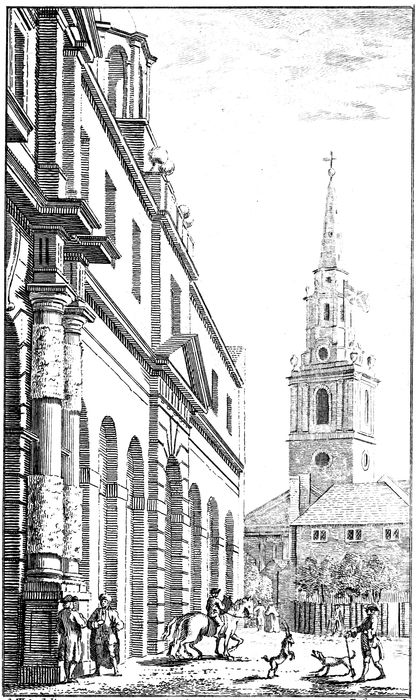
S. Wale delin. B. Green sculp. Part of the Meuse and St. Martins Church.
323There is something in this part of the intended building of the Mews very noble, particularly the center, which is enriched with columns and a pediment, and the continuity of the architecture preserved. The smaller pediment and rustic arch under the cupolas or lanthorns are properly subordinate, but set so close to the balustrade that its intent, as a gallery, is thereby destroyed. In the view given in the print scarce half the front is seen: and over some old houses you see the beautiful steeple and part of the portico of St. Martin’s church, which has the general fate of our public buildings, to be so incumbered with houses as to have no place to view them to advantage.
Upon viewing this edifice, it is impossible not to be offended at the wretched buildings which form the other sides of the square. It is indeed much to be wished that they were made to correspond with the main building; this, if it were done, and a suitable regular entrance 324made from Charing Cross, would make the royal stables one of the greatest ornaments of this metropolis. Some of the finest horses in the kingdom, both for the coach and saddle, may here be seen.
Mews, Devonshire square, Bishopsgate street.
St. Michael’s alley, by the side of St. Michael’s church, Cornhill.
St. Michael Bassishaw, a church on the west side of Basinghall street, so denominated from its dedication to St. Michael the Archangel, and its situation near Basing’s haw or hall. A church dedicated to the same patron has stood here from about the year 1140, but the last edifice being destroyed by the fire of London, the present structure was erected in its place. Newc. Rep. Eccles.
The walls are strengthened with rustic work at the corners, and the body well enlightened by a single series of large windows; at the east end, where the top is terminated by an arch, the light is given by three windows, one of them tall and upright, the two others circular. The steeple is a tower crowned with a turret, from which rises a kind of spire.
The patronage of this rectory appears to have been anciently in the Bishop of London; after which it fell into lay hands; 325but at last came to the Dean and Chapter of St. Paul’s, where it has ever since continued, but is subject to the Archdeacon. The Rector receives 132l. 11s. per annum in lieu of tithes.
St. Michael’s, an ancient parochial chapel, which stood at the end of Leadenhall street, where is now the row of houses fronting Aldgate; and the remains of this chapel are still to be seen under the corner house of Leadenhall street. They extend thirty-six feet from north to south, and sixteen from east to west, and there is still standing the Gothic arched roof, which is supported by handsome pillars; the whole built with square brick, chalk, and stone. Maitland.
St. Michael’s Cornhill, on the east side of St. Michael’s alley. We find that a church was situated here, dedicated to the same holy angel, so early as before the year 1133; but the last edifice being destroyed with the other public buildings by the fire of London, the present Gothic structure was raised in its stead. Stowe.
The body is seventy feet long and sixty broad, the height to the roof is thirty-five feet, and that of the tower an hundred and thirty feet. The lower part of the tower occupies the center, and on each side there is a regular extent of 326building. The principal door opens in the lower stage of the tower, which rises with angulated corners from the ground, forming a kind of base, terminated at the height of the body of the church. The second stage, which is plain and lofty, has two tall windows, one over the other, properly shaped for the style of the building; this is terminated with a truly Gothic cornice. The third stage is exactly in the form of the two others, only they are plain, and this is covered with ornaments, the angulated corners are fluted, and terminated by cherubims heads under a cornice: the plain face between has four windows in two series. Above the cornice, over the uppermost of these windows, runs a battlement on the plain faces of the tower, and from the corners are carried up four beautiful fluted turrets, cased a part of their height with Doric turrets; these terminate in pinacle heads, from within which rises a spire at each corner crowned with a fane. The author of the Critical Review of the public buildings observes, that this Gothic tower is very magnificent, and justly deserves to be esteemed the finest thing of that sort in London.
The advowson of this church was anciently in the Abbot and Canons of Evesham; 327but in 1503 they conveyed it to the Drapers company, who settled upon that convent a perpetual annuity of 5l. 6s. 8d. and that company have been its patrons ever since. The Rector, instead of uncertain tithes, has by act of Parliament a settled stipend of 140l. a year.
St. Michael’s Crooked Lane, on the east side of St. Michael’s lane, in Candlewick ward, receives its additional epithet from its vicinity to Crooked lane. A church dedicated to St. Michael stood in the same place before the year 1304; but suffering by the fire of London in 1666 was soon after rebuilt.
It is a plain Structure built with stone, and enlightened by a series of large arched windows. The tower, which is at the west end, is carried square to a considerable height, and the uppermost window in the center of each face, is ornamented with a head, and handsome festoons. From hence, instead of a balustrade, is a range of open work of the Gothic kind, with vases at the corners. From within this part, the tower rises circular, diminishing in three stages, with an open buttress rising from each corner of the square tower, to the top of the first stage; from this buttress rises a large scroll to the top of the second, and a smaller to the 328top of the third stage, above which rises a kind of short round spire of a peculiar kind, it swelling out at the bottom, and then rounding off, rises to a small height, where it is terminated by a gilt ball and fane.
The patronage of this church was anciently in the Prior and Convent of Canterbury, in whom it continued till the year 1408, since which time it has been in the Archbishops of that see, and is one of the thirteen peculiars in this city belonging to Canterbury. The Rector, in conformity to an act of Parliament granted in the reign of King Charles II. receives, besides his other profits, 100l. per annum in lieu of tithes.
Among the several monuments in this church, is that of Sir William Walworth who slew Wat Tyler. See the article London. The inscription, as given by Mr. Weaver, in his Funeral Monuments, is as follows:
Here under lyth a man of fame,
William Walworth callyd by name;
Fishmonger he was in life time here,
And twise Lord Mayor, as in bookes appere;
Who with courage stout and manly might,
Slew Wat Tyler in King Richard’s sight;
329For which act done, and trew intent,
The King made him Knight incontinent:
And gave him armes, as here may see,
To declare his fact and chivalrie.
He left this life the yere of our God
Thirteene hundryd fourscore and three od.
Here is also a monument erected to the honour of Queen Elizabeth; and the following very concise inscription on the tomb of William Wray.
Here lyeth, wrapt in clay,
The body of William Wray,
I have no more to say.
St. Michael’s lane, in Great Eastcheap, by the above church.
St. Michael’s Queenhithe, situated on the north side of Thames street, in the ward of Queenhithe, opposite to the great wharf and buildings of that name, was about the year 1181, denominated St. Michael de Cornhithe, which may lead us to the origin of the name by which we at present call that wharf, and this church from its situation near it; as the quantities of corn brought thither down the Thames might occasion the original name, and Queenhithe be only a corrupt way of speaking it.
330The old church being consumed by the dreadful fire in 1666, the present structure was erected in its room. It consists of a well-proportioned body, enlightened by two series of windows, the first a range of tall arched ones, and over these a range of large porthole windows, above which are cherubims heads, and underneath festoons, that adorn the lower part, and fall between the tops of the under series. The tower is plain but well-proportioned, and is terminated by a spire crowned with a fane in the form of a little ship.
This church has all along been in the gift of the Dean and Chapter of St. Paul’s, and is subject to the Archdeacon. On its being rebuilt the parish of the Trinity was united to it, by which the Rector’s fees were considerably augmented, who, besides his other advantages, receives 160l. per annum, in lieu of tithes.
St. Michael Querne, a church which stood at the west end of Cheapside, between Blowbladder street and Pater noster row, and had a narrow passage at the west end. We have an account of this edifice so early as the year 1181, when it appears to have been only a chapel, since the first Rector was buried in it in 1461. in old records it is called St. Michael ad Bladum; that is, At the Corn, which was 331corrupted to Querne. It was also sometimes denominated St. Michael de Macello, from its vicinity to the flesh market.
This ancient edifice being burnt by the fire of London, the place on which it stood was, by act of Parliament, laid into the street, in order to enlarge it, and the parish united to the church of St. Vedast, in Foster lane. Stowe’s Survey. Newc. Rep. Eccles.
St. Michael Royal, on the east side of College hill, in Vintry ward, is thus denominated from its being anciently near the Tower Royal. This was a parish church before the year 1285, when it was under the patronage of the Prior and Canons of Canterbury, in whom it continued till it was converted into a college by Sir Richard Whittington, mercer, four times Lord Mayor, who rebuilt the church; but even then the monks of Canterbury so far continued its patrons, as to present a person nominated by the Master and Wardens of the Mercers company. This church being consumed with the other public buildings by the fire of London, the present structure was erected in its room, and the parish of St. Martin Vintry united to it. Newc. Rep. Eccles. Stowe’s Survey.
332This structure is a plain, decent, and substantial stone building, enlightened by a single series of large arched windows, placed so high that the doors open under the level of their bottoms. The tower consists of three stages, and at the top is surrounded with carved open work instead of a balustrade: from hence rises a light and elegant turret adorned with Ionic columns, and ending in a fine diminution, which supports the fane.
This church is one of the thirteen peculiars belonging to the Archbishop of Canterbury, and the Rector, besides his other profits, receives 140l. a year in lieu of tithes. Among the several monumental inscriptions, was one in memory of the above Sir Richard Whittington.
St. Michael’s Wood Street, is seated on the west side of Wood street, in Cripplegate ward. An old church, dedicated to the same patron, stood there in the year 1392, and probably another succeeded it towards the close of the fifteenth century; however, in 1666 the church then standing was destroyed by the fire of London, and the present structure, which rose in its place, was finished a few years after, and the Parish of St. Mary Staining united to it.
333As the east end of this edifice is the most conspicuous part, it is ornamented with four Ionic columns raised upon a continued pedestal, with arches between, and supporting a handsome pediment, in the middle of which is a circular window. Between the columns are three upright arched windows, that fill the whole space. The rest of the body is plain, and the windows are raised so high that the doors open under them.
The tower consists of three plain stages with large windows, from the uppermost of which rises a small square course, the foundation of the base of the turret. This base is cut away from the breadth of the tower gradually to the diameter of the turret, which is plain, but handsome; and from its top rises a ball that supports the fane.
The patronage of this church was in the Abbot and Convent of St. Alban’s till the suppression of that monastery, when Henry VIII. sold it to William Barwell, who in the year 1588, conveyed it to several persons in trust for the parish, in which it still continues. The Rector, besides his other profits, receives 100l. a year in lieu of tithes.
Middle court, 1. Bernard’s Inn, Holborn. 2. Clement’s Inn.
334Middle row, 1. St. Giles’s. 2. Goswell street. 3. Holborn. 4. Gray’s Inn lane.
Middle Scotland yard, Whitehall.
Middle Shadwell, near Shadwell market.
Middle Shadwell lane, Middle Shadwell.
Middle Street, 1. Cloth Fair. 2. Horselydown.
Middle Temple, Fleet street. See the article Temple.
Middle Temple lane, a lane that leads from Fleet street to the Middle Temple.
Middle Turning lane, Shadwell.
Middlesex court, 1. Drury lane. 2. Little Bartholomew close.
Middlesex Hospital, for the reception of the sick and the lame, and for lying-in married women, in Marybon Fields near Oxford road. This is a neat, plain, and not inelegant brick building: it has the decent appearance and all the accommodations one would wish in a house devoted to charity, without that ostentatious magnificence which too often in a great measure defeats the humane and noble end of such pious and charitable institutions, where those sums are squandered away in useless decorations, that ought to be employed in administering health to the sick, and giving feet to the lame.
335Nature and religion patronize every instance of distress, but most powerfully befriend that deepest of all distresses, sickness in poverty. Sickness itself will excite compassion, though alleviated by every comfort and advantage of wealth. How much stronger a sympathy must then arise at the sight or idea of sickness imbittered by poverty! or considered in another view, of poverty disabled by sickness! Most men are inclined, but very few, in comparison, have the power to relieve it. Public contributions, therefore, seemed the most likely to effect what the private bounty of individuals could not. This gave rise, in the present charitable age, to infirmaries, and in particular to this, which has the merit and the honour of being the first hospital in this kingdom for lying-in women; and of setting an example which has been so happily followed.
The charitable designs of this hospital were carried on for several years in two convenient houses adjoining to each other, in Windmill street, Tottenham court road, where the first institution in August 1745, was intended only for the relief of the indigent sick and lame: but in July 1747, the Governors willing to render it more worthy of the notice of the public, extended their plan to the relief of the 336pregnant wives of the industrious poor: when the great increase of patients, occasioned by the reputation of this twofold charity, soon obliged the Governors to think of enlarging their edifice, as well as their plan; and the kind benevolence of the public by donations, legacies, &c. enabled them in 1755, to erect a much larger and more convenient building in Marybon Fields, wherein the apartments for the reception of the lying-in women are in a separate part of the building, remote from the sick and lame; and that ladies may visit the lying-in patients, without being incommoded by the sick and lame, different stair-cases lead to each, the lying-in wards having no communication with the sick and lame.
The qualification of a Governor of this charity is an annual subscription of three guineas; which also intitles the subscriber to recommend, and have in the house at one time, either one sick or lame patient, or one lying-in woman, and to recommend out-patients, A subscription of five guineas per annum intitles the subscriber to recommend one sick or lame in-patient, out-patients, and one lying-in woman. A subscription of thirty guineas at one payment, constitutes the subscriber a Governor for life, with the last mentioned 337privileges. Contributions of lesser sums than three guineas per annum are thankfully received, and intitle the contributors to recommend one sick or lame in-patient, and one out-patient at the same time.
A committee of the Governors (appointed quarterly) meet at the hospital every Tuesday, at ten of the clock, to receive and discharge patients, and to transact the other necessary business of the house; where every Governor, though not of the committee, has a right to be present, and his attendance is received as a favour. A report of their proceedings is made to the general court held every quarter, when the resolutions of this committee are approved or rejected.
The patients are attended without fee or reward by three eminent Physicians, a Man-midwife, three Surgeons, and a reverend Divine.
The Physicians visit the patients every Tuesday, Thursday, and Saturday, and on intermediate days, when particular cases require it. The Surgeons attend every day.
Patients are admitted on a letter of recommendation from a Governor or Contributor, who may recommend in-patients, and have out-patients on the books, 338according to the regulation abovementioned: and when in-patients are recommended, and there is not room in the house to receive them, they are put on the list to be admitted on the first vacancy, and in the mean time are prescribed for as out-patients.
No security is required for burials.
All accidents are admitted without recommendation.
Tuesday being the day appointed for the admission of patients, they are expected to be at the hospital, with their recommendations, at ten of the clock.
The Physicians and Surgeons meet every Saturday at twelve of the clock, at the hospital, where they give advice gratis to all such diseased poor who shall come, though unrecommended, and require it.
Married women only are admitted (in the last month of their pregnancy) after they have been examined by the weekly board, and on their producing an affidavit made before a Justice of the peace, of the time and place of their marriage, and of the settlement of the husband, with the manner the said settlement was obtained, whether by birth, servitude, or otherwise. And that this useful branch of the charity, the midwifery ward, may be made every way beneficial, and not 339liable to any objection, no pupils will be admitted; the whole being under the direction of Dr. Brudenell Exton, Physician and Man-midwife: and no woman whatsoever, who has been able to prove her marriage, and her husband’s settlement, so as to avoid burthening the parish wherein the hospital stands, has been refused admittance.
The number of beds at present are sixty-four.
The patients admitted from the first institution of this hospital, in August 1745, to the 1st of June 1758, are as follow:
In-patients, sick and lame 1829
Out-patients 11785
Lying-in women 1425
15039
The servants of the house are forbid to take any gratuity of the patients or their friends, on any pretence whatsoever, on pain of expulsion.
Such persons who are inclined to favour this charitable design, are desired to send their subscriptions, with their names and places of abode, to the Treasurers, at the weekly committee, held every Tuesday in the forenoon at the hospital; and in order to supply the current expence of this charity, the subscribers are requested 340to continue to pay their yearly subscriptions in advance.
Subscriptions and benefactions are likewise taken in at Messrs. Honywood, Fuller, and Co. bankers in Birchin lane; and at Mr. Gislingham Cooper’s, banker in the Strand. From the account published by the Society in June 1758.
The reader may find the other hospitals for lying-in women, founded after the example set by this excellent charity, under the articles London Lying-in Hospital, Lying-in Hospital in Brownlow street, and Lying-in Hospital in Duke street.
Middlesex row, St. Giles’s Broadway.
Midley’s wharf, Ratcliff.†
Milborne’s Almshouse, on the west side of Woodrof lane, Crutched Friars, was erected by Sir John Milborne in the year 1535, for the reception of thirteen poor members of the Drapers company, whom he allowed 7d. per week, which was at that time a sufficient support. In the front of the building is the following inscription:
Ad laudem Dei, & gloriosæ Virginis Mariæ, hoc opus erexit Dominus Johannes Milborne, Miles & Alderman. bujus civitatis, A. D. 1535.
341That is,
‘To the praise of God, and the glory of the Virgin, this edifice was erected by John Milborne, Mayor of this city in the year 1535.’
The Drapers company, to whom the management of this almshouse was intrusted, have not only increased the number of the pensioners to fifteen; but have doubled their pensions, with a load of coals, and twenty or more shillings annually, out of the money left to be distributed by that company at discretion.
St. Mildred’s Bread Street, a church situated on the east side of Bread street, and in the ward of that name, is thus denominated from its being dedicated to St. Mildred, a Saxon lady, the daughter of Merwaldus, brother to Penda King of the Mercians. This Princess despising the gaieties of a court, retired to a convent at Hale in France, whence returning to England, accompanied by seventy virgins, she was consecrated Abbess of a new monastery in the isle of Thanet, where she died in the year 676.
A church under the same tutelary name stood in that spot in the year 1333: but the last structure being destroyed by the fire of London, the present edifice was created in its room in 1670.
342It consists of a spacious body, and a light tower divided into four stages, whence rises a tall spire.
The advowson of this church was anciently in the Prior and Canons of St. Mary Overie’s, but it afterwards came to Sir Nicholas Crispe, in whose family it may perhaps still remain. On the present edifice being built, the parish of St. Margaret Moses was annexed to it. The Rector, besides his other profits, receives 130l. per annum in lieu of tithes.
St. Mildred’s Poultry, at the corner of Scalding alley, in Cheap ward. A church of the same name stood in this place before the year 1325; but the last edifice sharing the fate of most of the other public buildings at the fire of London, this was built in its room.
It is a plain, substantial stone building, enlightened by a series of large windows, and strengthened with rustic at the corners. The tower is crowned with a plain course, without either pinacles, turret, or any other ornament.
The patronage of this church was in the Prior and Canons of St. Mary Overie’s in Southwark, till their suppression; and it has ever since been in the King’s gift. After its being rebuilt, the parish of St. Mary Cole was annexed to it, by which 343the profits of the Rector were considerably increased. Besides his other profits, he receives 170l. a year in lieu of tithes.
Mile End, so called from its being a mile from Aldgate, is situated near Stepney, in the road to Bow. Here anciently stood a Lazaretto, or hospital of lepers, denominated the house of our Saviour Jesus Christ, and Mary Magdalene, to whom Edward VI. granted letters patent, allowing them to beg for their support.
Mile End Green, Stepney.
Mile End Old Town, near Stepney.
Mile’s lane, 1. By Crooked lane. † 2. New Fish street.†
Mile’s rents, 1. Dog lane, Barnaby street. † 2. Powell’s alley, Beech lane, Whitecross street.†
Milford lane, extends from the Strand to the Thames.†
Milford stairs, at the bottom of Milford lane. †
Military mews, Prince’s street, Soho.
Milk alley, 1. Dean street, Soho. 2. Long Ditch, Westminster. 3. Milk yard, near Gravel lane. 4. Peter street, Clare market. 5. Wapping. 6. Winchester yard, Winchester street.
Milk street, Cheapside; so called from a market for milk formerly kept there.
344Milk yard, 1. New Gravel lane, Shadwell. 2. Popping’s alley, Fleet street. 3. Rag Fair, Rosemary lane.
Millbank, Westminster horse ferry.
Miller’s court, Aldermanbury.†
Mill lane, Tooley street.
Millman’s street, near Red Lion street, Holborn.†
Millpond Bridge, Rotherhith.
Millpond Bridge lane, Rotherhith.
Millpond row, Rotherhith.
Mill street, 1. Conduit street. 2. Rotherhith wall. 3. St. Saviour’s dock.
Mill yard, runs from Rosemary lane into Goodman’s fields.
Mills’s yard, Rotherhith wall.†
Milxan’s wharf, Durham yard.†
Mims, there are two villages of this name; North Mims, situated in Hertfordshire, on the east side of Colney, and two miles from Hatfield. In its neighbourhood is the seat of the late Sir Joseph Jekyll, Master of the Rolls, in right of his Lady, who was heir to her late brother the great Lord Somers. It has a most delightful prospect. The body of that Nobleman lies interred in the chancel of the church, without any inscription. This seat now belongs to the Duke of Leeds, who is Lord of the manor.
345South Mims is situated two miles from the former, in the most northern corner of Middlesex. Here is an almshouse built and endowed for six poor people, by James Hickson, Esq; who died in 1689, when he gave by his will to fifteen poor people of this parish two shifts, one pair of hose, and a pair of shoes annually; for the payment of these, and other benefactions, he left several estates in this parish to the Brewers company in London.
Mincing lane, on the south side of Fenchurch street, extends to Tower street, is well built, and chiefly inhabited by merchants.
Mine and Battery Works Company, for the discovery of mines and minerals. In order to give a just idea of the origin of this and the following company, it is necessary to observe, that the English, in the reign of Queen Elizabeth, being but little acquainted with the manner of working and discovering mines, she, by the advice of her Council, sent for several Germans, well skilled both in these works, and in smelting and refining of minerals; who on their arrival were no sooner naturalized, than they obtained a licence to search for mines.
346Among these, that Princess in the year 1565, impowered William Humfreys and Christopher Schutz a German, to search for all mines, minerals, and subterraneous treasure, except allum and copperas, in the several royalties throughout England, exclusive of the following eight counties, York, Cumberland, Westmoreland, Cornwall, Lancashire, Devon, Gloucester, and the principality of Wales, for their sole use and profit; her Majesty only reserving to herself a tenth part of all gold, silver, and quicksilver ores, and the pre-emption of refined gold and silver, the former at 8d. and the latter at 1d. per ounce lower than the current price of those metals; and 6d. for every hundred weight of copper.
Afterwards her Majesty, in the year 1568, incorporated this society by the name of, The Governors, Assistants, and Society of the Mineral and Battery Works. The number of shares belonging to this company at first amounted to thirty-six; which being divided into half and quarter parts, they are at present increased to an hundred and forty four.
Mines Royal Company. This society owed its origin to the same cause as the former, and was founded a year before it: 347for in 1564 Queen Elizabeth, by her letters patent granted to Thomas Thurland and Daniel Houghsetter, and their heirs for ever, impowered them to search for mines of gold, silver, copper, and quicksilver, in the several royalties in the counties of York, Lancashire, Cumberland, Westmoreland, Cornwall, Devon, Gloucester, Worcester, and the principality of Wales, to be held of the crown upon the same terms as those abovementioned, with respect to the Mine and Battery Works company.
At length Thurland and Houghsetter having in virtue of the powers granted them, sold several parts or shares of their said privileges, they, with the purchasers, were, by letters patent, dated the 22d of May 1568, incorporated by the stile of, The Governors, Assistants, and Commonalty of the Mines Royal. The shares of this company at first consisted of twenty-four; but they have since been increased to ninety-six. Sir John Pettus’s Fodinæ Regale.
Minories. This street extends from Aldgate street to Tower hill. The middle part of the east side is called the Little Minories; this part is railed in, and is out of the liberties of the city. Here anciently stood an abbey 348of nuns of the order of St. Clare, called the Minoresses; whence the street obtained the name of the Minories. See the article Trinity in the Minories.
Mint, an office kept in the Tower for coining money. Before the Norman conquest the Kings of England set apart certain monasteries for mints; presuming that the coinage would in those places be best secured from frauds and corruption. Edward I. however ordered a mint of thirty furnaces to be erected in the Tower of London, and others in Canterbury, Kingston upon Hull, Newcastle upon Tyne, Bristol and Exeter. From that time the mint was kept sometimes in one place, and sometimes in another, according to the will and pleasure of the Prince, who, for a sum of money, was frequently prevailed upon to grant the privilege of coining to some Nobleman, Bishop, or Corporation; which being attended with many inconveniencies to the public, Queen Elizabeth, in the beginning of her reign, endeavoured to rectify those abuses, by confining the mint to the Tower of London, which has ever since been appropriated to the coinage of money, except when King Charles I. by the confusion of 349the times, was obliged to erect new mints at Oxford, York, and Newark upon Trent, where being with his army, he was reduced to the necessity of coining money to supply his present wants: and when King William III. having called in all the base and clipped money, for the sake of expedition, and for the service of distant parts of the nation, was obliged to erect mints at Bristol, Exeter, York and Winchester.
The mint office is on the left hand on entering into the Tower, and at a small distance from the gate. There is no possibility of describing the particular processes that the different metals undergo before they receive the impression.
The manner of stamping is all you are permitted to see, and this is done with surprizing expedition, by means of an engine, worked sometimes by three, and sometimes by four men. The manner of making the impression on gold, silver, and copper, is exactly the same, only a little more care is necessary in the one, than in the other, to prevent waste.
This engine, which makes the impression on both sides of a piece of money, in the same moment, works by a worm-screw terminating in a spindle; just in 350the same manner as the letter press for printing books. To the point of this spindle the head of the die is fastened by a small screw, and in a little sort of a cup directly underneath it, is placed the reverse. Between these the piece of metal already cut round, or cast to the size, and if gold, exactly weighed, is placed; and by once pulling down the spindle with a jerk, is completely stamped. The whole process is performed with amazing dexterity; for as fast as the men who work the engine can turn the spindle, so fast does another twitch out with his middle finger that which was stamped, while with his finger and thumb he places another that is unstamped. The silver and gold thus stamped, are delivered to be milled round the edges, the manner of performing which is a secret never shewn to any body.
The mint is managed by several officers formed into a corporation. These are a Warden, a Master and Worker, a Comptroller, the King’s Assay Master, the chief Engraver, the Surveyor of the meltings, a Clerk of the irons, a Weigher and Teller, a Provost, Melters, Blanchers, Moneyers, &c.
The Warden receives the silver, &c. 351from the goldsmiths, pays for it, and oversees all that belong to his office. His salary amounts to 450l. a year for himself and clerk. He has also another clerk who receives 100l. a year.
The Master and Worker receives the silver, &c. from the Warden, orders it to be melted, delivers it to the Moniers, and receives it back from them again. His salary is 650l. a year for himself and three clerks.
The Comptroller sees that the money be made of the just assize; oversees the officers, and controlls them, if the money does not prove as it ought. His salary for himself and clerk is 535l. per annum.
The King’s Assay Master, takes care that the bullion is according to standard. He has a salary of 225l. a year for himself and clerk: and the Assistant Assay Master has 100l. per annum.
The chief Engraver, engraves the stamps for the money. He has a salary of 200l. a year, and his Assistant 80l.
The Surveyor of the meltings, is to see the bullion cast out, and that the metal be not altered after the Assay Master has made trial of it, and it is delivered to the melter.
352The business of the Clerk of the irons, is to see that the working irons are kept clean, and fit for the work. These two last offices are frequently enjoyed by the same person, who has a salary of 130l. 10s. a year.
The Weigher weighs the bullion.
The Teller counts the number of pieces. These two last offices are also frequently enjoyed by the same person, who has a salary of 142l. 10s. a year for himself and clerk.
The Provost to the company of Moneyers, provides for all the Moneyers, and oversees them. His salary is 100l. a year.
The Moneyers cast the money, and sheer it; some beat it broad, others round it, and others stamp or coin it. These have 40l. a year each.
Besides these there are the King’s Clerk, and Clerk of the papers, who has 100l. a year; a Surveyor of the money presses, who has 40l. a year; and several deputies and clerks.
Mint, opposite the west end of St. George’s church, Southwark. Here anciently stood a magnificent structure belonging to the Duke of Suffolk, which coming to Henry VIII. he erected a 353mint in it, from which that neighbourhood is still denominated. This place was for many years a famous asylum for debtors, who fled thither with their effects, in order to defraud their creditors: till this was carried to such a height, that the Parliament found it necessary to take away the privilege of sanctuary in order to destroy this nest of spoilers.
Mint street, extends west from the corner of Blackman street, opposite St. George’s church, Southwark.
Mint square, in the Mint, Southwark.
Mitchell’s court, 1. Milk street, Cheapside† 2. Mitchell street, Old street.†
Mitchell’s street, Brick lane, Old street.†
Mitre court, 1. Cheapside.* 2. Cornhill.* 3. Fenchurch street.* 4. Fish street hill.* 5. Fleet street.* 6. Friday street.* 7. Gutter lane, Cheapside.* 8. High street, Aldgate.* 9. St. John’s street, West Smithfield.* 10. Milk street, Cheapside.* 11. St. Paul’s Church yard.*
Mitre court buildings, Inner Temple.*
Mitre yard, Shoemaker row, Aldgate.*
Moldstrand Dock stairs, Willow street, Bank side.
Molin’s court, Shoe lane, Fleet street.†
354Moneybag alley, Blue Anchor yard, Rosemary lane.
Moneybag yard, Anchor alley.
Money court, Mile’s lane.
Monger’s Almshouse, in Well street, Hackney, was founded by Henry Monger, Esq; in the year 1699, for six poor old men, who are allowed forty shillings per annum each. Maitland.
Monkwell street, Silver street, near Cripplegate. It took its name from the monks lodging in it, and a well belonging to them. Maitland.
Monmouth court, 1. Hedge lane, Charing Cross. 2. High Holborn. 3. Monmouth street, St. Giles’s.
Monmouth street, 1. Quaker street, Spitalfields. 2. Seven Dials. This street is famous for the sale of old cloaths. 3. Shadwell market. 4. Spitalfields.
Montague alley, Clare street, Clare market.
Montague close, in Southwark.
Montague court, 1. Bishopsgate street. 2. Little Britain. 3. Montague street, Spitalfields. 4. Petticoat lane.
Montague House, in Great Russel street, a noble building, with a very spacious court yard before it. His Grace 355the late Duke of Montague having built another house in the Privy Garden at Whitehall, this edifice was let for the use of the King’s great wardrobe, and is since purchased by authority of Parliament, to be a repository for the Cotton library, and for the natural and artificial curiosities, medals, coins, printed books, and manuscripts, bought by the public of the executors of the late Sir Hans Sloane, the late Lord Oxford, &c. Stowe’s Survey, last edition. See the article British Museum.
Montague street, Brick lane, Spitalfields.
Month’s alley, St. Catharine’s lane.
The End of the Fourth Volume.
TRANSCRIBER’S NOTES
P. 112, changed “pent-houses” to “pest-houses”.
P. 310, changed “Town Clerk, &c. their several coaches” to “Town Clerk, &c. in their several coaches”.
All spelling errors were left uncorrected.