C.
Reading edition
Cabbage alley, 1. Barnaby street. 2. Long lane, Southwark.
Cabbage lane, near King’s Arms stairs.
Cabbage yard, Cork lane, Swan fields.
Cabinet court, Duke street, Spitalfields.
Cable court, Cable street.
Cable street, Rag fair.
Cadd’s row, Islington.†
Cæsar’s Head court, Crutched Friars.*
Cage alley, Cock hill, Ratcliff.
Cain and Abel’s alley, 1. Angel alley, Houndsditch.* 2. Bishopsgate street without.*
Calender’s court, 1. Drury lane. 2. Long alley, Moorfields.
62Camberwell, a pleasant village in Surry, two miles from Southwark, in the road to Croydon.
Camberwell road, Newington butts.
Cambray house. See Canonbury House.
Cambridge heath, in Middlesex near Hackney.
Cambridge street, Broad street, Poland street.
Camden court, Clerkenwell.
Camden house, in Middlesex, a little to the west of Kensington palace, was lately the seat and manor of the Earl of Warwick, but it now belongs to Henry Fox, Esq.
Camel row, Mile end.
Camomile court, Camomile street.
Camomile street, Bishopsgate street.
Campion lane, Allhallows, Thames street.†
Campion’s alley, Market street, Westminster.†
Camp’s Almshouse, in Wormwood street, was founded by Mr. Laurence Camp, for the relief of six poor people of the parish of Allhallows London Wall, who had an allowance of 1l. 14s. 8d. a year.
Canary court, Exeter court in the Strand.
Candlewick Ward, took its name from a street called Candlewick, or Candlewright street, remarkable for wax and 63tallow chandlers, who were anciently called candlewrights, and is bounded on the south by Bridge and Dowgate wards; on the west by Dowgate and Wallbrook wards; on the north by Langborne ward; and on the east by Bridge ward. The principal streets in this ward are, Eastcheap, and a part of Canon street, and St. Martin’s lane. The most remarkable buildings are the parish churches of St. Clement’s Eastcheap, St. Mary Abchurch, and St. Michael’s Crooked lane.
It is governed by an Alderman, his Deputy, and seven other Common Council men; twelve wardmote inquest men, six scavengers, eight constables, and a beadle. The jurymen returned by the wardmote inquest serve on juries in Guildhall in the month of December.
Cane’s wharf, Milford lane.†
Canon alley, St. Paul’s church yard.
Canon row, or Channel row, New Palace yard, Westminster; called Canon row from this row formerly consisting of the houses for the Canons of St. Stephen’s Westminster.
Canon street, 1. In the Mint. 2. Ratcliff Highway. 3. A considerable street extending from Budge row to Eastcheap.
64Canonbury, vulgarly called Cambray House, formerly belonged to the Prior and Canons of St. Bartholomew in Smithfield. It is pleasantly situated on a beautiful eminence on the east side of Islington, and commands three delightful prospects to the east, north, and south.
Canons of St. Paul’s. These Canons or Prebendaries, who are 30 in number, with the Bishop of London at their head, compose the Chapter, which has the management of the affairs of this cathedral; these canonries are in the collation of the Bishop, and are as follows. 1. Bromesbury, in the parish of Willesden, Middlesex. 2. Brownswood, in the same parish. 3. Cadington Major, in the manor of Astonbury, Bedfordshire. 4. Cadington Minor, in the parish of Cadington, Bedfordshire. 5. Chamberlain’s-Wood, in the parish of Willesden, Middlesex. 6. Chiswick, in the county of Middlesex. 7. Consumpt. per Mare, a prebend in the parish of Walton, or Waltome, on the coast of Essex, which being overflowed by the sea, before the conquest, the present name serves only to perpetuate the remembrance of that fatal catastrophe. 8. Eald Street, or Old 65Street, in Shoreditch parish. 9. Ealdland, in the parish of Tillingham, Essex. 10. Holiwell, alias Finsbury, in the parishes of St. Giles Cripplegate, and Shoreditch. 11. Harleston, in the parish of Willesdon, Middlesex. 12. Holborn, in the suburbs of London. 13. Hoxton, in the parish of Shoreditch. 14. Islington, in the county of Middlesex. 15. Kentish-town, in the parish of St. Pancras. 16. Mapelsbury, in the parish of Willesdon. 17. Mora, in the parish of St. Giles Cripplegate. 18. Neasdon, in the parish of Willesdon. 19. Oxgate, in the same parish. 20. St. Pancras, in Middlesex. 21. Portpool, in the parish of St. Andrew Holborn. 22. Reculvarland, in the parish of Tillingham, Essex. 23. Rougemere, in the parish of Pancras. 24. Sneating, in the parish of Kirkeby, Essex. 25. Stoke Newington, Middlesex. 26. Tottenhall or Tottenham Court, in the parish of St. Pancras. 27. Twyford, in the parish of Willesdon, Middlesex. 28. Wenlakesbarn, in the parish of St. Giles Cripplegate. 29. Wildland, in the parish of Tillingham, Essex. 30. Willesdon, in the county of Middlesex. Newc. Repert.
The petty Canons who are twelve in 66number, are chosen out of the ministers and officers belonging to the cathedral, and should be persons of unspotted characters, with harmonious voices, and skilled in vocal music. These were constituted a body politic and corporate by letters patent granted by King Richard II. in the year 1399, by the title of The College of the twelve petty Canons of St. Paul’s; and allowed a common seal, with one of their number for a Warden. Newc. Repert.
Canterbury court, 1. Black Friars, 2. Phenix street.
Car court, Rotten row, Old street.
Car yard, 1. Moor lane. 2. Redcross street. 3. White’s yard, Rosemary lane.
Card court, West Smithfield.
Cardinals of the choir, two officers chosen out of the petty Canons of St. Paul’s, by the Dean and Chapter. Their office is to superintend the behaviour and attendance of the several officers belonging to the choir; and to take minutes of the several crimes of which they are guilty when on duty, in order to their being corrected for them by the Dean and Chapter.
Cardinal’s Cap alley, Bank side.*
Cardmakers, were incorporated by letters patent of Charles I. in the year 671629. This company is governed by a Matter, two Wardens, and eighteen Assistants, but they have neither livery nor hall.
Cary lane, Foster lane, Cheapside.†
Cary street, Lincoln’s Inn fields.†
Carlisle street, Soho square.
Carman’s yard, Pepper alley.
Carmen, were constituted a fellowship of this city, by an act of Common Council in the reign of Henry VIII. and incorporated by letters patent granted by James I. in 1606, with the fraternity of Fuellers, under the denomination of Woodmongers, with whom they continued till 1668, when the Woodmongers were convicted by parliament of many enormous frauds in the sale of coals, and other fuel, and being apprehensive of suffering the punishment due to their crimes, threw up their charter in order to avoid it, upon which the Carmen were again appointed a fellowship by an act of Common Council, under the title of The free Carmen of the city of London. They are governed by a Master, two Wardens, and forty-one Assistants, under the direction of the court of the Lord Mayor and Aldermen, but have neither livery nor hall.
68Carnaby, or Marlborough Market, by Carnaby street, has Marlborough street on the north, and Broad street on the south west. This is lately become a very plentiful market for flesh and other provisions.
Carnaby street, 1. Silver street, Bloomsbury. 2. Silver street, Golden square.
Caroline court, Saffron hill.
Caron’s Almshouse, in Kingston road, Vauxhall, consists of seven rooms for as many poor women, and was founded by his excellency the Right Hon. Noel Baron of Caron, Ambassador from the States General in the year 1623. This almshouse he endowed with a handsome estate, out of which each of his almswomen receives 4l. a year.
Carpenters, a fraternity incorporated by Edward III. in the year 1344; with the power of making by-laws. This company is governed by a Master, three Wardens, and twenty Assistants, with a livery of 100 members, who pay a fine of 8l. upon their admission.
Their hall is situated on the south side of London Wall almost facing the east end of Bethlem hospital, in a court called Carpenters hall yard, to which there is an entrance through a large pair of gates. 69The building is composed of timber and plaister; and though very old, is not without its peculiar ornaments.
Carpenters alley, Wych street.
Carpenters buildings, London wall.
Carpenters court, 1. Aldermanbury. 2. Bett’s street, Ratcliff. 3. Charterhouse lane. 4. Long Acre.
Carpenters street, Mount row.†
Carpenters yard, 1. Beech lane. 2. Coleman street. 3. Near Blackman street. 4. Deadman’s place. 5. London wall. 6. Long lane, West Smithfield. 7. Peter street, Westminster. 8. Poor Jewry lane. 9. Skinner street. 10. Town Ditch, Little Britain. 11. Upper Ground street.
Carriers street, Buckeridge street.
Carshalton, a village in Surry, situated among innumerable springs, which all together form a river in the very street of the town, and joining other springs that flow from Croydon and Beddington, form one stream called the Wandell. Though this village is thus situated among springs, it is built upon firm chalk, and on one of the most beautiful spots on that side of London, on which account it has many fine houses belonging to the citizens of London, some of them built with such grandeur and expence, that 70they might be rather taken for the seats of the nobility, than the country houses of citizens and merchants. Mr. Scawen intended to build a magnificent house here in a fine park which is walled round, and vast quantities of stone and other materials were collected by him for this purpose; but the design was never carried into execution. Here also Dr. Ratcliff built a very fine house, which afterwards belonged to Sir John Fellows, who added gardens and curious water-works. It at length passed into the possession of the Lord Hardwick, who sold it to the late William Mitchell, Esq; and it is now in the possession of his family.
Carteret street, Broad way, Westminster.
Cart yard, 1. Rosemary lane. 2. Whitechapel.
Carter’s court, 1. Lukener’s lane.† 2. Cursitors alley, Bristol street.†
Carter’s rents. Brick lane, Spitalfields.†
Carter’s street, Houndsditch.†
Carthusian street, Pickax street, Aldersgate street.
Cartwright street, Broad way, Westminster.† 2. Rosemary lane.†
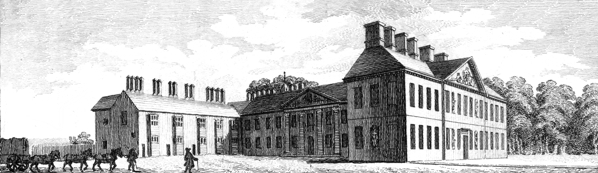
CASHIOBURY.
Cashiobury, in Hertfordshire, situated 71sixteen miles north of London, is said to have been the seat of the Kings of Mercia, during the Heptarchy, till Offa gave it to the monastery of St. Alban’s. Henry VIII. however bestowed it on Richard Morison, Esq; from whom it passed to Arthur Lord Capel, Baron of Hadham, and from him came by inheritance to be the manor of the Earls of Essex, who have here a noble seat erected in the form of an H, with a large park adorned with fine woods and walks: the gardens were planted and laid out by Le Notre in the reign of King Charles II. The front and one side are of brick and modern, the other side is very old. The print shews it better than description.
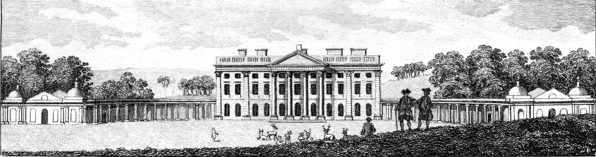
Moor Park.
Cash’s alley, near Shoreditch church.†
Castle alley, 1. Cornhill.* 2. Near Lambeth hill.* 3. Trig lane, Thames street.*
Castle Baynard Ward, was so called from an ancient castle near the Thames built by Baynard, a nobleman of great authority, who came from Normandy with William the Conqueror. It is bounded on the north and west by the ward of Faringdon within; on the east by Queenhithe and Bread street wards; and on the south by the river Thames.
72The principal streets in this ward are, the south end of Thames street, St. Peter’s hill, St. Bennet’s hill, Addle hill, Knight Rider street, Paul’s chain, Carter lane, and the east side of Creed lane, and Warwick lane. The remarkable buildings are, the churches of St. Bennet’s, Paul’s Wharf, St. Andrew Wardrobe, and St. Mary Magdalen, with the Heralds office.
It is governed by an Alderman and his Deputy, nine other Common Council men; fourteen wardmote inquest men, seven scavengers, ten constables, and a beadle. The jurymen returned by the inquest for this ward serve in the courts of Guildhall in the month of September.
Castle court, 1. Birchin lane.* 2. Budge row.* 3. Castle alley, Cornhill.* 4. Castle lane, in the Mint.* 5. Castle street, Long Acre.* 6. College hill.* 7. Cornhill.* 8. Houndsditch.* 9. Laurence lane.* 10. Lombard street. 11. St. Martin’s lane, Charing Cross. 12. In the Strand. 13. Whitecross street, Cripplegate.*
Castle Inn yard, Aldersgate street.*
Castle lane, 1. Castle street, Long Acre.* 2. Castle street, Southwark.* 3. Petty France, Westminster (called also Cabbage lane).* 4. Redcross street, Deadman’s 73place.* 5. St. James’s Westminster.* 6. Thames street.*
Castle street, 1. Air street, Piccadilly.* 2. Bloomsbury.* 3. Cavendish market.* 4. Near Long Acre.* 5. In the Park, Southwark.* 6. Near the Royal Mews. * 7. Saffron hill.* 8. Shoreditch field.* 9. Thames street.* 10. Near Wentworth street, Spitalfields.* 11. Bevis street.*
Castle Street Library, was founded in the year 1685, by Thomas Tennison, D.D. Vicar of St. Martin’s in the fields, and afterwards Archbishop of Canterbury, for the use of his school, under which it is placed in a spacious room, and consists of about 4000 volumes.
The librarian’s salary is 10l. per annum, and he has convenient lodgings contiguous to the library. Maitland.
Castle Street School, was founded by Dr. Tennison, at the same time with the library. In 1697, that gentleman gave 1000l. towards a fund for the maintenance of his foundation, and some time after, by the consent of Dr. Patrick, Bishop of Ely, another sum of 500l. which had been left them jointly in trust, to dispose of in charitable uses, as they thought proper: which two sums, together 74with two leasehold messuages for the term of forty years, he vested in trustees, for the support of his school and library; out of the profits of which the librarian has the allowance mentioned above; the schoolmaster, besides a commodious dwelling house, has a salary of 30l. per annum; and the usher the same salary without any apartment; for which they teach thirty boys, the sons of the inhabitants of St. Martin’s in the fields. Maitland.
Castle yard, 1. Castle alley, Cornhill.* 2. Chick lane.* 3. Dacre street.* 4. East street, Bloomsbury.* 5. Harrow corner, Deadman’s place.* 6. Hermitage bridge, Wapping.* 7. Holborn.* 8. Houndsditch.* 9. Kingsland road, Shoreditch.* 10. Near the Broad way.* 11. Pennyfield street.* 12. St. Martin’s lane, Charing Cross.* 13. Piccadilly. * 14. Saffron hill.*
Cat alley, Long lane, Smithfield.*
Cat’s Head court, Orchard street, Stable yard, Westminster.*
Cat’s hole, Tower ditch.
Cat’s hole yard, Tower ditch.
Cateaton street, King’s street, Cheapside.
Catharine alley, Bishopsgate street.
Catharine court, 1. Prince’s street, Threadneedle street. 2. Seething lane.
75St. Catharine Cree Church, at the corner of Creechurch lane in Leadenhall street. The addition of the word Cree, arose from the English spelling of the word Christ as pronounced by the French; for this church being placed on the ground of a dissolved priory, which with its church was called our Saviour Christ’s church, tho’ it was dedicated to the virgin martyr St. Catharine, the original name of that priory became added to its denomination. The present edifice was erected in the year 1630, and is a very singular structure, built with stone, and of a mixed Gothic style. It has rounded battlements on the top, and a square tower that has the same kind of battlements: this tower is crowned with a square turret, over which is a dome, and from its summit rises the weather cock.
This is a curacy, and the parishioners have the privilege of choosing their own minister, who must be licensed by the Bishop of London. The Curate receives 70l. a year, exclusive of other advantages. Maitland.
St. Catharine Coleman, on the south side of Fenchurch street, is thus denominated from its been dedicated to the same saint as the two former churches, and the epithet of Coleman is added from there 76being formerly near it a large haw, yard, or garden, called Coleman-haw.
The old church escaped the flames at the fire of London; but becoming very ruinous, was rebuilt by the parish in the year 1734. The body is lofty, and enlightened with two series of windows; and the steeple, a plain tower crowned with battlements.
This church is a rectory, in the gift of the Bishop of London. The living is worth about 100l. per annum.
St. Catharine’s Church, on the east side of St. Catharine’s court, near the Tower, originally belonged to an hospital founded by Matilda, consort to King Stephen, and was farther endowed by Queen Eleanor, the relict of Henry III. Queen Eleanor consort to Edward I. and King Henry VI. who not only confirmed all the former grants, and added several additional ones, but gave an ample charter to this hospital. It was exempt from the jurisdiction of the Bishop of London, till its suppression by Henry VIII. soon after which King Edward VI. annexed it to the diocese of London. The church, which is a very antique building, is at present collegiate, and has a master and three brethren, who have 40l. each; three sisters who have 20l. and ten beadswomen 77who have 8l. per annum each: but the other profits arising from their estates, being only known to the master and brethren, are divided amongst them. Stow, Maitland.
St. Catharine’s Courts. To this precinct belong two courts; in one of which actions of debt for any sum are tried weekly on Thursdays: and in the other, which depends upon the civil law, are decided ecclesiastical matters.
St. Catharine’s court, 1. St. Catharine’s.☐ 2. Threadneedle street.
St. Catharine’s lane, East Smithfield.☐
St. Catharine’s stairs, St. Catharine’s.☐
St. Catharine’s street, St. Catharine’s.☐
Catharine street, in the Strand.
Catharine Wheel alley, 1. Blackman street.* 2. Holiwell street.* 3. St. James’s street.* 4. Kent street.* 5. Petticoat lane.* 6. Snow hill.* 7. Whitechapel.*
Catharine Wheel court, 1. Bridgewater gardens.* 2. Snow hill.* 3. Whitechapel.*
Catharine Wheel yard, 1. Bishopsgate street.* 2. Blackman street.* 3. London wall.* 4. St. James’s street.* 5. West Smithfield.*
Catharine Wheel and George yard, Bishopsgate street.*
78Catharine Wheel Inn yard, St. Margaret’s hill.*
Catlin’s alley, Shoreditch.†
Catstick yard, Gray’s Inn lane.
Cavendish court, Houndsditch.†
Cavendish market, Cavendish street.
Cavendish square, near Oxford street, has a spacious area which contains between two and three acres, with a large grass plat in the middle, surrounded with wooden rails, erected upon a brick wall; but both the rails and wall being much decayed, now make but an indifferent appearance. The square is, however, encompassed by noble buildings: the Lord Harcourt has a fine house on the east side; on the west is a noble edifice belonging to Mr. Lane, formerly the Lord Bingley’s; and in the center of the north side is a space left for a house intended to be erected by the late Duke of Chandos, the wings only being built; however, there is a handsome wall and gates before this space, which serve to preserve the uniformity of the square. Adjoining to this square, Lord Foley has just built a very grand house, with offices, and a court before it.
Cavendish street, Oxford street.
Causabond’s grounds, Maiden lane.†
79Cecil court, St. Martin’s lane, Charing Cross.†
Cecil street, in the Strand, so named from Cecil house, belonging to the great Lord Burleigh.
Cecil’s dock, Rotherhith wall.†
Master of the Ceremonies. See the article Master of the Ceremonies.
Chain alley, near Crutched Friars.
Chain court, Ship yard, Temple Bar.
Chain gate, near St. Saviour’s church, Southwark.
Lord Chamberlain, a great officer of the King’s houshold, who has the oversight of all the officers above stairs, except the precinct of the King’s bedchamber, which is under the government of the Groom of the stole. He has the oversight of the King’s Chaplains, notwithstanding his being a layman; also of the officers of the wardrobe, beds, tents, revels, music, comedians, hunting, and of all the physicians, apothecaries, surgeons, barbers, messengers, trumpets, drummers, tradesmen and artisans retained in his Majesty’s service. His salary is 100l. a year, and 1100l. a year board wages. His office is in Cleveland row.
Chamberlain of London, an officer of great trust, annually chosen on Midsummer day, tho’ he enjoys his place for 80life, if he is not found guilty of some great crime. He receives and pays all the city cash, and with him are deposited all public securities, for which he annually accounts to the proper auditors. As he is therefore entrusted with very considerable sums, he is obliged to give security for his fidelity, at his entrance into his office.
Chamberlain’s Office, is kept in Guildhall, in a room on the right hand side of the passage leading into the court of King’s bench, where this officer attends every morning, to decide the differences that arise between masters and apprentices, to enrol and turn over the latter, and to admit all who are duly qualified, to the freedom of the city; of whom there are annually admitted about fifteen hundred.
Chamber’s street, 1. Goodman’s Fields.† 2. Upper Shadwell.†
Chamber’s wharf, near the Bridge yard.†
Campion lane, Thames street.†
Lord High Chancellor, the supreme and sole judge in the court of Chancery, where he is to judge according to equity and conscience, and to moderate the exact rigour and letter of the common law, to which all other judges are strictly tied; but his decrees may be reversed by the house of Lords. This great officer, who is assisted by the masters in Chancery, takes 81precedency after the Archbishop of Canterbury, and next to the King, and Princes of the blood, is the highest person in the kingdom in civil affairs. The Lord High Chancellor is generally Keeper of the great seal, and is thence stiled Lord Keeper. See the article Lord Keeper.
Chancellor of the Exchequer. See the article Exchequer.
Chancellor of St. Paul’s, an officer anciently called Magister Scholarum, from his having the literature of the city committed to his care, by which he was impowered to license all the schoolmasters in London, except those of St. Martin’s le Grand, and Mary le Bow; but at present he is only Secretary to the Chapter, and has the third stall on the north side of the choir.
Court of Chancery. In the opinion of several learned men this court took its name from the cross bars of iron or wood, called by the Romans cancelli, with which it was formerly inclosed, to prevent the officers being incommoded by the crowding of the people. The Chancery consists of two courts, in one of which the Lord Chancellor proceeds according to the laws and statutes of the kingdom, and in the second, according to 82equity, judging rather by the spirit than the letter of the laws. In case of absence, his place upon the bench is supplied by the Master of the rolls, who also determines causes in the same equitable manner. See the article Lord Chancellor.
It is the peculiar business of this court to rescue people out of the hands of their oppressors, and to afford relief in case of fraud, accidents, and breach of trust. Besides, out of this court are issued writs for parliaments, charters, patents for sheriffs, writs of certiorari to remove records and false judgments in inferior courts, writs of moderata misericordia, when a person has been amerced too high, and for a reasonable part of goods for widows and orphans. Here also are sealed and enrolled, treaties with foreign Princes, letters patent, commissions of appeal, oyer and terminer, &c.
The manner of proceeding here is much like that in the courts of the civil law; for the actions are by bill or plaint; the witnesses are privately examined; there is no jury, but all the sentences are given by the judge of the court. However as it proceeds not according to law, it is no court of record, 83and therefore binds only the person, his lands and goods.
To this court belong twelve masters in chancery; an accountant general; six head clerks; sixty-two sworn clerks, who purchase their places, and twelve waiting clerks, whose places are given by the six clerks; two chief examiners, with their respective clerks; a chief and four inferior registers; the clerk of the crown; a prothonotary; clerks of the petty bag, subpæna, patent, affidavit, cursitors, and alienation office.
Masters in Chancery, are the twelve assistants of the Chancellor or Lord Keeper, the first of whom is Master of the rolls, which is a place of great dignity, and is in the gift of the King. These gentlemen sit at Westminster hall, with the Lord Chancellor, three at a time while the term lasts, and two at a time when the Lord Chancellor sits to hear causes in his own house, and to them he often refers the farther hearing of causes; he also refers to them matters of account, and other things of small moment; but never the merits of the cause.
The salary of the Masters in chancery is 100l. to each of them paid quarterly out of the Exchequer, besides robe money.
84Chancery lane, Fleet street, so called from the court of Chancery there.
Chandler’s alley, Orchard street, Westminster.*
Chandler’s rents, Black Friars.†
Chandler’s street, Duke street.†
Chandos street, Bedford street, Covent Garden.†
Chanel row, New Palace yard. See Canon Row.
Change, behind Exeter Change in the Strand.
Change court, in the Strand.☐
Chanter of St. Paul’s. See the article Precentor.
Chapel Royal, a chapel in each of the King’s palaces, neatly ornamented on the inside. They are under the government of a Dean, who acknowledges no superior but his Majesty; for the Chapel Royal, or King’s Chapel, is not within the jurisdiction of any Bishop, but is a regal peculiar under the immediate government of the King. By the Dean are chosen the Sub-dean and all the other officers.
These are the King’s Clerk of the closet, a Divine whose office is to attend at his Majesty’s right hand during divine service, to wait on his Majesty in his 85private oratory; and to resolve all his doubts relating to religious subjects.
Forty-eight Chaplains in Ordinary, who are generally Doctors of Divinity distinguished for their learning and other accomplishments. Four of whom wait at court every month, to preach in the chapel on Sundays, and other Holidays before the King, and early in the morning on Sundays before the houshold; to read divine service to his Majesty every morning and evening during the rest of the week in his private oratory, and to say grace at the table in the absence of the Clerk of the closet.
The other officers are, a Confessor of the King’s houshold, whose office is to read prayers every morning to the family, to visit the sick, to examine and prepare communicants; and to inform such as desire advice in any case of conscience or point of religion. Ten Priests in Ordinary, sixteen gentlemen of the Chapel Royal, who with the Priests perform in the chapel the office of divine service, in praying, singing, &c. a master of the singing boys, of whom there are ten for the service of the chapel; a composer, two organists, a lutenist, a violist, and other officers.
86Chapels. Though there are 115 churches within this city, and the bills of mortality, and above 120 meeting houses of dissenters, yet the chapels of the established religion are very numerous, as will appear from the following list.
1. Archbishop of Canterbury’s chapel, at Lambeth. 2. Ask’s almshouse chapel, at Hoxton. 3. Audley street chapel. 4. Bancroft’s almshouse chapel. 5. Banqueting house chapel, Whitehall. 6. Berwick street chapel, Old Soho. 7. Bridewell hospital chapel. 8. Charter house chapel. 9. College almshouse chapel, Deadman’s place. 10. Conduit street chapel. 11. Coopers almshouse chapel, Ratcliff. 12. Curzon street chapel. 13. Dacre’s chapel, Westminster. 14. Draper’s almshouse chapel, Blackman street. 15. also at Newington Butts. 16. Duke’s street chapel, Westminster. 17. Ely house chapel, Holborn hill. 18. Fishmongers almshouse chapel, Newington Butts. 19. Fleet Prison chapel. 20. Foundling hospital chapel. 21. Gray’s Inn chapel, Gray’s Inn. 22. Great Queen street chapel, Lincoln’s Inn fields. 23. Gresham College chapel, Bishopsgate street. 24. Grosvenor square chapel, Audley’s street. 25. Guildhall chapel. 26. Guy’s hospital chapel, Southwark. 27. 87Hill’s chapel, Rochester row, Westminster. 28. Jeffries’s hospital chapel, Kingsland road. 29. Kensington palace chapel. 30. King’s bench prison chapel, Southwark. 31. Kingsland hospital chapel, Kingsland. 32. King’s street chapel, Oxford street. 33. Knight’s-bridge chapel, Knight’s-bridge. 34. Lamb’s chapel, Monkwell street. 35. Lincoln’s Inn chapel, Chancery lane. 36. Lock hospital chapel, Southwark. 37. Long Acre chapel, Long Acre. 38. London infirmary chapel, Whitechapel. 39. London workhouse chapel, Bishopsgate street. 40. Ludgate prison chapel. 41. Magdalen hospital chapel, Goodman’s fields. 42. May fair chapel, May fair. 43. Mercers chapel, Cheapside. 44. New Chapel, Westminster. 45. Newgate prison chapel. 46. New street chapel, St. Giles’s in the fields. 47. Owen’s almshouse chapel, Islington. 48. Oxendon chapel, near the Haymarket. 49. Oxford chapel, Marybon fields. 50. Palmer’s hospital chapel, Westminster. 51. Petticoat lane chapel, Whitechapel. 52. Poultry Compter chapel. 53. Queen square chapel, Westminster. 54. Queen street chapel, Bloomsbury. 55. Ram’s chapel, Homerton, Hackney. 56. Rolls chapel, Chancery 88lane. 57. Russel court chapel, Drury lane. 58. St. James’s palace chapel. 59. St. John’s chapel, Clerkenwell. 60. St. John’s chapel, near Red Lion street. 61. St. Margaret’s chapel. Chapel street. 62. St. Martin’s almshouse chapel, Hog lane. 63. St. Thomas’s hospital chapel, Southwark. 64. Serjeants inn chapel, Chancery lane. 65. Skinner’s almshouse chapel, Mile end. 66. Somerset house chapel. 67. Spring garden chapel, Charing Cross. 68. Staple’s inn chapel, Holborn. 69. Trinity almshouse chapel, Mile end. 70. Vintners almshouse chapel, Mile end. 71. Whitechapel prison chapel. 72. Whitington’s college chapel, College hill. 73. Wheeler’s chapel, Spitalfields. 74. Wood street Compter chapel, Wood-street.
French Chapels. 1. Black Eagle street chapel, Spitalfields. 2. Berwick street chapel, Old Soho. 3. Brown’s lane chapel, Spitalfields. 4. Castle street chapel Green street. 5. Crispin’s street chapel, Spitalfields. 6. Friery chapel, Pallmall. 7. Hog lane chapel, Soho. 8. Little Chapel street chapel, Old Soho. 9. Little Rider’s court chapel, Little Newport street. 10. Mary le Bon chapel, St. Mary le Bon. 11. Milk alley chapel, Wapping. 8912. Orange street chapel, Hedge lane. 13. Petticoat lane chapel. 14. St. John’s street chapel, Swanfields, Shoreditch. 15. St. Martin’s lane chapel, Canon street. E. 16. Savoy chapel, in the Savoy. E. 17. Slaughter’s street chapel, Swanfields, Shoreditch. 18. Spring garden chapel, Charing Cross. 19. Threadneedle street chapel. E. 20. Three crown court chapel, Spitalfields. 21. West street chapel, Soho.
German, Dutch and other Chapels. 1. Danish chapel, Well close square. 2. Dutch chapel, St. Augustine Friars. 3. and in the Savoy. 4. German chapel, in St. James’s Palace. E. 5. and in the Savoy. E. 6. German chapel, in Trinity lane. E. 7. Swedish chapel, Prince’s square, Ratcliff highway.
The chapels of the French, Dutch, and Germans, might perhaps with greater propriety be placed among the meeting houses of the Protestant dissenters, except those mark’d with an E, which properly belong to those of the established religion; the Common Prayer being read in French or German, and worship performed nearly in the same manner as in the national church.
90Popish Chapels of Foreign Ministers. 1. French Ambassador’s in Greek street. 2. Imperial Ambassador’s, Hanover square. 3. Portuguese Ambassador’s, in Golden square. 4. Sardinian Ambassador’s, Lincoln’s Inn fields. 5. Venetian Ambassador’s, Suffolk street.
Chapel alley, 1. near Oxford street.☐ 2. Long Acre.☐
Chapel court, 1. Audley street.☐ 2. Gilbert street, Bloomsbury.☐ 3. Henrietta street, Cavendish square.☐ 4. Lincoln’s Inn.☐
Chapel passage, Gray’s Inn.☐
Chapel street, 1. Audley street.☐ 2. Broad Way, Westminster.☐ 3. Long Acre.☐ 4. Red Lion street, Holborn.☐ 5. Wardour street.☐
Chapman’s court, George street, Tothill side.☐
Chapman’s rents, Barnaby street.☐
Chapman’s yard, Goodman’s fields.☐
Chapter House, on the north side of St. Paul’s church yard. This is a handsome building, belonging to St. Paul’s, in which the Convocation of the province of Canterbury sat to consult about ecclesiastical affairs, and to form canons for the government of the church: but tho’ the upper and lower house are called by 91the King’s writ at every session of parliament, they are now constantly prorogued, and dismissed by his Majesty’s authority.
Chapter House court, St. Paul’s church yard.☐
Charing Cross, opposite the west end of the Strand, is so denominated from a village called Charing, in which Edward I. caused a magnificent cross to be erected in commemoration of his beloved Queen Eleanor, part of which continued till the civil wars in the reign of Charles I. when it was entirely destroyed by the populace, as a monument of popish superstition. Stow. However, after the restoration an equestrian statue of King Charles I. was erected on the spot where this cross stood, which is still, tho’ very improperly, called Charing Cross. This statue has the advantage of being well placed; the pedestal is finely elevated, and the horse full of fire and spirit; but the man is not perhaps equally well executed: so that upon the whole it can neither be generally condemned, nor universally admired.[2] Its situation is 92shewn in the view of Northumberland House.
Charing Cross court, Charing Cross.
Charing Cross yard, Forest street, Lambeth.
Charitable Corporation Office, Spring Garden, Charing Cross. This Society was incorporated by Queen Anne in the year 1708, for the relief of the industrious poor, by assisting them with small sums, lent upon pledges at legal interest. For this purpose the corporation were impowered to raise a fund not less than 20, nor more than 30,000l. but this sum being afterwards increased by additional grants to 600,000l. was, instead of being employed to the mutual advantage of the poor, and of the proprietors, villainously embezzled by the company’s cashier, warehouse keeper, and others, the two former of whom fled to France to shelter themselves from justice. Upon this the proprietors applied to parliament, and had a lottery granted for their relief; while those who had fled were invited to return and produce the books and effects 93of the corporation; and on their not complying were declared felons.
This corporation were by their charter enjoined not to interfere with the Bank of England by discounting of bills; nor to trade in any other business but that of lending money upon pledges, which they were to advance upon legal interest, and a reasonable allowance for charges. Their affairs were under the direction of a committee of seven of the proprietors, three or more of whom constituted a court, impowered to make by-laws for the better government of the company, and to appoint their cashier, warehouse keepers, accomptant, clerks, &c.
During the prosperity of this corporation they had two offices, one in Spring Garden, and the other on Laurence Poulteney’s hill; but their misfortunes occasioned that in the city to be laid aside.
Charity alley, near St. Thomas street Southwark.
Charity court, Aldersgate street.
Charles court, 1. Bartholomew close. 2. Near Hungerford market. 3. In the Strand.
Charles’s rents, St. George’s fields.
Charles’s square, a small neat square near Pitfield street, Hoxton: a grass plat in 94the area is surrounded with wooden rails, and a row of trees on each side, all cut in the manner of a cone, or sugar loaf. The houses, which take up only two sides and a part of a third, are handsome buildings; and the rest of the square is separated from the neighbouring gardens by rows of pales.
Charles street, 1. Black Friars. 2. Bridgewater gardens. 3. Covent garden. 4. St. James’s square. 5. Grosvenor square. 6. King’s street, Westminster. 7. Long Acre. 8. Old Gravel lane. 9. Oxford street. 10. Pitfield street, Hoxton. 11. Russel street, Covent garden. 12. Westminster.
Charlton, a pleasant well-built village in Kent, on the edge of Blackheath; famous for a very disorderly fair held in its neighbourhood, on St. Luke’s day, when the mob who wear horns on their heads, take all kinds of liberties, and the lewd and vulgar among the women give a loose to all manner of indecency. This is called Horn Fair, and there are sold at it, Rams horns, horn toys and wares of all sorts. Of this fair a vulgar tradition gives the following origin: King John having a palace at Eltham, in this neighbourhood, and being hunting near Charlton, then a mean hamlet, was separated 95from his attendants, when entering a cottage he admired the beauty of the mistress, whom he found alone, and debauched her; her husband, however, suddenly returning, caught them in the fact, and threatening to kill them both, the King was forced to discover himself, and to purchase his safety with gold, besides which he gave him all the land, from thence as far as the place now called Cuckold’s Point, and also bestowing on him the whole hamlet, established a fair, as a condition of his holding his new demesne, in which horns were both to be sold and worn. A sermon is preached on the fair day in the church, which is one of the handsomest in the county, and was repaired by Sir Edward Newton, Bart. to whom King James I. granted this manor. This gentleman built his house at the entrance of the village: it is a long Gothic structure, with four turrets on the top; it has a spacious court yard in the front, with two large Gothic piers to the gates, and on the outside of the wall is a long row of some of the oldest cypress trees in England. Behind the house are large gardens, and beyond these a small park which joins to Woolwich common. This 96house now belongs to the Earl of Egmont.
On the edge of the hill, and at a small distance from the church, are two fine houses, one of which was in the possession of the late Governor Hunter, and the other was erected by the late Lord Romney. The gardens being on the side of the hill, slope down towards the river, and render the prospect very delightful in summer, from the extensive view they afford of the country, and of the great number of ships that are generally sailing by every tide: but being fully exposed to the north wind, the fruit trees are generally blighted; and in winter time the air is said to be made unwholesome by the water which frequently overflows the neighbouring plains.
Charterhouse. This edifice was originally a religious foundation. In the year 1349 a terrible pestilence swept off more than half the inhabitants of London; and the church yards being unable to contain the dead, Sir Walter Manny, Bart. a foreign gentleman, who had been honoured with the order of the Garter by King Edward III. for his bravery in the field, purchased for a burial ground a spot of thirteen acres, where 97the Charterhouse now stands, and 50,000 persons are said to have been buried there in the space of that year.
The following year that public benefactor built a chapel upon the spot, according to the religion of those times, for prayers to be said for the souls of all who had been interred there, and afterwards founded a monastery of the Carthusians in the same place. This monastery, by the corruption of the word Cartreux, by which the French mean a Carthusian house, obtained the name of Charterhouse.
This monastery being dissolved at the reformation, at length fell to the Earl of Suffolk, who disposed of it to Thomas Sutton, Esq; a citizen of London, for 13,000l. The latter then applied to King James I. for a patent for his intended charitable foundation, which was readily granted in the year 1611, and confirmed by parliament in 1628. The expence of fitting up the house for the reception of his pensioners and scholars amounted to 7000l. which added to the purchase money, made 20,000l. But this was not all, he endowed his hospital and school with fifteen manors, and other lands, to the value of above 4490l. 98per annum. And the estate is at present improved to above 6000l. a year.
In this house are maintained eighty pensioners, who, according to the institution are gentlemen, merchants, or soldiers, who are fallen into misfortunes. These are provided with handsome apartments, and all the necessaries of life, except cloaths, instead of which each of them is allowed a gown, and 7l. per annum.
There are also forty-four boys supported in the house, where they have handsome lodgings, and are instructed in classical learning, &c. Besides these, there are twenty-nine students at the universities, who have each an allowance of 20l. per annum for the term of eight years. Others who are judged more fit for trades, are put out apprentices, and the sum of 40l. is given with each of them. As a farther encouragement to the scholars brought up on this foundation, there are nine ecclesiastical preferments in the patronage of the Governors, who, according to the constitution of the hospital, are to confer them upon those who were educated there.
The pensioners and youths are taken 99in at the recommendation of the Governors, who appoint in rotation. Maitland.
The buildings, which are extremely rude and irregular, have nothing but their convenience and situation to recommend them. The rooms are well disposed, and the square in the front is very neat, and kept in as good order as most in town. This square and the large gardens behind, give a free air, and at one and the same time contribute both to health and pleasure.
Charterhouse lane, Charterhouse square.☐
Charterhouse square, near West Smithfield.☐
Charterhouse street, Long lane, West Smithfield.☐
Cheapside, 1. From St. Paul’s church yard to the Poultry. It derives its name from there being a market there, or in the Saxon language a Cheap. In the year 1331, only the south side of this street Was built, and there being a great opening on the other side King Edward III. held jousts or tournaments there for three days together. Maitland. It is a spacious street, adorned with lofty buildings, inhabited by goldsmiths, linendrapers, haberdashers, &c. extending from Paternoster 100row to the Poultry. 2. There is another street called Cheapside in the Mint, Southwark.
Cheap Ward, is situated in the very center of the city; it being bounded on the north by Cripplegate ward, Bassishaw ward, and Coleman street ward; on the west by Queenhithe ward, and Cripplegate ward; on the south by Cordwainers ward; and on the east by Broad street ward, and Wallbrook ward: it takes its name from the Saxon word Chepe, a market, there being one kept in this division of the city. This market was from its situation known by the name of West Cheap, to distinguish it from the market, between Candlewick street, and Tower street, called East Cheap.
The principal streets in this ward are, Bucklersbury, the north side of Pancras lane, part of Queen street, the Poultry, the south end of the Old Jewry, Ironmonger lane, King street, Laurence lane, the east end of Cheapside, as far as to the midway between the paved passage into Honey lane market and Milk street, and part of Cateaton street.
The most remarkable buildings are, the parish churches of St. Mildred in the Poultry, and St. Mary’s Colechurch; 101Guildhall, Mercer’s hall, or Chapel, and Grocer’s hall, with the Poultry Compter.
This ward has an Alderman, and his Deputy, eleven other Common Council men, twelve wardmote inquest men, nine scavengers, eleven constables, and a beadle. The jurymen returned by the wardmote inquest, serve in the courts in Guildhall in the month of February.
Chelsea, a very large and populous village, two miles from London, pleasantly situated on the banks of the Thames almost opposite to Battersea. Here is the physic garden belonging to the company of Apothecaries of London, a particular account of which the reader may find in the article relating to that company. Sir Robert Walpole, the late Earl of Orford, had here for some time a house adorned with a noble collection of pictures, which was afterwards removed to Houghton-hall in Norfolk, and is now thought the finest collection in England[3]. There are several other private buildings worthy of the observation of the curious. I. At this place is the house and fine gardens that belonged to the late Earl of Ranelagh. See Ranelagh Gardens. 102Salter’s coffee house here is well known, being much frequented on account of the great number of natural curiosities to be seen there.
Chelsea Hospital, a noble edifice erected for the invalids in the land servive. The original building on this spot was a college founded by Dr. Sutkliff, Dean of Exeter, in the reign of King James I. for the study of Polemic divinity, and was endowed in order to support a Provost and Fellows, for the instruction of youth in that branch of learning. The King, who laid the first stone, gave many of the materials, and promoted the work by a large sum of money, and the clergy were very liberal upon the same occasion; but the sum settled upon the foundation by Dr. Sutkliff being far unequal to the end proposed, the rest was left to private contributions; and these coming in slowly, the work was stopped before it was finished, and therefore soon fell to ruin. At length the ground on which the old college was erected, becoming escheated to the crown, Charles II. began to erect the present hospital, which was carried on by James II. and completed by William and Mary.
The whole edifice, which was built 103by the great Sir Christopher Wren, consists of a vast range of buildings. The front toward the north opens into a piece of ground laid out in walks for the pensioners; and that facing the south, into a garden which extends to the Thames, and is kept in good order. This side affords not only a view of that fine river, but of the county of Surry beyond it. In the center of this edifice is a pediment supported by four columns, over which is a handsome turret, and through this part is an opening which leads through the building. On one side of this entrance is the chapel, the furniture and plate of which was given by K. James I. and on the other side is the hall, where all the pensioners dine in common, the officers by themselves. In this hall is the picture of King Charles II. on horseback, with several other pieces as big as the life, designed by Signior Vario, and finished by Mr. Cook. These were presented by the Earl of Ranelagh. The pavement of both the chapel and hall are black and white marble. The altar piece in the chapel is the resurrection, painted by Sebastian Ricci.
The wings, which extend east and west, join the chapel and hall to the 104north, and are open towards the Thames, on the south; these are near 360 feet in length, and about 80 in breadth, they are three stories high, and the rooms are so well disposed, and the air so happily thrown in by means of the open spaces, that nothing can be more pleasant. On the front of this square is a colonade extending along the side of the hall and chapel, over which upon the cornice is the following inscription in capitals.
In subsidium et levamen emeritorum senio, belloque fractorum, condidit Carolus II. Auxit Jacobus II. Perfecere Gulielmus et Maria, Rex et Regina, MDCXC.
And in the midst of the quadrangle is the statue of King Charles II. in the ancient Roman dress, somewhat bigger than the life, standing upon a marble pedestal. This was given by Mr. Tobias Rustat, and is said to have cost 500l.
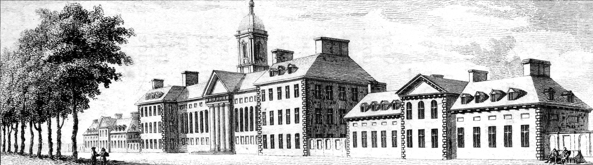
North Front of Chelsea Hospital.
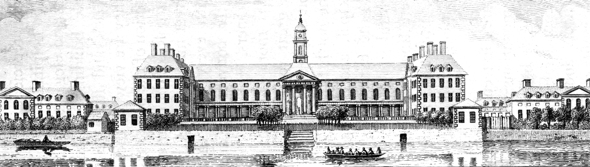
South Front of the Same. S. Wale delin. J. Green sc. Oxon.
There are several other buildings adjoining, that form two other large squares, and consist of apartments for the officers and servants of the house; for old maimed officers of horse and foot, and the infirmary for the sick. None of these are shewn in the two views we 105have given, which only represent the two principal fronts of the hospital.
An air of neatness and elegance is observable in all these buildings. They are composed of brick and stone, and which way soever they are viewed, there appears such a disposition of the parts as is best suited to the purposes of the charity, the reception of a great number, and the providing them with every thing that can contribute to the convenience and pleasure of the pensioners.
Chelsea Hospital is more particularly remarkable for its great regularity and proper subordination of parts, which is very apparent in the north front. The middle is very principal, and the transition from thence to the extremities, is very easy and delightful.
The expence of erecting these buildings is computed to amount to 150,000l. and the extent of the ground is above forty acres.
In the wings are sixteen wards, in which are accommodations for above 400 men, and there are besides in the other buildings, a considerable number of apartments for officers and servants.
These pensioners consist of superannuated veterans, who have been at least 106twenty years in the army; or those soldiers who are disabled in the service of the crown. They wear red coats lined with blue, and are provided with all other cloaths, diet, washing, and lodging. The Governor has 500l. a year; the Lieutenant Governor 250l. and the Major 150l. Thirty-six officers are allowed 6d. a day; thirty-four light horsemen, and thirty serjeants, have 2s. a week each; forty-eight corporals and drums have 10d. per week; and three hundred and thirty-six private men, are each allowed 8d. a week. As the house is called a garrison, all the members are obliged to do duty in their respective turns; and they have prayers twice a day in the chapel, performed by two chaplains, who have each a salary of 100l. a year. The physician, secretary, comptroller, deputy treasurer, steward, and surgeon, have also each 100l. per annum, and many other officers have considerable salaries. As to the out-pensioners, who amount to between eight and nine thousand, they have each 7l. 12s. 6d. a year.
These great expences are supported by a poundage deduced out of the pay of the army, with one day’s pay once a year from each officer and common soldier; 107and when there is any deficiency, it is supplied by a sum raised by parliament. This hospital is governed by the following commissioners; the President of the council, the first Commissioner of the treasury, the Principal Secretary of state, the Pay master general of the forces, the Secretary at war, the Comptrollers of the army, and by the Governor and Lieutenant Governor of the hospital.
Chelsea Water-works, are under the management of a society incorporated by act of parliament in the year 1722, by the name of The Governor and Company of the Chelsea Water-works. They have a common seal, and power to purchase lands, &c. in mortmain to the value of 1000l. per annum, with a right to alienate and dispose of the same as they shall think proper. These works are divided into two thousand shares. The company’s affairs are managed by a Governor, Deputy Governor, and thirteen Directors.
Chelton court, Bedfordbury.
Cheney’s alley, Shoreditch.†
Cheney’s wharf, Lower Shadwell.†
Chequer alley, 1. In the Borough.* 2. Great Old Bailey.* 3. Old Bethlem. 4. Whitecross street, Cripplegate.*
108Chequer court, 1. Charing Cross.* 2. Catharine’s lane.* 3. Golden lane.*
Chequer yard, 1. St. Catharine’s lane.* 2. Dowgate hill.* 3. Golden lane. 4. St. Martin’s lane, Charing Cross.* 5. Old street.* 6. Whitechapel.*
Cherry Garden lane, Rotherhith.‡
Cherry Garden stairs, Rotherhith.‡
Cherry Garden street, Rotherhith Wall.‡
Cherry Tree alley, 1. Bunhill row.‡ 2. Golden lane.‡ 3. Ship street.‡ 4. Whitecross street.‡
Cherry Tree Alley School, was founded by Mr. William Worral in Cherry Tree alley, Golden lane, in the year 1689, and endowed by him with the annual revenue of 30l. for educating and cloathing forty boys, whose livery is an orange colour, in commemoration of the revolution by the Prince of Orange in 1688.
Cherry Tree corner, Horseferry.
Cherry Tree court, 1. Aldersgate street. 2. Gardiner’s lane. 3. Piccadilly. 4. Cherubin court, Angel alley. 5. White’s alley.
Chertsey, a town in Surry, nineteen miles from London, carries on a considerable trade in malt, which is sent in barges to 109London. Here was once an abbey, in which was deposited the corpse of Henry VI. who was stabbed in the Tower, but his body was afterwards removed by Henry VII. to Windsor. Out of the ruins of this abbey Sir Henry Carew, master of the buckhounds to King Charles II. built a very fine house. To this village Cowley, the Poet, retired after being weary of attending on the court, and there ended his days. Here is a bridge over the Thames to Shepperton, and a handsome free-school erected by Sir William Perkins, who had a seat here.
Chesham, a market town in Buckinghamshire, situated on the borders of Hertfordshire, twenty-nine miles from London. It had formerly a chantry, and has now a charity school.
Cheshire’s rents, 1. Fleet lane, by the Fleet market.† 2. Shipwright’s street, Rotherhith.†
Cheshunt, with its park and wash, are situated about fifteen miles from London near the river Lea in Hertfordshire. Here was formerly a convent of nuns; and King Edward III. gave Cheshunt the privilege of a market, which has been long discontinued.
110
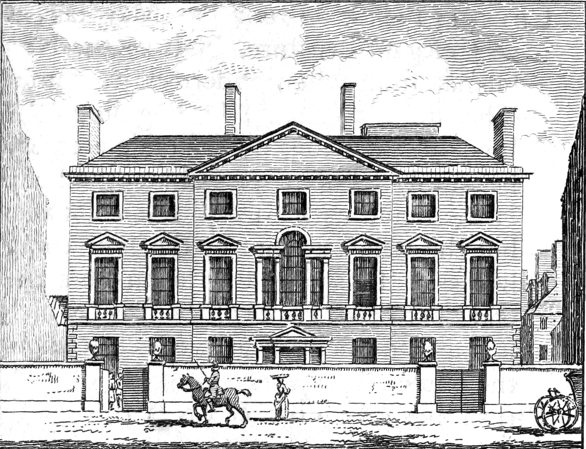
Ld. Egremont’s
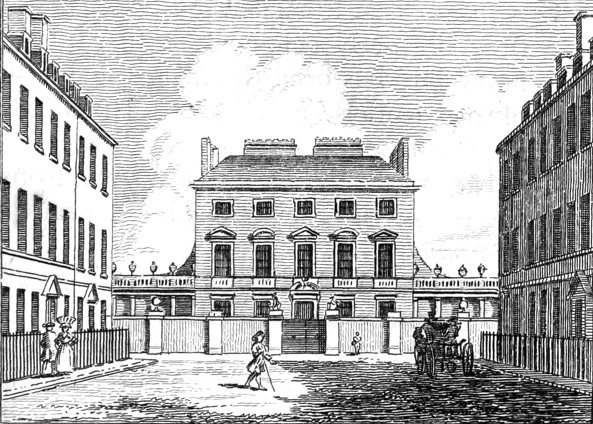
Chesterfield House. S. Wale del. B. Green sculp.
Chesterfield House, in May fair, a very elegant structure, built by the Nobleman from whom it derives its name. The stone colonades leading from the house to the wings on each side are very beautiful. The print exhibits the body of the house with part of the colonade, but the wings are hid by the intervening houses. This view was taken from the end next Hyde Park, of the street which is opposite the great gate which leads to the house.
Chester’s key, Thames street.†
Cheswick. See Chiswick.
Chever’s court, Limehouse.†
Cheyney, near Flounden in Buckinghamshire, formerly belonged to the Cheyneys, but has been the manor and seat of the Russels, now Dukes of Bedford, for about 200 years.
Chichester rents, Chancery lane, from the Bishop of Chichester’s house near it. Maitland.
Chick lane, West Smithfield.
Chidley’s court, Pall mall.†pm od Chigwell, a village in Essex, situated between Waltham Abbey and Rumford. The rectory and parish church are united to the prebend of St. Pancras in St. Paul’s cathedral. Here is a charity 111school; and at a small distance are two hamlets named Chigwell-Dews and Chigwell-Row.
Chigwell hill, Ratcliff highway.
Chigwell street, Ratcliff highway.
Chile’s court, 1. Eagle court, Strand.† 2. In the Strand.†
Chimney alley, Coleman street.
Chimney-Sweepers alley, Barnaby street.
Chingford, a village in Essex, near Woodford, and not far from Epping Forest, so agreeably situated for privacy and retirement, that the remotest distance from the metropolis can hardly exceed it. The church, which was erected in the reign of King Richard II. is a neat little building dedicated to St. Peter and Paul.
Chipping Ongar, a town in Essex, twenty miles from London, was formerly the manor of Richard Lacy, who being Protector of England, while Henry II. was absent in Normandy, he built a church and a castle here with other fortifications, the remains of which are still to be seen.
Chislehurst, a town near Bromley, in Kent, where the family of the Walsinghams resided for several generations; and are interred in the church. Here 112Mr. Camden composed the principal part of his annals of Queen Elizabeth.
Chiswick, in Middlesex, situated on the Thames on the south-west side of Hammersmith. Here are two manors, one belonging to the Prebendary of Cheswick in St. Paul’s cathedral, and the other call’d the Dean’s manor, from its belonging to the Dean and Chapter of St. Paul’s. In this village there is a charity school, and it is adorned with several elegant seats, as the Earl of Shrewsbury’s, the Earl of Grantham’s now Col. Elliot’s, the late Lord Wilmington’s, &c. But the most remarkable of the kind is the late Earl of Burlington’s, which was a plain, commodious building, with good offices about it; but a part of the old edifice being some years ago destroyed by fire, his Lordship erected near it a beautiful villa, which, for elegance of taste, surpasses every thing of its kind in England. The court in the front, which is of a proportionable size with the building, is gravelled and constantly kept very neat. On each side are yew hedges in panels, with Termini placed at a proper distance; and in the front of these hedges, are two rows of Cedars of Libanus, which, at a small 113distance have a fine effect, the dark shade of these solemn ever-greens affording a pleasing contrast to the whiteness of the elegant building that appears between them, the view of which from the road surprizes you in a most agreeable manner.
The ascent to the house is by a noble flight of steps, on one side of which is the statue of Palladio, and on the other that of Inigo Jones. The portico is supported by six fine fluted columns of the Corinthian order, with a pediment very elegant, and the cornice, frize and architrave, as rich as possible. This magnificent front strikes all who behold it with an uncommon pleasure and surprize.
The octagonal saloon finishing at top in a dome, through which it is enlightened, is also very elegant. The other rooms are extremely beautiful, and are finely furnished with pictures of the great masters; an account of which is here annexed. It were to be wished this house had been built to a larger scale, that the grandeur might have equalled the elegance.
Though the other front towards the garden is plainer, yet it is in a very bold, noble and masterly stile, and has at the 114same time a pleasing simplicity, as hath also the side front towards the serpentine river, which is different from the two others. In making the drawing of this house, it was viewed by the angle, by which means the print here given of it, shews it more perfectly than if only the principal front had been given. The inside of this structure is finished with the utmost elegance; the ceilings are richly gilt and painted, and the rooms adorned with some of the best pictures in Europe. In the gardens, which are very beautiful, the vistos are terminated by a temple, obelisk, or some such ornament, which produce a most agreeable effect.
The gardens are laid out in the finest taste: on descending from the back part of the house you enter a verdant lawn planted with clumps of ever-greens, between which are two rows of large stone vases. At the ends next the house are two wolves in stone, done by the celebrated Scheemaker, the statuary; at the farther end are two large lions, and the view is terminated by three fine antique statues, dug up in Adrian’s garden at Rome, with stone seats between 115them, and behind a close plantation of ever-greens.
On turning to the house on the right hand, an open grove of forest trees affords a view of the orangery, which is seen as perfectly as if the trees were planted on the lawn; and when the orange trees are in flower, their fragrance is diffused over the whole lawn to the house. These are separated from the lawn by a fossee, to secure them from being injured by the persons admitted to walk in the garden.
On leaving the house to the left, an easy slope covered with short grass leads down to the serpentine river, on the side whereof are clumps of ever-greens, with agreeable breaks, between which the water is seen; and at the farther end is an opening into an inclosure, where are a Roman temple, and an obelisk, with grass slopes, and in the middle a circular piece of water.
From hence you are led to the wilderness, through which are three strait avenues terminated by three different edifices; and within the quarters are serpentine walks, through which you may ramble near a mile in the shade. On each side the serpentine river, are 116verdant walks, which accompany the river in all its turnings. On the right hand of this river is a building that is the exact model of the portico of the church of Covent garden, on the left is a wilderness laid out in regular walks, and in the middle is a Palladian wooden bridge over the river.
With the earth dug from the bed of this river, his Lordship has raised a terrace, that affords a prospect of the adjacent country; which, when the tide is up, is greatly enlivened by the view of the boats and barges passing along the river Thames.
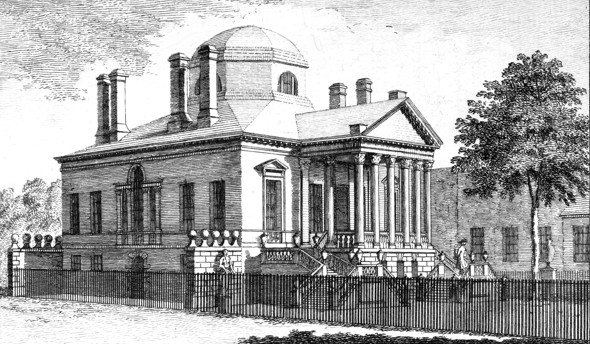
Chiswick House. S. Wale delin. B. Green sc. Oxon.
Pictures, &c. in the new house at Chiswick.
In the Portico.
Augustus, a busto.
Saloon.
Lord Burlington and three of his sisters, Elizabeth, Juliana, and Jane, by Sir Godfrey Kneller.
Rape of Proserpine, Sconians.
Anne of Austria, Frederick Elde.
Morocco Ambassador in the reign of Charles II. figure by Sir Godf. Kneller; the back ground and horse, by Wyke.
King Charles, his Queen, and two children, Vandyke.
Judgment of Paris, Cav. Daniele.
117Lewis XIII. Fred. Elde.
Apollo and Daphne, Cav. Daniele.
Bustos.
Antinous. Lucius Antinous.
A Bacchanalian.
Socrates.
Faustina.
Britannicus.
Plautilla.
Antoninus.
Apollo.
Bust unknown.
Domitian.
Adrian.
Red Velvet Room.
Madonna della Rosa, by Domenichino.
Noah sacrificing, Carlo Maratti.
Painting and designing, Guido Rheni.
The holy family, Carlo Maratti.
King Charles I. Cornelius Johnson.
Pope Innocent IX. Diego Velasques.
St. Gregorio, Cavidoni.
Pope Clement IX. Carlo Maratti.
The holy family, Giacinto Brandi.
The holy family, Salviati.
Duchess of Somerset, Vandyke.
Bacchus and Ariadne, Sebastiano Ricci.
A woman, school of Rubens.
Three statues, chiaro oscuro, Nic. Poussin.
118A man, school of Rubens.
Venus and Cupid, Seb. Ricci.
St. John in the wilderness, Franc. Mola.
A portrait, Langians.
First Countess of Burlington, Vandyke.
Cardinal Baronius, Frederico Barocci.
A portrait, Rembrandt.
Mr. Killegrew, Vandyke.
First Earl of Burlington, Vandyke.
Salmasis and Hermaphroditus, Francisco Albano.
The holy family, Andrea del Sarto.
Mary Queen of Scotland, Fred. Zucchero.
The holy family, Pietro da Cortona.
The procession of the Dogesse, Paolo Veronese.
Bronzes.
A young Hercules.
Three pictures of incense lamps, Benvenuto Celini.
Blue Velvet Room.
A chymist’s shop, by David Teniers.
A landscape and figures, Franc. Mola.
A landscape and figures, Gaspar Poussin.
A Magdalen’s head, Guido Rheni.
A landscape with figures hawking, Wouwerman.
A landscape and figures, Franc. Mola.
A landscape and figures, Gasp. Poussin.
A march, Bourgognone.
119The passage of the Red sea, ditto.
The Jesuits church at Antwerp, Geringh.
A landscape and figures, Bott.
A landscape, Gaspar Poussin.
A landscape, ditto.
A landscape with horsemen, Vander Meulen.
A landscape, Bott.
Lord Sandwich in a round, Sir Pet. Lely.
A woman frying fritters, Schalcken.
The holy family, Carlo Maratti.
A tent, Wouwerman.
A landscape with fishermen, Phill. Laura.
The flight into Egypt, Nicolo Poussin.
A ferry boat and cattle, Berchem.
A woman feeding children, Schalcken.
The holy family, Andrea Sacchi.
Ditto, Camillo Procacini.
Inigo Jones in a round, Dobson.
Red closet next the blue room.
Lot and his two daughters, Rottenhammer.
A landscape and ruins, Viviano, the figures by Mich. Angelo.
Jupiter and Io, Francesco Imperiali.
Spanish lady, D. Velasques.
Fishermen, Rubens.
The Presentation, Giuseppe Chiari.
A man hawking, Inigo Jones.
A sea-port, Marco Ricci.
A landscape, Velvet Brughel.
120A Flora, Francesco Albano.
Temptation of St. Antonio, Annibale Carracci.
A landscape, Patel.
Lady Dorothy Boyle, Lady Burlington.
A landscape, Velvet Brughel.
The holy family, Sebastian Bourdon.
The inside of a church, Perino del Vaga.
A sea piece, Vandervelde.
A landscape, Marco Ricci.
Christ in the garden.
The holy family, Schidoni.
A crucifixion of a saint, Seb. Bourdon.
A landscape, Rysdal.
The holy family, Denis Calvert.
The Samaritan woman, Paolo Veronese.
A boy’s head, Holbein.
Cleopatra, Leonardo da Vinci.
A landscape, Swanevelt.
The holy family, Passari.
Earl of Essex.
A portrait, Fran. Hals.
Inside of a church, Vandyke.
A landscape, Gaspar Poussin.
A man and vases, Benedetto Castiglione.
A landscape, Francisque Meli.
Green Velvet room.
Mars and Venus, Albano.
Acis and Galatea, Luca Giordano.
Constantine’s arch, Gio. Paolo Panini.
121Romulus and Remus, Pietro da Cortona.
A woman bathing, Rousseau.
Mr. Rogers, Vandyke.
Our Saviour in the garden, Guercino.
A man half length with a dog, Dobson.
Rembrant in his painting room, Gerrard Dow.
Ruins, Viviano.
A view of Florence, Gasparo degli Occhiale.
Diana and Endymion, Sebastiano Ricci.
Flowers by Baptiste the boy, Seb. Ricci.
Ponte Rotto, Gasparo degli Occhiale.
The holy family, Francesco Mola.
A landscape, Mons. Verton.
Buildings, Rousseau.
A Magdalen, Carlo Maratti from Guido.
A man half length, Rembrant.
A Madona and St. Catharine, Pietro da Cortona.
The Jews scourging our Saviour, Giacomo Bassano.
Piazza del Popolo, Gasparo degli Occhiale.
A landscape with fishermen, Salvator Rosa.
Belisarius, Vandyke.
Earl of Pembroke and his sister, Vandyke.
Bed chamber.
Earl of Cumberland in a round.
122Mr. Pope in a round, Kent.
Lady Burlington in a round, Aikman.
Gallery.
Susanna and P. Veronese.
* * * * Bassan.
* * * * Ditto.
Landscapes.
Ditto.
Ditto.
Middle of the ceiling, Paolo Veronese.
Two statues, Guelphi.
Two ditto, Scheemaker.
Two little heads, Guelphi.
Two porphyry vases, from Rome.
Closet within the bed chamber.
Lord Clifford and his family, painted in 1444 by John Van Eyk, called John of Bruges.
A woman in a hat, Blomaert.
Lady Dorothy Boyle, in crayons, Lady Burlington.
Henry IV. of France, Mosaick.
A head, a sketch, Vandyke.
Ditto, ditto.
Flowers upon glass, Baptiste.
A woman selling fish and herbs.
Hagar and the angel.
A boy’s head.
A man’s head.
A woman combing her head.
123A satyr whipping a woman.
A head, Holbein.
A Venus sleeping.
Dutch figures.
A man reading.
The ascension, Albano.
The new dining room.
Twelfth night, Jordans.
The finding of Moses, Seb. Ricci.
Jephtha, Seb. Ricci.
Good Samaritan, Giacomo Bassan.
A flower piece, Baptiste.
Ditto, ditto.
Ditto, ditto.
A portrait, Rubens.
Ditto, unknown.
Buildings and cattle, Wenix.
First Lady Halifax, Sir Peter Lely.
The marriage of Cupid, &c. Andrea Schiavone.
A landscape, Gio. Franceso Bolognese.
Mars and Venus, Le Fevre.
A landscape, Gio. Franceso Bolognese.
A Madona, Parmegiano.
Woman taken in adultery, Allesandro Veronese.
Liberality and Modesty, Guido, after
Chiswell street, near the Artillery ground, Moorfields.†
124Chitterling alley, Beer lane, Tower street.
Chiver’s court, Nightingale lane, in Limehouse, Fore street.‡
Choirister’s rents, near the Almonry.
Cholmondeley’s Almshouse, in Church entry, Black Friars, was founded by the Lady Cholmondeley for three poor women, each of whom receives 2s. a week.
Christopher’s alley, 1. in the Borough. 2. Lombard street. 3. St. Martin’s le Grand. 4. Middle turning, Shadwell. 5. Upper Moorfields.
St. Christopher’s alley, St. Christopher’s court, Threadneedle street.☐
St. Christopher’s Church, by the Bank of England in Threadneedle street, is dedicated to a Jewish convert and martyr, named before his conversion Reprobus, but having, it is pretended, carried our Saviour over a river, was thence named Christopher. Mention is made of a church in this place so early as the year 1368. The present edifice suffered greatly by the fire of London; but not so much as to occasion its being rebuilt, and therefore being thoroughly repaired, it continues on the ancient foot. The body is well enlightened, and the tower 125is crowned with four handsome pinacles. It is a very plain edifice, and indeed had it been ever so well ornamented, it could not, in its present situation, have been seen to advantage.
This church is a rectory, the patronage of which has been for above three hundred years in the Bishop of London. The Rector, besides other considerable advantages, receives 120l. a year in lieu of tithes.
Christopher’s court, 1. Cartwright street. 2. Rosemary lane.
St. Christopher’s court, Threadneedle street.
Christopher’s Inn yard, 1. Barnaby street. 2. St. Margaret’s hill.*
Christ’s Church, Church street, Spitalfields. The district in which this edifice stands was till lately considered as a hamlet in the parish of Stepney: but the kind reception given to the persecuted French protestants, greatly increased the number of the inhabitants of this spot, and these refugees bringing the silk manufacture along with them, soon brought affluence to the place, and with it a multitude of new inhabitants. Hence this was constituted a distinct parish from Stepney in the year 1728, and one 126of the fifty new churches was ordered to be built here. The foundation was laid in 1723, and it was finished in four years.
The body of this church is solid and well proportioned; it is ornamented with a Doric portico, to which there is a handsome ascent by a flight of steps; and upon these the Doric order arises supported on pedestals. The tower over these rises with arched windows and niches, and on its diminishing for the steeple, is supported by the heads of the under corners, which form a kind of buttresses: from this part rises the base of the spire, with an arcade; its corners are in the same manner supported with a kind of pyramidal buttresses ending in a point, and the spire is terminated by a vase and fane. This is the character given of this edifice in the English Architect: who asserts that solidity without weight is its character, and that though this structure is not without faults, yet it is worthy of great praise; it being singular, and built for ages. It has however been severely censured by the author of The Critical Review of Buildings, who says that it is one of the most absurd piles in Europe.
127This church is made a rectory, but is not to be held in commendam. For the maintenance of the Rector and his successors the Parliament granted the sum of 3000l. to be laid out in the purchase of lands and tenements in fee simple: besides which provision the Churchwardens are by that act appointed to pay him annually the sum of 125l. to be raised by burial fees. Maitland.
Christ’s Church, in Bennet street, Southwark, is a regular and well-constructed building, erected with little expence, since the year 1737, when the foundation of the old church gave way. It consists of a plain body enlightened by two ranges of windows, and a square tower with a turret.
This church is a rectory, the patronage is in the heirs and assigns of John Marshal of the Borough of Southwark, Gent. who caused the old church to be built, by leaving, in the year 1627, the sum of 700l. for that purpose, with an estate of 60l. a year towards the maintenance of a Minister, and the inhabitants applying to parliament in 1670, it was made a distinct parish independent of that of St. Saviour’s.
Christ’s Church, behind the northern 128row of houses in Newgate street. This is a vicarage, or impropriation, and the right of advowson is in the Governors of St. Bartholomew’s hospital. The old spacious church being consumed by the fire of London, this edifice was erected in its room, and by an act of parliament constituted the place of public worship, both for this parish and that of St. Leonard’s Foster lane.
This church is a plain edifice, neatly ornamented on the inside; it has a square tower of a considerable height, crowned with a light and handsome turret, which is so concealed by the houses, that it can scarce any where be seen to advantage. The Incumbent receives 200l. per annum in lieu of tithes.
Christ’s Hospital, for the education and support of the fatherless children of freemen, is an establishment of considerable antiquity; for Henry VIII. in the last year of his reign gave the city both the priory of St. Bartholomew’s, and the convent of Gray Friars, which anciently belonged to that priory, for the relief of the poor. He also in the same year founded two churches out of these religious houses, the one to be called Christ Church, out of the Gray Friars, and the 129other Little St. Bartholomew’s, out of the hospital of that name. By the above grant the city was obliged to establish here a settled and regular provision for the poor, which was not done till some years after, when King Edward VI. being extremely moved at a sermon preached by Bishop Ridley, wherein that good Prelate expatiated on the obligations of the rich to assist the poor and miserable, his Majesty expressed his hearty desire to concur in promoting so laudable a work, and by the Bishop’s advice, immediately caused a letter to be wrote to the Lord Mayor, to obtain his assistance; and this letter his Majesty signed with his own hand, and sealed with his signet. The good Bishop, who, by the young King’s desire, stayed till the letter was finished, was the messenger dispatched on this important business. The chief Magistrate was pleased with the honour done the city, and after several consultations with the Aldermen and Common Council, several charitable plans were formed for the carrying on of this and other charities; and while the diseased were provided for at St. Thomas’s, and the idle at Bridewell, it was resolved that the young 130and helpless should be educated at Christ Church.
This being reported to the King, his Majesty voluntarily incorporated the Governors of these houses by the title of The Mayor, Commonalty and Citizens of the City of London, Governors of the possessions, revenues and goods of the hospitals of Edward VI., King of England, &c. as his Majesty desired to be esteemed their chief founder and patron. To promote and continue this work, he granted the city certain lands that had been given to the house of the Savoy, founded by King Henry VII. for the lodging of pilgrims and strangers, but which was now only used by vagabonds and strumpets. These lands amount to the yearly value of 600l. He also commanded, that after reserving a sufficient quantity of the linen, which had been used in the times of popish superstition, to each church within the city and suburbs of London, the remaining superfluous great quantities should be delivered to the Governors of this hospital, for the use of the poor children under their care. And one of the last actions of that good Prince’s life, was signing a licence for this corporation to purchase lands in mortmain.
131In 1552 the house of the Gray Friars was prepared for the poor fatherless children, and the same year 340 were admitted. Soon after, several considerable private benefactions were left to this hospital, and at length Charles II. by a well judged liberality, founded and endowed a mathematical school for the instruction of forty boys in that study, in order to fit them for the sea, and for this purpose he ordered 1000l. a year to be paid out of the Exchequer for seven years. This institution is executed in a manner suitable to the intention of the founder. Every year ten of these boys are put out apprentices to masters of ships, and ten more are received in their room. The master is not only expected to be a good mathematician, but to understand the learned languages. Afterwards the Governors appointed forty other boys to be taught mathematics in the same manner. The other schools are a grammar school, a writing school, and a school for the girls who learn reading and needle work, and there have been lately added a master to teach the boys drawing, an art of the greatest use in many mechanical arts.
This charity is so very extensive, that there are sometimes above a thousand 132children supported here at a time. The youngest, for whom there is not room in the house, and who are not of an age to understand the lessons taught there, are, at the expence of the charity, sent to Hertford and Ware, where there are schools erected and masters employed at handsome salaries for that purpose. As the eldest are put out apprentices, and these grow more fit for the place, they are brought in.
The boys are cloathed in blue coats, with petticoats of the same colour, yellow stockings, and bonnets instead of hats. And on their being put out apprentice, they have 10l. given with each.
The edifice is concealed by the contiguous houses, and cannot be seen entire. It is spacious, and though built in the old manner, is not ill contrived. The principal buildings form the four sides of a large area, which have porticoes continued round them. These have Gothic arches, and the walls are supported by abutments. The front of the building is, however, more modern than the rest, and has Doric pilasters supported on pedestals.
Among the ancient buildings that still remain, is an old cloister, which was a 133part of the priory. This was repaired by the direction of Sir Christopher Wren, and serves both for a thoroughfare, and place of recreation for the boys, especially in rainy weather.
The writing school is, however, a neat modern edifice, built with brick and stone in the year 1694, at the end of the great hall. It was founded by Sir John Moore, one of the Aldermen of the city, and President of the house, whom it is said to have cost 5000l. It contains long writing boards sufficient for 300 boys to sit and write upon, and at the upper end of the room is Sir John’s statue in white marble.
The inner distribution of the rooms and wards is very good. There is a spacious hall built at the expence of Sir John Fenwick after the fire of London, in which the boys dine and sup. At the upper end of this room is a large picture representing King James II. sitting with his Nobles, the Governors, &c. with the half figures of King Edward VI. and Charles II. hanging as pictures in the same piece. There is also a piece representing the mathematical school done by Vario, and reckoned worth 1000l. At the other end is a large piece representing King Edward VI. delivering the 134charter to the Lord Mayor, who kneels, with the Aldermen behind him; the young King is accompanied by Bishop Ridley and several others, who stand about him. Here also is a fine piece of the pool of Bethesda, which is very large, and painted in a masterly stile by Mr. Hogarth. In this hall there is likewise a good organ, which plays on Sundays, when the boys sing psalms and anthems.
A great room where the Governors meet, is also adorned with the pictures of the royal founder, and of all the chief benefactors.
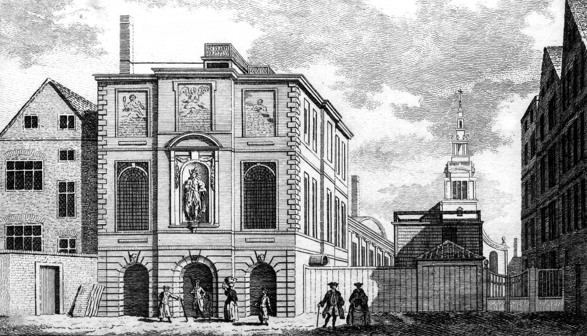
Christ’s-Church Hospital. S. Wale delin. J. Taylor sc.
There are eight wards for the children’s beds; that of the girls is separated from the rest; and there is also a ward for the sick. Each of the masters have 100l. a year, and the grammar master an additional salary of 20l. for catechising the boys, and his usher has 50l. a year; in short, 12 or 1300l. a year is expended in salaries to the officers, clerks, and servants; and the sum expended for the support of the hospital, amounts to between 11 and 12,000l. a year. To defray this expence, the hospital has a great annual revenue in houses and lands; the benefit of licensing 135and looking after the 420 carts allowed in the city, each of which pays a certain sum for sealing. The hospital has likewise a duty of about three farthings upon every piece of cloth brought to Blackwell hall, where clerks are kept to receive it. The Governors, amount to about three hundred, and these chuse their officers and servants, both men and women, and also the President and Treasurer.
The building of this hospital is partly Gothic and partly modern, being built at various times, and has very little regularity. That part represented in the print belongs to the mathematical school, and is in Gray Friars. The niche contains a statue of Charles II. in the royal robes, which, considering the difficulty the statuary had to encounter, is a very good one. At a distance is the steeple and part of the front of the church, which was rebuilt, after being burnt down by the fire of London, by Sir Christopher Wren.
Churches. These are very numerous; and the reader may see an account of each under the names of the patrons to whom they are dedicated, as St. Alban’s, Allhallows, St. Alphage, St. Andrew’s, &c.
136Church alley, 1. Basinghall street.☐ 2. Black Friars.☐ 3. Denmark street, St. Giles’s.☐ 4. Giltspur street.☐ 5. Harp alley, Shoe lane.☐ 6. St. Mary hill.☐ 7. New Rents, Compter street.☐ 8. Noble street, Foster lane.☐ 9. Old Jewry.☐ 10. Puddle dock hill.☐ 11. In the Strand.☐ 12. Thames street.☐ 13. Tooley street.☐ 14. Wapping.☐ 15. Watling street.☐ 16. Whitechapel.☐
Church court, 1. Church passage, Piccadilly.☐ 2. Clement’s lane, Canon street.☐ 3. Duke’s place.☐ 4. Little Chapel street.☐ 5. St. Margaret’s church yard.☐ 6. In the Strand.☐ 7. Church Entry, Austin Friars.☐ 8. Black Friars.☐
Church hill, Black Friars.☐
Church lane, 1. Dyot street.☐ 2. Elephant lane, Rotherhith.☐ 3. Houndsditch.☐ 4. Islington.☐ 5. Ropewalk, Limehouse.☐ 6. St. Mary Overies.☐ 7. Newington Butts.☐ 8. In the Strand.☐ 9. Near Three Cranes lane, Thames street.☐ 10. Whitechapel.☐ 11. White street, Southwark.☐ 12. Wood street, Cheapside.☐
Church passage, 1. Cloth Fair.☐ 2. Dorset street.☐ 3. Piccadilly.☐
Church row, near Aldgate.☐
Church stairs, Rotherhith.☐
Church street, 1. Bernbridge street.☐ 2. 137Coverlead fields.☐ 3. St. Giles’s street.☐ 4. Hackney.☐ 5. Hoxton.☐ 6. Lambeth.☐ 7. Long Acre.☐ 8. Millbank.☐ 9. Prescot street.☐ 10. Rotherhith.☐ 11. Sclater street.☐ 12. Shoreditch fields.☐ 13. Soho.☐ 14. Spitalfields.☐ 15. Stepney Causeway.☐ 16. Swan fields.☐
Church Yard alley, 1. Cartwright street.☐ 2. Chick lane.☐ 3. Fetter lane.☐ 4. Harp alley.☐ 5. Hole stairs.☐ 6. Rosemary lane.☐ 7. Rotherhith wall.☐ 8. Shoe lane.☐ 9. Thames street.☐ 10. St. Thomas’s street, Southwark.☐ 11. Tooley street.☐
Church Yard court, 1. Botolph lane.☐ 2. Inner Temple.☐
Church Yard lane, St. Thomas’s street, Southwark.☐
Chymisters alley, Bedfordbury.
Cinnamon alley, Turnmill street.
Cinnamon street, 1. Near Old Gravel lane. 2. Near Wapping dock.
Cise yard, Whitechapel.
Civet Cat alley, Bunhill row.*
Clandon. There are two towns of this name, in Surry, lying near each other, and distinguished by their situation with respect to each other. West Clandon is twenty-six miles from London, and is 138the manor of the Lord Onslow, whose title is Lord of Onslow and Clandon, and whose seat is near the church. It is a noble edifice, erected after an Italian model. The gardens are beautiful, and laid out in the modern taste. It has plenty of good water, and commands a delightful and extensive prospect as far as Windsor. The house is seen from the road up a grand avenue, and appears to be, what it really is, one of the finest seats in that part of the kingdom.
East Clandon lies about two miles to the east of the last mentioned village, and was anciently the estate of Gerard Lord Aungier, of the kingdom of Ireland, who had a house and park here. In the neighbourhood of East Clandon is the seat of Admiral Boscawen.
Clapham, a village three miles from London, in the road to Richmond.
Clapton, a village adjoining to Hackney.
Abbey of St. Clare. See Minories.
Clare court, Drury lane.†
Clare market, Lincoln’s Inn fields, has a considerable trade for flesh, greens, &c.
Clare street, Clare market.†
Clare’s yard, Barnaby street.†
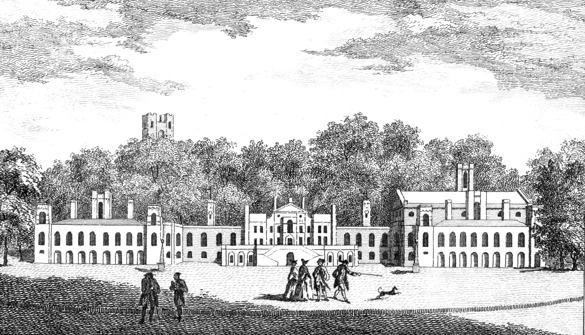
Claremont. S. Wale delin. B. Green sculp.
Claremont, is the seat of his Grace the Duke of Newcastle at Esher. The house 139was designed and built by the late Sir John Vanbrugh, in a whimsical style of architecture, which is better shewn in the print than described. It was afterwards purchased of Sir John by his Grace, who has been at great expence in improving the place. The structure, though singular, does not appear to be irregular. It is built of brick with a good deal of variety in it, and of considerable extent, but not much elevated. The Duke has since built a grand room for the reception of company when numerous, which makes the ends of the house not appear similar. The house has a lawn in the front shaded on each side with trees, and the ground behind it rising gradually shews the trees there also, so that the house appears to be embowered by them except just in the front; and the white summer house with four little pinacles, one at each corner, built on the mount which gives name to the place, when viewed from before the front of the house, rises up finely from behind the trees, and all together forms a very pleasing appearance. The park in which it is situated is distinguished by its noble woods, lawns, walks, mounts, prospects, &c. The summer house call’d the Belvedere, 140at about a mile distance from the house, on that side of the park next Esher, affords a very beautiful and extensive view of the country quite round; yet that from the summer house at Esher place, which is just by, is perhaps no way inferior to it.
Clarges street, Hyde Park road. Thus named from Sir Thomas Clarges.
Clarke’s alley, 1. Bishopsgate street.† 2. Vine street, Hatton wall.† 3. Whitechapel.†
Clarke’s orchard, Rotherhith wall.†
Clarke’s rents, 1. Grub street. 2. St. Catharine’s lane.†
Clarke’s yard, 1. Cock alley, London wall.† 2. Upper ground.†
Clayton’s rents, King street.†
Cleaveland court, Cleaveland row, St. James’s street; formerly a large house called Berkshire house; which being purchased by the Duchess of Cleaveland, took her name; on the same ground are now built several handsome houses.
Cleaveland row, St. James’s.
Cleaveland street, by St. James’s palace.
Cleaveland yard, near St. James’s square.
St. Clement’s Church in the Strand, also called St. Clement Danes, is supposed to be dedicated to Pope Clement I. 141who suffered martyrdom in the reign of Trajan, and obtained the name of Danes from its being dedicated to their use. A church has been situated in the same place at least ever since the year 700; but the present edifice began to be erected in 1680, and was compleated in two years, but the steeple was not added till several years after.
The body of the church, which is of stone, has two series of windows, the lower plain and the upper well ornamented, and the termination is by an attic, whose pilasters are crowned with vases. On the south side it is entered by a portico to which there is an ascent of a few steps, this portico is covered with a dome supported by Ionic columns. Opposite to this there is another, and on each side the base of the steeple in the west front is a small square tower with its dome. The steeple is carried to a great height in several stages: where it begins to diminish the Ionic order takes place, and upon its entablature supports vases. The next stage is Corinthian, and above that stands the Composite supporting a dome which is crowned with a smaller one, from whence rises the ball and its fane.
142The author of the New Critical Review of the publick Buildings justly censures the situation of this church in the midst of the street, and their having “in compliance with the superstitious custom of placing it in a due east and west situation, crowded the backside of the church into the face of the people, though they had room enough to build it otherwise, and prevent so capital a nuisance.” This church is a rectory, in the patronage of the Earl of Exeter.
St. Clement’s Eastcheap, on the east side of St. Clement’s lane, Lombard street. The old church was destroyed by the dreadful conflagration in 1666, and upon its ruin the present edifice arose. It is a very plain neat structure, with a tower crowned only by a battlement.
This church is a rectory, with the parish of St. Mary Ongars added to it; the advowson is in the Bishop of London. The Rector receives 140l. per annum in lieu of tithes. Newc. Repert. Eccles.
St. Clement’s Church yard, in the Strand.
Clement’s court, Milk street.
Clement’s, or St. Clement’s Inn, on the north side of Wych street, is thus called from its being near St. Clement’s 143church. It is one of the inns of chancery, and has three courts one within another, which consists of old buildings, except a row in the garden, which is well built.
Clement’s Inn court, Clement’s Inn.
Clement’s lane, 1. Clare market.☐ 2. Clement’s Inn.☐
St. Clement’s lane, Lombard street.
St. Clement’s Well, a celebrated fountain, which was many years ago one of the three principal springs at which the city youths, on festival days, used to entertain themselves with a variety of diversions. But it is now covered up, and a pump placed over it, at the east side of St. Clements Inn, and lower end of St. Clement’s lane. Maitland.
Clergymen’s Widows, and Children. See an account of the corporation formed for their relief under the article Corporation.
Clerk of the Essoins, Juries, King’s Silver, Supersedeas, &c. See an account of their several employments and offices, under the articles Essoins, Juries, King’s Silver, &c.
Clerks. The Parish Clerks were incorporated by Henry III. in the year 1233, by the name of The fraternity of St. Nicholas, by which they were known 144till they were incorporated by charter in 1611. By a decree of the court of Star chamber, they obtained the privilege of keeping a printing press in their hall, for printing the bill of mortality, they being strictly enjoined by their charter to make a report of all the christenings and burials in their respective parishes by six o’clock, on Thursday in the afternoon; but this is by a by-law changed to two o’clock on the same day, that the King and the Lord Mayor may have the account the day before its publication. This list is however extremely defective; for as there are above an hundred meeting houses in the bills of mortality, the members of which never have their children christened in the parish churches, though the far greater number of their dead are interred in the parochial burying grounds, the burials in these lists are made greatly to exceed the christenings; and hence very grave remarks have been made on the unhealthfulness of the city, and the vices of its inhabitants.
This company consists of a Master, two Wardens, seventeen Assistants, and the whole body of parish clerks within the bills of mortality; who have a commodious hall in Wood street.
145Clerks, or Clerken Well, a spring at the lower end of Clerkenwell green, in Rag street, opposite Mutton lane, was so called from the parish clerks of the city annually meeting there to exhibit dramatic representations of certain parts of scripture; for which they were so famous, that not only the Lord Mayor and citizens, but even the nobility were their spectators. From this well a neighbouring priory with the church and parish were denominated Clerkenwell. Maitland.
Clerkenwell Church. See St. James’s Clerkenwell.
Clerkenwell close, a street on the north side of Clerkenwell green.
Clerkenwell green, on the south side of St. James’s church, Clerkenwell.
Clerkenwell Priory of Nuns, was founded by Jordan Briset, a wealthy Baron, about the year 1100, in a field adjoining to Clerks, or Clerken Well, and dedicated to the honour of God, and the assumption of the blessed Virgin. This priory continued till it was suppressed by Henry VIII. in the year 1539, when its revenues were found to amount to 262l. 19s. per annum. On the north east side of St. James’s church, which 146anciently belonged to this priory, is still to be seen the ambulatory, or south side row of this priory, consisting of six arches; and tho’ the eastern part of the cloister be destroyed, yet the nuns hall, which was situated at the north end, is still remaining, tho’ at present it is converted into a work shop, and the garden on the east side was formerly the cemetery belonging to the nunnery. Maitland.
Clifford’s Inn, one of the Inns of Chancery, is situated behind St. Dunstan’s church in Fleet street, and is much improved by new buildings. It has three courts, and a garden adorned with rows of lime trees set round the grass plats, and with gravel walks, which are kept in good order. This Inn took its name from its being anciently the house of the Lord Clifford.
Clifford’s Inn lane, Fleet street.☐
Clifford’s street, New Bond street.†
Clincard’s alley, Westminster market.
Clink Liberty Court, a court of record kept on the Bank side in Southwark by the Bishop of Winchester’s steward, before whom are tried pleas of debt, damage and trespass, for any sum. Here also is a court leet in which things peculiar to that court are managed. Maitland.
147Clink prison, in Clink street, belongs to the liberty of the Bishop of Winchester, called the Clink liberty, but is little used. It is a very dismal hole, where debtors are sometimes confined.
Clink street, begins at Deadman’s place, and extends to St. Mary Overy’s dock.
Clink yard, Clink street.
Cloak lane, Dowgate hill.
Cloak and Wheatsheaf alley, Houndsditch.*
Cloak and Wheatsheaf court, Houndsditch.*
Clockmakers. Charles I. incorporated this company by letters patent in the year 1632. They have a Master, three Wardens, and twenty-eight Assistants; but neither livery nor hall.
Cloisters, 1. In the Middle Temple. 2. St. Bartholomew’s hospital.
Cloister court, 1. Inner Temple.☐ 2. Black Friars.☐
Cloisters court, Glasshouse yard, Water lane, near White Friars.☐
Cloth Fair, Smithfield. King Henry II. granting to the priory of St. Bartholomew, the privilege of a fair to be kept annually at Bartholomew tide, the clothiers of England and the London drapers repaired thither, and had their 148booths and stalls within the church yard of that priory; this place being built into a narrow street, still retains the name of Cloth Fair; and in conformity to its name several eminent woollen drapers still live there.
Cloth yard, Dunning’s alley.
Clothworkers, one of the twelve principal companies, was incorporated by letters patent granted by King Edward IV. in the year 1482, by the name of The fraternity of the Assumption of the blessed Virgin Mary, of the Sheermen of London: but being reincorporated by Queen Elizabeth, she changed their first appellation, to that of The Master, Wardens, and Commonalty of freemen of the art and mystery of Clothworkers of the city of London; which title was confirmed by Charles I.
This company is governed by a Master, four Wardens, and thirty-two Assistants, with a livery of 154 members, each of whom, upon his admission, pays a fine of 20l. They have a very large estate, out of which they annually pay to the poor about 1400l.
Clothworkers Hall is situated near the north east end of Mincing lane, and is a brick building with fluted 149columns of brick crowned with Corinthian capitals of stone. The hall is a lofty room wainscoted up to the ceiling, which is adorned with fretwork. The screen at the south end is of oak, and ornamented with four pilasters that have their entablature and compass pediment of the Corinthian order. At the west end are the figures of King James and King Charles I. in their robes, carved as big as the life, and on the windows are painted the King’s arms, those of the city, the clothworkers company, and several others, belonging to the masters of that fraternity.
Club row, Cock lane, Shoreditch.
Clun’s yard, Grub street.†
Coach and Horses yard, 1. Aldersgate street.* 2. Coleman street.* 3. Fann’s alley.* 4. Oxford street.* 5. St. John’s street.* 6. Wood street, Cheapside.*