C. (continued 2)
Reading edition
Coachmakers. This company was incorporated by letters patent of Charles II. in the year 1677, by the title of The Master, Wardens, Assistants, and Commonalty of the company of Coach and Coach-harness-makers of London. It is governed by a Master, three Wardens, twenty-three Assistants, and one hundred and four Liverymen, each of whom upon 150their admission pay a fine of 10l. They have a spacious hall in Noble street.
Coaches. See Hackney Coaches.
Coal alley, Whitechapel.
Coal Exchange, Billingsgate.
Coal Harbour, Thames street. See the article Cold Harbour.
Coal stairs, Lower Shadwell.
Coal wharf, near the Strand.
Coal yard, 1. Goswell street. 2. High Holborn. 3. Willow street, Bank side.
Coalman’s alley, Puddle dock.†
Coalmeters, fifteen officers in the port of London, to whom belong the care and inspection of the just measure and weight of coals; each of whom is allowed four deputies or under-meters, who must be approved by the Lord Mayor and Aldermen, as upon them the care of weighing and measuring coals principally depends; their business being to attend each ship, in order to observe the due weight and admeasurement, to top the vats, and to return an account of the coals measured to the coal office, by which return or certificate of the under-meters, the duties on coals are collected. For this trouble they receive the fee of a penny per chaldron for all coals measured, and two pence per ton for all coals weighed: 151and both the principal and under-meters take an oath at their admission into their office, to give just measure to rich and poor without partiality or favour; to buy no coals except for their own use, nor ever to sell coals while in that office, or to take any more for their trouble than was anciently allowed.
Coalmeters Office, in Church alley, St. Dunstan’s hill. In this office, which belongs to the fifteen upper coalmeters, is entered all the ships that arrive in the port of London with coals, and the quantity measured or weighed; in order to ascertain the duties to be paid, as well as to prevent impositions and frauds with respect to the subject.
Mr. Maitland gives the following septenary account, from the Custom House entry book, of the coals imported into the port of London.
Years. 1726. 1727. 1728. 1729.
Chald. 479,336 417,974 536,019 497,167
Years. 1730. 1731. 1732. Total. Medium
Chald. 460,615 478,411 453,503 3,323,025 474,717
But as both London and Westminster have been prodigiously increased since the last of these years, by a vast number of entire streets being built, we may conclude that this account falls extremely 152short of the quantity now annually imported into the same port.
Coat’s farm, Coat’s lane.†
Coat’s lane, Bethnal green.†
Cobb’s court, Black Friars.†
Cobb’s yard, 1. Blackman’s street.† 2. Petticoat lane.†
Cobham, a town in Surry, situated on the river Mole, six miles from Epsom, in the road from London to Guilford.
Near Cobham are several fine seats, particularly one belonging to the Lord Ligonier, and another, the seat of Mr. Bridges, which is built in a very singular taste, tho’ very plain on the outside, somewhat after the manner of an Italian villa. The principal rooms are richly ornamented; the ceilings are gilt; and the offices below are not only convenient, but contrived with great judgment, so as to answer the purposes for which they were designed. As the house is situated on an eminence, it commands the prospect of the adjacent fields, which are kept in great order. The river Mole passes along by the side of the gardens, and being made here four or five times, broader than it was naturally, it has a happy effect, especially as the banks are disposed into a slope, with a broad grass 153walk, planted on each side with sweet shrubs. At one end of this walk is a very elegant room, which is a delightful retreat in hot weather, it being shaded with large elms on the south side, and having the water on the north and east sides, is extremely cool and pleasant. The house is situated about half a mile from the public road to Portsmouth, and is so much hid by the trees near it, as not to be seen till you rise on the heath beyond Cobham, where you have a fine view of it in several parts of the road between that town and Ripley.
Cock alley, 1. Deadman’s place.* 2. East Smithfield.* 3. Fleet lane.* 4. Green bank, Tooley street.* 5. Holiwell street, Shoreditch.* 6. Ludgate street.* 7. Montague close.* 8. Moorgate.* 9. Near Pepper alley, Southwark.* 10. Norton Falgate.* 11. Portpool lane.* 12. Shoreditch.* 13. Turnmill street.* 14. Wapping.* 15. Whitechapel.* 16. Whitecross street, Cripplegate.*
Cock Alley stairs, near Pepper alley stairs, Southwark.*
Cock court, 1. Angel alley, Houndsditch.* 2. Black Boy alley, Chick lane.* 3. Grub street, near Moorfields.* 4. Ludgate hill.* 5. St. Martin’s le Grand.* 1546. New street, Broad street.* 7. Philip lane, London Wall.* 8. Poor Jewry lane.* 9. Snow hill.*
Cock and Bottle court, near Nightingale lane.*
Cock and Hoop court, Addle hill.*
Cock and Magpye court, Hog lane, Norton Falgate.*
Cock and Wheatsheaf court, Houndsditch.*
Cock hill, 1. Anchor street. 2. Ratcliff.
Cock lane, 1. By Cock hill. 2. Near Falcon lane.* 3. Snow hill.* 4. Swan fields, Shoreditch.*
Cock yard, 1. Bennet street, Westminster.* 2. East Smithfield.* 3. Falconer’s alley, Cow Cross.* 4. In the Haymarket.* 5. Jacob’s street.* 6. Parish street.* 7. Thacket’s court, Bishopsgate street.* 8. Tothill street.*
Cock and Heart yard, in the Borough.*
Cock and Hoop yard, 1. In the Borough.* 2. Castle street, Long Acre.* 3. Houndsditch.*
Cocket alley, Fore street, Lambeth.
The Cockpit, opposite to the Privy Garden, is esteemed a part of the ancient palace of Whitehall, and retains its ancient name, though converted to very different uses from that of a Cockpit. This edifice, 155which is built with stone, is very old, and on the outside next the street has nothing to recommend it; but within it has several noble rooms and apartments, as the council chamber, &c.
Cockpit alley, 1. Drury lane. 2. Gravel lane.
Cockpit buildings, Upper Chelsea road.
Cockpit court, 1. Dean street, Soho. 2. Gravel lane. 3. Jewin street. 4. King’s Way, near Bedford row. 5. Poppin’s alley, Shoe lane.
Cockpit street, Whitehall.☐
Cockpit yard, James street.☐
Cock’s Head court, Golden lane.*
Cock’s rents, St Catharine’s.†
Cockspur street, Pall Mall.
Codlin yard, Virginia street.‡
Codpiece court, petty France, Westminster.║
Codpiece row, Cold Bath fields.║
Coffee House alley, Thames street.☐
Coffee House court, Moorfields.☐
Coffin alley, Cow Cross.*
Coffin court, St. Dunstan’s hill.*
Cogdell court, near Pultney street.†
Coggan’s rents, Bett’s street.†
Colchester street, 1. Red Lion street, Whitechapel. 2. Woodroffe lane.
Cold Bath fields, Hockley in the hole, 156took their name from the cold bath near them. See Cold Bath square.
Cold Bath row, Cold Bath street.☐
Cold Bath street, Cold Bath fields.☐
Cold Bath square, Cold Bath fields. On the north side of this small square, is pleasantly situated fronting the fields, the house in which is the cold bath. This is a handsome though old building, and is surrounded by a small, but neat garden, inclosed by a wall.
Cold Harbour, Thames street. It took its name from a magnificent building called Cold Herbergh, that is, Cold Inn, probably so denominated from its vicinity to the river. This building, which extended into the place now called Cold Harbour lane, was given by King Henry IV. to his son the Prince of Wales. Rymer’s Fœdera.
Cold Harbour lane, Thames street. This lane, and the stairs, are now generally called, and even spelt Coal Harbour.
Cold Harbour row, Hackney road.
Cold Harbour stairs, Thames street.
Colebrook, or Colnbrook, a town in Buckinghamshire, situated 18 miles from London, on four channels of the river Coln, over each of which it has a bridge. One part of the town is in Middlesex, and 157the other in Buckinghamshire. Here is a charity school, and an ancient chapel, said to have been founded by Edward III. The principal support of the place are the inns, on account of its being in the Bath road.
Coleman alley, 1. Brown street.† 2. Bunhill row.†
Coleman’s court, Castle lane.†
Coleman street, 1. Farthing fields.† 2. Lothbury.† 3. New Gravel lane.†
Coleman Street Ward, is bounded on the north by Cripplegate ward, upper Moorfields, and Bishopsgate ward; on the east by Bishopsgate ward, Broad street ward, and Cheap ward; on the south by Cheap ward; and on the west by Basinghall street ward. It extends from east to west, from the grate by Lothbury church, to the south side of Ironmonger lane; but no farther than the south-west corner of Basinghall street on the north side; and, in the other direction, it extends south from Moorgate to the garden belonging to Grocers hall in the Poultry.
The principal streets in this ward are, Coleman street, the north part of the Old Jewry; Lothbury, from Coleman street to St. Margaret’s church, on the north side, and on the south, to about 158twenty-seven feet beyond Prince’s street; the north side of Cateaton street, from Basinghall street to Coleman street, and the south side from Ironmonger lane. The most remarkable buildings are, the parish churches of St. Stephen Coleman street, St. Margaret’s Lothbury, and St. Olave’s Jewry; Founders hall, the Armourers and Brasiers hall, and the Excise office.
This ward is governed by an Alderman and his Deputy, six Common Council men, thirteen wardmote inquest men, four scavengers, four constables, and a beadle. The jurymen returned by the wardmote inquest serve in the several courts in Guildhall in the month of August.
Coleman’s yard, 1. Barnaby street.† 2. Whitecross street, Cripplegate.†
Cole’s alley, Whitechapel.†
Cole’s rents, Moorfields.†
Cole yard, between Holborn and Drury lane.
College court, 1. Cow Cross. 2. Dean’s yard, Westminster. 3. Nightingale lane. 4. Stable yard. 5. Warwick lane.☐
College hill, Thames street.
College of Heralds. See Heralds Office.
159College of Physicians. See Physicians.
College street, 1. Dirty lane, Westminster. 2. Narrow Wall, Lambeth.
College yard, 1. Compter lane. 2. Deadman’s place. 3. Near the Hermitage.
Collier’s court, Hart street, Cripplegate.†
Collier’s rents, White street.†
Collingburn’s rents, Dick’s shore, Limehouse.†
Collingwood street, Maze Pond, near Snow fields, Southwark.†
Collin’s court, 1. Bloomsbury market.† 2. Brick street.† 3. Farmer’s street.†
Collin’s rents, 1. High Holborn.† 2. Upper Shadwell.† 3. White street.†
Colnbrook. See Colebrook.
Colney, a village in Hertfordshire, three miles from St. Alban’s in the road to London, is called London Colney, to distinguish it from Colney street, which lies a little to the west, and Colney green. These villages receive their names from the river Coln, near which they are situated.
Colour yard, Worcester street.
Colson’s court, Drury lane.†
Comb Nevil, in Surry, is situated in the parish of Kingston upon Thames, and was formerly the seat of the Earl of Warwick, 160called the setter up and puller down of Kings; but was lately in the possession of William Harvey, Esq; It is situated in the midst of a park; and near the house are certain springs whose water is conveyed in leaden pipes for three miles, under the road and lands, and across the bottom of the Thames to Hampton Court.
Cumber’s court, Blackman street.†
Combmakers, a company incorporated by letters patent granted by Charles I. in the year 1636. They consist of a Master, two Wardens, and thirteen Assistants; but have neither hall nor livery.
Comes’s court, Noble street, Foster lane.†
Commistry’s alley, Cock hill, Ratcliff cross.
Common Council. These are the representatives of the commons, and compose one of the parts of the city legislature, which nearly resembles that of the kingdom; for as the latter consists of the King, Lords, and Commons, so this is composed of the Lord Mayor, the Aldermen and Common Council; the principal difference is, that the three estates of the kingdom enjoy separately the right of a negative, while in the city 161this right is confined to the Aldermen and Common Council.
Before the year 1347, there were only two Common Council men returned for each ward, which being thought inefficient to represent the numerous body of the commons, it was at that time agreed, that each of the city wards should chuse a number of Common Council men according to its dimensions; but none to exceed twelve, nor any to have less than six; which has been since increased to the present number.
The city is now divided into twenty-five wards, and they into 236 precincts, each of which lends a representative, who is elected in the same manner as an Alderman; with this only difference, that as the Lord Mayor presides in the wardmote, and is judge of the poll at the election of an Alderman, the case is the same with the respect to the Aldermen in their several wards, at the choice of Common Council men. Maitland.
The Court of Common Council, consists of the Lord Mayor, Aldermen, and representatives of the several wards, who assemble in Guildhall, as often as the Lord Mayor, by his summons, thinks 162proper to convene them, in order to make by-laws for the government of the city. They annually select six Aldermen and twelve Commoners for letting the city lands, and this committee generally meet at Guildhall on Wednesdays. They also appoint another committee of four Aldermen and eight Commoners for transacting the affairs belonging to Gresham College, who generally meet at Mercers hall, according to the appointment of the Lord Mayor, who is always one of the number. Besides the appointing of these, and several other committees, they by virtue of a royal grant, annually chuse a Governor, Deputy, and Assistants, for the management of the city lands in Ireland. They have likewise a right to dispose of the offices of town clerk, common serjeant, judges of the Sheriffs court, common crier, coroner, bailiff of the borough of Southwark, and city garbler. Maitland’s Survey.
Common Clerk. See Town Clerk.
Common Crier, an office of the city, who with the serjeant at arms, is to summon all executors and administrators of freemen to appear, and bring inventories of their personal estates, 163within two months after their decease. He is also obliged to attend the Lord Mayor on particular days, and to be present at the courts held weekly by his Lordship and the Aldermen. He is by his place an Esquire.
Common Hunt, the chief huntsman of the city, whose principal business is to take care of the city hounds, and to attend the Lord Mayor and citizens in hunting whenever desired. This officer has a house allowed him in Finsbury Fields, where the hounds are kept, and for their support he has a considerable annual allowance, besides his perquisites. He is also to attend the Lord Mayor on set days, and is by his place an Esquire.
Common lane, in Thames street.
Court of Common Pleas. This is one of the four great courts of the kingdom, and is so called because in that court are debated the usual or common pleas between subject and subject, and all civil causes whatsoever. It was anciently ambulatory, and followed the King wheresoever he went; but at the confirmation of Magna Charta, by King John, in 1215, it was fixed at Westminster, where it still continues.
164Soon after the fixing of this court at Westminster, such a multitude of causes were brought before it, that the King for the greater dispatch of business, found it necessary instead of three, to constitute six Judges, whom he appointed to sit in two places: but at present the number being only four, they sit together in Westminster hall to hear and decide causes; but no Counsellor can plead before them under the degree of a Serjeant.
The chief Judge in this court is the Lord Chief Justice of the Common Pleas, who has a salary of 2500l. per annum. with his robes and two tons of wine; the other, who are called the three puisne Judges of this court, and also four Serjeants, are each allowed fees, reward and robes, the puisne Judges having 2000l. per annum each.
The other officers of this court are, the Custos Brevium; three Prothonotaries and their Secondaries; several clerks, who have their several counties allotted them, and are to engross the fines levied on lands in their respective divisions; the Chirographer; the Register of the fines, and a Clerk of the proclamations. The Prothonotaries and Chirographer sit in the court covered with black round caps, 165which was the fashion before the invention of hats and wigs. These are all sworn and have their offices for life. See Custos Brevium, Prothonotary, &c.
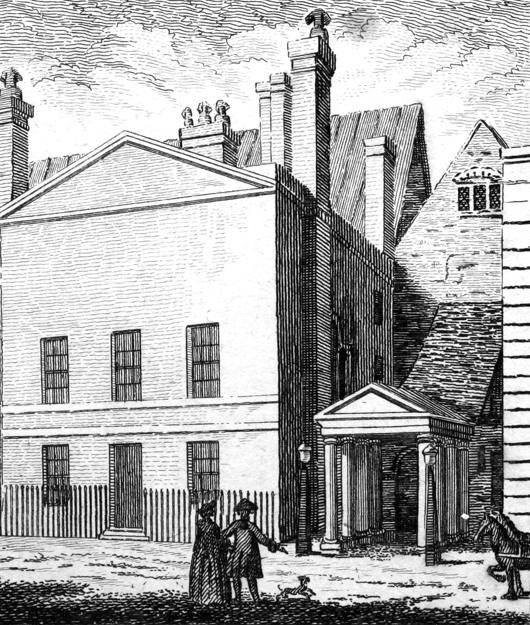
Entrance to the House of Lord’s with the Office of Ordnance. S. Wale del.
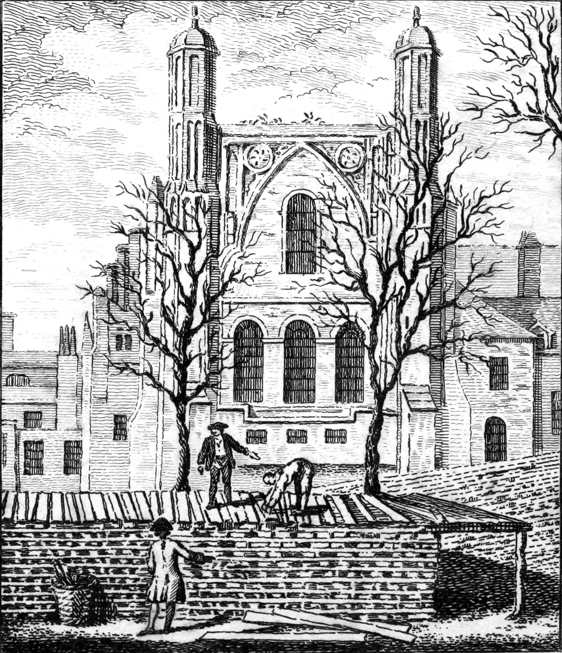
House of Commons. C. Grignion sculp.
In this court there are three officers unsworn, viz. a clerk of the treasury, a clerk of the enrollments of fines and recoveries, and a clerk of the outlawries: there are besides a clerk of the King’s silver; a clerk of the warrants; a clerk of the juries; a clerk of the essoins; a clerk of the supersedeas; filazers for the several counties of England; an exigenter; four criers and a porter.
Common Serjeant, an officer of the city, who is obliged to attend the Lord Mayor and Court of Aldermen on court days, and to be in council with them on all occasions, both within and without the precincts or liberties of the city; and formerly he was to take care of the estates of the city orphans.
House of Commons, also called St. Stephen’s Chapel, joins to the south east angle of Westminster hall. The print represents a view as seen from the Cotton Garden. King Stephen first founded a chapel here, and dedicated it to St. Stephen the Protomartyr: but Edward III. rebuilding it in the year 1347, in a very magnificent 166manner, converted it into a collegiate church, the revenues of which at its suppression amounted to 1085l. 10s. and 5d. per annum: but being surrendered to Edward VI. it was appropriated for the reception of the representatives of the Commons of England, who have ever since continued to meet there every sessions of parliament, except when summoned by the King’s writs to Oxford, and it is now generally called the House of Commons.
It is at present a spacious room wainscotted up to the ceiling, accommodated with galleries, supported by slender iron pillars adorned with Corinthian capitals and sconces, from the middle of the ceiling hangs a handsome branch or lustre. At the upper end, the Speaker is placed upon a raised seat, ornamented behind with Corinthian columns, and the King’s arms carved and placed on a pediment; before him is a table, at which the Clerk and his Assistant sit near him on each hand, just below the chair; and on each side, as well below as in the galleries, the members are placed promiscuously. The Speaker and clerks always wear gowns in the house, as the professors of the law do in term 167time; but no other of the members wear robes, except the four representatives for the city of London, who, the first day of every new parliament, are dressed in scarlet gowns, and sit all together on the right hand of the chair, next to the Speaker.
The time of sitting is upon any day in the morning, except on Sundays, or some other high festivals or fast days, upon which it is not usual to assemble, unless upon the most urgent occasions: but tho’ the Speaker always adjourns the house to nine o’clock of the morning of the day when they agree to meet again, the house seldom meets till twelve.
This house has an equal share with the Lords in making laws, and none can be made without the consent of the Commons, who are the guardians of the liberties of the people; and as they are the grand inquest of the nation, they have a power to impeach the greatest Lords in the kingdom, both spiritual and temporal.
On the day prefixed by the King in the writ of summons, his Majesty goes in person to the house of Lords, where being seated with the crown on his head, and cloathed in his royal robes, he sends 168for the Commons by the Gentleman Usher of the black rod, who coming to the bar of the house, bows, and advancing a few steps, repeats this mark of respect a second and a third time, saying, “Gentlemen of the house of Commons, the King commands this honourable house to attend him immediately in the house of Peers;” and then retiring backwards, bowing, withdraws: the Commons then immediately attend his Majesty in the house of Lords, where the Lord Chancellor or Keeper commands them in the King’s name to chuse a Speaker, upon which they return to their own house. One of the members then standing up in his place, and making a short introductory speech, moves that such member as he then names, may take the chair, and his motion being seconded by some other member, if no contest happens, they lead the person mentioned from his seat to the bar of the house, from whence they conduct him bowing thrice, up the chair; where being placed, he stands up, and returns thanks to the house for the honour done him, and modestly acknowledging his inability to discharge so great a trust, desires they would make choice of a more 169*able person, which being disapproved, he submits to their pleasure; and after receiving the directions of the house, on the usual requests to be made on his appearing before his Majesty, adjourns to the day appointed for that purpose.
But before the Commons can enter upon any business, or even the choice of a Speaker, all the members enter the court of wards, where they take the oaths of allegiance and supremacy, with those appointed by the act of the 1st of William and Mary, in the presence of an officer appointed by his Majesty, who is usually the Lord Steward of the houshold; and after they have chosen the Speaker, they take the same oaths again in the house, at the table, and subscribe their opinions against the doctrines of transubstantiation, the invocation and adoration of Saints, and the sacrifice of the mass; and before they can give any vote in the house, except for the choice of a Speaker, they are obliged also to abjure the Pretender.
Upon the day appointed, the Usher of the black rod is again sent for the Commons, when he alters his stile, and addresses himself to the Speaker. The members, obeying this summons, return 170to the house of Lords, and present their Speaker to the King, who is again seated on the throne, and having obtained his approbation, the Speaker desires, that the Commons, during their sitting, “may have free access to his Majesty, freedom of speech in their own house, and freedom from arrests.” After which the King makes his speech to both houses, the whole house of Commons being supposed to be at the bar of the house of Lords.
After the Speaker and members have taken the oaths, the standing orders of the house are read, and grand committees appointed to sit on usual days: which being done, the house generally begins with reading some bill left unfinished the sessions before. Any member of parliament is at liberty to move for a bill to be brought in; which being agreed to by the house, the person who made the motion, with some of those who seconded it, are ordered to prepare, and bring it in. When the bill is ready, some of the members who were ordered to prepare it, read the order at the side bar of the house, desiring leave to bring the bill to the table; which upon the question being agreed to, it has a first reading 171by the clerk at the table; and then the Speaker taking the bill in his hand, reads the abbreviate or abstract of it: which one, after the debate upon the bill, if any happens, he puts the question, Whether it shall have a second reading; and sometimes upon a motion being made appoints a day for it.
When the bill has been read a second time, the question is put, Whether it shall be committed, which is either to a committee of the whole house, if the bill be of importance; or to a private committee, any member at pleasure naming the persons to be of that committee; and their names being read by the clerk at the table, they are ordered to meet in the Speaker’s chamber, and report their opinion to the house. Accordingly meeting there, they chuse their Chairman, and either adjourn to some other time, or proceed upon the bill, which in this last case, the Chairman orders a clerk who attends them to read, then taking the bill himself, and reading it paragraph by paragraph, he puts every clause to the question, fills up the blanks, and makes amendments according to the opinion of the majority of the committee, of whom there must be eight of 172the persons named, to proceed regularly, though five may adjourn.
When the committee have gone through the whole bill, the Chairman by their desire makes his report at the side bar of the house, reading all the alterations made by the committee, and how any of these amendments have altered the scope of the bill, the clerk having before written down in what page and line of the bill those amendments are to be found; and if the committee have thought fit to add any clauses, they are marked alphabetically, read by the Chairman, and delivered to the clerk, who reads all the amendments and clauses. The Speaker then puts the question, Whether they shall be read a second time, and if this be agreed to, he then reads them himself, and particularly as many of them as the house agrees to. After which the question is put, Whether the bill so amended shall be engrossed, that is, written fair on parchment; and read the third time some other day. It being at length read the third time, the Speaker holds the bill in his hand, and puts the question, Whether the bill shall pass, and if the major part be for it, the clerk writes 173on the bill Soit baillé aux Seigneurs, i. e. Be it delivered to the Lords.
When an engrossed bill is read, and any clauses referred to be added to it, they must be on parchment engrossed like the bill, which are then called riders; and if agreed to, they are added to the bill.
Petitions are offered like bills at the bar of the house, and brought up and delivered at the table, by the member who presents them.
When a member speaks to a bill, he stands up uncovered, and addresses himself only to the Speaker; but if he be answered by another, he is not allowed to reply the same day, unless personally reflected on: for nobody is to speak to a bill above once in a day, unless the whole house be turned into a committee, and then every number may reply as often as the Chairman thinks proper. But if a bill be rejected, it cannot be any more proposed, during the same sessions.
Messengers from the Lords, and all persons appearing at the bar of the house, are introduced by the serjeant attending the house, with the mace upon his shoulder.
174While the Speaker is in the chair, the mace lies upon the table, except when sent upon any extraordinary occasion into Westminster hall and the court of requests, to summon the members to attend. But when the members resolve themselves into a committee of the whole house, the mace is laid under the table, and the Chairman to that committee takes the chair where the clerk of the house usually sits.
Forty members are necessary to make a house, and eight a committee. But the Speaker is not allowed to vote, except the house be equally divided: nor is he to persuade or dissuade in passing a bill; but only to make a short and plain narrative.
The members of the house of Commons vote by yeas and noes; but if it appear doubtful which is the greater number, the house divides. If the question relates to any thing already in the house, the noes go out; but if it be to bring any thing in, as a bill, petition, &c. the ayes go out: where the house divides, the Speaker appoints four tellers, two of each opinion, who after they have told those within, place themselves in the passage between the bar and the door, 175and tell the others who went out; which done, the two tellers who have the majority take the right hand, and placing themselves within the bar, all four advance bowing three times; and being come up to the table deliver the number, saying, the ayes who went out, are so many; the noes who staid, so many; or the contrary: which is repeated by the Speaker, who declares the majority.
In a committee of the whole house, they divide by changing sides, the ayes taking the right hand of the chair, and the noes the left; and then there are only two tellers.
If when a bill is passed in one house, and sent to the other, they demur upon it; a conference is then demanded in the Painted Chamber, where certain members deputed from each house meet, and debate the affair, while the Lords sit covered at a table, and the Commons stand without their hats. If they disagree, the affair is dropped; but if they come to an agreement, it is at length brought, with all the other bills that have passed both houses, to receive the royal assent, in the house, where the King being seated in the chair of state, the Clerk of the crown reads the title 176of each bill; and as he reads, the Clerk of the Parliament, according to the instructions he hath received from his Majesty, pronounces the royal assent; if it be a public bill by saying, Le Roy le veut, i. e. The King will have it so; or if a private bill, Soit fait comme il est désiré; i. e. Be it done as is desired. But if his Majesty does not approve the bill, the answer is, Le Roy s’avisera: that is, The King will consider of it.
Money bills always begin in the house of Commons; because the greatest part of the supplies are raised by the people, and for this reason the Commons will not allow the Lords to alter them; and on the presenting these bills to his Majesty, the answer is, Le Roy remercie ses loyaux sujets, accepte leur benevolence, & aussi le veut: that is, The King thanks his loyal subjects, accepts of their benevolence, and therefore grants his consent.
A bill for a general pardon has but one reading in each house; because they must take it as the King will please to give it: and when this bill is passed, the answer is, Les Prélats, Seigneurs, & Communes, en ce parlement assemblez, au nom du tous vos autre sujets, remercient 177très humblement vôtre Majesté, & prient Dieu vous donner en santé, bonne vie & longue: that is, The Bishops, Lords, and Commons in this Parliament assembled, in the name of all your other subjects, most humbly thank your Majesty, and beseech God to grant you a long and healthful life.
The King, without his personal presence, may, by a commission granted to some of his Nobles, give his royal assent to any bill that requires haste.
When his Majesty prorogues or dissolves the Parliament, he generally comes in person, and being seated with the crown on his head, sends the Black Rod for all the house of Commons to come to the bar of the house of Lords; and then the speech being read by the Lord Chancellor, he, by the King’s special command, pronounces the Parliament prorogued or dissolved.
The Parliament was formerly dissolved at the death of the King; but to prevent tumults and confusion, it is now expressly provided by a solemn act, That a Parliament sitting, or in being at the King’s demise, shall continue; and if not sitting shall meet expressly, for keeping 178the peace of the realm, and preserving the succession. See House of Lords.
Compass alley, Spitalfields market.*
Compter alley, near Compter court.
Compter court, near Tooley street.
Compter lane, St. Margaret’s hill.
Compters, two prisons, for the confinement of all who are arrested within the city and liberties; one in the Poultry, belonging to one of the Sheriffs of London, and another in Wood street, Cheapside, which belongs to the other Sheriff. Both these prisons are of the same nature, and have the like officers, each being a place of security both for debtors and criminals.
Under the Sheriffs there are the following officers in each Compter, who give security to the Sheriff, for the faithful discharge of their respective trusts.
I. The principal officer, next to the Sheriff, is the Secondary, who returns writs, marks warrants, and impannels juries for the courts both above and below, and also for the sessions.
II. The Clerk of the Papers: whose office is to impannel juries, for the Sheriffs court; and who enters upon judgment, and makes out all processes for the Sheriffs court.
179III. Four Clerks Sitters, who enter actions, take bail, receive verdicts after trial, &c.
IV. Sixteen Serjeants at mace, each of whom has his yeoman, or follower. Their office is to arrest persons for debt, to execute all processes, to serve writs, executions upon actions, and summonses from above, as well as from the courts below. Each of these serjeants give 400l. security to the Sheriff, for the due execution of his office. Four of these serjeants, and as many yeomen out of each Compter, wait upon their respective Sheriffs daily; and during the time of sessions, double the number. At which time in the morning they bring the prisoners down from Newgate to the sessions house; put them in the dock; and after waiting all day, return the prisoners back to the jail at night: they also attend at the execution of prisoners. Upon their days of waiting, they always wear blue cloth gowns, which are given them annually by the Sheriffs.
To each Compter also belong a Master keeper, two turnkeys, and other servants.
The prisoners in the common side, 180in both Compters, receive daily relief from the Sheriffs table, of all the broken meat and bread; and there are also several benefactions made by charitable persons, settled upon the Compters for their relief. Maitland.
Compting House court, Christ’s hospital.
Compton street, 1. St. John’s street, near Clerkenwell.† 2. Soho.†
Conduit alley, Quakers street.
Conduit close, Phenix street.
Conduit court, Long Acre.
Conduit street, 1. New Bond street, runs from New Bond street eastward to Swallow street. 2. Red Lion street, Holborn.
Connoway’s court, Nightingale lane, in Limehouse.†
Court of Conscience, also called the Court of Requests, was first instituted in the reign of Henry VIII. by an act of Common Council, for the recovery of small debts, under the value of 40s. and has since been confirmed by several acts of parliament. It is of great use to such poor debtors as are not able to pay their debts immediately; and also of great benefit to such poor persons as have small debts owing to them, and are unable to enter into a more expensive suit. The 181Lord Mayor and court of Aldermen appoint monthly such Aldermen and Commoners to sit as Commissioners in this court as they think fit, and these, or any three of them, compose a court, kept in Guildhall every Wednesday and Saturday, from eleven till two o’clock, to hear and determine such causes as are brought before them. They have the power of administering an oath to the creditor, of examining witnesses, and of making such orders between the plaintiff and defendant, the creditor and debtor, as they think most agreeable to equity and conscience; and if the debtor be unable to pay the whole sum at once, they appoint it to be paid monthly in such proportions as they judge to be in his power; but if he neglects paying monthly into court the small sums appointed, he may be served with an execution, and carried to prison; or if the person cannot be found, his goods may be seized.
A cause may be brought and determined in this court for the value of 10d. viz. 6d. for the plaint and summons, and 4d. for the order; but if the defendant does not appear the second court day after the summons, an attachment may be awarded against him.
182If any citizen shall be arrested for a debt under 40s. this court will grant a summons for the plaintiff in the action; and if he does not appear on the first court day after the summons is left at his house, the court will grant an attachment against him, force him to take his debt, and pay the defendant his costs; and if any attorney in London shall presume to proceed in any such suit, after notice to the contrary, or shall refuse to obey the order of this court, upon complaint thereof to the court of Aldermen, they will suspend such person from his practice.
The fees taken by the clerks of the court of conscience at Guildhall are as follow: For every plaint 2d. For every appearance 2d. For every order 4d. For every remittance to the common law 4d. For every precept or warrant to commit to prison 6d. For every search 2d. For every satisfaction acknowledged on an order 6d. For warning any person within the liberties 6d. For serving any precept or warrant 6d.
Besides the court of conscience held at Guildhall for the city, there is one in Bedford court, near Covent garden; another in Fulwood’s rents, High Holborn; 183another in St. Margaret’s hill, Southwark; and another in Whitechapel.
Court of Conservacy; a court held eight times in the year before the Lord Mayor, at such places and times as his Lordship shall think proper to appoint, within the counties of Middlesex, Essex, Kent and Surry, in which several counties he has the power of summoning juries, who, for the better preservation of the fishery of the Thames, and the regulation of the fishermen, are upon oath to make inquisition of all offences committed in and upon that river from Staines bridge in the west, to Yenfleet in the east, and to present all who are found guilty of a breach of certain articles, relating to unlawful methods of fishing, and the destruction of the young fry. See Water Bailiff.
Constable’s alley, Hoxton.†
Coney court, Gray’s Inn.
Cooks, a company incorporated by Edward IV. in the year 1480, by which patent every member of the company is to be presented to the Lord Mayor, before he is admitted into the freedom. They have two Masters, two Wardens, twenty-five Assistants, and seventy-eight 184Liverymen, who upon their admission pay each a fine of 10l. They have an old convenient hall in Aldersgate street.
Cook’s alley, Bedfordbury.†
Cook’s court, 1. Camomile street.† 2. Searle’s street.†
Coopers, a company incorporated by letters patent granted by Henry VII. in the year 1501; and in the succeeding reign impowered to search and gauge all beer, ale, and soap vessels within the city of London, and two miles round its suburbs, for which they were allowed a farthing for each cask. They are governed by a Master, three Wardens, and twenty Assistants, and have a livery of 244 of their members, whose fine of admission is 15l. Their hall is in Basinghall street. Maitland.
Cooper’s alley, 1. Wapping dock.† 2. Whitechapel. 3. Whitecross street, Cripplegate.†
Cooper’s court, 1. East Smithfield.† 2. Portpool lane.†
Cooper’s rents, East Smithfield.†
Cooper’s square, Goodman’s fields.
Cooper’s yard, 1. Lower Shadwell.† 2. Green Bank.† 3. Wapping.† 4. Petticoat lane.†
English Copper Office, in Bush lane, 185Canon street, belongs to a company incorporated by letters patent of the third of William and Mary in 1691, by the name of The Governor and Company of Copper Miners in England; which was confirmed by Queen Anne in the year 1710; and by subsequent grants their power of working of mines was extended to all parts of Ireland and New England.
This corporation consists of a Governor, Deputy Governor, and eighteen Assistants. Maitland.
Coppice row, or Codpiece row, Petty France, Westminster.
Copt Hall, the seat of John Conyers, Esq; is situated in Essex, between Epping and the forest, and being built on an eminence above Waltham Abbey, is seen at a great distance.
Copthall court, a very handsome well-built court in Throgmorton street.
Coptick’s court, Poppin’s alley, Fleet street.†
Coral court, Near Southampton street, in the Strand.
Corbet’s court, 1. Brown’s lane, Spitalfields.† 2. Gracechurch street.†
Corbet’s yard, Back street, Lambeth.†
Cordwainers, or Shoemakers. This 186company was incorporated by letters patent granted by King Henry IV. in the year 1410, by the name of Cordwainers and Coblers, the latter of which names was then far from being a despicable term, as it signified not only a shoemaker, but a dealer in shoes; and it does not appear that the word shoemaker was then in use.
Mr. Stow observes, that King Richard II. marrying the daughter of Wenceslaus King of Bohemia, the English by her example wore long peaked shoes tied to their knees with silk laces, or silver chains gilt. This preposterous fashion occasioned the passing of an act of parliament, in the reign of Edward IV. in which it was enacted, that no cordwainer or cobler within the city of London, or three miles of it, should make any shoes, galoshes or huseans, that is, boots or buskins, with any pyke or poleyn, exceeding the length of two inches, to be adjudged by the Wardens or Governors of the same mystery in London: nor should they presume to sell, or put upon the legs or feet of any person, any shoes, boots or buskins on Sundays, or on the feasts of the nativity and ascension of our Lord, or on 187Corpus Christi day, on the penalty of paying twenty shillings for each offence.
By a late charter, this company is stiled, The Master, Wardens and Commonalty of the mystery of Cordwainers of the city of London. They are governed by a Master, four Wardens, and sixteen Assistants, and have 180 liverymen, whose fine on admission is 10l.
Cordwainers Hall, is situated on the north side of Great Distaff lane, and is a handsome brick building. The large hall is adorned with the pictures of King William, and Queen Mary his consort.
Cordwainers court, Great Distaff lane.☐
Cordwainers Street Ward, took its name from the employment of its principal inhabitants, who were cordwainers, or shoemakers, curriers, and other workers in leather. It is bounded on the north by Cheap ward; on the west by Bread street ward; on the south by Vintry ward, and on the east by Wallbrook ward.
The principal streets and lanes in this ward are, Bow lane, Queen street, Budge row, Little St. Thomas Apostle’s, Pancrass lane, with a small part of Watling street and Basing lane; and the most 188remarkable buildings are the parish churches of St. Antholin, St. Mary Aldermary, and St. Mary le Bow.
This ward has an Alderman, and nine Common Council men, fourteen wardmote inquest men, eight scavengers, eight constables, and a beadle. The jurymen returned by the wardmote inquest for this ward, serve in the courts in Guildhall in the month of December. Maitland.
Cork alley, Turnmill street.
Cork street, Burlington Gardens.
Corkcutters alley, Long ditch.
Corner court, Spitalfields market.
Corn Exchange, a very handsome building on the east side of Mark lane. Next the street is an ascent of three steps to a range of eight lofty Doric columns, those at the corners being coupled; between them are iron rails, and three iron gates. These columns, with two others on the inside, support a plain building two stories high, which contains two coffee houses, to which there are ascents by a flight of handsome stone steps on each hand underneath the edifice. On entering the iron gates you pass by these steps into a small square paved all over with broad stones; this is 189surrounded by a colonade, composed of six columns on each side, and four at the ends, reckoning the corners twice. Above the entablature is a handsome balustrade surrounding the whole square, with an elegant vase placed over each column. The space around within the colonade is very broad, with sash windows on the top, to give the greater light to the cornfactors who sit round the court below. Each has a kind of desk before him, on which are several handfuls of corn, and from these small samples, are every market day sold many thousand quarters.
Cornhill, extends from the end of Bishopsgate street to the Mansion house.
Cornhill Ward, is so called from the principal street in it, which was named Cornhill from the corn market anciently kept there. This ward is bounded on the north by Broad street ward; on the east by Bishopsgate ward; on the south by Langborne ward; and on the west by Cheap ward.
This ward contains only one principal street, which is Cornhill. Its most remarkable buildings are, the Royal Exchange, and the parish churches of St. Michael, and St. Peter.
190It is governed by an Alderman and six Common Council men, including the Deputy; to which are added, sixteen wardmote inquest men, four scavengers, four constables, and a beadle. The jury returned by the wardmote inquest serve in the several courts of Guildhall in the month of January. Maitland.
Coroner, an officer of great antiquity, who is to enquire into the causes of all sudden deaths, where there is the least suspicion of murder, and for that purpose he impannels a jury, to whom he gives a charge, and takes evidence upon oath. The Lord Mayor for the time being is coroner of the city; but he appoints a deputy for the discharge of that office. The coroner’s jury have a right to examine the body of the deceased, and to call in the assistance of physicians or surgeons. They are to try the supposed murderer; and if they acquit him of all guilt, and concern in the death of the deceased, he is set at liberty; but if they find him guilty, their sentence is not final; the supposed murderer being sent to prison to take his trial at the Old Bailey. The coroner is likewise to enquire into the escape of a 191murderer, and also concerning found treasure, deodands, and wrecks at sea.
There are several other coroners, who hold courts out of the liberties of the city, as for Westminster, the Tower Hamlets, &c.
Coroner’s court, Cross lane.
Corporation lane, Bridewell walk, Clerkenwell.
Corten’s yard, New North street.†
Cortes’s gardens, Shoreditch.†
Cote’s yard, Skinner street, Bishopsgate street without.†
Cotterell’s Almshouse, situated in Chapel yard, Hog lane, Soho, was endowed by Sir Charles Cotterell, with a perpetual annuity of 20l. a year, towards the support of eight poor women.
Cotton Library, consisting of a curious collection of valuable manuscripts, relating to the antiquities of Great Britain and Ireland, &c. was collected by that excellent antiquary Sir Robert Cotton, who left it to his son Sir Thomas, and after his decease to Sir John Cotton, his grandson, who giving it to the public, an act of parliament was passed in the year 1701, for securing it, for the benefit of the public. Pursuant to which the library, together with the coins, 192medals and other rarities, were, upon the death of Sir John Cotton, vested in trustees, who appointed a librarian, well read in antiquities; but on the 23d of October 1731, this valuable collection suffered greatly by fire; by which ninety nine volumes were destroyed, and an hundred and eleven much damaged.
Before this misfortune, the Cotton library consisted of 958 volumes of original charters, grants, instruments, registers of monasteries, remains of Saxon laws; the letters of Sovereign Princes, transactions between this and other kingdoms and states, the book of Genesis, said to have been written by Origen, in the second century, and to be the most ancient Greek copy extant; and the curious Alexandrean manuscript of the Old and New Testament, in Greek capitals, said to have been written in the third century.
For the care of this library, seven trustees were appointed, viz. the Lord Chancellor, or Keeper, the Speaker of the house of Commons, and the Lord Chief Justice of the court of King’s Bench, for the time being; with four others, nominated by the heir male of the Cotton family. The books were 193deposited in the Old Dormitory at Westminster, but agreeably to a late act of parliament they are now placed with Sir Hans Sloane’s Museum in Montague House, Bloomsbury. See the article British Museum.
Cotton’s Wharf, Bridge yard passage, Southwark.†
Covely’s alley, Grey Eagle street, Spitalfields.†
Covent Garden, received its name from its being formerly a garden belonging to the Abbot and Monks of the convent of Westminster, whence it was called Convent Garden, of which the present name is a corruption. At the dissolution of religious houses it fell to the Crown, and was given first to Edward Duke of Somerset; but soon after, upon his attainder, it reverted again to the Crown, and Edward VI. granted it in 1552 to John Earl of Bedford, together with a field, named the Seven Acres, which being now built into a street, is from its length called Long Acre.
Covent Garden would have been without dispute one of the finest squares in Europe, had it been finished on the plan designed for it, by that excellent architect Inigo Jones. The piazza 194is grand and noble; besides the convenience of walking dry under it in wet weather, the superstructure it supports is light and elegant. In the middle is a handsome column supporting four sun dials, and on the west side of the square, is the church, erected by Inigo Jones, and esteemed by the best judges one of the most simple, and at the same time most perfect pieces of architecture, that the art of man can produce. But the market before it diminishes the beauty of the square.
Covent Garden Church, was erected in the year 1640, as a chapel of ease to St. Martin’s in the Fields, at the expence of Francis Earl of Bedford, for the convenience of his tenants, who were then vastly increased.
This church is remarkable for its majestic simplicity, and the gates on each side are suitable to the structure and very elegant. This church never fails to attract the eye of the most incurious, and, as we observed before, if Inigo Jones’s original design had been compleated, it would have had a most noble effect.
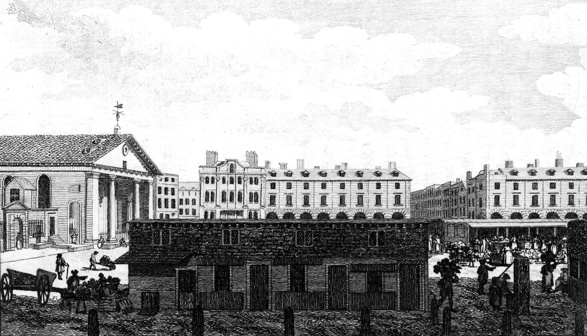
Covent Garden.
In 1645, the precinct of Covent Garden was separated from St. Martin’s, and constituted an independent parish, 195which was confirmed after the restoration in 1660, by the appellation of St. Paul’s Covent Garden, when the patronage was vested in the Earl of Bedford: and as it escaped the fire in 1666, which did not reach so far, it remains as it came from the hands of the great architect.
In the front is a plain, but noble portico of the Tuscan order, executed in the most masterly manner; the columns are massy, and the intercolumniation large, which has an air of noble simplicity, that if compared with the most ornamented Gothic structures, shews the superiority of the Roman architecture in its plainest form, over the finest barbarism. The building, tho’ as plain as possible, is happily proportioned; the walls are of brick covered with plaister, and the corners of stone; the roof is flat, and though of great extent, is supported by the walls alone, without columns. The pavement is stone; the windows are of the Tuscan form like the portico, and the altar piece is adorned with eight fluted columns of the Corinthian order, painted in imitation of porphyry. But this by some is thought a defect, the lightness of the 196altar piece in their opinion giving the church an air of heaviness.
Covent Garden Market, Covent Garden.
Coventry court, Coventry street.
Coventry street, Hay Market.
Coverlead fields Spitalfields.
Coulsdon, a village in Surry, near Croydon, which anciently belonged to the abbey of Chertsey.
Council Office, in the Cock-pit. See the article Privy Council.
Counsellors alley, Great Pearl street.
Counter alley, 1. Grocer’s alley, in the Poultry.☐ 2. Southwark.
Counter lane, St. Margaret’s hill.
Countinghouse yard, Christ’s hospital.
Courts. See the several courts held in London under their respective names; those of the government, under the articles Admiralty, Arches, Chancery, Common Pleas, Delegates, Dutchy of Lancaster, King’s Bench, &c. and those of the corporation under the articles Chamberlain, Common Council, Conscience, Conservacy, Coroner, Escheator, Hustings, &c.
Court street, Whitechapel.
Couzen’s lane, Thames street.†
197Couzen’s rents, Rosemary lane.†
Couzen’s yard, Blue Anchor alley, Rosemary lane.†
Cow alley, Freeschool street.*
Cow court, 1. Jamaica street.* 2. Old street.* 3. Rotherhith wall.
Cow cross, near West Smithfield.*
Cow lane, 1. Cow yard, Artichoke lane.* 2. Liquorpond street, Leather lane.* 3. New Gravel lane.* 4. Snow hill.* 5. Trinity street, Rotherhith.*
Cowden’s rents, Little Trinity lane.†
Cowley street, by Wood street, Westminster.†
Cowley’s rents, Long alley, Moorfields.†
Cowling street, behind the Abbey, Westminster.†
Cowper’s bridge, Old Horselydown.†
Cowper’s court, 1. East Smithfield.† 2. Portpool lane.†
Cowper’s rents, East Smithfield.†
Cowper’s square, Goodman’s fields.†
Cox’s alley, Leather lane, Holborn.†
Cox hole, Spring street.†
Cox’s court. 1. Aldersgate street.† 2. Kent street.† 3. Shore ditch.†
Cox’s entry, Leather lane.†
Cox’s garden, Wapping Wall.†
Cox’s key, near Thames street.†
Cox’s key entry, Thames street.†
198Cox’s rents, 1. St. Catharine’s.† Crow alley, Whitecross street.†
Cox’s square, Spitalfields.†
Cox’s wharf, Tooley street.†
Cox’s yard, Pennington street.†
Coxan court, Dorset street, Shoreditch.†
Crab court, 1. New Gravel lane. 2. Ratcliff Highway. 3. Woolpack alley, Houndsditch.
Crabtree lane, Castle street. ‡
Crabtree orchard, Clare market.
Crackbrain court, Rosemary lane.║
Cradle alley, 1. Cow Cross.* 2. Cut-throat lane, Shadwell.* 3. Drury lane.* 4. Golden lane.* 5. Gray’s Inn lane.*
Cradle court, 1. Aldersgate street.* 2. Cow Cross.* 3. Fenchurch street.* 4. Fore street, Moorgate.* 5. Golden lane.* 6. St Mary Ax.* 7. Redcross street, Cripplegate.*
Craig’s court. Charing Cross.†
Cranburn Lodge, a fine house in Berkshire in the middle of Windsor Forest. It was built by the late Earl of Ranelagh; and is now in possession of his granddaughter the Countess of Coventry. As it is seated on a hill, it commands a most delightful prospect.
Crane alley, 1. Chancery lane.* 2. Old Change, Cheapside.*
199Cranebourn alley, Little Newport street, Leicester fields.†
Cranebourn passage, Cranebourn alley.†
Crane court, 1. Aldersgate street. 2. Fleet street. 3. Lambeth hill. 4. Old Change.
Cranford, a village on the north west side of Hounslow. It has a charity school, and a bridge over the river Crane; and here the Earl of Berkley has a seat.
Craven buildings, Drury lane, from the house of the noble family of Craven at the end of Drury lane.
Craven court, Craven street.†
Craven mews, Drury lane.† See Mews.
Craven street, in the Strand.†
Craven wood yard, May-pole alley, Wych street.
Craven yard, Drury lane.†
Crawford’s court, Rosemary lane.†
Cray. There are several villages of this name in Kent, situated on the small river Cray, from which they take their names. This stream rises a little to the south west of St. Mary Cray, runs by that town, and passing by Paul’s Cray, Foot’s Cray, and North Cray, runs into the Darent, near its conflux with the Thames at Dartford creek, opposite to Purfleet. The principal of these places is St. Mary Cray, about which are many woods 200of birch, from which the broom-makers in Kent street, Southwark, are supplied.
Crayford, a town near Dartford in Kent, is 14 miles from London, and obtained its name from its having anciently a ford over the river Cray, or Crouch, a little above its influx into the Thames. In the adjacent heath and fields are several caves, supposed to have been formed by the Saxons as places of security and shelter for their wives, children, and effects, during their wars with the Britons.
Creechurch court, Creechurch lane.☐ See St. Catharine Creechurch.
Creechurch lane, Leadenhall street.☐
Creed lane, Ludgate street. See Paternoster Row.
Cripplegate, so named from some cripples who anciently begged there, appears to have been one of the original gates of the city, and is situated 1032 feet to the west of Moorgate. It has been many times rebuilt, but the present structure, which was repaired in 1663, seems to have stood between two and three hundred years. It is a very plain solid edifice, void of all ornament. It has only one postern, and has more the appearance of a fortification than any of the others.
Cripplegate Ward, is very large, and 201consists of two parts, one lying within Cripplegate and London Wall, and the other reaching to the extent of the city liberties. The whole ward extends from Cheapside on the south, to beyond Bridgewater square in the north; and from Jewin street in the west, to Back street, Moorfields, in the east; it being bounded on the north by the parish of St. Luke, without the freedom; on the west by Aldersgate ward; on the south by Cheap ward; and on the east, by little Moorfields, part of Coleman street ward, Bassishaw ward, and Cheap ward.
The principal streets, &c. within the walls are, Milk street, Aldermanbury, Love lane, Wood street, Silver street, Addle street, and a very small part of Cheapside, containing 170 feet eastward from Wood street. The chief places without the walls are, Fore street, Moor lane, Whitecross street to beyond Beech lane, Redcross street, Beech lane, part of Barbican, and all Bridgewater square.
The principal buildings in this ward are the parish churches of St. Giles Cripplegate, St. Alphage, St. Alban’s Wood street, St. Michael’s Woodstreet, and St. Mary Aldermanbury; Lamb’s chapel, Sion college, Dr. Williams’s Library; 202and the halls of the Haberdashers, Waxchandlers, Plaisterers, Brewers, Curriers, Bowyers, and Loriners companies.
This ward is governed by an Alderman, and within the gate are eight Common Council men, fifteen wardmote inquest men, twelve scavengers, nine constables, and a beadle. Without the gate there are four Common Council, seventeen wardmote inquest men, four scavengers, two constables, and a beadle. The jurymen returned by the wardmote inquest serve in the several courts in Guildhall in the month of March.
Crispin’s alley, Holiwell street.*
Crispin street, Smock alley, Spitalfields.*
Croft’s yard, East Smithfield.†
Crooked Billet court, Long alley, Moorfields.*
Crooked Billet wharf, Millbank.*
Crooked lane, 1. Mint street. 2. New Fish street.
Cropp’s alley, Back street, Lambeth.†
Cropp’s yard, Back lane, Lambeth.†
Crosby’s court, Charterhouse street.†
Crosby’s square, Bishopsgate street. Here was anciently a very large house, built 203by Sir John Crosby, grocer and woolman, called Crosby Place.
Crosby Square passage, St. Mary Ax.☐ Crosby street, 1. Free School street. 2. St. Mary Ax.
Cross alley, 1. George alley, Shoe lane. 2. Marigold street. 3. One Gun alley, Wapping. 4. Upper Well alley, Wapping.§
Cross court, 1. Beaufort Buildings in the Strand, 2. Carnaby street. 3. London Wall. 4. Russel street.
Cross lane, 1. Bush lane. 2. Cartwright street. 3. St. Dunstan’s hill. 4. Hartshorn lane in the Strand, 5. Long Acre. 6. Love lane, Little Eastcheap, 7. Marigold street. 8. St. Mary hill. 9. Parker’s lane, Drury lane. 10. Shad Thames.
Cross row, Islington.
Cross street, 1. Carnaby street. 2. Essex street in the Strand. 3. Hatton Garden, 4. Islington. 5. King’s street, Oxford street. 6. Lukener’s lane. 7. Rotherhith.
Cross Daggers court, Grub street, near Moorfields.*
Crossed Guns court, Rosemary lane.*
Cross Harper’s court, Whitecross street.
Cross Keys alley, 1. Barnaby street.*. 2. Blackman street.* 3. Norton Falgate.* 2044. Without Temple Bar.* 5. Watling street.* 6. Whitechapel.* 7. Whitecross street, Cripplegate.*
Cross Keys court, 1. Chick lane.* 2. Grape street.* 3. Little Britain.* 4. London Wall.* 5. Queen street, Cheapside.* 6. Watling street.* 7. Whitechapel.* 8. Whitecross street, Cripplegate.*
Cross Keys yard, Whitecross street, Cripplegate.*
Cross Keys Inn yard, Whitecross street, Cripplegate.*
Cross Shovel alley, Blackman street.*
Crow alley, Whitecross street, Cripplegate.*
Crowd alley, Salisbury court, Fleet street.
Crowder’s rents, Narrow street, Ratcliff.†
Crowder’s Well, a spring of clear water admired for its medicinal virtues. It is on the back of the church yard of St. Giles’s Cripplegate.
Crowder’s Well alley, Jewin street.☐
Crowfoot’s court, Rosemary lane.
Crown alley, 1. Back side.* 2. Broad St. Giles’s.* 3. Dorset street, Fleet street.* 4. King Tudor street.* 5. In the Minories.* 6. Petticoat lane.* 7. Tooley street.* 8. Upper Moorfields.* 9. Whitecross street, Old street.* 10. 205White street, Horselydown.* 11. White’s yard.*
Crown court, 1. Aldersgate street.* 2. Angel hill.* 3. Bank side.* 4. Back lane.* 5. Broad street, Moorfields. 6. Butcherhall lane.* 7. Butcher row, Temple Bar.* 8. St. Catharine’s lane.* 9. Chancery lane.* 10. Cheapside.* 11. Chick lane.* 12. Church lane, Rag Fair.* 14. Cock lane, Shoreditch.* 15. Cow lane, West Smithfield.* 16. Crown alley. 17. Dancing Bridge lane.* 18. Dean’s street, Soho.* 19. Dorset Gardens.* 20. Duke street, Westminster.* 21. Dunning’s alley, Bishopsgate street.* 22. East Smithfield.* 23. Fleet street.* 24. French alley.* 25. Gerrard street.* 26. St. Giles’s Broadway.* 27. Golden lane.* 28. Gracechurch street.* 29. Grub street.* 30. Horselydown.* 31. King John’s court.* 32. King street, St. James’s.* 33. King’s street, Tooley street.* 34. Knaves Acre.* 35. Little Moorfields.* 36. Little Pearl street.* 37. Little Russel street, Drury lane.* 38. Long Acre.* 39. Long Walk, Christ’s Hospital.* 40. Narrow Wall, Deadman’s place. 41. Newgate street.* 42. New Gravel lane.* 43. Newington Butts.* 44. Old Change.* 45. Petticoat lane.* 206 46. Pickleherring street.* 47. Portpool lane.* 48. Princess street, Soho.* 49. Quaker street.* 50. Rosemary lane.* 51. Seething lane.* 52. Sherwood street.* 53. Ship street.* 54. Sun Tavern fields.* 55. Thieving lane. 56. Threadneedle street.* 57. Tower ditch.* 58. Trinity lane.* 59. Turnagain lane.* 60. Warwick lane, Newgate street.* 61. White’s alley.* 62. Whitecross street.* 63. White Friars, Fleet street.* 64. Worcester street.*
Crown and Cushion court, West Smithfield.*
Crown and Sceptre court, St. James’s street, Pall Mall.*
Crown and Sheers court, Rosemary lane.*
Crown Office, in Bell yard, Chancery lane. This is an office of great importance, under the Clerk of the crown, who is either by himself, or his deputy, continually to attend the Lord Chancellor, or Lord Keeper, for special matters of state; he has therefore a place appointed for him in the house of Lords. He makes all writs for the election of members of parliament, upon a warrant directed to him on the death or removal of any member; and also commissions of oyer 207and terminer, jail delivery, commissions of peace, and many other commissions for distributing justice to the King’s subjects. This office is sometimes executed by a deputy. Chamb. Pres. State.
Crown Office row, Inner Temple.
Crown street. 1. Hoxton.* 2. Wapping.*
Crown yard, 1. Bishopsgate street without.* 2. Nightingale lane.*
Croydon, a large and populous town in Surry, situated on the edge of Bansted Downs, ten miles and a half from London. ’Tis said there was once a royal palace in this place, which was given with the manor to the Archbishops of Canterbury, who converted it into a palace for themselves; but it is now much decayed. Archbishop Whitgift founded an hospital here, which he endowed with farms for the support of a warden, and twenty-eight men and women, decayed house-keepers of Croydon and Lambeth, with a school for ten boys, and as many girls, with 20l. a year and a house for the master, who must be a clergyman. The church, which is esteemed the finest and largest in the county, has several stately monuments, particularly one for Archbishop Grindall, another for Archbishop Sheldon, and 208another for Mr. Francis Tyrrel, a grocer in London, who generously gave 200l. to build the market house. Here is a great corn market on Saturdays, chiefly for oats and oatmeal for the service of London; and the adjacent hills being well covered with wood, great quantities of charcoal are made and sent to this city.
Crucifix lane, Barnaby street.
Crutched Friars. This street took its name from a monastery of the Holy Cross at the south east corner of Hart street, near Tower hill. This monastery was founded about the year 1298, and continued till the suppression of the other religious houses. In the reign of Henry VIII. a Prior of this house being found in bed with a whore in the day time, by the Visitors appointed by the Lord Cromwell, he distributed thirty pounds among them, and promised them as much more; an account of which being sent by the Visitors to Cromwell, these scandalous crimes hastened the dissolution of monasteries. The ruins of this religious house are not now to be seen, and nothing of it remains but the name, which is given to the street, that is more commonly called Crutched Friars, than Hart 209street. In the place where the monastery stood, is now erected the Navy office, and many other handsome buildings.
Cuckold’s court, Thames street.║
Cuckold’s point, Rotherhith Wall.║
Cuckold’s Point stairs, Rotherhith.║
Cucumber alley, 1. Queen street, Seven Dials. 2. Ship yard, Temple Bar.
Cullum street, Fenchurch street; it takes its name from Sir Thomas Cullum, Knt. who built it. Maitland.
Culver court, Fenchurch street.
Cumberland court, Bartholomew close.†
Cumber’s court, Blackman street.†
Cumber’s paved court, Blackman street.†
Cuper’s bridge, Narrow Wall, Lambeth.†
Cuper’s bridge stairs, Cuper’s bridge.†
Cuper’s Gardens, near the south bank of the Thames, opposite to Somerset house, and in the parish of Lambeth, was for several years a place of public entertainment: the gardens were illuminated, and the company entertained by a band of music, and fire works; but this, with other places of the same kind, has been lately discontinued by an act that has reduced the number of these seats of luxury and dissipation. Here are several statues, &c. the remains of 210Greek and Roman antiquities, that have been much disfigured by time and bad usage, supposed to be part of the famous collection of the Earl of Arundel, but being broken and defaced, were not thought good enough to be presented to the university of Oxford, and put among the Marmoria Arundeliana; they were therefore removed hither, when Arundel house on the other side of the Thames was turned into a street.
Cupid’s alley, Golden lane.
Cupid’s street, Coverley’s fields.
Cure’s Almshouse, in College yard, Deadman’s Place, Southwark, was founded by Thomas Cure, Esq; in the year 1584, for the reception of sixteen poor men and women, with an allowance of twenty pence a week each; and by the additional benefactions of his son and Mrs. Appleby, each of them receives an additional allowance of 16s. a year.
Curll’s court, In the Strand.†
Curriers, a company of considerable antiquity, since, according to Mr. Stow, they founded a religious fraternity in the convent of White Friars, Fleet street, so early as in the year 1367; they were however not incorporated by letters patent 211till the year 1605. This company consists of a Master, two Wardens, twelve Assistants, and 103 Liverymen, whose fine is 9l. 13s. 4d. They have a pretty handsome hall near Cripplegate.
Curriers alley, 1. Bristol street, 2. Shoe lane.
Curriers Arms Inn yard, Fann’s alley.*
Curriers court, London Wall.
Cursitors Office, in Chancery lane, where is made out original writs. The Clerks, who are twenty-four in number, were anciently called Clerici Brevium de Cursu, and each hath certain counties and cities allotted them, for which they make out such original writs as are required; they are a distinct corporation, and each of them executes his respective duty by himself or his deputy. This office was erected by Sir Nicholas Bacon, Lord Keeper, in the reign of Queen Elizabeth, and the father of the celebrated Sir Francis Bacon.
Cursitors alley, Chancery lane.☐
Cursitors street, Chancery lane.☐
Curtain row, Hog lane, Norton Falgate.
Curzon street, MayFair, a long street, with some grand houses on the south side, and on the north side is the house of the Lord Fane.
212Cushion court, 1. Little Broad street. 2. Pig street.
The Custom House, a commodious building, erected for the receipt of his Majesty’s customs on goods imported and exported. It is situated near the east end of Thames street, and its front opens to the wharfs and rivers. In ancient times the business of the Custom House was transacted in a more irregular manner at Billingsgate: but in the reign of Queen Elizabeth a building was erected here for this purpose; for in the year 1559, an act being passed that goods should be no where landed, but in such places as were appointed by the Commissioners of the revenue, this was the spot fixed upon for the entries in the port of London, and here a Custom House was ordered to be erected; it was however destroyed by fire with the rest of the city in 1666, and was rebuilt with additions two years after by King Charles II. in a much more magnificent and commodious manner, at the expence of 10,000l. but that being also destroyed in the same manner in 1718, the present structure was erected in its place.
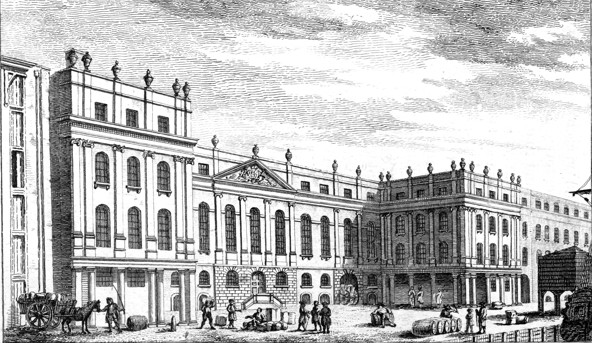
Custom House. S. Wale delin. B. Green sc. Oxon.
This edifice is built with brick and stone, and is calculated to stand for ages. 213It has underneath and on each side, large warehouses for the reception of goods on the public account, and that side of the Thames for a great extent is filled with wharfs, keys, and cranes for landing them. The Custom House is 189 feet in length: the center is twenty-seven feet deep, and the wings considerably more. The center stands back from the river; the wings approach much nearer to it, and the building is judiciously and handsomely decorated with the orders of architecture: under the wings is a colonade of the Tuscan order, and the upper story is ornamented with Ionic columns and pediments. It consists of two floors, in the uppermost of which is a magnificent room fifteen feet high, that runs almost the whole length of the building: this is called the Long Room, and here sit the Commissioners of the customs, with their officers and clerks. The inner part is well disposed, and sufficiently enlightened; and the entrances are so well contrived, as to answer all the purposes of convenience.
Though we cannot call this a very beautiful building, yet from its great utility, and the conspicuous place in which it stands, we thought a representation of it by a print could not be omitted.
214It is observable that in the year 1590, the customs and subsidies in the port of London inwards, were let to farm to Mr. Thomas Smith, for 20,000l. per annum, when it was discovered that they amounted annually to 30309l. so that Queen Elizabeth lost every year 10,309l. but by the vast increase of commerce since that time, they at present bring in above an hundred times as much, the customs now annually amounting to above two millions, and yet this immense business is transacted with as much order and regularity, as the common affairs of a merchant’s counting house.
The government of the Custom House is under the care of nine Commissioners, who are entrusted with the whole management of all his Majesty’s customs in all the ports of England, the petty farms excepted, and also the oversight of all the officers belonging to them. Each of these Commissioners has a salary of 1000l. a year, and both they, and several of the principal officers under them, hold their places by patent from the King. The other officers are appointed by warrant from the Lords of the Treasury.
Custom House court, Beer lane.☐
215Custom House key, Thames street.☐
Custom House stairs, Thames street.☐
Custos Brevium, the first clerk of the court of Common Pleas, whose office is to receive and keep all writs returnable in that court, and to receive of the Prothonotaries all records of nisi prius called posteas. He holds his place by patent from the King, and has the gift of the second Prothonotary’s place, and of the Clerk of the juries. This office is in Brick court, near the Middle Temple. See Common Pleas.
Cutlers, a company incorporated by letters patent granted by King Henry V. in the year 1417, and afterwards united to the haft and sheath makers. This fraternity is governed by a Master, two Wardens, and twenty-one Assistants, with a livery of 110 members, who upon their admission pay a fine of 10l. They have a neat and convenient hall in Cloak lane, Dowgate hill.
Cutlers street, Houndsditch.
Cutters rents, Gravel lane.
Cut-throat lane, 1. Cock hill, Ratcliff. 2. Upper Shadwell.
Cutting alley, New North street.
216