B. (continued 2)
Reading edition
Judith and Holofernes 4 4½ 3 11 Manfredo.
3 10½ 3 2½ Lewis Carrachi.
A sacrifice 3 2 4 3 Nich. Poussin.
A Venus, Cupid and Satyrs 2 2 1 8 Ditto.
Daphne changed into a laurel 2 2½ 1 10 Nich. Poussin.
A landskip with figures 3 0 4 3 Gaspar Poussin.
Architecture and figures 3 9 5 3 Viviano.
Architecture and figures 3 2 4 4½ Ditto.
Joseph and his brethren 3 0 4 2 Paraccini.
Jacob embracing Benjamin 3 0 4 2 Ditto.
A landskip with figures 2 0 2 9 Claude Lorrain.
A landskip with figures 2 6 3 11½ Francisco Mille.
A landskip with figures 1 5 1 10 Ditto.
Three figures ½ lengths 3 10 3 1 after Car. Maratti.
A quarter length 2 9 2 0 Albert Durer.
A battle piece 2 3 3 2 Bourgognone.
A battle piece 2 3 3 2 Ditto.
An holy family 3 0 3 9 Solomini.
Paris and Helena 2 0 3 2½ L’Araise.
The judgment of Solomon, gallery chimney piece 3 9 4 1½ Pompeio.
Hector and Andromache, drawing room chimney piece 3 4 3 6 Imperialis.
Coriolanus, saloon chimney piece 3 9 3 9 Imperialis and Masucci.
Architecture and figures, dressing room chimney piece 4 8 4 0½ Paulo Panini.
Architecture with figures, bedchamber chimney piece 2 5 2 4½ Ditto.
Ditto, yellow bedchamber chimney piece 3 4½ 3 3 Ditto.
Ditto, library chimney piece 4 7½ 4 0½ after Panini.
Ditto, yellow dressing room, ditto 2 10 3 7½ Harding aft. Panini.
Ditto, red dressing over the chimney piece, ditto 3 6 3 4½ Ditto.
Ditto, store room chimney piece, ditto 2 9½ 2 8½ Ditto.
Ditto, over the doors of the red drawing room 1 9 3 3 after P. Panini.
Ditto, over the doors of the red drawing room 1 9 3 3 Harding aft. Panini
Ditto, with figures over the door in the saloon 2 4 3 8 Ditto.
Ditto, ditto 2 4 3 8 Ditto.
A landskip with figures, dining room chimney piece 3 8½ 3 8½ Lambert.
A landskip with figures, green dressing room chimney piece 2 10½ 3 2½ Ditto.
A landskip with figures, green bedchamber chimney piece 2 4½ 2 4½ By
Fruit and flowers, breakfast chimney piece 2 5 2 5 By
Pharaoh’s daughter and Moses 2 3½ 1 10½ Chev. Vanderwerff.
Message by the angels to the shepherds 2 2 1 7½ Ditto.
King Zeleucus giving his kingdom to his son 2 4 1 8 Ditto.
Shepherds and shepherdesses dancing 1 10 1 5½ Chev. Vanderwerff.
Hercules between Virtue and Vice 1 11 1 5 Ditto.
Roman Charity 1 11½ 1 5 Ditto.
Joseph and Potipher’s wife 1 11 1 5½ Ditto.
Mary Magdalen reading in a grotto 1 11 1 6 Ditto.
Bathsheba bathing 1 10 1 3½ Ditto.
Our Saviour and Mary Magdalen 2 4 1 8½ Ditto.
Venus and Cupid 1 5½ 1 0 Ditto.
Chevalier Vanderwerff, his wife and daughter 2 1 0 2 2½ Ditto.
Adam and Eve 1 6 1 0 Peter Vanderwerff.
and Stratonica 1 6 1 0 Ditto.
A landskip with many figures, a fair at Ghen 2 8 3 8 Sir D. Teniers.
Ditto with figures 2 8 3 9½ Ditto.
Fruit and flowers 2 7 2 0 Van Huysan.
Ditto 2 7 2 0 Ditto.
Fruit and flowers 2 0 1 9 Van Huysan.
Ditto 2 0 1 9 Ditto.
Ditto 1 3 1 0 Ditto.
A view of Venice, over the saloon door 2 4 3 8 Harding af. Canaleti.
Ditto, ditto 2 4 3 8 Ditto.
Architecture, over the door in the gallery 2 6 4 0 Ditto after Panini.
Ditto, ditto 2 6 4 0 Ditto.
The golden age 2 1 2 8 Limburg.
The great church at Harlem 2 7 2 3 De Witt.
A landskip with figures 0 7 0 10 Velvet Brughel.
Ditto 0 4½ 0 6 Ditto.
A poulterer’s shop 1 5 1 3 Old Meiris.
A fishmonger’s shop 1 5 1 3 Ditto.
A water piece 0 10 1 1 Zagtleven.
An hunting piece 2 2 2 8 Berchem.
An Italian playing on the guitar 1 2 1 0 Brower.
A landskip with figures and cattle 1 10½ 2 2½ Wouvermans.
A landskip with figures and cattle 1 6 1 10 Wouvermans.
The holy family 2 3 1 7 Scalchen.
Ditto 2 3 1 7 Ditto.
A woman with a torch 1 0½ 0 10½ Ditto.
A schoolmaster 1 2 0 11 Gerard Dowe.
The offering of the kings 1 4 1 0 Polenburgh.
Two small figures, Venus and Adonis 1 3½ 1 6½ Young Meiris.
A landskip with cattle 1 7½ 2 7 Edema.
A landskip with fowls and a dog 2 0 2 5½ Craddock.
In the Gallery 52 pictures
Drawing room 13
Saloon 8
Dressing room 32
Bedchamber 1
Library 1
Dining room 2
Attick story 9
——
118 In all
Black Horse alley. 1. Barbican.* 2. Near Snow hill.*
Black Horse court. 1. Aldersgate street.* 2. In the Minories. 3. Old Change.* 4. White street, Southwark.* 5. Windmill street.*
Black Horse yard. 1. Green street, Leicester fields.* 2. In the Curtain, Hog lane, Shoreditch.* 3. Gravel lane, Houndsditch.* 4. Gray’s Inn lane.* 5. Harrow alley, Petticoat lane.* 6. Nightingale lane.* 7. Pickax street.* 8. Poor Jewry lane, within Aldgate.* 9. Tottenham Court road.* 10. Townditch, Little Britain.* 11. Tower hill.* 12. Whitechapel.* 13. Great Windmill street.*
Black Jack alley. 1. East Smithfield.* 2. Great Windmill street.* 3. Old street.*
Black Lion alley, Wentworth street.*
Black Lion court. 1. Bank side.* 2. Foster lane.* 3. Old Change.*
Black Lion stairs, near York Buildings.*
Black Lion yard. 1. Bedfordbury.* 2. Stony lane, Petticoat lane.* 3. Whitechapel.*
Blackman’s court. 1. Great Peter street.* 2. Price’s alley.*
Blackman’s street, St. George’s church, Southwark.*
Black Mary’s hole, a few stragling houses near the Cold Bath fields, in the road to Hampstead. It took its name from a Blackmoor woman called Mary, who about thirty years ago lived by the side of the road near the stile in a small circular hut built with stones.
Blackmoor’s Head yard, near St. James’s square.*
Blackmoor street, Clare-market.*
Blackmoor’s alley. 1. Farthing fields.* 2. Green bank, Wapping.* 3. St. Martin’s lane, Charing cross.*
Black Raven alley. 1. Coleman street.* 2. Leadenhall street.* 3. Near Fishmongers hall in Thames street.*
Black Raven court. 1. Chiswell street.* 2. Golden lane.* 3. Grub street. 4. Leadenhall street.* 5. St. Olave’s street.* 6. Seething lane.*
Black Raven passage, Fetter lane.*
Black Rod, an officer of the King’s palace, so called from his carrying a black staff, is the chief of the four Gentlemen Ushers of the presence chamber, and attends the House of Lords every day during the sitting of Parliament, where his seat is within the bar. When the King sends to order the House of Commons to attend him in that house, he always sends the Black Rod. This gentleman is also employed in fitting up the House of Lords before the meeting of the Parliament; he introduces the Lords into that house, and to his custody delinquents are committed by the Lords. This gentleman is likewise Usher to the order of the Garter.
Black’s alley, East Smithfield.
Black’s fields, Shad Thames.
Blacksmiths, an ancient guild, or fraternity, which was continued by prescription, till the Blacksmiths were incorporated by letters patent granted by Queen Elizabeth, and confirmed by King James I.
This company is governed by a Master, three Wardens, and twenty-one Assistants, and has a livery of 220 members, whose fine is 8l. They have a pleasant hall on Lambeth hill, for the dispatch of their affairs.
Blacksmiths yard, Upper Ground, Southwark.
Black Spread Eagle alley. 1. Blackman street.* 2. Kent street.* 3. Turnmill street.*
Black Spread Eagle court. 1. Blackman street.* 2. Finch lane, Cornhill.*
Black Swan alley. 1. Golden lane.* 2. Corbet’s court, Eagle street.* 3. Holiwell street.* 4. Little Carter lane.* 5. Opposite Garlick Hill, Thames street.* 6. London wall.* 7. St. Margaret’s hill.*
Black Swan court. 1. Bartholomew lane.* 2. Canon street.* 3. Golden lane.* 4. In the Maze.* 5. Market street.* 6. St. Paul’s Church yard.* 7. Shore ditch.* 8. Great Tower street.*
Black Swan yard. 1. Brown’s lane.* 2. In the Borough.* 3. Newington Butts.* 4. Ropemakers fields, Limehouse.*
Black Swan Inn yard, Holborn.*
Blackwell, Poplar.
Blackwell hall, Basinghall street, a very ancient edifice, employed for several ages as a market for all kinds of woollen cloth brought to London. This edifice was originally called Basing’s Haugh or Hall; probably from the family of the Basings, who first built the house, and whose arms were placed in many parts of it, painted on the walls, and cut in the stone-work. From this family, who were owners also of the adjoining ground. Stow supposes, that “the ward itself took its name, as Coleman street ward of Coleman, and Faringdon ward, of William and Nicholas Faringdon.” Of this family the same author observes, that Solomon Basing was Mayor in the year 1216; and that to Adam Basing his son, who was also afterwards Mayor, King Henry III. gave the advowson of the church at Basing Hall, and several liberties and privileges.
In the 36th year of Edward III. this house was inhabited by Mr. Thomas Bakewell, whence it obtained the name of Bakewell Hall; a name that was afterwards corrupted to that of Blackwell Hall. At length it was purchased, with the garden and appurtenances, of King Richard II. by the city, for the sum of 50l. and from that time has been chiefly employed as a weekly market for all the broad and narrow woollen cloths brought out of the country.
This house at length growing ruinous, was rebuilt in the form of a handsome store house in the year 1558, at the charge of 2500l. but an hundred and eight years after was destroyed by the fire of London, and again rebuilt in 1672; this last is the present edifice.
It is a square building with a court in the middle surrounded with warehouses, and has two spacious entrances for carriages, one from Basinghall street, and the other opposite to it by Guildhall. This last is the principal front, and has the door-case adorned with two columns of the Doric order, with their entablature, and a pediment, in which are the King’s arms, and a little lower the city arms enriched with Cupids, &c.
In this edifice are the Devonshire, Gloucester, Worcester, Kentish, Medley, Spanish, and Blanket Halls, in which each piece of cloth pays one penny for pitching, and a half-penny per week resting; and the profits, which are said to amount to about 1100l. per annum, are applied towards the support of Christ’s Hospital, the Governors whereof have the whole management of these warehouses. There are several statutes relating to the regulation of this market, with respect to the factors, and others concerned.
Blackwell Hall court, London Wall, Basinghall street. ☐
Blackwell Hall passage, Cateaton street. ☐
Blackwell Hall yard, Basinghall street. ☐
Blake’s alley, Holiwell lane. †
Blake’s court, Catharine street, in the Strand. †
Blake’s yard, Old street. †
Bland court, Narrow street. †
Bland’s dock, Rotherhith. †
Bland’s yard, In the Minories. †
Blank yard, Great Pearl street.
Blechingly, a small parliamentary borough in Surrey, said to have enjoyed that privilege ever since parliaments had a being, and yet it has no market. The Bailiff, who returns the members, is annually chosen at the Lord of the Mannor’s court. The town, which is five miles from Ryegate, and twenty from London, being situated on a hill, on the side of Holmsdale, affords a fine prospect, as far as Sussex and the South Downs, and from some of the ruins of the castle, which are still visible, tho’ in the midst of a coppice, one may take a view to the west into Hampshire, and to the east into Kent. Here is a free school and an almshouse; but the spire of the church was consumed by lightning and all the bells melted in the year 1606.
Bleeding Heart yard, Cross street, Hatton garden. †
Blenheim street, Oxford street.
Blewgate fields, Ratcliff Highway.
Blewit’s buildings, Fetter lane. †
Blewit’s court, Fetter lane. †
Blick’s row, Oxford row. †
Blind Beggars alley, Cow Cross. †
Blood’s ground, Mersham street. †
Bloodworth’s dock, Wapping. †
Bloodworth’s yard, Wapping wall.
Bloody Bridge, King’s Road, Chelsea.
Bloomsbury, the district thus named was anciently a village denominated Lomsbury, in which were the King’s stables, till they were destroyed by fire in 1354. Maitland.
Bloomsbury church. See St. George’s Bloomsbury.
Bloomsbury court, Bloomsbury market.
Bloomsbury market, by Bloomsbury square.
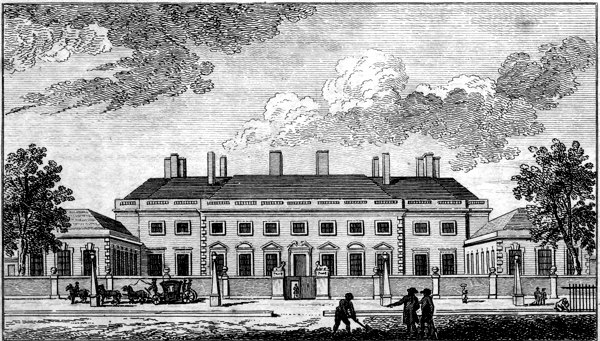
S. Wale delin. C. Grignion sculp. Bedford House.
Bloomsbury square, Southampton street, Holborn. This square has been lately embellished with many goodhouses, and the grass plats in the middle surrounded with neat iron rails. The north side is entirely taken up with Bedford House, which is elegant, and was the design of Inigo Jones. Besides the body of the house, are two wings, and on each side the proper offices. One of the wings is a magnificent gallery in which are copies of the Cartoons at Hampton Court, as large as the originals, by Sir James Thornhill. Behind the house are extensive gardens, which command a view of the country, and particularly of Highgate and Hampstead.
Blossom’s Inn entry, Blossom’s Inn yard, Laurence lane, Cheapside.
Blossom’s Inn yard, Honey lane market, Cheapside.
Blossom’s street. 1. Briant street. 2. White-Lion street, Norton Falgate.
Blowbladder street, from Cheapside to St. Martin’s le Grand. It obtained its present name from the bladders formerly sold there, when the shambles were in Newgate street.
Blow’s court, Saffron hill. †
Blue Anchor alley. 1. Barnaby street. * 2. Brook’s street, near Ratcliff Cross. * 3. Bunhill row. * 4. Cable street. * 5. Green Bank. * 6. Great Minories. * 7. Old street. * 8. Pesthouse row. * 9. Petty France. * 10. Rosemary lane. * 11. St. Catharine’s. * 12. Tooley street. * 13. Tower ditch. * 14. Whitecross street, Cripplegate. *
Blue Anchor court. 1. Butcher row, without Temple Bar. * 2. Coleman street. * 3. Salisbury court, Fleet street.
Blue Anchor road, West lane, Rotherhith wall. *
Blue Anchor yard. 1. Green Bank. * 2. Little Tower hill. * 3. London wall. * 4. Petty France, Westminster. * 5. St. Catharine’s lane. * 6. Rosemary lane. *
Blue Ball alley. 1. In the Mint, Southwark. * 2. Saffron hill. *
Blue Ball court. * 1. Artichoke lane. * 2. Canon street. * 3. Drury lane. * 4. Little Hart street, Covent Garden. * 5. Salisbury court, Fleet street. *
Blue Ball yard, Fell street, Little Wood street. *
Blue Bell yard. 1. Dirty lane. * 2. Petty France, Westminster. *
Blue Bear alley. 1. Blackman street. * 2. Field lane. * 3. White street. *
Blue Bear court. 1. Canon street. * 2. Chick lane. * 3. Friday street. * 4. Rosemary lane. *
Blue Boar yard. 1. Field lane, Holborn. * 2. Great Russel street. *
Blue Boar Head yard, King’s street, Westminster. *
Blue Boar Inn yard, Whitechapel. *
Blue Boar’s Head alley. 1. Barbican. * 2. White street. *
Blue Boar’s Head Inn yard, Whitechapel.*
Blue court, Saffron hill.
Blue Cross street, Hedge lane, Charing cross.
Blue Gate alley, Whitecross street, Southwark.*
Blue Gate field, Upper Shadwell.
Blue Gate street. 1. Dirty lane, Blackman street. 2. Ratcliff Highway.
Blue Gate yard. 1. Carter’s Rents. 2. East Smithfield. 3. Harrow yard, Whitechapel.
Blue Hart court, Little Bell alley.*
Blue Maid alley, St. Margaret’s hill.*
Blue Post alley, Blue Gate field.
Blue yard, Gravel lane.
Blunderbuss alley, 1. King’s Gate street.* 2. St. Thomas Apostles.*
Boar alley, Grub street, Fore street.*
Boarded alley, Baldwin’s gardens.
Boarded entry. 1. Crutched Friars. 2. London wall. 3. Surrey street.
Boar’s Head alley. 1. Whitechapel.* 2. White street.*
Boar’s Head court. 1. In the Borough.* 2. Fleet ditch.* 3. Gracechurch street.* 4. Grub street.*
Boar’s Head yard. 1. Petticoat lane.* 2. West Smithfield. *
Boar’s Head Inn yard, Compter lane, St. Margaret’s hill.*
Boatbuilders yard. 1. Bank side. 2. College street.
Bock’s alley, Wapping wall.†
Bodd’s court, Philip lane, London wall.†
Boddington court. Cloak lane, Dowgate hill.*
Boddy’s Bridge yard, Upper Ground.
Boddy’s rents, Gravel lane.†
Bolt and Tun alley. 1. In the Strand.* 2. Whitechapel.*
Bolt and Tun court, Fleet street.*
Bolt court, Fleet street.
Bond’s stables, by Fetter lane.†
Bond’s stables yard, near Fetter lane.†
Bond’s street, Piccadilly.†
Bond’s court, Walbrook.†
Bond’s rents, Marigold street, Rotherhith wall.†
Bond’s yard, White Horse street, Ratcliff.†
Book’s alley, Wapping wall.†
Booker’s gardens, Leadenhall street.†
Boot alley. 1. Abchurch lane.* 2. Grub street, Fore street, Cripplegate.* 3. Kent street, Southwark.* 4. St. James’s street, Westminster.* 5. Upper Ground street, Southwark.*
Boot passage, Piccadilly.*
Boot Street. 1. Hoxton.* 2. Brick lane, Spitalfields.*
Booth street, Spitalfields.†
Booth yard, Wapping.†
Borough, a street in the borough of Southwark, extending from London bridge to St. Margaret’s hill.
Borough Court. This is a court of record by prescription, and is held every Monday by the Lord Mayor’s steward, at the hall on St. Margaret’s hill, Southwark, where are tried actions for any sum of money, damage, trespasses, &c. To this court belong three attornies, who are admitted by the steward. Maitland. See St. Margaret’s Hill.
There are also, besides this, three courts leet held in the Borough; for it contains three liberties or manors, viz. the Great Liberty, the Guildable, and the King’s manor, in which are chosen constables, aleconners, &c. and other business is dispatched peculiar to such courts. In this neighbourhood court leets are also kept at Lambeth, Bermondsey, and Rotherhith.
Boss alley. 1. Near Trig stairs, Thames street. 2. St. Mary hill. 3. Shad Thames.
Boss court, Peter’s hill, Thames street.
Bosvill’s rents, George street, Spitalfields.†
Bosville court, 1. Devonshire street, Theobald’s row.† 2. Carey street, Lincoln’s Inn fields.†
Bostwick’s alley, Whitechapel.†
Bostwick’s street, Old Gravel lane.†
St. Botolph’s Aldersgate, so denominated from St. Botolph, a monk born in Cornwall, is situated at the south east corner of Little Britain, and tho’ the fire in 1666 did not reach this edifice, it from that time fell into decay, and was great part of it rebuilt in 1757. It is a plain brick edifice with a tower supported on a kind of arch work, and crowned with an open turret, and its fane. It is a curacy in the patronage of the Dean and Chapter of Westminster Abbey; but is subject to the Bishop and Archdeacon of London, to whom it pays procuration.
St. Botolph’s Aldgate, situated on the east side of Houndsditch, fronting the Minories. The old church escaped the fire in 1666, and stood till the year 1741, when it was taken down, and the present edifice finished in 1744. It is built with brick, and is a plain, massy, and yet elegant structure. It consists of a body of a regular shape, and a lofty and well-proportioned steeple, formed of a tower and spire. Its greatest ornament is a bold rustic with which it is strengthened at the corners. This church is a curacy, and the impropriation is held in fee of the Crown. The Curate, besides other considerable advantages, receives 400l. a year by tithes. Newc. Rep. Eccles.
St. Botolph’s Billingsgate, a rectory, the church whereof formerly stood opposite to Botolph lane, in Thames street, in Billingsgate ward; but being destroyed by the fire of London, and not rebuilt, the parish was by act of parliament annexed to St. George’s Botolph lane.
St. Botolph’s Bishopsgate, opposite the north end of Houndsditch. The old church escaping the general conflagration in 1666, at length fell into decay, and the present structure was raised by act of parliament, at the expence of the parish. It is a massy and spacious edifice. The body is well built with brick, and well enlightened, and the roof hid by a handsome balustrade. On the inside the roof is arched, except over the galleries, and two rows of Corinthian columns support both the galleries and arch which extends over the body of the church, and is neatly adorned with fret work, from which hang several handsome gilt branches. The steeple, tho’ heavy, has an air of magnificence. In the center of the front is a large plain arched window, decorated at a distance with pilasters of the Doric order. Over this window is a festoon, and above that an angular pediment; on each side is a door crowned with windows, and over these others of the porthole kind; above these last rises a square tower crowned with a dome, whose base is circular, and surrounded by a balustrade in the same form; by the side of which, on the corners of the tower, are placed urns with flames. From this part rises a series of coupled Corinthian columns, supporting other urns like the former, and over them rises the orgive dome, crowned with a very large vase with flames. The Author of The Critical Review says, that he thinks this steeple more in taste than most about town; and that the parts of which it is composed are simple, beautiful and harmonious. The author of The English Architecture, however, observes, “That the placing of a window in the middle of the street, where the principal door should have been, is an error of the first magnitude. The most unlearned eye must perceive a strange imperfection in this, though without knowing what it is; and there is something in the highest degree disgustful, at being shut out by a dead wall at the proper and natural entrance.” But in justification of the architect, it may be alledged, that this being the east end, he might not be allowed to form a door in the center, where the altar is placed under a noble arch beneath the steeple; and that much greater improprieties than this are daily seen, from the idle custom which has generally prevailed of placing the altar to the east in spight of any inconveniences it may occasion, as in St. Clement’s in the Strand, St. Dunstan’s in Fleet street, and many others. This church is a rectory, the patronage of which is in the Bishop of London. The Rector, besides other considerable advantages, receives about 200l. a year by tithes,
Botolph lane, Little Eastcheap.†
Botolph’s alley, Botolph lane.†
Botolph’s court, Durham yard.
Botolph’s wharf, Thames street.†
Bottle alley, Bishopsgate street without.*
Bottle of hay yard, Islington road.*
Bottle yard, Bottle alley.*
Boulton street, Hyde Park road.†
Bourne’s Almshouse, in Kingsland Road, was erected in the year 1734, by the company of Framework-knitters, pursuant to the will of Thomas Bourne, Esq; who bequeathed to that company 1000l. to purchase ground, and erect a building upon it of twelve rooms, for that number of poor freemen or their widows, and endowed this almshouse with 2000l. to be laid out in a purchase of 80l. a year.
Bow, a village in Middlesex, a little to the east of Mile End, also called Stratford le Bow; is named Bow, from the stone arches of its bridge built over the river Lea, by Maud the wife of Henry I. Its church built by Henry II. was a chapel of ease to Stepney; but was lately made parochial.
This village is inhabited by many whitsters and scarlet dyers, and here has lately been set up a large manufactury of porcelain, which is brought to such perfection as to be very little inferior to that of China.
Bow church, in Cheapside. See St. Mary le bow.
Bow church yard, Cheapside.
Bow lane. 1. Cheapside, so named from the church of St. Mary le Bow, near the north west end of it. 2. New Gravel lane. 3. Poplar.
Bow road, Mile end, leading to the village of Stratford le Bow.
Bow street. 1. A very handsome street by Covent Garden. 2. Long Ditch. 3. St. Giles’s Broad street. 4. Sutton street, Hog lane, Soho.
Bowl alley, St. Saviour’s Dock head.
Bowl court, Shoreditch.
Bowl yard, St. Giles’s Broadway.
Bowling alley. 1. Cow Cross. 2. Dean’s yard, Westminster. 3. Thames street. 4. Tooley street. 5. Turnmill street. 6. Whitecross street, Cripplegate.
Bowling green. 1. Bandy Leg walk. 2. Near Hospital walk.
Bowling green alley, Hoxton.
Bowling green passage, Queen street, Southwark.†
Bowling green field, Blue Maid’s alley.†
Bowling green lane, Bridewell walk, Clerkenwell.
Bowman’s court. 1. Gardiner’s lane, King’s street, Westminster.† 2. Salisbury court, Fleet street.†
Bowson’s yard, Quaker’s street.†
Bowyers, or makers of long and cross bows, a company by prescription, but in 1620, tho’ the use of bows and arrows were entirely laid aside, they were incorporated by King James I. by the name of the Master, Wardens, and Society of the mystery of Bowyers of the city of London. They consist entirely of other trades, and are governed by a Master, two Wardens, and twelve Assistants, with thirty Liverymen, who at the time of their admission pay a fine of 8l. Tho’ they had formerly a hall, they have none at present.
Bowyer’s court. 1. Fenchurch street.† 2. Monkwell street.†
Bowyer’s yard, Wapping.†
Box’s alley, Wapping wall.†
Boxford’s court, New street, Shoe lane.†
Boxhill, near Dorking in Surrey, received its name from the box trees planted on the south side of it, by the Earl of Arundel, in the reign of King Charles I. but the north part is covered with yews. Upon this hill, which extends in a continued chain into Kent, there is a large warren; and as its top affords a most enchanting prospect, it is much frequented by the gentry from Epsom, who come to divert themselves in the labyrinths formed in these delightful groves; and for their accommodation arbours are made, in which refreshments of all sorts are sold. The river Mole runs under the foot of this hill, for a quarter of a mile together.
Boxwood court, New street square.
Boy and Bell alley, Brick lane, Spitalfields.*
Boyle’s Head court, in the Strand.*
Boyle’s Lecture, was founded by the Hon. Robert Boyle, who by his last will left an annual salary of 50l. for some learned Divine to preach eight sermons in the year, in proof of the christian religion, against Atheists, Deists, Pagans, and Mahometans, without descending to any controversies that subsist among Christians. These Lectures to be in the first Mondays of the months of January, February, March, April, May, September, October, and November. In such churches as the Trustees should from time to time appoint. This Lecture has been carried on by very learned men, and are now generally preached at Bow church in Cheapside.
Brabant court, Philpot lane.
Brackley street, Litton street, Bridge-water gardens.†
Brackley’s yard, Barnaby street.†
Bradley’s alley, Queen street.†
Bradshaw’s rents, Portpool lane.†
Brand’s court, Ratcliff Narrow street.
Brand’s yard, in the Minories.†
Brandy yard, in the Minories.
Brank’s yard, Nightingale lane.†
Bratt’s rents, Ducking pond row, Whitechapel common.
Bray’s rents, Rag fair.†
Brazen court, Hartshorn lane, in the Strand.║
Braze’s bridge, St. Olave street.†
Brazil warehouse yard, Trinity lane.
Brazile’s rents, East Smithfield.†
Bread street, Cheapside, thus named from a bread market kept there before the fire of London. Maitland.
Bread street alley, Bread street hill.
Bread street hill, Thames street.
End of the First Volume.
Transcriber’s Notes: The tables on page 187 and following pages, were reformated from multiple, separate tables to one larger table for each volume. Pound, shilling and pence abbreviations (l. s. d.) were regularized to be italic. Missing or obscured punctuation was silently corrected. Typographical errors were silently corrected. Inconsistent spelling and hyphenation were made consistent only when a predominant form was found in this book.