A (continued 2)
Reading edition
Manet post Funera Virtus.
54. Next to this is Mr. Priestman’s monument, to which is suspended by a knot of ribbons, fastened to a column of variegated marble, a fine medalion, with the words Henry Priestman, Esq; round the head. Underneath are naval trophies and sea instruments; and upon the base is an inscription, shewing that the person to whom this monument is erected, was Commander in chief of a squadron of ships of war in the reign of King Charles II. a Commissioner of the Navy, and one of the Commissioners for executing the office of Lord High Admiral of England in the reign of King William III. He died Aug. 20, 1712, aged 65.
55. The monument of Philip Carteret, son to Lord George Carteret, who died a King’s scholar at Westminster, ripe for the university, on the 19th of March 1710, aged nineteen. On the upper part is an admirable bust of this noble youth, and underneath a very fine figure of Time standing on an altar, and holding a scroll in his hand, whereon is written in Sapphic verses, lines to the following import, which he is supposed to be repeating:
Why flows the mournful Muse’s tear,
For thee! cut down in life’s full prime?
Why sighs, for thee, the parent dear!
Cropt by the scythe of hoary Time?
Lo! this, my Boy’s the common lot!
To me thy memory entrust;
When all that’s dear shall be forgot,
I’ll guard thy venerable dust.
From age to age, as I proclaim
Thy learning, piety, and truth;
Thy great example shall enflame;
And emulation raise in youth.
56. A neat monument erected for Edward de Carteret, the son of Sir Edward de Carteret, Gentleman Usher to King Charles II. who died on the 30th of October 1677, in the eighth year of his age. It is ornamented with cherubs and with festoons of leaves and fruit.
57. The monument of Thomas Levingston, Viscount Teviot, is decorated with the arms, supporters, and crest of that nobleman, and with military trophies, alluding to his profession of a soldier. On the face of the monument is a long inscription in Latin, shewing that he was born in Holland, but descended from the Levingstons in Scotland; that from his childhood he was trained to arms; and having attended the Prince of Orange into Britain, as a Colonel of foot, rose to the rank of a Lieutenant-General in the army, and General of the Scotch forces, was made Master of the ordnance, and a Privy Counsellor; that he secured Scotland to the King by one decisive action on the Spey, for which he was advanced to the dignity of a Viscount, and that he died on the 14th of Jan. 1710, aged sixty.
58. A handsome monument erected for the Lord Constable, ornamented with a cherub below, and the family arms above. It has this short inscription:
Near this lies the Right Hon. Robert Lord Constable, Viscount Dunbar, who departed this life Nov. 23, 1714, in the sixty-fourth year of his age.
59. A plain neat monument for Peter Heylin, D.D. and Prebendary of this church, who died on the 8th of May 1662. It is adorned with a pediment, and the arms of the deceased, and contains a long inscription in Latin, mentioning the most remarkable incidents in his life.
60. The tomb of Charles Williams, Esq; adorned with very remarkable scroll-work, and scollopping; what is very singular is, its being supported by a death’s head on the wings of Time. This gentleman died on the 29th of August 1720, aged eighty-seven.
61. A small but elegant monument erected to the memory of the celebrated Henry Purcell, Esq; well known by his admirable musical compositions. The inscription consists of this short and comprehensive sentence:
Here lies Henry Purcell, who left this life,
and is gone to that blessed place, where
only his harmony can be exceeded. He
died Nov. 21, 1697, in his 37th year.
62. The next is the monument of William Croft, Doctor in music. On the pedestal is an organ in bas relief, and on the top, a bust of the deceased,
63. The tomb of John Blow, Doctor in music, is adorned with cherubs, flowers, and a canon in four parts set to music. In the center is an English inscription, by which it appears he was organist, composer, and master to the children in the chapel royal thirty-five years, and organist to this Abbey fifteen years; that he was scholar to Dr. Christopher Gibbons; and master to the famous Mr. Purcell, and to most of the eminent masters of his time. He died Oct. 1. 1708, in his sixtieth year; and his epitaph observes, that his own musical compositions, especially his church music, are a far nobler monument to his memory than any other that can be raised to him.
64. We come now to the neat and elegant monument erected to the memory of Dr. Boulter, Archbishop of Armagh in Ireland. It is of the finest marble beautified with an admirable new invented polish. The bust of this worthy Archbishop is finely executed; his long flowing hair has all the gracefulness of nature, without the smallest degree of that stiffness which belongs to stone; and his venerable countenance strikes the beholder with reverence. The ensigns of his dignity wherewith the monument is adorned, are most exquisitely fine, and every part about it discovers a masterly genius in the sculptor. The inscription is inclosed in a beautiful border of porphyry, and is as follows:
Dr. Hugh Boulter, late Archbishop of Armagh, Primate of all Ireland, a Prelate so eminent for the accomplishments of his mind, the purity of his heart, and the excellence of his life, that it may be thought superfluous to specify his titles, recount his virtues, or even erect a monument to his fame. His titles he not only deserved, but adorned; his virtues are manifest in his good works, which had never dazzled the public eye, if they had not been too bright to be concealed; and as to his fame, whosoever has any sense of merit, any reverence for piety, any passion for his country, or any charity for mankind, will assist in preserving it fair and spotless, that when brass and marble shall mix with the dust they cover, every succeeding age may have the benefit of his illustrious example. He was born Jan. 4, 1671, was consecrated Bishop of Bristol, 1718, translated to the Archbishopric of Armagh, 1723, and from thence to Heaven, Sept. 27, 1742.
65. A plain table monument erected to the memory of Dr. Samuel Bradford, Bishop of Rochester, who died on the 14th of May 1731, in the seventy-ninth year of his age. It contains a long Latin inscription scarce legible, surrounded with the arms, and proper ensigns of his several dignities.
66. The next is a monument erected to the memory of Richard Kane, Esq; Governor of Minorca, adorned with a curious bust of that gentleman in white marble, placed upon a handsome pedestal, whereon are inscribed the most remarkable passages of his life. He was born at Down in Ireland, Dec. 20, 1661. In 1689 he first appeared in a military capacity at the memorable siege of Derry; and after the reduction of Ireland, followed King William into Flanders, where he distinguished himself, particularly by his intrepid behaviour at the siege of Namur, where he was grievously wounded. In 1702, he bore a commission in the service of Queen Anne, and assisted in the expedition to Canada; from whence he again returned into Flanders, and fought under the Duke of Argyle and Greenwich, and afterwards under Lord Carpenter. In 1712, he was made Sub-Governor of Minorca, through which island he caused a road to be made, which had been thought impracticable. In 1720 he was ordered by King George I. to the defence of Gibraltar, where he sustained an eight months siege against the Spaniards, when all hope of relief was extinguished. For which gallant service he was afterwards, by King George II. rewarded with the government of Minorca, where he died Dec. 19, 1736, and was buried in the castle of St. Philip.
67. The monument of Percy Kirk, Esq; is adorned with a fine bust of that gentleman, on each side of which is a winged seraph, one with a dagger in his right hand inverted, and in his left a helmet; the other resting on a ball, and holding in his left hand a torch reversed. The inscription lets us know, that he was Lieutenant-General of his Majesty’s armies; that he was son to Percy Kirk, Lieutenant-General in the reign of King James II. by the Lady Mary, daughter to George Howard Earl of Suffolk, and that he died Jan. 1, 1741, aged fifty-seven.
68. We come now to the monument erected to the memory of that brave commander the Lord Aubrey Beauclerk, ornamented with arms, trophies, and naval ensigns, and in an oval nich on a beautiful pyramid of dove-coloured marble, is a fine bust of that young Hero. On this pyramid is the following historical inscription:
The Lord Aubrey Beauclerk was the youngest son of Charles Duke of St. Albans, by Diana, daughter of Aubrey de Vere Earl of Oxford. He went early to sea, and was made a commander in 1731. In 1740, he was sent upon that memorable expedition to Carthagena, under the command of Admiral Vernon, in his Majesty’s ship the Prince Frederic, which, with three others, was ordered to cannonade the castle of Boccachica. One of these being obliged to quit her station, the Prince Frederic was exposed, not only to the fire from the castle, but to that of Fort St. Joseph, and to two ships that guarded the mouth of the harbour, which he sustained for many hours that day, and part of the next, with uncommon intrepidity. As he was giving his commands upon deck, both his legs were shot off; but such was his magnanimity, that he would not suffer his wounds to be drest, till he communicated his orders to his first Lieutenant, which were, To fight his ship to the last extremity. Soon after this he gave some directions about his private affairs, and then resigned his soul with the dignity of a Hero and a Christian. Thus was he taken off in the thirty-first year of his age, an illustrious commander of superior fortitude and clemency, amiable in his person, steady in his affections, and equalled by few in the social and domestic virtues of politeness, modesty, candour, and benevolence. He married the widow of Col. Francis Alexander, a daughter of Sir Henry Newton, Knt. Envoy Extraordinary to the Court of Florence and the Republic of Genoa, and Judge of the high court of Admiralty.
Over his inscription is the following epitaph:
Whilst Britain boasts her Empire o’er the deep,
This marble shall compel the brave to weep;
As men, as Britons, and as soldiers mourn:
’Tis dauntless, loyal, virtuous Beauclerk’s urn.
Sweet were his manners, as his soul was great,
And ripe his worth, tho’ immature his fate;
Each tender grace that joy and love inspires,
Living, he mingled with his martial fires;
Dying, he bid Britannia’s thunder roar,
And Spain still felt him, when he breath’d no more.
69. A beautiful monument erected to the memory of Admiral Balchen, on which is his bust well executed in the finest white marble. The enrichments, arms and trophies, are admirably wrought, but in fastening the cable to the anchor this excellent artist has shewn that he is no mariner. In the front is a fine representation of a ship in a storm. The inscription is as follows:
To the memory of Sir John Balchen, Knt. Admiral of the White Squadron of his Majesty’s fleet in 1744, being sent out Commander in chief of the combined fleets of England and Holland, to cruize on the enemy, was on his return home in his Majesty’s ship the Victory, lost in the Channel by a violent storm; from which sad circumstance of his death we may learn, that neither the greatest skill, judgment, or experience, joined to the most firm unshaken resolution, can resist the fury of the winds and waves; and we are taught from the passages of his life, which were filled with great and gallant actions, but ever accompanied with adverse gales of fortune, that the brave, the worthy and the good man, meets not always his reward in this world. Fifty-eight years of faithful and painful services he had passed, when being just retired to the government of Greenwich Hospital to wear out the remainder of his days, he was once more, and for the last time, called out by his King and Country, whose interest he ever preferred to his own, and his unwearied zeal for their service ended only in his death; which weighty misfortune to his afflicted family became heightened by many aggravating circumstances attending it; yet amidst their grief had they the mournful consolation to find his gracious and royal Master mixing his concern with the general lamentations of the public, for the calamitous fate of so zealous, so valiant, and so able a Commander; and as a lasting memorial of the sincere love and esteem borne by his widow, to a most affectionate and worthy husband, this honorary monument was erected by her. He was born Feb. 2, 1669, married Susannah, daughter of Col. Apreece of Washingly in the County of Huntingdon. Died Oct. 7, 1744, leaving one son and one daughter, the former of whom, George Balchen, survived him but a short time; for being sent to the West Indies in 1745, Commander of his Majesty’s ship the Pembroke, he died in Barbadoes in December the same year, aged 28, having walked in the steps, and imitated the virtue and bravery of his good, but unfortunate father.
70. A noble and elegant monument erected in honour of General Guest. It is adorned with a pyramid and base of the most beautiful Egyptian porphyry, ornamented with the finest enrichments, and on the latter is an admirable bust of the General of white marble. The whole is executed in the most delicate and masterly manner. It has this short, but apposite inscription:
Sacred to those virtues that adorn a Christian and a Soldier, this marble perpetuates the memory of Lieut. Gen. Joshua Guest, who closed a service of sixty years by faithfully defending Edinburgh castle against the Rebels, 1745.
71. The next worthy of notice is the elegant monument of Sir Charles Wager. The principal figure here is that of Fame holding a portrait of Sir Charles in relief, which is also supported by an infant Hercules. The enrichments are naval trophies, instruments of war and navigation, &c. on the base is represented in relief the destroying and taking of the Spanish galleons in 1708, The inscription is as follows:
To the memory of Sir Charles Wager, Knt.
Admiral of the White, first Commissioner of the Admiralty,
And Privy Counsellor;
A man of great natural talents,
Who bore the highest commands,
And pass’d through the greatest employments,
With credit to himself, and honour to his country.
He was in private life
Humane, temperate, just, and bountiful:
In public station,
Valiant, prudent, wise, and honest:
Easy of access to all;
Plain and unaffected in his manners,
Steady and resolute in his conduct:
So remarkably happy in his presence of mind,
That no danger ever discompos’d him;
Esteemed and favoured by his King;
Beloved and honoured by his Country.
He died 24 May 1743. Aged 77.
72. The next tomb in the Abbey that demands our attention, is that erected to the memory of John Hollis Duke of Newcastle, by his daughter the Countess of Oxford. This is perhaps the loftiest and most costly of any in the Abbey. A pediment is supported by beautiful columns of variegated marble. The Duke is represented resting upon a sepulchral monument, holding in his right hand a General’s staff, and in his left a ducal coronet. On one side the base stands a statue of Wisdom, on the other, of Sincerity. On the angles of the upper compartment sit angels, and on the ascending sides of the pediment sit two cherubs, one with an hour-glass, alluding to the admeasurement of man’s life by grains of sand; the other pointing upwards, where life shall no longer be measured by hours and minutes. On the base is an inscription enumerating his Grace’s titles, and several employments; his marriage and issue; and informing us that he was born Jan. 9, 1661–2, and died July 15, 1711.
73. The monument of William Cavendish Duke of Newcastle is also very pompous, but is in the old taste. Under a rich canopy of state lie, as the inscription expresses it, “The loyal Duke of Newcastle, and his Duchess, his second wife, by whom he had no issue: her name was Margaret Lucas, youngest sister to Lord Lucas of Colchester, a noble family; for all the brothers were valiant, and all the sisters virtuous. The Duchess was a wise, witty, and learned Lady, which her many books do well testify: She was a most virtuous, and a loving and careful wife, and was with her Lord all the time of his banishment and miseries; and when he came home, never parted from him in his solitary retirements.” This is the English inscription. The Latin gives his titles and employments; and observes, that for his fidelity to King Charles I. he was made Captain-General of the forces raised for his service in the North, fought many battles, and generally came off victorious; but that when the rebels prevailed (being one of the first designed a sacrifice) he left his estate, and endured a long exile. It then gives his issue by his first wife, and concludes with observing, that he died Dec. 27, 1676, in his eighty-fourth year.
74. On the adjoining pillar is a neat tablet, on which is this inscription:
Grace, eldest daughter of Sir Thomas Mauleverer of Allerton Mauleverer in Yorkshire, Bart. born 1622, married unto Col. Scott, a member of the Hon. House of Commons 1644, and died Feb. 24, 1645.
He that will give my Grace but what is hers,
Must say her death has not
Made only her dear Scott,
But Virtue, Worth, and Sweetness, widowers.
75. The monument of Dame Mary James is neatly ornamented with an urn, wreathed and crowned with a Viscount’s coronet, on a handsome pedestal The inscription observes that this Lady was wife to Sir John James, of the ancient family of the Lords of Hostrick in Holland, and that she died Nov. 6, 1667.
76. A magnificent and elegant monument of white marble to the memory of Sir Peter Warren, done by Roubiliac. Close to the wall is a large flag hanging to the flag-staff, and spreading in very natural folds behind the whole monument. Before it is a fine figure of Hercules placing Sir Peter’s bust on its pedestal; and on the other side, Victory, with a laurel wreath in her hand, is seated gazing on the bust with a look of melancholy mixed with admiration. Behind her a Cornucopia pours out fruit, corn, the fleece, &c. and by it is a cannon, an anchor, and other decorations. The inscription is as follows:
Sacred to the memory
Of Sir Peter Warren,
Knight of the Bath,
Vice-Admiral of the Red Squadron
Of the British Fleet,
And Member of Parliament
For the City and Liberty of Westminster.
And a little lower:
He derived his descent from an ancient Family of Ireland,
His fame and honours from his virtues and abilities.
How eminently these were displayed,
With what vigilance and spirit they were exerted,
In the various services wherein he had the honour to command,
And the happiness to conquer,
Will be more properly recorded in the annals of
GREAT BRITAIN.
On this tablet, affection with truth may say,
That deservedly esteemed in private life,
And universally renowned for his public conduct,
The judicious and gallant officer
Possessed all the amiable qualities of the Friend,
The Gentleman, and the Christian.
But the ALMIGHTY,
Whom alone he feared,
And whose gracious protection he had often experienced,
Was pleased to remove him from a life of honour
To an eternity of happiness,
On the 29th day of July 1752, in the 49th year of his age.
On the bottom of the base:
Susannah, his afflicted wife, caused this monument
to be erected.
77. The monument inscribed to the memory of Sir Gilbert Lort, of Stackpole in Pembrokeshire, who died Sept. 19, 1698, was erected to his memory by his sister Dame Elizabeth Campbell of Calder in Scotland. The author of The Review of the public buildings, &c. observes, that the two boys here placed on each side a little tomb, are in a very pretty taste, and a perfect contrast to each other; one representing passionate, exclamatory grief, and the other still and silent; and adds, “’Tis pity they are divided by so bad an ornament in the middle: had they leaned on a single urn, which, in the antique taste, might have been supposed to hold his ashes, they would have had a fine effect, and challenged more admiration than many a more pompous and expensive pile.”
78. The monument erected to Hugh Chamberlayne, M.D. was some years ago esteemed one of the best pieces in the Abbey; but some of the later monuments greatly exceed it. The principal figure lies, as it were, at ease, upon a tomb stone, leaning upon his right arm, with his hand upon his night cap, and his head uncovered. In his left hand, he holds a book, to shew his intense application to study. On each side are the emblems of Physic and Longevity; and over his head, is Fame descending with a trumpet in one hand, and a wreath in the other. On the top are weeping cherubs, and on the pedestal a long Latin inscription, which mentions his great knowledge and industry in his profession, his humanity in relieving the sick, and his affinities and connections in social and private life. He died June 17, 1728, aged sixty-four.
79. The tomb of Almericus de Courcy, Baron of Kinsale, in Ireland, is ornamented with the figure of his Lordship in armour, reposing himself after the fatigues of an active life, under a gilded canopy. The inscription shews, that he was descended from the famous John de Courcy, Earl of Ulster, who in the reign of King John, in consideration of his great valour, obtained the extraordinary privilege for him and his heirs, of being covered in the King’s presence. Almericus de Courcy died Feb. 9, 1719, aged fifty-seven.
80. The monument of Sir Thomas Duppa is adorned with flowers and foliage, and on the top with an urn wreathed. The inscription shews, that Sir Thomas in his youth waited upon King Charles II. when Prince of Wales, and at length became Gentleman Usher of the Black Rod, in which office he died April 25, 1694, aged 75.
81. We come now to a monument that has been much admired, and as much censured, that of Dame Elizabeth Carteret, who died on the 26th of March, 1717, aged fifty-two. This Lady is represented springing upwards, with only one foot fixed to the earth, and a little winged seraph descending to receive her; but the disproportions are so great between them, that one cannot help thinking, that it is much more likely she should pull the aerial messenger down, than he raise her one inch from the ground; but what is still worse, her attitude is such, that it is impossible she should know that he is coming to give her a lift. Below her hovering on the base, is another of these heavenly spirits unfolding a very indifferent epitaph.
82. We come now to the grand and magnificent monument of the great Sir Isaac Newton, whose statue is formed recumbent, leaning his right arm on four folios, thus titled Divinity, Chronology, Optics, and Phil: Prin: Math: and pointing to a scroll supported by cherubs. Over him is a large globe projecting from a pyramid behind, whereon is delineated the course of the comet in 1680, with the signs, constellations and planets. On this globe sits the figure of Astronomy, with her book closed, in a very thoughtful composed and pensive mood. Beneath the principal figure is a very fine bas relief, representing the various labours in which Sir Isaac chiefly employed his time: such as discovering the cause of gravitation, settling the principles of light and colours, and reducing the coinage to a determined standard. The inscription on the pedestal is in Latin, short, but full of meaning, intimating, that by a spirit nearly divine, he solved on principles of his own, the motion and figure of the planets, the paths of the comets, and the ebbing and flowing of the sea; that he discovered the dissimularity of the rays of light, and the properties of colours from thence arising, which none but himself had ever dreamt of; that he was a diligent, wise and faithful interpreter of nature, antiquity, and the holy scriptures; that by his philosophy he maintained the dignity of the Supreme Being; and by the purity of his life, the simplicity of the gospel; and it concludes with a just exclamation, What reason have mortals to pride themselves in the existence of so great an ornament to the human race! He was born Dec. 25, 1642, and died in 1726.
So noble a monument erected to real merit, is a greater honour to the nation than to the great genius for whom it was raised; in this light it is viewed by all Europe.
83. On the other side of the entrance into the choir is another lofty and pompous monument. This last was erected to the memory of Earl Stanhope, who is also represented leaning upon his arm in a recumbent posture, holding in his right hand a General’s staff, and in his left a parchment scroll. Before him stands a cupid resting upon a shield. Over a martial tent sits Minerva, holding in her right hand a javelin, and in the other a scroll. Behind is a slender pyramid. On the middle of the pedestal are two medalions, and on each side the pilasters one. In short, under the principal figure is a Latin inscription, displaying the merits of this great man, as a soldier, a statesman, and a senator: observing, that in 1707, he concluded an advantageous peace with Spain; and the same year was sent Embassador to Charles III. In 1708, he took Port Mahon: In 1710, he forced his way to the gates of Madrid, and took possession of that capital: In 1715, being of the Secret Committee, he impeached the Duke of Ormond. In 1717 he was made first Commissioner of the treasury, and Chancellor of the exchequer; and in July following was created a Peer. He died in 1721, in the forty-seventh year of his age.
84. Mr. Thynne’s monument has always been esteemed a very fine one. That gentleman is represented dying, and at his feet is a boy weeping. Underneath on a table of black marble in white letters is this short inscription:
Thomas Thynne of Longleate in Com. Wilts, Esq; who was barbarously murdered on Sunday the 12th of February, 1682.
And upon the pedestal the story of his murder is finely represented in relief.
This last observation makes it necessary to give the particulars of this murder, which we shall do from a very accurate, tho’ small work, from which we have obtained considerable assistance in the description of many things relating to the Abbey. The above murder was conspired by Count Koningsmark, and executed by three assassins hired for that purpose, who shot this unhappy gentleman in Pall-Mall, in his own coach. The motive was, to obtain the rich heiress of Northumberland in marriage, who in her infancy had been betrothed to the Earl of Ogle, but left a widow before consummation; and afterwards married to Mr. Thynne; but being scarce fifteen, and her mother extremely tender of her, and at the same time desirous of her having issue, prevailed upon her husband to travel another year before he bedded her, in which time she became acquainted with Koningsmark at the Court of Hanover. Whether she had ever given him any countenance is uncertain; but having no grounds to hope to obtain her while her husband lived, he in this villainous manner accomplished his death: the Lady, however, detested this base and inhuman conduct, and soon after married the great Duke of Somerset.—At the time this happened, a report was spread that Mr. Thynne had formerly debauched a woman of family and character, on honourable pretences; but upon his uncle’s leaving him 10,000l. a year; he basely deserted her; whence arose the saying, that he had escaped his misfortune, if he had either married the Lady he had lain with, or lain with the Lady he had married. But we do not pretend to insinuate that there was any truth in this story. It may probably be only a cruel piece of defamation. Historical Description of Westminster Abbey.
85. The monument of Dame Grace Gethin, is ornamented with a figure of a Lady devoutly kneeling, with a book in her right hand, and her left on her breast; on each side is an angel, one holding over her head a crown, and the other a chaplet; and on the ascending sides of the pediment are two female figures in a mournful posture. It is adorned with three different coats of family arms, and on the base is an English inscription, which also lets us know that she was married to Sir Richard Gethin of Gethin Grott in Ireland; was famed for her exemplary piety, and wrote a book of devotions, which Mr. Congreve has complimented with a poem. She died Oct. 11, 1697, aged twenty-one.
86. A monument erected to the memory of two sisters, the daughters of Ralph Freke of Hannington in Wilts, Esq; whose busts in relief ornament the sides. The inscription observes, that the eldest, named Elizabeth, was married to Percey Freke of West Bilney in Norfolk, and died on the 7th of April 1714; that Judith the youngest married Robert Austin of Tenterden in Kent, and died May 19, 1716: and that they were both the best of daughters, the best of wives, and the best of mothers.
87. A large monument of black marble erected to the memory of Sir Thomas Richardson, Lord Chief Justice of England in the reign of King Charles I. He died in 1634, and his tomb is adorned with his effigy in brass, lying in his robes, and his collar of S S.
88. An ancient monument raised to the memory of William Thynne of Botterville, Esq.; it is of marble and alabaster gilt, and is adorned with the statue of that gentleman lying at full length. The inscription informs us, that he was a polite gentleman, a great traveller, and a brave soldier, and that he died on the 14th of March 1584.
89. A very handsome monument erected for that learned grammarian Dr. Busby, master of Westminster school; who is represented in his gown, looking earnestly at the inscription; holding in his right hand a pen, and in his left a book open. Upon the pedestal underneath are a variety of books, and at the top is his family arms. The inscription is a very elegant one, and intimates whatsoever fame the school of Westminster boasts, and whatever advantages mankind shall reap from thence in future times, are all principally owing to the wise institutions of this gentleman, who was born at Lutton in Lincolnshire, Sept. 22, 1606, and after being made Master of Westminster college was elected Prebendary of Westminster, and Treasurer of Wells. He died April 5, 1695.
90. The next monument, is that erected to the memory of Robert South, D.D. who is represented in a recumbent posture in his canonical habit, with his arm resting on a cushion, and his right hand on a death’s head. In his left he holds a book with his finger between the leaves, as if just closed from reading, and over his head is a group of cherubs issuing from a mantling. This monument is however very badly executed, and the statue is clumsy and unmeaning. It has a long Latin inscription, shewing that this celebrated divine was scholar to Dr. Busby, and student at Christ Church, Oxford; that by the patronage of the Lord Clarendon he was made Prebendary both of Westminster and Christ Church, and afterwards rector of Islip, where he rebuilt the parsonage house, and founded and endowed a school for the education of poor children. He died on the 8th of July 1718, aged eighty-two.
The Monuments in the Cloisters. The most ancient of these are towards the east end of the south walk, where lie the remains of four Abbots marked in the pavement by four stones.
The first of these covers the Abbot Vitales, who died in 1082, and was formerly covered with brass plates.
The second is of grey marble, to the memory of Gislebertus Crispinus, who died in 1114, and whose effigies may still be traced on the stone.
Under the third, which is a raised stone of Sussex marble, lies the Abbot Laurentius, who died in 1176, and is said to be the first who obtained from Pope Alexander III. the privilege of using the mitre, ring and globe.
The last is of black marble, and covers the ashes of Gervasius de Blois, who was natural son to King Stephen, and died in 1166. This is called Long Meg, from its extraordinary length, it being eleven feet eight inches. All these seem to have had their names and dates cut afresh.
In the east walk is a handsome monument erected to the memory of Daniel Pulteney, Esq; facing those of the above Abbots; the inscription on which is much admired for the purity of the diction, and its propriety and elegance, and is as follows:
Reader,
If thou art a Briton,
Behold this tomb with reverence and regret.
Here lieth the remains of
Daniel Pulteney,
The kindest relation, the truest friend,
The warmest patriot, the worthiest man;
He exercised virtues in this age,
Sufficient to have distinguished him even in the best.
Sagacious by nature,
Industrious by habit,
Inquisitive with art,
He gain’d a compleat knowledge of the state of Britain,
Foreign and domestic.
In most the backward fruit of tedious experience,
In him the early acquisition of undissipated youth.
He served the court several years:
Abroad in the auspicious reign of Queen Anne,
At home, in the reign of that excellent Prince K. George the First.
He served his country always,
At court independent,
In the senate unbiass’d,
At every age, and in every station:
This was the bent of his generous soul,
This was the business of his laborious life.
Public men, and public things,
He judged by one constant standard,
The true interest of Britain;
He made no other distinction of party,
He abhorred all other:
Gentle, humane, disinterested, beneficent,
He created no enemies on his own account:
Firm, determined, inflexible,
He feared none he could create in the cause of Britain.
Reader,
In this misfortune of thy country, lament thy own:
For know
The loss of so much private virtue
Is a public calamity.
Almost at the end of the north east walk is a monument against the Abbey wall to the memory of the Rev. Mr. William Laurence, the inscription on which is remarkable for its quaintness, and is as follows:
With diligence and trust exemplary,
Did William Laurence serve a Prebendary;
And for his pains, now past, before not lost,
Gain’d this remembrance at his master’s cost.
O! read these lines again, you seldom find
A servant faithful, and his master kind.
Short-hand he wrote, his flower in prime did fade,
And hasty death short hand of him hath made.
Well couth he numbers, and well measur’d land,
Thus doth he now that ground whereon we stand,
Whereon he lies so geometrical,
Art maketh some, but thus will Nature all.
Ob. Dec. 28. 1621. Ætat. 29.
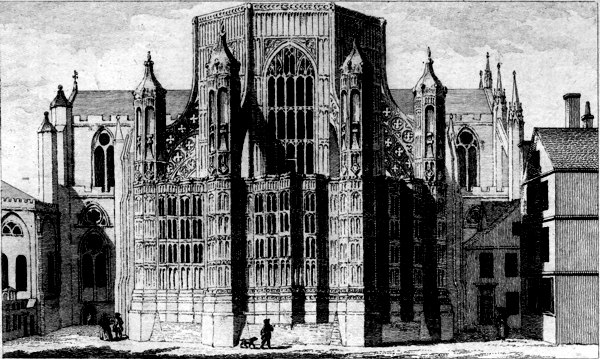
S. Wale delin. E. Rooker sc. Henry the Seventh’s Chapel.
Henry the Seventh’s Chapel. As this is a separate building from Westminster Abbey, we did not think proper to confound it with the other chapels; and as it is joined to the Abbey, we did not chuse to render it so distinct an article as it would have been, had we given it the place it would have demanded in the order of the alphabet. It is to be examined at the same time with that edifice, and we have followed the example of the architect in uniting them.
This chapel, which was founded by Henry VII. in the year 1502, and the succeeding years, is styled by Leland the wonder of the world. It is situated to the east of the Abbey, to which it is so neatly joined, that on a superficial view it appears to be one and the same building. It is supported by fourteen Gothic buttresses, all beautifully ornamented, and projecting from the building in different angles, and is enlightened by a double range of windows that throw the light into such a happy disposition as at once to please the eye, and afford a kind of solemn gloom. These buttresses extend up to the roof, and are made to strengthen it by their being crowned with Gothic arches. In these buttresses are niches, in which formerly stood a number of statues; but these being greatly decayed, have been long taken down.
This chapel is one of the most expensive remains of the ancient English taste and magnificence; there is no looking upon it without admiration: yet, perhaps, its beauty consists much more eminently in the workmanship than the contrivance. The plate shews the outside, where it joins to the Abbey, and gives some idea of the fine taste of Gothic architecture in that age, which seems to have been its meridian; but it soon fell into the bad taste practised in the time of Queen Elizabeth, as may be seen in the tomb of this Queen and her predecessor in the side aisles of this chapel.
This may be sufficient for the outside of this edifice, the entrance to which is from the east end of the Abbey, by a flight of steps of black marble, under a very noble arch, that leads to the gates opening to the body or nave of the chapel: for, like a cathedral it is divided into a nave and side isles, to which you may enter by a door on each hand. The gates at the entrance of the nave are of brass curiously wrought in the manner of frame work, and have in every other open pannel a rose and portcullis alternately.
Being entered, the eye is naturally directed to the lofty ceiling, in the most admirable manner wrought with such an astonishing variety of figures as is impossible to be described. The stalls on each side are of oak, with Gothic canopies, most beautifully carved, as are also the seats; and the pavement is of black and white marble, laid at the charge of Dr. Killigrew, once Prebendary of this Abbey. The east view from the entrance presents you with the brass chapel and tomb of the founder, which will be hereafter described, and round it where the east end forms a semicircle, are the chapels of the Dukes of Buckingham and Richmond. At that end the side isles open to the nave. It must not be omitted, that the walls both of the nave and the side isles are adorned with the most curious imagery imaginable, and contain an hundred and twenty statues of patriarchs, saints, martyrs and confessors, under which are angels supporting imperial crowns, besides innumerable small ones, all of them esteemed so curious, that the best masters are said to have travelled from abroad to copy them. The roof of the side isles is flattish, and supported on arches between the nave and side isles turning upon twelve stately Gothic pillars, curiously adorned with figures, fruitage and foliage. The windows, besides a spacious one at the east end, are thirteen on each side above and as many below, and were formerly painted, having in each pane a white rose, the badge of the house of Lancaster, a B the initial letter of the founder’s name, or portcullises crowned, the badge of the Beaufort’s family, of which there are some now remaining.
This chapel was originally designed as a sepulchre appropriated solely to the use of those of royal blood; and so far has the will of the founder been observed, that none have been yet interred there, but those of high quality, whose descent may generally be traced from some of our ancient Kings: I shall therefore mention each of these tombs, beginning with that which is the most ancient, as well as the most astonishing.
It has been already observed, that in the middle of the east end of the nave is situated the magnificent tomb of Henry VII. this is enclosed with a screen of cast brass, most admirably designed, and executed; this screen is nineteen feet in length, eleven in breadth, and the same in height. It is ornamented with statues, of which those only of St. James, St. Bartholomew, St. George, and St. Edward, are now remaining; and also adorned with other devices alluding to King Henry the Seventh’s family; as portcullises, signifying his relation to the Beaufort’s by his mother’s side; roses twisted and crowned, in memory of the union of the two houses of Lancaster and York, by his marriage; and at each end a crown in a bush, alluding to the crown of Richard III. found in a hawthorn bush, near Bosworth field, where the famous battle was fought in which Richard lost his life. Within the rails are the effigies of the royal pair, in their robes of state, on a tomb of black marble, the head whereof is supported by a red dragon the ensign of Cadwalladar, from whom King Henry VII. was fond of tracing his descent, and the foot by an angel.
At the head of this tomb lie the remains of Edward VI. grandson to Henry VII. who died in the sixteenth year of his age, and the seventh of his reign. A fine monument was erected to his memory by Queen Mary, his sister and successor; it was adorned with curious sculpture representing the passion and resurrection of our Saviour; with two angels on the top kneeling; and the whole elegantly finished; but it was afterwards demolished as a relict of Popish superstition.
On one side of Henry the Seventh’s tomb in a small chapel, in which is the monument of Lewis Stuart Duke of Richmond, and Frances his wife; whose statues in cast brass are represented lying on a marble table under a canopy of brass curiously wrought, and supported by the figures of Faith, Hope, Charity, and Prudence; and on the top is a figure of Fame taking her flight, and resting only on her toe.
On the north side of Henry the Seventh’s tomb is a monument decorated with several emblematical figures in brass gilt; the principal is Neptune in a pensive posture with his trident reversed, and Mars with his head crushed; these support the tomb on which lie the effigies of George Villars Duke of Buckingham, the great favourite of King James I. and King Charles I. who fell a sacrifice to the national resentment by the hand of Felton. His Grace married Catharine, daughter to the Earl of Rutland, who erected this monument to his memory, and lies in effigy on the same tomb by his side. The Latin inscription, after recounting his noble qualities, and high titles, alludes to the story of his death.
Of a later date, and superior in point of design and workmanship, is a noble monument erected to the memory of John Sheffield Duke of Buckingham, where his Grace’s statue in a Roman habit, is laid in a half raised posture on an altar of fine marble: his Duchess is represented standing at his feet weeping. On each side are military trophies; and over all an admirable figure of Time holding several medallions representing the heads of their Graces children. This monument is very justly admired. It has been observed, that the Duke himself appears the principal figure in the group, and though he lies in a recumbent posture, and his Lady is in the most beautiful manner placed at his feet, yet her figure is so characterized, as to be only a guide to his, and both reflect back a beauty on each other. The decorations are allowed to be extremely picturesque and elegant; the trophies at his head, the figure of Time above, with the medallions of his children, fill up all the spaces with such propriety, that little could be added, and nothing appears superfluous. The inscription sets forth the Duke of Buckingham’s posts, and his qualifications as a good poet, and a fine writer; and over his statue is inscribed in Latin sentences to the following purpose:
I lived doubtful, not dissolute.
I die unresolved, not unresigned.
Ignorance and error are incident to human nature.
I trust in an Almighty and All-good God.
Thou King of Kings have mercy upon me.
And underneath:
For my King often, for my Country always.
His Grace died in the 57th year of his age, Feb. 24, 1720, leaving the publication of his works to the care of Mr. Pope. He had three wives; the first, Ursula, Countess of Coventry; the second, Catharine, Countess of Gainsborough; the third, Catharine, Countess of Anglesey.
In this isle there is a lofty pyramid supported by two griffins of gilt brass, on a pedestal of the most curious marble, erected to the memory of Charles Montague, Marquis of Halifax, son to George Montague of Horton. He was placed at the head of the treasury in the reign of King Charles I. and undertaking the reformation of the coin, which was then most infamously clipped, he restored it to its proper value. For this, and other public services, he was first created Baron, and then Marquis of Halifax.
Against the east wall at the end of the north isle is a monument in the form of a beautiful altar, raised by King Charles II. to the memory of Edward V. and his brother Richard, on which is an inscription in Latin, to the following purport:
Here lie the reliques of Edward V. King of England, and Richard Duke of York, who, being confined in the Tower, and there stifled with pillows, were privately and meanly buried, by order of their perfidious uncle Richard the Usurper. Their bones, long enquired after and wished for, after lying two hundred and one years in the rubbish of the stairs, lately leading to the chapel of the White Tower, were on the 17th of July 1674, by undoubted proofs discovered; being buried deep in that place. Charles II. pitying their unhappy fate, ordered these unfortunate Princes to be laid amongst the reliques of their predecessors, in the year 1678, and the 20th of his reign.
At the east end of the same isle is a vault in which are deposited the bodies of King James I. and Anne his Queen, daughter to Frederic II. King of Denmark.
Over this vault is a small tomb adorned with the figure of a child, erected to the memory of Mary the third daughter of James I. who was born at Greenwich in 1605, and died at two years old.
There is also another monument on which is the representation of a child in a cradle, erected to the memory of Sophia, the fourth daughter of the same King, who was born at Greenwich in 1606, and died three days after.
In the same isle is a lofty monument erected to the memory of Queen Elizabeth by King James I. her successor. The inscription represents her character, high descent, and the memorable acts of her glorious reign, “That she was the mother of her country, and the patroness of religion and learning; was herself skilled in many languages, adorned with every excellence of mind and person, and endowed with princely virtues beyond her sex: that in her reign religion was refined to its original purity; peace was established; money restored to its just value; domestic insurrections quelled; France delivered from intestine troubles; the Netherlands supported; the Spanish Armada defeated; Ireland, almost lost by the secret contrivances of Spain, recovered; the revenues of both universities improved by a law of provisions; and, in short, all England enriched. That she was a most prudent Governess, forty-five years a virtuous and triumphant Queen; truly religious, and blest in all her great affairs; and that after a calm and resigned death in the 70th year of her age, she left her mortal part to be deposited in this church, which she established upon a new footing, till by the word of Christ she is called to immortality.” She died March 24, 1602.
In the south isle is a lofty and pompous tomb erected to the memory of Mary Queen of Scots, the mother of King James I. who flying into England from her rebellious subjects, was taken prisoner, tried and condemned for conspiring the death of Queen Elizabeth, and on the 8th of February 1587, beheaded on a scaffold erected in the hall of Fotheringhay Castle, in Northamptonshire. She was afterwards pompously interred by order of Queen Elizabeth, in the cathedral church of Peterborough; but upon the accession of her son to the throne of England, he ordered her remains to be removed from thence, and placed near this monument.
Near the last monument is a tomb enclosed with iron rails, on which lies a Lady also finely robed, the effigies of Margaret Douglas, daughter of Margaret Queen of Scots by the Earl of Angus. Her son the Lord Darnely, father to King James I. is represented foremost on the tomb kneeling, with the crown over his head, and there are seven other of her children represented round the tomb. This great Lady, though she herself never sat on the throne, had, according to the English inscription, King Edward IV. to her great grandfather; Henry VII. to her grandfather; Henry VIII. to her uncle; Edward VI. to her cousin german; James V. of Scotland to her brother; Henry I. of Scotland to her son; James VI. to her brother. Having to her great grandmother and grandmother two Queens, both named Elizabeth; to her mother, Margaret Queen of Scots; to her aunt, Mary the French Queen; to her cousins german, Mary and Elizabeth Queens of England; and to her niece and daughter-in-law, Mary Queen of Scots. This great Lady died March 10, 1577.
In the south side is likewise the monument of Margaret Countess of Richmond, mother to Henry VII. by her first husband Henry Tudor. She was afterwards married to Humphry Stafford, a younger son to Humphry Duke of Buckingham, and at last to Thomas Lord Stanley, Earl of Derby; but by the two last had no children. The inscription mentions the charities of this humane and generous Princess, particularly her founding two colleges at Oxford, Christ Church and St. John’s; and a grammar school at Winbourne. She died in July 1509, in the reign of her grandson Henry VIII.
At the east end of this isle is the royal vault of King Charles II., King William III., Queen Mary his Consort, Queen Anne, and Prince George.
Over these royal Personages are their effigies (except that of Prince George) in wainscot presses; they are of wax work resembling life, and dressed in their coronation robes.
Another wainscot press is placed at the corner of the great east window, in which is the effigy of the Lady Mary Duchess of Richmond, daughter to James Duke of Richmond and Lenox, dressed in the very robes her Grace wore at the coronation of Queen Anne.
On leaving this isle you will be shewn in another wainscot press the effigies of General Monk, who had a great share in the restoration of King Charles II. to the throne of England, and was interred in a vault appropriated to him and his family. He is represented in armour, and his ducal cap is generally made use of by those who shew this chapel, to receive the bounty of those who visit it; these persons having no share of the money paid for seeing it.
Thus have we given a description of every thing remarkable in the Abbey, and that venerable pile adjoining to it, called Henry the Seventh’s chapel; we have mentioned and described the monuments in both that are worthy of notice, and we shall conclude this article with the following reflections, extracted from an ingenious writer, on this subject.
“However amiable fame may be to the living, ’tis certain no advantage to the dead, whatever dangers they have dared, whatever toils they have undergone, whatever difficulties they have surmounted; the grave is deaf to the voice of applause, and the dust of the noble and vulgar sleep in the same obscurity together. ’Tis possible the conscious spirit may have an idea of the honour that is paid to his ashes; but ’tis much more probable, that the prospect of this imaginary glory, while he lived among us, was all the pleasure it ever could afford him. I make this observation, because most monuments are said to be erected as an honour to the dead, and the living are supposed to be the least concerned in them: but one man’s fame is made the foundation of another’s, in the same manner with the gentleman’s, who ordered this sentence to be made his epitaph; Here lies Sir Philip Sidney’s friend. Some there are that mention only the names of the persons whose dust they cover, and preserve a noble silence with regard to the hand that raised them; but even here, the dead can receive no benefit from such disinterested affection; but the living may profit much by so noble an example. Another thing that displeases me is the manner of the inscriptions, which frequently mistake the very design of engraving them, and as frequently give the lie to themselves. To pore one’s self blind in guessing out Æternæ Memoriæ Sacrum, is a jest, that would make Heraclitus laugh; and yet most of them begin in that pompous taste, without the least reflection that brass and marble can’t preserve them from the tooth of Time; and if men’s actions have not guarded their reputations, the proudest monument would flatter in vain. Sepulchral monuments should be always considered as the last public tribute paid to virtue; as a proof of our regard for noble characters, and most particularly as an excitement to others to emulate the great example.
“It is certain there is not a nobler amusement, than a walk in Westminster Abbey, among the tombs of heroes, patriots, poets, and philosophers; you are surrounded with the shades of your great forefathers; you feel the influence of their venerable society, and grow fond of fame and virtue in the contemplation: ’tis the finest school of morality, and the most beautiful flatterer of imagination in nature. I appeal to any man’s mind that has any taste for what is sublime and noble, for a witness to the pleasure he experiences on this occasion; and I dare believe he will acknowledge, that there is no entertainment so various, or so instructive. For my own part, I have spent many an hour of pleasing melancholy in its venerable walks; and have been more delighted with the solemn conversation of the dead, than the most sprightly sallies of the living. I have examined the characters that were inscribed before me, and distinguished every particular virtue. The monuments of real fame, I have viewed with real respect; but the piles that wanted a character to excuse them, I considered as the monuments of folly. I have wandered with pleasure into the most gloomy recesses of this last resort of grandeur, to contemplate human life, and trace mankind thro’ all the wilderness of their frailties and misfortunes, from their cradles to their grave. I have reflected on the shortness of our duration here, and that I was but one of the millions who had been employed in the same manner, in ruminating on the trophies of mortality before me; that I must moulder to dust in the same manner, and quit the scene to a new generation, without leaving the shadow of my existence behind me; that this huge fabric, this sacred repository of fame and grandeur, would only be the stage for the same performances; would receive new accessions of noble dust; would be adorned with other sepulchres of cost and magnificence; would be crouded with successive admirers; and at last, by the unavoidable decays of time, bury the whole collection of antiquities in general obscurity, and be the monument of its own ruin.”
Abbots Langley, a village in Hertfordshire, situated to the east of Kings Langley, and three or four miles to the S. W. of St. Alban’s, to whose abbey it once belonged. It is famous for being the birth place of Nicholas Breakspeare, who was made Pope by the title of Adrian IV. and had his stirrup held by the Emperor Frederic while he dismounted: but notwithstanding his pride, it is a still more indelible stain to his memory, that when Sovereign Pontiff, he suffer’d his mother to be maintained by the alms of the church of Canterbury. This place gives the title of Baron to the Lord Raymond, who has a seat in this neighbourhood.
Abbs Court, in the parish of Walton upon Thames in Surrey. The Lord of this Manor, which is also called Aps, used formerly upon All-Saints Day to give a barrel of beer, and a quarter of corn baked into loaves, to as many poor as came. This charity was begun in the days of Popery, in order, as ’tis supposed, to encourage the prayers for deliverance of souls out of purgatory.
Abchurch lane, 1. Gracechurch street.☐ 2.Lombard street.☐ See St. Mary Abchurch.
Abel court, Rosemary lane.
Abel’s buildings, Rosemary lane.†
Abingdon buildings, Old Palace yard.
Abingdon street, near Old Palace yard.
Academy court, Chancery lane.
Acorn alley, Bishopsgate street, without.*
Acorn court, Bishopsgate street, without.*
Acton (East) a village six miles from London, a little to the north of the Oxford Road, noted for the medicinal wells near it, which are frequented in the summer months.
Acton (West) a village in the road to Oxford, situated seven miles from London.
Adam-a-digging yard, Peter street, Westminster.*
Adam and Eve alley, 1. Barnaby street.* 2. by West Smithfield.*
Adam and Eve court, 1. Oxford street.* 2. Tottenham court road.* 3. West Smithfield.* 4. Hatchet alley, Whitechapel. 5. Petticoat lane.*
Adam and Eve yard, 1. Homerton.* 2. Ratcliff highway.*
Adam’s court, 1. Little Broad street.† 2. Pig street.† 3. Sharp’s buildings, Duke’s place.† 4. Near Swan’s close.†
Adam’s mews, 1. Audley street.† 2. Charles street near Mount street.†
Adam’s yard, Hockley in the Hole. †
Addington, a village in Surrey, three miles from Croydon, situated at the descent of a high spacious common to which it gives name. Its church, though said to be above 300 years old, is still very firm. But what is most remarkable, is, that the Lord of the Manor held it in the reign of Henry III. by the service of making his Majesty a mess of pottage in an earthen pot in the King’s kitchen at his coronation; and so late as the coronation of King Charles II. Thomas Leigh, Esq; then Lord of the Manor, made a mess according to his tenure, and brought it to his Majesty’s table, when that King accepted of his service, though he did not taste what he had prepared.
Addison’s yard, Peter street, Westminster. †
Addle hill, Great Carter lane, Thames street.
Addle street, Wood street, Cheapside.
Admiralty court. This court, which is held in Doctors Commons, was formerly under the direction of the Lord High Admiral, as it is now under the Lords of the Admiralty, who here take cognisance of all causes relating to merchants and mariners. The proceedings are in the Civil Law. The plaintiff gives security to prosecute, and if cast, to pay what shall be adjudged, and likewise to stand to all his proctor shall transact in his name. But in criminal cases, as the trial of pirates, and crimes committed at sea, the process, by a special commission, is by a judge, jury and witnesses, a Judge of the Common Law assisting: on which occasion the court is commonly held at the Session-house in the Old Bailey. The officers of this court are the Judge of the Admiralty, who must be a Civilian, an Advocate and Proctor, a Register, and a Marshal, who carries a silver oar before the Judge.
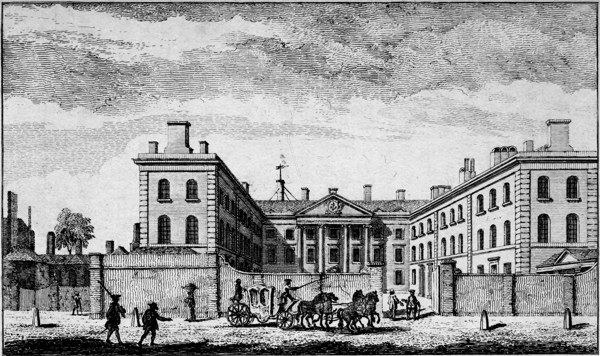
S. Wale delin. J. Green sc. Oxon. Admiralty
Admiralty office, an edifice built with brick and stone, on the west side of the street, opposite to Scotland yard. The east front, which is that represented in the print, has two deep wings, and is entered by a very lofty portico supported by four very large stone columns of the Ionic Order, to which there is an ascent by a few steps.
The importance of this building is what recommends it to notice. The portico, which was intended as an ornament, rather disgusts than pleases, by the immoderate height and ill shape of the columns.
In this office are transacted all martime affairs belonging to the jurisdiction of the Admiralty, who here regulate the affairs of the navy; nominate Admirals, Captains, and other officers to serve on board his Majesty’s ships of war, and give orders for the trial of those who have failed in their duty, or been guilty of other irregularities.
Admiralty office yard, Whitehall.☐
Adscomb, in Surrey near Croydon, is the seat of William Draper, Esq; the paintings and furniture of which are fine.
Advocates of Doctors Commons. See Doctors Commons.
Affidavit office, in Symond’s inn. This office belongs to the Masters in Chancery, where one or more of them constantly attend to take affidavits, and there all affidavits belonging to the Court of Chancery are filed.
African Company. The English first sent ships to Africa on account of commerce about the year 1553, from which time the trade to that country was carried on by private hands till 1588, when Queen Elizabeth, by her letters patent, erected a company, for the more effectual promoting of that trade, which then was only for gold, elephants teeth, and Guinea pepper; for the use of negroes was not yet introduced into America.
This company was greatly encouraged during the reigns of James I. and Charles I. but the Dutch taking several forts on the coast of Africa from the Portuguese, committed great depredations on the English, upon which Charles II. the better to enable his subjects to carry on that trade, incorporated a body of merchants, in the year 1662, by the title of The Company of Royal Adventurers of England to Africa: but the subscriptions for carrying on this precarious commerce not answering the expectation of the incorporated merchants, they were soon involved in debt, and reduced to such difficulties as rendered them unable to continue their trade to advantage; wherefore they agreed for a certain sum, to surrender their charter to the crown, and to assign all their estates and effects both at home and abroad to certain merchants, who intended to erect a new company, for the more effectual carrying on a trade to Africa: these merchants the King incorporated in the year 1672, and these were the Royal African company, who had a power to trade from the port of Sallee, to the Cape of Good Hope, exclusive of all the King’s other subjects, during the term of a thousand years.
By virtue of this royal grant, the company made a considerable progress in erecting forts, and settling factors: but their trade being laid open by parliament in the year 1697, they were rendered unable to support their forts, it was therefore enacted, that all private traders to Africa should pay ten per cent. to the company for that purpose.
This duty did not however answer the end for which it was granted, and the company was obliged to apply to parliament in the year 1730 for relief, when they obtained a certain sum for that purpose, and it was enacted that all his Majesty’s subjects treading to and from Africa, between Cape Blanco and the Cape of Good Hope, should hereafter be deemed a body corporate, and that all the countries, islands, rivers and places, together with the forts, should be in the possession of this new company; the members of which should not trade to or from Africa in their joint capacity, have any joint or transferable stock, or borrow money on their common seal. That the persons trading or intending to trade to Africa, should pay to the Chamberlain of London, the Clerk of the Merchants-hall in Bristol, or the Town Clerk of Liverpool, 40s. each for the freedom of the new company. That the management of the affairs of this new company, should be under the direction of a committee of nine persons, to be chosen annually, three out of the members in the city of London, three out of those of Bristol, and three out of those of Liverpool. That this committee should have power to make orders for the government and improvement of the forts and factories; to appoint governors, and other officers civil and military; to receive annually the sum of 40s. and to take a list of the names of all the persons making payment.
It is also enacted, that the committee shall once a year give an account of all their transactions to the Commissioners for trade and plantations, and likewise lay before the Cursitor Baron of the Exchequer, an account, upon oath, of all the money they have received within the preceding year, and the application thereof; and the Lords of the Admiralty are to give instructions to the Captains of such of his Majesty’s ships of war as shall be stationed or ordered to cruize within the above limits, to inspect, and make report to them from time to time of the state of the forts and settlements, copies of which are to be laid before the parliament every sessions.
This is the state at present of this company, who keep their office in Cooper’s court, Cornhill.
Agnes court, Little George street.
St. Agnes le Clare fields, near Hoxton, so called from a spring of water dedicated to that Saint, and now converted into a cold bath.
Ailsbury court, George street.
Ailsbury street, 1. By Jermyn street. 2. St. John’s street, Clerkenwell green.
Ainger street, York street.†
Air street, 1. Piccadilly.† 2. By Mary la bone.† 3. Leather lane.†
Akersley yard, Great St. Anne’s street.†
Alam yard, Crutched Friars.
St. Alban’s, a large and very ancient town in Hertfordshire, 21 miles from London, was so called from St. Alban, who suffered in the persecution under Dioclesian, and being afterwards canonized, and interred on a hill in the neighbourhood of this town, a monastery was erected and dedicated to him by King Offa. King Edward I. erected a magnificent cross in memory of Queen Eleanor; and King Edward VI. incorporated this town by a charter, granting the inhabitants a Mayor, a Steward, a Chamberlain, and ten Burgesses: but the Mayor and Steward are here the only Justices of peace. Here are three churches, besides the ancient cathedral called St. Alban’s, belonging to the monastery, which is now a parish church.
In this ancient edifice is a funeral monument and effigies of King Offa, its founder, who is represented seated on his throne; and underneath is the following inscription:
Fundator Ecclesiæ circa annum 793.
Quem male depictum, et residentem cernitis alte
Sublimem solio, Mercius Offa fuit.
That is,
The founder of the church, about the year 793.
Whom you behold ill-painted on his throne
Sublime, was once for Mercian Offa known.
On the east side stood the shrine of St. Alban, where the following short inscription is still to be seen;
S. Albanus Verolamensis, Anglorum Protomartyr, 17 Junii 293.
In the south isle near the above shrine is the monument of Humphry, brother to King Henry V. commonly distinguished by the title of the Good Duke of Gloucester. It is adorned with a ducal coronet, and the arms of France and England quartered. In niches on one side are seventeen Kings; but in the niches on the other side there are no statues remaining. The inscription, which alludes to the pretended miraculous cure of a blind man detected by the Duke, is as follows:
Piæ Memoriæ V. Opt. Sacrum.
Hic jacet Humphredus, Dux ille Glocestrius olim,
Henrici Sexti protector, fraudis ineptæ
Detector, dum ficta notat miracula cœci.
Lumen erat patriæ, columen venerabile regni,
Pacis amans, Musisque favens melioribus; unde
Gratum opus Oxonio, quæ nunc schola sacra refulget.
Invida sed mulier regno, regi, sibi nequam,
Abstulit hunc, humili vix hoc dignata sepulcro.
Invidia rumpente tamen, post funera vivit.
Which has been thus translated:
Sacred to the memory of the best of men.
Interr’d within this consecrated ground,
Lies he, whom Henry his protector found:
Good Humphry, Gloc’ster’s Duke, who well could spy
Fraud couch’d within the blind impostor’s eye.
His country’s light, the state’s rever’d support,
Who peace and rising learning deigned to court;
Whence his rich library at Oxford plac’d,
Her ample schools with sacred influence grac’d:
Yet fell beneath an envious woman’s wile,
Both to herself, her King, and country vile;
Who scarce allowed his bones this spot of land:
Yet spite of envy shall his glory stand.
About 40 years ago in digging a grave, a pair of stairs were discovered that lead down into a vault where his leaden coffin was found, in which his body was preserved entire, by a kind of pickle in which it lay, only the flesh was wasted from the legs, the pickle at that end being dried up. Many curious medals and coins are to be seen in the church, that have been dug out of the ruins of Old Verulam that stood on the other side of the river Ver, or Moore, which runs south west of the town.
Near St. Alban’s is a fort, at a place called by the common people the Oyster Hills, which is supposed to have been the camp of Ostorius, the Roman Proprætor. This town is the largest in the county, and besides the four churches, has several meeting-houses, two charity schools, and three fairs, and has on Saturday one of the best markets for wheat in England. It gives the title of Duke to the noble family of Beauclerc. The great John Duke of Marlborough erected a seat here, called Holloway-house, and several neat alms-houses have been built here by him and his Duchess.
St. Alban’s, Wood street, on the north side of London, and the east side of Wood street, Cheapside, is dedicated to St. Alban, the British Proto-Martyr, who suffered under the persecution of Dioclesian. The first church in this place was erected in the year 930, and dedicated to the same Saint. After various repairs, the old church was pulled down in 1634, and another erected, which was destroyed by the fire of London thirty-two years after, when the present edifice was built from the same model as the former. It is entirely in the Gothic stile, and consists of a spacious body, and a handsome tower with pinacles.
This church is a rectory in the patronage of Eton College, and the parish of St. Olave, Silver street, is united to it. The Rector, besides other advantages, receives 170l. in lieu of tithes.
Munday in his edition of Stow mentions several uncommon epitaphs in this church, from which we have only selected the following:
Hic jacet Tom Shorthose,
Sine tombe, sine sheet, sine riches,
Qui vixit sine gowne,
Sine cloake, sine shirt, sine breeches.
St. Alban’s street, Pall-mall.
Albemarle buildings, Bond street, so called from the Duke of Albemarle, who bought the Earl of Clarendon’s seat, which stood here, and afterwards selling the house and gardens, they were laid out into streets, whence arose this and the two following streets.
Albemarle mews, Dover street.
Albemarle street. 1. Piccadilly, 2. St. John’s street, West Smithfield.†
In the possession of Richard Mead, Esq; in Albemarle street, is a book bought out of the collection of the famous Cardinal Maximi at Rome; it contain 148 accurate and elegant paintings in water colours, done from ancient pictures found on the walls, ceilings and floors of the baths of Titus, and various other buildings in Rome, some of which have been engraved by Bartoli in his Sepolchri di Nassoni, and in other books: but many of them are to be seen no where else, neither engraved, nor on the walls from whence they were first copied, where they are much defaced by the weather, the smoke of torches, and other accidents.
Of these ancient paintings on wall, Mr. Mead has also a very elegant little specimen representing Augustus restoring a crown to a conquered Prince in the presence of several of his courtiers, among which the faces of Mecænas and Horace may be distinguished.—This has been engraved and explained by Turnbull.
An ancient Greek inscription, being eight lines of Hexameter and Pentameter verses on a marble brought from Asia, which had been a pedestal to a statue of Jupiter Urius. This has been engraved and explained by the learned Mr. Chishul in his Antiquitates Asiaticæ.
Alcock’s rents, Barnaby street.†
Aldermanbury, Cateaton street. This street was thus named from the Guildhall being anciently situated there, till falling to decay, the present hall was built at the end of King street, about the year 1420. The old hall must have been very ancient, as this street had the name of Aldermanbury so early as before the year 1189; and Mr. Maitland supposes that Edward the Confessor, who began his reign in 1042, had a considerable share in its first foundation.
Aldermanbury Postern, London wall.
Alderman Parsons’s stairs, St. Catharine’s.†
Alderman’s walk, Bishopsgate street.
Aldermen. These are twenty-six in number, and each has his separate ward, to the government of which he is more immediately to attend. Those who have served the office of Lord Mayor, are said to be above the chair, and with three of the eldest that are next it, are justices of the peace by charter. All the Aldermen keep their wardmote for chusing ward officers, and settling the affairs of the ward; for redressing grievances, and presenting all defaults found in the ward. In the management of these affairs, every Alderman has his deputy, chosen out of the common council, and in some of the wards, that are very large, the Alderman has two deputies.
Aldersgate, which is situated 1265 feet south west of Cripplegate, is, in Stow’s opinion, one of the original gates of the city; but this is disputed by Maitland, who observes, that the epithet of Alder does not necessarily imply its antiquity, as some derive the name of the gate from Aldrich, a Saxon; others from the seniors or old men by whom it was built; and others from the great number of alder trees, which grew in that neighbourhood; whence he imagines that either of these opinions is more probable, than that this name was conferred upon it on account of its age, particularly as it is no where found to be mentioned before the conquest.
The present gate was built in the year 1616, and being much damaged by the fire of London, was repaired in 1670. In a large square over the arch is King James I. on horseback, in the same posture as when he made his entry through this gate, on his coming to take possession of the crown. The arms of England, Scotland, and Ireland, are quartered above his head. In a nich on the east side is the prophet Jeremiah, with the words of the 25th verse of the 17th chapter of his book; and in a nich on the west side stands the prophet Samuel, with the first verse of the 12th chap. of 1 Sam. On the south side is King James I. in his royal robes, sitting in a chair of state, done in relief. By the sides of the gate there are two posterns for the convenience of foot passengers: and the apartments above are appropriated to the use of the common crier of the city.
A late author observes, that this gate is so heavy and Gothic a structure, that it hardly deserves notice, unless for the sake of the bass relief of King James, which, though in an aukward and inelegant taste, is a very tolerable piece of workmanship, and may challenge some applause.
Aldersgate bars, in Goswell street, a little beyond the north end of Aldersgate street, where the liberties of the city end on that side.
Aldersgate street, extends from the gate to the corner of Barbican.
Aldersgate Ward, is of considerable extent both within and without the gate from which it is named, and extends in length from Blowbladder street to Aldersgate bars, including part of Noble street, almost all Foster lane, St. Martin’s le Grand, Bull and Mouth street, Little Britain, and Aldersgate street. The principal buildings are two churches, St. Botolph’s and St. Ann’s, Goldsmiths-hall, Cooks-hall, Coachmakers-hall, Shaftsbury house, a noble building now used for the London lying-in hospital, and London-house. This ward is governed by an Alderman, two Deputies, and eight Common Council Men; eight constables, nine scavengers, nineteen wardmote inquest men and a beadle. The jurymen returned by the wardmote inquest serve in the several courts in Guildhall in the month of August.
Aldgate, was one of the four original gates of the city, and that through which the Roman vicinal way led to the trajectus or ferry at Old Ford. Stow says, that it received its name from its antiquity, which Maitland observes is very improbable, though he allows that the Saxons might give it the epithet of Eald or Ald, from the ruinous condition in which they found it when they first possessed themselves of this city. However, the first time it is found mentioned, is in a charter granted by King Edgar about the year 967.
Aldgate being very ruinous, was pulled down in the year 1606, and the first stone of the present edifice was laid the next year; but this work was not finished till 1609. It is observable that in digging the foundation, several Roman coins were discovered, two of which Mr. Bond the surveyor caused to be cut on stone, and placed on each side of the east front. On the same side was placed in a large square the statue of King James I. in gilt armour, with a golden lion and a chained unicorn couchant at his feet. On the top of the gate was a vane supported by a gilt sphere, on each side of which stood a soldier holding a bullet in his hand, on the top of the upper battlements. On the west side was a figure of Fortune gilt, and standing on a globe, with a prosperous sail spreading over her head; under which was carved the King’s arms; some what lower on the south side stood Peace with a dove perched on her hand, and a gilded wreath in the other; and on the north side was the emblem of Charity. Over the arch of the gate was also engraven,
Senatus Populusque Londinensis
Fecit 1609
Humfrey Weld, Maior.
But all these statues have been removed, and none of these ornaments remain, except the representation of the two Roman coins, and the inscription.
The apartments over this gate are appropriated to the use of one of the Lord Mayor’s carvers.
Aldgate high street, extends from Aldgate to Leadenhall street.
Aldgate street, extends without Aldgate, to the north east corner of the Minories.
Aldgate Ward, is bounded on the east by Portsoken ward; on the south by Tower street ward; and on the west and north, by the wards of Langbourn, Lime street and Bishopsgate. It extends from Aldgate to Lime street corner in Leadenhall street, and takes in all the streets and lanes on the one hand to Bevis Mark and Shoemaker row, and on the other to Ironmongers hall in Fenchurch street; to the navy office, only a part of which is in this ward, and to the end of River street Tower hill; including Poor Jury lane, Crutched Friars, London street, Woodroff lane, &c. The principal buildings are these four parish churches, St. Catharine Cree church, St. Andrew Undershaft, St. James Duke’s place, and St. Catharine Coleman; three Jews Synagogues, and the Ironmongers, Fletchers and Bricklayers halls. It is under the government of an Alderman and six Common Council men, one of whom is the Alderman’s deputy, with six constables, nine scavengers, eighteen wardmote inquest men, and a beadle. The jurymen returned by the wardmote inquest, serve as jurors in the several courts of Guildhall in the month of January. Maitland.
Alexander’s yard, Water lane, Fleet street.†
Alienation office in the Inner Temple, is one of the offices under the Lord Chancellor. Here all writs of covenants and entry upon which fines are levied, and recoveries suffered, are carried to have fines for alienation, set and paid thereupon. This office is executed by three commissioners. Chamberlain’s Present State.
Allard’s hill, Rotherhith wall.†
Allen’s street, Goswell street.†
Allen’s court, 1. Leadenhall street.† 2. Oxford street.†
Allen’s rents, Houndsditch, Bishopsgate street without.†
Alleyn’s College at Dulwich. See Dulwich college. Alleyn’s Almshouse in Lamb alley in Bishopsgate street. This charitable foundation, was erected in Petty France by Edward Alleyn, a comedian, about the year 1614, and from thence removed to the above place upon the rebuilding of Petty France, now called New Broad street. Ten poor men and women are, besides their lodging, allowed about 40s. per annum, and every other year the men have coats and breeches, and the women gowns and petticoats. Maitland.
Alleyn’s Almshouse, in Pesthouse lane near Old street, was founded by the above Edward Alleyn, about the year 1616, for ten poor men and women; who receive 6d. per week each, and every other year coats and gowns.
Alleyn’s Almshouse in Soap yard, Deadman’s Place in Southwark, was also founded by the above Edward Alleyn, about the year 1616, for ten poor men and women, with an allowance of only 6d. per week.
Allhallows Barking church, at the east end of Tower street, is so denominated from its being dedicated to all the Saints, vulgarly called Allhallows; and its anciently belonging to the Abbess and Convent of Barking in Essex. It escaped the fire in 1666, and carries about it the marks of that period when architecture was not well understood in England. The church is of considerable extent, and the steeple is a plain tower with its turret. It is a vicarage in the patronage of the Archbishop of Canterbury. The Vicar, besides other advantages, receives about 126l. a year in tithes.
Allhallows Bread street. The old church was destroyed by the dreadful conflagration which laid most of the other churches in ruins; and the present edifice was erected in 1684. It consists of a plain body, and a square tower divided into four stages with arches near the top. It is a rectory, and one of the thirteen peculiars in this city belonging to the Archbishop of Canterbury.
The advowson of this church is in the Archbishop of Canterbury, and to this parish that of St. John the Evangelist is united. The Vicar, besides glebes, casualties, annual donations, and other advantages, receives 1401. a year in lieu of tithes. Maitland.
The following monumental inscripton in this church is worthy of a place in this work. It is to the memory of Humfrey Levins, a citizen and grocer of London, who died in 1682, in the fifty-third year of his age, and his son Humfrey, a youth aged fourteen, who died in 1677, and lies buried in the same grave.
Which shall we weep? both merit tears; yet sure
Tears are but vain, where bliss is so secure.
Which shall we praise? our eulogy can’t add
Unto the bless’d, who God’s kind euge had.
Our duty’s but to imitate and admire
This happy pair of the celestial choir.
Allhallows the Great, situated on the south side of Thames street, was anciently denominated Allhallows the More, and Allhallows ad Fœnum in the Ropery, from its vicinity to a hay-wharf or market, and situation among ropemakers. The old church with a large cloister on the south side, were consumed in the general conflagration in 1666, and the present edifice arose in 1683. It was built on Sir Christopher Wren’s plan; but in some parts the mason has taken inexcusable liberties. The church is 87 feet in length, 60 in breadth, and the height to the roof is 33. It is built of stone, and there runs thro’ the whole, an apparent strength and solidity. The walls are plain and massy, the ornaments are few and simple, and the apertures, tho’ large, in order to enlighten so considerable a breadth, are not numerous. The tower is plain, square, and divided into five stages, but terminates absolutely square and plain, without spire, turret or pinacles. The cornice is supported by scrolls, and over these rises a balustrade of solid construction, very proper for the rest of the building. Maitland, and English Architecture.
Among the funeral monuments in this church, before its being burnt, was one in memory of Queen Elizabeth, with the following inscriptions:
If royal virtues ever crown’d a crown;
If ever mildness shin’d in majesty;
If ever honour honour’d true renown;
If ever courage dwelt with clemency;
If ever Princess put all Princes down,
For temperance, prowess, prudence, equity;
This, this was she, that in despight of death
Lives still admir’d, ador’d Elizabeth.
Many daughters have done virtuously, but thou excellest them all.
In the figure of a book above her picture;
They that trust in the Lord shall be as Mount Sion, which shall not be removed.
On the right side;
Spain’s rod, Rome’s ruin, the Netherlands relief,
Heaven’s gem, earth’s joy, world’s wonder, nation’s chief.
On the left side;
Britain’s blessing, England’s splendor,
Religion’s nurse, and Faith’s defender.
And beneath;
I have fought a good fight, I have finished my course, &c.
Queen Elizabeth died the 24th of March, 1602.
This church is a rectory, and one of the thirteen peculiars belonging to the Archbishop of Canterbury; and to this parish that of Allhallows the Less is annexed, by which the profits of the Rector are greatly increased. He receives, besides glebes, &c. 200l. per annum in lieu of tithes.
Allhallows Honey lane, a small church, which stood where the east end of Honey lane market is at present situated; but being destroyed by the fire of London in 1666, the parish was by act of parliament united to the church of St. Mary le Bow.
Allhallows the Less, stood on the south side of Thames street, almost adjoining to that of Allhallows the Great; but having suffered in the common calamity in 1666, the parish was united to that of Allhallows the Great.
Allhallows Lombard street, situated in Bell alley, near the north corner of Lombard street, in Langbourn ward. A church stood here under the same patronage, before the year 1053; but the present plain, well-proportioned building, was erected in the room of that destroyed by the fire of London. The body is enlightened by a single series of large windows, and the tower is terminated by a plain battlement.
This church is a rectory, and one of the thirteen peculiars in this city belonging to the Archbishop of Canterbury. The Rector, besides glebes, donations, and casualties, receives 110l. a year in lieu of tithes. Maitland.
Allhallows London wall, a small mean edifice, a little to the east of Bethlem Hospital, on the outside of London wall. It escaped the fire in 1666, and is a rectory, in the King’s gift.
Allhallows Staining, situated near the north end of Mark lane. It is said to obtain the name of Staining, from the corruption of the word stoney, because built at first of stone, when the other churches dedicated to all the Saints were of wood. It escaped the fire in 1666. The body is well illuminated with Gothic windows, and the square tower is crowned with a small turret.
This church is a curacy, in the gift of the Grocers company. The curate receives about 100l. a year by tithes. Maitland, and English Architecture.
Allhallows Staining School, was founded in the year 1658, by Mr. William Winter, who endowed it with the sum of 600l. the profits arising from which, amounting to 26l. per annum, are employed in instructing six boys in reading, writing, and accounts, and putting them out apprentice, with each of whom a sum is given not exceeding 10l.
Allhallows Lane, near the Steelyard, Thames street.☐
Allhallows Stairs, Allhallows lane, Thames street.
Lord High Almoner, a clergyman of the highest rank, and frequently the Archbishop of York, who has the office of disposing of the King’s alms, and for that use receives all deodands, the goods of persons found guilty of self-murder, and other sums allowed by his Majesty to be disposed of for that purpose. Besides the sums distributed to the poor of several parishes, there are many poor pensioners to the King below stairs, who have a competency duly paid them, either because they are so old as to be unfit for service, or because they are the widows of such of his Majesty’s household servants as died poor, and were unable to provide for their wives and children in their life-times.
Under the Lord High Almoner, are a Sub-almoner, a Yeoman, and a Groom of the Almonry.
Almonry, vulgarly called the Ambry, receives its name from the alms of the Abbey being distributed there, and was originally a chapel dedicated to St. Catharine, and not, as Mr. Stow asserts, to St. Anne. Near this chapel Abbot Islip erected the first printing-house that ever was in England in the year 1474; when Mr. William Caxton, a citizen and mercer of London, bringing that invaluable art from Holland, became the first printer in Britain. Maitland.
Almonry School, situated in the Almonry at Westminster, was founded in the year 1677, by Henry Hill, Esq; who also endowed it with 7l. a year for the education of poor children.
Almshouses. See a particular account of each under the names of their respective founders. The number of persons contained in the several Alms-houses and hospitals within the bills of mortality, with the children put forth apprentice by the money collected at the feast, &c. of the Sons of the Clergy, and the several poor families that participate of the king’s annual charity, amount in the whole to about 8000 persons, and the sum employed for their relief to 80,000l. Maitland.
Almshouse yard. 1. Little Almonry, Westminster. 2. Dormer’s Hill. 3. Little Chapel street. 4. Coleman street. 5. Snow Hill, in which Hammond’s almshouse is situated.
St. Alphage, in Aldermanbury near London wall, owes its name to its dedication to St. Alphage, or Elphege, a noble Saxon Saint, and Archbishop of Canterbury, who was murdered at Greenwich by the pagan Danes, in the year 1013. This church escaped the flames in 1666, and is still standing; tho’ it is as mean a structure as can well be conceived.
The living is a rectory in the patronage of the Bishop of London, and the Rector receives about 75l. a year in tithes.
Amble court, near Wellclose square.
Amen corner, at the end of Pater-noster-row, near St. Paul’s. See Pater-noster-row.
Amersham, or Agmondesham, a small but very ancient borough, in Buckinghamshire, situated in a vale between woody hills, 29 miles from London. This town does not come within the compass which we have prescribed round London, but our map of the environs not being a circle, the angles of it take in some few places at a greater distance than 20 miles; and these being inserted in our map, we thought we could not dispense with taking notice of them, as well as of those within the prescribed limits. The town consists of a long street, divided about the middle by a shorter cross street; in the intersection of which stands the church, said to be the best rectory in the county; it being well endowed by Geoffery de Mandeville, Earl of Essex, in the reign of King Stephen. There is here a handsome market-house, built with brick on arched pillars, about 80 years ago, by Sir William Drake, Knt. It has a free school founded in the reign of Queen Elizabeth; and here is also a fine seat called Shardelowes, the manor of which formerly belonged to the noble family of the Russels; but about the time of the restoration it was sold, with the borough, to Sir William Drake, Bart. in whose family it still remains.
Amicable Society, in Serjeants-inn Fleet street, was incorporated by a charter granted by Queen Anne, in the year 1706, for a perpetual Assurance-office for the purpose of making a provision for their wives, children, and other relations, after an easy, certain and advantageous manner, with power to purchase lands, &c. and to have a seal, which is a dove standing upon a serpent, and above in a scroll the motto Prudens Simplicitas. The number of persons to be incorporated was not to exceed 2000. After paying the charges of the policy, and 10s. entrance-money, each person was to pay 6l. 4s. per annum, which annual payments have since, by the increase of the Society’s stock, been reduced to 5l. a year, payable quarterly, and from these payments the dividends to claimants are to arise.
That this Society has been greatly beneficial to the public, evidently appears from a state of their yearly dividends from Lady-day 1710, to Lady 1757, during which each claim amounted upon an average to 106l. 1s. 4d. but taking the computation only for these twenty-three years last past, viz. from the year 1734, (when by an order of the general court, a part of their yearly income was appropriated for augmenting their claims whenever they should happen to be under 100l.) the quantum of such claims from the year 1734 to 1757, have amounted upon an average to 120l. 9s. 1d. and so considerable has been the increase of the dividends for these nine years last past, that each claim, during that period, has been advanced upon an average to 142l. 6s. 5d.
However, at a general court held May 12, 1757, an order was made for farther augmenting the dividends on claims, so as that for the future they will not be less than 125l. each claim, but yet may happen to be considerably more, which has been the case of several former years.