Part 3 — Chapter III.
Reading edition
THE IMPLICATION OF PROPOSITIONS. —IMMEDIATE FORMAL INFERENCE.—EDUCATION.
The meaning of Inference generally is a subject of dispute, and to avoid entering upon debatable ground at this stage, instead of attempting to define Inference generally, I will confine myself to defining what is called Formal Inference, about which there is comparatively little difference of opinion.
Formal Inference then is the apprehension of what is implied in a certain datum or admission: the derivation of one proposition, called the Conclusion, from one or more given, admitted, or assumed propositions, called the Premiss or Premisses.
When the conclusion is drawn from one proposition, the inference is said to be immediate; when more than one proposition is necessary to the conclusion, the inference is said to be mediate.
The modes and conditions of valid Mediate Inference constitute Syllogism, which is in effect the reasoning together of separate admissions. With this we shall deal presently. Meantime of Immediate Inference.
To state all the implications of a certain form of proposition, to make explicit all that it implies, is the same thing with showing what immediate inferences from it are legitimate. Formal inference, in short, is the eduction of all that a proposition implies.
Most of the modes of Immediate Inference formulated by logicians are preliminary to the Syllogistic process, and have no other practical application. The most important of them technically is the process known as Conversion, but others have been judged worthy of attention.
Æquipollent or Equivalent Forms—Obversion.
The history of Æquipollence in logical treatises illustrates two tendencies. There is a tendency on the one hand to narrow a theme down to definite and manageable forms. But when a useful exercise is discarded from one place it has a tendency to break out in another under another name. A third tendency may also be said to be specially well illustrated—the tendency to change the traditional application of logical terms.
In accordance with the above definition of Æquipollence or Equivalence, which corresponds with ordinary acceptation, the term would apply to all cases of "identical meaning under difference of expression". Most examples of the reduction of ordinary speech into syllogistic form would be examples of æquipollence; all, in fact, would be so were it not that ordinary speech loses somewhat in the process, owing to the indefiniteness of the syllogistic symbol for particular quality, Some. And in truth all such transmutations of expression are as much entitled to the dignity of being called Immediate Inferences as most of the processes so entitled.
Dr. Bain uses the word with an approach to this width of application in discussing all that is now most commonly called Immediate Inference under the title of Equivalent Forms. The chief objection to this usage is that the Converse per accidens is not strictly equivalent. A debater may want for his argument less than the strict equivalent, and content himself with educing this much from his opponent's admission. (Whether Dr. Bain is right in treating the Minor and Conclusion of a Hypothetical Syllogism as being equivalent to the Major, is not so much a question of naming.)
To Æquipollence belonged also the manipulation of the forms known after the Summulæ as Exponibiles, notably Exclusive and Exceptive propositions, such as None but barristers are eligible, The virtuous alone are happy. The introduction of a negative particle into these already negative forms makes a very trying problem in interpretation. The æquipollence of the Exponibiles was dropped from text-books long before Aldrich, and it is the custom to laugh at them as extreme examples of frivolous scholastic subtlety: but most modern text-books deal with part of the doctrine of the Exponibiles in casual exercises.
Curiously enough, a form left unnamed by the scholastic logicians because too simple and useless, has the name Æquipollent appropriated to it, and to it alone, by Ueberweg, and has been adopted under various names into all recent treatises.
Fowler (following Karslake) calls it Permutation. The title is not a happy one, having neither rhyme nor reason in its favour, but it is also extensively used.
This immediate inference is a very simple affair to have been honoured with such a choice of terminology. "This road is long: therefore, it is not short," is an easy inference: the second proposition is the Obverse, or Permutation, or Æquipollent, or (in Jevons's title) the Immediate Inference by Privative Conception, of the first.
All S is P = No S is not-P. No S is P = All S is not-P. Some S is P = Some S is not not-P. Some S is not P = Some S is not-P.
Conversion.
The process takes its name from the interchange of the terms. The Predicate-term becomes the Subject-term, and the Subject-term the Predicate-term.
When propositions are analysed into relations of inclusion or exclusion between terms, the assertion of any such relation between one term and another, implies a Converse relation between the second term and the first. The statement of this implied assertion is technically known as the Converse of the original proposition, which may be called the Convertend.
Three modes of Conversion are commonly recognised:—(a) Simple Conversion; (b) Conversion per accidens or by limitation; (c) Conversion by Contraposition.
(a) E and I can be simply converted, only the terms being interchanged, and Quantity and Quality remaining the same.
If S is wholly excluded from P, P must be wholly excluded from S. If Some S is contained in P, then Some P must be contained in S.
(b) A cannot be simply converted. To know that All S is contained in P, gives you no information about that portion of P which is outside S. It only enables you to assert that Some P is S; that portion of P, namely, which coincides with S.
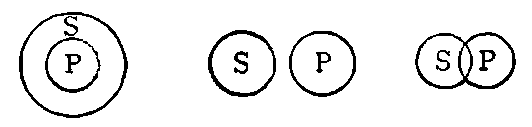
O cannot be converted either simply or per accidens. Some S is not P does not enable you to make any converse assertion about P. All P may be S, or No P may be S, or Some P may be not S. All the three following diagrams are compatible with Some S being excluded from P.
Some have called it "Conversion by Negation," but "negation" is manifestly too wide and common a word to be thus arbitrarily restricted to the process of substituting for one term its opposite.
Others (and this has some mediæval usage in its favour, though not the most intelligent) would call the form All not-P is not-S (the Obverse or Permutation of No not-P is S), the Converse by Contraposition. This is to conform to an imaginary rule that in Conversion the Converse must be of the same Quality with the Convertend. But the essence of Conversion is the interchange of Subject and Predicate: the Quality is not in the definition except by a bungle: it is an accident. No not-P is S, and Some not-P is S are the forms used in Syllogism, and therefore specially named. Unless a form had a use, it was left unnamed, like the Subalternate forms of Syllogism: Nomen habent nullum: nec, si bene colligis, usum.
Table of Contrapositive Converses.
All S is P No S is P Some S is not P Some S is P Con. Con. No not-P is S Some not-P is S Some not-P is S None.
When not-P is substituted for P, Some S is P becomes Some S is not not-P, and this form is inconvertible.
Other Forms of Immediate Inference.
I have already spoken of the Immediate Inferences based on the rules of Contradictory and Contrary Opposition (see p. 145)
Modal Consequence has also been named among the forms of Immediate Inference. By this is meant the inference of the lower degrees of certainty from the higher. Thus must be is said to imply may be; and None can be to imply None is.
Dr. Bain includes also Material Obversion, the analogue of Formal Obversion applied to a Subject. Thus Peace is beneficial to commerce, implies that War is injurious to commerce. Dr. Bain calls this Material Obversion because it cannot be practised safely without reference to the matter of the proposition. We shall recur to the subject in another chapter.
(1) A "not" placed before the sign of Quantity contradicts the whole proposition. Not "All S is P," not "No S is P," not "Some S is P," not "Some S is not P," are equivalent respectively to contradictories of the propositions thus negatived.
(2) A "not" placed after the sign of Quantity affects the copula, and amounts to inverting its Quality, thus denying the predicate term of the same quantity of the subject term of which it was originally affirmed, and vice versâ.
All S is "not" P No S is "not" P Some S is "not" P Some S is "not" not P = No S is P. = All S is P. = Some S is not P. = Some S is P.
(3) If a "not" is placed before as well as after, the resulting forms are obviously equivalent (under Rule 1) to the assertion of the contradictories of the forms on the right (in the illustration of Rule 2).
Not Not Not Not All S is "not" P No S is "not" P Some S is "not" P Some S is "not" not P = No S is P = All S is P = Some S is not P = Some S is P = Some S is P. = Some S is not P. = All S is P. = No S is P.