Part 3 — Chapter II.
Reading edition
THE "OPPOSITION" OF PROPOSITIONS.—THE INTERPRETATION OF "NO".
The practical question from which the technical doctrine has been developed was how to determine the significance of contradiction. What is meant by giving the answer "No" to a proposition put interrogatively? What is the interpretation of "No"? What is the respondent committed to thereby?
"Have all ratepayers a vote?" If you answer "No," you are bound to admit that some ratepayers have not. O is the Contradictory of A. If A is false, O must be true. So if you deny O, you are bound to admit A: one or other must be true: either Some ratepayers have not a vote or All have.
Is it the case that no man can live without sleep? Deny this, and you commit yourself to maintaining that Some man, one at least, can live without sleep. I is the Contradictory of E; and vice versâ.
Contradictory opposition is distinguished from Contrary, the opposition of one Universal to another, of A to E and E to A. There is a natural tendency to meet a strong assertion with the very reverse. Let it be maintained that women are essentially faithless or that "the poor in a lump is bad," and disputants are apt to meet this extreme with another, that constancy is to be found only in women or true virtue only among the poor. Both extremes, both A and E, may be false: the truth may lie between: Some are, Some not.
Logically, the denial of A or E implies only the admission of O or I. You are not committed to the full contrary. But the implication of the Contradictory is absolute; there is no half-way house where the truth may reside. Hence the name of Excluded Middle is applied to the principle that "Of two Contradictories one or other must be true: they cannot both be false".
While both Contraries may be false, they cannot both be true.
Opposition, in the ordinary sense, is the opposition of incompatible propositions, and it was with this only that Aristotle concerned himself. But from an early period in the history of Logic, the word was extended to cover mere differences in Quantity and Quality among the four forms A E I O, which differences have been named and exhibited symmetrically in a diagram known as: The Square of Opposition.
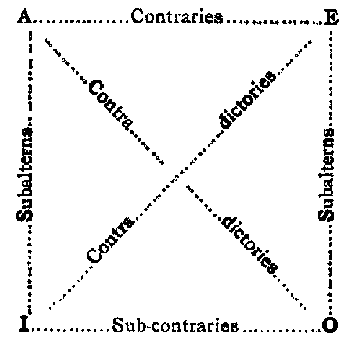
The four forms being placed at the four corners of the Square, and the sides and diagonals representing relations between them thus separated, a very pretty and symmetrical doctrine is the result.
Contradictories, A and O, E and I, differ both in Quantity and in Quality.
Contraries, A and E, differ in Quality but not in Quantity, and are both Universal.
Sub-contraries, I and O, differ in Quality but not in Quantity, and are both Particular.
Subalterns, A and I, E and O, differ in Quantity but not in Quality.
Again, in respect of concurrent truth and falsehood there is a certain symmetry.
Contradictories cannot both be true, nor can they both be false.
Contraries may both be false, but cannot both be true.
Sub-contraries may both be true, but cannot both be false.
Subalterns may both be false and both true. If the Universal is true, its subalternate Particular is true: but the truth of the Particular does not similarly imply the truth of its Subalternating Universal.
This last is another way of saying that the truth of the Contrary involves the truth of the Contradictory, but the truth of the Contradictory does not imply the truth of the Contrary.
There, however, the symmetry ends. The sides and the diagonals of the Square do not symmetrically represent degrees of incompatibility, or opposition in the ordinary sense.
There is no incompatibility between two Sub-contraries or a Subaltern and its Subalternant. Both may be true at the same time. Indeed, as Aristotle remarked of I and O, the truth of the one commonly implies the truth of the other: to say that some of the crew were drowned, implies that some were not, and vice versâ. Subaltern and Subalternant also are compatible, and something more. If a man has admitted A or E, he cannot refuse to admit I or O, the Particular of the same Quality. If All poets are irritable, it cannot be denied that some are so; if None is, that Some are not. The admission of the Contrary includes the admission of the Contradictory.
Consideration of Subalterns, however, brings to light a nice ambiguity in Some. It is only when I is regarded as the Contradictory of E, that it can properly be said to be Subalternate to A. In that case the meaning of Some is "not none," i.e., "Some at least". But when Some is taken as the sign of Particular quantity simply, i.e., as meaning "not all," or "some at most," I is not Subalternate to A, but opposed to it in the sense that the truth of the one is incompatible with the truth of the other.
Again, in the diagram Contrary opposition is represented by a side and Contradictory by the diagonal; that is to say, the stronger form of opposition by the shorter line. The Contrary is more than a denial: it is a counter-assertion of the very reverse, τὸ ἐνάντιον. "Are good administrators always good speakers?" "On the contrary, they never are." This is a much stronger opposition, in the ordinary sense, than a modest contradictory, which is warranted by the existence of a single exception. If the diagram were to represent incompatibility accurately, the Contrary ought to have a longer line than the Contradictory, and this it seems to have had in the diagram that Aristotle had in mind (De Interpret., c. 10).
It is only when Opposition is taken to mean merely difference in Quantity and Quality that there can be said to be greater opposition between Contradictories than between Contraries. Contradictories differ both in Quantity and in Quality: Contraries, in Quality only.
There is another sense in which the Particular Contradictory may be said to be a stronger opposite than the Contrary. It is a stronger position to take up argumentatively. It is easier to defend than a Contrary. But this is because it offers a narrower and more limited opposition.