Volume 9 — LIFE OF MICHELAGNOLO BUONARROTI PAINTER, SCULPTOR, AND ARCHITECT OF FLORENCE (continued 3)
Gaston du C. De Vere translation
Michelagnolo also wrote to Vasari in those days that Julius III being dead, and Marcellus elected, the faction that was against him, in consequence of the election of the new Pontiff, had again begun to harass him. Which hearing, and not liking these ways, the Duke caused Giorgio to write and tell him that he should leave Rome and come to live in Florence, where the Duke did not desire more than his advice and designs at times for his buildings, and that he would receive from that lord all that he might desire, without doing anything with his own hand. Again, there were carried to him by M. Leonardo Marinozzi, the private Chamberlain of Duke Cosimo, letters written by his Excellency; and so also by Vasari. But then, Marcellus being dead, and Paul IV having been elected, by whom once again numerous offers had been made to him from the very beginning, when he went to kiss his feet, the desire to finish the fabric of S. Pietro, and the obligation by which he thought himself bound to that task, kept him back; and, employing certain excuses, he wrote to the Duke that for the time being he was not able to serve him, and to Vasari a letter in these very words:
"Messer Giorgio, my dear Friend,
"I call God to witness how it was against my will and under the strongest compulsion that I was set to the building of S. Pietro in Rome by Pope Paul III, ten years ago. Had they continued to work at that fabric up to the present day, as they were doing then, I would now have reached such a point in the undertaking that I might be thinking of returning home; but for want of money it has been much retarded, and is still being retarded at the time when it has reached the most laborious and difficult stage, insomuch that to abandon it now would be nothing short of the greatest possible disgrace and sin, losing the reward of the labours that I have endured in those ten years for the love of God. I have made you this discourse in answer to your letter, and also because I have a letter from the Duke that has made me marvel much that his Excellency should have deigned to write so graciously; for which I thank God and his Excellency to the best of my power and knowledge. I wander from the subject, because I have lost my memory and my wits, and writing is a great affliction to me, for it is not my art. The conclusion is this: to make you understand what would be the result if I were to abandon the fabric and depart from Rome; firstly, I would please a number of thieves, and secondly, I would be the cause of its ruin, and perhaps, also, of its being suspended for ever."
Continuing to write to Giorgio, Michelagnolo said to him, to excuse himself with the Duke, that he had a house and many convenient things at his disposal in Rome, which were worth thousands of crowns, in addition to being in danger of his life from disease of the kidneys, colic, and the stone, as happens to every old person, and as could be proved by Maestro Realdo, his physician, from whom he congratulated himself on having his life, after God; that for these reasons he was not able to leave Rome, and, finally, that he had no heart for anything but death. He besought Vasari, as he did in several other letters that Giorgio has by his hand, that he should recommend him to the Duke for pardon, in addition to what he wrote to the Duke, as I have said, to excuse himself. If Michelagnolo had been able to ride, he would have gone straightway to Florence, whence, I believe, he would never have consented to depart in order to return to Rome, so much was he influenced by the tenderness and love that he felt for the Duke; but meanwhile he gave his attention to working at many parts of the above-named fabric, in order so to fix the form that it might never again be changed. During this time certain persons had informed him that Pope Paul IV was minded to make him alter the façade of the chapel where the Last Judgment is, because, he said, those figures showed their nakedness too shamelessly. When, therefore, the mind of the Pope was made known to Michelagnolo, he answered: "Tell the Pope that it is no great affair, and that it can be altered with ease. Let him put the world right, and every picture will be put right in a moment." The office of the Chancellery of Rimini was taken away from Michelagnolo, but he would never speak of this to the Pope, who did not know it; and it was taken away from him by the Pope's Cup-bearer, who sought to have a hundred crowns a month given to him in respect of the fabric of S. Pietro, and caused a month's payment to be taken to his house, but Michelagnolo would not accept it. In the same year took place the death of Urbino, his servant, or rather, as he may be called, and as he had been, his companion. This man came to live with Michelagnolo in Florence in the year 1530, after the siege was finished, when his disciple Antonio Mini went to France; and he rendered very faithful service to Michelagnolo, insomuch that in twenty-six years that faithful and intimate service brought it about that Michelagnolo made him rich and so loved him, that in this, Urbino's last illness, old as he was, he nursed him and slept in his clothes at night to watch over him. Wherefore, after he was dead, Vasari wrote to Michelagnolo to console him, and he answered in these words:
"My dear Messer Giorgio,
"I am scarce able to write, but, in reply to your letter, I shall say something. You know how Urbino died, wherein God has shown me very great grace, although it is also a grave loss and an infinite grief to me. This grace is that whereas when living he kept me alive, dying he has taught me to die not with regret, but with a desire for death. I have had him twenty-six years, and have found him a very rare and faithful servant; and now, when I had made him rich and was looking to him as the staff and repose of my old age, he has flown from me, nor is any hope left to me but to see him again in Paradise. And of this God has granted a sign in the happy death that he died, in that dying grieved him much less than leaving me in this traitorous world with so many afflictions; although the greater part of me is gone with him, and nothing is left me but infinite misery. I commend myself to you."
Michelagnolo was employed in the time of Pope Paul IV on many parts of the fortifications of Rome, and also by Salustio Peruzzi, to whom that Pope, as has been related elsewhere, had given the charge of executing the great portal of the Castello di S. Angelo, which is now half ruined; and he occupied himself in distributing the statues of that work, examining the models of the sculptors, and correcting them. At that time the French army approached near to Rome, and Michelagnolo thought that he was like to come to an evil end together with that city; whereupon he resolved to fly from Rome with Antonio Franzese of Castel Durante, whom Urbino at his death had left in his house as his servant, and went secretly to the mountains of Spoleto, where he visited certain seats of hermits. Meanwhile Vasari wrote to him, sending him a little work that Carlo Lenzoni, a citizen of Florence, had left at his death to Messer Cosimo Bartoli, who was to have it printed and dedicated to Michelagnolo; which, when it was finished, Vasari sent in those days to Michelagnolo, and he, having received it, answered thus:
September 18, 1556.
"Messer Giorgio, dear Friend,
"I have received Messer Cosimo's little book, which you send to me, and this shall be a letter of thanks. I pray you to give them to him, and send him my compliments.
"I have had in these days great discomfort and expense, but also great pleasure, in visiting the hermits in the mountains of Spoleto, insomuch that less than half of me has returned to Rome, seeing that in truth there is no peace to be found save in the woods. I have nothing more to tell you. I am glad that you are well and happy, and I commend myself to you."
Michelagnolo used to work almost every day, as a pastime, at that block with the four figures of which we have already spoken; which block he broke into pieces at this time for these reasons, either because it was hard and full of emery, and the chisel often struck sparks from it, or it may have been that the judgment of the man was so great that he was never content with anything that he did. A proof that this is true is that there are few finished statues to be seen out of all that he executed in the prime of his manhood, and that those completely finished were executed by him in his youth, such as the Bacchus, the Pietà in S. Maria della Febbre, the Giant of Florence, and the Christ of the Minerva, which it would not be possible to increase or diminish by as little as a grain of millet without spoiling them; and the others, with the exception of the Dukes Giuliano and Lorenzo, Night, Dawn, and Moses, with the other two, the whole number of these statues not amounting in all to eleven, the others, I say, were all left unfinished, and, moreover, they are many, Michelagnolo having been wont to say that if he had had to satisfy himself in what he did, he would have sent out few, nay, not one. For he had gone so far with his art and judgment, that, when he had laid bare a figure and had perceived in it the slightest degree of error, he would set it aside and run to lay his hand on another block of marble, trusting that the same would not happen to the new block; and he often said that this was the reason that he gave for having executed so few statues and pictures. This Pietà, when it was broken, he presented to Francesco Bandini. Now at this time Tiberio Calcagni, a Florentine sculptor, had become much the friend of Michelagnolo by means of Francesco Bandini and Messer Donato Giannotti; and being one day in Michelagnolo's house, where there was the Pietà, all broken, after a long conversation he asked him for what reason he had broken it up and destroyed labours so marvellous, and he answered that the reason was the importunity of his servant Urbino, who kept urging him every day to finish it, besides which, among other things, a piece of one of the elbows of the Madonna had been broken off, and even before that he had taken an aversion to it, and had had many misfortunes with it by reason of a flaw that was in the marble, so that he lost his patience and began to break it up; and he would have broken it altogether into pieces if his servant Antonio had not besought him that he should present it to him as it was. Whereupon Tiberio, having heard this, spoke to Bandini, who desired to have something by the hand of Michelagnolo, and Bandini contrived that Tiberio should promise to Antonio two hundred crowns of gold, and prayed Michelagnolo to consent that Tiberio should finish it for Bandini with the assistance of models by his hand, urging that thus his labour would not be thrown away. Michelagnolo was satisfied, and then made them a present of it. The work was carried away immediately, and then put together again and reconstructed with I know not what new pieces by Tiberio; but it was left unfinished by reason of the death of Bandini, Michelagnolo, and Tiberio. At the present day it is in the possession of Pier Antonio Bandini, the son of Francesco, at his villa on Monte Cavallo. But to return to Michelagnolo; it became necessary to find some work in marble on which he might be able to pass some time every day with the chisel, and another piece of marble was put before him, from which another Pietà had been already blocked out, different from the first and much smaller.
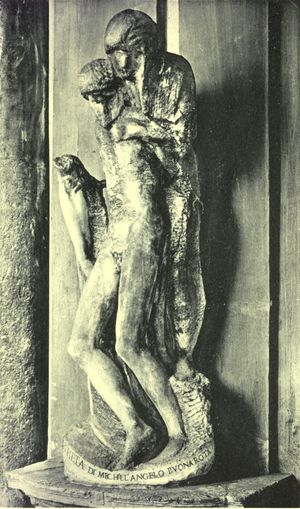
PIETÀ (After Michelagnolo. Rome: Palazzo Rondanini) Alinari View larger image
There had entered into the service of Paul IV, and also into the charge of the fabric of S. Pietro, the architect Pirro Ligorio, and he was now once more harassing Michelagnolo, going about saying that he had sunk into his second childhood. Wherefore, angered by such treatment, he would willingly have returned to Florence, and, having delayed to return, he was again urged in letters by Giorgio, but he knew that he was too old, having now reached the age of eighty-one. Writing at that time to Vasari by his courier, and sending him various spiritual sonnets, he said that he was come to the end of his life, that he must be careful where he directed his thoughts, that by reading he would see that he was at his last hour, and that there arose in his mind no thought upon which was not graved the image of death; and in one letter he said:
"It is God's will, Vasari, that I should continue to live in misery for some years. I know that you will tell me that I am an old fool to wish to write sonnets, but since many say that I am in my second childhood, I have sought to act accordingly. By your letter I see the love that you bear me, and you may take it as certain that I would be glad to lay these feeble bones of mine beside those of my father, as you beg me to do; but by departing from here I would be the cause of the utter ruin of the fabric of S. Pietro, which would be a great disgrace and a very grievous sin. However, when it is so firmly established that it can never be changed, I hope to do all that you ask me, if it be not a sin to keep in anxious expectation certain gluttons that await my immediate departure."
With this letter was the following sonnet, also written in his own hand:
Giunto è già 'l corso della vita mia Con tempestoso mar' per fragil barca Al comun porto, ov'a render' si varca Conto e ragion' d'ogni opra trista e pia. Onde l'affetuosa fantasia, Che l'arte mi fece idolo e monarca, Conosco or' ben' quant'era d'error' carca, E quel ch'a mal suo grado ognun' desia. Gli amorosi pensier' già vani e lieti Che sien'or', s'a due morti mi avvicino? D'una so certo, e l'altra mi minaccia. Nè pinger' nè scolpir' sia più che quieti L'anima volta a quello Amor Divino Ch'aperse a prender' noi in Croce le braccia.
Whereby it was evident that he was drawing towards God, abandoning the cares of art on account of the persecution of his malignant fellow-craftsmen, and also through the fault of certain overseers of the fabric, who would have liked, as he used to say, to dip their hands in the chest. By order of Duke Cosimo, a reply was written to Michelagnolo by Vasari in a letter of few words, exhorting him to repatriate himself, with a sonnet corresponding in the rhymes. Michelagnolo would willingly have left Rome, but he was so weary and aged, that although, as will be told below, he was determined to go back, while the spirit was willing the flesh was weak, and that kept him in Rome. It happened in June of the year 1557, he having made a model for the vault that was to cover the apse, which was being built of travertine in the Chapel of the King, that, from his not being able to go there as he had been wont, an error arose, in that the capomaestro took the measurements over the whole body of the vault with one single centre, whereas there should have been a great number; and Michelagnolo, as the friend and confidant of Vasari, sent him designs by his own hand, with these words written at the foot of two of them:
"The centre marked with red was used by the capomaestro over the body of the whole vault; then, when he began to pass to the half-circle, which is at the summit of the vault, he became aware of the error which that centre was producing, as may be seen here in the design, marked in black. With this error the vault has gone so far forward, that we have to displace a great number of stones, for in that vault there is being placed no brick-work, but all travertine, and the diameter of the circle, without the cornice that borders it, is twenty-two palms. This error, after I had made an exact model, as I do of everything, has been caused by my not being able, on account of my old age, to go there often; so that, whereas I believed that the vault was now finished, it will not be finished all this winter, and, if it were possible to die of shame and grief, I should not be alive now. I pray you account to the Duke for my not being at this moment in Florence."
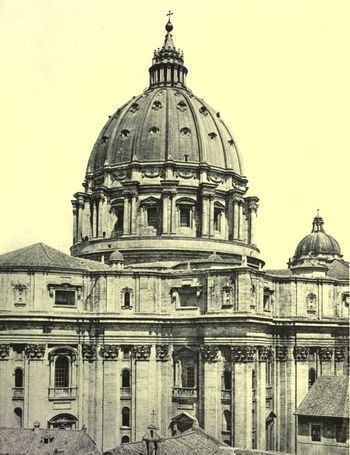
S. PETER'S (After Michelagnolo. Rome) Alinari View larger image
And continuing in the other design, where he had drawn the plan, he said this:
"Messer Giorgio,
"To the end that it may be easier to understand the difficulty of the vault by observing its rise from the level of the ground, let me explain that I have been forced to divide it into three vaults, corresponding to the windows below divided by pilasters; and you see that they go pyramidally into the centre of the summit of the vault, as also do the base and sides of the same. It was necessary to regulate them with an infinite number of centres, and there are in them so many changes in various directions, from point to point, that no fixed rule can be maintained. And the circles and squares that come in the middle of their deepest parts have to diminish and increase in so many directions, and to go to so many points, that it is a difficult thing to find the true method. Nevertheless, having the model, such as I make for everything, they should never have committed so great an error as to seek to regulate with one single centre all those three shells; whence it has come about that we have been obliged with shame and loss to pull down, as we are still doing, a great number of stones. The vault, with its sections and hewn stone-work, is all of travertine, like all the rest below; a thing not customary in Rome."
Michelagnolo was excused by Duke Cosimo, hearing of these misfortunes, from coming to Florence; the Duke saying to him that his contentment and the continuation of S. Pietro were more dear to him than anything in the world, and that he should rest in peace. Whereupon Michelagnolo wrote to Vasari, on the same sheet in which he thanked the Duke to the best of his power and knowledge for such kindness, saying, "God give me grace that I may be able to serve him with this my poor person, for my memory and my brain are gone to await him elsewhere." The date of this letter was August in the year 1557. Thus, then, Michelagnolo learned that the Duke esteemed his life and his honour more than he did himself, who so revered him. All these things, and many more that it is not necessary to mention, we have in our possession, written in his hand.
Michelagnolo by this time was reduced to a feeble condition, and it was evident that little was being done in S. Pietro, now that he had carried on a great part of the frieze of the windows within, and of the double columns without, which curve above the great round cornice[4] where the cupola is to be placed, as will be related; and he was exhorted and urged by his greatest friends, such as the Cardinal of Carpi, Messer Donato Giannotti, Francesco Bandini, Tommaso de' Cavalieri, and Lottino that, since he saw the delay in the raising of the cupola, he should at least make a model of it. He stayed many months without making up his mind to this, but in the end he made a beginning, and then little by little constructed a small model in clay, from which, as an exemplar, and from the plans and profiles that he had drawn, it might be possible afterwards to make a larger one of wood. This, having made a beginning with it, he caused to be constructed in little more than a year by Maestro Giovanni Franzese, with much study and pains; and he made it on such a scale that the smaller proportions of the model, measured by the old Roman palm, corresponded with complete exactness to those of the large work, he having fashioned with diligence in that model all the members of columns, bases, capitals, doors, windows, cornices, projections, and likewise every least thing, knowing that in such a work no less should be done, for in all Christendom, nay, in all the world, there is not to be found or seen any fabric more ornate or more grand. And I cannot but think that, if we have given up time to noting smaller things, it is even more useful, and also our duty, to describe this manner of design for building the structure of this tribune with the form, order, and method that Michelagnolo thought to give it; wherefore with such brevity as we may we will give a simple description of it, to the end that, if it should ever be the fate of this work, which God forbid, to be disturbed by the envy and malice of presumptuous persons after the death of Michelagnolo, even as we have seen it disturbed up to the present during his lifetime, these my writings, such as they may be, may be able to assist the faithful who are to be the executors of the mind of that rare man, and also to restrain the malignant desires of those who may seek to alter it, and so at one and the same time assist, delight, and open the minds of those beautiful intellects that are the friends of this profession and regard it as their joy.
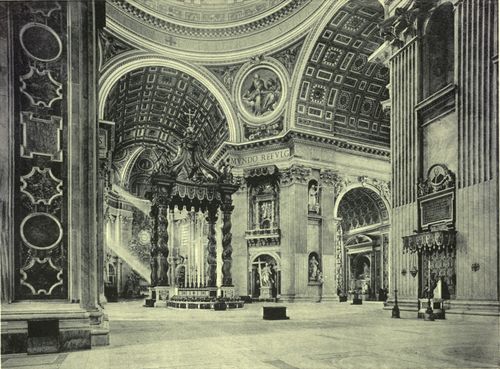
S. PETER'S (After Michelagnolo. Rome) Anderson View larger image
I must begin by saying that according to this model, made under the direction of Michelagnolo, I find that in the great work the whole space within the tribune will be one hundred and eighty-six palms, speaking of its width from wall to wall above the great cornice of travertine that curves in a round in the interior, resting on the four great double piers that rise from the ground with their capitals carved in the Corinthian Order, accompanied by their architrave, frieze, and cornice, likewise of travertine; which great cornice, curving right round over the great niches, rests supported upon the four great arches of the three niches and of the entrance, which form the cross of the building. Then there begins to spring the first part of the tribune, the rise of which commences in a basement of travertine with a platform six palms broad, where one can walk; and this basement curves in a round in the manner of a well, and its thickness is thirty-three palms and eleven inches, the height to the cornice eleven palms and ten inches, the cornice over it about eight palms, and its projection six and a half palms. Into this basement you enter, in order to ascend the tribune, by four entrances that are over the arches of the niches, and the thickness of the basement is divided into three parts; that on the inner side is fifteen palms, that on the outer side is eleven palms, and that in the centre is seven palms and eleven inches, which make up the thickness of thirty-three palms and eleven inches. The space in the centre is hollow and serves as a passage, which is two squares in height and curves in a continuous round, with a barrel-shaped vault; and in line with the four entrances are eight doors, each of which rises in four steps, one of them leading to the level platform of the cornice of the first basement, six palms and a half in breadth, and another leading to the inner cornice that curves round the tribune, eight palms and three-quarters broad, on which platforms, by each door, you can walk conveniently both within and without the edifice, and from one entrance to another in a curve of two hundred and one palms, so that, the sections being four, the whole circuit comes to be eight hundred and four palms. We now have to ascend from the level of this basement, upon which rest the columns and pilasters, and which forms the frieze of the windows within all the way round, being fourteen palms and one inch in height, and around it, on the outer side, there is at the foot a short order of cornice-work, and so also at the top, which does not project more than ten inches, and all of travertine; and so in the thickness of the third part, above that on the inner side, which we have described as fifteen palms thick, there is made in every quarter-section a staircase, one half of which ascends in one direction and the second half in another, the width being four palms and a quarter; and this staircase leads to the level of the columns. Above this level there begin to rise, in line with the solid parts of the basement, eighteen large piers all of travertine, each adorned with two columns on the outer side and pilasters on the inner, as will be described below, and between the piers are left the spaces where there are to be all the windows that are to give light to the tribune. These piers, on the sides pointing towards the central point of the tribune, are thirty-six palms in extent, and on the front sides nineteen and a half. Each of them, on the outer side, has two columns, the lowest dado of which is eight palms and three-quarters broad and one palm and a half high, the base five palms and eight inches broad and ... palms and eleven inches high, the shaft of the column forty-three and a half palms high, five palms and six inches thick at the foot and four palms and nine inches at the top, the Corinthian capital six palms and a half high, with the crown of mouldings nine palms. Of these columns three quarters are to be seen, and the other quarter is merged into the corner, with the accompaniment of the half of a pilaster that makes a salient angle on the inner side, and this is accompanied in the central inner space by the opening of an arched door, five palms wide and thirteen palms and five inches high, from the summit of which to the capitals of the pilasters and columns there is a filling of solid masonry, serving as a connection with two other pilasters that are similar to those that form a salient angle beside the columns. These two pilasters correspond to the others, and adorn the sides of sixteen windows that go right round the tribune, each with a light twelve palms and a half wide and about twenty-two palms high. These windows are to be adorned on the outer side with varied architraves two palms and three-quarters high, and on the inner side they are to be adorned with orders likewise varied, with pediments and quarter-rounds; and they are wide without and more narrow within, and so, also, they are sloped away at the foot of the inner side, so that they may give light over the frieze and cornice. Each of them is bordered by two flat pilasters that correspond in height to the columns without, so that there come to be thirty-six columns without and thirty-six pilasters within; over which pilasters is the architrave, which is four palms and three-quarters in height, the frieze four and a half, and the cornice four and two-thirds, with a projection of five palms; and above this is to go a range of balusters, so that one may be able to walk all the way round there with safety. And in order that it may be possible to climb conveniently from the level where the columns begin, another staircase ascends in the same line within the thickness of the part that is fifteen palms wide, in the same manner and of the same width, with two branches or ascents, all the way up to the summit of the columns, with their capitals, architraves, friezes, and cornices; insomuch that, without obstructing the light of the windows, these stairs pass at the top into a spiral staircase of the same breadth, which finally reaches the level where the turning of the tribune is to begin.
All this order, distribution, and ornamentation is so well varied, commodious, rich, durable, and strong, and serves so well to support the two vaults of the cupola that is to be turned upon it, that it is a very ingenious thing, and it is all so well considered and then executed in masonry, that there is nothing to be seen by the eyes of one who has knowledge and understanding that is more pleasing, more beautiful, or wrought with greater mastery, both on account of the binding together and mortising of the stones and because it has in it in every part strength and eternal life, and also because of the great judgment wherewith he contrived to carry away the rain-water by many hidden channels, and, finally, because he brought it to such perfection, that all other fabrics that have been built and seen up to the present day appear as nothing in comparison with the grandeur of this one. And it has been a very great loss that those whose duty it was did not put all their power into the undertaking, for the reason that, before death took away from us that rare man, we should have seen that beautiful and terrible structure already raised.
Up to this point has Michelagnolo carried the masonry of the work; and it only remains to make a beginning with the vaulting of the tribune, of which, since the model has come down to us, we shall proceed to describe the design that he has left to the end that it may be carried out. He turned the curve of this vault on three points that make a triangle, in this manner:
A B C
The point C, which is the lowest, is the principal one, wherewith he turned the first half-circle of the tribune, with which he gave the form, height and breadth of this vault, which he ordered to be built entirely of bricks well baked and fired, laid herring-bone fashion. This shell he makes four palms and a half thick, and as thick at the top as at the foot, and leaving beside it, in the centre, a space four palms and a half wide at the foot, which is to serve for the ascent of the stairs that are to lead to the lantern, rising from the platform of the cornice where there are balusters. The arch of the interior of the other shell, which is to be wider at the foot and narrower at the top, is turned on the point marked B, and the thickness of the shell at the foot is four palms and a half. And the last arch, which is to be turned in order to make the exterior of the cupola, wider at the foot and narrowing towards the top, is to be raised on the point marked A, which arch turned, there remains at the top all the hollow space of the interior for the ascent of the stairs, which are eight palms high, so that one may climb them upright; and the thickness of that shell comes to diminish little by little, insomuch that, being as before four palms and a half at the foot, it decreases at the top to three palms and a half. And the outer shell comes to be so well bound to the inner shell with bonds and with the stairs, that the one supports the other; while of the eight parts into which the fabric is divided at the base, the four over the arches are left hollow, in order to put less weight upon the arches, and the other four are bound and chained together with bonds upon the piers, so that the structure may have everlasting life.
The stairs in the centre between one shell and the other are constructed in this form; from the level where the springing of the vault begins they rise in each of the four sections, and each ascends from two entrances, the stairs intersecting one another in the form of an X, until they have covered the half of the arch marked C, on the upper side of the shell, when, having ascended straight up the half of that arch, the remaining space is then easily climbed circle after circle and step after step in a direct line, until finally one arrives at the eye of the cupola, where the rise of the lantern begins, around which, in accord with the diminution of the compartments that spring above the piers, there is a smaller range of double pilasters and windows similar to those that are constructed in the interior, as will be described below.
Over the first great cornice within the tribune there begin at the foot the compartments for the recesses that are in the vault of the tribune, which are formed by sixteen projecting ribs. These at the foot are as broad as the breadth of the two pilasters which at the lower end border each window below the vault of the tribune, and they rise, diminishing pyramidally, as far as the eye of the lantern; at the foot they rest on pedestals of the same breadth and twelve palms high, and these pedestals rest on the level platform of the cornice which goes in a circle right round the tribune. Above this, in the recessed spaces between the ribs, there are eight large ovals, each twenty-nine palms high, and over them a number of straight-sided compartments that are wider at the foot and narrower at the top, and twenty-four palms high, and then, the ribs drawing together, there comes above each straight-sided compartment a round fourteen palms high; so that there come to be eight ovals, eight straight-sided compartments, and eight rounds, each range forming recesses that grow more shallow in succession. The ground of all these displays extraordinary richness, for Michelagnolo intended to make the ribs and the ornaments of the said ovals, straight-sided compartments, and rounds, all corniced in travertine.
It remains for us to make mention of the surface and adornment of the arch on that side of the vault where the roofing is to go, which begins to rise from a base twenty-five palms and a half high, which has at the foot a basement that has a projection of two palms, as have the crowning mouldings at the top. The covering or roofing with which he proposed to cover it is of lead, such as covers the roof of the old S. Pietro at the present day, and is divided into sixteen sections from one solid base to another, each base beginning where the two columns end, which are one on either side of it. In each of these sections, in the centre, he made two windows to give light to the inner space where the ascent of the stairs is, between the two shells, so that in all they are thirty-two. These, by means of brackets that support a quarter-round, he made projecting from the roof in such a manner as to protect the lofty and novel view-point from the rain. In a line with the centre of the solid base between each two columns, above which was the crowning cornice, sprang a rib, one to each, wider at the foot and narrowing at the top; in all sixteen ribs, five palms broad, in the centre of each of which was a quadrangular channel one palm and a half wide, within which is formed an ascent of steps about one palm high, by which to ascend or descend between the platform at the foot and the summit where the lantern begins. These are to be built of travertine and constructed with mortisings, to the end that the joins may be protected against water and ice during times of rain.
The design for the lantern is reduced in the same proportion as all the rest of the work, so that, taking lines round the circumference, everything comes to diminish in exact accord, and with proportionate measurements it rises as a simple temple with round columns two by two, like those on the solid bases below. These have pilasters to correspond to them, and one can walk all the way round and see from the central spaces between the pilasters, where the windows are, the interior of the tribune and the church. Above this, architrave, frieze, and cornice curve in a round, projecting over each pair of columns; and over these columns, in a line with them, spring some caulicoles, which, together with some niches that divide them, rise to find the end of the lantern, which, beginning to draw together, grows gradually narrower for a third of its height, in the manner of a round pyramid, until it reaches the ball, upon which, as the final crown of the structure, goes the cross. Many particulars and minute details I might have mentioned, such as air-holes for protection against earthquakes, water-conduits, the various lights, and other conveniences, but I omit them because the work is not yet come to completion, being content to have touched on the principal parts as well as I have been able. For, since every part is in existence and can be seen, it is enough to have made this brief sketch, which is a great light to him who has no knowledge of the structure.
The completion of this model caused the greatest satisfaction not only to all his friends, but to all Rome, the form of the fabric having been thus settled and established. It then came to pass that Paul IV died, and after him was elected Pius IV, who, while causing the building of the little palace in the wood of the Belvedere to be continued by Pirro Ligorio, who remained architect to the Palace, made many gracious offers and advances to Michelagnolo. The Motu-proprio originally received by Michelagnolo from Paul III, and then from Julius III and Paul IV, in respect of the fabric of S. Pietro, he confirmed in his favour, and he restored to him a part of the revenues and allowances taken away by Paul IV, employing him in many of his works of building; and in his time he caused the fabric of S. Pietro to be carried on vigorously. He made use of Michelagnolo, in particular, in preparing a design for the tomb of the Marchese Marignano, his brother, which, destined to be erected in the Duomo of Milan, was allotted by his Holiness to the Chevalier Leone Lioni of Arezzo, a most excellent sculptor and much the friend of Michelagnolo; the form of which tomb will be described in the proper place.
At this time the Chevalier Leone made a very lively portrait of Michelagnolo in a medal, and to please him he fashioned on the reverse a blind man led by a dog, with these letters around:
DOCEBO INIQUOS VIAS TUAS, ET IMPII AD TE CONVERTENTUR.
And Michelagnolo, since it pleased him much, presented him a model in wax of Hercules crushing Antæus, by his own hand, with certain of his designs. Of Michelagnolo we have no other portraits but two in painting, one by the hand of Bugiardini and the other by Jacopo del Conte, one in bronze executed in full-relief by Daniello Ricciarelli, and this one by the Chevalier Leone; from which portraits so many copies have been made, that I have seen a good number in many places in Italy and in foreign parts.
The same year Cardinal Giovanni de' Medici, the son of Duke Cosimo, went to Rome to receive the hat from Pius IV, and it fell to Vasari, as his servant and familiar friend, to go with him; which Vasari went there willingly and stayed about a month, in order to enjoy Michelagnolo, who received him with great affection and was always with him. Vasari had taken with him, by order of his Excellency, a model in wood of the whole Ducal Palace of Florence, together with designs of the new apartments that had been built and painted by him; which Michelagnolo desired to see both in the model and in the designs, since, being old, he was not able to see the works themselves. These works, which were abundant and well varied, with different inventions and fancies, began with the Castration of Uranus and continued in stories of Saturn, Ops, Ceres, Jove, Juno, and Hercules, each room having one of these names, with the stories in various compartments; even as the other chambers and halls, which were beneath these, had the names of the heroes of the House of Medici, beginning with the elder Cosimo, and continuing with Lorenzo, Leo X, Clement VII, Signor Giovanni, Duke Alessandro, and Duke Cosimo, in each of which were not only the stories of their actions, but also portraits of them, of their children, and of all the ancients renowned in statesmanship, in arms, and in letters, taken from the life. Of these Vasari had written a Dialogue in which he explained all the stories, the end of the whole invention, and how the fables above harmonized with the stories below; which was read to Michelagnolo by Annibale Caro, and he took the greatest pleasure in it. This Dialogue, when Vasari shall have more time, will be published.
The result of all this was as follows. Vasari was desirous of setting his hand to the Great Hall, and since, as has been said elsewhere, the ceiling was low, making it stunted and wanting in lights, he had a desire to raise that ceiling. Now the Duke would not make up his mind to give him leave that it should be raised; not that the Duke feared the cost, as was seen afterwards, but rather the danger of raising the beams of the roof thirteen braccia. However, like a man of judgment, his Excellency consented that the advice of Michelagnolo should be taken, and Michelagnolo, having seen in that model the Hall as it then was, and afterwards, all the beams having been removed and replaced by other beams with a new invention in the ceiling and walls, the same Hall as it has since been made, with the invention of the stories likewise designed therein, liked it and straightway became not a judge but a supporter, and the rather as he saw the facile method of raising the beams and the roof, and the plan for executing the whole work in a short time. Wherefore, on Vasari's return, he wrote to the Duke that he should carry out that undertaking, since it was worthy of his greatness.
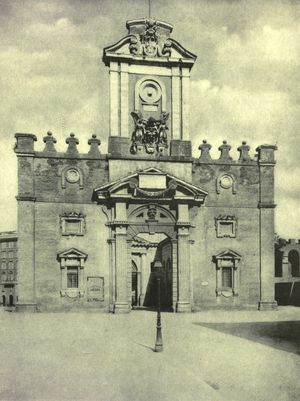
PORTA PIA (After Michelagnolo. Rome) Alinari View larger image
The same year Duke Cosimo went to Rome with the Lady Duchess Leonora, his consort, and Michelagnolo, after the Duke's arrival, went straightway to see him. The Duke, after receiving him with many endearments, caused him, out of respect for his great genius, to sit by his side, and with much familiarity talked to him of all that he had caused to be done in painting and sculpture at Florence, and also of all that he was minded to have done, and in particular of the Hall; and Michelagnolo again encouraged and reassured him in that matter, lamenting, since he loved that Lord, that he was not young enough to be able to serve him. His Excellency said that he had discovered the way to work porphyry, a thing which Michelagnolo could not believe, and the Duke therefore sent him, as has been related in the first chapter of the Treatise on Theory, the head of Christ wrought by the sculptor Francesco del Tadda, at which he was astonished; and he visited the Duke several times the while that he stayed in Rome, to his vast satisfaction. He did the same a short time afterwards when the most Illustrious Don Francesco de' Medici, the Duke's son, went there, in whom Michelagnolo took much delight from the marks of regard and affection shown to him by his most Illustrious Excellency, who spoke with him always cap in hand, having infinite reverence for so rare a man; and Michelagnolo wrote to Vasari that it vexed him to be old and infirm, for he would have liked to do something for that Lord, but he was going about trying to buy some beautiful antique to send to him in Florence.
Being requested at this time by the Pope for a design for the Porta Pia, Michelagnolo made three, all fantastic and most beautiful, of which the Pope chose the least costly for putting into execution; and it is now to be seen erected there, with much credit to him. Perceiving the inclination of the Pope, and hoping that he would restore the other gates of Rome, he made many other designs for him; and he did the like, at the request of the same Pontiff, in the matter of the new Church of S. Maria degli Angeli in the Baths of Diocletian, in order to convert them into a temple for the use of Christians. A design by his hand prevailed over many others made by excellent architects, being executed with such beautiful considerations for the convenience of the Carthusian Friars, who have now carried it almost to completion, that it caused his Holiness and all the prelates and lords of the Court to marvel at the judgment of the lovely conceptions that he had drawn, availing himself of all the skeleton of those baths, out of which was seen formed a most beautiful temple, with an entrance surpassing the expectations of all the architects; from which he acquired infinite praise and honour. For that place, also, he designed for his Holiness a Ciborium of the Sacrament in bronze, cast for the most part by Maestro Jacopo Ciciliano, an excellent bronze-caster, who makes his works come out very delicate and fine, without any roughness, so that they can be polished with little labour; in which field he is a rare master, and gave much satisfaction to Michelagnolo.
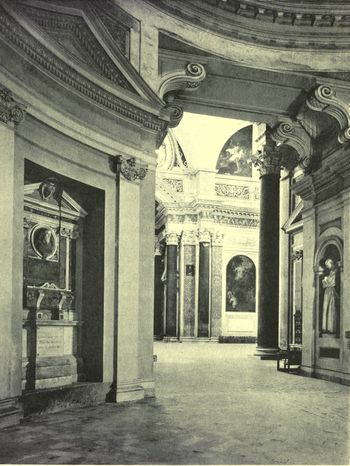
S. MARIA DEGLI ANGELI (After Michelagnolo. Rome) Alinari View larger image
The Florentine colony had often talked among themselves of giving a good beginning to the Church of S. Giovanni in the Strada Giulia. Finally, all the heads of the richest houses having assembled together, they each promised to contribute in due proportion according to their means towards that fabric, insomuch that they contrived to collect a good sum of money; and then it was discussed among them whether it were better to follow the old lines or to have something new and finer. It was determined that something new should be erected upon the old foundations, and finally they elected three men to have the charge of the fabric, who were Francesco Bandini, Uberto Ubaldini, and Tommaso de' Bardi; and these requested Michelagnolo for a design, recommending themselves to him on the ground that it was a disgrace to their colony to have thrown away so much money without any kind of profit, and that, if his genius did not avail to finish the work, they had no other resource. He promised them to do it, with as much lovingness as he had ever shown in any work in the past, because in this his old age he readily gave his attention to sacred things, such as might redound to the honour of God, and also from affection for his fellow-Florentines, whom he loved always. Michelagnolo had with him at this conference the Florentine sculptor Tiberio Calcagni, a young man very ardent to learn art, who, after going to Rome, had turned his mind to the study of architecture. Loving him, Michelagnolo had given him to finish, as has been related, the Pietà in marble that he had broken, and, in addition, a head of Brutus in marble with the breast, considerably larger than life, to the end that he might finish it. Of this the head alone was carved, with certain most minute gradines, and he had taken it from a portrait of Brutus cut in a very ancient cornelian that was in the possession of Signor Giuliano Cesarino; which Michelagnolo was doing for Cardinal Ridolfi at the entreaty of Messer Donato Giannotti, his very dear friend, and it is a rare work. Michelagnolo, then, in matters of architecture, not being able by reason of old age to draw any more or to make accurate lines, was making use of Tiberio, because he was very gentle and discreet; and thus, desiring to avail himself of him in such an undertaking, he laid on him the charge of tracing the plan of the site of the above-named church. That plan having been traced and carried straightway to Michelagnolo, at a time when it was not thought that he was doing anything, he gave them to understand through Tiberio that he had carried out their wishes, and finally showed them five most beautiful ground-plans of temples; which having seen, they marvelled. He said to them that they should choose one that pleased them, and they, not wishing to do it, left the matter to his judgment, but he insisted that they should decide of their own free will; wherefore they all with one accord chose the richest. This having been adopted, Michelagnolo said to them that if they carried such a design to completion, neither the Greeks nor the Romans ever in their times executed such a work; words that neither before nor afterwards ever issued from the mouth of Michelagnolo, for he was very modest. Finally it was agreed that the direction should be left entirely to Michelagnolo, and that the labour of executing that work should fall to Tiberio; with all which they were content, Buonarroti promising them that Tiberio would serve them excellently well. And so, having given the ground-plan to Tiberio to be drawn accurately and with correct measurements, he drew for him the profiles both within and without, and bade him make a model of clay, teaching him the way to execute it so that it might stand firm. In ten days Tiberio executed a model of eight palms, which much pleased the whole Florentine colony, so that afterwards they caused to be made from it a model of wood, which is now in the residence of the Consuls of that colony; a thing as rare in its beauty, richness, and great variety, as any temple that has ever been seen. A beginning was made with the building, and five thousand crowns were spent; but the funds for the fabric failed, and so it was abandoned, at which Michelagnolo felt very great displeasure. He obtained for Tiberio the commission to finish under his direction, at S. Maria Maggiore, a chapel begun for Cardinal Santa Fiore; but it was left unfinished, on account of the death of the Cardinal, of Michelagnolo, and of Tiberio himself, the death of which young man was a very great loss.
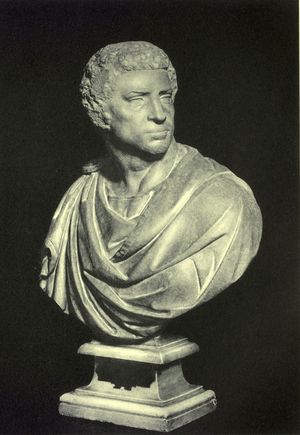
BRUTUS (After Michelagnolo. Florence: Museo Nazionale) Brogi View larger image
Michelagnolo had been seventeen years in the fabric of S. Pietro, and several times the deputies had tried to remove him from that position, but they had not succeeded, and they were seeking to oppose him in every matter now with one vexatious pretext and now with another, hoping that out of weariness, being now so old that he could do no more, he would retire before them. It happened in those days that Cesare da Castel Durante, who had been the overseer, died, and Michelagnolo, to the end that the fabric might not suffer, sent there Luigi Gaeta, who was too young but very competent, until he should find a man after his desire. The deputies (some of whom had many times made efforts to place there Nanni di Baccio Bigio, who was always urging them and promising great things), in order to be able to disturb the affairs of the fabric at their pleasure, sent Luigi Gaeta away, which having heard, Michelagnolo, as in anger, would no longer show himself at the fabric; whereupon they began to give out that he could do no more, that it was necessary to give him a substitute, and that he himself had said that he did not wish to be embroiled any longer with S. Pietro. All this came to the ears of Michelagnolo, who sent Daniello Ricciarelli of Volterra to Bishop Ferratino, one of the superintendents, who had said to the Cardinal of Carpi that Michelagnolo had told one of his servants that he did not wish to be mixed up with the fabric any longer; and Daniello said that this was by no means Michelagnolo's desire. Ferratino complained that Michelagnolo would not make his conception known, adding that it would be well for him to provide a substitute, and that he would have gladly accepted Daniello; and with this Michelagnolo appeared to be content. Thereupon Ferratino, having had the deputies informed in the name of Michelagnolo that they now had a substitute, presented not Daniello, but in his place Nanni di Baccio Bigio, who came in and was accepted by the superintendents. Before very long he gave orders to make a scaffolding of wood from the side of the Pope's stables, where the hill is, to rise above the great recess that is turned towards that side, and caused some stout beams of fir to be cut, saying that too many ropes were consumed in drawing up the materials, and that it was better to raise them by his method. Which having heard, Michelagnolo went straight to the Pope, who was on the Piazza di Campidoglio, and made so much noise that his Holiness made him go at once into a room, where he said: "Holy Father, there has been appointed as my substitute by the deputies a man of whom I know nothing; but if they are convinced, and also your Holiness, that I am no longer the proper man, I will return to rest in Florence, where I will enjoy the favours of that great Duke who has so long desired me, and will finish my life in my own house; I therefore beg your gracious leave." The Pope was vexed at this, and, consoling him with kind words, ordained that he should come to speak with him on the following day at the Araceli. There, having caused the deputies of the fabric to be assembled together, he desired to be informed of the reasons of what had happened: whereupon their answer was that the fabric was going to ruin, and that errors were being made in it. Which having heard not to be the truth, the Pope commanded Signor Gabrio Scerbellone that he should go to see the fabric for himself, and that Nanni, who was making these assertions, should show it to him. This was carried out, and Signor Gabrio found that the whole story was a malicious slander, and not the truth; wherefore Nanni was dismissed from that fabric with no very flattering words in the presence of many lords, being also reproached that by his fault the bridge of Santa Maria fell into ruin, and that at Ancona, seeking to do great things at little cost in the matter of cleaning out the harbour, he filled it up more in one day than the sea had done in ten years. Such was the end of Nanni in the fabric of S. Pietro. For that work Michelagnolo for seventeen years attended constantly to nothing but to establishing it securely with directions, doubting on account of those envious persecutions lest it might come to be changed after his death; so that at the present day it is strong enough to allow the vaulting to be raised with perfect security. Thus it has been seen that God, who is the protector of the good, defended him as long as he lived, and worked for the benefit of the fabric and for the defence of the master until his death. Moreover, Pius IV, living after him, commanded the superintendents of the fabric that nothing of what Michelagnolo had directed should be changed; and with even greater authority his successor, Pius V, caused it to be carried out, who, lest disorder should arise, insisted that the designs made by Michelagnolo should be carried into execution with the utmost fidelity, so that, when the architects Pirro Ligorio and Jacopo Vignuola were in charge of it, and Pirro wished presumptuously to disturb and alter those directions, he was removed with little honour from that fabric, and only Vignuola remained. Finally, that Pontiff being full of zeal no less for the honour of the fabric of S. Pietro than for the Christian religion, in the year 1565, when Vasari went to kiss the feet of his Holiness, and in the year 1566, when he was again summoned, nothing was discussed save the means to ensure the observing of the designs left by Michelagnolo; and his Holiness, in order to obviate all chance of disorder, commanded Vasari that he should go with Messer Guglielmo Sangalletti, the private treasurer of his Holiness, to seek out Bishop Ferratino, the head of the superintendents of S. Pietro, with orders from the Pontiff that he should listen to all the suggestions and records of importance that Vasari might impart to him, to the end that no words of any malignant and presumptuous person might ever cause to be disturbed any line or order left by the excellent genius of Michelagnolo of happy memory; and at that interview was present Messer Giovan Battista Altoviti, who was much the friend of Vasari and of these arts. And Ferratino, having heard a discourse that Vasari made to him, readily accepted every record, and promised to observe and to cause to be observed with the utmost fidelity in that fabric every order and design that Michelagnolo had left for that purpose, and, in addition, to be the protector, defender, and preserver of the labours of that great man.
But to return to Michelagnolo: I must relate that about a year before his death, Vasari secretly prevailed upon Duke Cosimo de' Medici to persuade the Pope by means of Messer Averardo Serristori, his Ambassador, that, since Michelagnolo was much reduced, a diligent watch should be kept on those who were about him to take care of him, or who visited him at his house, and that, in the event of some sudden accident happening to him, such as might well happen to an old man, he should make arrangements for his property, designs, cartoons, models, money, and all his other possessions at the time of his death, to be set down in an inventory and placed in security, for the sake of the fabric of S. Pietro, so that, if there were things pertaining to that fabric, and also to the sacristy, library, and façade of S. Lorenzo, they might not be taken away, as is often wont to happen; and in the end, all this being duly carried out, such diligence had its reward. Leonardo, the nephew of Michelagnolo, was desirous to go during the coming Lent to Rome, as one who guessed that he was now come to the end of his life; and at this Michelagnolo was content. When, therefore, he fell sick of a slow fever, he straightway caused Daniello to write to Leonardo that he should come; but the illness grew worse, although Messer Federigo Donati, his physician, and his other attendants were about him, and with perfect consciousness he made his will in three sentences, leaving his soul in the hands of God, his body to the earth, and his substance to his nearest relatives, and enjoining on his friends that, at his passing from this life, they should recall to him the agony of Jesus Christ. And so at the twenty-third hour of the seventeenth day of February, in the year 1563 (after the Florentine reckoning, which according to the Roman would be 1564), he breathed his last, to go to a better life.
Michelagnolo was much inclined to the labours of art, seeing that everything, however difficult, succeeded with him, he having had from nature a genius very apt and ardent in these most noble arts of design. Moreover, in order to be entirely perfect, innumerable times he made anatomical studies, dissecting men's bodies in order to see the principles of their construction and the concatenation of the bones, muscles, veins, and nerves, the various movements and all the postures of the human body; and not of men only, but also of animals, and particularly of horses, which last he much delighted to keep. Of all these he desired to learn the principles and laws in so far as touched his art, and this knowledge he so demonstrated in the works that fell to him to handle, that those who attend to no other study than this do not know more. He so executed his works, whether with the brush or with the chisel, that they are almost inimitable, and he gave to his labours, as has been said, such art and grace, and a loveliness of such a kind, that (be it said without offence to any) he surpassed and vanquished the ancients; having been able to wrest things out of the greatest difficulties with such facility, that they do not appear wrought with effort, although whoever draws his works after him finds enough in imitating them.
The genius of Michelagnolo was recognized in his lifetime, and not, as happens to many, after death, for it has been seen that Julius II, Leo X, Clement VII, Paul III, Julius III, Paul IV, and Pius IV, all supreme Pontiffs, always wished to have him near them, and also, as is known, Suleiman, Emperor of the Turks, Francis of Valois, King of France, the Emperor Charles V, the Signoria of Venice, and finally, as has been related, Duke Cosimo de' Medici; all offering him honourable salaries, for no other reason but to avail themselves of his great genius. This does not happen save to men of great worth, such as he was; and it is evident and well known that all these three arts were so perfected in him, that it is not found that among persons ancient or modern, in all the many years that the sun has been whirling round, God has granted this to any other but Michelagnolo. He had imagination of such a kind, and so perfect, and the things conceived by him in idea were such, that often, through not being able to express with the hands conceptions so terrible and grand, he abandoned his works—nay, destroyed many of them; and I know that a little before he died he burned a great number of designs, sketches, and cartoons made with his own hand, to the end that no one might see the labours endured by him and his methods of trying his genius, and that he might not appear less than perfect. Of such I have some by his hand, found in Florence, and placed in my book of drawings; from which, although the greatness of that brain is seen in them, it is evident that when he wished to bring forth Minerva from the head of Jove, he had to use Vulcan's hammer. Thus he used to make his figures in the proportion of nine, ten, and even twelve heads, seeking nought else but that in putting them all together there should be a certain harmony of grace in the whole, which nature does not present; saying that it was necessary to have the compasses in the eyes and not in the hand, because the hands work and the eye judges; which method he used also in architecture.
No one should think it strange that Michelagnolo delighted in solitude, he having been one who was enamoured of his art, which claims a man, with all his thoughts, for herself alone; moreover, it is necessary that he who wishes to attend to her studies should shun society, and, while attending to the considerations of art, he is never alone or without thoughts. And those who attributed it to caprice and eccentricity are wrong, because he who wishes to work well must withdraw himself from all cares and vexations, since art demands contemplation, solitude, and ease of life, and will not suffer the mind to wander. For all this, he prized the friendship of many great persons and of learned and ingenious men, at convenient times; and these he maintained. Thus the great Cardinal Ippolito de' Medici loved him greatly, and, having heard that a Turkish horse that he possessed pleased Michelagnolo because of its beauty, it was sent as a present to him by the liberality of that lord, with ten mules laden with fodder, and a serving-man to attend to it; and Michelagnolo accepted it willingly. The illustrious Cardinal Pole was much his friend, Michelagnolo being enamoured of his goodness and his talents; also Cardinal Farnese, and Santa Croce, which latter afterwards became Pope Marcellus, Cardinal Ridolfi, Cardinal Maffeo, Monsignor Bembo, Carpi, and many other Cardinals, Bishops, and Prelates, whom it is not necessary to name. Others were Monsignor Claudio Tolomei, the Magnificent Messer Ottaviano de' Medici, his gossip, whose son he held at baptism, and Messer Bindo Altoviti, to whom he presented that cartoon of the Chapel in which Noah, drunk with wine, is derided by one of his sons, and his nakedness is covered by the two others; M. Lorenzo Ridolfi, M. Annibale Caro, and M. Giovan Francesco Lottini of Volterra. But infinitely more than any of the others he loved M. Tommaso de' Cavalieri, a Roman gentleman, for whom, being a young man and much inclined to these arts, he made, to the end that he might learn to draw, many most superb drawings of divinely beautiful heads, designed in black and red chalk; and then he drew for him a Ganymede rapt to Heaven by Jove's Eagle, a Tityus with the Vulture devouring his heart, the Chariot of the Sun falling with Phaëthon into the Po, and a Bacchanal of children, which are all in themselves most rare things, and drawings the like of which have never been seen. Michelagnolo made a life-size portrait of Messer Tommaso in a cartoon, and neither before nor afterwards did he take the portrait of anyone, because he abhorred executing a resemblance to the living subject, unless it were of extraordinary beauty. These drawings, on account of the great delight that M. Tommaso took in them, were the reason that he afterwards obtained a good number, miraculous things, which Michelagnolo once drew for Fra Sebastiano Viniziano, who carried them into execution; and in truth he rightly treasures them as reliques, and he has courteously given craftsmen access to them. Of a truth Michelagnolo always placed his affections with persons noble, deserving, and worthy of them, for he had true judgment and taste in all things.
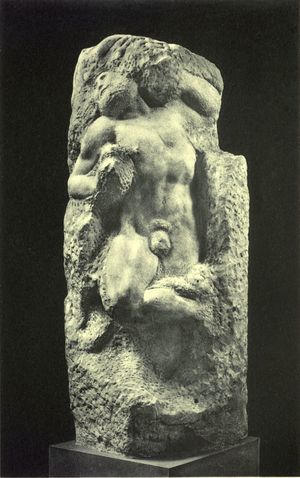
UNFINISHED FIGURE (After Michelagnolo. Florence: Museo Nazionale) Brogi View larger image
M. Tommaso afterwards caused Michelagnolo to make many designs for friends, such as that of the picture for Cardinal di Cesis, wherein is Our Lady receiving the Annunciation from the Angel, a novel thing, which was afterwards executed in colours by Marcello Mantovano and placed in the marble chapel which that Cardinal caused to be built in the Church of the Pace at Rome. So, also, with another Annunciation coloured likewise by the hand of Marcello in a picture in the Church of S. Giovanni Laterano, the design of which belongs to Duke Cosimo de' Medici, having been presented after Michelagnolo's death by his nephew Leonardo Buonarroti to his Excellency, who cherishes it as a jewel, together with a Christ praying in the Garden and many other designs, sketches, and cartoons by the hand of Michelagnolo, and likewise the statue of Victory with a captive beneath, five braccia in height, and four captives in the rough which serve to teach us how to carve figures from the marble by a method secure from any chance of spoiling the stone; which method is as follows. You take a figure in wax or some other solid material, and lay it horizontally in a vessel of water, which water being by its nature flat and level at the surface, as you raise the said figure little by little from the level, so it comes about that the more salient parts are revealed, while the lower parts—those, namely, on the under side of the figure—remain hidden, until in the end it all comes into view. In the same manner must figures be carved out of marble with the chisel, first laying bare the more salient parts, and then little by little the lower parts; and this method may be seen to have been followed by Michelagnolo in the above-mentioned captives, which his Excellency wishes to be used as exemplars for his Academicians.
Michelagnolo loved his fellow-craftsmen, and held intercourse with them, as with Jacopo Sansovino, Rosso, Pontormo, Daniello da Volterra, and Giorgio Vasari of Arezzo, to which last he showed innumerable kindnesses; and he was the reason that Giorgio gave his attention to architecture, intending to make use of him some day, and he readily conferred and discussed matters of art with him. Those who say that he was not willing to teach are wrong, because he was always willing with his intimates and with anyone who asked him for counsel; and I have been present on many such occasions, but of these, out of consideration, I say nothing, not wishing to reveal the deficiencies of others. It may be urged that he had bad fortune with those who lived with him in his house, which was because he hit upon natures little able to imitate him. Thus, Pietro Urbano of Pistoia, his pupil, was a man of parts, but would never exert himself. Antonio Mini was willing, but had no aptitude of brain; and when the wax is hard it does not readily take an impression. Ascanio dalla Ripa Transone took great pains, but of this no fruits were ever seen either in designs or in finished works, and he toiled several years over a picture for which Michelagnolo had given him a cartoon. In the end, all the good expectation in which he was held vanished in smoke; and I remember that Michelagnolo would be seized with compassion for his toil, and would assist him with his own hand, but this profited him little. If he had found a nature after his heart, as he told me several times, in spite of his age he would often have made anatomical studies, and would have written upon them, for the benefit of his fellow-craftsmen; for he was disappointed by several. But he did not trust himself, through not being able to express himself in writing as he would have liked, because he was not practised in diction, although in the prose of his letters he explained his conceptions very well in a few words. He much delighted in readings of the poets in the vulgar tongue, and particularly of Dante, whom he much admired, imitating him in his conceptions and inventions; and so with Petrarca, having delighted to make madrigals and sonnets of great weight, upon which commentaries have been written. M. Benedetto Varchi gave a lecture in the Florentine Academy upon that sonnet which begins—
Non ha l'ottimo artista alcun concetto Ch'un marmo solo in se non circonscriva.
Michelagnolo sent a vast number by his own hand—receiving answers in rhyme and in prose—to the most illustrious Marchioness of Pescara, of whose virtues he was enamoured, and she likewise of his; and she went many times to Rome from Viterbo to visit him, and Michelagnolo designed for her a Dead Christ in the lap of Our Lady, with two little Angels, all most admirable, and a Christ fixed on the Cross, who, with the head uplifted, is recommending His Spirit to the Father, a divine work; and also a Christ with the Woman of Samaria at the well. He much delighted in the sacred Scriptures, like the excellent Christian that he was; and he held in great veneration the works written by Fra Girolamo Savonarola, because he had heard the voice of that friar in the pulpit. He greatly loved human beauty for the sake of imitation in art, being able to select from the beautiful the most beautiful, for without this imitation no perfect work can be done; but not with lascivious and disgraceful thoughts, as he proved by his way of life, which was very frugal. Thus, when he was young, all intent on his work, he contented himself with a little bread and wine, and this he continued when old until the time when he was painting the Judgment in the Chapel, taking his refreshment in the evening when he had finished the day's work, but always very frugally. And, although he was rich, he lived like a poor man, nor did any friend ever eat at his table, or rarely; and he would not accept presents from anyone, because it appeared to him that if anyone gave him something, he would be bound to him for ever. This sober life kept him very active and in want of very little sleep, and often during the night, not being able to sleep, he would rise to labour with the chisel; having made a cap of thick paper, and over the centre of his head he kept a lighted candle, which in this way threw light over where he was working without encumbering his hands. Vasari, who had seen the cap several times, reflecting that he did not use wax, but candles of pure goat's tallow, which are excellent, sent him four bundles of these, which weighed forty libbre. And his servant with all courtesy carried them to him at the second hour of the evening, and presented them to him; but Michelagnolo refused them, declaring that he did not want them; and then the servant said: "They have broken my arms on the way between the bridge and here, and I shall not carry them back to the house. Now here in front of your door there is a solid heap of mud; they will stand in it beautifully, and I will set them all alight." Michelagnolo said to him: "Put them down here, for I will not have you playing pranks at my door."
He told me that often in his youth he slept in his clothes, being weary with labour and not caring to take them off only to have to put them on again later. There are some who have taxed him with being avaricious, but they are mistaken, for both with works of art and with his substance he proved the contrary. Of works of art, as has been seen and related, he presented to M. Tommaso de' Cavalieri, to Messer Bindo, and to Fra Sebastiano, designs of considerable value; and to Antonio Mini, his pupil, all his designs, all his cartoons, and the picture of the Leda, and all the models in clay and wax that he ever made, which, as has been related, were all left in France. To Gherardo Perini, a Florentine gentleman who was very much his friend, he gave three sheets with some divine heads in black chalk, which since Perini's death have come into the hands of the most illustrious Don Francesco, Prince of Florence, who treasures them as jewels, as indeed they are; for Bartolommeo Bettini he made a cartoon, which he presented to him, of a Venus with a Cupid that is kissing her, a divine thing, which is now in the possession of Bettini's heirs in Florence, and for the Marchese del Vasto he made a cartoon of a "Noli me Tangere," a rare thing; and these two last were painted excellently well by Pontormo, as has been related. He presented the two Captives to Signor Ruberto Strozzi, and the Pietà in marble, which he broke, to Antonio, his servant, and to Francesco Bandini. I know not, therefore, how this man can be taxed with avarice, he having given away so many things for which he could have obtained thousands of crowns. What better proof can I give than this, that I know from personal experience that he made many designs and went to see many pictures and buildings, without demanding any payment? But let us come to the money earned by him by the sweat of his brow, not from revenues, not from traffickings, but from his own study and labour. Can he be called avaricious who succoured many poor persons, as he did, and secretly married off a good number of girls, and enriched those who served him and assisted him in his works, as with his servant Urbino, whom he made a very rich man? This Urbino was his man of all work, and had served him a long time; and Michelagnolo said to him: "If I die, what will you do?" And he answered: "I will serve another master." "You poor creature," said Michelagnolo, "I will save you from such misery"; and presented two thousand crowns to him in one sum, an act such as is generally left to Cæsars and Pontiffs. To his nephew, moreover, he gave three and four thousand crowns at a time, and at the end he left him ten thousand crowns, besides the property in Rome.
Michelagnolo was a man of tenacious and profound memory, so that, on seeing the works of others only once, he remembered them perfectly, and could avail himself of them in such a manner, that scarcely anyone has ever noticed it; nor did he ever do anything that resembled another thing by his hand, because he remembered everything that he had done. In his youth, being once with his painter-friends, they played for a supper for him who should make a figure most completely wanting in design and clumsy, after the likeness of the puppet-figures which those make who know nothing, scrawling upon walls; and in this he availed himself of his memory, for he remembered having seen one of those absurdities on a wall, and drew it exactly as if he had had it before him, and thus surpassed all those painters—a thing difficult for a man so steeped in design, and accustomed to choice works, to come out of with credit. He was full of disdain, and rightly, against anyone who did him an injury, but he was never seen to run to take revenge; nay, rather, he was most patient, modest in all his ways, very prudent and wise in his speech, with answers full of weight, and at times sayings most ingenious, amusing, and acute. He said many things that have been written down by me, of which I shall include only a few, because it would take too long to give them all. A friend having spoken to him of death, saying that it must grieve him much, because he had lived in continual labour in matters of art, and had never had any repose, he answered that all that was nothing, because, if life is a pleasure to us, death, being likewise by the hand of one and the same master, should not displease us. To a citizen who found him by Orsanmichele in Florence, where he had stopped to gaze at Donato's statue of S. Mark, and who asked him what he thought of that figure, Michelagnolo answered that he had never seen a figure that had more of the air of a good man than that one, and that, if S. Mark was like that, one could give credence to what he had written. Being shown the drawing of a boy then beginning to learn to draw, who was recommended to him, some persons excusing him because it was not long since he had applied himself to art, he replied: "That is evident." He said a similar thing to a painter who had painted a Pietà, and had not acquitted himself well: "It is indeed a pitiful thing to see." Having heard that Sebastiano Viniziano had to paint a friar in the chapel of S. Pietro a Montorio, he said that this would spoil the work for him; and being asked why he said that, he answered: "Since they have spoiled the world, which is so large, it would not be surprising if they were to spoil such a small thing as that chapel." A painter had executed a work with very great pains, toiling over it a long time; but when it was given to view he had made a considerable profit. Michelagnolo was asked what he thought of the craftsman, and he answered: "As long as this man strives to be rich, he will always remain a poor creature." One of his friends who was a churchman, and used formerly to say Mass, having arrived in Rome all covered with points and silk, saluted Michelagnolo; but he pretended not to see him, so that the friend was forced to declare his name to him. Michelagnolo expressed marvel that he should be in that habit, and then added, as it were to congratulate him: "Oh, but you are magnificent! If you were as fine within as I see you to be without, it would be well with your soul." The same man had recommended a friend to Michelagnolo (who had given him a statue to execute), praying him that he should have something more given to him, which Michelagnolo graciously did; but the envy of the friend, who had made the request to Michelagnolo only in the belief that he would not grant it, brought it about that, perceiving that the master had granted it after all, he complained of it. This matter was reported to Michelagnolo, and he answered that he did not like men made like sewers, using a metaphor from architecture, and meaning that it is difficult to have dealings with men who have two mouths. Being asked by a friend what he thought of one who had counterfeited in marble some of the most celebrated antique figures, and boasted that in his imitations he had surpassed the antiques by a great measure, Michelagnolo replied: "He who goes behind others can never go in front of them, and he who is not able to work well for himself cannot make good use of the works of others." A certain painter, I know not who, had executed a work wherein was an ox, which looked better than any other part; and Michelagnolo, being asked why the painter had made the ox more lifelike than the rest, said: "Any painter can make a good portrait of himself." Passing by S. Giovanni in Florence, he was asked his opinion of those doors, and he answered: "They are so beautiful that they would do well at the gates of Paradise." While serving a Prince who kept changing plans every day, and would never stand firm, Michelagnolo said to a friend: "This lord has a brain like a weather-cock, which turns round with every wind that blows on it." He went to see a work of sculpture which was about to be sent out because it was finished, and the sculptor was taking much trouble to arrange the lights from the windows, to the end that it might show up well; whereupon Michelagnolo said to him: "Do not trouble yourself; the important thing will be the light of the Piazza"; meaning to infer that when works are in public places, the people must judge whether they are good or bad. There was a great Prince in Rome who had a notion to play the architect, and he had caused certain niches to be built in which to place figures, each three squares high, with a ring at the top; and having tried to place various statues within these niches, which did not turn out well, he asked Michelagnolo what he should place in them, and he answered: "Hang bunches of eels from those rings." There was appointed to the government of the fabric of S. Pietro a gentleman who professed to understand Vitruvius, and to be a critic of the work done. Michelagnolo was told, "You have obtained for the fabric one who has a great intelligence"; and he answered, "That is true, but he has a bad judgment." A painter had executed a scene, and had copied many things from various other works, both drawings and pictures, nor was there anything in that work that was not copied. It was shown to Michelagnolo, who, having seen it, was asked by a very dear friend what he thought of it, and he replied: "He has done well, but I know not what this scene will do on the day of Judgment, when all bodies shall recover their members, for there will be nothing left of it"—a warning to those who practise art, that they should make a habit of working by themselves. Passing through Modena, he saw many beautiful figures by the hand of Maestro Antonio Bigarino,[5] a sculptor of Modena, made of terra-cotta and coloured in imitation of marble, which appeared to him to be excellent works; and, since that sculptor did not know how to work marble, Michelagnolo said: "If this clay were to become marble, woe to the ancient statues." Michelagnolo was told that he should show resentment against Nanni di Baccio Bigio, who was seeking every day to compete with him; but he answered: "He who contends with men of no account never gains a victory." A priest, his friend, said to him: "It is a pity that you have not taken a wife, so that you might have had many children and left them all your honourable labours." And Michelagnolo replied: "I have only too much of a wife in this art of mine, who has always kept me in tribulation, and my children shall be the works that I may leave, which, even if they are naught, will live a while. Woe to Lorenzo di Bartoluccio Ghiberti, if he had not made the gates of S. Giovanni, for his children and grandchildren sold or squandered all that he left, but the gates are still standing." Vasari, sent by Julius III to Michelagnolo's house for a design at the first hour of the night, found him working at the Pietà in marble that he broke. Michelagnolo, recognizing him by the knock at the door, left his work and took a lamp with his hand by the handle; Vasari explained what he wanted, whereupon Michelagnolo sent Urbino upstairs for the design, and then they entered into another conversation. Meanwhile Vasari turned his eyes to examine a leg of the Christ at which he was working, seeking to change it; and, in order to prevent Vasari from seeing it, he let the lamp fall from his hand, and they were left in darkness. He called to Urbino to bring a light, and meanwhile came forth from the enclosure where the work was, and said: "I am so old that death often pulls me by the cloak, that I may go with him, and one day this body of mine will fall like the lamp, and the light of my life will be spent."
For all this, he took pleasure in certain kinds of men after his taste, such as Menighella, a commonplace and clownish painter of Valdarno, who was a most diverting person. He would come at times to Michelagnolo, that he might make for him a design of S. Rocco or S. Anthony, to be painted for peasants; and Michelagnolo, who was with difficulty persuaded to work for Kings, would deign to set aside all his other work and make him simple designs suited to his manner and his wishes, as Menighella himself used to say. Among other things, Menighella persuaded him to make a model of a Crucifix, which was very beautiful; of this he made a mould, from which he formed copies in pasteboard and other materials, and these he went about selling throughout the countryside. Michelagnolo would burst out laughing at him, particularly because he used to meet with fine adventures, as with a countryman who commissioned him to paint a S. Francis, and was displeased because Menighella had made the vestment grey, whereas he would have liked it of a finer colour; whereupon Menighella painted over the Saint's shoulders a pluvial of brocade, and so contented him.
He loved, likewise, the stone-cutter Topolino, who had a notion of being an able sculptor, but was in truth very feeble. This man spent many years in the mountains of Carrara, sending marble to Michelagnolo; nor would he ever send a boatload without adding to it three or four little figures blocked out with his own hand, at which Michelagnolo would die of laughing. Finally Topolino returned, and, having blocked out a Mercury from a piece of marble, he set himself to finish it; and one day, when there was little left to do, he desired that Michelagnolo should see it, and straitly besought him that he should tell him his opinion. "You are a madman to try to make figures, Topolino," said Michelagnolo. "Do you not see that your Mercury is more than a third of a braccio too short between the knees and the feet, and that you have made him a dwarf and all misshapen?" "Oh, that is nothing! If there is nothing else wrong, I will put it right; leave it to me." Michelagnolo laughed once more at his simplicity; and when he was gone, Topolino took a piece of marble, and, having cut the Mercury a quarter of a braccio below the knees, he let it into the new piece of marble and joined it neatly together, making a pair of buskins for the Mercury, the tops of which were above the joins; and so he added the length required. Then he invited Michelagnolo to come, and showed him his work once again; and the master laughed, marvelling that such simpletons, when driven by necessity, form resolutions of which able men are not capable.
While Michelagnolo was having the tomb of Julius II finished, he caused a marble-hewer to execute a terminal figure for placing in the tomb in S. Pietro in Vincola, saying to him, "Cut away this to-day," "Level that," "Polish here"; insomuch that, without the other noticing it, he enabled him to make a figure. Wherefore, when it was finished, the man gazed at it marvelling; and Michelagnolo said: "What do you think of it?" "I think it fine," he answered, "and I am much obliged to you." "Why so?" asked Michelagnolo. "Because by your means I have discovered a talent that I did not know I possessed."
Now, to be brief, I must record that the master's constitution was very sound, for he was lean and well knit together with nerves, and although as a boy he was delicate, and as a man he had two serious illnesses, he could always endure any fatigue and had no infirmity, save that in his old age he suffered from dysuria and from gravel, which in the end developed into the stone; wherefore for many years he was syringed by the hand of Maestro Realdo Colombo, his very dear friend, who treated him with great diligence. He was of middle stature, broad in the shoulders, but well proportioned in all the rest of the body. In his latter years he wore buskins of dogskin on the legs, next to the skin, constantly for whole months together, so that afterwards, when he sought to take them off, on drawing them off the skin often came away with them. Over the stockings he wore boots of cordwain fastened on the inside, as a protection against damp. His face was round, the brow square and spacious, with seven straight lines, and the temples projected considerably beyond the ears; which ears were somewhat on the large side, and stood out from the cheeks. The body was in proportion to the face, or rather on the large side; the nose somewhat flattened, as was said in the Life of Torrigiano, who broke it for him with his fist; the eyes rather on the small side, of the colour of horn, spotted with blueish and yellowish gleams; the eyebrows with few hairs, the lips thin, with the lower lip rather thicker and projecting a little, the chin well shaped and in proportion with the rest, the hair black, but mingled with white hairs, like the beard, which was not very long, forked, and not very thick.
Truly his coming was to the world, as I said at the beginning, an exemplar sent by God to the men of our arts, to the end that they might learn from his life the nature of noble character, and from his works what true and excellent craftsmen ought to be. And I, who have to praise God for infinite blessings, as is seldom wont to happen with men of our profession, count it among the greatest blessings that I was born at the time when Michelagnolo was alive, that I was thought worthy to have him as my master, and that he was so much my friend and intimate, as everyone knows, and as the letters written by him to me, now in my possession, bear witness; and out of love for truth, and also from the obligation that I feel to his loving kindness, I have contrived to write many things of him, and all true, which many others have not been able to do. Another blessing he used to point out to me himself: "You should thank God, Giorgio, who has caused you to serve Duke Cosimo, who, in his contentment that you should build and paint and carry into execution his conceptions and designs, has grudged no expense; and you will remember, if you consider it, that the others whose Lives you have written did not have such advantages."