Volume 9 — LIFE OF MICHELAGNOLO BUONARROTI PAINTER, SCULPTOR, AND ARCHITECT OF FLORENCE (continued 2)
Gaston du C. De Vere translation
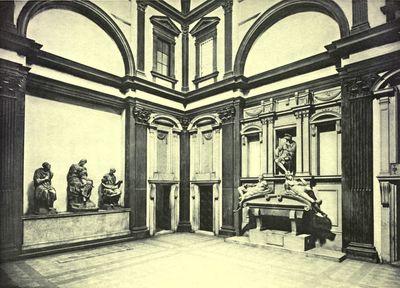
THE NEW SACRISTY (After Michelagnolo. Florence: S. Lorenzo) Alinari View larger image
Many and various were the discussions that arose on this subject, on the ground that such a work as that façade should have been distributed among several persons, and in the matter of the architecture many craftsmen flocked to Rome to see the Pope, and made designs; Baccio d'Agnolo, Antonio da San Gallo, Andrea Sansovino and Jacopo Sansovino, and the gracious Raffaello da Urbino, who was afterwards summoned to Florence for that purpose at the time of the Pope's visit. Thereupon Michelagnolo resolved to make a model and not to accept anyone beyond himself as his guide or superior in the architecture of such a work; but this refusal of assistance was the reason that neither he nor any other executed the work, and that those masters returned in despair to their customary pursuits. Michelagnolo, going to Carrara, had an order authorizing that a thousand crowns should be paid to him by Jacopo Salviati; but on his arrival Jacopo was shut up in his room on business with some citizens, and Michelagnolo, refusing to wait for an audience, departed without saying a word and went straightway to Carrara. Jacopo heard of Michelagnolo's arrival, and, not finding him in Florence, sent him a thousand crowns to Carrara. The messenger demanded that Michelagnolo should write him a receipt, to which he answered that the money was for the expenses of the Pope and not for his own interest, and that the messenger might take it back, but that he was not accustomed to write out quittances or receipts for others; whereupon the other returned in alarm to Jacopo without a receipt.
While Michelagnolo was at Carrara and was having marble quarried for the tomb of Julius, thinking at length to finish it, no less than for the façade, a letter was written to him saying that Pope Leo had heard that in the mountains of Pietrasanta near Seravezza, in the Florentine dominion, at the summit of the highest mountain, which is called Monte Altissimo, there were marbles of the same excellence and beauty as those of Carrara. This Michelagnolo already knew, but it seems that he would not take advantage of it because of his friendship with the Marchese Alberigo, Lord of Carrara, and, in order to do him a good service, chose to quarry those of Carrara rather than those of Seravezza; or it may have been that he judged it to be a long undertaking and likely to waste much time, as indeed it did. However, he was forced to go to Seravezza, although he pleaded in protest that it would be more difficult and costly, as in truth it was, especially at the beginning, and, moreover, that the report about the marble was perhaps not true; but for all that the Pope would not hear a word of objection. Thereupon it was decided to make a road for several miles through the mountains, breaking down rocks with hammers and pickaxes to obtain a level, and sinking piles in the marshy places; and there Michelagnolo spent many years in executing the wishes of the Pope. Finally five columns of the proper size were excavated, one of which is on the Piazza di S. Lorenzo in Florence, and the others are on the sea-shore. And for this reason the Marchese Alberigo, who saw his business ruined, became the bitter enemy of Michelagnolo, who was not to blame. Michelagnolo, in addition to these columns, excavated many other marbles there, which are still in the quarries, abandoned there for more than thirty years. But at the present day Duke Cosimo has given orders for the road to be finished, of which there are still two miles to make over very difficult ground, for the transportation of these marbles, and also a road from another quarry of excellent marble that was discovered at that time by Michelagnolo, in order to be able to finish many beautiful undertakings. In the same district of Seravezza he discovered a mountain of variegated marble that is very hard and very beautiful, below Stazema, a village in those mountains; where the same Duke Cosimo has caused a paved road of more than four miles to be made, for conveying the marble to the sea.
But to return to Michelagnolo: having gone back to Florence, he lost much time now in one thing and now in another. And he made at that time for the Palace of the Medici a model for the knee-shaped windows of those rooms that are at the corner, where Giovanni da Udine adorned the chamber in stucco and painting, which is a much extolled work; and he caused to be made for them by the goldsmith Piloto, but under his own direction, those jalousies of perforated copper, which are certainly admirable things. Michelagnolo consumed many years in quarrying marbles, although it is true that while they were being excavated he made models of wax and other things for the work. But this undertaking was delayed so long, that the money assigned by the Pope for the purpose was spent on the war in Lombardy; and at the death of Leo the work was left unfinished, nothing being accomplished save the laying of a foundation in front to support it, and the transportation of a large column of marble from Carrara to the Piazza di S. Lorenzo.
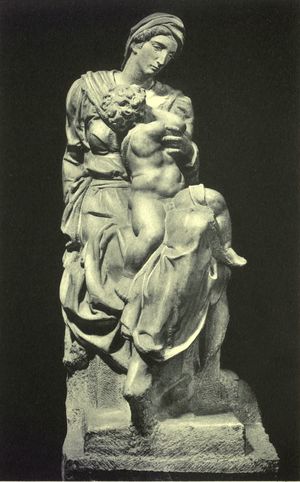
MADONNA AND CHILD (After Michelagnolo. Florence: New Sacristy of S. Lorenzo) Anderson View larger image
The death of Leo completely dismayed the craftsmen and the arts both in Rome and in Florence; and while Adrian VI was alive Michelagnolo gave his attention in Florence to the tomb of Julius. But after the death of Adrian Clement VII was elected, who was no less desirous than Leo and his other predecessors to leave his fame established by the arts of architecture, sculpture, and painting. At this time, which was the year 1525, Giorgio Vasari was taken as a little boy to Florence by the Cardinal of Cortona, and placed with Michelagnolo to learn art. But Michelagnolo was then summoned to Rome by Pope Clement VII, who had made a beginning with the library of S. Lorenzo and also the new sacristy, in which he proposed to place the marble tombs that he was having made for his forefathers; and he resolved that Vasari should go to work with Andrea del Sarto until he should himself be free again, and went in person to Andrea's workshop to present him.
Michelagnolo departed for Rome in haste, harassed once again by Francesco Maria, Duke of Urbino, the nephew of Pope Julius, who complained of him, saying that he had received sixteen thousand crowns for the above-named tomb, yet was living a life of pleasure in Florence; and he threatened in his anger that, if Michelagnolo did not give his attention to the work, he would make him rue it. Having arrived in Rome, Pope Clement, who wished to make use of him, advised him to draw up his accounts with the agents of the Duke, believing that after all that he had done he must be their creditor rather than their debtor; and so the matter rested. After discussing many things together, they resolved to finish completely the library and new sacristy of S. Lorenzo in Florence. Michelagnolo therefore departed from Rome, and raised the cupola that is now to be seen, causing it to be wrought in various orders of composition; and he had a ball with seventy-two faces made by the goldsmith Piloto, which is very beautiful. It happened, while Michelagnolo was raising the cupola, that he was asked by some friends, "Should you not make your lantern very different from that of Filippo Brunelleschi?" And he answered them, "Different it can be made with ease, but better, no." He made four tombs in that sacristy, to adorn the walls and to contain the bodies of the fathers of the two Popes, the elder Lorenzo and his brother Giuliano, and those of Giuliano, the brother of Leo, and of Duke Lorenzo, his nephew. And since he wished to execute the work in imitation of the old sacristy that Filippo Brunelleschi had built, but with another manner of ornamentation, he made in it an ornamentation in a composite order, in a more varied and more original manner than any other master at any time, whether ancient or modern, had been able to achieve, for in the novelty of the beautiful cornices, capitals, bases, doors, tabernacles, and tombs, he departed not a little from the work regulated by measure, order, and rule, which other men did according to a common use and after Vitruvius and the antiquities, to which he would not conform. That licence has done much to give courage to those who have seen his methods to set themselves to imitate him, and new fantasies have since been seen which have more of the grotesque than of reason or rule in their ornamentation. Wherefore the craftsmen owe him an infinite and everlasting obligation, he having broken the bonds and chains by reason of which they had always followed a beaten path in the execution of their works. And even more did he demonstrate and seek to make known such a method afterwards in the library of S. Lorenzo, at the same place; in the beautiful distribution of the windows, in the pattern of the ceiling, and in the marvellous entrance of the vestibule. Nor was there ever seen a more resolute grace, both in the whole and in the parts, as in the consoles, tabernacles, and cornices, nor any staircase more commodious; in which last he made such bizarre breaks in the outlines of the steps, and departed so much from the common use of others, that everyone was amazed.
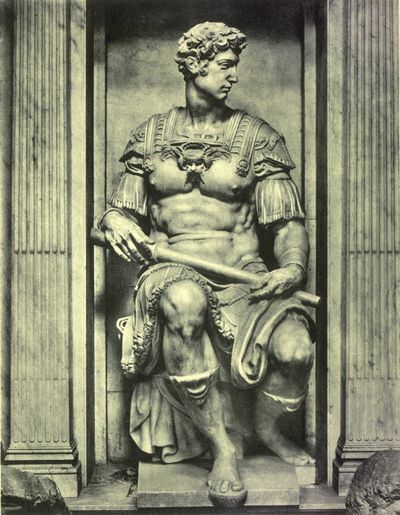
GIULIANO DE' MEDICI (After Michelagnolo. Florence: New Sacristy of S. Lorenzo) Anderson View larger image
At this time he sent his disciple Pietro Urbano of Pistoia to Rome to carry to completion a nude Christ holding the Cross, a most admirable figure, which was placed beside the principal chapel of the Minerva, at the commission of Messer Antonio Metelli. About the same time there took place the sack of Rome and the expulsion of the Medici from Florence; by reason of which upheaval those who governed the city of Florence resolved to rebuild the fortifications, and therefore made Michelagnolo Commissary General over all that work. Whereupon he made designs and caused fortifications to be built for several parts of the city, and finally encircled the hill of San Miniato with bastions, which he made not with sods of earth, wood, and bundles of brushwood, as is generally done, but with a stout base of chestnut, oak, and other good materials interwoven, and in place of sods he took unbaked bricks made with tow and the dung of cattle, squared with very great diligence. And for this reason he was sent by the Signoria of Florence to Ferrara, to inspect the fortifications of Duke Alfonso I, and so also his artillery and munitions; where he received many courtesies from that lord, who besought him that he should do something for him with his own hand at his leisure, and Michelagnolo promised that he would. After his return, he was continually engaged in fortifying the city, but, although he was thus occupied, nevertheless he kept working at a picture of a Leda for that Duke, painted with his own hand in distemper-colours, which was a divine thing, as will be related in the proper place; also continuing the statues for the tombs of S. Lorenzo, but in secret. At this time Michelagnolo spent some six months on the hill of San Miniato in order to press on the fortification of that hill, because if the enemy became master of it, the city was lost; and so he pursued these undertakings with the utmost diligence.
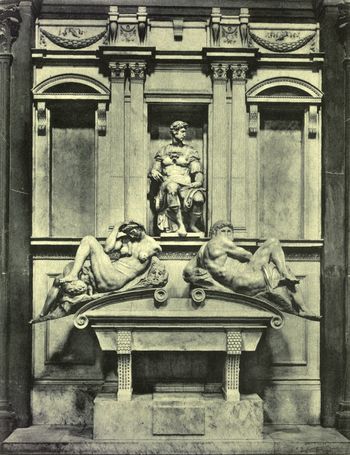
TOMB OF GIULIANO DE' MEDICI (After Michelagnolo. Florence: New Sacristy of S. Lorenzo) Anderson View larger image
At this same time he continued the work in the above-mentioned sacristy, in which were seven statues that were left partly finished and partly not. With these, and with the architectural inventions of the tombs, it must be confessed that he surpassed every man in these three professions; to which testimony is borne by the statues of marble, blocked out and finished by him, which are to be seen in that place. One is Our Lady, who is in a sitting attitude, with the right leg crossed over the left and one knee placed upon the other, and the Child, with the thighs astride the leg that is uppermost, turns in a most beautiful attitude towards His Mother, hungry for her milk, and she, while holding Him with one hand and supporting herself with the other, bends forward to give it to Him; and although the figure is not equal in every part, and it was left rough and showing the marks of the gradine, yet with all its imperfections there may be recognized in it the full perfection of the work. Even more did he cause everyone to marvel by the circumstance that in making the tombs of Duke Giuliano and Duke Lorenzo de' Medici he considered that earth alone was not enough to give them honourable burial in their greatness, and desired that all the phases of the world should be there, and that their sepulchres should be surrounded and covered by four statues; wherefore he gave to one Night and Day, and to the other Dawn and Twilight; which statues, most beautifully wrought in form, in attitude, and in the masterly treatment of the muscles, would suffice, if that art were lost, to restore her to her pristine lustre. There, among the other statues, are the two Captains, armed; one the pensive Duke Lorenzo, the very presentment of wisdom, with legs so beautiful and so well wrought, that there is nothing better to be seen by mortal eye; and the other is Duke Giuliano, so proud a figure, with the head, the throat, the setting of the eyes, the profile of the nose, the opening of the mouth, and the hair all so divine, to say nothing of the hands, arms, knees, feet, and, in short, every other thing that he carved therein, that the eye can never be weary or have its fill of gazing at them; and, of a truth, whoever studies the beauty of the buskins and the cuirass, believes it to be celestial rather than mortal. But what shall I say of the Dawn, a nude woman, who is such as to awaken melancholy in the soul and to render impotent the style of sculpture? In her attitude may be seen her effort, as she rises, heavy with sleep, and raises herself from her downy bed; and it seems that in awakening she has found the eyes of that great Duke closed in death, so that she is agonized with bitter grief, weeping in her own unchangeable beauty in token of her great sorrow. And what can I say of the Night, a statue not rare only, but unique? Who is there who has ever seen in that art in any age, ancient or modern, statues of such a kind? For in her may be seen not only the stillness of one sleeping, but the grief and melancholy of one who has lost a great and honoured possession; and we must believe that this is that night of darkness that obscures all those who thought for some time, I will not say to surpass, but to equal Michelagnolo in sculpture and design. In that statue is infused all the somnolence that is seen in sleeping forms; wherefore many verses in Latin and rhymes in the vulgar tongue were written in her praise by persons of great learning, such as these, of which the author is not known—
La Notte che tu vedi in si dolci atti Dormire, fu da un Angelo scolpita In questo sasso; e perche dorme, ha vita. Destala, se no 'l credi, e parleratti.
To which Michelagnolo, speaking in the person of Night, answered thus—
Grato mi è il sonno, e più l'esser di sasso; Mentre che il danno e la vergogna dura, Non veder' non sentir' m'è gran ventura. Però non mi destar'; deh parla basso.
Truly, if the enmity that there is between Fortune and Genius, between the envy of the one and the excellence of the other, had not prevented such a work from being carried to completion, Art was like to prove to Nature that she surpassed her by a great measure in every conception.
While Michelagnolo was labouring with the greatest solicitude and love at these works, there came in 1529 the siege of Florence, which hindered their completion only too effectually, and was the reason that he did little or no more work upon them, the citizens having laid upon him the charge of fortifying not only the hill of S. Miniato, but also the city, as we have related. And thus, having lent a thousand crowns to that Republic, and being elected one of the Nine, a military Council appointed for the war, he turned all his mind and soul to perfecting those fortifications. But in the end, when the enemy had closed round the city, and all hope of assistance was failing little by little, and the difficulties of maintaining the defence were increasing, and it appeared to Michelagnolo that he was in a sorry pass with regard to his personal safety, he determined to leave Florence and make his way to Venice, without making himself known to anyone on the road. He set out secretly, therefore, by way of the hill of S. Miniato, without anyone knowing of it, taking with him Antonio Mini, his disciple, and the goldsmith Piloto, his faithful friend; and each of them carried a number of crowns on his person, sewn into his quilted doublet. Having arrived in Ferrara, they rested there; and it happened that on account of the alarm caused by the war and the league of the Emperor and the Pope, who were besieging Florence, Duke Alfonso d'Este was keeping strict watch in Ferrara, and required to be secretly informed by the hosts who gave lodging to travellers of the names of all those who lodged with them from one day to another; and he caused a list of all foreigners, with their nationality, to be brought to him every day. It came to pass, then, that when Michelagnolo had dismounted with his companions, intending to stay there without revealing himself, this became known in that way to the Duke, who was very glad, because he had already become his friend. That Prince was a man of lofty mind, delighting constantly in persons of ability all his life long, and he straightway sent some of the first men of his Court with orders to conduct him in the name of his Excellency to the Palace, where the Duke was, to remove thither his horses and all his baggage, and to give him a handsome lodging in that Palace. Michelagnolo, finding himself in the power of another, was constrained to obey and to make the best of a bad business, and he went with those courtiers to the Duke, but without removing his baggage from the inn. Thereupon the Duke, after first complaining of his reserve, gave him a great reception; and then, making him rich and honourable presents, he sought to detain him in Ferrara with the promise of a fine salary. He, having his mind set on something else, would not consent to remain; but the Duke again made him a free offer of all that was in his power, praying him that he should at least not depart as long as the war continued. Whereupon Michelagnolo, not wishing to be outdone in courtesy, thanked him warmly, and, turning towards his two companions, said that he had brought twelve thousand crowns to Ferrara, and that, if the Duke had need of them, they were at his disposal, together with himself. The Duke then took him through the Palace to divert him, as he had done on another occasion, and showed him all the beautiful things that he had there, including a portrait of himself by Tiziano, which was much commended by Michelagnolo. However, his Excellency was not able to keep him in the Palace, for he insisted on returning to the inn; wherefore the host who was lodging him received from the Duke a great abundance of things wherewith to do him honour, and also orders that at his departure he should not accept anything for his lodging. From Ferrara he made his way to Venice, where many gentlemen sought to become known to him; but he, who always had a very poor opinion of their knowledge of his profession, departed from the Giudecca, where he had his lodging. There, so it is said, he made for that city at that time, at the request of the Doge Gritti, a design for the bridge of the Rialto, which was very rare in invention and in ornamentation.
Michelagnolo was invited with great insistence to go back to his native country, being urgently requested not to abandon his undertaking there, and receiving a safe-conduct; and finally, vanquished by love of her, he returned, but not without danger to his life. At this time he finished the Leda that he was painting, as has been related, at the request of Duke Alfonso; and it was afterwards taken to France by Antonio Mini, his disciple. And at this same time he saved the campanile of S. Miniato, a tower which sorely harassed the enemy's forces with its two pieces of artillery, so that their artillerists, having set to work to batter it with heavy cannon, had half ruined it, and were like to destroy it completely, when Michelagnolo protected it so well with bales of wool and stout mattresses suspended by cords, that it is still standing. It is said, also, that at the time of the siege there came to him an opportunity to acquire, according to a desire that he had long had, a block of marble of nine braccia which had come from Carrara, and which Pope Clement, after much rivalry and contention between him and Baccio Bandinelli, had given to Baccio. But Michelagnolo, now that such a matter was in the hands of the Commonwealth, asked for it from the Gonfalonier, who gave it to him that he might likewise try his hand upon it, although Baccio had already made a model and hacked away much of the stone in blocking it out. Thereupon Michelagnolo made a model, which was held to be a marvellous and very beautiful thing; but on the return of the Medici the marble was restored to Baccio.
When peace had been made, Baccio Valori, the Pope's Commissioner, received orders to have some of the most partisan citizens arrested and imprisoned in the Bargello, and the same tribunal sought out Michelagnolo at his house; but he, fearing that, had fled secretly to the house of one who was much his friend, where he remained hidden many days. Finally, when the first fury had abated, Pope Clement, remembering the ability of Michelagnolo, caused a diligent search to be made for him, with orders that nothing should be said to him, but rather that his former appointments should be restored to him, and that he should attend to the work of S. Lorenzo, over which he placed as proveditor M. Giovan Battista Figiovanni, the old servant of the Medici family and Prior of S. Lorenzo. Thus reassured, Michelagnolo, in order to make Baccio Valori his friend, began a figure of three braccia in marble, which was an Apollo drawing an arrow from his quiver, and carried it almost to completion. It is now in the apartment of the Prince of Florence, and is a very rare work, although it is not completely finished.
At this time a certain gentleman was sent to Michelagnolo by Duke Alfonso of Ferrara, who, having heard that the master had made some rare work for him with his own hand, did not wish to lose such a jewel. Having arrived in Florence and found Michelagnolo, the envoy presented to him letters of recommendation from that lord; whereupon Michelagnolo, receiving him courteously, showed him the Leda embracing the Swan that he had painted, with Castor and Pollux issuing from the Egg, in a large picture executed in distemper, as it were with the breath. The Duke's envoy, thinking from the praise that he heard everywhere of Michelagnolo that he should have done something great, and not recognizing the excellence and artistry of that figure, said to Michelagnolo: "Oh, this is but a trifle." Michelagnolo, knowing that no one is better able to pronounce judgment on works than those who have had long practise in them, asked him what was his vocation. And he answered, with a sneer, "I am a merchant"; believing that he had not been recognized by Michelagnolo as a gentleman, and as it were making fun of such a question, and at the same time affecting to despise the industry of the Florentines. Michelagnolo, who had understood perfectly the meaning of his words, at once replied: "You will find you have made a bad bargain this time for your master. Get you gone out of my sight."
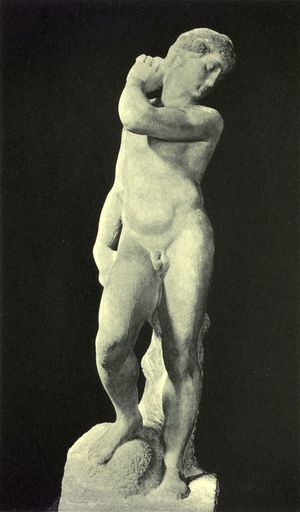
APOLLO (After Michelagnolo. Florence: Museo Nazionale) Alinari View larger image
Now in those days Antonio Mini, his disciple, who had two sisters waiting to be married, asked him for the Leda, and he gave it to him willingly, with the greater part of the designs and cartoons that he had made, which were divine things, and also two chests full of models, with a great number of finished cartoons for making pictures, and some of works that had been painted. When Antonio took it into his head to go to France, he carried all these with him; the Leda he sold to King Francis by means of some merchants, and it is now at Fontainebleau, but the cartoons and designs were lost, for he died there in a short time, and some were stolen; and so our country was deprived of all these valuable labours, which was an incalculable loss. The cartoon of the Leda has since come back to Florence, and Bernardo Vecchietti has it; and so also four pieces of the cartoons for the chapel, with nudes and Prophets, brought back by the sculptor Benvenuto Cellini, and now in the possession of the heirs of Girolamo degli Albizzi.
It became necessary for Michelagnolo to go to Rome to see Pope Clement, who, although angry with him, yet, as the friend of every talent, forgave him everything, and gave him orders that he should return to Florence and have the library and sacristy of S. Lorenzo completely finished; and, in order to shorten that work, a vast number of statues that were to be included in it were distributed among other masters. Two he allotted to Tribolo, one to Raffaello da Montelupo, and one to Fra Giovanni Agnolo, the Servite friar, all sculptors; and he gave them assistance in these, making rough models in clay for each of them. Whereupon they all worked valiantly, and he, also, caused work to be pursued on the library, and thus the ceiling was finished in carved woodwork, which was executed after his models by the hands of the Florentines Carota and Tasso, excellent carvers and also masters of carpentry; and likewise the shelves for the books, which were executed at that time by Battista del Cinque and his friend Ciappino, good masters in that profession. And in order to give the work its final perfection there was summoned to Florence the divine Giovanni da Udine, who, together with others his assistants and also some Florentine masters, decorated the tribune with stucco; and they all sought with great solicitude to give completion to that vast undertaking.
Now, just as Michelagnolo was about to have the statues carried into execution, at that very time the Pope took it into his head to have him near his person, being desirous to have the walls of the Chapel of Sixtus painted, where Michelagnolo had painted the vaulting for Julius II, his nephew. On the principal wall, where the altar is, Clement wished him to paint the Universal Judgment, to the end that he might display in that scene all that the art of design could achieve, and opposite to it, on the other wall, over the principal door, he had commanded that he should depict the scene when Lucifer was expelled for his pride from Heaven, and all those Angels who sinned with him were hurled after him into the centre of Hell: of which inventions it was found that Michelagnolo many years before had made various sketches and designs, one of which was afterwards carried into execution in the Church of the Trinità at Rome by a Sicilian painter, who stayed many months with Michelagnolo, to serve him and to grind his colours. This work, painted in fresco, is in the Chapel of S. Gregorio, in the cross of the church, and, although it is executed badly, there is a certain variety and terrible force in the attitudes and groups of those nudes that are raining down from Heaven, and of the others who, having fallen into the centre of the earth, are changed into various forms of Devils, very horrible and bizarre; and it is certainly an extraordinary fantasy. While Michelagnolo was directing the preparation of the designs and cartoons of the Last Judgment on the first wall, he never ceased for a single day to be at strife with the agents of the Duke of Urbino, by whom he was accused of having received sixteen thousand crowns from Julius II for the tomb. This accusation was more than he could bear, and he desired to finish the work some day, although he was already an old man, and he would have willingly stayed in Rome to finish it, now that he had found, without seeking it, such a pretext for not returning any more to Florence, since he had a great fear of Duke Alessandro de' Medici, whom he regarded as little his friend; for, when the Duke had given him to understand through Signor Alessandro Vitelli that he should select the best site for the building of the castle and citadel of Florence, he answered that he would not go save at the command of Pope Clement.
Finally an agreement was formed in the matter of the tomb, that it should be finished in the following manner: there was no longer to be an isolated tomb in a rectangular shape, but only one of the original façades, in the manner that best pleased Michelagnolo, and he was to be obliged to place in it six statues by his own hand. In this contract that was made with the Duke of Urbino, his Excellency consented that Michelagnolo should be at the disposal of Pope Clement for four months in the year, either in Florence or wherever he might think fit to employ him. But, although it seemed to Michelagnolo that at last he had obtained some peace, he was not to be quit of it so easily, for Pope Clement, desiring to see the final proof of the force of his art, kept him occupied with the cartoon of the Judgment. However, contriving to convince the Pope that he was thus engaged, at the same time he kept working in secret, never relaxing his efforts, at the statues that were going into the above-named tomb.
In the year 1533[1] came the death of Pope Clement, whereupon the work of the library and sacristy in Florence, which had remained unfinished in spite of all the efforts made to finish it, was stopped. Then, at length, Michelagnolo thought to be truly free and able to give his attention to finishing the tomb of Julius II. But Paul III, not long after his election, had him summoned to his presence, and, besides paying him compliments and making him offers, requested him to enter his service and remain near his person. Michelagnolo refused, saying that he was not able to do it, being bound by contract to the Duke of Urbino until the tomb of Julius should be finished. The Pope flew into a rage and said: "I have had this desire for thirty years, and now that I am Pope do you think I shall not satisfy it? I shall tear up the contract, for I am determined to have you serve me, come what may." Michelagnolo, hearing this resolution, was tempted to leave Rome and in some way find means to give completion to the tomb; however, fearing, like a wise man, the power of the Pope, he resolved to try to keep him pacified with words, seeing that he was so old, until something should happen. The Pope, who wished to have some extraordinary work executed by Michelagnolo, went one day with ten Cardinals to visit him at his house, where he demanded to see all the statues for the tomb of Julius, which appeared to him marvellous, and particularly the Moses, which figure alone was said by the Cardinal of Mantua to be enough to do honour to Pope Julius. And after seeing the designs and cartoons that he was preparing for the wall of the chapel, which appeared to the Pope to be stupendous, he again besought Michelagnolo with great insistence that he should enter his service, promising that he would persuade the Duke of Urbino to content himself with three statues, and that the others should be given to other excellent masters to execute after his models. Whereupon, his Holiness having arranged this with the agents of the Duke, a new contract was made, which was confirmed by the Duke; and Michelagnolo of his own free will bound himself to pay for the other three statues and to have the tomb erected, depositing for this purpose in the bank of the Strozzi one thousand five hundred and eighty ducats. This he might have avoided, and it seemed to him that he had truly done enough to be free of such a long and troublesome undertaking; and afterwards he caused the tomb to be erected in S. Pietro in Vincola in the following manner. He erected the lower base, which was all carved, with four pedestals which projected outwards as much as was necessary to give space for the captive that was originally intended to stand on each of them, instead of which there was left a terminal figure; and since the lower part had thus a poor effect, he placed at the feet of each terminal figure a reversed console resting on the pedestal. Those four terminal figures had between them three niches, two of which (those at the sides) were round, and were to have contained the Victories. Instead of the Victories, he placed in one Leah, the daughter of Laban, to represent the Active Life, with a mirror in her hand to signify the consideration that we should give to our actions, and in the other hand a garland of flowers, to denote the virtues that adorn our life during its duration, and make it glorious after death; and the other figure was her sister Rachel, representing the Contemplative Life, with the hands clasped and one knee bent, and on the countenance a look as of ecstasy of spirit. These statues Michelagnolo executed with his own hand in less than a year. In the centre is the other niche, rectangular in shape, which in the original design was to have been one of the doors that were to lead into the little oval temple of the rectangular tomb; this having become a niche, there is placed in it, upon a dado of marble, the gigantic and most beautiful statue of Moses, of which we have already said enough. Above the heads of the terminal figures, which form capitals, are architrave, frieze, and cornice, which project beyond those figures and are carved with rich ornaments, foliage, ovoli, dentils, and other rich members, distributed over the whole work. Over that cornice rises another course, smooth and without carvings, but with different terminal figures standing directly above those below, after the manner of pilasters, with a variety of cornice-members; and since this course accompanies that below and resembles it in every part, there is in it a space similar to the other, forming a niche like that in which there is now the Moses, and in the niche, resting on projections of the cornice, is a sarcophagus of marble with the recumbent statue of Pope Julius, executed by the sculptor Maso dal Bosco, while in that niche, also, there stands a Madonna who is holding her Son in her arms, wrought by the sculptor Scherano da Settignano from a model by Michelagnolo; which statues are passing good. In two other rectangular niches, above the Active and the Contemplative Life, are two larger statues, a Prophet and a Sibyl seated, which were both executed by Raffaello da Montelupo, as has been related in the Life of his father Baccio, but little to the satisfaction of Michelagnolo. For its crowning completion this work had a different cornice, which, like those below, projected over the whole work; and above the terminal figures, as a finish, were candelabra of marble, with the arms of Pope Julius in the centre. Above the Prophet and the Sibyl, in the recess of each niche, he made a window for the convenience of the friars who officiate in that church, the choir having been made behind; which windows serve to send their voices into the church when they say the divine office, and permit the celebration to be seen. Truly this whole work has turned out very well, but not by a great measure as it had been planned in the original design.
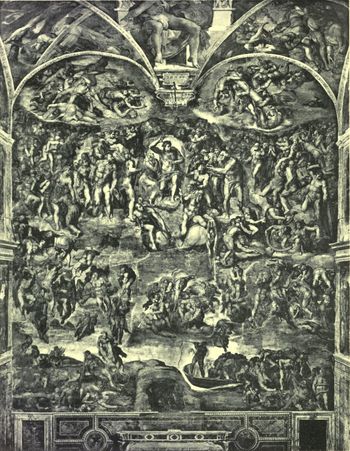
THE LAST JUDGMENT (After the fresco by Michelagnolo. Rome: The Vatican, Sistine Chapel) Anderson View larger image
Michelagnolo resolved, since he could not do otherwise, to serve Pope Paul, who allowed him to continue the work as ordered by Clement, without changing anything in the inventions and the general conception that had been laid before him, thus showing respect for the genius of that great man, for whom he felt such reverence and love that he sought to do nothing but what pleased him; of which a proof was soon seen. His Holiness desired to place his own arms beneath the Jonas in the chapel, where those of Pope Julius II had previously been put; but Michelagnolo, being asked to do this, and not wishing to do a wrong to Julius and Clement, would not place them there, saying that they would not look well; and the Pope, in order not to displease him, was content to have it so, having recognized very well the excellence of such a man, and how he always followed what was just and honourable without any adulation or respect of persons—a thing that the great are wont to experience very seldom. Michelagnolo, then, caused a projection of well baked and chosen bricks to be carefully built on the wall of the above-named chapel (a thing which was not there before), and contrived that it should overhang half a braccio from above, so that neither dust nor any other dirt might be able to settle upon it. But I will not go into the particulars of the invention and composition of this scene, because so many copies of it, both large and small, have been printed, that it does not seem necessary to lose time in describing it. It is enough for us to perceive that the intention of this extraordinary man has been to refuse to paint anything but the human body in its best proportioned and most perfect forms and in the greatest variety of attitudes, and not this only, but likewise the play of the passions and contentments of the soul, being satisfied with justifying himself in that field in which he was superior to all his fellow-craftsmen, and to lay open the way of the grand manner in the painting of nudes, and his great knowledge in the difficulties of design; and, finally, he opened out the way to facility in this art in its principal province, which is the human body, and, attending to this single object, he left on one side the charms of colouring and the caprices and new fantasies of certain minute and delicate refinements which many other painters, perhaps not without some show of reason, have not entirely neglected. For some, not so well grounded in design, have sought with variety of tints and shades of colouring, with various new and bizarre inventions, and, in short, with the other method, to win themselves a place among the first masters; but Michelagnolo, standing always firmly rooted in his profound knowledge of art, has shown to those who know enough how they should attain to perfection.
But to return to the story: Michelagnolo had already carried to completion more than three-fourths of the work, when Pope Paul went to see it. And Messer Biagio da Cesena, the master of ceremonies, a person of great propriety, who was in the chapel with the Pope, being asked what he thought of it, said that it was a very disgraceful thing to have made in so honourable a place all those nude figures showing their nakedness so shamelessly, and that it was a work not for the chapel of a Pope, but for a bagnio or tavern. Michelagnolo was displeased at this, and, wishing to revenge himself, as soon as Biagio had departed he portrayed him from life, without having him before his eyes at all, in the figure of Minos with a great serpent twisted round the legs, among a heap of Devils in Hell; nor was Messer Biagio's pleading with the Pope and with Michelagnolo to have it removed of any avail, for it was left there in memory of the occasion, and it is still to be seen at the present day.
It happened at this time that Michelagnolo fell no small distance from the staging of this work, and hurt his leg; and in his pain and anger he would not be treated by anyone. Now there was living at this same time the Florentine Maestro Baccio Rontini, his friend, an ingenious physician, who had a great affection for his genius; and he, taking compassion on him, went one day to knock at his door. Receiving no answer either from the neighbours or from him, he so contrived to climb by certain secret ways from one room to another, that he came to Michelagnolo, who was in a desperate state. And then Maestro Biagio would never abandon him or take himself off until he was cured.
Having recovered from this injury, he returned to his labour, and, working at it continually, he carried it to perfect completion in a few months, giving such force to the paintings in the work, that he justified the words of Dante—
Morti li morti, i vivi parean vivi.
And here, also, may be seen the misery of the damned and the joy of the blessed. Wherefore, when this Judgment was thrown open to view, it proved that he had not only vanquished all the earlier masters who had worked there, but had sought to surpass the vaulting that he himself had made so famous, excelling it by a great measure and outstripping his own self. For he imagined to himself the terror of those days, and depicted, for the greater pain of all who have not lived well, the whole Passion of Christ, causing various naked figures in the air to carry the Cross, the Column, the Lance, the Sponge, the Nails, and the Crown of Thorns, all in different attitudes, executed to perfection in a triumph of facility over their difficulties. In that scene is Christ seated, with a countenance proud and terrible, turning towards the damned and cursing them; not without great fear in Our Lady, who, hearing and beholding that vast havoc, draws her mantle close around her. There are innumerable figures, Prophets and Apostles, that form a circle about Him, and in particular Adam and S. Peter, who are believed to have been placed there, one as the first parent of those thus brought to judgment, and the other as having been the first foundation of the Christian Church; and at His feet is a most beautiful S. Bartholomew, who is displaying his flayed skin. There is likewise a nude figure of S. Laurence; besides which, there are multitudes of Saints without number, both male and female, and other figures, men and women, around Him, near or distant, who embrace one another and make rejoicing, having received eternal blessedness by the grace of God and as the reward of their works. Beneath the feet of Christ are the Seven Angels with the Seven Trumpets described by S. John the Evangelist, who, as they sound the call to judgment, cause the hair of all who behold them to stand on end at the terrible wrath that their countenances reveal. Among others are two Angels that have each the Book of Life in the hands: and near them, on one side, not without beautiful consideration, are seen the Seven Mortal Sins in the forms of Devils, assailing and striving to drag down to Hell the souls that are flying towards Heaven, all with very beautiful attitudes and most admirable foreshortenings. Nor did he hesitate to show to the world, in the resurrection of the dead, how they take to themselves flesh and bones once more from the same earth, and how, assisted by others already alive, they go soaring towards Heaven, whence succour is brought to them by certain souls already blessed; not without evidence of all those marks of consideration that could be thought to be required in so great a work. For studies and labours of every kind were executed by him, which may be recognized throughout the whole work without exception; and this is manifested with particular clearness in the barque of Charon, who, in an attitude of fury, strikes with his oars at the souls dragged down by the Devils into the barque, after the likeness of the picture that the master's best-beloved poet, Dante, described when he said—
Caron demonio con occhi di bragia, Loro accennando, tutte le raccoglie, Batte col remo qualunque si adagia.
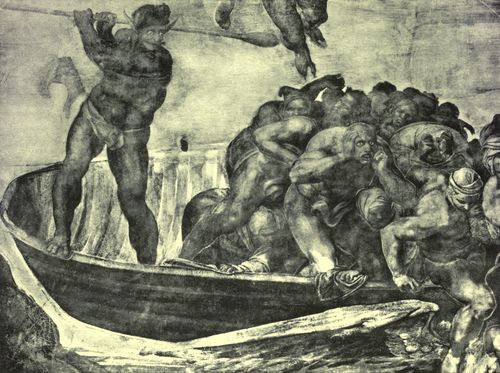
CHARON'S BOAT: DETAIL FROM THE LAST JUDGMENT (After the fresco by Michelagnolo. Rome: The Vatican, Sistine Chapel) Anderson View larger image
Nor would it be possible to imagine how much variety there is in the heads of those Devils, which are truly monsters from Hell. In the sinners may be seen sin and the fear of eternal damnation; and, to say nothing of the beauty of every detail, it is extraordinary to see so great a work executed with such harmony of painting, that it appears as if done in one day, and with such finish as was never achieved in any miniature. And, of a truth, the terrible force and grandeur of the work, with the multitude of figures, are such that it is not possible to describe it, for it is filled with all the passions known to human creatures, and all expressed in the most marvellous manner. For the proud, the envious, the avaricious, the wanton, and all the other suchlike sinners can be distinguished with ease by any man of fine perception, because in figuring them Michelagnolo observed every rule of Nature in the expressions, in the attitudes, and in every other natural circumstance; a thing which, although great and marvellous, was not impossible to such a man, for the reason that he was always observant and shrewd and had seen men in plenty, and had acquired by commerce with the world that knowledge that philosophers gain from cogitation and from writings. Wherefore he who has judgment and understanding in painting perceives there the most terrible force of art, and sees in those figures such thoughts and passions as were never painted by any other but Michelagnolo. So, also, he may see there how the variety of innumerable attitudes is accomplished, in the strange and diverse gestures of young and old, male and female; and who is there who does not recognize in these the terrible power of his art, together with the grace that he had from Nature, since they move the hearts not only of those who have knowledge in that profession, but even of those who have none? There are foreshortenings that appear as if in relief, a harmony of painting that gives great softness, and fineness in the parts painted by him with delicacy, all showing in truth how pictures executed by good and true painters should be; and in the outlines of the forms turned by him in such a way as could not have been achieved by any other but Michelagnolo, may be seen the true Judgment and the true Damnation and Resurrection. This is for our art the exemplar and the grand manner of painting sent down to men on earth by God, to the end that they may see how Destiny works when intellects descend from the heights of Heaven to earth, and have infused in them divine grace and knowledge. This work leads after it bound in chains those who persuade themselves that they have mastered art; and at the sight of the strokes drawn by him in the outlines of no matter what figure, every sublime spirit, however mighty in design, trembles and is afraid. And while the eyes gaze at his labours in this work, the senses are numbed at the mere thought of what manner of things all other pictures, those painted and those still unpainted, would appear if placed in comparison with such perfection. Truly blessed may he be called, and blessed his memories, who has seen this truly stupendous marvel of our age! Most happy and most fortunate Paul III, in that God granted that under thy protection should be acquired the renown that the pens of writers shall give to his memory and thine! How highly are thy merits enhanced by his genius! And what good fortune have the craftsmen had in this age from his birth, in that they have seen the veil of every difficulty torn away, and have beheld in the pictures, sculptures, and architectural works executed by him all that can be imagined and achieved!
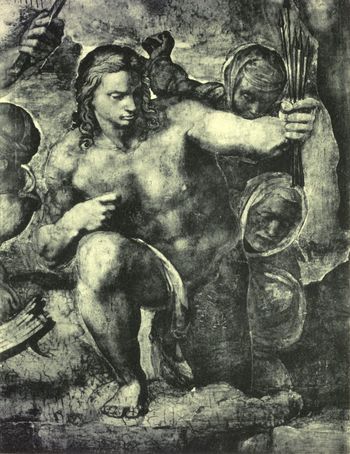
S. SEBASTIAN (After the fresco by Michelagnolo. Rome: The Vatican, Sistine Chapel) Anderson View larger image
He toiled eight years over executing this work, and threw it open to view in the year 1541, I believe, on Christmas day, to the marvel and amazement of all Rome, nay, of the whole world; and I, who was that year in Venice, and went to Rome to see it, was struck dumb by its beauty.
Pope Paul, as has been related, had caused a chapel called the Pauline to be erected on the same floor by Antonio da San Gallo, in imitation of that of Nicholas V; and in this he resolved that Michelagnolo should paint two great pictures with two large scenes. In one he painted the Conversion of S. Paul, with Jesus Christ in the air and a multitude of nude Angels making most beautiful movements, and below, all dazed and terrified, Paul fallen from his horse to the level of the ground, with his soldiers about him, some striving to raise him up, and others, struck with awe by the voice and splendour of Christ, are flying in beautiful attitudes and marvellous movements of panic, while the horse, taking to flight, appears to be carrying away in its headlong course him who seeks to hold it back; and this whole scene is executed with extraordinary design and art. In the other picture is the Crucifixion of S. Peter, who is fixed, a nude figure of rare beauty, upon the cross; showing the ministers of the crucifixion, after they have made a hole in the ground, seeking to raise the cross on high, to the end that he may remain crucified with his feet in the air; and there are many remarkable and beautiful considerations. Michelagnolo, as has been said elsewhere, gave his attention only to the perfection of art, and therefore there are no landscapes to be seen there, nor trees, nor buildings, nor any other distracting graces of art, for to these he never applied himself, as one, perchance, who would not abase his great genius to such things. These, executed by him at the age of seventy-five, were his last pictures, and, as he used himself to tell me, they cost him much fatigue, for the reason that painting, and particularly working in fresco, is no art for men who have passed a certain age. Michelagnolo arranged that Perino del Vaga, a very excellent painter, should decorate the vaulting with stucco and with many things in painting, after his designs, and such, also, was the wish of Pope Paul III; but the work was afterwards delayed, and nothing more was done, even as many undertakings are left unfinished, partly by the fault of want of resolution in the craftsmen, and partly by that of Princes little zealous in urging them on.
Pope Paul had made a beginning with the fortifying of the Borgo, and had summoned many gentlemen, together with Antonio da San Gallo, to a conference; but he wished that Michelagnolo also should have a part in this, knowing that the fortifications about the hill of S. Miniato in Florence had been constructed under his direction. After much discussion, Michelagnolo was asked what he thought; and he, having opinions contrary to San Gallo and many others, declared them freely. Whereupon San Gallo said to him that his arts were sculpture and painting, and not fortification. Michelagnolo replied that of sculpture and painting he knew little, but of fortification, what with the thought that he had devoted to it for a long time, and his experience in what he had done, it appeared to him that he knew more than either Antonio or any of his family; showing him in the presence of the company that he had made many errors in that art. Words rising high on either side, the Pope had to command silence; but no long time passed before Michelagnolo brought a design for all the fortifications of the Borgo, which laid open the way for all that has since been ordained and executed; and this was the reason that the great gate of S. Spirito, which was approaching completion under the direction of San Gallo, was left unfinished.
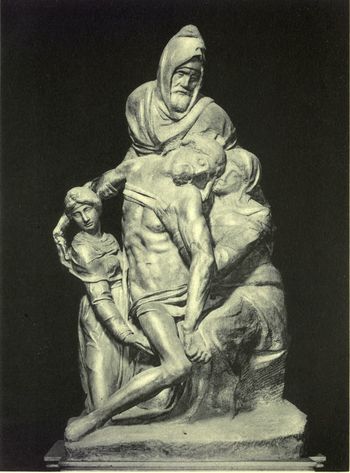
PIETÀ (After Michelagnolo. Florence: Duomo) Alinari View larger image
The spirit and genius of Michelagnolo could not rest without doing something; and, since he was not able to paint, he set to work on a piece of marble, intending to carve from it four figures in the round and larger than life, including a Dead Christ, for his own delight and to pass the time, and because, as he used to say, the exercise of the hammer kept him healthy in body. This Christ, taken down from the Cross, is supported by Our Lady, by Nicodemus, who bends down and assists her, planted firmly on his feet in a forceful attitude, and by one of the Maries, who also gives her aid, perceiving that the Mother, overcome by grief, is failing in strength and not able to uphold Him. Nor is there anywhere to be seen a dead form equal to that of Christ, who, sinking with the limbs hanging limp, lies in an attitude wholly different, not only from that of any other work by Michelagnolo, but from that of any other figure that was ever made. A laborious work is this, a rare achievement in a single stone, and truly divine; but, as will be related hereafter, it remained unfinished, and suffered many misfortunes, although Michelagnolo had intended that it should serve to adorn his own tomb, at the foot of that altar where he thought to place it.
It happened in the year 1546 that Antonio da San Gallo died; whereupon, there being now no one to direct the building of S. Pietro, many suggestions were made by the superintendents to the Pope as to who should have it. Finally his Holiness, inspired, I believe, by God, resolved to send for Michelagnolo. But he, when asked to take Antonio's place, refused it, saying, in order to avoid such a burden, that architecture was not his proper art; and in the end, entreaties not availing, the Pope commanded that he should accept it, whereupon, to his great displeasure and against his wish, he was forced to undertake that enterprise. And one day among others that he went to S. Pietro to see the wooden model that San Gallo had made, and to examine the building, he found there the whole San Gallo faction, who, crowding before Michelagnolo, said to him in the best terms at their command that they rejoiced that the charge of the building was to be his, and that the model was a field where there would never be any want of pasture. "You speak the truth," answered Michelagnolo, meaning to infer, as he declared to a friend, that it was good for sheep and oxen, who knew nothing of art. And afterwards he used to say publicly that San Gallo had made it wanting in lights, that it had on the exterior too many ranges of columns one above another, and that, with its innumerable projections, pinnacles, and subdivisions of members, it was more akin to the German manner than to the good method of the ancients or to the gladsome and beautiful modern manner; and, in addition to this, that it was possible to save fifty years of time and more than three hundred thousand crowns of money in finishing the building, and to execute it with more majesty, grandeur, and facility, greater beauty and convenience, and better ordered design. This he afterwards proved by a model that he made, in order to bring it to the form in which the work is now seen constructed; and thus he demonstrated that what he said was nothing but the truth. This model cost him twenty-five crowns, and was made in a fortnight; that of San Gallo, as has been related, cost four thousand, and took many years to finish. From this and other circumstances it became evident that that fabric was but a shop and a business for making money, and that it would be continually delayed, with the intention of never finishing it, by those who had undertaken it as a means of profit.
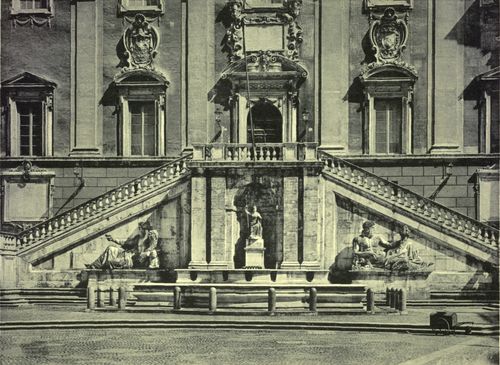
STAIRS OF THE PALACE OF THE SENATORS (After Michelagnolo. Rome: The Capitol) Anderson View larger image
Such methods did not please our upright Michelagnolo, and in order to get rid of all these people, while the Pope was forcing him to accept the office of architect to the work, he said to them openly one day that they should use all the assistance of their friends and do all that they could to prevent him from entering on that office, because, if he were to undertake such a charge, he would not have one of them about the building. Which words, spoken in public, were taken very ill, as may be believed, and were the reason that they conceived a great hatred against him, which increased every day as they saw the whole design being changed, both within and without, so that they would scarcely let him live, seeking out daily new and various devices to harass him, as will be related in the proper place. Finally the Pope issued a Motu-proprio creating him head of that fabric, with full authority, and giving him power to do or undo whatever he chose, and to add, take away, or vary anything at his pleasure; and he decreed that all the officials employed in the work should be subservient to his will. Whereupon Michelagnolo, seeing the great confidence and trust that the Pope placed in him, desired, in order to prove his generosity, that it should be declared in the Motu-proprio that he was serving in the fabric for the love of God and without any reward. It is true that the Pope had formerly granted to him the ferry over the river at Parma,[2] which yielded him about six hundred crowns; but he lost it at the death of Duke Pier Luigi Farnese, and in exchange for it he was given a Chancellery at Rimini, a post of less value. About that he showed no concern; and, although the Pope sent him money several times by way of salary, he would never accept it, to which witness is borne by Messer Alessandro Ruffini, Chamberlain to the Pope at that time, and by M. Pier Giovanni Aliotti, Bishop of Forlì. Finally the model that had been made by Michelagnolo was approved by the Pope; which model diminished S. Pietro in size, but gave it greater grandeur, to the satisfaction of all those who have judgment, although some who profess to be good judges, which in fact they are not, do not approve of it. He found that the four principal piers built by Bramante, and left by Antonio da San Gallo, which had to support the weight of the tribune, were weak; and these he partly filled up, and beside them he made two winding or spiral staircases, in which is an ascent so easy that the beasts of burden can climb them, carrying all the materials to the very top, and men on horseback, likewise, can go up to the uppermost level of the arches. The first cornice above the arches he constructed of travertine, curving in a round, which is an admirable and graceful thing, and very different from any other; nor could anything better of that kind be done. He also made a beginning with the two great recesses of the transepts; and whereas formerly, under the direction of Bramante, Baldassarre, and Raffaello, as has been related, eight tabernacles were being made on the side towards the Camposanto, and that plan was afterwards followed by San Gallo, Michelagnolo reduced these to three, with three chapels in the interior, and above them a vaulting of travertine, and a range of windows giving a brilliant light, which are varied in form and of a sublime grandeur. But, since these things are in existence, and are also to be seen in engraving, not only those of Michelagnolo, but those of San Gallo as well, I will not set myself to describe them, for it is in no way necessary. Let it suffice to say that he set himself, with all possible diligence, to cause the work to be carried on in those parts where the fabric was to be changed in design, to the end that it might remain so solid and stable that it might never be changed by another; which was the wise provision of a shrewd and prudent intellect, because it is not enough to do good work, if further precautions be not taken, seeing that the boldness and presumption of those who might be supposed to have knowledge if credit were placed rather in their words than in their deeds, and at times the favour of such as know nothing, may give rise to many misfortunes.
The Roman people, with the sanction of that Pope, had a desire to give some useful, commodious, and beautiful form to the Campidoglio, and to furnish it with colonnades, ascents, and inclined approaches with and without steps, and also with the further adornment of the ancient statues that were already there, in order to embellish that place. For this purpose they sought the advice of Michelagnolo, who made them a most beautiful and very rich design, in which, on the side where the Senatore stands, towards the east, he arranged a façade of travertine, and a flight of steps that ascends from two sides to meet on a level space, from which one enters into the centre of the hall of that Palace, with rich curving wings adorned with balusters that serve as supports and parapets. And there, to enrich that part, he caused to be placed on certain bases the two ancient figures in marble of recumbent River Gods, each of nine braccia, and of rare workmanship, one of which is the Tiber and the other the Nile; and between them, in a niche, is to go a Jove. On the southern side, where there is the Palace of the Conservatori, in order that it might be made rectangular, there followed a rich and well varied façade, with a loggia at the foot full of columns and niches, where many ancient statues are to go; and all around are various ornaments, doors, windows, and the like, of which some are already in place. On the other side from this, towards the north, below the Araceli, there is to follow another similar façade; and before it, towards the west, is to be an ascent of baston-like steps, which will be almost level, with a border and parapet of balusters; here will be the principal entrance, with a colonnade, and bases on which will be placed all that wealth of noble statues in which the Campidoglio is now so rich. In the middle of the Piazza, on a base in the form of an oval, is placed the famous bronze horse on which is the statue of Marcus Aurelius, which the same Pope Paul caused to be removed from the Piazza di Laterano, where Sixtus IV had placed it. This edifice is now being made so beautiful that it is worthy to be numbered among the finest works that Michelagnolo has executed, and it is being carried to completion at the present day under the direction of M. Tommaso de' Cavalieri, a Roman gentleman who was, and still is, one of the greatest friends that Michelagnolo ever had, as will be related hereafter.
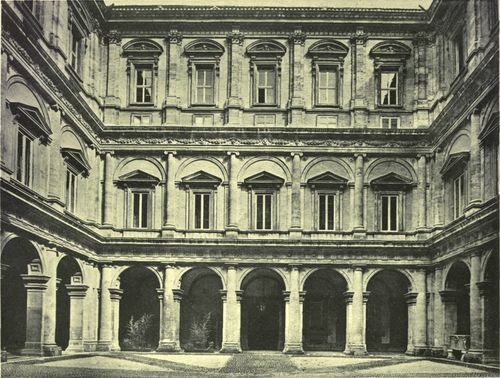
COURT OF THE PALAZZO FARNESE (After Michelagnolo. Rome) Anderson View larger image
Pope Paul III had caused San Gallo, while he was alive, to carry forward the Palace of the Farnese family, but the great upper cornice, to finish the roof on the outer side, had still to be constructed, and his Holiness desired that Michelagnolo should execute it from his own designs and directions. Michelagnolo, not being able to refuse the Pope, who so esteemed and favoured him, caused a model of wood to be made, six braccia in length, and of the size that it was to be; and this he placed on one of the corners of the Palace, so that it might show what effect the finished work would have. It pleased his Holiness and all Rome, and that part of it has since been carried to completion which is now to be seen, proving to be the most varied and the most beautiful of all that have ever been known, whether ancient or modern. On this account, after San Gallo was dead, the Pope desired that Michelagnolo should have charge of the whole fabric as well; and there he made the great marble window with the beautiful columns of variegated marble, which is over the principal door of the Palace, with a large escutcheon of great beauty and variety, in marble, of Pope Paul III, the founder of that Palace. Within the Palace he continued, above the first range of the court, the two other ranges, with the most varied, graceful, and beautiful windows, ornaments and upper cornice that have ever been seen, so that, through the labours and the genius of that man that court has now become the most handsome in Europe. He widened and enlarged the Great Hall, and set in order the front vestibule, and caused the vaulting of that vestibule to be constructed in a new variety of curve, in the form of a half oval.
Now in that year there was found at the Baths of Antoninus a mass of marble seven braccia in every direction, in which there had been carved by the ancients a Hercules standing upon a mound, who was holding the Bull by the horns, with another figure assisting him, and around that mound various figures of Shepherds, Nymphs, and different animals—a work of truly extraordinary beauty, showing figures so perfect in one single block without any added pieces, which was judged to have been intended for a fountain. Michelagnolo advised that it should be conveyed into the second court, and there restored so as to make it spout water in the original manner; all which advice was approved, and the work is still being restored at the present day with great diligence, by order of the Farnese family, for that purpose. At that time, also, Michelagnolo made a design for the building of a bridge across the River Tiber in a straight line with the Farnese Palace, to the end that it might be possible to go from that palace to another palace and gardens that they possessed in the Trastevere, and also to see at one glance in a straight line from the principal door which faces the Campo di Fiore, the court, the fountain, the Strada Giulia, the bridge, and the beauties of the other garden, even to the other door which opened on the Strada di Trastevere—a rare work, worthy of that Pontiff and of the judgment, design, and art of Michelagnolo.
In the year 1547 died Sebastiano Viniziano, the Friar of the Piombo; and, Pope Paul proposing that the ancient statues of his Palace should be restored, Michelagnolo willingly favoured the Milanese sculptor Guglielmo della Porta, a young man of promise, who had been recommended by the above-named Fra Sebastiano to Michelagnolo, who, liking his work, presented him to Pope Paul for the restoration of those statues. And the matter went so far forward that Michelagnolo obtained for him the office of the Piombo, and he then set to work on restoring the statues, some of which are to be seen in that Palace at the present day. But Guglielmo, forgetting the benefits that he had received from Michelagnolo, afterwards became one of his opponents.
In the year 1549 there took place the death of Pope Paul III; whereupon, after the election of Pope Julius III, Cardinal Farnese gave orders for a grand tomb to be made for his kinsman Pope Paul by the hand of Fra Guglielmo, who arranged to erect it in S. Pietro, below the first arch of the new church, beneath the tribune, which obstructed the floor of the church, and was, in truth, not the proper place. Michelagnolo advised, most judiciously, that it could not and should not stand there, and the Frate, believing that he was doing this out of envy, became filled with hatred against him; but afterwards he recognized that Michelagnolo had spoken the truth, and that the fault was his, in that he had had the opportunity and had not finished the work, as will be related in another place. And to this I can bear witness, for the reason that in the year 1550 I had gone by order of Pope Julius III to Rome to serve him (and very willingly, for love of Michelagnolo), and I took part in that discussion. Michelagnolo desired that the tomb should be erected in one of the niches, where there is now the Column of the Possessed, which was the proper place, and I had so gone to work that Julius III was resolving to have his own tomb made in the other niche with the same design as that of Pope Paul, in order to balance that work; but the Frate, who set himself against this, brought it about that his own was never finished after all, and that the tomb of the other Pontiff was also not made; which had all been predicted by Michelagnolo.
In the same year Pope Julius turned his attention to having a chapel of marble with two tombs constructed in the Church of S. Pietro a Montorio for Cardinal Antonio di Monte, his uncle, and Messer Fabiano, his grandfather, the first founder of the greatness of that illustrious house. For this work Vasari having made designs and models, Pope Julius, who always esteemed the genius of Michelagnolo and loved Vasari, desired that Michelagnolo should fix the price between them; and Vasari besought the Pope that he should prevail upon him to take it under his protection. Now Vasari had proposed Simone Mosca for the carvings of this work, and Raffaello da Montelupo for the statues; but Michelagnolo advised that no carvings of foliage should be made in it, not even in the architectural parts of the work, saying that where there are to be figures of marble there must not be any other thing. On which account Vasari feared that the work should be abandoned, because it would look poor; but in fact, when he saw it finished, he confessed that Michelagnolo had shown great judgment. Michelagnolo would not have Montelupo make the statues, remembering how badly he had acquitted himself in those of his own tomb of Julius II, and he was content, rather, that they should be entrusted to Bartolommeo Ammanati, whom Vasari had proposed, although Buonarroti had something of a private grievance against him, as also against Nanni di Baccio Bigio, caused by a reason which, if one considers it well, seems slight enough; for when they were very young, moved rather by love of art than by a desire to do wrong, they had entered with great pains into his house, and had taken from Antonio Mini, the disciple of Michelagnolo, many sheets with drawings; but these were afterwards all restored to him by order of the Tribunal of Eight, and, at the intercession of his friend Messer Giovanni Norchiati, Canon of S. Lorenzo, he would not have any other punishment inflicted on them. Vasari, when Michelagnolo spoke to him of this matter, said to him, laughing, that it did not seem to him that they deserved any blame, and that he himself, if he had ever been able, would have not taken a few drawings only, but robbed him of everything by his hand that he might have been able to seize, merely for the sake of learning art. One must look kindly, he said, on those who seek after excellence, and also reward them, and therefore such men must not be treated like those who go about stealing money, household property, and other things of value; and so the matter was turned into a jest. This was the reason that a beginning was made with the work of the Montorio, and that in the same year Vasari and Ammanati went to have the marble conveyed from Carrara to Rome for the execution of that work.
At that time Vasari was with Michelagnolo every day; and one morning the Pope in his kindness gave them both leave that they might visit the Seven Churches on horseback (for it was Holy Year), and receive the Pardon in company. Whereupon, while going from one church to another, they had many useful and beautiful conversations on art and every industry, and out of these Vasari composed a dialogue, which will be published at some more favourable opportunity, together with other things concerning art. In that year Pope Julius III confirmed the Motu-proprio of Pope Paul III with regard to the building of S. Pietro; and although much evil was spoken to him of Michelagnolo by the friends of the San Gallo faction, in the matter of that fabric of S. Pietro, at that time the Pope would not listen to a word, for Vasari had demonstrated to him (as was the truth) that Michelagnolo had given life to the building, and also persuaded his Holiness that he should do nothing concerned with design without the advice of Michelagnolo. This promise the Pope kept ever afterwards, for neither at the Vigna Julia did he do anything without his counsel, nor at the Belvedere, where there was built the staircase that is there now, in place of the semicircular staircase that came forward, ascending in eight steps, and turned inwards in eight more steps, erected in former times by Bramante in the great recess in the centre of the Belvedere. And Michelagnolo designed and caused to be built the very beautiful quadrangular staircase, with balusters of peperino-stone, which is there at the present day.
Vasari had finished in that year the printing of his work, the Lives of the Painters, Sculptors, and Architects, in Florence. Now he had not written the Life of any living master, although some who were old were still alive, save only of Michelagnolo; and in the book were many records of circumstances that Vasari had received from his lips, his age and his judgment being the greatest among all the craftsmen. Giorgio therefore presented the work to him, and he received it very gladly; and not long afterwards, having read it, Michelagnolo sent to him the following sonnet, written by himself, which I am pleased to include in this place in memory of his loving-kindness:
Se con lo stile o co' colori havete Alla Natura pareggiato l'Arte, Anzi a quella scemato il pregio in parte, Che 'l bel di lei più bello a noi rendete, Poichè con dotta man posto vi siete A più degno lavoro, a vergar carte, Quel che vi manca a lei di pregio in parte, Nel dar vita ad altrui tutto togliete. Che se secolo alcuno omai contese In far bell'opre, almen cedale, poi Che convien', ch'al prescritto fine arrive. Or le memorie altrui già spente accese Tornando fate, or che sien quelle, e voi, Mal grado d'esse, eternalmente vive.
Vasari departed for Florence, and left to Michelagnolo the charge of having the work founded in the Montorio. Now Messer Bindo Altoviti, the Consul of the Florentine colony at that time, was much the friend of Vasari, and on this occasion Giorgio said to him that it would be well to have this work erected in the Church of S. Giovanni de' Fiorentini, and that he had already spoken of it with Michelagnolo, who would favour the enterprise; and that this would be a means of giving completion to that church. This proposal pleased Messer Bindo, and, being very intimate with the Pope, he urged it warmly upon him, demonstrating that it would be well that the chapel and the tombs which his Holiness was having executed for the Montorio should be placed in the Church of S. Giovanni de' Fiorentini; adding that the result would be that with this occasion and this spur the Florentine colony would undertake such expenditure that the church would receive its completion, and, if his Holiness were to build the principal chapel, the other merchants would build six chapels, and then little by little all the rest. Whereupon the Pope changed his mind, and, although the model for the work was already made and the price arranged, went to the Montorio and sent for Michelagnolo, to whom Vasari was writing every day, receiving answers from him according to the opportunities presented in the course of affairs. Michelagnolo then wrote to Vasari, on the first day of August in 1550, of the change that the Pope had made; and these are his words, written in his own hand:
Rome.
"My dear Messer Giorgio,
"With regard to the founding of the work at S. Pietro a Montorio, and how the Pope would not listen to a word, I wrote you nothing, knowing that you are kept informed by your man here. Now I must tell you what has happened, which is as follows. Yesterday morning the Pope, having gone to the said Montorio, sent for me. I met him on the bridge, on his way back, and had a long conversation with him about the tombs allotted to you; and in the end he told me that he was resolved that he would not place those tombs on that mount, but in the Church of the Florentines. He sought from me my opinion and also designs, and I encouraged him not a little, considering that by this means the said church would be finished. Respecting your three letters received, I have no pen wherewith to answer to such exalted matters, but if I should rejoice to be in some sort what you make me, I should rejoice for no other reason save that you might have a servant who might be worth something. But I do not marvel that you, who restore dead men to life, should lengthen the life of the living, or rather, that you should steal from death for an unlimited period those barely alive. To cut this short, such as I am, I am wholly yours,
"Michelagnolo Buonarroti."
While these matters were being discussed, and the Florentine colony was seeking to raise money, certain difficulties arose, on account of which they came to no decision, and the affair grew cold. Meanwhile, Vasari and Ammanati having by this time had all the marbles quarried at Carrara, a great part of them were sent to Rome, and with them Ammanati, through whom Vasari wrote to Buonarroti that he should ascertain from the Pope where he wanted the tomb, and, after receiving his orders, should have the work begun. The moment that Michelagnolo received the letter, he spoke to his Holiness; and with his own hand he wrote the following resolution to Vasari:
"13th of October, 1550.
"My dear Messer Giorgio,
"The instant that Bartolommeo arrived here, I went to speak to the Pope, and, having perceived that he wished to begin the work once more at the Montorio, in the matter of the tombs, I looked for a mason from S. Pietro. 'Tantecose'[3] heard this and insisted on sending one of his choosing, and I, to avoid contending with a man who commands the winds, have retired from the matter, because, he being a light-minded person, I would not care to be drawn into any entanglement. Enough that in my opinion there is no more thought to be given to the Church of the Florentines. Fare you well, and come back soon. Nothing else occurs to me."
Michelagnolo used to call Monsignor di Forlì "Tantecose," because he insisted on doing everything himself. Being Chamberlain to the Pope, he had charge of the medals, jewels, cameos, little figures in bronze, pictures, and drawings, and desired that everything should depend on him. Michelagnolo was always anxious to avoid the man, because he had been constantly working against the master's interests, and therefore Buonarroti feared lest he might be drawn into some entanglement by the intrigues of such a man. In short, the Florentine colony lost a very fine opportunity for that church, and God knows when they will have such another; and to me it was an indescribable grief. I have desired not to omit to make this brief record, to the end that it may be seen that our Michelagnolo always sought to help his fellow-countrymen and his friends, and also art.
Vasari had scarcely returned to Rome, when, before the beginning of the year 1551, the San Gallo faction arranged a conspiracy against Michelagnolo, whereby the Pope was to hold an assembly in S. Pietro, and to summon together the superintendents and all those who had the charge of the work, in order to show to the Pope, by means of false calumnies, that Michelagnolo had ruined that fabric, because, he having already built the apse of the King, where there are the three chapels, and having executed these with the three windows above, they, not knowing what was to be done with the vaulting, with feeble judgment had given the elder Cardinal Salviati and Marcello Cervini, who afterwards became Pope, to understand that S. Pietro was being left with little light. Whereupon, all being assembled, the Pope said to Michelagnolo that the deputies declared that the apse would give little light, and he answered: "I would like to hear these deputies speak in person." Cardinal Marcello replied: "We are here." Then Michelagnolo said to him: "Monsignore, above these windows, in the vaulting, which is to be made of travertine, there are to be three others." "You have never told us that," said the Cardinal. And Michelagnolo answered: "I am not obliged, nor do I intend to be obliged, to say either to your Highness or to any other person what I am bound or desirous to do. Your office is to obtain the money and to guard it from thieves, and the charge of the design for the building you must leave to me." And then, turning to the Pope, he said: "Holy Father, you see what my gains are, and that if these fatigues that I endure do not profit me in my mind, I am wasting my time and my work." The Pope, who loved him, laid his hands on his shoulders, and said: "You shall profit both in mind and in body; do not doubt it." Michelagnolo having thus been able to get rid of those persons, the Pope came to love him even more; and he commanded him and Vasari that on the day following they should both present themselves at the Vigna Julia, in which place his Holiness had many discussions with him, and they carried that work almost to the condition of perfect beauty in which it now is; nor did the Pope discuss or do anything in the matter of design without Michelagnolo's advice and judgment. And, among other things, since Michelagnolo went often with Vasari to visit him, the Pope insisted, once when he was at the fountain of the Acqua Vergine with twelve Cardinals, after Buonarroti had come up; the Pope, I say, insisted very strongly that he should sit beside him, although he sought most humbly to excuse himself; thus always honouring his genius as much as lay in his power.
The Pope caused him to make the model of a façade for a palace that his Holiness desired to build beside S. Rocco, intending to avail himself of the Mausoleum of Augustus for the rest of the masonry; and, as a design for a façade, there is nothing to be seen that is more varied, more ornate, or more novel in manner and arrangement, for the reason that, as has been seen in all his works, he never consented to be bound by any law, whether ancient or modern, in matters of architecture, as one who had a brain always able to discover things new and well-varied, and in no way less beautiful. That model is now in the possession of Duke Cosimo de' Medici, who had it as a present from Pope Pius IV when he went to Rome; and he holds it among his dearest treasures. That Pope had such respect for Michelagnolo, that he was constantly taking up his defence against Cardinals and others who sought to calumniate him, and he desired that other craftsmen, however able and renowned they might be, should always go to seek him at his house; such, indeed, were the regard and reverence that he felt for him, that his Holiness did not venture, lest he might annoy him, to call upon Michelagnolo for many works which, although he was old, he could have executed.
As far back as the time of Paul III Michelagnolo had made a beginning with the work of refounding, under his own direction, the Ponte S. Maria at Rome, which had been weakened by the constant flow of water and by age, and was falling into ruin. The refounding was contrived by Michelagnolo by means of caissons, and by making stout reinforcements against the piers; and already he had carried a great part of it to completion, and had spent large sums on wood and travertine on behalf of the work, when, in the time of Julius III, an assembly was held by the Clerks of the Chamber with a view to making an end of it, and a proposal was made among them by the architect Nanni di Baccio Bigio, saying that if it were allotted by contract to him it would be finished in a short time and without much expense; and this they suggested on the pretext, as it were, of doing a favour to Michelagnolo and relieving him of a burden, because he was old, alleging that he gave no thought to it, and that if matters remained as they were the end would never be seen. The Pope, who little liked being troubled, not thinking what the result might be, gave authority to the Clerks of the Chamber that they should have charge of the work, as a thing pertaining to them; and then, without Michelagnolo hearing another word about it, they gave it with all those materials, without any conditions, to Nanni, who gave no attention to the reinforcements, which were necessary for the refounding, but relieved the bridge of some weight, in consequence of having seen a great quantity of travertine wherewith it had been flanked and faced in ancient times, the result of which was to give weight to the bridge and to make it stouter, stronger, and more secure. In place of that he used gravel and other materials cast with cement, in such a manner that no defect could be seen in the inner part of the work, and on the outer side he made parapets and other things, insomuch that to the eye it appeared as if made altogether new; but it was made lighter all over and weakened throughout. Five years afterwards, when the flood of the year 1557 came down, it happened that the bridge collapsed in such a manner as to make known the little judgment of the Clerks of the Chamber and the loss that Rome suffered by departing from the counsel of Michelagnolo, who predicted the ruin of the bridge many times to me and to his other friends. Thus I remember that he said to me, when we were passing there together on horseback, "Giorgio, this bridge is shaking under us; let us spur our horses, or it may fall while we are upon it."
But to return to the narrative interrupted above; when the work of the Montorio was finished, and that much to my satisfaction, I returned to Florence to re-enter the service of Duke Cosimo, which was in the year 1554. The departure of Vasari grieved Michelagnolo, and likewise Giorgio, for the reason that Michelagnolo's adversaries kept harassing him every day, now in one way and now in another; wherefore they did not fail to write to one another daily. And in April of the same year, Vasari giving him the news that Leonardo, the nephew of Michelagnolo, had had a male child, that they had accompanied him to baptism with an honourable company of most noble ladies, and that they had revived the name of Buonarroto, Michelagnolo answered in a letter to Vasari in these words:
"Dear Friend Giorgio,
"I have had the greatest pleasure from your letter, seeing that you still remember the poor old man, and even more because you were present at the triumph which, as you write, you witnessed in the birth of another Buonarroto; for which intelligence I thank you with all my heart and soul. But so much pomp does not please me, for man should not be laughing when all the world is weeping. It seems to me that Leonardo should not make so much rejoicing over a new birth, with all that gladness which should be reserved for the death of one who has lived well. Do not marvel if I delay to answer; I do it so as not to appear a merchant. As for the many praises that you send me in your letter, I tell you that if I deserved a single one of them, it would appear to me that in giving myself to you body and soul, I had truly given you something, and had discharged some infinitesimal part of the debt that I owe you; whereas I recognize you every hour as my creditor for more than I can repay, and, since I am an old man, I can now never hope to be able to square the account in this life, but perhaps in the next. Wherefore I pray you have patience, and remain wholly yours. Things here are much as usual."
Already, in the time of Paul III, Duke Cosimo had sent Tribolo to Rome to see if he might be able to persuade Michelagnolo to return to Florence, in order to give completion to the Sacristy of S. Lorenzo. But Michelagnolo excused himself because, having grown old, he could not support the burden of such fatigues, and demonstrated to him with many reasons that he could not leave Rome. Whereupon Tribolo finally asked him about the staircase of the library of S. Lorenzo, for which Michelagnolo had caused many stones to be prepared, but there was no model of it nor any certainty as to the exact form, and, although there were some marks on a pavement and some other sketches in clay, the true and final design could not be found. However, no matter how much Tribolo might beseech him and invoke the name of the Duke, Michelagnolo would never answer a word save that he remembered nothing of it. Orders were given to Vasari by Duke Cosimo that he should write to Michelagnolo, requesting him to write saying what final form that staircase was to have; in the hope that through the friendship and love that he bore to Vasari, he would say something that might lead to some solution and to the completion of the work. Vasari wrote to Michelagnolo the mind of the Duke, saying that the execution of all that was to be done would fall to him; which he would do with that fidelity and care with which, as Michelagnolo knew, he was wont to treat such of his works as he had in charge. Wherefore Michelagnolo sent the directions for making the above-named staircase in a letter by his own hand on the 28th of September, 1555.
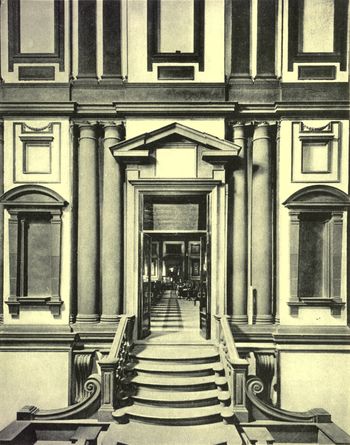
BIBLIOTECA LAURENZIANA (After Michelagnolo. Florence) Alinari View larger image
"Messer Giorgio, Dear Friend,
"Concerning the staircase for the library, of which so much has been said to me, you may believe that if I could remember how I had designed it, I would not need to be entreated. There does, indeed, come back to my mind, like a dream, a certain staircase; but I do not believe that it is exactly the one which I conceived at that time, because it comes out so stupid. However, I will describe it here. Take a quantity of oval boxes, each one palm in depth, but not of equal length and breadth. The first and largest place on the pavement at such a distance from the wall of the door as may make the staircase easy or steep, according to your pleasure. Upon this place another, which must be so much smaller in every direction as to leave on the first one below as much space as the foot requires in ascending; diminishing and drawing back the steps one after another towards the door, in accord with the ascent. And the diminution of the last step must reduce it to the proportion of the space of the door. The said part of the staircase with the oval steps must have two wings, one on one side and one on the other, with corresponding steps but not oval. Of these the central flight shall serve as the principal staircase, and from the centre of the staircase to the top the curves of the said wings shall meet the wall; but from the centre down to the pavement they shall stand, together with the whole staircase, at a distance of about three palms from the wall, in such a manner that the basement of the vestibule shall not be obstructed in any part, and every face shall be left free. I am writing nonsense; but I know well that you will find something to your purpose."