CABINET CYCLOPÆDIA.
Reading edition
CONDUCTED BY THE
REV. DIONYSIUS LARDNER, LL.D. F.R.S. L. & E.
M.R.I.A. F.R.A.S. F.L.S. F.Z.S. Hon. F.C.P.S. &c. &c.
ASSISTED BY
EMINENT LITERARY AND SCIENTIFIC MEN.
Biography.
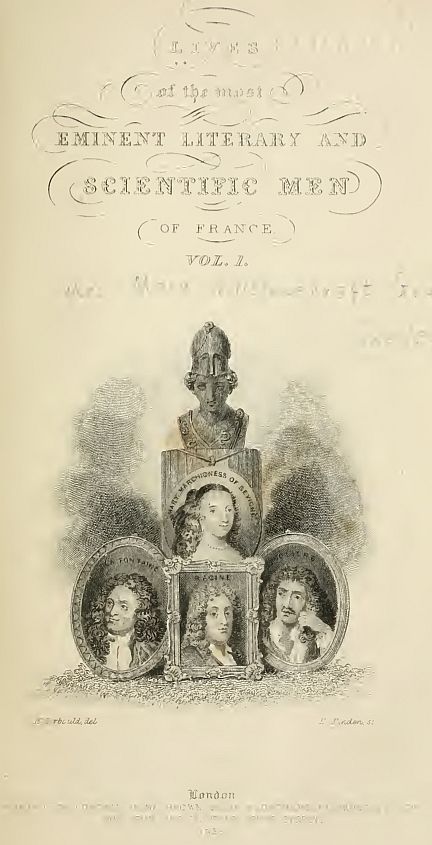
EMINENT LITERARY AND SCIENTIFIC MEN OF FRANCE.
VOL. I.
LONDON: PRINTED FOR LONGMAN, ORME, BROWN, GREEN, & LONGMANS, PATERNOSTER-ROW; AND JOHN TAYLOR, UPPER GOWER STREET.
1838.
CONTENTS
MONTAIGNE RABELAIS CORNEILLE ROCHEFOUCAULD MOLIÈRE LA FONTAINE PASCAL SÉVIGNÉ (Madame de) BOILEAU RACINE FÉNÉLON
LIVES OF EMINENT LITERARY AND SCIENTIFIC MEN.
MONTAIGNE
1533-1592
There is scarcely any man into whose character we have more insight than that of Montaigne. He has written four volumes of "Essays," which are principally taken up by narrations of what happened to himself, or dissertations on his own nature, and this in an enlightened and philosophical, though quaint and naïve style, which renders him one of the most delightful authors in the world. It were easy to fabricate a long biography, by drawing from this source, and placing in a consecutive view, the various information he affords. We must abridge, however, into a few pages several volumes; while, by seizing on the main topics, a faithful and interesting picture will be presented.
Michel de Montaigne was born at his paternal castle of that name[1], in Périgord, on the 8th of February, 1533. He was the son of Pierre Eyquem, esquire—seigneur of Montaigne, and at one time elected mayor of Bordeaux. This portion of France, Gascony and Guienne, gives birth to a race peculiar to itself; vivacious, warm-hearted, and vain—they are sometimes boastful, but never false; often rash, but never disloyal; and Montaigne evidently inherited much of the disposition peculiar to his province. He speaks of his family as honourable and virtuous:—"We are a race noted as good parents, good brothers, good relations," he says,—and his father himself seems eminently to deserve the gratitude and praise which his son bestows. His description of him is an interesting specimen of a French noble of those days:—"He spoke little and well, and mixed his discourse with allusions to modern books, mostly Spanish; his demeanour was grave, tempered by gentleness, modesty, and humility; he took peculiar care of the neatness and cleanliness of his dress, whether on horseback or on foot; singularly true in his conversation, and conscientious and pious, almost even to superstition. For a short slight man he was very strong; his figure was upright and well proportioned; he was dexterous and graceful in all noble exercises; his agility was almost miraculous; and I have seen him, at more than sixty years of age, throw himself on a horse, leap over the table, with only his thumb on it, and never going to his room without springing up three or four stairs at a time." Michel was the eldest of five sons. His father was eager to give him a good education, and even before his birth consulted learned and clever men on the subject. On these consultations and on his own admirable judgment he formed a system, such as may in some sort be considered the basis of Rousseau's; and which shows that, however we may consider one age more enlightened than another, the natural reason of men of talent leads them to the same conclusions, whether living in an age when warfare, struggle, and the concomitant ignorance were rife, or when philosophers set the fashion of the day. "The good father whom God gave me," says Montaigne, "sent me, while in my cradle, to one of his poor villages, and kept me there while I was at nurse and longer, bringing me up to the hardest and commonest habits of life. He had another notion, also, which was to ally me with the people, and that class of men who need our assistance; desiring that I should rather give my attention to those who should stretch out their arms to me, than those who would turn their backs; and for this reason he selected people of the lowest condition for my baptismal sponsors, that I might attach myself to them." He was taught, also, in his infancy directness of conduct, and never to mingle any artifice or trickery with his games. With regard to learning, his good father meditated long on the received modes of initiating his son in the rudiments of knowledge. He was struck by the time given to, and the annoyance a child suffers in, the acquirement of the dead languages; this was exaggerated to him as a pause why the moderns were so inferior to the ancients in greatness of soul and wisdom. He hit, therefore, on the expedient of causing Latin to be the first language that his son should hear and speak. He engaged the services of a German, well versed in Latin, and wholly ignorant of French. "This man," continues Montaigne, "whom he sent for expressly, and who was liberally paid, had me perpetually in his arms. Two others of less learning, accompanied to relieve him; they never spoke to me except in Latin; and it was the invariable rule of the house, that neither my father nor my mother, nor domestic, nor maid, should utter in my presence any thing except the few Latin phrases they had learnt for the purpose of talking with me. It is strange the progress that every one made. My father and mother learnt enough Latin to understand it, and to speak it on occasions, as did also the other servants attached to me;—in short, we talked so much Latin, that it overflowed even into our neighbouring villages, where there still remain, and have taken root, several Latin names for workmen and their tools. As for me, at the age of six, I knew no more French than Arabic; and, without study, book, grammar, or instruction,—without rod and tears—I learnt as pure a Latin as my schoolmaster could teach, for I could not mix it with any other language. If, after the manner of colleges, I had a theme set me, it was given, not in French, but in bad Latin, to be turned into good; and my early master, George Buchanan and others, have often told me that I was so ready with my Latin in my infancy, that they feared to address me. Buchanan, whom I afterwards saw in the suite of the marshal de Brissac, told me that he was about to write on education, and should give mine as an example. As to Greek, of which I scarcely know any thing, my father intended that I should not learn it as a study, but as a game—for he had been told to cause me to acquire knowledge of my own accord and will, and not by force, and to nourish my soul in all gentleness and liberty, without severity or restraint, and this to almost a superstitious degree; for having heard that it hurts a child's brain to be awoke suddenly, and torn from sleep with violence, he caused me to be roused in the morning by the sound of music, and there was always a man in my service for that purpose.
"The rest maybe judged of by this specimen, which proves the prudence and affection of my excellent father, who must not be blamed if he gathered no fruits worthy of such exquisite culture. This is to be attributed to two causes: the first is the sterile and troublesome soil; for although my health was good, and my disposition was docile and gentle, I was, notwithstanding, so heavy, dull, and sleepy, that I could not be roused from my indolence even to play. I saw well what I saw; and beneath this dull outside I nourished a bold imagination, and opinions beyond my age. My mind was slow, and it never moved unless it was led—my understanding tardy—my invention idle—and, amidst all, an incredible want of memory. With all this it is not strange that he succeeded so ill. Secondly, as all those who are furiously eager for a cure are swayed by all manner of advice, so the good man, fearing to fail in a thing he had so much at heart, allowed himself at last to be carried away by the common opinion; and, not having those around him who gave him the ideas of education which he brought from Italy, sent me, at six years of age, to the public school of Guienne, which was then very flourishing, and the best in France. It was impossible to exceed the care he then took to choose accomplished private tutors; but still it was a school: my Latin deteriorated, and I have since lost all habit of speaking it; and my singular initiation only served to place me at once in the first classes; for when I left college, at the age of thirteen, I had finished my course, but, truly, without any fruit at present useful to me.
"The first love I had for books came to me through the pleasure afforded by the fables in Ovid's Metamorphoses. For, at the age of seven or eight, I quitted every other pleasure to read them; the more that its language was my maternal one, and that it was the easiest book I knew, and, considering the matter, the best adapted to my age. I was more careless of my other studies, and in this was lucky in having a clever man for my preceptor, who connived at this and similar irregularities of mine; for I thus read through the Æneid, and then Terence and Plautus, led on by delight in the subject. If he had been so foolish as to prevent me, I believe I should have brought from college a hatred of all books, as most of our young nobles do. He managed cleverly, pretending not to see; and sharpened my appetite by only allowing me to devour these volumes by stealth, and being easy with me with regard to my other lessons; for the principal qualities which my father sought in those who had charge of me were kindness and good humour; consequently idleness and laziness were my only vices. There was no fear that I should do harm, but that I should do nothing—no one expected that I should become wicked, but only useless. It has continued the same: the complaints I hear are of this sort: that I am indolent, slow to perform acts of friendship, too scrupulous, and disdainful of public employments. Meanwhile my soul had its private operations, and formed sure and independent opinions concerning the subjects it understood, digesting them alone, without communication; and among other things, I believe it had been incapable of submitting to force or violence."
It would require a volume almost to examine the effect that this singular education had on Montaigne's character. If absence of constraint strengthened the defects of his character, at least it implanted no extraneous ones. His defective memory was not cultivated, and therefore remained defective to the end. His indolence continued through life: he became somewhat of a humourist; but his faculties were not deadened, nor his heart hardened, by opposition and severity.
Montaigne's heart was warm; his temper cheerful[2], though unequal; his imagination lively[3]; his affections exalted to enthusiasm; and this ardour of disposition, joined to the sort of personal indolence which he describes, renders him a singular character. On leaving college he studied law, being destined for that profession; but he disliked it; and, though he was made counsellor to the parliament of Bordeaux, he, in the sequel, gave up the employment as by no means suited to him. He lived in troubled times. Religious parties ran high, and were so well balanced, the kingly power being diminished through the minority of Charles IX., and that of the nobles increasing in consequence, that the struggle between the two was violent and deadly. Montaigne was a catholic and a lover of peace. He did not mingle with the dissensions of the times, avoided all public employments, and it is not in the history of his times that we must seek for the events of his life.
1559. Ætat. 26.
The chief event, so to call it, that he himself records with fondness and care, is his friendship for Étienne de la Boëtie. To judge by the only writing we possess of this friend, composed when he was scarcely more than seventeen, his Essay on "Voluntary Servitude," he evidently deserved the high esteem in which Montaigne held him, though apparently very dissimilar from him in character. Boldness and vigour mark the thoughts and style; love of freedom, founded on a generous independence of soul, breathes in every line; the bond between him and Montaigne rested on the integrity and lofty nature of their dispositions—on their talents—on the warmth of heart that distinguished both—and a fervid imagination, without which the affections seldom rise into enthusiasm. Montaigne often refers to this beloved friend in his essays. "The greatest man I ever knew," he writes, "was Étienne de la Boëtie. His was indeed a soul full of perfections, a soul of the old stamp, and which would have produced great effects had fate permitted, having by learning and study added greatly to his rich natural gifts."[4] In another essay, which is entitled "Friendship," he recounts the history of their intimacy. "We sought each other," he writes, "before we met, on account of what we heard of each other, which influenced our inclinations more than there seems to have been reason for, I think through a command of Heaven. We, as it were, embraced each other's names; and at our first meeting, which was by chance, and at a large assembly, we found ourselves so drawn together, so known to each other, that nothing hereafter was nearer than we were one to the other. He wrote a beautiful Latin poem to excuse the precipitation of our intimacy, which so promptly arrived at its perfection. As it was destined to last so short a time, and began so late, for we were both arrived at manhood, and he was several years the elder, it had no time to lose; it could not regulate itself by slow and regular friendships, which require the precaution of a long preluding acquaintance. Ours had no idea foreign to itself, and could refer to itself alone; it did not depend on one special cause, nor on two, nor three, nor four, nor a thousand, but was the quintessence of all which seized on my will, and forced it to merge and lose itself in his, and which, having seized his will, led him to merge and lose his in mine, with equal desire and eagerness. I use the word lose as the proper one, for we neither reserved any thing that was not common to both. Our souls mingled so entirely, and penetrated with such ardent affection into the very essence of each other, that not only was I as well acquainted with his as with my own, but certainly I should have more readily trusted him than myself. This attachment must not be put in the same rank with common friendships. I have known the most perfect of a slighter kind; and, if the rules are confounded, people will deceive themselves. In other friendships you must proceed bridle in hand; in the more exalted one, the offices and benefits which support other intimacies do not deserve even to be named. The perfect union of the friends causes them to hate and banish all those words that imply division and difference, such as benefit, obligation, gratitude, entreaty, thanks, and the like. All is in common with them; and, if in such a friendship one could give to the other, it would be him who received that would benefit his companion. Menander pronounced him happy who should meet only with the shadow of such a friend: he was right; for if I compare the rest of my life, though, with the blessing of God, I have passed it agreeably and peacefully, and, save from the loss of such a friend, exempt from any poignant affliction, with a tranquil mind, having taken the good that came to me originally and naturally, without seeking others; yet, if I compare the whole of it, I say, with the four years during which it was given me to enjoy the dear society of this person, it is mere smoke,—it is a dark and wearisome night. I have dragged it out painfully since I lost him; and the very pleasures that have offered themselves to me, instead of consoling, doubled the sense of my loss. We used to share every thing, and methinks I rob him of his portion. I was so accustomed to be two in every thing that I seem now but half of myself. There is no action nor idea that does not present the thought of the good he would have done me, for as he surpassed me infinitely in every talent and virtue, so did he in the duties of friendship."
1553. Ætat. 30.
A severe illness of a few days carried off this admirable friend. Montaigne recounts, in a letter to his father, the progress of the malady, and his death bed; and nothing can be more affecting, nor better prove the noble and virtuous qualities of both, than these sad hours when the one prepared to die, and the other ministered to the dying. This loss was never forgotten; and we find, in the journal of his travels in Italy, written eighteen years after, an observation, that he fell one morning into so painful a reverie concerning M. de la Boëtie that his health was affected by it.
Montaigne married at the age of thirty-three: he married neither from wish nor choice. "Of my own will," he says, "I would have shunned marrying Wisdom herself, had she asked me. But we strive in vain; custom, and the uses of common life, carry us away: example, not choice, leads me in almost all my actions. In this, truly, I did not go of my own accord, but was led, or carried, by extraneous circumstances; and certainly I was then less prepared, and more averse than now that I have tried it. But I have conducted myself better than I expected. One may keep one's liberty prudently; but, when once one has entered on the obligation, one must observe the laws of a common duty." Montaigne made, therefore, a good husband, though not enthusiastically attached, and a good father—indeed, in all the duties of life, he acted better than was expected of him. At his death, his father[5] left him his estate, fancying that it would be wasted through his indolence and carelessness; but Montaigne's faults were negative; and he easily brought himself to regard his income as the limit of his expenses, and even kept within it. His hatred of business and trouble, joined to sound common sense, led him to understand that ease could be best attained by limiting his desires to his means, and by the degree of order necessary to know what these means were; and his practice accorded with this conclusion.
Montaigne's father lived to old age. He married late in life, and we are ignorant of the date of his death; from that period Montaigne himself seems to have lived chiefly at his paternal castle. It would appear that he was at that time under forty[6]; and henceforth his time was, to a great degree, spent in domestic society, among the few books he loved, writing his essays, and attending to the cares that wait upon property. It is not to be supposed, however, that he lived a wholly sedentary and inactive life. Though he adhered to no party, and showed no enthusiasm in the maintenance of his opinions, his disposition was inquisitive to eagerness, ardent and fiery. The troubles that desolated his country throughout his life fostered the activity of mind of which his writings are so full. He often travelled about France, and, above all, was well acquainted with Paris and the court. He loved the capital, and calls himself a Frenchman only through his love of Paris, which he names the glory of France, and one of the noblest ornaments of the world. He attended the courts at the same time of the famous duke de Guise and the king of Navarre, afterwards Henry IV. He had predicted that the death of one or the other of these princes could alone put an end to the civil war, and even foresaw the likelihood there was that Henry of Navarre should change his religion. He was at Blois when the duke de Guise was assassinated; but that event took place long subsequent to the period of which we at present write.
During his whole life civil war raged between catholic and huguenot. Montaigne, attached to the kingly and catholic party, abstained, however, from mingling in the mortal struggles going on.[7] Yet sometimes they intruded on his quiet, and he was made to feel the disturbances that desolated his country. It is a strange thing to picture France divided into two parties, belonging to which were men who risked all for the dearest privilege of life, freedom of thought and faith; and were either forced, or fancied that they were forced, to expose life and property to attain it; and to compare these religionists in arms with the tranquil philosopher, who dissected human nature in his study, and sounded the very depths of all our knowledge in freedom and ease, because he abstained from certain watchwords, and had no desire for proselytes or popular favour. "I regard our king," he says, "with a mere legitimate and political affection, neither attracted nor repelled by private interest; and in this I am satisfied with myself. In the same way I am but moderately and tranquilly attached to the general cause, and am not subject to entertain opinions in a deep-felt and enthusiastic manner. Let Montaigne, if it must, be swallowed up in the public ruin; but, if there is no necessity, I shall be thankful to fortune to save it. I treat both parties equally, and say nothing to one that I could not say to the other, with the accent only a little changed; and there is no motive of utility that could induce me to lie." This moderation, on system, of course led him, in his heart, to be inimical to the reformers. "They seek reformation," he says, in the worst of destructions, "and aim at salvation by the exact modes in which we are sure to reap damnation; and think to aid divine justice and humanity by overturning law and the rulers, under whose care God has placed them, tearing their mother (the church) to pieces, to give portions to be gnawed by her ancient enemies, filling their country with parricidal hatreds." This is no lofty view of the great and holy work of reformation, the greatest and (however stained by crime, the effect of the most cruel persecutions) the most beneficent change operated in modern times in human institutions. Montaigne goes on:—"The people suffered greatly then, both for the present and the future, from the devastation of the country. I suffered worse, for I encountered all those injuries which moderation brings during such troubles—I was pillaged by all parties. The situation of my house, and my alliance with my neighbours, gave me one appearance, my life and actions another; no formal accusations were made, for they could get no hold against me; but mute suspicion was secretly spread. A thousand injuries were done me one after another, which I could have borne better had they come altogether."
His mode of preserving his castle from pillage was very characteristic. "Defence," he says, "attracts enterprise, and fear instigates injury. I weakened the ardour of the soldiery by taking from their exploit all risk or matter for military glory, which usually served them as an excuse: what is done with danger is always honourable at those periods when the course of justice is suspended. I rendered the conquest of my house cowardly and treacherous; it was shut against no one who knocked; a porter was its only guard, an ancient usage and ceremony, and which did not serve so much to defend my abode as to offer an easier and more gracious entrance. I had no centinel but that which the stars kept for me. A gentleman does wrong to appear in a state of defence who is not perfectly so. My house was well fortified when built, but I have added nothing, fearing that such might be turned against myself. So many garrisoned houses being taken made me suspect that they were lost through that very reason. It gave cause and desire for assault. Every guarded door looks like war. If God pleased I might be attacked, but I would not call on the assailant. It is my retreat wherein to repose myself from war. I endeavour to shelter this corner from the public storm, as also another corner in my soul. Our contest vainly changes its forms, and multiplies and diversifies itself in various parties—I never stir. Among so many armed houses, I alone, in France, I believe, confided mine to the protection of Heaven only, and have never removed either money, or plate, or title-deed, or tapestry. I was resolved neither to fear nor to save myself by halves. If an entire gratitude can acquire divine favour, I shall enjoy it to the end; if not, I have gone on long enough to render my escape remarkable; it has lasted now thirty years." And he preserved his philosophy through all. "I write this," he says, in one of his essays, "at a moment when the worst of our troubles are gathering about me; the enemy is at my gates, and I endure all sorts of military outrage at once." He gives an interesting account of how, on one occasion, by presence of mind and self-possession, he saved his castle. A certain leader, bent on taking it and him, resolved to surprise him. He came alone to the gate and begged to be let in. Montaigne knew him, and thought he could rely on him as his neighbour, though not as his friend: he caused his door to be opened to him as to every one. The visitant came in a hurried manner, his horse panting, and said that he had encountered the enemy, who pursued him, and he being unarmed, and with fewer men about him, he had taken shelter at Montaigne's, and was in great trouble about his people, whom he feared were either taken or killed. Montaigne believed the tale and tried to reassure and comfort him. Presently five or six of his followers, with the same appearance of terror, presented themselves; and then more and more, to as many as thirty, well equipped and armed, pretending that they were pursued by the enemy. Montaigne's suspicions were at last awakened; but finding that he must go on as he had begun, or break out altogether, he betook himself to what seemed to him the easiest and most natural course, and ordered all to be admitted; "being," he says, "a man who gladly commits himself to fortune, and believing that we fail in not confiding sufficiently in Heaven." The soldiers having entered remained in the court yard—their chief, with his host, being in the hall, he not having permitted his horse to be put up, saying he should go the moment his people arrived. He now saw himself master of his enterprise,—the execution alone remained. He often said afterwards—for he did not fear to tell the tale—that Montaigne's frankness and composure had disarmed his treachery. He remounted his horse and departed, while his people, who kept their eyes continually upon him to see if he gave the signal, were astonished to behold him ride off and abandon his advantage.
On another occasion, confiding in some truce, he undertook a journey, and was seized by about thirty gentlemen, masked, as was the custom then, followed by a little army of arquebusiers. Being taken, he was led into the forest and despoiled of his effects, which were valuable, and high ransom demanded. He refused any, contending for the maintenance of the truce; but this plea was rejected, and they were ordered to be marched away. He did not know his enemies, nor, apparently, did they know him; and he and his people were being led off as prisoners, when suddenly a change took place: the chief addressed him in mild terms, caused all his effects to be collected and restored, and the whole party set at liberty. "The true cause of so sudden a change," says Montaigne, "operated without any apparent cause, and of repentance in a purpose then through use held just, I do not even now know. The chief among them unmasked, and told his name, and several times afterwards said that I owed my deliverance to my composure, to the courage and firmness of my words, which made me seem worthy of better treatment."
As Montaigne advanced in life he lost his health. The stone, which he believed he inherited from his father, and painful nephritic colics that seized him at intervals, put his philosophy to the test. He would not allow his illnesses to disturb the usual tenor of his life, and, above all, refused medical aid, having also inherited, he says, from his father a contempt for physicians. There was a natural remedy, however, by which he laid store, one much in favour at all times on the continent—mineral and thermal springs. The desire to try these, as well as a wish to quit for a time his troubled country, and the sight of all the misery multiplying around him, caused him to make a journey to Italy. His love of novelty and of seeing strange things sharpened his taste for travelling; and, as a slighter motive, he was glad to throw household cares aside; for, though the pleasures of command were something, he received perpetual annoyances from the indigence and sufferings of his tenants, or the quarrels of his neighbours: to travel was to get rid of all this at once.
Of course, his mode of proceeding was peculiar: he had a particular dislike to coaches or litters,—even a boat was not quite to his mind; and he only really liked travelling on horseback. Then he let every whim sway him as to the route: it gave him no annoyance to go out of his way: if the road was bad to the right, he took to the left: if he felt too unwell to mount his horse, he remained where he was till he got better: if he found he had passed by any thing that he wished to see, he turned back. On the present occasion his mode of travelling was, as usual, regulated by convenience: hired vehicles carried the luggage while he proceeded on horseback. He was accompanied by several friends, and, among others, by his brother, M. de Mattecoulon. Montaigne had the direction of the journey. We have a journal of it, partly written in his own hand, partly dictated to his valet, who, though he speaks of his roaster in the third person, evidently wrote only the words dictated. This work, discovered many years after Montaigne's death, never copied nor corrected, is singularly interesting. It seems to tell us more of Montaigne than the Essays themselves: or, rather, it confirms much said in those, by relating many things omitted, and throws a new light on various portions of his character. For instance, we find that the eager curiosity of his mind led him to inquire into the tenets of the protestants; and that, at the Swiss towns, he was accustomed, on arriving, to seek out with all speed some theologian, whom he invited to dinner, and from whom he inquired the peculiar tenets of the various sects. There creeps out, also, an almost unphilosophical dislike of his own country, springing from the miserable state into which civil war had brought it.[8]
1580. Ætat. 47.
The party set off from the castle of Montaigne on the 22d of June, 1580: they proceeded through the north-east of France to Plombieres, where Montaigne took the waters, and then went on by Basle, Baden, in the canton of Zurich, to Constance, Augsburgh, Munich, and Trent. It is not to be supposed that he went to these places in a right line: he often changed his mind when half way to a town, and came back; so that at last his zigzag mode of proceeding rendered several of his party restive. They remonstrated; but he replied, that, for his own part, he was bound to no place but that in which he was; and that he could not go out of his way, since his only object was to wander in unknown places; and so that he never followed the same road twice, nor visited the same place twice, his scheme was accomplished. If, indeed, he had been alone, he had probably gone towards Cracovia, or overland to Greece, instead of to Italy; but he could not impart the pleasure he took in seeing strange places, which was such as to cause him to forget ill health and suffering, to any other of his party: they only sought to arrive where they could repose; he, when he rose after a painful uneasy night, felt gay and eager when he remembered that he was in a strange town and country; and was never so little weary, nor complained so little of his sufferings, having his mind always on the stretch to find novelties and to converse with strangers; for nothing, he says, hurt his health so much as indolence and ennui.
With all his windings, after he had visited Venice, which "he had a hunger to see," he found himself in Rome on the last day of November, having the previous morning risen at three hours before daylight in his haste to behold the eternal city. Here he had food in plenty for his inquiring mind; and, getting tired of his guide, rambled about, finding out remarkable objects alone; making his shrewd remarks, and trying to discover those ancient spots with which his mind was familiar. For Latin being his mother-tongue, and Latin books his primers, he was more familiar with Roman history than with that of France, and the names of the Scipios and Metelli were less of strangers to his ear than those of many Frenchmen of his own day. He was well received by the pope, who was eager to be courteous to any man of talent and rank who would still abide by the old religion. Montaigne, before he set out, had printed two books of his "Essays:" these were taken at the custom-house and underwent a censorship: several faults were found—that he had used the word fortune improperly; that he cited heretical poets; that he found excuses for the emperor Julian; that he had said that a man must of necessity he exempt from vicious inclinations while in the act of prayer; that he regarded all tortuous modes of capital punishment as cruel; that he said that a child ought to be brought up to do every thing. Montaigne took this fault-finding very quietly, saying that he had put these things down as being his opinions, and without supposing that they were errors; and that sometimes the censor had mistaken his meaning. Accordingly, these censures were not insisted upon; and when he left Rome, and took leave of the prelate, who had discoursed with him on the subject, he begged him not to pay any regard to the censure, which was a mistaken one, since they honoured his intentions, his affection for the church, and his talents; and so esteemed his frankness and conscientiousness, that they left it to him to make any needful alterations in another edition: and they ended by begging him to assist the church with his eloquence, and to remain at Rome, away from the troubles of his native country. Montaigne was much flattered by this courtesy and much more so by a bull being issued which conferred on him the citizenship of Rome, pompous in seals and golden letters, and gracious in its expressions.1581. Ætat. 48. Nothing, he tells us, ever pleased him more than this honour, empty as it might seem, and had employed to obtain it, he says, all his five senses, for the sake of the ancient glory and present holiness of the city.
The descriptions which he gives of Rome, of the pope, and all he saw, are short, but drawn with a master's hand—graphic, original, and just; and such is the unaltered appearance of the eternal city, that his pages describe it as it now is, with as much fidelity as they did when he saw it in the sixteenth century. Its gardens and pleasure-grounds delighted him; the air seemed to him the most agreeable he had ever felt; and the perpetual excitement of inquiry in which he lived, his visits to antiquities, and to various beautiful and memorable spots, delighted him; and neither at home nor abroad was he once visited by gloom or melancholy, which he calls his death.
On the 19th of April he left Rome, and passing by the eastern road, and the shores of the Adriatic, he visited Loretto, where he displayed his piety by presenting a silver tablet, on which were hung four silver figures,—that of the virgin, with those of himself, his wife, and their only child, Eleanor, on their knees before her; and performed various religious duties, which prove the sincerity of his catholic faith. In the month of May he arrived at the baths of Lucca, where he repaired for the sake of the waters. He took up his abode at the Bagni di Villa, and with the exception of a short interval, during which he visited Florence and Pisa, he remained till September, when, on the 7th of that month, he received letters to inform him that he had been elected mayor of Bordeaux,—a circumstance which forced him to hasten his return; but he did not leave Italy without again visiting Rome. His journey home during winter, although rendered painful by physical suffering, was yet tortuous and wandering among the northern Italian towns. He re-entered France by Mont Cenis, and, visiting Lyons, continued his route through Auvergne and Périgord, till he arrived at the château de Montaigne.
Montaigne, though flattered by the unsought for election of the citizens of Bordeaux, the more so that his father had formerly been elected to that office, yet, from ill health and natural dislike to public employments, would have excused himself, had not the king interposed with his commands. He represented himself to his electors such as he conceived himself to be,—without party spirit, memory, diligence, or experience. Many, indeed, in the sequel considered him too indolent in the execution of the duties of his office, while he deemed his negative merits as deserving praise, at a period when France was distracted by the dissensions of contending factions: the citizens, probably, entertained the same opinion, since he was re-elected at the end of the two years, when his office expired, to serve two years more.
Montaigne's was a long-lived family; but he attained no great age, and his latter years were disturbed by great suffering. Living in frequent expectation of death, he was always prepared for it,—his affairs being arranged, and he ready to fulfil all the last pious catholic duties as soon as he felt himself attacked by any of the frequent fevers to which he was subject. One of the last events of his life was his friendship with mademoiselle Marie de Gournay le Jars, a young person of great merit, and afterwards esteemed one of the most learned and excellent ladies of the day; and honoured by the abuse of pedants, who attacked her personal appearance and her age, in revenge for her transcending even their sex in accomplishments and understanding: while, on the other hand, she was regarded with respect and friendship by the first men of her time.1585. Ætat. 52. She was very young when Montaigne first saw her, which happened during a long visit he made to Paris, after his mayorship at Bordeaux was ended. Having conceived an enthusiastic love and admiration of him from reading his essays, she called on him, and requested his acquaintance. He visited her and her mother at their château de Gournay, and allied himself to her by adopting her as his daughter, and entertaining for her a warm affection and esteem. His picture of her is not only delightful, as a testimony of the merits of this young lady[9], but a proof of the unfailing enthusiasm and warmth of his own heart, which, even in suffering and decay, eagerly allied itself to kindred merit.
The illness of which he died was a quinsey, that brought on a paralysis of the tongue. His presence of mind and philosophy did not desert him at the end: he is said, as one of his last acts, to have risen from his bed, and, opening his cabinet, to have paid his servants and other legatees the legacies he had left them by will, foreseeing that his heirs might raise difficulties on the subject. When getting worse, and unable to speak, he wrote to his wife to beg her to send for some gentlemen, his neighbours, to be with him at his last moments. When they arrived, he caused mass to be celebrated in his chamber: at the moment of the elevation he tried to rise, when he fell back fainting, and so died, on the 13th of September, 1592, in the sixtieth year of his age. He was buried at Bordeaux, in a church of the commandery of St. Anthony, and his widow raised a tomb to his memory.
Montaigne was rather short of stature, strong, and thick set: his countenance was open and pleasing. He enjoyed good health till the age of forty-six, when he became afflicted by the stone. Vivacious as a Gascon, his spirits were unequal,—but he hated the melancholy that belonged to his constitution, and his chief endeavour was to nourish pleasing sensations, and to engage his mind, when his body was unemployed, in subjects of speculation and inquiry.
Of three daughters who had been born to him, one, named Eleonora, alone survived.[10] But his other daughter by adoption, mademoiselle de Gournay, deserved also that name, by the honour and care she bestowed on his memory. Immediately on his decease, the widow and her daughter invited her to come and mourn their loss with them; and she crossed all France to Bordeaux in compliance with their desire. She afterwards published several editions of his "Essays," which she dedicated to the cardinal de Richelieu, and accompanied by a preface, in which she ably defended the work from the attacks made against it. This preface, though somewhat heavy, is full of sound reasoning, and displays learning and acuteness, and completely replies to all the blame ever thrown on his works.
Montaigne's "Essays" have also been attacked in modern times. It requires that the reader should possess some similarity to the author's own mind to enter fully into their merits, and relish their discursive style. The profoundest and most original thinkers have ever turned to his pages with delight. His skilful anatomy of his own mind and passions,—his enthusiasm, clothed as it is in apparent indifference, which only renders it the more striking,—his lively and happy descriptions of persons,—his amusing narratives of events,—his happy citations of ancient authors,—and the whole instinct with individuality;—perspicuity of style, and the stamp of good faith and sincerity that reigns throughout;—these are the charms and merits of his "Essays,"—a work that raises him to the rank of one of the most original and admirable writers that France has produced.
RABELAIS
1483-1553
Francis Rabelais,—"the great jester of France," as he is designated by Lord Bacon; a learned scholar, physician, and philosopher, as he appears from other and eminent testimonies,—was one of the most remarkable persons who figured in the revival of letters. It is his fortune, like the ancient Hercules, to be noted with posterity for many feats to which he was a stranger,—but which are always to his disadvantage. The gross buffooneries amassed by him in his nondescript romance have made his name a common mark for any extravagance or impertinence of unknown or doubtful parentage. The purveyors of anecdotes have even fixed upon him some of the lazzi, as they are called, which may be found in the stage directions of old Italian farce. Those events and circumstances of his life which are really known, or deserving of belief, may be given within a narrow compass. We, of course, reject, in this notice, all that would offend the decencies of modern and better taste.
Rabelais was born at Chinon, a small town of Touraine. The date of his birth is not ascertained; but the generally received opinion of his death, at the age of 70, in 1553, would place his birth in 1483. There is the same uncertainty respecting the condition of his father; whether that of an innkeeper or apothecary. His predilection for the study of medicine favours the latter supposition, whilst the imputed habits of his life countenance the former. If, however, he was really abandoned to intemperance, as he is represented by his adversaries, who were many and unscrupulous, it may, with equal propriety, be charged to his monastic education, at a time when cloisters were the chosen seats of debauchery and ignorance.
He received his first rudiments at the convent of Seville, near his native town, where his progress was so slow that he was removed to another in Angiers. Here also his career seemed unpromising; and the only advantage he derived was that of becoming known to the brothers Du Bellay, one of whom, afterwards bishop of Paris and cardinal, was his patron and friend through life.
From Angiers he passed to a convent of cordeliers at Fontenaye-le-Compte, in Poitou. He now applied himself, for the first time, to the cultivation of his talents, but under circumstances the most unfavourable. The cordeliers of Fontenaye-le-Compte had no library, or notion of its use. Rabelais assumed the habit of St. Francis, distinguished himself by his preaching, and employed what he received for his sermons and masses in providing himself with books. The animosity of his brother monks was excited against him: they envied and hated him, for his success as a preacher, and for his superior attainments;—but his great and crying sin in their eyes was his knowledge of Greek, the study of which they denounced as an unholy and forbidden art. This was perfectly consistent: they were content with Latin enough to give them an imposing air with the multitude; some did not know even so much, and, instead of a breviary, carried a wine flask exactly resembling it in exterior form.
His brother monks annoyed and harassed Rabelais by all the modes which malice, ignorance, and numbers can employ against an individual, and in a convent. The learned Budeus[11], alluding to the persecutions which he was suffering, says, in one of his letters, "I understand that Rabelais is grievously annoyed and persecuted, by those enemies of all that is elegant and graceful, for his ardour in the study of Greek literature. Oh! evil infatuation of men whose minds are so dull and stupid!" They at last condemned him to live in pace; that is to linger out the remainder of his life, on bread and water, in the prison cell of the convent.
The cause, or the pretence, of Rabelais's being thus buried alive, is described as "a scandalous adventure:" but differently related. According to some the scandal consisted in his disfiguring, by way of frolic, in concert with another young cordelier, the image of their patron saint. Others state, that on the festival of St. Francis he removed the image of the saint, and took its place. Having taken precautions to hear out the imposture, he escaped detection, until the grotesque devotions of the multitude, and the rogueries of the monks, overcame his gravity, and he laughed. The simple people, seeing the image of the saint, as they supposed it, move, exclaimed, "A miracle!" but the monks, who knew better, dismissed the laity, made their false brother descend from his niche, and gave him the discipline, with their hempen cords, until his blood appeared. We will not decide which, or whether either, of these versions be true; but it is certain that he was condemned, as we have said, to solitary confinement for life in the prison cell.
Fortunately for him, his wit, gaiety, and acquirements had made him friends who were powerful enough to obtain his release. These were the Du Bellays already mentioned, and Andre Tiraqueau, chief judge of the province, to whom one of Rabelais's Latin letters is addressed;—a man of learning, it would appear, and an upright judge. The letter is addressed, "Andreo Tiraquello, equissimo judici, apud Pictones," and commences "Tiraquello doctissime." Their influence obtained not only his liberty, but the pope's (Clement VII.) licence to pass from the cordeliers of Fontenaye-le-Compte, to a convent of Benedictines at Maillezieux in the same province. This latter order has been distinguished for learning, and deserves respectful and grateful mention for its share in the preservation of the classic remains of antiquity. It was, no doubt, more agreeable, or less disagreeable, to Rabelais than that which he had left; but wholly disgusted with the monastic life, he soon threw off the frock and cowl, left the convent of his own will and pleasure, without licence or dispensation from his superiors, and for some time led a wandering life as a secular priest.
We next find him divested wholly of the sacerdotal character; and studying medicine at Montpelier. The date of this transition, as too frequently happens in the life of Rabelais, cannot be determined. He, however, pursued his studies, took his successive degrees of bachelor, licentiate, and doctor, and was, after some time, appointed a professor. He lectured, it appears from his letters of a subsequent date, chiefly on the works of Hippocrates and Galen. His superior knowledge of the Greek language enabled him to correct the faults of omission, falsification, and interpolation, committed by former translators of Hippocrates; and he executed this task, he says, by the most careful and minute collation of the text with the best copies of the original. "If this be a fault," says he, speaking of preceding mistranslations, "in other books, it is a crime in books of medicine; for in these the addition or omission of the least word, the misplacing even of a point, compromises the lives of thousands." Accordingly, his edition of Hippocrates, subsequently published by him at Lyons, has been highly prized by physicians and scholars.
Rabelais had less difficulty in restoring and elucidating the text, than in bringing into practice the better medical system of the father of the art. He complains, in his Latin epistle to Tiraqueau, at some length, but in substance, that though the age boasted many learned and enlightened men, yet the multitude was in worse than Cimmerian darkness—the many so besotted by the errors, however gross, which they had first imbibed, and by the books, however absurd, which they had first read, as to seem irremediably blind to reason and truth—clinging to ignorance and absurdity, like those shipwrecked persons who trust to a beam or a rag of the vessel which had split, instead of making aneffort themselves to swim, and finding out their mistake only when they are hopelessly sinking.—Mountebanks and astrologers (he adds) were preferred to learned physicians, even by the great.
But his capacity and zeal were held in just estimation by the medical faculty of Montpelier.—The chancellor Duprat having, for some reason now unknown, deprived that body of its privileges, or, according to Nicéron, one college only having suffered deprivation, Rabelais was deputed to solicit their restoration. There is a current anecdote of the strange mode which he took to introduce himself to the chancellor.—Arrived at the chancellor's door, he spoke Latin to the porter, who, it may be supposed, did not understand him; a person who understood Latin presenting himself, Rabelais spoke to him in Greek; to a person who understood Greek, he spoke Hebrew; and so on, through several other languages and interpreters, until the singularity of the circumstance reached the great man, and Rabelais was invited to his presence. This is in the last degree improbable. Cardinal du Bellay, his patron, was then bishop of Paris, in high favour at the court of Francis I., and, doubtless, ready to present him in a manner much more conducive to the success of his mission. The ridiculous invention was suggested by a passage of Rabelais, in which Panurge addresses Pantagruel, on their first meeting, in thirteen different languages, dead and living, not including French. Rabelais, however, pleaded the cause of the faculty of Montpelier so well, that its privileges were restored, and he was received by his colleagues on his return with unprecedented honours. So great was the estimation in which he was held henceforth, and the reverence for him after his departure, that every student put on Rabelais's scarlet gown when taking his degree of doctor. This curious usage continued from the time of Rabelais down to the Revolution. The gown latterly used was not the identical one of Rabelais. The young doctors, in their enthusiasm for its first wearer, carried off each a piece, by way of relic, until, in process of time, it reached only to the hips, and a new garment was substituted.
Rabelais, having left Montpelier, appears next at Lyons, where he practised as a physician, and published his editions of Hippocrates and Galen, with some minor pieces, including almanacks, which prove him conversant with the science of astronomy. One almanack bearing his name is pronounced spurious, on the ground of his being made to describe himself as "physician and astrologer." He treated the pretended science of astrology with derision. This would add nothing to his reputation in a later age; but, considering the number of his contemporaries, otherwise enlightened, who were not proof against this weakness, it proves him to have been one of those superior spirits whose views are in advance of their generation.
Cardinal du Bellay was sent ambassador by Francis I. to the court of Rome in 1534, and attached Rabelais as physician to his suite. He appears to have made two visits to Italy with the cardinal at this period, but there are no traces by which they can be distinguished, nor is it very material. It is made a question in one of the most recent sketches of the life of Rabelais, whether he attended the ambassador as physician or buffoon. His letters, addressed from Rome, to his friend the bishop of Maillezieux, furnish decisive evidence of his being a a person treated with respect and confidence, independently of the known friendship of the cardinal. They are the letters of a man of business, well informed of all that was passing, and trusted with state secrets. He alludes, in one letter, to the quarrels of Paul III. (now pope) and Henry VIII. It appears that the cardinal du Bellay and the bishop of Mâcon opposed and retarded, in the consistory, the bull of excommunication against Henry, as an invasion of the rights and interests of Francis I. Writing of the pope, and to a bishop, he treats him as a temporal prince, with the freedom of one man of sense and frankness writing to another, but without the least approach to levity.
We pass over the gross and idle buffooneries which Rabelais is said to have permitted himself at his first audience of the pope, and towards his person. They are too coarse to be mentioned, and too inconsistent with the probabilities of place and person to be believed. One anecdote only may be excepted, as not altogether incredible. The pope, it is said, expressed his willingness to grant Rabelais a favour, and he, in reply, begged his holiness to excommunicate him. Being asked why he preferred so strange a request, he accounted for it by saying, that some very honest gentlemen of his acquaintance in Touraine had been burned, and finding it a common saying in Italy, when a faggot would not take fire, that it was excommunicated by the pope's own mouth, he wished to be rendered incombustible by the same process. Rabelais appears to have indulged and recommended himself by his writ and gaiety at Rome; and it is not absolutely incredible that he may have gone this length with Paul III., who was a bad politician rather than a persecutor. But it is still unlikely, that whilst he was soliciting absolution from one excommunication, which he had already incurred by his apostacy from his monastic vows, he should request the favour of another, even in jest. It appears untrue that he gave offence by his buffooneries, and was punished or disgraced. This assertion is negatived by his letters, and, more conclusively, by the pope's granting him the bull of absolution, which he had been soliciting for some time.
Rabelais returned to Lyons after his first visit to Rome. After the second, he appears to have gone to Paris. No credit is due to the ridiculous artifice by which, it has been stated so often in print, he got over the payment of his hotel bill at Lyons, and travelled on to Paris at the public charge. He made up, it is pretended, several small packets, and employed a boy, the son of his hostess, to write on them "poison for the king," "poison for the queen," &c. through the whole royal family. His injunctions of secrecy of course ensured the disclosure of the secret by the young amanuensis to his mother, and Rabelais was conveyed a state prisoner to the capital. Arrived at Paris, and at court too, he proved the innocuous quality of his packets, and amused Francis I. by swallowing the contents. It has been justly remarked by Voltaire, that at a moment when the recent death of the dauphin had taken place under the suspicion of poison, this freak would have subjected Rabelais to be questioned upon the rack. Other ridiculous expedients, said to have been used by him, to extricate himself from his tavern bills, when he was without money to pay them, are undeserving of notice. There is no good evidence of his having been at any time under the necessity of resorting to them. His letters from Rome to the bishop of Maillezieux, of whom he was the pensioner, make it appear that his mode of life there was frugal and regular. But the common source of all these impertinent fictions is the mistake, as we have already said, of confounding an author with his book. Rabelais, the eulogist of debts and drunkenness, the high priest of "the oracle of the holy bottle," must of course have been reduced to such expedients! There cannot be a greater error. Doctor Arbuthnot, who approached the broad humour of Rabelais, even nearer than Swift, was remarkable for the gravity of his character and deportment.
Cardinal du Bellay, on his return from Rome to Paris, took Rabelais into his family, as his physician, his librarian, his reader, and his friend. It is stated, that he confided to him even the government of his household; which is itself a proof that Rabelais was not the reckless, dissolute buffoon he is represented. The cardinal's regard for him did not rest here. He obtained from the pope a bull, which secularized the abbey of St. Maur-des-Fosses, in his diocese of Paris, and conferred it on Rabelais. The next favour bestowed upon Rabelais by his patron was the cure or rectory of Meudon, which he held to his death, and from which he is familiarly styled "Le curé de Meudon."
It is not known at what periods or places Rabelais wrote his "Lives of the great Giant Garagantua and his Son Pantagruel;" to which he owes, if not all his reputation, certainly all his popularity; but he appears to have completed and republished it after his return from Italy. The date of the earliest existing edition of the first and second books is 1535; but there were previous editions, which have disappeared. The "Champ Fleury," of Geoffroy Tory, quoted by Lacroix du Maine, refers to them as existing before 1529. The royal privilege, dated 1545, granted by Francis I. to "our well-beloved Master Francis Rabelais," for reprinting a correct and complete edition of his work, sets forth that many spurious publications of it had been made; that the book was useful and delectable and that its continuance and completion had been solicited of the author "by the learned and studious of the kingdom."
The book and the author were attacked on all sides, and from opposite quarters. The champions for and against Aristotle, who disputed with a sectarian animosity, equalling in fury the theological controversies of the time, suspended their warfare to turn their arms against Rabelais; he was assailed, as a common enemy, by the champions of the Romish and reformed doctrines; by the anti-stagyrite Peter Ramus, and his antagonist Peter Gallandus; by the monk of Fontevrault, Puits d'Herbault, and by Calvin. But the most formidable quarter of attack was the Sorbonne, and its accusations against him the most perilous to which he could be exposed—heresy and atheism. The book was condemned by the Sorbonne, and by the criminal section of the court of parliament.
When it is considered that Rabelais, in the sixteenth century, and in France, chose for the subjects of his ridicule and buffoonery the wickedness and vices of popes, the lazy luxurious lives and griping avarice of the prelates, the debauchery, libertinism, knavery, and ignorance of the monastic orders, the barbarous and absurd theology of the Sorbonne, and the no less barbarous and absurd jurisprudence of the high tribunals of the kingdom, the wonder is not that he was persecuted, but that he escaped the stake. His usual good fortune and high protection, however, once more saved him. Francis I. called for the obnoxious and condemned book, had it read to him from the beginning to the end, pronounced it innocent and "delectable," and protected the author. The sentence of condemnation became a dead letter, the book was read with avidity, and Rabelais admired and sought as the first wit and scholar of his age.
Some expositors of Rabelais will have it, that his romance is the history of his own time burlesqued. The fictitious personages and events have even been resolved into the real. Nothing can be more uncertain, or indeed more improbable. The simple fact, that of two the most copious and diligent commentators of Rabelais,—Motteux and Duchat,—one has identified Rabelais's personages with the D'Albrets of Navarre, Montluc bishop of Valence, &c., whilst the other has discovered in Grandgousier, Garagantua, Pantagruel, Panurge, friar John, the characters of Louis XII., Francis I., Henry II., cardinal Lorraine, cardinal du Bellay. This fact alone proves the hopeless uncertainty of the question. Passing over the glaring want of congruity, which any reader of history and of Rabelais must observe between the personages here identified, how improbable the supposition that Rabelais should have held up to public ridicule the sovereign who protected him, and the friend upon whom he was mainly dependant! How absurd the supposition that neither of them should have discovered it, or been made sensible of it by others! We more particularly notice this baseless hypothesis,—for such it really is,—because it is the most confidently and frequently reproduced.
But, independently of what we have said, there is an outrageous disregard of all design and probability in the work, which defies any such verification. The most reasonable opinion, we think, is, that Rabelais attached himself to no series of events, and to no particular persons, but burlesqued classes and conditions of society, and even arts and sciences, as they presented themselves to his wayward humour and ungoverned or ungovernable imagination. This view is borne out by what we read in the memoirs of the president De Thou, who describes the author and the book as follows:—"Rabelais had a perfect knowledge of Greek and Latin literature, and of medicine, which he professed. Discarding, latterly, all serious thoughts, he abandoned himself to a life of gaiety and sensuality, and, to use his expression, embracing as his own the art of ridiculing mankind, produced a book full of the mirth of Democritus, sometimes grossly scurrilous, yet most ingeniously written, in which he exhibited, under feigned denominations, as on a public stage, all orders of the community and of the state, to be laughed at by the public."
Perhaps the real secret of his enigmatical book may be found on the surface, in his own declaration,—that he wrote for the amusement of his patients, and of the sick and sad of mankind, "those jovial follies (cez folastreries joyeuses), whilst taking his bodily refreshment, that is, eating and drinking, the proper time for treating matters of such high import and profound science."
The charge of heresy, as understood by the church of Rome, could be easily proved against him; but there appears no good ground for that of atheism, or of infidelity. He applies texts of Scripture improperly and indecently, but rather from wanton levity of humour than deliberate profaneness; and he may have retained this part of his early habits as a cordelier,—for the monks were notorious for the licence with which they applied, in their orgies, the texts of Scripture in their breviaries,—probably the only portions of Scripture which they knew: allowance is also to be made for the tone of manners and language in an age when the most zealous preachers and theologians, Romish and reformed, indulged in profane applications and parodies of Scripture without reproach. Rabelais was in principle a reformer, but of a humour too light and careless to embark seriously in the great cause.
No writer has had more contemptuous depreciators and enthusiastic admirers: his book has been called a farrago of impurity, blasphemy, and trash; a masterpiece of wit, pleasantry, erudition, and philosophy, composed in a charming style. An unqualified judgment for or against him would mislead. The most valuable opinions of him are those of his own countrymen, since the French language and literature have attained their highest cultivation. Labruyere, after discarding the idea of any historic key to Rabelais, says of him, that "where he is bad, nothing can be worse, he can please only the rabble; where good, he is exquisite and excellent, and food for the most delicate." Lafontaine, who in his letters calls him "gentil Maitre Français," has versified several of his tales, and even imitated his diction. Boileau called him "reason in masquerade" (la raison en masque). Bayle, however, made so light of him, that he has not deigned him an article in his dictionary, and only names him once or twice in passing. This was surely injustice from one who gives a separate and copious notice to the buffoon and bigot. Father Garasse. Voltaire has treated Rabelais contemptuously; called him "a physician playing the part of Punch," "a philosopher writing in his cups," "a mere buffoon." But these opinions, expressed in his philosophical letters, were recanted by him, after some years, in a private letter to Madame du Deffand; and he avows in it that he knew "Maitre Français" by heart. Voltaire appropriated both the matter and manner of Rabelais in some of his tales and "facéties," and he has been accused of this petty motive for decrying him. It was discovered, at the French revolution, that Rabelais was another Brutus, counterfeiting folly to escape the despotism of which he meditated the overthrow; and the late M. Ginguené proved, in a pamphlet of two hundred pages, that Rabelais anticipated all the reforms of that period in the church and state.
The detractors of Rabelais's book may be more easily justified than his admirers. The favour which it obtained in his lifetime, and the popularity which it has maintained through three centuries, may be ascribed to other causes besides its merits. It had the attraction of satire, malice, and mystery, which all were at liberty to expound at their pleasure; and many, doubtless, read it for its ribald buffooneries. There is in it, at the same time, a fund of wit, humour, and invention—a rampant, resistless gaiety, which gives an amusing and humorous turn to the most outrageous nonsense. There are touches of keen and witty satire, which bear out the most favourable part of the judgment of Labruyere. The condemnation of Panurge, who is left to guess his crime, is most happily humorous and satirical, whether applied to the Inquisition or to the barbarous jurisprudence of the age. Panurge protests his innocence of all crime: "Ha! there!" exclaims Grippe-Menaud; "I'll now show you that you had better have fallen into the claws of the devil than into ours. You are innocent, are you? Ha! there! as if that was a reason why we should not put you through our tortures. Ha! there! our laws are spiders' webs; the simple little flies are caught, but the large and mischievous break through them." There is in Rabelais a variety of erudition, less curious than Butler's, but more elegant. His stock of learning, it has been said, would be indigence in later times: but it should be remembered at how little cost a great parade of erudition may now be made out of indexes and encyclopedias, whilst Rabelais, Erasmus, and the other scholars of their time, had to purvey for themselves.
Rabelais most frequently quotes; but he also appropriates sometimes, without acknowledgment, what he had read. Some of his tales are to be found in the "Facetiæ" of Poggius;—that, for instance, which has been versified by Lafontaine and Dryden: and he applied to himself, after Lucian (in his treatise of the manner of writing history), the story of Diogenes rolling his tub during the siege of Corinth. Lucian has been called his prototype. Their essentially distinctive traits may be seen at a glance in their respective uses of this anecdote of the cynic philosopher: in the redundant picturesque buffoonery of dialogue and description of the one; the felicity, humour, severer judgment, and chaster style of the other.
It is impossible to characterise the fantastic cloud of words, so far beyond any thing understood by copiousness or diffuseness, conjured up sometimes by Rabelais; his vagrant digressions, astounding improbabilities, and monstrous exaggerations: but he has that rare endowment which all but redeems these faults, and charms the reader,—the talent of narrating. His great and fatal blemish is his grossness, his disregard of all decency, his sympathy with nastiness, his invasion of all that is weak and vile in the recesses of nature and the imagination. But it should be said for him, at the same time, that his is the coarseness which revolts, rather than the depravity which contaminates; and not only his affectation of a diction more antique than even his own age, but his use of the vulgar provincialisms called in France Patois, limit his popularity in the original to readers of his own country, and the better informed of other countries.
Rabelais had a host of imitators in his own age, and that which immediately succeeded: they have all sunk into utter and just oblivion, with the exception, perhaps, of Beroalde de Verville, author of the "Moyen de Parvenir." Scarron more recently made Rabelais his model, with a congenial taste for buffoonery and burlesque. Molière has not disdained to borrow from him in his comedies. Lafontaine has versified several of the tales introduced in his romance, and has even inclined to his diction. Swift has condescended to be indebted to him. "Gulliver's Travels" and the "Tale of a Tub" both bear decisive evidence, not only in particular passages, but in their respective designs, of the author's being well acquainted with the romance of "Garagantua and Pantagruel." But the imitations only prove Swift's incomparable superiority of judgment and genius. No two things can be more different, than the grave and governed humour of Swift, and the laughing mask of everlasting buffoonery worn by Rabelais: both employ in their fictions the mock-marvellous and gigantic; but Swift observes, throughout, a proportioned scale in his creations, whilst Rabelais outrages all proportion and probability: for instance, in his absurd yet laughable fiction of Panurge's six months' travels, and his discovery of mountains, valleys, rocks, cities, in the mouth of the great giant Pantagruel. Sterne's "Tristram Shandy" is more closely modelled upon the romance of Rabelais. There is the same love of farce, whim, and burlesque, even to the theology of the schoolmen; the same love of digression and wandering: but in Sterne, a superior finesse of perception and expression, the relief of mirth and pathos intermingled, and, above all, a tone of finer humanity.
Rabelais left, besides his romance, "Certain Books of Hippocrates;" and "The Ars Medicinalis of Galen," revised, edited, and commented by him; "The Second Part of the Medical Epistles of Manardi, a physician of Ferrara," edited and commented; "The Will of Lucius Cuspidius;" and "A Roman Agreement of Sale—venerable Remains of Antiquity:" (Rabelais was deceived—they were forgeries: the one by Pomponius Lætus; the other by Pontanus, whom Rabelais, on discovering his mistake, gibbeted in his romance). "Marliani's Topography of Ancient Rome," merely republished by him; "Several Almanacks, calculated under the Meridian of the noble City of Lyons;" "Military Stratagems and Prowess of the renowned Chevalier de Langey," a relative of his patron cardinal du Bellay (doubtful whether his); "Letters from Italy, addressed to the Bishop of Maillezieux," with a historical commentary, far exceeding the bulk of the text, by the brothers St. Marthe; "La Sciomachie" (sham battle)—a description of the fête given at Rome by cardinal du Bellay, in honour of the birth of the duke of Orleans, son of Francis I.; "Epistles," in Latin prose and French verse; "Smaller Pieces" of French poetry; "The Pantagrueline Prognostication," connected with the romance; and "The Philosophical Cream," a burlesque on the disputations of the schoolmen and the Sorbonne.
"The heroic Lives of the great Giants Garagantua and Pantagruel" have gone through countless editions, various expurgations, and endless commentaries; but the most valuable or curious are Duchat's, with a historical and critical commentary, in French; Motteux's, with similar commentaries, in English; an edition by the bookseller Bernard, of Amsterdam, in 1741, with the annotations of the two former, revised and criticised, and illustrations of the text engraved from drawings by Picart; an edition, in three volumes, Paris, 1823, with a copious glossary, a curious and highly illustrative table of contents, and "Rabelæsiana," collected from the author's book, not from his life; another Paris edition, of the same date, in nine volumes, with a "variorum" commentary, from the earliest annotators down to Ginguené, valuable from its copiousness rather than discernment. This last edition gives the 120 wood-cut Pantagruelian caricatures, first published in 1655, under the title of "Songes drolatiques," and ascribed, upon questionable grounds, to Rabelais.
It has been said, with every appearance of truth, that the conversation and character of Rabelais were greatly superior to his book. He knew fourteen languages, dead and living, including Hebrew and Arabic, and wrote Greek, Latin, and Italian. The Greek which he puts into the mouth of Panurge, though not the purest, even for a modern, is fluent and correct. We may remark, in passing, that the Greek word "αὐτὸ" given as part of the text in the common character, is written "afto." He was conversant with all the sciences and most of the arts of his time: a physician, a naturalist, a mathematician, an astronomer, a theologian, a jurist, an antiquary, an architect, a grammarian, a poet, a musician, a painter. His person and deportment are described as noble and graceful, his countenance engaging and expressive, his society agreeable, his disposition generous and kind. He was the physician as well as pastor of his parishioners at Meudon, where he passed his time between the society of men of letters and his friends, his clerical and medical duties, and teaching the children who chanted in the choir the elements of music. He died, it is supposed, in 1553, at the age of seventy, in Paris, and was buried in the churchyard of St. Paul, Rue des Jardins, at the foot of a tree, which, out of respect to his memory, was religiously spared, until it disappeared by natural decay.
It is untrue that he sent to cardinal du Bellay, from his deathbed, this idle message, by a page whom the cardinal had sent to know his state—"Tell the cardinal I am going to try the great 'perhaps'—you are a fool—draw the curtain—the farce is done;" or that he made this burlesque will,—"I have nothing—I owe much—I leave the rest to the poor;" or that he put on a domino when he felt his death approaching, because it is written, "beat! qui moriuntur in Domino." They are impertinent fictions. Duverdier (quoted by Nicéron in his Literary Memoirs, vol. XXXII.) had spoken ill of Rabelais in his "Bibliothèque Française," but retracted in his "Prosographie," and bore testimony to the Christian sentiments in which he died.
No monument has been placed over the grave of Rabelais, but he has been the subject of many epitaphs. We select two of them; one in Latin, the other in French:—
Ille ego Gallorum Gallus Democritus, ill. Gratius, aut si quid Gallia progenuit. Sic homines, sic et cœlestia Numina lusi, Vix homines, vix ut Numina læsa putes. Pluton, prince du sombre empire, Ou les tiens ne rient jamais, Reçois aujourd'hui Rabelais, vous aurez, tous, de quoi rire.
CORNEILLE
1606-1684
There is something forcible and majestic attached to the name of the father of French tragedy. As Æschylus displayed a sublime energy before the beauty of Sophocles, and the tenderness of Euripides threw gentler graces over the Greek theatre, so (if we may compare aught French to the mightier Athenian), before Racine added elegance and pathos, did Corneille, in heroic verse and majestic situation, impart a dignity and simplicity to the French drama afterwards wholly lost. We know little of him—a sort of shadowy indistinctness confounds the course of his life; but in the midst of this obscurity we trace the progress of a master mind—a man greater than his works, and yet not so great; who conceived ideas more sublime than any he executed, and who yet was held back from achieving all of which he might have been capable by a certain narrowness of taste. Had Corneille been English or Spanish, unfettered by French dramatic rules, unweakened by the jejune powers of French verse, his talent had shown itself far more mighty. As it is, however imperfect his plays may be, we admire the genius of the man far more than that of his successors, as displayed in the same career. It has been observed, that Shakspeare himself never portrayed a hero—a man mastering fate through the force of virtue. Corneille has done this; and some of his verses are instinct with an heroic spirit worthy a language more capable of expressing them.
Pierre Corneille, master of waters and forests in the viscounty of Rouen, and Marthe Le Pesant, a lady of noble family, were the parents of the poet, Pierre Corneille, surnamed the great. They had two other children; Thomas, who followed his brother's career, and was a dramatic author; and Marthe, who also shared the talents of this illustrious family. She was consulted by her brother, who read his plays to her before they were acted. She married, and was the mother of Fontenelle, the author. Pierre was a pupil of the Jesuits of Rouen, and always preserved feelings of gratitude towards that society. He was educated for the bar, but neither displayed taste for, nor obtained any success in, this career; while the spirit of the age and his own genius pointed out another, in which he acquired high renown.
The civil dissensions which had hitherto desolated France prevented the cultivation of the refined arts. Henry IV. bestowed peace on his country; but the men of his day, brought up in the lap of war, were rough and unlettered. It is generally found that national struggles develope, in the first instance, warriors and statesmen; and, when these are at an end, intellectual activity, finding no stage for practical exertion, turns itself to the creation of works of the imagination. Thus, at least, it was in Rome, where Virgil and Horace succeeded to Cato and Cæsar;—thus in France, where Corneille and Fénélon replaced Sully and his hero king. The influence of Henry IV. had been exerted to raise men fitted for the arts of government—that of Richelieu, to depress them. In the midst of the peace of desolation, bestowed by this minister on his country, which crushed all generous ardour for liberty or political advancement, the arts had birth; and the cardinal had not only sufficient discernment to encourage them in others, but entertained the ambition of shining himself. The theatre as yet did not exist in France; monastic exhibitions, mysteries and pageants, had been in vogue, which displayed neither invention nor talent. By degrees the French gathered some knowledge of the Spanish stage—the true source of modern drama, but they imitated them badly. The total want of merit in the plays of Hardy has condemned them to entire oblivion; and the dramas of Richelieu, though mended and patched by the best authors in Paris, were altogether execrable: but the spirit was born and spread abroad. 1629. Ætat. 23. Pierre Corneille, in the provincial town of Rouen, imbibed it, and was incited to write. His first play was a comedy called "Melite." The plot was simple enough, and suggested by an incident that occurred to himself. A friend who was in love, and met with no return, introduced Corneille to the lady, and asked him to write a sonnet, addressed to her, in his name. The young poet found greater favour in the lady's eyes, and became a successful rival; and this circumstance, which he mixed up with others less credible, forms the plot of "Melite." "This," writes Corneille, "was my coup d'essai. It is not in the rules, for I did not then know that such existed. Common sense was my only guide, added to the example of Hardy. The success of my piece was wonderful; it caused the establishment of a new company of players in Paris; it equalled the best which had then appeared, and made me known at court." The comedy itself has slight merit, and reads dully. Perhaps the spectators felt this, for it had its critics. Corneille made a journey to Paris to see it acted.1634. Ætat. 23. He there heard that the action of a play ought to be confined within the space of twenty-four hours; and he heard the meagerness of his plot and the familiarity of the language censured. As a sort of bravado, to show what he could do, he undertook to write a tragedy full of events, all of which should occur during the space of twenty-four hours, and raised the language to a sort of tragic elevation, while he took no pains to tax his genius to dc its best. At this time Corneille neither understood the basis on which theatrical interest rests (the struggle of the passions), nor had he acquired that force of expression which elevates him above all other French dramatic writers. He went on writing plays whose mediocrity renders them absolutely unreadable, and produced six comedies, which met with great success, as being the best which had then appeared, but which are now neither read nor acted. Thus brought into notice, he became one among five authors who corrected the plays of cardinal de Richelieu. His associates were L'Etoile, Boisrobert, Colletet, and Rotrou; of whom the last only was a man of genius, and he alone appreciated Corneille's merit. The others envied and depreciated him. They were joined in this sort of cabal by men of greater talent, and who ranked as the first literati of the day. Scuderi and Mairet both attacked him; and at last he had the misfortune to awaken the ill feelings of the cardinal-minister-author. Richelieu had caused a play to be acted at his palace, called the "Comédie des Tuileries," the scenes of which he himself arranged. Corneille ventured, unhidden, to alter something in the third act.1634. Ætat. 29. Two of his associates represented this as an impertinence; and the cardinal reproved him, saying, that it was necessary to have "un esprit de suite," or an orderly mind, meaning a cringing one. This circumstance probably disgusted Corneille with his occupation of corrector to greatness; for, under the pretext that his presence was required at Rouen for the management of his little property, he retired from his subaltern employment.
Another reason may have induced him to take up his principal abode at Rouen. The same lady who inspired the first conception of "Melite" continued to have paramount influence over his thoughts. Her name was madame du Pont; she was wife of a maitre des comptes of Rouen, and perfectly beautiful. This was the serious and enduring passion of his life. He addressed many love poems to her, which he always refused to publish, and burnt two years before his death. She first inspired him with the love of poetry; and her secret admiration for his productions rendered him eager to write.[12] His genius was industrious and prolific.
We have few traces to denote that Corneille was a scholar. However, of course, he read Latin, and Seneca furnished him with the idea of a tragedy on the subject of Medea. The "Sophonisba" of Mairet was the only regular tragedy that had appeared on the French stage. 1635. Ætat. 29. Corneille aspired to classic correctness in this new play; but his piece met with little success. It was a cold imitation of a bad original—the interest was null. Corneille was afterwards aware of its defects, and speaks openly of them when he subsequently printed it. After "Medea" he wrote another comedy, in his old style, called "The Illusion." It is strange that a writer whose merit consists in energy and grandeur should have spent his youth in writing tame and mediocre comedies.
At length Corneille broke through the sort of cloud which so long obscured his genius and his glory. And let not the French ever forget that he owed his initiation into true tragic interest to the Spanish drama. Difference of manners, religion, and language renders the heroic subjects, which are so sublime and vehement in their native Greek dress, in modern plays either tame expositions of book learning, or false pictures, in which Frenchmen take ancient names, but express modern sentiments. Spanish poets at once escaped from these trammels: they portrayed men such as they knew them to be; they represented events such as they witnessed; they depicted passions such as they felt warm in their own hearts; and Corneille, by recurring to these writers, at once entered into the spirit of stage effect and interest, and opened to his countrymen a career, which, if they and he had had discernment to follow, might have raised them far higher in the history of modern drama. The incongruities of the Spanish theatre are, it is true, numerous; and, in following their example, much was to be avoided, both in plot and dialogue. Corneille felt this; but, in some degree, he fell into the opposite extreme.
An Italian secretary of the queen, Mary d'Medici, named Chalons, having retired to Rouen, advised Corneille to learn Spanish, and pointed out the "Cid" of Guillen de Castro as affording an admirable subject for a drama.[13] There are several old Spanish romances which narrate the history of the blow received by the father of the Cid from the Count Lozano—the death of the former by the youthful hand of the avenging son—and the subsequent demand which Ximena, daughter of Lozano, makes the king of the hand of Rodrigo. The Spanish poet saw that, by interweaving the idea of a prior attachment between Rodrigo and Ximena, the struggle of passion that must ensue, ere she could consent to marry the slayer of her father, presented a grand, deeply moving subject for a drama. Corneille followed closely in Guillen de Castro's steps: he rejected certain puerilities adopted by the Spaniard from the ancient ballads of their country, which were venerable in Spain, but might excite ridicule in France; but he at the same time injured his subject by too much attention to French rules. The senseless notion of unity of time takes away from the probability of the circumstances; and that which becomes natural after a lapse of years, is monstrous when crowded into twenty-four hours; so that we repeat Scuderi's exclamation, "How actively his personages were employed!" The French rule of having but two or three persons on the stage at a time detracts from the spirited scene, where, in the Spanish play, the nobles quarrel, and the blow is given at the council board of the sovereign. Corneille mentions one or two defects himself, which show rather his erroneous notions than defects in his play. Speaking of the weakness of purpose and want of power which the king displays as a fault, he says, no king ought to be introduced but as powerful and prudent; though he gives no reason why a dramatic sovereign should be an abstract idea, instead of an historic and real personage. When the king, in Guillen de Castro, shows himself as he was, the lord paramount of turbulent feudal nobles, whom he was unable to control, and yet to whom he will not yield, and exclaims——
"Rey soy mal obecido, Castigarè mis vasallos!"—
we see at once the various motives of action which rendered him eager to crush a quarrel between two influential families by uniting them in marriage. Corneille makes the scene take place at Seville, a city not in possession of the Spaniards till many years after. Certainly, the countryman of Shakspeare have no right to be severe on anachronisms; but the reason Corneille gives for his choice of place displays slender knowledge of the ancient state of a neighbouring country, or even of its geography. He says he does it to make the sudden incursion of the Moors, and the unprepared state of the king, more probable, by causing the attack to come by sea; when, in fact, in those days the boundaries of the warring powers were so uncertain, and the inroads so predatory, that nothing was more frequent than unforeseen invasions; and, besides, Seville is on the Guadalquivir, and several miles from the coast.
The real interest of the play, resting on the position of Rodrigo, who, despite his affection for Ximena, avenges his father, and of the miserable daughter, who feels her attachment for her lover survive the death of her parent, and the mutual struggles that ensue, overpowers these minor defects, aided as it is by powerful language and energy of passion. The success of the tragedy was unprecedented, it was received with enthusiasm in Paris, and all France re-echoed the praise, till a sort of epidemic transport was spread through the country. It became a national phrase to applaud any thing or person by calling them as excellent as the Cid (beau comme de Cid); the name spread through the world; translations of the play were made in all languages; a knowledge of it became incorporated with all minds. "I knew two men," says Fontenelle, in his life of Corneille, "a soldier and a mathematician, who had never heard of any other play that had ever been written; but the name of the Cid had penetrated even the barbarous state in which they lived."
So much renown of course inspired his would be rivals with rancour; they tried to detract from the merit of the successful play, and to show that at least it ought not to have succeeded. Scuderi published a bitter and elaborate attack, remarkable chiefly for the entire ignorance it displays of all the real springs of human passion and human interest. He calls Chimene a monster, and speaks of "the odious struggle of love and honour." He appealed to the French academy to decide on the justice of his criticism. The academy, not long before instituted by the cardinal de Richelieu, penetrated the minister's annoyance at Corneille's success, and his wish to have a rival crushed; so they by no means liked to come forward in defence of the poet; nor, on the other hand, did they relish the invidious task of pronouncing against him; they signified, therefore, that they should remain silent, unless invited by the author himself to decide on his merits. The cardinal, eager for a blow against the young poet, commissioned Corneille's intimate friend Boisrobert to write to him at Rouen on the subject. Corneille evaded giving an assent, on the score that the task in question was unworthy to occupy the academy; but, pressed by reiterated letters, he at last replied, that the academy could do as it liked; adding, "and as you say that his eminence would be glad to see their decision, and be diverted by it, I can have no objection." On this, Richelieu urged the academy to its task. Three of their number. De Bourzey, Des Marets, and Chapelain, were commissioned to draw up a judgment: each performed his work apart; and Chapelain cooked it into form, and presented it to the cardinal for his approbation. Richelieu wrote his observations in the margin, and his grudge against the poet suggested at least one ill-natured one. The academy, as an excuse for their criticisms, remarked, that the discussions concerning the greatest works, the "Jerusalem" of Tasso, and the "Pastor Fido," tended to improve the art of poetry. Richelieu observed on this, "The praise and blame of the 'Cid' is a dispute between the learned and the ignorant, while the discussions on the other works mentioned were between clever men."[14] The work of the academy was, however, not over. The cardinal recommended that a few handsful of flowers should be scattered over Chapelain's criticism; but, when these flowers were added, he found them far too fragrant and ornamental, and had them plucked up and thrown away. 1637. Ætat. 31. After a good deal of discussion, and five months' labour, the judgment of the academy was got up and printed. Scuderi hailed it as a sentence in his favour: Corneille was not so well pleased; but, after some indecision, he resolved to abstain from all reply. Such a course was the most dignified; and he excused the failure of respect it might show to the academy on the score that it marked a higher degree towards the cardinal.
He never, it may be believed, forgot the cardinal's ill offices on this occasion, though his fear of offending caused him to dedicate his play of "Horace" to him in an adulatory address. 1639. Ætat. 33. This tragedy shows a considerable advance in the power of expressing noble and heroic sentiments. The framework is too slight, being the duel of the Horatii and the Curiatii, and the subsequent murder of his sister by the surviving Horatius, when she reproached him for slaying her betrothed. Such a subject in the hands of Shakspeare had not, indeed, been threadbare. He would have brought the jealousies of the states of Rome and Alba in living scenes before our eyes. We should have beheld the collision of turbulent, ambitious spirits, and felt that the world was not large enough for both. The pernicious rule of unity of time and place prevented this: the ambition of Rome could be displayed only in the single person of Horatius. All we have, therefore, are various scenes between him, his sister, his wife, and the Curiatius, betrothed to the former, and brother to the latter; and these scenes are, for the most part, repetitions one of another; for the same rules confining the time of action, restrict the whole play to the delineation of the catastrophe; variety of incident and feeling is excluded, and the art of the French dramatist consists principally in petty devices, to delay the catastrophe, and so to drag it through long tête-à-tête conversations, till the fifth act: often they are unable to defer it beyond the fourth, and then the fifth is an appendix of little account.