Part 1 / Book 1 — CHAPTER II. THE FOUNDER OF THE COTTONIAN LIBRARY.
Reading edition
‘Est in hac urbe nobilis Eques, homo pereruditus rerum vetustarum et omnis historiæ, sive priscæ, sive recentis, studiossisimus, qui ex ipsis monumentis publicis et epistolis duarum reginarum Angliæ et Scotiæ veram eorum quæ gesta sunt, historiam didicit, et jam regis jussu eandem componit, digeritque in ordinem.’
Casaubon to De Thou (London, 5 Kal. Mart., 1611). Epistolæ, 373.
The Personal and Public Life of Sir Robert Cotton.—His Political Writings and Political Persecutions.—Sources and Growth of the Cottonian Library.—The Successors of Sir Robert Cotton.—History of the Cottonian Library, until its union with the Library of Harley, and with the Museum and Miscellaneous Collections of Sloane.—Review of some recent Aspersions on the Character of the Founder.
Book I, Chap. II. Life of Sir Robert Cotton.
Sir Robert Cotton was the eldest son of Thomas Cotton of Conington and of Elizabeth Shirley, daughter of Francis Shirley of Staunton-Harold in Leicestershire. He was born on the 22nd of January, 1570, at Denton, in the county of Huntingdon. Denton was a sort of jointure-house attached to that ancient family seat of Conington, which had come into the possession of the Cottons, about the middle of the preceding century, by the marriage of 49William Cotton with Mary Wesenham, daughter and heir of Robert Wesenham, who had acquired Conington by his marriage with Agnes Bruce.[1]
Parentage and Ancestry of Sir Robert Cotton.
The Cottons of Conington were an offshoot of the old Cheshire stock. They held a good local position in right of their manorial possessions both in Huntingdonshire and in Cambridgeshire, but they had not, as yet, won distinction by any very conspicuous public service. Genealogically, their descent, through Mary Wesenham, from Robert Bruce, was their chief boast. Sir Robert was to become, as he grew to manhood, especially proud of it. He rarely missed an opportunity of commemorating the fact, and sometimes seized occasions for recording it, heraldically, after a fashion which has put stumbling-blocks in the way of later antiquaries. But the weakness has about it nothing of meanness. It is not an unpardonable failing. And with the specially antiquarian virtues it is not less closely allied than with love of country. In days of court favour, James the First was wont to please Sir Robert Cotton by calling him cousin. Sir Robert’s descendants became, in their turn, proud of his personal celebrity, but they too were, at all times, as careful to celebrate, upon the family monuments, their Bruce descent, as to claim a share in the literary glories of the ‘Cottonian Library.’
This cousinship with King James—and also a matter which to Sir Robert was much more important, the descent to the Cottons of the rich Lordship of Conington with its appendant manors and members—will be seen, at a glance, by the following—
51
+---------------------------------------------------------------------+
| PEDIGREE OF COTTON, OF CONINGTON. |
| |
| EDMUND, called Ironside,----King of England. |
| | |
| Edward = Agatha, Daughter of the Emperor Henry III. |
| | |
| +-----------------+ |
| | |
| Malcolm, = Margaret (Saint). |
| Cean-mohr, King of Scotland.| |
| +------------------+ |
| | |
| David, King of Scotland = Maud,[2] daughter, and heir |
| | of Waltheof, Earl |
| | of Huntingdon. |
| +---------------+ |
| | |
| Henry, = Ada, daughter of the William de Cotton |
| Prince of Scotland. | Earl of Warren. (of Cotton, in Cheshire).|
| +----+ | |
| | | |
| David, = Margaret, daughter | |
| Earl of Huntingdon and Angus, | and heir of Ralph, | |
| Lord of Conington. | Earl of Chester. | |
| | | |
| +-------+ | |
| | | |
| Robert Bruce, = Isabel, heiress of | |
| Lord of Conington | Conington. William de Cotton |
| (jure uxoris). | (of Hampstall-Ridware |
| +-----------+-------------+ in Staffordshire). |
| | | | |
| Robert Bruce, Sir Bernard de Bruce, [*] |
| Earl of Carrick, Lord of Conington |
| Competitor for the [‘by the gift of his Mother, |
| Crown of Scotland. 37 Henry III,[3]-Sir R. |
| | Cotton’s Note in MS. Harl.] |
| +-------+ |
| | |
| Robert, = .... |
| King of Scotland. | |
| +-----------+-----+ |
| | | |
| David, Marjory Bruce = Walter Stuart. |
| King of Scotland. | |
| +------------------+ |
| | |
| Robert (Stuart) II, |
| King of Scotland. |
| | |
| James I, King of Scotland. |
| | |
| |
| | |
| James VI, of Scotland, |
| and I, of Britain. |
+---------------------------------------------------------------------+
| Sir Bernard de Bruce, |
| Lord of Conington. |
| | |
| Sir John de Bruce, = Margaret Beauchamp. |
| Lord of Conington. | |
| +---------------+----------+ |
| | | |
| Agnes Bruce, = Sir Hugh de Joan Bruce = Sir Nicholas |
| eldest daughter | Wesenham. 2nd daughter | Greene. |
| and co-heir. | and co-heir. | |
| | +------------+ |
| +-+--------------------+ | |
| | | | |
| Thomas Wesenham Robert Wesenham a quo |
| (d. 39 Hen. VI, (died 17 Edw. IV). Culpeper |
| without issue). | and |
| +-------+ Harington. |
| [*] | |
| | | |
| William de Cotton (2nd son = Mary Wesenham |
| of Richard de Cotton), | (heir of Conington). |
| (of Hampstall Ridware) | |
| slain at the Battle of | |
| St. Albans, 33 H. VI. | |
| +-------------+ |
| | |
| Thomas Cotton, = Eleanor Knightley. |
| (Lord of Conington). | |
| +-------+ |
| | |
| Thomas Cotton = Jane Paris. |
| | |
| +-----+ |
| | |
| Thomas Cotton = Lucy Harney. |
| | |
| +-----+ |
| | |
| Thomas Cotton = Elizabeth Shirley. |
| | |
| +-----+ |
| | |
| Sir ROBERT (BRUCE) COTTON, |
| Knight and Bart., Lord of Conington, &c., and |
| Founder of the Cottonian Library (Born |
| 1570; Died 6 May, 1631).[3] |
+---------------------------------------------------------------------+
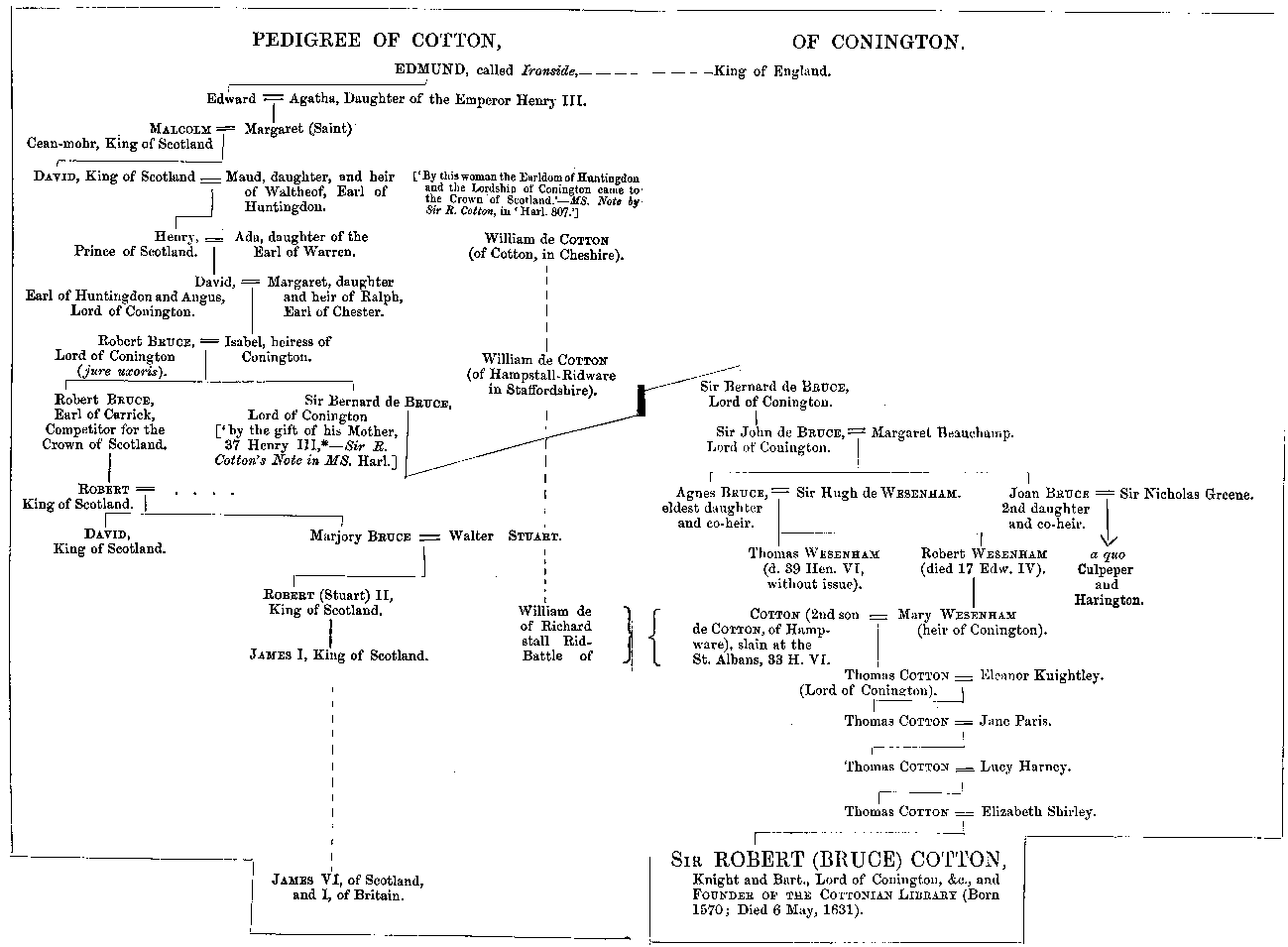
[From the Cotton Roll XIV, 6 [by Segar, Camden, and St. George]; compared with MS. Hark 807, fol. 95, and with MS. Lansd., 863, containing the heraldic Collections of R. St. George, Norroy, Vol. III, fol. 82 verso.]
[For the continuation of the Cotton Pedigree, showing (1) the descent from Sir Robert of the subsequent possessors of the Cottonian Library, up to the date of the gift to the Nation made by Sir John Cotton, and (2) the relationship of the Cottonian Trustees of the British Museum, see the concluding pages of the present Chapter.]
52Robert Cotton was educated at Trinity College in Cambridge, where he took the degree of B.A. towards the close of 1585.[4] Of his collegiate career very little is discoverable, save that it was an eminently studious one. |Cotton’s Early Friendships.| Long before he left Trinity, he had given unmistakeable proofs of his love for archæology. Some among the many conspicuous and lifelong friendships which he formed with men likeminded took their beginnings at Cambridge, but most of them were formed during his periodical and frequent sojourns in London. John Josceline, William Dethick, Lawrence Nowell, William Lambarde, and William Camden were amongst his earliest and closest friends. Most of them were much his seniors. Whilst still in the heyday of youth he married Elizabeth Brocas, daughter and eventually coheir of William Brocas of Thedingworth in Leicestershire. Soon after his marriage he took a leading part in the establishment of the first Society of Antiquaries. 53Some of Cotton’s fellow-workers in the Society are known to all of us by their surviving writings. Others of them are now almost forgotten, though not less deserving, perhaps, of honourable memory; for amongst these latter was—
‘that good Earl, once President
Of England’s Council and her Treasury;
Who liv’d in both unstain’d with gold or fee,’
at a time when such praise could seldom be given truthfully. It was as a contributor towards the common labours of that Society that Cotton made his earliest appearance as an author. The subjects chosen for his discourses at the periodical meetings of the Elizabethan antiquarians indicate the prevalent bias of his mind. Nearly all of them may be said to belong to our political archæology.
Growth of the Cottonian Library and Gallery.
Before the close of the sixteenth century, his collections of Manuscripts and of Antiquities had already become so large and important as to win for him a wide reputation in foreign countries, as well as at home. His correspondence indicates, even at that early period, a generous recognition of the brotherhood of literature, the world over, and proves the ready courtesy with which he had learned to bear somewhat more than his fair share of the obligations thence arising. In later days he was wont to say to his intimates: ‘I, myself, have the smallest share in myself.’ From youth, onwards, there is abundant evidence that the saying expressed, unboastingly, the simple facts of his daily life.
Friendship with Camden.
Camden was amongst the earliest of those intimates, and to the dying day of the author of the Britannia the close friendship which united him with Cotton was both unbroken and undiminished. The former was still in the 54full vigour of life when Cotton had given proof of his worthiness to be a fellow-labourer in the field of English antiquities. In 1599 they went, in company, over the northern counties; explored together many an old abbey and many a famous battle-field. When that tour was made, the evidences of the ruthless barbarism with which the mandates of Henry the Eighth had been carried out by his agents lay still thick upon the ground, and may well have had their influence in modifying some of the religious views and feelings of such tourists. Not a few chapters of the Britannia embody the researches of Cotton as well as those of Camden; and the elder author was ever ready to acknowledge his deep sense of obligation to his younger colleague. For both of them, at this time, and in subsequent years, the storied past was more full of interest than the politics, howsoever momentous or exciting, of the day. But, occasionally, they corresponded on questions of policy as well as of history. There is evidence that on one stirring subject, about which men’s views were much wont to run to extremes, they agreed in advocating moderate courses. In the closing years of the Queen, Cotton, as well as Camden, recognised the necessity that the Government should hold a firm hand over the emissaries of the Church and Court of Rome, whilst refusing to admit that a due repression of hostile intrigues was inconsistent with the honourable treatment of conscientious and peaceful Romanists.
It was, in all probability, almost immediately after Cotton’s return from the Archæological tour to the North which he had made with his early friend, that he received a message from the Queen. Elizabeth had been told of his growing fame for possessing an acquaintance with the mustiest of records, and an ability ‘to vouch precedents’ 55such as few students, even of much riper years, had attained to. He was now to be acquainted with a dispute about national precedency which had arisen at Calais between Sir Henry Neville and the Ambassador of Spain. |The Tractate on English precedency over Spain.| It was Her Majesty’s wish that he should search the records which bore upon the question, and send her such a report as might strengthen Neville’s hands in his contest for the honour of England.
Such a task could not fail to be a welcome one; and Cotton found no lack of pertinent evidence. The bent and habit of his mind were always methodical. He begins his abstract of the records by tabulating his argument. Precedency, he says, must have respect either to the nation or to the ruler of the nation. A kingdom must rank either (1) according to its antiquity, or (2) according to ‘the eminency of the throne royal,’ by which phrase he means the complete unity of the dominion under one supreme ruler. On the first title to precedency he observes that it may be based either upon the date of national independence, or upon that of the national recognition of Christianity. He claims for England that it was a monarchy at least four hundred and sixty years before Castile became one; that Christianity had then been established in it, without break or interruption, for a thousand years; |Cottoni Posthuma, pp. 76, 77.| whereas in Spain Christianity was ‘defaced with Moorish Mahumetisme,’ until the expulsion of the Moors by Ferdinand, little more than a century before the time at which he was writing.
His assertion of the greater ‘eminency of the throne royal’ in England than in Spain is mainly founded on the union in the English sovereignty alone of supreme ecclesiastical with supreme civil power; and on the lineal descent of the then sovereign ‘from Christian princes for 800 years,’ whereas the descent of the Kings of Spain ‘is 56chiefly from the Earls of Castilia, about 500 years since,’ and the then King of Spain was ‘yet in the infancy of his kingdom.’
Two minor and ancillary arguments in this tract are also notable: The Spanish throne, says Cotton, hath not, as hath the English and French, ‘that virtue to endow the king therein invested with the power to heal the king’s evil; for into France do yearly come multitudes of Spaniards to be healed thereof.’ And he further alleges that ‘absolute power of the King of England, which in other kingdoms is much restrained.’ The time was to come when the close friend and fellow-combatant of Eliot and the other framers of the great ‘Petition of Right’ would rank himself with the foremost in ‘much restraining’ the kingly power in England, and would discover ample warrant in ancient precedents for every step of the process. But, as yet, that time was afar off.
MS. Cott. Vesp. C. xiii, ff. 158; 160, seqq. (B. M.)
Immediately on the accession of King James, Sir Robert Cotton greeted the new monarch with two other and far more remarkable tractates on a subject bearing closely on our relations with Spain. Their political interest, as contributions to the history of public opinion, is great. Their biographical interest is still greater. But I postpone the consideration of them until we reach a momentous crisis in Sir Robert’s life on which they have a vital bearing. He also wrote,—almost simultaneously,—a much more courtierlike ‘Discourse of his Majesty’s descent from the Saxon Kings,’ which was graciously welcomed. |Domestic Correspondence, James I, vol. i, f. 3 (R. H.).| In the following September he received the honour of knighthood. |Returned to Parliament.| In James’ first Parliament he sat for the County of Huntingdon, in fellowship with Sir Oliver Cromwell, uncle of the future Protector. There is no evidence that at this period 57he took any active part in debate. Nor did he, at any time, win distinction as a debater. But in the labours of Committees he was soon both zealous and prominent. Two classes of questions, in particular, appear to have engaged his attention:—questions of Church discipline, and questions of administrative reform. |Dom. Cor. as above; vol. xix, pp. 37 seqq.; vol. xxvii, pp. 44 seqq. (R. H.); MS. Cott. Jul. C., iii, p. 10. (B. M.)| He also assisted Bacon in the difficult attempt to frame acceptable measures for a union with Scotland.
The fame of his library and of his museum of antiquities continued to spread farther and wider. He had many agents on the Continent who sought diligently to augment his collections. His correspondence with men who were busied in like pursuits both at home and abroad increased. Much of it has survived. On that interesting point at which a glance has been cast already, its witness is uniform. He was always as ready to impart as he was eager to collect. Few, if any, important works of historical research were carried on in his day to which he did not, in some way or other, give generous furtherance. At a time when he was most busy in forming his own library, he helped Bodley to lay the foundation of the noble library at Oxford.
Further Growth and Sources of the Cottonian Library.
Readers who can call to mind even mere fragments of that superabundant evidence which tells of the neglect throughout much of the Tudor period of the public archives of the realm, can feel little surprise that Sir Robert Cotton should have been able to collect a multitude of documents which had once been the property of the nation, or of the sovereign. Those who are most familiar with that evidence ought to be the first to remember that, under the known circumstances of the time, the presumption of honest acquisition is stronger than that of dishonest, whenever conclusive proof of either is absent. English State Papers 58had passed into the possession not only of English antiquarians, but of English booksellers—and not a few of them into that of foreigners—before Cotton was born. Other considerations bearing on this matter, and tending as it seems in a like direction, belong to a later period of Sir Robert’s life. There is, however, a very weighty one which stands at the threshold of his career as a collector.
Almost the earliest incident which is recorded of Cotton’s youthful days, is his concurrence in a petition in which Queen Elizabeth was entreated to establish a Public and National Library, and to honour it with her own name. |Attempt of Cotton and Camden to Establish a National Library.| Its especial and prime object was to be the collection and preservation, as public property, of the monuments of our English history. The proposal was not altogether new. It was a much improved revival of a project which Dr. John Dee had once submitted, in an immature form, to Queen Mary. It was the reiteration of an earnest request which had been made to Queen Elizabeth by Archbishop Parker, at a time when Cotton was still in his cradle. The joint petition of Cotton and Camden met with as little success as had attended the entreaties of those who had taken the same path before them. |Petition, &c. (undated) in Cotton MS. Faustina, E. V, ff. 67, 68.| The petitioners were willing to bind themselves, and others like-minded, to incur ‘costs, and charges,’ for the effectual attainment of their patriotic object, on the condition of royal patronage and royal fellow-working with them in its pursuit. When Cotton, upon bare presumptions, is charged to be an embezzler of records, this Petition comes to have a very obvious relevancy to the matter in question. The relevancy is enhanced by the fact that two, at least, of those who had (at various times) concurred in promoting its object, gave to the Library of their fellow-labourer in the field of antiquity, manuscripts and records which, had the issue of their project been 59otherwise, they would have given to the ‘Public Library of Queen Elizabeth,’ in express trust for their fellow-countrymen at large.
Indirectly, this same petition has also its bearing on a curious passage relating to Sir Robert Cotton which occurs among the Minute-books of the Corporation of London, and which has recently been printed by Mr. Riley, in his preface to Liber Custumarum.
On the 10th of November, 1607, the Court of Aldermen of London recorded the following minute: |Cotton and the City Records of London.| ‘It is this day ordered, that Mr. Chamberlain, Mr. Town Clerk, Mr. Edmonds, and Mr. Robert Smith, or any three of them, shall repair to Sir Robert Cotton, from this Court, and require him to deliver to the City’s use three of the City’s books which have been long time missing—the first book called Liber Custumarum; the second, called Liber Legum Antiquorum; and the thirde, called Fletewode, which are affirmed to be in his custody.’ Of the results of the interview of Master Chamberlain and his fellow-ambassadors with Cotton no precise account has been preserved. It is plain, however, from the sequel, that they found the matter to be one for which such extremely curt ‘requisition’ was scarcely the appropriate mode of setting to work. The Corporation appealed in vain to the Lord Privy Seal Northampton; and they had afterwards to solicit the mediation with Cotton of two of their own members—Sir John Jolles and another—who were personally known to him. Their interposition was alike ineffectual. Of the interview we have no report; but Sir Robert, it is clear, asserted his right to retain the City books (or rather portions of books) which were then in his hands, and he did retain them. They now form part of the well-known and very valuable Cottonian MS., ‘Claudius D. XI.’
60That these London records had once belonged to the citizens is now unquestioned. That Cotton—both in 1607 and again in the following year—asserted a title, of some sort, to those of them which were then in his hands, seems also to be established. Is the fair inference this: ‘Their then holder, in 1607, had obtained them wrongfully, and he persisted, despite all remonstrance, in his wrongful possession’? Is it not rather to be inferred that, whosoever may have been the original wrongdoer, Sir Robert Cotton had acquired them by a lawful purchase? |The Dispute about City Records.| If that should have been the fact, he may possibly have had a valid reason for declining to give what he had, ineffectually and rudely, been commanded to restore.
On the other hand, it is impossible to defend Sir Robert’s occasional mode of dealing with MSS.,—some of which, it is plain, were but lent to him,—when, by misplacement of leaves, or by insertions, and sometimes by both together, he confused their true sequence and aspect. Of this unjustifiable manipulation I shall have to speak hereafter.
The years which followed close upon this little civic interlude were amongst the busiest years of Cotton’s public life. He testified the sincerity of his desire to serve his country faithfully, by the choice of the subjects to the study of which he voluntarily bent his powers.
|Cotton’s Memorial on Abuses in the Navy.|
Abuses in the management of the navy and of naval establishments have been at most periods of our history fruitful topics for reformers, competent or other. In the early years of James there was a special tendency to the increase of such abuses in the growing unfitness for exertion of the Lord High Admiral. Nottingham had yet many years to live,—near as he had been to the threescore and ten when the new reign began. But even his large 61appetencies were now almost sated with wealth, employments, and honours; and ever since his return from his splendid embassy to Spain, he seemed bent on compensating himself for his hard labour under Elizabeth by his indolent luxury under James. The repose of their chief had so favoured the illegitimate activities of his subordinates, that when Cotton addressed himself to the task of investigating the state of the naval administration he soon found that it would be much easier to prove the existence and the gravity of the abuses than to point to an effectual remedy.
The abuses were manifold. Some of them were, at that moment, scarcely assailable. To Cotton, in particular, the approach to the subject was beset with many difficulties. He was, however, much in earnest. |The Inquiry instituted by Cotton into Abuses in the Royal Navy.| When he found that some of the obstacles must, for the present, be rather turned by evasion than be encountered—with any fair chance of success—by an open attack in front, he betook himself to the weaker side of the enemy. He obtained careful information as to naval account-keeping; discovered serious frauds; and opened the assault by a conflict with officials not too powerful for immediate encounter,—though far indeed from being unprotected.
Cotton, Memorial on Abuses of the Navy;—Domestic Corresp. James I, vol. xli, p. 21. (R. H).
Of Sir Robert’s Memorial to the King, I can give but one brief extract, by way of sample: ‘Upon a dangerous advantage,’ he writes, ‘which the Treasurer of the Navy taketh by the strict letter of his Patent, to be discharged of all his accounts by the only vouchee and allowance of two chief officers, it falls out, strangely, at this time—by the weakness of the Controller and cunning of the Surveyor—that these two offices are, in effect, but one, which is the Surveyor himself, who—joining with the Treasurer as a Purveyor of all provisions—becomes a paymaster to himself ... at such rates as he thinks good.’ It is a suggestive statement.
62Cotton’s most intimate political friendships were at this time with the Howards. Henry Howard (now Earl of Northampton),—whatever the intrinsic baseness and perfidy of his nature, was a man of large capacity. He was not unfriendly to reform,—when abuses put no pelf in his own pocket. To naval reforms, his nearness of blood to Nottingham, the Lord High Admiral, tended rather to predispose him; for when near relatives dislike one another, the intensity of their dislike is sometimes wonderful to all bystanders. Interest made these two sometimes allies, but it never made them friends. Northampton gave his whole influence in favour of Sir Robert’s plan. He began the inquiries into this wide subject by persuading the King to appoint a Commission. On the 30th of April, 1608, Letters Patent were issued, in the preamble of which the pith of the Memorial is thus recited: ‘We are informed that very great and considerable abuses, deceits, frauds, corruptions, negligences, misdemeanours and offences have been and daily are perpetrated ... against the continual admonitions and directions of you, our Lord High Admiral, by other the officers of and concerning our Navy Royal, and by the Clerks of the Prick and Check, and divers other inferior officers, ministers, mariners, soldiers, and others working or labouring in or about our said Navy;’ |Commission for Inquiry on the Abuses in the Navy.| and thereupon full powers are given to the Commissioners so appointed to make full inquiry into the allegations; and to certify their proceedings and opinions. Cotton was made a member of the Commission, and at the head of it were placed the Earls of Northampton and of Nottingham. It was directed that the inquiry should be carried at least as far back as the year 1598. The Admiral’s share was little more than nominal. The proceedings were opened on the 7th of May, 1608, when, as
63Cotton himself reports, an ‘elegant speech was made by Lord Northampton, of His Majesty’s provident and princely purposes for reformation of the abuses.’ Northampton, he adds, ‘took especial pains and care for a full and faithful discharge of that trust.’ At his instance Sir Robert was made Chairman of a sort of sub-committee, to which the preliminary inquiries and general array of the business were entrusted; |Proceedings in the Commission for the Navy Royal; MS. Cott. Julius F. iii, fol. 1. (B. M.)| ‘Sir Robert Cotton, during all the time of this service, entertaining his assistants at his house at the Blackfriars as often as occasion served.’
The inquiry lasted from May, 1608, to June, 1609. Cotton was then requested by his fellow-commissioners to make an abstract of the depositions to be reported to the King. It abundantly justified the Memorial of 1608. James, when he had read it, ordered a final meeting of the Commissioners to be held in his presence, at which all the inculpated officers were to attend that they might adduce whatever answers or pleas of defence might be in their power. ‘In the end,’ says Sir Robert, ‘they were advised rather to cast themselves at the feet of his grace and goodness for pardon, than to rely upon their weak replies; which they readily did.’ The most important outcome of the inquiry was the preparation of a ‘Book of Ordinances for the Navy Royal,’ in the framing of which Sir Robert Cotton had the largest share. It led to many improvements. But, in subsequent years, measures of a still more stringent character were found needful.
The Inquiry into Crown Revenues.
In the next year after the presentation of this Report on the Navy, Sir Robert addressed to the King another Report on the Revenues of the Crown. The question is treated historically rather than politically, but the long induction of fiscal records is frequently enlivened by keen glances both at underlying principles and at practical results. 64Once or twice, at least, these side glances are such as, when we now regard them, in the light of the subsequent history of James’s own reign and of that of his next successor, seem to have in them more of irony than of earnest. The style of the treatise is clear, terse, and pointed.
On no branch of the subject does the author go into more minute detail than on that delicate one of the historical precedents for ‘abating and reforming excesses of the Royal Household, Retinue, and Favourites.’ He points the moral by express reference to existing circumstances. Thus, for example, in treating of the arrangements of the royal household, he says, ‘There is never a back-door at Court that costs not the king £2000 yearly;’ and again, when treating of gifts to royal favourites: ‘It is one of the greatest accusations against the Duke of Somerset for suffering the King [Edward VI] to give away the possessions and profits of the Crown in manner of a spoil.’
Not less plainspoken are Cotton’s words about a question that was destined, in a short time, to excite the whole kingdom. Tonnage and poundage, he says, were granted simply for defence of the State, ‘so they may be employed in the wars; and particular Treasurers account in Parliament’ for that employment. |Proceedings in the Commission for the Navy Royal, &c.; as above.| ‘They are so granted,’ he adds, ‘in express words; and that they proceed of goodwill, not of duty. Precedents of this nature are plentiful in all the Rolls.’ A final example of this sort may be found in the pithy warning grounded upon Richard the Second’s grant to a minion of the power of compounding with delinquents. It was fatal, he says, both to the king and to his instrument. ‘It grew the death of the one and the deposition of the other.’
Cotton’s Report on the Crown Revenues has also an 65incidental interest. Out of it grew the creation of the new dignity of baronets. Were His Majesty, says the writer, ‘now to make a degree of honour hereditary as Baronets, next under Barons, and grant them in tail, taking of every one £1000, in fine it would raise with ease £100,000; |Cotton’s Proposition for the Creation of Baronets, 1609.| and, by a judicious election, be a means to content those worthy persons in the Commonwealth that by the confused admission of [so] many Knights of the Bath held themselves all this time disgraced.’ When this passage was written that which had been, under Elizabeth, so real and eminent an honour as to be eagerly coveted by patriotic men, had been lavished by James with a profusion which entailed their contempt and disgust. I have before me the fine old MS. from a passage in which Cotton borrowed the title of the new dignity. |9 R. II. Durh. 17 July, 1385. Cotton MS., Nero D., vi, § 16. (B. M.)| The word occurs thus:—‘Ceux sont les estatutz, ordenances ... de n̄re très excellent souv seigneur le Roy Richard, et Johan, Duc de Lancastre, ... et des autres Contes, Barons, et Baronnetz, et sages Chivalers.’
Sir Robert was himself amongst the earliest receivers (June, 1611) of the new order. Its creation led to many jealousies and discords. It gave both to the King and to his councillors not a little trouble in settling the precise privileges and precedencies of its holders. In those controversies the author of the suggestion took no very active part. King James was much more anxious for the speedy receipt of the hundred thousand pounds, than about the ‘judicious election’ of those by whom the money was to be provided. Cotton’s satisfaction with the ultimate working out of his plan must have had its large alloy.[5]
66This is the more apparent, inasmuch as, at the first acceptance of his project, Sir Robert had obtained the King’s distinct promise that no future creation of a baron should be made, until the new peer had first received the degree of baronet; unless he belonged to a family already ennobled. Hearing of a probability that the royal promise in this respect was likely to be broken, he wrote to Somerset:—‘If His Highness will do it, I rather humbly beg a relinquishing in the design of the baronets, as desponding of good success.’ |Cotton to Somerset (undated) MS. Harl., 7002, f. 380. (B. M.)| But to James all projects for the opening of gold mines—whether at home or abroad—were much too attractive to be staved off by any puritanic scruples about pledge or promise. For him, from youth to dotage, the one thing needful was gold.
The question of the baronetcies is one of the earliest which brings us in presence of the eventful political connection which subsisted between Cotton and the Earl of Somerset. |The Political Intercourse of Sir R. Cotton with Lord Somerset. 1613–1615.| Of its first beginnings no precise testimony seems to have survived. But there is a strong presumption that when Somerset was led, by his fatal love for Lady Essex, to change his early position of antagonism to the Howards for one of alliance and friendship, he came frequently into contact with Sir Robert, who had long been familiarly acquainted with the Earl of Suffolk—and also with his too well-known Countess—as well as with the Earl of Northampton.
The one ineffaceable stigma on Somerset’s memory 67which was brought upon him by his disgraceful marriage has barred the way to an impartial estimate of his standing as a politician. A man who was branded by his peers (though upon garbled depositions) as a murderer can scarcely, by possibility, have his pretensions to statesmanship fairly weighed in a just balance. Such testimony, it is true, as that on which Somerset was found guilty of the poisoning of Overbury would not now suffice to convict a vagrant of petty larceny. It would not indeed at this day be treated as evidence at all; it would be looked upon as a mere decoction of surmises. But the foul scandal of the marriage itself has so tainted Somerset’s very name that historians (almost with one consent) have condoned the baseness of his prosecutors.
With some of this man’s contemporaries it was quite otherwise. Some English statesmen whose names we have all learnt to venerate, looked upon the murder of Overbury as a revengeful deed instigated by Lady Somerset, wholly without her husband’s complicity; and they looked at Somerset’s conviction of complicity in the crime as simply the issue of a skilfully-managed court intrigue, for a court object. They knew that Somerset’s enemies had been wont to say amongst themselves, ‘A nail is best driven out by driving in another nail,’ and had, very effectually, put the proverb into action. They knew, too, that to the rising favourite the King had committed—most characteristically—the pleasing task of communicating, on his behalf, with the Crown lawyers, as their own task of compiling the depositions against the falling favourite went on from stage to stage.
Sir Robert Cotton believed not only that Somerset was guiltless of the murder of Overbury, and that the Earl’s political extinction was resolved upon, as the readiest means 68of making room for a new favourite, but he also believed that Somerset’s loss of power involved the loss by England—for a long time to come—of some useful domestic reforms, as well as its subjection to several new abuses. This belief was a favourite subject of conversation with him to his dying day. He was in the habit of imparting it to the famous men who, in the early years of the next reign, joined with him in fighting the battles of parliamentary freedom against royal prerogative. There may well have been an element of truth in Cotton’s view of the matter, though, in these days, it seems but a barren pursuit to have discussed the preferability to England of the rule of a Robert Carr rather than that of a George Villiers.
Cotton and the projected Spanish Match.
What is now chiefly important in the close political connection which was formed between Cotton and Somerset is the fact that it eventually thrust Sir Robert’s fortune and entire future into great peril, even if it did not actually hazard his life itself, as well as his fair fame with posterity. The life that was preserved to him was also to be redeemed by future and brilliant public service. |1615.| His fortune sustained no great damage, and much of it was afterwards spent upon public objects. His reputation as a statesman, however, suffered, and must suffer, some degree of loss. Somerset led him to become an agent in urging on the treaty for the marriage of Prince Charles with the Infanta of Spain. As it seems, his agency was—for a very brief period—even active and zealous. Neither Somerset nor Cotton, however, set that intercourse with Gondomar afoot which presently brought Sir Robert within the toils. It was pleasantly originated by the wily Spaniard himself, in the character of a lover of antiquities, deeply anxious to study Sir Robert’s Museum, in its owner’s company.
It is unfortunate for a truthful estimate of the degree of 69discredit attachable to Cotton for this agency in promoting a scheme pregnant with dishonour to England, that little evidence of the share he took in it is now to be derived from any English source. His own extant correspondence yields very little, though it suffices to establish the fact of the agency, apart from that testimony of Gondomar, which will be cited presently.
Under Cotton’s own hand we have the fact that in a conversation with himself the Ambassador of Spain on one occasion held out (by way, it seems, more immediately, of inducement to the English Government to shape certain pending negotiations on other matters into greater conformity with Spanish counsels) |Cotton to Somerset; (undated) Harleian MS. 7002, fol. 378. (B. M.)| the threat that, if such a course were not taken, ‘turbulent spirits—of which Spain wanteth not—might add some hurt to the ill affairs of Ireland, or hindrance to the near affecting of the great work now in hand;’ a threat which Cotton transmits to Somerset without rebuke or comment.
Early in 1615, Cotton had an interview with Gondomar in relation to the progress of the marriage negotiation in Spain. Of what passed at this interview we have no detailed account other than that which was sent to the King of Spain by his Ambassador. The way in which Cotton’s name is introduced, and the singular misstatement that he had the custody of ‘all the King’s archives,’ seem to imply that Gondomar had still but little knowledge of the messenger now employed by James and by Somerset to confer with him. Throughout, the reader will have to bear in mind that the narrative is Gondomar’s, and that all the material points of it rest upon his sole authority.
1615. April 18.
‘The King and the Earl of Somerset,’ writes the Ambassador, ‘have sent in great secrecy by Sir Robert Cotton—who is a gentleman greatly esteemed here, and 70with whom the King has deposited all his archives—to tell me what Sir John Digby has written about the marriage of the Infanta with this Prince. Cotton informed me that he was greatly pleased that the negotiation had been so well received in Spain, because he desired its conclusion and success. He enlarged upon the conveniencies of the marriage, but said that the King considered Digby not to be a good negotiator, because he was a great friend of the Archbishop of Canterbury, and of the Earl of Pembroke, who were of the Puritan faction, and was in correspondence with them.’... ‘In order to make a beginning,’ continued Cotton, as Gondomar reports his conversation, ‘the King must beg your Majesty to answer three questions: (1.) “Does your Majesty believe that with a safe conscience you can negotiate this marriage?” (2.) “Is your Majesty sincerely desirous to conclude it, upon conditions suitable to both parties?” (3.) “Will your Majesty abstain from asking anything, in matters of Religion, which would compel him to do that which he cannot do without risking his life and his kingdom; contenting yourself with trusting that he will be able to settle matters quietly?” |Gardiner Transcripts of Simancas MSS.| When an answer is given to these questions he will consider the matter as settled, and will immediately give a commission to the Earl of Somerset to arrange the points with me. |See also S. R. Gardiner, in Letters of Gondomar, giving an Account of the affair of the Earl of Somerset; (Archæologia, vol. xli.)| This Sir Robert Cotton is held here, by many, to be a Puritan, but he told me that he was a Catholic, and gave me many reasons why no man of sense could be anything else.’ He afterwards adds: ‘Sir Robert Cotton, who has treated with me in this business, tells me that after the marriage is agreed upon, [and] before the Infanta arrives in England, matters of Religion will be in a much improved condition.’ The writer of this remarkable despatch, it may be well to mention, had asserted with 71equal roundness, but a few months before, that James himself had said, at the dinner-table: ‘I have no doubt that the Roman Catholic Church is the true Church.’
Simancas MSS. 2590, 10 (Gardiner Transcripts).
Nor is it unimportant, as bearing on the degree of credibility to be assigned to Gondomar’s despatches, when they chance to be uncorroborated,—to remark that a despatch addressed by him to the Duke of Lerma, in November, contains an express contradiction of an assertion addressed to Philip, in the preceding April. To the King, as we have just seen, he narrates Cotton’s communication of despatches written by Digby. To the Minister he writes, six months later, that ‘a traitor had given information’ against Cotton, for communicating Papers of State to the Spanish Ambassador, and that the charge is ‘false.’ |Simancas MS. 2534, 61 (Gardiner Transcripts).| Discrepancies like this (howsoever easily explained, or explainable) suffice to show that Gondomar’s testimony, when unsupported, needs to be read with caution; and of such discrepancies there are many. Consummate as he was in diplomatic ability of several kinds, this able statesman was nevertheless loose (and sometimes reckless) in assertion. He was very credulous when he listened to welcome news. It is impossible to study his correspondence without perceiving that to him, as to so many other men, the wish was often father of the thought.
On the 22nd of June, Sir Robert paid another visit to Gondomar. He told me, says the Ambassador, that the King’s hesitations had been overcome; that James was now willing to negotiate on the basis of the Spanish articles, with some slight modifications; that Somerset had taken his stand upon the match with Spain, had won the co-operation of the Duke of Lennox, and was now willing to stake his fortunes on the issue. Sir Robert Cotton, adds Gondomar, ‘assured me of his own satisfaction at the turn 72which things had taken, as he had no more ardent wish than to live and die an avowed Catholic, like his fathers and ancestors.[6] Whereupon I embraced him, and said that God would guide.’
Thus far, I have, advisedly, followed a Spanish account of English conversations. Although believing that there exists, already ample, evidence (both in our own archives and elsewhere) for bringing home to the Count of Gondomar wilful misstatements of |Sir Robert Cotton’s Account of the first interview with Count Gondomar.| fact—in the despatches which he was wont to write from London—as well as very pardonable misapprehensions of the talk which he reports, I have preferred to put before the reader the Ambassador’s own story in its Spanish integrity.
The mere fact, indeed, that an English historian[7], deservedly esteemed for his acute and painstaking research, as well as for his eminent abilities, has honoured Gondomar’s story by endorsing it, is warrant enough for citing these 73despatches as they stand. But they have now to be compared with another account of the same transaction given by authority of Sir Robert Cotton himself. It was given upon a memorable occasion. The place was the Painted Chamber in the Palace of Westminster. The hearers were the assembled Lords and Commons of the Realm.[8]
The Spaniard, it seems, was far, indeed, from holding—as he says that he held—his first conference with Cotton 74either in his own ambassadorial lodging, or upon credentials given in the name and by the command of King James. That Cotton sought him he suggests, by implication. That the visit, in which the ground was broken, was made at the King’s instance, he states circumstantially. Both the suggestion and the assertion are false.
As the reader has seen, Sir Robert’s openness in exhibiting his library and his antiquities was matter of public notoriety. |1614. February.| Profiting by that well-known facility of access, the Spanish Ambassador presented himself at Cotton House in the guise of a virtuoso. ‘Do me the favour—with your wonted benevolence to strangers—to let me see your Museum.’ With some such words as these, Gondomar volunteered his first visit; led the conversation, by and bye, to politics; found that Cotton was not amongst the fanatical and undiscriminating enemies of Spain at all price—outspoken, as he had been, from the first, in his assertion both of the wisdom and of the duty of England to protect the Netherlanders; showed him certain letters or papers (not now to be identified, it appears), and in that way produced an impression on Cotton’s mind which led him to confer with Somerset, and eventually with the King. So much is certain. Unfortunately, the speeches at the famous ‘Conference’ on the Spanish Treaty, in 1624, are reported in the most fragmentary way imaginable. The reporter gives mere hints, where the reader anxiously looks for details. Their present value lies in the conclusive reasons which notwithstanding the lacunæ—they supply for weighing, with many grains of caution, the accusations of an enemy of England against an English statesman—whensoever it chances that those accusations are uncorroborated. King James himself (it may here be added), when looking back at this mysterious transaction some years later, 75and in one of his Anti-Spanish moods—said to Sir Robert: ‘The Spaniard is a juggling jack. I believe he forged those letters;’ alluding, as the context suggests, to the papers—whatever they were—which Gondomar showed to Cotton at the outset of their intercourse, in order to induce him to act as an intermediary between himself and the Earl of Somerset.
At this time, the ground was already trembling beneath Somerset’s feet, though he little suspected the source of his real danger. He knew, ere long, that an attempt would be made to charge him with embezzling jewels of the Crown. In connection with this charge there was a State secret, in which Sir Robert Cotton was a participant with Somerset, and with the King himself. And a secret it has remained. Such jewels, it is plain, were in Somerset’s hands, and by him were transferred to those of Cotton. Few persons who have had occasion to look closely into the surviving documents and correspondence which bear upon the subsequent and famous trials for the murder of Overbury, will be likely to doubt that the secret was one among those ‘alien matters’ of which Somerset was so urgently and so repeatedly adjured and warned, by James’s emissaries, to avoid all mention, should he still persist (despite the royal, repeated, and almost passionate, entreaties with which he was beset) in putting himself upon his trial; instead of pleading guilty, after his wife’s example, and trusting implicitly to the royal mercy.
For the purpose of warding off the lesser, but foreseen, danger, Cotton advised the Earl to take a step of which the Crown lawyers made subsequent and very effective use, in order to preclude all chance of his escape from the unforeseen and greater danger. |1615. July.| By Sir Robert’s recommendation 76he obtained from the King permission to have a pardon drawn, in which, amongst other provisions, it was granted that no account whatever should be exacted from Somerset at the royal exchequer; and to that pardon the King directed the Chancellor to affix the Great Seal. The Seal, however, was withheld, and a remarkable scene ensued in the Council Chamber. There are extant two or three narratives of the occurrence, which agree pretty well in substance. Of these Gondomar’s is the most graphic. The incident took place on the 20th of August. The despatch in which it is minutely described was written on the 20th of October. There is reason to believe that the Ambassador drew his information from an eye-witness of what passed.
‘As the King was about to leave the Council Board,’ writes Gondomar, ‘Somerset made to him a speech which, as I was told, had been preconcerted between them. |The scene in the Council Chamber, respecting the Pardon drawn by Sir R. Cotton for Somerset.| He said that the malice of his enemies had forced him to ask for a pardon; adduced arguments of his innocency; and then besought the King to command the Chancellor to declare at once what he had to allege against him, or else to put the seal to the pardon. |1615. August.| The King, without permitting anything to be spoken, said a great deal in Somerset’s praise; asserted that the Earl had acted rightly in asking for a pardon, which it was a pleasure to himself to grant—although the Earl would certainly stand in no need of it in his days—on the Prince’s account, who was then present.’ Here, writes Gondomar, the King placed his hand on the Prince’s shoulder, and added—‘That he may not undo what I have done.’ Then, turning to the Chancellor, the King ended with the words: ‘And so, my Lord Chancellor, put the seal to it; for such is my will.’ The Chancellor, instead of obeying, threw himself on his 77knees, told the King that the pardon was so widely drawn that it made Somerset (as Lord Chamberlain) absolute master of ‘jewels, hangings, tapestry, and of all that the palace contained; seeing that no account was to be demanded of him for anything.’ And then the Chancellor added: ‘If your Majesty insists upon it, I entreat you to grant me a pardon also for passing it; otherwise I cannot do it.’ On this the King grew angry, and with the words, ‘I order you to pass it, and you must pass it,’ left the Council Chamber. His departure in a rage, before the pardon was sealed, gave Somerset’s enemies another opportunity by which they did not fail to profit. They had the Queen on their side. On that very day, too, the King set out on a progress, long before arranged. For the time the matter dropped. Before the Ambassador of Spain took up his pen to tell the story to his Court, Villiers, ‘the new favourite,’ had begun to supplant his rival; so that the same despatch which narrates the beginnings of the fall of Somerset, tells also of the first stage in the rapid rise of Buckingham.
The Second Pardon drawn by Cotton. 1615, Sept.
About a month after this wrangling at the Council Board, Somerset again advised with Sir Robert Cotton on the same subject. |Report of the Trial of the Earl of Somerset. (MS. R. H.)| Cotton recommended him to have the Pardon renewed; saying to the Earl, ‘In respect you have received some disgrace in the opinion of the world, in having passed’ [i. e. missed] ‘that pardon which in the summer you desired, and seeing there be many precedents of larger pardons, I would have you get one after the largest precedent; that so, by that addition, you may recover your honour.’ Strangely as these closing words now sound, in relation to such a matter, they seem to embody both the feeling and the practice of the times.
In another version of the proceedings at the trial of May, 781616, Somerset is represented as using in the course of his defence these words: ‘To Sir Robert Cotton I referred the whole drawing and despatch of the Pardon.’ And again: ‘I first sought the Pardon by the motion and persuasion of Sir Robert Cotton, who told me in what dangers great persons honoured with so many royal favours had stood, in former times.’ |MS. Report of Trial (R. H.)| Sir Robert’s own account of this and of many correlative matters of a still graver sort has come down to us only in garbled fragments and extracts from his examinations, such as it suited the purposes of the law-officers of the Crown to make use of, after their fashion. The original documents were as carefully suppressed, as Cotton’s appearance in person at the subsequent trial was effectually hindered. At that day it was held to be an unanswerable reason for the non-appearance of a witness,—whatever the weight of his testimony,—to allege that he was regarded by the Crown as ‘a delinquent,’ and could not, therefore, be publicly questioned upon ‘matters of State.’ There is little cause to marvel that a scrutinising reader of the State Trials (in their published form) is continually in doubt whether what he reads ought to be regarded as sober history, or as wild and, it may be, venomous romance.
One other incident of 1615 needs to be noticed before we proceed to the catastrophe of the Gondomar story.
1615. May 24.
In May of this year Sir Robert wrote a letter to Prince Charles, which is notable for the contrasted advice, in respect to warlike pursuits, which it proffers to the new Prince, from that more famous advice which had but recently been offered to his late brother. |Comp. MS. Cott. Cleop. F. vi, § 1. ‘An Answer ... to certain military men, &c., (April, 1609).| He had lately found, he tells Prince Charles, a very ancient volume containing the principal passages of affairs between the 79two kingdoms of England and France under the reigns of King Henry the Third and King Henry the Fifth, and had caused a friend of his to abstract from it the main grounds of the claim of the Kings of England to the Crown of France; translating the original Latin into English. This he now dedicates to the Prince, ‘as a piece of evidence concerning that title which, at the time when God hath appointed, shall come unto you.’ He ends his letter in a strain more than usually rhetorical:—‘This title hath heretofore been pleaded in France, as well by ordinary arguments of civil and common law, as also by more sharp syllogisms of cannons in the field. There have your noble ancestors, Kings of this realm, often argued in arms; there have been their large chases; there, their pleasant walks; there have they hewed honour out of the sides of their enemies; there—in default of peaceable justice—they have carried the cause by sentence of the sword. |Sir R. Cotton to Prince Charles. (MS. Lansd. 223. fol. 7.) (Copy.) (B. M.)| God grant that your Highness may, both in virtues and victories, not only imitate, but far excel them.’
The King to Archbishop of Canterbury, &c. Domestic Corresp. James I, vol. lxxxvi, § 16. (R. H.)
The royal commission for the first examination of Cotton was issued on the 26th of October, 1615. Two months afterwards he was committed to the custody of one of the Aldermen of London. His library and papers were also searched.
Cotton’s accusation was that of having communicated papers and secrets of State to the Spanish Ambassador. He was subjected to repeated examinations, which (as we have seen) are extant only in part. He maintained his innocence of all intentional offence. |Cotton’s examinations by Commission Jan.-April, 1616.| ‘The King,’ he said, ‘gave me instruction to speak as I did. If I misunderstood His Majesty my fault was involuntary. I followed the King’s instruction to the best of my belief and recollection.’ 80The examiners, however, were more intent by far on extracting something from Cotton that would tell against Somerset, than on the punishment of the fallen favourite’s ally and agent. Coke, in particular, was indefatigable in the task. It was as congenial to him as was the study of Bracton or of Littleton.
What then must have been his delight when,—whilst attending a sermon at Paul’s Cross,—word was brought to him which gave hope of a discovery of Somerset’s most secret correspondence? The pending proceedings had stirred men’s minds in city and suburb, as well as at Court. A London merchant had been asked, a little while before, to take into his charge a box of papers. The depositor was a woman of the middle class, with whom his acquaintance was but slight. At that time there was nothing in the incident to excite suspicion. But, at a moment when strange rumours were afloat, the depositor suddenly requested the return of the deposit. The merchant bethought himself that the circumstances now looked mysterious. If the papers should chance to bear on matters of State, to have had any concern with them, howsoever innocent, might be dangerous. He carried the box to Sir Edward Coke’s chambers. Not a moment was lost in apprising the absent lawyer of the incident. Such news was of more interest than the sermon. Probably, the preacher had not finished his exordium, before all the faculties of Coke and of a fellow-commissioner were bent on the letters which had passed between Somerset and Northampton.
If Gondomar is to be believed, some secret papers belonging to King James himself were part of the precious spoil.[9]
81As usual, there are two accounts of the original secretor of the papers so opportunely discovered. According to one of them, the box was delivered by Somerset’s own order to the woman by whom it was carried to the London merchant. |Cotton’s dealings with Somerset’s Correspondence.| |1615.| According to another, Somerset entrusted the papers to Cotton; and the latter, anticipating the search and sealing up of his library, gave them to a female acquaintance with whom he thought they would remain in safety, but whose own fears led her to shift their custody, in her turn.
That the letters which Northampton had received from Somerset—containing, amongst many other things, numerous references to the imprisonment of Overbury in the Tower—had been in Sir Robert Cotton’s hands is unquestioned. After Northampton’s death, Cotton, to use his own words, had been ‘permitted to peruse and oversee all the writings, books, &c. in the Earl’s study.’ In the course of this examination he proceeds to say, ‘I had collected thirty several letters of my Lord of Somerset to the Earl of Northampton, which, upon request, I delivered to my Lord Treasurer [the Earl of Suffolk,] who sent them to the Earl of Somerset.’ Suffolk, it is to be remembered, was Northampton’s heir.
Thus far, no charge rests upon Cotton in relation to this correspondence. What he did in disposing of Somerset’s 82letters was done by order of the representatives of their deceased owner. It is far otherwise with respect to their treatment after they had repassed, by Suffolk’s gift, into the hands of Somerset, their writer.
The letters were undated. That they should be so was in accordance with the practice of a majority of the letter-writers of the time—as students of history know to their sorrow. |Extracts of Examinations, &c. (R. H.).| When suspicion was aroused and inquiry commenced about the real cause of Overbury’s death, Cotton’s advice was sought by Somerset. He told me, says Somerset himself: ‘These letters of yours may be dated, so as may clear you of all imputation.’ Did he mean that the dates might be forged, and so be made to bear false witness? Or did he mean that, by putting their true dates to the letters, their contents would exculpate an innocent man? To these questions there is absolutely no answer, save the presumptive answer of character.[10]
83Whatever may be our estimate of the difficulty attending on the admission of such exculpation as that, in respect of a charge which amounts (in substance) to participation, after the fact, in the crime of murder, there is really now no alternative. That Sir Robert Cotton put dates to Somerset’s undated letters is certain. It was found to be absolutely impossible, after desperate effort, to prove that the dates were false. It is alike impossible to prove that they are true. These dates are in Cotton’s own hand, without any attempt to disguise it.
Upon the hypothesis of Somerset’s guilt, the question is beset with as much difficulty, as upon the hypothesis of his innocence. By procuring Overbury’s imprisonment—with whatever motive, or beneath whatever influence—Somerset had brought himself under inevitable suspicion of complicity in the ultimate result of that imprisonment. He was already within the web. His struggles made it only the more tangled.
Sir Robert Cotton remained in custody until the middle of the year 1616. He was effectually prevented from appearing in May of that year as a witness at his friend’s trial. |Domestic Corresp. James I, vol. lxxxvii, f. 67 (R. H.).| He was himself put to no form of trial whatever. But he had to purchase his pardon at the price of five hundred pounds. It received the Great Seal on the 16th July. |Bacon to Villiers, Feb. 1; and April 18; 1616.| Remembering Bacon’s share in each stage of the proceedings against Somerset, and the lavishness of his professions 84to Villiers of the extreme delight he felt in following the lead of the new favourite throughout every step of the prosecution of the old one, it is suggestive to note that the framers, five years afterwards, of a pardon for the Lord Chancellor Bacon were directed to follow the precedent of the pardon granted in July 1616 to Sir Robert Cotton.
Nor is it of less interest to observe that, to some of Sir Robert Cotton’s closest friends, it seemed—at the moment when every part of the matter was fresh in men’s minds—that it was much more needful for him to exonerate himself from a suspicion of having stood beside Somerset too lukewarmly, than to clear himself from the charge of committing a forgery in order to cloke a murder. Very significant, for example, are the words of one of those friends which I find in a letter addressed to Cotton on the very day on which his pardon passed the Great Seal:—‘If I say I rejoice and gratulate to you your return to your own house, as I did lament your captivity, ... it will easily be credited.... The unsureness of this collusive world, and the danger of great friendships, you have already felt; and may truly say, with holy David, Nolite fidere in principibus.... As I hear, you have begun to make good use of it, by receiving to you your Lady which God himself had knit unto you. It is a piety for which you are commended. And, were it not for one thing I should think my comfort in you were complete.... It is said you were not sufficiently sincere to your most trusting friend, the pitied Earl. |E. Bolton to Sir R. Cotton; Cott. MS. Julius C., iii, fol. 32. (B. M.)| Though I hold this a slander, yet being not able to make particular defences, I opposed my general protestation against it as an injury to my friend. Yet wanting apt countermines to meet with those close works by which some seek to blow up a breach into your honour, I was not a little afflicted.... 85I leave the arming of me in this cause to your own pleasure.’
The caution as to the danger of the friendships of grandees and great favourites was one which Cotton took to heart. In the years to come he had occasionally to give critical advice, in critical junctures. But, in the true sense of the words, he learnt, at last, not to put his trust in Princes. Long before his acquaintance with Somerset and his private conferences with James, a very true and dear friend had noted a dangerous proclivity in Sir Robert’s character. |Arthur Agarde to Sir R. Cotton: Cott. MS. Julius C., iii, fol. 1.| It prompted, by way of counsel, the words: ‘Be yourself; and no man’s creature; but [only] God’s. And so He will prosper all your designs, both to his glory and your good.’
That ply had been taken too deeply, however, to be very easily smoothed out. In the years to come Sir Robert Cotton approached—more than once, perhaps—the brink of the old peril. As Buckingham clomb higher and higher, and busied himself with many transactions of the nature of which he had but a very insecure mental grasp, he felt his need of the counsels of experienced men. He made occasional advances to Cotton, amongst others. They were met; and not always so warily, as might now have been expected.
But against the danger which over-confiding intercourse with too-powerful courtiers was sure to bring in its train, Cotton found a better safeguard in wounded self-esteem, than even in dearbought experience. He soon saw that in Buckingham’s character there was at least as much of vacillation as of versatility. The famous lines which describe the son as
A man so various, that he seem’d to be
Not one, but all mankind’s epitome,
86would have a spice of truth if applied to the father. But their applicability is only partial; whereas the lines which follow are almost as true—a single word excepted—of the first Duke of Buckingham as they were of the second—
Stiff in opinions; often in the wrong;
He’s everything by starts, and nothing long.
When Sir Robert Cotton perceived that James’s new favourite would listen, in the morning, to grave advice on a grave subject, and affirm his resolution to act upon it; and yet, in the afternoon suffer himself to be carried from his purpose by the silly jests or malicious suggestions of youngsters and sycophants, unacquainted with affairs and often reckless of consequences, he saw the wisdom of standing somewhat aloof. He rarely, however, refused his advice, when it was asked. In regard to matters of naval administration,—the authoritative value of his opinion on which was now everywhere recognised, save in the dockyards and their dependencies,—he gave it with especial willingness. But henceforward, to use Agarde’s words, he was ‘no man’s creature.’
Five years passed on, marked by events which stirred England to its core, but to Sir Robert Cotton they were years of comparative quiet. He was, indeed, very far from being a careless bystander. He observed much, and learnt much. |Growth of Cotton’s Literary and Public Correspondence.| Had it not been for the lessons which those publicly eventful years impressed on his receptive mind, he might have gone to his grave with no other reputation than that of a profound antiquary, and the Founder of the Cottonian Library.
Meanwhile, his pen worked as hard in the service of scholars, both at home and abroad, as though he had been a 87busy proof-reader in a leading printing-office. He supplied, at the same time, on the right hand and on the left, precedents and formulæ, with a diligence and readiness which would have won both fame and fortune for a long-accustomed conveyancer. Camden consults him, continually, for help in his historical labours. Ben Jonson puts questions to him about intricate points of Roman geography. |MS. Cott., Julius C., iii, fol. 239. (B. M.)| William Lisle seeks Cotton’s aid in the prosecution of his studies of the language and literature of the Anglo-Saxons. |Ib., fol. 288, seqq.| Peiresc consults him on questions in Numismatics. |Domestic Corresp., Jas. I, vol. lxxxi, § 15. (R. H.)| If great officers of State chance to quarrel amongst themselves about their respective claims to carry before the King the sword Curtana, at some special ceremony, they agree to refer the dispute to Sir Robert Cotton and to abide—without fighting a duel—by his momentous decision. If a courtier obtains for a friend the royal promise of an Irish viscounty he writes to Cotton, asking him to choose an appropriate and well-sounding title. |MS. Cott., Julius C., iii, fol. 378.| Roger Maynwaring begs him to determine the legal amount of burial-fees. |Ib., fol. 252.| Dr. Lambe asks him to settle conflicting pretensions to the advowson of a living which, in old time, belonged to an abbey. |Ib., fol. 229.| Augustine Vincent implores his help in a tough question about patents of peerage. |Ib., fol. 379.| The Lord Keeper Williams seeks advice on questions of parliamentary form and privilege. |Edwards’ Life and Letters of Ralegh, vol. ii, p. 321.| Ralegh writes to him, from that ‘Bloody Tower’ which he was about to turn into a literary shrine for all generations of Englishmen to come, by composing in it a noble ‘History of the World’—beseeching him to supply a desolate prisoner with historical materials. |MS. Julius C. iii, fol. 204.| The Earl of Arundel writes to him from Padua, begging that he would compile ‘the story of my ancestors.’ |Ib., fol. 320.| The Earl of Dorset entreats him to make out a list of the gifts which some early Sackville had piously bestowed upon the 88Church—not, however, with the smallest intention of himself increasing them. And, anon, there comes to Sir Robert, from a third great peer, the second of the Cecil Earls of Salisbury, an entreaty—expressed in terms so urgent that one might call it a supplication—‘Permit me, I pray you, to see my Lord of Northampton’s letters.... |Salisbury to Cotton, in MS. Cott., Julius C., iii.| I will return them unread, and unseen, by anybody,’ save himself. And then the Secretary of State writes to him in an impetuous hurry which made his letter scarcely legible:—‘If you be not here’ [i. e. at the Council Chamber] ‘with those precedents for which there is present use, we are all undone. |MS. Cott., Julius C., iii, fol. 57.| For His Majesty doth so chide, that I dare not come in his sight.’
Along with this busy correspondence—of which, in these brief sentences I have given the reader but a very inadequate and scanty sample—the surviving records of these years of comparative retirement supply us with abundant notices of the growth and of the sources, from time to time, of the Cottonian Library. It would be no unwelcome task to tell that story at length. It would, indeed, be but the paying, in very humble coin, of a debt of gratitude to a liberal benefactor. But within the compass of these pages so many careers have to be narrated that the due proportions of some of them—and even of one so interesting as Cotton’s—must needs be closely shorn. On this point it must, for the present, suffice to say that the acquisition of many Cottonian State Papers, and of such as carry on their face the most irrefragable marks of former official ownership, can be distinctly traced. The assertion is no hasty or inconsiderate one. It is founded on an acquaintance with the Cottonian MSS., which is now, I fear, thirty years old, and on the strength of which (when reading some recent assaults on the fair fame of their Collector), I 89have been tempted to put certain well-known lines into Sir Robert’s mouth:—
If I am
Traduced by o’er hasty tongues—which neither know
My faculties nor person, yet will be
The chroniclers of my doing—let me say
’Tis but the fate of place, and the rough brake
That virtue must go through.
Were it not, however, for one pregnant circumstance in Sir Robert Cotton’s subsequent life, all this would have but a very meager attractiveness for nineteenth-century readers. The story of the growth of a great library has its charm, but the sphere of potency is of small dimension. Few but those who are themselves imbued with a spice of literary antiquarianism ever enter within the narrow circle. Just in like manner, that active literary and political correspondence—spreading from Exeter to Durham, and from Venice to Copenhagen—would nowadays have but a slender interest for anybody (not belonging to the scorned fraternity of Oldbuck and Dryasdust), were it not for that great war between King and Parliament, Cavalier and Roundhead, of which, in one sense, Cotton lived only long enough to see the gathering of forces, and the early skirmishes, but in which, nevertheless, he played a part second only to that played by Eliot and by Pym. His close connection with the Parliamentarian leaders of 1625–1629 lifts the whole story of the man out of the petty circuit of mere ‘curiosities of literature,’ into the broad arena of the hard-won liberties of England.
Cotton’s alliance with the Parliamentarian chiefs.
All students of the deeds done in that arena now know—and their knowledge is in no slight degree due to the persistent labours of a living writer—that the battle of the ‘Petition of Right’ was even a greater battle than Naseby 90or Marston Moor. They know that the marshalling of the forces which, at a period antecedent to that famous Petition, succeeded in winning a safe place on ‘the fleshy tables’ of the hearts of Englishmen for those political immunities it embodied—after the first written record had been vainly torn from the Council Book—was a feat of arms not less brilliant, in its way, than was that arraying of Ironsides, on much later days of the long strife, which resulted in ‘Darwen stream with blood of Scots imbued,’ and placed Worcester’s laureat wreath on the brow of Cromwell. There are many senses in which we have all of us (or nearly all) learnt to see the truth of the familiar words, ‘Peace hath her victories, not less renown’d than War,’ but in no sense have those words a deeper truth than when we simply invert Milton’s own application of them. By him they were pointed at something yet to be done, and which, as he hoped, might be done by Cromwell. Nowadays, the historian has good ground to point them at an earlier victory, won when the great soldier was but looking on at the parliamentary contest, which he could not much advance, and might very possibly have seriously impeded. The one thing which has transmuted Robert Cotton from the status of a dead antiquary into that of a living English worthy, is his close fellowship with Eliot, Rudyard, and Pym. His rights to a place amongst our national worthies is due—more than all else—to the fact that the services which he rendered in that strife of heroes were services which one man, and only one, throughout broad England had made himself capable of rendering. Cotton could no more have led the parliamentary phalanx, than he could have led the Ironsides. To stir men’s minds as Eliot or Pym could stir them was about as much in his power as it was to have invented logarithms, or to have written ‘Lear.’ 91But if he could not command the army, he could furnish the arsenal. At that day and under the then circumstances that service was priceless.
Sir Robert Cotton’s best and most memorable parliamentary service was rendered under Charles; not under James. But there is one incident in his public career which occurred just before the change in the wearers of the Crown that has a claim to mention, even in so brief a memoir as this.
Among the revenges wrought by the ‘whirligigs of time’ before James went to his grave, was the necessity laid upon him to direct a search for precedents how best to put a mark of disgrace on a Spanish Ambassador for misconduct in his office. The man selected by the Duke of Buckingham to make the search, and to report upon it, was Sir Robert Cotton. Some weeks before he had been chosen to draw up, in the name of both Houses of Parliament, a formal address to the King for the rupture of the Spanish match.
The search for precedents against Ambassadors.
When Buckingham made that famous speech at the Conference of Lords and Commons on the relations between England and Spain, to which Cotton’s well-known Remonstrance of the treaties of Amity and Marriage of the Houses of Austria and Spain with the Kings of England,[11] was to serve as a preface, he spoke with considerable force and incisiveness. |1624. 27 April.| His arguments were not hampered by many anxieties about consistency with his own antecedents. 92His words were chosen with a view to clinch his arguments to English minds rather than to spare Spanish susceptibilities. The ambassadors—there were then, I think, two of them—were furious at a degree of plain-speaking to which they had been little accustomed. They appealed to the King. They knew that the versatile favourite, once loved, was now dreaded. They tried to work on the King’s cowardice. The Duke, they told His Majesty, had plotted the calling of Parliament expressly to have a sure tool with which to keep him in control, should he prove refractory to the joint schemes of the Duke and Prince Charles. ‘They will confine your Majesty’s sacred person,’ said they, ‘to some place of pleasure, and transfer the regal power upon the Prince.’
The framing of such an accusation, writes Sir Robert, in the Report which he addressed to Buckingham on ‘Proceedings against Ambassadors have miscarried themselves,’ would, by the laws of the realm, amount to High Treason, had it been made by a subject. |Relation of Proceedings, &c.; MS. Lansd., 811, ff. 133–139.| He then adduces a long string of precedents for the treatment of offending envoys; advises that the Spaniards should first be immediately confined to their own abode; and should then, by the Speakers of both Houses of Parliament, in person, be exhorted and required to ‘make a fair discovery of the ground that led them so to inform the King.’
If, says Sir Robert, they refuse—‘as I believe they will’—then are they authors of the scandal, and His Majesty should be addressed to send a ‘letter of complaint to the King of Spain, requiring justice to be done according to the law of nations, which claim should the King of Spain refuse, the refusal would amount to a declaration of war.’ This advice was given by Cotton to the Duke on the 27th of April, 1624. Its author’s momentary favour with the 93favourite of the now fast-rising sun was destined (as we shall see presently) to be of extremely brief duration.
Pen-service of this sort was eminently congenial with Sir Robert Cotton’s powers. To his vast knowledge of precedents he added much acumen and just insight in their application. Though never admitted to the Privy Council as a sworn councillor of the Crown, his service as an adviser on several great emergencies was conspicuous.
And it did not stand alone. Small as were his natural gifts for oratory, Cotton’s earnestness in the strife of politics prompted him, more than once, to put aside his own sense of his disadvantages, and to endeavour himself to strike a good blow, with the weapons which he knew so well how to choose for others. |Cotton’s Speech in the Parliament at Oxford.| On one of these occasions he prepared a speech which proved very effective.
1625. 10 August.
Curiously enough, whilst the best contemporary reports of that speech agree amongst themselves in substance; they differ as to the name of the speaker by whom it was actually uttered within the walls of the House of Commons. Internal evidence and external authority are also agreed that the speech, if not spoken, was at all events prepared by Sir Robert Cotton. On that point, all parties coincide. But according to one account, he both wrote and uttered it. According to another, he wrote it; but was prevented from the intended delivery,—either by an accidental absence from the House, or by some inward and unwaivable misgiving which led him at the eleventh hour to hand over the task to the able and well-accustomed tongue of his comrade Eliot.
Cotton’s? or Eliot’s?
If we turn, for help—in our strait—to the admirable biography of Eliot, by Mr. Forster, we shall find that its author rather accepts the doubt, than solves it. Inclining 94to the opinion that Sir John Eliot was the actual utterer, he thinks nevertheless that the best course is to ‘let the speech stand double and inseparable; a memorial of a fast friendship.’ It was the friendship, I may add, of two statesmen who fought a good fight, side by side; until one of them was violently torn out of the arena, and thrust into a dungeon, in the hope that slow disease might unstring the eloquent tongue which honours could not bribe, and terrors could not silence.
In Sir Robert’s posthumous tracts (as they were published by James Howell) this speech has been printed as unquestionably spoken by him who wrote it. But that publication—as I have had occasion to show already, in relation to the ‘Twenty-four Arguments’—carries no grain of authority. Spoken or simply composed by its author, the speech is alike memorable in English history, and in the personal life of the man himself.
The existence of the plague in London had led to the adjournment of the first Parliament of King Charles to Oxford. It was there, and on the 10th of August, 1625, that the speech which—whether it came from the lips of John Eliot or of Robert Cotton—made a deep impression on the House, was spoken. It gave the key-note to not a few speeches of a subsequent date, and it contains passages which, in the event, came to have on their face something of the stamp of prophecy.
Retrenchment in expenditure,—Parliamentary curb on Royal favourites,—No trust of a transcendent power to any one Minister,—Less lavishness in the bestowal of honours and dignities won by suit, or purchase, rather than by public meed,—Wary distrust of Spain,—Abolition of unjust monopolies and oppressive imposts;—these are amongst the earnest counsels which (whether it were as 95writer, or as speaker) Sir Robert Cotton impressed on his fellow-members in that memorable sitting at Oxford. Both the pith and the sting of the Speech may be found in its concluding words: ‘His Majesty hath ... wise, religious, and worthy servants.... In loyal duty, we offer our humble desires that he would be pleased to advise with them together; ... not with young and single counsel.’ Well would it have been for Charles, had he taken those simple words to heart, in good time.
To us, and now, there is a special interest in an incidental passage of this speech which relates to Somerset. The reader has seen how Count Gondomar’s secret testimony—just disinterred from Simancas—against Somerset, as well as against Cotton, has recently been dealt with by an eminent historian. |(See, also, heretofore, the foot-note to p. 73.)| It is worth our while to remember some other words on that subject spoken publicly in the Parliament at Oxford almost two centuries and a half agone. They were spoken in the ears of men whose eyes had looked with keen scrutiny into the Spanish envoy as well as into the English minister. Somerset was still living. Men who then sat in the Parliament Chamber knew every incident in his official life, and not a few incidents in his private life, as well as every charge by which—publicly or privately—he had been infamed. They knew, exactly, Sir Robert Cotton’s position towards the fallen minister. If we choose to suppose that Eliot was now speaking what Cotton wrote, the inference is unchanged. To those listeners Sir John and Sir Robert were known to be politically ‘double and inseparable.’
Cotton’s Eulogy on Lord Somerset’s policy (August, 1625).
The facts being so, what is the course taken by the speaker when he finds occasion to remind the House of things that happened when ‘My Lord of Somerset stood in state of grace, and had the trust of the Signet Seal?’ 96Does he take a line of apology and use words of extenuation? Not a whit. In the presence of some of the wisest and ablest of English statesmen, he eulogises Somerset as an honest and unselfish minister of the Crown. He asserts, that the Earl had discovered ‘the double dealings’ of Spanish emissaries, and the dangers of the Spanish alliance; and had made some progress in dissuading even King James from putting faith in Spaniards. Then, winding up this episode, in order to pass to the topic of the hour, Cotton says: ‘Thus stood the effect of Somerset’s power with His Majesty, when the clouds of his misfortune fell upon him. What future advisers led to we may well remember. |MS. Lansd.,[12] 491, fol. 195.| The marriage with Spain was renewed; Gondomar declared an honest man; Popery heartened; His Majesty’s forces in the Palatinate withdrawn; His Highness’s children stripped of their patrimony; our old and fast allies disheartened; and the King our now master exposed to so great a peril as no wise and faithful counsel would ever have advised.’
At Court, speech such as this was deeply resented, instead of being turned to profit. A curious little incident which occurred at the Coronation of Charles in the next winter testifies, characteristically, to the effect which it produced on the minds both of the new King and of his favourite.
At the date of that ceremony, Sir Robert’s close political connection with the future Parliamentary chiefs was but in its infancy. His views of public policy were fast ripening, and had borne fruit. His private friendships were more and more shaping themselves into accordance with his tendencies 97in politics. Amongst those whose intimacy he cultivated—besides that of Eliot and others who have been mentioned already—were Symonds D’Ewes, and John Selden. |Friends and Hospitalities.| It was at Cotton’s hospitable table, in Old Palace Yard, that the two men last named first made acquaintance with each other. Both were scholars; both were strongly imbued with the true antiquarian tinge; both had an extensive acquaintance with the black-letter lore of jurisprudence, as well as with the more elegant branches of archæology; and both, up to a certain point, had common aims in public life; yet they did not draw very near together. Selden’s more robust mind, and his wider sympathies, shocked some of the puritanic nicenesses of D’Ewes. Precisely the same remark would hold good of the relations between Cotton and D’Ewes. But a certain geniality of manners in Sir Robert, combined with his grandee-like openness of hand and mind, attracted his fellow-baronet in a degree which went some way towards vanquishing D’Ewes’ most ingrained scruples. |Harl. MS., as above.| ‘I had much more familiarity with Sir Robert Cotton, than with Master Selden,’ jots down Sir Symonds in his Autobiographic Diary, and then he adds: ‘Selden being a man exceedingly puffed up with the apprehension of his own abilities.’ That last sentence,—as the reader, perhaps, will agree with me in thinking,—may possibly tell a more veracious tale of the writer, than of the man whom it reproves.
Be that as it may, the dining-room in Old Palace Yard witnessed frequent meetings of many groups of visitors of whose tabletalk it would be delightful could we find as good a record as we have of the tabletalk in Bolt Court, or at Streatham Park; or even as we have of almost contemporary talk around the board at Hawthornden. Glorious old Ben himself was a frequent guest at Sir Robert Cotton’s 98table. Until late in James’ reign, Camden, when his growing infirmities permitted him to journey up from Chislehurst, would still be seen there, now and again. During the rare sessions of Parliament, many a famous member, as he left the House of Commons, would join the circle. And the high discourse about Greeks and Romans, about poetry and archæology, would be pleasantly varied, by the newest themes of politics, by occasional threnodies on the exorbitant power of court minions, but also by occasional and glowing anticipations of a better time to come.
At one of these festive meetings, occurring not long before the Coronation of Charles the First, the talk seems to have turned on the coming solemnity. The plague at this time was still in London, though it was fast abating. |Cotton and the Coronation of Charles I.| That circumstance was to abridge the ceremonies, in order to permit the Court to leave Westminster more quickly; but it was known that great attention had been given by the King, personally, when framing the programme, to the strict observance of ancient forms. D’Ewes was one of Sir Robert’s guests. Like his host, he had a great love for sight-seeing on public occasions. And they would both anticipate a special pleasure in witnessing the revival of certain coronation observances which had been pretermitted during two centuries. In regard to the coronation oath Cotton had been consulted, and he expected to be present, carrying in his hand his own famous copy of the Gospels known as the ‘Evangeliary of King Ethelstan.’ It was also expected that the watergate of Cotton House would be the King’s landing-place, and that he would cross the garden in order that he might enter the Palace more conveniently than he could from its usual stairs, then under repair, or in need of it. Sir Robert invited D’Ewes, with 99other of his guests—not privileged to claim places in Westminster Abbey on the great occasion—that at least they might see their new sovereign, as he passed to take his crown.
When the morning came D’Ewes was early in his visit, but, he found Cotton House already filled with ladies. The Earl Marshal had decorated the stairs to the river and the watergate very handsomely. Sir Robert had done his part by decorating his windows, and his garden, more handsomely still. But to the chagrin alike of the fair spectators and of their host, as they were standing, in all their bravery, from watergate to housedoor, to do respectful obeisance, the royal barge, by the King’s own commandment—given at the moment, but pre-arranged by Buckingham—was urged onward. To our amazement, writes Sir Symonds, ‘we saw the King’s barge pass to the ordinary stairs, belonging to the backyard of the Palace, where the landing was dirty ... and the incommodity was increased by the royal barge dashing into the ground and sticking fast, before it touched the causeway.’ |D’Ewes; in Harl. MS., 646, as before.| His Majesty, followed by the Favourite, had to leap across the mud,—certainly an unusual incident in a coronation show.
When Cotton—swallowing the mortification which he must have felt, on behalf of his bevy of fair visitors, if not on his own—presently showed himself in the Abbey, bearing the Evangeliary, he and it were contemptuously thrust aside.
As a straw tells the turn of the wind, this trivial incident points to a policy. The insults both within the Abbey and without, had been planned, by the King and Duke, in order to mark the royal indignation at the close fellowship of Cotton with Eliot and the other Parliamentary leaders. That the insults might be the more 100keenly felt, the Earl Marshal was left in ignorance of the plan. It is a help to the truthful portraiture of Charles, as well as to that of Buckingham, to note that to insult a group of English ladies was no drawback to the pleasure of putting a marked affront upon a political opponent. Perhaps, it increased the zest, from the probable near relationship of some among them to the offender.
But it is more important to note that another and graver intention in respect to Sir Robert Cotton had been already formed. It was in contemplation to do, in 1626, what was not really done until 1629. |Mede to Stuteville; MS. Harl., 383, 18 April, 1626.| Buckingham had advised the King to put the royal seals on the Cottonian Library. That done, he thought, there would surely be an end to the communication of formidable precedents for parliamentary warfare. More wary counsellors however interposed with wiser advice. A fitting pretext was lacking. Slenderness in the pretext would be no serious obstacle to action. But some excuse there must be. The project, though abandoned for the time, will be seen to have its value when considering, presently, the strange story which is told, in the Privy Council Book, of the ‘Proposition to bridle the impertinency of Parliaments,’ and when narrating the sequel of that high-handed act of power, which brought Cotton’s head—as yet scarcely gray—with sorrow to the grave.
Advice to Privy Council on Change of Coinage.
Although, thus early in the reign of Charles, a court insult was inflicted upon Sir Robert Cotton, after a fashion the extreme silliness of which rather serves to set off the intended malignity than to cloke it, only a few months passed before his advice was called for in presence of the Council Board, on an important question of home policy. The question raised was that of an alteration of the coinage. 101The Privy Council was divided in opinion. There was a desire for the advice of statesmen who were not at the Board, but who were known to have studied a subject beset with many difficulties. Among these, Sir Robert Cotton was consulted. He appeared at the Council Table on the 2nd of September, 1626, and we have a report of his speech to the Lords, which from several points of view is notable. |MS. Lansd., ff. 141–152. (B. M.)[13]| |Council Registers, James I, vols. v and vi, passim. (C. O.)| But a preliminary word or two needs to be said on what may seem the singularity that a man who, in 1625, was fighting zealously beside the Parliamentary patriots, should, in 1626, be speaking at the Council Table as a quasi-councillor of the Crown.
It might be sufficient to point attention to the obvious difference between questions affecting the liberty of the subject, and questions of mere administration, were this the only occasion—or were it a fair sample of the only class of occasions—in which Cotton appears as an unofficial Councillor. But the fact is otherwise. And it is best to be explained, partly, by the unsettled character of party connection during the political strife of Charles’ reign, as well as long afterwards, and partly by peculiarities belonging to the man himself. |Life of Sir John Eliot, vol. i, p 468.| There are not many statesmen, even of that period, of whom it could be said as the able biographer of Sir John Eliot says of Sir Robert Cotton: ‘He acted warmly with Eliot and with the patriots in the first Parliament of Charles. At the opening of the third, he was tendering counsel to the King, of which the obsequious forms 102have yet left no impression unfavourable to his uprightness and honour.’ The result is unusual. How came it to pass?