Part 1 / Book 1 — CHAPTER II. THE FOUNDER OF THE COTTONIAN LIBRARY. (continued 2)
Reading edition
Perhaps the preceding pages may have already suggested to the reader’s mind more than one possible and plausible answer to this question. Here it may suffice to say that while Sir Robert Cotton was plainly at one with the Parliamentarian leaders in the main points of their civil policy, he never went to the extreme lengths of the puritanic faith, either in things secular, or in matters pertaining to Religion. On some religious questions he differed from them widely. In secular matters, a tyrannic Parliament would have been as little to his liking as a despotic king. Neither friend nor enemy—Gondomar excepted—ever called him a Puritan (or pretended-Puritan) in his lifetime, any more than they would have called him a Republican. His ultimate divergence was not cloaked. It was no bar to the entire respect, or to the love and close fellowship, of men like Eliot, just because it was frankly avowed, and had no selfish aim. Cotton,—had he lived long enough,—would probably have ranged himself, at last, with the Cavaliers, rather than with the Roundheads. He would have had Falkland’s misgivings, and Falkland’s sorrow, but I think he would not have lacked Falkland’s self-devotion also.
And, in another point, he resembled Lord Falkland. Both would have advised Charles to yield much of so-called ‘prerogative.’ Neither of them would have bade him to yield a grain of true royal honour. In later years, some words which Cotton wrote,—in 1627,—for the King’s eye may well have come back painfully into Charles’ memory:—‘To expiate the passion of the People,’ said Sir Robert, ‘with sacrifice of any of His 103Majesty’s servants, I have ever found to be no less fatal to the Master than to the Minister, in the end.’
The question of the Coinage, on which he was called into Council in September 1626, had caused no small measure of discussion whilst James was still on the throne. |The Advice given by Sir R. Cotton on Mint Affairs.| Many merchants of London had raised the old and hacknied cry of complaint against an alleged ‘vast transportation of gold and silver from England’ to the Continent. Others said that the complaint, if not groundless, was misdirected. The following Minute of the Privy Council will shew how the question stood in that early stage. It was drawn up in November, 1618.
Council to the King, 30 Nov., 1618; James I, vol. iv, p. 45. (C. O.)
‘Being by Your Majesty’s commandment to take into our consideration the state of the Mint and to advise of the way or means how to bring bullion more plentifully into the Kingdom, and to be coined there, as also how to stop the great exportation of treasure out of the Realm,—a matter of which the State hath been jealous: For our better information and Your Majesty’s satisfaction we thought it fit first to know from the Office of your Mint what quantity of gold and silver hath been there coined in the last seven years of the reign of Queen Elizabeth and the seven years last past of Your Majesty. And we find that in the said seven years of the Queen there was coined in gold and silver of all sorts £948,713 sterling, whereas in the seven late years of Your Majesty’s reign there hath been coined of all sorts, in gold and silver, £1,603,998. So as, comparing the one with the other, there hath been coined of both species in the said seven years of Your Majesty’s reign £655,285 sterling, more than in the seven years aforesaid of the Queen, the difference being almost 104three parts to one. Next we required a certificate from the Goldsmiths of London of the Plate that hath been made in those years within the City of London; and it appeareth that there was made and stamped in their hall the last seven years of Queen Elizabeth of silver plate the worth of £22,187 more than in the seven later years of Your Majesty’s reign. But upon the whole matter we cannot find and do humbly certify the same unto Your Majesty as our opinion that there hath been of late any such vast transportation of gold and silver into France and the Low Countries as was supposed; neither that there is any such notorious diminution of treasure generally in the Kingdom—at the least of gold—since it is apparent that there hath been a far greater quantity in the total coined within these seven years last past than in the last seven years of the late Queen. Besides Your Majesty may be pleased to observe that the making of so much silver plate cannot be the principal cause of the decay of the Mint since there was more plate made in London [in] those last seven years of the Queen,—when there came more silver to be coined in the Mint,—than there hath been used of late years, when silver in the Mint hath been so scarce though Gold more plentiful.... In the mean time we do humbly offer ... that there is no necessity ... to raise your coin, either in the one kind or in the other. |Registers of Privy Council, as above, p. 46. (C. O.)| But rather that the same may draw with it many inconveniences; and because the noise thereof through the City of London and from thence to other parts of the Realm, as we understand, hath already done hurt and in some measure interrupted and distracted the course of general commerce, we think it very requisite ... that some signification be forthwith made from this Table 105time to raise your coins.’
The course thus recommended—and in the recommendation the Council seems to have been well nigh unanimous—was precisely the course James did not wish to take. The Council Books abound with proof how hard it was to dissuade the King from adopting this ‘intended project of enhancing the coin [i. e. by debasing the standard], though, as Cotton afterwards said at the Council Table, to do so would trench, both into the honour, the justice, and the profit’ [i. e. the real and ultimate profit] ‘of my royal Master very far.’
In his address at the Board, Sir Robert made an almost exhaustive examination of the history of the English Mint. He did it with much brevity and pith. His views about foreign trade are, of course, not free from the fallacies which were accepted as aphorisms by very nearly every statesman then living. But his advice on the immediate question at issue is marked by sound common sense, by insight and practical wisdom. |MS. Lansd., 811, ff. 148–152 (B. M.) [Compare the Report of Proceedings in the House of Commons, Feby. 1621. (Parl. Hist., vol. i, c. 1188–1194).]| His speech told, and he followed it up by framing, as Chairman of a Committee, (1) an Answer to the Propositions delivered by some Officers of the Mint; and (2) Certain General Rules collected concerning Money and Bullion out of the late Consultation at Court. Copies of both exist amongst the Harleian and Lansdowne MSS., and both, together with the Speech, are printed in the Posthuma (although not without some of the Editor’s characteristic inaccuracies).
The next question which it was Sir Robert’s task to discuss before the Privy Council was a much more momentous question than that of the Coinage. It was, potentially, both to Sovereign and to people, an issue of life or death.
106In January, 1628 [N. S.], he delivered, at the Board, the substance of the remarkable Discourse which has been more than once printed under the title, ‘The Danger wherein this Kingdom now Standeth, and the Remedy.’ |Discourse on the Calling of a Parliament. 1628. Jany.| The courtliness of its tone no more detracts from its incisiveness of stroke, than a jewelled hilt would detract from the cleaving sweep of a Damascus blade, when wielded by well-knit sinews. It led instantly to the calling of the Parliament. |MS. Lansd., 254, ff. 258, seqq.| But neither its essential and true loyalty to the King, nor the opportune service which it rendered to the country was to make the fortunes of its author any exception to those which—sooner or later—befell every councillor of Charles the First, who, in substance if not in form, was wont to put Country before King.
In that third Parliament of Charles Sir Robert himself had no seat. In the Parliament which preceded it he sat for Old Sarum, having lost his seat for Huntingdonshire. But he continued to be the active ally and the influential councillor of the leaders of opposition to strained prerogatives. When the Parliament assailed Bishops Neile and Laud, the inculpated prelates, it is said, threw upon Cotton as much of their anger as they well could have done had he led the assault in person.
The opportunity was not very far to seek. |The ‘Proposition to bridle Parliaments.’ 1629. October.| Not long after the dissolution in March, 1629, of that Parliament of the assembling of which Sir Robert Cotton’s patriotic effort had been the immediate occasion, and to some of the effective blows of which he had helped to give vigour, some courtier or other brought to Charles’ hands a political tract, in manuscript, and told him that copies of it were in the possession of several statesmen. Those—with one exception—who were then named to the King were men wont to be held in greater regard in the country than at 107Court. The pamphlet bore for its title: ‘The Proposicion for Your Majesties Service ... to secure your Estate and to bridle the impertinencie of Parliaments.’
The consequences of this small incident were destined to prove of large moment. The earliest mention we have of it occurs in a letter written by the Archbishop of York—himself a Privy Councillor—to Sir Henry Vane, in November, 1629: ‘The Vice-Chancellor,’ says Archbishop Harsnet, ‘was sent to Sir Robert Cotton to seal up his library, and to bring himself before the Lords of the Council.’ |Domest. Corresp., Charles I, vol. cli, § 24. (R. H.)| In the words that follow the Archbishop is evidently speaking from what he had been told, not from his personal knowledge. ‘There was found,’ he proceeds to say, ‘in his custody a pestilential tractate which he had fostered as a child, containing a project how a Prince may make himself an absolute tyrant. |Ib.| This pernicious device he had communicated to divers Lords.’
Charles was presently in intense excitement about the matter. Its next stage cannot be better or more briefly told, than in the words which the King himself addressed to his assembled Councillors—in unusual array, for they were twenty-one in number—and afterwards caused to be entered upon the Council Book:
1629. 15 Nov.
‘This day His Majestie, sitting in Counsell, was pleased to imparte to the whole Boarde the cause for which the |[Council Register, vol. v, p. 495.]| Erles of Clare, Somerset, and Bedforde, Sir Robert Cotton, and sundry other persons of inferior qualitie, had bene lately restrained and examined by a speciall Committee appointed by him for that purpose, which cause was this:—
‘His Majestie declared that there came to his handes, by meere accedent, the coppie of a certain “Discourse” 108or “The Proposicion” (which was then, by his commandement, read at the Boarde), pretended to be written “for His Majesties service,” and bearing this title—”The Proposicion for Your Majestie’s Service conteineth twoe partes: |Proceedings against Sir Robert Cotton in the Privy Council.| The one to secure your Estate, and to bridle the impertinencie of Parlements; the other to encrease Your Majestie’s Revenue much more then it is.”
‘Now the meanes propounded in this Discourse for the effecting thereof are such as are fitter to be practised in a Turkish State then amongst Christians, being contrarie to the justice and mildnesse of His Majestie’s Government, and the synceritie of his intentions, and therefore cannot be otherwise taken then for a most scandalous invention, proceding from a pernitious dessein, both against His Majestie and the State, which, notwithstanding, the aforesaid persons had not onely read—and concealed the same from His Majestie and his Counsell—but also communicated and divulged it to others.
‘Whereupon His Majestie did farther declare that it is his pleasure that the aforesaid three Erles, and Sir Robert Cotton, shall answere this their offense in the Court of Star Chamber, to which ende they had alreadie bene summoned, and that now they shoulde be discharged and freed from their restraint and permitted to retourne to their severall houses, to the ende that they mighte have the better meanes to prepare themselves for their answere and defense.
‘And, lastly, he commanded that this his pleasure should be signified by the bearer unto them, who were then attending without,—having, for that purpose, bene sent for. His Majestie, having given this Order and direccion, rose from the Boarde, and when he was gone, the three Erles were called in severally and the Lorde 109Keeper signified to each of them His Majestie’s pleasure in that behalfe; shewing them, with all, how gratiously he had bene pleased to deale with them, both in the maner of the restraint, which was only during the time of the examination of the cause (a thing usuall and requisite specially in cases of that consequence), and in that they had bene committed to the custodie of eminent and honorable persons by whom they were treated according to their qualities; and lykewise in the discharge of them now from their restraint that they may have the better convenience and meanes to prepare themselves for the defense of their cause in that legall coursse by which His Majestie had thought fit to call them to an account and tryall.
‘The like was also signified by his Lordship to Sir Robert Cotton, who was further tolde that although it was His Majestie’s pleasure that his Studies’ [meaning, that is, his Library and Museum,] ‘shoulde, as yett, remaine shut up, yet he might enter into them and take such writtings wherof he shoulde have use, provided that he did it in the presence of a Clerke of the Counsell; |Council Register, Chas. I, vol. v, ff. 495, 496 (C. O.).| and whereas the Clerke attending hath the keyes of two of his Studies he might put a seconde lock on either of them so that neither dores might be opened, but by him and the said Clerke both together.’
A reader who now looks back on this singular transaction—and who has therefore the advantage of looking at it by the stern-lights of history,—will be likely to believe that the chief offence of the pamphlet lay (in a certain sense,) in its truth. |Character and Authorship of the ‘Proposition to bridle Parliaments.’| It was the much too frank exposition of a policy which clung very close to Charles’ heart, though he could ill afford—in 1629—to have it openly avowed. The undeniable fact that this ‘Proposition for 110Your Majesty’s Service’ was indeed fitter for the latitude of Constantinople, than for that of London, sounds but awkwardly on the royal lips, when connected with an assertion (in the same breath,) of the ‘justice and mildness’ of the King’s own government. The indictment which his Parliament brought against Charles,—and which History has endorsed,—could hardly be packed into briefer words than those which the King himself used that day at the Council Board. His notions of kingly rule, like his father’s, were in truth much better suited for the government of Turkey than for the government of England.
Sir Robert Cotton, however, had no more to do with the authorship of the ‘Proposition’ than had Charles himself. The author was Sir Robert Dudley. The time of its composition was at least fifteen years before the date of the imprisonment of Cotton and his companions in disfavour. The place of its birth was Florence. It cannot even be proved that Cotton had any personal knowledge of the fact that the offensive tract had been found in his own library. He had recently read it, indeed,—in common with Bedford, Clare, and Oliver Saint-John, and no doubt, like them, had read it with many surging thoughts,—but he had read it in a recent transcript, written by a clerk.
Of Robert Dudley’s motive in writing his ‘Proposition’ we have also no proof. But the presumptive and internal evidence is so strong, as to make proof almost superfluous. The tract bears witness, between the lines, that it was composed to win the favour—or at least to arrest the despoiling hand—of King James. And there is hardly a suggestion in it which might not be backed by some parallel passage in the writings, or the speeches, of James himself, when expatiating on kingly prerogatives in 111some mood of mind a little more foolish than usual, or when striving—only too successfully—to train up his successor to follow in his own path. It seems like an irony of Fate to find that (in all probability,—for here again the proof is not quite clinching,) the King’s informer, against Cotton and the other offenders, was Wentworth, who, not many years after 1629, was to sum up views of policy much akin to Robert Dudley’s in the memorable word ‘Thorough.’
Cotton himself believed that this apparently trivial incident cost him his life. He said not long before his death,—‘It has killed me.’ We shall probably never know whether Dudley’s tract had anything to do with bringing about in the mind of Wentworth that eventful change of political views which is known to have passed over it (about the time when the incriminated manuscript was sent so eagerly from hand to hand), and which, in a few years more, was to work his death also. But one can hardly avoid, in passing, a momentary thought on the curious possibility that a pamphlet, written at Florence, in the hope that it might save, for the writer, some wreck or remnant of a despoiled inheritance,—may have proved fatal alike to the close political friend of Eliot, and to the close political friend of Laud. A tract of such potency may well claim a few words about its contents. They bear in every line the stamp of mental energy, and also the stamp of moral recklessness.
Career of Sir R. Dudley, (the true Author).
Sir Robert Dudley knew well enough that a rooted dislike of Parliaments was, in James’s mind, combined with a besetting dread of them. He knew that, between hate and fear, a Parliament was like a nightmare, for ever crouching behind the royal pillow. It is the purpose of his tract to tell the King how to drive the nightmare 112away. He recommends, amongst other and minor measures, the erection of a strong fortress in all the chief towns of the Kingdom, to be manned by trained bands, and to be placed in such situations as shall command the high roads. In addition to these measures, your Majesty, he says, must set up a strict system of passports, for travellers. Nor is all this merely a new and more elaborate version of the old story of belling the cat. The writer of this counsel knows, perfectly, that already the King’s poverty is the Parliament’s power; and that to build fortresses and array soldiers needs a full purse, not an exhausted one. But he says,—as Wentworth said after him,—that soldiers can be set to work upon good hopes of the pay to come. A resolute King, he thinks, with resolute troops at his back, could do in England what had so often been done in Italy. He could tithe men’s estates. He could make salt and some other things of prime necessity a royal monopoly. He could set a tariff on dignities of honour. He could establish sumptuary laws, such as should make the vanity and jealousy of thriving nobodies—men with full pockets and blank pedigrees—willing contributors to the King’s Exchequer. He could buy up improvident leases of Crown lands, and resell them at a large profit.
The shortsightedness of such advice as this is now obvious enough. But advice quite as shortsighted and far less plausibly couched,—for the eyes that were to read it,—had been fruitful of result, when offered to Stuarts. Nor was the man who now offered it to Charles a mere clever talker. He was a man who had already acquitted himself with conspicuous ability in several spheres of action, lying widely apart.
Sir Robert Dudley possessed many splendid accomplishments. 113He had been educated by the same ripe scholar who afterwards became tutor to Prince Henry. At the age of one and twenty, he had put himself into the lists with Ralegh, as navigator and discoverer, by heading an expedition to the Oronoco. |The career of Sir Robert Dudley.| In the course of that expedition he had captured nine Spanish ships; one of them of twice his own strength. At three and twenty, he had fought, side by side with Ralegh, in the naval battle in the bay of Cadiz; had handled his ship with an ability which won the praise of his rivals; and had then fought, in the land attack, side by side with Essex. When his own unbridled passions and resentments gave a fatal opening for the equally unbridled cupidity of James, and of James’s courtiers, to despoil him of a great estate, and to drive him into exile, he showed that he knew how to snatch honour out of defeat. He laid the foundation of a new English trade with Italy and created—it is not saying too much—the maritime prosperity of Leghorn. He drained vast Italian marshes, and made corn to grow where corn had never grown before. The man who, in early life, had won fame at once as a navigator full of pluck and resource, and as an able soldier by sea and land:—and who, on attaining full manhood, had shown himself both a clever diplomatist and a great engineer;—did not go to his foreign grave before he had won literary fame with the pen, and scientific fame at the furnace of the chemist. He had, in its fullest measure, the versatility and the energy of his race. English family biography, I suppose, can scarcely show a stranger group of lives than the successive lives of the last four Dudleys of that line:—Edmund, the Minister of Henry VII, and author of The Tree of the Commonwealth; Northumberland, the subduer of Edward VI, and the murderer of Jane Grey; Leicester, the Favourite of 114Elizabeth; Sir Robert, the self-made exile, and the maker of Leghorn. Whilst English history, in its long course, can scarcely match the fatality which seems to have foredoomed powers of mind and strength of will, such as are rarely repeated in four successive generations, to teem with evil instead of good for England.
Such, in few words, was the career of the man, the forgotten production of whose pen was to shorten the life of a statesman whose only connection with it—so far as the evidence goes—lay in the fact that a copy chanced to turn up in his library; fell under the keen eye of a lawyer who thought that something might be made of it; and was then copied—probably by some clerk, who was in the habit of making transcripts for students to whom money was less precious than time.[14] In some points of the story 115there is still considerable uncertainty. But so much as this seems to be established. How the tract came, at the first, into Sir Robert Cotton’s library there is no evidence whatever to shew.
It is not the least curious point in this transaction that the Earl of Somerset should have been mixed up with it. He had been released from the Tower almost eight years before (namely, on the 28th of January, 1622), but was prohibited from living near the Court. At first, he was ordered to restrict himself to one or other of two old mansions in Oxfordshire—Caversham and Grey’s Court. |Council Registers, James I, vol. v, pp. 230, 425 (C. O.).| Afterwards, his option was enlarged, by including, in the license, Aldenham, in Hertfordshire. It is evident that, after 116Buckingham’s death, he began to hope that a political career might be still possible for him. And statesmen like Bedford and Clare—as well as Cotton—kept up with him a correspondence.
More than once or twice, coming events had cast their preliminary shadows over Sir Robert, in relation to the very matter which so vexed his heart in the winter of 1629. ‘Sir Robert Cotton’s Library is threatened to be sealed up’ is a sentence which made its occasional appearance in news-letters, long before King Charles hurried down to the Council Chamber to vent his indignation on the handing about of Dudley’s ‘Proposition to bridle Parliaments.’
Ben Jonson and the Verses to Felton.
One cause of the rumour lay doubtless in the known enmity between Buckingham and the great antiquary. This enmity, on one occasion, brought Ben Jonson into peril. Ben was fond of visiting Cotton House. He liked the master, and he liked the table; and he was wont to meet at it men with whom he could exchange genial talk. On one such occasion, just a year before the Florence pamphlet incident, some verses went round the table at Cotton House, with the dessert. They began, ‘Enjoy thy bondage,’ and ended with the words ‘England’s ransom here doth lie.’ Only two months had then passed since Buckingham’s assassination, and these verses were, or were supposed to be, addressed to Felton. We can now imagine more than one reason why such lines may have been curiously glanced at, over Sir Robert’s table, without assuming that there was any triumphing over a fallen enemy; still less any approval of murder. But there seems to have been present one guest too many. |Domestic Corresp. Charles I, vol. cxix, § 33.| Some informer told the story at Whitehall, and Jonson found himself accused of being the author of the obnoxious verses. He cleared 117himself; but not, it seems, without some difficulty and annoyance.
The release from immediate restraint of the prisoner of November ’29 was no concession to any prompting of Charles’ own better nature. Fortunately for Sir Robert Cotton, his companions in the offence were peers. Their fellow-peers shewed, quietly but significantly, that continued restraint would need to be preceded by some open declaration of its cause. During the course of the proceedings which followed their release it was asserted—I do not know by whom—that not only had the ‘Proposition’ been copied, but that an ‘Answer’ to it had been either written, or drafted. And that the reply, like the original tract, would be found in Sir Robert’s library.
This somewhat inexplicable circumstance in the story is nowhere mentioned, I think, except in a Minute of the Privy Council. The Minute runs thus:—
‘A Warrant directed to Thomas Mewtas, Esq. ... and Laurence Whitaker, Esq. [Clerks of Council] autorising them to accompanie Sir Robert Cotton, Knight, to his house and assist him in searching amongst the papers in his studie or elsewhere, for certaine notes or draughtes for an answer to a “Proposicion” pretended to be made “for His Majesties Service” touching the securing of His Estate, and also to seeke diligently amongst his papers, and lykewise the trunkes and chambers of Mr. James, and [of] Flood, Sir Robert Cotton’s servant, as well for anie such notes, as also for coppies of the said “Proposicion,” and for other wrytings, of that nature, which may import prejudice to the government and His Majestie’s service.’ |Council Registers, Charles I; vol. 5, pp. 493, 495. 1629. Nov. 10. Whitehall. (C. O.).| The new search, it seems, had not the desired, or any important, result.
118A year passed away. The proceedings in the Star Chamber proved to be almost as fruitless, as had been the vain, but repeated, searches which wearied the legs and perplexed the minds of Clerks of Council and of Messengers of the Secretary’s office. |Domestic Corresp. Chas. I, clxvii, § 65, seqq. (R. H.)| But the locks and seals were still kept on the Cottonian Library. Sir Robert and his son (afterwards Sir Thomas) petitioned the King over and over again. But Charles had set his face as a flint, and would not listen. In vain he was told that the Manuscripts were perishing by neglect; and that, as they occupied some of the best rooms, the continued locking up made their owner to be like a prisoner, in his own house. In order to go into any one of them he had to send to Whitehall, to request the presence of a Clerk of the Council.
Cotton’s decline of health.—The artful Quack and the wary patient.
Under such circumstances it is not surprising that his friends noticed with anxiety his changed appearance. His ruddy countenance became sallow and haggard. It grew, says his associate D’Ewes, to be of ‘a blackish paleness near to the semblance and hue of a dead visage.’ His somewhat portly frame stooped and waned. Life had still some charms for him,—so long at least as he could hope even faintly, for an opportunity of returning, at last, to his beloved studies. He was told of the growing repute of a certain Dr. Frodsham, who combined (it seems) experiments at the retort and still of the chemist, with the clinical practice of the physician,—when he could get it. Sir Robert sent for him and desired that he would bring a certain restorative balsam, or other nostrum, that had become the talk of the town. The worthy practitioner preferred to send his answer in writing. With great frankness, he said to his correspondent: ‘I have now an extraordinary occasion for money.... Neither is it my accustomed manner to distil for any body, without 119some payment beforehand. So, noble Sir, if pleas you, send here, by this berer, £17 and 12s., for so much the druges will cum tow. I confes that way I worke is deare, yett must say, upon my life, that I will make’ [you] ‘as sound and able of body, as at thirty-five,—and’ [this] ‘within five weeks.’ |MS. Harl., 7002, fol. 318; H. Frodsam to Sir R. Cotton (B. M.).| But the eye for which this naïve epistle was meant was an eye keen enough to detect the difference between corn and chaff. |Ib.| ‘I did,’ replied Sir Robert, ‘expect something of fact, to make me confident; before I could venture either my trial or my purse.... Promises I have often met and rejected. Error of judgment must be, to me, of more loss than the money.’
By way of addition to the combined anxieties of failing health, and of a bitter grief, there came now to be heaped upon Cotton’s shoulders the heavier burden of a conspiracy to assail his moral character.
Large as had been his expenditure on his noble collections, and openhanded as was his manner of life and of giving, Sir Robert Cotton was still wealthy. Some persons who had benefited by his repeated generosity thought they saw an opening, in the summer of 1630, to increase the gain by a clever and lucrative plot. The method they took reads, nowadays, less like a real incident in English literary biography, than like one of those—
... last, best, of the ‘Hundred Merry Tales’
Of how [a grave and learned sage] devised
To carry off a spouse that moped too much,
And cured her of the vapours in a trice;
· · · · ·
For now the husband—playing Vulcan’s part,—
... started in hot pursuit
To catch the lovers, and came raging up;
Cast then his net, and call’d neighbours to see
The convicts in their rosy impudence.
120The victim of this plot was now in his sixtieth year. Whatever may have been the sins of his youth, there was obvious risk in a contrivance to extort money by telling such a tale as that, about a man the fever of whose blood must needs have abated; even had he not been already broken down under cumulative weight of the sorrow and hunger of the heart. |The Conspiracy of Wilcox and Stevenson against Sir R. Cotton.| The intended victim, too, was a man with troops of friends. But the conspirators, it is evident, thought that Sir Robert’s known disgrace at Court would tell as a good counterpoise in their favour. A man already in circumstances of peril would, they thought, be likely to open his pursestrings rather than incur the burden of a new accusation.
On a June morning in 1630 Sir Robert Cotton received an urgent letter from an elderly woman—one Amphyllis Ferrers—who had the claim upon him of distant kinship, and upon whom, in that character, he had bestowed many kindnesses. The letter made a new appeal to his compassion; told him of the distresses of the writer’s daughter—married not long before to a needy man—and besought him to pay them a visit; that he might judge of their necessities with his own eyes. Both mother and daughter lived together in Westminster, at no great distance from Cotton House.
Sir Robert paid the invited visit; was told of various family plans connected with the recent marriage, and, amongst other things, of a pressing need for some household furniture. When the talk turned upon furniture, he was asked to look, himself, at an upstairs room, and form his own opinion about the request. Both mother and daughter went up with him; but the three had hardly entered the room, when a loud battering noise was heard on the other side of the thin wall which separated them 121from the neighbouring house. And, presently a still greater noise was heard from the rush of footsteps upon the stairs.
The daughter, it seems, was not in the plot. Her husband had ostentatiously ridden away from the door on the previous morning, to go into the country, for an absence of some days;—exactly like a hero in Boccaccio. At night, he quietly returned, and took up his abode, by preconcert with his neighbours, next door. In the morning he lay with those neighbours in ambush. When they all tumultuously rushed up stairs—into the man’s own abode—they were full of indignation at Sir Robert’s wantonness; but,—unfortunately for their story—in their eager haste they entered the room almost as soon as he himself had entered it, with his two companions. Nevertheless, they persisted in their accusation; permitting, however, when the first burst of virtuous wrath had somewhat subsided, the appearance of a sufficient indication that they were not wholly averse from listening to a reasonable proposal. There was a way, and one way only, in which that fierce wrath might be appeased. Sir Robert, however, was indignant in his turn. The purse of the intended victim remained stubbornly closed.
1630. July—Decr.
There is no need to pursue the unsavoury narrative. Nor would so much of the story have here been told, but for the suggestion which lies within it that the rapid breaking up of Sir Robert’s vigorous constitution was not perhaps due, quite exclusively,—as has been commonly believed[15]—to the malicious privation inflicted upon him by King Charles. For though he was successful in extracting, from the chief accuser himself, a confession of the falsehood of the charge, and an acknowledgment that the object of the 122conspirators was to extort money, yet the matter brought him much toil and vexation of spirit. One of the latest acts of his life was to arrange the proofs of the conspiracy in due and formal array.[16] |Cottonian Charters, &c., i, 3, seqq.; MS. Addit., 14049, ff. 21–43. (B. M.)| When he had done that, and had once again made an effort—as fruitless as the efforts which had been made before—for the recovery of his library, he seems to have prepared himself for death.
Domestic Corresp., Charles I, vol. clxvii, § 45, seqq. (R. H.).
Sir Robert’s repeated efforts to regain his Library were not unseconded by friends powerful at Court. But the King’s stubbornness would not give way—till concession was too late. The Lord Privy Seal (the newly-appointed successor of Worcester, recently dead), was amongst those who interceded with Charles. |Cotton’s Death.| A little before Sir Robert’s death his Lordship sent to him John Rowland—one of his officers—to tell him that, at length, his mediation had been successful, and the King was reconciled to him. |Rowland, in Pref. to the Political Satire entitled Gondomar’s Transactions, &c.| Cotton answered, ‘You come too late. My heart is broken.’
Cotton, when he came to lie on the bed of death, had certain topics of reflection—of a secular sort—on which he might well look back with some measure of complacency. As a student of Antiquity he had been conspicuously successful. |Cotton’s Deathbed Reflections.| He had won the respect and reverence of every man in Europe who had proved himself competent to judge of such studies. And he had not been a selfish student. He had made his own researches and collections seed plots for Posterity. If, as a Statesman, he had missed his immediate aims more frequently than he had reached them, he 123had none the less rendered, on some salient occasions, brilliant public service. He had shewn, incontestably, that the true greatness of England lay near his heart.
One of his contemporaries presently said of him—when told of his death—‘If you could look at Sir Robert Cotton’s heart “My Library” would be found inscribed there;—just as Queen Mary said “Calais” was printed deeply on hers.’ But the character impressed on every volume of that large collection which he so loved is ‘England.’ To illustrate the history, and to enlighten the policy, of Englishmen was the object which made Cotton, from his youth, a Collector.
On the other hand, when the inevitable deathbed reflections passed from things secular to things sacred,—and also from Past to Future,—there was very little room for complacency of any sort. A few years before, when a better and more famous man than Cotton lay in like circumstances, this thought came into his mind:—‘Godly men, in time of extreme afflictions, did comfort themselves with the remembrance of their former life, in which they had glorified God. It is not so in me. I have no comfort that way. All things in my former life have been vain,—vain,—vain.’
Those words were among Sir Robert Cotton’s own early recollections. When he was sixteen years of age some of the dying words of Philip Sydney were repeated in almost every manor-house of England, and at many a cottage fireside. Those particular words came under his eye, at the most impressionable period of his life. The document which has handed them down to us was preserved by his care.[17] Did the exact thought they embody, and the very 124words themselves, come into his mind, as they well might, when he, too, lay upon his deathbed?
Be that as it may, such words in Sir Robert’s mouth would have had a special fitness. And he knew it well. Happily, he also knew where to look for comfort. He found it, just as Philip Sydney—in common with many thousands among the nameless Englishmen who had passed away in the interval between 1586 and 1631—had found it before him. He could say, as Sydney said:—
‘My Faith is frail; Hope constant never,
Yet this my comfort is, for ever,
God saves not man for merit.’[18]
Not long before he died, Cotton said to a friend (after a long conference which he had held with Dr. Oldisworth, a Divine who spent many hours, from day to day, at his bedside) such comfort as I would not want, to be the greatest monarch in the world.’ |The last Scene.| Bishop Williams—who passed the greater part of the last night in conversation with him—remarked, as he went his way in the morning, ‘I came to bring Sir Robert comfort, but I carry away more than I brought.’ To the last, however, the ruling passion of Cotton’s nature asserted itself. He could forgive his persecutors, but he could not shake off the memory of the bitterness of the persecution. Turning to Sir Henry Spelman, he said: ‘Tell the Lord Privy Seal, and the rest of the Council, that their so long detaining my books from me has been the cause of this mortal malady.’ Spelman gave his message, and the ‘Lord Privy Seal’ himself hastened to Sir Robert’s bedside to express his regrets. 125The interview was narrated to Charles, and presently the Earl of Dorset was sent, from the King himself. The new comforter came half an hour too late. The persecuted man had passed to his rest. He died, trusting in the one, only, all-sufficient, Saviour of sinful men. His death occurred on the 6th of May, 1631. |John Pory to Sir Thomas Puckering; MS. Harl., 7000, fol. 310.| His body was removed to Conington, and was interred with more than the usual demonstrations of respect. The inscription on his monument is printed at the end of this chapter.
The Royal Message to Sir Thomas Cotton, 2nd Bart.
When Lord Dorset, on his arrival at Cotton House with the royal message, found that Sir Robert was already dead he turned to the heir. If the Earl has been truly reported, the terms in which he expressed his master’s condolence and good wishes were ill-chosen: ‘To you, His Majesty commanded me to say that, as he loved your father, so he will continue his love to yourself.’ |Pory to Sir T. Puckering, as above.| The comfort of the promise could not have been great. Sir Thomas’ experiences of the rubs of life were, however, to come chiefly from the King’s opponents; not from the King.
His life was a quiet one, up to the time of the outbreak of Civil War. Until then, its most notable incidents grew out of the circumstance that it fell to his lot to serve as Sheriff of Huntingdonshire, during the busy year of ‘Shipmoney.’
Sir Thomas Cotton was in no danger of being tempted to follow the example of Hampden. The readiness with which he discharged the troublesome task of collecting the impost throughout his county probably laid the first foundation of a strong feeling of personal ill-will towards him, on the part of the lower class of the adherents of the Parliament, during subsequent years. He never ranged himself with the King’s party. Neither would he take any prominent 126part on the side of the Parliament. He had little taste for public life; and regarded the quarrel with the aloofness of spirit natural to a man with no dominant political convictions, and with a decided love for country sports and for the pleasures of domesticity.
Domestic Corresp., Charles I, vol. cccxliii, § 67; cccxlvi, § 115; cccxlv, § 17; cccxlviii, cccl, § 40; cccliv, § 58; ccclxi, § 104; ccclxvi, § 13; ccclxxi, § 58. (R. H.)
He had sat in Parliament (for Marlow) during his father’s lifetime, and in his father’s company. His correspondence shows considerable talent. The extensive portion of that correspondence—in the years 1636 and 1637—which was imposed on him by the Shipmoney business, shews also considerable power of dealing with official details, little as he could have liked them. It exhibits an anxiety to acquit himself conscientiously of a difficult duty, and not to shirk any of the incidents of duty merely on account of their distastefulness. In the ‘Short Parliament’ of 1640 he sat as member for his own county. He does not seem to have sought for any seat in the memorable Parliament which followed.
The Committee of Sequestrations for Huntingdonshire.
His troubles began in 1644. Much to his disgust he was appointed to be one of the ‘Committee of Sequestrations’ for Huntingdonshire. The duty was one which any English gentleman might well have disliked without incurring the reproach either of idleness or of undue fastidiousness. Sir Thomas’ repugnance to the work was backed by a repugnance, not less keen, to those who would fain have been his fellows in its performance.
‘This County of Huntingdon’—so he writes not long after his own nomination to an ungenial office, which he refused to accept on the ground of an illness, that was far from being feigned for the occasion—‘is in an unhappy condition by Sequestrators. Only four or five men, of mean reputation and estate, are “Committees;” and they act (all of them) as Judges, Jury, and Executioners.’ His 127own experience was destined to become a pregnant comment on that pithy text.
His avoidance of all share in the task of punishing, by fine and imprisonment, those of his old friends and country neighbours who thought that the duty of loyalty to the Crown was still a duty, however glaring the faults of the man who, for the time, wore the Crown, was the primary offence given by Sir Thomas Cotton to the busy patriots who would fain have had him work with them as a fellow-sequestrator. His illness (as I have said) was doubtless real enough; but he also disliked the work, and took no pains to conceal his dislike. Medical advisers told him that Bedfordshire—where he also had property—was a better county than Huntingdonshire for a man who suffered from chronic ague and low fever. But Sir Thomas needed no adviser to tell him that, under the existing circumstances of the country and the times, Eyworth would be a much more satisfactory abode than Conington for a quiet-loving man who had other duties than those of a soldier, who abhorred civil war with all his soul, and who ardently desired such a solution of the current issues as would neither make the King a mere dependent on his Parliament, nor make the Parliament an absolute ruler over the kingdom. Sir Thomas went into Bedfordshire. Lady Cotton continued to abide at Conington. Very soon after his departure she received a summons, addressed to her husband, and couched exactly in these words: ‘You are assessed eight hundred pounds, according to an Ordinance of Parliament. |1643. 16 August.| The King and Parliament hath present use of these monies. Therefore, we pray you, send it up to us at Huntingdon on Saturday next.’ Before the receipt of this very summary ‘assessment’ many of Sir Thomas Cotton’s horses, with a good deal of farm produce 128and other property, had been already seized, by measures more summary still. Meanwhile Sir Thomas had committed no act of delinquency; he had simply removed himself into another county. Payment was refused.
The Proceedings of the Huntingdonshire Sequestrators at Conington.
The sequel of the story depicts, in small, what was then passing at large over much of the length and breadth of England. The farmers on the Conington estate were told, in the plainest of words, that if they did not pay their rents ‘to us at Huntingdon,’ their moveables would be seized and themselves treated as ‘delinquents.’ Execution, in those days, followed hard on process; and little difference was made, either in word or deed, at the farms and at the manor-house. On one morning, Lady Cotton was visited in her bedchamber—before she could dress—by five troopers, who, under her own eyes, broke open her drawers and trunks, and carried off what they thought meet. On another, one of Sir Thomas’ confidential servants received a similar visit; had his papers rifled in a like fashion, and his apparel stolen. At the stables and out-offices scarcely any three days passed, during the entire summer of 1643—from May to August—without some raid or other for plunder. For much of this there was scarcely the semblance or the pretext of a legal warrant. During those saturnalia of ‘liberty’ there was, virtually, no judge in England, and not a few men did whatsoever seemed good in their own eyes.
Sir Thomas Cotton was old enough to remember the early stages of the long conflict of which—in 1643—this was seemingly the upshot. In the Parliament at Oxford he had sat beside his father and his father’s friends. His correspondence at this time—so far as it appears to have survived—deals merely with the passing events. It contains, 129I think, no disclosure of any reflections which may have crossed his mind on the principles which underlay them. He was probably shrewd enough to see already that the grossness of the current abuses of popular power carried with it no scintilla of valid blame upon the first leaders in that conflict—the real issues of which were still far off. What he, in common with so many of the best gentlemen in England, was now smarting under was the consequence rather of the royal triumphs of Charles’ earlier years, than of the royal defeats of his later years. Had the policy of Robert Cotton and of John Eliot prevailed a quarter of a century sooner, there would (very probably) have been no county committees of sequestrators; no political scaffolds at Whitehall; no ruling of England by brute force under artificers suddenly transformed into generals; no wholesale massacres in Ireland, fraught with mischief for the whole empire during centuries to come.
Be that however as it may, things were not yet at so bad a pass, but that a curb could, now and then, be put on the necks of such busy patriots as those who sat in perpetual Committee at Huntingdon. Redress was impossible; seeing that the plunder was dissipated almost as fast as it was made. But, in Sir Thomas Cotton’s case, it was found practicable to put a check on its progress. He invoked the aid of a powerful friend, Henry, Earl of Manchester, who represented the authority of the Parliament in Huntingdonshire. The Earl summoned the Sequestrators to show cause for their raids on Conington. He held a court. The new functionaries were brought—after some ineffectual bluster—to confess that they knew of no act done by Cotton which brought 130him within purview of the Parliamentary Ordinance, nor of any other legal cause to subject him to sequestration. As the words of confession were on the lips of one active Committee-man, another functionary blurted out—most felicitously—‘You are wrong. |Proceedings in the Sequestration of the Estate of Sir T. Cotton; MS. Addit., 5012, ff. 34, seqq.| Master Serjeant Wilde wished it should be done.’ And, in the sequel, ‘Master Serjeant’ proved to be strong enough to protract the inquiry, and even to procure its adjournment to London; though his attempt to maintain the sequestration—on a plea the falsehood of which was conclusively proved—came at last to be entirely foiled.
When Sir Thomas Cotton came to sum up his losses he found that they amounted to more than four thousand pounds (in the money of that day). |Ib., ff. 71, seqq.| ‘They have had,’ he wrote, ‘£1500, in money; besides eleven horses, worth £140; Billeting at Conington, Eyworth, and other places, which came to £100; spoil made at Sawtrey and at St. Germans which £300 will not make good; and besides the decay of my rents to an amount of at least £600 a-year; ... and now the layers and taxes will take up the whole of Ladyday’s rent.’ |Ib., 74.| Meanwhile his unlucky tenants, in Huntingdonshire alone, had been deprived of a hundred and ninety horses, and their farms had been stripped both of provisions and of forage.
By way of pleasant diversity to his troubles in Huntingdonshire and Bedfordshire Sir Thomas received, presently, a letter from John Selden—the old and warmly-attached friend of his family—warning him that the capabilities of Cotton House in London had caught the eye of certain other Committee-men, and had made a deep impression on them. |The Attempt to seize on Cotton House.| They saw that it would do capitally both as a lodging house for the entertainment of distinguished strangers who might come to Westminster, to wait on the 131Parliament, and as a State prison for very eminent delinquents. These watchful Committee-men were also members of the Council of State; and the time had now come when King James’ sarcastic and well-remembered jest—‘Bring me sax chairs, for I see sax kings approaching’—was turning itself into a very awkward fact. These Committee-men, too, (like their humbler fellows at Huntingdon,) had their Serjeant at hand to give them advice on elastic points of law. ‘Serjeant Dendy,’ wrote Selden, ‘fairly told me that the Committee and Council were informed that, by the Patent under which you claim, it was provided that your interest [in Cotton House] should cease, during the time of the Parliament.’ |Selden to Sir T. Cotton; in an Appendix to Cotton MSS. marked ‘16. l.’ fol. 50 (B. M.)| Certainly, an awkward clause to appear in a man’s lease, in days when a Parliament, beginning its ‘time’ in 1641 had not quite ended it until 1660. This claim of the Council of State proved, in the sequel, to have in it no more of real validity than had that other claim to procure the Conington rents to be paid ‘to us at Huntingdon’; but, like that, it gave Sir Thomas Cotton a good deal of annoyance before he succeeded in getting quit of it.
It is much to his honour that petty but cumulative misfortunes like these did not sour Sir Thomas Cotton’s temper. When quieter times came, he showed himself the worthy son of his eminent father, both by the improvement of his library, at considerable charge, and by the liberality with which he lent his choicest manuscripts, and, in many ways, made them and his other collections serviceable to literature. The still extant acknowledgments of service of this sort from historians and great scholars are very numerous.[19]
132By his first marriage with Margaret Howard, daughter of William Lord Howard of Naworth, Sir Thomas had one son and two daughters. By his second marriage with Alice Constable he had four sons, two of whom died without issue. Alice was the daughter and sole heir of Sir John Constable of Dromondley in Yorkshire, and the relict of Edmund Anderson of Eyworth and of Stratton in Bedfordshire, and she brought with her a considerable dowry.
Sir John Cotton, the eldest son of the first marriage, 133sat in Parliament for the borough of Huntingdon in the reign of Charles the Second, and for Huntingdonshire in that of James the Second. But he took no prominent part in public affairs. Like his father he was twice married. And his first wife became step-daughter as well as daughter-in-law to his father, being Dorothy, daughter and heir of Edmund Anderson of Eyworth above mentioned. His second wife was Elizabeth Honywood. He seems to have resembled his father both in his tastes for a quiet country life, and in the liberality with which he allowed (on reasonable cause and to proper persons) access to his library. Nor did Sir John, any more than Sir Thomas, escape animadversion, when he allowed himself to form his own judgment of the fitness or the timeliness of any particular application. |Autobiog. and Corresp., vol. ii, p. 40.| |History of the Reformation, vol. iii, Introd., p. 8. (Edit. of 1714.)| Caustic Symonds D’Ewes writes down Sir Thomas Cotton as ‘unworthy to be master of so inestimable a library.’ Caustic Bishop Burnet writes in his turn of Sir John Cotton: ‘A great Prelate had possessed him with such prejudices against me that ... he desired to be excused’ [from granting Burnet admittance to the Cottonian Library] ‘unless the Archbishop of Canterbury or a Secretary of State would recommend me as a person fit to have access.’ Against strictures such as these, it were easy, but is not needful, to adduce a score of acknowledgments of deep obligation, from writers more eminent by far than either D’Ewes or Burnet.
The eldest son (also John) of Sir John Cotton, by his wife Dorothy, did not live to inherit either the famous library or the ancestral estates. He died in 1681, and his later days seem to have been marked by some stormy incidents. In one point, his troubles resembled those which disturbed the last year of his great-grandfather’s life;—in so far as that they were caused by a lady. But whereas 134Sir Robert had the lady thrust upon him, to suit the purposes of other men, the misfortunes of his great-grandson appear to have grown out of an ardent but illicit passion—as ardently, and not less illicitly, returned by its object. Some scraps of their correspondence which have chanced to be preserved read, after two centuries of dusty repose, as if they were still all aflame with that fierce love which an experienced poet describes as ‘passion’s essence.’[20]
Sir John Cotton survived till nearly the close of the seventeenth century. He was succeeded in the baronetcy and estates by John, the son of the last-mentioned John Cotton, who had married Frances, daughter and heir of Sir George Downing of East Hatley in Cambridgeshire. Sir John, fourth baronet, married Elizabeth Herbert, one of the grand-daughters of Philip, Earl of Pembroke and Montgomery. Like his ancestors of many generations, this Sir John Cotton sat in Parliament for Huntingdonshire. His chief claim to honourable memory is that he settled the Cottonian Library on the British nation for ever, and thus made its founder, Sir Robert, the virtual and first Founder of the British Museum. This was done by Act of Parliament, in the year 1700.
135This eminent public benefactor died, in 1731, without surviving issue. The baronetcy then reverted to Robert the eldest son of the second marriage of the first Sir John Cotton, grandson of the Founder. From Sir Robert, fifth baronet, the dignity came, in 1749, to a fourth ‘John Cotton’ who then became sixth baronet and who was the last surviving male heir of his honoured line.
Sir John had lost his only son—a fifth John—many years before his accession to the baronetcy, which, on his own death (27 March, 1752), became extinct. Conington had long previously passed to a younger son of Sir Thomas Cotton, second baronet; as shown in the following—
137
+-----------------------------------------------------------------------------+
| CONCLUSION OF THE PEDIGREE OF COTTON OF CONINGTON, |
| Showing Also the Descent of the Cottonian Trusteeship |
| of the British Museum. |
| |
| |
| Sir Robert (Bruce) Cotton = Elizabeth Brocas. |
| Founder of the | |
| Cottonian Library. | |
| | |
| | |
| Alice Constable, = Sir Thomas Cotton, = Margaret Howard, |
| daughter and sole heir | (2nd Bart.) | daughter of William, |
| of Sir John Constable, | of Conington, Hunts, | Lord Howard of |
| of Dromondley, in | and of Eyworth, | Naworth [First Wife]. |
| Yorkshire; Relict | Bedfordshire. | |
| of Edmund Anderson, | [X] |
| of Eyworth and of | |
| Stratton, in | |
| Bedfordshire. | |
| | |
| +-------------+-------+----------------------+---------------+ |
| | | | | |
| Thomas Sir Robert Cotton = Gertrude Philip Cotton, William Cotton, |
| (died in of Hatley St. | Morrice. eventually of of Cotton Hall, |
| infancy). George, County | Conington, in Cheshire. |
| of Cambridge, | died without | |
| Knight. | issue, leaving | |
| | Conington to | |
| | Thomas Cotton, | |
| | his nephew. | |
| | | |
| +---------------------+ +---------------------------+ |
| | | |
| Alice = Robert Trefusis. Thomas Cotton, |
| | of Conington, |
| | devisee of Philip. |
| | | |
| Robert-Cotton Trefusis. Frances = Dingley Ascham. |
| | (sole heir). |
| | |
| From whom |
| the present |
| Charles Henry |
| Rolle Trefusis, |
| 18th Baron Clinton, |
| of Maxtoke. |
+-----------------------------------------------------------------------------+
| [X] |
| | |
| +-----------------------------+-----+ |
| | | | |
| Elizabeth Honywood = Sir John Cotton = Dorothy Anderson, Lucy. Frances. |
| [Second Wife]. | (3rd Bart.) | daughter and sole |
| | of Conington, | heir of Edmund |
| | and of Eyworth, | Anderson, of |
| | succy. M.P. for | Eyworth and of |
| | Borough and | Stratton [First |
| | County of | Wife]. |
| | Huntingdon. | |
| | [Y] |
| | |
| +---------+-----------------------------+------------+ |
| | | | |
| Sir Robert Cotton = Elizabeth Wigston. Elizabeth. Mary. |
| of Gedding, in Hunts, | |
| succeeded, as 5th Bart., | |
| on the death, in 1731, | |
| of Sir John Cotton. | |
| | |
| +---------------+ |
| | |
| Sir John Cotton = Jane Burdett. |
| Succ. as 6th Bart | |
| in 1749. Died, | |
| without surviving | |
| male issue, | |
| 27 March, 1752. | |
| +----------+ |
| | | |
| John, Jane = Thomas Hart, |
| died in infancy. of Warfield, |
| Berkshire. First |
| Parliamentary |
| Trustee of the |
| Cottonian Library. |
+-----------------------------------------------------------------------------+
| |
| [Y] |
| | |
| John Cotton = Frances Downing, |
| Died in 1681 | daughter of Sir George |
| in his Father’s | Downing, of East |
| lifetime. | Hatley, Cambridgeshire. |
| | |
| | |
| +----------+----------------------+-------+ |
| | | | |
| Sir John Cotton = Elizabeth Herbert, Thomas Frances = William Hanbury.[21] |
| (4th Bart.) grand-daughter of Cotton. | |
| M.P. for Philip, Earl of | | |
| Huntingdon, Pembroke, &c. | | |
| Donor of Cotton | | |
| Library to | | |
| the Nation. | | |
| +-+ | |
| | | |
| Mary, Mary Hanbury = Martin Annesley. |
| sole heir | |
| | |
| | |
| | |
| +----------------+--------+ |
| | | |
| Revd. Francis Annesley, George Annesley, |
| Present Cottonian Trustees of |
| the British Museum. |
+-----------------------------------------------------------------------------+
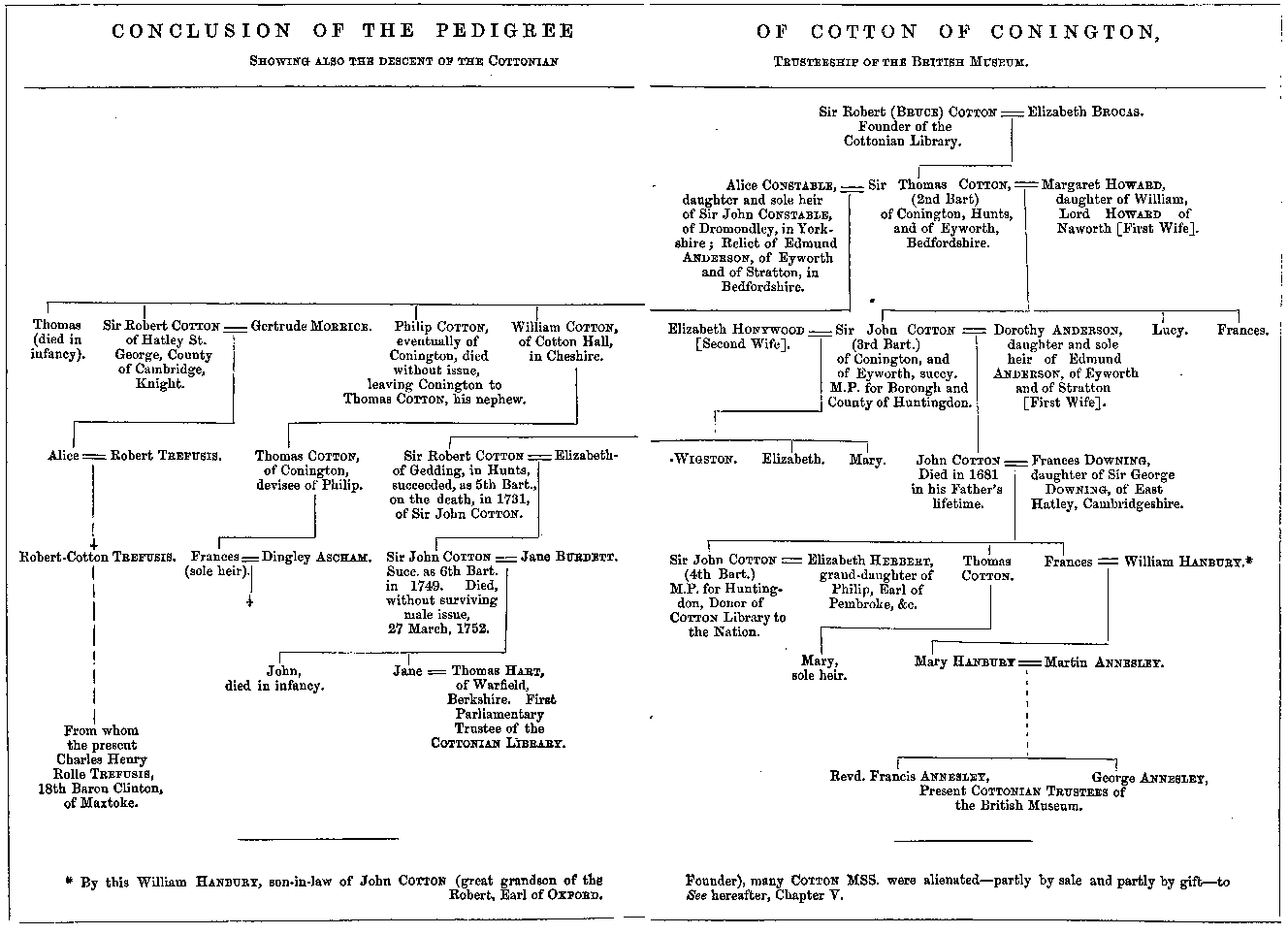
138The reader who glances at this pedigree will notice that some of the Cottons of 1600–1750 were as fortunate in getting heiress-wives as had been their foregoers of preceding centuries. But their possessions were scattered almost as rapidly as they had been augmented. Conington, which was the most valued possession of Sir Robert, was less prized by his descendants. The Council Books show that some of its appendant manors and members—notably Glatton and Hulme—gave to the Founder himself a good deal of trouble. The Sequestration Books show the anxieties and losses which the busy Parliamentarians of Huntingdonshire inflicted on his next successor. Other circumstances tended also to bring the place into disfavour with owners who had a choice of seats. It lay so close to the great northern road, as to be exposed to undue demands alike from the movement of troops and from the tramping of professional vagrants. Nor was it less exposed, from its situation, to injuries by great floods. |Desertion of the old Seat of Conington.| Long before the extinction of the male line, Conington was deserted, in favour of more attractive abodes in southern counties. We learn from a passage in Stukeley’s Itinerary that the house was fast becoming a ruin, even in the reign of George the First; although it had been solidly rebuilt by Sir Robert himself.
‘I thought it,’ writes that antiquary, ‘a piety to turn half a mile out of the road, to visit Conington the seat of the noble Sir Robert Cotton,—where he and Camden have often sat in council upon the Antiquities of Britain, and where he had a choice collection of Roman inscriptions picked up from all parts of the kingdom. I was concerned to see a stately old house of hewn stone, large and handsome, already falling into ruin.’[22]
139By the Statute which established the Cotton Library as a national institution, it was enacted as follows: ‘The Cottonian Library ... shall be kept and preserved, in the name and family of the Cottons, for public use and advantage. |The Establishment Act of 1700.| And therefore, according to the desire of the said Sir John Cotton, and at his request, the said Mansion House, ... and also all the said Library, ... together with all the Coins, Medals, and other rarities, ... shall be vested in Trustees ... with a perpetual succession.’ The first Trustees were the Lord Chancellor Somers, Mr. Speaker Harley (afterwards Earl of Oxford), and the Lord Chief Justice, ex officio; together with Sir Robert Cotton, of Hatley St. George, Cambridgeshire; Philip Cotton, of Conington; Robert Cotton of Gedding, in Cambridgeshire, and William Hanbury, of the Inner Temple. |12 & 13 Will. III, c. 7.| It was provided that on the decease of any one of the four family trustees the heir male, for the time being, of Sir Robert Cotton, the founder, should appoint a successor.
The furious party-spirit which at this time divided the country into hostile camps, the leaders of which were at any moment ready to fly at each other’s throats, was eminently unfavourable both to the guardianship and to the growth of the new institution; as it was, indeed, to all matters of learning or of mental culture. Hardly seven years had passed before it was found necessary to pass ‘An Act for the better securing of Her Majesty’s purchase of Cotton House in Westminster.’
This Act recites that since the preceding enactment of 1700 ‘very little had been done in pursuance thereof to make the said Library useful to the Public, except what had been lately done at Her Majesty’s charge;’ and that the place wherein the Library then was, being ‘a narrow little damp room, was improper for preserving the books 140and papers.’ The Act then proceeds to declare that an agreement had been made for the purchase of Cotton House for £4,500, ‘to the intent that it might be in Her Majesty’s power to make this most valuable collection useful to her own subjects, and to all learned strangers.’
Within five years, however, this unfortunate Library had to be removed from Cotton House to Essex House, in the Strand (1712); and thence again, in 1730, to Ashburnham House, at Westminster (already containing the Royal collection), where it had not long been lodged, when the fire occurred by which it was so seriously injured. |The Fire at Ashburnham House.| The account which the Parliamentary Committee of Inquiry gave to the Public, shortly after the occurrence of this calamity, runs thus:
‘On Saturday morning, October 23, 1731, a great smoke was perceived by Dr. Bentley, and the rest of the family at Ashburnham House, which soon after broke out into a flame. It began from a wooden mantel-tree taking fire which lay across a stove-chimney that was under the room where the MSS. of the Royal and Cottonian Libraries were lodged, and was communicated to that room by the wainscoat and by pieces of timber, that stood perpendicularly upon each end of the mantel-tree.’
‘They were in hope, at first,’ continues the Committee, ‘to put a stop to the fire by throwing water upon the pieces of timber and wainscoat, ... and therefore did not begin to remove the books so soon as they otherwise would have done. But, the fire prevailing, Mr. Casley, the Deputy Librarian, took care in the first place to remove the famous Alexandrian MS. and the books under the head of Augustus’ [twelve of the Cottonian presses, it will be remembered, were adorned by the heads of the twelve Cæsars, whence the still existing designations or press-marks, 141as for instance, that of the famous Evangeliary of King Ethelstan, Nero D. vi, mentioned on page 132] ‘in the Cottonian Library, as being esteemed the most valuable amongst the collection. Several entire presses, with the books in them, were also removed; but ... several of the backs of the presses being already on fire, they were obliged to be broke open, and the books, as many as could be, thrown out of the windows.’ All the MSS. that were saved, and the remains of what been burnt, were removed to the Dormitory of Westminster School.
1731 October.
At the time of this disastrous fire, the number of MS. volumes was 958. Of this number 114 were reported to be ‘lost, burnt, or entirely spoiled; and 98 damaged so as to be defective.’ Mr. Speaker Onslow took immediate measures, in conjunction with Dr. Bentley and Mr. Casley, for the examination of the burnt MSS., and for the repair of such as were then deemed alone reparable. Three months afterwards the Record Clerk to whom the task was more particularly committed, thus reports his progress: ‘One hundred and upwards,’ he says, ‘being volumes of Letters and State Papers, have been quite taken to pieces, marked, and bound again.’ |Report of the Committee appointed to view the Cottonian Library (1732), pp. 11–15; and Casley’s Appendix thereto.| But he laments that ‘there having no way hitherto been found out to extend vellum and parchment that has been shrivelled up and contracted by fire to its former dimensions, part of several of the vellum MSS. must remain not legible, unless the desideratum can be supplied.’
For nearly a century some of the most precious of the injured MSS. remained as the fire had left them. But in 1824, by the care of Mr. Forshall, the then Keeper of the MSS. in the British Museum, a commencement was made towards their restoration, which his successor, Sir F. Madden, zealously and successfully continued. Nearly 142three hundred volumes have been repaired, and more or less completely restored, (a considerable number of which were previously regarded as beyond all hope of recovery) to a state of legibility.[23]
The calamity of 1731 brought about what may, in a sense, be termed a partial compensation, by inducing Major Arthur Edwards to make an important bequest, with the view of precluding its recurrence. |The bequest of Arthur Edwards.| Owing to the protraction of a life interest in the legacy—the terms of which will be cited in describing that eventual Act of Incorporation which created the British Museum—it did not become available until other arrangements had made its application to building purposes needless. It was, consequently, and in pursuance of the Testator’s contingent instructions, appropriated to the purchase of books in the manner, and with results, which will be spoken of in a subsequent chapter. Major Edwards also bequeathed his own collection of about 2,000 volumes of printed books, by way of addition to the Cottonian Library of MSS. These, however, were not actually incorporated with the Museum collections until the year 1769.
For several years, Bentley conjoined the Keepership of the Cottonian with that of the Royal Library. His predecessors in the office were Dr. Thomas Smith (hitherto the only biographer of the Founder,) and William Hanbury, who had married a descendant of the Founder. |The Keepers of the Cottonian Library.| Dr. Smith was less eminent as a scholar—though his learning was great—but far more estimable as a man, than was his successor in the 143Keepership, the imperious and covetous Master of Trinity. For conscience sake, Smith had given up both a good fellowship and a good living, at the Revolution. Literature profited by the loss of Divinity. He died in May, 1710. Hanbury—by a very undesirable plurality—was a Trustee as well as Keeper. That he was not, in either capacity, strictly faithful to the spirit of the Trust confided to him seems to be established by incidents which I find recorded in the MS. Diary of Humphrey Wanley. The reader will observe that it is possible to reconcile Wanley’s statement with the supposition that the MSS. alienated had never actually been made part of the Cottonian Library, though it is as plain as sunlight that a really faithful trustee would have made them part of it. As it turned out, the sale of them did no actual and eventual mischief. On December 2nd, 1724, says Wanley, ‘I had a conversation with Mr. Hanbury, who owned that he hath still in his possession many original and valuable papers given him by his wife’s brother, Sir John Cotton, which now lie in different places. These papers and whatever else happens to be among them—as books, rolls, &c.—he hath agreed to put into my hands for my Lord’s [Oxford’s] use. |Wanley’s Diary, MS., ii, 40 (B.M.).| I have promised that he shall be very well paid and considered for the same.’
Wanley had already recorded a previous visit in which Hanbury had delivered ‘for my Lord Oxford’s use, a small but curious parcel of old letters,’ adding: ‘I believe he expects a gratuity for them.’ On the last day of December he received another parcel; and on the 4th January, 1725, he again writes: ‘Mr. Hanbury gave me another parcel of letters written to Sir Robert Cotton.’
Without endorsing the violent diatribe of Lord Oxford (the second of the Harleian Earls) against Hanbury’s 144successor—as the almost wilful destroyer of part of the Cotton MSS.—it must be admitted that there is conclusive evidence that neglect of duty on Dr. Bentley’s part was a moving agent in the disaster. Under his nominal keepership the practical duties of Cottonian Librarian were discharged by an industrious and otherwise meritorious deputy, David Casley.
The Project of 1707 for uniting the Cottonian, Royal, and Arundel, Libraries.
There were many projects for making Sir Robert Cotton’s noble collections, both in literature and antiquities, the foundation of a ‘British Museum,’ before a feasible and successful project was hit upon. |Sloane to Charlett, 7 April, 1707. (Bodleian Library, Oxford).| It is curious to note that one of these schemes embraced, as the groundwork of the projected national Museum, the collections of Sir Robert Cotton, of Prince Henry, and of Lord Arundel; and that some particulars of the plan were narrated—to a country correspondent—by Sir Hans Sloane, almost fifty years before his own conditional bequest gave occasion and means for the eventual union of the collections so spoken of with the vast gatherings of all kinds, in literature and in science, to the procuring of which so large a portion of his own useful and laborious life was to be devoted.
When that occasion came, two of the then Cottonian Trustees framed a Petition to Parliament in which they expressed their acknowledgments for ‘seasonable and necessary care’ of the Cotton Library. They alleged that it had remained ‘almost useless’ to the Public, during many years, for want of a fixed and convenient building to receive it; that it had been exposed to many dangers by frequent removals, and had once run the hazard of ‘a total destruction by fire.’ If, said they, the loss which the Public then sustained proved to be less than had been feared, the Public owed the obligation ‘to a great member 145of this House’ [of Commons] ‘who powerfully interposed and assisted in its preservation.’ The allusion is to the Right Hon. Arthur Onslow, the then Speaker, who afterwards became one of the first Trustees of the Museum established by the Act of 1753.
Petition of Samuel Burroughs and Thos. Hart; MS. in Cottonian ‘Appendix’ (B. M.).
The Petitioners proceed to state that their most earnest wishes are accomplished by seeing a Library, famed throughout Europe, with the generous gifts of Major Edwards annexed thereto, placed out of all further dangers from neglect, and that they rejoice to perceive that the Museum of their own Founder is about to be enlarged by other rare and valuable collections. ‘We are,’ say they, ‘fully persuaded that an edifice raised upon such a stately plan will, by degrees, be stored with benefactions and become a common Cabinet for preserving with safety all curiosities and whatsoever is choice or excellent in its kind. Moreover, being a new institution for the service of the learned world it will be an honour to the Nation, an ornament long wanted in this great city, and a distinguished event in the history of our times.’ |Heretofore, p. 3.| Then follows the passage which I have prefixed, by way of motto, to this first division of the volume now in the reader’s hands.
When these Petitioners went on to state to Parliament that ‘no expression of gratitude can be too great ... for doing honour to the memory of Sir Robert Cotton,’ their assertion gave rise to no utterance of hostile feeling. |Recent Charges against the character and fame of Sir R. Cotton.| They were not even charged with undue laudation of their ancestor. People who at that time troubled themselves to think of such matters at all, were agreed in regarding Sir Robert Cotton as unquestionably one of the worthies of England. Nowadays—as I have had occasion to show 146already—there are many gainsayers. A distinguished historian (Mr. Gardiner) asperses Cotton’s character both for statesmanship and for truthfulness; whilst a distinguished archæologist (Mr. Brewer) charges him with embezzling records.
The first charge has been partly met, in these pages, by the simple apposition and collation of contemporary evidence. The reader has his choice between the cumulative testimony of several English peers and statesmen; and the unsupported testimony of one foreign diplomatist, who made it his boast to be the enemy of Englishmen, and whose hostility was graduated in tolerably exact accordance with the qualities and the deeds which have made England proud of them. The home witnesses gave their testimony whilst the events were still fresh in men’s minds. They gave it in broad daylight, and with open doors. The foreign witness put his evidence into a secret dispatch, to be seen by no human eye, out of the Spanish Cabinet, until our own historian disinterred it, at Simancas, two centuries and a half after date. Nor is this quite all.
If Gondomar’s account be true, not only was Sir Robert Cotton’s life as a statesman a protracted lie, but his duplicity was so superbly cloaked as to deceive the most keen-sighted of his contemporaries. The men who sat habitually at his board in his days of health, and who ministered at his bedside in all the offices of tender friendship in his days of sickness and of death, were all wrong about his character. |A Discours wether yt be fitt for Inglande to make peace with Spaine. MS. Cott. Vespas. C. xiii, ff. 160, seqq. (B. M.).| And there is this other little fact to boot: Sir Robert Cotton began his public life by as open a declaration of anti-Spanish policy in relation to the great question of the Netherlands as ever came from the lips of our Ralegh. He ended his public life with as staunch an adherence to the principles, both in Church and State, 147which the rulers of Spain abhorred as that which had been shown by Ralegh on the scaffold in Old Palace Yard, or by Eliot in the dungeon of the Tower of London. Meanwhile, just in the mid-channel of his career, and in the prime of his faculties, Sir Robert Cotton threw himself, gratuitously, at the feet of Gondomar. He humbly asked leave to take Spanish service in the guise of a political slave. The historian’s proposition is a bold one. And its evidence needs to be cogent. English readers now know quite enough about Gondomar to judge whether or not his sole testimony is sufficient to damn the fame of such a man as Cotton;—to degrade him from the rank of an English worthy;—to brand him as a criminal virtually convicted of apostacy in religion, and of treason to his avowed convictions in politics?[24]
148From the nature of things the second charge cannot be so directly, so compactly, or so effectively met. Almost a third of the manuscripts which form the most important section of the Cotton Library consist of, or contain, Papers of State. Of these a very considerable proportion once belonged to the State. How came they to pass into the hands of Sir Robert Cotton?
Mr. Brewer’s Account of Sir R. Cotton’s Acquisition of State Papers.
By Mr. Brewer the question has been answered, unhesitatingly and exhaustively. Large portions of the Diplomatic Correspondence of Henry the Eighth were, he says, ‘carried off in 1614, if not before, by Sir Robert Cotton.... The original bundles appear to have been broken up under the keepership of Agarde, when the Treasury of the Exchequer was rifled of its most precious contents to augment the collections of Sir R. Cotton.... |Calendar of the State Papers; Reign of Henry VIII, Pref., pp. viii, ix.| For the early years of Henry, his [Sir Robert’s] collections are more numerous, and even more interesting, than the documents in the English, the French, or the Spanish Archives. They are equally authentic.... By what fraud or negligence they found their way into the possession of Sir Robert Cotton it is not for me to inquire.’
No writer can be better qualified to speak with authority on such a topic as this than is Mr. Brewer. Familiar with State Papers and with records of all kinds for a very long period, he has won the deep respect of all students of our history by the uses to which his knowledge has been applied. But the ablest writer will sometimes write 149hastily. The most impartial inquirer will now and then reach a conclusion by overleaping part of the evidence.
The sweeping passage which I have quoted, like other passages in Mr. Riley’s preface to Liber Custumarum, previously noticed, leaves altogether out of view three or four whole classes of testimony—chains not links—having a vital bearing on the issue. For example—
Sir T. Wilson to King James I, Domestic Corresp., vol. xcvi, § 41*, seqq. (R. H.)
I. It disregards the fact that certain bundles of State letters and papers were given by the King’s order to Sir Robert Cotton, during the reign of James the First. These, indeed, were commanded to be ‘subscriptions and signatures of Princes and great men, attached to letters otherwise unimportant.’ But who is to tell us what was the estimate of ‘importance’ in papers of State formed, two centuries and a half ago, by James, who gave the order, or by Sir Thomas Wilson, who received it?
II. It disregards the fact that long before, as well as long after, that known order of 1618, Sir Robert’s possession of papers once the property of the Government was so published and so recognized as to imply, by fair induction, that the possession must have been—as far as he was concerned—a lawful one. In his own writings, he iterates and reiterates reference to national documents then in his own collection. His references are specific and minute. Secretaries of State write to him, asking leave to inspect original Treaties (sometimes in order to lay them before the King in person) and promising to return them promptly. |Domestic Corresp., as above, 1621, March; and passim; also Council Books (C. O.).| Law Officers of the Crown desire him kindly to afford them opportunities for collating public instruments, preserved at Cotton House, with public instruments still in the repositories of the Crown.
III. It leaves out of sight the fact that in the correspondence of Sir Edward Coke with Sir Robert Cotton 150there is a passage which also implies—though it does not expressly assert—that Sir Robert had received from King James a permission to select records, of some kind or other, from the Tower of London, anterior to the qualified permission, |Sir E. Coke to Sir R. Cotton; MS. Cott. Julius, ciii (Undated; probably 1612). (B. M.)| above mentioned, given in 1618, to select ‘autographs’ from the Paper Office;
IV. It disregards that strong implication of a lawful possession—so far as Sir Robert Cotton, individually, is concerned—which necessarily arises out of the fact that at two several periods the Cottonian Library was under the sole control and custody of Crown officials; |Registers of Privy Council, 1616; 1629; 1630; passim (C. O.)| that it remained under such control for an aggregate period of more than two years; that Cotton’s bitter enemies were then at the head of affairs; that in 1630 a Royal Commission was actually issued |Signs Manual, Charles I, vol. xii, § 15 (R. H.).| ‘to search what Records or other Papers of State in the custody of Sir Robert Cotton properly belong to His Majesty, and thereof to certify;’ and that the existing Cottonian MSS., together with those burned in 1732, were, one year after the issue of that Commission, restored by the Crown to Sir Robert Cotton’s heirs;
e. g. MS. Harl., 7002, ff. 120, 122, &c., MS. Cott. Julius ciii, passim (B. M.).
V. It overlooks the circumstance, vital to the issue now raised, that amongst the MSS. which most indubitably were once Crown property many can still be minutely traced from possessor to possessor, prior to their reception into the Cottonian Library;
And VI. It disregards the fact, hardly less important, that a patriotic statesman conversant both with the arcana of government at large, and with the special arcana of the State Paper Office and Secretary’s offices, under King James the First and King Charles the First, might have cogent reasons for believing that some important classes of State Papers would be likely to remain much more truly 151and enduringly the property of the English nation if stored up at Cotton House—even had no ‘British Museum’ ever been created—than if stored up at Whitehall.
Inferences and implications such as these are far from amounting to conclusive proof. But most readers, I think, will assent to the assertion that, cumulatively, they amount to a very strong presumption indeed that the stigma which has been impressed on Sir Robert Cotton’s memory is both precipitate and unjust. Precipitate it plainly is, for a confident verdict has virtually been pronounced—upon a grave issue,—before hearing any evidence for the accused. Unjust I, for one, cannot but think it, inasmuch as circumstances which at most are but grounds of mere suspicion of the greater offence charged, have been so huddled up with proofs of a minor and (comparatively) venial offence, that readers giving but ordinary attention to the allegations and their respective evidence are almost certain to be misled.
For, undoubtedly, Sir Robert Cotton stands convicted of dealing, more than once, with manuscripts which he had borrowed very much as though they had been manuscripts which he possessed. Mr. Riley’s testimony is, on this point, conclusive. An independent witness, Dr. Sedgwick Saunders, the able Chairman of the Library Committee of the Corporation of London, tells me that both the returned MS. of Liber Custumarum, and also that of Liber Legum Antiquorum, bear as unmistakable marks of a claim to ownership on Sir Robert’s part, as those of which the return was refused.
To such proofs as these I can myself add a new instance. Archbishop Laud had procured, from the Principal and Fellows of St. John’s, the loan to Sir Robert Cotton of a 152certain ancient Beda MS. of great value. Many years passed, and the MS. had not returned to St. John’s. The Fellows cast severe blame on their eminent benefactor. |Archbp. Laud to Sir R. Cotton, MS. Cott. Julius C., iii, f. 232.| Laud had to petition his friend Cotton for the return of Beda, in terms almost pathetic; and he was so doubtful whether pathos would suffice that he added bribe to entreaty. If, he said, ‘anything of worth in like kind come to my hands, I will freely give it you in recompense.’
The reader has seen the abounding proofs of that generous furtherance of every kind of literary effort which Cotton gave, throughout life, with an ungrudging heart and an open hand. |Bolton to Camden; MS. Harl., 7002, f. 396.| Sir Robert’s openness made his library—to use the words of an eminent contemporary—the ‘Common treasury’ of English antiquities. The reader now sees also the drawback. It remains for him to strike a true balance; and to strike it with justice, but also with charity.
153