A RACE FOR A CAT.
Reading edition
A FAIRY STORY.
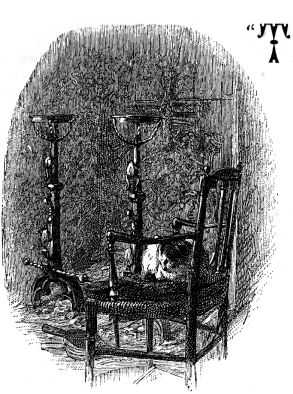
"a cat was lying ... upon a chair"
oo small! too small!" so the birds sang, so the roses whispered, so the bees hummed.
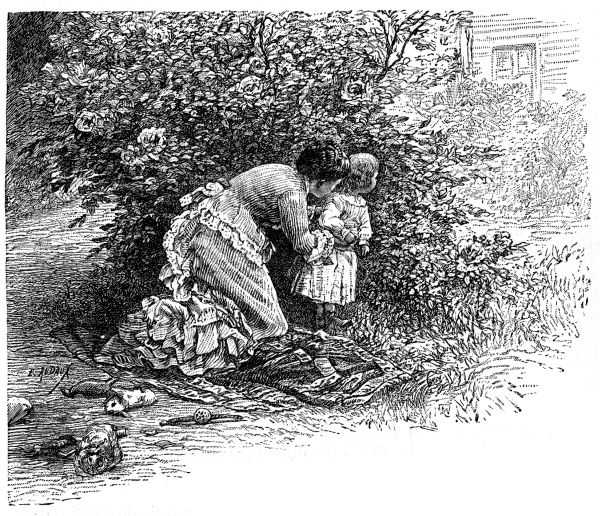
"She will creep in at the window," said the mother, who was kneeling beside a little child. "Only a small child can do that."
But the window shut down suddenly with a bang, and the house to which it belonged began to move away, slowly at first, then quicker and quicker, until it was out of sight altogether. The child began to sob, and said—
"Nan will run after it."
Ah! such a flutter among the roses, and such a twittering amongst the birds, whilst the bees hummed—
"Too small, too small! She should be tall, If she would catch the house at all."
And the birds sang—
"She must grow, We all do know; And that's a process very slow."
"It will be years," said the mother, "before she grows tall."
"Pooh! porridge!" said a toy dog that was lying on the ground.
The mother turned round.
The little dog was standing upright, and had pricked up his ears.
"Porridge, porridge!" he said, and he kept saying it over so many times that at last the mother thought there must be something in it.
II.
So the mother made some porridge, and Nan began to eat it.
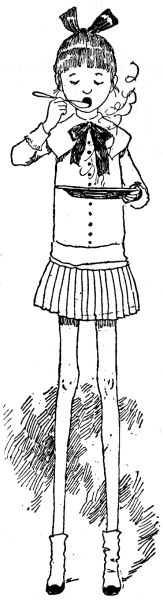
At the first plateful she could look over the table; at the second she reached up to her mother's shoulder; at the third she was taller than her mother.
"Stop! stop!" said the mother, as Nan began upon the fourth plate; "you'll be a giantess; and your legs are so thin, I am afraid they will break in two. You look as if you were on stilts."
"One must have long legs," said Nan, "in order to run fast. It was the woolly dog that thought of it," she added, and she would have stooped down to pat the toy dog, with its red morocco collar, but she was so high up that she found it a difficult matter to bend down. "I am as stiff as a poker," said she.
The woolly dog, however, understood what she wanted, and he jumped upon a chair, then upon the table, and finally into Nan's arms.
She would have given him some porridge, but her mother said—
"No; if he should grow as tall as you, we should not know what to do with him."
Then the little dog laughed.
"Perhaps he will run away with the spoon," said Nan.
But no; he was an honest little dog, and did not think of doing anything of the kind.
III.
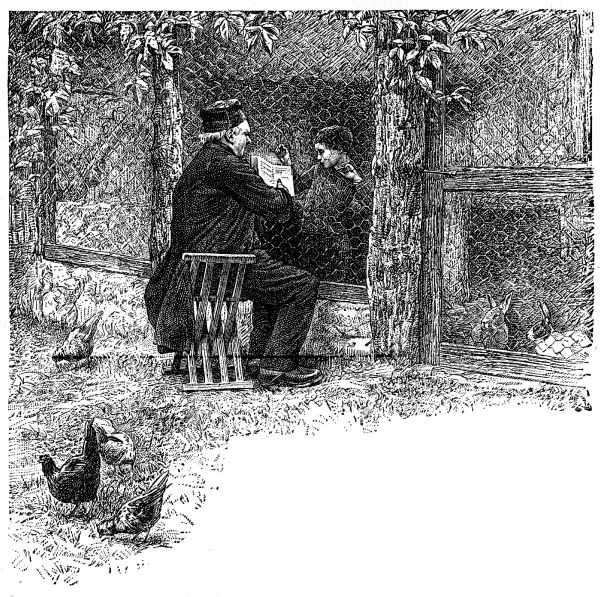
On the opposite side of the house was an old gentleman in a velvet cap. He had a paper in his hand, and was trying to teach something to a boy who was on the other side of the trellis. But the boy was not attending to him, though he kept his eyes fixed upon the paper.
No; he was muttering—
"The little cat was in the house, and the house moved away. It must have been an enchanted house and an enchanted cat."
"What are you saying?" asked the old gentleman. "That is not on the paper."
Then the boy looked up and said—
"If I'd seven-leagued boots, I'd go after them."
"That is certainly not written down there," answered the old gentleman. "Of what are you thinking, Ulick?"
"Of the house that stood close by this house. I had a dream last night that it moved away, and that the little cat with which I played had also gone, and I want to go after them."
"You talk nonsense, Ulick. How can a house made of bricks and mortar and heavy beams of wood move away?"
"That I know not; but it is gone. I hear it now rumbling away in the distance, as if it were on great wheels—I do really," answered Ulick.
"the mother ... was kneeling beside a little child" (p. 361).
The old gentleman, who often came to chat with Ulick, and to try to teach him various things, felt quite vexed, and he folded up his paper, and shut up his camp-stool and went away.
When he had gone an old hen turned round and spoke to Ulick.
"You can hear us, for you have the right sort of ears, but the old man cannot. It is quite true: the house has gone."
"Where?"
The rabbits were listening, with their long ears erect.
"That I cannot tell, but Nan is going after it."
"Nan! but she is so small."
"Is she?" exclaimed the hen. "You should see her now that she has eaten the porridge: she is much taller than her mother, and her legs are so long that she can skim over the ground like an ostrich."
"Then she will get the cat."
"Perhaps. One does not know," answered the hen.
"I hope she will," said a young rabbit.
"I hope she won't," said an old rabbit, "for then she will bring her back here."
There was a groan amongst the rabbits and the poultry. And then the Virginian creeper, that was twisting and turning and throwing its leaves about all over the trellis, began to quiver and shake as if it were trying to say something, and at last a very tiny voice came from one of the shoots, and said—
"Should Nan the flying house o'ertake, She will with it long journeys make, And come back here no more."
The fowls and rabbits were glad to hear this, but Ulick said—
"Nan shall not overtake the house; Nan shall not have the dear little cat."
IV.
"she was so high up" (p. 361).
"Nan will soon be tired," said Ulick; "besides, she does not know where to go."
"Do you?"
Ulick started, for he could see no one. Still he was not surprised, for since the rabbits and fowls and Virginian creeper had begun to talk there was no reason why other things should not also. It must have been some sensible creature; and he began to consider the point.
No, he did not know where the house had gone; he did not suppose that even the top of the tallest chimney would be visible, or even the smoke from it. The house might have gone along the straight road, or have turned to the right or left, he could not tell. And Ulick sat down upon a large moss-covered stone, and felt very despondent.
"What's the matter, little man?" asked his big brother Ben, who happened to come up at the moment. And Ulick told him of his difficulty.
"Oh! if that is all," said big Ben, "I will start you on your journey, for I know which way the house went. I saw it rumbling along the road, and then it turned off to the right and kept a straight line over the country; nothing stopped it, hedges, ditches, or anything else."
And he took Ulick's hand, and went out upon the road with him. Ulick half turned and kissed his hand to his own home.
"What is that for?" asked Ben.
"For 'good-bye,' if I don't come back again. The house might take me away altogether, you know."
Ben laughed.
"Well, then, boy, start off, for there in the distance over the corn-fields you can just see the house. There, there—do you see it—moving along?"
"No—yes—no—yes, yes I do. But what is that?"
V.
"What is that? why, a pole with a flag on the top," said Ben.
"No, no," said Ulick, "that——"
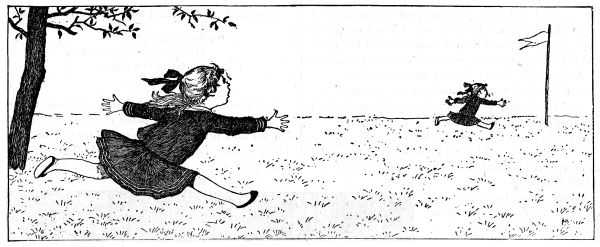
"Why, it's Nan flying along. What long legs she has! She goes so fast that she seems as if she were in two places at once."
"There are two girls running," said Ulick, "and one seems to be overtaking the other all the time."
"No, there is but one," answered Ben, "but she is here and there so quickly that you seem to see her in two places at once—you understand what I mean. And it looks exactly like two people."
"I don't know," said Ulick; "I am sure there are two Nans. What long legs!"
"Yes, porridge has done that. You should have had some porridge. You'll never overtake her."
But Ulick started off. Ben watched him out of sight, and then went home.
"he had a paper in his hand" (p. 361).
VI.
Now, all this time a cat was lying comfortably upon a chair in the house that was running away.
The chair was covered with red velvet, and there was a bright fire in the room, that sparkled and glowed and made all the furniture in it shine.
The cat looked up and then she purred, saying—
"Till there is a place Where gamekeepers are not, My house shall not stay In any spot."
And the house with the cat in it went on and on, until it came to a far-off place where there were no houses and no gamekeepers, and no fear of traps. Then it stopped with such a jerk that the front door flew open, and a woolly dog, with a red morocco collar and very stiff legs, came in, crying out—
"She is coming, she is coming, She will like a cup of tea. She must be quite hot with running, She is coming after me."
"Who is she?" asked the cat.
Then said the dog—
"Little Nan, she ate the porridge, And she grew quite tall, But when she has reached your cottage She will be quite small."
"Why?" asked the cat.
"Because the effect of the porridge only lasts whilst she is running."
"Oh!" responded the cat.
Upon which Nan herself came running in, and she was no larger than when her mother was kneeling beside her in the garden.
"O my dear, dearest, darling, little pussy-cat! I have found you again, and we will live together always, and you will let me play with you. I am so glad to see you again."
The cat purred and rubbed her head against Nan, as much as to say "Yes."
And the woolly dog barked for joy.
"'there are two girls running,' said ulick" (p. 363).
So Nan had won the race.
Nan looked out of the window and nodded to Ulick, who was panting in the distance. She also held up the cat for him to see.
There was no longer any need for Ulick to run, for everything round him was shouting—
"Nan has won the race!"
Yes, he knew that she had, and he wept bitterly and went home again. Perhaps if he had also eaten the porridge he might have outstripped Nan.
No one ever saw the house again, though once it returned to the spot upon which it had stood near Ulick's home. It did not stay long there, only just long enough for Nan's mother to pack up her clothes and join her little girl, who was too small to live by herself.
Then the front door shut quite tightly, and the house fled away faster than ever, and never stopped until it had reached a beautiful island far, far away in the middle of the sea. There it paused, for no gamekeepers, or traps, or cruel boys were to be found there. And in the house on the beautiful island Nan and her mother, and the cat, and the toy dog lived peacefully and happily for ever and ever.
Julia Goddard.