GLIMPSES OF PORTUGAL AND THE PORTUGUESE.
Reading edition
Sketch Map of NORTH SPAIN and PORTUGAL.
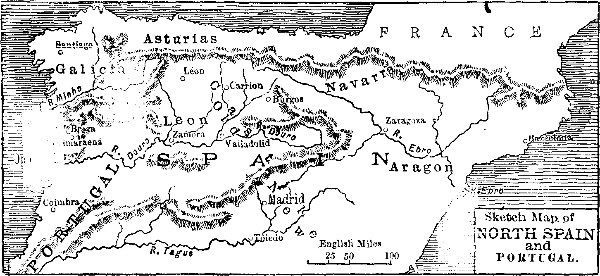
The mere name of Spain calls up at once a string of flashing, barbaric pictures—Moorish magnificence and Christian chivalry, bull-fights, boleros, serenades, tattered pride and cruel pleasure. All these things go to form that piquant whole, half Eastern, half European, which is the Spain of our imaginations. Our associations with the western part of the Peninsula are, on the other hand, vague and incomplete. Vasco da Gama, the earthquake of Lisbon, port wine and Portuguese plums are the Lusitanian products most readily called to mind. After them would come perhaps the names of Magellan, of Prince Henry the Navigator and of the ill-fated Don Sebastian. One poet of the country, Camoens, is as often referred to as Tasso or Ariosto. Those whose memories go back to the European events of 1830 and thereabouts may recall the Portuguese civil wars, the woes of Dona Maria and the dark infamy of Don Miguel. And more recently have we not heard of the Portuguese Guide to English Conversation and relished its delicious discoveries in our language? All these items do not, however, present a very vivid or finished picture of the country: like the words in a dictionary, they are a trifle disconnected.
Portugal was the first station of Childe Harold's pilgrimage, but it holds no place in the ordinary European tour of to-day. It does not connect with any of the main lines of travel in such a manner as to beguile the tourist insensibly over its border: a deliberate start must be made by steamer from England in order to reach Lisbon from the north. Another and probably stronger reason for our neglect of its scenery is that it is not talked of. We go to Europe to see places and follow up associations with which fame has already made us familiar, and, though Portugal has had a great past of which the records are still extant, it has not been brought to our notice by art.
The two nations living side by side on the Peninsula, though originally of the same stock and subjected to the same influences, present more points of difference than of likeness. Their early history is the same. Hispania and Lusitania both fell successively under the dominion of the Romans and of the Moors, and were modified to a considerable extent by the civilization of each. Moorish influence was predominant in Spain—Portugal retained more deeply the Roman stamp. This is easily seen in the literature of the two countries. Spanish ballads and plays show the Eastern delight in hyperbole, the Eastern fertility of invention: Portuguese literature is completely classic in spirit, avoiding all exaggeration, all offences against taste, and confining itself to classic forms, such as the pastoral, the epic and the sonnet. Many Moorish customs survive in Portugal to this day, but they have not become so closely assimilated there as in Spain to the character of the people. The cruelty which has always marked the Spanish race is no part of the Portuguese national character, which is conspicuous rather for the "gentler-sexed humanity." True, the bull-fight, that barbarous legacy of the Moors, still lingers among the Portuguese, but the sport is pursued with no such wanton intoxication of cruelty as in the country with which its name is now associated. On the other hand, the Roman tradition has been preserved in Portugal more perfectly than in Italy itself: in the "fairest of Roman colonies," as it was once called, there will be found manners and customs which bring up more vividly the life portrayed by the classic poets than any existing among the peasants of modern Italy.
ANCIENT HOUSE IN OPORTO.
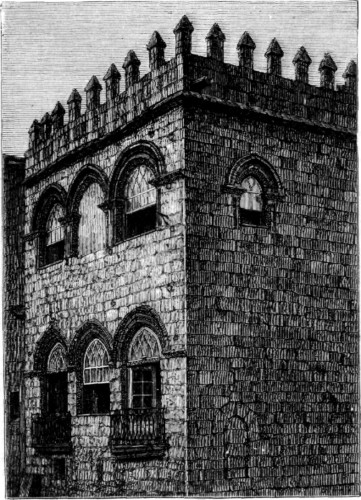
Both Rome and Arabia stood sponsors for the land they thus endowed. The name Portugal is compounded of the Latin portus, a "port," and the Arabic caläh, a "castle" or "fortress." The first of these names was originally given to the town which still retains it—Oporto—one of the oldest of Portugal, and at one time its capital.
The history of Portugal, when it separates from that of Spain, is the history of a single stupendous achievement. A small nation raising itself in a short time to the power of a great empire, reaching a height which to gain was incredible, to keep impossible, and at the first relaxation of effort suddenly falling with a disastrous crash,—that is the drama of Portugal's greatness. There was no gradual rise or decline: it mounted and fell. There is a tradition that the first king of Portugal, Affonso Henriquez, was crowned on the battlefield with a burst of enthusiasm on the part of the soldiers whom he was leading against the Saracens, and that on the same day he opened his reign by the glorious victory of Ourique. Less than half a century previously the country had been given as a fief to a young knight, Count Henry of Burgundy, on his marriage with a daughter of the king of Castile. The Moors were overrunning it on the one hand, Castile was eying it jealously on the other, yet Affonso Henriquez made it an independent and permanent kingdom. This prince slaughtered Saracens and carried off honors on the field as fast as the Cid, but his deeds were not embalmed in an epic destined to become a storehouse of poetry for all the world. His chronicler did not come till about four centuries later, and then nearer and vaster achievements than those of Affonso Henriquez lay ready to his pen. At the birth of Camoens, in 1525, Portugal had gained her greatest conquests, and, if the shadows were already falling across her power, she had still great men who were making heroic efforts to retain it. Vasco da Gama had died within the year. Albuquerque, the hero of the Lusiado, the noblest and most far-sighted mind in an age of great men, had been dead ten years. Camoens, like the Greek dramatists, was soldier as well as poet: he was not alone the singer of past adventures—he was the reporter of what took place under his own eyes. His epic was already finished before the defeat of Don Sebastian in the battle of Alcazar put an end to the glory it celebrated, and in dying shortly after the poet is said to have breathed a prayer of thanksgiving at being spared the pain of surviving his country.
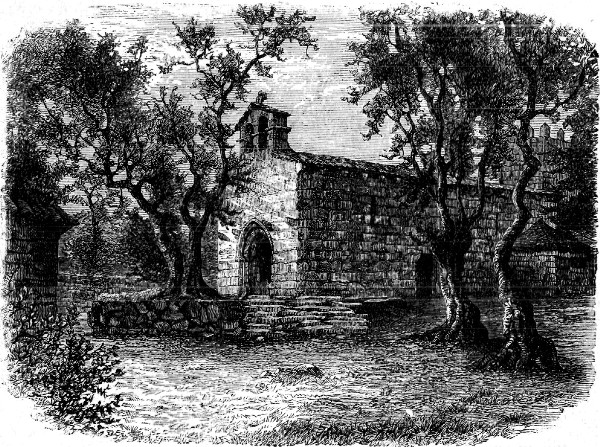
CHAPEL NEAR GUIMARAENS.
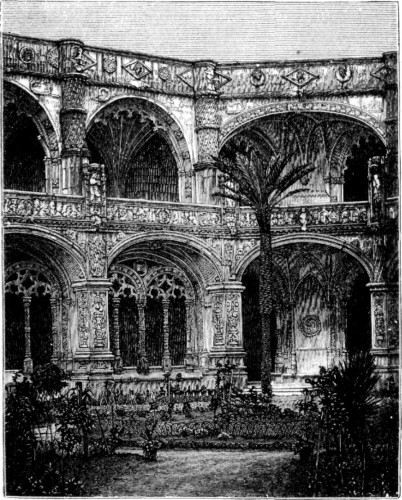
The period of Portuguese supremacy lasted then, altogether, less than a century. There is an irresistible temptation to ponder over what results were lost by its sudden downfall, and to seek therein some explanation of the strange fact that Portugal alone among the southern nations of Europe has never had a national art. There was a moment when the foundations for it seemed to be laid: it was the period at which early Spanish art was putting forth its first efforts, while that of Italy was in its prime. Under Emanuel the Fortunate and his successor Portugal was rich and powerful. Its intellect and ambition had been stimulated by the achievements of its great navigators. There was an awakening of interest in art and letters. A school of poets had arisen of which Camoens was to be the crown. The court, mindful of the duties of patronage, was building new churches and convents and decorating the old ones with religious pictures, and in Portugal religious feeling has always been peculiarly strong. Many of these pictures are still preserved. They are not, however, of a high order of merit, and it is not even certain that they are the work of native artists, some authorities inclining to the belief that they were done by inferior Flemish painters visiting the country, and are therefore the lees of the Flemish school, not the flower of a national one. Universal belief among the Portuguese attributes them to Gran Vasco, a master whose very existence is mythical, and who if he had lived several lives could not have painted all the works of various styles which are ascribed to him. That the artistic sense was not lacking in the Portuguese people is abundantly shown in their architecture, in their repoussé-work of the fifteenth century and the carvings in wood and stone. The church and convent at Belem, the work of this period, are ornamented by Gothic stone-work of exquisite richness and fertility of invention. The church is unfinished, like the epoch it commemorates. To an age of activity and conquest succeeded one of gloom and depression. The last of the kings whom the nation had leaned on, while it supported them so loyally, had fallen at Alcazar, and in the struggle which ensued for the succession Portugal fell an easy prey to the strongest claimant. Philip II. strengthened his claim to the vacant throne by sending an army of twenty thousand men into the country under the command of the duke of Alva, and the other heirs were too weak or too divided to oppose him. The discoveries and conquests made by Portugal had laid the foundations of riches and power for other nations: her own immediate benefit from them was over. The period of prosperous repose which may be expected to follow one of great national activity was denied to her. When the house of Braganza recovered its rights, the impulse to creative art was extinct.
CLOISTERS OF BELEM CONVENT.
Though it was as a maritime power that Portugal rose to its greatest height, it has been from time immemorial an agricultural nation, and the mass of its people are engaged in tilling the soil. They are a cheerful, industrious race, who, far from meriting Lord Byron's contemptuous epithet of "Lusitanian boors," are gifted with a natural courtesy and refinement of manner. A New-England farmer would be tempted to follow the poet's example and regard them with contempt: weighed in his balance, they would certainly be found wanting. There is no public-school system in operation, and the Portuguese farmer is not likely to be able to read or sign his name. But the want of literature is not felt in a Southern country, where social intercourse is far more cultivated than in our own rural districts. It is not by reading the newspapers, but by talking matters over with his neighbor, that the Portuguese farmer obtains his sound and intelligent views on the politics of his country. He is a great talker, taking a keen interest in all that goes on, enjoying a joke thoroughly and addressing his comrade with all the ceremonies and distinctions of a language which contains half a dozen different forms of address. The illiterate peasant is no whit behind the man of culture in the purity of his Portuguese. In no country in Europe is the language kept freer from dialect, and this notwithstanding the fact that it is one of involved grammatical forms. In France the use of the imperfect subjunctive is given up by the lower classes and by foreigners, but in Portugal the peasant has still deeper subtleties of speech at the end of his tongue. Add to this that he has a vocabulary of abuse before which the Spaniard or the California mule-driver would be silenced, and you have the extent of his linguistic accomplishments. This profane eloquence was an art imparted no doubt by the Moors. The refinements of syntax come from the Latin, to which Portuguese bears more affinity in form than any other modern language.
From the Romans the Lusitanian received his first lessons in agriculture—lessons which have never been entirely superseded. His plough was given him by the Romans, and he has not yet seen fit to alter the pattern. The ox-cart used in town and country for all purposes of draught is another relic preserved intact. Its wheels of solid wood are fastened to the axle, which revolves with them, this revolution being accompanied by a chorus of inharmonious shrieks and creaks and wails which to the foreign and prejudiced nerve is simply agonizing. Its master hears it with a different ear: he finds it rather cheerful than otherwise, good to enliven the oxen, to dispel the silence of lonely places and to frighten away wolves and bogies, of which enemies he has a childish awe. Instead, therefore, of pouring oil upon this discord, he applies lemon-juice to aggravate the sound! The cart pleases the eye of the stranger more than his ear. When in the vintage season the upright poles forming its sides are bound together by a wickerwork of vine branches with their large leaves, and the inside is heaped with purple grapes, it is a goodly sight, and one which Alma-Tadema might paint as a Roman vintage, for it is doubtless a counterfeit presentment of the grape-laden wains which moved in the season of vintage over the Campagna. The results in both cases were the same, for the vinho verde, a harsh but refreshing wine, made and drunk by the country-people, is made in the same way and is probably identical with that wherewith the Latin farmer slaked his thirst. The recipe may have descended through Lusus, the companion of Bacchus, whom tradition names as the father of the Lusitanian. Be that as it may, the Portuguese is still favored of the wine-god. Wine flows for him even more freely than water, which gift of Nature has to be dug for and sought far and wide. He drinks the ruby liquid at home and carries it afield: he even shares it with his horse, who sinks his nose, nothing loth, in its inviting depths, and neither man nor beast shows any ill effects from this indulgence.
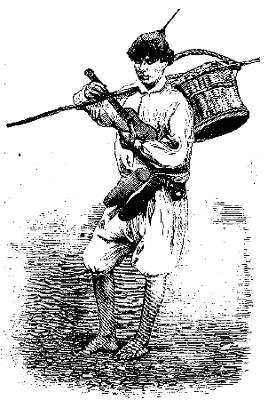
A MADEIRA FISHERMAN.
It is in the north-western corner of the country, in the Minho province, that the highest rural prosperity is to be met with. This little province, scarcely as large as the State of Delaware, but with more than four times its population, has successfully solved the problem of affording labor and sustenance in nearly equal shares to a large number of inhabitants. Bonanza-farming is unheard of there. The high perfection of its culture, which gives the whole province the trim, thriving air of a well-kept garden, comes from individual labor minutely bestowed on small surfaces. No mowing-, threshing- or other machines are used. Instead of labor-saving, there is labor cheerfully expended—in the place of the patent mower, a patient toiler (often of the fair sex), armed with a short, curved reaping-hook. The very water, which flows plentifully in fountains and channels, comes not direct from heaven without the aid of man. It is coaxed down from the hills in tedious miles of aqueduct or forced up from a great depth by a rustic water-wheel worked by oxen, and is then distributed over the land. Except for its aridity, the climate is kind to the small farmer: there is no long inactivity forced upon him by a cold winter. A constant succession of crops may be raised, and all through the year he works cheerfully and industriously, finding his ten acres enough and his curious broad hoe dexterously wielded the equivalent of shovel and pickaxe. If ignorant of our inventions, he is intimately acquainted with some American products. If a Yankee were to walk into a Portuguese farm-house and surprise the family at dinner, he would be sure to see on the table two articles which, however oddly served, would be in their essentials familiar to him—Indian meal and salt codfish. Indian corn has long been cultivated as the principal grain: it is mixed with rye to make the bread in every-day use. The Newfoundland cod, under the name of bacalhau, has crept far into the affections of the nation, its lack of succulence being atoned for by a rich infusion of olive oil, so that the native beef, cheap and good as it is, has no chance in comparison. Altogether, the Portuguese peasant with his wine, his oil and his bacalhau fares better than most of his class. At Christmas-tide he stakes his digestion on rebanadas, a Moorish invention—nothing less than ambrosial flapjacks made by soaking huge slices of wheaten bread in new milk, frying them in olive oil and then spreading them lavishly with honey.
The Portuguese can be industrious, but all work and no play is a scheme of life which would ill accord with his social, pleasure-loving temperament. With a wisdom rare in his day and generation, and an energy unparalleled among Southern races, he manages to combine the two. After rising at dawn and working from twelve to fifteen hours, he does not sit down and fall asleep, but slings a guitar over his shoulder and is off to the nearest threshing-floor to dance a bolero. His dancing is not the more graceful for coming after hours of field-labor, but it lacks neither activity nor picturesqueness: above all, it is the outcome of light-heartedness and enjoyment in capering. The night air, soft yet cool, is refreshing after the intense heat of the day: the too sudden lowering of temperature at sundown which makes the evenings unhealthy in many Southern countries is not experienced in Portugal. Every peasant has his guitar, for a love of music is widely diffused, and some of them not only sing but improvise. In the province of the Minho it is not uncommon at these gatherings for a match of improvisation to be held between two rustic bards. One takes his guitar, and in a slow, drawling recitative sings a simple quatrain, which the other at once caps with a second in rhyme and rhythm matching the first. Verse follows verse in steady succession, and the singer who hesitates is lost: his rival rushes in with a tide of rhyme which carries all before it. In such primitive pleasures the shepherds of the Virgilian eclogue indulged.
As the life of the peasant, so is that of his wife or sweetheart. She shares in the work, guiding the oxen, cutting grass, even working on the road with hoe and basket. "Verse sweetens toil, however rude the sound." Like Wordsworth's reaper, she sings as she works, and the day's labor over is ready to join in the bolero. On fête-days she is arrayed in all the magnificence of her peasant ornaments, worth, if her family is well-to-do, a hundred dollars or more—gold pendants in her ears, large gold chains of some antique Moorish design falling in a triple row over her gay bodice. The men wear long hooded cloaks of brown homespun, which they sometimes retain for convenience after the rest of the peasant-dress has been thrown aside for the regulation coat and trousers. There is no tendency to eccentricity in the national costume of Portugal, but the Portuguese colony of Madeira have invented a singular head-gear in a tiny skull-cap surmounted by a steeple of tightly-wound cloth, which serves as a handle to lift it by. Like the German student's cap, it requires practice to make it adhere at the required angle. This is a bit of coxcombry which has no match in the simple, unaffected vanity of the Portuguese.
COUNTRY-HOUSE IN PORTUGAL.
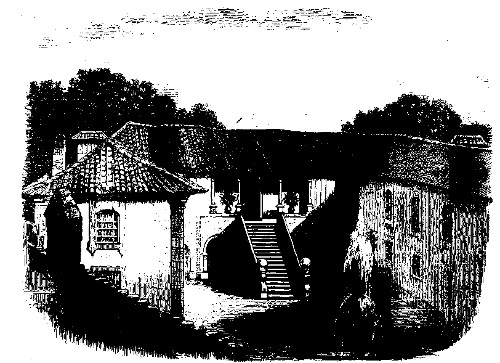
The country is left during the greater part of the year to the exclusive occupancy of the peasantry, the town atmosphere being more congenial in the long run to the social gentry of Portugal. The wealthy class in Lisbon have their villas at Cintra, in which paradise of Nature and art, with its wonderful ensemble of precipices and palaces, forest and garden scenes, they can enjoy mountains without forsaking society. Many Oporto families own country-houses in the Minho, and rusticate there very pleasantly for a month or two in early fall. The gentlemen have large shooting-parties, conducted on widely-different principles from those so unswervingly adhered to by Trollope's indefatigable sporting character, Mr. Reginald Dobbs. In a Portuguese shooting the number of men and dogs is often totally disproportionate to that of the game, and a single partridge may find itself the centre of an alarming volley from a dozen or more guns. The enjoyment is not measured, however, by the success. There is a great deal of talking and laughing, and no discontent with the day's sport is exhibited even if there be little to show for the skill and patience expended. There is further occupation in superintending vintage and harvest, while the orange-groves and luxuriant gardens offer plenty of resources for exercise or idleness. Plant-life in Portugal is singularly varied even for so warm a country. To the native orange, olive and other trees of Southern Europe have been added many exotics. The large magnolia of our Southern States, the Japanese camellia and the Australian gum tree have made themselves at home there, and grow as if their roots were in their native soil. Geraniums and heliotrope, which we confine easily in flower-pots, assume a different aspect in the public gardens of Lisbon, where the former is seen in flaming trees and hedges twenty or thirty feet high, and the latter distributes its fragrance while covering the high walls with its spreading arms.
The grapes from which port-wine is made are all grown within the narrow compass of a mountain-valley about twenty-seven miles long by five or six wide, where the conditions of soil and climate most favorable to wine-culture—including a large degree of both heat and cold—are found in perfection. Owing to its elevation the frosts in this district are tolerably severe, while in summer the sun looks steadily down with his hot glance into the valley till its vine-clad sides are permeated by heat. The grapes ripened there are of peculiar richness and strength. The trade is all in the hands of a certain number of English merchants at Oporto, who buy the grapes as they hang of the native farmers and have the wine made under their own supervision. The wine-making is conducted in much the same manner as in other countries, a certain quantity of spirits being added to arrest decay and ensure its preservation. All wine has passed through the first stage of decay, fermentation, and is liable at any time to continue the course. It may be made with little or no alcohol if it is to be drunk within the year: to ensure a longer lease of life some antiseptic is necessary. Port is, from its richness, peculiarly liable to decay, and will stand fortification better than sherry, which being a light wine is less in need of it and more apt to be over-fortified. The area in which port is produced being so small, there can be no material difference in the produce of different vineyards, but some slight superiorities of soil or aspect have given the Vesuvio, the Raïda and a few other wines a special reputation.
The history of port is a somewhat curious one. It is associated closely with the old English gentleman of a bygone generation, a staunch and bigoted being who despised French wines as he abhorred the French nation, and agreed with Doctor Johnson that claret was for boys, port for men. The vintage of 1820 was a remarkable one in Portugal. The port made in that season was of a peculiar strength and sweetness, in color nearly black. The old English gentleman would acknowledge no other as genuine, and, as Nature positively refused to repeat the experiment, the practice of dyeing port with dried elderberries and increasing the infusion of brandy to impart strength and flavor was resorted to. It was successful for some time, but after a while the secret oozed out, and the public began to receive the garnet-hued liquid again into favor, and to find, with Douglas Jerrold, that it preferred the old port to the elder. The elderberry is not sufficiently common in Portugal to make the continuation of this process popular with wine-makers. At present port is tolerably free from adulteration, though its casks and those of an inferior red wine of Spain after voyaging to England sometimes find their contents a little mixed.
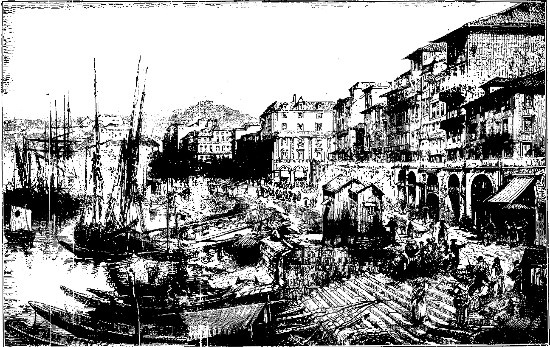
Oporto is the seat of the wine-trade, and its huge warehouses are filled with stores of port ripening to a good old age, when the garnet will be exchanged for a dark umber tint. A handsome, thriving city is Oporto, mounting in terraces up the slope of a steep hill. A fine quay runs the length of the town along the Douro, and here the active life of Oporto is mainly concentrated. Any stranger watching this stir of movement and color will be struck by the prominent position which women fill in the busy crowd. The men do not absorb all branches of labor. Besides the water-carriers, market-women and fruit-vendors there may be seen straight, stalwart lasses acting as portresses to convey loads to and from the boats which are fastened to the river-wall. Many of the servants and other laborers through Portugal come from Galicia, the inhabitants of that Spanish province enjoying a reputation for honesty and faithful service combined with stupidity.
QUAY AT OPORTO—THE QUEEN'S STAIRS.
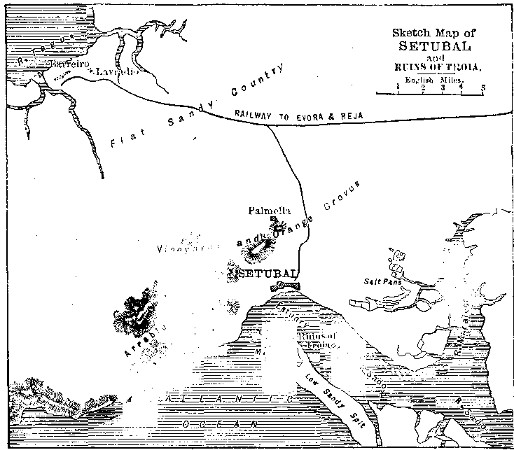
A sad contrast to the fertility of the Minho is presented by the country opposite Lisbon and the adjoining province of Alemtejo. This Portuguese campagna was in Roman days a fertile plain covered with golden wheat-fields. Now it is a barren, melancholy waste, producing only ruins. It is in and about this region that the most important Roman remains in the country are to be found. The soil in the neighborhood of Evora is rich in coins and other relics, and Evora has, besides its great aqueduct, the massive pillars of a temple to Diana, which, sad to say, was once put to ignoble use as a slaughter-house. The ruins of Troia have escaped desecration, if they have not obtained the care and study which they merit. Lying on a low tongue of land which projects into the bay of Setubal, the city of Troia is buried, not in Pompeian lava, but in deep mounds of sand, accumulated there by the winds and waves. A tremendous storm in 1814 washed away a part of this sand and revealed something of its treasure, but it was not till 1850 that the hint was followed up by antiquaries and a regular digging made. A large Roman house was uncovered, together with a vast débris of marble columns, mosaic pavements, baths, urns, and other appurtenances of Roman existence. The excavations have been far from thorough; the peninsular Troy still awaits its Schliemann. The name Troia was probably bestowed by Portuguese antiquaries of the Renaissance period, who mention it thus in their writings. According to Roman records, the city flourished about 300 a.d. as Cetobriga.
Sketch Map of SETUBAL and RUINS OF TROIA.
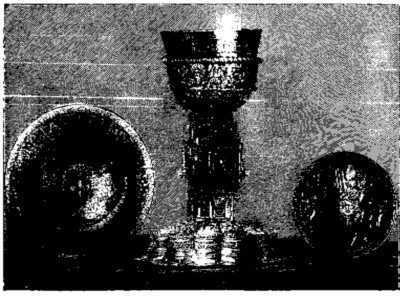
We must return to the Minho province—still the most representative section of Portugal—for monuments of Portuguese antiquity. Guimaraens is the oldest town of purely native growth, and is closely associated with the life of Affonso Henriquez. The massive castle in which he was born, and the church which witnessed the christening of the first king of Portugal, are still standing: the old walls of the town date back to the time of the hero; and not far off is the field where he fought the battle which gained him his independence at eighteen. Within a few miles of Guimaraens is Braga, celebrated for centuries as a stronghold of the Church. Its Gothic cathedral is of grand proportions, containing a triple nave, and belongs to the thirteenth century. The church treasures shut up in its sanctuary are among the richest in the Peninsula.
Portugal presents the curious spectacle of a country in which the customs of antiquity have lasted as long as its monuments. In a certain way the former are the more impressive. As some little familiar trait will sometimes give a fresher insight into a great man than the more important facts of his biography, so the ploughing, harvesting and singing of a Portuguese peasant, with their bucolic simplicity, bring the life of the ancients a little nearer to us than the sight of their great aqueducts and columns. But the nineteenth century is striking the death-blow of the bucolic very fast, the world over, and Portugal is awake and bestirring herself—not the less effectively that she is making no noise about it. Nevertheless, she is becoming better known. Mr. Oswald Crawfurd, the English consul at Oporto, who has lived in Portugal for many years, is writing about it from the best point of view, half within, half without. His book of travels published under the pseudonym of Latouche, and a volume entitled Portugal, Old and New, recently issued under his own name, throw a strong, clear light upon the country and its inhabitants. Another sympathetic and entertaining traveller is Lady Jackson, the author of Fair Lusitania.
CHURCH PLATE IN BRAGA CATHEDRAL.
The Portugal of Mr. Crawfurd and Lady Jackson is a different land from that which Southey, Byron and other English celebrities visited at the beginning of this century: it is not the same which Wordsworth's daughter, Mrs. Quillinan, travelled through on horseback in 1837, making light of inconveniences and looking at everything with kind, frank eyes. Lisbon is no longer a beautiful casket filled with dirt and filth, but a clean, bright and active city, and Portugal is no longer a sleeping land, but a well-governed country, which will probably be hindered by its small natural proportions, but not by any sluggishness or incapacity of its people, from taking a high place among European nations.