LILLIAN MORRIS. (continued 3)
Jeremiah Curtin translation
One-half of the circus is buried in shadow, the other is deluged with sunlight. On every ticket, near the number of the seat, is printed “sombra” (shadow) or “sol” (sun). Evidently the tickets “sombra” cost considerably more. It is difficult to imagine how those who have “sol” tickets can endure to sit in such an atmosphere a number of hours and on those heated stone steps, with such a sun above their heads.
The places are all filled, however. Clearly the love of a bloody spectacle surpasses the fear of being roasted alive.
In northern countries the contrast between light and shadow is not so great as in Spain; in the north we find always a kind of half shade, half light, certain transition tones; here the boundary is cut off in black with a firm line without any transitions. In the illuminated half the sand seems to burn; people’s faces and dresses are blazing; eyes are blinking under the excess of glare; it is simply an abyss of light, full of heat, in which everything is sparkling and gleaming excessively, every color is intensified tenfold. On the other hand, the shaded half seems cut off by some transparent curtain, woven from the darkness of night. Every man who passes from the light to the shade, makes on us the impression of a candle put out on a sudden.
At the moment when we enter, the arena is crowded with people. Before the spectacle the inhabitants of Madrid, male and female, must tread that sand on which the bloody drama is soon to be played. It seems to them that thus they take direct part, as it were, in the struggle. Numerous groups of men are standing, lighting their cigarettes and discoursing vivaciously concerning the merits of bulls from this herd or that one. Small boys tease and pursue one another. I see how one puts under the eyes of another a bit of red cloth, treating him just as a “capeador” treats a bull. The boy endures this a while patiently; at last he rolls his eyes fiercely and runs at his opponent. The opponent deceives him adroitly with motions of a cape, exactly again as the capeador does the bull. The little fellows find their spectators, who urge them on with applause.
Along the paling pass venders of oranges proclaiming the merits of their merchandise. This traffic is carried on through the air. The vender throws, at request, with unerring dexterity, an orange, even to the highest row; in the same way he receives a copper piece, which he catches with one hand before it touches the earth. Loud dialogues, laughter, calls, noise, rustling of fans, the movement of spectators as they arrive,—all taken together form a picture with a fulness of life of which no other spectacle can give an idea.
All at once from the orchestra come sounds of trumpets and drums. At that signal the people on the arena fly to their places with as much haste as if danger were threatening their lives. There is a crush. But after a while all are seated. Around, it is just black: people are shoulder to shoulder, head to head. In the centre remains the arena empty, deluged with sunlight.
Opposite the royal box a gate in the paling is thrown open, and in ride two “alguazils.” Their horses white, with manes and tails plaited, are as splendid as if taken from pictures. The riders themselves, wearing black velvet caps with white feathers, and doublets of similar material, with lace collars, bring to mind the incomparable canvases of Velasquez, which may be admired in the Museo del Prado. It seems to us that we are transferred to the times of knighthood long past. Both horsemen are handsome, both of showy form. They ride stirrup to stirrup, ride slowly around the whole arena to convince themselves that no incautious spectator has remained on it. At last they halt before the royal box, and with a movement full of grace uncover their heads with respect.
Whoso is in a circus for the first time will be filled with admiration at the stately, almost middle-age, ceremonial, by the apparel and dignity of the horsemen. The alguazils seem like two noble heralds, giving homage to a monarch before the beginning of a tournament. It is, in fact, a prayer for permission to open the spectacle, and at the same time a request for the key of the stables in which the bulls are confined. After a while the key is let down from the box on a gold string; the alguazils incline once again and ride away. Evidently this is a mere ceremonial, for the spectacle was authorized previously, and the bulls are confined by simple iron bolts. But the ceremony is beautiful, and they never omit it.
In a few minutes after the alguazils have vanished, the widest gate is thrown open, and a whole company enters. At the head of it ride the same two alguazils whom we saw before the royal box; after them advance a rank of capeadors; after the capeadors come “banderilleros,” and the procession is concluded by picadors. This entire party is shining with all the colors of the rainbow, gleaming from tinsel, gold, silver, and satins of various colors. They come out from the dark side to the sunlighted arena, dive into the glittering light, and bloom like flowers. The eye cannot delight itself sufficiently with the many colors of those spots on the golden sand.
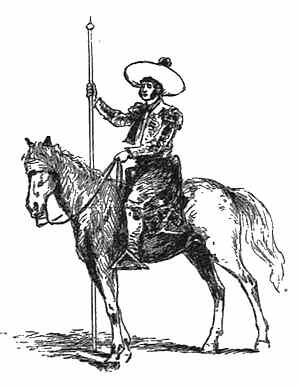
Having reached the centre, they scatter on a sudden, like a flock of butterflies. The picadors dispose themselves around at the paling, and each one drawing his lance from its rest, grasps it firmly in his right hand; the men on foot form picturesque groups; they stand in postures full of indifference, waiting for the bull.
This is perhaps the most beautiful moment of the spectacle, full of originality, so thoroughly Spanish that regret at not being a painter comes on a man in spite of himself. How much color, what sunlight might be transferred from the palette to the canvas!
Soon blood will be flowing on that sand. In the circus it is as still as in time of sowing poppy seed,—it is barely possible to hear the sound of fans, which move only in as much as the hands holding them quiver from impatience. All eyes are turned to the door through which the bull will rush forth. Time now is counted by seconds.
Suddenly the shrill, and at the same time the mournful, sound of a trumpet is heard in the orchestra; the door of the stable opens with a crash, and the bull bursts into the arena, like a thunderbolt.
That is a lordly beast, with a powerful and splendid neck, a head comparatively short, horns enormous and turned forward. Our heavy breeder gives a poor idea of him; for though the Spanish bull is not the equal of ours in bulk of body, he surpasses him in strength, and, above all, in activity. At the first cast of the eye you recognize a beast reared wild in the midst of great spaces; consequently with all his strength he can move almost as swiftly as a deer. It is just this which makes him dangerous in an unheard of degree. His forelegs are a little higher than his hind ones; this is usual with cattle of mountain origin. In fact, the bulls of the circus are recruited especially from the herds in the Sierra Morena. Their color is for the greater part black, rarely reddish or pied. The hair is short, and glossy as satin; only the neck is covered somewhat with longer and curly hair.
After he has burst into the arena, the bull slackens his pace toward the centre, looks with bloodshot eyes to the right, to the left,—but this lasts barely two seconds; he sees a group of capeadors; he lowers his head to the ground, and hurls himself on them at random.
The capeadors scatter, like a flock of sparrows at which some man has fired small-shot. Holding behind them red capes, they circle now in the arena, with a swiftness that makes the head dizzy; they are everywhere; they glitter to the right, to the left; they are in the middle of the arena, at the paling, before the eyes of the bull, in front, behind. The red capes flutter in the air, like banners torn by the wind.
The bull scatters the capeadors in every direction; with lightning-like movements he chases one,—another thrusts a red cape under his very eyes; the bull leaves the first victim to run after a second, but before he can turn, some third one steps up. The bull rushes at that one! Distance between them decreases, the horns of the bull seem to touch the shoulder of the capeador; another twinkle of an eye and he will be nailed to the paling,—but meanwhile the man touches the top of the paling with his hand, and vanishes as if he had dropped through the earth.
What has happened? The capeador has sprung into the passage extending between the paling and the first row of seats.
The bull chooses another man; but before he has moved from his tracks the first capeador thrusts out his head from behind the paling, like a red Indian stealing to the farm of a settler, and springs to the arena again. The bull pursues more and more stubbornly those unattainable enemies, who vanish before his very horns; at last he knows where they are hidden. He collects all his strength, anger gives him speed, and he springs like a hunting-horse over the paling, certain that he will crush his foes this time like worms.
But at that very moment they hurl themselves back to the arena with the agility of chimpanzees, and the bull runs along the empty passage, seeing no one before him.
The entire first row of spectators incline through the barrier, then strike from above at the bull with canes, fans, and parasols. The public are growing excited. A bull that springs over the paling recommends himself favorably. When people in the first row applaud him with all their might, those in the upper rows clap their hands, crying, “Bravo el toro! muy buen! Bravo el toro!” (Bravo the bull! Very well, bravo the bull!)
Meanwhile he comes to an open door and runs out again to the arena. On the opposite side of it two capeadors are sitting on a step extending around the foot of the paling, and are conversing without the slightest anxiety. The bull rushes on them at once; he is in the middle of the arena,—and they sit on without stopping their talk; he is ten steps away,—they continue sitting as if they had not seen him; he is five steps away,—they are still talking. Cries of alarm are heard here and there in the circus; before his very horns the two daring fellows spring, one to the right, the other to the left. The bull’s horns strike the paling with a heavy blow. A storm of handclapping breaks out in the circus, and at that very moment these and other capeadors surround the bull again and provoke him with red capes.
His madness passes now into fury: he hurls himself forward, rushes, turns on his tracks; every moment his horns give a thrust, every moment it seems that no human power can wrest this or that man from death. Still the horns cut nothing but air, and the red capes are glittering on all sides; at times one of them falls to the ground, and that second the bull in his rage drives almost all of it into the sand. But that is not enough for him,—he must search out some victim, and reach him at all costs.
Hence, with a deep bellow and with bloodshot eyes he starts to run forward at random, but halts on a sudden; a new sight strikes his eye,—that is, a picador on horseback.
The picadors had stood hitherto on their lean horses, like statues, their lances pointing upward. The bull, occupied solely with the hated capes, had not seen them, or if he had seen them he passed them.
Almost never does it happen that the bull begins a fight with horsemen. The capes absorb his attention and rouse all his rage. It may be, moreover, that the picadors are like his half-wild herdsmen in the Sierra Morena, whom he saw at times from a distance, and before whom he was accustomed to flee with the whole herd.
But now he has had capes enough; his fury seeks eagerly some body to pierce and on which to sate his vengeance.
For spectators not accustomed to this kind of play, a terrible moment is coming. Every one understands that blood must be shed soon.
The bull lowers his head and withdraws a number of paces, as if to gather impetus; the picador turns the horse a little, with his right side to the attacker, so the horse, having his right eye bound with a cloth, shall not push back at the moment of attack. The lance with a short point is lowered in the direction of the bull; he withdraws still more. It seems to you that he will retreat altogether, and your oppressed bosom begins to breathe with more ease.
Suddenly the bull rushes forward like a rock rolling down from a mountain. In the twinkle of an eye you see the lance bent like a bow; the sharp end of it is stuck in the shoulder of the bull,—and then is enacted a thing simply dreadful: the powerful head and neck of the furious beast is lost under the belly of the horse, his horns sink their whole length in the horse’s intestines; sometimes the bull lifts horse and rider, sometimes you see only the upraised hind part of the horse, struggling convulsively in the air. Then the rider falls to the ground, the horse tumbles upon him, and you hear the creaking of the saddle; horse, rider, and saddle form one shapeless mass, which the raging bull tramples and bores with his horns.
Faces unaccustomed to the spectacle grow pale. In Barcelona and Madrid I have seen Englishwomen whose faces had become as pale as linen. Every one in the circus for the first time has the impression of a catastrophe. When the rider is seen rolled into a lump, pressed down by the weight of the saddle and the horse, and the raging beast is thrusting his horns with fury into that mass of flesh, it seems that for the man there is no salvation, and that the attendants will raise a mere bloody corpse from the sand.
But that is illusion. All that is done is in the programme of the spectacle.
Under the white leather and tinsel the rider has armor which saves him from being crushed,—he fell purposely under the horse, so that the beast should protect him with his body from the horns. In fact the bull, seeing before him the fleshy mass of the horse’s belly, expends on it mainly his rage. Let me add that the duration of the catastrophe is counted by seconds. The capeadors have attacked the bull from every side, and he, wishing to free himself from them, must leave his victims. He does leave them, he chases again after the capeadors; his steaming horns, stained with blood, seem again to be just touching the capeadors’ shoulders. They, in escaping, lead him to the opposite side of the arena; other men meanwhile draw from beneath the horse the picador, who is barely able to move under the weight of his armor, and throw him over the paling.
The horse too tries to raise himself: frequently he rises for a moment, but then a ghastly sight strikes the eye. From his torn belly hangs a whole bundle of intestines with a rosy spleen, bluish liver, and greenish stomach. The hapless beast tries to walk a few steps; but his trembling feet tread on his own entrails, he falls, digs the ground with his hoofs, shudders. Meanwhile the attendants run up, remove the saddle and bridle, and finish the torments of the horse with one stab of a stiletto, at the point where head and neck come together.
On the arena remains the motionless body, which, lying now on its side, seems wonderfully flat. The intestines are carried out quickly in a basket which is somewhat like a wash-tub, and the public clap their hands with excitement. Enthusiasm begins to seize them: “Bravo el toro! Bravo picador!” Eyes are flashing, on faces a flush comes, a number of hats fly to the arena in honor of the picador. Meanwhile “el toro,” having drawn blood once, kills a number of other horses. If his horns are buried not in the belly but under the shoulder of the horse, a stream of dark blood bursts onto the arena in an uncommon quantity; the horse rears and falls backward with his rider. A twofold danger threatens the man: the horns of the bull or, in spite of his armor, the breaking of his neck. But, as we have said, the body of the horse becomes a protection to the rider; hence, every picador tries to receive battle at the edge of the arena, so as to be, as it were, covered between the body of the horse and the paling. When the bull withdraws, the picador advances, but only a few steps, so that the battle never takes place in the centre.
All these precautions would not avail much, and the bull would pierce the horseman at last, were it not for the capeadors. They press on the bull, draw away his attention, rush with unheard of boldness against his rage, saving each moment the life of some participant in the fight. Once I saw an espada, retreating before the raging beast, stumble against the head of a dead horse and fall on his back; death inevitable was hanging over him, the horns of the bull were just ready to pass through his breast, when suddenly between that breast and the horns the red capes were moving, and the bull flew after the capes. It may be said that were it not for that flock of chimpanzees waving red capes, the work of the picadors would be impossible, and at every representation as many of them as of horses would perish.
It happens rarely that a picador can stop a bull at the point of a lance. This takes place only when the bull advances feebly, or the picador is gifted with gigantic strength of arms, surpassing the measure of men. I saw two such examples in Madrid, after which came a hurricane of applause for the picador.
But usually the bull kills horses like flies; and he is terrible when, covered with sweat, glittering in the sun, with a neck bleeding from lances and his horns painted red, he runs around the arena, as if in the drunkenness of victory. A deep bellow comes from his mighty lungs; at one moment he scatters capeadors, at another he halts suddenly over the body of a horse, now motionless, and avenges himself on it terribly,—he raises it on his horns, carries it around the arena, scattering drops of stiff blood on spectators in the first row; then he casts it again on the stained sand and pierces it a second time. It seems to him, evidently, that the spectacle is over, and that it has ended in his triumph.
But the spectacle has barely passed through one-half of its course. Those picadors whose horses have survived the defeat, ride out, it is true, from the arena; but in place of them run in with jumps, and amid shouts, nimble banderilleros. Every one of them in his upraised hands has two arrows, each an ell long, ornamented, in accordance with the coat of the man, with a blue, a green, or a red ribbon, and ending with a barbed point, which once it is under the skin will not come out of it. These men begin to circle about the bull, shaking the arrows, stretching toward him the points, threatening and springing up toward him. The bull rolls his bloodshot eyes, turns his head to the right, to the left, looking to see what new kind of enemies these are. “Ah,” says he, evidently, to himself, “you have had little blood, you want more—you shall have it!” and selecting the man, he rushes at him.
But what happens? The first man, instead of fleeing, runs toward the bull,—runs past his head, as if he wished to avoid him; but in that same second something seems hanging in the air like a rainbow: the man is running away empty-handed with all the strength of his legs, toward the paling, and in the neck of the bull are two colored arrows.
After a moment another pair are sticking in him, and then a third pair,—six altogether, with three colors. The neck of the beast seems now as if ornamented with a bunch of flowers, but those flowers have the most terrible thorns of any on earth. At every movement of the bull, at every turn of his head, the arrows move, shake, fly from one side of his neck to the other, and with that every point is boring into the wound. Evidently from pain the animal is falling into the madness of rage; but the more he rushes the greater his pain. Hitherto the bull was the wrong-doer, now they wrong him, and terribly. He would like to free himself from those torturing arrows; but there is no power to do that. He is growing mad from mere torment, and is harassed to the utmost. Foam covers his nostrils, his tongue is protruding; he bellows no longer, but in the short intervals between the wild shouts, the clapping, and the uproar of the spectators, you may hear his groans, which have an accent almost human. The capeadors harassed him, every picador wounded him, now the arrows are working into his wounds; thirst and heat complete his torments.
It is his luck that he did not get another kind of “banderille.” If—which, however, happens rarely—the bull refuses to attack the horses and has killed none, the enraged public rise, and in the circus something in the nature of a revolution sets in. Men with their canes and women with their parasols and fans turn to the royal box; wild, hoarse voices of cruel cavaliers, and the shrill ones of senoritas, shout only one word: “Fuego! fuego! fuego!” (Fire, fire, fire!)
The representatives of the government withhold their consent for a long time. Hence “Fuego!” is heard ever more threateningly, and drowns all other voices; the threat rises to such an intensity as to make us think that the public may pass at any instant from words to a mad deed of some kind. Half an hour passes: “Fuego! fuego!” There is no help for it. The signal is given, and the unfortunate bull gets a banderille which when thrust into his neck blazes up that same instant.
The points wound in their own way, and in their own way rolls of smoke surround the head of the beast, the rattle of fireworks stuns him; great sparks fall into his wounds, small congreve rockets burst under his skin; the smell of burnt flesh and singed hair fill the arena. In truth, cruelty can go no further; but the delight of the public rises now to its zenith. The eyes of women are covered with mist from excitement, every breast is heaving with pleasure, their heads fall backward, and between their open moist lips are gleaming white teeth. You would say that the torment of the beast is reflected in the nerves of those women with an answering degree of delight. Only in Spain can such things be seen. There is in that frenzy something hysterical, something which recalls certain Phœnician mysteries, performed on the altar of Melitta.
The daring and skill of the banderilleros surpass every measure. I saw one of them who had taken his place in the middle of the arena in an arm-chair; he had stretched his legs carelessly before him,—they were in rose-colored stockings,—he crossed them, and holding above his head a banderille, was waiting for the bull. The bull rushed at him straightway; the next instant, I saw only that the banderille was fastened in the neck, and the bull was smashing the chair with mad blows of his head. In what way the man had escaped between the chair and the horns, I know not,—that is the secret of his skill. Another banderillero, at the same representation, seizing the lance of a picador at the moment of attack, supported himself with it, and sprang over the back and whole length of the bull. The beast was dumb-founded, could not understand where his victim had vanished.
A multitude of such wonders of daring and dexterity are seen at each representation.
One bull never gets more than three pairs of banderilles. When the deed is accomplished, a single trumpet is heard in the orchestra with a prolonged and sad note,—and the moment the most exciting and tragic in the spectacle approaches. All that was done hitherto was only preparation for this. Now a fourth act of the drama is played.
On the arena comes out the “matador” himself,—that is, the espada. He is dressed like the other participants in the play, only more elaborately and richly. His coat is all gold and tinsel: costly laces adorn his breast. He may be distinguished by this too,—that he comes out bareheaded always. His black hair, combed back carefully, ends on his shoulders in a small tail. In his left hand he holds a red cloth flag, in his right a long Toledo sword. The capeadors surround him as soldiers their chief, ready at all times to save him in a moment of danger, and he approaches the bull, collected, cool, but terrible and triumphant.
In all the spectators the hearts are throbbing violently, and a moment of silence sets in.
In Barcelona and Madrid I saw the four most eminent espadas in Spain, and in truth I admit, that besides their cool blood, dexterity, and training, they have a certain hypnotic power, which acts on the animal and fills him with mysterious alarm. The bull simply bears himself differently before the espada from what he did before the previous participants in the play. It is not that he withdraws before him; on the contrary, he attacks him with greater insistence perhaps. But in former attacks, in addition to rage, there was evident a certain desire. He hunted, he scattered, he killed; he was as if convinced that the whole spectacle was for him, and that the question was only in this, that he should kill. Now, at sight of that cold, awful man with a sword in his hand, he convinces himself that death is there before him, that he must perish, that on that bloody sand the ghastly deed will be accomplished in some moments.
This mental state of the beast is so evident that every man can divine it. Perhaps even this, by its tragic nature, becomes the charm of the spectacle. That mighty organism, simply seething with a superabundance of vitality, of desire, of strength, is unwilling to die, will not consent to die for anything in the world! and death, unavoidable, irresistible, is approaching; hence unspeakable sorrow, unspeakable despair, throbs through every movement of the bull. He hardly notices the capeadors, whom before he pursued with such venom; he attacks the espada himself, but he attacks with despair completely evident.
The espada does not kill him at once, for that is not permitted by the rules of the play. He deceives the bull with movements of the flag, himself he pushes from the horns by turns slight and insignificant; he waits for the moment, withdraws, advances. Evidently he wishes to sate the public; now, this very instant, he’ll strike, now he lowers his sword again.
The struggle extends over the whole arena; it glitters in the sun, is dark in the shade. In the circus applause is heard, now general, now single from the breast of some señorita who is unable to restrain her enthusiasm. At one moment bravos are thundering; at another, if the espada has retreated awkwardly or given a false blow, hissing rends the ear. The bull has now given some tens of blows with his horns,—always to the flag; the public are satisfied; here and there voices are crying: “Mata el toro! mata el toro!” (Kill the bull! kill the bull!)
And now a flash comes so suddenly that the eye cannot follow it; then the group of fighters scatter, and in the neck of the bull, above the colored banderilles, is seen the red hilt of the sword. The blade has gone through the neck, and, buried two thirds of its length, is planted in the lungs of the beast.
The espada is defenceless; the bull attacks yet, but he misleads him in the old fashion with the flag, he saves himself from the blows with half turns.
Meanwhile it seems that people have gone wild in the circus. No longer shouts, but one bellow and howl are heard, around, from above to below. All are springing from their seats. To the arena are flying bouquets, cigar-cases, hats, fans. The fight is approaching its end.
A film is coming over the eyes of the bull; from his mouth are hanging stalactites of bloody saliva; his groan becomes hoarse. Night is embracing his head. The glitter and heat of the sun concern him no longer. He attacks yet, but as it were in a dream. It is darker and darker for him. At last he collects the remnant of his consciousness, backs to the paling, totters for a moment, kneels on his fore feet, drops on his hind ones, and begins to die.
The espada looks at him no longer; he has his eyes turned to the spectators, from whom hats and cigar-cases are flying, thick as hail; he bows; capeadors throw back to the spectators their hats.
Meanwhile a mysterious man dressed in black climbs over the paling in silence and puts a stiletto in the bull, where the neckbone meets the skull; with a light movement he sinks it to the hilt and turns it.
That is the blow of mercy, after which the head of the bull drops on its side.
All the participants pass out. For a moment the arena is empty; on it are visible only the body of the bull and the eviscerated carcasses of four or five horses, now cold.
But after a while rush in with great speed men with mules, splendidly harnessed in yellow and red; the men attach these mules to the bodies and draw them around so that the public may enjoy the sight once again, then with speed equally great they go out through the doors of the arena.
But do not imagine that the spectacle is ended with one bull. After the first comes a second, after the second a third, and so on. In Madrid six bulls perish at a representation. In Barcelona, at the time of the fair, eight were killed.
Do not think either that the public are wearied by the monotony of the fight. To begin with, the fight itself is varied with personal episodes caused by temperament, the greater or less rage of the bull, the greater or less skill of the men in their work; secondly, that public is never annoyed at the sight of blood and death.
The “toreadores” (though in Spain no participant in the fight is called a toreador), thanks to their dexterity, rarely perish; but if that happens, the spectacle is considered as the more splendid, and the bull receives as much applause as the espada. Since, however, accidents happen to people sometimes, at every representation, besides the doctor, there is present a priest with the sacrament. That spiritual person is not among the audience, of course; but he waits in a special room, to which the wounded are borne in case of an accident.
Whether in time, under the influence of civilization, bull-fights will be abandoned in Spain, it is difficult to say. The love of those fights is very deep in the nature of the Spanish people. The higher and intelligent ranks of society take part in them gladly. The defenders of these spectacles say that in substance they are nothing more than hazardous hunting, which answers to the knightly character of the nation. But hunting is an amusement, not a career; in hunting there is no audience,—only actors; there are no throngs of women, half fainting from delight at the spectacle of torment and death; finally, in hunting no one exposes his life for hire.
Were I asked if the spectacle is beautiful, I should say yes; beautiful especially in its surroundings,—that sun, those shades, those thousands of fans at sight of which it seems as though a swarm of butterflies had settled on the seats of the circus, those eyes, those red moist lips. Beautiful is that incalculable quantity of warm and strong tones, that mass of colors, gold, tinsel, that inflamed sand, from which heat is exhaling,—finally those proofs of bold daring, and that terror hanging over the play. All that is more beautiful by far than the streams of blood and the torn bellies of the horses.
He, however, who knows these spectacles only from description, and sees them afterwards with his own eyes, cannot but think: what a wonderful people for whom the highest amusement and delight is the sight of a thing so awful, so absolute and inevitable as death. Whence comes that love? Is it simply a remnant of Middle-age cruelty; or is it that impulse which is roused in many persons, for instance at sight of a precipice, to go as near as possible to the brink, to touch that curtain, behind which begin the mystery and the pit?—that is a wonderful passion, which in certain souls becomes irresistible.
Of the Spaniards it may be said, that in the whole course of their history they have shown a tendency to extremes. Few people have been so merciless in warfare; none have turned a religion of love into such a gloomy and bloody worship; finally, no other nation amuses itself by playing with death.
Other works by Henryk Sienkiewicz.
——————
With Fire and Sword. An Historical Novel of Poland and Russia. By Henryk Sienkiewicz. Translated from the original by Jeremiah Curtin. Crown 8vo. Cloth, $2.00. Library edition, 2 vols., crown 8vo, cloth, gilt top, $3.00.
The Deluge. An Historical Novel of Poland, Sweden, and Russia, a sequel to “With Fire and Sword,” translated from the Polish of Henryk Sienkiewicz by Jeremiah Curtin. With photogravure portrait of the author and map of the country at the period of the stories. 2 vols. Crown 8vo. Cloth, $3.00.
Every one should read these remarkable books. They have received the highest praise everywhere. The distinguished writer, Charles Dudley Warner, in a review of “With Fire and Sword” in “Harper’s Monthly Magazine,” says that the author has given, in the character of Zagloba, a new type to the literature of fiction.
Of these extraordinary romances it has been truly said that action in the field has never before been described in any language with such a marvellous expression of energy. The comparisons which have suggested themselves to American critics couple the Polish novelist with such names as Scott, Dumas, Schiller, Cervantes, Shakespeare, and Homer. The character of Zagloba has been described as “a curious and fascinating combination of Falstaff and Ulysses.”
“The only modern romance with which ‘Fire and Sword’ can be compared,” says the “New York Tribune,” “is ‘The Three Musketeers.’”
A new Historical Romance by Henryk Sienkiewicz, completing “With Fire and Sword” and “The Deluge.”
Pan Michael. An Historical Novel of Poland, the Ukraine, and Turkey. A sequel to “With Fire and Sword” and “The Deluge.” Translated by Jeremiah Curtin. Crown 8vo. Cloth, $2.00.
This great historical romance completes the remarkable series of historical novels by Sienkiewicz, begun by “With Fire and Sword” and continued in “The Deluge.” These powerful works have been received everywhere with enthusiastic commendation, and the publication of the final story of the trilogy can only add to and continue their popularity.
——————
Without Dogma. A new novel by the author of “With Fire and Sword.”
Without Dogma. A Novel of Modern Poland. By Henryk Sienkiewicz. Translated from the Polish by Iza Young. Crown 8vo. Cloth, $1.50.
A psychological novel of modern thought, and of great power. Its utter contrast to the author’s historical romances exhibits in a most striking manner the remarkable variety of his genius.
A triumph of psychology.—Chicago Times.
Belongs to a high order of fiction.—New York Times.
A masterly piece of writing.—Pittsburg Bulletin.
Intellectually the novel is a masterpiece.—Christian Union.
Emphatically a human document.—The Boston Beacon.
Displays the most remarkable genius.—Boston Home Journal.
Both absorbing and instructive.—Boston Courier.
Yanko the Musician and Other Stories.
By Henryk Sienkiewicz. Translated from the Polish by Jeremiah Curtin. Illustrated by Edmund H. Garrett. 16mo. White and gold. $1.25.
This charming volume contains the following stories of two continents by the popular author of “With Fire and Sword,” “The Deluge,” etc.: I. Yanko the Musician; II. The Lighthouse Keeper of Aspinwall; III. From the Diary of a Tutor in Poznan; IV. A Comedy of Errors, a Sketch of American Life; V. Bartek the Victor. “Yanko the Musician,” the initial story of the volumes, won the author his fame. In a review of Sienkiewicz in Blackwood’s Magazine, this beautiful story was fittingly described as a little poem in prose, absolutely perfect of its kind.
“Bartek the Victor” is the story of a hero of the Franco-Prussian war. The Blackwood reviewer, writing of it, says: “The battle of Gravelotte is so admirably described that it is difficult to believe the writer not to have been actively engaged in it himself.”
The stories are deeply intellectual.—Philadelphia Public Ledger.
The tale of Yanko has wonderful pathos.—Chicago Herald.
Exquisite in technical expression.—Boston Beacon.
There is an outdoor freshness about these tales, and an impulse which, like Polish music, sets one’s blood a-tingling.—New Haven Register.
They are full of powerful interest.—Boston Courier.
The simple story of the lighthouse man is a little masterpiece.—New York Times.
The admirers of the distinguished Polish novelist will not be disappointed in this volume of short stories, which is beautifully illustrated by Edmund H. Garrett, and daintily bound.—Boston Home Journal.
These stories show that he touches nothing without mastery.—Christian Register.
The title story is a strangely simple, pathetic story of a weakling child with a passion for music. The careful, loving treatment of the slight plot makes it, even in translation, a beautiful story.—Chicago Figaro.
Five stories, all conceived with great power and written with masterly skill.—Boston Gazette.
The Blind Musician.Translated from the Russian of Vladimir Korolenko by Aline Delano. With Introduction by George Kennan, and illustrations by Edmund H. Garrett. 16mo. Cloth, gilt top, $1.25.
This unique and exquisite little book is less a story than a wonderfully faithful and delicate study in psychology. Though told in prose, it is in essence a poem. The volume is in edition de luxe, with dainty and charming bits of vignette illustration and a perfection of finish which gives refined pleasure to the touch as well as to the eye.—Boston Transcript.
A Woman of Shawmut. A Romance of Colonial Times. (Boston, 1640.) By Edmund Janes Carpenter. With 12 charming full-page illustrations and numerous chapter-headings from pen-and-ink drawings by F. T. Merrill. 16mo. Cloth, extra, gilt top, $1.25.
Has qualities placing it among the prose poems of recent literature.—Boston Journal.
Clever pictures of old Boston.—Boston Transcript.
A decidedly artistic specimen of bookmaking.—Boston Gazette.
Carine, a Story of Sweden. By Louis Énault. Translated from the French by Linda De Kowalewska. With thirty-nine Illustrations by Louis K. Harlow. 16mo. Cloth, gilt top, $1.25. Uniform with “A Woman of Shawmut.”
Swedish life in all its varying domestic aspects, as seen from intimacy with cultivated and refined people, is revealed with exquisite fidelity; and the portrayal of Carine’s problematic character is elaborated in a veritably artistic manner. The whole story has the idyllic touch.—Boston Beacon.
Lyrics and Legends. By Nora Perry, author of “After the Ball,” “A Flock of Girls and Their Friends,” etc. Illustrated by Edmund H. Garrett. 16mo. Cloth, gilt top, $1.25.
Many of the songs have already sung themselves into the hearts of those who love beautiful thought in beautiful form.—Public Opinion.
——————
LITTLE, BROWN, & CO., Publishers.
FOOTNOTE: