LILLIAN MORRIS. (continued 2)
Jeremiah Curtin translation
A great weight fell from my heart when, after three weeks of such crossings, I saw at last the waters of a river white as if traced out with chalk; this stream is called now Republican River, but at that time it had no name in English. Broad belts of dark willows, stretching like a mourning trail along the white waters, could afford us fuel in plenty; and though that kind of willow crackles in the fire, and shoots sparks with great noise, still it burns better than wet buffalo dung. I appointed at this place another rest of two days, because the rocks, scattered here and there by the banks of the river, indicated the proximity of a hilly country, difficult to cross, lying on both sides of the back of the Rocky Mountains. We were already on a considerable elevation above the sea, as could be known by the cold nights.
That inequality between day and night temperature troubled us greatly. Some people, among others old Smith, caught fevers, and had to go to their wagons. The seeds of the disease had clung to them, probably, at the unwholesome banks of the Missouri, and hardship caused the outbreak. The nearness of the mountains, however, gave hope of a speedy recovery; meanwhile, my wife nursed them with a devotion innate to gentle hearts only.
But she grew thin herself. More than once, when I woke in the morning, my first look fell on her beautiful face, and my heart beat uneasily at its pallor and the blue half circles under her eyes. It would happen that while I was looking at her in that way she would wake, smile at me, and fall asleep again. Then I felt that I would have given half my health of oak if we were in California; but California was still far, far away.
After two days we started again, and coming to the Republican River at noon, were soon moving along the fork of the White Man toward the southern fork of the Platte, lying for the most part in Colorado. The country became more mountainous at every step, and we were really in the canyon along the banks of which rose up in the distance higher and higher granite cliffs, now standing alone, now stretching out continuously like walls, now closing more narrowly, now opening out on both sides. Wood was not lacking, for all the cracks and crannies of the cliffs were covered with dwarf pine and dwarf oak as well. Here and there springs were heard; along the rocky walls scampered the wolverine. The air was cool, pure, wholesome. After a week the fever ceased. But the mules and horses, forced to eat food in which heather predominated, instead of the juicy grass of Nebraska, grew thinner and thinner, and groaned more loudly as they pulled up the mountains our well filled and weighty wagons.
At last on a certain afternoon we saw before us beacons, as it were, or crested clouds half melting in the distance, hazy, blue, azure, with white and gold on their crests, and immense in size, extending from the earth to the sky.
At this sight a shout rose in the whole caravan; men climbed to the tops of the wagons to see better, from every side thundered shouts: “Rocky Mountains! Rocky Mountains!” Caps were waving in the air, and on all faces enthusiasm was evident.
Thus the Americans greeted their Rocky Mountains, but I went to my wagon, and, pressing my wife to my breast, vowed faith to her once more in spirit before those heaven-touching altars, which expressed such solemn mysteriousness, majesty, unapproachableness, and immensity. The sun was just setting, and soon twilight covered the whole country; but those giants in the last rays seemed like measureless masses of burning coal and lava. Later on, that fiery redness passed into violet, ever darker, and at last all disappeared, and was merged into one darkness, through which gazed at us from above the stars, the twinkling eyes of the night.
But we were at least a hundred and fifty miles yet from the main chain; in fact, the mountains disappeared from our eyes next day, intercepted by cliffs; again they appeared and again they vanished, as our road went by turns.
We advanced slowly, for new obstacles stood in our way; and though we kept as much as possible to the bed of the river, frequently, where the banks were too steep, we had to go around and seek a passage by neighboring valleys. The ground in these valleys was covered with gray heather and wild peas, not good even for mules, and forming no little hindrance to the journey, for the long and powerful stems, twisting around, made it difficult to pass through them.
Sometimes we came upon openings and cracks in the earth, impassable and hundreds of yards long; these we had to go around also. Time after time the scouts, Wichita and Tom, returned with accounts of new obstacles. The land bristled with rocks, or broke away suddenly.
On a certain day it seemed to us that we were going through a valley, when all at once the valley was missing; in place of it was a precipice so deep that the gaze went down with terror along the perpendicular wall, and the head became dizzy. Giant oaks, growing at the bottom of the abyss, seemed little black clumps, and the buffaloes pasturing among them like beetles. We entered more and more into the region of precipices, of stones, fragments, debris, and rocks thrown one on the other with a kind of wild disorder. The echo sent back twice and thrice from granite arches the curses of drivers and squealing of mules. On the prairie our wagons, rising high above the surface of the country, seemed lordly and immense; here before those perpendicular cliffs, the wagons became wonderfully small to the eye, and vanished in those gorges as if devoured by gigantic jaws. Little waterfalls, or as they are called by the Indians, “laughing waters,” stopped the road to us every few hundred yards; toil exhausted our strength and that of the animals. Meanwhile, when at times the real chain of mountains appeared on the horizon, it seemed as far away and hazy as ever. Happily curiosity overcame in us even weariness, and the continual change of views kept it in practice. None of my people, not excepting those who were born in the Alleghanies, had ever seen such wild regions; I myself gazed with wonder on those canyons, along the edges of which the unbridled fancy of Nature had reared as it were castles, fortresses, and stone cities. From time to time we met Indians, but these were different from those on the prairies, very straggling and very much wilder.
The sight of white men roused in them fear mingled with a desire for blood. They seemed still more cruel than their brethren in Nebraska; their stature was loftier, their complexion much darker, their wide nostrils and quick glances gave them the expression of wild beasts caught in a trap. Their movements, too, had almost the quickness and timidity of beasts. While speaking, they put their thumbs to their cheeks, which were painted in white and blue stripes. Their weapons were tomahawks and bows, the latter made of a certain kind of firm mountain hawthorn, so rigid that my men could not bend them. These savages, who in considerable numbers might have been very dangerous, were distinguished by invincible thievishness; happily they were few, the largest party that we met not exceeding fifteen. They called themselves Tabeguachis, Winemucas, and Yampas. Our scout, Wichita, though expert in Indian dialects, could not understand their language; hence we could not make out in any way why all of them, pointing to the Rocky Mountains and then to us, closed and opened their palms, as if indicating some number.
The road became so difficult, that with the greatest exertion, we made barely fifteen miles a day. At the same time our horses began to die, being less enduring than mules and more choice of food; men failed in strength too, for during whole days they had to draw wagons with the mules, or to hold them in dangerous places. By degrees unwillingness seized the weakest; some got the rheumatism, and one, through whose mouth blood came from exertion, died in three days, cursing the hour in which it came to his head to leave New York. We were then in the worst part of the road, near the little river called by the Indians Kiowa. There were no cliffs there as high as on the Eastern boundary of Colorado; but the whole country, as far as the eye could reach, was bristling with fragments thrown in disorder one upon another. These fragments, some standing upright, others overturned, presented the appearance of ruined graveyards with fallen headstones. Those were really the “Bad Lands” of Colorado, answering to those which extended northward over Nebraska. With the greatest effort we escaped from them in the course of a week.
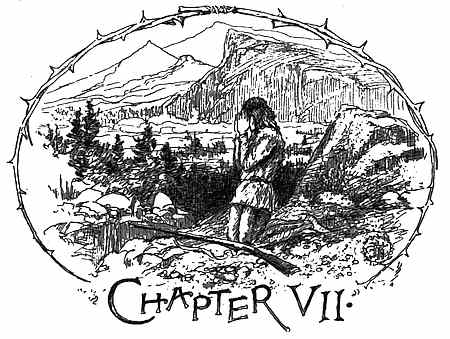
At last we found ourselves at the foot of the Rocky Mountains.
Fear seized me when I looked from a proximate point at that world of granite mountains, whose sides were wrapped in mist, and whose summits were lost somewhere in eternal snow and clouds. Their size and silent majesty pressed me to the earth; hence I bent before the Lord, imploring Him to permit me to lead, past those measureless walls, my wagons, my people, and my wife. After such a prayer I entered the stone gullies and corridors with more confidence. When they closed behind us we were cut off from the rest of the world. Above was the sky; in it a few eagles were screaming, around us was granite and then granite without end,—a genuine labyrinth of passages, vaults, ravines, openings, precipices, towers, silent edifices, and as it were chambers, gigantic and dreamy. There is such a solemnity there, and the soul is under such pressure, that a man knows not himself why he whispers instead of speaking aloud. It seems to him that the road is closing before him continually, that some voice is saying to him: “Go no farther, for there is no passage!” It seems to him that he is attacking some secret on which God Himself has set a seal. At night, when those upright legions were standing as black as mourning, and the moon cast about their summits a silvery mantle of sadness, when certain wonderful shadows rose around the “laughing waters,” a quiver passed through the most hardened adventurers. We spent whole hours by the fires, looking with a certain superstitious awe at the dark depths of the ravines, lighted by ruddy gleams; we seemed to think that something terrible might show itself any moment.
Once we found under a hollow in the cliff the skeleton of a man; and though from the remnant of the hair which had dried to the skull, we saw that he was an Indian, still an ominous feeling pressed our hearts, for that skeleton with grinning teeth seemed to forewarn us that whoso wandered in there would never come out again.
That same day the half-breed, Tom, was killed suddenly, having fallen with his horse from the edge of a cliff. A gloomy sadness seized the whole caravan; formerly we had advanced noisily and joyfully, now the drivers ceased to swear, and the caravan pushed forward in a silence broken only by the squeaking of wheels. The mules grew ill-tempered more frequently, and when one pair stood as still as if lashed to the earth, all the wagons behind them had to stop. I was most tortured by this,—that in those moments which were so difficult and oppressive, and in which my wife needed my presence more than at other times, I could not be near her; for I had to double and treble myself almost, so as to give an example, uphold courage and confidence. The men, it is true, bore toil with the endurance innate with Americans, though they were simply using the last of their strength. But my health was proof against every hardship. There were nights in which I did not have two hours of sleep; I dragged the wagons with others, I posted the sentries, I went around the square,—in a word, I performed service twice more burdensome than any one of the company; but it is evident that happiness gave me strength. For when, wearied and beaten down, I came to my wagon, I found there everything that I held dearest: a faithful heart and a beloved hand, that wiped my wearied forehead. Lillian, though suffering a little, never went to sleep wittingly before my arrival; and when I reproached her she closed my mouth with a kiss and a prayer not to be angry. When I told her to sleep she did so, holding my hand. Frequently in the night, when she woke, she covered me with beaver skins, so that I might rest better. Always mild, sweet, loving, she cared for me and brought me to worship her simply. I kissed the hem of her garment, as if it had been the most sacred thing, and that wagon of ours became for me almost a church. That little one in presence of those heaven-touching walls of granite, upon which she cast her upraised eyes, covered them for me in such a way, that in presence of her they vanished from before me, and amid all those immensities I saw only her. What is there wonderful, if when strength failed others, I had strength still, and felt that so long as it was a question of her I would never fail?
After three weeks’ journey we came at last to a more spacious canyon formed by White River. At the entrance to it the Winta Indians prepared an ambush which annoyed us somewhat; but when their reddish arrows began to reach the roof of my wife’s wagon, I struck on them with my men so violently that they scattered at once. We killed three or four of them. The only prisoner whom we took, a youth of sixteen, when he had recovered a little from terror, pointed in turn at us and to the West, repeating the same gestures which the Yampa had made. It seemed to us that he wanted to say that there were white men near by, but it was difficult to give credit to that supposition. In time it turned out to be correct, and it is easy to imagine the astonishment and delight of my men on the following day, when, descending from an elevated plateau, we saw on a broad valley which lay at our feet, not only wagons, but houses built of freshly-cut logs. These houses formed a circle, in the centre of which rose a large shed without windows; through the middle of the plain a stream flowed; near it were herds of mules, guarded by men on horseback.
The presence of men of my own race in that valley filled me with astonishment, which soon passed into fear, when I remembered that they might be “criminal outlaws” hiding in the desert from death. I knew from experience that such outcasts push frequently to very remote and entirely desert regions, where they form detachments, on a complete military footing. Sometimes they are founders of new societies as it were, which at first live by plundering people moving to more inhabited places; but later, by a continual increase of population, they change by degrees into ordered societies. I met more than once with “outlaws” on the upper course of the Mississippi, when, as a squatter, I floated down logs to New Orleans; more than once I had bloody adventures with them, hence their cruelty and bravery were equally well known to me.
I should not have feared them had not Lillian been with us; but at thought of the danger in which she would be if we were defeated and I fell, the hair rose on my head, and for the first time in my life I was as full of fear as the greatest coward. But I was convinced that if those men were outlaws, we could not avoid battle in any way, and that the conflict would be more difficult with them than with Indians.
I warned my men at once of the probable danger, and arranged them in order of battle. I was ready either to perish myself, or destroy that nest of wasps, and resolved to strike the first blow.
Meanwhile they saw us from the valley, and two horsemen started toward us as fast as their horses could gallop. I drew breath at that sight, for “outlaws” would not send messengers to meet us. In fact, it turned out that they were riflemen of the American fur company, who had their “summer camp” in that place. Instead of a battle, therefore, a most hospitable reception was waiting for us, and every assistance from those rough but honest riflemen of the desert. Indeed, they received us with open arms, and we thanked God for having looked on our misery and prepared such an agreeable resting-place.
A month and a half had passed since our departure from Big Blue River. Our strength was exhausted, our mules were only half alive; but here we might rest a whole week in perfect safety, with abundance of food for ourselves, and grass for our beasts. That was simply salvation for us.
Mr. Thorston, the chief of the camp, was a man of education and enlightenment. Knowing that I was not a common rough fellow of the prairies, he became friendly at once, and gave his own cottage to me and Lillian, whose health had suffered greatly.
I kept her two days in bed. She was so wearied that she barely opened her eyes for the first twenty-four hours; during that time I took care that nothing should disturb her. I sat at her bedside and watched hour after hour. In two days she was strengthened enough to go out; but I did not let her touch any work. My men, too, for the first few days slept like stones, wherever each one dropped down. Only after they had slept did we repair our wagons and clothing and wash our linen. The honest riflemen helped us in everything earnestly. They were Canadians, for the greater part, who had hired with the company. They spent the winter in trapping beavers, killing skunks and minks; in summer they betook themselves to so-called “summer camps,” in which there were temporary storehouses of furs. The skins, dressed there in some fashion, were taken under convoy to the East. The service of those people, who hired for a number of years, was arduous beyond calculation; they had to go to very remote and wild places, where all kinds of animals existed in plenty, and where they themselves lived in continual danger and endless warfare with redskins. It is true that they received high wages; most of them did not serve, however, for money, but from love of life in the wilderness, and adventures, of which there was never a lack. The choice, too, was made of people of great strength and health, capable of enduring all toils. Their great stature, fur caps, and long rifles reminded Lillian of Cooper’s tales; hence she looked with curiosity on the whole camp and on all the arrangements. Their discipline was as absolute as that of a knightly order. Thorston, the chief agent of the company, and at the same time their employer, maintained complete military authority. Withal they were very honest people, hence time passed for us among them with perfect comfort; our camp, too, pleased them greatly, and they said that they had never met such a disciplined and well-ordered caravan. Thorston, in presence of all, praised my plan of taking the northern route instead of that by St. Louis and Kansas. He told us that on that route a caravan of three hundred people, under a certain Marchwood, after numerous sufferings caused by heat and locusts, had lost all their draught-beasts, and were cut to pieces at last by the Arapahoe Indians. The Canadian riflemen had learned this from the Arapahoes themselves, whom they had beaten in a great battle, and from whom they had captured more than a hundred scalps, among others that of Marchwood himself.
This information had great influence on my people, so that old Smith, a veteran pathfinder, who from the beginning was opposed to the route through Nebraska, declared in presence of all that I was smarter than he, and that it was his part to learn of me. During our stay in the hospitable summer camp we regained our strength thoroughly. Besides Thorston, with whom I formed a lasting friendship, I made the acquaintance of Mick, famous in all the States. This man did not belong to the camp, but had wandered through the deserts with two other famous explorers, Lincoln and Kit Carson. Those three wonderful men carried on real wars with whole tribes of Indians; their skill and superhuman courage always secured them the victory. The name of Mick, of whom more than one book is written, was so terrible to the Indians, that with them his word had more weight than a United States treaty. The Government employed him often as an intermediary, and finally appointed him Governor of Oregon. When I made his acquaintance he was nearly fifty years old; but his hair was as black as the feather of a raven, and in his glance was mingled kindness of heart with strength and irrestrainable daring. He passed also for the strongest man in the United States, and when we wrestled I was the first, to the great astonishment of all, whom he failed to throw to the ground. This man with a great heart loved Lillian immensely, and blessed her, as often as he visited us. In parting he gave her a pair of beautiful little moccasins made by himself from the skin of a doe. That present was very timely, for my poor wife had not a pair of sound shoes.
At last we resumed our journey, with good omens, furnished with minute directions what canyons to take on the way, and with supplies of salt game. That was not all. The kind Thorston had taken the worst of our mules and in place of them given us his own, which were strong and well rested. Mick, who had been in California, told us real wonders not only of its wealth, but of its mild climate, its beautiful oak forests, and mountain canyons, unequalled in the United States. A great consolation entered our hearts at once, for we did not know of the trials which awaited us before entering that land of promise.
In driving away, we waved our caps long in farewell to the honest Canadians. As to me, that day of parting is graven in my heart for the ages, since in the forenoon that beloved star of my life, putting both arms around my neck, began, all red with embarrassment and emotion, to whisper something in my ear. When I heard it I bent to her feet, and, weeping with great excitement, kissed her knees.
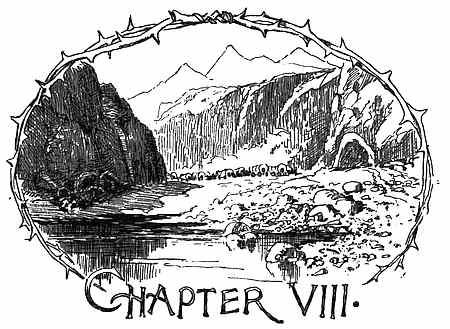
Two weeks after leaving the summer camp, we came out on the boundary of Utah, and the journey, as of old, though not without labors, advanced more briskly than at the beginning. We had yet to pass the western part of the Rocky Mountains; forming a whole network of branches called the Wasatch Range. Two considerable streams, Green and Grand Rivers, whose union forms the immense Colorado, and numerous tributaries of those two rivers, cut the mountains in every direction, opening in them passages which are easy enough. By these passages we reached after a certain time Utah Lake, where the salt lands begin. A wonderful country surrounded us, monotonous, gloomy; great level valleys encircled by cliffs with blunt outlines,—these, always alike, succeed one another, with oppressive monotony. There is in those deserts and cliffs a certain sternness, nakedness, and torpor, so that at sight of them the Biblical deserts recur to one’s mind. The lakes here are brackish, their shores fruitless and barren. There are no trees; the ground over an enormous expanse exudes salt and potash, or is covered by a gray vegetation with large felt-like leaves, which, when broken, give forth a salt, clammy sap. That journey is wearisome and oppressive, for whole weeks pass, and the desert stretches on without end, and opens into plains of eternal sameness, though they are rocky. Our strength began to give way again. On the prairies we were surrounded by the monotony of life, here by the monotony of death.
A certain oppression and indifference to everything took gradual possession of the people. We passed Utah,—always the same lifeless lands! We entered Nevada,—no change! The sun burnt so fiercely that our heads were bursting from pain; the light, reflecting from a surface covered with salt, dazzled the eye; in the air was floating a kind of dust, coming it was unknown whence, which inflamed our eyelids. The draught-beasts, time after time, seized the earth with their teeth, and dropped from sunstroke, as if felled by lightning. The majority of the people kept themselves up only with the thought that in a week or two weeks the Sierra Nevada would appear on the horizon, and behind that the desired California.
Meanwhile days passed and weeks in ever increasing labors. In the course of a certain week we were forced to leave three wagons behind, for there were no animals to draw them.
Oh, that was a land of misfortune and misery! In Nevada the desert became deeper, and our condition still worse, for disease fell upon us.
One morning people came to inform me that Smith was sick. I went to see what his trouble was, and saw with amazement that typhus had overthrown the old miner. So many climates are not changed with impunity; severe labor, in spite of short rests, makes itself felt, and the germs of disease are developed from hardship and toil. Lillian, whom Smith loved, as if she had been his own daughter, and whom he blessed on the day of our marriage, insisted on nursing him. I, weak man, trembled in my whole soul for her, but I could not forbid her to be a Christian. She sat over the sick man whole days and nights, together with Aunt Atkins and Aunt Grosvenor, who followed her example. On the second day, however, the old man lost consciousness, and on the eighth he died in Lillian’s arms. I buried him, shedding ardent tears over the remains of him who had been not only my assistant and right hand in everything, but a real father to Lillian and me. We hoped that after such a sacrifice God would take pity on us; but that was merely the beginning of our trials, for that very day another miner fell ill, and almost every day after that some one lay down in a wagon, and left it only when borne on our arms to a grave.
And thus we dragged along over the desert, and after us followed the pestilence, grasping new victims continually. In her turn Aunt Atkins fell ill, but, thanks to Lillian’s efforts, her sickness was conquered. The soul was dying in me every instant, and more than once, when Lillian was with the sick, and I somewhere on guard in front of the camp, alone in the darkness, I pressed my temples with my hands and knelt down in prayer to God. Obedient as a dog, I was whining for mercy on her without daring to say: “Let Thy will and not mine be done.” Sometimes in the night, when we were alone, I woke suddenly, for it seemed to me that the pestilence was pushing the canvas of my wagon aside and staring in, looking for Lillian. All the intervals when I was not with her, and they formed most of the time, were for me changed into one torture, under which I bent as a tree before a whirlwind. Lillian, however, had been equal to all toils and efforts so far. Though the strongest men fell, I saw her emaciated it is true, pale, and with marks of maternity increasingly definite on her forehead, but in health, and going from wagon to wagon. I dared not even ask if she were well; I only took her by the shoulders and pressed her long and long to my breast, and even had I wished to speak, something so oppressed me, that I could not have uttered a word.
Gradually, however, hope began to enter me, and in my head were sounding no longer those terrible words of the Bible: “Who worshipped and served the creature more than the Creator.”
We were nearing the western part of Nevada, where, beyond the belt of dead lakes, the salt lands and desert rocks find an end, and a belt of prairie begins, more level, greener, and very fertile. During two days’ journey no one fell ill; I thought that our misery was over. And it was high time!
Nine men had died, six were ailing yet; under the fear of infection discipline had begun to relax; nearly all the horses were dead, and the mules seemed rather skeletons than beasts. Of the fifty wagons with which we had moved out of the summer camp, only thirty-two were dragging now over the desert. Besides, since no one wished to go hunting lest he might fall somewhere away from the caravan and be left without aid, our supplies, not being replenished, were coming to an end. Wishing to spare them, we had lived for a week past on black ground squirrels; but their malodorous meat had so disgusted us that we put it to our mouths with loathing, and even that wretched food was not found in sufficiency. Beyond the lakes, however, game became more frequent, and grass was abundant. Again we met Indians, who, in opposition to their custom, attacked us in daylight and on the open plain; having firearms, they killed four of our people. In the conflict I received such a severe wound in the head from a hatchet that in the evening of that day I lost consciousness from loss of blood; but I was happy since Lillian was nursing me, and not patients from whom she might catch the typhus. Three days I lay in the wagon, pleasant days, since I was with her continually. I could kiss her hands when she was changing the bandages, and look at her. On the third day I was able to sit on horseback; but the soul was weak in me, and I feigned sickness before myself so as to be with her longer.
Only then did I discover how tired I had been, and what weariness had gone out of my bones while I was lying prostrate. Before my illness I had suffered not a little concerning my wife. I had grown as thin as a skeleton, and as formerly I had been looking with fear and alarm at her, so now she was looking with the same feelings at me. But when my head had ceased to fall from shoulder to shoulder there was no help for it; I had to mount the last living horse and lead the caravan forward, especially as certain alarming signs were surrounding us on all sides. There was a heat well-nigh preternatural, and in the air a dull haze as if of smoke from a distant burning; the horizon became dull and dark. It was impossible to see the sky, and the rays of the sun came to the earth red and sickly; the draught-beasts showed a wonderful disquiet, and, breathing hoarsely, bared their teeth. As to us, we inhaled fire with our breasts. The heat was caused, as I thought, by one of those stifling winds from the Gila desert, of which men had told me in the East; but there was stillness round about, and not a grass blade was stirring on the plain. In the evening the sun went down as red as blood, and stifling nights followed. The sick groaned for water, the dogs howled. Whole nights I wandered around a number of miles from the camp to make sure that the plains were not burning; but there was no fire in sight anywhere. I calmed myself finally with the thought that the smoke must be from a fire that had gone out already. In the daytime I noticed that hares, antelopes, buffaloes, even squirrels, were hastening eastward, as if fleeing from that California to which we were going with such effort. But since the air had become a little purer and the heat somewhat less, I settled finally in the thought that there had been a fire which had ceased, that the animals were merely looking for food in some new place. It was only needful for us to push up as soon as possible to the burnt strip, and learn whether the belt of fire could be crossed or whether we should go around it. According to my calculation it could not be more than three hundred miles to the Sierra Nevada, or about twenty days’ journey. I resolved, therefore, to reach it, even with our last effort.
We travelled at night now, for during the hours of midday heat weakened the animals greatly, and among the wagons there was always some shade in which they could rest.
One night, being unable to remain on horseback because of weariness and my wound, I sat in the wagon with Lillian. I heard all at once a sudden wheezing and biting of the wheels striking on some peculiar ground; at the same time shouts of “Stop! stop!” were heard along the whole length of the train. I sprang from the wagon at once. By the light of the moon I saw the drivers bent to the earth and looking at it carefully. At the same moment a voice called:
“Ho, captain, we are travelling on coals.”
I bent down, felt the earth,—we were travelling on a burnt prairie. I stopped the caravan at once, and we remained the rest of the night on that spot. With the first light of morning a wonderful sight struck our eyes: As far as we could see, there lay a plain black as coal,—not only were all the bushes and grass burnt, but the earth was so glossy that the feet of our mules and the wheels of the wagons were reflected in it as they might have been in a mirror. We could not see clearly the width of the fire, for the horizon was still hazy from smoke; but I gave command without hesitation to turn to the south, so as to reach the edge of that tract instead of venturing on the burnt country. I knew from experience what it is to travel on burnt prairie land where there is not a blade of grass for draught-beasts. Since evidently the fire had moved northward with the wind, I hoped by going toward the south to reach the beginning of it.
The people obeyed my order, it is true, but rather unwillingly, for it involved God knows how long a delay in the journey. During our halt at noon the smoke became thinner; but if it did, the heat grew so terrible that the air quivered from its fervency, and all at once something took place which might seem a miracle.
On a sudden the haze and smoke parted, as if at a signal, and before our eyes rose the Sierra Nevada, green, smiling, wonderful, covered with gleaming snow on the summits, and so near that with the naked eye we could see the dents in the mountains, the green lakes, and the forests. It seemed to us that a fresh breeze filled with odors from the pitchy fir was coming to us above the burnt fields, and that in a few hours we should reach the flowery foothills. At this sight the people, worn out with the terrible desert and with labors, went out of their minds almost with delight; some fell on the ground sobbing, others stretched forth their hands toward heaven or burst into laughter, others grew pale without power to speak. Lillian and I wept from delight too, which in me was mingled with astonishment, for I had thought that a hundred and fifty miles at least separated us yet from California; but there were the mountains smiling at us across the burnt plain, and they seemed to approach as if by magic, and bend toward us and invite us and lure us on.
The hours fixed for rest had not passed yet, but the people would not hear of a longer halt. Even the sick stretched out their yellow hands from beneath the canvas roofs and begged us to harness the mules and drive on. Briskly and willingly we moved forward, and to the biting of the wheels on the charred earth were joined the cracking of whips, shouts, and songs; of driving around the burnt tract there was not a word now. Why go around when a few tens of miles farther on was California and its marvellous snowy mountains? We went straight across toward them.
Meanwhile the smoke covered the bright view from us again with a wonderful suddenness. Hours passed; the horizon came nearer. At last the sun went down; night came. The stars twinkled dimly on the sky, but we went forward without rest; still the mountains were evidently farther than they seemed. About midnight the mules began to squeal and balk; an hour later the caravan stopped, for the greater number of the beasts had lain down. The men tried to raise them, but there was no chance of doing so. Not an eye closed all night. At the first rays of light our glances flew eagerly into the distance and—found nothing. A dark mourning desert extended as far as the eye could see, monotonous, dull, defining itself with a sharp line at the horizon; of yesterday’s mountains there was not a trace.
The people were amazed. To me the ominous word “mirage” explained everything, but also it went with a quiver to the marrow of my bones. What was to be done,—go on? But if that burnt plain extended for hundreds of miles? Return, and then seek some miles distant the end of the burnt tract?—but had the mules strength to go back over the same road? I hardly dared to look to the bottom of that abyss, on the brink of which we were all standing. I wished, however, to know what course to take. I mounted my horse, moved forward, and from a neighboring elevation I took in with my eye a wider horizon with the aid of a field-glass. I saw in the distance a green strip. When I reached it, however, after an hour’s journey, the place turned out to be merely a lake along the bank of which the fire had not destroyed vegetation completely. The burnt plain extended farther than vision through the glass. There was no help, it was necessary to turn back the caravan and go around the fire. For that purpose I turned my horse. I expected to find the wagons where I had left them, for I had given command to wait for me there. Meanwhile, disobeying my command, they had raised the mules, and the caravan went on. To my questions they answered moodily: “There are the mountains, we will go to them.”
I did not try even to struggle, for I saw that there was no human power present to stop those men. Perhaps I should have gone back alone with Lillian, but my wagon was not there, and Lillian had gone on with Aunt Atkins.
We advanced. Night came again, and with it a forced halt. Out of the burnt plain rose a great lurid moon and lighted the distance, which was equally black. In the morning only half of the wagons could be moved, for the mules of the others had died. The heat of that day was dreadful. The sun’s rays, absorbed by the charred land, filled the air with fire. On the road one of the sick men expired in dreadful convulsions, and no one undertook his burial; we laid him down on the plain and went farther.
The water in the lake at which I had been the day before refreshed men and animals for a time, but could not restore their strength. The mules had not nipped a grass blade for thirty-six hours, and had lived only on straw which we took out of the wagons; but even that failed them now. We marked the road as we went with their bodies, and on the third day there was left one only, which I took by force for Lillian. The wagons and the tools in them, which were to give us bread in California, remained in that desert,—be it cursed for all ages!
Every one now except Lillian went on foot. Soon a new enemy looked us in the eyes,—hunger. A part of our provisions had been left in the wagons, that which each one could carry was eaten. Meanwhile there was not a living thing in the country around us. I alone in the whole caravan had biscuits yet and a piece of salt meat; but I hid them for Lillian, and I was ready to rend any man to pieces who would mention that food. I ate nothing myself, and that terrible plain stretched on without end.
As if to add to our torments the mirage appeared in the midday hours on the plain again, showing us mountains and forests with lakes; but the nights were more terrible than ever. All the rays which that charred land stole from the sun in the daytime came out at night, scorching our feet and parching our throats. On such a night one man lost his mind, and sitting on the ground burst into spasmodical laughter, and that dreadful laughter followed us long in the darkness. The mule on which Lillian was riding fell; the famishing people tore it to bits in a twinkle, but what food was that for two hundred!
The fourth day passed and the fifth. From hunger, the faces of the people became like those of birds of some kind, and they began to look with hate at one another. They knew that I had provisions; but they knew, too, that to ask one crumb of me was death, hence the instinct of life overcame in them hunger. I gave food to Lillian only at night, so as not to enrage them with the sight of it. She implored me by all that was holy to take my share, but I threatened to put a bullet in my brain if she even mentioned it. She was able, however, to steal from my watchfulness crumbs which she gave to Aunt Atkins and Aunt Grosvenor. At that time hunger was tearing my entrails with iron hand, and my head was burning from the wound.
For five days there had been nothing in my mouth but water from that lake. The thought that I was carrying bread and meat, that I had them with me, that I could eat, became a torture; I was afraid besides, that being wounded, I might go mad and seize the food.
“O Lord!” cried I in spirit, “suffer me not to become so far brutalized as to touch that which is to keep her in life!” But there was no mercy above me. On the morning of the sixth day I saw on Lillian’s face fiery spots; her hands were inflamed, she panted loudly. All at once she looked at me wanderingly, and said in haste, hurrying lest she might lose presence of mind,—
“Ralph, leave me here; save yourself, there is no hope for me.”
I gritted my teeth, for I wanted to howl and blaspheme; but saying nothing I took her by the hands. Fiery zigzags began to leap before my eyes in the air, and to form the words: “Who worshipped and served the creature more than the Creator?” I had broken like a bow too much bent; so, staring at the merciless heavens, I exclaimed with my whole soul in rebellion,—
“I!”
Meanwhile I was bearing to the mount of execution my dearest burden, this my only one, my saint, my beloved martyr.
I know not where I found strength; I was insensible to hunger, to heat, to suffering. I saw nothing before me, neither people nor the burning plain; I saw nothing but Lillian. That night she grew worse. She lost consciousness; at times she groaned in a low voice,—
“Ralph, water!” And oh, torments! I had only salt meat and dry biscuits. In supreme despair I cut my arm with a knife to moisten her lips with my blood; she grew conscious, cried out, and fell into a protracted faint, from which I thought she would not recover. When she came to herself she wished to say something, but the fever had blunted her mind, and she only murmured,—
“Ralph, be not angry! I am your wife.”
I carried her farther in silence. I had grown stupid from pain.
The seventh day came. The Sierra Nevada appeared at last on the horizon, and as the sun was going down the life of my life began to quench also. When she was dying I placed her on the burnt ground and knelt beside her. Her widely opened eyes were gleaming and fixed on me; thought appeared in them for a moment, and she whispered,—
“My dear, my husband!” Then a quiver ran through her, fear was on her face,—and she died.
I tore the bandages from my head, and lost consciousness. I have no memory of what happened after that. As in a kind of dream I remember people who surrounded me and took my weapons; then they dug a grave, as it were; and, still later, darkness and raving seized me, and in them the fiery words: “Who worshipped and served the creature more than the Creator!”
I woke a month later in California at the house of Moshynski, a settler. When I had come to health somewhat I set out for Nevada; the prairie had grown over again with grass, and was abundantly green, so that I could not find even her grave, and to this day I know not where her sacred remains are lying. What have I done, O God, that Thou didst turn Thy face from me and forget me in the desert?—I know not. Were it permitted me to weep even one hour at her grave, life would be easier. Every year I go to Nevada, and every year I seek in vain. Since those dreadful hours long years have passed. My wretched lips have uttered more than once, Let Thy will be done! But without her it is hard for me in the world. A man lives and walks among people, and laughs even at times; but the lonely old heart weeps and loves, and yearns and remembers.
I am old, and it is not long till I shall make another journey, the journey to eternity; and for one thing alone I ask God,—that on those celestial plains I may find my heavenly one, and not part from her ever again.

IN the town of Antelope, situated on a river of the same name in the State of Texas, every living person was hurrying to the circus. The inhabitants were interested all the more since from the foundation of the town that was the first time that a circus had come to it with dancing women, minstrels, and rope-walkers. The town was recent. Fifteen years before not only was there not one house there, but in all the region round about there were no white people. Moreover, on the forks of the river, on the very spot on which Antelope was situated, stood an Indian village called Chiavatta. That had been the capital of the Black Snakes, who in their time were such an eyesore to the neighboring settlements of Berlin, Gründenau, and Harmonia, that these settlements could endure them no longer. True, the Indians were only defending their “land,” which the State government of Texas had guaranteed to them forever by the most solemn treaties; but what was that to the colonists of Berlin, Gründenau, and Harmonia? It is true that they took from the Black Snakes earth, air, and water, but they brought in civilization in return; the redskins on their part showed gratitude in their own way,—that is, by taking scalps from the heads of the Germans. Such a state of things could not be suffered. Therefore, the settlers from Berlin, Gründenau, and Harmonia assembled on a certain moonlight night to the number of four hundred, and, calling to their aid Mexicans from La Ora, fell upon sleeping Chiavatta.
The triumph of the good cause was perfect. Chiavatta was burned to ashes, and the inhabitants, without regard to sex or age, were cut to pieces. Only small parties of warriors escaped who at that time were absent on a hunt. In the town itself not one soul was left living, mainly because the place lay in the forks of a river, which, having overflowed, as is usual in spring-time, surrounded the settlement with an impassable gulf of waters. But the same forked position which ruined the Indians, seemed good to the Germans. From the forks it was difficult to escape, but the place was defensible. Thanks to this thought, emigration set in at once from Berlin, Gründenau, and Harmonia to the forks, in which in the twinkle of an eye, on the site of the wild Chiavatta, rose the civilized town of Antelope. In five years it numbered two thousand inhabitants.
In the sixth year they discovered on the opposite bank of the forks a quicksilver mine; the working of this doubled the number of inhabitants. In the seventh year, by virtue of Lynch law, they hanged on the square of the town the last twelve warriors of the Black Snakes, who were caught in the neighboring “Forest of the Dead,”—and henceforth nothing remained to hinder the development of Antelope. Two “Tagblätter” (daily papers) were published in the town, and one “Montagsrevue” (Monday Review). A line of railroad united the place with Rio del Norte and San Antonio; on Opuncia Gasse (Opuncia Street) stood three schools, one of which was a high school. On the square where they had hanged the last Black Snakes, the citizens had erected a philanthropic institution. Every Sunday the pastors taught in the churches love of one’s neighbor, respect for the property of others, and similar virtues essential to a civilized society; a certain travelling lecturer read a dissertation “On the rights of nations.”
The richest inhabitants had begun to talk of founding a university, to which the government of the State was to contribute. The citizens were prosperous. The trade in quicksilver, oranges, barley, and wine brought them famous profits. They were upright, thrifty, industrious, systematic, fat. Whoever might visit in later years Antelope with a population nearing twenty thousand would not recognize in the rich merchants of the place those pitiless warriors who fifteen years before had burned Chiavatta. The days passed for them in their stores, workshops, and offices; the evenings they spent in the beer-saloon “Golden Sun” on Rattlesnake Street. Listening to those sounds somewhat slow and guttural of “Mahlzeit, Mahlzeit!” (meal-time, meal-time), to those phlegmatic “Nun ja wissen Sie, Herr Müller, ist das aber möglich?” (Well, now, Herr Müller, but is that possible?), that clatter of goblets, that sound of beer dropping on the floor, that plash of overflowing foam; seeing that calm, that ness, those Philistine faces covered with fat, those fishy eyes,—a man might suppose himself in a beer-garden in Berlin or Monachium, and not on the ruins of Chiavatta. But in the town everything was “ganz gemüthlich” (altogether cosey), and no one had a thought of the ruins. That evening the whole population was hastening to the circus, first, because after hard labor recreation is as praiseworthy as it is agreeable; second, because the inhabitants were proud of its arrival. It is well-known that circuses do not come to every little place; hence the arrival of the Hon. M. Dean’s troupe had confirmed the greatness and magnificence of Antelope. There was, however, a third and perhaps the greatest cause of the general curiosity.
No. Two of the programme read as follows:
“A walk on a wire extended fifteen feet above the ground will be made to the accompaniment of music by the renowned gymnast Black Vulture, sachem of the Black Snakes, the last descendant of their chiefs, the last man of the tribe. 1. The walk; 2. Springs of the Antelope; 3. The death-dance and death-song.”
If that “sachem” could rouse the highest interest in any place, it was surely in Antelope. Hon. M. Dean told at the “Golden Sun” how fifteen years before, on a journey to Santa Fé, he had found, on the Planos de Tornado, a dying old Indian with a boy ten years of age. The old man died from wounds and exhaustion; but before death he declared that the boy was the son of the slain sachem of the Black Snakes, and the heir to that office.
The troupe sheltered the orphan, who in time became the first acrobat in it. It was only at the “Golden Sun,” however, that Hon. M. Dean learned first that Antelope was once Chiavatta, and that the famous rope-walker would exhibit himself on the grave of his fathers. This information brought the director into perfect humor; he might reckon now surely on a great attraction, if only he knew how to bring out the effect skilfully. Of course the Philistines of Antelope hurried to the circus to show their wives and children, imported from Germany, the last of the Black Snakes,—those wives and children who in their lives had never seen Indians,—and to say: “See, we cut to pieces men just like that fellow, fifteen years ago!” “Ach, Herr Je!” It was pleasant to hear such an exclamation of wonder from the mouth of Amalchen, or little Fritz. Throughout the town, therefore, all were repeating unceasingly, “Sachem! Sachem!”
From early morning the children were looking through cracks in the boards with curious and astonished faces; the older boys, more excited by the warrior spirit, marched home from school in terrible array, without knowing themselves why they did so.
It is eight o’clock in the evening,—a wonderful night, clear, starry. A breeze from the suburbs brings the odor of orange groves, which in the town is mingled with the odor of malt. In the circus there is a blaze of light. Immense pine-torches fixed before the principal gate are burning and smoking. The breeze waves the plumes of smoke and the bright flame which illuminates the dark outlines of the building. It is a freshly erected wooden pile, circular, with a pointed roof, and the starry flag of America on the summit of it. Before the gate are crowds who could not get tickets or had not the wherewithal to buy them; they look at the wagons of the troupe, and principally at the canvas curtain of the great Eastern door, on which is depicted a battle of the whites with the redskins. At moments when the curtain is drawn aside the bright refreshment-bar within is visible, with its hundreds of glasses on the table. Now they draw aside the curtain for good, and the throng enters. The empty passages between the seats begin to resound with the steps of people, and soon the dark moving mass fills all the place from the highest point to the floor. It is clear as day in the circus, for though they had not been able to bring in gas pipes, a gigantic chandelier formed of fifty kerosene lamps takes its place. In those gleams are visible the heads of the beer drinkers, fleshy, thrown back to give room to their chins, the youthful faces of women, and the pretty, wondering visages of children, whose eyes are almost coming out of their heads from curiosity. But all the spectators have the curious, self-satisfied look that is usual in an audience at a circus. Amid the hum of conversation interrupted by cries of “Frisch wasser! frisch wasser!” (fresh water), all await the beginning with impatience.
At last a bell sounds, six grooms appear in shining boots, and stand in two ranks at the passage from the stables to the arena. Between those ranks a furious horse rushes forth, without bridle or saddle; and on him, as it were a bundle of muslin ribbons and tulle, is the dancer Lina. They begin manœuvring to the sound of music. Lina is so pretty that young Matilda, daughter of the brewer on Opuncia Gasse, alarmed at sight of her beauty, inclines to the ear of Floss, a young grocer from the same street, and asks in a whisper if he loves her yet. Meanwhile the horse gallops, and puffs like an engine; the clowns, a number of whom run after the dancer, crack whips, shout, and strike one another on the faces. The dancer vanishes like lightning; there is a storm of applause. What a splendid representation! But No. One passes quickly. No. Two is approaching. The word “Sachem! sachem!” flies from mouth to mouth among the spectators. No one gives a thought now to the clowns, who strike one another continually. In the midst of the apish movements of the clowns, the grooms bring lofty wooden trestles several yards in height, and put them on both sides of the arena. The band ceases to play Yankee Doodle, and gives the gloomy aria of the Commandore in Don Juan. They extend the wire from one trestle to the other. All at once a shower of red Bengal light falls at the passage, and covers the whole arena with a bloody glare. In that glare appears the terrible sachem, the last of the Black Snakes. But what is that? The sachem is not there, but the manager of the troupe himself, Hon. M. Dean. He bows to the public and raises his voice. He has the honor to beg “the kind and respected gentlemen, as well as the beautiful and no less respected ladies, to be unusually calm, give no applause, and remain perfectly still, for the chief is excited and wilder than usual.” These words produce no little impression, and—a wonderful thing!—those very citizens of Antelope who fifteen years before had destroyed Chiavatta, feel now some sort of very unpleasant sensation. A moment before, when the beautiful Lina was performing her springs on horseback, they were glad to be sitting so near, right there close to the parapet, whence they could see everything so well; and now they look with a certain longing for the upper seats of the circus, and in spite of all laws of physics, find that the lower they are the more stifling it is.
But could that sachem remember? He was reared from years of childhood in the troupe of Hon. M. Dean, composed mainly of Germans. Had he not forgotten everything? This seemed probable. His environment and fifteen years of a circus career, the exhibition of his art, the winning of applause, must have exerted their influence.
Chiavatta, Chiavatta! But they are Germans, they are on their own soil, and think no more of the fatherland than business permits. Above all, man must eat and drink. This truth every Philistine must keep in mind, as well as the last of the Black Snakes.
These meditations are interrupted suddenly by a certain wild whistle in the stables, and on the arena appears the sachem expected so anxiously. A brief murmur of the crowd is heard: “That is he, that is he!”—and then silence. But there is hissing from Bengal lights, which burn continually at the passage. All eyes are turned toward the chief, who in the circus will appear on the graves of his fathers. The Indian deserves really that men should look at him. He seems as haughty as a king. A mantle of white ermine—the mark of his chieftainship—covers his figure, which is lofty, and so wild that it brings to mind a badly tamed jaguar. He has a face as it were forged out of bronze, like the head of an eagle, and in his face there is a cold gleam; his eyes are genuinely Indian, calm, indifferent as it were,—and ominous. He glances around on the assembly, as if wishing to choose a victim. Moreover, he is armed from head to foot. On his head plumes are waving, at his girdle he has an ax and a knife for scalping; but in his hand, instead of a bow, he holds a long staff to preserve his balance when walking on the wire. Standing in the middle of the arena he gives forth on a sudden a war cry. Herr Gott! That is the cry of the Black Snakes. Those who massacred Chiavatta remember clearly that terrible howl,—and what is most wonderful, those who fifteen years before had no fear of one thousand such warriors are sweating now before one. But behold! the director approaches the chief and says something to him, as if to pacify and calm him. The wild beast feels the bit; the words have their influence, for after a time the sachem is swaying on the wire. With eyes fixed on the kerosene chandelier he advances. The wire bends much; at moments it is not visible, and then the Indian seems suspended in space. He is walking as it were upward; he advances, retreats, and again he advances, maintaining his balance. His extended arms covered with the mantle seem like great wings. He totters! he is falling!—No. A short interrupted bravo begins like a storm and stops. The face of the chief becomes more and more threatening. In his gaze fixed on the kerosene lamps is gleaming some terrible light. There is alarm in the circus, but no one breaks the silence. Meanwhile the sachem approaches the end of the wire, stops; all at once a war-song bursts forth from his lips.
A strange thing! The chief sings in German. But that is easy to understand. Surely he has forgotten the tongue of the Black Snakes. Moreover, no one notices that. All listen to the song, which rises and grows in volume. It is a half chant, a kind of half call, immeasurably plaintive, wild, and hoarse, full of sounds of attack.
The following words were heard: “After the great yearly rains, five hundred warriors went from Chiavatta on the war-path or to the spring hunts; when they came back from war they brought scalps, when they came back from the hunt they brought flesh and the skins of buffaloes; their wives met them with gladness, and they danced in honor of the Great Spirit.
“Chiavatta was happy. The women worked in the wigwams, the children grew up to be beautiful maidens, to be brave, fearless warriors. The warriors died on the field of glory, and went to the silver mountains to hunt with the ghosts of their fathers. Their axes were never dipped in the blood of women and children, for the warriors of Chiavatta were high-minded. Chiavatta was powerful; but pale-faces came from beyond distant waters and set fire to Chiavatta. The white warriors did not destroy the Black Snakes in battle, but they stole in as do jackals at night, they buried their knives in the bosoms of sleeping men, women, and children.
“Now there is no Chiavatta. In place of it the white men have raised their stone wigwams. The murdered nation and ruined Chiavatta cry out for vengeance.”
The voice of the chief became hoarse. Standing on the wire, he seemed a red archangel of vengeance floating above the heads of that throng of people. Evidently the director himself was afraid. A silence as of death settled down in the circus. The chief howled on,—
“Of the whole nation there remained only one little child. He was weak and small, but he swore to the spirit of the earth that he would have vengeance,—that he would see the corpses of white men, women, and children, that he would see fire and blood.”
The last words were changed into a bellow of fury. In the circus murmurs were heard like the sudden puffs of a whirlwind. Thousands of questions without answer came to men’s minds. What will he do, that mad tiger? What is he announcing? How will he accomplish his vengeance,—he alone? Will he stay here or flee? Will he defend himself, and how? “Was ist das, was ist das?” is heard in the terrified accents of women.
All at once an unearthly howl was rent from the breast of the chief. The wire swayed violently, he sprang to the wooden trestle, standing at the chandelier, and raised his staff. A terrible thought flew like a flash through all heads. He will hurl around the lamps and fill the circus with torrents of flaming kerosene. From the breasts of the spectators one shout was just rising; but what do they see? From the arena the cry comes, “Stop! stop!” The chief is gone! Has he jumped down? He has gone through the entrance without firing the circus! Where is he? See, he is coming, coming a second time, panting, tired, terrible. In his hand is a pewter plate, and extending it to the spectators, he calls in a voice of entreaty: “Was gefällig für den letzten der Schwarzen Schlangen?” (What will you give to the last of the Black Snakes?)
A stone falls from the breasts of the spectators. You see that was all in the programme, it was a trick of the director for effect. The dollars and half dollars came down in a shower. How could they say “No” to the last of the Black Snakes, in Antelope reared on the ruins of Chiavatta? People have hearts.
After the exhibition, the sachem drank beer and ate dumplings at the “Golden Sun.” His environment had exerted its influence, evidently. He found great popularity in Antelope, especially with the women,—there was even scandal about him.

IN the little town of Lupiskory, after the funeral of widow Kaliksta, there were vespers, and after vespers old women, between ten and twenty in number, remained in the church to finish the hymn. It was four o’clock in the afternoon; but, since twilight comes in winter about that hour, it was dark in the church. The great altar, especially, was sunk in deep shade. Only two candles were burning at the ciborium; their flickering flames barely lighted a little the gilding of the doors, and the feet of Christ, hanging on a cross higher up. Those feet were pierced with an enormous nail, and the head of that nail seemed a great point gleaming on the altar.
From other candles, just quenched, streaks of smoke were waving, filling the places behind the stalls with a purely church odor of wax.
An old man and a small boy were busied before the steps of the altar. One was sweeping; the other was stretching the carpet on the steps. At moments, when the women ceased their singing, either the angry whisper of the old man was heard scolding the boy, or the hammering on the snow-covered windows of sparrows that were cold and hungry outside.
The women were sitting on benches nearer the door. It would have been still darker had it not been for a few tallow candles, by the light of which those who had prayer-books were reading. One of those candles lighted well enough a banner fastened to the seat just beyond; the banner represented sinners surrounded by devils and flames. It was impossible to see what was painted on the other banners.
The women were not singing; they were, rather, muttering with sleepy and tired voices a hymn in which these words were repeated continually,—
“And when the hour of death comes, Gain for us, gain from Thy Son.”
That church buried in shadow, the banners standing at the seats, the old women with their yellow faces, the lights flickering as if oppressed by the gloom,—all that was dismal beyond expression; nay, it was simply terrible. The mournful words of the song about death found there a fitting background.
After a time the singing stopped. One of the women stood up at the seat, and began to say, with a trembling voice, “Hail, Mary, full of grace!” And others responded, “The Lord is with Thee,” etc.; but since it was the day of Kaliksta’s funeral, each “Hail, Mary,” concluded with the words, “Lord, grant her eternal rest, and may endless light shine on her!”
Marysia, the dead woman’s daughter, was sitting on a bench at the side of one of the old women. Just then the snow, soft and noiseless, was falling on the fresh grave of her mother; but the little girl was not ten years old yet, and seemed not to understand either her loss, or the pity which it might rouse in another. Her face, with large blue eyes, had in it the calmness of childhood, and even a certain careless repose. A little curiosity was evident,—nothing beyond that. Opening her mouth, she looked with great attention at the banner on which was painted hell with sinners; then she looked into the depth of the church, and afterward on the window at which the sparrows were hammering.
Her eyes remained without thought. Meanwhile, the women began to mutter, sleepily, for the tenth time,—
“And when the hour of death comes.”
The little girl twisted the tresses of her light-colored hair, woven into two tiny braids not thicker than mice tails. She seemed tired; but now the old man occupied her attention. He went to the middle of the church, and began to pull a knotty rope hanging from the ceiling. He was ringing for the soul of Kaliksta, but he did this in a purely mechanical manner; he was thinking, evidently, of something else.
That ringing was also a sign that vespers were ended. The women, after repeating for the last time the prayer for a happy death, went out on the square. One of them led Marysia by the hand.
“But, Kulik,” asked another, “what will you do with the girl?”
“What will I do? She will go to Leschyntsi. Voytek Margula will take her. But why do you ask me?”
“What will she do in Leschyntsi?”
“My dears, the same as here. Let her go to where she came from. Even at the mansion they will take in the orphan, and let her sleep in the kitchen.”
Thus conversing, they passed through the square to the inn. Darkness was increasing every moment. It was wintry, calm; the sky was covered with clouds, the air filled with moisture and wet snow. Water was dropping from the roofs; on the square lay slush formed of snow and straw. The village, with wretched and tattered houses, looked as gloomy as the church. A few windows were gleaming with light; movement had ceased, but in the inn an organ was playing.
It was playing to entice, for there was no one inside. The women entered, drank vodka; Kulik gave Marysia half a glass, saying,—
“Drink! Thou art an orphan; thou wilt not meet kindness.”
The word “orphan” brought the death of Kaliksta to the minds of the women. One of them said,—
“To you, Kulik, drink! Oh, my dears, how that paralus [paralysis] took her so that she couldn’t stir! She was cold before the priest came to hear her confession.”
“I told her long ago,” said Kulik, “that she was spinning fine [near her end]. Last week she came to me. Said I, ‘Ah, better give Marysia to the mansion!’ But she said, ‘I have one little daughter, and I’ll not give her to any one.’ But she grew sorry, and began to sob, and then she went to the mayor to put her papers in order. She paid four zloty and six groshes. ‘But I do not begrudge it for my child,’ said she. My dears, but her eyes were staring, and after death they were staring still more. People wanted to close them, but could not. They say that after death, even, she was looking at her child.”
“Let us drink half a quarter over this sorrow!”
The organ was playing continually. The women began to be somewhat tender. Kulik repeated, with a voice of compassion, “Poor little thing! poor little thing!” and the second old woman called to mind the death of her late husband.
“When he was dying,” said she, “he sighed so, oh, he sighed so, he sighed so!—” and drawling still more, her voice passed into a chant, from a chant into the tone of the organ, till at last she bent to one side, and in following the organ began to sing,—
“He sighed, he sighed, he sighed, On that day he sighed.”
All at once she fell to shedding hot tears, gave the organist six groshes, and drank some more vodka. Kulik, too, was excited by tenderness, but she turned it on Marysia,—
“Remember, little orphan,” said she, “what the priest said when they were covering thy mother with snow, that there is a yamyol [an angel] above thee—” Here she stopped, looked around as if astonished, and then added, with unusual energy, “When I say that there is a yamyol, there is a yamyol!”
No one contradicted her. Marysia, blinking with her poor, simple eyes, looked attentively at the woman. Kulik spoke on,—
“Thou art a little orphan, that is bad for thee! Over orphans there is a yamyol. He is good. Here are ten groshes for thee. Even if thou wert to start on foot to Leschyntsi, thou couldst go there, for he would guide thee.”
The second old woman began to sing:
“In the shade of his wings he will keep thee eternally, Under his pinions thou wilt lie without danger.”
“Be quiet!” said Kulik. And then she turned again to the child,—
“Knowest thou, stupid, who is above thee?”
“A yamyol,” said, with a thin voice, the little girl.
“Oh, thou little orphan, thou precious berry, thou little worm of the Lord! A yamyol with wings,” said she, with perfect tenderness, and seizing the child she pressed her to her honest, though tipsy, bosom.
Marysia burst into weeping at once. Perhaps in her dark little head and in her heart, which knew not yet how to distinguish, there was roused some sort of perception at that moment.
The innkeeper was sleeping most soundly behind the counter; on the candle-wicks mushrooms had grown; the man at the organ ceased to play, for what he saw amused him.
Then there was silence, which was broken by the sudden plashing of horses’ feet before the door, and a voice calling to the horses,—
“Prrr!”
Voytek Margula walked into the inn with a lighted lantern in his hand. He put down the lantern, began to slap his arms to warm them, and at last said to the innkeeper,—
“Give half a quarter.”
“Margula, thou chestnut,” cried Kulik, “thou wilt take the little girl to Leschyntsi.”
“I’ll take her, for they told me to take her,” replied Margula.
Then looking closely to the two women he added,—
“But ye are as drunk as—”
“May the plague choke thee,” retorted Kulik. “When I tell thee to be careful with the child, be careful. She is an orphan. Knowest thou, fool, who is above her?”
Voytek did not see fit to answer that question, but determined evidently to raise another subject, and began,—
“To all of you—”
But he didn’t finish, for he drank the vodka, made a wry face, and putting down the glass with dissatisfaction, said,—
“That’s pure water. Give me a second from another bottle.”
The innkeeper poured from another. Margula twisted his face still more:
“Ai! haven’t you arrack?”
Evidently the same danger threatened Margula that threatened the women; but at that very time, in the mansion at Lupiskory, the landowner was preparing for one of the journals a long and exhaustive article, “On the right of landowners to sell liquor, this right being considered as the basis of society.” But Voytek co-operated only involuntarily to strengthen the basis of society, and that all the more because the sale here, though in a village, was really by the landowner.
When he had co-operated five times in succession he forgot, it is true, his lantern, in which the light had gone out, but he took the half-sleeping little girl by the hand, and said,—
“But come on, thou nightmare!”
The women had fallen asleep in a corner, no one bade farewell to Marysia. The whole story was this: Her mother was in the graveyard and she was going to Leschyntsi.
Voytek and the girl went out, sat in the sleigh. Voytek cried to the horses, and they moved on. At first the sleigh dragged heavily enough through the slush of the town, but they came out very soon to fields which were broad and white. Movement was easy then; the snow barely made a noise under the sleigh-runners. The horses snorted at times, at times came the barking of dogs from a distance.
They went on and on. Voytek urged the horses, and sang through his nose, “Dog ear, remember thy promise.” But soon he grew silent, and began to “carry Jews” (nod). He nodded to the right, to the left. He dreamt that they were pounding him on the shoulders in Leschyntsi, because he had lost a basket of letters; so, from time to time, he was half awake, and repeated: “To all!” Marysia did not sleep, for she was cold. She looked with widely opened eyes on the white fields, hidden from moment to moment by the dark shoulders of Margula. She thought also that her “mother was dead;” and thinking thus, she pictured to herself perfectly the pale and thin face of her mother with its staring eyes,—and she felt half consciously that that face was greatly beloved, that it was no longer in the world, and would never be in Leschyntsi again. She had seen with her own eyes how they covered it up in Lupiskory. Remembering this, she would have cried from grief; but as her knees and feet were chilled, she began to cry from cold.
There was no frost, it is true, but the air was penetrating, as is usual during thaws. As to Voytek he had, at least in his stomach, a good supply of heat taken from the inn. The landowner at Lupiskory remarked justly: “That vodka warms in winter, and since it is the only consolation of our peasants, to deprive landowners of the sole power of consoling peasants is to deprive them of influence over the populace.” Voytek was so consoled at that moment that nothing could trouble him.
Even this did not trouble him, that the horses when they came to the forest slackened their pace altogether, though the road there was better, and then walking to one side, the beasts turned over the sleigh into a ditch. He woke, it is true, but did not understand well what had happened.
Marysia begun to push him.
“Voytek!”
“Why art thou croaking?”
“The sleigh is turned over.”
“A glass?” asked Voytek, and went to sleep for good.
The little girl sat by the sleigh, crouching down as best she could, and remained there. But her face was soon chilled, so she began to push the sleeping man again.
“Voytek!”
He gave no answer.
“Voytek, I want to go to the house.”
And after a while again: “Voytek, I’ll walk there.”
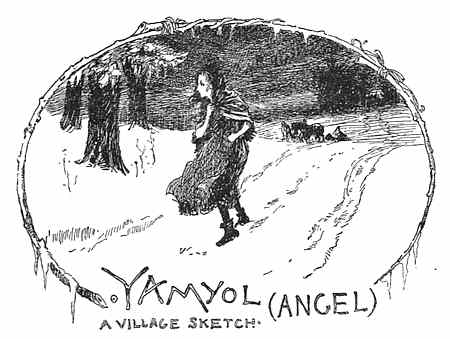
At last she started. It seemed to her that Leschyntsi was very near. She knew the road, too, for she had walked to church over it every Sunday with her mother. But now she had to go alone. In spite of the thaw the snow in the forest was deep, but the night was very clear. To the gleam from the snow was added light from the clouds, so that the road could be seen as in the daytime. Marysia, turning her eyes to the dark forest, could see tree-trunks very far away outlined distinctly, black, motionless, on the white ground; and she saw clearly also snow-drifts blown to the whole height of them. In the forest there was a certain immense calm, which gave solace to the child. On the branches was thick, frozen snow, and from it drops of water were trickling, striking with faint sound against the branches and twigs. But that was the only noise. All else around was still, white, silent, dumb.
The wind was not blowing. The snowy branches were not stirring with the slightest movement. Everything was sleeping in the trance of winter. It might seem that the snowy covering on the earth, and the whole silent and shrouded forest, with the pale clouds in the heavens, were all a kind of white, lifeless unity. So it is in time of thaw. Marysia was the only living thing, moving like a little black speck amid these silent greatnesses. Kind, honest forest! Those drops, which the thawing ice let down, were tears, perhaps, over the orphan. The trees are so large, but also so compassionate, above the little creature. See, she is alone, so weak and poor, in the snow, in the night, in the forest, wading along trustfully, as if there is no danger.
The clear night seems to care for her. When something so weak and helpless yields itself, trusts so perfectly in enormous power, there is a certain sweetness in the act. In that way all may be left to the will of God. The girl walked rather long, and was wearied at last. The heavy boots, which were too large, hindered her; her small feet were going up and down in them continually. It was hard to drag out such big boots from the snow. Besides, she could not move her hands freely, for in one of them, closed rigidly, she held with all her strength those ten groshes which Kulik had given her. She feared to drop them in the snow. She began at times to cry aloud, and then she stopped suddenly, as if wishing to know if some one had heard her. Yes, the forest had heard her! The thawing ice sounded monotonously and somewhat sadly. Besides, maybe some one else had heard her. The child went more and more slowly. Could she go astray? How? The road, like a white, broad, winding ribbon, stretches into the distance, lies well marked between two walls of dark trees. An unconquerable drowsiness seized the little girl.
She stepped aside and sat down under a tree. The lids dropped over her eyes. After a time, she thought that her mother was coming to her along the white road from the graveyard. No one was coming. Still, the child felt certain that some one must come. Who? A yamyol. Hadn’t old Kulik told her that a yamyol was above her? Marysia knew what a yamyol is. In her mother’s cottage there was one painted with a shield in his hand and with wings. He would come, surely. Somehow the ice began to sound more loudly. Maybe that is the noise of his wings, scattering drops more abundantly. Stop! Some one is coming really; the snow, though soft, sounds clearly; steps are coming, and coming quietly but quickly. The child raises her sleepy eyelids with confidence.
“What is that?”
Looking at the little girl intently is a gray three-cornered face with ears, standing upright,—ugly, terrible!

IT is Sunday! Great posters, affixed for a number of days to the corners of Puerta del Sol, Calle Alcala, and all streets on which there was considerable movement, announce to the city that to-day, “Si el tiempo lo permite” (if the weather permits), will take place bull-fight XVI., in which Cara-Ancha Lagartijo and the renowned Frascuello are to appear as “espadas” (swords).
Well, the weather permits. There was rain in the morning; but about ten o’clock the wind broke the clouds, gathered them into heaps, and drove them away off somewhere in the direction of the Escurial. Now the wind itself has ceased; the sky as far as the eye can reach is blue, and over the Puerta del Sol a bright sun is shining,—such a Madrid sun, which not only warms, not only burns, but almost bites.
Movement in the city is increasing, and on people’s faces satisfaction is evident.
Two o’clock.
The square of the Puerta del Sol is emptying gradually, but crowds of people are advancing through the Calle Alcala toward the Prado. In the middle is flowing a river of carriages and vehicles. All that line of equipages is moving very slowly, for on the sidewalks there is not room enough for pedestrians, many of whom are walking along the sides of the streets and close to the carriages. The police, on white horses and in showy uniforms and three-cornered hats, preserve order.
It is Sunday, that is evident, and an afternoon hour; the toilets are carefully made, the attire is holiday. It is evident also that the crowds are going to some curious spectacle. Unfortunately the throng is not at all many-colored; no national costumes are visible,—neither the short coats, yellow kerchiefs á la contrabandista, with one end dropping down to the shoulder, nor the round Biscay hats, nor girdles, nor the Catalan knives behind the girdles.
Those things may be seen yet in the neighborhood of Granada, Seville, and Cordova; but in Madrid, especially on holidays, the cosmopolitan frock is predominant. Only at times do you see a black mantilla pinned to a high comb, and under the mantilla eyes blacker still.
In general faces are dark, glances quick, speech loud. Gesticulation is not so passionate as in Italy, where when a man laughs he squirms like a snake, and when he is angry he gnaws off the top of his hat; still, it is energetic and lively. Faces have well-defined features and a resolute look. It is easy to understand that even in amusement these people retain their special and definite character.
However, they are a people who on weekdays are full of sedateness, bordering on sloth, sparing of words, and collected. Sunday enlivens them, as does also the hope of seeing a bloody spectacle.
Let us cut across the Prado and enter an alley leading to the circus.
The crowd is becoming still denser. Here and there shouts are rising, the people applauding single members of the company, who are going each by himself to the circus.
Here is an omnibus filled with “capeadors,” that is, partakers in the fight, whose whole defence is red capes with which they mislead and irritate the bull. Through the windows are visible black heads with pigtails, and wearing three-cornered hats. The coats of various colors worn by the capeadors are embroidered with gold and silver tinsel. These capeadors ride in an omnibus, for the modest pay which they get for their perilous service does not permit a more showy conveyance.
Somewhat farther, three mounted “picadors” push their way through the people. The sun plays on their broad-brimmed white hats. They are athletic in build, but bony and lean. Their shaven faces have a stern, and, as it were, concentrated look. They are sitting on very high wooden saddles, hence they are perfectly visible over the crowd. Each of them holds in his hand a lance, with a wooden ball at the end of it, from which is projecting an iron point not above half an inch long. The picador cannot kill a bull with a weapon like that,—he can only pierce him or stop him for a moment; but in the last case he must have in his arm the strength of a giant.
Looking at these men, I remember involuntarily Doré’s illustrations to “Don Quixote.” In fact, each of these horsemen might serve as a model for the knight “of the rueful visage.” That lean silhouette, outlined firmly on the sky, high above the heads of the multitude, the lance standing upright, and that bare-boned horse under the rider, those purely Gothic outlines of living things,—all answer perfectly to the conception which we form of the knight of La Mancha, when we read the immortal work of Cervantes.
But, the picadors pass us, and urging apart the crowd slowly, push forward considerably. Now only three lances are visible, three hats, and three coats embroidered on the shoulders. New men ride up, as incalculably similar to the first as if some mill were making picadors for all Spain on one pattern. There is a difference only in the color of the horses, which, however, are equally lean.
Our eyes turn now to the long row of carriages. Some are drawn by mules, but mules so large, sleek, and beautiful that, in spite of the long ears of the animals, the turn-out does not seem ridiculous. Here and there may be seen also Andalusian horses with powerful backs, arched necks, and curved faces. Such may be seen in the pictures of battle-painters of the seventeenth century.
In the carriages are sitting the flower of Madrid society. The dresses are black, there is very black lace on the parasols, on the fans, and on the heads of ladies; black hair trimmed in forelocks, from under which are glancing eyes, as it were, of the lava of Vesuvius. Mourning colors, importance, and powder are the main traits of that society.
The faces of old and of young ladies also are covered with powder, all of them are equally frigid and pale. A great pity! Were it not for such a vile custom, their complexion would have that magnificent warm tone given by southern blood and a southern sun, and which may be admired in faces painted by Fortuni.
In the front seats of the carriages are men dressed with an elegance somewhat exaggerated; they have a constrained and too holiday air,—in other words, they cannot wear fine garments with that free inattention which characterizes the higher society of France.
But the walls of the circus are outlined before us with growing distinctness. There is nothing especial in the building: an enormous pile reared expressly to give seats to some tens of thousands of people,—that is the whole plan of it.
Most curious is the movement near the walls. Round about, it is black from carriages, equipages, and heads of people. Towering above this dark mass, here and there, is a horseman, a policeman, or a picador in colors as brilliant as a poppy full blown.
The throng sways, opens, closes, raises its voice; coachmen shout; still louder shout boys selling handbills. These boys squeeze themselves in at all points among footmen and horsemen; they are on the steps of carriages and between the wheels; some climb up on the buttresses of the circus; some are on the stone columns which mark the way for the carriages. Their curly hair, their gleaming eyes, their expressive features, dark faces, and torn shirts open in the bosom, remind me of our gypsies, and of boys in Murillo’s pictures. Besides programmes some of them sell whistles. Farther on, among the crowds, are fruit-venders; water-sellers with bronze kegs on their shoulders; in one place are flower dealers; in another is heard the sound of a guitar played by an old blind woman led by a little girl.
Movement, uproar, laughter; fans are fluttering everywhere as if they were wings of thousands of birds; the sun pours down white light in torrents from a spotless sky of dense blue.
Suddenly and from all sides are heard cries of “mira, mira!” (look, look!) After a while these cries are turned into a roar of applause, which like real thunder flies from one extreme to another; now it is quiet, now it rises and extends around the whole circus.
What has happened? Surely the queen is approaching, and with her the court?
No! near by is heard “eviva Frascuello!” That is the most famous espada, who is coming for laurels and applause.
All eyes turn to him, and the whole throng of women push toward his carriage. The air is gleaming with flowers thrown by their hands to the feet of that favorite, that hero of every dream and imagining, that “pearl of Spain.” They greet him the more warmly because he has just returned from a trip to Barcelona, where during the exhibition he astonished all barbarous Europe with thrusts of his sword; now he appears again in his beloved Madrid, more glorious, greater,—a genuine new Cid el Campeador.
Let us push through the crowd to look at the hero. First, what a carriage, what horses! More beautiful there are not in the whole of Castile. On white satin cushions sits, or reclines, we should say, a man whose age it is difficult to determine, for his face is shaven most carefully. He is dressed in a coat of pale lily-colored satin, and knee-breeches of similar material trimmed with lace. His coat and the side seams of his breeches are glittering and sparkling from splendid embroidery, from spangles of gold and silver shining like diamonds in the sun. The most delicate laces ornament his breast. His legs, clothed in rose-colored silk stockings, he holds crossed carelessly on the front seat,—the very first athlete in the hippodrome at Paris might envy him those calves.
Madrid is vain of those calves,—and in truth she has reason.
The great man leans with one hand on the red hilt of his Catalan blade; with the other he greets his admirers of both sexes kindly. His black hair, combed to his poll, is tied behind in a small roll, from beneath which creeps forth a short tress. That style of hair-dressing and the shaven face make him somewhat like a woman, and he reminds one besides of some actor from one of the provinces; taken generally, his face is not distinguished by intelligence, a quality which in his career would not be a hindrance, though not needed in any way.
The crowds enter the circus, and we enter with them.
Now we are in the interior. It differs from other interiors of circuses only in size and in this,—that the seats are of stone. Highest in the circle are the boxes; of these one in velvet and in gold fringe is the royal box. If no one from the court is present at the spectacle this box is occupied by the prefect of the city. Around are seated the aristocracy and high officials; opposite the royal box, on the other side of the circus, is the orchestra. Half-way up in the circus is a row of arm-chairs; stone steps form the rest of the seats. Below, around the arena, stretches a wooden paling the height of a man’s shoulder. Between this paling and the first row of seats, which is raised considerably higher for the safety of the spectators, is a narrow corridor, in which the combatants take refuge, in case the bull threatens them too greatly.