Front matter (continued 2)
Reading edition
Total thickness 21,130
PLATE IV.
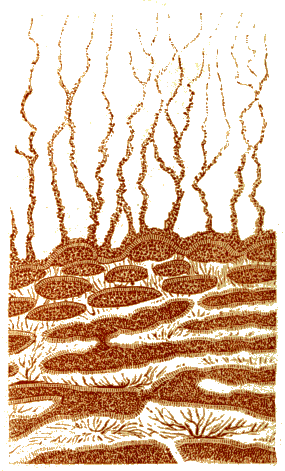
Magnified and Restored Section of a portion of Eozoon Canadense.
The portions in brown show the animal matter of the Chambers, Tubuli, Canals, and Pseudopodia; the portions uncoloured, the calcareous skeleton.
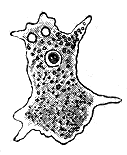
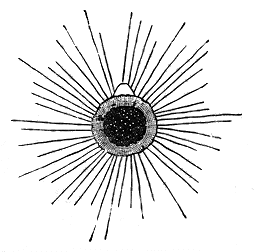
Fig. 12. Amœba. Fig. 13. Actinophrys.
From original sketches.
CHAPTER IV. WHAT IS EOZOON?
The shortest answer to this question is, that this ancient fossil is the skeleton of a creature belonging to that simple and humbly organized group of animals which are known by the name Protozoa. If we take as a familiar example of these the gelatinous and microscopic creature found in stagnant ponds, and known as the Amœba[P] (fig. 12), it will form a convenient starting point. Viewed under a low power, it appears as a little patch of jelly, irregular in form, and constantly changing its aspect as it moves, by the extension of parts of its body into finger-like processes or pseudopods which serve as extempore limbs. When moving on the surface of a slip of glass under the microscope, it seems, as it were, to flow along rather than creep, and its body appears to be of a semi-fluid consistency. It may be taken as an example of the least complex forms of animal life known to us, and is often spoken of by naturalists as if it were merely a little particle of living and scarcely organized jelly or protoplasm. When minutely examined, however, it will not be found so simple as it at first sight appears. Its outer layer is clear or transparent, and more dense than the inner mass, which seems granular. It has at one end a curious vesicle which can be seen gradually to expand and become filled with a clear drop of liquid, and then suddenly to contract and expel the contained fluid through a series of pores in the adjacent part of the outer wall. This is the so-called pulsating vesicle, and is an organ both of circulation and excretion. In another part of the body may be seen the nucleus, which is a little cell capable, at certain times, of producing by its division new individuals. Food when taken in through the wall of the body forms little pellets, which become surrounded by a digestive liquid exuded from the enclosing mass into rounded cavities or extemporised stomachs. Minute granules are seen to circulate in the gelatinous interior, and may be substitutes for blood-cells, and the outer layer of the body is capable of protrusion in any direction into long processes, which are very mobile, and used for locomotion and prehension. Further, this creature, though destitute of most of the parts which we are accustomed to regard as proper to animals, seems to exercise volition, and to show the same appetites and passions with animals of higher type. I have watched one of these animalcules endeavouring to swallow a one-celled plant as long as its own body; evidently hungry and eager to devour the tempting morsel, it stretched itself to its full extent, trying to envelope the object of its desire. It failed again and again; but renewed the attempt, until at length, convinced of its hopelessness, it flung itself away as if in disappointment, and made off in search of something more manageable. With the Amœba are found other types of equally simple Protozoa, but somewhat differently organized. One of these, Actinophrys (fig. 13), has the body globular and unchanging in form, the outer wall of greater thickness; the pulsating vesicle like a blister on the surface, and the pseudopods long and thread-like. Its habits are similar to those of the Amœba, and I introduce it to show the variations of form and structure possible even among these simple creatures.
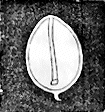
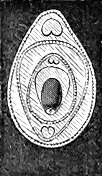
Fig. 14. Entosolenia. A one-celled Foraminifer. Magnified as a transparent object. Fig. 15. Biloculina. A many-chambered Foraminifer. Magnified as a transparent object.
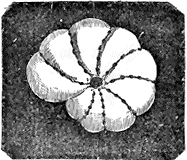
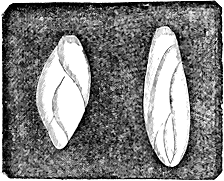
Fig. 16. Polystomella. A spiral Foraminifer. Magnified as an opaque object. Fig. 17. Polymorphina. A many-chambered Foraminifer. Magnified as an opaque object. Figs. 14 to 17 are from original sketches of Post-pliocene specimens.
The Amœba and Actinophrys are fresh water animals, and are destitute of any shell or covering. But in the sea there exist swarms of similar creatures, equally simple in organization, but gifted with the power of secreting around their soft bodies beautiful little shells or crusts of carbonate of lime, having one orifice, and often in addition multitudes of microscopic pores through which the soft gelatinous matter can ooze, and form outside finger-like or thread-like extensions for collecting food. In some cases the shell consists of a single cavity only, but in most, after one cell is completed, others are added, forming a series of cells or chambers communicating with each other, and often arranged spirally or otherwise in most beautiful and symmetrical forms. Some of these creatures, usually named Foraminifera, are locomotive, others sessile and attached. Most of them are microscopic, but some grow by multiplication of chambers till they are a quarter of an inch or more in breadth. (Figs. 14 to 17.)
The original skeleton or primary cell-wall of most of these creatures is seen under the microscope to be perforated with innumerable pores, and is extremely thin. When, however, owing to the increased size of the shell, or other wants of the creature, it is necessary to give strength, this is done by adding new portions of carbonate of lime to the outside, and to these Dr. Carpenter has given the appropriate name of “supplemental skeleton;” and this, when covered by new growths, becomes what he has termed an “intermediate skeleton.” The supplemental skeleton is also traversed by tubes, but these are often of larger size than the pores of the cell-wall, and of greater length, and branched in a complicated manner. (Fig. 20.) Thus there are microscopic characters by which these curious shells can be distinguished from those of other marine animals; and by applying these characters we learn that multitudes of creatures of this type have existed in former periods of the world’s history, and that their shells, accumulated in the bottom of the sea, constitute large portions of many limestones. The manner in which such accumulation takes place we learn from what is now going on in the ocean, more especially from the result of the recent deep-sea dredging expeditions. The Foraminifera are vastly numerous, both near the surface and at the bottom of the sea, and multiply rapidly; and as successive generations die, their shells accumulate on the ocean bed, or are swept by currents into banks, and thus in process of time constitute thick beds of white chalky material, which may eventually be hardened into limestone. This process is now depositing a great thickness of white ooze in the bottom of the ocean; and in times past it has produced such vast thicknesses of calcareous matter as the chalk and the nummulitic limestone of Europe and the orbitoidal limestone of America. The chalk, which alone attains a maximum thickness of 1000 feet, and, according to Lyell, can be traced across Europe for 1100 geographical miles, may be said to be entirely composed of shells of Foraminifera imbedded in a paste of still more minute calcareous bodies, the Coccoliths, which are probably products of marine vegetable life, if not of some animal organism still simpler than the Foraminifera.
Lastly, we find that in the earlier geological ages there existed much larger Foraminifera than any found in our present seas; and that these, always sessile on the bottom, grew by the addition of successive chambers, in the same manner with the smaller species. To some of these we shall return in the sequel. In the meantime we shall see what claims Eozoon has to be included among them.
Let us, then, examine the structure of Eozoon, taking a typical specimen, as we find it in the limestone of Grenville or Petite Nation. In such specimens the skeleton of the animal is represented by a white crystalline marble, the cavities of the cells by green serpentine, the mode of whose introduction we shall have to consider in the sequel. The lowest layer of serpentine represents the first gelatinous coat of animal matter which grew upon the bottom, and which, if we could have seen it before any shell was formed upon its surface, must have resembled, in appearance at least, the shapeless coat of living slime found in some portions of the bed of the deep sea, which has received from Huxley the name Bathybius, and which is believed to be a protozoon of indefinite extension, though it may possibly be merely the pulpy sarcode of sponges and similar things penetrating the ooze at their bases. On this primary layer grew a delicate calcareous shell, perforated by innumerable minute tubuli, and by some larger pores or septal orifices, while supported at intervals by perpendicular plates or pillars. Upon this again was built up, in order to strengthen it, a thickening or supplemental skeleton, more dense, and destitute of fine tubuli, but traversed by branching canals, through which the soft gelatinous matter could pass for the nourishment of the skeleton itself, and the extension of pseudopods beyond it. (Fig. 10.) So was formed the first layer of Eozoon, which seems in some cases to have spread by lateral extension over several inches of sea bottom. On this the process of growth of successive layers of animal sarcode and of calcareous skeleton was repeated again and again, till in some cases even a hundred or more layers were formed. (Photograph, Plate III., and nature print, Plate. V.) As the process went on, however, the vitality of the organism became exhausted, probably by the deficient nourishment of the central and lower layers making greater and greater demands on those above, and so the succeeding layers became thinner, and less supplemental skeleton was developed. Finally, toward the top, the regular arrangement in layers was abandoned, and the cells became a mass of rounded chambers, irregularly piled up in what Dr. Carpenter has termed an “acervuline” manner, and with very thin walls unprotected by supplemental skeleton. Then the growth was arrested, and possibly these upper layers gave off reproductive germs, fitted to float or swim away and to establish new colonies. We may have such reproductive germs in certain curious globular bodies, like loose cells, found in connection with irregular Eozoon in one of the Laurentian limestones at Long Lake and elsewhere. These curious organisms I observed some years ago, but no description of them was published at the time, as I hoped to obtain better examples. I now figure some of them, and give their description in a note. (Fig. 18). I have recently obtained numerous additional examples from the beds holding Eozoon at St. Pierre, on the Ottawa. They occur at this place on the surface of layers of the limestone in vast numbers, as if they had been growing separately on the bottom, or had been drifted over it by currents. These we shall further discuss hereafter. Such was the general mode of growth of Eozoon, and we may now consider more in detail some questions as to its gigantic size, its precise mode of nutrition, the arrangement of its parts, its relations to more modern forms, and the effects of its growth in the Laurentian seas. In the meantime a study of our illustration, Plate. IV., which is intended as a magnified restoration of the animal, will enable the reader distinctly to understand its structure and probable mode of growth, and to avail himself intelligently of the partial representations of its fossilized remains in the other plates and woodcuts.
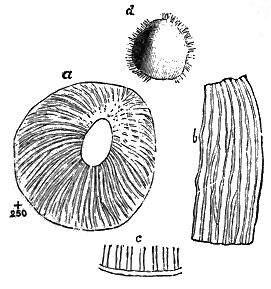
Fig. 18. Minute Foraminiferal forms from the Laurentian of Long Lake.
Highly magnified. (a.) Single cell, showing tubulated wall. (b, c.) Portions of same more highly magnified. (d.) Serpentine cast of a similar chamber, decalcified, and showing casts of tubuli.
With respect to its size, we shall find in a subsequent chapter that this was rivalled by some succeeding animals of the same humble type in the Silurian age; and that, as a whole, foraminiferal animals have been diminishing in size in the lapse of geological time. It is indeed a fact of so frequent occurrence that it may almost be regarded as a law of the introduction of new forms of life, that they assume in their early history gigantic dimensions, and are afterwards continued by less magnificent species. The relations of this to external conditions, in the case of higher animals, are often complex and difficult to understand; but in organisms so low as Eozoon and its allies, they lie more on the surface. Such creatures may be regarded as the simplest and most ready media for the conversion of vegetable matter into animal tissues, and their functions are almost entirely limited to those of nutrition. Hence it is likely that they will be able to appear in the most gigantic forms under such conditions as afford them the greatest amount of pabulum for the nourishment of their soft parts and for their skeletons. There is reason to believe, for example, that the occurrence, both in the chalk and the deep-sea mud, of immense quantities of the minute bodies known as Coccoliths along with Foraminifera, is not accidental. The Coccoliths appear to be grains of calcareous matter formed in minute plants adapted to a deep-sea habitat; and these, along with the vegetable and animal debris constantly being derived from the death of the living things at the surface, afford the material both of sarcode and shell. Now if the Laurentian graphite represents an exuberance of vegetable growth in those old seas proportionate to the great supplies of carbonic acid in the atmosphere and in the waters, and if the Eozoic ocean was even better supplied with carbonate of lime than those Silurian seas whose vast limestones bear testimony to their richness in such material, we can easily imagine that the conditions may have been more favourable to a creature like Eozoon than those of any other period of geological time.
Growing, as Eozoon did, on the floor of the ocean, and covering wide patches with more or less irregular masses, it must have thrown up from its whole surface its pseudopods to seize whatever floating particles of food the waters carried over it. There is also reason to believe, from the outline of certain specimens, that it often grew upward in cylindrical or club-shaped forms, and that the broader patches were penetrated by large pits or oscula, admitting the sea-water deeply into the substance of the masses. In this way its growth might be rapid and continuous; but it does not seem to have possessed the power of growing indefinitely by new and living layers covering those that had died, in the manner of some corals. Its life seems to have had a definite termination, and when that was reached an entirely new colony had to be commenced. In this it had more affinity with the Foraminifera, as we now know them, than with the corals, though practically it had the same power with the coral polyps of accumulating limestone in the sea bottom, a power indeed still possessed by its foraminiferal successors. In the case of coral limestones, we know that a large proportion of these consist not of continuous reefs but of fragments of coral mixed with other calcareous organisms, spread usually by waves and currents in continuous beds over the sea bottom. In like manner we find in the limestones containing Eozoon, layers of fragmental matter which shows in places the characteristic structures, and which evidently represents the debris swept from the Eozoic masses and reefs by the action of the waves. It is with this fragmental matter that the small rounded organisms already referred to most frequently occur; and while they may be distinct animals, they may also be the fry of Eozoon, or small portions of its acervuline upper surface floated off in a living state, and possibly capable of living independently and of founding new colonies.
It is only by a somewhat wild poetical licence that Eozoon has been represented as a “kind of enormous composite animal stretching from the shores of Labrador to Lake Superior, and thence northward and southward to an unknown distance, and forming masses 1500 feet in depth.” We may discuss by-and-by the question of the composite nature of masses of Eozoon, and we see in the corals evidence of the great size to which composite animals of a higher grade can attain. In the case of Eozoon we must imagine an ocean floor more uniform and level than that now existing. On this the organism would establish itself in spots and patches. These might finally become confluent over large areas, just as massive corals do. As individual masses attained maturity and died, their pores would be filled up with limestone or silicious deposits, and thus could form a solid basis for new generations, and in this way limestone to an indefinite extent might be produced. Further, wherever such masses were high enough to be attacked by the breakers, or where portions of the sea bottom were elevated, the more fragile parts of the surface would be broken up and scattered widely in beds of fragments over the bottom of the sea, while here and there beds of mud or sand or of volcanic debris would be deposited over the living or dead organic mass, and would form the layers of gneiss and other schistose rocks interstratified with the Laurentian limestone. In this way, in short, Eozoon would perform a function combining that which corals and Foraminifera perform in the modern seas; forming both reef limestones and extensive chalky beds, and probably living both in the shallow and the deeper parts of the ocean. If in connection with this we consider the rapidity with which the soft, simple, and almost structureless sarcode of these Protozoa can be built up, and the probability that they were more abundantly supplied with food, both for nourishing their soft parts and skeletons, than any similar creatures in later times, we can readily understand the great volume and extent of the Laurentian limestones which they aided in producing. I say aided in producing, because I would not desire to commit myself to the doctrine that the Laurentian limestones are wholly of this origin. There may have been other animal limestone-builders than Eozoon, and there may have been limestones formed by plants like the modern Nullipores or by merely mineral deposition.
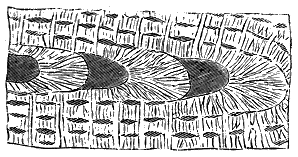
Fig. 19. Section of a Nummulite, from Eocene Limestone of Syria.
Showing chambers, tubuli, and canals. Compare this and fig. 20 with figs. 10 and 11.
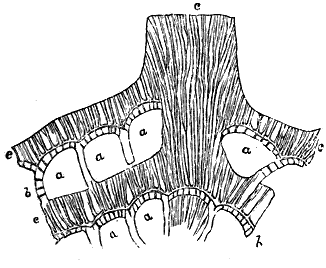
Fig. 20. Portion of shell of Calcarina.
Magnified, after Carpenter. (a.) Cells. (b.) Original cell-wall with tubuli. (c.) Supplementary skeleton with canals.
Its relations to modern animals of its type have been very clearly defined by Dr. Carpenter. In the structure of its proper wall and its fine parallel perforations, it resembles the Nummulites and their allies; and the organism may therefore be regarded as an aberrant member of the Nummuline group, which affords some of the largest and most widely distributed of the fossil Foraminifera. This resemblance may be seen in fig. 19. To the Nummulites it also conforms in its tendency to form a supplemental or intermediate skeleton with canals, though the canals themselves in their arrangement more nearly resemble Calcarina, which is represented in fig. 20. In its superposition of many layers, and in its tendency to a heaped up or acervuline irregular growth it resembles Polytrema and Tinoporus, forms of a different group in so far as shell-structure is concerned. It may thus be regarded as a composite type, combining peculiarities now observed in two groups, or it may be regarded as a representative in the Nummuline series of Polytrema and Tinoporus in the Rotaline series. At the time when Dr. Carpenter stated these affinities, it might be objected that Foraminifera of these families are in the main found in the Modern and Tertiary periods. Dr. Carpenter has since shown that the curious oval Foraminifer called Fusulina, found in the coal formation, is in like manner allied to both Nummulites and Rotalines; and still more recently Mr. Brady has discovered a true Nummulite in the Lower Carboniferous of Belgium. This group being now fairly brought down to the Palæozoic, we may hope finally to trace it back to the Primordial, and thus to bring it still nearer to Eozoon in time.
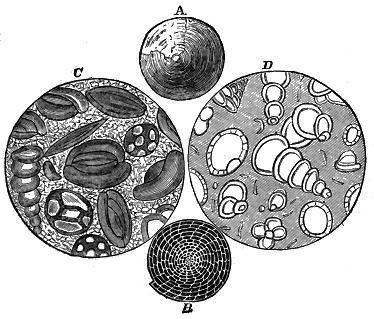
Fig. 21. Foraminiferal Rock Builders.
(a.) Nummulites lævigata—Eocene. (b.) The same, showing chambered interior. (c.) Milioline limestone, magnified—Eocene, Paris. (d.) Hard Chalk, section magnified—Cretaceous.
Though Eozoon was probably not the only animal of the Laurentian seas, yet it was in all likelihood the most conspicuous and important as a collector of calcareous matter, filling the same place afterwards occupied by the reef-building corals. Though probably less efficient than these as a constructor of solid limestones, from its less permanent and continuous growth, it formed wide floors and patches on the sea-bottom, and when these were broken up vast quantities of limestone were formed from their debris. It must also be borne in mind that Eozoon was not everywhere infiltrated with serpentine or other silicious minerals; quantities of its substance were merely filled with carbonate of lime, resembling the chamber-wall so closely that it is nearly impossible to make out the difference, and thus is likely to pass altogether unobserved by collectors, and to baffle even the microscopist. (Fig. 24.) Although therefore the layers which contain well characterized Eozoon are few and far between, there is reason to believe that in the composition of the limestones of the Laurentian it bore no small part, and as these limestones are some of them several hundreds of feet in thickness, and extend over vast areas, Eozoon may be supposed to have been as efficient a world-builder as the Stromatoporæ of the Silurian and Devonian, the Globigerinæ and their allies in the chalk, or the Nummulites and Miliolites in the Eocene. The two latter groups of rock-makers are represented in our cut, fig. 21; the first will engage our attention in chapter sixth. It is a remarkable illustration of the constancy of natural causes and of the persistence of animal types, that these humble Protozoans, which began to secrete calcareous matter in the Laurentian period, have been continuing their work in the ocean through all the geological ages, and are still busy in accumulating those chalky muds with which recent dredging operations in the deep sea have made us so familiar.
NOTES TO CHAPTER IV.
(A.) Original Description of Eozoon Canadense.
[As given by the author in the Journal of the Geological Society, February, 1865.]
"At the request of Sir W. E. Logan, I have submitted to microscopic examination slices of certain peculiar laminated forms, consisting of alternate layers of carbonate of lime and serpentine, and of carbonate of lime and white pyroxene, found in the Laurentian limestone of Canada, and regarded by Sir William as possibly fossils. I have also examined slices of a large number of limestones from the Laurentian series, not showing the forms of these supposed fossils.
"The specimens first mentioned are masses, often several inches in diameter, presenting to the naked eye alternate laminæ of serpentine, or of pyroxene, and carbonate of lime. Their general aspect, as remarked by Sir W. E. Logan (Geology of Canada, 1863, p. 49), reminds the observer of that of the Silurian corals of the genus Stromatopora, except that the laminæ diverge from and approach each other, and frequently anastomose or are connected by transverse septa.
"Under the microscope the resemblance to Stromatopora is seen to be in general form merely, and no trace appears of the radiating pillars characteristic of that genus. The laminæ of serpentine and pyroxene present no organic structure, and the latter mineral is highly crystalline. The laminæ of carbonate of lime, on the contrary, retain distinct traces of structures which cannot be of a crystalline or concretionary character. They constitute parallel or concentric partitions of variable thickness, enclosing flattened spaces or chambers, frequently crossed by transverse plates or septa, in some places so numerous as to give a vesicular appearance, in others occurring only at rare intervals. The laminæ themselves are excavated on their sides into rounded pits, and are in some places traversed by canals, or contain secondary rounded cells, apparently isolated. In addition to these general appearances, the substance of the laminæ, where most perfectly preserved, is seen to present a fine granular structure, and to be penetrated by numerous minute tubuli, which are arranged in bundles of great beauty and complexity, diverging in sheaf-like forms, and in their finer extensions anastomosing so as to form a network (figs. 10 and 28). In transverse sections, and under high powers, the tubuli are seen to be circular in outline, and sharply defined (fig. 29). In longitudinal sections, they sometimes present a beaded or jointed appearance. Even where the tubular structure is least perfectly preserved, traces of it can still be seen in most of the slices, though there are places in which the laminæ are perfectly compact, and perhaps were so originally.
"With respect to the nature and probable origin of the appearances above described, I would make the following remarks:—
"1. The serpentine and pyroxene which fill the cavities of the calcareous matter have no appearance of concretionary structure. On the contrary, their aspect is that of matter introduced by infiltration, or as sediment, and filling spaces previously existing. In other words, the calcareous matter has not been moulded on the forms of the serpentine and augite, but these have filled spaces or chambers in a hard calcareous mass. This conclusion is further confirmed by the fact, to be referred to in the sequel, that the serpentine includes multitudes of minute foreign bodies, while the calcareous matter is uniform and homogeneous. It is also to be observed that small veins of carbonate of lime occasionally traverse the specimen’s, and in their entire absence of structures other than crystalline, present a striking contrast to the supposed fossils.
"2. Though the calcareous laminæ have in places a crystalline cleavage, their forms and structures have no relation to this. Their cells and canals are rounded, and have smooth walls, which are occasionally lined with films apparently of carbonaceous matter. Above all, the minute tubuli are different from anything likely to occur in merely crystalline calc-spar. While in such rocks little importance might be attached to external forms simulating the appearances of corals, sponges, or other organisms, these delicate internal structures have a much higher claim to attention. Nor is there any improbability in the preservation of such minute parts in rocks so highly crystalline, since it is a circumstance of frequent occurrence in the microscopic examination of fossils that the finest structures are visible in specimens in which the general form and the arrangement of parts have been obliterated. It is also to be observed that the structure of the calcareous laminæ is the same, whether the intervening spaces are filled with serpentine or with pyroxene.
"3. The structures above described are not merely definite and uniform, but they are of a kind proper to animal organisms, and more especially to one particular type of animal life, as likely as any other to occur under such circumstances: I refer to that of the Rhizopods of the order Foraminifera. The most important point of difference is in the great size and compact habit of growth of the specimens in question; but there seems no good reason to maintain that Foraminifera must necessarily be of small size, more especially since forms of considerable magnitude referred to this type are known in the Lower Silurian. Professor Hall has described specimens of Receptaculites twelve inches in diameter; and the fossils from the Potsdam formation of Labrador, referred by Mr. Billings to the genus Archæocyathus, are examples of Protozoa with calcareous skeletons scarcely inferior in their massive style of growth to the forms now under consideration.
"These reasons are, I think, sufficient to justify me in regarding these remarkable structures as truly organic, and in searching for their nearest allies among the Foraminifera.
"Supposing then that the spaces between the calcareous laminæ, as well as the canals and tubuli traversing their substance, were once filled with the sarcode body of a Rhizopod, comparisons with modern forms at once suggest themselves.
"From the polished specimens in the Museum of the Canadian Geological Survey, it appears certain that these bodies were sessile by a broad base, and grew by the addition of successive layers of chambers separated by calcareous laminæ, but communicating with each other by canals or septal orifices sparsely and irregularly distributed. Small specimens have thus much the aspect of the modern genera Carpenteria and Polytrema. Like the first of these genera, there would also seem to have been a tendency to leave in the midst of the structure a large central canal, or deep funnel-shaped or cylindrical opening, for communication with the sea-water. Where the laminæ coalesce, and the structure becomes more vesicular, it assumes the ‘acervuline’ character seen in such modern forms as Nubecularia.
"Still the magnitude of these fossils is enormous when compared with the species of the genera above named; and from the specimens in the larger slabs from Grenville, in the museum of the Canadian Survey, it would seem that these organisms grew in groups, which ultimately coalesced, and formed large masses penetrated by deep irregular canals; and that they continued to grow at the surface, while the lower parts became dead and were filled up with infiltrated matter or sediment. In short, we have to imagine an organism having the habit of growth of Carpenteria, but attaining to an enormous size, and by the aggregation of individuals assuming the aspect of a coral reef.
"The complicated systems of tubuli in the Laurentian fossil indicate, however, a more complex structure than that of any of the forms mentioned above. I have carefully compared these with the similar structures in the ‘supplementary skeleton’ (or the shell-substance that carries the vascular system) of Calcarina and other forms, and can detect no difference except in the somewhat coarser texture of the tubuli in the Laurentian specimens. It accords well with the great dimensions of these, that they should thus thicken their walls with an extensive deposit of tubulated calcareous matter; and from the frequency of the bundles of tubuli, as well as from the thickness of the partitions, I have no doubt that all the successive walls, as they were formed, were thickened in this manner, just as in so many of the higher genera of more modern Foraminifera.
"It is proper to add that no spicules, or other structures indicating affinity to the Sponges, have been detected in any of the specimens.
“As it is convenient to have a name to designate these forms, I would propose that of Eozoon, which will be specially appropriate to what seems to be the characteristic fossil of a group of rocks which must now be named Eozoic rather than Azoic. For the species above described, the specific name of Canadense has been proposed. It may be distinguished by the following characters:—
“Eozoon Canadense; gen. et spec. nov.
“General form.—Massive, in large sessile patches or irregular cylinders, growing at the surface by the addition of successive laminæ.
“Internal structure.—Chambers large, flattened, irregular, with numerous rounded extensions, and separated by walls of variable thickness, which are penetrated by septal orifices irregularly disposed. Thicker parts of the walls with bundles of fine branching tubuli.
“These characters refer specially to the specimens from Grenville and the Calumet. There are others from Perth, C. W., which show more regular laminæ, and in which the tubuli have not yet been observed; and a specimen from Burgess, C. W., contains some fragments of laminæ which exhibit, on one side, a series of fine parallel tubuli like those of Nummulina. These specimens may indicate distinct species; but on the other hand, their peculiarities may depend on different states of preservation.
“With respect to this last point, it may be remarked that some of the specimens from Grenville and the Calumet show the structure of the laminæ with nearly equal distinctness, whether the chambers are filled with serpentine or pyroxene, and that even the minute tubuli are penetrated and filled with these minerals. On the other hand, there are large specimens in the collection of the Canadian Survey in which the lower and still parts of the organism are imperfectly preserved in pyroxene, while the upper parts are more perfectly mineralized with serpentine.”
[The following note was added in a reprint of the paper in the Canadian Naturalist, April, 1865.]
“Since the above was written, thick slices of Eozoon from Grenville have been prepared, and submitted to the action of hydrochloric acid until the carbonate of lime was removed. The serpentine then remains as a cast of the interior of the chambers, showing the form of their original sarcode-contents. The minute tubuli are found also to have been filled with a substance insoluble in the acid, so that casts of these also remain in great perfection, and allow their general distribution to be much better seen than in the transparent slices previously prepared. These interesting preparations establish the following additional structural points:—
“1. That the whole mass of sarcode throughout the organism was continuous; the apparently detached secondary chambers being, as I had previously suspected, connected with the larger chambers by canals filled with sarcode.
“2. That some of the irregular portions without lamination are not fragmentary, but due to the acervuline growth of the animal; and that this irregularity has been produced in part by the formation of projecting patches of supplementary skeleton, penetrated by beautiful systems of tubuli. These groups of tubuli are in some places very regular, and have in their axes cylinders of compact calcareous matter. Some parts of the specimens present arrangements of this kind as symmetrical as in any modern Foraminiferal shell.
“3. That all except the very thinnest portions of the walls of the chambers present traces, more or less distinct, of a tubular structure.
“4. These facts place in more strong contrast the structure of the regularly laminated species from Burgess, which do not show tubuli, and that of the Grenville specimens, less regularly laminated and tubulous throughout. I hesitated however to regard these two as distinct species, in consequence of the intermediate characters presented by specimens from the Calumet, which are regularly laminated like those of Burgess, and tubulous like those of Grenville. It is possible that in the Burgess specimens, tubuli, originally present, have been obliterated, and in organisms of this grade, more or less altered by the processes of fossilisation, large series of specimens should be compared before attempting to establish specific distinctions.”
(B.) Original Description of the Specimens added by Dr. Carpenter to the above—in a Letter to Sir W. E. Logan.
[Journal of Geological Society, February, 1865.]
"The careful examination which I have made, in accordance with the request you were good enough to convey to me from Dr. Dawson and to second on your own part, with the structure of the very extraordinary fossil which you have brought from the Laurentian rocks of Canada,[Q] enables me most unhesitatingly to confirm the sagacious determination of Dr. Dawson as to its Rhizopod characters and Foraminiferal affinities, and at the same time furnishes new evidence of no small value in support of that determination. In this examination I have had the advantage of a series of sections of the fossil much superior to those submitted to Dr. Dawson; and also of a large series of decalcified specimens, of which Dr. Dawson had only the opportunity of seeing a few examples after his memoir had been written. These last are peculiarly instructive; since in consequence of the complete infiltration of the chambers and canals, originally occupied by the sarcode-body of the animal, by mineral matter insoluble in dilute nitric acid, the removal of the calcareous shell brings into view, not only the internal casts of the chambers, but also casts of the interior of the ‘canal system’ of the ‘intermediate’ or ‘supplemental skeleton,’ and even casts of the interior of the very fine parallel tubuli which traverse the proper walls of the chambers. And, as I have remarked elsewhere,[R] ‘such casts place before us far more exact representations of the configuration of the animal body, and of the connections of its different parts, than we could obtain even from living specimens by dissolving away their shells with acid; its several portions being disposed to heap themselves together in a mass when they lose the support of the calcareous skeleton.’
"The additional opportunities I have thus enjoyed will be found, I believe, to account satisfactorily for the differences to be observed between Dr. Dawson’s account of the Eozoon and my own. Had I been obliged to form my conclusions respecting its structure only from the specimens submitted to Dr. Dawson, I should very probably have seen no reason for any but the most complete accordance with his description: while if Dr. Dawson had enjoyed the advantage of examining the entire series of preparations which have come under my own observation, I feel confident that he would have anticipated the corrections and additions which I now offer.
"Although the general plan of growth described by Dr. Dawson, and exhibited in his photographs of vertical sections of the fossil, is undoubtedly that which is typical of Eozoon, yet I find that the acervuline mode of growth, also mentioned by Dr. Dawson, very frequently takes its place in the more superficial parts, where the chambers, which are arranged in regular tiers in the laminated portions, are heaped one upon another without any regularity, as is particularly well shown in some decalcified specimens which I have myself prepared from the slices last put into my hands. I see no indication that this departure from the normal type of structure has resulted from an injury; the transition from the regular to the irregular mode of increase not being abrupt but gradual. Nor shall I be disposed to regard it as a monstrosity; since there are many other Foraminifera in which an originally definite plan of growth gives place, in a later stage, to a like acervuline piling-up of chambers.
"In regard to the form and relations of the chambers, I have little to add to Dr. Dawson’s description. The evidence afforded by their internal casts concurs with that of sections, in showing that the segments of the sarcode-body, by whose aggregation each layer was constituted, were but very incompletely divided by shelly partitions; this incomplete separation (as Dr. Dawson has pointed out) having its parallel in that of the secondary chambers in Carpenteria. But I have occasionally met with instances in which the separation of the chambers has been as complete as it is in Foraminifera generally; and the communication between them is then established by several narrow passages exactly corresponding with those which I have described and figured in Cycloclypeus.[S]
"The mode in which each successive layer originates from the one which had preceded it, is a question to which my attention has been a good deal directed; but I do not as yet feel confident that I have been able to elucidate it completely. There is certainly no regular system of apertures for the passage of stolons giving origin to new segments, such as are found in all ordinary Polythalamous Foraminifera, whether their type of growth be rectilinear, spiral, or cyclical; and I am disposed to believe that where one layer is separated from another by nothing else than the proper walls of the chambers,—which, as I shall presently show, are traversed by multitudes of minute tubuli giving passage to pseudopodia,—the coalescence of these pseudopodia on the external surface would suffice to lay the foundation of a new layer of sarcodic segments. But where an intermediate or supplemental skeleton, consisting of a thick layer of solid calcareous shell, has been deposited between two successive layers, it is obvious that the animal body contained in the lower layer of chambers must be completely cut off from that which occupies the upper, unless some special provision exist for their mutual communication. Such a provision I believe to have been made by the extension of bands of sarcode, through canals left in the intermediate skeleton, from the lower to the upper tier of chambers. For in such sections as happen to have traversed thick deposits of the intermediate skeleton, there are generally found passages distinguished from those of the ordinary canal-system by their broad flat form, their great transverse diameter, and their non-ramification. One of these passages I have distinctly traced to a chamber, with the cavity of which it communicated through two or three apertures in its proper wall; and I think it likely that I should have been able to trace it at its other extremity into a chamber of the superjacent tier, had not the plane of the section passed out of its course. Riband-like casts of these passages are often to be seen in decalcified specimens, traversing the void spaces left by the removal of the thickest layers of the intermediate skeleton.
"But the organization of a new layer seems to have not unfrequently taken place in a much more considerable extension of the sarcode-body of the pre-formed layer; which either folded back its margin over the surface already consolidated, in a manner somewhat like that in which the mantle of a Cyprœa doubles back to deposit the final surface-layer of its shell, or sent upwards wall-like lamellæ, sometimes of very limited extent, but not unfrequently of considerable length, which, after traversing the substance of the shell, like trap-dykes in a bed of sandstone, spread themselves out over its surface. Such, at least, are the only interpretations I can put upon the appearances presented by decalcified specimens. For on the one hand, it is frequently to be observed that two bands of serpentine (or other infiltrated mineral), which represent two layers of the original sarcode-body of the animal, approximate to each other in some part of their course, and come into complete continuity; so that the upper layer would seem at that part to have had its origin in the lower. Again, even where these bands are most widely separated, we find that they are commonly held together by vertical lamellæ of the same material, sometimes forming mere tongues, but often running to a considerable length. That these lamellæ have not been formed by mineral infiltration into accidental fissures in the shell, but represent corresponding extensions of the sarcode-body, seems to me to be indicated not merely by the characters of their surface, but also by the fact that portions of the canal-system may be occasionally traced into connection with them.
"Although Dr. Dawson has noticed that some parts of the sections which he examined present the fine tubulation characteristic of the shells of the Nummuline Foraminifera, he does not seem to have recognised the fact, which the sections placed in my hands have enabled me most satisfactorily to determine,—that the proper walls of the chambers everywhere present the fine tubulation of the Nummuline shell; a point of the highest importance in the determination of the affinities of Eozoon. This tubulation, although not seen with the clearness with which it is to be discerned in recent examples of the Nummuline type, is here far better displayed than it is in the majority of fossil Nummulites, in which the tubuli have been filled up by the infiltration of calcareous matter, rendering the shell-substance nearly homogeneous. In Eozoon these tubuli have been filled up by the infiltration of a mineral different from that of which the shell is composed, and therefore not coalescing with it; and the tubular structure is consequently much more satisfactorily distinguishable. In decalcified specimens, the free margins of the casts of the chambers are often seen to be bordered with a delicate white glistening fringe; and when this fringe is examined with a sufficient magnifying power, it is seen to be made up of a multitude of extremely delicate aciculi, standing side by side like the fibres of asbestos. These, it is obvious, are the internal casts of the fine tubuli which perforated the proper wall of the chambers, passing directly from its inner to its outer surface; and their presence in this situation affords the most satisfactory confirmation of the evidence of that tubulation afforded by thin sections of the shell-wall.
"The successive layers, each having its own proper wall, are often superposed one upon another without the intervention of any supplemental or intermediate skeleton such as presents itself in all the more massive forms of the Nummuline series; but a deposit of this form of shell-substance, readily distinguishable by its homogeneousness from the finely tubular shell immediately investing the segments of the sarcode-body, is the source of the great thickening which the calcareous zones often present in vertical sections of Eozoon. The presence of this intermediate skeleton has been correctly indicated by Dr. Dawson; but he does not seem to have clearly differentiated it from the proper wall of the chambers. All the tubuli which he has described belong to that canal system which, as I have shown,[T] is limited in its distribution to the intermediate skeleton, and is expressly designed to supply a channel for its nutrition and augmentation. Of this canal system, which presents most remarkable varieties in dimensions and distribution, we learn more from the casts presented by decalcified specimens, than from sections, which only exhibit such parts of it as their plane may happen to traverse. Illustrations from both sources, giving a more complete representation of it than Dr. Dawson’s figures afford, have been prepared from the additional specimens placed in my hands.
"It does not appear to me that the canal system takes its origin directly from the cavity of the chambers. On the contrary, I believe that, as in Calcarina (which Dr. Dawson has correctly referred to as presenting the nearest parallel to it among recent Foraminifera), they originate in lacunar spaces on the outside of the proper walls of the chambers, into which the tubuli of those walls open externally; and that the extensions of the sarcode-body which occupied them were formed by the coalescence of the pseudopodia issuing from those tubuli.[U]
"It seems to me worthy of special notice, that the canal system, wherever displayed in transparent sections, is distinguished by a yellowish brown coloration, so exactly resembling that which I have observed in the canal system of recent Foraminifera (as Polystomella and Calcarina) in which there were remains of the sarcode-body, that I cannot but believe the infiltrating mineral to have been dyed by the remains of sarcode still existing in the canals of Eozoon at the time of its consolidation. If this be the case, the preservation of this colour seems to indicate that no considerable metamorphic action has been exerted upon the rock in which this fossil occurs. And I should draw the same inference from the fact that the organic structure of the shell is in many instances even more completely preserved than it usually is in the Nummulites and other Foraminifera of the Nummulitic limestone of the early Tertiaries.
"To sum up,—That the Eozoon finds its proper place in the Foraminiferal series, I conceive to be conclusively proved by its accordance with the great types of that series, in all the essential characters of organization;—namely, the structure of the shell forming the proper wall of the chambers, in which it agrees precisely with Nummulina and its allies; the presence of an intermediate skeleton and an elaborate canal system, the disposition of which reminds us most of Calcarina; a mode of communication of the chambers when they are most completely separated, which has its exact parallel in Cycloclypeus; and an ordinary want of completeness of separation between the chambers, corresponding with that which is characteristic of Carpenteria.
"There is no other group of the animal kingdom to which Eozoon presents the slightest structural resemblance; and to the suggestion that it may have been of kin to Nullipore, I can offer the most distinct negative reply, having many years ago carefully studied the structure of that stony Alga, with which that of Eozoon has nothing whatever in common.
"The objections which not unnaturally occur to those familiar with only the ordinary forms of Foraminifera, as to the admission of Eozoon into the series, do not appear to me of any force. These have reference in the first place to the great size of the organism; and in the second, to its exceptional mode of growth.
"1. It must be borne in mind that all the Foraminifera normally increase by the continuous gemmation of new segments from those previously formed; and that we have, in the existing types, the greatest diversities in the extent to which this gemmation may proceed. Thus in the Globigerinæ, whose shells cover to an unknown thickness the sea bottom of all that portion of the Atlantic Ocean which is traversed by the Gulf Stream, only eight or ten segments are ordinarily produced by continuous gemmation; and if new segments are developed from the last of these, they detach themselves so as to lay the foundation of independent Globigerinæ. On the other hand in Cycloclypeus, which is a discoidal structure attaining two and a quarter inches in diameter, the number of segments formed by continuous gemmation must be many thousand. Again, the Receptaculites of the Canadian Silurian rocks, shown by Mr. Salter’s drawings[V] to be a gigantic Orbitolite, attains a diameter of twelve inches; and if this were to increase by vertical as well as by horizontal gemmation (after the manner of Tinoporus or Orbitoides) so that one discoidal layer would be piled on another, it would form a mass equalling Eozoon in its ordinary dimensions. To say, therefore, that Eozoon cannot belong to the Foraminifera on account of its gigantic size, is much as if a botanist who had only studied plants and shrubs were to refuse to admit a tree into the same category. The very same continuous gemmation which has produced an Eozoon would produce an equal mass of independent Globigerinæ, if after eight or ten repetitions of the process, the new segments were to detach themselves.
"It is to be remembered, moreover, that the largest masses of sponges are formed by continuous gemmation from an original Rhizopod segment; and that there is no á priori reason why a Foraminiferal organism should not attain the same dimensions as a Poriferal one,—the intimate relationship of the two groups, notwithstanding the difference between their skeletons, being unquestionable.
"2. The difficulty arising from the zoophytic plan of growth of Eozoon is at once disposed of by the fact that we have in the recent Polytrema (as I have shown, op. cit., p. 235) an organism nearly allied in all essential points of structure to Rotalia, yet no less aberrant in its plan of growth, having been ranked by Lamarck among the Millepores. And it appears to me that Eozoon takes its place quite as naturally in the Nummuline series as Polytrema in the Rotaline. As we are led from the typical Rotalia, through the less regular Planorbulina, to Tinoporus, in which the chambers are piled up vertically, as well as multiplied horizontally, and thence pass by an easy gradation to Polytrema, in which all regularity of external form is lost; so may we pass from the typical Operculina or Nummulina, through Heterostegina and Cycloclypeus to Orbitoides, in which, as in Tinoporus, the chambers multiply both by horizontal and by vertical gemmation; and from Orbitoides to Eozoon the transition is scarcely more abrupt than from Tinoporus to Polytrema.
"The general acceptance, by the most competent judges, of my views respecting the primary value of the characters furnished by the intimate structure of the shell, and the very subordinate value of plan of growth, in the determination of the affinities of Foraminifera, renders it unnecessary that I should dwell further on my reasons for unhesitatingly affirming the Nummuline affinities of Eozoon from the microscopic appearances presented by the proper wall of its chambers, notwithstanding its very aberrant peculiarities; and I cannot but feel it to be a feature of peculiar interest in geological inquiry, that the true relations of by far the earliest fossil yet known should be determinable by the comparison of a portion which the smallest pin’s head would cover, with organisms at present existing."
(C.) Note on Specimens From Long Lake and Wentworth.
[Journal of Geological Society, August, 1867.]
"Specimens from Long Lake, in the collection of the Geological Survey of Canada, exhibit white crystalline limestone with light green compact or septariiform[W] serpentine, and much resemble some of the serpentine limestones of Grenville. Under the microscope the calcareous matter presents a delicate areolated appearance, without lamination; but it is not an example of acervuline Eozoon, but rather of fragments of such a structure, confusedly aggregated together, and having the interstices and cell-cavities filled with serpentine. I have not found in any of these fragments a canal system similar to that of Eozoon Canadense, though there are casts of large stolons, and, under a high power, the calcareous matter shows in many places the peculiar granular or cellular appearance which is one of the characters of the supplemental skeleton of that species. In a few places a tubulated cell-wall is preserved, with structure similar to that of Eozoon Canadense.
“Specimens of Laurentian limestone from Wentworth, in the collection of the Geological Survey, exhibit many rounded silicious bodies, some of which are apparently grains of sand, or small pebbles; but others, especially when freed from the calcareous matter by a dilute acid, appear as rounded bodies, with rough surfaces, either separate or aggregated in lines or groups, and having minute vermicular processes projecting from their surfaces. At first sight these suggest the idea of spicules; but I think it on the whole more likely that they are casts of cavities and tubes belonging to some calcareous Foraminiferal organism which has disappeared. Similar bodies, found in the limestone of Bavaria, have been described by Gümbel, who interprets them in the same way. They may also be compared with the silicious bodies mentioned in a former paper as occurring in the loganite filling the chambers of specimens of Eozoon from Burgess.”
These specimens will be more fully referred to under Chapter VI.
(D.) Additional Structural Facts.
I may mention here a peculiar and interesting structure which has been detected in one of my specimens while these sheets were passing through the press. It is an abnormal thickening of the calcareous wall, extending across several layers, and perforated with large parallel cylindrical canals, filled with dolomite, and running in the direction of the laminæ; the intervening calcite being traversed by a very fine and delicate canal system. It makes a nearer approach to some of the Stromatoporæ mentioned in Chapter VI. than any other Laurentian structure hitherto observed, and may be either an abnormal growth of Eozoon, consequent on some injury, or a parasitic mass of some Stromatoporoid organism overgrown by the laminæ of the fossil. The structure of the dolomite in this specimen indicates that it first lined the canals, and afterward filled them; an appearance which I have also observed recently in the larger canals filled with serpentine (Plate VIII., fig. 5). The cut below is an attempt, only partially successful, to show the Amœba-like appearance, when magnified, of the casts of the chambers of Eozoon, as seen on the decalcified surface of a specimen broken parallel to the laminæ.
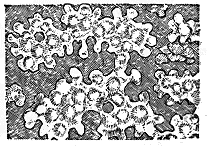
Fig. 21a.
Plate V.
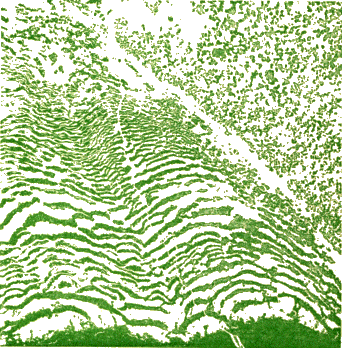
Nature-print of Eozoon, showing laminated, acervuline, and fragmental portions.
This is printed from an electrotype taken from an etched slab of Eozoon, and not touched with a graver except to remedy some accidental flaws in the plate. The diagonal white line marks the course of a calcite vein.
CHAPTER V. THE PRESERVATION OF EOZOON.
Perhaps nothing excites more scepticism as to this ancient fossil than the prejudice existing among geologists that no organism can be preserved in rocks so highly metamorphic as those of the Laurentian series. I call this a prejudice, because any one who makes the microscopic structure of rocks and fossils a special study, soon learns that fossils undergo the most remarkable and complete chemical changes without losing their minute structure, and that calcareous rocks if once fossiliferous are hardly ever so much altered as to lose all trace of the organisms which they contained, while it is a most common occurrence to find highly crystalline rocks of this kind abounding in fossils preserved as to their minute structure.
Let us, however, look at the precise conditions under which this takes place.
When calcareous fossils of irregular surface and porous or cellular texture, such as Eozoon was or corals were and are, become imbedded in clay, marl, or other soft sediment, they can be washed out and recovered in a condition similar to that of recent specimens, except that their pores or cells if open may be filled with the material of the matrix, or if not so open that they can be thus filled, they may be more or less incrusted with mineral deposits introduced by water, or may even be completely filled up in this way. But if such fossils are contained in hard rocks, they usually fail, when these are broken, to show their external surfaces, and, breaking across with the containing rock, they exhibit their internal structure merely,—and this more or less distinctly, according to the manner in which their cells or cavities have been filled. Here the microscope becomes of essential service, especially when the structures are minute. A fragment of fossil wood which to the naked eye is nothing but a dark stone, or a coral which is merely a piece of gray or coloured marble, or a specimen of common crystalline limestone made up originally of coral fragments, presents, when sliced and magnified, the most perfect and beautiful structure. In such cases it will be found that ordinarily the original substance of the fossil remains, in a more or less altered state. Wood may be represented by dark lines of coaly matter, or coral by its white or transparent calcareous laminæ; while the material which has been introduced and which fills the cavities may so differ in colour, transparency, or crystalline structure, as to act differently on light, and so reveal the structure. These fillings are very curious. Sometimes they are mere earthy or muddy matter. Sometimes they are pure and transparent and crystalline. Often they are stained with oxide of iron or coaly matter. They may consist of carbonate of lime, silica or silicates, sulphate of baryta, oxides of iron, carbonate of iron, iron pyrite, or sulphides of copper or lead, all of which are common materials. They are sometimes so complicated that I have seen even the minute cells of woody structures, each with several bands of differently coloured materials deposited in succession, like the coats of an onyx agate.
A further stage of mineralization occurs when the substance of the organism is altogether removed and replaced by foreign matter, either little by little, or by being entirely dissolved or decomposed, leaving a cavity to be filled by infiltration. In this state are some silicified woods, and those corals which have been not filled with but converted into silica, and can thus sometimes be obtained entire and perfect by the solution in an acid of the containing limestone, or by its removal in weathering. In this state are the beautiful silicified corals obtained from the corniferous limestone of Lake Erie. It may be well to present to the eye these different stages of fossilization. I have attempted to do this in fig. 22, taking a tabulate coral of the genus Favosites for an example, and supposing the materials employed to be calcite and silica. Precisely the same illustration would apply to a piece of wood, except that the cell-wall would be carbonaceous matter instead of carbonate of lime. In this figure the dotted parts represent carbonate of lime, the diagonally shaded parts silica or a silicate. Thus we have, in the natural state, the walls of carbonate of lime and the cavities empty. When fossilized the cavities may be merely filled with carbonate of lime, or they may be filled with silica; or the walls themselves may be replaced by silica and the cavities may remain filled with carbonate of lime; or both the walls and cavities may be represented by or filled with silica or silicates. The ordinary specimens of Eozoon are in the third of these stages, though some exist in the second, and I have reason to believe that some have reached to the fifth. I have not met with any in the fourth stage, though this is not uncommon in Silurian and Devonian fossils.
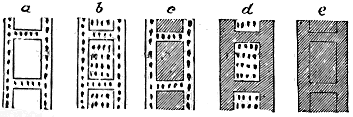
Fig. 22. Diagram showing different States of Fossilization of a Cell of a Tabulate Coral.
(a.) Natural condition—walls calcite, cell empty. (b.) Walls calcite, cell filled with the same. (c.) Walls calcite, cell filled with silica or silicate. (d.) Walls silicified, cell filled with calcite. (e.) Walls silicified, cell filled with silica or silicate.
With regard to the calcareous organisms with which we have now to do, when these are imbedded in pure limestone and filled with the same, so that the whole rock, fossils and all, is identical in composition, and when metamorphic action has caused the whole to become crystalline, and perhaps removed the remains of carbonaceous matter, it may be very difficult to detect any traces of fossils. But even in this case careful management of light may reveal indications of structure, as in some specimens of Eozoon described by the writer and Dr. Carpenter. In many cases, however, even where the limestones have become perfectly crystalline, and the cleavage planes cut freely across the fossils, these exhibit their forms and minute structure in great perfection. This is the case in many of the Lower Silurian limestones of Canada, as I have elsewhere shown.[X] The gray crystalline Trenton limestone of Montreal, used as a building stone, is an excellent illustration of this. To the naked eye it is a gray marble composed of cleavable crystals; but when examined in thin slices, it shows its organic fragments in the greatest perfection, and all the minute structures are perfectly marked out by delicate carbonaceous lines. The only exception in this limestone is in the case of the Crinoids, in which the cellular structure is filled with transparent calc-spar, perfectly identical with the original solid matter, so that they appear solid and homogeneous, and can be recognised only by their external forms. The specimen represented in fig. 23, is a mass of Corals, Bryozoa, and Crinoids, and shows these under a low power, as represented in the figure; but to the naked eye it is merely a gray crystalline limestone. The specimen represented in fig. 24 shows the Laurentian Eozoon in a similar state of preservation. It is from a sketch by Dr. Carpenter, and shows the delicate canals partly filled with calcite as clear and colourless as that of the shell itself, and distinguishable only by careful management of the light.
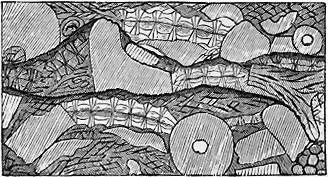
Fig. 23. Slice of Crystalline Lower Silurian Limestone; showing Crinoids, Bryozoa, and Corals in fragments.
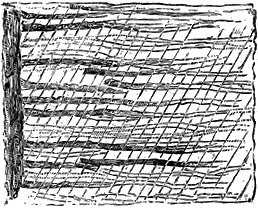
Fig. 24. Wall of Eozoon penetrated with Canals. The unshaded portions filled with Calcite. (After Carpenter.)
In the case of recent and fossil Foraminifers, these—when not so little mineralized that their chambers are empty, or only partially filled, which is sometimes the case even with Eocene Nummulites and Cretaceous forms of smaller size,—are very frequently filled solid with calcareous matter, and as Dr. Carpenter well remarks, even well preserved Tertiary Nummulites in this state often fail greatly in showing their structures, though in the same condition they occasionally show these in great perfection. Among the finest I have seen are specimens from the Mount of Olives (fig. 19), and Dr. Carpenter mentions as equally good those of the London clay of Bracklesham. But in no condition do modern Foraminifera or those of the Tertiary and Mesozoic rocks appear in greater perfection than when filled with the hydrous silicate of iron and potash called glauconite, and which gives by the abundance of its little bottle-green concretions the name of “green-sand” to formations of this age both in Europe and America. In some beds of green-sand every grain seems to have been moulded into the interior of a microscopic shell, and has retained its form after the frail envelope has been removed. In some cases the glauconite has not only filled the chambers but has penetrated the fine tubulation, and when the shell is removed, either naturally or by the action of an acid, these project in minute needles or bundles of threads from the surface of the cast. It is in the warmer seas, and especially in the bed of the Ægean and of the Gulf Stream, that such specimens are now most usually found. If we ask why this mineral glauconite should be associated with Foraminiferal shells, the answer is that they are both products of one kind of locality. The same sea bottoms in which Foraminifera most abound are also those in which for some unknown chemical reason glauconite is deposited. Hence no doubt the association of this mineral with the great Foraminiferal formation of the chalk. It is indeed by no means unlikely that the selection by these creatures of the pure carbonate of lime from the sea-water or its minute plants, may be the means of setting free the silica, iron, and potash, in a state suitable for their combination. Similar silicates are found associated with marine limestones, as far back as the Silurian age; and Dr. Sterry Hunt, than whom no one can be a better authority on chemical geology, has argued on chemical grounds that the occurrence of serpentine with the remains of Eozoon is an association of the same character.
However this may be, the infiltration of the pores of Eozoon with serpentine and other silicates has evidently been one main means of the preservation of its structure. When so infiltrated no metamorphism short of the complete fusion of the containing rock could obliterate the minutest points of structure; and that such fusion has not occurred, the preservation in the Laurentian rocks of the most delicate lamination of the beds shows conclusively; while, as already stated, it can be shown that the alteration which has occurred might have taken place at a temperature far short of that necessary to fuse limestone. Thus has it happened that these most ancient fossils have been handed down to our time in a state of preservation comparable, as Dr. Carpenter states, to that of the best preserved fossil Foraminifera from the more recent formations that have come under his observation in the course of all his long experience.
Let us now look more minutely at the nature of the typical specimens of Eozoon as originally observed and described, and then turn to those preserved in other ways, or more or less destroyed and defaced. Taking a polished specimen from Petite Nation, like that delineated in Plate. V., we find the shell represented by white limestone, and the chambers by light green serpentine. By acting on the surface with a dilute acid we etch out the calcareous part, leaving a cast in serpentine of the cavities occupied by the soft parts; and when this is done in polished slices these may be made to print their own characters on paper, as has actually been done in the case of Plate. V., which is an electrotype taken from an actual specimen, and shows both the laminated and acervuline parts of the fossil. If the process of decalcification has been carefully executed, we find in the excavated spaces delicate ramifying processes of opaque serpentine or transparent dolomite, which were originally imbedded in the calcareous substance, and which are often of extreme fineness and complexity. (Plate VI. and fig. 10.) These are casts of the canals which traversed the shell when still inhabited by the animal. In some well preserved specimens we find the original cell-wall represented by a delicate white film, which under the microscope shows minute needle-like parallel processes representing its still finer tubuli. It is evident that to have filled these tubuli the serpentine must have been introduced in a state of actual solution, and must have carried with it no foreign impurities. Consequently we find that in the chambers themselves the serpentine is pure; and if we examine it under polarized light, we see that it presents a singularly curdled or irregularly laminated appearance, which I have designated under the name septariiform, as if it had an imperfectly crystalline structure, and had been deposited in irregular laminæ, beginning at the sides of the chambers, and filling them toward the middle, and had afterward been cracked by shrinkage, and the cracks filled with a second deposit of serpentine. Now, serpentine is a hydrous silicate of magnesia, and all that we need to suppose is that in the deposits of the Laurentian sea magnesia was present instead of iron and potash, and we can understand that the Laurentian fossil has been petrified by infiltration with serpentine, as more modern Foraminifera have been with glauconite, which, though it usually has little magnesia, often has a considerable percentage of alumina. Further, in specimens of Eozoon from Burgess, the filling mineral is loganite, a compound of silica, alumina, magnesia and iron, with water, and in certain Silurian limestones from New Brunswick and Wales, in which the delicate microscopic pores of the skeletons of stalked star-fishes or Crinoids have been filled with mineral deposits, so that when decalcified these are most beautifully represented by their casts, Dr. Hunt has proved the filling mineral to be a silicate of alumina, iron, magnesia and potash, intermediate between serpentine and glauconite. We have, therefore, ample warrant for adhering to Dr. Hunt’s conclusion that the Laurentian serpentine was deposited under conditions similar to those of the modern green-sand. Indeed, independently of Eozoon, it is impossible that any geologist who has studied the manner in which this mineral is associated with the Laurentian limestones could believe it to have been formed in any other way. Nor need we be astonished at the fineness of the infiltration by which these minute tubes, perhaps 110000 of an inch in diameter, are filled with mineral matter. The micro-geologist well knows how, in more modern deposits, the finest pores of fossils are filled, and that mineral matter in solution can penetrate the smallest openings that the microscope can detect. Wherever the fluids of the living body can penetrate, there also mineral substances can be carried, and this natural injection, effected under great pressure and with the advantage of ample time, can surpass any of the feats of the anatomical manipulator. Fig. 25 represents a microscopic joint of a Crinoid from the Upper Silurian of New Brunswick, injected with the hydrous silicate already referred to, and fig. 26 shows a microscopic chambered or spiral shell, from a Welsh Silurian limestone, with its cavities filled with a similar substance.
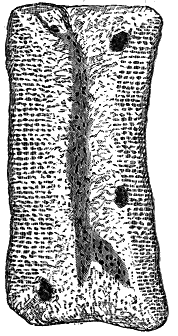
Fig. 25. Joint of a Crinoid, having its pores injected with a Hydrous Silicate.
Upper Silurian Limestone, Pole Hill, New Brunswick. Magnified 25 diameters.
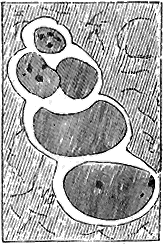
Fig. 26. Shell from a Silurian Limestone, Wales; its cavity filled with a Hydrous Silicate.
Magnified 25 diameters.
It is only necessary to refer to the attempts which have been made to explain by merely mineral deposits the occurrence of the serpentine in the canals and chambers of Eozoon, and its presenting the form it does, to see that this is the case. Prof. Rowney, for example, to avoid the force of the argument from the canal system, is constrained to imagine that the whole mass has at one time been serpentine, and that this has been partially washed away, and replaced by calcite. If so, whence the deposition of the supposed mass of serpentine, which has to be accounted for in this way as well as in the other? How did it happen to be eroded into so regular chambers, leaving intermediate floors and partitions. And, more wonderful still, how did the regular dendritic bundles, so delicate that they are removed by a breath, remain perfect, and endure until they were imbedded in calcareous spar? Further, how does it happen that in some specimens serpentine and pyroxene seem to have encroached upon the structure, as if they and not calcite were the eroding minerals? How any one who has looked at the structures can for a moment imagine such a possibility, it is difficult to understand. If we could suppose the serpentine to have been originally deposited as a cellular or laminated mass, and its cavities filled with calcite in a gelatinous or semi-fluid state, we might suppose the fine processes of serpentine to have grown outward into these cavities in the mass, as fibres of oxide of iron or manganese have grown in the silica of moss-agate; but this theory would be encompassed with nearly as great mechanical and chemical difficulties. The only rational view that any one can take of the process is, that the calcareous matter was the original substance, and that it had delicate tubes traversing it which became injected with serpentine. The same explanation, and no other, will suffice for those delicate cell-walls, penetrated by innumerable threads of serpentine, which must have been injected into pores. It is true that there are in some of the specimens cracks filled with fibrous serpentine or chrysotile, but these traverse the mass in irregular directions, and they consist of closely packed angular prisms, instead of a matrix of limestone penetrated by cylindrical threads of serpentine. (Fig. 27.) Here I must once for all protest against the tendency of some opponents of Eozoon to confound these structures and the canal system of Eozoon with the acicular crystals, and dendritic or coralloidal forms, observed in some minerals. It is easy to make such comparisons appear plausible to the uninitiated, but practised observers cannot be so deceived, the differences are too marked and essential. In illustration of this, I may refer to the highly magnified canals in figs. 28 and 29. Further, it is evident from the examination of the specimens, that the chrysotile veins, penetrating as they often do diagonally or transversely across both chambers and walls, must have originated subsequently to the origin and hardening of the rock and its fossils, and result from aqueous deposition of fibrous serpentine in cracks which traverse alike the fossils and their matrix. In specimens now before me, nothing can be more plain than this entire independence of the shining silky veins of fibrous serpentine, and the fact of their having been formed subsequently to the fossilization of the Eozoon; since they can be seen to run across the lamination, and to branch off irregularly in lines altogether distinct from the structure. This, while it shows that these veins have no connection with the fossil, shows also that the latter was an original ingredient of the beds when deposited, and not a product of subsequent concretionary action.
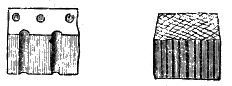
Fig. 27. Diagram showing the different appearances of the cell-wall of Eozoon and of a vein of Chrysotile, when highly magnified.
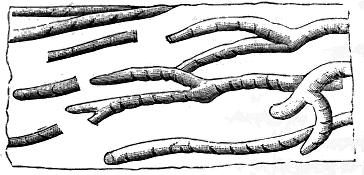
Fig. 28. Casts of Canals of Eozoon in Serpentine, decalcified and highly magnified.
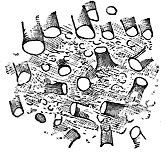
Fig. 29. Canals of Eozoon.
Highly magnified.
Taking the specimens preserved by serpentine as typical, we now turn to certain other and, in some respects, less characteristic specimens, which are nevertheless very instructive. At the Calumet some of the masses are partly filled with serpentine and partly with white pyroxene, an anhydrous silicate of lime and magnesia. The two minerals can readily be distinguished when viewed with polarized light; and in some slices I have seen part of a chamber or group of canals filled with serpentine and part with pyroxene. In this case the pyroxene or the materials which now compose it, must have been introduced by infiltration, as well as the serpentine. This is the more remarkable as pyroxene is most usually found as an ingredient of igneous rocks; but Dr. Hunt has shown that in the Laurentian limestones and also in veins traversing them, it occurs under conditions which imply its deposition from water, either cold or warm. Gümbel remarks on this:—"Hunt, in a very ingenious manner, compares this formation and deposition of serpentine, pyroxene, and loganite, with that of glauconite, whose formation has gone on uninterruptedly from the Silurian to the Tertiary period, and is even now taking place in the depths of the sea; it being well known that Ehrenberg and others have already shown that many of the grains of glauconite are casts of the interior of foraminiferal shells. In the light of this comparison, the notion that the serpentine and such like minerals of the primitive limestones have been formed, in a similar manner, in the chambers of Eozoic Foraminifera, loses any traces of improbability which it might at first seem to possess."
In many parts of the skeleton of Eozoon, and even in the best infiltrated serpentine specimens, there are portions of the cell-wall and canal system which have been filled with calcareous spar or with dolomite, so similar to the skeleton that it can be detected only under the most favourable lights and with great care. (Fig. 24, supra.) The same phenomena may be observed in joints of Crinoids from the Palæozoic rocks, and they constitute proofs of organic origin even more irrefragable than the filling with serpentine. Dr. Carpenter has recently, in replying to the objections of Mr. Carter, made excellent use of this feature of the preservation of Eozoon. It is further to be remarked that in all the specimens of true Eozoon, as well as in many other calcareous fossils preserved in ancient rocks, the calcareous matter, even when its minute structures are not preserved or are obscured, presents a minutely granular or curdled appearance, arising no doubt from the original presence of organic matter, and not recognised in purely inorganic calcite.
Another style of these remarkable fossils is that of the Burgess specimens. In these the walls have been changed into dolomite or magnesian limestone, and the canals seem to have been wholly obliterated, so that only the laminated structure remains. The material filling the chambers is also an aluminous silicate named loganite; and this seems to have been introduced, not so much in solution, as in the state of muddy slime, since it contains foreign bodies, as grains of sand and little groups of silicious concretions, some of which are not unlikely casts of the interior of minute foraminiferal shells contemporary with Eozoon, and will be noticed in the sequel.
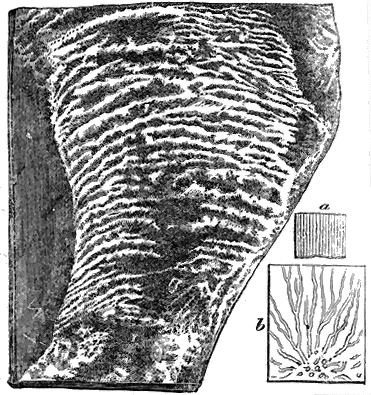
Fig. 30. Eozoon from Tudor.
Two-thirds natural size. (a.) Tubuli. (b.) Canals. Magnified. a and b from another specimen.
Still another mode of occurrence is presented by a remarkable specimen from Tudor in Ontario, and from beds probably on the horizon of the Upper Laurentian or Huronian.[Y] It occurs in a rock scarcely at all metamorphic, and the fossil is represented by white carbonate of lime, while the containing matrix is a dark-coloured coarse limestone. In this specimen the material filling the chambers has not penetrated the canals except in a few places, where they appear filled with dark carbonaceous matter. In mode of preservation these Tudor specimens much resemble the ordinary fossils of the Silurian rocks. One of the specimens in the collection of the Geological Survey (fig. 30) presents a clavate form, as if it had been a detached individual supported on one end at the bottom of the sea. It shows, as does also the original Calumet specimen, the septa approaching each other and coalescing at the margin of the form, where there were probably orifices communicating with the exterior. Other specimens of fragmental Eozoon from the Petite Nation localities have their canals filled with dolomite, which probably penetrated them after they were broken up and imbedded in the rock. I have ascertained with respect to these fragments of Eozoon, that they occur abundantly in certain layers of the Laurentian limestone, beds of some thickness being in great part made up of them, and coarse and fine fragments occur in alternate layers, like the broken corals in some Silurian limestones.
Finally, on this part of the subject, careful observation of many specimens of Laurentian limestone which present no trace of Eozoon when viewed by the naked eye, and no evidence of structure when acted on with acids, are nevertheless organic, and consist of fragments of Eozoon, and possibly of other organisms, not infiltrated with silicates, but only with carbonate of lime, and consequently revealing only obscure indications of their minute structure. I have satisfied myself of this by long and patient investigations, which scarcely admit of any adequate representation, either by words or figures.
Every worker in those applications of the microscope to geological specimens which have been termed micro-geology, is familiar with the fact that crystalline forces and mechanical movements of material often play the most fantastic tricks with fossilized organic matter. In fossil woods, for example, we often have the tissues disorganized, with radiating crystallizations of calcite and little spherical concretions of quartz, or disseminated cubes and grains of pyrite, or little veins filled with sulphate of barium or other minerals. We need not, therefore, be surprised to find that in the venerable rocks containing Eozoon, such things occur in the more highly crystalline parts of the limestones, and even in some still showing traces of the fossil. We find many disseminated crystals of magnetite, pyrite, spinel, mica, and other minerals, curiously curved prisms of vermicular mica, bundles of aciculi of tremolite and similar substances, veins of calcite and crysolite or fibrous serpentine, which often traverse the best specimens. Where these occur abundantly we usually find no organic structures remaining, or if they exist they are in a very defective state of preservation. Even in specimens presenting the lamination of Eozoon to the naked eye, these crystalline actions have often destroyed the minute structure; and I fear that some microscopists have been victimised by having under their consideration only specimens in which the actual characters had been too much defaced to be discernible. I must here state that I have found some of the specimens sold under the name of Eozoon Canadense by dealers in microscopical objects to be almost or quite worthless, being destitute of any good structure, and often merely pieces of Laurentian limestone with serpentine grains only. I fear that the circulation of such specimens has done much to cause scepticism as to the Foraminiferal nature of Eozoon. No mistake can be greater than to suppose that any and every specimen of Laurentian limestone must contain Eozoon. More especially have I hitherto failed to detect traces of it in those carbonaceous or graphitic limestones which are so very abundant in the Laurentian country. Perhaps where vegetable matter was very abundant Eozoon did not thrive, or on the other hand the growth of Eozoon may have diminished the quantity of vegetable matter. It is also to be observed that much compression and distortion have occurred in the beds of Laurentian limestone and their contained fossils, and also that the specimens are often broken by faults, some of which are so small as to appear only on microscopic examination, and to shift the plates of the fossil just as if they were beds of rock. This, though it sometimes produces puzzling appearances, is an evidence that the fossils were hard and brittle when this faulting took place, and is consequently an additional proof of their extraneous origin. In some specimens it would seem that the lower and older part of the fossil had been wholly converted into serpentine or pyroxene, or had so nearly experienced this change that only small parts of the calcareous wall can be recognised. These portions correspond with fossil woods altogether silicified, not only by the filling of the cells, but also by the conversion of the walls into silica. I have specimens which manifestly show the transition from the ordinary condition of filling with serpentine to one in which the cell-walls are represented obscurely by one shade of this mineral and the cavities by another.
The above considerations as to mode of preservation of Eozoon concur with those in previous chapters in showing its oceanic character; but the ocean of the Eozoic period may not have been so deep as at present, and its waters were probably warm and well stocked with mineral matters derived from the newly formed land, or from hot springs in its own bottom. On this point the interesting investigations of Dr. Hunt with reference to the chemical conditions of the Silurian seas, allow us to suppose that the Laurentian ocean may have been much more richly stored, more especially with salts of lime and magnesia, than that of subsequent times. Hence the conditions of warmth, light, and nutriment, required by such gigantic Protozoans would all be present, and hence, also no doubt, some of the peculiarities of its mineralization.
NOTES TO CHAPTER V.
(A.) Dr. Sterry Hunt on the Mineralogy of Eozoon and the containing Rocks.
It was fortunate for the recognition of Eozoon that Dr. Hunt had, before its discovery, made so thorough researches into the chemistry of the Laurentian series, and was prepared to show the chemical possibilities of the preservation of fossils in these ancient deposits. The following able summary of his views was appended to the original description of the fossil in the Journal of the Geological Society.
"The details of structure have been preserved by the introduction of certain mineral silicates, which have not only filled up the chambers, cells, and canals left vacant by the disappearance of the animal matter, but have in very many cases been injected into the tubuli, filling even their smallest ramifications. These silicates have thus taken the place of the original sarcode, while the calcareous septa remain. It will then be understood that when the replacement of the Eozoon by silicates is spoken of, this is to be understood of the soft parts only; since the calcareous skeleton is preserved, in most cases, without any alteration. The vacant spaces left by the decay of the sarcode may be supposed to have been filled by a process of infiltration, in which the silicates were deposited from solution in water, like the silica which fills up the pores of wood in the process of silicification. The replacing silicates, so far as yet observed, are a white pyroxene, a pale green serpentine, and a dark green alumino-magnesian mineral, which is allied in composition to chlorite and to pyrosclerite, and which I have referred to loganite. The calcareous septa in the last case are found to be dolomitic, but in the other instances are nearly pure carbonate of lime. The relations of the carbonate and the silicates are well seen in thin sections under the microscope, especially by polarized light. The calcite, dolomite, and pyroxene exhibit their crystalline structure to the unaided eye; and the serpentine and loganite are also seen to be crystalline when examined with the microscope. When portions of the fossil are submitted to the action of an acid, the carbonate of lime is dissolved, and a coherent mass of serpentine is obtained, which is a perfect cast of the soft parts of the Eozoon. The form of the sarcode which filled the chambers and cells is beautifully shown, as well as the connecting canals and the groups of tubuli; these latter are seen in great perfection upon surfaces from which the carbonate of lime has been partially dissolved. Their preservation is generally most complete when the replacing mineral is serpentine, although very perfect specimens are sometimes found in pyroxene. The crystallization of the latter mineral appears, however, in most cases to have disturbed the calcareous septa.
"Serpentine and pyroxene are generally associated in these specimens, as if their disposition had marked different stages of a continuous process. At the Calumet, one specimen of the fossil exhibits the whole of the sarcode replaced by serpentine; while, in another one from the same locality, a layer of pale green translucent serpentine occurs in immediate contact with the white pyroxene. The calcareous septa in this specimen are very thin, and are transverse to the plane of contact of the two minerals; yet they are seen to traverse both the pyroxene and the serpentine without any interruption or change. Some sections exhibit these two minerals filling adjacent cells, or even portions of the same cell, a clear line of division being visible between them. In the specimens from Grenville on the other hand, it would seem as if the development of the Eozoon (considerable masses of which were replaced by pyroxene) had been interrupted, and that a second growth of the animal, which was replaced by serpentine, had taken place upon the older masses, filling up their interstices."
[Details of chemical composition are then given.]
"When examined under the microscope, the loganite which replaces the Eozoon of Burgess shows traces of cleavage-lines, which indicate a crystalline structure. The grains of insoluble matter found in the analysis, chiefly of quartz-sand, are distinctly seen as foreign bodies imbedded in the mass, which is moreover marked by lines apparently due to cracks formed by a shrinking of the silicate, and subsequently filled by a further infiltration of the same material. This arrangement resembles on a minute scale that of septaria. Similar appearances are also observed in the serpentine which replaces the Eozoon of Grenville, and also in a massive serpentine from Burgess, resembling this, and enclosing fragments of the fossil. In both of these specimens also grains of mechanical impurities are detected by the microscope; they are however, rarer than in the loganite of Burgess.
"From the above facts it may be concluded that the various silicates which now constitute pyroxene, serpentine, and loganite were directly deposited in waters in the midst of which the Eozoon was still growing, or had only recently perished; and that these silicates penetrated, enclosed, and preserved the calcareous structure precisely as carbonate of lime might have done. The association of the silicates with the Eozoon is only accidental; and large quantities of them, deposited at the same time, include no organic remains. Thus, for example, there are found associated with the Eozoon limestones of Grenville, massive layers and concretions of pure serpentine; and a serpentine from Burgess has already been mentioned as containing only small broken fragments of the fossil. In like manner large masses of white pyroxene, often surrounded by serpentine, both of which are destitute of traces of organic structure, are found in the limestone at the Calumet. In some cases, however, the crystallization of the pyroxene has given rise to considerable cleavage-planes, and has thus obliterated the organic structures from masses which, judging from portions visible here and there, appear to have been at one time penetrated by the calcareous plates of Eozoon. Small irregular veins of crystalline calcite, and of serpentine, are found to traverse such pyroxene masses in the Eozoon limestone of Grenville.
"It appears that great beds of the Laurentian limestones are composed of the ruins of the Eozoon. These rocks, which are white, crystalline, and mingled with pale green serpentine, are similar in aspect to many of the so-called primary limestones of other regions. In most cases the limestones are non-magnesian, but one of them from Grenville was found to be dolomitic. The accompanying strata often present finely crystallized pyroxene, hornblende, phlogopite, apatite, and other minerals. These observations bring the formation of silicious minerals face to face with life, and show that their generation was not incompatible with the contemporaneous existence and the preservation of organic forms. They confirm, moreover, the view which I some years since put forward, that these silicated minerals have been formed, not by subsequent metamorphism in deeply buried sediments, but by reactions going on at the earth’s surface.[Z] In support of this view, I have elsewhere referred to the deposition of silicates of lime, magnesia, and iron from natural waters, to the great beds of sepiolite in the unaltered Tertiary strata of Europe; to the contemporaneous formation of neolite (an aluimino-magnesian silicate related to loganite and chlorite in composition); and to glauconite, which occurs not only in Secondary, Tertiary, and Recent deposits, but also, as I have shown, in Lower Silurian strata.[AA] This hydrous silicate of protoxide of iron and potash, which sometimes includes a considerable proportion of alumina in its composition, has been observed by Ehrenberg, Mantell, and Bailey, associated with organic forms in a manner which seems identical with that in which pyroxene, serpentine, and loganite occur with the Eozoon in the Laurentian limestones. According to the first of these observers, the grains of green-sand, or glauconite, from the Tertiary limestone of Alabama, are casts of the interior of Polythalamia, the glauconite having filled them by ‘a species of natural injection, which is often so perfect that not only the large and coarse cells, but also the very finest canals of the cell-walls and all their connecting tubes, are thus petrified and separately exhibited.’ Bailey confirmed these observations, and extended them. He found in various Cretaceous and Tertiary limestones of the United States, casts in glauconite, not only of Foraminifera, but of spines of Echinus, and of the cavities of corals. Besides, there were numerous red, green, and white casts of minute anastomosing tubuli, which, according to Bailey, resemble the casts of the holes made by burrowing sponges (Cliona) and worms. These forms are seen after the dissolving of the carbonate of lime by a dilute acid. He found, moreover, similar casts of Foraminifera, of minute mollusks, and of branching tubuli, in mud obtained from soundings in the Gulf Stream, and concluded that the deposition of glauconite is still going on in the depths of the sea.[AB] Pourtales has followed up these investigations on the recent formation of glauconite in the Gulf Stream waters. He has observed its deposition also in the cavities of Millepores, and in the canals in the shells of Balanus. According to him, the glauconite grains formed in Foraminifera lose after a time their calcareous envelopes, and finally become ‘conglomerated into small black pebbles,’ sections of which still show under a microscope the characteristic spiral arrangement of the cells.[AC]
“It appears probable from these observations that glauconite is formed by chemical reactions in the ooze at the bottom of the sea, where dissolved silica comes in contact with iron oxide rendered soluble by organic matter; the resulting silicate deposits itself in the cavities of shells and other vacant spaces. A process analogous to this in its results, has filled the chambers and canals of the Laurentian Foraminifera with other silicates; from the comparative rarity of mechanical impurities in these silicates, however, it would appear that they were deposited in clear water. Alumina and oxide of iron enter into the composition of loganite as well as of glauconite; but in the other replacing minerals, pyroxene and serpentine, we have only silicates of lime and magnesia, which were probably formed by the direct action of alkaline silicates, either dissolved in surface-waters, or in those of submarine springs, upon the calcareous and magnesian salts of the sea-water.”
[As stated in the text, the canals of Eozoon are sometimes filled with dolomite, or in part with serpentine and in part with dolomite.]
(B.) Silurian Limestones holding Fossils infiltrated with Hydrous Silicate.
Since my attention has been directed to this subject, many illustrations have come under my notice of Silurian limestones in which the pores of fossils are infiltrated with hydrous silicates akin to glauconite and serpentine. A limestone of this kind, collected by Mr. Robb, at Pole Hill, in New Brunswick, afforded not only beautiful specimens of portions of Crinoids preserved in this way, but a sufficient quantity of the material was collected for an exact analysis, a note on which was published in the Proceedings of the Royal Irish Academy, 1871.