Volume 1 / Part 3 — THIRD PERIOD. PART III. [FROM 1824 till Beethoven's Death in 1827.]
Reading edition
Oratorio contemplated by Beethoven—The German and Italian Opera at Vienna—Memorial addressed to Beethoven—Results of his Concert at the Hof-Theater—Mademoiselles Sontag and Ungher—Beethoven's distrustful Disposition—Invited to visit England—Proposition from the Philharmonic Society—His Arrangements with a Russian Prince—His Residence near Schönbrunn—His Illness—He disposes of some of his Works—His adopted Nephew—Extracts from Beethoven's Letters to him—Beethoven's Physicians—His Sufferings—He writes to Mr. Moscheles—Generosity of the Philharmonic Society—Beethoven's Property—His death—Preparations for the Funeral—Conformation of his Skull.
THE Ninth Symphony was finished, and Beethoven now proposed to devote his attention, without delay, to a work worthy of his powers—the composition of an Oratorio, written by his friend C. Bernard, and entitled "The Victory of the Cross." From this work he anticipated much pleasure, as he was satisfied with the poetry—a point in his estimation of no little moment—when an occurrence took place that deserves to be circumstantially related, as well on account of its importance to the history of art, as because, in relation to Beethoven, its consequences were interesting.
The Italian Opera in Vienna had now for some years possessed itself of those halls devoted to the melodious art, which in the time of Gluck had been exclusively occupied by German music; and although, for the last ten years, the tendencies exhibited by the musical world had been rather towards the sensual and the material, yet, in the main body of the Vienna public, a noble spirit was stirring, which it would never have been possible to exclude, or rather to expel, from its native soil, had there only existed a determination firmly to uphold what was of native growth.
The German Opera had still among her votaries devoted adherents, who, by holding manfully together, might long have resisted the force of prevalent error, and saved the edifice from destruction.
A former administration does not seem to have duly understood the demands of the time, so as, while cautiously yielding to them to a certain extent, to have, nevertheless, retained all that was essential. The public, therefore, became impatient, and the first Italian Solfeggio that was heard within those walls sounded like the signal of banishment to the German Opera. The violence of the current carried every one along with it. No one asked in what direction he was borne, for all were enchanted, intoxicated, with the roulades of the Rossini school. Few, indeed, were they, who could resist the force of such a stream, and preserve in all its purity their taste for the truly beautiful and ideal in art; but to this little band German music is deeply indebted; for its warning voice by degrees brought back many a wanderer to the right path.
How, then, did all this affect Beethoven? As monarch in his own domain, he was almost as much forgotten by the crowd as if he had never existed; and no other mark of distinction was conferred upon him than the manifestation of outward respect, even by persons of the highest rank, whenever he made his appearance. How deeply he felt this ominous state of things, and how much it weighed upon his mind, was proved by his more than ordinary seclusion, as well as his determination to bring out the two new works, the Mass, and the Ninth Symphony, in Berlin. The report of this intention induced a small number of artists and friends of art to make an effort to avert from the imperial city the threatened disgrace; and they, in consequence, addressed to Beethoven a memorial, of which, on account of the interest of its contents, I will here give a faithful transcript:—
"To M. Ludwig van Beethoven.
"A small number of the disciples and lovers of art, from the wide circle of admirers of your genius, in your adopted city, present themselves before you to-day, in order to give utterance to wishes long felt, and to prefer a request which they have long hesitated to make.
"Although the number of speakers bears but a small proportion to that crowd, who are sensible of your worth, and joyfully acknowledge what you have done for the present and future time, yet their wishes and requests are by no means confined to the speakers, but shared by all to whom art and the realization of the ideal are more than a means of passing away an idle hour. Their wish is the wish also of a countless number, and their requests are repeated, aloud or in silence, by all whose bosoms are animated by a sense of whatever is divine in music.
"The wishes of those who venerate art in our native country are those which we would more especially express to you at present; for, although the name and the creations of Beethoven belong to every country where a susceptibility to the beauties of art exists, Austria may yet boast of the nearest claim to them. Among her people a due sense of the value of the great and immortal works of Mozart and Haydn, produced within her bosom, is not yet dead; and with joyful pride do they remember that the sacred triad, in which your name and theirs appear as the symbol of whatever is highest in the spiritual realms of music, sprung from the soil of their father-land.
"So much the more painful, however, must it be to you to see that a foreign power has invaded this royal citadel—that above the graves of the departed, and within the dwelling-place of the only one of this band that is still left us, productions are taking the lead, which can boast of no relationship with the princely spirits of the house; shallowness usurping the name and symbol of art, and an unworthy sporting with what is holy darkening and effacing the sense of truth and everlasting beauty.
"More than at any former time, therefore, do those who now address you feel a lively conviction, that the one thing needful at the present moment is a new impulse from a powerful hand—a new appearance of the sovereign within his own domain. This necessity it is which brings them to you to-day, and the following are the requests which they now prefer to you in the name of native art and of all to whom it is dear.
"Withdraw no longer from the public enjoyment,—deny no longer to our sense of what is great and perfect the performance of the latest masterpiece of your hand. We know that a valuable composition in church-music has been produced, to succeed that in which you have immortalised the sensations of a soul, penetrated by the power of faith and illumined by the divine rays of genius. We know that a new flower blooms in the garland of your magnificent and unequalled Symphonies. For years, since the thunders of the Victory of Vittoria ceased to sound, have we anxiously hoped to see you pour out again, in a circle of kindred spirits, fresh gifts from the abundance of your wealth. Disappoint no longer the expectations of your friends; heighten the impression of your newest creations by introducing us yourself to the knowledge of them. Permit not these, the youngest offspring of your genius, to appear one day as strangers in the place of their birth—to fall, perhaps, into the hands of those whose minds are foreign to yours.
"Appear, then, once more in the circle of your friends, your admirers, your venerators; this is our first and most urgent request.
"Other claims on your talents, however, have been openly put forward. The wishes expressed and the offers made to you a year ago by the Directors of our Court Opera, and afterwards by the Society of Austrian Lovers of Music, were shared and approved by too many who respected your name, and were concerned for the interests of art, not to have quickly become public, and to have excited universal interest. Poetry has done her part to support these pleasing hopes and expectations, and worthy materials from a much-esteemed poetical mind await only your magic touch to charm them into life.
"Let this summons to so noble a work not be heard in vain. Delay no further to transport us back to those long-departed days when the power of Polyhymnia moved with mighty spells alike the hearts of the multitude and of the consecrated priests of art. Need we say with what deep regret your late retired mode of life has filled us? Is any assurance required that all eyes have been turned towards you, and that all have seen with sorrow that he, whom they acknowledged as the highest of living men in his own domain, should have looked on in silence while our German soil has been invaded by the footsteps of foreign art—the seat of the German muse usurped—and German works have become but the echo of those of strangers; threatening a second childhood of taste to succeed its golden age? You alone are able to secure activity to the efforts of the best among us. You alone can bestow new life on national art and on the German Opera; bid them bloom once more, and save the true and the beautiful from the violence by which the fashion of the day seeks to subject to itself their everlasting laws.
"Suffer us, then, to hope for the speedy fulfilment of the wishes of all to whom your harmonies have penetrated. This is our second and most urgent request. May this year not pass without our being rejoiced by witnessing the fruits of our entreaties, and may the unfolding of one of those long-wished-for gifts render the coming spring to us, and to the whole world of art, a twofold time of promise.
"Vienna, February, 1824. (Signed) "PRINCE C. LICHNOWSKY. ARTARIA & CO. V. HAUSCHKA. M. Z. LEIDESDORF. J. E. VON WAYNA. ANDREAS STREICHER. ANTON HALM. ABBÉ STADLER. FERD. COUNT VON PALFY. EDWARD BARON VON SCHWEIGER. COUNT CZERNIN, Chamberlain. MORITZ COUNT V. FRIES. J. F. CASTELLI. PROF. DEINHARDSTEIN. CH. KUFFNER. F. R. NEHAMMER. STEINER VON FELSBURG. MORITZ COUNT V. DIETRICHSTEIN. IG. EDLER VON MOSEL. KARL CZERNY. MORITZ COUNT VON LICHNOWSKY. VON ZMESKALL. HOFRATH KIESEWETTER. DR. N. SONNLEITHNER. VON FELSBURG. FERD. COUNT VON STOCKHAMMER. ANTON DIABELLI. STEINER & CO. LEDERER. J. N. BIHLER."
The bearers of this memorial indulged the expectation of receiving immediately from Beethoven an assurance of his compliance with the requests contained in it; but in this they were egregiously mistaken, for he declined reading it till he should be alone. I had been prevented from being present when it was delivered to him, and arrived only just as he had finished its perusal. He communicated to me the contents, and, after running them over once more, handed the paper quietly to me; then turning towards the window, he remained some time looking up at the sky. I could not help observing that he was much affected, and, after I had read it, I laid it down without speaking, in the hope that he would first begin the conversation. After a long pause, whilst his eyes never ceased following the clouds, he turned round, and said, in a solemn tone which betrayed his internal emotion—"It is really gratifying!—I am much pleased." I nodded assent, and wrote in the conversation-book that he must now be convinced that he would meet with sufficient support, if he would resolve to have the two new pieces brought out soon at a concert. To this course he had always declared himself decidedly adverse, professing his conviction that, from the alteration which had taken place in musical taste, and in the intoxicated state of the public mind, no sensibility remained for what was truly great.[86]
Beethoven read what I had just written, and then said, "Let us get into the open air." When we were out, he appeared, contrary to his custom, rather disposed to taciturnity, but I remarked the glimmering of a latent wish to comply with the well-meant requests of his admirers.
After a good deal of discussion with one and another, it was at last decided that the works should be brought before the public—but where? This was a question hard to answer, so that several weeks elapsed before it could be settled, and I will venture to say that the good people of Bonn were not so much perplexed to decide on the place best adapted for Beethoven's monument, and that many an entangled political problem was solved in less time at the Congress of Vienna.
Since Beethoven had intrusted to me alone the arrangement of the concert to be given, I might, in speaking of the difficulties I had to overcome, take occasion to mention at length the numerous obstacles and intrigues, the many basely avaricious demands, and the innumerable tricks and machinations, of which I became aware, but that it would lead me too far from my subject. I will therefore only observe, that, after a long debate, the place chosen was the Hof-Theater at the Kärnthner Thor, but this did not advance the matter much. A new struggle was now to be commenced with the manager, M. Duport, who was no less zealous than the rest for the interests of his theatre, and wished to make a profit of Beethoven's undertaking.
When two flints had come into collision, what results could be expected?—especially as neither one nor the other remained steady to his first terms, but changed every day like a weathercock.
At length, in order to be at least certain of what were the wishes of one of the contracting parties, we were obliged to have recourse to the following stratagem: I begged Count Lichnowsky and M. Schuppanzigh to call on Beethoven at the same hour, as if by accident, and to sound him with regard to his intentions. On this occasion we were to endeavour to lead him to speak categorically on the several points in discussion, and one of us was immediately to write down whatever he should say, and then, half in jest, half in earnest, call on him to sign it.
The plan succeeded to admiration, but what was the consequence? From the whole procedure, Beethoven at length became aware of our design, and, suspecting as usual falsehood and treachery at the bottom, despatched to us the following sultan-like hatti-sherif:—
"To the Count Moritz von Lichnowsky.
"I despise artifices. Let me have no more of your visits. The Academy (the Concert) will not take place.
"BEETHOVEN."
"To M. Schuppanzigh.
"Let me see you no more. I shall give no Academy.
"BEETHOVEN."
"To M. Schindler.
"Do not come near me again till I send for you. No Academy.
"BEETHOVEN."
Fortunately Beethoven did not send us the silken cord along with these missives, so we all three remained in the land of the living. We suffered his anger to evaporate, and in the mean time assisted each other to do the best that we could for him.
Towards the end of April, Beethoven one day wrote to me in an angry mood:—"After these six weeks' squabbling about this and that, I feel absolutely boiled, stewed, and roasted. What is to be done at last about this much-talked-of Concert? Unless the prices are raised, what will remain for me after so many expenses, since the copying alone has cost so much?"
It will appear from this, that the principal point in discussion was concerning the raising the prices of admission. If Beethoven wished to get back the money that he had already expended, he must after all, nolens volens, submit to the demand of the manager, which was, that the Concert should take place in the theatre, on a subscription-night, at the ordinary prices; and that, for the use of it, as well as of the Chorus and Orchestra, the administration should receive the sum of one thousand florins, Vienna currency. There was no help for it. It was now—"Beethoven, submit to your fate."
The Concert took place on the 7th of May, 1824. The house was filled to overflowing. The gross receipts were 2220 florins; of which, subtracting 1000 for the theatre and 800 for the copying, there remained for Beethoven 420 florins. Every box was crammed, with the single exception of the Emperor's, which remained empty, although Beethoven had gone in person, in my company, to make the invitations to all the members of the Imperial family then in Vienna, and some of the illustrious personages had promised to attend. When the time came, however, the Emperor and Empress were on a journey, and the Archduke Rudolph was in Olmütz; so that our great master was obliged to shift without the countenance of the Imperial court.
These were the immediate results of the concert. The details of the further consequences to Beethoven I may be permitted to pass over for the present, as I shall have much worse to notice in the sequel; but I cannot forbear mentioning some facts connected with the rehearsal of the vocal parts of the two works above alluded to.
It will perhaps be remembered that, in speaking of the performance of Fidelio, in the second period, I observed that Beethoven was in the habit of paying little attention to the possibility of the execution of what he wrote for the vocal parts. Innumerable proofs of this assertion may be found again in the second Mass and in the ninth Symphony, which, during the rehearsals of the chorus and solo parts, led to many unpleasant discussions. With due deference for the master, it was not possible to avoid telling him that this and that passage could not be sung. The two ladies, Mademoiselle Sontag and Mademoiselle Ungher, who undertook the soprano and alto solos, came several times to practise them at Beethoven's house, and made the remark to him beforehand.[87]
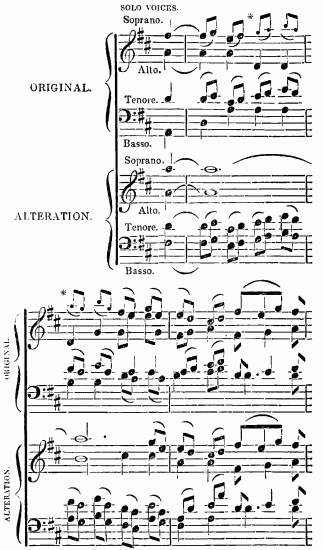
* The passages marked with a *, and inserted in small notes, indicate the high notes alluded to.—ED.
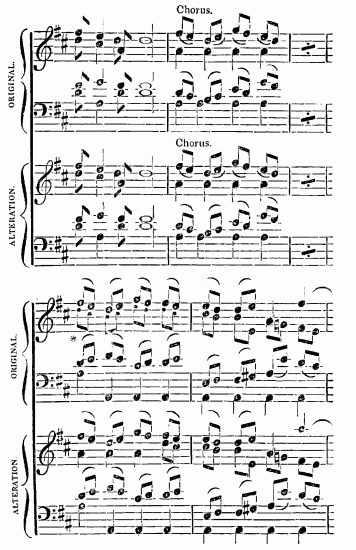
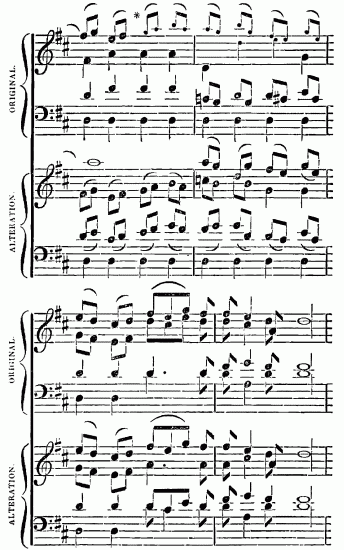
* This is the very part I did alter, as shown in the above illustration; for if, as the sequel shows, a Sontag had perseverance and means sufficient to work it out, the same could not be expected from every singer, and least of all from the Chorus, which repeats the same passage after the Solo performers.—ED.
Mlle. Ungher did not hesitate to call him the tyrant of singers, but he only answered, smiling, that it was because they were both so spoiled by the modern Italian style of singing that they found the two new works difficult.[88] "But this high passage here," said Sontag, pointing to the vocal Quartett in the Symphony,
Küsse gab sie uns und Reben—
"would it not be possible to alter that?"—"And this passage, M. van Beethoven," continued Mademoiselle Ungher, "is also too high for most voices. Could we not alter that?"—"No! no! no!" was the answer,[89]—"Well then, for Heaven's sake (in Gottes Namen), let us work away at it again," said the patient Sontag.
As for the poor Soprani, in the chorus parts of the Mass, every day did they complain to Beethoven that it was out of their power to reach and sustain the high notes so long as he prescribed. In some places the tyrant remained inexorable, though it would have been easy for him, by a transposition of some of the intervals, to render those passages easier for the voices, without altering anything essential. Umlauf, the most strictly classical conductor I have ever known, to whom Beethoven had committed the management of the whole, also made some modest remarks on this difficulty, but equally in vain. The consequence of this obstinacy was, that every chorus-singer, male and female, got over the stumbling-block as well as he or she could, and, when the notes were too high, left them out altogether.[90]
The master, however, standing in the midst of this confluence of music, heard nothing of all this, was not even sensible of the tumultuous applause of the auditory at the close of the Symphony, but was standing with his back to the proscenium, until Mademoiselle Ungher, by turning round and making signs, roused his attention, that he might at least see what was going on in the front of the house. This acted, however, like an electric shock on the thousands present, who were struck with a sudden consciousness of his misfortune; and, as the flood-gates of pleasure, compassion, and sympathy were opened, there followed a volcanic explosion of applause, which seemed as if it would never end.[91]
This success, such as had never been witnessed in those venerable halls of art, induced the speculative manager of the theatre to propose a repetition of the new works, (with the exception of four numbers of the Mass,) securing, before-hand, to Beethoven 500 florins Vienna currency (1250 francs). The manager offered to take on himself all expenses, but claimed all the surplus receipts. Discouraged by the small profit of the first concert, (420 florins, paper currency,) Beethoven, for a long time, would not agree to this, but was at length necessitated to comply. In the latter part of the month of May, accordingly, the repetition took place in the imperial assembly-rooms (Redouten-Saal); the four movements of the Mass, however, Kyrie, Credo, Agnus Dei, and Dona nobis pacem, which were the only parts of the Mass performed at the first concert, were destined to be omitted, though Beethoven protested strongly against it. In place of them the Italian roulade-monger, Signor David, sung the favourite Cavatina "Di tanti palpiti," in spite of the outcry of all the purists; and Sontag gave innumerable fioriture of Mercadante's. Of Beethoven's music, besides the ninth Symphony, the Terzetto Tremate, empi tremate, by Italian singers, and the grand Overture in C major, with the double fugue, were also performed.
The pecuniary result of these manifold exertions was, that the manager had the pleasure of paying 800 florins towards the expenses, as the house was not half full, and that Beethoven, deeply vexed at this unexpected result, declined at first to accept the 500 florins guaranteed to him, and was with much difficulty at last prevailed upon to take the money. The most complete ill humour took possession of him, so that he was no longer accessible to any one, and it was increased by the gossiping tittle-tattle of certain persons, who put it into his head that he had been cheated at the first concert, and thus excited his suspicions, especially against me. At a dinner, which he gave a few days afterwards to the two directors of his concert, Messrs. Umlauf and Schuppanzigh, and to me, in the Prater, he could no longer restrain his anger, but declared that he had been informed that I, in conjunction with the manager, M. Duport, had defrauded him. It was in vain that our two companions endeavoured to convince him that, as every piece of money had passed through the hands of the two cashiers of the theatre, and their accounts of the receipts exactly corresponded, a fraud on either side was out of the question: he refused to retract his charge, and I consequently withdrew immediately, in company with M. Umlauf, and did not see Beethoven again till the month of November, when he called upon me at the theatre in the Josephstadt, where I was acting as music-director, and begged that what had passed might be forgotten.
This occurrence may serve to show what it was to be Beethoven's friend, and to keep on good terms with him only a single year. How much friendship, how many sacrifices, what an entire self-denial, did it not require to submit to be daily exposed to the most malicious calumnies, and even to the most dishonourable accusations! The friend of his youth, Hofrath von Breuning, was alienated from him by a similar reflection on his honour, and Beethoven was only brought back to him by certain melancholy events of the year 1826, when he stood in need of his assistance.
An accusation of this kind occasioned a coolness of twelve years' standing between him and his old friend Dr. Malfatti; and it was not till Beethoven was on his deathbed that I brought about a reconciliation. Credulous, inexperienced, and distrustful as he was, it was easy for any worthless person to slander and set him against his most tried friend. It was not always that these calumnies originated with his brothers, but other odious creatures were continually poisoning his mind, as there are examples enough to prove in his conversation-books.
In his last illness he circumstantially related to me and M. von Breuning many of the intrigues and machinations of some of those persons, whose motives were always envy and covetousness. He also confessed that he had several times been induced to write letters, declaring his conviction of the deceit and treachery of this or that friend, without any better ground than those false accusations.
The manner in which he made his peace, however, was so frank and open-hearted, that one could not help passing over every vexation and insult that might have been received from him.
With his servants he was accustomed to make up these affronts by presents of money, and it was said that his faithful old housekeeper, who bore his humours for many years, was able to help him in time of need with what she had saved out of these presents, or rather fines, which Beethoven imposed on himself. That there really were such moments I can myself bear witness, and a note which I received from him in the spring of the year 1824 attests the same thing:—"Frau Schnapps (a nickname he had given to his housekeeper) will advance what is wanted for housekeeping; so come and dine with me at two o'clock. I have some good news to tell, but let this be between ourselves, that the brain-eater[92] may know nothing about it.—BEETHOVEN."
In the spring of the year 1824, Beethoven was again invited to visit England, and he appeared more than usually resolved on undertaking this journey in the following autumn. I was to accompany him, and we were to travel through the Rhenish provinces, that he might see his native country once more, where, alas! not a creature, with the exception of Dr. Wegeler in Coblentz, Ries's father, and the music-publisher Simrock in Bonn, ever bestowed a thought upon him. How rare was his correspondence, even with these old friends, appears from the Notices of Beethoven, published by the first-mentioned of them. Autumn approached, but Beethoven made no preparations for the journey.
In a letter dated the 20th of December of the same year, the invitation was most pressingly repeated on the part of the Philharmonic Society by Mr. Neate,[93] music professor of London, who had formerly passed some time in Vienna. The terms offered were as follow:—
"The Philharmonic Society proposes to pay you 300 guineas for your visit, and expects, on your part, that you will superintend the performance of your own works, of which at least one will be given at every concert. It also expects that you will, in the course of your stay in England, write a new Symphony and a Concerto, to be performed here, but to remain your own property." For a concert, which it was further proposed that he should himself give in London, the sum of 500l. sterling was to be guaranteed to him; so that nothing could be handsomer than these offers, as Beethoven himself acknowledged. But his nephew!... certain rumours with respect to this young man had now become generally current, and the consequence was, that the journey was given up, and the hopes of the Londoners, to see among them their long-established favourite, Beethoven, were all frustrated.
And now for the following fact, which I hope may be considered in all its bearings, and duly estimated by all admirers of the great deceased, since it deserves, far more than any of those already related, the attention of the whole musical world.
In the beginning of the year 1824, Beethoven received from a Russian prince his first extremely flattering letter, with a request that he would write one or two instrumental Quartetts, and dedicate them to the writer. The terms proposed were highly agreeable, the condition being added, that the prince should possess both of the works to be composed for a full year as his sole property, and that, after the lapse of that time only, the master should have a right to publish them. (This condition, which served to increase the loss that he eventually sustained, was not at first agreed to by Beethoven, but afterwards punctually fulfilled.)
This was soon followed by a second letter to the same purport, and just as some serpents are said by their glance to fascinate their destined prey, did Beethoven, by whom adulation was in general totally disregarded, appear intoxicated by the flatteries of the Russian prince. He abandoned the composition of the Oratorio by C. Bernard, which was already begun, and set about a Quartett for Prince Nicholas von Galitzin, but before it was ready the prince applied for a second, and soon after for a third, and found means to gain over Beethoven so entirely, that he seemed to think no more of the Oratorio, of the tenth Symphony, or even of a work which he had already planned, and which was to be the grand effort of his life, the conclusion of his artistical exertions—namely—the setting Göthe's Faust to music.[94] The musical world has to thank this man only that all these works, as well as a grand Requiem, which the composer had also projected, remained unwritten, and for this he can never make amends. But let us proceed. The sum agreed on for the Quartetts, to be written for this princely Mæcenas, was 125 ducats. Beethoven, however, received from St. Petersburg nothing but letters filled with questions concerning doubtful or difficult passages in these Quartetts, to which the fullest and most circumstantial replies were immediately dispatched, and it would be highly desirable, for the intelligibility of the pieces in question, that these answers should be published;[95] but never did he receive a single ruble. It was not till the month of December, in the year 1826, when a long illness had occasioned him considerable pecuniary embarrassment, that he applied to the prince for the stipulated sum, representing his distressed situation; but received no answer. Beethoven wrote again, and at the same time begged the Austrian ambassador and the banking-house of Stieglitz at St. Petersburg, in private letters, to make application to the prince. At length an answer arrived from the latter, that Prince Nicholas von Galitzin had gone to Persia to join the army, without leaving them any instructions to remit money to Beethoven. In this painful situation Beethoven recollected the offer made to him by the London Philharmonic Society, and wrote on the subject to Moscheles and Sir George Smart. I shall return again to this matter, and in the mean time I must be allowed to close this extraordinary case by observing, that if Prince Nicholas von Galitzin is still living, he can only hope to appease the manes of Beethoven by paying over this just debt of 125 ducats, either to some charitable institution, or to the Bonn committee for the erection of a monument to his memory.
Immediately after the above-mentioned two memorable concerts, Beethoven moved into a pleasant house at Penzing, near Schönbrunn, to which he had taken a fancy, connected with which is a characteristic anecdote. The house is situated near the river Wien, over which there is a bridge for foot passengers, and, as the master had become an object of great public curiosity, it was not uncommon for this bridge to be occupied by a crowd of persons, who had posted themselves there, to wait for an opportunity of seeing him. This annoyed him so much that he left the house in three weeks and went to Baden. A similar case had occurred a year before at Hetzendorf, where he left a lodging which he had taken for the summer, and for which he had paid in advance 400 florins, because he took offence at the excessive politeness of his landlord.
In the autumn of the year 1824 Beethoven returned from Baden, and for the first time for many years took a house in town, that his nephew, who had now left school, might be near the University. During this winter (1824-5) the master had a severe fit of illness, originating in an intestinal disorder: indeed, he had been on bad terms with his stomach during his whole life. The eminent physician, Dr. Staudenheim, had hitherto been his medical attendant, and often had to remonstrate seriously with his patient, though it must be confessed without much effect. Now, however, he chose to appoint Dr. Braunhofer, professor at the University, to attend him. The winter was passed in a state of constant suffering, and it was not till the spring that he began to recover a little, and moved again to Baden, his favourite summer residence.
His mental activity during this whole year extended no further than to the composition of the last Quartett; for the Russian Mæcenas was continually writing flattering letters to urge him to its completion.
The first work undertaken after the illness of the year 1825 was the Quartett, No. 12, with the remarkable adagio—"Canzone di ringraziamento in modo lidico, offerta alla Divinità da un guarito."
In the year 1825 Beethoven closed with an offer made to him by the brothers Schott, in Mainz, for the purchase of his second Mass and of the ninth Symphony, after proposals had been made to him by houses in Berlin, Vienna, and Leipzig, which, however, did not suit him. Pursuant to this agreement, Beethoven received
florins.
For the Mass in D major, op. 1231000
For the ninth Symphony, op. 125600
At the same time the house at Mainz agreed for the following works of Beethoven's:—
Quatuor, op. 127, for50ducats.
Quatuor, op. 131, for80"
Overture in C major, op. 124
Opferlied, op. 121
Bundeslied, op. 122
Ariette to Chloe, op. 128
Bagatelles for the pianoforte op. 126
For these five works Beethoven received the sum of130ducats.
This not inconsiderable sum might have enabled him to replace the amount abstracted from his little fund, and to avert many future difficulties, had he not determined to consider it as a capital, to be laid out in the purchase of public securities, as a provision for his nephew, and not as his own property. How far he was in the right we shall see in the sequel.
In the autumn of 1825 Beethoven moved to his last lodging, in what is called the Schwarzpanier House, situated on the glacis of the suburb of Währing. It suited him well, had plenty of sunshine, and commanded an extensive and, at the same time, agreeable prospect over the city and several suburbs. In this abode he passed the eventful year 1826, in which his harassed mind was destined to the hardest and bitterest trial which could be imposed upon a man, to whom virtue and honour were the dearest of all things.
His adopted nephew, endowed, as I have already remarked, with uncommon mental abilities, had, to the great joy of his uncle, who brought him up like the child of a nobleman, already made considerable progress in his education, and Beethoven took no little pride in his success. At the age of seventeen, the youth returned to the house of this his second father, and, attending only the course of philosophy at the University, was released from all the restraints to which he was necessarily subject while at school; for his uncle, trusting entirely to his understanding and steadiness, granted his nephew all the freedom he desired, which, indeed, under the circumstances, he could hardly avoid. It would lead us too far to enter into any detail of the observations made by his first teachers on a certain turn of mind in the boy, which might probably lead him away from the right path; it was hoped that this had been corrected in his subsequent education.
This youth, possessing talents worthy of his renowned name, was no sooner in the full enjoyment of his liberty, than he fell into an evil course of life—neglected his studies—abused the affection and indulgence of his uncle—and was, at last, expelled from the University, where even the respect universally felt for the name he bore could no longer screen him. It would be needless to dwell on the sufferings of the great master, before and during this event, which was not unexpected. Whoever saw him in this time of trouble could not fail to perceive plainly on his features the traces of the mortification caused by this dishonour to his name.
The measure of his sufferings was, however, far from full; and they were increased by the circumstance that there were people found who threw the blame of all that had happened on the uncle; and we will not therefore shrink from inquiring, in the course of this narrative, whether some part of the fault may not indeed be attributable to Beethoven.
In accordance with the wish of this young man, he was now allowed to continue his studies at the Polytechnic Institution, and to devote himself to mercantile pursuits—a permission which Beethoven was the more willing to grant, since he knew his nephew would, in that institution, be under the superintendence of the vice-director, M. Reisser, who was his joint-guardian with himself. All attempts to bring him again into an honourable course were vain; on the contrary, Beethoven received innumerable proofs that he had not only lost all affection, but even all respect for him, and rejected with equal obstinacy advice and entreaty. It may now be time to inquire how far the master may be considered blameable for the conduct of this youth, and by what means the latter forfeited his affection and his respect.
When a man undertakes the education of a gifted child, possessed by such an excess of love as Beethoven bore to his nephew, this alone may prove the source of innumerable evils, and become a kind of Pandora's box. Beethoven, in the first instance, committed the mistake of granting unbounded confidence to his nephew when a boy ten or twelve years of age, though he had often been convicted of falsehood and other serious juvenile faults; and afterwards expecting from a lad of sixteen the steadiness of a man, and emancipating him in the fullest sense of the term. Of these mistakes he now became conscious—but alas! too late! Beethoven was still more to blame because he could not, even in the presence of his nephew, refrain from expressing his detestation of the boy's mother, to which he gave utterance sometimes in the most violent manner; forbidding him all intercourse with her, utterly regardless of the voice of Nature, which, sooner or later, may awaken and become its own avenger.
No sooner was the young man released from the restraints of his childhood than he sought out this in every sense unfortunate mother; and continued to visit her, although he knew that this had been most strictly forbidden by Beethoven: and hence arose many painful contests between uncle and nephew.
In these proceedings, though Beethoven may have been over-severe towards the mother, he was led to adopt this course by the most cogent reasons founded on antecedent events.
There are now lying before me twenty-nine letters, addressed by Beethoven to his nephew in the summer of the year 1825, dated Baden, and which, with other papers, came again into his possession after his nephew's catastrophe in August, 1826. They were confided to me and Hofrath von Breuning, at that moment, towards the end of his earthly career, to which I have adverted in the introduction to this work, in order that from their contents a judgment might be formed of the line of conduct pursued by the uncle towards his nephew, and that he might stand before the world acquitted of charges brought against him. I now proceed to fulfil the melancholy duty of making some faithful extracts from them.
I.
"I rejoice, my dear son, that you are pleased with your adopted sphere of life, and diligent in acquiring what is necessary for it. Your handwriting I should not have known again. I myself indeed care only about the sense and signification, but you must now endeavour to attain also external elegance.
"If it is too hard a task for you to come hither, never mind. Should it, however, be any way possible, I shall be glad to have in my exile some feeling heart about me. I embrace you most cordially.
"Your affectionate father, "BEETHOVEN."
II.
"May 18, 1825.
"It cannot but be becoming in a youth, now nearly nineteen, to unite with his cares for his education and future prosperity the duty which he owes to his benefactor, to whom he is indebted for his maintenance. Have I not fulfilled mine towards my poor parents, and rejoiced when I was able to assist them? How different has been your conduct towards me! Thoughtless boy, farewell.
"BEETHOVEN."
III.
"May 22, 1825.
"I have been assured, although hitherto it has been only matter of conjecture, that you have again been carrying on a clandestine intercourse with your mother. Am I again to experience this hateful ingratitude? Shall the tie between us be severed?—So be it then. You will be detested by every impartial person who shall hear of your ingratitude. The expressions used by my brother, and your own of yesterday, with respect to Dr. S——r, must of course be painful to me, since the very reverse of what he requires has been decided by the tribunal.[96] Am I continually to be forced to entangle myself in these abominations? Never again! Is the agreement become burdensome to you? Be it so, in God's name! I have done my part, and leave you to Providence. I do not fear to answer for my conduct before the judgment-seat of the Almighty.
"BEETHOVEN."
IV.
"Baden, May 31, 1825.
"Enough of this! Spoiled as you have been, it would do you no injury to pay some attention at last to simplicity and truth. I have suffered too much from your artifices, and it will be a hard matter for me to forget them. Even if I would always submit, without murmuring, like an ox to the yoke, if you should behave thus towards others, you will never gain the good-will of any human creature. God knows all I wish is to be freed from you, from this base brother, and from these my worthless relations. May God hear my prayer! for I can never trust you more.
"Your father—alas! "yet, fortunately not your father."
V.
(In answer to an account of money received.)
"June 18, 1825.
" ... Let us not look further back. It would be easy to do so, but it would only be painful for me; at last it would only be—'you are a very good guardian, &c.... Were you but a little steadier, you would have always acted differently.'
"BEETHOVEN."
VI.
"July 18, 1825.
"Dear Son,
"Only be moderate. Fortune has crowned my endeavours, but let no mistaken views lead you into embarrassment. Be candid and exact in the account of your expenses. Let the theatre rest for the present. Be ruled by your father, and guided by him whose every wish has been invariably directed towards your moral welfare as well as your worldly prosperity! Be indeed my son. What an unheard-of discord would it be, if you were indeed false to me, as some people still maintain!
"BEETHOVEN."
VII.
"I am growing thinner and thinner, and am indeed very poorly, without having any doctor, or any one to feel for me. If it be possible, come to me. But I do not wish to be any hindrance to you. I wish I were only sure that the Sunday would be properly spent without me. I must learn to give up all. Would that these great sacrifices might only bring forth good fruits!
"Where am I not injured and wounded? Have no secret dealings with my brother. Once for all, have no secrets from me—from your affectionate father. If I am angry, ascribe it to my anxiety on your account, for you are exposed to much peril. Think of my sufferings and give me no uneasiness. I ought by rights to have no fears of this kind,——but what have I not experienced!
"BEETHOVEN."
VIII.
"'Come soon, come soon, come soon.' Be it so. The day before yesterday came my Signor Fratello[97] and his brother-in-law. What a wretched creature! If Cato, speaking of Cæsar, exclaimed 'This man and we'—what shall we say of such a one as this?
"Now, as ever, thine anxious and "affectionate Father, "BEETHOVEN."
IX.
September, 1825.
"I do not wish that you should come to me on the 14th inst. It is better that you should finish your studies. God has never yet forsaken me, and some one will be found to close my eyes. There seems to me indeed to be something pre-ordained in all that has taken place, in which my brother (Pseudo) plays a part. I know that you have no wish to come to me even afterwards, and it is natural that it should be so. Such a sphere as mine is too pure for you.... You need not come on Sundays, either, for, after such behaviour, true harmony and concord can never subsist; and what is the use of hypocrisy? Be, in reality, a better man; but use no deceit, no lies; it will be all the better for your moral character in the end. You see your conduct is reflected in the mirror of my mind. The kindest remonstrances would be of no avail. You will, in either case, be incensed. For the rest, be under no apprehension. I will continue my cares for you as usual. What troubles do you not occasion me! Farewell. He who has not indeed bestowed on you your life, but the support of that life, and what is more than all else, the cultivation of your mind, as a father—nay more than that—most fervently implores you to keep in the only true path to all that is right and good.
"Your faithful affectionate Father, "BEETHOVEN."
X.
"My dear son,—No more of this—come to my arms, you shall not hear one harsh word. For God's sake, do not ruin yourself: you shall be received as kindly as ever. As to what is to be thought of, and done for the future, we will talk it over in a friendly manner together. Upon my word of honour, you shall hear no reproaches, which, indeed can now do no good. You have nothing to expect from me but the most anxious and affectionate care for your welfare. Only come, come to the heart of your father,
"BEETHOVEN."
XI.
October 5, 1825.
"I have just received your letter. I was excessively anxious, and had made up my mind to go to-day to Vienna. Thank God, it is not necessary. Only be obedient to me, and affection, peace of mind, and worldly prosperity, will be our united lot. You will enjoy an inward and spiritual, as well as a material, existence. But let the former be preferred to the latter.
"A thousand times I embrace and kiss you, not my lost, but my new-born son. For you, my restored child, will your affectionate father ever care.
"BEETHOVEN."
XII.
"October 14, 1825.
"I inform you in haste, that I will certainly come to-morrow morning, even if it should rain, therefore let me be sure of finding you. I shall rejoice to see you once more, and should some dark clouds appear, do not ascribe them to intentional resentment. They will be entirely dispersed by the improved behaviour you have promised, by happiness, based upon sincerity and active industry. Who would not rejoice to see the wanderer return again to the right path? This happiness I hope to experience.
"BEETHOVEN."
These fragments will be sufficient to exhibit Beethoven's situation, his state of mind, and his sufferings, as described by himself; not less plainly do they serve to show his relation to various members of his family. Above all, however, we perceive in these letters the noble high-minded man; and such was Beethoven, not only in moments of excitement, but throughout his whole life. Could I add, in reference to the last extract, that Beethoven long enjoyed the felicity of seeing his ill-advised nephew, then nineteen years old, walking in the paths of virtue and honour, I should breathe more freely after the painful emotions excited by thus recalling the past, and awakening the remembrance of what I have gone through in witnessing the patience, with which, for years, the great artist bore his cross, the weight of which sometimes bowed him to the ground. Alas! all this was only the prelude to that catastrophe which was destined to give the death-blow to our illustrious master!
Notwithstanding all care, attention, and kindness on the part of Beethoven[98] and the joint guardian of this unhappy young man, the vice-director of the Polytechnic Institution, he again entered the slippery path which he had been prevailed on to quit, and when, in August 1826, he was urged to work up many examinations at the Institution, which were in arrear, he made an attempt on his life. This attempt failed, but it placed him as a suicide, according to the laws of his country, in the hands of justice, for it is presumed that nothing but a want of religion can possibly lead to so violent a step; malefactors of this kind are consequently placed under the care of the civil authorities, with a view of promoting the amendment of their religious principles.
Thus it was with the nephew of Beethoven, and when the time came, when he was to be again given over to the care of his guardian, it was done with a positive injunction on the part of the authorities, to keep him only one day in his house, since he was not permitted to remain longer in Vienna. This took place towards the end of the month of October, and now it was hard to know what was to be done. Johann van Beethoven offered his brother his country-house as a temporary residence for his nephew, until Hofrath von Breuning should succeed in procuring for the young man a commission as cadet in some regiment, since he had now an inclination to a military life. After a great deal of trouble, M. von Breuning succeeded in interesting Lieutenant Field-Marshal Stutterheim for the deeply afflicted Beethoven, and he consented to take the nephew into his regiment. Out of gratitude, Beethoven dedicated to this officer his grand Quartett in C sharp minor.
The severity of the season, and the incredibly thoughtless conduct of which the nephew and the other relations of Beethoven were guilty towards him obliged him to return to Vienna. This journey, which, in so advanced a period of the year, could not be performed in one day, was made in an open carriage, because, as Beethoven himself assured me, his brother had refused to trust him with his close one.
It was necessary to give a brief relation of these occurrences, for only thus could Beethoven find the defence and the justification which he thought necessary, and which he will meet with from every sympathetic mind. In fact, in the many discussions concerning him, mention was often made of this circumstance, without any knowledge of the real state of the case, and often with conjectures which, by degrees, might at length assume the shape of a regular accusation against him.
On the 2nd of December, 1826, Beethoven, with his nephew, returned sick to Vienna; but it was not till several days afterwards that I heard of his situation, or even of his arrival. I hastened to him, and, among other details, which shocked me much, learned that he had often in vain entreated his two former physicians, Drs. Braunhofer and Staudenheim, to undertake his case; the first declining to do so, because the distance was too great for him to come; and the second, indeed, promising to come, but not keeping his word. A physician was sent to his house, he did not know how, or by whom, and who, consequently, knew nothing of him or his constitution. When, however, this physician (the excellent Dr. Wawruch, clinical professor) visited Beethoven's sick-bed, I heard from his own mouth how it happened, and it affords an additional proof that this man, belonging to the world and to posterity, was abandoned by his nearest relations, who had so much cause to be grateful to him: not merely abandoned, indeed, but betrayed and sold. Professor Wawruch related to me that he had been sent to Beethoven by the marker at a billiard-table at a coffee-house, who being, on account of illness, brought to the hospital, had mentioned that some days before the nephew of Beethoven had come to the coffee-house, where he played at billiards, and commissioned him, the marker, to find a physician for his sick uncle; but, being extremely unwell at the time, he had not been able to do so, and therefore begged the Professor to visit Beethoven, which, entertaining the highest respect for the artist, he had immediately done, and had on his arrival still found him without medical attendance. It was necessary then for the marker at a billiard-table to fall sick and be taken to the hospital, before the great Beethoven could obtain help in time of need!!
Who would not find his feelings revolted by this disgraceful fact? After this no farther explanation can be necessary to show what were Beethoven's sufferings in his deplorable condition, or what was the ultimate cause of his early death.
Before the end of December, the nephew set off to join his regiment, and from that moment it seemed as if the uncle had been delivered from his evil genius. He became more cheerful and resigned to his fate, hoping and expecting a speedy recovery from his illness to result from the care of his physician. His former love for his nephew seemed now transformed into bitter hatred; but before the hour arrived which was to sunder every earthly tie, his first feelings returned, and he appointed this nephew his sole heir.[99]
The malady which brought him back to Vienna, on the occasion just mentioned, was an inflammation of the lungs, soon followed by symptoms of dropsy. These at first Professor Wawruch refused to recognise, but they increased so rapidly that it was no longer possible to doubt the nature of the disease.
On the 18th of December an operation was found to be necessary; another followed on the 8th of January; a third on the 28th of the same month; and the fourth on the 27th of February.[100]
Towards the end of January Beethoven's former friend, the celebrated Dr. Malfatti, was induced, after much supplication and entreaty, to prescribe for him; and, from this time, by the advice of both his medical attendants, he took daily, as the only specific, considerable quantities of iced punch, by which the vital powers, prostrated by the frequent operations, were restored to such a degree, that he considered himself as perfectly convalescent, threw away angrily the volume of Walter Scott, with which he had been trying to pass away the time, and exclaiming,—"The man writes only for money!" set to work again at a Sonata for two performers, which he had been writing for Diabelli, although the physicians had positively prohibited every mental exertion. After the fourth operation, however, even iced punch could no longer act as a restorative, although no limits were prescribed to its use. From this time he declined rapidly.
During this period of suffering, Beethoven would have no one about him but von Breuning and myself; and when we were both unavoidably kept from him by our avocations, as indeed generally happened for several hours every day, the favourite companion and best nurse of the sick artist was von Breuning's son, a lively and clever boy, eleven years old, who, by his freedom from care, and ignorance of the danger in which we knew our friend to be, was frequently better able to raise his spirits than we were. Little Gerhard was often warmly thanked by Beethoven for his assistance in this way.
It is now time to give a detailed account of Beethoven's letters to London, in which he made an application to the Philharmonic Society, as these letters have been much talked of, and often taken amiss.
It may, perhaps, be recollected under what circumstances Beethoven was compelled, in the year 1823, to encroach on his little savings, as well as that the extremely slender profit accruing from the two concerts in 1824 had disappointed his hopes of being able to make up the deficiency thus occasioned. How and why the projected journey to London in the same year, which afforded such cheering pecuniary prospects, was given up, and how he had foolishly appropriated to his unworthy heir the sum received for his last works, without thinking of himself, I have also related. To these causes of embarrassment we may add the base conduct of the Russian Prince Nicholas von Galitzin, at the time when Beethoven was scarcely able to rise from his bed, and had to contend with heavy expenses, while he was assured by his physicians that his illness was likely to be of long duration, and that he must not think of working for a long time to come.
In addition to all this came the increased expenditure for his nephew, for whose maintenance, as his adopted father, he was, even by the laws of his country, compelled to provide.
Thus, sick and harassed, Beethoven found himself obliged either to make use of the only property he possessed, consisting of a few bank shares, or to apply to his brother for assistance. This brother one day, in the presence of M. von Breuning and myself, declined letting Beethoven have any of his hay, when two physicians had prescribed for him a hay vapour-bath; alleging as an excuse that his hay was not good enough. Yet this "unbrotherly brother," as Beethoven called him, rich as he was, wished to share in the little that the composer possessed.[101] To be obliged to ask assistance from him was of itself like a death-blow to Beethoven.
Forgotten by the Viennese, whom his decease first aroused from the delirium of the Rossini-fever, and pressed by these difficulties, the master remembered an offer made to him some years before by the Philharmonic Society, and after much hesitation determined to apply, as a first step, by letter to Moscheles, although quite against my advice and that of M. von Breuning, as we foresaw the wrong construction that would be put on this letter. On the 22nd of February, 1827, Beethoven wrote on this subject, at the same time to Moscheles and to Sir George Smart.
"My dear Moscheles,—I am sure you will not take it amiss, if I trouble you, as well as Sir G. Smart, to whom I enclose a letter, with a request. The affair is briefly as follows:—Some years ago the Philharmonic Society in London made a handsome offer to give me a benefit concert. At that time I was not, thank God, in a situation to make it necessary to avail myself of this generous proposal. But affairs are much altered with me at present, when I have been confined three months by a tedious illness—the dropsy. Schindler will tell you more about it in a letter accompanying this. You have long known my way of life—you know how and by what I live. Writing is at present out of the question, and I might unfortunately become so situated as to be reduced to want. You have not only extensive connexions in London, but also considerable influence with the Philharmonic Society. I beg that you will do what you can to induce them again to consider their intention, and put it soon into execution. My enclosed letter to Sir George Smart is to the same purport, as well as one to Mr. Stumpff,[102] which is already despatched. I entreat you to forward this to Sir George, and to unite with him and my other friends in London to effect this object. Even dictating becomes painful to me, so much exhausted do I feel. Make my compliments to your amiable wife, and be assured I shall always remain
"Your friend, "BEETHOVEN."
"Pray answer me soon, in order that I may know if I have anything to hope."
On the 14th of March, Beethoven again wrote on this subject to Moscheles, earnestly begging his attention to it.
From this second letter I make only the following extract:—
"On the 27th of February the operation was performed for the fourth time, and there are evident signs that I must soon submit to it again. What is to be the end of it, and what will become of me if it lasts much longer? Mine is indeed a hard fate, but I resign myself to it, only praying that God in his providence may so ordain that, whilst I endure this death in life, I may be protected from want. I should then have strength enough, let my lot be ever so severe, to submit with resignation to the will of the Most High. Hummel is here, and has called several times upon me."
As early as the 1st of March, Moscheles and Mr. Stumpff had written to inform him of the sensation excited among his numerous admirers in London by his first letter; and the former afterwards wrote to the following effect:—
"The Society resolved to express their good-will and lively sympathy by requesting your acceptance of £100 sterling (1000 florins) to provide the necessary comforts and conveniences during your illness. This money will be paid to your order by Mr. Rau, of the house of Eskeles, either in separate sums, or all at once, as you may desire."
Moscheles added that the Philharmonic Society was willing to extend their good offices still further, and that Beethoven had only to write, if he needed their assistance.
In reply, Beethoven dictated to me, on the 18th of March, the following, since he was himself too weak to write:—
"I know not how in words to describe the feelings with which I have read yours of the 1st. I am deeply sensible of the generosity with which the Philharmonic Society has almost anticipated my request, and I beg you, dear Moscheles, to become the organ through which I may convey my heart-felt thanks for their kind sympathy and distinguished liberality. I have found myself compelled to apply for the whole sum of 1000 florins, as I was just under the unpleasant necessity of raising money, which would have occasioned me fresh embarrassment. With regard to the concert which the Society intend to arrange for my benefit, I trust they will not relinquish that noble design, and beg that they will deduct the £100 which they already have sent me from the profits. Should after that any surplus be left, and the Society be kindly willing to bestow it upon me, I hope to have it in my power to evince my gratitude by composing for them either a new Symphony, which already lies sketched on my desk, or a new Overture, or anything else the Society may prefer. May Heaven grant me my health soon again, that I may be able to prove to the generous English how well I can appreciate their sympathy with my melancholy situation! Your noble conduct can never be forgotten by me, and I beg you to return my thanks in particular to Sir George Smart and Mr. Stumpff.
"With the highest esteem, yours, (Signed) "BEETHOVEN."
"P. S. Kindest regards to your wife. I have to thank the Philharmonic Society and you for a new and most amiable friend in M. Rau.[103]
"I beg you to transmit the subjoined metronomic list of my Ninth Symphony to the Philharmonic Society:"
Allegro ma non troppo 88 =

Molto vivace 116 =

Presto 116 =
Adagio primo 60 =
Andante moderato 63 =
Finale presto 96 =
Allegro ma non troppo 88 =
Allegro assai 80 =
Alla marcia 84 =
Andante maestoso 72 =
Adagio divoto 60 =
Allegro energico 84 =
Allegro ma non tanto 120 =
Prestissimo 132 =
Maestoso 60 =

From my own letter to Moscheles, dated the 24th of March, accompanying the above from Beethoven, written with a view to prepare his friends in London for the approaching death of this great man, I shall make the following extract, since it belongs, no less than the former, to the history of his life.
* * * * * "The letter addressed to you, and dated the 18th, was dictated word for word by himself, and is probably his last. To-day he whispered to me—'Write to Smart and Stumpff.' Should it be possible for him to sign these letters, it shall be done to-morrow.[104]
"He is conscious of his approaching end, for yesterday he said to me and Breuning, 'Plaudite amici, Comœdia finita est.'[105]
"The last few days have been memorable ones. He sees the approach of death with the most perfect tranquillity of soul and real Socratic wisdom.[106] Yesterday we were so fortunate as to finish the business of the will. Three days after the receipt of your last, he was much excited, and would have his sketch of the Tenth Symphony brought to him, concerning the plan of which he talked to me a great deal. It was destined for the Philharmonic Society, and, according to the form which it assumed in his morbid imagination, it was to be a musical leviathan, compared with which his other Grand Symphonies would be merely trifling performances."
On the 18th of March, Beethoven begged me to attend to the dedication of his last Quartett, and to choose for this mark of respect one of his worthiest friends. As I knew this compliment to be well deserved by M. Johann Wolfmayer, a merchant of Vienna, most highly esteemed by Beethoven in the latter days of his life, and that he was frequently occupied by considering in what way he could manifest his gratitude to him, I sent the name of this gentleman, after the decease of Beethoven, to Messrs. Schott, in Mainz, the publishers of the above-mentioned work, with a request that it might be dedicated to him. This fact is sufficient to prove how anxious Beethoven was, even to his latest breath, to show himself grateful to his friends and benefactors; and had he been able, he would, in his last moments, have expressed himself more decidedly with respect to this dedication.
On the payment of the thousand florins by M. Rau, Beethoven had still 100 florins in ready money, which was sufficient for the expenses of the latter days of his life, and from the above sum, therefore, only a small part was deducted for the expenses of the funeral. The remainder of this sum should have been, according to the letter of Mr. Moscheles of the 1st of March, returned to the Philharmonic Society, since it was specially destined to provide for the comfort of Beethoven; but they did not wish it to fall into the hands of his unworthy relatives. At the legal inventory taken after Beethoven's death, however, this money fell into the hands of the authorities; but Dr. Bach, whom he had while living appointed his executor, assigned reasons for opposing its delivery, which, in consequence, was not insisted upon.
According to the account rendered by Dr. Bach, the entire amount of property, including the produce of the sale of furniture, music, and seven Bank Shares, amounted toflorins. 10,232
From this were to be deducted for the illness, funeral, and legal expenses,1,213
So that there was a net remainder of9,019[107]
Dr. Bach accompanied this account with a remark, in which I fully concur, that the amount of the property was out of all proportion to the deserts of the great man by whom it was left, and might throw an unfavourable light upon his contemporaries, were it not susceptible of explanation from the character and opinions of the master, who thought only of his Art, and left to others the consideration of the profit to be derived from it.
Symptoms of a speedy termination to Beethoven's sufferings appeared early on the 24th of March, after the holy Sacrament for the dying had been administered at his own desire, and received by him with true devotion. The first symptoms of approaching dissolution manifested themselves about one o'clock on the same day. A most terrible struggle between life and death now began, and continued, without intermission, till the 26th, when, a quarter before six in the evening, the great composer breathed his last, during a tremendous hail-storm, aged 56 years, 3 months, and 9 days.
I am not so fortunate as to be able to say that it was I who closed the eyes of the artist who belongs to the latest posterity; neither was it M. von Breuning; for we had gone on the afternoon in question to the burial-ground belonging to the village of Währing, to provide a suitable place of interment, and were prevented from returning by the violence of the storm. The person who had to render him this last service was M. Anselm Hüttenbrenner, from Grätz, in Styria, favourably known as a composer, who had hastened to Vienna, that he might see Beethoven once more. He fulfilled, therefore, this sacred duty in our stead, and when we entered the chamber we were told, "It is all over!" and we returned thanks to God that his sufferings were at an end.
The arrangements for the funeral were made by M. von Breuning and myself, in conjunction with M. Tobias Haslinger, who was so obliging as to superintend the music to be performed at the ceremony, which took place on the afternoon of the 29th. The procession was followed, from the abode of the great deceased to the parish church of the Alster-suburb, where the service was performed, by at least 20,000 persons.[108]
Since it would not be uninteresting to many admirers of Beethoven to learn the conformation of his skull, and the state in which the organs of hearing were found, I insert the following particulars from the report made after the dissection of the body by Dr. Johann Wagner. "The auditory nerves were shrivelled and marrowless, the arteries running along them stretched, as if over a crow-quill, and knotty. The left auditory nerve, which was much thinner than the other, ran with three very narrow greyish streaks; the right, with a thicker white one, out of the fourth cavity of the brain, which was in this part of a much firmer consistence and more filled with blood than in the rest. The circumvolutions of the brain, which was soft and watery, appeared twice as deep as usual, and much more numerous. The skull was throughout very compact, and about half an inch thick."
A few days after the funeral, M. von Breuning received notice from the wife of the sexton of Währing, that a considerable sum had been offered to her husband if he would bring the head of Beethoven to a place specified in Vienna. M. von Breuning, thinking that this information might originate in a mercenary motive of the sexton's, offered him money, which he however refused, assuring M. von Breuning that the intimation which he had sent was nothing but the truth. On this account, M. von Breuning had the grave watched every night for some time.