Chapter 5 INSECTS AND THEIR KIN
Reading edition
The insect world populating the dense grass jungles and sand-dune deserts at Castle Neck is generally unfamiliar to the human towering above, yet its principal characters may readily be observed by the keen eye, or, better, the keen eye aided by a simple magnifying glass.
Insects are identified by the presence of six legs. Insect-like animals may be found with more than six legs. Let’s look at these first.
INSECT RELATIVES: MULTILEGGED CREATURES
Eight-legged Animals

Ticks
(Ioxidae and Argasidae)
Body egg-shaped in outline
Very small head
Parasitic on human beings as well as animals
Ticks are quite common at the beach, but only the tourist who ventures into the woods will encounter them. From the tip of a blade of grass they hook on to a warm-blooded animal passing by. In removing a Tick some care is necessary so that the tiny head will not remain embedded in the victim. Ticks can usually be persuaded to let go if touched with a lighted cigarette or daubed with rubbing alcohol.
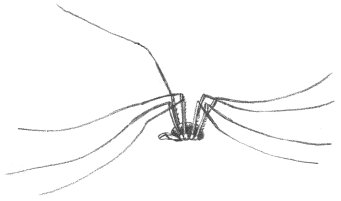
Harvestmen
(Phalangida)
Very small oval body
Extremely long, slender legs
Better known as “Daddy-long-legs,” these creatures resemble Spiders, but are not very closely related to them. They are perfectly harmless and cannot bite. Most of them feed on plant juices or dead insects.
34
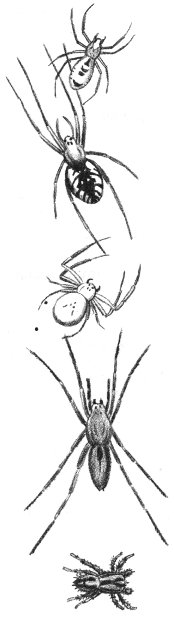
True Spiders
(Araneida)
Body divided into two distinct parts
All have poison fangs
Many spiders are to be found on Crane’s Beach. Most are small, harmless, and difficult to identify. However, some of the general groups may be readily recognized:
Sheet-web Spiders (Linyphiidae): A small spider, usually less than a quarter of an inch long. Its sheetlike web identifies it.
Orb-weaving Spiders (Argiopidae): All of these spiders build their webs like a wheel with radiating spokes. The Orange-and-Black Garden Spider (Miranda aurantia), a large species infesting grassy places in the fall, is typical of the group.
Crab Spiders (Thomisidae): The Crab Spiders do not construct webs, but their crablike shape and the fact that they walk sidewise will identify them.
Wolf Spiders (Lycosidae): This spider hunts its prey instead of building a web and waiting for its meal to happen along. Wolf Spiders are often large and quite hairy. The holes you find in the sand dunes are nurseries constructed by the female Sand Dune Wolf Spider (Lycosa pikei).
Jumping Spiders (Attidae): “Jumpers” have a rather fat body that is heavily covered with hair. They too hunt their prey, often jumping several inches to capture it.
Creatures with More Than Eight Legs
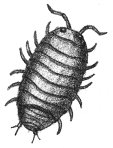
Sow Bugs
(Isopoda)
Flat, segmented body
Less than ten pairs of legs
The Sow Bug, commonly called the “Pill Bug,” is usually found hiding under a damp log. It is completely innocuous and will often roll into a ball when disturbed.
35
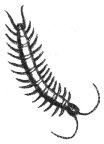
Centipedes
(Chilopoda)
Elongated, segmented body
Fifteen or more pairs of legs
One pair of legs per segment
The Centipede is usually found hidden in a moist place. It feeds on insects killed by a poison injected through its jaw. Although Centipedes occasionally bite a finger, their poison is so weak that the bite can be ignored.
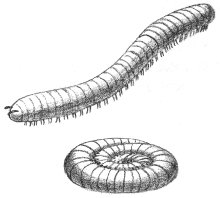
Millipedes
(Diplopoda)
Hard, segmented, worm-shaped body
Two pair of legs per segment
Roll into a ball when disturbed
The Millipede is found in much the same habitat as the Centipede, under a board or rock or inside a rotten stump. It is harmless, and lives for the most part on decaying plants.
INSECTS: SIX-LEGGED ANIMALS
The Mayflies
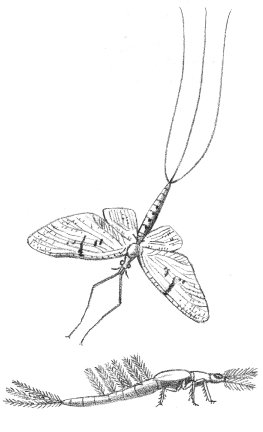
These insects have long, soft bodies and two long “tails.” The first stage in the Mayfly’s life is spent under water in one of the several swampy pools behind the main beach. Early in the spring it changes into the winged adult that is unable to eat. This adult lays its eggs and dies soon afterwards.
36
The Dragonflies and Damselflies
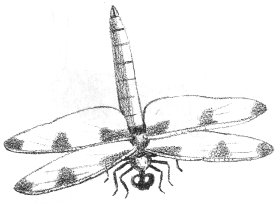
Dragonflies
(Aeshnidae, and others)
Two pairs of long, stiff wings
Two large compound eyes, which touch each other
Hold wings outspread when they alight
Dragonflies are often called “Devil’s Darning Needles,” but they are perfectly harmless. They frequent wet areas, where they feed on other insects—particularly mosquitoes!
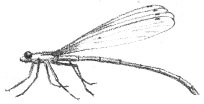
Damselflies
(Lestidae and Coenagrionidae)
Two pairs of long wings
Large compound eyes do not touch
Wings folded over back when resting
Aside from their smaller, more delicate appearance, these insects look like the Dragonflies. They are found in the same places and have similar habits.
The Fan-winged Insects: Grasshoppers, Crickets, etc.
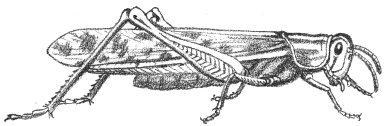
Short-horned Grasshoppers
(Acrididae)
Antennae shorter than body
Typical Grasshopper shape
Most Grasshoppers are strong fliers and are easily frightened into flight. The males may be heard singing during the day—a rasping noise produced by drawing the hind leg across the veins on the wing.
37
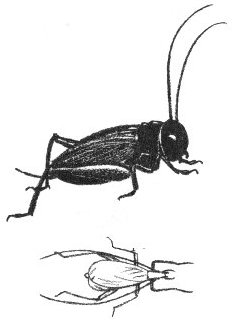
Crickets
(Gryllidae)
Antennae longer than body
Black or dark brown color
The commonest Cricket here is the Black Field Cricket (Acheta assimilis). The “singing” of the Cricket is produced by the male as he rubs his wings together. Of particular interest is the Snowy Tree Cricket (Oecanthus niveus), which chirps rhythmically. By counting the chirps in one minute and subtracting forty, then dividing this total by four and adding your new sum to fifty, you will have a rough estimate of the temperature in degrees Fahrenheit.
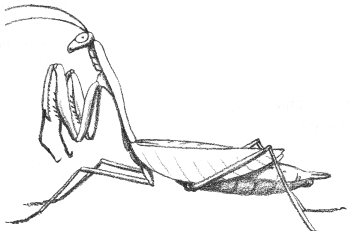
Praying Mantis
(Stagmomantis carolina)
Pale green color
Forefeet bent as though praying
Mantids were once rare in New England but in recent years seem to have been extending their range northward and are now quite common even in the grassy beach area. They are said to be the only insects that can look over their shoulders.
The Earwigs
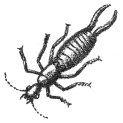
European Earwig
(Forficula auricularia)
Wings short, not half length of body
Two pincers on tail
The Earwig hides by day, coming out at night to feed on plant material. Since it does not bite with its pincers, it can be handled freely. Other species are occasionally found. The Seaside Earwig (Anisolabis maritima) is the largest New England earwig. It has more than twenty-four segments to its antennae, whereas the European has no more than fifteen.
38
The True Bugs
In common parlance, the term “bug” is usually applied to all insects. Actually the following group is the only one scientifically recognized as “bugs.” In all of them, half of the forewing is thickened and leather-like, and all of the mouth parts are designed to pierce their food.
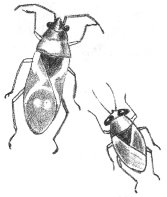
Lygaeid Bugs
(Lygaeidae)
Four sections to antenna
Antennae end in club shape
Very few veins in forewing
The most common member of this group is the Red-and-Black Milkweed Bug (Oncopeltus fasciatus), which feeds exclusively on Milkweed. A small insect (Geocoris) also belongs to this group. It has a hammer-shaped head and may be found beneath dried seaweed.
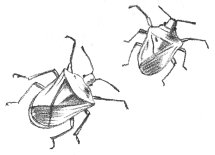
Stink Bugs
(Pentatomidae)
Broad, shield-shaped insect
There are many kinds of Stink Bugs, so named because of the disagreeable odor they emit when crushed. Some are brightly colored and are commonly found on the fleshy dune plants.
The Aphids and Scale Insects
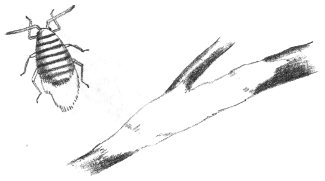
Woolly Alder Aphid
(Prociphilus tessellatus)
White, woolly mass on Alder or Maple tree
The Woolly Aphid is found only on Alder and Maple trees and may be recognized by its downy appearance. Although it feeds on the tree, it is never common enough to do any damage. The wool is a secretion of wax protecting the insect.
39
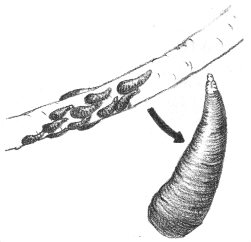
Oyster-shell Scale
(Lepidosaphes ulmi)
Tiny oyster-shell-shaped body covering
Attached to bark of tree (particularly Poplar and Birch)
You must look very carefully to discover one of these insects. The young Scales have legs and move about during the month of June. Then they settle down, lose their legs, and secrete a wax shell over their bodies. These Scales are extremely common at the beach, but only the careful observer is likely to see them.
The Golden-eyed Insects
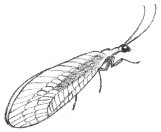
Common Lacewing
(Chrysopa, several species)
Delicate-green insect
Very large wings
Golden-colored eyes
In spite of its delicate shape, when caught the Lacewing emits an odor which has earned it the name “Stink Fly.” Its eggs are laid singly on long stalks because the young, called “aphid lions,” are cannibalistic.
Nature’s Insect Tanks: Beetles
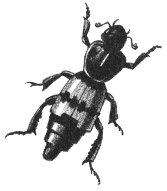
Carrion Beetles
(Silphidae)
Body is soft but horny
Five segments in antennae
Usually found near dead animals
The Carrion Beetles lay their eggs on a dead animal, which they bury as a food reserve for their young. This habit has given them the common name of “Burying Beetles.”
40
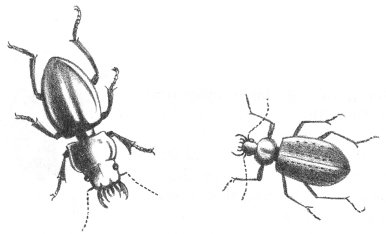
Ground Beetles
(Carabidae)
Dark brown or black
Head narrower than mid-body
Usually have prominent jaws
The legs of the Ground Beetle are designed for quick movement. These beetles are mostly active by night. They are beneficial because they eat other insects.
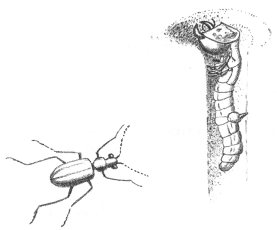
Tiger Beetles
(Cicindelidae)
Bright green or blue, metallic
Head broader than neck
Run and fly quickly
The adult feeds savagely on other insects, killing them with powerful jaws—which can also nip your finger. The larvae are called “doodlebugs” and live in upright burrows in the sand, allowing their jaws to extend above ground to capture unsuspecting prey.
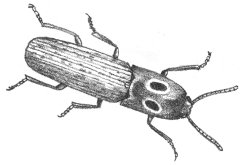
Click Beetles
(Elateridae)
When turned over, the insect snaps back upright
First body segment as broad as the last
Click Beetles are so named because of the resounding “click” they make when snapping up into the air after being overturned. The adults are strict vegetarians, so look for them on plants.
41
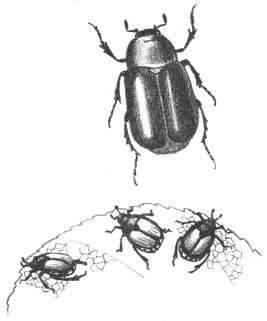
Scarab Beetles
(Scarabaeidae)
Large body, oval outline
Antennae terminate with fanlike segment
Body has “polished” finish
There are more than 1400 species in this group in the United States and more than 30,000 in the world. Two of the most common at the beach are:
May Beetle (Phyllophaga fusca): A large cylindrical brown body. Also called “June Bug,” in May and June it is frequently discovered at night flying to a light.
Japanese Beetle (Popillia japonica): The head and forebody are metallic green; the wings are copper color. Introduced from the Orient about fifty years ago, these beetles do great damage to many kinds of plants.
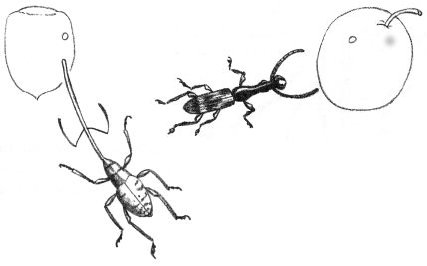
Snout Beetles or Weevils
(Curculionidae)
Small, roundish body
Dull, uninteresting color
Long tube (snout) on head
These are very common beetles on the dunes. Their long snout is used to drill into seeds and plant tissues. None of our species do great harm, but they have some unpleasant relatives—the Plum Curculio (Conotrachelus nenuphar) and the Cotton Boll Weevil (Anthonomus grandis).
42
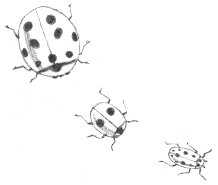
Ladybug Beetles
(Coccinellidae)
Hemispherical shape
Brightly colored
Many kinds of “Ladybug” or “Ladybird” Beetles can be found at the beach. Some feed on plants and others on small insects. The insect-eating varieties are extremely valuable.
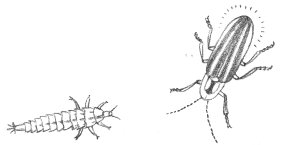
Fireflies
(Lampyridae)
A “tail light”
Elongated soft body
Head is not visible from above
The Firefly’s light is produced by the chemical reaction of a substance called luciferin. It is an almost perfect “cold” light, with practically no heat loss. The light is used to attract the opposite sex during mating. The larva of this beetle is the “glowworm.”
The Scaled-wing Insects: Butterflies and Moths
Butterflies may be identified by their threadlike antennae, which are club-shaped at the end; Moths usually have feathered antennae.
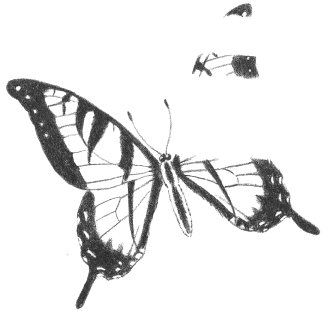
Swallowtails
(Papilionidae)
Large Butterflies
Tail-like extension on hind wings
The Tiger Swallowtail (Papilio ajax), with yellow and black wings, is the largest butterfly at the beach, and, indeed, the largest butterfly in America. In midsummer you may find one fluttering about flowering plants.
43
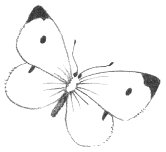
Cabbage and Sulphur Butterflies
(Pieridae)
Half-dollar size
White or orange wings
These butterflies are common wherever there is an open area such as the dunes. In other parts of the United States the caterpillars destroy great amounts of alfalfa and cabbage.
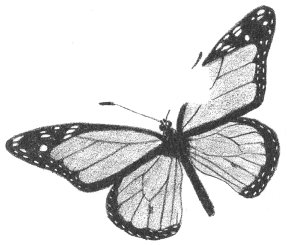
Milkweed Butterflies
(Danaidae)
Large size
Orange and black markings
The Monarch Butterfly (Danaus plexippus) is our most common species. Because of its bitter taste the birds won’t eat it.
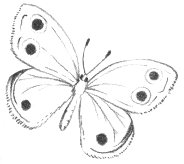
Wood Nymphs
(Satyridae)
Butterflies with two large “eye spots” in brown wings
Large wing veins are swollen at base
Nymphs are found from sea level to the mountain peaks. Look for them in the Pitch Pine woods behind the beach.
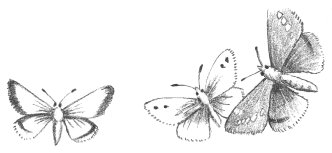
Skippers
(Hesperiidae)
Very hairy Butterflies, even wings
Erratic, skipping flight
The Skippers look much like Moths. Their crazy, zigzag flight helps identify them.
44
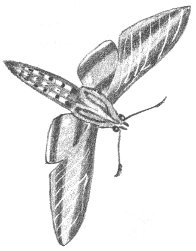
Sphinx Moths
(Sphingidae)
Sphinx Moths frequently have a five-inch wingspread and
are called “Hawk” or “Hummingbird” Moths.
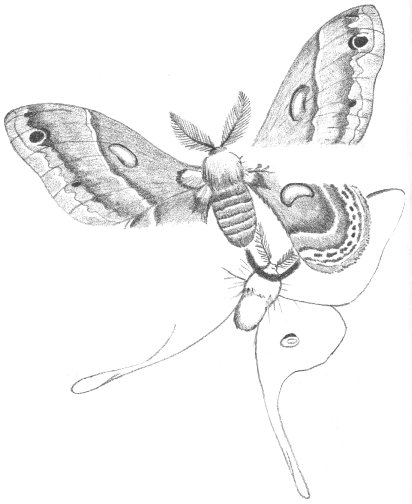
Saturnid Moths
(Saturniidae)
Very large, hairy moths
Large, feather-like antennae
Two species occur in our area:
Cecropia Moth (Samia cecropia): It is the largest moth in our area, having varying colors of brown and yellow.
Luna Moth (Tropaea luna): New England’s most beautiful moth, the Luna is pale green, with a brown leading edge on the forewing and a long tail-like extension from the hind wing.
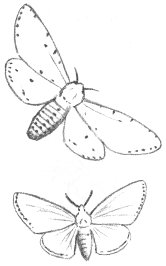
Tiger Moths
(Arctiinae)
Yellowish-brown body
Three rows of black spots on body
The larvae of these moths are the well-known “Woolly Bear” caterpillars that are covered with a dense coat of rusty-red and black hairs. They are not beneficial. Two common examples are:
Salt-marsh Caterpillar (Estigmene acrea): This caterpillar is covered with rose-colored hair. It feeds on practically every type of leaf in the fall.
Webworm (Hyphantria cunea): It covers the ground for several feet with its silky web. In large numbers, Webworms can denude a tree in short order. Periodic outbreaks of these “Soldier Worms” are common at the beach.
45
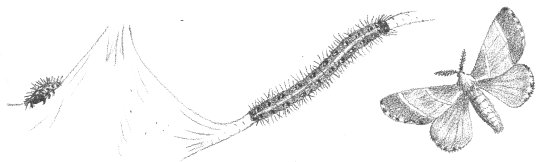
Eastern Tent Caterpillar
(Malacosoma americanum)
Adult moth is reddish brown
Extremely hairy, even on legs
The adult is less readily recognized than is the web home of these caterpillars. In the spring, the webs may be found on most of the Black Cherry trees in the area.
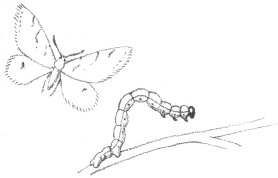
Measuringworms
(Geometridae)
Small gray or brown Moths
Margin of wings frilly or scalloped
The caterpillars of these moths are the famous “Inch-worms” which move along by arching the body to bring the tail up to the head, then throwing the head out as if measuring the inches with the body.
The Two-winged Insects: Flies and Mosquitoes
Flies differ from other insects in having only two wings (one pair). The second pair has degenerated into a tiny club-shaped structure that aids the Fly in keeping its balance.
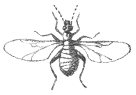
Biting Midges
(Certaopogonidae)
Minute size (usually felt rather than seen!)
Also called “No-see-ums” and “Sand Flies,” these tiny blood-sucking Flies are altogether too common at the beach. So small that they can pass through window screening, they are best discouraged with a liberal dose of insect repellent.
46
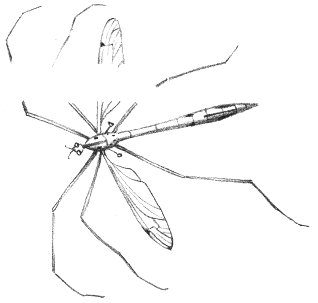
Crane Flies
(Tipulidae)
Resemble overgrown Mosquitoes
Extremely long, threadlike legs
Crane Flies are associated with the wet, swampy areas behind the beach. In spite of their mosquito-like shape, they can’t bite.
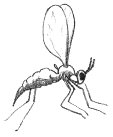
Gall Midges
(Cecidomyiidae)
Minute Flies with humpback
Antennae as long as body
The galls appear as unnatural swellings on plant stems or leaves. Each species of these flies has a specific-shaped gall, made on a specific type of plant, and at a specific place on the plant.
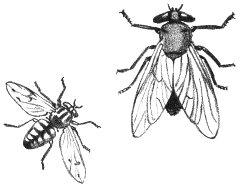
Horse and Deer Flies
(Tabanidae)
½″ to 1″ in length
Head is hemispherical in shape
Large eyes, occupy entire head
The mouth of these flies is designed to puncture the skin
and draw blood. They frequently are pests, with a special
fondness for bathers.
47
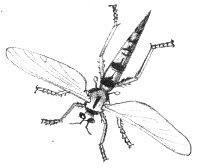
Robber Flies
(Asilidae)
Large flies
Hind body narrower than forebody
Head hollowed out between eyes
Robber Flies do not bother human beings but they attack other insects, often larger than themselves, in mid-air.
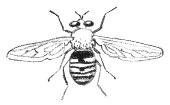
Syrphid Flies
(Syrphidae)
Large black-and-yellow-striped bodies
Superficially resemble bees
The Syrphids are constantly found among flowers and so are called “Flower Flies.” They are nearly as important as bees in pollination. All are harmless to us.
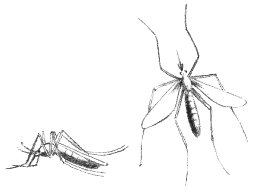
Mosquitoes
(Culicidae)
Small, long-legged insects
Threadlike antennae covered with whorls of hair
Only female Mosquitoes bite. They must have one meal of blood before they can lay eggs. We have eighteen species of Mosquitoes in our area.
48
The Ants, Wasps, and Bees
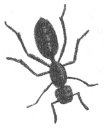
Ants
(Formicidae)
Small, usually wingless, insects
Extremely thin waist
Ants are social insects, and our species is found in large or small colonies everywhere. Ants are also the most common insect. Two readily recognized types are:
Carpenter Ant (Camponotus herculeanus pennsylvanicus): A large black ant that is found burrowing in damp wood. The labyrinth-like tunnels in rotten wood will aid you in finding a colony.
Mound Ant (Formica exsectoides): Produce the well-known “ant hills,” which may be six inches to a foot in diameter.
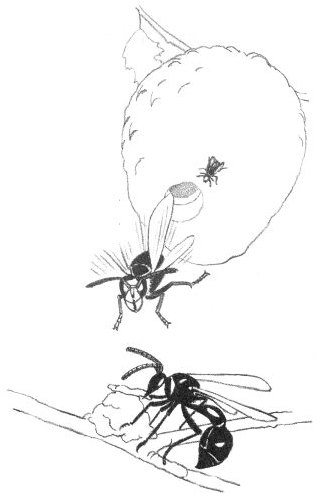
Hornets and Potter Wasps
(Vespidae)
Black or black and yellow, not furry, “Wasp-waisted”
Bald-faced Hornet (Vespula maculata): This is a black wasp with white markings. The distinctive nest is made of paper manufactured from wood pulp gathered by the insect from dead trees or old fence posts. At the end of the season, it may be as much as a foot or two in diameter. The only safe time to collect these nests is during the winter months!
Potter Wasp (Eumenes fraternus): The Potter Wasp constructs a “clay pot” on branches of trees, particularly Red Cedar, which it fills with paralyzed caterpillars as food for its young.
49
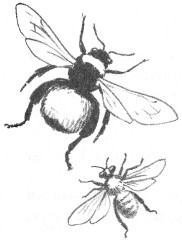
Bumble and Honey Bees
(Apidae)
Extremely hairy, woolly appearance
Hind legs flattened for pollen collection
Bumblebees (Bombus, species): Bumblebees are common visitors to flowers. Their heavy body seems much too bulky for flight. The bee makes its nest in old mouse nests on the ground and a careful search for such nests will generally result in discovery of a Bumblebee’s home.
Honey Bee (Apis mellifera): The well-known Honey Bee was brought to this country from Europe. It has now become a common “wild” bee as well as a domesticated species. You may find some wild-bee colonies in hollow trees, particularly on Castle Hill.
INSECT COLLECTING—AN INEXPENSIVE HOBBY
Insects are everywhere and it is easy to collect them. Practically no expense is required to produce a very beautiful collection. Some of the seaside insects are most unusual and not available elsewhere, so it would be well to start your collection right here. Some references that will help you are:
Donald J. Borror and Dwight M. DeLong, An Introduction to the Study of Insects. New York: Rinehart, 1954. $10.00
Alexander B. Klots and E. B. Klots, Living Insects of the World. New York: Doubleday, 1959. $9.95
Su Zan Noguchi Swain, Insects in Their World. New York: Garden City Books, 1955. $2.95
Herbert S. Zim and Clarence Cottam, Insects: A Guide to Familiar American Insects. Rev. ed. New York: Golden Press, 1956. Cloth $2.50, paper $1.00
50