Chapter 4 LIFE AT THE EDGE OF THE SEA
Reading edition
Everyone likes to be a beachcomber! And each passing tide exposes the secrets of the sea to those interested enough to take a closer look. Suppose that we examine this world which is revealed to us twice daily.
“WEEDS” OF THE SEA
The sea holds many strange plants that have taken on fantastic sizes and shapes because of their underwater environment. In spite of their size, these plants are usually among the most primitive—a simple sheet of cells. Such plants are called algae and are subdivided according to their colors.
The Brown Algae
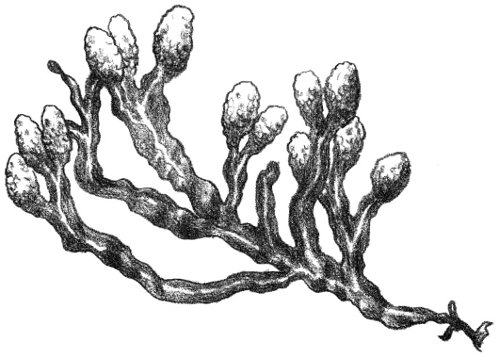
Common Rockweed
(Fucus, several species)
Brown, flattened body
Central midrib
Stem has air bladders
The bladders are filled with air, and children like to squeeze them to hear their pop. These bladders cause the plant to float upright, thus keeping all its sides in contact with water.
20
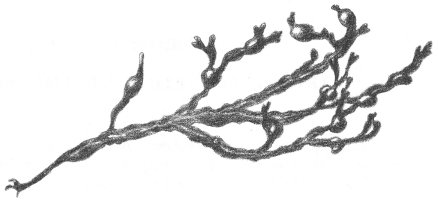
Nodose Rockweed
(Ascophyllum nodosum)
Thin, round stem
No central midrib
When dried by the sun, this plant makes an interesting and lasting souvenir, for it turns a lustrous black.
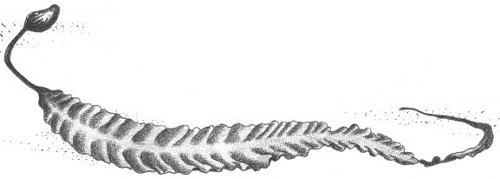
Common Kelp
(Laminaria agardhii)
Broad, flat blade
Several feet in length
The kelps of the Pacific grow several hundred feet in length, making them the largest of the algae and among the very largest plants.
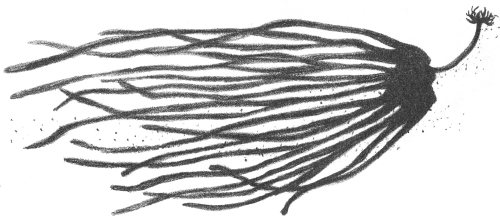
Fingered Kelp
(Laminaria digitata)
Many blades, extending like fingers on a hand
All kelps have a rootlike structure called a “holdfast” to serve as an anchor. Often tiny sea creatures dwell in among the holdfast. Why not take a look?
21
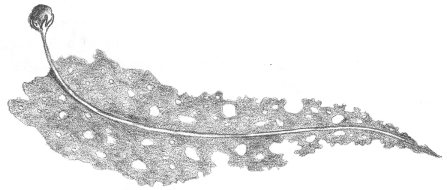
Perforated Kelp
(Agarum cribrosum)
Central midrib
Broad blade punctured with hundreds of holes
In Asia this kelp is farmed for food called agar. An extract of the plant, agar-agar, is used in the laboratory as a culture medium for bacteria and other disease-producing organisms.
The Green Algae
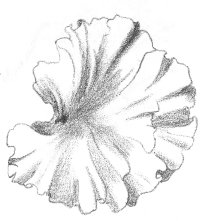
Sea Lettuce
(Ulva species)
A sheet of green
This is a very simple seaweed that reproduces itself by fragmentation, each fragment growing into a new plant. Two common kinds are found at Crane’s Beach:
Ulva lactuca, which is the broad green “leaf”; Ulva lanceolata, which is in thinner, more ribbon-like strips.
The Red Algae
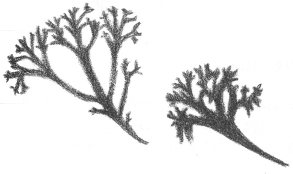
Irish Moss
(Chondrus crispus)
Flattened, branching fronds
Purple in life, white when sun-bleached
Here is a very common tidal plant that has commercial value. It is called “Dulse” on the Boston markets, and a very delicious pudding is prepared from it (seamoss farine). Why not take some home and try it?
22
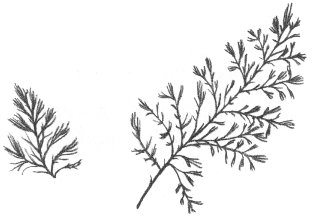
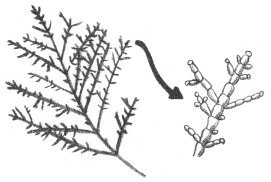
Polysiphonia
(Polysiphonia, several species)
Pink or red color
Branching, lace-like appearance
Sometimes called “Mermaid’s Hair,” these tiny plants are very common on the beach. There are many kinds of Polysiphonias, but a microscopic study is usually necessary to tell them apart.
Coralline Algae
(Coralline, several species)
White or pink limy covering
Appear jointed
These plants have the amazing ability of concentrating lime from the sea water and depositing it on their fronds, thus acquiring a stony, coral-like appearance.
ANIMALS OF THE SEA
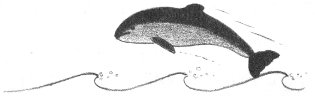
Animals, in a kaleidoscope of unbelievable sizes, shapes, and colors, abound here at the margin of the sea. Specializations range from the single-celled body of the zooplankton to the multicellular body of the Seals and the occasional Porpoise.
23
The Sponges
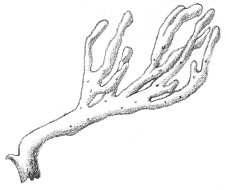
Finger Sponge
(Chalina oculata)
Brown or tan color
In colonies of fingerlike projections
The most common sponge on Crane’s Beach is the Finger Sponge. Even a small piece may be identified by the holes on its surface, through which the animal filtered water. The strange appearance of this sponge has given it the repulsive name of “Dead Men’s Fingers.”
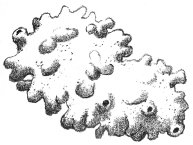
Crumb-of-Bread Sponge
(Halichondria panicea)
Pale green in life
Light tan or white when dried on beach
Crumbles easily
Only the most searching eye will discover this sponge, because it so closely resembles a dull uninteresting rock or pile of bread crumbs. When it has been freshly broken, it has a vile odor—a good clue to identification.
The Jelly-like Animals
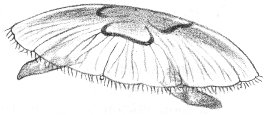
White Jellyfish
(Aurelia aurita)
Flattened body
Under 10″ in diameter
The tentacles dangling down from the underside of this jellyfish are covered with tiny stinging cells, which in this species do not penetrate human skin.
24
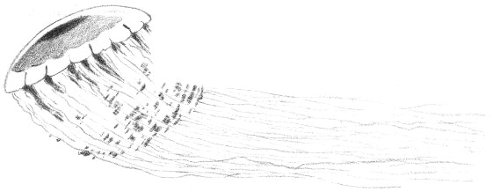
Pink or Red Jellyfish
(Cyanea capillata)
More than 10″ in diameter
Reddish center, yellowish sides
This jellyfish occasionally grows up to eight feet in diameter, with tentacles a hundred or more feet long. The stinging cells can painfully wound a swimmer, but you may examine a small jellyfish safely by placing your hand on the smooth dorsal surface and turning it over.
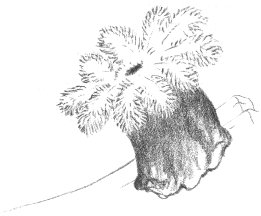
Sea Anemone
(Metridium dianthus)
Cylindrical, soft body
Tentacles at top give flower-like appearance
Generally very colorful
The “petals” of the Sea Anemone’s flower-like head are actually tentacles covered with stinging cells and used to stun its food. Generally found in the water at tide level, the Sea Anemone moves by walking on its single, base-like foot.
The Worms
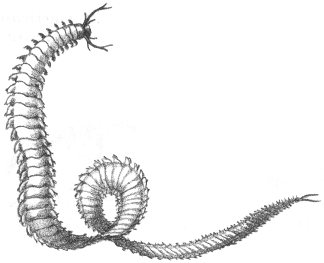
Clam Worm
(Nereis virens)
Jointed
One pair of paddle-like feet per segment
Two “tails”
Pinchers on the head (watch out!)
This is the best-known worm on the beach because of its desirability as fish bait. During the day it lives in its burrow in the sand, wandering forth at night and swimming about in the water, where it becomes easy prey for gulls and fishes. The skin is brilliantly iridescent in the sunlight.
25
The Crustaceans
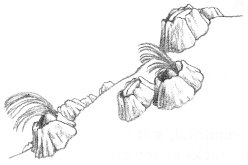
Common Barnacle
(Balanus balanolides)
Common on rocks and shellfish
White, volcano-shaped shell
Two “barn doors” at top
This animal goes through life standing on its head and kicking food into its mouth with its feet! When it is submerged in sea water you can see its shell doors open and its feather-like feet sweep the water for microscopic food organisms. The limy shell first suggests a relationship with the clam, but body structure shows it to be a closer relative of the crab.
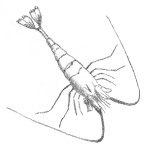
Shrimps
(Crago septemspinosus, the Sand Shrimp, and Palaemonetes vulgaris, the Prawn)
Hard, transparent shell
Long antennae
Paddle-like tail
These tiny tide-pool creatures look for all the world like the larger edible shrimp served in local restaurants. Actually, these miniature two-inch-long shrimps are edible also, and quite enjoyable if you have the time and patience to collect enough for a meal.
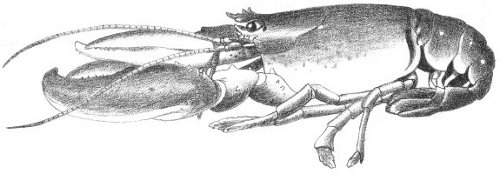
American Lobster
(Homarus americanus)
Bits and pieces of Lobster are frequently found on the beach, but seldom the entire animal. The Lobster inhabits deeper water and finds its way to shore only after losing a battle with one of its enemies. A favorable dining size is one or two pounds; however, Lobsters do attain weights up to forty pounds.
26
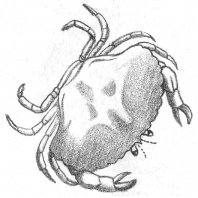
True Crabs
(Cancridae and Portunidae)
Football-shaped in cross section
Two large claws
Eyes mounted on stalks
The three very common True Crabs of Crane’s Beach may be found in one search of the tidal pools. They are:
Rock Crab (Cancer irroratus): A brick-red shell, somewhat granulated, with a black and yellowish undersurface.
Jonah Crab (Cancer borealis): Similar in color to the above, but its shell has a more sculptured surface.
Green Crab (Carcinides maenas): A greenish-colored shell. The last pair of legs end in sharp points, rather than being flattened like paddles.
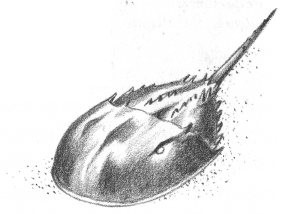
Horseshoe Crab
(Limulus polyphemus)
Shell with horseshoe-shaped outline
Long, sharply pointed tail
Two immovable compound eyes
The Horseshoe is not a Crab at all, but is more closely related to the spiders, mites, and scorpions. In spite of its relations, the Horseshoe is a harmless creature whose only protection is its hard shell. Therefore it may be examined freely—a strange “living fossil” that has survived 400,000,000 years of evolution with very little change.
The Mollusks
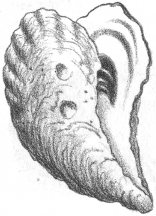
Oyster
(Ostrea virginica)
Mottled, unattractive shell
Gray splotches on inside surface
Even without pearls, our Oyster is worth many thousands of dollars a year to shellfish dealers because of its delicious flesh. Its tropical relatives are the pearl producers.
27
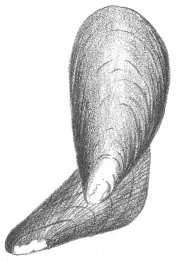
Mussels
(Mytilidae)
Blue-colored shells
Shells covered with black, horny skin
Living mussels are always found attached to rocks or pieces of wood by tiny threads of their own making. Two common mussels are:
Edible Mussel (Mytilus edulis): Smooth, velvety-blue shell identifies it. The animal within is edible and quite delicious. It is commonly utilized as food in Europe but less so here, where we have, and seem to prefer, the Oyster.
Ribbed Mussel (Modiolus demissus plicatulus): Similar to the above but with many distinct ribs radiating on the surface. The Ribbed Mussel is not considered edible. While not poisonous, it is most unpalatable.
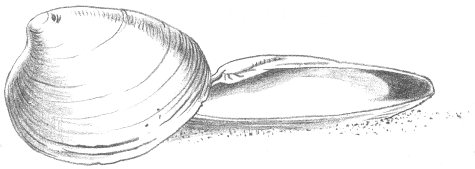
Hardshell Clam
(Venus mercenaria)
Thick, round shell
Purple blotches on inside surface
Also called “Quahog,” “Little Neck,” “Round Clam,” or “Cherrystone,” the Hardshell Clam is another highly prized seafood.
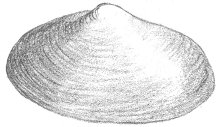
Edible Clam
(Mya arenaria)
Fragile shell with egg-shaped outline
Wing extending out from inside top of left half of shell
These clams are found just a foot or so under the sand, and their empty shells are common on the beaches. This is the Softshell Clam, which we enjoy steamed, baked, or fried, as well as in New England’s famous clambakes and clam chowders.
28
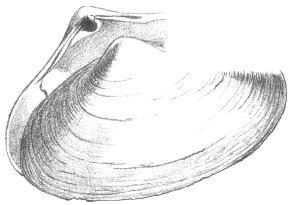
Surf Clam
(Spisula solidissima)
Very large shell
Spoon-shaped trough at inside top of shell
This is the largest clam on the Atlantic seaboard, growing up to about seven inches in length. It is edible, and just one or two make a large chowder. The shell makes a fine ashtray and an unusual and useful souvenir.
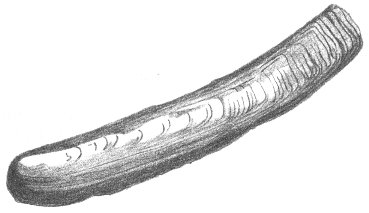
Razor Clam
(Ensis directus)
Elongated brown shell
The Razor has a very large foot, with which it can often dig faster than the hand trying to discover it. Although delicious, the Razor Clam is seldom seen on the markets because it is so difficult to capture.
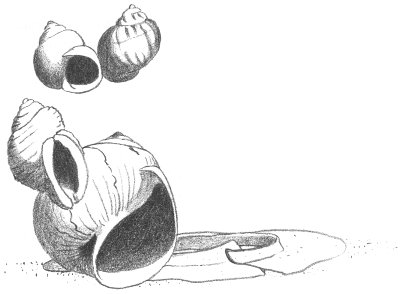
Snails
(Littorinidae, Thiasidae, and Naticidae)
Clams in a coiled shell
Several species are found at Crane’s Beach:
Periwinkles (Littorina): These have a wrinkled shell about the size of a thumbnail. Because they are able to withstand long periods without water, Periwinkles are often found high on a beach.
Rock Purple (Thais lapillus): Has a rough, white shell coming to a point at the top. This snail secretes a purplish dye that was used by the American Indians and the ancient Phoenicians to produce their “royal purple” dyes.
Moon Snail (Polinices heros): Large white shell with almost round shape. The Moon Snail lays its eggs in a sand “collar,” which is frequently discovered on the beach in its dry state.
29
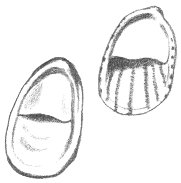
Slipper Shell
(Crepidula fornicata)
Shell is boat-shaped
Tiny “seat” inside shell
This animal protects its bare underside by attaching itself to a handy rock with its suction-cup foot. Often there are enough of them to give the rock a warted appearance.
The Spiny-skinned Animals (Echinoderms)
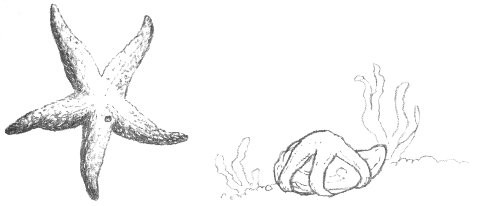
Starfishes
(Asterias vulgaris, and others)
Five-armed body
The Starfish seems to like Oysters as well as we do, and it opens them by sheer strength. Oystermen used to tear Starfish apart to destroy them, until they discovered that each arm has the ability to regenerate and become a whole starfish!
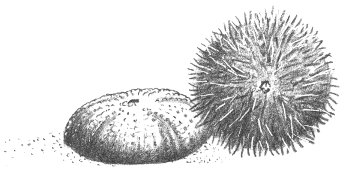
Sea Urchin
(Strongylocentrotus droehbachiensis)
Round body
Covered with spines
Here is a creature with a scientific name much too long for its size. Indeed, the name is said to be the longest in animal nomenclature. The Sea Urchin is a living fossil with four times as many extinct cousins as living ones.
30
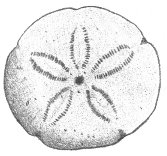
Sand Dollar
(Echinarachnius parma)
Silver-dollar size and shape
Raised, star-shaped pattern on back
This is an animal of deeper water and so the bather seldom sees a live, heavily spined specimen. We find the dry, spineless shells on the beach. Wrap them carefully if you wish to take them home, because they are most fragile.
The Fishes
The waters off Crane’s Beach abound with many dramatic fishes such as Cod, Mackerel, Flounder, and Sand Sharks; but we are concerned only with the common tidal fishes that are regularly washed onto the shore.
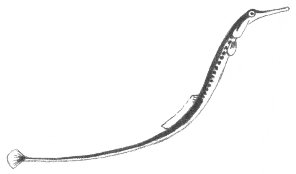
Pipefish
(Syngnathus fuscus)
Lead-pencil size and shape
Hard, bony plates cover body
One look at a Pipefish will convince you that it must be related to the Seahorse. It spawns late in the spring, the female laying her eggs in the pouch on the stomach of the male. The male carries these eggs kangaroo-fashion, until they hatch during the summer.
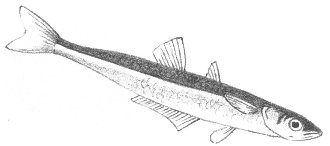
Silverside
(Menidia menidia)
Silver stripe running down a light side
These fish are also an important food item for the Gulls and Terns. Silversides run in schools of a hundred or more, which can be located by the flocks of birds gathered round overhead.
31
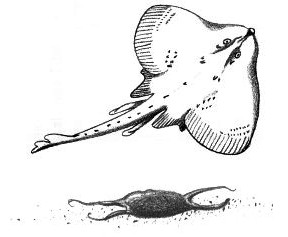
Skates
(Raja, several species)
Strange bat shape
Long ratlike tail
These are harmless fish resembling the dangerous Rays of the tropics, except for their habits. The egg cases of the Skate are rectangular, black, horny envelopes. They are commonly found on the beach, where they are called “mermaids’ purses.” If you find a fresh one and open it, you may discover a miniature Skate inside.
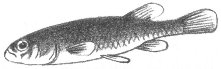
Killifish
(Fundulus heteroclitus)
Stout, olive-green fish
Rounded tail
The “Chub,” well known to fishermen, can live for a day covered only with a layer of damp seaweed. It does us a real service by feeding on the mosquito larvae in brackish water.
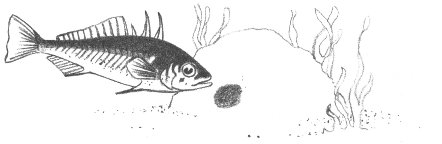
Sticklebacks
(Gasterosteus and Apeltes species)
Spines on the back
Very narrow base to tail
During the early summer months, the Stickleback builds a barrel-shaped nest, held together with gelatinous threads. After the eggs have been deposited, the male guards the nest with amazing vigor, considering his size.
32

Sand Lance
(Ammodytes americanus)
Knife-shaped body
Long dorsal fin (fin on back)
Protruding lower jaw
Thriving abundantly off the beach, the Sand Lance is an important item in the diet of shore birds.
FOR MORE INFORMED BEACHCOMBING
Thus begins our day of beachcombing. Every animal and plant of the sea has a tale to tell and some of the most exciting of all are found in this ribbon-like strip of water in the tidal wash.
For your further investigation, here is a list of reference books:
Charles M. Breder, Jr., Field Book of Marine Fishes of the Atlantic Coast. Rev. ed. New York: Putnam’s, 1948. $5.00
Ralph M. Buchsbaum, Animals without Backbones. Rev. ed. Chicago: University of Chicago Press, 1948. $8.00, text ed. $6.00
Rachel L. Carson, The Edge of the Sea. Boston: Houghton Mifflin, 1955. $3.95
Roy Waldo Miner, Field Book of Seashore Life. New York: Putnam’s, 1950. $7.00
Percy A. Morris, A Field Guide to the Shells of Our Atlantic and Gulf Coasts. Rev. ed. Boston: Houghton Mifflin, 1951. $3.95
Herbert S. Zim and Lester Ingle, Seashores: A Guide to Animals and Plants along the Beaches. New York: Golden Press, 1955. Cloth $2.50, paper $1.00
33