Volume 15 — THÉOPHILE GAUTIER
Reading edition
(1811-1872)
BY ROBERT SANDERSON

héophile Gautier was born in Tarbes (Department of the Hautes-Pyrénées) in Southern France, August 31st, 1811. Like all French boys, he was sent to the lycée (academy), where he promised to be a brilliant scholar; but his father was really his tutor, and to him Gautier attributed his instruction. Young Théophile showed marked preference for the so-called authors of the Decadence—Claudianus, Martial, Petronius, and others; also for the old French writers, especially Villon and Rabelais, whom he says he knew by heart. This is significant, in view of the young man's strong tendencies, later on, towards the new romantic school. The artistic temperament was very strong in him; and while still carrying on his studies at college he entered the painter Rioult's studio. His introduction to Victor Hugo in 1830 may be considered the decisive point in Gautier's career: from that day he gave up painting and became a fanatic admirer of the romantic leader.
Théophile Gautier
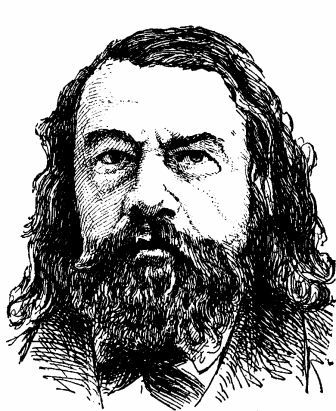
A short time afterwards, the first representation of 'Hernani' took place (February 25th, 1830), an important date in the life of Gautier. It was on this occasion that he put on for the only time that famous red waistcoat, which, with his long black mane streaming down his back, so horrified the staid Parisian bourgeois. This red waistcoat turns out, after all, not to have been a waistcoat at all, but a doublet; nor was it red, but pink. No truer is the legend, according to Gautier, that on this memorable occasion, armed with his two formidable fists, he felled right and left the terrified bourgeois. He says that he was at that time rather delicate, and had not yet developed that prodigious strength which later on enabled him to strike a 520-pound blow on a Turk's-head. In appearance Gautier was a large corpulent man with a leonine countenance, swarthy complexion, long black hair falling over his shoulders, black beard, and brilliant black eyes; an Oriental in looks as well as in some of his tastes. He had a passion for cats. His house was overrun by them, and he seldom wrote without having one on his lap. The privations he underwent during the siege of Paris, doubly hard to a man of Gautier's Gargantuesque appetite, no doubt hastened his death. He died on October 23d, 1872, of hypertrophy of the heart.
Gautier is one of those writers of whom one may say a vast deal of good and a vast deal of harm. His admirers think that justice has not been done him, that his fame will go on rising and his name will live as one of the great writers of France; others think that his name may perhaps not entirely disappear, but that if he is remembered at all it will be solely as the author of 'Émaux et Camées' (Enamels and Cameos). He wrote in his youth a book that did him great harm in the eyes of the public; but he has written something else besides 'Mademoiselle de Maupin,' and both in prose and poetry we shall find a good deal to admire in him. One thing is certain: he is a marvelous stylist. In his earliest poems Gautier already possesses that admirable artistic skill that prompts him to choose his words as a painter his colors, or a jeweler his gems and stones, so as to produce the most brilliant effects: these first compositions also have a grace, a charm, that we shall find lacking later on, for as he proceeds with his work he pays more and more attention to form and finish.
'Albertus, or Soul and Sin,' the closing poem of Gautier's first collection, is a "semi-diabolic, semi-fashionable" legend. An old witch, Veronica, a second Meg Merrilies, transforms herself into a beautiful maiden and makes love to Albertus, a young artist—otherwise Gautier himself. He cares for nothing but his art, but falls a victim to the spell cast over him by the siren. At the stroke of midnight, Veronica, to the young man's horror, from a beautiful woman changes back to the old hag she was, and carries him off to a place where witches, sorcerers, hobgoblins, harpies, ghouls, and other frightful creatures are holding a monstrous saturnalia; at the end of which, Albertus is left for dead in a ditch of the Appian Way with broken back and twisted neck. What does it all mean? the reader may ask. That "the wages of sin is death" seems to be the moral contained in this poem, if indeed any moral is intended at all. Be that as it may, 'Albertus' is a literary gem in its way; a work in which the poet has given free scope to his brilliant imagination, and showered by the handful the gems and jewels in his literary casket. Gautier may be said to have possessed the poetry of Death—some would say its horrors. This sentiment of horror at the repulsive manner of man's total destruction finds most vivid expression in 'The Comedy of Death,' a fantastic poem divided into two parts, 'Death in Life' and 'Life in Death.' The dialogue between the bride and the earth-worm is of a flesh-creeping nature.
It is however as the poet of 'Émaux et Camées' (Enamels and Cameos) that Théophile Gautier will be chiefly remembered. Every poem but one in this collection is written in short octosyllabic verse, and every one is what the title implies,—a precious stone, a chiseled gem. Gautier's wonderful and admirable talent for grouping together certain words that produce on one's eye and mind the effect of a beautiful picture, his intense love of art, of the outline, the plastic, appear throughout this work. You realize on reading 'Émaux et Camées,' more perhaps than in any other work by this writer, that the poet is fully conscious of his powers and knows just how to use them. Any poem may be selected at random, and will be found a work of art.
The same qualities that distinguish Gautier as a poet are to be found in his novels, narratives of travels, criticisms,—in short, in everything he wrote; intense love for the beautiful,—physically beautiful,—wonderful talent for describing it. Of his novels, properly speaking, there are four that stand out prominently, each very different in its subject,—a proof of Gautier's great versatility,—all perfect in their execution. The first is 'Mademoiselle de Maupin'; it is an immoral book, but it is a beautiful book, not only because written with a rare elegance of style, but also because it makes you love beauty. Briefly, 'Mademoiselle de Maupin' may be called a pæan to beauty, sung by its high priest Théophile Gautier.
The other remarkable novels by this writer are 'Le Capitaine Fracasse' (Captain Smash-All), 'Le Roman de la Momie' (The Romance of the Mummy), and 'Spirite.' 'Captain Fracasse,' although not published until 1863, had been announced long beforehand; and Gautier had worked at it, off and on, for twenty years. It belongs to that class of novel known as picaresque—romances of adventures and battles. 'Captain Fracasse' is certainly the most popular of Gautier's works.
'The Romance of the Mummy' is a very remarkable book, in which science and fiction have been blended in the most artistic and clever manner; picturesque, like all of Gautier's writings, but the work of a savant as well as of a novelist. Here more than in any other book by this author,—with the exception perhaps of 'Arria Marcella,'—Gautier has revived in a most lifelike way an entire civilization, so long extinct. 'The Romance of the Mummy' abounds in beautiful descriptions. The description of the finding of the mummy, that of the royal tombs, of Thebes with its hundred gates, the triumphal entrance of Pharaoh into that city, the crossing of the Red Sea by the Israelites, are all marvelous pictures, that not only fill the reader with the same admiration he would evince at the sight of a painting by one of the great masters, but give him the illusion of witnessing in the body the scenes so admirably described.
'Spirite,' a fantastic story, is a source of surprise to readers familiar with Gautier's other works: they find it hard to conceive that so thorough a materialist as Gautier could ever have produced a work so spiritualistic in its nature. The clever handling of a mystic subject, the richness and coloring of the descriptions, together with a certain ideal and poetical vein that runs through the book, make of 'Spirite' one of Gautier's most remarkable works.
Théophile Gautier has also written a number of nouvelles or short novels, and tales, some of which are striking compositions. 'Arria Marcella' is one of these; a brilliant, masterly composition, in which Gautier gives us such a perfect illusion of the past. Under his magic pen we find ourselves walking the streets of Pompeii and living over the life of the Romans in the first century of our era; and 'Une Nuit de Cléopâtre' (A Night with Cleopatra) is a vivid resurrection of the brilliant Egyptian court.
Of his various journeys to Spain, Italy, and the Orient, Gautier has given us the most captivating relations. To many this is not the least interesting portion of Gautier's work. The same qualities that are so striking in his poems and novels—vividness of description, love of the picturesque, wonderful power of expression—are likewise apparent in his relations of travels.
As a literary and especially as an art critic, Gautier ranks high. Bringing to this branch of literature the same qualities that distinguish him in others, he created a descriptive and picturesque method of criticism peculiarly his own. Of his innumerable articles on art and literature, some have been collected under the names of 'Les Grotesques,' a series of essays on a number of poets of the end of the sixteenth and first half of the seventeenth centuries, ridiculed by Boileau, but in whom Gautier finds some wheat among the chaff. The 'History of Dramatic Art in France for the Last Twenty-five Years,' beginning with the year 1837, will be consulted with great profit by those who are curious to follow the dramatic movement in that country. Of his essays on art, one is as excellent as the other; all the great masters are treated with a loving and admiring hand.
Among the miscellaneous works of this prolific writer should be mentioned 'Ménagerie Intime' (Home Menagerie), in which the author makes us acquainted in a most charming and familiar way with his home life, and the various pets, cats, dogs, white rats, parrots, etc., that in turn shared his house with him; la Nature chez elle (Nature at home), that none but a close observer of nature could have written.
The last book written by Gautier before his death was 'Tableaux de Siège' (Siege Pictures, 1871). The subjects are treated just in the way we might expect from such a writer, from a purely artistic point of view.
Gautier has written for the stage only short plays and ballets; but if all he ever wrote were published, his works would fill nearly three hundred volumes. In spite of the quantity and quality of his books, the French Academy did not open her doors to him; but no more did it to Molière, Beaumarchais, Balzac, and many others. Opinions still vary greatly as to Théophile Gautier's literary merits; but his brilliant descriptive powers, his eminent qualities as a stylist, together with the influence he exercised over contemporary letters as the introducer of the plastic in literature, would seem sufficient to rank him among the great writers of France.

THE ENTRY OF PHARAOH INTO THEBES
From 'The Romance of a Mummy'
At length their chariot reached the manœuvring-ground, an immense inclosure, carefully leveled, used for splendid military displays. Terraces, one above the other, which must have employed for years the thirty nations led away into slavery, formed a frame en relief for the gigantic parallelogram; sloping walls built of crude bricks lined these terraces; their tops were covered, several rows deep, by hundreds of thousands of Egyptians, whose white or brightly colored costumes blazed in the sun with that perpetually restless movement which characterizes a multitude, even when it appears motionless; behind this line of spectators the cars, chariots, and litters, with their drivers, grooms, and slaves, looked like the encampment of an emigrating nation, such was their immense number; for Thebes, the marvel of the ancient world, counted more inhabitants than did some kingdoms.
The fine, even sand of the vast arena, bordered with a million heads, gleamed like mica dust beneath the light, falling from a sky as blue as the enamel on the statuettes of Osiris. On the south side of the field the terraces were broken, making way for a road which stretched towards Upper Ethiopia, the whole length of the Libyan chain. In the corresponding corner, the opening in the massive brick walls prolonged the roads to the Rhamses-Maïamoun palace....
A frightful uproar, rumbling, deep, and mighty as that of an approaching sea, arose in the distance and drowned the thousand murmurs of the crowd, like the roar of the lion which hushes the barking of the jackals. Soon the noise of instruments of music could be distinguished amidst this terrestrial thunder, produced by the chariot wheels and the rhythmic pace of the foot-soldiers. A sort of reddish cloud, like that raised by the desert blasts, filled the sky in that direction, yet the wind had gone down; there was not a breath of air, and the smallest branches of the palm-trees hung motionless, as if they had been carved on a granite capital; not a hair moved on the women's moist foreheads, and the fluted streamers of their head-dresses hung loosely down their backs. This powdery fog was caused by the marching army, and hung over it like a fallow cloud.
The tumult increases; the whirlwinds of dust opened, and the first files of musicians entered the immense arena, to the great satisfaction of the multitude, who in spite of its respect for his Majesty were beginning to tire of waiting beneath a sun which would have melted any other skulls than those of the Egyptians.
The advance guard of musicians halted for several instants; colleges of priests, deputations of the principal inhabitants of Thebes, crossed the manœuvring-ground to meet the Pharaoh, and arranged themselves in a row in postures of the most profound respect, in such manner as to give free passage to the procession.
The band, which alone was a small army, consisted of drums, tabors, trumpets, and sistras.
The first squad passed, blowing a deafening blast upon their short clarions of polished brass, which shone like gold. Each of these trumpeters carried a second horn under his arm, as if the instrument might grow weary sooner than the man. The costume of these men consisted of a short tunic, fastened by a sash with ends falling in front; a small band, in which were stuck two ostrich feathers hanging over on either side, bound their thick hair. These plumes, so worn, recalled to mind the antennae of scarabæi, and gave the wearers an odd look of being insects.
The drummers, clothed in a simple gathered skirt, and naked to the waist, beat the onagra-skin heads of their rounded drums with sycamore-wood drumsticks, their instruments suspended by leathern shoulder-belts, and observed the time which a drum-major marked for them by repeatedly turning towards them and clapping his hands.
After the drummers came the sistra-players, who shook their instruments by a quick, abrupt motion, and made at measured intervals the metal links ring on the four bronze bars.
The tabor-players carried their oblong instruments crosswise, held up by a scarf passed around the neck, and struck the lightly stretched parchment with both hands.
Each company of musicians numbered at least two hundred men; but the hurricane of noise produced by trumpets, drums, tabors, and sistras, and which would have drawn blood from the ears inside a palace, was none too loud or too unbearable beneath the vast cupola of heaven, in the midst of this immense open space, amongst this buzzing crowd, at the head of this army which would baffle nomenclators, and which was now advancing with a roar as of great waters.
And was it too much to have eight hundred musicians preceding a Pharaoh who was the best loved of Ammon-Ra, represented by colossal statues of basalt and granite sixty cubits high, whose name was written in cartouches on imperishable monuments, and his history painted and sculptured and painted on the walls of the hypostyle chambers, on the sides of pylons, in interminable bas-reliefs, in frescoes without end? Was it indeed too much for a king who could raise a hundred conquered races by the hair of their heads, and from his high throne corrected the nations with his whip; for a living sun burning their dazzled eyes; for a god, almost eternal?
After the musicians came the barbarian captives, strangely formed, with brutish faces, black skins, woolly hair, resembling apes as much as men, and dressed in the costume of their country, a short skirt above the hips, held by a single brace, embroidered in different colors.
An ingenious and whimsical cruelty had suggested the way in which the prisoners were chained. Some were bound with their elbows drawn behind their backs; others with their hands lifted above their heads, in a still more painful position; one had his wrists fastened in wooden cangs (instruments of torture, still used in China); another was half strangled in a sort of pillory; or a chain of them were linked together by the same rope, each victim having a knot round his neck. It seemed as if those who had bound these unfortunates had found a pleasure in forcing them into unnatural positions; and they advanced before their conqueror with awkward and tottering gait, rolling their large eyes and contorted with pain.
Guards walked beside them, regulating their step by beating them with staves.
Tawny women, with long flowing hair, carrying their children in ragged strips of cloth bound about their foreheads, came behind them; bent, covered with shame, exhibiting their naked squalor and deformity: a wretched company, devoted to the most degrading uses.
Others, young and beautiful, with lighter skin, their arms encircled by broad ivory bracelets, their ears pulled down by large metal discs, were enveloped in long tunics with wide sleeves, an embroidered hem around the neck, and falling in small flat folds to their ankles, upon which anklets rattled. Poor girls, torn from country, family, perhaps lovers, smiling through their tears! For the power of beauty is boundless; strangeness gives rise to caprice; and perhaps the royal favor awaited one of these barbarian captives in the depths of the gynæceum.
They were accompanied by soldiers who kept away the crowd.
The standard-bearers came next, lifting high the gilded staves of their flags, representing mystic baris, sacred hawks, heads of Hathor crowned with ostrich plumes, winged ibexes, inscriptions embellished with the King's name, crocodiles, and other religious or warlike emblems. Long white streamers, spotted with black, were tied to these standards, and floated gracefully with every motion. At sight of the standards announcing the appearance of Pharaoh, the deputations of priests and notables raised towards him their supplicating hands, or let them hang, palm outwards, against their knees. Some even prostrated themselves, with elbows pressed to their sides, their faces in the dust, in attitudes of absolute submission and profound adoration. The spectators waved their large palm-leaves in every direction.
A herald, or reader, holding in one hand a roll covered with hieroglyphics, came forward quite alone between the standard-bearers and the incense-bearers who preceded the King's litter.
He proclaimed in a loud voice, resounding as a brass trumpet, the victories of the Pharaoh; he recounted the results of the different battles, the number of captives and war chariots taken from the enemy, the amount of plunder, the measures of gold dust, and the elephant's tusks, the ostrich feathers, the masses of fragrant gum, the giraffes, lions, panthers, and other rare animals; he mentioned the names of the barbarian chiefs killed by the javelins or the arrows of his Majesty, Aroëris, the all-powerful, the loved of the gods.
At each announcement the people sent up an immense cry, and from the top of the slopes strewed the conqueror's path with long green palm-branches they held in their hands.
At last the Pharaoh appeared!
Priests, turning towards him at regular intervals, stretched out their amschiras to him, first throwing incense on the coals blazing in the little bronze cup, holding them by a handle formed like a sceptre, with the head of some sacred animal at the other end; they walked backwards respectfully, while the fragrant blue smoke ascended to the nostrils of the triumpher, apparently as indifferent to these honors as a divinity of bronze or basalt.
Twelve oëris, or military chiefs, their heads covered by a light helmet surrounded by ostrich feathers, naked to the waist, their loins enveloped in a narrow skirt with stiff folds, their targes suspended from the front of their belts, supported a sort of huge shield, on which rested the Pharaoh's throne. It was a chair, with arms and legs in the form of a lion, high-backed, with large full cushion, adorned on the sides with a kind of trellis-work of pink and blue flowers; the arms, legs, moldings of the seat were gilded, and the parts which were not, flamed with bright colors.
On either side of the litter, four fan-bearers waved enormous semicircular fans, fixed to gilded staves; two priests held aloft a large richly decorated horn of plenty, from which fell bunches of enormous lotus blooms. The Pharaoh wore a mitre-like helmet, cut out to make room for the ear, and brought down over the back of the neck to protect it. On the blue ground of the helmet scintillated a quantity of dots like the eyes of birds, made of three circles, black, white, and red; a scarlet and yellow border ran along the edge, and the symbolic viper, twisting its golden coils at the back, stood erect above the royal forehead; two long curled feathers, purple in color, floated over his shoulders, and completed his majestically elegant head-dress.
A wide gorget, with seven rows of enamels, precious stones, and golden beads, fell over the Pharaoh's chest and gleamed brightly in the sunlight. His upper garment was a sort of loose shirt, with pink and black squares; the ends, lengthening into narrow slips, were wound several times about his bust and bound it closely; the sleeves, cut short near the shoulder, and bordered with intersecting lines of gold, red, and blue, exposed his round, strong arms, the left furnished with a large metal wristband, meant to lessen the vibration of the string when he discharged an arrow from his triangular bow; and the right, ornamented by a bracelet in the form of a serpent in several coils, held a long gold sceptre with a lotus bud at the end. The rest of his body was wrapped in drapery of the finest linen, minutely plaited, bound about the waist by a belt inlaid with small enamel and gold plates. Between the band and the belt his torso appeared, shining and polished like pink granite shaped by a cunning workman. Sandals with returned toes, like skates, shod his long narrow feet, placed together like those of the gods on the temple walls.
His smooth beardless face, with large clearly cut features, which it seemed beyond any human power to disturb, and which the blood of common life did not color, with its death-like pallor, sealed lips, enormous eyes enlarged with black lines, the lids no more lowered than those of the sacred hawk, inspired by its very immobility a feeling of respectful fear. One might have thought that these fixed eyes were searching for eternity and the Infinite; they never seemed to rest on surrounding objects. The satiety of pleasures, the surfeit of wishes satisfied as soon as expressed, the isolation of a demigod who has no equal among mortals, the disgust for perpetual adoration, and as it were the weariness of continual triumph, had forever frozen this face, implacably gentle and of granite serenity. Osiris judging the souls could not have had a more majestic and calm expression.
A large tame lion, lying by his side, stretched out its enormous paws like a sphinx on its pedestal, and blinked its yellow eyes.
A rope, attached to the litter, bound the war chariots of the vanquished chiefs to the Pharaoh. He dragged them behind him like animals in leash. These men, with fierce despairing faces, their elbows drawn together by a strap and forming an ungraceful angle, tottered awkwardly at every motion of the chariots, driven by Egyptians.
Next came the chariots of the young princes royal, drawn by thoroughbred horses, elegantly and nobly formed, with slender legs, sinewy houghs, their manes cut short like a brush, harnessed by twos, tossing their red-plumed heads, with metal-bossed headstalls and frontlets. A curved pole, upheld on their withers, covered with scarlet panels, two collars surmounted by balls of polished brass, bound together by a light yoke bent like a bow with upturned ends; a bellyband and breastband elaborately stitched and embroidered, and rich housings with red or blue stripes and fringed with tassels, completed this strong, graceful, and light harness.
The body of the chariot, painted red and white, ornamented with bronze plaques and half-spheres, something like the umbo of the shields, was flanked with two large quivers placed diagonally opposite each other, one filled with arrows and the other with javelins. On the front of each, a carved, gilded lion, with set paws, and muzzle wrinkled into a frightful grin, seemed ready to spring with a roar upon the enemy.
The young princes had their hair bound with a narrow band, in which the royal viper was twisted; their only garment was a tunic gaudily embroidered at the neck and sleeves, and held in at the waist by a belt of black leather, clasped with a metal plate engraved with hieroglyphics. In this belt was a long dagger, with triangular brass blade, the handle channeled crosswise, terminated by a hawk's head.
In the chariot, by the side of each prince, stood the charioteer, who drove it in battle, and the groom, whose business it was to ward off with the shield the blows aimed at the combatant, while the latter discharged the arrows or threw the javelins which he took from the quivers on either side of the car.
In the wake of the princes followed the chariots, the Egyptian cavalry, twenty thousand in number, each drawn by two horses and holding three men. They advanced ten in a line, the axletrees perilously near together, but never coming in contact with each other, so great was the address of the drivers.
Several lighter chariots, used for skirmishing and reconnoitring, marched at the head and carried one warrior only, who in order to leave his hands free for fighting wound the reins around his body: by bending to the right or the left, or backwards, he guided or stopped his horses; and it was really wonderful to see the noble animals, apparently left to themselves, but governed by imperceptible movements, keep up an undisturbedly regular pace....
The stamping of the horses, held in with difficulty, the thundering of the bronze-covered wheels, the metallic clash of weapons, gave to this line something formidable and imposing enough to raise terror in the most intrepid bosoms. The helmets, plumes, and breastplates dotted with red, green, and yellow, the gilded bows and brass swords, glittered and blazed terribly in the light of the sun, open in the sky, above the Libyan chain, like a great Osirian eye; and it was felt that the onslaught of such an army must sweep away the nations like a whirlwind which drives a light straw before it.
Beneath these innumerable wheels the earth resounded and trembled, as if it had been moved by some convulsion of nature.
To the chariots succeeded the battalions of infantry, marching in order, their shields on the left arm; in the right hand the lance, curved club, bow, sling, or axe, according as they were armed; the heads of these soldiers were covered with helmets, adorned with two horsehair tails, their bodies girded with a cuirass belt of crocodile skin. Their impassible look, the perfect regularity of their movements, their reddish copper complexions, deepened by a recent expedition to the burning regions of Upper Ethiopia, their clothing powdered with the desert sand, they awoke admiration by their discipline and courage. With soldiers like these, Egypt could conquer the world. After them came the allied troops, recognizable from the outlandish form of their head-pieces, which looked like truncated mitres, or were surmounted by crescents spitted on sharp points. Their wide-bladed swords and jagged axes must have produced wounds which could not be healed.
Slaves carried on their shoulders or on barrows the spoils enumerated by the herald, and wild-beast tamers dragged behind them leashed panthers, cheetahs, crouching down as if trying to hide themselves, ostriches fluttering their wings, giraffes which overtopped the crowd by the entire length of their necks, and even brown bears,—taken, they said, in the Mountains of the Moon.
The procession was still passing, long after the King had entered his palace.
FROM 'THE MARSH'
It is a pond, whose sleepy water Lies stagnant, covered with a mantle Of lily pads and rushes. . . . Under the creeping duck-weed The wild ducks dip Their sapphire necks glazed with gold; At dawn the teal is seen bathing, And when twilight reigns, It settles between two rushes and sleeps.
FROM 'THE DRAGON-FLY'
Upon the heather sprinkled With morning dew; Upon the wild-rose bush; Upon the shady trees; Upon the hedges Growing along the path; Upon the modest and dainty Daisy, That droops its dreamy brow; Upon the rye, like a green billow Unrolled By the winged caprice of the wind, The dragon-fly gently rocks.
THE DOVES
On the hill-side, yonder where are the graves, A fine palm-tree, like a green plume, Stands with head erect; in the evening the doves Come to nestle under its cover. But in the morning they leave the branches; Like a spreading necklace, they may be seen Scattering in the blue air, perfectly white, And settling farther upon some roof. My soul is the tree where every eve, as they, White swarms of mad visions Fall from heaven, with fluttering wings, To fly away with the first rays.
THE POT OF FLOWERS
Sometimes a child finds a small seed, And at once, delighted with its bright colors, To plant it he takes a porcelain jar Adorned with blue dragons and strange flowers. He goes away. The root, snake-like, stretches, Breaks through the earth, blooms, becomes a shrub; Each day, farther down, it sinks its fibrous foot, Until it bursts the sides of the vessel. The child returns: surprised, he sees the rich plant Over the vase's débris brandishing its green spikes; He wants to pull it out, but the stem is stubborn. The child persists, and tears his fingers with the pointed arrows. Thus grew love in my simple heart; I believed I sowed but a spring flower; 'Tis a large aloe, whose root breaks The porcelain vase with the brilliant figures.
PRAYER
As a guardian angel, take me under your wing; Deign to stoop and put out, smiling, Your maternal hand to my little hand To support my steps and keep me from falling! For Jesus the sweet Master, with celestial love, Suffered little children to come to him; As an indulgent parent, he submitted to their caresses And played with them without showing weariness. O you who resemble those church pictures Where one sees, on a gold background, august Charity Preserving from hunger, preserving from cold, A fair and smiling group sheltered in her folds; Like the nursling of the Divine mother, For pity's sake, lift me to your lap; Protect me, poor young girl, alone, an orphan, Whose only hope is in God, whose only hope is in you!
THE POET AND THE CROWD
One day the plain said to the idle mountain:— Nothing ever grows upon thy wind-beaten brow! To the poet, bending thoughtful over his lyre, The crowd also said:—Dreamer, of what use art thou? Full of wrath, the mountain answered the plain:— It is I who make the harvests grow upon thy soil; I temper the breath of the noon sun, I stop in the skies the clouds as they fly by. With my fingers I knead the snow into avalanches, In my crucible I dissolve the crystals of glaciers, And I pour out, from the tip of my white breasts, In long silver threads, the nourishing streams.
The poet, in his turn, answered the crowd:— Allow my pale brow to rest upon my hand. Have I not from my side, from which runs out my soul, Made a spring gush to slake men's thirst?
THE FIRST SMILE OF SPRING
While to their perverse work Men run panting, March that laughs, in spite of showers, Quietly gets Spring ready. For the little daisies, Slyly, when all sleep, He irons little collars And chisels gold studs. Through the orchard and the vineyard, He goes, cunning hair-dresser, With a swan-puff, And powders snow-white the almond-tree. Nature rests in her bed; He goes down to the garden And laces the rosebuds In their green velvet corsets. While composing solfeggios That he sings in a low tone to the blackbirds, He strews the meadows with snowdrops And the woods with violets. By the side of the cress in the brook Where drinks the stag, with listening ear, With his concealed hand he scatters The silver bells of the lilies of the valley.
Then, when his work is done And his reign about to end, On the threshold of April, turning his head, He says, Spring, you may come!
THE VETERANS
From 'The Old Guard'
The thing is worth considering; Three ghosts of old veterans In the uniform of the Old Guard, With two shadows of hussars! Since the supreme battle One has grown thin, the other stout; The coat once made to fit them Is either too loose or too tight. Don't laugh, comrade; But rather bow low To these Achilles of an Iliad That Homer would not have invented. Their faces with the swarthy skin Speak of Egypt with the burning sun, And the snows of Russia Still powder their white hair. If their joints are stiff, it is because on the battle-field Flags were their only blankets: And if their sleeves don't fit, It is because a cannon-ball took off their arm.