Volume 15 — JAMES ANTHONY FROUDE
Reading edition
(1818-1894)
BY CHARLES FREDERICK JOHNSON

ames Anthony Froude, English historian and essayist, was born April 23d, 1818, and died October 20th, 1894. His father was a clergyman, and the son was sent to Westminster School and to Oriel College, Oxford. In 1842 he became a fellow of Exeter, and two years later he was ordained a deacon; an office which he did not formally lay down until many years later, although his earliest publications, 'Shadows of the Clouds' and 'Nemesis of Faith,' showed that he had come to hold—and what perhaps is more to the point, dared to express,—views hardly compatible with the character of a docile and unreasoning neophyte.
J. A. Froude
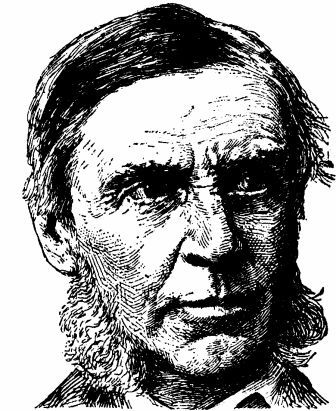
These books were severely censured by the authorities, and cost him—to the great benefit of the world—an appointment he had received of teacher in Tasmania. He resigned his fellowship and took up the profession of letters, writing much for Fraser and the Westminster, and becoming for a short period the editor of the former. His magnum opus is his 'History of England from the Fall of Wolsey to the Defeat of the Spanish Armada,' in twelve volumes, from 1856 to 1870. His other principal publications are—'The English in Ireland in the Eighteenth Century' (1874); 'Cæsar' (1879); 'Bunyan' (1880); 'Thomas Carlyle (first forty years of his life)' (1882); 'Life in London' (1884); 'Short Studies on Great Subjects' (1882, four series); 'The Two Chiefs of Dunboy' (1889); 'The English in the West Indies' (1889); 'The Divorce of Catharine of Aragon' (1892); 'The Life and Letters of Erasmus' (1892); 'English Seamen in the Sixteenth Century' (1892); and 'The Council of Trent.' 'Shadows of the Clouds,' 'The Nemesis of Faith,' and 'The Two Chiefs of Dunboy' are in the form of fiction; and though they—especially the last—contain some charming descriptive passages, and evince some of Froude's power of character sketching, they serve on the whole to prove that he was not a novelist. The fortunes of his group of people are of less absorbing interest to him than questions of social and racial ethics. There is nothing more annoying than to have an essayist stand behind a story-teller and interrupt him from time to time with acute philosophical comments on ultimate causes. The characters of Morty and Sylvester Sullivan are admirably contrasted Celtic types, but both they and the English Colonel Goring are a trifle stagy and stiff in their joints. The murders of the two chiefs, Morty Sullivan and Colonel Goring, are dramatically told; but Froude's deficient sense of humor, at least of that quality of humor which gives a subtle sense of congruity, results in an attempt to combine the elements of the tale and the didactic society in impossible proportions. He is an essayist and historian, not a novel-writer.
Froude stands before the English-reading public prominent in three characteristics: First, as a technical prose artist, in which regard he is entitled to be classed with Ruskin, Newman, and Pater; less enthusiastic and elaborately ornamental than the first, less musically and delicately fallacious than the second, and less self-conscious and phrase-caressing than the third, but carrying a solider burden of thought than all three. Second, as a historian of the modern school, which aims by reading the original records to produce an independent view of historical periods. Third, as the most clear-sighted and broad-minded of those whose position near the centre of the Oxford movement and intimacy with the principal actors gave them an insight into its inner nature.
There can be but one opinion of Froude as a master of English. In some of his early work there are traces of the manner of Macaulay in the succession of short assertive sentences, most of which an ordinary writer would group as limiting clauses about the main assertion. This method gives a false appearance of vigor and definiteness; it makes easy reading by relieving the mind from the necessity of weighing the modifying propositions: but it is entirely unadapted to nice modulations of thought. Froude very soon avoided the vices of Macaulayism, and attained a narrative style which must be regarded as the best in an age which has paid more attention than any other to the art of telling a story. In descriptive historical narrative he is unrivaled, because he is profoundly impressed not only with the dramatic qualities but with the real significance of a scene; unlike Macaulay, to whom the superficial theatrical elements appeal. A reading of Macaulay's description of the trial of Warren Hastings, and Froude's narrative of the killing of Thomas Becket or of the execution of Mary Queen of Scots, will bring out at once Froude's radical superiority in both conception and execution.
This is not the place to debate the question of Froude's historical accuracy, further than to remark that he was an industrious reader of historical documents, and by nature a seeker after the truth. If a profound conviction of the harmfulness of ecclesiasticism colored the light with which he illuminated the records of the past, we must remember that history is at best largely the impressions of historians; and that if it be true that Froude does present one side, it is the side on which the warnings to posterity are most distinctly inscribed. A reading of the controversy between Froude and Freeman in the calmer light of the present leads to the conclusion that the suppressio veri with which Froude was charged is not a suggestio falsi, but an artistic selection of the characteristic. He felt a certain contempt for the minute and meaningless fidelity to the record, which is not writing history but editing documents. He possessed, too, among his other literary powers, the rare one of being able to individualize the man whose life he studies and of presenting the character so as to be consistent and human. This power fills his history and sketch with rare personalities. Thomas Becket, Henry III., Henry VIII., Queen Catharine, Mary Queen of Scots, and Elizabeth, are more than historical portraits in the ordinary sense: they are conceptions of individuals, vivified by the artistic sense. Whether or not they are true to the originals as reflected in the contemporary documents, they are at least human possibilities, and therefore truer than the distorted automata that lie in state on the pages of some historians. A human character is so exceedingly complex and so delicately balanced with contradictory elements, that it is probable that no two persons ever estimate it exactly alike. Besides, prominent historical personages become in the popular imagination invested with exaggerated attributes, and it is not likely that men will ever agree even as to which of them was the hero and which the villain of the drama. It was to be expected that Froude should be violently assailed by those who accepted a traditional view of Henry VIII. and of Mary. It was inevitable that he should differ from them, because he had more than a view: he had a conception. His historical personages are certainly possibilities, because they are human, and the traditional figures are either monsters or saints; and humanity—at least Teutonic humanity—does not produce unadulterated saints nor unrelieved monsters.
While Froude's historical work has been criticized for lack of minute accuracy in details, his books on Carlyle have been criticized for the opposite fault of quoting too fully and literally; from letters and journals, matter never intended for the public, and of a nature not only to wound living persons but to create an erroneous impression of the writer. The habit of expressing himself in pithy and pungent personalities seems to have been with Carlyle a sort of intellectual exercise, and should not necessarily be taken as an index of morose ill-temper. A very delicate literary tact was necessary to his literary executor, in selecting from the matter put in his hands that which would combine to make a true picture of a crude and powerful genius without making him appear to the ordinary reader a selfish, willful man. Froude's idea of the duty of an editor of contemporary biography seems to have been that it was limited to careful publication of all the available material as mémoires pour servir. Such miscellaneous printing may in the end serve truth, but at the time it arouses resentment. It resulted, however, in the production of a book far preferable to the non-committal, evasive, destructively laudatory biography of a public man, of which every year brings a new specimen. It is at least honest, if not tactful.
Froude's early connection with the Oxford movement and his work on the Lives of the Saints first called his attention to the study of historical documents, and to the large amount of fiction with which truth is diluted in them. His further researches among the authorities recently made accessible, for the history of the destruction of the monasteries, impressed on him the fact that an assumption of spiritual authority is as dangerous to those who assume it as to those over whom it is assumed, exactly as physical slavery is in the end as harmful to the masters as it is to the slaves. He saw that ecclesiasticism had been profoundly hostile to morals, and he judged the present by the past till he really believed that the precious fruits of the Reformation would be lost if the ritualists obtained control of the Church. He persuaded himself that under such influence—
"Civilization would ebb, the great moral lights be extinguished, Over the world would creep an unintelligent darkness Under which men would be portioned anew 'twixt the priest and the soldier."
It is perhaps too much to expect of a man of the imaginative temperament of Froude, to whom the abominations of the Church from the twelfth to the sixteenth century were as real as if he had witnessed them, to retain judicial calmness under the vituperation with which he was assailed; but his profound distrust of the mediæval Church certainly does give an air of partisanship to his strictures on its modern ineffectual revival. He forgot that great principles of justice and toleration are now so embodied in law and fixed in the hearts of the English-speaking people that society is protected, and the evils of spiritual tyranny are restricted to the few who are willing to abase their intellects to it; that the corroding evil of conventual life is minimized by healthy outside influences; and that the most advanced modern ritualist would prove too good a Christian to light an auto da fé. It was but natural that he should forget this, for he was a strong man in the centre of the conflict, and independence was the core of his being.
This strength of independence is shown by the fact that though young, and profoundly sensitive to the attraction of a character like Newman's, he was from the first able to resist the fascination which that remarkable man exerted over all with whom he came in contact. The pure spiritual nature possesses a mysterious power over young men, so great that they often yield to its counterfeit. Newman was the true priest, and Froude recognized his genius and that his soul was "an adumbration of the Divine." But he felt instinctively the radical unsoundness of Newman's thought, and "would not follow, though an angel led." Others fell off for prudential reasons; but Froude was indifferent to these, and obedient to a conviction the strength of which must be estimated by the depth of his feeling for character.
Froude was sometimes criticized for writing history under the influence of personal feeling. It is difficult to see how a readable history can be written except by one who at least takes an interest in the story; but whether capacity for feeling makes a man a less trustworthy historian, depends upon how far this emotional susceptibility is controlled by intellectual insight and just views of the laws under which society develops. That Froude was an absolutely perfect historian, no one would claim: he was too intensely human to be perfect. It is safe to say that the perfect historian will not exist until Shakespeare and Bacon reappear combined in one man. For the great historian must be both scholar and artist. As scholar he must possess, too, both the acquisitive and the organizing intellect. He must both gather facts and interpret them. He must have the artistic sense which selects from the vast mass of fact that which is significant. This power of artistic selection is of course influenced by his unconscious ideals, by his conception of the relative importance of the forces which move mankind, and of the ultimate goal of progress. His philosophy directs his art, and his art interprets in the light of his philosophy.
It may be admitted that Froude possesses a larger share of the artistic than of the philosophic qualities necessary to the great historian. At times his hatred of ecclesiasticism becomes almost a prejudice. In his writings on Irish and colonial questions he evinces the Englishman's love of the right, but sometimes, unfortunately, the Englishman's inability to do justice to other races in points which distinguish them from his own. In some expressions he seems to distrust democracy in much the same unreasoning way in which Mr. Ruskin distrusts machinery. He had imbibed something of Mr. Carlyle's belief in the "strong man"; though he, no more than Carlyle, can show how the strong, just ruler can be produced or selected. But a more serious deficiency in Froude's philosophy arises from his imperfect conception of the method of evolution which governs all organizations, civil and religious, so that they continually throw off short-lived varieties and history becomes a continual giving way of the old order to the new. To fear, as Froude seems to, lest a survival may become a governing type, is as unreasonable as to fear that old men will live forever. Certainly he would have taken a juster, saner view of the English Reformation, had he been convinced that all the collisions between the moral laws and the rebellious wills of men, which are the burden of the years, are in the end obliterated in the slow onward movement of the race; but then perhaps his history would have lost in interest what it might have gained in philosophic breadth and balance. For it cannot be denied that feeling has given his narrative that most valuable quality—life.
The general recognition of Froude's power, and the growing conviction that he was far nearer right than the theological school he so cordially detested, was vindicated by his appointment as Professor of History at Oxford to succeed Freeman, one of the severest critics of his historical fairness. He lived to deliver but three courses of lectures, one of which has been published in that delightful volume 'The Life and Letters of Erasmus.' The others, 'English Seamen of the XVIth Century,' 'Lectures on the Council of Trent,' and the very able paper on Job in 'Short Studies on Great Subjects,' even if taken by themselves, would cause us to form a high opinion of the scope and range of Froude's powers. Those to whom brilliancy is synonymous with unsoundness may perhaps continue to call him merely a "brilliant writer"; but the general verdict will be that his brilliancy is the structural adornment of a well-fitted framework of thought.
THE GROWTH OF ENGLAND'S NAVY
From 'English Seamen in the Sixteenth Century'
Jean Paul the German poet said that God had given to France the empire of the land, to England the empire of the sea, and to his own country the empire of the air. The world has changed since Jean Paul's days. The wings of France have been clipped: the German Empire has become a solid thing: but England still holds her watery dominion; Britannia does still rule the waves, and in this proud position she has spread the English race over the globe; she is peopling new Englands at the Antipodes; she has made her Queen Empress of India; and is in fact the very considerable phenomenon in the social and political world which all acknowledge her to be. And all this she has achieved in the course of three centuries, entirely in consequence of her predominance as an ocean power. Take away her merchant fleets, take away the navy that guards them,—her empire will come to an end, her colonies will fall off like leaves from a withered tree, and Britain will become once more an insignificant island in the North Sea, for the future students in Australian and New Zealand universities to discuss the fate of in their debating societies.
How the English navy came to hold so extraordinary a position is worth reflecting on. Much has been written on it, but little, as it seems to me, which touches the heart of the matter. We are shown the power of our country growing and expanding. But how it grew; why, after a sleep of so many hundred years, the genius of our Scandinavian forefathers suddenly sprang again into life,—of this we are left without explanation.
The beginning was undoubtedly the defeat of the Spanish Armada in 1588. Down to that time the sea sovereignty belonged to the Spaniards, and had been fairly won by them. The conquest of Granada had stimulated and elevated the Spanish character. The subjects of Ferdinand and Isabella, of Charles V., and Philip II., were extraordinary men and accomplished extraordinary things. They stretched the limits of the known world; they conquered Mexico and Peru; they planted their colonies over the South-American continent; they took possession of the great West-Indian islands, and with so firm a grasp that Cuba at least will never lose the mark of the hand which seized it. They built their cities as if for eternity. They spread to the Indian Ocean, and gave their monarch's name to the Philippines. All this they accomplished in half a century, and as it were, they did it with a single hand; with the other they were fighting Moors and Turks, and protecting the coasts of the Mediterranean from the corsairs of Tunis and Constantinople.
They had risen on the crest of the wave, and with their proud Non Sufficit Orbis were looking for new worlds to conquer, at a time when the bark of the English water-dogs had scarcely been heard beyond their own fishing grounds, and the largest merchant vessel sailing from the port of London was scarce bigger than a modern coasting collier. And yet within the space of a single ordinary life these insignificant islanders had struck the sceptre from the Spaniards' grasp and placed the ocean crown on the brow of their own sovereign. How did it come about? What Cadmus had sown dragons' teeth in the furrows of the sea, for the race to spring from who manned the ships of Queen Elizabeth, who carried the flag of their own country round the globe, and challenged and fought the Spaniards on their own coasts and in their own harbors?
The English sea power was the legitimate child of the Reformation. It grew, as I shall show you, directly out of the new despised Protestantism. Matthew Parker and Bishop Jewell, the judicious Hooker himself, excellent men as they were, would have written and preached to small purpose without Sir Francis Drake's cannon to play an accompaniment to their teaching. And again, Drake's cannon would not have roared so loudly and so widely, without seamen already trained in heart and hand to work his ships and level his artillery. It was to the superior seamanship, the superior quality of English ships and crews, that the Spaniards attributed their defeat. Where did these ships come from? Where and how did these mariners learn their trade? Historians talk enthusiastically of the national spirit of a people rising with a united heart to repel the invader, and so on. But national spirit could not extemporize a fleet, or produce trained officers and sailors to match the conquerors of Lepanto. One slight observation I must make here at starting, and certainly with no invidious purpose. It has been said confidently,—it has been repeated, I believe, by all modern writers,—that the Spanish invasion suspended in England the quarrels of creed, and united Protestants and Roman Catholics in defense of their Queen and country. They remind us especially that Lord Howard of Effingham, who was Elizabeth's admiral, was himself a Roman Catholic. But was it so? The Earl of Arundel, the head of the House of Howard, was a Roman Catholic, and he was in the Tower praying for the success of Medina Sidonia. Lord Howard of Effingham was no more a Roman Catholic than—I hope I am not taking away their character—than the present Archbishop of Canterbury or the Bishop of London. He was a Catholic, but an English Catholic, as those reverend prelates are. Roman Catholic he could not possibly have been, nor any one who on that great occasion was found on the side of Elizabeth. A Roman Catholic is one who acknowledges the Roman Bishop's authority. The Pope had excommunicated Elizabeth, had pronounced her deposed, had absolved her subjects from their allegiance and forbidden them to fight for her. No Englishman who fought on that great occasion for English liberty was, or could have been, in communion with Rome. Loose statements of this kind, lightly made, fall in with the modern humor. They are caught up, applauded, repeated, and pass unquestioned into history. It is time to correct them a little.
THE DEATH OF COLONEL GORING
From 'Two Chiefs of Dunboy'
Fatally mistaking what was intended for a friendly warning, the colonel conceived that there was some one in the forge whom the smith wanted to conceal.
"I may return or not," he said; "but I must first have a word with these strangers of yours. We can meet as friends for once, with nothing to dispute over."
Minahan made no further attempt to prevent him from going in. If gentlemen chose to have their quarrels, he muttered between his teeth, it was no business of his.
Goring pushed open the door and entered. By the dim light—for the shutter that had been thrown back had been closed again, and the only light came from a window in the roof—he made out three figures standing together at the further end of the forge, in one of whom, though he tried to conceal himself, he instantly recognized his visitor of the previous evening.
"You here, my man?" he said. "You left my house two hours ago. Why are you not on your way home?"
Sylvester, seeing he was discovered, turned his face full round, and in a voice quietly insolent, replied, "I fell in with some friends of mine on the road. We had a little business together, and it is good luck that has brought your honor to us while we are talking, for the jintlemen here have a word or two they would like to be saying to ye, colonel, before ye leave them."
"To me!" said Goring, turning from Sylvester to the two figures, whose faces were still covered by their cloaks. "If these gentlemen are what I suppose them to be, I am glad to meet them, and will hear willingly what they may have to say."
"Perhaps less willingly than you think, Colonel Goring," said the taller of the two, who rose and stepped behind him to the door, which he closed and barred. Goring, looking at him with some surprise, saw that he was the person whom he had met on the mountains, and had afterwards seen at the funeral at Derreen. The third man rose from a bench on which he had been leaning, lifted his cap, and said:—
"There is an old proverb, sir, that short accounts make long friends. There can be no friendship between you and me, but the account between us is of very old standing. I have returned to Ireland, only for a short stay; I am about to leave it, never to come back. A gentleman and a soldier, like yourself, cannot wish that I should go while that account is still unsettled. Our fortunate meeting here this morning provides us with an opportunity."
It was Morty's voice that he heard, and Morty's face that he saw as he became accustomed to the gloom. He looked again at the pretended messenger from the carded curate, and he then remembered the old Sylvester who had brought the note from Lord Fitzmaurice to the agent from Kenmare. In an instant the meaning of the whole situation flashed across him. It was no casual re-encounter. He had been enticed into the place where he found himself, with some sinister and perhaps deadly purpose. A strange fatality had forced him again and again into collision with the man of whose ancestral lands he had come into possession. Once more, by a deliberate and treacherous contrivance, he and the chief of the O'Sullivans had been brought face to face together, and he was alone, without a friend within call of him; unless his tenant, who as he could now see had intended to give him warning, would interfere further in his defense. And of this he knew Ireland well enough to be aware that there was little hope.
He supposed that they intended to murder him. The door, at which he involuntarily glanced, was fastened by this time with iron bolts. He was a man of great personal strength and activity, but in such a situation neither would be likely to avail him. Long inured to danger, and ready at all moments to meet whatever peril might threaten him, he calmly faced his adversary and said:—
"This meeting is not accidental, as you would have me believe. You have contrived it. Explain yourself further."
"Colonel Goring," said Morty Sullivan, "you will recall the circumstances under which we last parted. Enemy as you are and always have been to me and mine, I will do you the justice to say that on that occasion you behaved like a gentleman and a man of courage. But our quarrel was not fought out. Persons present interfered between us. We are now alone, and can complete what was then left unfinished."
"Whether I did well or ill, sir," the colonel answered, "in giving you the satisfaction which you demanded of me at the time you speak of, I will not now say. But I tell you that the only relations which can exist between us at present are those between a magistrate and a criminal who has forfeited his life. If you mean to murder me, you can do it; you have me at advantage. You can thus add one more to the list of villainies with which you have stained an honorable name. If you mean that I owe you a reparation for personal injuries, such as the customs of Ireland allow one gentleman to require from another, this, as you well know, is not the way to ask for it. But I acknowledge no such right. When I last encountered you I but partly knew you. I now know you altogether. You have been a pirate on the high seas. Your letters of marque do not cover you, for you are a subject of the King, and have broken your allegiance. Such as you are, you stand outside the pale of honorable men, and I should degrade the uniform I wear if I were to stoop to measure arms with you."
The sallow olive of Morty's cheek turned livid. He clutched the bench before him, till the muscles of his hands stood out like knots of rope.
"You are in my power, colonel," he said: "do not tempt me too far. If my sins have been many, my wrongs are more. It must be this or worse. One word from me, and you are a dead man."
He laid four pistols on the smith's tool-chest. "Take a pair of them," he said. "They are loaded alike. Take which you please. Let us stand on the opposite sides of this hovel, and so make an end. If I fall, I swear on my soul you shall have no hurt from any of my people. My friend Connell is an officer of mine, but he holds a commission besides in the Irish Brigade. There is no better-born gentleman in Kerry. His presence here is your sufficient security. You shall return to Dunboy as safe from harm as if you had the Viceroy's body-guard about you, or your own boat's crew that shot down my poor fellows at Glengariff. To this I pledge you my honor."
"Your honor!" said Goring; "your honor! And you tempted me here by a lying tale, sent by the lips of yonder skulking rascal. That alone, sir, were there nothing else, would have sufficed to show what you are."
A significant click caught the ear of both the speakers. Looking round, they saw Sylvester had cocked a pistol.
"Drop that," said Morty, "or by God! kinsman of mine though you be, I will drive a bullet through the brain of you. Enough of this, sir," he said, turning to Goring. "Time passes, and this scene must end. I would have arranged it otherwise, but you yourself know that by this way alone I could have brought you to the meeting. Take the pistols, I say, or by the bones of my ancestors that lie buried under Dunboy Castle yonder, I will call in my men from outside, and they shall strip you bare, and score such marks on you as the quartermaster leaves on the slaves that you hire to fight your battles. Prince Charles will laugh when I tell him in Paris how I served one at least of the hounds that chased him at Culloden."
The forge in which this scene was going on was perfectly familiar to Goring, for he had himself designed it and built it. There was the ordinary broad open front to the road, constructed of timber, which was completely shut. The rest of the building was of stone, and in the wall at the back there was a small door leading into a field, and thence into the country. Could this door be opened, there was a chance, though but a faint one, of escape. A bar lay across, but of no great thickness. The staple into which it ran was slight. A vigorous blow might shatter both.
Sylvester caught the direction of Goring's eye, caught its meaning, and threw himself in the way. The colonel snatched a heavy hammer which stood against the wall. With the suddenness of an electric flash he struck Sylvester on the shoulder, broke his collar-bone, and hurled him back senseless, doubled over the anvil. A second stroke, catching the bar in the middle, shattered it in two, and the door hung upon the latch. Morty and Connell, neither of whom had intended foul play, hesitated, and in another moment Goring would have been free and away. Connell, recovering himself, sprang forward and closed with him. The colonel, who had been the most accomplished wrestler of his regiment, whirled him round, flung him with a heavy fall on the floor, and had his hand on the latch when, half stunned as he was, Connell recovered his feet, drew a skene, and rushed at Colonel Goring again. So sudden it all was, so swift the struggle, and so dim the light, that from the other end it was hard to see what was happening. Wrenching the skene out of Connell's hands, and with the hot spirit of battle in him, Colonel Goring was on the point of driving it into his assailant's side.
"Shoot, Morty! shoot, or I am a dead man!" Connell cried.
Morty, startled and uncertain what to do, had mechanically snatched up a pistol when Sylvester was struck down. He raised his hand at Connell's cry. It shook from excitement, and locked together as the two figures were, he was as likely to hit friend as foe. Again Connell called, and Morty fired and missed; and the mark of the bullet is still shown in the wall of the smithy as a sacred reminiscence of a fight for Irish liberty. The second shot went true to its mark. Connell had been beaten down, though unwounded, and Goring's tall form stood out above him in clear view. This time Morty's hand did not fail him. A shiver passed through Goring's limbs. His arms dropped. He staggered back against the door, and the door yielded, and he fell upon the ground outside. But it was not to rise and fly. The ball had struck him clean above the ear, and buried itself in the brain. He was dead.
SCIENTIFIC METHOD APPLIED TO HISTORY
From 'Short Studies on Great Subjects'
Historical facts can only be verified by the skeptical and the inquiring, and skepticism and inquiry nip like a black frost the eager credulity in which legendary biographies took their rise. You can watch such stories as they grew in the congenial soil of belief. The great saints of the fifth, sixth, and seventh centuries, who converted Europe to Christianity, were as modest and unpretending as true, genuine men always are. They claimed no miraculous powers for themselves. Miracles might have been worked in the days of their fathers. They for their own parts relied on nothing but the natural powers of persuasion and example. Their companions, who knew them personally in life, were only a little more extravagant. Miracles and portents vary in an inverse ratio with the distance of time. St. Patrick is absolutely silent about his own conjuring performances. He told his followers, perhaps, that he had been moved by his good angel to devote himself to the conversion of Ireland. The angel of metaphor becomes in the next generation an actual seraph. On a rock in the county of Down there is, or was, a singular mark, representing rudely the outline of a foot. From that rock, where the young Patrick was feeding his master's sheep, a writer of the sixth century tells us that the angel Victor sprang back to heaven after delivering his message, and left behind him the imprinted witness of his august visit. Another hundred years pass, and legends from Hegesippus are imported into the life of the Irish apostle. St. Patrick and the Druid enchanter contend before King Leogaire on Tara Hill, as Simon Magus and St. Peter contended before the Emperor Nero. Again a century, and we are in a world of wonders where every human lineament is lost. St. Patrick, when a boy of twelve, lights a fire with icicles; when he comes to Ireland he floats thither upon an altar-stone which Pope Celestine had blessed for him. He conjures a Welsh marauder into a wolf, makes a goat cry out in the stomach of a thief who had stolen him, and restores dead men to life, not once or twice but twenty times. The wonders with which the atmosphere is charged gravitate towards the largest concrete figure which is moving in the middle of them, till at last, as Gibbon says, the sixty-six lives of St. Patrick which were extant in the twelfth century must have contained at least as many thousand lies. And yet of conscious lying there was very little; perhaps nothing at all. The biographers wrote in good faith and were industrious collectors of material, only their notions of probability were radically different from ours. The more marvelous a story, the less credit we give to it; warned by experience of carelessness, credulity, and fraud, we disbelieve everything for which we cannot find contemporary evidence, and from the value of that evidence we subtract whatever may be due to prevalent opinion or superstition. To the mediæval writer, the more stupendous the miracle the more likely it was to be true; he believed everything which he could not prove to be false, and proof was not external testimony, but inherent fitness.
So much for the second period of what is called human history. In the first or mythological there is no historical groundwork at all. In the next or heroic we have accounts of real persons, but handed down to us by writers to whom the past was a world of marvels, whose delight was to dwell upon the mighty works which had been done in the old times, whose object was to elevate into superhuman proportions the figures of the illustrious men who had distinguished themselves as apostles or warriors. They thus appear to us like their portraits in stained-glass windows, represented rather in a transcendental condition of beatitude than in the modest and checkered colors of real life. We see them not as they were, but as they appeared to an adoring imagination, and in a costume of which we can only affirm with certainty that it was never worn by any child of Adam on this plain, prosaic earth. For facts as facts there is as yet no appreciation; they are shifted to and fro, dropped out of sight, or magnified, or transferred from owner to owner,—manipulated to suit or decorate a preconceived and brilliant idea. We are still in the domain of poetry, where the canons of the art require fidelity to general principles, and allow free play to fancy in details. The Virgins of Raphael are no less beautiful as paintings, no less masterpieces of workmanship, though in no single feature either of face or form or costume they resemble the historical mother of Christ, or even resemble one another.
At the next stage we pass with the chroniclers into history proper. The chronicler is not a poet like his predecessor. He does not shape out consistent pictures with a beginning, a middle, and an end. He is a narrator of events, and he connects them together on a chronological string. He professes to be relating facts. He is not idealizing, he is not singing the praises of the heroes of the sword or the crosier; he means to be true in the literal and commonplace sense of that ambiguous word. And yet in his earlier phases, take him in what part of the world we please,—take him in ancient Egypt or Assyria, in Greece or in Rome, or in modern Europe,—he is but a step in advance of his predecessor. He is excellent company. He never moralizes, never bores you with philosophy of history or political economy. He never speculates about causes. But on the other hand, he is uncritical. He takes unsuspectingly the materials which he finds ready to his hand,—the national ballads, the romances, and the biographies. He transfers to his pages whatever catches his fancy. The more picturesque an anecdote, the more unhesitatingly he writes it down, though in the same proportion it is the less likely to be authentic. Romulus and Remus suckled by the wolf; Curtius jumping into the gulf; our English Alfred spoiling the cakes; or Bruce watching the leap of the spider,—stories of this kind he relates with the same simplicity with which he records the birth in his own day, in some outlandish village, of a child with two heads, or the appearance of the sea-serpent or the flying dragon. Thus the chronicle, however charming, is often nothing but poetry taken literally and translated into prose. It grows, however, and improves insensibly with the growth of the nation. Like the drama, it develops from poor beginnings into the loftiest art, and becomes at last perhaps the very best kind of historical writing which has yet been produced. Herodotus and Livy, Froissart and Hall and Holinshed, are as great in their own departments as Sophocles or Terence or Shakespeare. We are not yet entirely clear of portents and prodigies. Superstition clings to us as our shadow, and is to be found in the wisest as well as the weakest. The Romans, the most practical people that ever lived,—a people so pre-eminently effective that they have printed their character indelibly into the constitution of Europe,—these Romans, at the very time they were making themselves the world's masters, allowed themselves to be influenced in the most important affairs of State by a want of appetite in the sacred chickens, or the color of the entrails of a calf. Take him at his best, man is a great fool. It is likely enough that we ourselves habitually say and practice things which a thousand years hence will seem not a jot less absurd. Cato tells us that the Roman augurs could not look one another in the face without laughing; and I have heard that bishops in some parts of the world betray sometimes analogous misgivings.
In able and candid minds, however, stuff of this kind is tolerably harmless, and was never more innocent than in the case of the first great historian of Greece. Herodotus was a man of vast natural powers. Inspired by a splendid subject, and born at the most favorable time, he grew to manhood surrounded by the heroes of Marathon and Salamis and Platæa. The wonders of Egypt and Assyria were for the first time thrown open to the inspection of strangers. The gloss of novelty was not yet worn off, and the impressions falling fresh on an eager, cultivated, but essentially simple and healthy mind, there were qualities and conditions combined which produced one of the most delightful books which was ever written. He was an intense patriot; and he was unvexed with theories, political or moral. His philosophy was like Shakespeare's,—a calm, intelligent insight into human things. He had no views of his own, which the fortunes of Greece or other countries were to be manipulated to illustrate. The world as he saw it was a well-made, altogether promising and interesting world; and his object was to relate what he had seen and what he had heard and learnt, faithfully and accurately. His temperament was rather believing than skeptical; but he was not idly credulous. He can be critical when occasion requires. He distinguishes always between what he had seen with his own eyes and what others told him. He uses his judgment freely, and sets his readers on their guard against uncertain evidence. And there is not a book existing which contains in the same space so much important truth,—truth which survives the sharpest test that modern discoveries can apply to it.
The same may be said in a slightly less degree of Livy and of the best of the late European chroniclers: you have the same freshness, the same vivid perception of external life, the same absence of what philosophers call subjectivity,—the projection into the narrative of the writer's own personality, his opinions, thoughts, and theories. Still, in all of them, however vivid, however vigorous the representation, there is a vein of fiction largely and perhaps consciously intermingled. In a modern work of history, when a statesman is introduced as making a speech, the writer at any rate supposes that such a speech was actually made. He has found an account of it somewhere either in detail or at least in outline or epitome. The boldest fabricator would not venture to introduce an entire and complete invention. This was not the case with the older authors. Thucydides tells us frankly that the speeches which he interweaves with his narrative were his own composition. They were intended as dramatic representations of the opinions of the factions and parties with which Greece was divided, and they were assigned to this person or to that, as he supposed them to be internally suitable. Herodotus had set Thucydides the example, and it was universally followed. No speech given by any old historian can be accepted as literally true unless there is a specific intimation to that effect. Deception was neither practiced nor pretended. It was a convenient method of exhibiting characters and situations, and it was therefore adopted without hesitation or reserve.
THE DEATH OF THOMAS BECKET
From 'Short Studies on Great Subjects'
The knights were introduced. They advanced. The archbishop neither spoke nor looked at them, but continued talking to a monk who was next him. He himself was sitting on a bed. The rest of the party present were on the floor. The knights seated themselves in the same manner, and for a few moments there was silence. Then Becket's black, restless eye glanced from one to the other. He slightly noticed Tracy; and Fitzurse said a few unrecorded sentences to him, which ended with "God help you!" To Becket's friends the words sounded like insolence. They may have meant no more than pity for the deliberate fool who was forcing destruction upon himself.
Becket's face flushed. Fitzurse went on, "We bring you the commands of the King beyond the sea; will you hear us in public or in private?" Becket said he cared not. "In private, then," said Fitzurse. The monks thought afterwards that Fitzurse had meant to kill the archbishop where he sat. If the knights had entered the palace, thronged as it was with men, with any such intention, they would scarcely have left their swords behind them. The room was cleared, and a short altercation followed, of which nothing is known save that it ended speedily in high words on both sides. Becket called in his clergy again, his lay servants being excluded, and bade Fitzurse go on. "Be it so," Sir Reginald said. "Listen, then, to what the King says. When the peace was made, he put aside all his complaints against you. He allowed you to return, as you desired, free to your see. You have now added contempt to your other offenses. You have broken the treaty. You have allowed your pride to tempt you to defy your lord and master to your own sorrow. You have censured the bishops by whose administration the Prince was crowned. You have pronounced an anathema against the King's ministers, by whose advice he is guided in the management of the empire. You have made it plain that if you could you would take the Prince's crown from him. Your plots and contrivances to attain your ends are notorious to all men. Say, then, will you attend us to the King's presence, and there answer for yourself? For this we are sent."
The archbishop declared that he had never wished any hurt to the Prince. The King had no occasion to be displeased if crowds came about him in the towns and cities, after having been so long deprived of his presence. If he had done any wrong he would make satisfaction, but he protested against being suspected of intentions which had never entered his mind.
Fitzurse did not enter into an altercation with him, but continued:—"The King commands further that you and your clerks repair without delay to the young King's presence, and swear allegiance, and promise to amend your faults."
The archbishop's temper was fast rising. "I will do whatever may be reasonable," he said, "but I tell you plainly, the King shall have no oaths from me, nor from any one of my clergy. There has been too much perjury already. I have absolved many, with God's help, who had perjured themselves. I will absolve the rest when he permits."
"I understand you to say that you will not obey," said Fitzurse, and went on in the same tone:—"The King commands you to absolve the bishops whom you have excommunicated without his permission" (absque licentiâ suâ).
"The Pope sentenced the bishops," the archbishop said. "If you are not pleased, you must go to him. The affair is none of mine."
Fitzurse said it had been done at his instigation, which he did not deny; but he proceeded to reassert that the King had given his permission. He had complained at the time of the peace of the injury which he had suffered in the coronation, and the King had told him that he might obtain from the Pope any satisfaction for which he liked to ask.
If this was all the consent which the King had given, the pretense of his authority was inexcusable. Fitzurse could scarce hear the archbishop out with patience. "Ay, ay!" said he; "will you make the King out to be a traitor, then? The King gave you leave to excommunicate the bishops when they were acting by his own order! It is more than we can bear to listen to such monstrous accusations."
John of Salisbury tried to check the archbishop's imprudent tongue, and whispered to him to speak to the knights in private; but when the passion was on him, no mule was more ungovernable than Becket. Drawing to a conclusion, Fitzurse said to him:—"Since you refuse to do any one of those things which the King requires of you, his final commands are that you and your clergy shall forthwith depart out of this realm and out of his dominions, never more to return. You have broken the peace, and the King cannot trust you again."
Becket answered wildly that he would not go—never again would he leave England. Nothing but death should now part him from his church. Stung by the reproach of ill-faith, he poured out the catalogue of his own injuries. He had been promised restoration, and instead of restoration he had been robbed and insulted. Ranulf de Broc had laid an embargo on his wine. Robert de Broc had cut off his mule's tail; and now the knights had come to menace him.
De Morville said that if he had suffered any wrong he had only to appeal to the Council, and justice would be done.
Becket did not wish for the Council's justice. "I have complained enough," he said; "so many wrongs are daily heaped upon me that I could not find messengers to carry the tale of them. I am refused access to the court. Neither one king nor the other will do me right. I will endure it no more. I will use my own powers as archbishop, and no child of man shall prevent me."
"You will lay the realm under interdict, then, and excommunicate the whole of us?" said Fitzurse.
"So God help me," said one of the others, "he shall not do that. He has excommunicated over-many already. We have borne too long with him."
The knights sprang to their feet, twisting their gloves and swinging their arms. The archbishop rose. In the general noise words could no longer be accurately heard. At length the knights moved to leave the room, and addressing the archbishop's attendants, said, "In the King's name we command you to see that this man does not escape."
"Do you think I shall fly, then?" cried the archbishop. "Neither for the King nor for any living man will I fly. You cannot be more ready to kill me than I am to die.... Here you will find me," he shouted, following them to the door as they went out, and calling after them. Some of his friends thought that he had asked De Morville to come back and speak quietly with him, but it was not so. He returned to his seat, still excited and complaining.
"My lord," said John of Salisbury to him, "it is strange that you will never be advised. What occasion was there for you to go after these men and exasperate them with your bitter speeches? You would have done better, surely, by being quiet and giving them a milder answer. They mean no good, and you only commit yourself."
The archbishop sighed, and said, "I have done with advice. I know what I have before me."
It was four o'clock when the knights entered. It was now nearly five; and unless there were lights the room must have been almost dark. Beyond the archbishop's chamber was an ante-room, beyond the ante-room the hall. The knights, passing through the hall into the quadrangle, and thence to the lodge, called their men to arms. The great gate was closed. A mounted guard was stationed outside, with orders to allow no one to go out or in. The knights threw off their cloaks and buckled on their swords. This was the work of a few minutes. From the cathedral tower the vesper bell was beginning to sound. The archbishop had seated himself to recover from the agitation of the preceding scene, when a breathless monk rushed in to say that the knights were arming. "Who cares? Let them arm," was all that the archbishop said. His clergy was less indifferent. If the archbishop was ready for death, they were not. The door from the hall into the court was closed and barred, and a short respite was thus secured. The intention of the knights, it may be presumed, was to seize the archbishop and carry him off to Saltwood or to De Morville's castle at Knaresborough, or perhaps to Normandy. Coming back to execute their purpose, they found themselves stopped by the hall door. To burst it open would require time; the ante-room between the hall and the archbishop's apartments opened by an oriel window and an outside stair into a garden. Robert de Broc, who knew the house well, led the way to it in the dark. The steps were broken, but a ladder was standing against the window, by which the knights mounted, and the crash of the falling casement told the fluttered group about the archbishop that their enemies were upon them. There was still a moment. The party who entered by the window, instead of turning into the archbishop's room, first went into the hall to open the door and admit their comrades. From the archbishop's room a second passage, little used, opened into the northwest corner of the cloister, and from the cloister there was a way into the north transept of the cathedral. The cry was "To the church! To the church!" There at least there would be immediate safety.
The archbishop had told the knights that they would find him where they left him. He did not choose to show fear; or he was afraid, as some thought, of losing his martyrdom. He would not move. The bell had ceased. They reminded him that vespers had begun, and that he ought to be in the cathedral. Half yielding, half resisting, his friends swept him down the passage into the cloister. His cross had been forgotten in the haste. He refused to stir till it was fetched and carried before him as usual. Then only, himself incapable of fear, and rebuking the terror of the rest, he advanced deliberately to the door into the south transept. His train was scattered behind him, all along the cloister from the passage leading out of the palace. As he entered the church, cries were heard, from which it became plain that the knights had broken into the archbishop's room, had found the passage, and were following him. Almost immediately Fitzurse, Tracy, De Morville, and Le Breton were discerned in the dim light, coming through the cloister in their armor, with drawn swords, and axes in their left hands. A company of men-at-arms was behind them. In front they were driving before them a frightened flock of monks.
From the middle of the transept in which the archbishop was standing, a single pillar rose into the roof. On the eastern side of it opened a chapel of St. Benedict, in which were the tombs of several of the old primates. On the west, running of course parallel to the nave, was a Lady chapel. Behind the pillar, steps led up into the choir, where voices were already singing vespers. A faint light may have been reflected into the transept from the choir tapers, and candles may perhaps have been burning before the altars in the two chapels; of light from without through the windows at that hour there could have been none. Seeing the knights coming on, the clergy who had entered with the archbishop closed the door and barred it. "What do you fear?" he cried in a clear, loud voice. "Out of the way, you coward! the Church of God must not be made a fortress." He stepped back and reopened the door with his own hands, to let in the trembling wretches who had been shut out among the wolves. They rushed past him, and scattered in the hiding-places of the vast sanctuary, in the crypt, in the galleries, or behind the tombs. All, or almost all, even of his closest friends,—William of Canterbury, Benedict, John of Salisbury himself,—forsook him to shift for themselves, admitting frankly that they were unworthy of martyrdom. The archbishop was left alone with his chaplain Fitzstephen, Robert of Merton his old master, and Edward Grim, the stranger from Cambridge,—or perhaps with Grim only, who says that he was the only one who stayed, and was the only one certainly who showed any sign of courage. A cry had been raised in the choir that armed men were breaking into the cathedral. The vespers ceased; the few monks assembled left their seats and rushed to the edge of the transept, looking wildly into the darkness.
The archbishop was on the fourth step beyond the central pillar ascending into the choir, when the knights came in. The outline of his figure may have been just visible to them, if light fell upon it from candles in the Lady chapel. Fitzurse passed to the right of the pillar, De Morville, Tracy, and Le Breton to the left. Robert de Broc, and Hugh Mauclerc, another apostate priest, remained at the door by which they entered. A voice cried, "Where is the traitor? Where is Thomas Becket?" There was silence; such a name could not be acknowledged. "Where is the archbishop?" Fitzurse shouted. "I am here," the archbishop replied, descending the steps, and meeting the knights full in the face. "What do you want with me? I am not afraid of your swords. I will not do what is unjust." The knights closed round him. "Absolve the persons whom you have excommunicated," they said, "and take off the suspensions." "They have made no satisfaction," he answered; "I will not." "Then you shall die as you have deserved," they said.
They had not meant to kill him—certainly not at that time and in that place. One of them touched him on the shoulder with the flat of his sword, and hissed in his ears, "Fly, or you are a dead man." There was still time; with a few steps he would have been lost in the gloom of the cathedral, and could have concealed him in any one of a hundred hiding-places. But he was careless of life, and he felt that his time was come. "I am ready to die," he said. "May the Church through my blood obtain peace and liberty! I charge you in the name of God that you hurt no one here but me."
The people from the town were now pouring into the cathedral; De Morville was keeping them back with difficulty at the head of the steps from the choir, and there was danger of a rescue. Fitzurse seized him, meaning to drag him off as a prisoner. He had been calm so far; his pride rose at the indignity of an arrest. "Touch me not, thou abominable wretch!" he said, wrenching his cloak out of Fitzurse's grasp. "Off, thou pander, thou!" Le Breton and Fitzurse grasped him again, and tried to force him upon Tracy's back. He grappled with Tracy and flung him to the ground, and then stood with his back against the pillar, Edward Grim supporting him. Fitzurse, stung by the foul epithet which Becket had thrown at him, swept his sword over him and dashed off his cap. Tracy, rising from the pavement, struck direct at his head. Grim raised his arm and caught the blow. The arm fell broken, and the one friend found faithful sank back disabled against the wall. The sword with its remaining force wounded the archbishop above the forehead, and the blood trickled down his face. Standing firmly, with his hands clasped, he bent his neck for the death-stroke, saying in a low voice, "I am prepared to die for Christ and for his Church." These were his last words. Tracy again struck him. He fell forward upon his knees and hands. In that position Le Breton dealt him a blow which severed the scalp from the head and broke the sword against the stone, saying, "Take that for my Lord William." De Broc or Mauclerc—the needless ferocity was attributed to both of them—strode forward from the cloister door, set his foot on the neck of the dead lion, and spread the brains upon the pavement with his sword's point. "We may go," he said; "the traitor is dead, and will trouble us no more."
Such was the murder of Becket, the echoes of which are still heard across seven centuries of time, and which, be the final judgment upon it what it may, has its place among the most enduring incidents of English history. Was Becket a martyr, or was he justly executed as a traitor to his sovereign? Even in that supreme moment of terror and wonder, opinions were divided among his own monks. That very night Grim heard one of them say, "He is no martyr, he is justly served." Another said—scarcely feeling, perhaps, the meaning of the words,—"He wished to be king and more than king. Let him be king, let him be king." Whether the cause for which he died was to prevail, or whether the sacrifice had been in vain, hung on the answer which would be given to this momentous question. In a few days or weeks an answer came in a form to which in that age no rejoinder was possible; and the only uncertainty which remained at Canterbury was whether it was lawful to use the ordinary prayers for the repose of the dead man's soul, or whether, in consequence of the astounding miracles which were instantly worked by his remains, the Pope's judgment ought not to be anticipated, and the archbishop ought not to be at once adored as a saint in heaven.
CHARACTER OF HENRY VIII.
From the 'History of England'
Protestants and Catholics united to condemn a government under which both had suffered; and a point on which enemies were agreed was assumed to be proved. When I commenced the examination of the records, I brought with me the inherited impression, from which I had neither any thought nor any expectation that I should be disabused. I found that it melted between my hands, and with it disappeared that other fact, so difficult to credit, yet as it had appeared so impossible to deny, that English Parliaments, English judges, English clergy, statesmen whose beneficent legislature survives among the most valued of our institutions, prelates who were the founders and martyrs of the English Church, were the cowardly accomplices of abominable atrocities, and had disgraced themselves with a sycophancy which the Roman Senate imperfectly approached when it fawned on Nero.
Henry had many faults. They have been exhibited in the progress of the narrative: I need not return to them. But his position was one of unexampled difficulty; and by the work which he accomplished, and the conditions, internal and external, under which his task was allotted to him, he, like every other man, ought to be judged. He was inconsistent: he can bear the reproach of it. He ended by accepting and approving what he had commenced with persecuting; yet it was with the honest inconsistency which distinguishes the conduct of most men of practical ability in times of change, and even by virtue of which they obtain their success. If at the commencement of the movement he had regarded the eucharist as a "remembrance," he must either have concealed his convictions or he would have forfeited his throne; if he had been a stationary bigot, the Reformation might have waited for a century, and would have been conquered only by an internecine war.
But as the nation moved the King moved, leading it, but not outrunning it; checking those who went too fast, dragging forward those who lagged behind. The conservatives, all that was sound and good among them, trusted him because he so long continued to share their conservatism; when he threw it aside he was not reproached with breach of confidence, because his own advance had accompanied theirs.
Protestants have exclaimed against the Six Articles Bill; Romanists against the Act of Supremacy. Philosophers complain that the prejudices of the people were needlessly violated, that opinions should have been allowed to be free, and the reform of religion have been left to be accomplished by reason. Yet, however cruel was the Six Articles Bill, the governing classes even among the laity were unanimous in its favor. The King was not converted by a sudden miracle; he believed the traditions in which he had been trained; his eyes, like the eyes of others, opened but slowly; and unquestionably, had he conquered for himself in their fullness the modern principles of toleration, he could not have governed by them a nation which was itself intolerant. Perhaps, of all living Englishmen who shared Henry's faith, there was not one so little desirous in himself of enforcing it by violence. His personal exertions were ever to mitigate the action of the law, while its letter was sustained; and England at its worst was a harbor of refuge to the Protestants, compared to the Netherlands, to France, to Spain, or even to Scotland.
That the Romanists should have regarded him as a tyrant is natural; and were it true that English subjects owed fealty to the Pope, their feeling was just. But however desirable it may be to leave religious opinion unfettered, it is certain that if England was legitimately free, she could tolerate no difference of opinion on a question of allegiance, so long as Europe was conspiring to bring her back into slavery. So long as the English Romanists refused to admit without mental reservation that, if foreign enemies invaded this country in the Pope's name, their place must be at the side of their own sovereign, "religion" might palliate the moral guilt of their treason, but it could not exempt them from its punishment.
But these matters have been discussed in the details of this history, where alone they can be understood.
Beyond and besides the Reformation, the constitution of these islands now rests in large measure on foundations laid in this reign. Henry brought Ireland within the reach of English civilization. He absorbed Wales and the Palatinates into the general English system. He it was who raised the House of Commons from the narrow duty of voting supplies, and of passing without discussion the measures of the Privy Council, and converted them into the first power in the State under the Crown. When he ascended the throne, so little did the Commons care for their privileges that their attendance at the sessions of Parliament was enforced by a law. They woke into life in 1529, and they became the right hand of the King to subdue the resistance of the House of Lords, and to force upon them a course of legislation which from their hearts they detested. Other kings in times of difficulty summoned their "great councils," composed of peers, or prelates, or municipal officials, or any persons whom they pleased to nominate. Henry VIII. broke through the ancient practice, and ever threw himself on the representatives of the people. By the Reformation and by the power which he forced upon them, he had so interwoven the House of Commons with the highest business of the State that the peers thenceforward sunk to be their shadow.
Something, too, ought to be said of his individual exertions in the details of State administration. In his earlier life, though active and assiduous, he found leisure for elegant accomplishments, for splendid amusements, for relaxations careless, extravagant, sometimes questionable. As his life drew onwards, his lighter tastes disappeared, and the whole energy of his intellect was pressed into the business of the commonwealth. Those who have examined the printed State papers may form some impression of his industry from the documents which are his own composition, and the letters which he wrote and received: but only persons who have seen the original manuscripts, who have observed the traces of his pen in side-notes and corrections, and the handwritings of his secretaries in diplomatic commissions, in drafts of Acts of Parliament, in expositions and formularies, in articles of faith, in proclamations, in the countless multitude of documents of all sorts, secular or ecclesiastical, which contain the real history of this extraordinary reign,—only they can realize the extent of labor to which he sacrificed himself, and which brought his life to a premature close. His personal faults were great, and he shared, besides them, in the errors of his age; but far deeper blemishes would be but as scars upon the features of a sovereign who in trying times sustained nobly the honor of the English name, and carried the commonwealth securely through the hardest crisis in its history.
ON A SIDING AT A RAILWAY STATION
From 'Short Studies on Great Subjects'
Some years ago I was traveling by railway, no matter whence or whither. I was in a second-class carriage. We had been long on the road, and had still some distance before us, when one evening our journey was brought unexpectedly to an end by the train running into a siding. The guards opened the doors, we were told that we could proceed no further, and were required to alight. The passengers were numerous, and of all ranks and sorts. There were third class, second, first, with saloon carriages for several great persons of high distinction. We had ministers of State, judges on circuit, directors, leading men of business, idle young men of family who were out amusing themselves, an archbishop, several ladies, and a duke and duchess with their suite. These favored travelers had Pullman cars to themselves, and occupied as much room as was allotted to scores of plebeians. I had amused myself for several days in observing the luxurious appurtenances by which they were protected against discomfort,—the piles of cushions and cloaks, the baskets of dainties, the novels and magazines to pass away the time, and the profound attention which they met with from the conductors and station-masters on the line. The rest of us were a miscellaneous crowd,—commercial people, lawyers, artists, men of letters, tourists moving about for pleasure or because they had nothing to do; and in third-class carriages, artisans and laborers in search of work, women looking for husbands or for service, or beggars flying from starvation in one part of the world to find it follow them like their shadows, let them go where they pleased. All these were huddled together, feeding hardly on such poor provisions as they carried with them or could pick up at the stopping-places. No more consideration was shown them than if they had been so many cattle. But they were merry enough: songs and sounds of laughter came from their windows, and notwithstanding all their conveniences, the languid-looking fine people in the large compartments seemed to me to get through their journey with less enjoyment after all than their poor fellow travelers. These last appeared to be of tougher texture, to care less for being jolted and shaken, to be better humored and kinder to one another. They had found life go hard with them wherever they had been, and not being accustomed to have everything which they wished for, they were less selfish and more considerate.
The intimation that our journey was for the present at an end came on most of us as an unpleasant surprise. The grandees got out in a high state of indignation. They called for their servants, but their servants did not hear them, or laughed and passed on. The conductors had forgotten to be obsequious. All classes on the platform were suddenly on a level. A beggar woman hustled the duchess, as she was standing astonished because her maid had left her to carry her own bag. The patricians were pushed about among the crowd with no more concern than if they had been common mortals. They demanded loudly to see the station-master. The minister complained angrily of the delay; an important negotiation would be imperiled by his detention, and he threatened the company with the displeasure of his department. A consequential youth who had just heard of the death of his elder brother was flying home to take his inheritance. A great lady had secured, as she had hoped, a brilliant match for her daughter; her work over, she had been at the baths to recover from the dissipation of the season; difficulty had arisen unlooked for, and unless she was at hand to remove it the worst consequences might be feared. A banker declared that the credit of a leading commercial house might fail, unless he could be at home on the day fixed for his return; he alone could save it. A solicitor had the evidence in his portmanteau which would determine the succession to the lands and title of an ancient family. An elderly gentleman was in despair about his young wife, whom he had left at home; he had made a will by which she was to lose his fortune if she married again after his death, but the will was lying in his desk unsigned. The archbishop was on his way to a synod, where the great question was to be discussed whether gas might be used at the altar instead of candles. The altar candles were blessed before they were used, and the doubt was whether gas could be blessed. The right reverend prelate conceived that if the gas tubes were made in the shape of candles the difficulty could be got over, but he feared that without his moderating influence the majority might come to a rash decision.
All these persons were clamoring over their various anxieties with the most naïve frankness, the truth coming freely out, whatever it might be. One distinguished-looking lady in deep mourning, with a sad, gentle face, alone was resigned and hopeful. It seemed that her husband had been stopped not long before at the same station. She thought it possible that she might meet him again.
The station-master listened to the complaints with composed indifference. He told the loudest that they need not alarm themselves. The State would survive the absence of the minister. The minister, in fact, was not thinking of the State at all, but of the party triumph which he expected; and the peerage which was to be his reward, the station-master said, would now be of no use to him. The youth had a second brother who would succeed instead of him, and the tenants would not be inconvenienced by the change. The fine lady's daughter would marry to her own liking instead of her mother's, and would be all the happier for it. The commercial house was already insolvent, and the longer it lasted the more innocent people would be ruined by it. The boy whom the lawyer intended to make into a rich baronet was now working industriously at school, and would grow up a useful man. If a great estate fell in to him he would be idle and dissolute. The old man might congratulate himself that he had escaped so soon from the scrape into which he had fallen. His wife would marry an adventurer, and would suffer worse from inheriting his fortune. The archbishop was commended for his anxiety. His solution of the candle problem was no doubt an excellent one; but his clergy were now provided with a harmless subject to quarrel over, and if it was adopted they might fall out over something else which might be seriously mischievous.
"Do you mean, then, that you are not going to send us forward at all?" the minister inquired sternly.
"You will see," the station-master answered with a curious short laugh. I observed that he looked more gently at the lady in mourning. She had said nothing, but he knew what was in her mind, and though he held out no hope in words that her wish would be gratified, he smiled sadly, and the irony passed out of his face.
The crowd meanwhile were standing about the platform, whistling tunes or amusing themselves, not ill-naturedly at the distress of their grand companions. Something considerable was happening. But they had so long experienced the ups and downs of things that they were prepared for what fortune might send. They had not expected to find a Paradise where they were going, and one place might be as good as another. They had nothing belonging to them except the clothes they stood in and their bits of skill in their different trades. Wherever men were, there would be need of cobblers, and tailors, and smiths, and carpenters. If not, they might fall on their feet somehow, if there was work to be done of any sort.
Presently a bell rang, a door was flung open, and we were ordered into a waiting-room, where we were told that our luggage was to be examined. It was a large, barely furnished apartment, like the salle d'attente at the Northern Railway Station at Paris. A rail ran across, behind which we were all penned; opposite to us was the usual long table, on which were piled boxes, bags, and portmanteaus, and behind them stood a row of officials, in a plain uniform with gold bands round their caps, and the dry peremptory manner which passengers accustomed to deference so particularly dislike. At their backs was a screen extending across the room, reaching half-way to the ceiling; in the rear of it there was apparently an office.
We each looked to see that our particular belongings were safe, but we were surprised to find that we could recognize none of them. Packages there were in plenty, alleged to be the property of the passengers who had come in by the train. They were arranged in the three classes,—first, second, and third,—but the proportions were inverted: most of it was labeled as the luggage of the travelers in fustian, who had brought nothing with them but what they carried in their hands; a moderate heap stood where the second-class luggage should have been, and some of superior quality; but none of us could make out the shapes of our own trunks. As to the grand ladies and gentlemen, the innumerable articles which I had seen put as theirs into the van were nowhere to be found. A few shawls and cloaks lay upon the planks, and that was all. There was a loud outcry; but the officials were accustomed to it, and took no notice. The station-master, who was still in charge of us, said briefly that the saloon luggage would be sent forward in the next train. The late owners would have no more use for it, and it would be delivered to their friends.
The late owners! Were we no longer actual owners, then? My individual loss was not great, and besides, it might be made up to me; for I saw my name on a strange box on the table, and being of curious disposition, the singularity of the adventure made it interesting to me. The consternation of the rest was indescribable. The minister supposed that he had fallen among communists, who disbelieved in property, and was beginning a speech on the elementary conditions of society; when silence was called, and the third-class passengers were ordered to advance, that their boxes might be opened. Each man had his own carefully docketed. The lids flew off, and within, instead of clothes, and shoes, and dressing apparatus, and money, and jewels, and such-like, were simply samples of the work which he had done in his life. There was an account-book also, in which were entered the number of days which he had worked, the number and size of the fields, etc., which he had drained and inclosed and plowed, the crops which he had reaped, the walls which he had built, the metal which he had dug out and smelted and fashioned into articles of use to mankind, the leather which he had tanned, the clothes which he had woven,—all entered with punctual exactness; and on the opposite page, the wages which he had received, and the share which had been allotted to him of the good things which he had helped to create.
Besides his work, so specifically called, there were his actions,—his affection for his parents or his wife and children, his self-denials, his charities, his purity, his truth, his honesty; or it might be ugly catalogues of sins and oaths and drunkenness and brutality. But inquiry into action was reserved for a second investigation before a higher commissioner. The first examination was confined to the literal work done by each man for the general good,—how much he had contributed, and how much society had done for him in return; and no one, it seemed, could be allowed to go any further without a certificate of having passed this test satisfactorily. With the workmen, the balance in most instances was found enormously in their favor. The state of the case was so clear that the scrutiny was rapidly got over, and they and their luggage were passed in to the higher court. A few were found whose boxes were empty, who had done nothing useful all their lives, and had subsisted by begging and stealing. These were ordered to stand aside till the rest of us had been disposed of.
The saloon passengers were taken next. Most of them, who had nothing at all to show, were called up together and were asked what they had to say for themselves. A well-dressed gentleman, who spoke for the rest, said that the whole investigation was a mystery to him. He and his friends had been born to good fortunes, and had found themselves, on entering upon life, amply provided for. They had never been told that work was required of them, either work with their hands or work with their heads,—in fact, work of any kind. It was right of course for the poor to work, because they could not honestly live otherwise. For themselves, they had spent their time in amusements, generally innocent. They had paid for everything which they had consumed. They had stolen nothing, taken nothing from any man by violence or fraud. They had kept the Commandments, all ten of them, from the time when they were old enough to understand them. The speaker, at least, declared that he had no breach of any Commandment on his own conscience, and he believed that he might say as much of his companions. They were superior people, who had been always looked up to and well spoken of; and to call upon them to show what they had done was against reason and equity.
"Gentlemen," said the chief official, "we have heard this many times; yet as often as it is repeated we feel fresh astonishment. You have been in a world where work is the condition of life. Not a meal can be had by any man that some one has not worked to produce. Those who work deserve to eat; those who do not work deserve to starve. There are but three ways of living: by working, by stealing, or by begging. Those who have not lived by the first have lived by one of the other two. And no matter how superior you think yourselves, you will not pass here till you have something of your own to produce. You have had your wages beforehand—ample wages, as you acknowledge yourselves. What have you to show?"
"Wages!" the speaker said: "we are not hired servants; we received no wages. What we spent was our own. All the orders we received were that we were not to do wrong. We have done no wrong. I appeal to the higher court."
But the appeal could not be received. To all who presented themselves with empty boxes, no matter who they were, or how excellent their characters appeared to one another, there was the irrevocable answer—"No admittance, till you come better furnished." All who were in this condition, the duke and duchess among them, were ordered to stand aside with the thieves. The duchess declared that she had given the finest parties in the season, and as it was universally agreed that they had been the most tedious, and that no one had found any pleasure there, a momentary doubt rose whether they might not have answered some useful purpose in disgusting people with such modes of entertainment; but no evidence of this was forthcoming: the world had attended them because the world had nothing else to do, and she and her guests had been alike unprofitable. Thus the large majority of the saloon passengers was disposed of. The minister, the archbishop, the lawyer, the banker, and others who although they had no material work credited to them had yet been active and laborious in their different callings, were passed to the superior judges.
Our turn came next,—ours of the second class,—and a motley gathering we were. Busy we must all have been, from the multitude of articles which we found assigned to us: manufacturers with their wares, solicitors with their law-suits, doctors and clergymen with the bodies and souls which they had saved or lost, authors with their books, painters and sculptors with their pictures and statues. But the hard test was applied to all that we had produced,—the wages which we had received on one side, and the value of our exertions to mankind on the other,—and imposing as our performances looked when laid out to be examined, we had been paid, most of us, out of all proportion to what we were found to have deserved. I was reminded of a large compartment in the Paris Exhibition, where an active gentleman, wishing to show the state of English literature, had collected copies of every book, review, pamphlet, or newspaper which had been published in a single year. The bulk was overwhelming, but the figures were only decimal points, and the worth of the whole was a fraction above zero. A few of us were turned back summarily among the thieves and the fine gentlemen and ladies: speculators who had done nothing but handle money which had clung to their fingers in passing through them, divines who had preached a morality which they did not practice, and fluent orators who had made speeches which they knew to be nonsense; philosophers who had spun out of moonshine systems of the universe, distinguished pleaders who had defeated justice while they established points of law, writers of books upon subjects of which they knew enough to mislead their readers, purveyors of luxuries which had added nothing to human health or strength, physicians and apothecaries who had pretended to knowledge which they knew that they did not possess,—these all, as the contents of their boxes bore witness against them, were thrust back into the rejected herd.
There were some whose account stood better, as having at least produced something of real merit, but they were cast on the point of wages: modest excellence had come badly off; the plausible and unscrupulous had thriven and grown rich. It was tragical, and evidently a surprise to most of us, to see how mendacious we had been: how we had sanded our sugar, watered our milk, scamped our carpentering and mason's work, literally and metaphorically; how in all things we had been thinking less of producing good work than of the profit which we could make out of it; how we had sold ourselves to tell lies and act them, because the public found lies pleasant and truth expensive and troublesome. Some of us were manifest rogues, who had bought cheap and sold dear, had used false measures and weights, had made cotton pass for wool, and hemp for silk, and tin for silver. The American peddler happened to be in the party, who had put a rind upon a grindstone and had sold it as a cheese. These were promptly sifted out and placed with their fellows; only persons whose services were on the whole greater than the pay which they had received were allowed their certificates. When my own box was opened, I perceived that though the wages had been small, the work done seemed smaller still; and I was surprised to find myself among those who had passed.
The whistle of a train was heard at this moment, coming in upon the main line. It was to go in half an hour, and those who had been turned back were told that they were to proceed by it to the place where they had been originally going. They looked infinitely relieved at the news; but before they started, a few questions had to be put to them, and a few alterations made which were to affect their future. They were asked to explain how they had come to be such worthless creatures. They gave many answers, which came mainly to the same thing. Circumstances had been against them. It was all owing to circumstances. They had been badly brought up. They had been placed in situations where it had been impossible for them to do better. The rich people repeated that they had never been informed that any work was expected of them. Their wants had all been provided for, and it was unfair to expect that they should have exerted themselves of their own accord when they had no motive for working. If they had only been born poor, all would have gone well with them. The cheating tradesman declared that the first duty of a shopkeeper, according to all received principles, was to make money and better his condition. It was the buyer's business to see to the quality of the articles which he purchased; the shopkeeper was entitled to sell his wares at the highest price which he could get for them. So, at least, it was believed and taught by the recognized authorities on the subject. The orators, preachers, newspaper writers, novel-writers, etc., etc., of whom there were a great many, appealed to the crowds who came to listen to them, or bought and read their productions. Tout le monde, it was said, was wiser than the wisest single sage. They had given the world what the world wished for and approved; they had worked at supplying it with all their might, and it was extremely hard to blame them for guiding themselves by the world's judgment. The thieves and vagabonds argued that they had been brought into existence without their consent being asked: they had not wished for it; although they had not been without their pleasures, they regarded existence on the whole as a nuisance which they would gladly have been spared. Being alive, however, they had to keep alive; and for all that they could see, they had as full a right to the good things which the world contained as anybody else, provided they could get them. They were called thieves. Law and language were made by the property-owners, who were their natural enemies. If society had given them the means of living honestly they would have found it easy to be honest. Society had done nothing for them—why should they do anything for society?
So, in their various ways, those who had been "plucked" defended themselves. They were all delighted to hear that they were to have another chance; and I was amused to observe that though some of them had pretended that they had not wished to be born, and had rather not have been born, not one of them protested against being sent back. All they asked was that they should be put in a new position, and that the adverse influences should be taken off. I expected that among these adverse influences they would have mentioned the faults of their own dispositions. My own opinion had been that half the misdoings of men came from congenital defects of character which they had brought with them into the world, and that constitutional courage, right-mindedness, and practical ability were as much gifts of nature or circumstance as the accidents of fortune. A change in this respect was of more consequence than in any other. But with themselves they were all apparently satisfied, and they required only an improvement in their surroundings. The alterations were rapidly made. The duchess was sent to begin her life again in a laborer's cottage. She was to attend the village school and rise thence into a housemaid. The fine gentleman was made a plowboy. The authors and preachers were to become mechanics, and bound apprentices to carpenters and blacksmiths. A philosopher who, having had a good fortune and unbroken health, had insisted that the world was as good as it could be made, was to be born blind and paralytic, and to find his way through life under the new conditions. The thieves and cheats, who pretended that their misdemeanors were due to poverty, were to find themselves, when they arrived in the world again, in palaces surrounded with luxury. The cup of Lethe was sent round. The past became a blank. They were hurried into the train; the engine screamed and flew away with them.
"They will be all here again in a few years," the station-master said, "and it will be the same story over again. I have had these very people in my hands a dozen times. They have been tried in all positions, and there is still nothing to show, and nothing but complaints of circumstances. For my part, I would put them out altogether." "How long is it to last?" I asked. "Well," he said, "it does not depend on me. No one passes here who cannot prove that he has lived to some purpose. Some of the worst I have known made at last into pigs and geese, to be fatted up and eaten, and made of use that way. Others have become asses, condemned to carry burdens, to be beaten with sticks, and to breed asses like themselves for a hundred generations. All animated creatures tend to take the shape at last which suits their character."
The train was scarcely out of sight when again the bell rang. The scene changed as at a theatre. The screen was rolled back, and we who were left found ourselves in the presence of four grave-looking persons, like the board of examiners whom we remembered at college. We were called up one by one. The work which had passed the first ordeal was again looked into, and the quality of it compared with the talent or faculty of the producer, to see how far he had done his best,—whether anywhere he had done worse than he might have done and knew how to have done; while besides, in a separate collection, were the vices, the sins, the selfishnesses and ill-humors, with—in the other scale—the acts of personal duty, of love and kindness and charity, which had increased the happiness or lightened the sorrows of those connected with him. These last, I observed, had generally been forgotten by the owner, who saw them appear with surprise, and even repudiated them with protest. In the work, of course, both material and moral, there was every gradation both of kind and merit. But while nothing was absolutely worthless, everything, even the highest achievements of the greatest artist or the greatest saint, fell short of absolute perfection. Each of us saw our own performances, from our first ignorant beginnings to what we regarded as our greatest triumph; and it was easy to trace how much of our faults were due to natural deficiencies and the necessary failures of inexperience, and how much to self-will or vanity or idleness. Some taint of mean motives, too,—some desire of reward, desire of praise or honor or wealth, some foolish self-satisfaction, when satisfaction ought not to have been felt,—was to be seen infecting everything, even the very best which was presented for scrutiny.