Front matter (continued 2)
Reading edition
From this time forward Lord Acton wrote less, and read, if possible, more. Dr. Shaw's careful Bibliography, my obligations to which I have already acknowledged, contains nothing between 1877 and 1885 except a review of Sir Erskine May's "Democracy in Europe" for the Quarterly of January 1878. Sir Erskine May, the well-known Clerk of the House, was a pleasant and popular writer, who dealt largely in generalisations, and sometimes condescended to platitudes. He was an earnest Liberal, though his office imposed some restraint upon his opinions, and it is creditable to the impartiality of the late Sir William Smith that he should have allowed a Liberal critic to deal with a Liberal author in the traditional organ of Conservatism. He certainly had his reward. For it would be difficult to find in the Quarterly Review from the days of Gifford and Southey to our own an article of more fascinating interest and more solid value than this masterly essay, which its author never took the trouble to republish. Notwithstanding Lord Acton's minute and conscientious accuracy in points of detail, he is always best and most characteristic in broad, luminous inferences from large masses of history and long periods of time. He contented himself on this occasion with a few civil remarks about the public servant who made so industrious a use of his leisure, and devoted the rest of his space, which was far too small, to a comparison or contrast of democracy with freedom. He showed that for eleven hundred years, from the first Constantine to the last, the Christian Empire was as despotic as the pagan; that it was Gregory the Seventh who made the Papacy independent of the empire; that Luther bequeathed as his political testament the doctrines of Divine right and passive obedience; and that Spanish Jesuits, in arguing against the title of Henry the Fourth to the throne of France, had anticipated the doctrines of Milton, Locke, and Rousseau. Passing on, with the ease of a man at home in all periods of history, to the dynastic change of 1688, he described the Whig settlement not as a Venetian oligarchy, but as an aristocracy of freeholders, while from the American rebellion of the following century he drew the moral that a revolution with very little provocation may be just, and a democracy of very large dimensions may be safe. The defect in the principles of 1789 was that they exalted equality at the expense of liberty, and subjected the free will of the individual to the unbridled power of the State.
After 1879 Lord Acton ceased to live at his country house in Shropshire, dividing the months when he was not in London between Germany and the Riviera. Besides his great Library at Aldenham, there was a smaller but complete library in each of his three houses. He usually spent the winter at Cannes, and the autumn in Bavaria, at Tegernsee, which belonged to the family of his wife. This cosmopolitan existence was by no means uncongenial to him, and, correspondence apart, he was not cut off from his English friends. Cannes in the season is as much English as French, and when Lord Acton was in London he made the best use of his time. The hours he spent in reading were so disposed that he could enjoy at the close of the day the sort of society he liked best. He was a member of Grillions, and of The Club. He knew almost everybody worth knowing, and no one so fond of study was ever more sociable. But, as these letters show, the man whom above all others he esteemed and revered was Mr. Gladstone. Mr. Gladstone, with characteristic humility, always deferred to Lord Acton's judgment in matters historical. On the other hand, Lord Acton, the most hypercritical of men, and the precise opposite of a hero-worshipper, an iconoclast if ever there was one, regarded Mr. Gladstone as the first of English statesmen, living or dead. The reason for this opinion will be found in the following pages. The opinion itself is not the less important because Lord Acton was in many respects cautious to a fault, and had little of the enthusiasm which sustained his idol. Except Döllinger, "the glory of Catholic learning," as Mr. Bryce well calls him, there was no other contemporary for whom Lord Acton felt unqualified reverence. Mere oratory had not much effect upon him, even if it were John Bright's or the Duke of Argyll's. Admiring, as he could not but admire, the charm and power of Newman's style, he considered Newman himself to be a "sophist, the manipulator, and not the servant, of truth." Knowing Mr. Gladstone from the inside, as few outside his own family knew him, he felt his simplicity as well as his greatness, and realised that he had no object except to learn what was true, and to do what was right. In politics there was no difference between the two men, unless it were that Lord Acton could never quite forgive Mr. Gladstone's eulogistic tribute to the memory of Lord Beaconsfield. Even in religion that which divided them was small indeed when compared with that which united them. Lord Acton was as staunch a believer in religious liberty as any Protestant, and no Catholic could desire more fervently the reunion of Christendom. In politics, as I have said, the sympathy was complete. Unlike most Catholics, Acton had been in favour of Italian independence, so dear to Mr. Gladstone's heart. He had always belonged to the school of Liberals who put the rights of the individual above the claims of the State, and he had as little liking for Socialism as Mr. Gladstone himself. He held in utter detestation the foreign policy of Lord Beaconsfield, and that temper of mind which goes by the cant term of "Jingoism." No one rejoiced more heartily over the Liberal victory of 1880, or attributed it more exclusively to Mr. Gladstone. No one worked harder to keep him at the head of the Liberal party, and no one can have foreseen more clearly the disastrous consequences of his final retirement. Perhaps the nearest approach to a schism between Lord Acton and his political chief was that each had a favourite novelist, and that neither would acknowledge the transcendent merits of the rival. Lord Acton was unjust to Scott. Mr. Gladstone underrated George Eliot. Lord Acton's estimate of George Eliot may be found in some of the ensuing letters, and in the Nineteenth Century for March 1885. This article, one of the most elaborate Lord Acton ever wrote, was translated into German, and, so far as the general public were concerned, might as well have appeared in that language at first. It is an extreme and provoking instance of the writer's passion for condensation, reference, and innuendo. It is well worth the trouble of reading, although fiction is not the province in which Lord Acton's opinion was most valuable. But the trouble is due to congested sentences, and might easily have been spared.
When in 1886 Mr. Gladstone made his great attempt to settle the Irish question by Home Rule, Lord Acton gave him a zealous and cordial support. Although, as we have seen, he was far from holding the doctrine of nationality in an unqualified form, he had grasped for many years with increasing strength the conviction that Ireland could be orderly and peaceably governed by Irishmen alone. So far back as October 1881, when the Liberal Government and the Land League were in open hostility, and Mr. Parnell was arrested under the Coercion Act, he wrote, "The treatment of Home Rule as an idea conceivably reasonable (in the speech at Leeds) which was repeated at the Guildhall, delighted me." There were not many readers besides Lord Acton who discerned at that time the trend of Mr. Gladstone's ideas. But a very few months later, in February 1882, Mr. Gladstone, speaking on the Address, used language of a much more significant kind, to Lord Acton's great delight. "I have long wished," he wrote on the 20th of February, "for that declaration about self-government.... The occasion last week gave extraordinary weight to the words.... The risk is that he may seem to underrate the gravity of a great constitutional change in the introduction of a federal element." Lord Acton, it will be observed, much as he desired the change, did not ignore its risks, or even its perils. When the decisive moment came, which Mr. Morley has described with so much eloquence and power ("Life of Gladstone," vol. iii. pp. 311-12), Lord Acton sounded a note of warning in the midst of his felicitations. "From the point of view of the ages," he wrote on the 18th of March 1886, "it is the sublime crown of his work, and there is a moral grandeur about it which will, I hope, strengthen and console him under any amount of difficulty, and even disaster." It was this faculty of seeing the case against his own most deeply cherished principles and predilections which made Lord Acton so valuable a friend and counsellor to Mr. Gladstone. Mr. Gladstone's splendid enthusiasm, and indomitable optimism, sometimes led him to ignore obstacles against which he might have provided. Acton, whose temperament was critical, as his mind was judicial, pointed out, with the sincerity of true friendship, though with unfailing tact, the clouds above, and the rocks ahead. No man admired Mr. Gladstone more. No man flattered him less.
The following letter to Mrs. Drew expresses his opinion at the time, and also the judgment of a distinguished Italian statesman who was always friendly to England:—
"Your letter comes in the midst of the living echoes of the speech, and of the uncertainty that follows, and does not quite relieve my feeling of apprehension. Rome is not a good place for accurate news, and I hope for more letters at Cannes in a couple of days. My old friend, Minghetti, is sinking under an incurable illness. The other night, when several people were attacking me about the Irish Bill, he said, very solemnly and in his best Italian: 'The one will be happy even if he fails, and the other will repent even of his success.' The other was Bismarck. Next morning came Herbert's letter saying that he feels that for himself the best thing would be defeat.
"I hope that there is not any real inconsistency in my language or in my thoughts at this crisis. I am more decidedly in favour of the principle of the measure than anybody; and there can hardly be one among your father's friends who urged it more decidedly, though some followed more or less contentedly. The Bill is better than I sometimes expected it to be, on one or two important points. It is not only right in my eyes, but glorious as the summit of his career, and if I was on the spot I should be the warmest and the most convinced of its supporters.
"But what makes it more admirable to me is that the stimulus is not hope but duty; that it is very much more clearly dictated by principle than by expediency, that the supreme motive is not strongly sustained by sordid calculation. I do not see a real likelihood of its succeeding in this Session, and I am not sanguine about success in Ireland.
"Arguments founded on the presumed good qualities of the Irish do not go very far with me, and I am ready to find the vices of the national character incurable. Especially in a country where religion does not work, ultimately, in favour of morality; therefore I am not hopeful, and it is with a mind prepared for failure and even disaster that I persist in urging the measure."
His adhesion to the cause, though it had no weight with the mass of electors, who did not know his name, had a deep meaning of another kind. When many men of the lettered, scientific, and learned classes left the Liberal party rather than vote for Home Rule, one of the few English names that enjoyed a European reputation did something to counterbalance others which were paraded so often that they seemed indefinitely numerous.
Lord Acton, however, did not come forward as a popular champion of Home Rule, for which he could have furnished a host of historic precedents. In the sphere of action he was too apt to distrust himself. The House of Lords was not favourable for the purpose, and he never appeared on public platforms. He was more congenially occupied in founding the English Historical Review, of which the late Bishop Creighton, then Professor of Ecclesiastical History at Cambridge, was the first editor. In 1887 he criticised, not without severity, the third and fourth volumes of the editor's great work on the Papacy. Some editors might have demurred to the insertion of the article. But Creighton was far above all petty and personal feelings of that or any kind. Among the other books noticed by Acton in the Historical Review were Seeley's "Life of Napoleon," Bright's "History of England" (by the Master of University), and Bryce's "American Commonwealth." Academic honours were now coming in rapid succession. In 1888 Lord Acton was made an Honorary Doctor of Laws at Cambridge, in 1889 a Doctor of Civil Law at Oxford, and in 1890 an Honorary Fellow of All Souls, thereby becoming Mr. Gladstone's colleague. For a man who had published scarcely anything in his own name these compliments were as rare as they were just.
When Mr. Gladstone formed his final Administration in 1892, Lord Acton was appointed a Lord-in-Waiting to the Queen. This may seem a singular method of rewarding literary merit. But the circumstances were peculiar. Lord Acton was desirous of showing his devotion to the Prime Minister, and his belief in the cause of Home Rule. His Parliamentary career had not been distinguished enough for more purely political office, and I am told by those who understand such matters that the lowness of his rank in the Peerage precluded him from a higher place in the Household. The incongruity, however, though Lord Acton felt it himself, was not quite so great as it looked. Besides their month's attendance at the Court, the Lords-in-Waiting are sometimes employed to represent public departments in the House of Peers, and Lord Acton represented the Irish Office for the Chief Secretary, Mr. Morley. In that character he showed, when occasion came, that his long silence in Parliament had not been due to incapacity for public speaking. At Windsor he was agreeable to the Queen from his German tastes and sympathies, not to mention the fact that he could speak German as fluently as English. Every moment of leisure during his "wait" there was spent in the Castle library. Yet the position was an unnatural one, and Lord Acton soon became anxious to escape from it. His thoughts turned to his favourite Bavaria, and he humbly suggested the Legation at Stuttgart as a possible sphere.
But something infinitely better than any political or diplomatic post remained for this born student and truly learned man. In 1895, just a year after Mr. Gladstone's resignation, Sir John Seeley, Professor of Modern History at Cambridge, departed this life. The Chair was in the gift of the Crown, that is, of the Prime Minister, and Lord Rosebery appointed Lord Acton. The appointment was singularly felicitous, and the opportunity came in the nick of time. For the Liberal Government was tottering to its fall, and Lord Salisbury was not wont to overlook the claims of political supporters. Lord Rosebery's choice was bold and unexpected. But it was more than successful; it was triumphant. Lord Acton was of the same age as his predecessor, and it is a dangerous thing for a man to begin the business of teaching at sixty. An academic Board would not have had the courage to appoint Lord Acton. They would have dreaded his want of experience. The advantage of retaining a connection of this kind with the State is that a Minister, rising above the purely academic point of view, will sometimes overlook or ignore technical disqualifications in favour of learning or genius. Even Cambridge herself was at first a little startled by the nomination of this famous, but rather mysterious stranger. Lord Acton had to make his own way, and he was not long in making it. The opening sentences of his Inaugural Lecture on the Study of History put him at once on good terms with his audience, and through his audience with the University. "I look back to-day," he said (June 11, 1895), "to a time before the middle of the century, when I was reading at Edinburgh, and fervently wishing to come to this University. At three Colleges I applied for admission, and, as things then were, I was refused by all. Here, from the first, I vainly fixed my hopes, and here, in a happier hour, after five-and-forty years, they are at last fulfilled." It is probable that the happiest hours of Lord Acton's life were spent at Cambridge. As the writer in the Edinburgh Review, so often quoted, says, "He loved Cambridge from his soul; loved the grounds and the trees, the buildings and the romance of the old colleges, the treasures of the libraries, the intercourse with scholars." In his first lecture he tried to find some point of agreement with Seeley. But their views of History were fundamentally different. To Seeley, History was purely political. In Lord Acton's view it included social and intellectual movements neither propelled nor impeded by the State. Lord Acton reckoned Modern History as beginning with the close of the fifteenth century, "when Columbus subverted the notions of the world, and reversed the conditions of production, wealth, and power; Machiavelli released Government from the restraint of law; Erasmus diverted the current of ancient learning from profane into Christian channels; Luther broke the chain of authority and tradition at the strongest link; and Copernicus erected an invincible power that set for ever the mark of progress upon the time that was to come." That "history is the true demonstration of religion" was one of the maxims which Lord Acton impressed upon his pupils at the first opportunity. But perhaps the most characteristic feature of the discourse is his insistence upon the necessity of keeping up the moral standard. Better, he exclaimed, err, if at all, on the side of rigour. For "if we lower our standard in history, we cannot uphold it in Church or State." When this brilliant and fascinating lecture came to be published, it was unfortunately encumbered by more than a hundred notes, all quotations, many of which merely expressed Lord Acton's meaning in language less forcible than his own. "As if," says Macaulay of some pointless reference to a Greek play by a Shakespearean commentator, "as if only Shakespeare and Euripides knew that mothers loved their children." Lord Acton was rather too apt to think that an expression of opinion, like a statement of fact, required an authority to support it.
Even under the stimulus of Cambridge Lord Acton did not work quickly. During the five years of his active professorship he only delivered two courses of lectures. The first was on the French Revolution. The second was on Modern History as a whole. He would naturally and by preference have begun with the more general subject. But the exigencies of the Tripos, or of the Curriculum, prevailed, and the thoroughbred animal was put, not for the first time in this world, into the harness of a hack. Lord Acton's lectures were, as they were bound to be, crowded. But they were only a small part of what he did for Cambridge. An Honorary Fellow of Trinity, he received graduate or undergraduate visitors with equal courtesy and kindness at his rooms in Nevill's Court. To them, and to any one who could appreciate it, he would always readily impart the knowledge he had spent his life in acquiring. He was not merely a willing answerer of questions, and a generous lender of books. He had boxes full of the notes he had made since boyhood, each box appropriated to its peculiar subject, and these notes were at the disposal of all historical students who could make a proper use of them. His pupils were, as Mr. Bryce puts it, "awed by the majesty of his learning." "When Lord Acton answers a question put to him," said one of them, "I feel as if I were looking at a pyramid. I see the point of it clear and sharp, but I see also the vast subjacent mass of solid knowledge."[3]
The following letter from Dr. Henry Jackson, Fellow of Trinity, for which my warmest thanks are due to the distinguished writer, will be interesting to all who desire to know more of Lord Acton's Cambridge life:—
"You ask me for information about Acton's life and work at Cambridge. I am not competent to write anything systematic about either the one or the other; but it is a pleasure to me to put down some of my recollections and impressions, and I shall be glad if my jottings are of any use to you.
"When Seeley died in 1895, my first thought was—'If they are good to us, they will send us Acton;' but I hardly hoped that he would be thought of, and I did not expect that, if he had the offer, he would accept it. So the news of his appointment was to me a very joyful surprise. When he came, he appeared heartily to like his new surroundings—his rooms at Trinity, the collegiate life, the informal conversation, his lectures, his pupils, and the University library. Quietly but keenly observant of men and things, he was very soon completely at home in the University, with which, as he related in his inaugural lecture, he had wished to connect himself forty years before.
"In hall, in combination-room, and where men smoked and talked, he took an unobtrusive but effective part in conversation. His utterances, always terse and epigrammatic, were sometimes a little oracular: 'I suppose, Lord Acton,' said some one interrogatively, 'that So-and-so's book is a very good one?' 'Yes,' was the reply; 'perhaps five per cent. less good than the public thinks it.' But a casual question not seldom drew from him an acute comment, an interesting reminiscence, or a significant fact. 'When was London in the greatest danger?' asked some one rather vaguely. 'In 1803,' was the immediate answer, 'when Fulton proposed to put the French army across the Channel in steamboats, and Napoleon rejected the scheme.'
"Others will tell you of his influence upon the historical studies of the University, of his help given freely to teachers and to learners, and of his judgment and skill in planning and distributing the sections and the subsections of the 'Modern History,' which he did not live to edit. He was an active member of the committee which recommends books for purchase by the University Library. But, in general, he shunned the routine of business. Even at the Library Syndicate, though he followed the proceedings attentively, he seldom or never took part in discussion or voted. Indeed, I thought that I noticed in him a paradox which extended beyond the limits of academic affairs. On the one hand, he was observant of everything, and he made up his mind about everything. On the other hand, except where supreme principles—Truth, Right, Toleration, Freedom—were in question, he was cautious and reserved in the expression of opinion, and he always preferred to leave action to others.
"Like other specialists, I found that my own study had not escaped his attention. He had a good general knowledge of the work done by modern students of ancient philosophy, and his criticisms of them showed a sound, clear, and independent judgment. One or two trifling incidents seemed to me significant. The first time that he came to my rooms, looking quickly along a bookshelf, he soliloquised: 'I never knew that Bonitz had translated the Metaphysics.' It surprised me, not that Acton did not know of the posthumous publication of this work, but that he expected to remember all that a specialist in Greek philosophy had written. On another occasion he was talking of German professors—first of professors of history, afterwards of others. He could tell us about all: he had heard many. At last it occurred to me to ask him about a forgotten scholar who had written a treatise about Socrates. The book was in no way important, but it had given me a very agreeable impression of the writer's personality. I found that Acton had known the man, had attended his lectures, and could testify to the personal attraction which I had surmised.
"When Acton died, writers of obituary notices appeared to regard him as one who, while he devoured books and accumulated facts, passed no judgments, framed no generalisations, and cherished no enthusiasms; and I fancied that Sir Mountstuart Grant Duff, in his very interesting letter to the Spectator, unconsciously encouraged this misapprehension. Nothing could well be further from the truth. To me it seemed that Acton never read of an action without appraising its significance and morality, never learnt a fact without fitting it into its environment, and never studied a life or a period without considering its effect upon the progress of humanity.
"His judgments were severe but just. Neither glamour of reputation nor splendour of achievement blinded him to moral iniquity. He had a wealth of righteous indignation which upon occasion blazed out fiercely. 'Are you aware,' he once asked, 'that Borromeo was a party to a scheme of assassinations?' 'But,' said some one, 'must we not make allowance for the morality of the time?' 'I make no allowance for that sort of thing,' was the emphatic answer; and the contrast with the measured and sedate tones of Acton's ordinary utterance made the explosion all the more impressive.
"This righteous indignation carried with it a corresponding appreciation of anything good. I remember well how he told me the supplement to the old story of the Copenhagen signal—that Parker made it with the expressed intention of relieving Nelson from responsibility, but in the confident expectation that, if skill and daring could do anything, Nelson would disobey. Acton could admire Parker's magnanimity as well as Nelson's genius.
"It would be presumption in me to say anything about Acton's historical attainments; but I may note one or two peculiarities which I noticed in his attitude to the study. History, as he conceived it, included in its scope all forms of human activity; so that scholars whom others would describe as theologians or jurists were in his eyes great departmental historians. This, I thought, was the explanation of his miscellaneous reading; for he was always methodical, never desultory.
"But despite this width of view, he did not grudge the expenditure of time and trouble upon details. On the contrary, he would not only ransack archives, but also interrogate those who had witnessed, or been concerned in, great events. Of course he minutely scrutinised and scrupulously weighed the testimony thus obtained; but when once he was satisfied of the accuracy of his information, he was prepared to use it for the interpretation and explanation of documentary evidence.
"Acton could never have written anything which was not literature of a high order—dignified, incisive, vigorous; and yet history was to him, not literature, but political philosophy; not an interesting narrative, but a scientific study of cause and effect. He had, however, no faith in political forecasts about anything more than the immediate future.
"It is impossible not to regret that Acton has not made his mark in literature as the writer of a great book, or in politics as a great statesman; but he preferred to know, and the men who know as Acton knew are few. The world is the richer whilst they are with us, and the poorer when they go. Acton will not be forgotten at Cambridge."
A brilliant and penetrating judgment of Lord Acton's services to Cambridge was paid in the Cambridge Review a few months after his death (October 16, 1902) by Professor Maitland, who had been associated with him in preparing the "Cambridge History" as a Syndic of the Press. Himself one of the most learned men in the University, Mr. Maitland was amazed by the extent of Lord Acton's range. "If," he writes, with a laudable wish to avoid extravagance, "we recall the giants of a past time, their wondrous memories, their encyclopædic knowledge, we must remember also how much that Lord Acton knew was for them practically unknowable." His reading was not for amusement. His daily consumption of a German octavo meant mastery of the book, with copious notes in a neat handwriting on slips of paper, which were always, like his books, at the disposal of his pupils. He "toiled," as Professor Maitland says, "in the archives, hunting the little fact that makes the difference." He was "deeply convinced that the history of religion lies near the heart of all history," while it was his fate to be suspected by Catholics as a Liberal, and by Liberals as a Catholic. "This man," I again quote the Professor, "who has been called a miser was in truth a very spendthrift of his hard-earned treasure, and ready to give away in half-an-hour the substance of an unwritten book." Some writers, especially bad writers, do not shine in conversation, because they are keeping their best things for the public. Lord Acton would pour out to a sympathetic listener the most recondite history, or, on a different occasion, the spiciest gossip, if that were the commodity in demand. So far as knowledge and power went, and if time had served, Professor Maitland is convinced that Lord Acton could himself have written all the twelve volumes of the "Cambridge History." The "History" is his best memorial. Another memorial is the famous Aldenham Library, bought by Mr. Carnegie, and presented by Mr. Morley to the University of Cambridge.
The article which I have ventured to associate with the name of Professor Maitland is signed "F.W.M.," a signature which the writer would not have adopted if he had desired to preserve his anonymity. The authorship of a letter signed "H.J.," and written from Cambridge, which appeared almost simultaneously in the Daily News, is not more difficult to identify. "H.J.'s" words are a memorable and eloquent protest against the ignorant fancy that Lord Acton spent his life in the mere accumulation of learning. The exact opposite, as he says, was the truth. Lord Acton "was no mere Dryasdust: he was a watchful observer of men and affairs. If he studied the detail of history, it was in order that he might the better elicit its significance and its teaching. He was slow to express an opinion; but in his judgments there was never any indecision. In the advocacy of intellectual freedom he was eager: in the denunciation of tyranny and persecution he was at a white heat. He was a man who loved to prove all things, and to hold fast that which is good." Every one who knew Lord Acton, or at least every one who could appreciate him, must recognise the justice and fidelity of this eloquent tribute. But it was at Cambridge that he put forth to the utmost the whole power of his mind. It was at Cambridge that he showed most clearly how his whole life had been devoted to the cause of freedom and of truth. It was there that he planned the "Cambridge History" in twelve volumes, of which two, the first and the seventh, have already appeared. Unhappily they were posthumous. Lord Acton did not live to see them, nor to write the Introduction. At the age of sixty-seven he was suddenly struck down by paralysis, and, after lingering for more than a year, died at Tegernsee on the 19th of June 1902. He was "buried by the side of the daughter whose deathbed he had comforted with the words, 'Be glad, my child, you will soon be with Jesus Christ.'"[4] Such through life and in death was his simple faith.
The lustre which Lord Acton's name reflected upon Cambridge was not felt more deeply, or more sincerely, than the higher standard of learning which he introduced into a learned professoriate. He was the one man in England, if not in Europe, who could have brought with him from the outside an equal knowledge of books and of the world. Cambridge saw his weak side quickly enough. The keen-witted men who enjoyed and appreciated his talk, or watched him listening with an attention that nothing escaped, could understand why Döllinger predicted that if he did not write a great book before he was forty he would never write one at all. As a matter of fact he did not write a book of any kind, small or great. He did not even, as he once thought of doing, republish his Essays. His contemplated Life of Döllinger dwindled into an article of forty pages on Döllinger's Historical Work for the English Historical Review.
But the article, which appeared in October 1890, shows Lord Acton at his best. His affectionate reverence for his great master gives a colour and animation to his style, which it often lacked. This is by far the most readable of all his essays, and by no means the least instructive. Döllinger was in some respects like himself. "Everybody felt that he knew too much to write," and the best part of his erudition was given to his pupils at Munich. In tracing the course of Döllinger's studies, and of his mental development, Lord Acton wrote the best, because the most characteristic, biography of the Old Catholic leader. Besides the interest of the subject itself, Lord Acton contrived to bring into this wonderful summary a number of judgments on other things and persons as vivid as they are acute. Freeman rather horrified him by preferring printed books to manuscripts as material for history. But then he "mixed his colours with brains." Lord Acton was inclined to think Stahl, the philosophical and Conservative statesman of Prussia, "the greatest man born of a Jewish mother since Titus." Döllinger, however, considered that this was unjust to Disraeli, and most Englishmen will probably agree with him in opinion.
Whether Lord Acton ought to have left the Church of Rome when Döllinger was excommunicated, or when the Vatican decrees were pronounced, is a question which it would not become a Protestant to ask, much less to answer. He did not shrink from the risk of speaking out, and it was not his fault that he escaped. No earthly reward or peril would have induced him to say what he did not think, or to profess what he did not believe. The truths which all Christians hold in common, and the moral principles to which Sophocles ascribes an unknown antiquity, guided him in history as in life. His emphatic statement that he had never felt any doubt about any Roman doctrine was made some years before 1870, and the secession of the Old Catholics, which failed for want of an Episcopate. In 1878 Pio Nono died, and was succeeded by a more liberal Pontiff. Manning lost his influence at Rome, Newman was made a cardinal, and the Broad Churchmen in the Roman communion were tolerated, if not encouraged. Even Lord Acton's old enemy, Manning, turned from theological controversy to movements of social philanthropy, to Irish politics, in which he agreed with Acton, and to good works among the poor. The strictest of Roman Catholics were not sorry to think that the most learned Prelates of the Anglican Church were less learned than a Catholic layman. The more a man knew, the larger was his idea of Lord Acton's knowledge. But for the years between 1895 and 1900 that knowledge would have been comparatively wasted. It would have profited only a few readers here and there beyond the circle of Lord Acton's friends. At Cambridge, the Professor of History was in perpetual contact with fresh minds eager to know, and to transmit what they acquired. He did not altogether understand the Greek mind, for he told Mr. Gladstone that it was unscientific. But he had this much in common with Socrates, the father of science, that he required the clash of dialectic to bring out his full force. When ignorant people laid down the law, Lord Acton smiled, and, it is to be feared, enjoyed himself in an almost sinful degree. When scholars and philosophers conversed with him, they found him often indeed more inclined to listen than to talk, but always appreciative, suggestive, and awakening. To genuine students he was a mine of information, and would give what was asked tenfold. Nobody ever entrapped him into a path which for good reasons he was disposed to avoid. Attempt to draw him into controversy, and he became cautious, subtle, enigmatic. But every one who came to him, as his Cambridge pupils came, for assistance and instruction, went away not merely satisfied and enlightened, but moved and touched by the profundity of his knowledge, the generosity of his temper, and the humility of his soul.
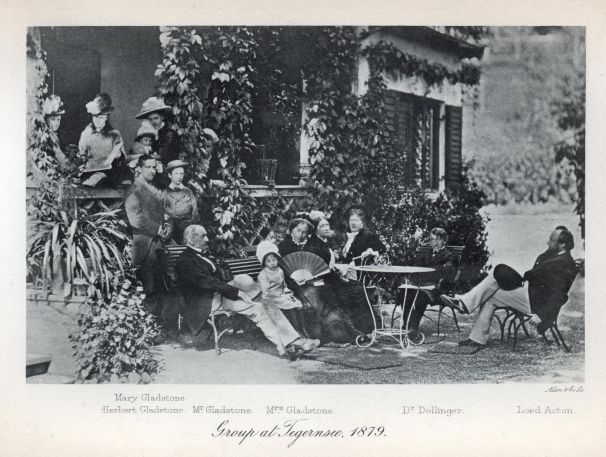
Group at Tegernsee, 1879
Mary Gladstone Herbert Gladstone Mr. Gladstone Mrs. Gladstone Dr. Dollinger Lord Acton
LETTERS OF LORD ACTON
Mentone Oct. 31, 1879
You were threatened with a long letter from me, about people at Paris, but I could not finish it, ... and so I lost the only days on which Paris information could be of any use. After a week of care, varied by pleasant visits from Lacaita, F. Leveson, and H. Cowper, we started, and rested at Milan and Genoa, and yet were nearly the first arrivals here. We expect to have the Granvilles for neighbours at Cannes, as well as Westminsters.
Let me first of all transcribe a passage from my unsent letter: "If you see Madame Waddington you will find her a very pleasant specimen of American womanhood. Her husband wants the qualities that charm and win at first, and I suppose he will not hold his own long. He has no dash, no entrain, no personal ascendency, like the men who succeed in France; but there is not a deeper scholar, or a more sincere and straightforward Christian in the country." I see from your letter that the unfavourable part of my remarks came true more than the praise. Something may be due to awkwardness connected with the Ferry[1] Bill. The interview with Scherer consoles me. He is a man of the first order as far as that can be without showy gifts. But he is guarded, cold, unsympathising, and the intellectual crisis by which he came to repudiate the Christian faith was so conspicuous that he is embarrassed with people who are notable for religious conviction.
I wanted to say so much about Mignet, who was celebrated before your father went up to college; of St. Hilaire, the best Grecian and earliest Republican in France; of Dufaure and Simon, the leaders of the Left Centre, who hold the fate of the Ministry in their hands; of Laboulaye, the political oracle of Waddington, who solves every problem by American principles; of Vielcastel, the most sensible and experienced of Conservatives, and the only surviving Doctrinaire; of Broglie,[2] who has all but ruined the Republic, in order to expiate his former ecclesiastical Liberalism; of Pasquier, who possesses the good qualities in which Broglie is deficient; of Taine, who has almost the solidity of Scherer, and more than his brilliancy. But it is all too late now.
You describe the Professor[3] most justly. Serenity has grown on him with years, although they were years of conflict and of the great grief that men who do not live for themselves can feel for the cause they have lived for. Strength, too, though in less degree, by reason of a vice which besets another great man. From a sense of dignity and of charity he refuses to see all the evil there is in men; and in order that his judgments may be always charitable, generous, and leaning to the safer side, he is not always exact in definitions or rigorous in applying principles. He looks for the root of differences in speculative systems, in defect of knowledge, in everything but moral causes, and if you had remained with us longer you would have found out that this is a matter on which I am divided from him by a gulf almost too wide for sympathy.
Boutney I never saw. But he is a sound and useful man, who makes it his business to spread political knowledge among those classes that govern France. A cousin of ours lectures, under his auspices, to half-educated Parisians.
"Le Gendre de M. Poirier" at the Français is one of the greatest treats imaginable. Your stay at Paris must have been full of new impressions and experiences, even in its levity.
And now, after a short interval of Victor Hugo at Keble, I fancy you will start for the Midlothian campaign. You were very wrong to suppress that second sheet of your letter, and I hope you will make up for it by letting me know how things go on, and bearing in mind that one learns nothing at Mentone, except the bare outside of public events.
Mentone March 15, 1880
There is so much to ask and say that I have not the courage to begin. I am afraid you will forgive the length neither of my letter nor of my silence, and will be as much bored by the silver of the one as by the golden of the other. But when all the world has its rendezvous in Harley Street, admit me, perdu in the crowd.
In this out-of-the-way region we have been kept up to the mark in home politics by pleasant visits from Freddy Leveson—a robust Gladstonian—Cowper Temple, who told me more than I knew about the world of spirits; Goschen, who spent several days with us, and whose footsteps are very visible on the road that leads away from the Liberal party, through Brookes's, to a moderado coalition; Reay, ... fresh from Midlothian; Mallet,[4] doctrinaire, disputatious and desponding, but abounding in criticism of the policy which he represents. Lord Blachford passed, but I did not see him. Nothing carried me back to England more than the two Italians[5] whom you overheard at Venice, who were here when I was very ill, but who took me over the whole ground traversed since 1842. Bonghi's essays[6] are appearing successively, and they are meant as a lesson for Italians, and break up the career in a way which loses the thread of continuity and the law of its progress and the wealth of the unity therein. But he is exceedingly intelligent and sympathetic, and I hope that he will recast his materials when he puts them together in a volume. When he asked me: Why is Mr. Gladstone so much attached to the Church and so much against establishments? Why is he so generous towards R. Catholics and so hard on the Pope? Why is not Ireland reconciled? Why is not England won?—you will believe that I found my voice again. I don't think the book will ever suit our public, but I should like it to appear in French.
*****
A certain letter of mine acknowledging the gift of the Lancashire Canvassing Speeches was written between the election and the summons to Windsor, in November 1868.[7] If it leads you to look at the Bristol electioneering speeches mentioned in it, you will be disappointed; for they will seem to you poor in comparison. In reality, they are an epoch in constitutional history. Burke there laid down, for ever, the law of the relations between members and constituencies, which is the innermost barrier against the reign of democratic force. Charles Sumner once said to me: "Mr. Burke legislated from those hustings." When you met John Morley at Glasgow he had just written a very good life of Burke. It is impossible not to be struck by the many points of resemblance between Burke and your father—the only two men of that stature in our political history—but I have no idea whether they would have been friends or bitter enemies.
Madame de Staël is the author of that saying about liberty, whom I commemorate in terms studiously excluding rivalry with George Eliot.
Do you remember a question as to the number of words in Shakespeare and in Milton? There is all about it in Brother Mark's[8] "Life of Milton," which is in the same series as Morley's "Burke."
And another, as to the title of the "Imitation"? I find that it is not the title given by the author—so that Milman's very plausible remark falls through.
Plenty of muffs have written in the Edinbro', but I am not one of them.
You see so many interesting and eminent men that you can spare a miss sometimes. But I am sorry for that silent evening near Lowell. The easy brightness of his mind surpasses all I remember in America. I sat next to him at a dinner at Boston twenty-seven years ago, and spoke of the burying, by Constantine, of the Palladium in a vault at Constantinople. Longfellow would not believe my story. I quoted a passage. "Yes," said Lowell, "but the passage we want is the passage into the vault." Somebody questioned whether the statue of Cromwell would stand among the sovereigns at Westminster. "At least," said he, "among the half-crowns."
I have never met him since. But if I had been fortunate enough to drop in that evening at Ripon's, I rather think I should have liked to sit next to him. You would have seen the difference between a live dog and a dead lion.
Scherer ought to be much obliged to me for the conversation and for the readers I procured him. He is, I think, one of the three best living writers in France—deeper and more subtle than Taine, and infinitely better versed in political questions than Renan. If you see that arch person you will find his conversation, easy and tripping as it is, very inferior to his writings. There are volumes of essays which I am sure you would read with pleasure. And he has a special bone to pick with the author of "A History of Liberty."[9]
I sent for Seeley,[10] and read him with improvement, with much pleasure, and with more indignation. It is hard in a few crowded lines to explain my meaning on a question so fundamental. The great object, in trying to understand history, political, religious, literary or scientific, is to get behind men and to grasp ideas. Ideas have a radiation and development, an ancestry and posterity of their own, in which men play the part of godfathers and godmothers more than that of legitimate parents. We understand the work and place of Pascal, or Newton, or Montesquieu, or Adam Smith, when we have measured the gap between the state of astronomy, of political economy, &c., before they came and after they were gone. And the progress of the science is of more use to us than the idiosyncrasy of the man. Let me try to explain myself by an example of to-day. Here is Ferry's article 7.[11] One way of looking at it is to reckon up the passions, the follies, the vengeance of the republicans, to admire or deplore the victory of the Conservatives, to wonder at the Democrats. But beyond the wishes of the Democrats there are the doctrines of Democracy, doctrines which push things towards certain consequences without help from local or temporary or accidental motives. There is a state built on democratic principles, and a society built, largely, on anti-democratic elements, clergy and aristocracy. Those elements of society must needs react upon the state; that is, try to get political power and use it to qualify the Democracy of the Constitution. And the state power must needs try to react on society, to protect itself against the hostile elements. This is a law of Nature, and the vividness and force with which we trace the motion of history depends on the degree to which we look beyond persons and fix our gaze on things.—This is dreadfully didactic prose. But this is my quarrel with Seeley. He discerns no Whiggism, but only Whigs. And he wonders at the mistakes of the Whigs when he ought to be following up the growth and modifications of their doctrine, and its influence on the Church, on Toleration, on European politics, on the English monarchy, the Colonies, finance, local government, justice, Scotland, and Ireland. So you may read in Alison of the profligacy of Mirabeau, the ferocity of Marat, the weakness of Louis, the sombre fanaticism of Robespierre. But what we want to know is why the old world that had lasted so long went to ruin, how the doctrine of equality sprang into omnipotence, how it changed the principles of administration, justice, international law, taxation, representation, property, and religion. Seeley is as sick as I am of the picturesque scenery of the historians of sense, but he does not like to go straight at the impersonal forces which rule the world, such as predestination, equality, divine right, secularism, Congregationalism, nationality, and whatever other ruling ideas have grouped and propelled associations of men. And my great complaint is that he so much dislikes the intriguers of 1688 that he does not recognise the doctrine of 1688, which is one of the greatest forces, one of the three or four greatest forces, that have contributed to construct our civilisation, and make 1880 so unlike 1680. See H. of L.,[12] page 50,000. All which things make me more zealous, eager, anxious about the coming election than you who are in the midst of it, mindful of the blessing of repose and credulous of Seeley. Therefore I read with delight the address to Midlothian—more even than the speech in Marylebone—and am daily refreshed by Lowe, John Morley, even Rogers,[13] and fancy how happy the inquisitors were, who put a stop to the people they disagreed with! But I can quite feel your sensation in watching all this.
*****
If we win, then there will be no rest in this life for Mr. Gladstone. The victory will be his, and his only. And so will the responsibility be. Then will come the late harvest and the gathering in of its heavy sheaves. And then there will be not much Hawarden for you.
I heartily wish your brothers success—even the riotous one[14]—especially the riotous one. I will come and wish him joy. If we are beaten, I shall be ashamed to let you see my grief. And as it is, I am ashamed to tell you how much I should like to hear from you, because you will suspect that I only want a supplement to the Times, or a later edition of the Echo. But the next few weeks are going to be a great turning-point in the history of our lifetime, and I believe you know how to be generous. Be generous before you are just. Do not temper mercy with justice.
*****
Cannes April 10, 1880
There is nothing to regret. Your brother has held a conspicuous place[15] in the most wonderful election contest of this century. He has held it in a manner which will never be forgotten in his lifetime, and which will do as much for him as victory; and the picture of the young untried son bursting into sudden popularity and turning men's thoughts from the absorbing exploits of his father adds an affecting domestic feature to that great biography. That meeting at Hawarden, after such a revolution and such a growth, is a thing I cannot think of without emotion.
So I cannot offer you anything sincere, except congratulation. We know now, indeed, that the British Democracy is neither Liberal nor Conservative in its permanent convictions, and therefore the party triumph is not as altogether satisfactory and secure as it should be. But the individual triumph, the homage rendered to a single name, could not be greater; and there could not be a fuller atonement for the desertion of 1874, than a success so personal as to convey dictatorial authority, apart from party merits and combinations.
Your idea has this advantage, that one must strike when the iron is hot, and it is now at white heat, and our legislative measures, even though they involve an early dissolution, ought to be begun soon. What I should fear most would be that, content with the intense reality of power, Mr. Gladstone should repeat the unhappy declarations of five years since in a way that would commit him for all future time; absolute abdication would be a misfortune all round, and the Conservative reaction would soon set in. But if an eventual return to power is not absolutely excluded, if no word is said of what might happen under certain contingencies, then we should still feel that we have an invincible reserve force, that, when our first line is broken, we can proclaim the Jehad and unfurl the green flag of the Prophet. For the patchwork settlement of 1875 depends on the life of a man who is several years older than your father,[16] who is a duke, and who has a deplorable habit of falling asleep early in the afternoon. But I only express this premature fear in view of circumstances which I am sure every influence in the country, except, perhaps, the influence of Windsor, will be strained to avert.
Your description of Lowe's generous and feeling sympathy is really touching. How little I thought, fourteen years ago,[17] when he was the hardest hitter your father had to meet, and when your father said he might well shrink from crossing swords with such a man, that he would close his active life as your brother's sponsor before vast constituencies, or that we should come to think of him listening with tears in his eyes to your brother's speeches, and muttering the words you tell.
Please tell Herbert that I have followed his proceedings as carefully as one could at a distance, that I don't think much of his defeat, that, in short, I go halves with Lowe.[18]
I see that your sister made her way into the fray. I trust all the worry and toil was not too much for Mrs. Gladstone.
We are ending the season here, not as far out of the world as you would suppose; for I just saw your neighbour Westminster, and here are Argyll, Cardwell, and Goldsmid.
If Disraeli waits to meet Parliament, and to fall in the daylight, I may hope to have an opportunity of expressing to you myself all my sense of the meaning of the victory, and my want of sympathy for you in your defeat.[19]
*****
Paris May 23, 1880
I have been in Paris only a few hours, and have seen nobody yet but Broglie, Gavard, and Laugel. I must see Scherer and talk to him about your visit here in the autumn. I have not been here for two years, and many of my friends are growing so old that I don't like putting off my visit to them. So I must keep those who have not that defect for a happier time.
Paris May 14, 1880
I shall be delighted to inaugurate breakfasting in Downing Street on Thursday; and I should very much like to drop in the night before, as you are to be there. But it seems very indiscreet; and if I dine with Lord Granville, I shall not be able to get away until very late, when you will be gone to bed. Tegernsee late hours cannot be kept in London. I will hope for the best, and keep all I have to say, partly for next week, partly for some more propitious season.
Würzburg May 23, 1880
Although ink was not invented to express our real feelings, I improve my first stoppage between two trains to thank you for three such delightful days in London. It was a shame to take up so much of your busy time, and to persecute you with the serpentine wisdom. I did not wish to turn into bitterness the sweetest thing on earth, but I fancied that there are things good to be observed in your great position which nobody will tell you if you do not hear them from the most wicked of your friends. Hayward, indeed, who walked home with me the other night, might claim that title and dispute my prerogative; and I thought he would be useful to you in many ways until I found out that he is only solicitous about getting invitations for ——.
Since you detected ... lending herself to a humble intrigue, you can never be surprised at the revelations of disappointment and self-seeking, and must not believe that the smiling faces you see express unmixed loyalty and satisfaction. So I want you to be vigilant not to resent, but to pursue the work of disarming resentment, and not easily to persuade yourself that it is done.
To begin at the top. Here is Lowe, positively wounded at the letter offering him a peerage instead of power, and wounded by the very thing which showed Mr. Gladstone's anxiety not to give him pain, by the absence of any reason given for being unable to offer him office. For one so often finds that acts specially showing delicacy and considerateness, little supererogatory works of kindness, are taken unkindly. Now that is just a state of mind you can improve away by an initiative of civility, bearing in mind that what Lowe says to me, his wife delivers from the house-tops.
*****
The animosity of the defeated party is natural, manifest, and invincible. They have offered Greenwood £110,000 for his newspaper, besides general offers of indefinite sums—enough to start it four or five times over. But the danger is not there, but at home; danger of disintegration and drifting. Both in church questions, and, ultimately, in land questions, your father is at variance with the great bulk of colleagues and followers—Chamberlain and Argyll in one Cabinet is an anomaly sure to tell in time, especially with Argyll discontented. So do not undervalue, or neglect, or waste, the social influence which centres in your hands.
Bismarck is so angry with Münster, that I hope he will transplant him; meanwhile it ought to be remembered that he, M., not only scouted the idea of Tory defeat, but wrote most disparagingly of Mr. Gladstone's influence and position.
Hayward will tell you what I learn from other sources, that Chenery really wishes to bring the Times round. Mr. Gladstone dislikes thinking of those things, and allowed Delane to slip from him. Don't leave the whole thing to be done at No. 18.[20]
I hope, towards the end of the session, you will consult MacColl about the Bavarian mystery. It would be nice if Leeds does not require its member just then. Above all things keep a very regular diary. You will be so glad afterwards, unless you have some distant correspondent, and make your letters to him, or her, do for a regular diary, which is also a good plan.
Tegernsee June 1, 1880
I received your letter last night on my return from Italy, and read the enclosure with interest. There are two things to be said in its defence. It is true that Hartington has, of late, shown higher qualities than the world attributed to him, and so far his adoring kinsfolk may consider their higher estimate justified. His whole attitude during the election was creditable, and his conduct towards Mr. Gladstone was correct.
Then, there is a grain of truth in the notion that the force that creates, and sustains in a crisis, is not quite the same that is wanted in time of prose to continue and to preserve; or in other words, that creative power makes a great consumption of party resources, and, if Burke gave up to party what was meant for mankind, it is better still to give up to mankind what some people mean to use for party. This is only a half truth, because party is not only, not so much, a group of men as a set of ideas and ideal aims; so that I do not admit Goldsmith's antithesis.[21] But taking party in the practical and popular sense, of an instrument for homing office, people are uneasily conscious that Mr. Gladstone will sacrifice it to loftier purpose sooner than they would like. Nothing is more untrue than the famous saying of an ancient historian, that power is retained by the same arts by which it is acquired; untrue at least for men, though truer in the case of nations.
But don't you see, pervading the letter and guiding the pen, the great intellectual and moral defect of the present day? I mean, the habit of dwelling on appearances, not on realities, of preferring the report to the bullet, and the echo to the report. To spend and lose a majority in some great cause, to be abused and ridiculed and calumniated, seems to the writer a misfortune so great that it is worth while to haul down one's flag rather than incur the risk of it. This is the power of journalism, of salons and club life, which teaches people to depend on popularity and success and not on the guide within, to act not from knowledge, but from opinion, and to be led by opinion of others rather than by knowledge which is their own. Not only ——, nearly everybody yields up his conscience, his practical judgment, into the keeping of others. I do not accuse Hartington, but it is clear from the words of —— and ——, that there was a scheme to get Mr. Gladstone out of the way. To expect him to take the first step was to expect him to resign. It is so easy to do a dirty thing with self-satisfaction when it consists in abstaining from action. The one letter is only the plausible, affectionate, amplification of the other's impertinence, with a saving clause, on the first page, inserted from dictation, when the grievous indiscretion had been committed....
*****
It does not matter seriously; but it serves to corroborate that grave speech of mine: trust nobody. I don't want you to think ill of people, or even to suspect them until the evidence is strong. It is not their virtue I question, but their attachment, and consequently their discretion. And I question their attachment because I doubt their thorough agreement with Mr. Gladstone. I don't say they are perfidious; but they are bound by an alliance they do not mean to last for ever.
*****
I do not cite Northcote and Carnarvon in confirmation. Soon after his resignation Carnarvon certainly wished to come over. At a solemn dinner inaugurating him as President of the Society of Antiquaries, he asked the secretaries to get me to propose his health. In a preceding speech he spoke of himself as a true Conservative at heart; and so I took those words up, congratulating him upon them in an Antiquarian, and eventually in a Liberal sense, indicating that they meant no more than we mean by constitutional, that there were no Pyrenees between us, that we entirely agreed with each other. We became close friends from that hour, and he made it very clear that he was pleased to be so interpreted. But he got little encouragement afterwards; and I fancied he honestly took this line—there are intelligent High Church men who dread, in the looming future, an alliance between democratic nonconformity and the predestined chief of the stern and unbending Tories, on the basis of anti-Erastianism. They say that the late election, swamping the vulgar Whig, has made those two allies stronger than ever, making each depend upon the other. They would stand a Liberal Government made up of Spencers and Cowpers, but they say that the demagogues have been strong enough to force their way in, and will make their power felt. So that property and the Church are in danger. I am ashamed to say that I thought this was Carnarvon's line. But Liddon knows what he says. Be sure that I also know what I say when I assure you that the victoria pilgrimage will be a help to your father, and that Lady R.'s coachman will grease wheels more important than her own. Do go on, this summer at least, and see whether it is not true. Lady R. is, moreover, a friend of Lady Blennerhassett, and will sympathise with your feelings.
*****
I should not have supported our side in its attack on Sir Bartle Frere. It was not merely a question of empire, but of lives he would be unable to protect, against a savage army[22] far stronger than the whole armed population of Natal. I fancy that the analogy, or apparent analogy, with the Cabul policy, which he had so much promoted, turned Liberal opinion against him. But Frere is a strong, an able, and a plausible man. It is true that his strength is akin to obstinacy and self-will, that he is rather too plausible, and that he will gain his ends by crooked paths when he has tried the straight in vain. He is a dangerous agent, but, I should think, a useful adviser. Indians are not generally a healthy element in the body politic, and he has the constant vice of Indians, belief in force. But he has a breadth of mind that is rare among them; and I have known people who hated him, because he is so good. I do not suggest that that is the motive of the three Anabaptists who ply you with advice from which I disagree.
Thanks, a thousand thanks, for all the kindness of your letter. I enjoyed the Sherbrooke-Airlie-Trevelyan dinner very much, and shall envy Lady R. every Monday to come....
*****
Tegernsee June 9, 1880
My letter was posted with the one to you, though written, I think, the night before, so that it must have been stopped and opened by some postmaster whom the direction attracted, and who, like yourself, exaggerated its importance. There are truths so prosaic, so dense, so dull, that one can hardly state them without suggesting the idea of something subtler or more interesting beyond. Of course, to one who spends his time in watching and trying to understand the progress of political life and thought, no public event could equal the late progress from Dalmeny to Downing Street, and no prouder thing could happen than to be able to serve Mr. Gladstone's policy. Indeed, if I was not lured by his genius, his persistent friendship, and a curious sympathy in many deep questions, I should be, now, by qualities never so apparent as in the last few days, by the power of grasping principle in one hand and policy in the other, without clashing, which was shown in the opium speech, and just before, in the speech on the liability of employers. I don't know whether I could ever have been of use abroad, in other circumstances, if my nearest relation was not Foreign Secretary,[23] for there is only one place for which I could pretend to any special fitness. But as to trying to qualify as a candidate for anything at home, you would soon be satisfied that it is impossible, if I had a good opportunity of talking—if we climb a mountain, a very high mountain, or cross a broad and stormy lake some day.[24] But I think I must remind you of the old lady at Carlisle in Forty-Five, who shut herself up in terror of the Highlanders, and, not being pursued, grew impatient, and cried out: "When are they going to begin?"
I am a little disturbed at the highly ingenious and easy solution of the great party[25] question. It is dangerous, at any time, to multiply sources of weakness. Now there is a source of future weakness in the idea of power assumed only for a term limited and defined. A Parliament near its end becomes helpless and unable to act. When the period fixed, or supposed to be fixed, is approaching, power will slip away. Disappointed people, men impatient of having to wait, hungry, jealous, reluctant supporters, will gravitate in other directions, will promote rivalry, will speed the parting chief, will magnify the rising sun. By having only Free and Easies, you establish a festive Centre elsewhere, and the world, revolving in an improper orbit, may lose its way. There has been, in this direction, a slight waste of capital....
*****
June 9, 1880
Your card came just after my letter was posted. I shall be at Munich on Friday, and have written to Hallam Tennyson, poste restante; but I hope to waylay them at the station. It will be pleasant to pilot the great man through Munich, or on the road to Achensthal, and I will do my best....
I hope you will not quarrel with John Morley, for he seems to be making the Pall Mall the best Liberal paper in England. But he has so many points of antagonism to Mr. Gladstone that I am afraid. He is a sceptic; his studies are all French, eighteenth century; in political economy he is a bald Cobdenite, and will do scant justice to the political aspects of the French treaty; he is a friend of Lytton's, and I suspect, of the peccant Strachey;[26] he has the obstinacy of a very honest mind. But I perceive that I am getting to be a bore....
Tegernsee June 21, 1880
The Tennysons came and went, I am sorry to say, prematurely. They spent two days with us, and would have gone by Achensee to Innsbruck, but the rain sent them back to Munich, where they took the train for Italy. You will be surprised to learn that the Poet made a favourable impression on my ladies and children. He was not only a gracious Poet, but he told us lots of good stories, read aloud without pressure, walked repeatedly with M., and seemed interested in the books he carried to his room. Lady Acton took him to Kreuth and round the lake, and liked him well. Yet our ways were very strange to him, and he must have felt that he stood on the far verge of civilisation, without the enjoyments proper to savage life. Even I was tamed at last. There was a shell to crack, but I got at the kernel, chiefly at night, when everybody was in bed. His want of reality, his habit of walking on the clouds, the airiness of his metaphysics, the indefiniteness of his knowledge, his neglect of transitions, the looseness of his political reasonings—all this made up an alarming cheval de frise.
But then there was a gladness—not quickness—in taking a joke or story, a comic impatience of the external criticism of Taine and others found here, coupled with a simple dignity when reading ill-natured attacks, a grave groping for religious certainty, and a generosity in the treatment of rivals—of Browning and Swinburne, though not of Taylor—that helped me through. He was not quite well, in consequence of the damp and of the mountain fare.
I write for news to your hotel at Venice, the weather having been against the Dolomites.
Hallam is a much better and clearer politician than his father, and the only time we differed he was the truer Blue. If I add that I discovered why he refused a baronetcy, I suspect it is no more than you know very well already.
*****
I have made Liddon's acquaintance at last. Nothing but Tennyson prevented me from seeing more of him, for I found in him all that I love Oxford for, and only a very little of what I dislike in it.
... Let me suppress truths only when they are pleasant, and confess that I have a doubt about the scene with O'Donnell. Mr. Gladstone brought against him an engine as obsolete as the Veto,[27] not for the sake of France, for he could have his say in another way, but for a disorderly act which was not the worst on record. It seemed a stretch of severity when the claim to have been severely treated is the most telling feather in an Irish cap, when the fact of having been silenced in a new way inflates the lungs, if it does not strengthen the hands, of a Home Ruler. But perhaps I am so fresh from the history of the Plebs and their Tribunes that I am not quite sound as to the management of Obstructives.
Challemel Lacour is the scholar, the philosopher, the ascetic of that republican school of which Gambetta is the Tribune and the platform hero. He is their Minister in reserve; and Albert Gate is so manifestly the stepping-stone to power, he is so conspicuous a leader of untried policy, that the civility of his reception will be taken in France as a tribute to his party in a way there has been no example of. He is probably the most interesting specimen in existence of the school from which Robespierre would have chosen his colleagues. I should very, very much like to know how he impresses you; and there is so much more I should very much like to know, that I must learn to be less obtrusive.
... If the Bavarian Fawcett[28] opened one of my letters, I suspect it was because they have not got over their perplexity at the Queen informing the King of Bavaria of the Rammingen misalliance. Only, when I ask indiscreet questions do not suspect me of asking for indiscreet answers.
I think Reay deserves a seat in the H. of L. (in the vulgar sense of those mystic letters),[29] because he would perhaps not recognise your portrait of a barren, contradictory, envious, dissolving cynic. But the cap fits only too well, and I must acknowledge the fidelity of the likeness, and the art of Lenbach in the deeper shades. Do you remember, now, my prophecy on the Piazzetta, when I rejoiced that you would not stay long enough to learn to hate me?
In worldly quarters you will probably meet with the objection to Reay that he is more instructive than amusing; but I hardly know a more genuine good fellow. Do you know Morier, who is in town? Another man much objected to, but exceedingly able, resolute, and energetic....
*****
I hope you will see Blennerhassett, and think him worthy of his wife, who is still at Munich. Thank you for the good news you give from high places, and for the greasy wheels. Your sister's ears ought to have tingled at the good things said of her here last week.
Tegernsee July 1, 1880
... I hope you have not many correspondents as unmerciful as I am, or as much inclined to forget that you are living the most interesting of lives, by the intensest blaze of light in all the world. Only let me just thank you for your letter of yesterday and for your kindness in asking me to future entertainments. My prospects are too uncertain for me to accept. I must come only if I am wanted, and we shall hardly have any close divisions of importance until the end of July. Your invitations have doubled in value since Reay, whose particular group of friends is so well known as to betray him to the worst of guessers, has supplied you with a key—a false key—to my Venetian Mystery.
Don't get tired too easily of London and its duties, for they are very real. They will not get on without you. And it is of no use coming over, if you are away on all kinds of larks.
We must wait till Sunday before the result of this evening's debate reaches Tegernsee. There is not any doubt the motion[30] is right; but I can imagine a much stronger statement of objections than the righteous indignation of the Tories produced.
Let us hope that John Morley was not discouraged by encountering Sweet Cæsar's ghost on Tuesday. The Pall Mall is getting a little personal, and too highly coloured in reports of fact. Do you know my intimate friend Lathbury, political editor of the Economist? A Weekly is easier to conduct than a Daily; but his articles seem to me excellent in tone, judgment, and impartiality. He wrote much formerly in the Daily News and the Pall Mall, and I was negotiating with Delane to put him on the Times when Bagehot's death gave him the other opening. His wife was Bonamy Price's daughter. You never saw a man more frank, cheery, and well-conditioned.
I suppose Hayward has brought ——. Let him bring Chenery, that he may be useful as well as ornamental. It is not a matter of indifference that, when other journalists come, he should be left to stay away. Only don't let his sins be cast in his teeth.
I am afraid you will not take to Morier; but he is the greatest force in our diplomatic service, in spite of his discomfiture at Lisbon. He would be the very man to meet Challemel Lacour, who will be an offence to so many.
Liddon repeated at Munich the story of Carnarvon. He also gave the excuse which I suggested—that Chamberlain, Fawcett, Dilke alarmed him. But it is not a pretty story as he tells it, considering the way Carnarvon turned against the new Ministry.
*****
Tegernsee July 10, 1880
I am heartily glad to hear what you say of Mr. Gladstone's health and strength and spirits, and of the nook behind Hampstead,[31] so much better than the dull air of the Thames Valley. There must be so much to harass him besides what appears, and what he can wind up and swamp in dazzling speech. Rosebery's anxiety is shared by many thorough Liberals, and it is not, perhaps, unfortunate that the perils of the position have made themselves felt at once, that the full warning comes in time, and the remedy can be taken early.
I wonder whether, for a reason you know as well as I do, a thing we all perceive remains a mystery to the person most concerned to know it. The Liberal party is held together, not by forces within, but by a force above it. It consists, like the being that declined a chair, of two wings and a head. Without Mr. Gladstone's ascendency and the lustre of his fame, Harcourt, Argyll, and Bright would soon offend every group into insubordination and incohesion. The jealousy between the old Liberals, who are losing ground, and the usurping Radicals, and all other familiar elements of discontent, cannot be restrained by Parliamentary management alone. There remains a great sphere for direct personal influence. The men Mr. Gladstone used to look up to, Peel and Aberdeen, had not much of this, and I fancy he takes from them the belief that it is unnecessary or undignified. He has been so long without holding the threads of party: it is so natural, in one who writes and speaks so much, to suspect those who misunderstand him doing it voluntarily: it is so natural to him to underrate the effect of personal contact, that he may think that the sole legitimate method of mastering men is Parliamentary speaking, or writings addressed to mankind. But it is worth anything that people should know and see more of him, in society if possible. First, because people are flattered. Next, because they are awed. Last, because they are conciliated, and so disciplined. And this applies to three sorts especially—members, diplomatists, and journalists. I am sure all that public policy can do to strengthen the Government will be done. But I note an unhappy impatience of those inferior arts my earthy spirit relies on.
I see how willing the Times is to be taken in hand, in spite of Walter. Sir Henry Maine, like Stephen, used to write in the Pall Mall. I don't know whether he has joined Morley. Maine's nature is to exercise power, and to find good reasons for adopted policy. Augustus or Napoleon would have made him Prime Minister. He has no strong sympathies, and is not at heart a Liberal, for he believes that Manchesterism will lose India. He considers also that the party, especially Lowe, has treated him less well than Salisbury. He is intensely nervous and sensitive. After that, I may say that I esteem him, with Mr. Gladstone, Newman, and Paget, the finest intellect in England. For some reason he is one of the men whom Lord Granville's arts do not reach. I wish you would see him....
It would be very kind of you indeed to ask the Lathburys some Tuesday or Tuesdays. I say that because he is so much my friend, but he is also an eminently useful and trustworthy man. His wife wrote much in the Saturday—I don't remember the article you speak of. When I am a little in doubt about anything I consult Lathbury, who steadies and encourages me. When I feel very sure of some conclusion I go to Maine, who always knocks it to pieces. He is much the more instructive of the two. The other is more pleasant.
With Maine, above him indeed at the India Office, is Sir Louis Mallet, a thoughtful economist, a sincere, almost passionate Liberal, but under Cobden's influence, one of those sincere Liberals least attracted by your father. He is very sound beyond the Indus, and I wish you sometimes saw him; but I ought not, perhaps, to say it, for I half suspect the Prime Minister has some ancient reason for objecting to him.
The breakfast with the archbishop,[32] the philosopher,[33] the Frenchman,[34] and even with G—— does not suggest hilarity. What you will do for sketches of character after the Reays leave England, I cannot imagine.
*****
Marienbad August 8, 1880
I don't know how to thank you for thinking of me at such a moment.[35] It was hard to bear being away just then, and you must have gone through a dreadful time. Even with the scraps of information that reach one here, I have been able to realise much of it. Almost the first consoling thing was the report of your escapade with Wolverton.
Every line of your letter is a monument of your goodness, even your disinclination to go into details. But I am afraid you must have been terribly knocked up—so soon, too, after your own illness, of which I will not speak now, but which, indeed, I was very sorry to hear of. And I do trust that Mrs. Gladstone was enabled to go through it all without excessive alarm or fatigue. She will not need words to be assured of all my sympathy. I am persuaded that your greatest pleasure, just now, comes from the expressive conduct of adversaries, not from the vain words of friends.
Our defeat in the Lords[36] opens a wide vista of difficulty and trouble—partly because it injures the Government, but not much, and will probably increase the ascendency of the P.M.; particularly because of the H. of Lords itself. Nobody will ever believe that such a majority was due to honest and disinterested motives. People will say, and will say truly, that an assembly which is moved by selfish and sordid motives, when there is a question of preventing ruin and starvation, is not only an injury to the poor, but a disgrace to the community, and there is no way out of it. Small majorities may give way or abstain; but after so determined a demonstration, repentance will be suicidal. And the one instance in modern times where the Lords have proved stronger than the Commons, because postponement here was prohibition, is a question of helping the poor who suffer, at a slight sacrifice and slighter danger to people immensely rich.
We are only beginning with questions of this kind. Did you hear the speech at the end of May in which Mr. Gladstone spoke of that class which is so numerous that it is virtually the entire nation? Graver words were never spoken in Parliament, for the entire land is virtually in the hands of another class. The considerations which this contrast, this contradiction suggests, have a mighty future before them, a future damaging to my boy's prospect of ever sitting on a red leather bench.
I am sorry we were not 52.[37] It would have been impressive, like the Doctrinaires of whom it was said: "Ils sont quatre; mais quand ils veulent imposer par le nombre, ils prétendent être cinq." Indeed, for all the reasons which Argyll repudiates, justifying my prophecy about him in the spirit, if not to the letter, there has been no measure for which I should be so anxious to vote. I wrote to Lord G.[38] to send me timely warning, as there was no trouble I would not take.
Having been to a doctor, without any idea that I was seriously out of order, I was sent here suddenly, and am forbidden, for reasons I must acknowledge, to move for some weeks to come. It could not have happened at a worse moment for me.
I was sorry for Frere, and should probably have allowed his daughter to come round me....
It is too kind of you to remember, after all that has passed over you and the nation, details of former letters. Unless there has been a change lately, there are two editors of the Economist, one for money matters and the other for politics. Maine will be proud and happy, and ought to be much obliged to me for supplying a topic for so pleasant a conversation. I wonder whether he showed you the luminous side of his mind, whether you saw why he always disagrees with me, and why some people are more afraid than fond of him. Whatever passes at the end of the Session, I do hope that a season of rest is included in our friend Dr. A. Clark's prescriptions. It might give me some remote chance of seeing you again.
That Dutch Interior is charming, and I hope you enjoyed the circle of widowers as much as I did your graphic account of them. It is delightful to think of the repose after the storm has been weathered so well. Argyll practising his next speech in the solitude of night, ——'s diplomatic deafness and yet more artful slumber, his brother with a hook placidly fixed in Bright's aggressive nose, the refined American[39] offended by the rigidity of the Democrat, the group of listening Senators, the harmless youth, the envious beauty—and then the great historic background and the one overshadowing figure—there is not a page in Mme. de Rémusat approaching it. Do you write like this to other people? Do you write at least six pages of diary every night? Please do; and let me read it now and then. And remember that one touch of ill-nature makes the whole world kin. If you are really going to be left at Hawarden, you ought to shut your door, shut your eyes, recall all that you have seen and heard during the last six months, and write it carefully down. You have such an opportunity and such a power. I am not like the Roman:[40] I envy almost as much as I admire.
You make me happy by allowing me to conclude that I gave no offence by what I wrote of our exalted House. I don't mean that your uneasiness was quite unreasonable. When a Bill[41] gets knocked about in Committee, even when an artful Minister means it to be knocked about, it can never go up to the Lords harmonious, consistent, and the genuine expression of a policy. There are not two sides to every question, but there is always an opening, in such cases, for sincere criticism. The way out of that is to pass the second reading, and to correct in Committee what was done wrong in Committee. What I mean in this case is that the Bill involved a principle of infinite force and value, which the Ministry probably veiled to their own eyes, and which the Lords were right to resist as a private association, which they are not; wrong to resist as a disinterested national institution, which is their claim to exist.
It is impossible to exaggerate the depth of aversion the Bill has evoked. You must have heard enough of it. One man has spent two days here for the purpose of telling me how wrong it was. Another writes to me that he has paired for the session, feeling that Government will be obliged to those who help them when they are hopelessly wrong, although the help consists in pairing and going to Vichy. These are idle men, representative of thousands.
It reminds me of the great landowner, Bedford, who reminds me of Arthur,[42] who reminds me of Maine. I suppose it was a refuge in Piccadilly that revealed the secret to me. Arthur's one fault is a delight in secrets. Although Maine is unfitted to be P.M. (under any but a despotic monarch), nobody has so large a conception of all questions relating to the tenure of land. I dare say he has been asked to say what he knows about Ireland. What pure reason and boundless knowledge can do, without sympathy or throb, Maine can do better than any man in England.
I am sorry to think of Lowell's sun sinking behind your horizon. At first sight one always fancies that those who question the certainty of history sap the certainty of religion, or are the victims of those who do, and I fancy I should have had a word (with corners) to throw at him. The Rémusat volumes are one of my landmarks in judging Napoleon. It is, of all accounts by competent people, the most injurious to his memory, as Segur's are the most favourable. Until I read them, I thought the fixed intention to put Enghien to death, the charge of murder, not proven. If the authority of these recollections breaks down, I must invent for myself a new Napoleon. After allowing for the fact that they were written, or re-written, years later, like the Diary of John Adams, the Memoirs of S. Simon, the History of Burnet, of Clarendon, the Annals of Tacitus, the Nine Muses of Herodotus, the Eight Books of Thucydides, which are the most conspicuous sources of all history, and for the suspicion that there was a great secret she not only could not tell, but wrote in order to obliterate, and after giving whatever weight it deserves to the little joke that calls it: "Souvenir d'une femme de chambre renvoyée," I am so persuaded that the book is authentic and true, that I should have liked to hear the argument. But this is true, history does not stand or fall with historians. From the thirteenth century we rely much more on letters than on histories written for the public. I need not add that the history of our Lord which we find in the Epistles is one most valuable testimony in favour of the Gospels. So that even if Lowell can damage the reports in this book, we can restore the certainty of history by the aid of letters, of documents and of those facts in which independent witnesses agree.
Is it not heroic of your sister renouncing a life like your own for the toil of Newnham? I wish her success and happiness in her pilgrimage most sincerely. By-the-bye your other sister is the real pilgrim, and I wish I had known in time to warn my belongings of her movements.
My time here is up, and I go home to-morrow. As a proper P.M.'s daughter you ought to say you hope I was really ill, to justify fifty-one.... It is absurd to come all the way to England and not to see you; so I shall come only if I am ideally wanted. I write at once to discover whether and when. Your telegram is a great disappointment. I wonder where they will go. Cannes is the place I recommend, but not till October. If I am not summoned home from Tegernsee for Hares or Burials,[43] I look forward to Ammergau, and wish you were coming.
*****
Tegernsee Sept. 21, 1880
I ought to write no more. I ought to hide my useless hand altogether. There was a week during which I looked forward to a summons home, a summons that never came; and after having persistently applied for it, I thought that it was better not to make the offer of my vote more urgent than the demand for it. I know how much I have missed and lost. Circumstances over which I have no control would probably have arrested my maritime enterprise at Gravesend.[44] But how pleasant Holmbury would have been! And then there was, and is, so much to talk to you about, so much that evaporates in writing and will not keep, so much that will. As there can hardly be an autumn session after prorogation in September, I must wait for the end of January. Meanwhile I hope you will cultivate the notion of Tegernsee. Such a break with the great world would do Mr. Gladstone good, and I fancy we could make you like the place once more. Let me have that hope before me.
*****
My children went to Ammergau and came back not deeply moved, but strongly impressed. I let them go without me from a sort of dread many people must have felt, not because of the chief actor, for a pious, simple-minded peasant's conception of the two natures is probably not more inadequate than my own, but what we do gradually realise in meditating the Passion is the character and experience of the disciples, the effect of that companionship, the utter human weakness that survived in the midst of the intense feelings it must have awakened in them. Those are contrasts that can be expressed, and are apparently too subtle for the performers at Ammergau. I am told that, on the whole, the audience remained cold.
The answer to my telegram was signed in a way that led me to doubt whether it came from you. I trust it was sent by your brother, and that Mr. Gladstone was not molested by my inquiries on the top of so many more. It is beginning at the wrong end to read David Copperfield first, but he is worth anything to busy men, because his fun is so hearty and so easy, and he rouses the emotions by such direct and simple methods. I am ashamed to think how much more often I return to Dickens than to George Eliot.
Do some of the brothers or secretaries make a point of reading the Temps? Of all that is written against the Ministry and its general policy, the Temps articles seem to me the most serious and suggestive, and at Marienbad I went through a course of Austrian newspapers, which are very hostile, and better written than our Tory organs, but not near so good as the Temps. I am afraid it is my friend Scherer. Not being a Frenchman, his patriotism is peculiarly lively. Don't call Chenery my friend. I have never seen him, and only know that he is making a mess of the Times. But my reasons were those you know well, and they will hold good next year.