X to XXXII. WENTWORTH PLACE.
Reading edition
X—XXXII. WENTWORTH PLACE.
X.
Dearest Fanny, I shall send this the moment you return. They say I must remain confined to this room for some time. The consciousness that you love me will make a pleasant prison of the house next to yours. You must come and see me frequently: this evening, without fail—when you must not mind about my speaking in a low tone for I am ordered to do so though I can speak out.
Yours ever sweetest love.—
J. KEATS.
turn over
Perhaps your Mother is not at home and so you must wait till she comes. You must see me tonight and let me hear you promise to come tomorrow.
Brown told me you were all out. I have been looking for the stage the whole afternoon. Had I known this I could not have remain’d so silent all day.
XI.
My dearest Girl,
If illness makes such an agreeable variety in the manner of your eyes I should wish you sometimes to be ill. I wish I had read your note before you went last night that I might have assured you how far I was from suspecting any coldness. You had a just right to be a little silent to one who speaks so plainly to you. You must believe—you shall, you will—that I can do nothing, say nothing, think nothing of you but what has its spring in the Love which has so long been my pleasure and torment. On the night I was taken ill—when so violent a rush of blood came to my Lungs that I felt nearly suffocated—I assure you I felt it possible I might not survive, and at that moment thought of nothing but you. When I said to Brown “this is unfortunate”[38] I thought of you. ’Tis true that since the first two or three days other subjects have entered my head.[39] I shall be looking forward to Health and the Spring and a regular routine of our old Walks.
Your affectionate
J. K.
XII.
My sweet love, I shall wait patiently till tomorrow before I see you, and in the mean time, if there is any need of such a thing, assure you by your Beauty, that whenever I have at any time written on a certain unpleasant subject, it has been with your welfare impress’d upon my mind. How hurt I should have been had you ever acceded to what is, notwithstanding, very reasonable! How much the more do I love you from the general result! In my present state of Health I feel too much separated from you and could almost speak to you in the words of Lorenzo’s Ghost to Isabella
“Your Beauty grows upon me and I feel A greater love through all my essence steal.”
My greatest torment since I have known you has been the fear of you being a little inclined to the Cressid; but that suspicion I dismiss utterly and remain happy in the surety of your Love, which I assure you is as much a wonder to me as a delight. Send me the words ‘Good night’ to put under my pillow.
Dearest Fanny,
Your affectionate
J. K.
XIII.
My dearest Girl,
According to all appearances I am to be separated from you as much as possible. How I shall be able to bear it, or whether it will not be worse than your presence now and then, I cannot tell. I must be patient, and in the mean time you must think of it as little as possible. Let me not longer detain you from going to Town—there may be no end to this imprisoning of you. Perhaps you had better not come before tomorrow evening: send me however without fail a good night.
You know our situation——what hope is there if I should be recovered ever so soon—my very health will not suffer me to make any great exertion. I am recommended not even to read poetry, much less write it. I wish I had even a little hope. I cannot say forget me—but I would mention that there are impossibilities in the world. No more of this. I am not strong enough to be weaned—take no notice of it in your good night.
Happen what may I shall ever be my dearest Love
Your affectionate
J. K.
XIV.
My dearest Girl, how could it ever have been my wish to forget you? how could I have said such a thing? The utmost stretch my mind has been capable of was to endeavour to forget you for your own sake seeing what a chance there was of my remaining in a precarious state of health. I would have borne it as I would bear death if fate was in that humour: but I should as soon think of choosing to die as to part from you. Believe too my Love that our friends think and speak for the best, and if their best is not our best it is not their fault. When I am better I will speak with you at large on these subjects, if there is any occasion—I think there is none. I am rather nervous today perhaps from being a little recovered and suffering my mind to take little excursions beyond the doors and windows. I take it for a good sign, but as it must not be encouraged you had better delay seeing me till tomorrow. Do not take the trouble of writing much: merely send me my good night.
Remember me to your Mother and Margaret.
Your affectionate
J. K.
XV.
My dearest Fanny,
Then all we have to do is to be patient. Whatever violence I may sometimes do myself by hinting at what would appear to any one but ourselves a matter of necessity, I do not think I could bear any approach of a thought of losing you. I slept well last night, but cannot say that I improve very fast. I shall expect you tomorrow, for it is certainly better that I should see you seldom. Let me have your good night.
Your affectionate
J. K.
XVI.
My dearest Fanny,
I read your note in bed last night, and that might be the reason of my sleeping so much better. I think Mr Brown[40] is right in supposing you may stop too long with me, so very nervous as I am. Send me every evening a written Good night. If you come for a few minutes about six it may be the best time. Should you ever fancy me too low-spirited I must warn you to ascribe it to the medicine I am at present taking which is of a nerve-shaking nature. I shall impute any depression I may experience to this cause. I have been writing with a vile old pen the whole week, which is excessively ungallant. The fault is in the Quill: I have mended it and still it is very much inclin’d to make blind es. However these last lines are in a much better style of penmanship, tho’ a little disfigured by the smear of black currant jelly; which has made a little mark on one of the pages of Brown’s Ben Jonson, the very best book he has. I have lick’d it but it remains very purple. I did not know whether to say purple or blue so in the mixture of the thought wrote purplue which may be an excellent name for a colour made up of those two, and would suit well to start next spring. Be very careful of open doors and windows and going without your duffle grey. God bless you Love!
J. KEATS.
P.S. I am sitting in the back room. Remember me to your Mother.
XVII.
My dear Fanny,
Do not let your mother suppose that you hurt me by writing at night. For some reason or other your last night’s note was not so treasureable as former ones. I would fain that you call me Love still. To see you happy and in high spirits is a great consolation to me—still let me believe that you are not half so happy as my restoration would make you. I am nervous, I own, and may think myself worse than I really am; if so you must indulge me, and pamper with that sort of tenderness you have manifested towards me in different Letters. My sweet creature when I look back upon the pains and torments I have suffer’d for you from the day I left you to go to the Isle of Wight; the ecstasies in which I have pass’d some days and the miseries in their turn, I wonder the more at the Beauty which has kept up the spell so fervently. When I send this round I shall be in the front parlour watching to see you show yourself for a minute in the garden. How illness stands as a barrier betwixt me and you! Even if I was well——I must make myself as good a Philosopher as possible. Now I have had opportunities of passing nights anxious and awake I have found other thoughts intrude upon me. “If I should die,” said I to myself, “I have left no immortal work behind me—nothing to make my friends proud of my memory—but I have lov’d the principle of beauty in all things, and if I had had time I would have made myself remember’d.” Thoughts like these came very feebly whilst I was in health and every pulse beat for you—now you divide with this (may I say it?) “last infirmity of noble minds” all my reflection.
God bless you, Love.
J. KEATS.
XVIII.
My dearest Girl,
You spoke of having been unwell in your last note: have you recover’d? That note has been a great delight to me. I am stronger than I was: the Doctors say there is very little the matter with me, but I cannot believe them till the weight and tightness of my Chest is mitigated. I will not indulge or pain myself by complaining of my long separation from you. God alone knows whether I am destined to taste of happiness with you: at all events I myself know thus much, that I consider it no mean Happiness to have lov’d you thus far—if it is to be no further I shall not be unthankful—if I am to recover, the day of my recovery shall see me by your side from which nothing shall separate me. If well you are the only medicine that can keep me so. Perhaps, aye surely, I am writing in too depress’d a state of mind—ask your Mother to come and see me—she will bring you a better account than mine.
Ever your affectionate
JOHN KEATS.
XIX.
My dearest Girl,
Indeed I will not deceive you with respect to my Health. This is the fact as far as I know. I have been confined three weeks[41] and am not yet well—this proves that there is something wrong about me which my constitution will either conquer or give way to. Let us hope for the best. Do you hear the Thrush singing over the field? I think it is a sign of mild weather—so much the better for me. Like all Sinners now I am ill I philosophize, aye out of my attachment to every thing, Trees, Flowers, Thrushes, Spring, Summer, Claret, &c. &c.—aye every thing but you.—My sister would be glad of my company a little longer. That Thrush is a fine fellow. I hope he was fortunate in his choice this year. Do not send any more of my Books home. I have a great pleasure in the thought of you looking on them.
Ever yours my sweet Fanny
J. K.
XX.
My dearest Girl,
I continue much the same as usual, I think a little better. My spirits are better also, and consequently I am more resign’d to my confinement. I dare not think of you much or write much to you. Remember me to all.
Ever your affectionate
John Keats.
XXI.
My dear Fanny,
I think you had better not make any long stay with me when Mr. Brown is at home. Whenever he goes out you may bring your work. You will have a pleasant walk today. I shall see you pass. I shall follow you with my eyes over the Heath. Will you come towards evening instead of before dinner? When you are gone, ’tis past—if you do not come till the evening I have something to look forward to all day. Come round to my window for a moment when you have read this. Thank your Mother, for the preserves, for me. The raspberry will be too sweet not having any acid; therefore as you are so good a girl I shall make you a present of it. Good bye
My sweet Love!
J. KEATS.
XXII.
My dearest Fanny,
The power of your benediction is of not so weak a nature as to pass from the ring in four and twenty hours—it is like a sacred Chalice once consecrated and ever consecrate. I shall kiss your name and mine where your Lips have been—Lips! why should a poor prisoner as I am talk about such things? Thank God, though I hold them the dearest pleasures in the universe, I have a consolation independent of them in the certainty of your affection. I could write a song in the style of Tom Moore’s Pathetic about Memory if that would be any relief to me. No—’twould not. I will be as obstinate as a Robin, I will not sing in a cage. Health is my expected heaven and you are the Houri——this word I believe is both singular and plural—if only plural, never mind—you are a thousand of them.
Ever yours affectionately my dearest,
J. K.
You had better not come to day.
XXIII.
My dearest Love,
You must not stop so long in the cold—I have been suspecting that window to be open.—Your note half-cured me. When I want some more oranges I will tell you—these are just à propos. I am kept from food so feel rather weak—otherwise very well. Pray do not stop so long upstairs—it makes me uneasy—come every now and then and stop a half minute. Remember me to your Mother.
Your ever affectionate
J. KEATS.
XXIV.
Sweetest Fanny,
You fear, sometimes, I do not love you so much as you wish? My dear Girl I love you ever and ever and without reserve. The more I have known the more have I lov’d. In every way—even my jealousies have been agonies of Love, in the hottest fit I ever had I would have died for you. I have vex’d you too much. But for Love! Can I help it? You are always new. The last of your kisses was ever the sweetest; the last smile the brightest; the last movement the gracefullest. When you pass’d my window home yesterday, I was fill’d with as much admiration as if I had then seen you for the first time. You uttered a half complaint once that I only lov’d your beauty. Have I nothing else then to love in you but that? Do not I see a heart naturally furnish’d with wings imprison itself with me? No ill prospect has been able to turn your thoughts a moment from me. This perhaps should be as much a subject of sorrow as joy—but I will not talk of that. Even if you did not love me I could not help an entire devotion to you: how much more deeply then must I feel for you knowing you love me. My Mind has been the most discontented and restless one that ever was put into a body too small for it. I never felt my Mind repose upon anything with complete and undistracted enjoyment—upon no person but you. When you are in the room my thoughts never fly out of window: you always concentrate my whole senses. The anxiety shown about our Loves in your last note is an immense pleasure to me: however you must not suffer such speculations to molest you any more: nor will I any more believe you can have the least pique against me. Brown is gone out—but here is Mrs. Wylie[42]—when she is gone I shall be awake for you.—Remembrances to your Mother.
Your affectionate
J. KEATS.
XXV.
My dear Fanny,
I am much better this morning than I was a week ago: indeed I improve a little every day. I rely upon taking a walk with you upon the first of May: in the mean time undergoing a babylonish captivity I shall not be jew enough to hang up my harp upon a willow, but rather endeavour to clear up my arrears in versifying, and with returning health begin upon something new: pursuant to which resolution it will be necessary to have my or rather Taylor’s manuscript,[43] which you, if you please, will send by my Messenger either today or tomorrow. Is Mr. D.[44] with you today? You appeared very much fatigued last night: you must look a little brighter this morning. I shall not suffer my little girl ever to be obscured like glass breath’d upon, but always bright as it is her nature to. Feeding upon sham victuals and sitting by the fire will completely annul me. I have no need of an enchanted wax figure to duplicate me, for I am melting in my proper person before the fire. If you meet with anything better (worse) than common in your Magazines let me see it.
Good bye my sweetest Girl.
J. K.
XXVI.
My dearest Fanny, whenever you know me to be alone, come, no matter what day. Why will you go out this weather? I shall not fatigue myself with writing too much I promise you. Brown says I am getting stouter.[45] I rest well and from last night do not remember any thing horrid in my dream, which is a capital symptom, for any organic derangement always occasions a Phantasmagoria. It will be a nice idle amusement to hunt after a motto for my Book which I will have if lucky enough to hit upon a fit one—not intending to write a preface. I fear I am too late with my note—you are gone out—you will be as cold as a topsail in a north latitude—I advise you to furl yourself and come in a doors.
Good bye Love.
J. K.
XXVII.
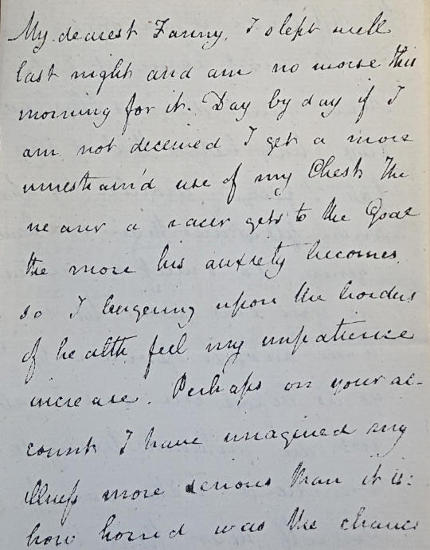
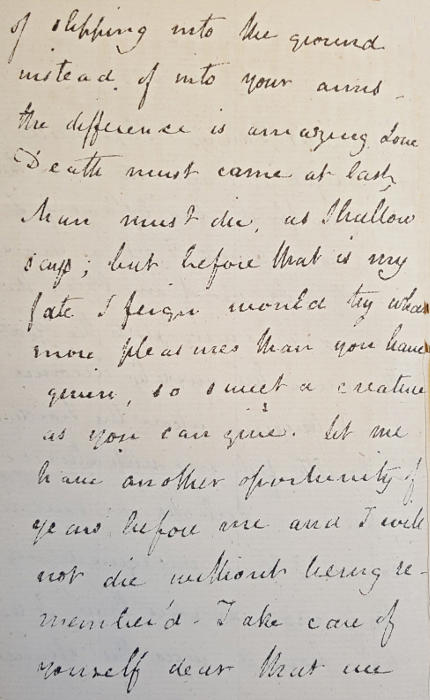
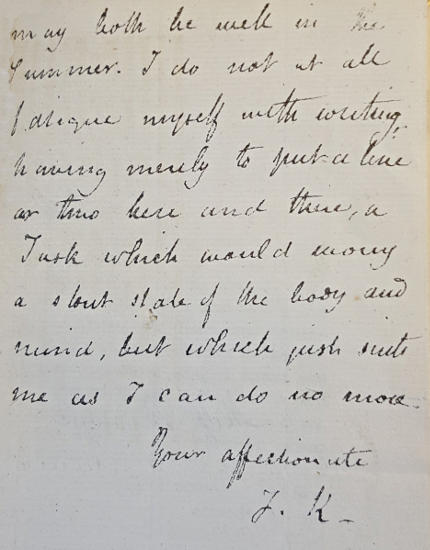
My dearest Fanny, I slept well last night and am no worse this morning for it. Day by day if I am not deceived I get a more unrestrain’d use of my Chest. The nearer a racer gets to the Goal the more his anxiety becomes; so I lingering upon the borders of health feel my impatience increase. Perhaps on your account I have imagined my illness more serious than it is: how horrid was the chance of slipping into the ground instead of into your arms—the difference is amazing Love. Death must come at last; Man must die, as Shallow says; but before that is my fate I fain would try what more pleasures than you have given, so sweet a creature as you can give. Let me have another opportunity of years before me and I will not die without being remember’d. Take care of yourself dear that we may both be well in the Summer. I do not at all fatigue myself with writing, having merely to put a line or two here and there, a Task which would worry a stout state of the body and mind, but which just suits me as I can do no more.
Your affectionate
J. K.
XXVIII.
My dearest Fanny,
I had a better night last night than I have had since my attack, and this morning I am the same as when you saw me. I have been turning over two volumes of Letters written between Rousseau and two Ladies in the perplexed strain of mingled finesse and sentiment in which the Ladies and gentlemen of those days were so clever, and which is still prevalent among Ladies of this Country who live in a state of reasoning romance. The likeness however only extends to the mannerism, not to the dexterity. What would Rousseau have said at seeing our little correspondence! What would his Ladies have said! I don’t care much—I would sooner have Shakspeare’s opinion about the matter. The common gossiping of washerwomen must be less disgusting than the continual and eternal fence and attack of Rousseau and these sublime Petticoats. One calls herself Clara and her friend Julia, two of Rousseau’s heroines—they all [sic, but qy. at] the same time christen poor Jean Jacques St. Preux—who is the pure cavalier of his famous novel. Thank God I am born in England with our own great Men before my eyes. Thank God that you are fair and can love me without being Letter-written and sentimentaliz’d into it.—Mr. Barry Cornwall has sent me another Book, his first, with a polite note.[46] I must do what I can to make him sensible of the esteem I have for his kindness. If this north east would take a turn it would be so much the better for me. Good bye, my love, my dear love, my beauty—
love me for ever.
J. K.
XXIX.
My dearest Fanny,
Though I shall see you in so short a time I cannot forbear sending you a few lines. You say I did not give you yesterday a minute account of my health. Today I have left off the Medicine which I took to keep the pulse down and I find I can do very well without it, which is a very favourable sign, as it shows there is no inflammation remaining. You think I may be wearied at night you say: it is my best time; I am at my best about eight o’Clock. I received a Note from Mr. Procter[47] today. He says he cannot pay me a visit this weather as he is fearful of an inflammation in the Chest. What a horrid climate this is? or what careless inhabitants it has? You are one of them. My dear girl do not make a joke of it: do not expose yourself to the cold. There’s the Thrush again—I can’t afford it—he’ll run me up a pretty Bill for Music—besides he ought to know I deal at Clementi’s. How can you bear so long an imprisonment at Hampstead? I shall always remember it with all the gusto that a monopolizing carle should. I could build an Altar to you for it.
Your affectionate
J. K.
XXX.
My dearest Girl,
As, from the last part of my note you must see how gratified I have been by your remaining at home, you might perhaps conceive that I was equally bias’d the other way by your going to Town, I cannot be easy tonight without telling you you would be wrong to suppose so. Though I am pleased with the one, I am not displeased with the other. How do I dare to write in this manner about my pleasures and displeasures? I will tho’ whilst I am an invalid, in spite of you. Good night, Love!
J. K.
XXXI.
My dearest Girl,
In consequence of our company I suppose I shall not see you before tomorrow. I am much better today—indeed all I have to complain of is want of strength and a little tightness in the Chest. I envied Sam’s walk with you today; which I will not do again as I may get very tired of envying. I imagine you now sitting in your new black dress which I like so much and if I were a little less selfish and more enthusiastic I should run round and surprise you with a knock at the door. I fear I am too prudent for a dying kind of Lover. Yet, there is a great difference between going off in warm blood like Romeo, and making one’s exit like a frog in a frost. I had nothing particular to say today, but not intending that there shall be any interruption to our correspondence (which at some future time I propose offering to Murray) I write something. God bless you my sweet Love! Illness is a long lane, but I see you at the end of it, and shall mend my pace as well as possible.
J. K.
XXXII.
Dear Girl,
Yesterday you must have thought me worse than I really was. I assure you there was nothing but regret at being obliged to forego an embrace which has so many times been the highest gust of my Life. I would not care for health without it. Sam would not come in—I wanted merely to ask him how you were this morning. When one is not quite well we turn for relief to those we love: this is no weakness of spirit in me: you know when in health I thought of nothing but you; when I shall again be so it will be the same. Brown has been mentioning to me that some hint from Sam, last night, occasions him some uneasiness. He whispered something to you concerning Brown and old Mr. Dilke[48] which had the complexion of being something derogatory to the former. It was connected with an anxiety about Mr. D. Sr’s death and an anxiety to set out for Chichester. These sort of hints point out their own solution: one cannot pretend to a delicate ignorance on the subject: you understand the whole matter. If any one, my sweet Love, has misrepresented, to you, to your Mother or Sam, any circumstances which are at all likely, at a tenth remove, to create suspicions among people who from their own interested notions slander others, pray tell me: for I feel the least attaint on the disinterested character of Brown very deeply. Perhaps Reynolds or some other of my friends may come towards evening, therefore you may choose whether you will come to see me early today before or after dinner as you may think fit. Remember me to your Mother and tell her to drag you to me if you show the least reluctance—
...