I to IX. SHANKLIN, WINCHESTER, WESTMINSTER.
Reading edition
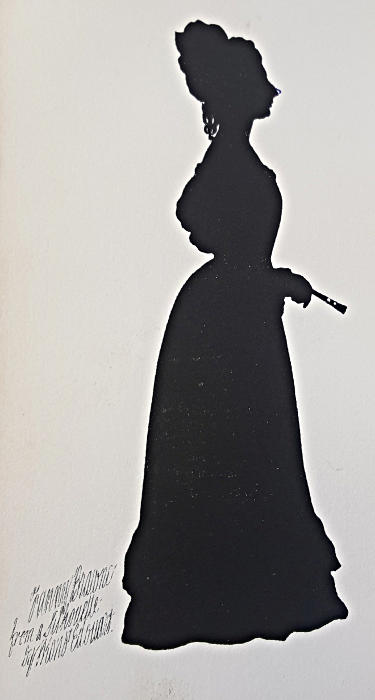
Fanny Brawne from a silhouette by Monsr Edouart.
I-IX. SHANKLIN, WINCHESTER, WESTMINSTER.
I.
Shanklin, Isle of Wight, Thursday.
[Postmark, Newport, 3 July, 1819.]
My dearest Lady,
I am glad I had not an opportunity of sending off a Letter which I wrote for you on Tuesday night—’twas too much like one out of Rousseau’s Heloise. I am more reasonable this morning. The morning is the only proper time for me to write to a beautiful Girl whom I love so much: for at night, when the lonely day has closed, and the lonely, silent, unmusical Chamber is waiting to receive me as into a Sepulchre, then believe me my passion gets entirely the sway, then I would not have you see those Rhapsodies which I once thought it impossible I should ever give way to, and which I have often laughed at in another, for fear you should [think me[23]] either too unhappy or perhaps a little mad. I am now at a very pleasant Cottage window, looking onto a beautiful hilly country, with a glimpse of the sea; the morning is very fine. I do not know how elastic my spirit might be, what pleasure I might have in living here and breathing and wandering as free as a stag about this beautiful Coast if the remembrance of you did not weigh so upon me. I have never known any unalloy’d Happiness for many days together: the death or sickness of some one[24] has always spoilt my hours—and now when none such troubles oppress me, it is you must confess very hard that another sort of pain should haunt me. Ask yourself my love whether you are not very cruel to have so entrammelled me, so destroyed my freedom. Will you confess this in the Letter you must write immediately and do all you can to console me in it—make it rich as a draught of poppies to intoxicate me—write the softest words and kiss them that I may at least touch my lips where yours have been. For myself I know not how to express my devotion to so fair a form: I want a brighter word than bright, a fairer word than fair. I almost wish we were butterflies and liv’d but three summer days—three such days with you I could fill with more delight than fifty common years could ever contain. But however selfish I may feel, I am sure I could never act selfishly: as I told you a day or two before I left Hampstead, I will never return to London if my Fate does not turn up Pam[25] or at least a Court-card. Though I could centre my Happiness in you, I cannot expect to engross your heart so entirely—indeed if I thought you felt as much for me as I do for you at this moment I do not think I could restrain myself from seeing you again tomorrow for the delight of one embrace. But no—I must live upon hope and Chance. In case of the worst that can happen, I shall still love you—but what hatred shall I have for another! Some lines I read the other day are continually ringing a peal in my ears:
To see those eyes I prize above mine own Dart favors on another— And those sweet lips (yielding immortal nectar) Be gently press’d by any but myself— Think, think Francesca, what a cursed thing It were beyond expression!
J.
Do write immediately. There is no Post from this Place, so you must address Post Office, Newport, Isle of Wight. I know before night I shall curse myself for having sent you so cold a Letter; yet it is better to do it as much in my senses as possible. Be as kind as the distance will permit to your
J. KEATS.
Present my Compliments to your mother, my love to Margaret[26] and best remembrances to your Brother—if you please so.
II.
July 8th.
[Postmark, Newport, 10 July, 1819.]
My sweet Girl,
Your Letter gave me more delight than any thing in the world but yourself could do; indeed I am almost astonished that any absent one should have that luxurious power over my senses which I feel. Even when I am not thinking of you I receive your influence and a tenderer nature stealing upon me. All my thoughts, my unhappiest days and nights, have I find not at all cured me of my love of Beauty, but made it so intense that I am miserable that you are not with me: or rather breathe in that dull sort of patience that cannot be called Life. I never knew before, what such a love as you have made me feel, was; I did not believe in it; my Fancy was afraid of it, lest it should burn me up. But if you will fully love me, though there may be some fire, ’twill not be more than we can bear when moistened and bedewed with Pleasures. You mention ‘horrid people’ and ask me whether it depend upon them whether I see you again. Do understand me, my love, in this. I have so much of you in my heart that I must turn Mentor when I see a chance of harm befalling you. I would never see any thing but Pleasure in your eyes, love on your lips, and Happiness in your steps. I would wish to see you among those amusements suitable to your inclinations and spirits; so that our loves might be a delight in the midst of Pleasures agreeable enough, rather than a resource from vexations and cares. But I doubt much, in case of the worst, whether I shall be philosopher enough to follow my own Lessons: if I saw my resolution give you a pain I could not. Why may I not speak of your Beauty, since without that I could never have lov’d you?—I cannot conceive any beginning of such love as I have for you but Beauty. There may be a sort of love for which, without the least sneer at it, I have the highest respect and can admire it in others: but it has not the richness, the bloom, the full form, the enchantment of love after my own heart. So let me speak of your Beauty, though to my own endangering; if you could be so cruel to me as to try elsewhere its Power. You say you are afraid I shall think you do not love me—in saying this you make me ache the more to be near you. I am at the diligent use of my faculties here, I do not pass a day without sprawling some blank verse or tagging some rhymes; and here I must confess, that (since I am on that subject) I love you the more in that I believe you have liked me for my own sake and for nothing else. I have met with women whom I really think would like to be married to a Poem and to be given away by a Novel. I have seen your Comet, and only wish it was a sign that poor Rice would get well whose illness makes him rather a melancholy companion: and the more so as so to conquer his feelings and hide them from me, with a forc’d Pun. I kiss’d your writing over in the hope you had indulg’d me by leaving a trace of honey. What was your dream? Tell it me and I will tell you the interpretation thereof.
Ever yours, my love!
JOHN KEATS.
Do not accuse me of delay—we have not here an opportunity of sending letters every day. Write speedily.
III.
Sunday Night.
[Postmark, 27 July, 1819.[27]]
My sweet Girl,
I hope you did not blame me much for not obeying your request of a Letter on Saturday: we have had four in our small room playing at cards night and morning leaving me no undisturb’d opportunity to write. Now Rice and Martin are gone I am at liberty. Brown to my sorrow confirms the account you give of your ill health. You cannot conceive how I ache to be with you: how I would die for one hour——for what is in the world? I say you cannot conceive; it is impossible you should look with such eyes upon me as I have upon you: it cannot be. Forgive me if I wander a little this evening, for I have been all day employ’d in a very abstract Poem and I am in deep love with you—two things which must excuse me. I have, believe me, not been an age in letting you take possession of me; the very first week I knew you I wrote myself your vassal; but burnt the Letter as the very next time I saw you I thought you manifested some dislike to me. If you should ever feel for Man at the first sight what I did for you, I am lost. Yet I should not quarrel with you, but hate myself if such a thing were to happen—only I should burst if the thing were not as fine as a Man as you are as a Woman. Perhaps I am too vehement, then fancy me on my knees, especially when I mention a part of your Letter which hurt me; you say speaking of Mr. Severn “but you must be satisfied in knowing that I admired you much more than your friend.” My dear love, I cannot believe there ever was or ever could be any thing to admire in me especially as far as sight goes—I cannot be admired, I am not a thing to be admired. You are, I love you; all I can bring you is a swooning admiration of your Beauty. I hold that place among Men which snub-nos’d brunettes with meeting eyebrows do among women—they are trash to me—unless I should find one among them with a fire in her heart like the one that burns in mine. You absorb me in spite of myself—you alone: for I look not forward with any pleasure to what is call’d being settled in the world; I tremble at domestic cares—yet for you I would meet them, though if it would leave you the happier I would rather die than do so. I have two luxuries to brood over in my walks, your Loveliness and the hour of my death. O that I could have possession of them both in the same minute. I hate the world: it batters too much the wings of my self-will, and would I could take a sweet poison from your lips to send me out of it. From no others would I take it. I am indeed astonish’d to find myself so careless of all charms but yours—remembering as I do the time when even a bit of ribband was a matter of interest with me. What softer words can I find for you after this—what it is I will not read. Nor will I say more here, but in a Postscript answer any thing else you may have mentioned in your Letter in so many words—for I am distracted with a thousand thoughts. I will imagine you Venus tonight and pray, pray, pray to your star like a Heathen.
Your’s ever, fair Star,
JOHN KEATS.
My seal is mark’d like a family table cloth with my Mother’s initial F for Fanny:[28] put between my Father’s initials. You will soon hear from me again. My respectful Compliments to your Mother. Tell Margaret I’ll send her a reef of best rocks and tell Sam[29] I will give him my light bay hunter if he will tie the Bishop hand and foot and pack him in a hamper and send him down for me to bathe him for his health with a Necklace of good snubby stones about his Neck.[30]
IV.
Shanklin, Thursday Night.
[Postmark, Newport, 9 August, 1819.]
My dear Girl,
You say you must not have any more such Letters as the last: I’ll try that you shall not by running obstinate the other way. Indeed I have not fair play—I am not idle enough for proper downright love-letters—I leave this minute a scene in our Tragedy[31] and see you (think it not blasphemy) through the mist of Plots, speeches, counterplots and counterspeeches. The Lover is madder than I am—I am nothing to him—he has a figure like the Statue of Meleager and double distilled fire in his heart. Thank God for my diligence! were it not for that I should be miserable. I encourage it, and strive not to think of you—but when I have succeeded in doing so all day and as far as midnight, you return, as soon as this artificial excitement goes off, more severely from the fever I am left in. Upon my soul I cannot say what you could like me for. I do not think myself a fright any more than I do Mr. A., Mr. B., and Mr. C.—yet if I were a woman I should not like A. B. C. But enough of this. So you intend to hold me to my promise of seeing you in a short time. I shall keep it with as much sorrow as gladness: for I am not one of the Paladins of old who liv’d upon water grass and smiles for years together. What though would I not give tonight for the gratification of my eyes alone? This day week we shall move to Winchester; for I feel the want of a Library.[32] Brown will leave me there to pay a visit to Mr. Snook at Bedhampton: in his absence I will flit to you and back. I will stay very little while, for as I am in a train of writing now I fear to disturb it—let it have its course bad or good—in it I shall try my own strength and the public pulse. At Winchester I shall get your Letters more readily; and it being a cathedral City I shall have a pleasure always a great one to me when near a Cathedral, of reading them during the service up and down the Aisle.
Friday Morning.—Just as I had written thus far last night, Brown came down in his morning coat and nightcap, saying he had been refresh’d by a good sleep and was very hungry. I left him eating and went to bed, being too tired to enter into any discussions. You would delight very greatly in the walks about here; the Cliffs, woods, hills, sands, rocks &c. about here. They are however not so fine but I shall give them a hearty good bye to exchange them for my Cathedral.—Yet again I am not so tired of Scenery as to hate Switzerland. We might spend a pleasant year at Berne or Zurich—if it should please Venus to hear my “Beseech thee to hear us O Goddess.” And if she should hear, God forbid we should what people call, settle—turn into a pond, a stagnant Lethe—a vile crescent, row or buildings. Better be imprudent moveables than prudent fixtures. Open my Mouth at the Street door like the Lion’s head at Venice to receive hateful cards, letters, messages. Go out and wither at tea parties; freeze at dinners; bake at dances; simmer at routs. No my love, trust yourself to me and I will find you nobler amusements, fortune favouring. I fear you will not receive this till Sunday or Monday: as the Irishman would write do not in the mean while hate me. I long to be off for Winchester, for I begin to dislike the very door-posts here—the names, the pebbles. You ask after my health, not telling me whether you are better. I am quite well. You going out is no proof that you are: how is it? Late hours will do you great harm. What fairing is it? I was alone for a couple of days while Brown went gadding over the country with his ancient knapsack. Now I like his society as well as any Man’s, yet regretted his return—it broke in upon me like a Thunderbolt. I had got in a dream among my Books—really luxuriating in a solitude and silence you alone should have disturb’d.
Your ever affectionate
JOHN KEATS.
V.
Winchester, August 17th.[33]
[Postmark, 16 August, 1819.]
My dear Girl—what shall I say for myself? I have been here four days and not yet written you—’tis true I have had many teasing letters of business to dismiss—and I have been in the Claws, like a serpent in an Eagle’s, of the last act of our Tragedy. This is no excuse; I know it; I do not presume to offer it. I have no right either to ask a speedy answer to let me know how lenient you are—I must remain some days in a Mist—I see you through a Mist: as I daresay you do me by this time. Believe in the first Letters I wrote you: I assure you I felt as I wrote—I could not write so now. The thousand images I have had pass through my brain—my uneasy spirits—my unguess’d fate—all spread as a veil between me and you. Remember I have had no idle leisure to brood over you—’tis well perhaps I have not. I could not have endured the throng of jealousies that used to haunt me before I had plunged so deeply into imaginary interests. I would fain, as my sails are set, sail on without an interruption for a Brace of Months longer—I am in complete cue—in the fever; and shall in these four Months do an immense deal. This Page as my eye skims over it I see is excessively unloverlike and ungallant—I cannot help it—I am no officer in yawning quarters; no Parson-Romeo. My Mind is heap’d to the full; stuff’d like a cricket ball—if I strive to fill it more it would burst. I know the generality of women would hate me for this; that I should have so unsoften’d, so hard a Mind as to forget them; forget the brightest realities for the dull imaginations of my own Brain. But I conjure you to give it a fair thinking; and ask yourself whether ’tis not better to explain my feelings to you, than write artificial Passion.—Besides, you would see through it. It would be vain to strive to deceive you. ’Tis harsh, harsh, I know it. My heart seems now made of iron—I could not write a proper answer to an invitation to Idalia. You are my Judge: my forehead is on the ground. You seem offended at a little simple innocent childish playfulness in my last. I did not seriously mean to say that you were endeavouring to make me keep my promise. I beg your pardon for it. ’Tis but just your Pride should take the alarm—seriously. You say I may do as I please—I do not think with any conscience I can; my cash resources are for the present stopp’d; I fear for some time. I spend no money, but it increases my debts. I have all my life thought very little of these matters—they seem not to belong to me. It may be a proud sentence; but by Heaven I am as entirely above all matters of interest as the Sun is above the Earth—and though of my own money I should be careless; of my Friends’ I must be spare. You see how I go on—like so many strokes of a hammer. I cannot help it—I am impell’d, driven to it. I am not happy enough for silken Phrases, and silver sentences. I can no more use soothing words to you than if I were at this moment engaged in a charge of Cavalry. Then you will say I should not write at all.—Should I not? This Winchester is a fine place: a beautiful Cathedral and many other ancient buildings in the Environs. The little coffin of a room at Shanklin is changed for a large room, where I can promenade at my pleasure—looks out onto a beautiful—blank side of a house. It is strange I should like it better than the view of the sea from our window at Shanklin. I began to hate the very posts there—the voice of the old Lady over the way was getting a great Plague. The Fisherman’s face never altered any more than our black teapot—the knob however was knock’d off to my little relief. I am getting a great dislike of the picturesque; and can only relish it over again by seeing you enjoy it. One of the pleasantest things I have seen lately was at Cowes. The Regent in his Yatch[34] (I think they spell it) was anchored opposite—a beautiful vessel—and all the Yatchs and boats on the coast were passing and repassing it; and circuiting and tacking about it in every direction—I never beheld anything so silent, light, and graceful.—As we pass’d over to Southampton, there was nearly an accident. There came by a Boat well mann’d, with two naval officers at the stern. Our Bow-lines took the top of their little mast and snapped it off close by the board. Had the mast been a little stouter they would have been upset. In so trifling an event I could not help admiring our seamen—neither officer nor man in the whole Boat moved a muscle—they scarcely notic’d it even with words. Forgive me for this flint-worded Letter, and believe and see that I cannot think of you without some sort of energy—though mal à propos. Even as I leave off it seems to me that a few more moments’ thought of you would uncrystallize and dissolve me. I must not give way to it—but turn to my writing again—if I fail I shall die hard. O my love, your lips are growing sweet again to my fancy—I must forget them. Ever your affectionate
KEATS.
VI.
Fleet Street,[35] Monday Morn.
[Postmark, Lombard Street, 14 September, 1819.]
My dear Girl,
I have been hurried to town by a Letter from my brother George; it is not of the brightest intelligence. Am I mad or not? I came by the Friday night coach and have not yet been to Hampstead. Upon my soul it is not my fault. I cannot resolve to mix any pleasure with my days: they go one like another, undistinguishable. If I were to see you today it would destroy the half comfortable sullenness I enjoy at present into downright perplexities. I love you too much to venture to Hampstead, I feel it is not paying a visit, but venturing into a fire. Que feraije? as the French novel writers say in fun, and I in earnest: really what can I do? Knowing well that my life must be passed in fatigue and trouble, I have been endeavouring to wean myself from you: for to myself alone what can be much of a misery? As far as they regard myself I can despise all events: but I cannot cease to love you. This morning I scarcely know what I am doing. I am going to Walthamstow. I shall return to Winchester tomorrow;[36] whence you shall hear from me in a few days. I am a Coward, I cannot bear the pain of being happy: ’tis out of the question: I must admit no thought of it.
Yours ever affectionately
JOHN KEATS.
VII.
College Street.[37]
[Postmark, 11 October, 1819.]
My sweet Girl,
I am living today in yesterday: I was in a complete fascination all day. I feel myself at your mercy. Write me ever so few lines and tell me you will never for ever be less kind to me than yesterday.—You dazzled me. There is nothing in the world so bright and delicate. When Brown came out with that seemingly true story against me last night, I felt it would be death to me if you had ever believed it—though against any one else I could muster up my obstinacy. Before I knew Brown could disprove it I was for the moment miserable. When shall we pass a day alone? I have had a thousand kisses, for which with my whole soul I thank love—but if you should deny me the thousand and first—’twould put me to the proof how great a misery I could live through. If you should ever carry your threat yesterday into execution—believe me ’tis not my pride, my vanity or any petty passion would torment me—really ’twould hurt my heart—I could not bear it. I have seen Mrs. Dilke this morning; she says she will come with me any fine day.
Ever yours
JOHN KEATS.
Ah hertè mine!
VIII.
25 College Street.
[Postmark, 13 October, 1819.]
My dearest Girl,
This moment I have set myself to copy some verses out fair. I cannot proceed with any degree of content. I must write you a line or two and see if that will assist in dismissing you from my Mind for ever so short a time. Upon my Soul I can think of nothing else. The time is passed when I had power to advise and warn you against the unpromising morning of my Life. My love has made me selfish. I cannot exist without you. I am forgetful of everything but seeing you again—my Life seems to stop there—I see no further. You have absorb’d me. I have a sensation at the present moment as though I was dissolving—I should be exquisitely miserable without the hope of soon seeing you. I should be afraid to separate myself far from you. My sweet Fanny, will your heart never change? My love, will it? I have no limit now to my love.... Your note came in just here. I cannot be happier away from you. ’Tis richer than an Argosy of Pearles. Do not threat me even in jest. I have been astonished that Men could die Martyrs for religion—I have shudder’d at it. I shudder no more—I could be martyr’d for my Religion—Love is my religion—I could die for that. I could die for you. My Creed is Love and you are its only tenet. You have ravish’d me away by a Power I cannot resist; and yet I could resist till I saw you; and even since I have seen you I have endeavoured often “to reason against the reasons of my Love.” I can do that no more—the pain would be too great. My love is selfish. I cannot breathe without you.
Yours for ever
JOHN KEATS.
IX.
Great Smith Street, Tuesday Morn.
[Postmark, College Street, 19 October, 1819.]
My sweet Fanny,
On awakening from my three days dream (“I cry to dream again”) I find one and another astonish’d at my idleness and thoughtlessness. I was miserable last night—the morning is always restorative. I must be busy, or try to be so. I have several things to speak to you of tomorrow morning. Mrs. Dilke I should think will tell you that I purpose living at Hampstead. I must impose chains upon myself. I shall be able to do nothing. I should like to cast the die for Love or death. I have no Patience with any thing else—if you ever intend to be cruel to me as you say in jest now but perhaps may sometimes be in earnest, be so now—and I will—my mind is in a tremble, I cannot tell what I am writing.
Ever my love yours
JOHN KEATS.