Denis Diderot. (continued 5)
Reading edition
"Duxit me Viennam in Austria patriam suam, ubi venereâ voluptate, quantâ maximâ poteram, ingurgitatus sum, per menses tres integros ejus splendidè nimis epulatus hospes. Illi, rugosi et contracti Lotharingo more colei, et eo usque longa crassaque mentula, ut dimidiam nondum acciperem, quamvis iterato coitu fractus rictus mihi miserè pateret. Immanem ast usu frequenti vagina tandem admisit laxè gladium; novasque excogitavimus artes, quibus fututionum quotidianaram vinceremus fastidium. Modò me resupinum agitabat; modò ipsum, eques adhærescens inguinibus, motu quasi tolutario versabam. Sæpe turgentem spumantemque admovit ori priapum, simulque appressis ad labia labiis, fellatrice me linguâ perfricuit. Etsi veneri nunquam indulgebat posticæ, à tergo me tamen adorsus, cruribus altera sublato, altera depresso, inter femora subibat, voluptaria quærens per impedimenta transire. Amatoria Sanchesii præcepta calluit ad unguem, et festivas Aretini tabulas sic expressit, ut nemo melius. His a me laudibus acceptis, multis florenorum millibus mea solvit obsequia, et Romam secessi.
"Quella Citta è il tempio de Venere, ed il soggiorno delle delizie. Tuttavia mi dispiaceva, que le natiche leggiadre sossero là encora più festeggiate delle più belle potte; quello che provai il terno giorno del mio arrivo in quel paese. Una Cortigiana illustre si offerisce a farmi guadagnare mila scudi, s'io voleva passar la sera con esso lei in una vigna. Accettai l'invito; salimmo in una carozza, e giungemmo in un luogo da lei ben conosciuto, nel quale due cavaliere colle braghenesse rosse si fecero incontro à noi, e ci condussero in un boschetto spesso e solto, dove cavatosi subito le vesti, vedemmo i più furiosi cazzi che risaltero mai. Ogn'uno chiavò la sua. Il trastullo poi si prese à quadrille, dopo per farsi guattare in bocca, poscia nelle tette; alla perfine, uno de chiavatori impadronissi del mio rivale, mentro l'altro mi lavorava. L'istesso fu fatto alla conduttrice mia; e ciò tutto dolcemente condito di bacci alla fiorentina. E quando i campioni nostri ebbero posto fine alla battaglia, facemmo la fricardella per risvegliar il gusto a quei benedetti Signori, i quali ci pagarono con generosita. In più volte simili guadagnai con loro sessanta mila scudi; e due altre volte tanto, con colloro che mi proccurava la Cortigiana. Mi ricordo di uno che visitava mi spesso, e che sborrava sempre due volte senza cavarlo; e d'un altro il quale usciva da me pian piano, per entrare sotilmente nel mio vicino; e per questo bastava fare sù e giù le natiche. Ecco una uzanza curiosa che si prattica in Italia."
Cypria's Toy continued her history; in a strain half Congese and half Spanish. In all probability it was not a sufficient master of the latter language, to employ it alone. "A language is not learnt," says the African author, who would sooner hang himself, than miss a common observation, "without talking it much:" and Cypria's Toy had little or no time to talk at Madrid.
"I fled from Italy," said the Toy, "notwithstanding some secret desires that called me back, influxo malo del clima! y tuve luego la resolucion de ir me a una tierra donde pudiesse gozar mis fueros, sin partir los con un usurpador. I travelled into old Castille, where I was brought back to my simple functions: but this did not gratify my revenge. Le impuse la tarea de batter el compas en los bayles che celebrava de dia y de noche; and he performed so well, that we were reconciled. We appear'd at the court of Madrid as good friends. Al entrar de la ciudad, I link'd con un Pape venerable por sus canas: happily for me: for he had compassion for my youth, and gave me a secret, the fruit of sixty years experience, para guardar me del mal de que merecieron los Franceses ser padrinos, por haver sido sus primeros pregones. With this receipt, and a relish for cleanliness, which I vainly endeavoured to introduce in Spain, I preserved myself from all accidents at Madrid, where my vanity alone was mortified. My mistress, you know, has a very little foot. Esta prenda es el incentivo mas poderoso de una imaginacion Castellana. A little foot, serves for a pasport at Madrid to a girl, que tiene la mas dilatada fima entre las piernas. I resolved to quit a country, where I owed the greatest part of my triumphs to a foreign merit; y me arrime a un definidor muy virtuoso que passava a las Indias. Under the wings of his reverence I saw the land of promise, that country where the happy mortal without scandal carries gold in his purse, a ponyard under his girdle, and his mistress behind him. How delightful a life is spent there! What nights! Gods, what nights! Hay de mi! al recordarme de tantos gustos me méo——Algo mas——Ya, ya—-Pierdo il sentido——Me muero——
"After spending a year at Madrid, and in America, I embarked for Constantinople. There I could not relish the customs of a people, by whom Toys are lock'd up; and I soon quitted a country, in which my liberty was in danger. However, I practised sufficiently with the Mussulmans, to perceive that they are much improved by their commerce with the Europeans: and I found in them the levity of the French, the ardor of the English, the strength of the Germans, the longanimity of the Spaniards, together with strong tinctures of the Italian refinements: in a word, a single Aga is worth a cardinal, four dukes, a lord, three grandees of Spain, and two German princes.
"From Constantinople I came, as you know, gentlemen, to the court of the great Erguebzed, where I formed the most amiable of our nobility: and when at length I became good for nought, I threw myself on that odd figure there," says the Toy, singling out Cypria's husband by a certain familiar gesture. "Gods, what a fall!"
The African author closes this chapter with an advertisement to the ladies, who might be tempted to order a translation of those parts of the the narrative, where Cypria's Toy expressed itself in foreign languages. "I should be wanting," says he, "to the duty of an historian, by suppressing them; and to the respect which I bear the sex, by preserving them in my work; without acquainting virtuous ladies, that Cypria's Toy had excessively spoil'd its speech in travelling, and that its narratives are infinitely more free than any of the clandestine lectures which it ever made."
CHAP. XLV.
Cydalisa.
Mangogul returned to the favorite, where Selim was come before him. "Well, prince," said Mirzoza, "has the account of Cypria's travels done you any good?" "Neither good nor harm," answered the Sultan: "I understood it not." "Why so?" replied the favorite. "Because," says the Sultan, "her Toy speaks like a Polyglot, all languages but mine. It is an impertinent Story-teller, but would make a excellent interpreter." "What!" replied Mirzoza, "did you gather nothing at all from her narrative?" "But one thing, madam," answered Mangogul, "and that is, that travelling is more pernicious, if possible, to the modesty of the women, than to the religion of the men; and that there is very little merit in knowing many languages. For one may be master of Greek, Latin, Italian, French, Spanish, and the language of Congo, and yet have no more sense than a Toy. Is this your opinion, madam? and what is Selim's? Now let him begin his story: but above all, no more travels. They fatigue me to death." Selim promised the Sultan, that the scene should be confined to one place, and spoke thus.
"I was about thirty years of age when I lost my father: I married to keep up my family, and I lived with my wife as becomes a husband; regards, attentions, politeness, decent behavior without much familiarity. The prince Erguebzed came to the throne: I had been in his good graces long before his reign: he continued me in them to his death, and I endeavour'd to do justice to this mark of distinction by my zeal and fidelity. The place of inspector general of his armies became vacant: I obtained it, and this post obliged me to take frequent journies to the frontiers."
"Frequent journies?" cried the Sultan. "A single one is sufficient to make me sleep till to morrow. Think of that."
"Prince," continued Selim, "it was in one of these tours that I became acquainted with the wife of a colonel of the Spahi's, whose name was Ostaluk, a man of bravery, and a good officer, but by no means an agreeable husband, jealous as a tyger, and his person was a sufficient warrant to justify that madness: for he was horribly ugly.
"He had lately espoused Cydalisa, young, lively, handsome; one of those uncommon women, for whom, at the first interview, one feels somewhat more than politeness, from whom one parts with regret, and who return a hundred times to your thoughts, till you see them again.
"Cydalisa had a just way of thinking, expressed herself with grace: her conversation was engaging, and if a person was never tired of seeing her, he was still less so of hearing her. With these qualities she had a right to make strong impressions on every heart, and I felt their effects. I esteemed her much; from esteem I soon ran into tenderness, and all my proceedings immediately assumed the true colour of a strong passion. The ease with which I obtained my former triumphs, had somewhat spoiled me: when I attacked Cydalisa, I imagined she would not hold out long; and that being very much honoured by the pursuit of Mr. Inspector General, she would only make a decent defence. Judge then at the surprise I was thrown into by the answer which she made to my declaration. 'My lord,' said she, 'altho' I had the presumption to believe that you are touched with some charms, which I am thought to have; yet I should be a fool to listen seriously to those same discourses with which you have deceived thousands, before you addressed them to me. Without esteem, what is love? A trifle, and you do not know me sufficiently to esteem me. Whatever judgment and penetration a person may have, he cannot in two days time enter deep enough into the character of a woman, to say that she deserves to be adored. Mr. Inspector General seeks an amusement; he is in the right; and so is Cydalisa too, in amusing no body.'
"In vain did I swear to the sincerity of my passion, that my happiness was in her hands, and that her indifference would poison the rest of my life. 'Jargon,' said she, 'pure jargon. Either think no more of me, or do not believe me stupid enough to be catch'd by those trite protestations. What you have just said to me, every body says without thinking of it, and every body hears without believing it.'
"If I had had but a bare liking to Cydalisa, her severity would have mortified me: but as I loved her, it afflicted me. I set out for the court: her image followed me thither; and absence, far from weakening the passion which I had conceived for her, did but augment it.
"Cydalisa had so far taken possession of me, that I thought a hundred times to make a sacrifice to her of the employments and rank which bound me to the court: but the uncertainty of success always withheld me.
"In the impossibility of flying to the place where I left her, I formed a project to bring her where I was. I took advantage of the confidence with which Erguebzed honoured me, by extolling the merit and valor of Ostaluk. He was named lieutenant of the Spahi's of his guard, an office which fixed him near the prince; and Ostaluk appeared at court, and with him Cydalisa, who instantly became the beauty of the day."
"You did well," says the Sultan, "to keep your employments, and call your Cydalisa to court: for I swear to you by Brama, that I should have suffered you to set out alone for the province she was in."
"She was ogled, surveyed, beset, but all in vain," continued Selim. "I enjoyed the sole privilege of seeing her every day. The more I visited her, the more graces and good qualities I perceived in her, and the more desperately I became enamoured. I fancied that possibly the remembrance of my numerous adventures might injure me in her mind; in order to efface it, and convince her of the sincerity of my love, I banished myself from company, and I saw no women but those which chance threw in my way at her house. It seemed to me as if this conduct had some effect on her, and that she relaxed somewhat of her former severity. I doubled my diligence, I asked for love, and she granted me esteem. Cydalisa began to treat me with distinction. I had some share in her confidence: she often consulted me on her family affairs, but was quite silent on those of her heart. If I expressed myself in tender sentiments, she answered me in maxims, which made me mad. This painful state had lasted a long time, when I took up the resolution to get out of it, and to know positively once for all, what I might depend on." "How did you set about it?" said Mirzoza. "Madam, you will soon be informed," answered Mangogul: and Selim continued.
"I have told you, madam, that I saw Cydalisa every day: I began by seeing her less frequently, I went on by slackening my visits more and more, till infine I scarce saw her at all. Whenever I happened to converse with her tête à tête, I spoke as little of love as if I had never felt the least spark of it. This change astonished her: she suspected me of some secret engagement, and one day, as I was making her a narrative of the galantries of the court, 'Selim,' said she to me with an air of confusion, 'you tell me nothing concerning yourself: you relate the good fortune of others charmingly, but you are very discreet with regard to your own.' 'Madam,' answered I, ''tis probably because I have none, or that I think it is proper to conceal it.' 'To be true,' interrupted she, ''tis of vast consequence to conceal those things to day, which all the world will know to morrow.' 'Be that as it will, madam,' replied I, 'yet at least nobody shall have them from me.' 'Indeed,' said she, 'you are quite marvellous with your reserves; but pray who does not know that you have designs upon the fair Misis, the little Zibelina, and the nut-brown Sephera?' 'And on whom you please besides, madam,' added I coldly. 'Truly,' replied she, 'I can easily believe that these are not all: these two months past, that the sight of you is a favour, you have not been idle, and business goes on fast with those ladies.' 'I, to remain idle,' answered I; 'I should never forgive myself. My heart is made to love, and somewhat to be beloved too; and I will go so far as to own that it is: but ask me no farther questions on this head, perhaps I have already said too much.'
"'Selim,' replied she seriously, 'I have no secret for you, and you shall have none for me, if you please. How far are you advanced?'——'Almost to the end of the novel'——'And with whom?' said she earnestly——'You know Marteza'—'Yes, sure; she is a very amiable woman.' 'Well then, after having in vain tried all means to please you, I turned to that side. I was wished for above half a year; two interviews levell'd the outworks, a third will compleat my happiness; and this very night Marteza expects me to supper. Her conversation is amusing, light, and a little caustic; but, that excepted, she is the best creature in the world. A person transacts his little affairs better with those giggling women, than with those lofty dames, who.'——'But, my Lord,' interrupted Cydalisa with a down-cast look, 'in complimenting you on your choice, may one observe to you, that Marteza is not new, and that before you, she has reckoned lovers?'——'What is that to me, madam?' replied I. 'If Marteza loves me sincerely, I look on myself as her first. But the hour of my appointment draws near, permit me.'——'One word more, my Lord. Is it really true that Marteza loves you?——'I believe it.'——'And you love her?' added Cydalisa.——'Madam,' answered I, ''tis you that have thrown me into the arms of Marteza: I need say no more to you.'——I was departing, but Cydalisa pull'd me by my Doliman, and turned back in a hurry.——'Does madam want to speak with me? Has she any commands for me?'——'No, Sir, how, are you there still? I thought you were a good way off by this time.'——'Madam, I will double my pace.'——'Selim'——'Cydalisa.'——'Then you are going?'——'Yes, madam.'——'Ah! Selim, to whom do you sacrifice me? Was not Cydalisa's esteem of greater value than the favors of a Marteza?'——'Without doubt, madam,' replied I, 'if I had nothing more than esteem for you. But I loved you.'——'It is not so,' cried she with transport: 'if you had loved me, you would have distinguished my real sentiments; you would have been prepossessed with them, you would have flattered yourself, that your perseverance would in time get the better of my pride: but you grew tired, you have abandoned me, and perhaps in the very moment'——At this word Cydalisa stopt short, a sigh slipt from her, and her eyes were wet.—'Speak, madam,' said I, 'make an end. If my tenderness lasted still, notwithstanding your rigorous treatment, could you.'——'I can do nothing, you do no longer love me, and Marteza waits for you.'——'If Marteza was indifferent to me; if Cydalisa was dearer to me than ever, what would you do?'—'It would be folly to explain myself on suppositions.'——'Cydalisa, I beseech you to answer me, as if I had supposed nothing. If Cydalisa was constantly the most lovely of her sex in my eyes; and if I never had the least design on Marteza; once again what would you do?'——'What I have always done, ingrateful man,' answered at length Cydalisa: 'I would love you.'—'And Selim adores you,' said I, falling on my knees, and kissing her hands which I water'd with my tears. Cydalisa was struck dumb, this unexpected change threw her into the utmost confusion: I took advantage of her disorder, and our reconciliation was sealed by certain marks of tenderness, which she had not power to refuse."
"And what did the good natured Ostaluk say to this?" interrupted Mangogul. "Doubtless he allowed his dear half to be generous to a man, to whom he was indebted for his lieutenancy of the Spahi's."
"Prince," replied Selim, "Ostaluk shewed great gratitude, whilst I was not listened to; but no sooner was I made happy, but he became troublesome, ill-humour'd, insupportable to me, and brutal to his wife. Not content with disturbing us in person, he caused us to be watched, we were betrayed, and Ostaluk, convinced of his pretended dishonour, had the impudence to challenge me to a duel. We fought in the great park of the Seraglio: I gave him two wounds, and obliged him to own himself indebted to me for his life.
"While he was under cure of his wounds, I never quitted his wife: but the first use that he made of his recovery, was to part us and ill-use Cydalisa. She sent me a pathetic account of her unhappy situation: I proposed carrying her off, to which she consented, and our jealous pate, returning from the chase, wherein he attended the Sultan, was vastly surprized to find himself a widower. Ostaluk, instead of giving vent to his passion in useless complaints against the author of the rape, instantly meditated revenge.
"I had Cydalisa in a country house, two leagues from Banza; and every other night I stole out of town, and went to Cisara. Mean while Ostaluk set a price on the head of his false one, bribed my servants, and was let into my park. That evening I was enjoying the refreshing breeze there with Cydalisa; we were got to the remoter end of a dark walk, and I was on the point of lavishing the most tender caresses on her, when an invisible hand pierced her breast with a ponyard before my eyes. It was the hand of cruel Ostaluk. The same fate hung over my head: but I prevented Ostaluk, I drew my dagger, and Cydalisa was revenged. I ran to the dear woman: her heart still panted: I hastened to carry her to the house, but before I reached it she expired, her mouth closely pressing on mine.
"When I perceived Cydalisa's limbs to grow stiff in my arms, I cryed out with vehemence: my people ran to me, and forced me away from this place of horror. I returned to Banza, and shut myself up in my palace, excessively grieved at Cydalisa's death, and loading myself with the most cruel reproaches. I loved Cydalisa sincerely, and was passionately beloved by her; and I was at full leisure to consider the greatness of the loss, which I had sustained, and to mourn for her."
"But at length," said the favorite, "you comforted your self?" "Alas! madam," replied Selim, "I thought I never should; but this one thing I have learnt by it, that there is no grief eternal."
"Well," said Mirzoza, "let me hear no more of the men: there they are all. That is to say, Signor Selim, that this poor Cydalisa, whose history has moved us to compassion, and whom you have so much regretted, was a great fool to rely on your oath; and that, while Brama perhaps chastises her severely for her credulity, you pass your time pleasantly enough in the arms of another."
"Pray, madam," replied the Sultan, "calm your self: Selim loves again, Cydalisa will be revenged." "Sir," answered Selim, "your highness may possibly be misinformed. Ought I not to have learnt, once for my whole life, by my adventure with Cydalisa, that true love was too prejudicial to happiness?"—"Without doubt," interrupted Mirzoza, "and yet I would lay a wager, notwithstanding your philosophical reflections, that you actually love another more ardently than—"
"More ardently," replied Selim, "I dare not assert: these five years past I am attached, but attached from my heart to a charming woman. It was not without difficulty, that I made her listen to me, for she had always been of a virtue!"—"Virtue!" cried the Sultan; "courage, my friend, I am charmed, when one talks to me of the virtue of a court lady." "Selim," said the favorite, "continue your story:" "and always believe, as a good mussulman, in the fidelity of your mistress," added the Sultan. "Ah! prince," replied Selim with vivacity, "Fulvia is faithful to me:" "faithful, or not," answered Mangogul, "what is that to your happiness? You believe it, and that is sufficient?" "Oh then! 'tis Fulvia that you are now in love with," said the favorite. "Yes, madam," answered Selim. "So much the worse, my friend," added Mangogul: "I have not a grain of faith in her. She is perpetually beset by Bramins, and these Bramins are terrible fellows: besides, I find she has little Chinese eyes, with a turn'd up nose; and an air thoroughly inclining to the side of pleasure. Between us, is this true?" "Prince," answered Selim, "I believe she has no aversion to it." "Well," replied the Sultan, "every thing gives way to that charm: which you ought to know better than I, or you are not"—"You are mistaken," replied the favorite, "a man may have all the sense in the world, and not know that. I wager"—"Always wagers," interrupted Mangogul: "I am out of all patience; those women are incorrigible. Pray, madam, win your castle, and lay wagers afterward."
"Madam," says Selim to the favorite, "might not Fulvia be of use to you in some station or other?" "As how?" ask'd Mirzoza. "I have observed," answered the courtier, "that the Toys have seldom or never spoke, but in presence of his highness; and I have fancied, that the Genius Cucufa, who has done so many surprising things in favour of Kanaglou the Sultan's grand-father, might have endowed his grand-son with the gift of making them speak. But Fulvia's Toy has not as yet opened its mouth, as far as I could ever learn: might it not be possible to interrogate it, in order to procure you the castle, and to convince me of the fidelity of my mistress?" "Doubtless," replied the Sultan; "what is your opinion, madam?" "Oh! I shall not meddle in so ticklish an affair. Selim is too much my friend, to expose him, for the sake of a castle; to the risque of being made unhappy the rest of his days." "But you do not consider," replied the Sultan: "Fulvia is virtuous: Selim would run his hand into the fire to prove it. He has said it, and he is not a man to flinch from his word." "No, Prince," answered Selim, "and if your highness will give me a meeting at Fulvia's house, I will certainly be there before you." "Be cautious of what you propose," replied the favorite. "Selim, my poor Selim, you go very fast, and how worthy soever you are of being beloved"—"Fear not, madam; since the dye is cast, I will hear Fulvia: the worst that can befal me, is to lose a faithless woman." "And to die of regret," added the Sultana, "for having lost her." "What a romance," says Mangogul. "You believe then that Selim is become very weak. He has lost the lovely Cydalisa, and yet there he is full of life; and you pretend, that if he happened to find Fulvia unfaithful to him, it would kill him. I'll insure him to you as immortal, if he is never demolished but by that stroke. Selim, to morrow at Fulvia's, do you hear? you will have notice of the hour." Selim bow'd, Mangogul quitted the company: the favorite continued to remonstrate to the old courtier, that he play'd a high game. Selim thank'd her for her tokens of good will, and each retired in expectation of the great event.
CHAP. XLVI.
Twenty-seventh Trial of the Ring.
Fulvia.
The African author, who had promised to bring Selim's character into some part of his book, has thought fit to place it here: and I have too much esteem for the works of antiquity, to assert that it would come in better some where else. "There are," says he, "some men, whose merit gives them access every where, who by their graceful person, and free easy wit, are in their youth the darlings of many women; and whose gray hairs are respected, because having known how to reconcile their duties with their pleasures, they have rendered their middle stage of life illustrious, by services done for the state: in a word, men, who at all times are the delight of society. Such was Selim. Though he had reached sixty years, and that he had entered the list of pleasure early; a strong constitution and some management had preserved him from the infirmities of age. A noble air, an easy carriage, insinuating language, a great knowledge of the world, founded on long experience, the habit of dealing with the sex, made him to be regarded at court, as a man whom every body would chuse to resemble, but who would be unsuccessfully copied, for want of being endowed by nature with the talents and genius which had distinguished him.
"Now I desire to know," continues the African author, "if this man had reason to make himself uneasy on the score of a mistress, and to spend the night like a mad man? For the fact is, that a thousand reflexions rolled in his head; and the more he loved Fulvia, the more he feared to find her unfaithful. 'Into what labyrinth have I thrust my self?' said he to himself. 'And to what purpose? What advantage will accrue to me, in case the favorite should win a castle; and what will be my fate, if she loses it? But why should she lose it? Am I not certain of Fulvia's love? Ah! I am in the sole and entire possession of her; and if her Toy speak, it will be of me alone.—But if the treacherous—no, no, I should have had some previous notion of it; I should have observed some unevenness in her temper. Some time or other, these five years past, she would have betrayed herself.—Yet the trial is dangerous.——But it is now no longer time to recoil, I have lifted the vessel to my mouth, I must finish, tho' I were to spill the liquor.——Perhaps also the oracle will be in my favour.—Alas! what can I expect from it? Why must others have failed in their attacks on that virtue, over which I have triumphed?——Ah! dear Fulvia, I wrong thee by my suspicions, and I forget what it cost me to conquer thee. A ray of hope enlightens me, and I flatter myself that thy Toy will obstinately keep silence.——'"
Selim was in this agitation of mind, when he received a card from the Sultan, which contained these words: This night, precisely at half an hour after eleven, you will be where you know. Selim took his pen, and answered with a trembling hand: Prince, I will obey.
Selim passed the rest of the day, as he had done the preceding night, fluctuating between hope and fear. Nothing is truer, than that lovers have an instinct: if their mistress be unfaithful, they are seized with an horror much like to that, which animals feel at the approach of bad weather. The suspicious lover is a cat, whose ear itches in cloudy weather. Animals and lovers have this property also in common, that domestic animals lose this instinct, and that it grows dull in lovers, when they are converted into husbands.
The hours seemed very tedious to Selim, he look'd a hundred times on his watch: infine the fatal moment came, and the courtier went to visit his mistress. It was late, but as he had admission at all hours, Fulvia's appartment was opened for him——"I had given you over," said she, "and I went to bed with a swimming in my head, which I owe to the impatience you have thrown me into"——"Madam," answered Selim, "business and respect have detained me with the Sultan; and since I parted from you, I have not been master of myself one moment." "And for my part," replied Fulvia, "I have been in a dreadful humour. How! two whole days without seeing you."—"You know," answered Selim, "what my rank obliges me to: and let the favour of the great appear ever so fixed"——"How," interrupted Fulvia, "has the Sultan shewn you any coldness? Has he forgot your services? Selim, you are pensive, you do not answer me.——Alas! if you love me, of what avail is the prince's good or bad reception to your happiness. It is not in his eyes, it is in mine, 'tis in my arms that you are to seek it."
Selim listened attentively to this discourse, examined the countenance of his mistress, and in its motions sought that character of truth, in which a person is not deceived, and which is impossible to counterfeit well: when I say impossible, I mean to us men: for Fulvia was so perfectly composed, that Selim began to blame himself for having suspected her, when Mangogul entered the room. Fulvia was silent in an instant, Selim trembled; and the Toy said: "In vain does my lady make pilgrimages to all the Pagoda's of Congo, she will have no children; for reasons well known to me, who am her Toy.——"
At this declaration a deadly paleness seized Selim: he attempted to rise, but his trembling knees failed him, and he fell back into his seat. The invisible Sultan step'd up to him, and whispered in his ear: "Have you enough?" "Alas! Prince," replied the melancholic Selim, "why did I not follow the advice of Mirzoza; and the misgivings of my own heart? My happiness is eclipsed, I am a lost man: I die, if her Toy does not speak; if it does, I am a dead man: let it speak out however. I expect frightful intelligences; but I fear them less than I hate the state of perplexity, in which I am.——"
In the mean time Fulvia's first motion was to put her hand on her Toy, and to shut its mouth: what it had hitherto said, might bear a favorable interpretation: but she dreaded the sequel. As she began to take courage on account of its remaining silent, the Sultan, urged by Selim, turned his ring: Fulvia was obliged to spread her fingers, and the Toy went on.
"I will never hold, I am too much harassed. The too assiduous visits of so many holy men will always obstruct my intentions, and madam will not have any children. If I had been regaled by none but Selim, I might possibly prove fruitful: but I lead the life of a gally-slave. This day fatigued by one, to morrow by another; and always at the oar. The last man which Fulvia sees, is always the person, whom she believes destined by heaven to perpetuate her race. None can be safe from this fancy. O how tiresome is the condition of the Toy of a titled lady, who has no heirs! These ten years past, I am exposed to people, who were not made even to lift their eyes up to me."
Here Mangogul was of opinion that Selim had heard enough, to cure him of his perplexity: wherefore he exempted him from the remaining part, turned off his ring, and went away, abandoning Fulvia to the reproaches of her lover.
At first the miserable Selim was petrified: but his fury giving him strength and speech, he darted a scornful look on his unfaithful mistress, and said: "Ingrateful, perfidious woman, if I loved you still, I would take revenge: but as you are unworthy of my affection, so you are likewise of my wrath. A man like me, Selim to be mixed with a pack of scoundrels.——"
"Truly," interrupted Fulvia smartly, in the strain of an unmasked courtisan, "it much becomes you to give yourself airs for a trifle: instead of thanking me for concealing matters from you, which would have made you mad at the time of their transacting; you take fire, you fly into a rage, as if you had been injured. And pray, Sir, what reason can you have for preferring yourself to Rickel, to Seton, to Mollio, to Tachmas, to the most amiable cavaliers of the court, from whom their mistresses won't be at the pains even of cloaking the slips they make. Consider, Selim, that you are exhausted, infirm, and long incapable of engrossing a pretty woman, who is not a fool. Acknowledge then, that your presumption is ill-timed, and your rage impertinent. Infine you may, if you are dissatisfied, leave the field open to others, who will make better use of it." "So I do, and most heartily," replied Selim with excessive indignation: and went away, fully resolved never more to see that woman.
He went home, and shut himself up for some days, less grieved for his loss, than for his long error. Not his heart, but his vanity suffered. He dreaded the reproches of the favorite, and the jokes of the Sultan; and he shun'd the one and the other.
He was upon the point of resolving to renounce the court, to go into retirement, and turn philosopher for the remaining part of a life, of which he had thrown away a great part in quality of a courtier; when Mirzoza, who guess'd his thoughts, undertook to comfort him, sent for him to the Seraglio, and made him this speech. "Well, my poor Selim, then you abandon me? 'Tis not Fulvia, it is me that you punish for her infidelity. We are all concerned for your adventure, we agree that it is vexatious: but if you set any value on the Sultan's protection and my esteem, you will continue to enliven our company, and you will forget that Fulvia, who never was worthy of a man like you."
"Madam," answered Selim, "age admonishes me that it is high time for me to retire. I have sufficiently seen the world; and four days ago I would have boasted that I knew it. But Fulvia's stroak confounds me. Women are indefinable, and I should hate them all, if you had not been included in the sex, of which you have all the charms. May Brama grant, that you never imbibe their perverseness. Farewell, madam, I am going to give myself up to useful reflections in solitude. The remembrance of the favours, with which you and the Sultan have honoured me, will follow me thither; and if my heart forms any vows henceforth, they will be for your happiness and his glory."
"Selim," replied the favorite, "your chagrine is your adviser. You are afraid of mockery, which you will less avoid by withdrawing from court, than by remaining at it. Have as much philosophy as you will, this is not the time to put it in practice; your retreat will be attributed to peevishness and melancholy. You are not framed to confine yourself in a desert; and the Sultan——"
Mangogul's arrival interrupted the favorite: she informed him of Selim's design. "Then he is turn'd fool," says the prince; "is it possible that the base usage of that little Fulvia has turn'd his head." And then addressing himself to Selim——"That shall not be, my friend, you shall stay," continues he: "I want your counsel, and madam your company. The welfare of my empire, and Mirzoza's satisfaction require it, and it shall be."
Selim, moved with the sentiments of Mangogul and the favorite, bowed respectuously, staid at court, was loved, cherished, sought for, and distinguished by his favour with the Sultan and Mirzoza.
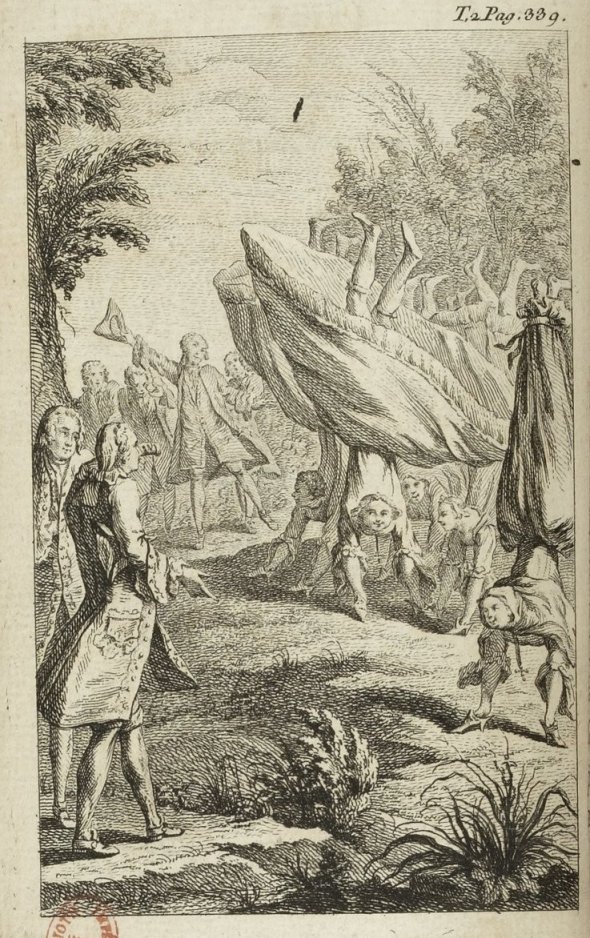
"During the reign of Mangogul's grand-father Kanaglou the women start walking on their hands and tumbling, fulfilling the prediction of a fairy."
CHAP. XLVII.
Prodigious events of the Reign of Kanaglou, Mangogul's Grand-father.
The favorite was very young. Born towards the end of Erguebzed's reign, she had scarce any idea at all of the court of Kanaglou. A word accidentally dropt had given her a curiosity to know the prodigies, which the genius Cucufa had wrought in favour of that good prince; and none could more faithfully inform her than Selim. He had been an eye-witness and even a sharer in them, and was throughly versed in the history of his time. One day that he was alone with her, Mirzoza put him on that topic, and asked him if the reign of Kanaglou, which made so great noise, had seen greater wonders, than those, which then engrossed the attention of Congo?
"I have no interest, madam," answered Selim, "in preferring times past to those of the reigning prince. Great things are come to pass under him, but they are perhaps no more than specimens of those which will continue to render Mangogul illustrious; and my time is too far advanced, to flatter my self with seeing them." "You are mistaken," replied Mirzoza; "you have acquired, and will keep the epithet of eternal. But tell me what you have seen."
"Madam," continued Selim, "Kanaglou's reign was long, and our poets have named it the golden age. This title suits it upon several accounts. It has been signalized by successes and victories: but the advantages were blended with crosses, which prove that this gold was sometimes mixed with bad alloy. The court, which sets the example to the rest of the empire, was very gallant. The Sultan had mistresses, the nobility piqued themselves on imitating him, and the lower people insensibly assumed the same air. The magnificence in dress, furniture, and equipages, was excessive. Delicacy in feasting was reduced to an art. People gam'd high, ran in debt, paid no body, and spent while they had either money or credit. There were very good laws enacted against luxury, but not put in execution. Towns were taken, provinces conquered, palaces begun, and the empire drained of men and money. The people sung victory, and were starving at the same time. The great had stately castles and delightful gardens, and their lands lay uncultivated. A hundred ships of war had rendered us masters of the sea, and the terror of our neighbours: but a good calculator made an exact estimate what it cost the government to keep these hulks in good order; and notwithstanding the remonstrances of the rest of the ministry, they were ordered to be turned into a bon-fire. The royal treasury was a great empty coffer, which this wretched oeconomy did not fill; gold and silver became so scarce, that the mints were, on a summer's morning, converted into paper-mills. To compleat our happiness, Kanaglou suffered himself to be persuaded by a set of fanatics, that it was of the utmost importance, that all his subjects should resemble him, and that they should have blue eyes, snub noses, and red whiskers, as well as he: and he expelled from Congo above two millions of people, who were not blessed with these regimentals, or who refused to counterfeit them. Such, madam, was this golden age; such those good old times, which you daily hear regretted: but let those dotards prate on, and do you believe that we have our Turennes and our Colberts, that, all things considered, the present is better than the time past; and that if the people are happier under Mangogul than they were under Kanaglou, his highness's reign is more illustrious than that of his grandfather, because the happiness of the subject is the exact measure of the greatness of the prince. But let us return to the particulars of Kanaglou's reign.
"I will begin by the origin of the Pantins." "Selim, I will excuse you, I know that story by heart," says the favorite, "proceed to other matters." "Madam," answered Selim, "might one ask from whom you have it?" "Why," says Mirzoza, "it is published." "True Madam," replied Selim, "and by people, who knew nothing of the matter. I am out of humour, when I see little obscure private persons, who have never been near princes, but at a public entry into the metropolis, or some such other ceremony, pretend to write their history.
"Madam," continued Selim, "we had spent the night at a masquerade in the great salons in the Seraglio, when the genius Cucufa, a vowed protector of the reigning family, appeared to us, and commanded us to go to bed, and sleep twenty four hours on a stretch. He was obeyed, and at the expiration of this term, the Seraglio was found to be transformed into a vast and magnificent galery of Pantins. At one end appeared Kanaglou seated on his throne: a long pack-thread, almost worn out, hung down between his legs: an old decrepit fairy was incessantly pulling it, and with a turn of her wrist, moved an innumerable multitude of subaltern Pantins, to whom fine imperceptible threads answered, which issued from Kanaglou's fingers and toes. She pulled, and in an instant the seneschal drew up, and sealed ruinous edicts; or pronounced a panegyric on the fairy, which was prompted by his secretary: the minister of war sent card matches to the army; the superintendant of the finances built houses, and suffered the soldiery to starve; and so of the other Pantins.
"When any of the Pantins happened to execute their movements aukwardly, by not lifting up their arms sufficiently, or not bowing their knee in a proper manner, the fairy cut their threads with a jerk of her left hand, and they became paralytic. I shall never forget two most valiant emirs, whom she found deficient in their duty, and who were ever after deprived of the use of their arms.
"The threads which issued from every part of Kanaglou's body, were extended to immense distances, and from the palace of Congo, put whole armies of Pantins into motion or winter quarters, even to the remotest parts of Monoémugi. With one pull of the pack-thread, a town was besieged, the trenches were opened, they battered in breach, and the enemy was preparing to capitulate; but upon a second pull, the besiegers fire slackened, the attacks were not carried on with the same vigour, troops came to the relief of the place, dissentions were kindled among the generals: we were attacked, surprized, beaten, and routed.
"These bad tidings never gave any concern to Kanaglou: he seldom heard them, till they were forgot by his subjects: and the fairy would not suffer him to be informed of them, but by Pantins, who had each a thread fastned to the tip of their tongue, and who said no more than what she thought proper, on pain of being struck dumb.
"Another time we young fools were all charmed with an adventure, which gave bitter scandal to the godly. The women all at once became tumblers, and fell to walking with their heads down, their legs up in air, and their hands in their slippers.
"This threw all our former knowledge into confusion; and we were obliged to commence a course of studies on these new physiognomies. Many were slighted, who ceased to be thought lovely, as soon as they shewed themselves; and others, who were never so much as talked of, gained vastly by making themselves known. Their petticoats and gowns falling over their eyes, put them in danger, either of losing their way, or stumbling: wherefore the former were shortened, and the latter cut open before. Such is the origin of short petticoats and open gowns. When the women returned to the use of their feet, they retained this part of their dress as it was: and if we thoroughly consider the petticoats of our fine ladies, we shall easily perceive, that they were not made to be worn, as they are worn at this day.
"Any mode, that has but one drift, will soon pass away: in order to make it lasting, it ought to answer two ends at least. In those same days a secret was discovered for plumping the breasts downward: and it is used at this day for plumping them upward.
"The devout women, surprized to find their heads down, and their heels up in the air, at first covered themselves with their hands: but this attention made them lose their poise, and stumble in their walks. By the advice of the Bramins, they afterwards tied their petticoats about their legs with little black ribbons. The gay part of the sex found this expedient ridiculous, and publickly declared, that it incommoded their respiration, and threw them into the vapours. This prodigy was attended with happy consequences; it occasioned a number of marriages, or somewhat like them, and a crowd of conversions. All those, who had disagreeable buttocks, ran headlong into the religious party, and took little black ribbons. Four missions of Bramins would not have made so many proselytes.
"We had scarcely got rid of this trial, when we underwent another, less universal indeed, but not less instructive. The young girls, one and all, from thirteen to eighteen, nineteen, twenty years of age, and upwards, rose on a fine summer's morning, the middle finger caught, guess where, madam?" says Selim to the favorite. "It was not in their mouth, nor in their ear, nor infine, à la Turque. Their disease was easily guess'd, and the remedy quickly applied. From that time may our custom be dated of marrying children, who are fit for nothing but dressing their dolls.
"Another blessing: Kanaglou's court swarmed with Petits-maitres, and I had the honour to be of the number. One day as I was entertaining them with the young French nobility, I perceived our shoulders working upwards, till they became higher than our heads: but that was not all; in an instant we all fell to whirling about on one heel." "And what rarity was there in that?" said the favorite. "Nothing, madam," replied Selim, "but that the first metamorphosis is the origin of the round shoulders, so much in vogue in your infancy; and the second, that of the scoffers, whose reign is not yet over. Then, as now, a discourse was begun to some one person, which by a sudden twirl on the heel, was continued to a second, and finished to a third, to whom it became half unintelligible, half impertinent.
"Another time we all found our selves short sighted, and were forced to have recourse to Bion: the rogue made us pay ten sequins for glasses, which we continued to use, even after recovering our sight. Thence come, madam, the opera spy glasses.
"I could never learn what the fine ladies did to the Genius Cucufa about this time; but he took severe vengeance of them. At the end of a certain year, whereof they had spent the nights in balls, banquets, and gaming, and the days in dressing, or between the arms of their lovers, they were all astonished to find themselves horridly ugly. One was as black as a mole, another bronzed over; a third pale and lean, a fourth of a sickly yellow, and full of wrinkles. There was a necessity to palliate this fatal enchantment, and our chemists found out the white, the red, pomatums, waters, venus's handkerchiefs, virgins milk, patches, and a thousand other cosmetics, which they employed, to avoid appearing ugly, and becoming frightful. Cucufa still held them under this curse, when Erguebzed, who loved beautiful women, became their intercessor. The Genius did all that he could; but the charm was so powerful, that he was not able to dissolve it thoroughly; and the court ladies remained such as you see them at this day."
"Was the fate of the other charms the same?" says Mirzoza. "No, madam," answered Selim, "they lasted some longer, some shorter: the round shoulders sunk by degrees, and people stood upright: and for fear of being thought hump-back'd, they turned up their noses to the wind, and danced as they walked. The whirlgig motion continued, and they whirl about to this day. Broach a serious or sensible conversation in presence of a young lord of the bel air; and Zeste, you shall see him wheel away from you in an instant, and go mutter out a parody to some body, who asks him the news of the war, or of his health; or to whisper in his ear, that he supped last night with Miss Rabon, and that she is an adorable girl; that there is a new romance coming abroad; that he has read some pages of it, and that it is fine, very fine: and then another twirl or two towards a lady, whom he asks if she has seen the new opera, and answers her, that Miss Dangeville has performed to a miracle."
Mirzoza found these ridicules very diverting, and asked Selim if he had been a sharer in them. "How, madam," replied the old courtier, "was it possible not to have them, without passing for a man come from the other world? I put on the round shoulders, I stood erect, I danced in walking, I cock'd the spy-glass, I whirled about, I hissed like the rest: and the utmost efforts of my judgment went no farther than to be one of the first in taking up these several biasses, and none of the last in shaking them off." Selim was got thus far, when Mangogul appeared. The African author does not inform us, what was become of him, or what were his occupations during this preceding chapter. Probably the princes of Congo may be allowed to perform indifferent actions, to say miserable things sometimes, and to resemble the rest of mankind, who spend a great part of their lives in doing nothing, or such things at least, as are not worthy of being known.
CHAP. XLVIII.
Twenty-eighth Trial of the Ring.
Olympia.
"Rejoice, madam," says Mangogul, coming in to the favorite's appartment. "I bring you an agreeable piece of news. The Toys are a parcel of little fools, who know not what they say. Cucufa's ring can indeed make them speak, but not extort the truth from them." "And how has your highness caught them in a lye?" says the favorite. "You shall hear," answered the Sultan. "Selim promised you an account of all his adventures, and you make no doubt but that he has kept his word. Well then, I am just come from consulting a Toy, who accuses him of a naughty trick, which he has not confessed to you, and which most certainly he has not play'd, as it is quite contrary to his character. To tyrannize over a pretty woman, to lay her under contribution, on pain of military execution: can you discover Selim in this proceeding?" "Pray, why not, Sir?" replied the favorite. "There is no malice of this sort, of which Selim has not been capable: and if he has concealed the adventure which you have discovered, possibly it is, that he is reconciled to this Toy, that they are well together, and that he thought he might keep that peccadillo from me, without swerving from his promise."
"The perpetual falsity of your conjectures," replied Mangogul, "ought to cure you of the disease of ever making any. There is nothing of what you imagine in the affair: it is one of the first flights of Selim's youthful days. It regards one of those women, who are gained in a minute, but are never kept long."
"Madam," says Selim to the favorite, "in vain do I examine my self, I can recal nothing more to my memory; and at present I find my conscience quite clear."
"Olympia," says Mangogul—"Ah! Prince," interrupted Selim, "I know the thing; but this little story is so old, that it is no wonder that it has escaped me."
"Olympia," continued Mangogul, "wife of the chief cashier of Hasna, had coiffed herself with a young officer, captain in Selim's regiment. Her lover came to her one morning in deep concern, to inform her that orders were issued for all the officers to set out and join their respective corps. My grandfather Kanaglou had resolved that year to open the campaign early: and an admirable project, which he had formed, miscarried, purely through the making these orders too publick. The politicians murmured, the women exclaimed, each party had their reasons. I have told you those of Olympia. This woman took the party of seeing Selim, and, if possible, to prevent the departure of Gabalis: for that was her lover's name. Selim already passed for a dangerous man. Olympia thought it was proper to have an escort: and two of her female friends, as handsome as her self, offered to accompany her. Selim was at home when they came. He received Olympia, who appeared alone, with that easy politeness, which you know he is master of, and asked what had procured him this agreeable visit? 'Sir,' says Olympia, 'I interest my self for Gabalis: he has some important affairs on his hands, which make his presence necessary at Banza, and I come to you to beg six months leave of absence for him.'
"'Six months leave, Madam? You do not consider,' replied Selim: 'the Sultan's orders are precise: I am heartily concerned, that I cannot make a merit towards you of a favour, which would infallibly ruin me.' New instances on Olympia's side: on Selim's new refusals—'The Grand Vizir has promised me, that I should be comprehended in the next promotion. Can you desire me, madam, to drown my self, in order to oblige you?' 'No, Sir, you may oblige me, without drowning your self'—'Madam, it is impossible: but if you go to the Visir'—'Alas! Sir, to whom do you send me, that man never did any thing for the ladies'—'I rack my brain to no purpose: for I should be highly rejoiced in being able to render you service, and I can see but one way.' 'And which is that?' asked Olympia with eagerness.—'Your intention,' answered Selim, 'would be to make Gabalis happy for six months: but, madam, could you not dispose of one quarter of an hour of those pleasures which you design for him?' Olympia understood him wonderfully well, blushed, stammered; and concluded by exclaiming at the severity of the condition. 'Let us say no more of the affair,' replied the colonel with a cold air, 'Gabalis shall join his regiment: the prince's service must be done. I might venture to take somewhat on my self: but you are inflexible. At least, madam, if Gabalis departs, it is you that send him away.' 'I,' cry'd Olympia sharply: 'Ah! Sir, make out his warrant quickly, and let him remain here.' The essential preliminaries of the treaty were ratified on a sopha, and the lady thought she had made sure of Gabalis; when the traitor, who stands before you, took it into his head to ask her, who those two ladies were, who came with her, and whom she left in the next appartment. 'They are two of my intimate friends,' replied Olympia; 'and of Gabalis too,' added Selim, 'beyond all doubt. This supposed, I do not believe they will refuse to execute each a third part of the articles of the treaty. Yes, this to me seems just: and to you, madam, I commit the care of disposing them to it.' 'Indeed, Sir,' says Olympia, 'you are a strange man. I protest, these ladies have no pretentions to Gabalis: but in order to extricate them and my self from this embarras, if you think me responsible, I will endeavour to discharge the bill of exchange, which you draw on them.' Selim accepted the offer. Olympia did honour to her word: and there, madam, is what Selim ought to have informed you of."
"I excuse him," says the favorite: "Olympia was not so good an acquaintance, that I should condemn him for having forgot her. I cannot imagine whither you go to hunt out that sort of women: indeed, prince, your conduct is that of a man, who has no desire to lose a castle."
"Madam, to me it seems, as if you had entirely changed your notions within these few days," answered Mangogul: "do me the favour to recollect the first trial of my ring, which I proposed to you; and you will see, it was not my fault that I have not lost it ere now."
"Yes," replied the Sultana, "I know, you have sworn to me, that I should be excepted out of the number of speaking Toys; and that since that time you have applied to such women only as have forfeited their character; to an Amina, a Zobeida, a Thelis, a Zulica, whose reputations were already pretty well settled."
"I grant," says Mangogul, "that it would be ridiculous indeed to rely on those Toys: but for want of others, I was necessitated to confine myself to them. I have already told you, and I now repeat it: good company with respect to Toys is scarcer than you think; and if you will not resolve to gain yourself——"
"I," interrupted Mirzoza smartly, "I shall never have a castle while I live, if I must use those means for obtaining one. A speaking Toy! Fy! That is so indecent.——Prince, in one word, you know my reasons, and with great seriousness I now reiterate my menaces."
"But, either do not complain of my trials, or at least hint at some persons, to whom you think we may have recourse: for I am quite uneasy that the affair is not terminated. Libertin Toys, and what next? Libertin Toys, and always Libertin Toys."
"I have great confidence," says Mirzoza, "in Egle's Toy; and I wait with impatience for the end of the fortnight which you demanded of me."
"Madam," replied Mangogul, "that term expired yesterday; and while Selim was telling you stories of the old court, I learnt from Egle's Toy, that, thanks to the ill humor of Celebi, and the constant attendance of Almanzor, it's mistress can do you no service."
"Ah! Prince," cry'd the favourite, "what have you said?" "'Tis fact," replied the Sultan; "I will regale you with that story some other time: but in the mean while seek another string to your bow."
"Egle, the virtuous Egle, has at length given herself the lye," says the favorite in a surprize; "indeed I cannot recover myself." "I see you are quite unhinged," replies Mangogul, "and know not whither to turn yourself."
"Not so," says the favorite; "but I own to you that I depended much on Egle." "Pray think no more about it," added Mangogul; "only tell us if she was the only virtuous woman that you know."
"No, Prince, there are a hundred others, and amiable women too, whom I will name to you," replied Mirzoza. "I will answer, as much as for myself, for——for——"
Mirzoza stop'd short, without having pronounced any one name. Selim could not refrain from smiling, and the Sultan from bursting out into laughter, at the favorite's embarrassment, who knew so many virtuous women, and could not recollect any one.
Mirzoza, piqued at this, turned to Selim, and said: "pray, Selim, help me out, you, who are so great a connoisseur. Prince," continued she directing her discourse to the Sultan, "apply to——whom shall I name? prithee, Selim, assist me." "To Mirzoza," says Selim. "You make your court to me very ill," replied the favorite. "I am not afraid of the trial, but I abhor it. Name some one else quickly, if you would have me pardon you."
"One may try," says Selim, "if Zaide has found the reality of the ideal lover, which she formed to herself, and to whom she was formerly wont to compare all those who made love to her."
"Zaide?" replys Mangogul. "I must own that she is a very proper subject to make me lose." "She is," added the favorite, "perhaps the only woman, whose reputation has been spared by the prude Arsinoe and the coxcomb Janeki."
"This is strong," says Mangogul: "but the trial of my ring is a better argument. Let us go directly to her Toy.
"That Oracle is surer much than Calchas."
"How," adds the favorite smiling: "you retain your Racine, like a player."
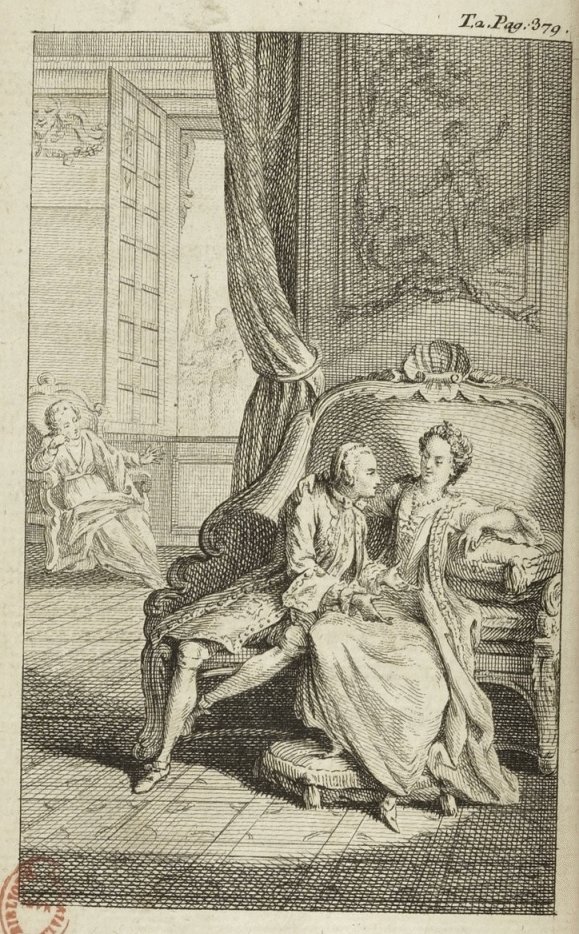
Sultan Mangogul and the Favourite.
CHAP. XLIX.
Twenty-ninth Trial of the Ring.
Zuleiman and Zaide.
Mangogul, without answering the favorite's joke, departed instantly, and went to Zaide's house. He found her retired in a closet, at a small table, on which he observed some letters, a portrait, and some trifles scatter'd here and there, which came from a cherished lover, as it was easy to presume, by the fondness she expressed for them. She was writing; tears ran down her cheeks, and wetted the paper. Every now and then she kiss'd the portrait with transport opened the letters, wrote some words, returned to the portrait, snatched up the above mentioned trifles, and pressed them to her breast.
The Sultan's astonishment was incredible; he had never seen any tender woman, but the favorite and Zaide. He thought himself beloved by Mirzoza: but did not Zaide love Zuleiman better still? And were not this pair the only true lovers of Congo.
The tears, which Zaide shed in writing, were not tears of sorrow. 'Twas love that made them flow. And in that moment, a delicious sentiment, which arose from a certainty of possessing the heart of Zuleiman, was the only one that affected her. "Dear Zuleiman," cry'd she, "how I love thee! how dear thou art to me! How agreeably thou employest me! In those instants, when Zaide has not the happiness of seeing thee, she writes to thee how much she is thine: separated from Zuleiman, his love is the only conversation which gives her pleasure."
Zaide was thus far advanced in her amorous meditation, when Mangogul pointed his ring at her. Immediately he heard her Toy send forth a sigh and repeat the first words of her mistress's monology. "Dear Zuleiman, how I love thee! how dear thou art to me! how agreeably thou employest me!" Zaide's heart and Toy were too well agreed, to vary in their discourse. Zaide was surprized at first; but she was so sure that her Toy would say nothing, but what Zuleiman might hear with pleasure, that she wish'd him present.
Mangogul repeated his trial, and Zaide's Toy repeated with a soft tender voice: "Zuleiman, dear Zuleiman, how I love thee! how dear thou art to me!" "Zuleiman," says the Sultan, "is the happiest mortal of my empire. Let us abandon this place, where the image of a happiness greater than mine is presented to my sight, and afflicts me." Accordingly he withdrew, and went to his favorite with an air of inquietude and pensiveness. "Prince," says she, "what ails you, you say nothing to me of Zaide?"——"Zaide is an adorable woman, madam," replied Mangogul. "She loves beyond any thing that ever loved"—"So much the worse for her," says Mirzoza. "What do you say?" replied the Sultan.——"I say," answers the favorite, "that Kermades is one of the most disagreeable persons of Congo; that interest and the authority of the parents made that match; and that there never was a couple worse sorted than Kermades and Zaide."
"But, madam," replies Mangogul, "it is not her husband that she loves"——"Who then?" says Mirzoza.——"'Tis Zuleiman," replies Mangogul——"Adieu then to the Porcelains and the little Sapajou," added the Sultana——"Ah!" says Mangogul whispering to himself, "this Zaide has struck me: she pursues me, she occupies my thoughts; I must absolutely see her again." Mirzoza interrupted him by some questions, which he answered in monosyllables. He refused a game of piquet which she proposed, complain'd of a head-ach which he counterfeited, retired to his appartment, went to bed without supping, which he had never done before, and had no sleep. The charms and tenderness of Zaide, the qualities and happiness of Zuleiman tormented him the whole night.
One may easily imagine, that he had no business so much in his head this day, as to return to Zaide. He walk'd out of his palace, even without enquiring after Mirzoza, the first time that ever he fail'd in this point. He found Zaide in the same closet as the preceding day, and Zuleiman with her; who held his mistresses hands between his own, and had his eyes fixed on her. Zaide on her knees, and inclining forward, darted glances animated with the most ardent passion on Zuleiman. They continued some time in this attitude: but both in the same instant yielding to the violence of their desires, they rush'd into each others arms, and embraced with eagerness. The profound silence, which had hitherto reigned about them, was disturbed by their sighs, the sound of their mutual kisses, and some inarticulated words, which slip'd from them——"You love me!"——"I adore you"——"Will you love me constantly?"——"Alas! the last sigh of my life shall be for Zaide!——"
Mangogul overwhelm'd with sorrow, threw himself into an easy chair, and covered his eyes with his hand. He dreaded seeing things, which are easily imagined, and yet did not happen. After a silence of some moments, "Ah! dear and tender lover," says Zaide, "why have I not always found you such as you are at present? I should not love you the less, nor should I have any reproach to throw on myself.——But you weep, dear Zuleiman. Come, dear and tender lover, come, and let me wipe off your tears. Zuleiman, you cast down your eyes, what ails you? Pray look on me.——Come, dear friend, come, that I may comfort thee: cling thy lips on my mouth, breathe thy soul into me, receive mine; suspend——Ah! no——no"——Zaide finished her discourse with a deep sigh, and was silent.
The African author informs us, that this scene touched Mangogul most sensibly, that he built some hopes on the impotence of Zuleiman, and that some secret proposals were made on his behalf to Zaide, who rejected them, and never made any merit of it with her lover.
CHAP. L.
Platonic Love.
"But is this Zaide an unique? Mirzoza is no ways inferior to her in charms, and I have a thousand proofs of her affection. I desire to be loved, I am, and who has told me that Zuleiman is more so than I? I was a fool to envy another's happiness. No, there is no man under the heavens happier than Mangogul." Thus began the remonstrances, which the Sultan made to himself. The author has surpressed the rest, and contents himself with apprizing us, that the prince paid more regard to them, than to those which his ministers presented him with, and that Zaide never after returned on his mind.
One of those evenings, that he was entirely satisfied with his mistress or with himself, he proposed sending for Selim, to walk in the groves of the Seraglio. These were verdant closets, where many things may be said and done without witnesses. In their way thither, Mangogul turn'd the conversation on the reasons people have for loving. Mirzoza, mounted on grand principles, and fill'd with idea's of virtue, which certainly did not suit with her rank, person, or age, maintain'd that people very frequently loved for the sake of loving; and that connections begun by a likeness of characters, supported by esteem, and cemented by mutual confidence, were very lasting and constant; without any pretensions to favors on the man's side, or on the woman's any temptation to grant them.
"Thus it is, Madam," replied the Sultan, "that you have been spoil'd by romances. In them you have seen hero's respectuous, and princesses virtuous even to folly; without reflecting that those Beings never existed but in the brains of authors. If you ask Selim, who thoroughly well knows the catechism of Cythera, 'what is love?' I would lay a wager that he would answer you, that love, is nothing else but——"
"Would you lay a wager," interrupted the Sultana, "that delicacy of sentiments is but a chimæra, and that without hopes of enjoyment, there would not be a grain of love in the world? If so, you must certainly entertain a very bad opinion of the human heart."
"So I do," replied Mangogul, "our virtues are not more disinterested than our vices. The brave pursues glory by exposing himself to dangers; the coward loves tranquility and life; and the lover desires enjoyment."
Selim declaring himself of the Sultan's party, added, that if two things happened, love would be banished from society, never more to make its appearance again.
"And which are those two things?" says the favorite. "They are," replied Mangogul, "if you and I, madam, and all the race of mankind, chanced to lose what Tanzai and Neadarne found in a dream."
"What! You believe," interrupted Mirzoza, "that without those pitiful things, there would be neither esteem nor confidence between two persons of different sexes? A woman adorn'd with talents, wit and beauty, would not touch? A man bless'd with an amiable person, a fine genius, and excellent character, would not be heeded?"
"No, madam," replies Mangogul; "for pray tell me what he would say?"
"A number of pretty things, which I think would always afford much pleasure to hear," answers the favorite.
"Observe, madam," says Selim, "that those things are said every day without love. No, no, madam, I have complete proofs, that without a well organised body, there is no love. Agenor, the handsomest young man of Congo, and the most refined wit of the court, would, if I had been a woman, in vain shew me his genteel leg, turn his large blue eyes on me, squander on me the most artful praise, and set himself off with every other advantage of which he is master; I would say but one word, and if he did not give an express answer to this word, I might have all possible esteem for him, but I should not love him."
"That is positive," added the Sultan, "and you yourself will allow the justness and utility of this mysterious word, when one loves. You ought indeed, for your instruction, to cause the conversation of a wit of Banza with a school-master to be related to you. You could comprehend in an instant, how the wit, who sustained your thesis, confessed in the end that he was in the wrong, and that his antagonist reasoned like a Toy. But Selim, of whom I had it, will you tell the story."
The favorite imagined, that a story, which Mangogul would not relate to her, must be very mortifying: and therefore she went into one of the arbors, without asking it of Selim, and happy it was for him; for with all his wit, he would have ill satisfied the favorite's curiosity, or much allarm'd her modesty. But in order to amuse her, and make her forget the story of the school-master, he related the following.
"Madam," says the courtier, "in a vast country near the sources of the Nile, lived a young man, beautiful as Adonis. Before he was eighteen years of age, all the maidens contended for his heart, and there were few women, who would not accept of him for their lover. Born with an amorous heart, he loved as soon as he was in a condition to love.
"On a certain day, while he was in the temple assisting at the public worship of the great Pagoda; and was, according to the usual ceremony, preparing to make the seventeen genuflexions prescribed by the law; the beauty, with which he was captivated, chanced to pass by, and darted a glance on him accompany'd with a smile, which threw him into such distraction, that he lost his poize, fell on his nose, scandalized the congregation by his fall, forgot the number of genuflexions, and performed but sixteen.
"The great Pagoda irritated at the offence and scandal, punished him cruelly. Hilas, for that was his name, the poor Hilas felt himself instantly inflamed with the most violent desires, and smack-smooth as the palm of his hand, deprived of the means of gratifying them. Equally surprized and grieved at so great a loss, he consulted the Pagoda. 'Thou shalt never be restored to thy pristine state,' answered she sneezing, 'but between the arms of a woman, who shall not love thee the less for knowing thy misfortune.'
"Presumption is generally the companion of youth and beauty. Hilas fancied that his wit and the comeliness of his person would soon gain him a heart of nice sentiments; who content with what he had remaining, would love him for himself, and soon restore to him what he had lost. He first addrest himself to the lady, who had been the innocent cause of his misfortune. She was young, brisk, voluptuous and a coquet. Hilas adored her, and obtained a meeting; where by a train of allurements he was drawn into the road leading to a place which it was impossible for him to reach. In vain did he torment himself, and in the arms of his mistress seek the accomplishment of the oracle: nothing appeared. When the lady was tired of waiting, she set herself to rights in a moment, and quitted him. The worst of the affair was, that the foolish girl told it in confidence to one of her female friends, who, out of her great discretion, related it but to three or four of hers, who did the same to as many others: so that Hilas, two days before the darling of all the sex, was despised, pointed at, and looked on as a monster.
"The wretched Hilas, cried down in his native country, resolved to travel, and seek a remedy for his disease in remote climes. He set out alone, and arrived incognito at the court of the Abyssinian emperor. The young stranger was singled out by the ladies, and the contest was, who should have him but Hilas prudently avoided all engagements, in which he had apprehensions of not finding his account, proportionable to his certainty that the women who pursued him would not find theirs in him. But observe and admire the penetration of the sex: 'a man so young, so comely, and so modest,' said they, 'is quite a prodigy:' and the union of these qualities in him had almost made them suspect his real defect; so as, for fear of allowing him what an accomplished man should have, to refuse him the very thing which he wanted.
"After having for some time studied the chart of the country, Hilas linked an acquaintance with a young woman, who, by some unknown caprice, had passed from refined gallantry to the highest devotion. He gradually insinuated himself into her confidence, espoused her notions, copied her practices, handed her in and out of the temples, and conversed with her so frequently on the vanity of worldly pleasures, that he insensibly revived her taste, as well as remembrance of them. They had now, for above a month, frequented the mosques, assisted at sermons, and visited the sick together, when he prepared himself for a thorough cure; but all in vain. His devote friend, tho' intimately acquainted with all the transactions of heaven, knew as well as others, how a man should be made on earth: and the poor lad lost in a moment all the fruits of his good works. If any thing consoled him, it was, that his secret was inviolably kept. One word would have rendered his disease incurable; but this word was not uttered, and Hilas linked in with some other pious women, whom he took, one after another, for the specific ordained by the oracle, and who did not break his enchantment, because they loved him only for what he was not. The habit, they had acquired of spiritualizing all objects, was of no service to him. They required sense, but it was of that sort which springs from pleasure. Hilas complained that they did not love him. But their answer was, 'pray, sir, are you ignorant, that people should know each other, before they love; nay, you must acknowledge, that, disgraced as you are, you are not lovely even when you are known.'
"'Alas!' said he retiring, 'this pure love, so much talked of, is no where to be found; this delicacy of sentiments, upon which both sexes value themselves, is a mere chimæra. The oracle has deceived me, and my disease is for life.'
"In his way, he met some of those women, who allow no other commerce with man, but that of the heart, and who hate a forward spark like a toad. They so seriously recommended to him to let nothing gross and terrestrial enter into his views, that he conceived great hopes of his cure. He complied heartily, and was quite astonished, after the amorous conversations, which they held with him, that he still remained as he was. 'I must certainly be cured,' said he to himself, 'but perhaps otherwise than by words:' and he sought an occasion of placing himself according to the intentions of the oracle. Thus it soon offered. A young female platonic, who was excessively fond of walking, led him into a lonesome wood and when they had penetrated far from the reach of any impertinent eye, the fair one was seized with a fainting fit. Hilas threw himself on her, and neglected nothing in his power to relieve her; but all his endeavours were fruitless: of which she soon became as sensible as himself. 'Ah! Sir,' cried she, disengaging herself from his arms, 'what sort of man are you? I shall be very cautious of ever venturing thus into lonesome places, where I have been taken so ill, and may dye a hundred times for want of help.'
"Others knew his condition, pitied him, protested to him, that the tenderness they had conceived for him, should not change; and never saw him more.
"The miserable Hilas, with his graceful figure, and the most refined sentiments, gave great dissatisfaction to many ladies."
"Then he was a fool," interrupted the Sultan. "Why did he not address some of the vestals, of which our monasteries are full? They would be charmed with him, and he would infallibly receive his cure through a grate."
"Prince," replied Selim, "chronicles assure us, that he tried that method, and found by experience, that the sex of all conditions do not care to love to their certain loss." "If that be the case," said the Sultan, "I take his distemper to be incurable." "So did he himself as well as your highness," continued Selim; "and tired out with unsuccessful trials, he plunged himself into solitude, on the word of an infinite number of women, who had expresly declared to him, that he was useless in society.
"He had already been several days rambling in a desert, when he heard some sighs issuing from a lonely place. He listened, the sighs began again, he drew near, and saw a young maiden, fair as the morn, her head leaning on her hand, her eyes bathed in tears, and the rest of her body in a pensive and mournful posture. 'What seek you here, madam?' said he to her. 'And are these deserts made for you?' 'Yes,' replied she in a melancholy strain: 'I can at least afflict myself here quite at my ease.' 'And what is the cause of your affliction?'—'Alas!'—'Speak, madam, what is the cause?'——'Nothing'——'How, nothing?'——'No, nothing at all, I say, is the cause of my grief: two years ago I had the misfortune to offend a Pagoda, who deprived me of my all: and it was so small a matter, that in so doing, she gave no great proof of her power. Since that time, all the men shun me, and will shun me, said the Pagoda, until I meet with one, who knowing my misfortune, will cleave to me, and love me in the state, in which I am.'
"'What do I hear!' cried Hilas. 'This wretch, whom you behold at your feet, has nothing, and that is his distemper likewise. Some time since he had the misfortune to offend a Pagoda, who deprived him of all that he had, and without vanity it was somewhat. From that time all the women shun him, and will shun him, said the Pagoda, until he meets with one, who, knowing his misfortune, will cleave to him, and love him in the state, in which he is.'
"'Is this possible?' says the young maiden.——'Is what you have told me true?' says Hilas.——'See,' answered the maiden. 'See,' answered Hilas.
"They both convinced each other beyond all doubt, that they were two objects of the celestial wrath. Their common misfortune united them. Iphis, this was the young maiden's name, was made for Hilas, Hilas was made for her. They loved each other in a platonic manner, as you may easily imagine; for they could not well love otherwise: but in an instant the inchantment was broken, they uttered cries of joy on the event, and platonic love vanished.
"During several months, that they continued together in the desert, they had full time to be persuaded of their change. When they quitted it, Iphis was perfectly cured; but as to Hilas, the author says that he was threatned with a relapse."
CHAP. LI.
Thirtieth and last trial of the Ring.
Mirzoza.
While Mangogul was entertaining himself with the favorite and Selim, news was brought him of the death of Sulamek. Sulamek's rise began by being appointed the Sultan's dancing-master, and that even contrary to the intentions of Erguebzed: but some intriguing ladies, whom he had taught certain dangerous steps, pushed him with all their might, and so bestirred themselves, that he was preferred to Marcel and others, whose deputy he was not worthy of being. He possessed the spirit of trifling, the court jargon, the gift of telling diverting stories, and of amusing children; but he knew nothing of the high dance. When the post of Grand Vizir became vacant, by dint of cringing, he supplanted the great Seneschal, who was an indefatigable dancer, but stiff-necked, and bowed with a bad grace. His ministry was not signalized by any events glorious to the nation. His enemies, (and who is there without them? true merit has many) accused him of playing ill on the violin, and of having no knowledge of choregraphy; of having suffered himself to be duped by the Pantomimes of Prester John, and to be affrighted by a bear from Monoémugi, who danced one day before him; of having given millions to the emperor of Tombur to keep him from dancing, at a time when he had the gout, and spent yearly five hundred thousand Zecchins in resin, and more in persecuting all the fidlers, who played any other minuets but his own: in a word, of having slept fifteen years of a stretch, at the sound of a cymbal of a clumsy native of Guinea, who accompanied his instrument with some Congo songs. True it is, that he had introduced the fashion of Dutch lime trees, &c.
Mangogul had an excellent heart: he regretted Sulamek, and ordered him a magnificent burial, with a funeral oration, which the orator Brrrouboubou was ordered to make.
On the day appointed for the ceremony, the chief Bramins, the whole Divan in a body, and the Sultanas led by their eunuchs, went to the great mosque. Brrrouboubou proved for two hours together, with surprizing rapidity, that Sulamek had risen to his high station by superior talents, made prefaces on prefaces, did not forget either Mangogul or his exploits during the administration of Sulamek; and he had almost spent himself in exclamations, when Mirzoza, to whom a lye gave the vapors, fell into a fit of the lethargy.
Her officers and women ran to her assistance; she was put into her palanquine, and instantly carried to the Seraglio. Mangogul, being informed of the danger she was in, ran to her; and the whole Pharmacopoeia was rummaged. The Garus, general la Motte's drops, the English drops, were all tried, but to no purpose. The distressed Sultan, one moment weeping over Mirzoza, the next swearing at Orcotomus, at length was deprived of all hopes, except some glimmerings which might remain in his ring. "If I have lost you, delight of my soul," cried he, "your Toy, as well as your mouth, must keep eternal silence."
In an instant he commanded every body to withdraw: he was obeyed; and being alone with the favorite, he turned his ring on her. But Mirzoza's Toy, which was tired at the sermon, as it happens to others every day, and besides had probably a touch of the lethargy, at first only mutter'd some confused and ill articulated words. The Sultan repeated the experiment, and the Toy then very distinctly said: "Separated from you, Mangogul, what would become of me?—Faithful even to the grave, I would have sought you; and if love and constancy have any recompence among the dead, dear prince, I would have found you—Alas! without you the delightful palace where Brama dwells, and which he has promised to his true believers, would prove a disagreeable residence to me."
Mangogul, transported with joy, did not perceive that the favorite was recovering from her lethargy; and that, if he did not turn off his ring, she would hear the last words of her Toy: which happened accordingly. "Ah! prince," said she, "what is become of your oaths? You have then cleared up your unjust suspicions? Nothing has withheld you, neither the condition I was in, the injury you were doing me, nor the word you had given me?"
"Madam," replied the Sultan, "impute not to a shameful curiosity, an impatience, which the despair for having lost you, has alone suggested to me. It was not an usual trial of my ring, that I made on you; but I believed that I might, without breach of promise, make use of a resource, which restores you to my vows, and secures my heart to you for ever."
"Prince," says the favorite, "I believe you; but pray restore the ring to the Genius, and let not his fatal present disturb your heart or empire for the future."
Mangogul immediately made a prayer, and Cucufa appeared. "Almighty Genius," said Mangogul, "take back your ring, and continue me your protection". "Prince," answered the Genius, "divide your days between love and glory. Mirzoza will certainly afford you the first of these blessings; and I promise you the second."
At these words the hooded spectre closed the tails of his owls, and went off, as he came, in a whirling motion.