Denis Diderot. (continued 2)
Reading edition
Scarce had the Toys began to speak, when one of these sharpers fill'd the houses of Banza with a printed bill of this form and tenor.——Advertisement to the ladies. And underneath in small Italic, by permission of my lord the great Seneschal, and with the approbation of the gentlemen of the royal academy of sciences. And lower down: The Sieur Eolipila of the royal academy of Banza, Member of the royal society of Monoémugi, of the imperial academy of Biafara, of the academy of the curious of Loango, of the society of Camur in Monomotapa, of the institute of Ereeco, and of the royal academies of Beleguanza and Angola; who has for many years given courses of baubles, with the applause of the court, the town, and the province; has, in favour of the fair sex, invented muzzles or portable gags, which deprive Toys of the use of speech, without obstructing their natural functions. They are neat and convenient. He has some of all sizes, of all prices, and for all ages: and he has had the honour to serve persons of the highest distinction with them.
There is nothing like being a member of a body of men. Be a work ever so ridiculous, it is puff'd into success. Thus it was, that Eolipila's invention gain'd ground. People flock'd to his house. The gay ladies went thither in their own equipages, prudent women in hackney-coaches; the devouts sent their confessors or footmen, and nuns their door-keepers. Every body must have a muzzle, so that not one from the dutchess down to the cobler's Joan, but had one either for the fashion or for reasons.
The Bramins, who had declared the prattle of Toys to be a divine punishment, and flatter'd themselves with a reformation of manners and other advantages from it, could not without horror see a machine, which eluded the vengeance of heaven and their hopes. Scarcely had they come down from their pulpits, but they mount again, thunder, roar, make the oracles to speak, and pronounce that a muzzle is an infernal machine, and that there is no salvation for those who shall use them. "Carnal women, quit your muzzles; submit," cried they, "to the will of Brama. Permit the voice of your Toys to awaken that of your consciences, and blush not to acknowledge crimes, which you have not been ashamed to commit."
But their exclamations were of little avail: the same fate attended muzzles, that had formerly attended the gowns without sleeves. The preachers were left to catch cold in the temples. All the women took gags, and quitted them not, either till they found them useless, or were tired of them.
CHAP. XVII.
The two Devouts.
For some days past the Sultan left the Toys at rest. Important affairs, on which he was busy, suspended the effects of his ring. In this interval it was, that two women of Banza made diversion for the whole town.
They were professed devouts. They had managed their intrigues with all possible discretion, and were in full enjoyment of a reputation, which even the malice of those of their own class paid respect to. In the mosques nothing was talk'd of but their virtue. Mothers proposed them as patterns to their daughters, and husbands to their wives. The principal maxim of both was, that scandal is the greatest of all sins. This conformity of sentiments, but above all, the difficulty of edifying a clear-sighted and crafty neighbour at an easy expence, had got the better of the difference of their tempers, and they were very good friends.
Zelida received Sophia's Bramin: and it was at Sophia's house that Zelida confer'd with her director; and by a little self-examination, the one could hardly be ignorant of what concerned the other's Toy: but the whimsical indiscretion of these Toys kept them both in cruel apprehensions. They held themselves as on the point of being unmask'd, and of losing that reputation of virtue, which had cost them fifteen years dissimulation and management, and which now embarassed them very much.
At some moments they would even forfeit their lives, especially Zelida, to be as much blasted as the greatest part of their acquaintance. "What will the world say? What will my husband do?——What! that woman so reserved, so modest, so virtuous, that Zelida, like others, is but——Alas! this thought distracts me!——Yes, I wish I never had any reputation," cried Zelida in a passion.
She was then with her female friend, who was making the same reflections, but without such violent commotion. Zelida's last words made her smile. "Laugh, madam, without constraint. Burst out," said Zelida, touched to the quick. "To be sure you have good cause." "I am as sensible of the impending danger, as you can be," answered Sophia, with an air of indifference; "but how to shun it? For you will agree with me, that there is no likelyhood that your wish will be accomplish'd."
"Contrive an expedient then," replied Zelida: "Oh!" said Sophia, "I am tired of rummaging my brain, I can find none.——To bury one's self in a country seat, is one way; but to abandon the pleasures of Banza, and renounce life, is what I will never do. I perceive that my Toy will never approve it." "What is to be done then?" "What! to leave all to providence, and laugh, as I do, at what the world will say. I have tried all shifts to reconcile reputation with pleasures: but since it is decreed that we must renounce reputation, let us at least preserve pleasures. We were uniques: but now, my dear, we shall be like a hundred thousand others; do you look on this as a hard fate?"
"Yes, without doubt," replied Zelida; "to me it seems hard to be like those, for whom I had put on a sovereign contempt. In order to avoid this mortification, methinks I would fly to the world's end."
"Set out, my dear," continued Sophia; "for my part, I stay—But à propos, I advise you to furnish yourself with some secret, to prevent your Toy from blabbing on the road."
"Indeed," replied Zelida, "pleasantry here has a very ill grace, and your intrepidity——"
"You are mistaken, Zelida, there is not a grain of intrepidity in my proceeding. To let things go their own way, when we cannot stop them, is resignation. I see that I am to be dishonoured: well then, dishonour for dishonour, I shall spare myself as much of the uneasiness as I can."
"Dishonour'd!" replied Zelida, bursting into tears. "Dishonour'd! What a shock! I cannot bear it.—Oh! accursed Bonza, 'tis thou that hast ruin'd me. I loved my husband, I was born virtuous; I should have loved him still, if thou hadst not made a wicked use of thy ministry and my confidence. Dishonour'd, dear Sophia!——"
She had not power to make an end. Sobs intercepted her words, and she fell on the carpet, quite in despair. As soon as Zelida recovered her speech, she cried out in a lamentable tone: "Alas! my dear Sophia, I shall die——I must die. No, I shall never survive my reputation."
"But Zelida, my dear Zelida, do not be in a hurry to die: perhaps," said Sophia——"No perhaps shall stop me, I must dye."——"But perhaps one might"——"One might do nothing, I tell you"——"But speak, my dear, what might one do?"——"Perhaps one might hinder a Toy from talking." "Ah! Sophia, you endeavour to comfort me by false hopes, you deceive me." "No, no, I do not deceive you; only hear me, instead of distracting yourself like a mad creature. I have heard talk of Frenicol, Eolipila, gags and muzzles." "Pray, what connexion is there between Frenicol, Eolipila, muzzles, and the danger which threatens us? What business has my Toyman here, and what is a muzzle?"
"It is this, my dear. A muzzle is a machine invented by Frenicol, approved by the academy, and improved by Eolipila, who claims the honour of the invention." "But pray, this machine invented by Frenicol, approved by the academy, and improved by that silly fellow Eolipila."——"Oh! you are of a vivacity that surpasses imagination. Well then, this machine being applied to a Toy, renders it discreet in spite of its teeth."——"Can this be true, my dear?" "It is so said." "We must know it," replied Zelida, "and immediately too."
She rang, one of her women appeared, and she sent for Frenicol. "Why not for Eolipila?" said Sophia. "Frenicol is less taken notice of," answered Zelida.
The Toyman came away with the messenger. "Ah! Frenicol, are you there," said Zelida, "you are welcome. Make haste, my friend, to extricate two women out of cruel anxiety."—"What is the business, ladies? Would you please to have some rare Toys?"—"No, we have two already, and we would willingly"—"Part with them, I suppose. Pray, ladies, let me see them, I will take them, or we will make an exchange."—"You are mistaken, Mr. Frenicol, we have nothing to truck."—"Well, I understand you, you have some ear-rings, which you would desire to lose, so as that your husbands may find them in my shop."——"Not that neither; pray, Sophia, inform him of the matter." "Frenicol," continued Sophia, "we want two——What, don't you understand?" "No, madam: how would you have me understand, when you say nothing?"——"'Tis," said Sophia, "because when a woman is modest, it gives her pain to speak plain on certain things." "But yet," replied Frenicol, "she must speak plain. I am a Toyman, not a Conjuror."——"You must guess however."——"Faith, ladies, the more I look on ye, the less I comprehend ye. When a lady is young, rich, and pretty as you are, she is not reduced to artifice: moreover, I declare sincerely, that I sell them no longer. I have left the dealing in those baubles to young beginners in the trade."
Our devouts found the Toyman's mistake so ridiculous, that they both burst out into a violent fit of laughter, which disconcerted him. "Permit me, ladies, to make my bow, and withdraw. You might well have spared yourselves the trouble of sending for me three miles off, to divert yourselves at my cost." "Stop, stop, friend," said Zelida, still laughing on. "That was not our intention. But by your misapprehending us, such ridiculous notions came into your head."——"'Tis in your power, ladies, to put juster into it. What is the business?" "Oh! Mr. Frenicol, let me laugh at ease, before I answer you."
Zelida laugh'd till she panted for breath. The Toyman thought within himself that she had the vapors, or was out of her senses, and had patience. At length Zelida ceased.——"Well," said she, "the business relates to our Toys, our own Toys, do you understand me, Mr. Frenicol? To be sure you cannot be ignorant, that for some time past several Toys have prattled like magpyes: now we would be very glad that ours would not follow this bad example." "Ah! now I take it, that is to say," replied Frenicol, "that you want a muzzle each."——"Very right, you have hit it off truly. I have been told that Mr. Frenicol was no fool." "Madam, your goodness is very great. As to what you require, I have of all sorts, I go this moment to bring you some."
Frenicol went accordingly: in the mean while Zelida embraced her friend, and thank'd her for her expedient: and I, says the African author, went to take a nap, waiting his return.
CHAP. XVIII.
The Toyman's return.
The Toyman returned, and presented the ladies with two muzzles of the best sort.——"Ah! mercy!" cried Zelida. "What enormous muzzles are these! And who are the unhappy women, whom these will fit? This is an ell long. Indeed, friend, you must certainly have taken measure by the Sultan's mare."——"Yes," said Sophia indolently, after having measured them with her fingers, "you are in the right; and there is but the Sultan's mare and old Rimosa, for whom these can do."——"I protest, ladies, that they are of the common size; and that Zelmaida, Zyrphila, Amiana, and a hundred other ladies, have of the same sort." "That is impossible," said Zelida.——"'Tis actually so however," replied Frenicol: "but they all said the same thing as ye have: and as they have, so may you undeceive yourselves by trying them on." "Mr. Frenicol may say what he will; but he shall never perswade me that this will fit me," said Zelida, "nor this me," said Sophia. "Let him shew us others, if he has any."
Frenicol, who had often experienced that women are not to be converted on that article, shew'd them muzzles for the age of thirteen. "Well," cried both at the same time, "these are such as we want." "I wish they may prove so," whisper'd Frenicol aside. "How do you sell them?" said Zelida. "But ten ducats a piece, madam."——"Ten ducats, you forget yourself, Frenicol."——"Madam, that is the price in conscience."——"You make us pay for the novelty."——"I protest, ladies, 'tis but two sixpences for a shilling." "I must own they are neatly made, but ten ducats are a great deal of money."——"I'll abate nothing."——"We will go to Eolipila's."——"You may, ladies: but there are workmen and workmen, muzzles and muzzles." Frenicol held firm, and Zelida came to. She paid for the two muzzles, and the Toyman went back, fully perswaded that they would be too little for them, and would soon be returned on his hands for a fourth part of the price he received for them. He was mistaken. Mangogul not happening to come within reach of turning his ring on those two women, their Toys were not seized with the humor of talking louder than ordinary; and happily for them: for Zelida having tried her muzzle, found it too little by one half. However, she did not part with it, fancying that it would be pretty near as inconvenient to change it, as not to make use of it at all.
These circumstances came to light from one of her women, who told them in confidence to her lover, who related them in confidence to others, who spread them all over Banza under the seal of secresy. Nor was Frenicol silent: the adventure of the devouts became public, and for sometime afforded employment to the calumniators of Congo.
Zelida became inconsolable upon it. This woman, more to be pitied than blamed, conceived an aversion for her Bramin, quitted her husband, and shut herself up in a convent. As for Sophia, she threw off the mask, despised censures, patch'd and painted, frequented public places, and had adventures.
CHAP. XIX.
Seventh trial of the Ring.
The stifled Toy.
Tho' the female cits of Banza doubted whether Toys of their rank would be honoured with the gift of speech; yet they all furnish'd themselves with muzzles. In Banza muzzles became as common, as a general court mourning in this country.
Here the African author observes with astonishment, that neither the lowness of the price, nor the commonness of muzzles put them out of fashion in the Seraglio. "This once," says he, "utility got the better of prejudice." So trite a reflection was not worth the pains of repeating: but to me it seems as if it was the defect of all the ancient authors of Congo, to fall into repetitions; whether they thereby hoped to give a greater air of truth and facility to their productions; or that they were far from having as much fecundity of invention as their admirers ascribe to them.
However that be, one day Mangogul, walking in his gardens, attended by his whole court, took the maggot to level his ring at Zelais. She was handsome, and suspected of several adventures: yet her Toy did no more than stammer, and utter'd only some few mangled words, which had no meaning, and which the Blasters interpreted as they thought fit.——"Pshuh!" says the Sultan, "here is a Toy that has a vast impediment of speech. Most certainly there must be somewhat that impedes its respiration." Wherefore he applied his ring more intensely. The Toy made a second effort to speak; and in some measure surmounting the obstacle, that stop'd its mouth, these words were heard very distinctly. "Alas! alas!—I am—I am—I am stifled. I can no more.—Alas! alas! I am stifled."
Immediately Zelais found herself going: she grew pale, her neck swell'd, and she fell, with her eyes shut and mouth half open, between the arms of those who stood around her.
Any where else Zelais would have been speedily relieved. 'Twas only debarrassing her of her muzzle, and allowing her Toy a freedom of respiration: but how to lend the helping hand in Mangogul's presence. "Quick, quick, physicians," cried the Sultan, "Zelais is dying."
Some pages ran to the palace, and returned, with the doctors gravely marching after them. Orcotomus was at their head. Some gave their opinion for bleeding, others for the kermes mineral; but the penetrating Orcotomus ordered Zelais to be carried to a neighbouring closet, examined her, and cut the braces of her harness. This muzzled Toy was one of those, which he boasted to have seen in the paroxysm.
However, the bloating was excessive, and Zelais would have continued to suffer, had not the Sultan had pity on her condition. He turn'd off his ring, the fluids return'd to their equilibrium. Zelais came to herself, and Orcotomus assumed the honour of this miraculous cure.
Zelais's accident and her physician's indiscretion, made the muzzles lose much of their credit. Orcotomus, without any regard to Eolipila's interest, proposed to himself to raise his own fortune on the ruins of the others; advertised himself as a patentee physician of Toys that had caught cold: and some of his bills are to be seen at this day in the by-streets. He began by getting money, and ended by falling into contempt. The Sultan took pleasure in lowering the presumption of the empiric. Did Orcotomus boast of silencing a Toy that had never utter'd a word? Mangogul had the cruelty to make it speak. People went so far as to remark, that any Toy that was tired of silence, need only have two or three visits from Orcotomus. In a little time he was rank'd with Eolipila in the class of quacks; and they will both continue therein, until it shall please Brama to take them out.
Shame was preferred to the apoplexy. "The one kills," said the women, "the other does not." Wherefore they renounced their muzzles; let their Toys talk on; and no body died thereby.
CHAP. XX.
Eighth trial of the Ring.
The Vapors.
There was a time, as we have seen, when the women dreaded the prating of their Toys, were stifled, and died away; but another succeeded, when they set themselves above this dread, threw away their muzzles, and had nothing beyond the vapors.
The favorite, among her attendants, had a very singular young lady. Her humour was charming, tho' uneven. She changed countenance ten times a day; but whatever face she put on, was pleasing. Unique in her melancholy, as well as in her gaiety, there slip'd from her, in her most extravagant moments, things of exquisite sense; and in her fits of sadness she uttered very diverting extravagances.
Mirzoza was so used to Callirhoe (for that is the name of this young mad girl) that she could hardly be without her. One time that the Sultan complain'd to the favorite of somewhat restless and cold, which he remark'd in her; "Prince," said she, embarrassed at his reproach, "without my three beasts, my nightingale, my lap-dog and Callirhoe, I am good for nothing; and you see that I have not the last." "And why is she not here?" said Mangogul. "I can't tell," answered Mirzoza; "but I remember, that some months ago she told me, that if Mazul made the campaign, she could not avoid having the vapors; and Mazul set out yesterday." "I easily excuse her," said the Sultan: "for I look on her vapors to be well grounded. But upon what account do a hundred other women take it into their heads to be vapor'd, who have young husbands, and besides take care to be well provided with lovers?" "Prince," answered a courtier, "'tis a fashionable disease. It is genteel in a woman to have the vapors. Without a lover and the vapors, she knows nothing of the world: and there is not a citizen's wife in Banza, who does not affect to have them."
Mangogul smiled, and resolved to visit some of these vaporish women immediately. He went directly to Salica's house, and found her in bed, with her neck quite bare, her eyes flaming, and her hair dishevel'd; and at her bed's side the little stammering hump-back'd physician Farfadi, telling her stories: while she was stretching out, now one arm, then another, yawning, sighing, putting her hand to her head, and exclaiming bitterly: "Alas I can't bear it—throw the windows open—give me air—I shall faint, I shall dye.——"
Mangogul took advantage of the moment that her affrighted women were assisting Farfadi in lightening the bed-cloaths, to turn his ring on her, and instantly these words were heard: "Oh! how tired I am of this humor! behold, madam has taken into her noddle to have the vapors. This farce will last eight days at least, and may I dye, if I know the cause: for after Farfadi's efforts to ferret out this disease, I think it is in the wrong to continue."—"Good," said the Sultan turning off his ring, "I understand. This dame has the vapors in favor of her physician. Let us try elsewhere."
He went from Salica's house to that of Arsinoe, which is not far from it. On entering her chambers he heard loud bursts of laughter, and advanced, thinking to find her in company: but she was alone; and Mangogul was not much surprized. "A woman who gives herself the vapors," says he, "gives them melancholy or merry, as is most convenient." He turn'd his ring on her, and presently her Toy began to laugh unmercifully. From these immoderate laughing fits it made a sudden transition to ridiculous lamentations on the absence of Narces, whom it advised as a friend to hasten his return; and continued to sob, weep, groan, sigh, and be comfortless, as if it had buried all its relations.
The Sultan, who could hardly refrain from laughing aloud at so whimsical an affliction, turn'd off his ring and departed; leaving Arsinoe and her Toy to lament at leisure, and inferring the falsity of the proverb.
CHAP. XXI.
Ninth Trial of the Ring.
Of Things lost and found.
To serve as a Supplement to the learned Treatise of Pancirollus, and to the Memoirs of the Academy of Inscriptions.
Mangogul returning to his palace, pondering on the ridiculous airs which women give themselves, found himself, whether thro' absence of mind, or some blunder of his ring, under the portico of the sumptuous building, which Thelis has decorated with the rich spoils of her lovers. He embraced the opportunity, to interrogate her Toy.
Thelis was the wife of the Emir Sambuco, whose ancestors had reign'd in Guinea. Sambuco had acquired a high reputation in Congo, by five or six signal victories, which he had gain'd over Erguebzed's enemies. As he was not a less able negotiator than a great captain, he had been employ'd in embassies of the greatest consequence, and executed his high trust with superior talents. On his return from Loango he saw Thelis, and was smitten. He was then upon the brink of fifty, and Thelis was not above twenty-five. She was rather agreeable than a beauty: the women said she was well enough, and the men thought her charming. Powerful matches sought her; but whether she had already fix'd her notions, or that there was too great a disproportion of fortune between her and her admirers, they were all rejected. Sambuco saw her, laid at her feet immense riches, a great name, laurels, and titles inferior to none but those of sovereigns, and obtain'd her.
Thelis was, or appear'd virtuous for six whole weeks after her marriage. But a Toy born voluptuous, seldom conquers itself; and a quinquagenarian husband, tho' otherwise ever so great a hero, is a madman, if he flatters himself with conquering such an enemy. Altho' Thelis mix'd prudence with her conduct, her first adventures were not unknown. This was sufficient for supposing afterwards, that she had others undisclosed: and Mangogul, desirous of full information, hastened to pass from the porch of her palace into her appartment.
It was then the middle of summer. The heat was excessive, and Thelis, after dining, had thrown herself on a couch, in a back closet adorned with glasses and paintings. She was a-sleep, her hand leaning on a collection of Persian tales, which had lull'd her to repose.
Mangogul view'd her some time, allowed that she had charms, and turn'd his ring on her. "I remember it as perfectly as if it had been yesterday: nine proofs of love in four hours. Ah! what moments! Zermounzaid is a divine man! He is not the old frozen Sambuco.—Dear Zermounzaid, I had been ignorant of true pleasures, real good: you alone made me sensible of them."
Mangogul, desirous of learning the particulars of Thelis's commerce with Zermounzaid, which the Toy kept from him, by dwelling on what affects a Toy the most feelingly, rubb'd the stone of his ring for some time against his waistcoat, and levell'd it, quite sparkling with light, at Thelis. Its influence soon reach'd her Toy, which being thereby better informed of what was required of it, re-assumed its discourse in a more historical strain.
"Sambuco commanded the Monoémugian army, and I followed him to the field. Zermounzaid served under him in quality of a colonel, and the general, who honoured him with his confidence, had put us under his escort. The zealous Zermounzaid did not abandon his post: he thought it too pleasing, to resign it: and the danger of losing it was the only one he fear'd during the whole campaign.
"While we were in winter quarters, I entertained a few new guests; Cacil, Jekia, Almamoun, Jasub, Selim, Manzora, Nereskim, all military men, who were commended by Zermounzaid, but were inferior to him. The credulous Sambuco relied for his wife's virtue on herself, and on Zermounzaid's care: and being entirely taken up with the immense business of the war, and the great operations which he was meditating for the glory of Congo, he never had the least suspicion either of the treachery of Zermounzaid, or the infidelity of Thelis.
"The war continued; the armies took the field, and we our litters. As they went a very slow pace, the main body of the army gain'd ground of us, and we found ourselves in the rear, which Zermounzaid commanded. This gallant youth, whom the sight of the greatest dangers had never made to swerve a foot from the path of glory, could not resist that of pleasure. He entrusted a subaltern with the care of watching the motions of the enemy, who harrassed us; and got up into our litter: but he was hardly there, when we heard a confused noise of arms and outcries. Zermounzaid, leaving his business half done, attempts to jump out: but he is level'd with the ground, and we become a prey to the conqueror.
"Thus I began by swallowing up the honor and services of an officer, who from his valour and merit might have expected the highest military employments, if he had never known his general's wife. Upwards of three thousand men fell in this action; and therefore of so many good subjects have we robb'd the nation."
Let any one, if he can, imagine Mangogul's surprize at this discourse. He had heard Zermounzaid's funeral oration, and did not know him by these features. His father Erguebzed had regretted this officer: the news-papers, after lavishing the highest eulogies on his fine retreat, had attributed his defeat and death to the enemy's superior numbers, which, as they said, were found to be six to one. All Congo had lamented a man, who had done his duty so well. His wife obtain'd a pension: his regiment was given to his eldest son, and an ecclesiastical preferment promised to his younger.
"What horror!" cried Mangogul, but softly. "A husband dishonor'd, the state betray'd, subjects sacrificed, crimes not only concealed, but even rewarded as virtues: and all that for a Toy."
Thelis's Toy, which had stopt to take breath, continued: "Thus am I abandoned to the enemy's discretion. A regiment of dragoons was ready to fall upon us. Thelis seem'd quite frighted, and yet wish'd nothing more ardently: but the charms of the prey sowed discord among the plunderers. The scimiters were drawn, and thirty or forty men were massacred in the twinkling of an eye. The noise of this disorder reach'd the general officer. He ran thither, calmed the furious soldiers, and sequestrated us under a tent; where we had not time to know ourselves, when he came and demanded the price of his good services. 'Woe to the vanquished,' cried Thelis, falling backward on a bed: and the whole night was spent in feeling her misfortune.
"The next day we found ourselves on the banks of the Niger. A saick was waiting for us, and my mistress and I set out, in order to be presented to the emperor of Benin. In this twenty-four hours voyage the captain of the vessel offer'd himself to Thelis, and was accepted: and I found by experience, that the sea service is infinitely brisker than the land service.
"We saw the emperor of Benin. He was young, ardent, voluptuous. Thelis made a conquest of him: but those of her husband affrighted the monarch. He demanded peace: and the price, at which he purchased it, was but three provinces and my ransom.
"Different times, different fatigues. Sambuco came to know, I can't tell how, the reason of the misfortunes of the preceding campaign; and during this, he deposited me with a friend of his, a chief of the Bramins, on the frontiers. The holy man made but a weak defence: he was ensnared by the wiles of Thelis, and in less than six months devoured his immense income, three lakes and two forests."
"Mercy," cried Mangogul, "three lakes and two forests! What an appetite for a Toy!"
"'Tis a mere trifle," resumed the Toy. "Peace was made, and Thelis accompanied her husband in his embassy to Monomotapa. She gamed, and very fairly lost a hundred thousand sequins in one day, which I won back again in an hour. A minister, whose master's affairs did not fill up all his time, fell into my clutches; and in three or four months I eat him up a fine landed estate, together with his castle well furnish'd, a park, and equipage, with the little pyed horses. A favor of four minutes duration, but well spun out, brought us in feasts, presents and jewels: and the blind or politic Sambuco did not disturb us.
"I shall not bring into the accompt," added the Toy, "the marquisats, counties, titles, coats of arms, &c. which have been eclipsed at my appearance. Apply to my secretary, who will tell you what is become of them. I have close-pared the horns of the dominions of Biafara, and am in possession of an entire province of Beleguanza. Erguebzed made overtures to me a little before his death." At these words Mangogul turn'd off his ring, and silenced this gulph: he respected his father's memory, and would hear nothing that might tarnish the splendor of the great qualities, which he knew were in him.
Returning to the seraglio, he entertained the favorite with the vapored ladies, and with the trial of his ring on Thelis. "You admit this woman," said he, "to your familiarity: but in all probability you do not know her as well as I." "I understand you, sir," answered the Sultana. "Her Toy has perhaps been foolish enough to give you a narrative of her adventures with the general Micokof, the Emir Feridour, the senator Marsupha, and the great Bramin Ramanadanutio. But pray, who is ignorant, that she keeps young Alamir, and that old Sambuco, who speaks not a word, is as well apprized of it as you."
"You have not hit the mark," replied Mangogul. "I have compell'd her Toy to make a full discharge." "Had it swallowed any thing of yours," said Mirzoza. "No," said the Sultan, "but much belonging to my subjects, to the grandees of my empire, to the neighbouring potentates; as estates, provinces, castles, lakes, forests, diamonds, equipages, with the little pyed horses." "Without reckoning their reputation and virtue, sir," added Mirzoza. "I cannot tell what benefit you will reap by your ring; but the more you try it, the more odious my sex becomes to me: even those, whom I thought I justly held in some esteem, are not expected. They have thrown me me into such an humor, that I beg your highness will allow me to indulge it alone for some moments." Mangogul, who knew that the favorite was an enemy to all constraint, kiss'd her right ear thrice, and retired.
CHAP. XXII.
A Sketch of Mangogul's moral Philosophy.
Mangogul, impatient to see the favorite again, slept little, arose earlier than usual, and was in her appartment before sun-rising. She had already rung the bell: a servant had just opened the curtains, and her women were preparing to dress her. The Sultan look'd narrowly around her, and seeing never a dog, he asked her the reason of this oddity. "I see," answered Mirzoza, "that you think me singular in this article, but there is nothing in it." "I assure you," replied the Sultan, "that I see dogs about all the women of my court, and you will oblige me in informing me why they have them, or why you have none. Most of them have several, and not one of them but lavishes such caresses on her own, as she seems not to bestow on her lover without some difficulty. How come these beasts to deserve the preference? What use is made of them?"
Mirzoza was puzzled at these questions: however, she made this answer. "To be sure, one keeps a dog as a parrot or a canary bird. It may be ridiculous to set one's heart on these animals; but there is nothing wonderful in having them: they sometimes amuse, and never injure. If they are caressed, 'tis because such caresses are of no consequence. Besides, do you believe, prince, that a lover is satisfied with a kiss, such as a woman bestows on her pug-dog?" "Doubtless, I believe it," says the Sultan. "By Jupiter the man must be very nice, who would not be satisfied."
One of Mirzoza's women, who had gain'd the good will of the Sultan and his favorite by sweetness of temper, good parts, and zeal, said: "These animals are inconvenient and nasty: they dirty one's clothes, spoil the furniture, tare laces, and do more mischief in a quarter of an hour, than would be sufficient to throw the most faithful lady's woman into disgrace: and yet they are kept."
"Tho', according to madam, they are good for nothing but that," added the Sultan.
"Prince," said Mirzoza, "we stick to our fancies, and the keeping of dogs must be one, like many others, which would be no longer fancies, if we could give a reason for them. The reign of monkeys is past, the parrots still support themselves. Dogs fell, and now they rise again. Squirrels have had their time: and it is with animals, as it has successively been with Italian, English, geometry, farthingales, and furbela's."
"Mirzoza," replied the Sultan, shaking his head, "has not all the knowledge that may be acquired on this subject; and the Toys——"
"Is not your highness going to imagine," said the favorite, "that you will be inform'd by Haria's Toy, why that woman, who saw her son, one of her daughters, and her husband, die without shedding a tear, wept the loss of her lap-dog for a whole fortnight."
"Why not?" replied Mangogul.
"Truly," says Mirzoza, "if our Toys could explain all our whims, they would be more knowing than ourselves."
"Pray, who disputes that with you?" replied the Sultan. "For my part I believe that the Toy makes a woman do a hundred things, without her perceiving it: and I have remark'd on more occasions than one, that a woman, who thought she was following her head, was obeying her Toy. A great philosopher placed the soul, I mean ours, in the pineal gland. If I allowed women to have one, I well know where I would place it."
"I excuse you from informing me," rejoin'd Mirzoza hastily. "But you will permit me at least," said Mangogul, "to communicate some notions to you, which my ring has suggested to me concerning women, upon a supposition that they have a soul. The experiments, which I have made with my ring, have made me a great moralist. I have neither the wit of La Bruyere, nor the logic of Port Royal, nor the imagination of Montaigne, nor the wisdom of Charron: but I have collected facts, to which perhaps they were strangers."
"Speak, prince," answered Mirzoza ironically, "I will hear you with all my ears. Moral essays of a Sultan of your age must be something curious."
"The system of Orcotomus is extravagant, with the leave of his fellow academician Hiragu: yet I find some sense in the answers which he gave to the objections started against it. If I allowed a soul to women, I would willingly suppose with him, that Toys have spoken from the beginning, but softly: and that the effect of the Genius Cucufa's ring is reduced to raising their voice. Upon this foundation nothing can be more easy than to define the whole sex.
"The sober woman, for example, would be she whose Toy is silent, or is not attended to.
"The prude, she who pretends not to listen to her Toy.
"The intriguing woman, she whose Toy desires a great deal, and who allows it too much.
"The voluptuous, she who gives ear to her Toy with complaisance.
"The courtezan, she on whom her Toy is making demands every moment, and who refuses it nothing.
"The coquette, she whose Toy is mute, or is not attended to; but who gives hopes to all the men that come near her, that her Toy will speak one day or other, and it may happen that she will not lend it a deaf ear.
"Well, delight of my soul, what do you think of my definitions?" "I think," said the favorite, "that your highness has forgot the tender woman."
"If I have not mentioned her," answered the Sultan, "'tis because I don't know what the term means; and that some able men pretend, that the word tender, abstracting from all connection with the Toy, is void of sense."
"How, void of sense," cried Mirzoza. "What! there is no medium then; and a woman must absolutely be a prude, an intriguer, a coquette, a voluptuous woman, or a libertin."
"Delight of my soul," said the Sultan, "I am willing to own the inaccuracy of my enumeration, and will add the tender woman to the preceding characters; but on condition that you will furnish me with a definition of her, which will not coincide with any of mine."
"Most willingly," said Mirzoza. "I hope to compass it without quitting your system."
"Let us see," added Mangogul.
"Well then," replied the favorite—"a tender woman is she——"
"Courage, Mirzoza," said Mangogul.
"Oh! I beg you won't disturb me. The tender woman is she——who has loved without a word utter'd by her Toy, or——whose Toy has never spoke, but in favor of the single man whom she loved."
It would not have been polite in the Sultan to chicane the favorite, and ask her what she understood by love: wherefore he avoided it. Mirzoza took his silence for consent, and proceeded, proud of having extricated herself from a difficulty, which to her appeared considerable. "Ye men believe, because we do not argue in form, that we do not reason. Know once for all, that we could as easily discover the falsity of your paradoxes, as ye that of our reasonings, if we would give ourselves the trouble. If your highness was less in a hurry to satisfy your curiosity on the subject of lap-dogs, I would in my turn give you a scrap of my philosophy. But it shall not be lost: I will reserve it for one of those days, that you will have more time to bestow on me."
Mangogul assured her that he had no better business, than to profit of her philosophical notions; that the metaphysics of a Sultana of twenty two, ought not to be less singular than the morals of a Sultan of his age.
But Mirzoza apprehending that this was pure complaisance in Mangogul, begg'd some time to prepare, and thus gave the Sultan a pretext for flying whither his impatience might call him.
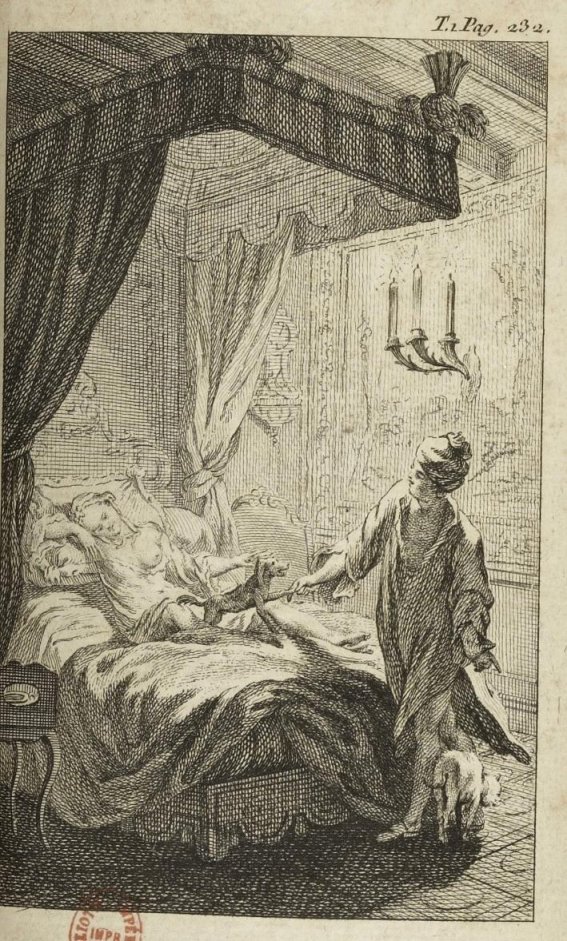
Sultan Mangogul in Haria's chamber.
CHAP. XXIII.
Tenth trial of the Ring.
The Dogs.
Mangogul went immediately to Haria's house; and as he took pleasure in soliloquy, he said within himself: "This woman never goes to bed without her four dogs, and either Toys know nothing of those animals, or her's will give me some account of them; for, thank God, 'tis well known that she loves her dogs to admiration." At the end of this monology he found himself in Haria's anti-chamber, and his olfactory organ already informed him of madam having her usual company in bed with her. These were a little shag-dog, a spaniel, and two pug-dogs. The Sultan drew out his snuff-box, took two pinches of Spanish by way of preservative, and approached Haria. She was asleep, but the pack, who were upon the watch, hearing some noise, fell to barking, and woke her. "Peace, my children," said she, but in so mild a tone, that she could not be suspected of speaking to her daughters, "go to sleep, go to sleep, and don't disturb my rest nor your own."
Haria was formerly young and pretty. She had had lovers of her own rank, but they all disappear'd even sooner than her charms. By way of comforting herself for this desertion, she gave into a whimsical sort of pomp, and her footmen were the handsomest fellows in Banza. She grew older and older, and years threw her into oeconomy: she restrained herself to four dogs and two Bramins, and became a model of edification. And surely the most envenom'd satyr could find no room to carp at this management; and for above ten years Haria was in peaceful possession of a high reputation of virtue, and of those animals. Nay, her tenderness for the pug-dogs was so well known, that the Bramins were no longer suspected of sharing it.
Haria renewed her intreaty to those beasts, and they had the complaisance to obey. Then Mangogul applied his ring, and the superannuated Toy set about relating the last of its adventures. It was such a vast while since the first were atchieved, that it had almost lost the very remembrance of them. "Withdraw, Pompey," it said with a hoarse voice, "you fatigue me. I like Dido better; I find her more gentle." Pompey, who was absolutely ignorant of the Toy's voice, went on in his own way: but Haria awaking, continued. "Get away, then, you little rogue, you hinder me from taking rest. That is well some times: but too much is too much." Pompey withdrew. Dido took his place, and Haria fell asleep.
Mangogul, who had suspended the energy of his ring, turn'd it on, and the antiquated Toy, uttering a deep, sigh, fell to jabbering, and said: "Alas! how I am grieved for the death of my large grey-hound; she was the best little wife, the most caressing creature: she never ceased giving amusement. She was so sensible, so genteel. Ye are but beasts in comparison of her. That naughty master of mine killed her.——Poor Zinzolina, I never think of her, without watering my plants. I thought it would have been the death of my mistress. She neither eat nor drank for two days, and narrowly escaped losing her senses. Judge of her sorrow: her director, her friends, nay her very pug-dogs were kept from me. Orders were issued to her women to refuse the door of her appartment to my master, under the penalty of being turn'd off.——'That monster has robb'd me of my dear Zinzolina,' cried she; 'let him not appear before me, I am resolved never to see him more.'"
Mangogul, curious of learning the circumstances of Zinzolina's death, revived the electrical power of his ring by rubbing it on the skirt of his doublet, pointed it at Haria, and the Toy resumed: "Haria, Ramadec's widow, coiffed herself with Sindor. This youth was of good birth, had no other fortune, but a certain merit which pleases the sex, and was, after dogs, Haria's predominant taste. Sindor's indigence conquered his repugnance to Haria's years and dogs. Twenty thousand crowns a year blinded his eyes with regard to the wrinkles of his mistress, and the inconveniency of the pug-dogs; and he married her.
"He was in hopes of getting the better of our beasts by his talents, and complaisant behavior; and to bring them into disgrace from the very commencement of his reign; but he was deceived. After the expiration of some months, when he thought he had merited much by his services; he took into his head to remonstrate to madam, that her dogs were not as good company in bed for him as for her; that it was ridiculous to have more than three; and that to admit more than one at a time, was turning the nuptial bed into a kennel.
"'I advise you,' said Haria, in a furious tone, 'to attack me with such speeches. Truly it well becomes a pitiful younger son from Gascony, whom I have taken from a garret, which was not good enough for my dogs, to give himself airs of nicety! To be sure, your sheets were perfumed, my little squire, when you dwelt in furnish'd lodgings. Know this once for all, that my dogs were long before you in possession of my bed, and that you may choose either to quit it, or be content to share it with them.'
"The declaration was peremptory, and our dogs remain'd masters of their post. But one night, as we were all asleep, Sindor, in turning unluckily kick'd Zinzolina. The hound, not used to such treatment, bit the calf of his leg; and madam was immediately awaked by Sindor's cries. 'What is the matter with you, Sir, one would think your throat was cutting: you dream.' 'It is your dogs, madam, that devour me, and your grey-hound has just torn off a piece of my leg.' 'Is that all?' says Haria, turning from him. 'You make a vast noise for nothing.'
"Sindor, piqued at this discourse, jump'd out of bed, swearing that he would never set his foot in it again, till the pack was banish'd thence. He employ'd friends, in order to obtain the exile of the dogs: but they all failed in that important negotiation. Haria's answer to them was, that Sindor was a knight of the post, whom she had drawn out of a cock-loft, which he shared with rats and mice; that it ill became him to be so nice; that he slept the whole night long; that she loved her dogs; that they amused her; that from her infancy she had taken a liking to their caresses; and that she was resolved never to deprive herself of them till death. 'Tell him besides,' continued she, addressing the mediators, 'that if he does not humbly submit to my will, he will repent it while he lives; that I will retract the donation I have made him, and will add it to the sums which I have bequeathed by my will, for the support of my dear children.'
"Between you and me," added the Toy, "Sindor must have been a great fool, to hope that she would do for him, what could not be obtained by twenty lovers, a director, a confessor, with a legion of Bramins, who had all lost their Latin on that head. Mean while, as often as Sindor met our animals, he was seized with such fits of passion, as he could hardly conquer. One day the unfortunate Zinzolina fell in his way. He took her by the neck, and threw her out of the window. The poor creature was kill'd by the fall. Then it was, that a fine noise was made. Haria, with inflamed countenance, and eyes bathed in tears——"
The Toy was going to repeat what it had already told; for Toys willingly fall into repetitions: but Mangogul cut its words short. Its silence was not of long duration: when the prince thought he had put this doting Toy out of its road, he restored it the freedom of speech; and the Tatler, bursting out into a loud laugh, resumed by way of recollection: "But à propos, I forgot to tell you what pass'd on Haria's wedding-night. I have seen a power of ridiculous things in my life, but never one that came up to this. After a splendid supper, the bride and bridegroom were conduced to their appartment. Every body retired except madam's women who undress her: she is undress'd, put to bed, and Sindor alone remains with her. Observing that the shag-dog, the two pugs, and the grey-hound, more alert than himself, were taking possession of his bride; 'permit me, madam,' he said, 'to remove these rivals a little.' 'My dear, do what you can,' answered Haria: 'for my part, I have not the courage to drive them away; these little animals are so attached to me; and I have been so long without any other company.' 'Perhaps,' replied Sindor, 'they will have the politeness this night to surrender the fort to me, which I must take possession of.' 'Try, sir,' said Haria.
"At first Sindor tried gentle means, and pray'd Zinzolina to retire to a corner. But the untractable animal fell to growling: the allarm spread among the rest of the troop; and the pug-dogs and shag-dog bark'd as if their mistress's throat was cutting. Sindor, losing all patience at this noise, tosses away one of the pugs, drives off the other, and seizes Pompey by the paw. Pompey, the faithful Pompey, abandoned by his allies, endeavour'd to repair this loss by the advantages of the post. Fix'd on his mistress's thighs, with eyes inflamed, hair standing an end, and open mouth, he grin'd, and shew'd the enemy two rows of very sharp teeth. Sindor made several assaults on him, and Pompey repell'd him as often, with bitten fingers and torn ruffles. The action lasted above a quarter of an hour with an obstinacy which gave diversion to none but Haria; when Sindor had recourse to a stratagem against an enemy, whom he despaired conquering by force. He provoked Pompey with the right hand. Pompey watching this motion, did not observe that of the left, and was seized by the neck. He made most vigorous efforts to disengage himself, but in vain. He was obliged to quit the field of battle, and surrender up Haria. Sindor took possession of her, but not without effusion of blood: in all likelihood Haria had resolved that her wedding-night should be a bloody one: her animals made a good defence, and disappointed not her expectations."
"There," says Mangogul, "is a Toy, that could write a Gazette better than my secretary." And now well knowing what notions to form of lap dogs, he return'd to the favorite.
"Prepare yourself," said he, as soon as he saw her, "to hear the most extravagant things in the world. 'Tis much worse than the baboons of Palabria. Could you believe, that Haria's four dogs were the rivals, and the preferred rivals of her husband; and that the death of a greyhound has raised a quarrel between that couple, never to be made up."
"What do you say," replied the favorite, "of rivals and dogs. I am quite in the dark. I know that Haria loves her dogs excessively; but I know at the same time that Sindor is a hot-temper'd man, who perhaps did not use all that complaisance, which women require, to whom a man owes his fortune. But yet, whatever has been his conduct, I cannot conceive that it has drawn rivals on him. Haria is so venerable, that I could wish your highness would vouchsafe to explain yourself more intelligibly."
"Listen," says Mangogul, "and agree that women have excessively whimsical tastes, to say nothing worse;" then he related Haria's history to her word for word, as the Toy had told it. Mirzoza could not refrain from laughter at the first night's battle: but presently resuming a serious air: "I can't tell," said she to Mangogul, "what indignation seizes me. I shall have an aversion for these animals and all those who keep any, and I shall declare to my women that I will turn off the first, who shall be even suspected of having a lap-dog."
"Pray," replied the Sultan, "why will you extend your hatred so far? You women are always upon extremes. These animals are good for hunting, are necessary in the country, and have many other uses, without reckoning that which Haria makes of them."
"In truth," said Mirzoza, "I begin to believe that your highness will find it a difficult task to light on a virtuous woman."
"I told you so," answered Mangogul; "but let us not be over hasty: you may one time or other upbraid me with being indebted to your want of patience for a declaration, which I pretend to owe entirely to the trials of my ring. I have some in my mind, which will astonish you. All secrets are not yet unveiled; and I expect to draw more important discoveries from those Toys, which remain to be consulted."
Mirzoza was in perpetual apprehensions for her own. Mangogul's discourse threw her into such uneasiness, as she was not able to conceal from him: but the Sultan, who had bound himself by an oath, and in his heart had a regard for religion, used his best endeavours to calm her mind, gave her some very tender kisses, and went to his council, whither affairs of moment called him.
CHAP. XXIV.
Eleventh trial of the Ring.
The Pensions.
Congo had been disturbed by bloody wars in the reigns of Kanaglou and Erguebzed; and those two monarchs had immortalized themselves by the conquests they had made over their neighbours. The emperors of Abex and Angola look'd on the youth of Mangogul and the beginning of his reign, as favourable conjunctures to recover the provinces that had been taken from them. Wherefore they declared war against Congo, and attacked it on every side. Mangogul had the best council in all Africa: and old Sambuco and the Emir Mirzala, who were train'd up in the former wars, were placed at the head of the troops, gain'd victories on victories, and formed generals capable of succeeding them; an advantage of greater importance than even their successes.
Thanks to the activity of the council, and the good conduct of the generals, the enemy, who thought themselves sure of overcoming the empire, did not advance as far as the frontiers, made a poor defence of their own, and saw their fortified towns and provinces ravaged. But, such constant and glorious successes notwithstanding, Congo grew weaker by aggrandizing itself: the frequent raising of troops unpeopled the towns and country: and the treasury was exhausted.
The sieges and battles had cost a vast number of lives: the grand Visir, very lavish of the blood of the soldiery, was accused of having hazarded battles that tended to nothing. Every family was in mourning: not one, but wept a father, a brother, or a friend. The number of officers slain was prodigious; and could be compared to naught but their wives, who sollicited pensions. The closets of the ministers were beset with them. They pestered the Sultan himself with petitions, in which the merit and services of the deceased, the grief of their widows, the dismal condition of their children, and other moving motives were not forgotten. Nothing seemed more equitable than their requests: but on what fund to ground pensions which amounted to millions?
The ministers, after having exhausted speeches, and sometimes peevishness and rough language, were obliged to deliberate on the means of bringing this affair to a final issue: but they had an excellent reason for concluding nothing: there was not a penny left.
Mangogul, tired with the false reasonings of his ministers and the lamentations of the widows, hit upon the expedient, which his ministry had been so long hunting after. "Gentlemen," said he to his council, "I am of opinion that, before any pensions are granted, it would be proper to examine if they are lawfully due." "This examination," answered the great Seneschal, "will be immense, and of prodigious discussion. Yet how to resist the clamors and persecution of these women, by whom you, sir, are particularly teazed?" "It will not be as difficult a talk as you imagine, Mr. Seneschal," replied the Sultan; "and I promise you that by to morrow noon the whole affair shall be terminated, by the laws of the strictest equity. Do you only bring them to my audience chamber by nine in the morning."
The council broke up, the Seneschal went into his office, pondered profoundly, and drew up the following proclamation; which in three hours time was printed, published by sound of trumpet, and fixed up at all the most public places of Banza.
By the Sultan's most excellent majesty, and my lord the grand Seneschal,
We Gander-beak, grand Seneschal of Congo, visir of the first bench, train-bearer to the great Manimonbanda, chief and super-intendant of the sweepers of the divan, give notice, that to-morrow morning at nine of the clock, the magnanimous Sultan will give audience to the widows of the officers slain in his service, in order to decree, on sight of their pretensions, what to him shall seem meet. Given at our office the twelfth of the moon of Regeb, in the year 147200000009.
All the distressed women of Congo, and a great number of them there was, did not fail to read the proclamation, or to send their footmen to read it; and less still to be at the appointed hour, in the lobby of the audience chamber. "In order to avoid a crowd, let no more enter," said the Sultan, "than six of these ladies at once. When we have heard them, let them pass thro' the back door, which leads to the outward courts. You, gentlemen, be attentive, and pronounce on their demands."
This said, he made a signal to the first gentleman usher of the audiences; and the six, who happen'd to be next the door, were introduced. They entered in long mourning robes, and made low reverences to his highness. Mangogul addressed the youngest and handsomest of them, whose name was Ifec. "Madam," said he, "how long is it since you have lost your husband?" "Three months," answered Ifec weeping. "He was lieutenant general in your highness's service. He was kill'd in the last battle, and six children are the only legacy he left me"—"He left you?" interrupted a voice, which, tho' issuing from Ifec, was not exactly in the same tone with her's. "Madam knows better than she says. They were all begun and finished by a young Bramin, who daily came to comfort her, while my master was in the field."
'Tis easy to guess, whence proceeded the indiscreet voice, which pronounced this answer. Poor Ifec, being put out of countenance, grew pale, trembled, fainted. "Madam is subject to the vapors," said Mangogul with an air of tranquillity: "let her be carried into an appartment of the Seraglio, and be taken care of." Then immediately addressing Phenice: "Madam," said he, "was not your husband a Pacha?" "Yes, sir," answered Phenice in a trembling voice. "And how have you lost him?" "Sir, he died in his bed, quite exhausted with the fatigues of the last campaign"—"With the fatigues of the last campaign," replied Phenice's Toy. "Go, madam, your husband brought a firm and vigorous state of health from the camp; and he would still enjoy it, had not two or three scoundrel players,—you understand me, take care of yourself." "Write," says the Sultan, "that Phenice demands a pension, for the good services, which she has rendered to the state and her husband."
A third was interrogated on her husband's age and name, who was said to have died in the army of the small-pox. "Of the small pox," said the Toy, "a fine story indeed: say, madam, of two good strokes of a scymeter which he received from the Sangiac Cavaglio, because he took it ill, that his eldest son was said to be as like the Sangiac, as one egg is to another: and madam knows as well as I," added the Toy, "that a likeness was never better grounded."
The fourth was going to speak without being interrogated by Mangogul, when her Toy was heard to cry out from the lower regions, that these ten years part, which the war had lasted, she had made pretty good use of her time; that two pages and a huge scoundrel of a footman had supplied her husband's place; and that without doubt she designed the pension, which she was solliciting, for keeping an actor of the comic opera.
A fifth stept forward with intrepidity, and with an air of confidence demanded the reward of her late husband's services, who was an aga of the Janissaries, and lost his life under the walls of Matatras. The Sultan turn'd his ring on her, but to no purpose. Her Toy was mute. "I must own," says the African author, who had seen her, "that she was so ugly, that the by-standers would be astonished, if her Toy had any thing to say."
Mangogul was got to the sixth, and here are the express words of her Toy. "Truly, it well becomes madam," meaning her, whose Toy was obstinately silent, "to sollicite pensions, while she lives upon the poule, keeps a breland table which brings her in three thousand sequins a year, makes private suppers at the expence of the gamesters, and received six hundred sequins from Osman, to draw me to one of these suppers, where the treacherous Osman——"
"Due regard shall be paid to your petitions, ladies," said the Sultan: "for the present ye may withdraw." Then directing his words to his counsellors, he ask'd them, if it did not seem ridiculous to them to grant pensions to a herd of little bastards of Bramins and others, and to women whose employment it was to dishonor brave men, who had enter'd into his service in quest of glory, at the expence of their lives.
The Seneschal stood up, answered, declaimed, resumed, and gave his opinion obscurely as usual. While he was yet speaking, Ifec recovered from her fit, quite enraged at her adventure; and, as she expected no pension for herself, and would run distracted, if any other obtain'd one, which would have happened in all likelihood, she went directly into the antichamber, and whispered to two or three of her female friends, that they were summoned thither purely to hear their Toys chatter; that she herself heard one deliver horrid things in the audience chamber; that she would not name it for the world; but that they must be fools, to expose themselves to the same danger.
This advice passed from hand to hand, and dispersed the crowd of widows. When the gentleman usher opened the door to let in a second parcel, not one was there. "Well, Seneschal, will you believe me another time?" said Mangogul informed of the desertion, to the good man, clapping him on the shoulder. "I promised to rid you of these female weepers, and I have done it. Yet they were very assiduous in making court to you, notwithstanding your fourscore and fifteen years of age. But whatever pretensions you may possibly have: for I am not ignorant of the facility you had to form pretensions on these ladies, I fancy you are obliged to me for their retreat. They gave you more embarras than pleasure."
The African author informs us, that the remembrance of this trial is kept up in Congo; and for that reason it is, that the government is so sparing of granting pensions: but this was not the only good effect of Cucufa's ring, as we shall see in the following chapter.
CHAP. XXV.
Twelfth Trial of the Ring.
A Law Case.
Rapes were severely punished in Congo: and there happened a most notorious one in Mangogul's reign. This prince, at his accession to the crown, had sworn, like all his predecessors, never to grant a pardon for that crime: but be laws ever so severe, they seldom curb those, whom a considerable advantage urges to infringe them. The criminal was condemned to lose that part of him, by which he had sinned; a cruel operation, of which he generally died; as the person who performed it, used less precaution than B——ll.
Kerfael, a young man of a good family, had now languished six months in a dungeon, waiting for the day of execution. Fatme, a young pretty woman, was his Lucretia and accuser. Every body knew, that they had been very well together: Fatme's indulgent husband took no exceptions against it: therefore it would be ungenteel in the public to intermeddle in their affairs.
After an undisturbed commerce of two years, whether thro' inconstancy or disgust, Kerfael took to a dancer at the opera of Banza, and grew cold towards Fatme, yet without coming to an open rupture. He resolved to make a decent retreat; which obliged him to continue his visits in the house. Fatme enraged for being thus forsaken, meditated revenge, and made use of this remnant of his assiduities to destroy her unfaithful lover.
One day, that the convenient husband had left them tête à tête, and that Kerfael, having ungirt his scymeter, was endeavouring to allay Fatme's suspicions by protestations, which cost nothing to lovers, but never surprize the credulity of a jealous woman; she assumed an affrighted air, and having tore her dress at five or six pulls, shriek'd out horridly, and call'd to her husband and domestics for help; who ran immediately, and became witnesses to the injury, which Fatme said she received from Kerfael; and shewing the scymeter, added: "This the infamous villain lifted at my head ten times to make me submit to his will."
The young man, struck dumb at the blackness of the accusation, had not power either to answer or make his escape. He was seiz'd, dragg'd to prison, and deliver'd up to justice and the prosecution of the Cadilesker.
The laws ordained that Fatme should be visited. Accordingly she was; and the report of the matrons proved very unfavourable to the accused. They had an original standard, by which they could determine the condition of a violated woman; and every circumstance concurred against Kerfael. The judges examined him, Fatme was confronted with him, and the evidence was heard. In vain did he plead innocence, deny the fact, and demonstrate by the commerce which he held with his accuser above two years, that she was not a woman to be ravished. The circumstance of the scymeter, the tête à tête solitude, Kerfael's confusion at the sight of the husband and domestics; taken all together formed, in the opinion of the judges, violent presumptions. Fatme on her side, far from owning that she had granted him favors, would not even allow that she gave him the least glimmering of hopes; and maintain'd that her obstinate adherence to her duty, from which she had never flinch'd, was without doubt what urged Kerfael to acquire by force, what he despair'd obtaining by craft. The verbal process drawn up by the commissaries was another terrible piece. Nothing more was requisite, than to run it over, and compare it with the articles of the Criminal Code, to read unhappy Kerfael's condemnation therein. He lost all expectations of life either by his defence, or the credit of his family; the magistrates had fixed the definitive sentence to the thirteenth of the month of Rebeg: and this was even published by sound of trumpet, according to custom.
This affair became the topic of conversations, and people were divided upon it for a good while. Some old hags, who had always been very safe from any apprehensions of a rape, ran about crying: "That Kerfael's attack was enormous; that unless a severe example were made of him, innocence would be no longer in security; and that an honest woman would be exposed to insults, even at the horns of the Altar." Then they cited instances of little impertinent puppies having attack'd the virtue of several respectable ladies: and the circumstances left no room to doubt, but that those respectable ladies mentioned by them were themselves: and all these speeches were made to Bramins less innocent than Kerfael, and by devotes as chaste as Fatme, by way of edifying conversations.
The Petits-Maitres on the contrary, and even some Petites-Maitresses, asserted that a rape was a chimæra, that a woman never surrendered but by capitulation; and that, if a fort was defended, tho' ever so little, it was absolutely impossible to take it by storm. Examples were alledged in support of this reasoning: the women knew some; the Petits-Maitres invented others; and there was no end of quoting instances of women, who had not been ravished. "Poor Kerfael," said they, "what the devil had he in his head, to take to little Bimbreloqua," which was the dancer's name, "why did he not stick to Fatme? They were extremely well together, and the husband left them at full liberty: what a blessing——Those witches the matrons put on their spectacles to no purpose, for they saw nothing. And indeed, who is the person that can see clear in that place? And besides, the senators are going to deprive him of his joy, for having burst an open door. The poor lad will die of it, no doubt. After that, pray consider, what will not dissatisfied women be authorized to do."——"If this execution takes place," interrupted another, "I will make myself a free mason."
Mirzoza, naturally compassionate, remonstrated to Mangogul, who was joking her on Kerfael's case, that if the laws spoke against Kerfael, good sense deposed against Fatme. "Moreover," added she, "it has never been heard, that, in a wise government, the letter of the law should be so closely adhered to, that the simple allegation of a female accuser should be sufficient to endanger the life of a subject. The reality of a rape cannot be too clearly proved; and you will allow, Sir, that this fact is as much at least within the province of your ring as of your senators. It would be very singular, that the matrons should be more knowing on this head than the Toys themselves. Hitherto your highness's ring has done little more than satisfy your curiosity. Might not the Genius, from whom you had it, have intended some more important end? If you employ it for the discovery of truth, and the happiness of your subjects, can you think the Genius will be offended? Try. You are in possession of an infallible method of drawing from Fatme a confession of her crime, or a proof of her innocence." "You are in the right," replied Mangogul, "and you shall be satisfied."
The Sultan departed immediately: and indeed there was no time to lose: for it was the night of the twelfth of the moon Rebeg, and the senate was to pronounce sentence on the thirteenth. Fatme was just got into bed, the curtains were not quite closed. A night taper threw a dull light on her countenance. The Sultan thought her beautiful, notwithstanding the violent commotions which disfigured her. Compassion and hatred, grief and revenge, audaciousness and shame were painted in her eyes, according as they succeeded each other in her heart. She uttered deep sighs, shed tears, wiped them off, shed fresh ones, remained some moments with her head drooping and eyes dejected, then suddenly raised them, and darted furious looks towards the heavens. What was Mangogul doing all this time? He was talking to himself, and saying. "These are the symptoms of despair. Her former tenderness for Kerfael has revived in all its violence. She has lost sight of the offence he committed, and has nothing in view but the punishment reserved for her lover." As soon as he had finished these words, he turned the fatal ring on Fatme, and her Toy cried out with vehemence.
"Twelve hours more, and we shall be revenged. The treacherous ingrateful man shall perish, and his blood shall be shed." Fatme affrighted at the extraordinary motion which she felt within her, and shock'd at the buzzing voice of her Toy, clapt both hands on it, and put herself upon duty to stop its mouth. But the powerful ring continued to act, and the ungovernable Toy breaking thro' every obstacle, added: "Yes, we shall be revenged. O! thou who hast betray'd me, wretched Kerfael, dye, and thou, whom he has preferred to me, O Bimbreloqua, despair!——Twelve hours more! Alas! how tedious will this time appear to me. Hasten, sweet moments, when I shall see the treacherous, the ingrateful Kerfael under the executioner's knife, his blood trickling down——Ah! Wretch, what have I said? Can I without horror see the dearest object of my love perish? Can I see the fatal weapon lifted up?——Ah! far from me this cruel thought.—He hates me, 'tis true; he has quitted me for Bimbreloqua, but perhaps some time or other——why do I say, perhaps? Love will certainly recall him under my yoke. That little Bimbreloqua is a fancy that will fly off; he must sooner or later be sensible of the injustice of his preference, and the ridiculousness of his new choice. Comfort thyself, Fatme, thou shalt see thy Kerfael again. Yes, thou shalt see him again. Arise quickly, run, fly to remove the dreadful danger which threatens him. Dost thou not tremble to come too late?—But whither shall I run, mean wretch that I am. Does not Kerfael's disdain foretel me, that he has abandoned me for ever. Bimbreloqua enjoys him, and 'tis for her that I was going to save him: ah! let him rather dye a thousand deaths. If he lives no more for me, why should I be concerned for his death?—Yes, I am now convinced that my wrath is just. The ingrateful Kerfael has deserved all my hatred. I no longer have any remorse. I had done every thing to keep him, I will do every thing to destroy him. Yet one day later, and my revenge was disappointed. But his evil genius delivered him up to me, the very moment that he thought to escape me. He is fallen into the snare which I laid for him. I have him fast. The appointment, to which I contrived to bring thee, was the last which thou intendedst for me: but thou wilt not so soon forget it.—With what address did you bring him to your beck? Fatme, how well concerted was your disorder? Your shrieks, your grief, your tears, your confusion, every thing, even to your silence, has ruin'd Kerfael. Nothing can snatch him from his impending fate. Kerfael is dead—You weep, wretched woman. He loved another, of what consequence is his life to you."
Mangogul, filled with horror at this discourse, turned off his ring; and while Fatme was recruiting her spirits, he flew back to the Sultana. "Well, prince," said she, "what have you heard? Is Kerfael still guilty, and the chast Fatme"—"I beseech you to excuse me," answered the Sultan, "from repeating the abominations which I come from hearing. How an exasperated woman is to be dreaded! Who could believe, that a body formed by the graces, sometimes enclosed a heart molded by the furies? But the sun shall not set to-morrow on my dominions, before they be purged of a monster more dangerous than those which are produced in my deserts."
The Sultan immediately sent for the Seneschal, and commanded him to seize Fatme, to remove Kerfael into one of the appartments of the seraglio, and to inform the Senate, that he reserved to himself the cognizance of his affair. His orders were executed that very night.
The next morning at dawn of day, the Sultan attended by the Seneschal and an Effendi, went to Mirzoza's appartment, and had Fatme brought thither. This unfortunate woman threw herself at Mangogul's feet, confessed her crime with all its circumstances, and conjured Mirzoza to intercede for her. Mean while Kerfael was conducted in. He expected nothing but death: however he made his appearance with that composed assurance, which innocence alone can give. Some ill-natured wags said, that he would be in greater consternation, if what he was threaten'd to lose, was worth preserving. The women were upon the tenters to know the issue. He prostrated himself respectuously before his highness. Mangogul made him a signal to arise, and giving him his hand, "You are innocent," said he, "be free. Render thanks to Brama for your preservation. In order to make amends for the misery you have suffered, I grant you a pension of two thousand sequins on my exchequer, and the first commandery that shall fall in the order of the Crocodile."
The more favors were bestowed on Kerfael, the more Fatme dreaded punishment. The great Seneschal gave his opinion for death, grounded upon the law: Si foemina ff. de vi C. calumniatrix. The Sultan was inclined for perpetual imprisonment. Mirzoza finding too much rigor in one of these judgments, and too much indulgence in the other, condemned Fatme's Toy to the padlock. The Florentine machine was publickly clapt on, upon the same scaffold that had been erected for Kerfael's execution. Thence she was conducted to a house of correction, together with the matrons who had given their decisive opinions with so much knowledge.
CHAP. XXVI.
Mirzoza's Metaphysics.
The Souls.
While Mangogul was interrogating the Toys of Haria, the widows, and Fatme, Mirzoza had full time to prepare her philosophical lecture. One evening, that the Manimonbanda was performing her devotions, that there was neither play nor drawing room at court, and that the favorite was almost certain of a visit from the Sultan; she took two black petticoats, put one on in the usual manner, and the other over her shoulders, passed her hands thro' the two slits, put on the peruke of Mangogul's Seneschal, and his chaplain's square cap; and thought herself equipped as a philosopher, whereas she had disguised herself into a bat.
In this masquerade dress, she walked up and down her appartments, as a professor of the royal college waiting for his scholars. She affected even to the gloomy pensive physiognomy of a learned man in meditation. Mirzoza did not hold this forced gravity long. The Sultan entered with some of his courtiers, and made a low bow to the new philosopher; whose gravity disconcerted her audience, and was in its turn disconcerted by the loud laughter it occasioned. "Madam," said Mangogul, "have you not advantage enough by your wit and figure, without taking the robe to your aid? without which your words would have all the weight that you could have desired." "It seems to me, sir," answered Mirzoza, "that you do not much respect this robe, and that a disciple should pay more regard to what constitutes half the merit at least of his master." "I perceive," replied the Sultan, "that you have already acquired the spirit and tone of your new condition. I make no doubt at present, but your capacity answers to the dignity of your dress, and I impatiently expect a proof of it."—"You shall be satisfied this minute," said Mirzoza, sitting down in the center of a large carpet. The Sultan and courtiers placed themselves around her, and she began.
"Have the philosophers, who presided over your highness's education, ever entertain'd you on the nature of the soul?" "Oh! very often," said Mangogul; "but all their systems had no other end, but giving me uncertain notions of it; and were it not for an inward sentiment, which seems to suggest to me, that it is a substance different from matter, I should either have denied its existence, or confounded it with the body. Would you undertake to clear up this chaos?"
"So far from it," replied Mirzoza, "that I am not farther advanced on that head than your pedagogues. The only difference between them and me, is that I suppose the existence of a substance different from matter, and that they hold it demonstrated. But this substance, if it exists, must be lodged somewhere. Have they not preached many extravagances to you on that article?"
"No," said Mangogul: "they all pretty generally agreed, that it resides in the head; and this opinion to me seemed probable. 'Tis the head that thinks, imagines, reflects, judges, disposes, commands; and we say every day of a man who does not think, that he has no brains, or that he wants a head."
"Well then," replied the Sultana, "the result of your long studies and of all your philosophy, is, to suppose a fact, and to ground it on popular expressions. Prince, what would you say of your first geographer, if he presented your highness with a map of your dominions, in which he had put the east in the west, and the north in the south?"
"That is too gross an error," answered Mangogul, "for any geographer to have ever committed."
"That may be," continued the favorite; "and in the case before us, your philosophers are greater bunglers, than the most bungling geographer can be. They had not a vast empire to survey; the business was not to fix the limits of the four parts of the world: all they had to do, was to enter into themselves, and there mark the true seat of their soul. Yet they have placed the east in the west, and the south in the north. They have pronounced that the soul is in the head, whereas the greatest part of mankind dye, without it's ever inhabiting that appartment; and its first residence is in the feet."
"In the feet!" interrupted the Sultan. "That is the most empty notion that I have ever heard."
"Yes, in the feet," replied Mirzoza, "and this opinion, which to you seems so silly, will, upon thoroughly examining it, become rational; contrary to all those, which you allow as true, and which upon a thorough examination are found to be false. Your highness agreed with me just now, that the existence of our soul was founded on the interior testimony alone, which it bore to itself; and I will now demonstrate, that all the proofs imaginable of sense concur to fix the soul in the seat which I have assigned it."
"There we expect you," said Mangogul.
"I desire no favor," continued she; "and I invite ye all to propose your difficulties. Well then, I was saying that the soul takes up its first residence in the feet, that there it begins to exist, and from the feet it advances into the body. To experience I appeal for this fact; and perhaps I am going to lay the first foundations of experimental metaphysics.
"We have all experienced in our infancy, that the benumbed soul remains whole months in a state of sleepiness. At that time the eyes open without seeing, the mouth without speaking, and the ears without hearing. 'Tis elsewhere that the soul endeavours to stretch itself and awake; 'tis in other members that she practises her first functions. 'Tis by the feet that a child gives notice of his formation. His body, head and arms are immoveable in the mother's womb; but his feet unfold and extend themselves, and give proofs of his existence, and perhaps of his exigences. When he is on the point of birth, what would become of his head, body and arms? They would never come out of their confinement, had they not been assisted by the feet: here the feet act the principal part, and drive the rest of the body before them. Such is the order of nature; and whenever any other member attempts to lead the van; when the head, for example, takes the place of the feet; every thing goes wrong, and God knows what is the consequence sometimes, both to the mother and the child.
"Is the child born? 'tis still in the feet that the chief motions are performed. We are obliged to confine them: and this is never done without some reluctance on their part. The head is a block, with which we do what we will; but the feet are sensible of, shake off the yoke, and seem jealous of the liberty, of which they are deprived.
"Is the child able to stand alone? the feet make a thousand efforts to move; they put every thing into action: they command the other members, and the obedient hands lean against the walls, and advance forward to prevent or break the falls, and facilitate the action of the feet.
"Whither do all the thoughts of a child tend, what are his pleasures, when, secure on his legs, his feet have acquired the habit of moving? To exercise them, to go to and fro', to run, to leap, to bounce. This turbulence pleases us, we take it for a mark of sense; and we predict the future stupidity of the child, when we see him indolent and sullen. Have you a mind to vex a child of four years old? make him sit down for a quarter of an hour, or imprison him between four chairs: he will grow peevish and ill-humor'd: for 'tis not his legs alone that you deprive of exercise, 'tis his soul that you hold in captivity.
"The soul remains in the feet to the age of two or three years; at four it inhabits the legs; it gets up to the knees and thighs at fifteen. Then we love dancing, fencing, riding, and the other violent bodily exercises. This is the predominant passion of all young folks, and the madness of some. What! does not the soul reside in those places, where she almost only manifests herself, and where she feels the most agreeable sensations? But if her residence varies in infancy and youth, why should it not vary thro' every stage of life?"
Mirzoza pronounced this discourse with such rapidity as made her pant. Selim, one of the Sultan's favorites, embraced the moment while she was taking breath, and said to her: "Madam, I will make use of the liberty you have granted the company, of proposing their objections. Your system is ingenious, and you have delivered it with equal grace and clearness: but I am not so far seduced by it, as to think it stands demonstrated. Methinks one may say, that even in infancy 'tis the head that commands the feet, and from thence the spirits flow, which, by means of the nerves, running into all the members, stop or move them at the will of the soul seated on the pineal gland: just as we see his highness's orders issuing from the sublime Porte, which set all his subjects in action."
"Doubtless," replied Mirzoza, "but one would tell me a very obscure thing; to which I should give no other answer than by an experienced fact. In infancy we have no certainty that the head thinks; and even you, my lord, who have so good an one, and who in your tender years passed for a prodigy of reason, do you remember that you thought at that time? But you might well assert, that when you gamboled about like a little Dæmon, so as to drive your governants out of their wits, your feet then governed your head."
"That proves nothing," said the Sultan. "Selim was lively, and so are a thousand other children. They do not reflect, but they think: time slips away, the remembrance of things wears out, and they remember not that they thought."
"But by what part did they think," replied Mirzoza: "for that is the point in dispute?"
"By the head," answered Selim.
"What! always this head, into which one cannot peep," replied the Sultana. "Pray, drop your dark lanthorn, in which you suppose a light, that is seen by none but by him who carries it: hear my experiment, and own the truth of my hypothesis. It is so constantly true, that the soul begins its progress in the body by the feet, that there are some of both sexes, in whom it never rose higher. My lord, you have admired Nini's nimbleness and Saligo's feats of activity a thousand times: answer me then sincerely, do you think that these creatures have their souls any where else but in their legs? And have you not remarked, that in Volucer and Zelindor the head is submissive to the feet? The eternal temptation of a dancer is to contemplate his legs. At every step his attentive eye follows his paces, and his head bows respectuously before his feet, as do before his highness his invincible Pacha's."
"I allow the observation," said Selim: "but I deny that it is a general one."
"Nor do I pretend," replied Mirzoza, "that the soul always fixes in the feet: she advances, she travels, she quits a part, returns to it, and quits it again; but I maintain that the other members are subordinate to that which she inhabits. All this varies according to the age, temper and circumstances; and thence arises the difference of tastes, the diversity of inclinations and characters. Do you not admire the fecundity of my principle? And is not its certainty evinced by the number of phænomena, to which it extends?"
"Madam," answered Selim, "if you applied it to some in particular, perhaps it might give us a degree of conviction, which we have not yet acquired."
"Most willingly," replied Mirzoza, who began to be sensible of the advantages she gain'd: "you shall be satisfied, only follow the chain of my notions. I do not pretend to make arguments in form. I speak from my heart; this is the philosophy of our sex, and you understand it almost as well as we. It is probable enough," added she, "that the soul occupies the feet and legs to the age of eight or ten: but about that time, or rather later, she quits that lodging, either of her own free motion, or by force. By force, when a tutor employs certain machines to drive her out of her native place, and lead her into the brain; where she is metamorphosed generally into memory, and seldom or never into judgment. This is the fate of school-boys. In like manner, if a weak governant labours hard to form a young girl, stuffs her mind with knowledge, and neglects the heart and morals; the soul rapidly flies towards the head, stops on the tongue, or fixes in the eyes; and her scholar is but a tiresome pratler, or a coquet.
"Thus the voluptuous woman is she whose soul occupies her Toy, and never strays from it.
"The woman of gallantry, she whose soul is sometimes in her Toy, and sometimes in her eyes.
"The affectionate woman, she whose soul is habitually in the heart, but sometimes also in her Toy.
"The virtuous woman, she whose soul is sometimes in her head, sometimes in her heart, but never any where else.
"If the soul fixes in the heart, she forms the characters of sensibility, compassion, truth, generosity. If she quits the heart without returning thither, and retires to the head; then she forms those whom we call hardhearted, ungrateful, deceitful, cruel men.
"The class of those, in whom the soul visits the head merely as a country-house, where its stay is short, is very numerous. It is composed of Petits-Maitres, coquets, musicians, poets, romancers, courtiers, and all those who are called pretty women. Listen to the reasoning of these entities, and you will instantly discern vagabond souls, which are influenced by the different climes they inhabit."
"If that be the case," said Selim, "nature has formed many useless things. And yet our sages hold as a constant maxim, that she has produced nothing in vain."
"Drop your sages and their lofty expressions," answered Mirzoza; "and as to nature, let us consider her with the eyes of experience only, and we shall learn from her, that she has placed the soul in the body of man, as in a spacious palace, of which she does not always occupy the most beautiful appartment. The head and heart are principally destined for her, as the center of virtue, and the residence of truth: but most commonly she stops on the road, and prefers a garret, a suspicious place, a miserable inn, where she drops asleep in perpetual drunkenness. Ah! If I were allowed for twenty-four hours only, to settle the world according to my fancy, I would divert you with a very strange sight: in a moment I would deprive each soul of the superfluous parts of its habitation; and you would see each individual characterised by the part left him. Thus dancers would be reduced to two feet, or two legs at most; singers to a throat; most women to a Toy; hero's and prize-fighters to an armed hand; certain learned men to a skull without brains; a female gamester should be stinted to two hands incessantly shuffling the cards; a glutton to two jaws always in motion; a coquet to two eyes; a rake to the sole instrument of his passion; the ignorant and lazy to nothing."
"If you leave the women any hands at all," interrupted the Sultan, "those men whom you would reduce to the sole instrument of their passions, would be pursued. This chace would be a pleasant sight: and if the sex was as greedy of this game every where else as in Congo, the species would soon be extinct."
"But," said Selim to the favorite, "of what would you compose affectionate and sensible women, constant and faithful lovers?"
"Of a heart," answered Mirzoza; "and I well know," added she, darting a tender glance on Mangogul, "that, to which mine would wish to be united."
The Sultan could not stand against this declaration: he sprung from his seat to the favorite: the courtiers disappear'd, and the new philosopher's chair became the theatre of their pleasures: he gave her repeated proofs that he was not less charmed with her sentiments than with her discourse; and the philosophic equipage was thrown into disorder. Mirzoza return'd the black petticoats to her women, sent my lord Seneschal his enormous peruke, and to Monsieur l'Abbé his square cap, with assurances that he should be on the list at the next nomination. What would he not have attained, if he had been a genius? A seat in the academy was the least reward that he could expect: but unluckily he knew but two or three hundred words, and had never been able from that stock, to compass the composing of two Ritournelles.