Volume 2 — Introductory material (continued 3)
George Burnham Ives translation
Mario rose with affected indifference, and asked what he should do.
"What's that? go upstairs with the maid," cried Madame Pignoux, "and lay the cloth in a hurry."
Mario went up, and said to the servant:
"My father? which room is he in? Tell me quickly!"
She led him up to the second floor and the child scratched gently at the door, which was locked and bolted inside.
The marquis instantly recognized that little hand, which scratched so every morning at his bedroom door.
"O God!" he cried, hurriedly opening the door, "you here? But what does this costume mean? Whom did you come with? how? why?"
"I haven't any time to explain," replied Mario. "I am alone; I want you to escape from here. Do as I have done, father; disguise yourself."
"Yes, to be sure," said the servant; "here are master's clothes; put them on, monsieur le mar——"
"No marquises!" said Mario; "leave us, my good girl; and you, father, shall be Master Pignoux."
"But why show myself?" observed the marquis, as he mechanically unbuttoned his vest; "I shall not be able to act a part as you do, my child."
"Yes, you will, yes, you will, my father! But, tell me, don't you know a reitre named Macabre? It seems to me I have heard you mention that name."
"Macabre? Yes, to be sure, I know that name and the man too, if it's the same one who——"
"Is it a long time since he saw you?"
"The devil! yes! something like twenty or thirty years—perhaps more!"
"Well, that is all right! Show yourself without fear; play the inn-keeper, and we will find a way to escape."
"That will not be possible, my child," said the marquis, continuing to undress. "We have crafty rascals to deal with. Just fancy that they came up with no more noise than if it had been a troop of mules going at a footpace under the charge of a single man. I had no suspicion; the hostess was asleep in the chimney corner. I was in the living-room, reading Astrée, while waiting until it was time to start."
"Let us hide Astrée! Cooks do not read books bound in silk," said Mario, seizing the volume, which the marquis had instinctively placed beside his hat when he took possession of the inn-keeper's chamber.
And, as the marquis removed each piece of his clothing, the child concealed it also under the firewood in a small loft adjoining.
"But did they not recognize you as a gentleman, my poor child?" continued the marquis, intensely excited as we may believe. "Mon Dieu! have they done you no harm?"
"No, no; let us talk about you, father. Didn't you try to leave the house before they had stationed their sentinels?"
"No, certainly not. I had no suspicion! They made so little noise that I thought that some muleteer had stopped here; and not until they had surrounded the house did they raise their voices slightly, and then I saw through the window that I was caught in a trap by the worst sort of cutthroats and villains within my knowledge. I kept perfectly still, thinking that they would soon go away; but I heard some Italian words, which I partly understood. They intend, I believe, to stay here until daybreak. Thereupon I said to myself that my people, finding that I did not arrive at Brilbault, where I am expected at ten o'clock, would be anxious about me, and would come during the night to look for me here, where they know that I was to stop. It would be better to wait for them. There are only about a dozen of these reitres; I was able to count them pretty accurately, and when our people arrive I shall have no difficulty in cutting our way to them through these knaves with my sword."
"Father," said Mario, who was looking out of the window, "there are at least twenty-five of them! for here is another numerous party just riding up. Our people are not thinking as yet of coming to look for you, and at any moment these fellows may search the house from top to bottom for plunder."
"Well, my child, here I am disguised from top to toe. Stay with me, as if you were nursing the sick landlord. If they come up here, they will not disturb us. They maltreat and hold to ransom only well-dressed and well-mounted people. Ah! by the way, my horse will betray me. They must have seen him."
"Your horse is hidden, and so is mine."
"Really? Then it must have been that worthy ostler who found a way to put him out of sight. But what is the matter with the brigands that they are shouting so? Do you hear them?"
"They are calling me. Stay here, father; don't lock yourself in: that would arouse suspicion. Hark! they are going into the room below. I must go! Listen to everything; the partitions are very thin. Try to understand, and be all ready to come if I call you."
LII
Mario ran like a cat down the narrow staircase leading from the inn-keeper's chamber to the salle d'honneur, and found himself in the presence of Captain Macabre, who, at the same instant, entered the room with heavy tread by the staircase leading from the kitchen.
Lieutenant Saccage was also there with two or three other men of no less hang-dog aspect.
The appearance of the individual who bore the sinister name of Macabre was less repellent at first glance than his lieutenant's. The latter was treacherous and cold, with a fiendish laugh. Macabre's face indicated nothing worse than brutalized roughness, which strove to appear imposing.
There was no place for a smile upon that face stupefied by fatigue and dissipation. The muscles seemed to have grown stiff—to have become ossified; the light eyes had a fixed stare like eyes made of enamel. The strongly marked features resembled Mr. Punch's, minus the animated, sly expression. A great scar across the jaw had paralyzed one corner of the mouth and separated in a curious way the gray and red beard, which seemed to grow in different directions, and, as to part of it, against the grain. A great hairy mole emphasized the hump on his protuberant nose. His fingers bristled with gray hair to the roots of the nails.
He was short and thin, but broad-shouldered, and as compactly built as a wild-boar, with tawny coat and head set close to the shoulders, like that beast. He seemed quite old, but his appearance still indicated herculean strength. His rasping voice, still maintained at the high pitch of the military officer in the mouth of a fool, sounded like a peal of thunder with the influenza, and made the glasses on the table rattle.
He was dressed after the fashion of the reitres, in doublet and tassets of buffalo hide, with a helmet and breastplate of burnished iron. A wretched stripped black feather adorned that black and gleaming helmet. He carried the stout, broad German sword, against which the glistening lances of the French gendarmerie were easily shattered; flint-lock pistols, to which our soldiers foolishly preferred the old match-lock weapons; a short musket, and a bandoleer with little black leather compartments containing charges of powder and ball, completed this individual's campaign equipment.
His private escort, or, as was still said at this time, his lance, consisted of two carbineers for scouting purposes, and two coutilliers, who performed the twofold functions of pages and farriers.
He had also seven soldiers, well-armed and mounted as light-horse, who never left him, and who were the cream of his cornette, or troop of picked men. We may translate, in this way, by equivalent terms to those in use at this time, the titles and different grades of this tribe of foreign adventurers, whose organization, equipment and staff each leader modified, according to his whim or his power.
Mario had not erred in estimating at twenty-five men the band accompanying the captain, added to that already at the inn under his lieutenant's command.
"Here's a filthy tavern!" cried the captain in a disdainful tone, scraping the heavy soles of his great muddy boots on the clean and glistening rungs of a walnut chair. "What sort of a fire is that for travellers by night? Are you short of wood in this barrack?"
"Alas! monsieur," said the servant, tossing an armful of wood on the fire, which was already burning brightly, "we can do no better; this is a flat country and wood is scarce."
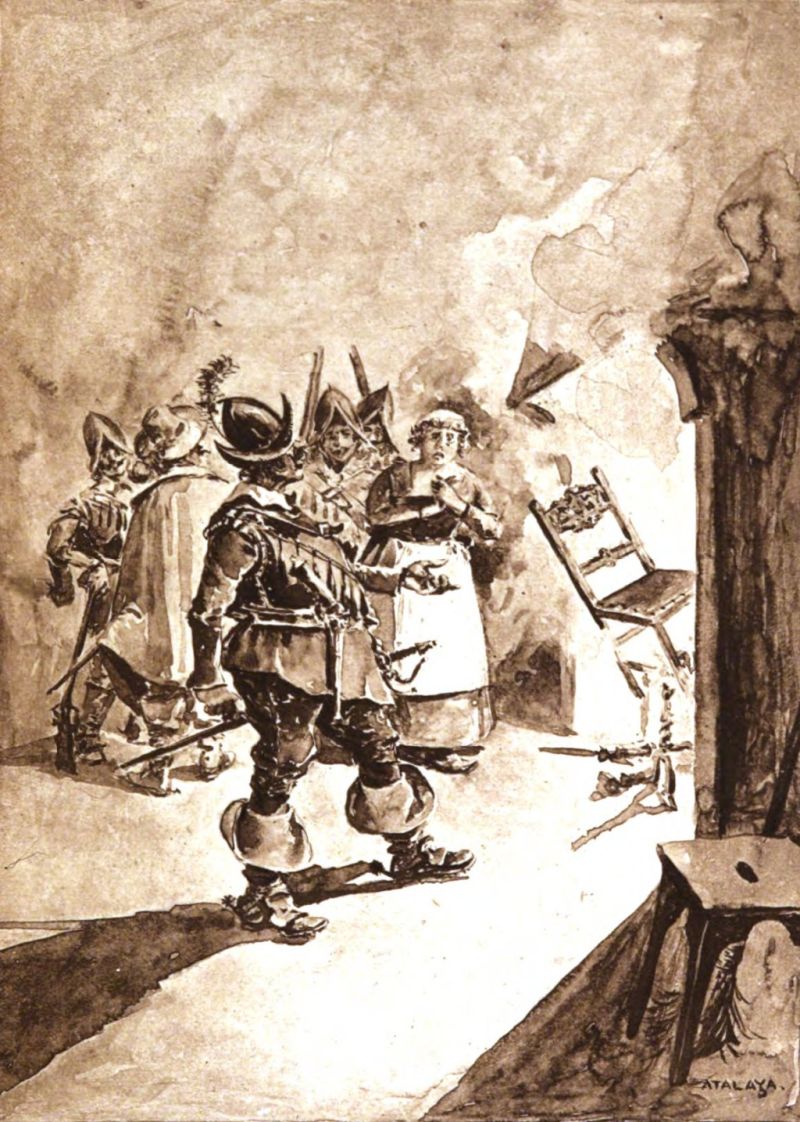
MACABRE AND HIS BAND AT THE INN.
"Look you, my toothless beauty; this is the way we warm ourselves when wood is dear!"
And he tossed the chair on which he had just wiped his feet into the fire.
"There's a stupid girl, and uglier, if possible, than her mistress!" rejoined the courteous Macabre. "Look you, my toothless beauty; this is the way we warm ourselves when wood is dear!"
And he tossed the chair on which he had just wiped his feet into the fire.
"And now, lieutenant," he continued coolly, turning to Saccage, "you say there's a little ragamuffin here, sent by those——"
"Here you are at last!" replied Saccage, raising his foot to impel Mario more rapidly toward the venerable captain.
Mario eluded the outrage by darting nimbly under the reitre's foot, and, standing in front of the other brute, said to him coolly:
"I am here, and this is my message; for I gave your lieutenant the countersign. You cannot stay in this inn, because a large body of armed men is coming here to-night. You cannot attack the château, which is well guarded. You must go back where you came from, or you will get into trouble; Sancho sends this message to you."
"Your Sancho is truly an old ass," retorted the captain.
And he added, accompanying each word with an oath which it is hardly worth while to repeat in order to convey an idea of the charm of his conversation:
"I haven't travelled a hundred leagues through a hostile country to go back empty-handed. Go and tell the man who sent you that Captain Macabre knows the country better than he does and cares devilish little about a well-guarded château! Tell him that I have forty horsemen, for there are fifteen more behind me, who are coming on in charge of my wife, and that forty reitres are as good as an army. Come, off with you, and go to the devil, gypsy!"
"Don't send him away, captain," said Saccage, who seemed the more judicious member of the council; "it's of no use for us to have anything more to do with that Spanish lunatic and that gypsy scum. It is quite unnecessary to send this sharp young messenger to say that you are going on. They would follow us and would simply embarrass us and burn and rob all around us. Do what your wife told you. Stay here till midnight, and then you will arrive long before daybreak, for it's only two leagues from here to Briantes. So don't let this little fellow go. I'll throw him out of the window, if you choose; that will prevent his running."
"No! no unnecessary severity," bleated the captain in falsetto. "I have become a humane and gentle man since I have had a tender-hearted spouse. Is the house properly guarded?"
"A fly could not get in without my permission."
"Then let us sup in peace, as soon as my Proserpine arrives. Have you given orders?"
"Yes; but in spite of Madame Proserpine's fine promises about the comforts of this inn, we shall sup but poorly here, I am afraid. The wonderful cook of whom she said so much is in bed, at the point of death, and the woman is losing her wits. The servant is a traitor whom we have to watch, and the maid is a frightened old fool who breaks everything she touches and doesn't forward matters."
"That's because you speak harshly to them, my friend! You always have insults and threats on your lips! Ten thousand devils! as my wife has often told you, you lack tact. Where is this damned hostess? summon her, and let me restore courage to her belly with a cuff or two!"
Walking heavily to the stairs, he called Madame Pignoux, heaping the coarsest epithets upon her, apparently to set his lieutenant an example of mildness and courtesy.
This whole conversation was carried on in French.
Macabre, who was of German descent, was born at Bourges and had passed his early youth in Berry. Except for a somewhat extended vocabulary for use in his military capacity, he spoke the language of his fathers with difficulty and without pleasure. The Italian Saccage murdered French with more facility than German. Thus they had difficulty in understanding each other when they spoke the latter tongue, and moreover they considered themselves so entirely masters of the situation that they scorned to take any precautions before Mario and the people of the house. Mario, who had taken a great risk when he tried to make the reitres retrace their steps, and who was likely to be contradicted at any moment by some genuine messenger from Sancho or La Flèche, realized that it would be too audacious for him to insist for the moment. He feigned indifference and preoccupation as he laid the table, but did not lose a word of what the two adventurers said to each other.
It was quite true that Sancho had promised to send a messenger to Etalié, which he had designated as the last halting-place of the reitres. But that messenger, who was a gypsy like the rest, and who hoped that the château of Briantes might be taken and pillaged without the aid of the Germans, had no idea of doing the errand, but went in search of plunder in the deserted village, pending the time fixed for the assault upon the manor by his companions.
The hostess, in obedience to Macabre's polite summons, came upstairs and faced him bravely.
"What is the use of big words, Captain Macabre?" said she, putting her arms akimbo. "We know each other of old, and I know very well that you will pay your reckoning and that of your devils of lansquenets[8] with oaths and destruction of property. I don't receive you for my own pleasure, and I know very well that it is more likely to be for my ruin. But I am a reasonable woman and no more foolish than another. So I face ill fortune with a stout heart and serve you to the best of my ability, in order to escape bad treatment and be rid of your faces the sooner. If you are at all reasonable yourself, captain, you will say to yourself that you had better not injure me to no purpose, but let me alone, and remember that I know how to fry and roast as well as another."
"In God's name, who are you, old chatterbox?" said the captain, trying to turn his stiff neck in its iron gorget, in order to look at Madame Pignoux.
"My maiden name was Marie Mouton, and I was your cantinière during the siege of Sancerre; and one day I fricasseed a stale crust for you and you smacked your lips over it."
"That may be; I remember the crust, which was good, but not you, who are ugly. But if you have served the good cause, I forgive your chatter."
"And what do you call the good cause now? For you and your like have changed so many times!"
"Hold your tongue, my dear Bonbec. I don't talk religion with people of your sort."
"Understand, too," interposed Saccage with a sneer, "that the good cause is always the one we serve!"
"Is this the time for jabbering," continued Macabre, "when my Proserpine approaches and I order you to make haste?"
"I cannot work any faster," replied La Pignoux; "why did you call me upstairs?"
"Because I propose that your husband, who is supposed to be a decent sort of cook, shall get up, dead or alive, and put his hand to the dough."
"That is impossible; my man is all twisted up with pain, and hasn't cooked for a long time."
"You lie, my dear; your man is a tool of old—Enough! I know about you; my wife has told me——"
"Old who? what do you mean?"
"Methinks you question me, strumpet!" said the captain, with a burlesque dignity which he assumed in perfect good faith.
"Why not?" retorted the hostess. "And your wife, as you call her,—who is she, to have kept you so well informed?"
"Hold your tongue, and when my goddess arrives, serve her on your knees," said Macabre with a fatuous smile in which his crooked mouth extended to his left eye.
Then, recurring to his fixed idea, which was to feast bountifully and regale his goddess handsomely, he insisted that the inn-keeper should be made to get up.
"By hell!" exclaimed Saccage, drawing his sword, "there is no difficulty about that; I have always heard that you must grease stiff joints to make them work, and I will find a way to unearth this pretended dying man whatever hole he may be hiding in! Come with me, scouts! and run your swords everywhere, whether it's into flesh or marrow."
"That is unnecessary," said Mario, jumping in front of the unsheathed sword; "I will go and bring him; I know where Master Pignoux is! I know him, and when I tell him that he has the honor of receiving Captain Macabre in person, he will come at once."
"That is a pretty boy!" said Macabre, looking after Mario as he left the room. "I must give him to my wife to wait on her. She asks me every day for a trim little page."
"You will make nothing of a gypsy," said Saccage. "This imp has an impudent, sneering air."
"You are mistaken! I consider him very pretty myself!" rejoined the captain, who did not enjoy being contradicted too much, and with whom the lieutenant had been a little too outspoken for several days past, for reasons which we shall soon learn, and which Macabre was beginning to suspect.
The marquis, being anxious about Mario, was standing in a small passageway near the salle d'honneur and doing his utmost to hear everything; but his ear grasped only snatches of the conversation, and Mario, hurrying out in search of him, hastily told him what had taken place, in as few words as possible.
He had not time, nor indeed had he the inclination, to tell what was happening at Briantes; he felt that the marquis already had enough upon his mind to extricate himself from his present plight, and that he ought not to disturb him by giving him other motives for apprehension.
The reitres being as ignorant as he of the attack precipitated by the gypsies, there was no risk that the marquis would learn it from another mouth than his when the proper moment should arrive.
But would that moment arrive? The present situation would have seemed desperate to an experienced person, and the marquis, who knew only a part of it, deemed it very serious. But Mario had the happy faith of childhood: he saw only half of the danger.
"If we escape from here, as I hope," he thought, "my father and I will have a hearty laugh at the figure we cut at this moment!"
LIII
In truth, the poor marquis, disguised as a cook, was very laughable.
He had done the work conscientiously. He had taken off his wig and concealed his bare skull beneath an oilcloth cap shaped like a cake-mould.
His face, thus bereft of its ebon curls, and smeared with soot, was not recognizable; nor were his great white hands, which were stained to correspond with his face.
He had succeeded in hiding his fine white shirt under a countryman's smock, and was shod in shabby felt slippers; a coarse apron, thrown over the whole, covered his broadcloth breeches, which were not very magnificent, for he had attired himself very simply for the projected nocturnal expedition to Brilbault, which circumstance proved to be very fortunate in this emergency.
Being informed by Mario that Macabre seemed to be a stupid, vain-glorious clown, he realized that it was his cue to inspire confidence in him, and at the outset he saw that no flattery would be too rank for him to swallow.
"Illustrious and gallant captain," he said, bowing to the ground, "I beg you to excuse my poor fool of a wife, who did not know what a great warrior and scholar we had under our roof. It is quite true that I am ill with the gout, but your affable and martial air would bring the dead to life, and I remember too well my service under your banner not to be determined, though I must leave my life in my fires, to serve you to the extent of such small talents as heaven has given me."
"Good! good!" said Saccage to the captain, "there is nothing like threatening! They are all claiming to have served under you."
"That's all right," rejoined Macabre, "provided he serves me well now. And after all, monsieur le lieutenant, it's not impossible that the old fellow may have known me long ago, during the war in the province. I had enough share in it for everybody to remember me. Scullion! you may tell me of your campaigns at dessert, for I see from your manner and your gait that the gout hasn't spoiled the carriage of a soldier. You have a curious odor about you," he added, referring to the perfumes with which the marquis, despite his disguise, was thoroughly impregnated; "it smells like confectionery! No matter! I will bet that you have been a lansquenet in your day, eh?"
"I was one for a whole year," replied Bois-Doré, who knew by heart the whole of Master Pignoux's checkered existence and Macabre's villainous youth. "Why, I saw you worry the Huguenots of Bourges during the massacre in the prisons, in company with that terrible vine-dresser who was called Le Grand Vinaigrier."
"Oho!" cried the Italian, glancing at his captain with a mocking air, "didn't I tell you that you were a great Papist, my captain?"
"Everything in its season!" retorted Macabre, with philosophical tranquillity; "my father, who was the captain of the great tower of Bourges with the late Monsieur de Pisseloup, protected the poor heretics in the province as well as he could. For my part, I fired crooked when I couldn't do anything better. But I got back into the straight road, and I am more sincere than you, Monsieur l'Italien, with your relics hidden under your German breastplate."
The Italian made a sharp retort, and Macabre, angry with him for raising his voice in presence of his pages and his men-at-arms, although they understood very little French, bade him be silent, and asked the marquis what he could give him to eat.
Bois-Doré, who had referred to the incident of the Catholic massacres only to see in what waters young Macabre was sailing since he had grown old, felt more at ease.
This leader of partizans could not be acting under the patronage of the Prince de Condé. The marquis's knowledge was sufficiently extensive to enable him to talk of culinary matters like a man who knows his ground, and as, during his stay of two hours at the inn, he had discussed this momentous question with Madame Pignoux, to pass the time away, he was quite familiar with the contents of the pantry and the resources of the cellar.
"We shall have the honor to offer you," he said, "a quarter of wild-boar seasoned with spices, which will commend itself to you; a fine mess of Issoudun crabs cooked in beer——"
"And well peppered, I hope," said the captain. "My wife loves highly-seasoned dishes."
"We will put in a taste of Spanish pimento."
And, having enumerated all the dishes, the marquis added:
"But would not your illustrious lady like some sweet dishes after the joint?"
"The devil! yes. I had nearly forgotten that she recommended a certain omelette au musc."
"Perhaps your lordship means aux pistaches? That is a dish of my own invention."
"The deuce you say! She told me that it was invented by the old man."
"The old man? Who dares, boast of having discovered before me the omelette au riz and aux pistaches?"
"Faith, old Bois-Doré, if I must mention that idiot of idiots in good company!"
Bois-Doré bit his lips.
"Who, pray, does the marquis the honor to repeat his absurd boasts?" he said. "Does madame your wife deign to know him?"
"It would seem so!" retorted Macabre, "and I know, also, my old rascal, that you are that triple hound of a false marquis's humble servant, and that he taught you how to cook; but I don't care a straw! You are watched and your ears will answer to me for your ragouts."
The marquis saw that he had no other resource than to speak ill of himself, and he did not spare himself, ridiculing his own rank and character in most amusing terms; but he could not decide to couple with his accursed and calumniated name the epithet old, which his contemporary Macabre insolently used to decry him.
The captain persisted in a most offensive way.
"That old dyspeptic must be pretty well broken up," he said, "for when I saw him last he was like a long lath, with no beard on his chin, and I nearly broke him in two by mistake."
"Indeed?" said Bois-Doré, recalling the youthful adventure which he had recently related to Adamas; "did you do him the honor of measuring swords with him?"
"No, my good man, I didn't stoop to that. He was on horseback, carrying munitions of war to our enemies. I took him by one leg and, stretching him at my feet, I left him for dead and seized his convoy."
"Which consisted of powder and ball?" queried Bois-Doré, unable to refrain from laughing inwardly at the absurd boasting of the man whom he had overturned with a kick, and at the remembrance of that famous stock of munitions of war, consisting of children's toys.
"It was a good capture!" replied the captain. "But we have talked enough, old jabberer! Go downstairs and have an eye to everything."
Bois-Doré, relegated to his ovens, was compelled to leave Mario, whom the captain detained.
As he left the room he cast a glance at his son: a glance of intense apprehension, which the child returned with one of the utmost confidence. He felt that Macabre was not ill-disposed toward him.
"Now, my boy," said the captain, "come here and tell me, if you can, who you are!"
"Faith, I don't know anything about it; captain," replied Mario, who had not had time as yet to forget the gypsy mode of speech; "I was stolen or picked up on the road somewhere by the dark-skinned devils called Egyptians."
"What can you do?"
"Three fine things," replied Mario, opportunely remembering La Flèche's lofty maxims: "fast, watch, and run; with that we can go a long way and get out of any scrape."
"He's a sharp boy," said Macabre, glancing at his lieutenant, who, to display his ill-humor, had turned his back on him, sitting astride his chair, his head and hands resting on the back, and his side to the fire. Macabre considered his position disrespectful, and told him so in cynical terms. Saccage rose without speaking and left the room.
Mario observed everything, and the discord between the two leaders seemed to him a good omen. He determined to take advantage of it, if possible, and if opportunity offered.
Macabre resumed the conversation with him.
"How does it happen," he said, "that I didn't see you at Brilbault last night?"
Mario was not long embarrassed by that question.
"I wasn't there," he said; "I was collecting chickens in the neighborhood, just to save them from the foxes and the pip."
"Do you know how to steal chickens? Well, that is a natural accomplishment which may be very useful. But tell me if the Spaniard finished his dying?"
"Monsieur d'Alvimar?" said Mario, beginning to understand Pilar's story, and no longer to look upon it as a dream.
"Yes, yes," said Macabre, "that dog of a Papist who turned my stomach with his prayers!"
"He died this morning."
"He did well, the lunatic! And what about Sancho? He's much more of a man; bigoted as he is, he understands matters. Where is he now?"
"He is hiding."
"Why doesn't he join me here?"
"As I told you, you are in danger here, and he knows it."
"What danger? Will old Pignoux betray us?"
"No, the poor man doesn't know anything at all about it; what could he do against you?"
"But from whom are we in danger?"
"A party of gentlemen who are looking for you at Brilbault at this moment, and who will soon pass here, with a big escort, on their way to sleep at Briantes."
"Did you see them?"
"Yes."
"How many of them are there?"
"Perhaps two hundred mounted men!" said Mario trying to frighten his man.
"So the plan is discovered, is it?" said Macabre, evidently shaken.
"It seems so!"
The captain seemed to reflect, in so far as his stony or, more accurately, his horny face could be said to denote any mental preoccupation.
Mario's heart beat fast under his rags. For a moment he thought that his stratagem would be successful and that Macabre would decide to retrace his steps. But the captain began to talk German with his scouts, who left the room at once, and Macabre resumed his graceful attitude, one leg thrown over the andiron, the other across the chair the lieutenant had left.
Mario ventured to question him.
"Well, captain," he said, "are you going to turn back?"
"To Linières? No, indeed, my little monkey! My horses are tired and my men too. For my own part I slept so tittle at Brilbault last night that I propose to make it up here. Woe to the man who disturbs me!"
These plans for slumber aroused hope anew in Mario's heart.
"If these people are very tired," he thought, "a moment will come when we shall be able to escape."
He did not, as the marquis did, rely upon the arrival of his friends and servants. Pilar, by advising them of the capture of the basse-cour at Briantes, would lead them to hurry thither instantly, expecting that the marquis would take the same direction; for the little gypsy, whose intellect was shrewd beyond her years, would not fail to tell them that Mario had started off to warn his father.
As he was making these reflections, Lieutenant Saccage re-entered the room, and, addressing Macabre, who was dozing before the fire, said in a half-humble, half-insolent tone:
"Allow me to inform you, captain, that, thanks to your plan of dividing us up into small parties, we lose much time; your wife and her party have not arrived, and if you sit a long while at table, as you usually do, our whole plan may fail. The proper course would be not to have a feast, but to eat quietly, sleep a couple of hours, and go forward before the passers-by have time to speed the news of our coming."
"Detain the passers-by!" rejoined Macabre, calmly. "Didn't we agree on that? You will have no great task, for we didn't meet a cat from Linières here, and this country's as empty as a church in '62. But these are useless words. I hear my Proserpine's voice. She comes! Let us go to meet her!"
As he spoke, Macabre rose with an effort and went down to the kitchen.
"The captain's growing old!" said Saccage, in Italian, to one of the farriers who stood like statues in front of the door.
"No," was the reply, "he has taken a wife, and that is worse! He thinks of nothing but carousing, and he doesn't know when it's time to march."
Mario, who was studying Latin with Lucilio, understood the substance of this colloquy, and followed the lieutenant and the two troopers to the kitchen.
As soon as he arrived there, paying no heed to the new arrivals who were crowding through the door, he glided to Bois-Doré's side, who was cooking for dear life with Madame Pignoux, saying to himself that the sooner the enemy was at table, the sooner there might be some opportunity to escape.
"Ah! here you are, my child," said the marquis in an undertone; "have they maltreated you?"
"No, no," said Mario, "the captain and I are on the best of terms. Let me help you, father. We can talk while they are not thinking about us."
"Very well, but we must not look at each other; watch me when I speak to the hostess.—Madame Pignoux, give me the butter!" he called aloud; then added in an undertone: "What is going on by the door, my good woman?"
"A lady dismounting from her horse. Don't turn round, she may happen to know you."
"Mustard, boy!" said the marquis, tapping Mario on the shoulder.—"Don't you turn either," he whispered in his ear.—"Madame Pignoux," leaning toward the hostess, "try to see her face."
"I don't recognize her," said La Pignoux; "she has a mass of hair and feathers. She's a powerful woman!"
LIV
Our three friends were standing at the end of the kitchen by the oven, with their backs to the door and their faces turned toward a window, through which they could see the figures of the sentinels walking to and fro outside, carbine in hand.
There were two on each side of the house; an unnecessarily large supply, for the house had only two doors, one opening on the road, the other of the pantry, opening on a small garden enclosed by a hedge.
All the windows on the ground-floor and first floor were provided with stout bars. It was hopeless to think of forcing their way out.
And yet the marquis sighed with impatience.
"Ah! my son, why are you here?" he said to Mario. "With this stout kitchen knife I could soon get rid of the two sentinels walking back and forth in front of the pantry door. But with you—I should not dare; I am a coward."
"And if my man was here," rejoined Madame Pignoux, "old as he is, he and Jacques would take care of the others. But I am very much afraid they have killed my poor servant! Good God! there he is! Just see how those devils have treated him! He's all covered with blood!"
Jacques le Bréchaud, so-called because he was gap-toothed,[9] was ugly, crafty and bad-tempered, but brave and devoted.
"Don't pay any attention to me," he said, "but give me a dish-clout to wipe my face."
"Why, they have split your head open, my poor fellow!" said the marquis, passing him his lace handkerchief, which he found in his breeches, pocket.
Mario seized the handkerchief, which might have betrayed their identity, and tossed it into the hot fire, where it disappeared like a match.
Jacques wiped away the blood and bandaged his wound with a napkin.
"Don't be alarmed," he said to Madame Pignoux; "they let me come here to wait on them. Give me the larding-knife, and the night shall not pass without my ripping up one or two of them."
"You will get yourself killed," said the hostess. "That's of no consequence," replied Jacques.
"But you will get us killed too!"
"Jacques," said the marquis, "look at this child, and don't say a word. Help him to leave this house, if you can, but be prudent if you love us."
Jacques glanced stealthily at Mario, and, without making any reply, went several times to the pantry, as if to attend to his duties, but in reality to examine the men who were pacing back and forth with the regularity of machines.
"Those German curs!" he said to the marquis, "they don't eat nor drink nor sleep until they have killed off everybody."
"And they know what discipline means too!" rejoined the marquis, with a sigh. "Ah! it can't be denied that the reitres are stout soldiers! If our good Henri had had ten thousand of them, he would have been king ten years earlier!"
"Cook, father, cook!" said Mario, "the lieutenant is looking at you!"
"He may look at me all he chooses, my son; I know how to handle a saucepan as well as Master Pignoux himself."
"That's the truth," said the hostess; "anyone would swear that you had studied cooking!"
"I studied it in the field, Madame Pignoux; I have made a fricassee for my Henri with my sword at my side and my helmet on my head. Who would have dreamed that I would ever do the same for a Macabre and his better half? She is some prostitute, I fancy!"
At that moment Madame Proserpine's voice rose above the others, which had drowned it thus far.
"Pah! how it smells of burned fat!" she exclaimed; "it is enough to make one sick! Let's go up; let's go up at once! Come, lieutenant, give me your hand, sacrebleu!"
Monsieur de Bois-Doré and his son glanced at each other then looked down into their saucepans.
This amazon, who, after conversing confidentially with the captain and lieutenant at the door of the inn, now strode slowly across the kitchen, resplendent in her warlike costume, and tossing beneath the multicolored plumes of her headgear her abundant bright red mane, this Madame Proserpine, the more or less lawful spouse of Captain Macabre, was the marquis's former housekeeper, Mario's personal enemy, Guillette Carcat of La Châtre, Bellinde of Briantes.
"We are lost," thought the marquis; "she will surely recognize us!"
"We are saved," thought Mario; "she does not recognize us!"
And, to make his disguise more complete, he too enveloped himself in an enormous apron which came to his chin, and passed his little soot-begrimed hands over his red cheeks.
Bellinde passed on without turning. But it was impossible to think of flight. Madame desired to be served instantly.
The ex-housekeeper, formerly a prudish and demure damsel, had undergone a sudden metamorphosis. On becoming the companion of an old swash-buckler, she had adopted the military manners and the imperious and shrewish tone which were the natural expression of her real nature, long held in restraint and glossed over at Briantes. Her person had developed with corresponding luxuriance. Being no longer obliged to indulge secretly in stolen liquors and delicacies, she had abandoned herself greedily to her gluttonous instincts. Being abundantly supplied with money, provisions and spirits by the forethought of Macabre, who always appropriated the lion's share of all booty, she drowned each day, in the fumes of debauchery, the remorse and disgust born of her subjection to a species of monster.
The pleasure of doing nothing but ride about the country and issue orders was also some compensation to her. The vicissitudes and excesses of her new life as an adventuress had speedily altered her features and almost doubled her size. Her face, naturally high-colored, had already taken on the blotched, purplish appearance of dissipation and over-indulgence. Proud of her luxuriant red mane, she allowed it to fall over her shoulders with absurd ostentation, and bedizened herself, without a trace of discernment, with all sorts of objects which Master Macabre had collected, more frequently by treachery than in honorable warfare.
Madame therefore was in haste to eat and drink, after a long journey in the saddle, and was overjoyed to think that she was to taste at last the fine cooking of Master Pignoux, which she had so often heard extolled at Briantes.
It mattered little to her that five-and-twenty stout troopers—they were miserable rascals by the way, we must not forget that—were waiting at the door with empty stomachs. The dissatisfaction which her conduct caused them did not disturb her in the slightest degree; she had no suspicion of it, her idiot of a husband having given her the rank of lieutenant and the command of a portion of his band, with whom she shared her booty when she was in good humor, and who were devoted to her from interested motives.
The fifteen brigands whom she had brought, and who took possession of the kitchen, while the others were relegated to the stables or ordered to mount guard, displayed at first the greatest eagerness in the preparation of her supper; they counted upon her leavings, and while some laid the table, hustling and abusing the inn servants, others spurred on Bois-Doré the chef, his supposed wife and Mario, the improvised turnspit, to satisfy the lieutenantess's appetite as speedily as possible.
For this reason they could not think of exchanging a word or looking toward the door. There was nothing to be done but cook, and cook they did with might and main.
This was one of the crises in the marquis's life, when he rose to the occasion.
He made ragouts worthy of a better fate, seasoned and dressed the dishes, greased the spider and turned the omelet with the graceful ease of a science which at last imposed respect on those cutthroats, despite their impatience.
As he was about to serve the soup, the marquis saw Jacques le Bréchaud put out his hand as if to put in more salt. He instinctively declined that uncalled-for assistance; but he was surprised to find that Jacques persisted, and, on taking hold of his hand he saw that the salt had a peculiar look.
"Let me do it," said Jacques, "they like their soup well-salted."
And his face wore a strange smile which impressed the marquis.
"No poison, Jacques!" he whispered; "that is cowardly, and cowardice brings bad luck! God alone can save us! Let us not anger God!"
Jacques dropped the rat poison with which he had proposed to season the soup for the charming guests of the Geault-Rouge. The marquis's generous and sentimental outburst was inexplicable to him; but he submitted to his ascendancy with a sort of superstitious awe.
Bois-Doré handed the soup and the whole first course to Madame Proserpine's bearded pages; he breathed a little more freely; they seemed disposed to give him somewhat more liberty.
Mario went to the door from time to time, indeed he might have made his escape at that moment by pretending to go out to the shed to fetch wood; but he was careful not to mention the fact to his father. He would have insisted upon his taking advantage of it, and not for anything in the world would the child have parted from him.
"If my father is to be killed," he thought, "I will die with him; but I shall not abandon the hope of saving him until the last moment."
Madame Pignoux also began to hope. Madame Proserpine's men seemed more insolent but somewhat less forbidding than those who had been in the kitchen before.
They were almost all Frenchmen and young. They issued their orders as cynically as the others; but there was a sort of boisterous gayety in their manner which might mean that they were good fellows at bottom, or, at least, that they might forget themselves for a moment.
But an order from the top of the stairs fell like a thunderbolt on the captives: Madame Proserpine summoned Master Pignoux and his wife to her presence.
"I will come, I am coming, as fast as I can!" cried the hostess, hurrying upstairs.
And she appeared before the lieutenantess and respectfully requested to know her wishes, taking care not to seem to recognize her, or else to humble herself before her as a personage of vastly greater consequence than the servant who used to take the marquis's little dogs out to walk.
"My orders were for your husband to appear also," observed La Bellinde, flattered by Madame Pignoux's submission. "Go and call him, my good woman."
"Excuse me," said La Pignoux, "my husband is in a terrible heat, and too much smoked up to appear in a dirty cap and apron before a lady like you."
"Do you think that you are more enticing, you old gallows-bird?" cried the captain. "Bah! you can't fool me. I want to see the face of your donkey of a husband, and no excuse will go down. Look you, rascals," he said to La Proserpine's attendants, "how happens it that when your lieutenant gives an order, you make her repeat it? Death of my life! Must I go myself and fetch that double-dyed traitor?"
At that moment, Bois-Doré, who had been compelled by force to ascend the staircase, was pushed into the room, and so roughly that he well-nigh fell on his knees at La Proserpine's feet.
Poor Mario followed, trembling with fear for him and with wrath against the villainous troopers. If his old father had fallen, the child would have lost patience and have defended him at the risk of being cut in pieces.
Luckily for them both, the marquis did not lose his head and determined to risk everything, staking his fate on the success of his disguise.
As luck would have it, Proserpine paid no heed to his features. She knew the genuine Pignoux very well; she did not deign to raise her eyes to his face at once, engrossed as she was by the exceedingly familiar homage paid to her by Lieutenant Saccage, who, being seated by her side, made the most of every moment when Macabre was not watching them closely.
Thus the marquis was able to take his stand behind Proserpine, in the attitude of a humble retainer awaiting orders; and, with a clever manœuvre he caused Mario to stand behind him.
"Ah! there you are at last, gallows-bird!" cried the captain, bringing his fist down on the table. "Your fear betrays your treachery, and I see through your vile schemes!"
Bois-Doré, believing that he was detected, was on the point of casting his disguise to the winds and making such use of the carving-knife as to be sure of dying without ignominy; but Mario was there and paralyzed his courage. In his uncertainty as to the meaning of the words addressed to him, he refrained from replying and thus allowing La Proserpine to hear his voice.
He contented himself by staring at Macabre with a self-possessed air. That was, although he did not know it, the wisest attitude he could assume.
"Zounds! will you speak?" roared the captain, who had seemed somewhat disturbed and was evidently reassured by his innocent air. "You play the simpleton, you miserable rascal! but you must know that by failing to come here yourself so that we could pull your ears to bring you to your senses, you disregarded all the rules and all the proprieties of your beastly trade."
Bois-Doré, being determined not to speak, made a gesture equivalent to an interrogation point, with a shake of the head which seemed to say: "What is all this about?"
"Have you lost your tongue, with which you chattered so fast a little while ago?" continued Macabre; "or have you never learned, you triple idiot, that a landlord ought always to be the first to taste the food and drink he provides? Do you think that I am so sure of you that I am willing to take the risk of poison? Come, be quick about it, you infernal beast, swallow what you see on this plate and in this goblet, or mordieu! I'll make you swallow my sword!"
As he spoke he pointed to a plate on which he had placed a portion of all the dishes on the table and a goblet filled with wine from all the jars.
The marquis was greatly relieved when he learned why he was wanted, especially as La Proserpine did not glance at him when he stooped over the table to take the plate and the glass.
The custom of requiring an inn-keeper to taste his dishes had fallen into disuse since the close of the great civil wars, in the central provinces at least; travellers had ceased to exercise that privilege, as inn-keepers had ceased to require travellers to disarm before entering their houses.
But Macabre acted as if he were in a conquered province, and it was useless to argue with the stronger party. So the marquis performed his task courageously, with a smile of disdain for the affront put upon his honor. He swallowed the contents of the plate and glass in silence, bestowing upon Jacques le Bréchaud an eloquent glance, which said:
"Generosity brings good luck, you see, Jacques!" And Jacques, who adored the marquis, crossed himself and returned to the kitchen.
LV
Everything went well.
Macabre and his subordinates, crushed by the haughty glance and haughty silence of the majestic cook, were delighted to be able to do honor to his toothsome dishes, and perhaps he would not have been required to appear again; but an unfortunate moment of distraction on his part spoiled everything.
La Proserpine dropped the feather fan which she carried in her belt, with a dagger and two pistols; and with the fatal instinct of courtesy which never failed him, even with respect to his housekeeper, the marquis stooped to pick up the trinket, which he handed to her with suppressed excitement, realizing his blunder too late.
There was an expression of surprise and uncertainty in La Proserpine's eyes for a moment, a moment that seemed as long as a century; at last the lady cried, putting her hand to her pistols:
"May I die in torment if this is Master Pignoux!"
"What? what does this mean?" cried Macabre in his turn. "Come here, old turnspit, and show your dirty snout to the company. By the death of the devil! if there's any trickery, and some scurvy spoil-sauce has usurped the duties of chief cook, I'll make a skimmer of his hide!"
The marquis did not listen to the brigand's threats; he felt that the crisis had come, and pushed Mario out of the room, saying:
"Go down stairs, my wife is calling you!"
Then he turned resolutely and faced La Proserpine, and looked her in the eye with that lofty dignity which only the brave man can summon to his aid against cowardly adversaries.
Despite her master's burlesque attire, Bellinde could not escape a sensation of respect and remorse. She held in her hands the life of the man whom she desired to humble and rob, but not to torture and murder. She hesitated another moment, then said:
"Faith, Master Pignoux, I do recognize you now! but mordi! you are much changed! Have you been very sick, pray?"
"Yes, madame," replied Bois-Doré, touched by her kindly impulse; "I have had a fatiguing time in my house since I was compelled to part with a person who served me well."
"I know whom you mean," rejoined Bellinde. "She was a treasure whom you didn't appreciate and turned out-of-doors like a dog. Yes, yes, I know how it happened. You were entirely in the wrong, and now you regret it! But it's too late, you see! she will never serve you again!"
"She will do well never to serve anyone, if she can do without it; but I flatter myself that, wherever she may be, she has not forgotten my generosity to her. I dismissed her without a word of reproach and did not treat her stingily; she may have told you so."
"Enough; we will speak of this later. Serve us with your best, and now go back to your work, old man. Go!"
As he went out, he saw her whisper to one of her men.
"We are saved!" he said to Mario in the hall. "She did not betray me, and she has given orders to let us go."
And the marquis, in his innocence, walked with Mario toward the kitchen door; but he was much mistaken: La Proserpine had, on the contrary, issued even stricter orders for the blockade.
So they had no choice but to continue to busy themselves with the composition of the famous omelette aux pistaches.
About an hour passed without any perceptible change in this absurd yet tragical situation.
There was a great uproar in the dining-room. Macabre was shouting and swearing and singing. There were alternations of brutal merriment and brutal rage.
This is what was taking place:
Lieutenant Saccage was as outspoken and concise as his name. It seemed ridiculous to him to prepare for a sharp and decisive blow, which demanded a swift and silent march, by a supper which he well knew would degenerate into a carouse.
Macabre was a desperado addicted to all the excesses which were the real motive of his expeditions. He had not, like his lieutenant, the qualities of the shrewd speculator, and, if I were not afraid of profaning words, I would say that, in his adventurous life, he wallowed in a sort of drunkenness, which was the poetry, a sombre and brutish sort of poetry, of that life. He was as much gypsy as thief, squandering all he acquired, and rich only by fits and starts.
The other amassed wealth in cold blood and put it aside. He understood business, spent nothing in dissipation, and was hoarding a fortune. In our day he would have been a sharper in higher station; he would have cheated in a black coat and lived in good society, instead of scouring the high roads and stripping wayfarers.
Each century has its own peculiar methods of traffic, and during the civil wars of the sixteenth and seventeenth centuries, brigandage was a regular branch of industry, conducted on business principles.
Saccage hoped to get rid of Macabre. He would not have dared to attack him in front; but he did as monsieur le prince did with the King of France: he urged his master into danger, calculating that a volley of musketry would carry him off and leave his place empty for him.
Guided by this idea, he strove to make himself agreeable to La Proserpine, who had charge of the cash-box and the jewel-case; and the lady, while handling her chance husband with care, did not discourage the embryo husband whom the chances of war might make useful to her at any moment.
This system of coquetry was beginning to be manifest to Macabre, and he was torn between his natural inclination to allow himself to be led by the nose, and his desire to discipline his goddess in vigorous fashion.
He was sorely tempted too, every moment in the day, to break the pitcher over his rival's head, but he realized how essential the lieutenant's activity and never-failing soundness of judgment were to him, who could never resign himself to the necessity of remaining sober and living on the alert.
So that, fatigued by this alternation of angry outbreaks and reconciliations, which was repeated at every halting-place, the captain adopted the plan of drowning his cares in the vintage of the hills of La Châtre, and, after talking much nonsense, began to feel an unconquerable longing to take a nap, with his nose amid the remains of a pie on his plate.
Not until then could Saccage talk seriously with Proserpine.
"You see, my Bradamante," he said, "that this old sot is good for nothing, and if you follow my advice we shall leave him here to sleep off his wine and go on and pillage the château. To-morrow, when we return, we will pick up our noble commander, who would simply serve to embarrass our expedition now."
Proserpine was nourishing a newly conceived idea, a bold and extraordinary idea, which she was careful not to impart to the lieutenant. She pretended to accede to his wish to make all necessary preparations for departure.
"Go and see that the whole party have something to eat," she said; "I will watch this sleeping man, and if he wakes I will give him more drink so that he will go to sleep again."
Saccage went down to the pantry, demanded that the whole stock of salt pork and dried meats should be delivered to him, and then went to the stable where his men and the captain's were quartered.
The provisions and the wine were distributed under his eyes with careful parsimony; he assured himself that the sentries were at their stations. Proserpine's men were at table in the kitchen, regaling themselves with the abundant broken meats from the officers' supper.
Meanwhile the amazon summoned the chief cook, who found her warming her stout, booted legs, in a masculine attitude. They were alone, for the captain was snoring in his pie.
"Sit you down, marquis, and let us talk," she said with a laughable air of condescension. "It is necessary that you should understand your situation and mine, and I will tell you much in a few words, for time presses."
The marquis seated himself without speaking.
"I must tell you," continued the lady-brigand, "that when you discharged me so discourteously from your château, I entered the service of Madame de Gartempe, who was going away to the Messin country in Lorraine, where she has large estates."
"I know it," said the marquis, "you were employed by a lady of rank, and you did not lower yourself. How does it happen——"
"That I left her so soon? I had taken it into my head to be pious when I was with you, because one likes to do the opposite of what one's masters do; and that is why, finding my great lady too exacting for my conscience, I turned to the Reformers, which served to make her dismiss me, much more harshly than you did, I admit!
"About that time there came to the Messin country a band of adventurers of all nations, who had served under the gallant captain who is known thereabout as the Bastard of Mansfeld; they had been beaten by the Emperor's Catholic troops on the other side of the Rhine and were seeking their fortune in Alsace and Lorraine.
"Everybody was terribly afraid of those people, I myself with the rest; but chance brought me in contact with one of them, whom you see here, who, having saved a tidy sum, had just dismissed his men and was thinking about returning to Bourges to settle down and end his days in peace. He remembered Berry so well that we soon became acquainted, and he offered me his heart and his hand.
"I don't know why I hesitated to bind myself to him; but one thing that is very certain, my dear marquis, is that your château will be taken to-night and burned to-morrow morning."
"So that is really the object of your expedition?" said the marquis, affecting perfect tranquillity. "Was it you who suggested that idea to Captain Macabre? I cannot believe that you are such a wicked and revengeful person as that."
"The idea did not come from me; but I unintentionally suggested it to this rapacious beast, by imprudently mentioning your treasure. He no sooner found out that you had such a thing than he overwhelmed me with questions, and I, having no idea what he was coming at, gave him enough details to satisfy him that it would be easy to seize it. The effect of my imprudent words was increased by some letters which I was imprudent enough to show him. One came from Monsieur Poulain, the other from Sancho. Both of them gave news of Monsieur d'Alvimar; both believed me to be still devoted to what they call good principles; and as it is a good thing to have friends everywhere, I took care not to let them know what company I was in. And so, my dear marquis, Macabre went off to Alsace one day and hunted up several of his old reitres; he enlisted some others who asked nothing better than to take the field again, and took for his second in command Lieutenant Saccage, who is a clever and intelligent man; and, when all that was done, he came to Linières, and went from there last night, with some of his men, to Brilbault, having arranged to meet the others to-night at this isolated inn."
Bois-Doré listened with close attention, but succeeded in concealing the surprise and anxiety which all these disclosures caused him.
Recalling the ghosts at Brilbault, he mechanically looked at the wall of the room in which he then was, and saw reproduced there the face with the huge hooked nose and long moustaches, together with the plumed helmet of Captain Macabre. It was the same profile that he had seen at Brilbault, and doubtless Poulain the rector, whom he had thought that he recognized, was also of the party. Moreover had he not heard from Proserpine's lips that D'Alvimar had survived the duel at La Rochaille?
He abstained from any reflection and confined himself to questioning the lady, who confirmed all his apprehensions.
D'Alvimar had been horrified beyond measure to find the Huguenot Macabre by his deathbed. But Sancho had sworn to join the reitres, with as many of the gypsies as would consent to accompany him, as soon as D'Alvimar had breathed his last.
"Macabre returned to Thevet this morning," added Proserpine, "where Saccage and I were waiting for him, with our people camped outside the town, where we were careful not to frighten or injure anybody. In that way, thanks to the caution and good discipline of our troopers, we have been able to ride more than a hundred leagues through France without once having to fight. We passed ourselves off as mercenaries sold to the king, and exhibited false commissions. By that means, you see, those of our men who may want to go and seek their fortune in the Huguenot camp or elsewhere will be able to get to Poitou. Macabre expects to give them a free rein, reserving the right to decamp with your booty if he sees that they are getting into any too unsavory business. And so, my dear marquis, we are in a fair way to ruin you, and, unluckily for you, you have thrown yourself into the hands of people who are fully determined to take your life."
"That is to say that my fate is in your hands," replied the marquis, "and you tell me so to make sure that I understand how grateful I ought to be to you. Rest assured, Bellinde, that my gratitude will not be confined to words, and that, if you will abandon the plan of leading these men to Briantes, it will be more profitable to you than to share my property with this band of thieves!"
"So far as that goes, I have told you, marquis, that I am not the leader; but I can assist you to get rid of the captain and make the lieutenant listen to reason, for he loves money better than fighting."
"So you want a ransom for me and the château, do you? In the first place, fix the amount for my person, which is, I confess, defenceless and in your power. As for the château——"
"As for the château, you are thinking that, when you are once free, you will defend it! So you won't be free until we have got through with it, unless——"
"Unless I pay?"
"Unless you sign, monsieur le marquis! for your signature is sacred to anyone who knows, as your faithful Bellinde does, what the honor of a gentleman like you is worth."
"What do you want me to sign?" said the marquis, readily resigned to his fate whenever money was in question.
Proserpine kept silence for an instant. Her face assumed an expression of diabolical malice, mingled nevertheless with a strange perturbation, as if she were somewhat inclined to blush for her temerity.
"Come, come," said the marquis, "speak, and let us have done with it at once, before your companion wakes."
"My companion is not my husband, as you must know, monsieur le marquis," replied the amazon in a mincing tone. "He is very ugly and very stupid—and, although you are no younger than he, you still have attractions—to which I have not always been so insensible as I seemed."
"What nonsense are you talking, my poor Bellinde? Come, a truce to jesting. Let us have done!"
"I am not jesting, marquis! I have always had an intense longing to be a woman of quality, and, if I must conclude, this is my last and only word: Be free! no ransom! Go, hurry home and defend your château, if I cannot prevent them from attacking it; and whatever the result of the affair may be, you will keep the promise you are going to put in writing, to make me your lawful wife and sole legatee."
"My wife, you!" cried the marquis, recoiling in utter stupefaction; "can you dream of such a thing? My legatee? when Mario——"
"Ah! there we are! the pretty boy is the stumbling-block. But never fear, I will treat him well if he behaves to me as he ought, and at my death your property can go back to him, provided that I am satisfied with him."
"You are mad, Bellinde!" cried the marquis, rising, "unless this is all a game——"
"It is not a game; and if you don't write at once what I demand," she said, rising in her turn, "why, death of my life! I will wake the captain and call my people upstairs!"
"Have me murdered, if you think best," replied Bois-Doré; "I will never give my consent to your mad whim! But understand that I will not allow my throat to be cut like a sheep, and that——"
The marquis, unsheathing his knife, had rushed toward the door to receive the assassins, whom Bellinde, suffocated with anger, was trying in vain to call, when Macabre suddenly staggered to his feet and threw at his wife's head a jug which would certainly have killed her if his hand had been steadier.
"Miserable slut!" he cried, chasing her about the room. "Ah! so you propose to marry your old marquis, do you? Perhaps you think I am deaf, and you don't know that Captain Macabre sleeps with one eye and one ear open! Stay here, marquis! I have nothing against you, for you refused the offers of this damned Potiphar. Stay here, I say! Help me catch this she-devil! I propose to wring her neck in proper form and make a drum-head of her skin!"
Despite these alluring invitations, the marquis, leaving the lovers at odds, had rushed into the hall, and Mario, terrified at the noise in the dining-room, had started to go to him. But they could neither go up nor down. On the one hand, Proserpine, pursued by Macabre, who was belaboring her with the rung of a chair, tumbled upon them on the stairs; on the other hand, the amazon's reitres rushed to the spot to adjust the conjugal dispute.
It was soon done.
La Proserpine, all dishevelled, rose and threw herself into the midst of them, and they, with no respect for the captain, seized him roughly, carried him back into the dining-room and locked him in there, laughing at his outcries and his threats.
Proserpine, accustomed to these tempests, was not long in recovering herself. She had no sooner swallowed a glass of gin, which one of her pages handed her, than she looked about with the eye of a bird of prey for her victim, who had taken refuge in a corner.
"The cook, the cook!" she cried. "Bring the cook before me."
LVI
They dragged forward the marquis and Mario, who clung desperately to him.
Bellinde recognized the child at the first glance, and her face, blanched by fear, flushed purple with savage joy.
"My friends," she cried, "we have the wild boar and the shote, and there's a chance for a handsome ransom for us, for us alone, you understand! no sharing with the Germans,"—she designated thus the captain's reitres,—"nor with Monsieur Saccage and his Italians! The Bois-Doré and the young one belong to us alone, and vive la France, tudieu! Pen, paper and ink—and quickly! The marquis must sign his ransom! I know all about his property, and I warrant you that he'll not conceal any of it from me! A thousand gold crowns for each of these fine fellows, do you hear, marquis? and for myself the promise that I asked of you."
"I will give you my whole fortune, wicked woman, if my son's life is spared. Give me the pen—give it to me!"
"No," replied Proserpine. "It is not your property alone that I want, but your name, and you must sign the promise of marriage."
The marquis would not have believed that the termagant would dare to announce her aspirations before witnesses. But the reitres, far from being scandalized, applauded, as if it were a most excellent trick, and the blood mounted to Bois-Doré's face in his intense abhorrence of the abject and absurd rôle assigned to him.
"You ask too much of me, madame," he said, shrugging his shoulders; "take my gold and my estates, but my honor——"
"Is that your last word, old idiot? Come hither, comrades! a rope, and string up this brat!"
As she spoke, the degraded creature pointed to a great iron hook suspended from the ceiling in the kitchen, which was used to support the weights of the huge spit.
In a twinkling they seized Mario, who exclaimed:
"Refuse! refuse, father! I will endure anything!"
But the marquis could not endure for a second the thought of seeing his child tortured.
"Give me the pen," he cried; "I consent! I will sign whatever you choose!"
"Let us give him a jerk or two all the same," said one of the brigands, beginning to attach the rope to Mario; "it will make the old fellow's handwriting freer."
"Yes, do so," said Proserpine. "That wicked child well deserves it."
The marquis became frantic; but he soon calmed down when he looked at his poor child, whose cheeks were white with terror despite his courage. It was useless to resist. Mario was in their power.
Bois-Doré fell at Proserpine's feet.
"Do not torture my child!" he cried; "I yield, I submit, I will marry you; what more do you want than my word?"
"I want your hand and seal," was the reply.
The marquis took the pen in his trembling hand, and wrote at the dictation of that fury:
"I, Sylvain-Jean-Pierre-Louis Bouron du Noyer, Marquis de Bois-Doré, do promise and swear to Demoiselle Guillette Carcat, alias Bellinde, alias Proserpine——"
At that point a terrible uproar was heard outside, and Proserpine's men rushed to the door.
The tumult was caused by the captain's Germans, who, being summoned by him from the window, hastened to set him free. The guards at the door were Italians of Saccage's command, and their orders were not to allow any person to go in or out.
The three troops were constantly quarrelling among themselves, like their leaders, who upheld their own men while striving to keep them apart. But this time it was impossible; Saccage, who had also been attracted by Macabre's outcries, and thought that Proserpine was in the act of doing away with her tyrant, exerted himself to prevent the Germans from going to his assistance. As for the lieutenantess's Frenchmen, they had no love for either of the other factions; and they all began to attack one another, without resorting to their weapons as yet, but abusing one another savagely, and fighting with hands and feet.
This uproar was accompanied by the crashing of furniture in the room above, where Macabre was fighting like a demon to set himself free, and by the piercing shrieks of La Proserpine encouraging her partizans, for she was beginning to fear for her own life if they should be worsted.
We may imagine that the marquis did not await the result of the combat before thinking of flight. In one bound he was at his son's side, trying to unbind him, but the knot was so artistically tied that, in his excitement, he was unable to untie it.
"Cut it! cut it!" said Madame Pignoux.
But the old man's hand trembled convulsively. He was afraid of wounding the child with the knife.
"Let me do it!" said Mario, pushing them both away.
And with perfect self-possession he skilfully untied the knot.
The marquis took him in his arms and followed the landlady and her maid-servant, whom he saw running toward the pantry.
As he left the house he nearly fell at the threshold. A body lay across the doorway; it was Jacques le Bréchaud's. He was dead; but beside him lay the bodies of two reitres, one run through with a spit, the other half beheaded with the larding-knife, Jacques had had his revenge, and had cleared the path. His ugly but powerful face wore a terrifying expression; it seemed to be contracted by a triumphant laugh, and the teeth were parted as if they would bite.
The marquis saw at a glance that there was nothing to be done for the poor fellow. He held Mario close to his breast and ran as fast as he could.
"Put me down," said the child, "we can run better. Please put me down!"
But the marquis fancied that he could hear the clicking of the terrible flint-lock pistols behind him, and he wished to make his body a rampart for his son.
When he found that he was out of range, he decided to let him run too, and they hurried toward the thicket where the half-ruined roof of the former hostelry lay hidden.
As they ran they saw Madame Pignoux and her servant also making their escape. Those two old women made their hearts ache. But to call them would be to destroy them and themselves with them. They were running across the fields, apparently heading for some hiding place known to them as a place of safety.
The Beaux Messieurs de Bois-Doré leaped upon their horses. They were very careful not to descend the Terrier by the road, but took one of the narrow paths, bordered by tall blackthorns, which wind about between the fields.
The battle of the reitres might end abruptly at any moment. They were well mounted and able to follow close upon their prey; but the light gallop of Rosidor and Coquet made little noise on the wet earth, and as the path they were following was constantly intersected by others, the pursuers would have to separate to overtake them.
The first and most essential thing was to gain ground; so the Bois-Dorés thought of nothing at first but throwing the enemy off the scent by plunging at random into that labyrinth of muddy paths, which became blinder and blinder as they approached the valley.
After about ten minutes of hard riding, the marquis drew rein and bade Mario do likewise.
"Halt!" he said, "and open your sharp ears. Are we pursued?"
Mario listened, but the hard breathing of his breathless horse prevented him from hearing well.
He dismounted, walked away a few steps and returned.
"I can hear nothing," he said.
"So much the worse!" said the marquis; "they have finished fighting and they must be thinking of us. Mount again quickly, my boy, and let us ride on. We must succeed in reaching Brilbault, where our friends and servants are."
"No, father, no," said Mario, who was already in the saddle. "There is no one left at Brilbault now. We must ride to Briantes by the cross-road. Oh! please don't hesitate, father, and be sure that I am right. I am perfectly certain of what I say."
Bois-Doré yielded without understanding. It was no time for discussion.
They rode in a straight line toward the hamlet of Lacs, through the great grain-growing tract which, as it all belonged to the seignioral estate of Montlevy, was not, at that time, cut up into many smaller parcels enclosed by hedges.
Our fugitives rode half the distance without seeing any bands of mounted men on the road, which they followed on a parallel line at a distance of two or three gun-shots.
To the marquis's mind this was a bad sign. The quarrel among the reitres could not have been prolonged until then. As soon as the Germans discovered that Macabre was not being assassinated, but was simply locked into the room because of drunkenness, the whole trouble would subside, and La Proserpine was not the woman to forget the prisoners, for whom she hoped to obtain a substantial ransom, if nothing more.
"If they don't come down upon us by the travelled road," thought the marquis, "it must be because they have seen us crossing the flat, and are waiting for us by the wood of Veille, in the sunken roads with which Bellinde is probably familiar. Perhaps the knaves are nearer to us than we think; for the mist is becoming dense, and I am beginning to be doubtful whether those figures I see yonder are young oaks or mounted men waiting for us."
He stopped Mario again to tell him of his apprehensions.
Mario looked at the trees and said:
"Let us go on! there are no mounted men there."
They rode forward. But as they skirted the copse which, at that time, extended to the farm of Aubiers, they suddenly found themselves at close quarters with a party of horsemen who were approaching at their right, and who shouted "Halt!" in resounding tones.
They were French voices, but Bellinde's adventurers were Frenchmen.
The marquis hesitated an instant. It was no easy matter to recognize those men, who were still in the shadow of the trees, while the Bois-Dorés were far enough in the open to be fully exposed to them.
"Let us ride straight on!" said Mario. "If they are not enemies, we shall soon find it out."
"Vive Dieu!" replied the marquis, "they must be the reitres, for they are following us! Ride hard, my dear child."
And he thought:
"May God give my poor horses strength of leg!"
But the horses had travelled too far over the heavy ploughed land not to have lost their first freshness, and the men behind them pressed them so close that the marquis expected every moment to hear bullets whistling about his ears. He lost ground by trying, in spite of Mario's remonstrances, to keep behind him so that he might receive the first discharge.
One horseman, better mounted than the rest, almost overtook him and shouted:
"Will you stop, you knave, or must I kill you?"
"God be praised, it is Guillaume!" cried Mario; "I know his voice!"
They turned about and were not a little surprised when Guillaume charged upon them and threatened to pull the marquis from his horse.
"How now, cousin!" said Bois-Doré; "don't you recognize me?"
"Ah! who in the devil would recognize you in that rig?" replied Guillaume. "What is that white thing you have on your head, cousin, and what sort of a petticoat are you wearing floating about your hips? I was most anxious for news of you; then, when we approached, I thought that I recognized your horse and Mario's. But I concluded that you were robbers who had stolen the horses, perhaps after murdering you! Can that be Mario? Upon my word, you are both arrayed in strange fashion!"
"True," said the marquis, remembering his kitchen apron and his oilcloth cap, which he had not thought, nor indeed had leisure to remove; "I am not equipped as a warrior, and you will oblige me, cousin, by supplying me with a hat and arms, for I have nothing but a kitchen knife at my side, and we may have a fight on our hands at any moment."
"Here, here," said Guillaume, handing him his own hat, and the weapons of his most trusty servant; "put them on quickly and let us not delay; for it seems that your château is in danger."
Bois-Doré thought that Guillaume was ill-informed.
"No," he said, "the reitres were still at Etalié half an hour ago."
"The reitres at Etalié?" exclaimed Guillaume. "In that case we have nothing to lose by hurrying, unless we want to be caught between two fires!"
There was no time for explanations; they galloped at full speed toward Briantes.
On the way Guillaume's troop was increased by Bois-Doré's servants, who, after a vain search at Brilbault, had received the little gypsy's warning, and were returning to the château at all risks, not placing much faith in her message, but believing it to be some ruse on the part of her comrades to throw them off the scent.
They had decided to return only because Pilar had told them that their master was warned and was himself returning; having failed to meet him at the general rendezvous at Brilbault, they had concluded that the warning, whether true or false, had been conveyed to him, and that it would be useless to go to Etalié in search of him.
LVII
Monsieur Robin had not believed a word of Pilar's story. He had started none the less with his escort, but had made no great haste, and it was to be feared that he had fallen in with the reitres, for when the others came in sight of Briantes he had not overtaken them.
They were anxious too concerning Master Jovelin, who had started first for Brilbault with five or six of the Briantes men, and whom they were surprised not to pick up on the road, for they had ridden very fast; so fast that they had no time to communicate these reflections to one another.
In many novels I have read of long conversations carried on between the characters while their horses were cleaving the air and devouring space; but I have never been able to understand how such a thing could be possible in real life.
Although it was about one o'clock in the morning, it was as light as at noon-day when they rode through the village. The farm-buildings were in flames.
At that sight all doubt was at an end, and they rushed forward to attack the tower of the huis, which was closed and defended by Sancho and a few gypsies hastily collected by him when he first heard the gallop of the new-comers.
"What are we doing here, cousin?" said Guillaume to the marquis. "Our people are too much carried away by their ardor and do not wait for orders from anyone. We shall lose our best men, and probably gain nothing! Let us take measures to work in a useful way."
"Yes, to be sure," replied Bois-Doré, "try to keep them back. A moment more or less will not prevent my barn from burning; I care more for the lives of those good Christians than for all my crops. Call them back and calm them! I must attend first of all to this child, who causes me much anxiety."
As he spoke the marquis led Mario aside.
"My son," he said, "give me your word as a gentleman not to stir until I call you."
"Why, father!" cried Mario in dismay, "you talk to me just as Aristandre did a little while ago, and treat me like a baby in arms! Are these the lessons in honor and gallantry you give me to-day, when you——"
"Silence, monsieur, and obey!" said the marquis, speaking to his beloved son for the first time in an imperious tone. "You are not old enough yet to fight, and I forbid it!"
Great tears came to the child's eyes. The marquis looked away to avoid seeing them, and leaving Mario in charge of a small reserve force of his faithful servants, he hastened to join Guillaume d'Ars, who had succeeded in reducing his forces to order and submission.
"It is quite useless," said the marquis, "to try to force the huis; two men can hold it for an hour unless we choose to sacrifice a score of our own men. Ah! cousin, it is all very well to fortify the entrances to the château, but it is extremely inconvenient when you want to get in yourself. The moat is fifteen feet deep at this point, and the bank is so steep, you see, that swimmers cannot land without being shot down from the moucharabi. Do you know what we must do? Look! The barn has fallen in. Well, it must have fallen into the moat and partly filled it. That is where we must force our way in. I will go there with my people. Do you stay here as if you were looking for boards and timbers to replace the drawbridge, which is hoisted, to mislead the enemy, whom you will prevent from escaping when we fall upon him. We, my friends," he said to his servants, "will steal quietly along behind the wall; its shadow will conceal us, notwithstanding the bright fire that is consuming our crops."
The marquis's plan was very judicious, and what he foresaw had actually taken place. The moat was partly filled up and the wall crushed by the fall of the barn. But it was necessary to pass over blazing débris and through billows of flame and smoke. The horses recoiled in fright.
"Dismount, my friends, dismount!" cried the marquis, riding forward at a gallop into that hell.
Rosidor alone plunged fearlessly into it, leaped all the obstacles with marvellous agility, and, heedless of the risk of scorching his beautiful mane and the ribbons with which it was tressed, gallantly bore his master into the centre of the enclosure.
The marquis's luxuriant hair was in no danger. It was still reposing under the firewood at the Geault-Rouge.
His servants, already intensely wrought up by the desire to rejoin and rescue or else to avenge, their families, were electrified by their master's courage, and several of them followed him closely enough to prevent his falling into the hands of the enemy. But just as the bulk of the party were passing over the red-hot ruins, a shout of alarm uttered by one of the peasants of whom the party consisted, caused all the rest to halt and rush back in deadly terror.
The high gable end of the barn, which was still standing, began to crack under the action of the intense heat, and swayed outward, threatening to crush anyone who should attempt to pass. If they waited a second it would fall; then they would pass, however difficult the undertaking. That is what everyone thought, and they all waited. But seconds and minutes succeeded one another and the wall did not fall. And those seconds and minutes were centuries in the plight in which the marquis was at that instant. With about half a score of his men, he was face to face with the whole troop of gypsies, still numbering about thirty combatants.
Four hours had passed since Mario had escaped under the sarrasine; and in those four hours the bandits had not once thought of gorging themselves again. The first intoxication of their victory and the first gluttony of their appetite had soon given place to the persistent hope of obtaining possession of the château. They had tried all methods to make their way in by surprise. Several of them had fallen, thanks to the vigilance of Adamas and Aristandre, seconded by the presence of mind, sound advice and incessant activity of Lauriane and the Moor. Finding all their efforts unavailing, they had set fire to the barn, hoping to induce the besieged to make a sortie in order to save the buildings and crops. Not without expending vast treasures of eloquence did the sage Adamas succeed in restraining Aristandre, who would have thrown himself head foremost into the trap. Indeed it was necessary for Lauriane to exert her authority, and to point out to him that, if he should fall in his undertaking, all the poor creatures shut up in the château, beginning with herself, were irrevocably lost.
During the hour that the barn had been burning, Aristandre, in a frenzy of exasperation, had exhausted all the oaths and imprecations in his vocabulary. Condemned to inaction, he was fuming and fretting, and even cursing Adamas and Lauriane, Mercedes and young Clindor, who also preached patience—in a word all those who prevented him from acting—when Adamas, who had climbed to the top of the tower-staircase, shouted to him from the cupola:
"Monsieur is there! monsieur is there! I can't see him, but he is there. I will swear to it! for they are fighting, and I am sure that I recognized his voice above all the rest."
"Yes, yes!" cried Mercedes from one of the windows on the courtyard; "Mario must be there, for little Fleurial is like a mad creature; he has smelt him. Look! I cannot hold him!"
"Aristandre!" cried Lauriane, "go out! Let us all go out; it is time!"
Aristandre had already gone. Heedless whether anybody followed him or not, he darted to the marquis's side and delivered him from La Flèche, who, supple as a snake, had leaped to the saddle behind him, and was suffocating him in his wiry, muscular arms, but could not succeed in unhorsing him.
Aristandre seized the gypsy by one leg, at the risk of dragging the marquis with him. He hurled him to the ground and trampled upon him, taking care to crush his ribs; then, leaving him there, dead or unconscious, he threw himself upon the others.
The servants of the château had gone out also, even Clindor, and even poor little Fleurial, who slipped through the legs of the excited Moor, ran between the legs of the marquis, who was too much engrossed to notice him, and at last disappeared in the hurly-burly, to go in search of Mario.
Lauriane, intensely excited, armed herself and attempted to go out.
"In heaven's name," said Adamas, placing himself in front of her, "do not do that! If monsieur sees that his dear daughter is in danger, he will lose his wits, and you will be responsible for his being killed. And then you see, madame, there is nobody left here to help me close the gate, which may be the salvation of our friends. Who knows what may happen? Stay here to help me in case of need."
"But the Moor has gone!" cried Lauriane. "Look, Adamas, look! the dear creature is looking for Mario! She is following the little dog! Great heaven! great heaven! Mercedes, come back! you will be killed!"
Mercedes could not hear amid the din of the battle. Indeed, she did not choose to hear: she was thinking of her child and nothing else. She was literally passing through fire and steel; she would have passed through granite.
The marquis and Aristandre, being gallantly supported, were soon masters of the field, and began to force the gypsies back; a part toward the ruins of the barn, a part toward the tower of the huis. Those who passed the high wall of the barn, heedless of its impending fall, were greeted with pikes and clubs by the vassals of Bois-Doré, who had begun to cross that dreaded strip of territory.
They killed and captured several of them. The others turned back, and the whole band, now numbering no more than a score, retreated along the wall and entered the archway of the huis.
"Put out the fire!" cried Bois-Doré, seeing that it was spreading to the other farm buildings, "and leave us to complete the rout of these curs!"
He addressed the peasants and the women and children who had ventured forth from the château; then hurried away with his servants to the vaulted archway, where a strange battle was in progress between the fleeing bandits and Sancho, the sole guardian of the exit.
Sancho was guided by a single implacable idea. He had seen the marquis place Mario, with an escort, out of range behind a house in the village. The child was well sheltered and well guarded. But it was impossible that he would not, sooner or later, leave that shelter and come within range of an arquebus.
Sancho was standing there on the watch, his gun-barrel resting on one of the crenellations of the moucharabi, his body well hidden, his eye fixed on the corner of the wall at which his prey would appear sooner or later. The dark-browed Spaniard had the incalculable advantage that no anxiety concerning his own life could turn him aside from his purpose. He had no thought of the morrow in his mind, nor even of the passing moment, pregnant with perils. He asked of heaven but a single moment to gloat over and accomplish his revenge.
And so, when the routed gypsies came and threw themselves, howling with fear, against the heavy stakes of the sarrasine, Sancho moved no more than the stones of the arch. In vain did frantic, desperate voices shout to him:
"The bridge! the portcullis! the bridge!"
He was deaf; of what consequence were his confederates in his eyes?
The gypsies were compelled to rush to the chambre de manœuvre, in order to set themselves free. Their wives and children uttered piteous cries.
It was a counterpart of the scene of terror and confusion that had taken place on that same spot a few hours earlier, among the bewildered vassals of the estate.
Bois-Doré, still mounted and surrounded by his men, had all that was left of that horde of thieves and murderers in a cage. Their women, who had become veritable furies in defence of their children, turned upon him in the frenzy of desperation.
"Surrender! surrender all of you!" cried the marquis, seized with compassion; "I will spare you for the sake of the children!"
But no one surrendered: the miserable wretches did not believe in the generosity of the victor. They did not understand kindness—a rare quality among the noblemen of that period, we must agree.
The marquis was compelled to restrain his men, in order, as he said afterward, to prevent a massacre of the innocents, if, indeed, there were any innocents among those little savages, already trained to all the wickedness of which they were capable.
At last the sarrasine was raised and the bridge lowered.
Guillaume, who was as generous as the marquis, would have spared the weak; but, to the great surprise of Bois-Doré, the fugitives passed unhindered. Guillaume and his force were not there.
"Ten thousand devils!" cried Aristandre, "those demons will escape. Forward! forward! after them! Ah! monsieur, we ought to have chopped them up into small pieces while we had them here!"
He hurried away in pursuit, leaving the marquis alone under the archway, now open and unobstructed. He was very anxious concerning Mario, but dared not ride across the bridge for fear of riding down his own men, who were on foot and crowding across that narrow thoroughfare to overtake the fugitives.
At last the bridge was clear. Victors and vanquished had passed out of sight. The marquis was able to cross, and saw Mario coming toward him on his right. The child thought that he might safely leave his place of shelter now that the affray seemed to be at an end.