VI THE STAGS’ VALLEY
Reading edition
Between the mountains Caraiman and Omul lies a wide valley shaped like a crescent. It is called Valea Cerbului—the Stags’ Valley—though for a long time past no stags have been seen there. But the valley contains something else which time cannot do away. All along the foot of the mountain, and leaning up against it, stand a number of gigantic stone figures, with unmistakable hands and faces, not unlike statues of the ancient Egyptian gods. A strange legend is told about these figures.
In days gone by there dwelt among these mountains a race of men, proud and of mighty strength, who were feared in all the region round about, for whatever they undertook was sure of success. From the hour of their birth they lived out under the open sky, slept upon the snow, and bathed in the icy mountain-streams. They were so tall that they could climb the highest mountains in a few steps; and if they did but give a tree one single stroke, it remained crooked for all time to come. They drank the milk of winged hinds and rode upon winged stags, whose wings, however, only increased their speed in covering the ground, for they could not rise into the air with burdens upon their backs.
An aged, very aged King ruled over these men; he was so wise that they consulted him about everything, and obeyed him like children. It was a glorious sight when the old man, with waving white locks and beard, swept by upon his winged stag, all his men following after, like a storm-cloud, beneath whose thunder the Carpathians shook again.
There was something, however, which filled them all with deepest concern. King Briar had no son, but only one daughter—a glorious maiden, as tall as a fir-tree, as bold as a boy, and so strong that she could lead the wild winged stags three and four on one halter, without giving way a step when they reared and tore at the bridle.
The men held a great council, and came to lay their anxious thoughts before the King. “May the Great Spirit send thee yet a long, long life,” said they, “but when he shall call thee down to the golden caverns below, whom are we to choose in thy stead, since thou hast no son? We would gladly choose thy daughter, and gladly would we serve her, but how can we submit a maiden to the hard test our kings have to undergo?”
The King stroked his white beard and answered: “Who knows but my child would endure the ordeal as heroically as though she were a lad? Ye can see that in all other matters she is brave and strong, and if she should choose a good and a wise mate, ye would be as happy then as ye are now. I will ask her if she will make the trial.”
King Briar clapped his hands. Then the Carpathians trembled from end to end; and presently, amid a trampling of hoofs and rustling of wings, a sound like the rushing of the storm-wind drew near.
The King’s daughter stood upright upon a stag’s back, clasping the golden chains that held his bit in one hand, while with the other she swung a whip, as long as a huge snake, that flashed in the air like a streak of fiery lightning. Her form seemed to reach up to the sky, and her hair fluttered about her like a thick cloud, hiding the sun at intervals. But, instead of the sun, the stars in her face shone forth, and the teeth that her laughing mouth disclosed, as she sang and shouted for glee.
The King glanced at his men with a smile, as though he would have said, “Is she enough of a lad for ye?”
At that moment she sprang to the ground, and throwing the chains to some of the bystanders, she cried, “There, take them; but there is not one of you can drive them all at once.” Then kneeling before the King, she asked in gentle tones, “Didst thou call me, my father?”
“Vijelia,[4] my child, arise and look upon these men; they have come to ask who shall be king after me. Whom thinkest thou?”
The maiden gazed earnestly at one and another, and when she had scanned every face, she turned again and examined each a second, yea, and a third time. Her face the while grew ever more anxious and grave, and more gloomy the frown that drew her heavy brows together, till the flashing eyes, in which a tear glistened, were darkened as by the shades of night.
Then she spoke in a deep and hollow voice: “None, my father; for not one is thine equal in my eyes. But thou, in thy wisdom, hast surely chosen long since, and chosen the best.”
“He whom I choose must submit to the test of which I still bear the scars on my body. Dost thou know the test, my child?”
“Yea, surely do I know it! It is a pity that I am not a lad. The test would not make me quail!”
“And what if I should treat thee as a lad?”
“Me!” A crimson flush overspread the cheeks and forehead and throat of the noble maiden, and with trembling lips she spoke:—
“I have not deserved so great an honour, and know not whether I have understanding enough; but the test I will gladly endure, if my father will make the first throw with his own hand. He shall himself consecrate me as his successor, but he must yet live for long years after, and grant me my freedom as of yore.”
This speech was greeted with a tempest of applause, that thundered and re-echoed till the eagles felt the air quiver around them, and the trees swayed as though beneath the northern storm-wind. The King’s daughter bent her head with a smile of acknowledgment, and thrust back the golden locks from her glowing face. The day upon which the test was to begin was now fixed, and the place for it chosen.
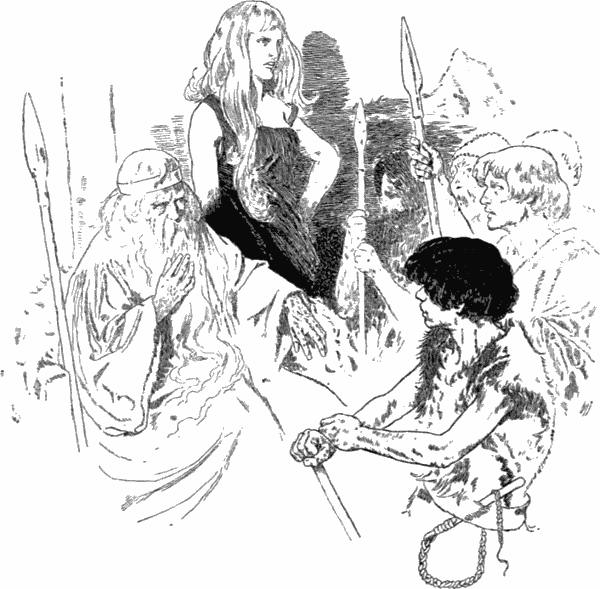
The maiden gazed earnestly at one and another.
First of all, Vijelia had to stand through a whole day, without meat or drink, in the burning sun. If she showed any weakness or weariness, or ate and drank too greedily when evening came, she could not be king.
The second day she was to collect a mighty heap of stones from a certain river in the depths of the valley, and would have to perform her journey countless times before she could get together the requisite number of stones, which, on the third day, were to be cast at her. If her endurance failed beneath the stoning, she could not be king.
The oldest man of the tribe explained all this to her, and she listened to him with a cheerful face.
The day came—a burning hot July day—and at sunrise Vijelia, clad in a snowy woollen robe, took her stand upon a neighbouring hill-top. For the first few hours she sang, as she stood there, in a full and ringing voice; but as noon drew on, her lips and throat grew so dry, she was fain to keep silence. The sun had already passed over the highest of the mountain-peaks before she even changed her weight from one foot to the other. Suddenly she heard the sound of hoofs ascending towards her, and lo! her stags appeared, and, flying around her, fanned her with a cool breeze from their wings; then her favourite hind drew near, offering her full udders for her mistress to drink from. But Vijelia, with stern voice, bade them all depart, and with drooping heads the faithful creatures slank away to their pasture.
The hours crept slowly on, and the sun burnt so hot that the tips of Vijelia’s golden locks were singed by it. But she did not stir.
When the sun was setting the men came and offered her a drink of water, but she only moistened her lips with it, and called, “Mititica!” Then the winged hind came flying up, and she took a little milk from her, refusing all other nourishment.
King Briar gazed with anxious eyes at his beautiful daughter, but she gave him a merry laugh, and said the first day had passed quickly and easily indeed. When the darkness fell she went down to the river, and plunged as many as ten times into its cool depths. Then she climbed the bank, and sitting upon a mossy stone, began to shake out the coils of her hair. The moon rose over the mountain-top and looked down upon the maiden sitting there in her heavenly beauty, and tenderly did she shed her beams upon her, so that the drops that were wrung from the golden coils glittered like silver. The moon did not know that that perfect body was to endure a cruel hail of stones, or she would have veiled her face for very sadness.
When the second day dawned, there stood Vijelia in her short garment, as fresh and cheerful as though no fatigue could ever touch her. When the men came to fetch her down for this day’s work, she was ranging over the hill upon her stag Graur, casting herself down upon his back, and playing with his wings, like a child in the cradle. But now she sprang down and dismissed the creature with a light touch of the hand; then, taking a broad, flat fragment of rock upon her shoulder, she carried it down into the valley, laid it beside the river’s edge, and wading into the water, began to seek for stones, which she piled upon it as high as it would hold.
“Help me up with it on to my shoulder,” said she. But none of the men could lift the weight. Then she bent down, and, laughing, threw it on to her left shoulder. Moreover, she made the men pick up the stones that had slipped off the while, and throw them on to the heap with the rest. Then she set off so fast up the hill that no one could follow her, put down her load, and ran back to the valley again without waiting to rest.
King Briar sat watching his daughter from the heights above, and stroked his white beard in silence.
Long before the day had begun to decline, Vijelia had already collected the prescribed number of stones. She crossed her arms and stood and looked at the heap, without the smallest sign of flinching. King Briar’s heart sank as he watched his child standing there, and he slept but little that night. Yet she slept, quietly and soundly, beneath a giant pine, through the branches of which the moonbeams stole to look at the beautiful sleeper, lying with her head on her arms, her lips slightly parted, in the sweetest, most childlike slumber.
When the dawn aroused her, she sought out a linen garment that she had spun and woven herself, so that she could rely upon its strength.
And thus she appeared before her people, so fair that the heart of many a one burnt within him at the thought of misusing her.
The heap of stones disappeared in a few minutes, for each man had armed himself with one. Now they formed a great circle round the maiden, who quietly gathered her hair up and fastened it in a knot.
“So that ye may not think my mantle shields me,” she explained, with a smile.
The first stone sped from the hand of King Briar himself, who looked his daughter firmly and earnestly in the face as he cast it. She kissed the place on her arm where he had smitten her, and threw him a kiss with both hands. Then she stood as still as a statue beneath the hail of stones, though her anguish grew with every moment. Only once a sigh escaped her, and she crossed her hands for a moment over her breast—and the hands were so white! But she let her arms drop again directly, and only turned her head aside, looking towards the sun, that was slowly, very slowly, sinking nearer to the mountain-top, and bathed the maiden’s face in a golden glow.
On a sudden the rain of stones ceased, and all the men knelt, with lowered swords and lances, at her feet, while in solemn voices they swore faith to her—eternal faith, and never to be broken.
But she raised her hand and spoke:—
“And I swear to you to work, to fight, and to endure, with and for you, to my life’s end!” Then she turned to the King and whispered low to him: “Give me thy hand, father; I am weary.”
The old man cast his mantle round her, and clasping his arm about her, led her homewards. She leaned her head on his shoulder, but as she went she felt something snuffing about her ear, and there was Graur, her faithful stag.
“Ha, do thou carry me!” she cried, and kissing the beast’s warm, downy nose, she sprang on his back and was out of sight in the twinkling of an eye. Graur bore her down to the river, in which she bathed for a long time, stretching and cooling her bruised limbs. She drank greedily, too, of the ice-cold water, and then came dashing homewards as merrily as though she had endured nothing.
For a while life went on again as of old, and Vijelia was once more the same untamed creature that she had ever been—wild as the storm-wind, and refusing to hear aught that concerned the affairs of government. But King Briar aged visibly, and his people besieged him with requests that he would choose a mate for his daughter, so that he might soon hope to hold a fair grandson upon his knee.
“Whom wilt thou have for thy husband, my child?” he one day asked his daughter. “Do none of our people please thee?”
“Nay,” answered Vijelia, “I cannot wed any of those who stoned me; I should always remember it, and could not give myself to him in true love. The man whom I shall love must come down from the air above, into which none belonging to us can rise up—none save our winged stags.”
She had scarcely ceased speaking, when there appeared as it were a mighty cloud, descending from the heavens, and from the midst of the cloud the sound of a harp rang forth unearthly sweet. Slowly the cloud sank earthwards, and now it disclosed to view a radiant youth, his head covered with waving curls, who held in his hand a harp, that towered aloft as high as the forest trees, and was strung with golden strings, that glittered, like a rainbow, with a thousand changing hues. Now he would smite the chords with a powerful hand, and again he would only blow softly upon them, and then they sent forth such sounds as melted the very heart in one’s breast.
Vijelia stood motionless, gazing up at him, and still she gazed on, as he sprang boldly to the ground, and with a thrust of his hand sent back the cloud that had brought him thither, away into the blue distance above. And now he came straight toward the maiden, and stretching out his hands to her, spoke thus:—
“I come from out the air; I am Viscol.[5] Wilt thou be mine, for I am thine equal?”
“Yea,” answered the maiden, as though in a dream. “I will be thine, for all time.”
But King Briar frowned, saying:
“And dost thou, indeed, love him already, my child? Have a care; for thou wilt not find happiness at his side, and he is not fitted for our people; he will ever be ranging far away over the skies and leaving thee alone, till thy men will refuse to serve thee. Child, child, it will come to a bad end, and thou wilt not be happy!”
“Happy or not, it is all alike to me, father. I cannot live without him; and I would rather be miserable with him than happy with another!”
With a deep sigh, the old King consented to her wish; but he cut short the promises and protestations of the youth with an impatient gesture of the hand.
“I will judge thee by thine actions,” he said curtly.
At first all went merrily enough; now Vijelia would ride through the heavens upon a cloud, and again, her husband would go forth with the flying stags. But the King often heard his men complain that there was much unrest in the land, and that the stranger had better never have come.
Presently, however, Vijelia began to stay much at home with her father, while her husband went rushing over the world. She spoke very little, and looked far sadder than she had done upon the day of her stoning. When she was asked where her husband was, she would hang her head and answer, “I know not;” or again, if inquiry were made when he was coming back, or when he would carry her forth with him upon the clouds, still the answer was, “I know not.”
And when he did return he was rough and violent, and the more humbly and quietly his young wife behaved, the more hardly he treated her.
Often did old King Briar’s beard tremble and his head droop toward the earth, whereon, indeed, he soon laid him down, saying:
“I shall never see my fair grandson now! May the Great Spirit grant thee, in him, the happiness thou hast not found for thyself!”
When he was dead, his men mourned night and day with lowered spears around his grave, for nine times nine weeks. And Vijelia did not cease from sighs and groans, until, in the midst of her great sorrow, a wondrous fair but exceeding tender little son was laid in her arms. Her tears rained down upon his tiny face as she gave him the name of Zephyr. Alas! how was he ever to rule this mighty people, and how withstand his father’s harsh usage?
She held him in her arms night and day, and never left him for an hour. He lay upon her lap when she sat and pronounced sentence, or tried to smooth over quarrels with all justice and wisdom.
When Viscol returned his anger knew no bounds. She had to defend the fragile child like a lioness, for he would fain have dashed him to pieces against a rock. He threw the whole land into an uproar; he gave unjust judgments, and was a scourge indeed, until he dashed forth again upon his wanderings. His harp, which he had forgotten, was, however, a source of consolation and joy both to mother and child. She learnt to play dirges upon it, to which all the people listened; but it was sweeter yet when Zephyr breathed across the strings—then the whole air seemed to be swelling with song, and the heart in every bosom melted for delight.
Zephyr grew dazzlingly beautiful, all the more so since his mother thought much of training and hardening him against the time of the “King-choosing,” which she dreaded exceedingly for her tender boy. She would trust him now to Graur, now to Mititica, who had to carry him for hours, and use him to their quickest pace. But in the midst of these rides Mititica would often kneel down and suffer him to suck a draught of her milk. Vijelia, too, would run races with the boy, and teach him to bend the bow and to bear heavy burdens; and, that he might become used to pain, she would smite him with rods and pelt him with stones, and if he did not laugh over it, but began to weep, she would call him coward, and after bathing him in the coldest streams, would strike him the next day yet harder, till he learnt to clench his teeth and laugh.
The people had such a hatred of Viscol that they would suffer him to enter the land no more, and shot at him as soon as he drew near upon his cloud. Some of them loved the boy for his noble mother’s sake, but some bore a grudge against him, because he was so delicate and tender. But when he played upon his harp all were enchanted, and, indeed, when he stood beside the harp, his silky golden curls falling upon his shoulders, he looked like a being from another world. He could not, it is true, drive five stags at once, or bear such burdens as his mother could; but he was far stronger than she had ever dared to hope, when he reached his sixteenth year, and the men judged it was time to try him and see if he were strong enough to be king. If it should chance otherwise, they were ready to force upon Vijelia another husband, chosen from amongst them, whose son might be expected to prove a stalwart king.
Zephyr bore the heat of the sun the whole day without flinching, and no one knew that all through the ensuing night he tossed to and fro in fever, while his mother watched beside him and bathed his temples. The next day he gathered the stones together, and his mother went beside him all the while, and secretly lent a helping hand. When evening came and the darkness covered them, he sank fainting into her arms. And now dawned the day, of which the unhappy mother stood in such dread. Every stone that struck her boy’s fair body smote her in the heart. Once she saw him reel, but her clear voice, ringing out in cheery encouragement, brought back the colour to his cheeks and the smile to his white lips. There were only a few more stones yet to come, when one, cast by a spiteful hand, sped forth, sharp and pointed, and struck the lad upon the temple. A wild cry burst from his mother, who flew to catch her fainting child in her arms, and kneeling down, pressed his blood-stained locks to her heart. He opened his eyes once more. “My harp—bring me the harp!” he whispered, and clasping it in his arms, he breathed out his pure soul into those chords, till the heavenly sound echoed on and on, vibrating ever further upon the air. But the poor mother rose up with fixed and terrible gaze, and lifting her arms to the clouds, she cried, “May ye then turn to stone, O ye men of stone! The Great Spirit will hear a mother’s voice, that cries aloud for vengeance! Stone shall ye become, who have broken faith with me! Stone shall ye become, who have cast out the purest spirit among you!”
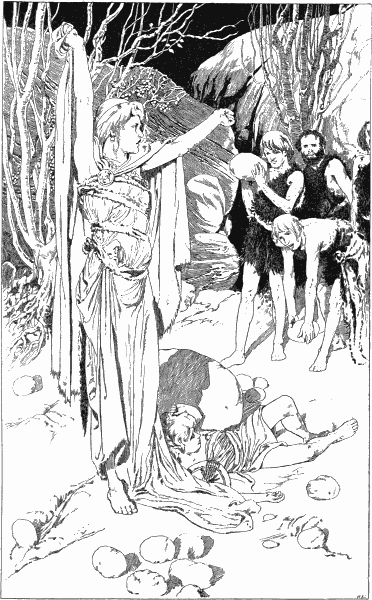
But the poor mother rose up with fixed and terrible gaze, and lifting her arms to the clouds, she cried, “May ye then turn to stone!”
And behold! before her eyes the people, as they stood in a circle, were turned to stone. But she sighed so deeply that the sighs burst her bosom, and went forth in wails of sorrow to tell the world of a mother’s woe, and to shake the foundations of the world, that had wrought such evil!
And the winged stags rose up into the air and disappeared for ever.