IX RÎUL DOAMNEI (“THE RIVER OF THE PRINCESS”)
Reading edition
Not far from the pretty little mountain-town of Câmpa Lungo, a clear, cool stream winds along, called Rîul Doamnei—“the river of the Princess.” This stream washes down gold along its bed, sometimes a bit half the size of one’s nail; and it was a custom in times gone by that all the gold found there should belong to the Princess, the wife of the ruler of the land. And this is the reason why:—
There was once a great famine in the land of Roumania, such a famine as had never been known in the memory of man. First the locusts had come into the land, in such swarms that the sun was darkened, and wherever they settled they devastated everything, so that in a few minutes the fairest field of corn would be left bald as a threshing-floor, and the trees, stripped of every leaf, stretched out their naked boughs against the summer sky, beneath whose cloudless blue the heat grew ever greater and greater, so that even at night there was no longer a breath of coolness in the air. As soon as all things around were devoured, the cloud of locusts would arise, only to settle instantly again upon the next green patch. And so it went on unceasingly; and in those days folk were not so clever as they are now, when they cover the great stretches of land where the insects have settled, with petroleum, and set it all on fire. Nor were there then any cannon with which they could shoot into the swarm of flying locusts, as they do now, and so sometimes contrive to scatter them.
After the locusts came the Poles from the North, the Hungarians from the West, and the Turks from the South, and fell upon the land, and by them all the houses were burnt and the cattle stolen away. At last these foes, too, quitted the country, but they left behind them fever and pestilence, both among man and beast.
Men went about with blackened lips, and grievous sores on their bodies. The cattle perished together in heaps on the barren fields, where not a single blade of grass was standing. Only the dogs and the ravens were in good case; they tore the flesh from the bones of the dead creatures, and for miles around nothing was to be seen but white bones with red flesh hanging to them, and millions of flies, that shone with gorgeous prismatic colours, settling upon them.
The air quivered with heat, and pestilential odours spread far over the land, so that men were stricken as with a plague, and died in a few hours.
Complaints were heard no longer, for dull despair had reduced all men to silence; and when the starving people tore one another to pieces, no one even told of it.
The bells rang no more; there was no keeping Sundays or holidays, nor was there any work done, for no one had any oxen for the ploughing, or any seeds to sow.
Men crept about like ghosts, with their bones staring through the skin, their lips drawn back so that the teeth lay bare, and only a few rags upon their bodies. There was hardly any one found to bury the dead, and many remained lying, like the cattle, upon the fields.
The beautiful Princess Irina felt her heart breaking for pity. She had given away all her jewels for the poor; she had spent her last coin to buy cattle for the peasants, but they had all been slain by the plague as soon as purchased. She had fed the hungry, till she had scarcely enough left to feed her own four little children. She stood at her window wringing her hands in despair, and prayed thus:
“O good God! hast Thou, then, quite forsaken me? Wilt Thou bring our poor land to destruction? Have we sinned yet more, that we must endure such searchings-out of Thy wrath?”
Then a soft, cool breath stole in, bearing a perfume as from the most beautiful of gardens, and a silvery voice spoke:
“Help shall arise for thee out of a river. Only seek.”
Then she went to the Prince, her husband, and to her children, and bade them farewell, promising soon to return, and saying she now knew where to seek for that which should free them all from their misery. She spoke with such cheerful assurance that it brought trust and hope to every man, for she never told them that she did not even know what she was to seek.
Then, through the burning summer heat, she began a weary pilgrimage toward the rivers. Sometimes she would still chance upon a poor, starved little horse, that would carry her a short distance, and then fall down dead, even beneath her light weight. She went up the Olto river, the Gin, the Buzlu, the Sereth, all the rivers, both great and small. They flowed but meagrely over their stony beds, and those once mighty waters scarcely whispered as they went, they that of old were wont to rush and roar.
“Merciful God!” prayed the Princess, “let but a little cloud appear when I have found the river that is to help us!” But there arose no cloud. She was wandering for a second time up the banks of the Argesch, and was just about to turn sadly back, when she caught sight of the mouth of a little stream that she had not noticed before. She turned her steps hesitatingly in that direction, her heart growing heavier and heavier as she saw the stream grow smaller and more insignificant.
Wearied by her hard journey over the stones, she stood still a moment and sighed: “I can find nothing, nothing at all, and perchance my children are starving and dying! Perhaps my thought was but a foolish one—a cobweb of the brain, a lying fancy!” Even as she spoke a shadow seemed to fall upon her. She thought it was only caused by the tears which for the first time were filling her large, wan eyes. She wiped them off. Nay, there was indeed a shadow lying over the treeless waste; and when she raised her eyes, lo! the sun had hidden itself behind a tiny cloud, that yet was growing slowly larger.
Irina began to tremble for joy, that yet was mingled with dread. Had God heard her, or was it only another mistake? “Dear God,” she prayed again, “if this be the river, suffer the cloud to become larger and the rain to fall, for rain alone would be a blessing, and a great help to us in our need.” She went on a little—yes, the cloud was growing larger; she hurried forward, she ran, till she grew too weak to go farther; then a few great, heavy drops began to fall. She drank them in, with lips and eyes, with hands and hair. Now a light patter and plashing began round about her, and all at once a perfect waterspout broke forth. She struggled on in the wet loam of the river-bed as well as she could, till the stream began to swell, and dashed by in a brown, foaming flood, like a broad river. Sometimes she was forced to stand still and seek for her path, but yet she went on and on, for fear the rain should leave off. It rained all day and all night. The Princess was so wet that a stream flowed from her garments. But she wrung them out, girt them up higher, and still went on, for one whole day and night longer. Now she had reached the mountains, and often fell to the ground from exhaustion after her long journey. At last she lay down upon the river-bank and fell asleep, while the rain streamed down upon her, and the river rose higher and higher, as though it would have snatched her down and floated her away.
She awoke trembling with cold. There stood the gleaming sun, looking as fresh in the bright morning air as if he had had a bath himself. And behold! the river was no longer brown, but clear and blue as the air, and at the bottom of the water something shone and glittered like the sunbeams themselves. Irina again girt up her garments and waded in—she must see what it was that shone with so wondrous a gleam. And lo! it was pure gold. She fell on her knees, there in the stream, and gave God thanks, aloud and earnestly. Gold! gold! Now she could help! She went carefully on through the water and gathered up the golden grains and little fragments, filling her mantle with them, till the burden was almost too heavy for her. And now she hurried home with her treasure, and poured it out before her husband. Her children were yet alive, though weak and sorely exhausted; and they scarcely knew her again, she was so emaciated and sunburnt. Yet now messengers went forth into distant lands and bought corn, maize and hay, seeds and cattle; and the river never grew weary of giving till the famine was at an end, and laughing green, and sleek cattle, covered the Roumanian meadows once more. And the thankful people called the river Rîul Doamnei, and no one was to touch any of the gold therein, to possess it, save the Princess of the land.
But the Princesses who came after this one, no doubt made a less good use of their riches, for the river has become more niggardly, and the gold that the peasants still find in it now and then, is saved up for exhibition in the State Museum.
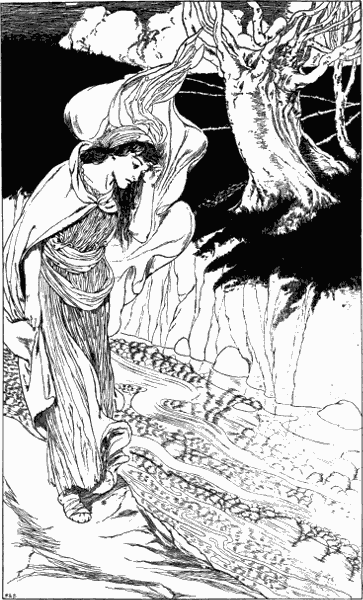
And behold! the river was no longer brown, but clean and blue as the air.