Chapter XI · : Moorish Romances of Spain
Reading edition
These are, of course, more of the nature of romances of the Moors than by the Moors—tales embedded in Spanish folk-lore relating to Saracen times and themes, rather than written fictions existing in ancient Arab manuscripts. The Arab literature of Spain was rather didactic, theological, and philosophical than romantic. Fiction was, perhaps, the province of the itinerant story-teller, as it still is in the East. But that many Moorish legends and stories were handed down among the Spanish peasantry, especially in the more southerly parts of the Peninsula, can hardly be doubted. These, however, have been much neglected by compilers, and but few of them are available. Such as exist in written form make up for their scantiness in number by the qualities of wonder and beauty which inform them. Perhaps no collection of the traditions of the Moors of Spain equals that of Washington Irving in his Tales of the Alhambra. These, he tells us, he “diligently wrought into shape and form, from various legendary scraps and hints picked up in the course of my perambulations, in the same manner that an antiquary works out a regular historical document from a few scattered letters of an almost defaced inscription.” The first of our Moorish legends, therefore, I shall retell from the enchanted pages of the great American wizard in words, apologizing to his shade for the alterations in verbiage which I have been forced to make in view of the requirements of modern readers. I have, indeed, entirely recast the tale for twentieth-century use.
The Arabian Astrologer
Aben Habuz, King of Granada, had in his old age earned the right to repose. But the young and ardent princes whose territories marched with his were in no mind that his old age should be free from the alarms of war, and although he took every precaution to ensure his possessions against the incursions of such hotheads, the constant menace of an attack from one or other of them, no less than the unrest which occasionally raised its head within his own dominions, filled his declining years with irritation and anxiety.
Harassed and perplexed, he cast about him for an adviser capable of assisting him to strengthen his position, but among the sages and nobles of his Court he experienced such a cold selfishness and lack of patriotic fervour as restrained him from adopting any of them as his confidant in high affairs of state. While he meditated upon his friendless condition it was announced to him that an Arabian sage had arrived in Granada, whose fame as a man of wisdom and understanding was proverbial throughout the East. The name of this pundit was Ibrahim Ebn Abu Ajib, and it was whispered of him that he had existed since the days of Mohammed, of one of whose personal friends he was the son. As a child he had accompanied the army of Amru, the Prophet’s general, into Egypt, where he had remained for generations, employing his time in the study of those occult sciences of which the Egyptian priests were such consummate masters. Old as he was—and his appearance was most venerable—he had walked the whole way from Egypt on foot, aided only by a staff, on which were engraved hieroglyphs of deep and hidden import. His beard descended to his girdle, his piercing eyes bespoke insight and intelligence almost superhuman, and his bearing was more grave and majestic than that of the most reverend mullah in Granada. It was said that he possessed the secret of the elixir of life, but as he had attained this knowledge when already well on in years, he had perforce to be content with his aged exterior, although he had already succeeded in prolonging his existence for upward of two hundred years.
King Aben Habuz, gratified at being able to extend his hospitality to a visitor of such consequence, entertained him with marked distinction. But the sage refused all his offers of soft living, and established himself in a cave in the side of the hill on which the famous palace of the Alhambra was later to be erected. This cavern he caused to be altered in such a manner that it bore a resemblance to the interiors of those lofty temples of the Egyptian land in which he had passed so many years of his long life. Through the living rock which formed its roof he commanded the Court architect to drive a deep shaft, so that from the gloom of his cavernous abode he might be able to behold the stars even at midday; for Ibrahim was pre-eminent in the study of that lore of the heavenly bodies, that thrice noble science of astrology, which the truly wise of all ages have recognized as the real source of all divine knowledge, and the shallow erudition of a later day foolishly despises. But only for a day in the round of eternity shall that great and golden book be set aside; nor shall its pages, arabesqued with mysterious and awful characters, ever be wholly closed to man. The weird, serpentine script of this language of the sages ornamented the walls of the astrologer’s cavern, interspersed with the no less mystic symbols of ancient Egypt, and, surrounded by these hieroglyphs and provided with the primitive telescope we have described, the wise Ibrahim busied himself in deciphering the history of events to come as written in the glittering pages of the heavens.
It was only natural that the distressed Aben Habuz should avail himself of the wisdom and foresight of the astrologer to the fullest degree. Indeed, Ibrahim became indispensable to him, and was consulted in every emergency. He responded graciously, and placed his marvellous gifts entirely at the service of the harassed monarch. On one occasion Aben Habuz complained bitterly of the constant vigilance he was forced to maintain against the attacks of his restless neighbours. For a space the astrologer was lost in thought. Then he replied: “O King, many years since I beheld a marvel in Egypt, wrought by a wise priestess of that land. Above the city of Borsa towers a lofty mountain, on which was placed the image of a ram, and above it the figure of a cock, both cast in brazen effigy and turning upon a pivot. Should the land be threatened by invasion the ram would turn in the direction of the enemy and the cock would crow, and by this means the inhabitants of Borsa were enabled to take timely measures for defence.”
“Would that such a contrivance might be erected at Granada,” said the King fervently. “Then might we rest in peace.”
The astrologer smiled at the King’s earnestness. “I have already told you, O King,” he said, “that I have spent many years in Egypt mastering the hidden knowledge of that mysterious land. One day while seated on the banks of the Nile speaking with a priest of that country, my companion pointed to the mighty pyramids which cast their shadows on the place where we reclined. ‘My son,’ remarked the sage, ‘thou beholdest these mountains in stone, the memorials of kings who died while Greece was yet in the cradle and Rome was unthought of; all the lore that we can teach thee is as a drop of water to the ocean compared with the secrets contained in those monuments. In the heart of the Great Pyramid is a death-chamber where rests the mummy of the high priest who designed and builded that stupendous pile. On his breast lies a wondrous book containing magical secrets of great potency—that book, indeed, which was given to Adam after the fall and by the aid of which Solomon built the temple at Jerusalem.’ From the moment I heard those words, O King, I might not rest. I resolved to find my way into the Great Pyramid and possess myself of the magic volume. Collecting a number of the soldiers of the victorious Amru and many of the native Egyptians, I addressed myself to the task of piercing the solid masonry which concealed this ineffable treasure, until, after unheard-of labours, I came upon one of its hidden passages. Long time I searched in the labyrinths of the vasty pyramid ere I arrived at the sepulchral chamber. At length, groping in profound darkness, and haunted by the rustling of the wrappings of mummied Pharaohs, I came upon the shrine where the corpse of the high priest lay in grim state. I opened the sarcophagus, and, unwrapping the voluminous bandages, found the mystic tome lying among spices and amulets on the shrivelled breast. Seizing it, I hastened through the black corridors, nor stayed until I beheld the fierce Egyptian day and the friendly green of the languid river.”
“But in what manner may all this assist me in my dilemma, O son of Abu Ajib?” asked the King querulously.
“This have I told thee, O King, because by the aid of this book most magical I can call to my assistance the spirits of earth and air—jinns, and afreets, and peris—by whose help I shall construct a talisman like that which surmounted the hill above Borsa.”
The astrologer was as good as his word. With all the resources of the kingdom at his command, he built a great tower on the steeps of the hill of Albayan. At his words of power spirits conveyed great stones from the pyramids of Egypt, and of these the edifice was built. In the summit of this tower he made a circular hall with windows looking toward every point of the compass, and before each window he set a table on which was arranged, as on a chessboard, a mimic army of horse and foot, with the effigy of the potentate who ruled in that direction, carved out of wood. Along with each table there was a small lance engraved with magical characters. And this hall he closed with a gate of brass, the key of which was kept by the King. Surmounting the tower was a figure of a Moorish horseman cast in bronze and fixed on a revolving pivot. He bore a shield and spear, the latter held perpendicularly. This image looked toward the city, but when a foeman approached it the horseman would face in his direction and would level the lance as if about to charge.
Now, averse as Aben Habuz had been to war, he was all impatience to test the virtues of this talisman. He had not long to wait, for one morning he was informed that the face of the bronze horseman was turned toward the mountains of Elvira, and that his lance was directed against the pass of Lope. The trumpets were at once commanded to sound the alarm, but Ibrahim requested the King not to disturb the city nor call his troops together, but only to follow him to the secret hall in the tower.
When they entered they found the window overlooking the pass of Lope wide open. “Now, O King,” said the astrologer, “behold the mystery of the table.” Aben Habuz looked at the table covered with tiny effigies of horse- and foot-soldiers, and to his astonishment saw that they were all in motion, that the warriors brandished their weapons, and the steeds neighed, but these sounds were no louder than the hum which rises from a beehive.
“Your Majesty,” said the astrologer, “if you desire to cause panic and confusion among your enemies, you have only to strike with the butt of the magic lance; but if you wish to bring death and destruction among them, then strike with the point.”
Aben Habuz, seizing the tiny lance, thrust it into some of the figures, belabouring others with the butt. The former dropped upon the board as dead, and the rest fell upon one another in confusion. Scouts sent to confirm the destruction caused among the real invaders told how a Christian army had advanced through the pass of Lope, but had turned their weapons upon one another and had retreated across the border in great confusion.
Delighted, the King requested Ibrahim to name his own reward. “My wants are few,” replied the astrologer; “if my cave be fitted up as a suitable abode for a philosopher, I crave no more.”
Surprised at his moderation, the King summoned his treasurer and commanded him to take a note of the astrologer’s requirements. The sage desired that an entire suite of apartments should be hewn out of the solid rock, and this having been done, he caused them to be furnished with the most lavish magnificence. Princely ottomans and magnificent divans filled every corner, and the damp walls were hung with the luxurious silks of Damascus, while the rocky floors were carpeted with the glowing fabrics of Ispahan. Seductive baths were constructed, and provided with every kind of Oriental perfume. The apartments were hung with innumerable silver and crystal lamps, which Ibrahim filled with a fragrant and magical oil, which burned perpetually and could not be exhausted.
Amazed at the profligacy of the astrologer, the treasurer made complaint of it to the King, but as his Majesty had passed his word to the sage and had, indeed, invited his extravagance, he could not interfere, and could only hope that the furnishing of the cavern would soon come to an end. When at last the hermitage was replete with the luxuries of three continents, the treasurer inquired of the astrologer if he was satisfied.
“I have only one small request more to make,” replied the sage. “I desire that several dancing women be provided for my amusement.”
The treasurer, rather scandalized, carried out the sage’s instructions, as he was bound to do, and Ibrahim, having all his wants supplied, enclosed himself in his retreat. Meanwhile the King occupied himself in the tower with mimic battles, and as the hand of the astrologer was not there to moderate his warlike propensities, he amused himself by scattering armies like chaff and smashing whole battalions by a stroke of the magic lance. His enemies, terrified at the fate of such expeditions as approached his territory, ceased to trouble him, and for many months the bronze horseman remained stationary. Robbed of his amusement, Aben Habuz pined and grew peevish. But one glorious morning news was brought him that the bronze cavalier had lowered his lance toward the mountains of Guadix.
The King at once repaired to the tower, but the magic table placed in the direction indicated by the horseman was placid. Not a mimic warrior stirred, not a toy charger neighed. Perplexed, Aben Habuz dispatched a scouting party, which returned after three days’ absence to report that they had encountered no warlike array, nothing more formidable, indeed, than a beauteous Christian damsel, whom they had found sleeping by a fountain, and made captive.
Aben Habuz commanded that the damsel should be brought to him. Her stately bearing and the lavish ornaments she wore bespoke her of exalted station. In answer to the King, she explained that she was the daughter of a Gothic prince, whose armies had been destroyed in the mountains as if by magic.
“Beware of this woman, O King,” whispered the astrologer, who stood by. “Methinks she is a sorceress who has been sent hither to work evil upon thee. Beware, I say.”
“Tush, Ibrahim,” replied Aben Habuz, “thou art a wise man enow, but little versed in the ways of women. Which of them, pray, is not a sorceress? The damsel finds favour in mine eyes.”
“O King,” said Ibrahim, “many victories have I given thee, but of all the spoil thou hast won I have received nothing. Give me then this Christian captive, who, I see, carries a silver lyre, and who will make sweet music for me in my retreat below ground. If she be a sorceress, as I suspect, I have spells that will render her harmless. But as for thee, she will speedily overcome thee if thou takest her into thy house.”
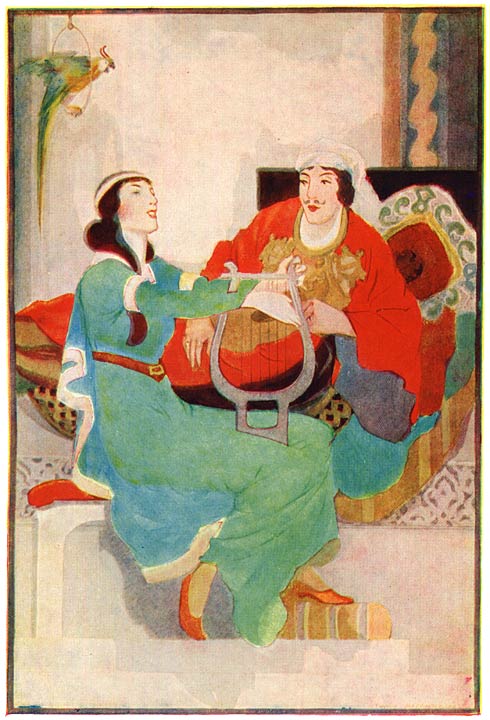
Aben Habuz and the Captive Princess
“What?” cried the incensed monarch. “By the beard of the Prophet, thou art a strange hermit indeed! Know that this damsel is not for thee.”
“So be it,” said the sage, in wavering tones. “But I fear for thee, royal Aben Habuz. Beware, I say to thee again, beware!” And the astrologer retired to his subterranean abode.
Now Aben Habuz had fallen over head and ears in love with the fair daughter of the Goths, and in his desire to please her strained the resources of his kingdom to their utmost limits. He lavished upon her all that was most exquisite and most magnificent in his storehouses and treasuries. He devised for her pastime a hundred spectacles and festivities, pageants, bull-fights, and tournaments. All these the haughty beauty took quite as a matter of course. Indeed it almost seemed as if she urged the infatuated monarch to greater extravagance and more lavish expenditure. But no matter how profuse was his bounty, she refused to listen to a single amorous word from the lips of Aben Habuz, and whenever he essayed to speak his love she swept her fingers across the strings of her silver lyre and smiled enigmatically. When she acted thus the King invariably felt a drowsiness steal over his senses, and as the dulcet sound gained ascendancy over him he would sink into a sleep from which he usually awoke refreshed and reinvigorated.
His subjects were, however, by no means so satisfied with this condition of affairs as he was. Irritated by his profligate expenditure, and virtual enslavement by a woman of hostile race, they at length broke into open revolt. But, like Sardanapalus of Babylon, he roused himself from silken dalliance and, putting himself at the head of his guards, crushed the outbreak almost before it had come to a head. The episode disquieted him, however, and he recalled the words of the wise Ibrahim, how that the Gothic princess would bring him woe.
He sought the astrologer in his cavern, and requested his advice. Ibrahim assured him that his position would be insecure so long as the princess remained one of his household. To this Aben Habuz refused to listen, and begged the sage to find him some retreat where he might pass the remainder of his days in tranquillity along with the princess of whom he was so deeply enamoured.
“And my reward if I can procure thee such a retreat?” asked Ibrahim.
“That thou shalt name thyself, O Ibrahim,” replied the infatuated old man.
“Thou hast heard of the garden of Irem, O King, that jewel of Arabia?”
“Aye, in fable. Dost thou mock me, astrologer?”
“No more than these eyes have mocked me, O King, for I myself have beheld that most delectable of all paradises.
“As a youth I stumbled upon it when searching for my father’s camels. Once the country of the Addites, its capital was founded by Sheddad, son of Ad, great-grandson of Noah, who determined to build in it a palace surrounded by gardens that should rival Paradise itself. But the curse of heaven fell upon him for his presumption. He and his subjects were swept from the earth, and his palace and gardens were laid under an enchantment that hides them from human sight. When I had recovered the book of Solomon I revisited the garden of Irem, and wrung from the jinns who guard it the secret of the spells which render it invisible to mortal sight. By virtue of these spells I can rear for thee, O King, such a retreat even here on the mountain above thy city.”
“O wise philosopher!” cried Aben Habuz, “ill was it of me to doubt thee. Do as thou dost promise, and name thy reward.”
“All the reward I ask is the first beast of burden with its load that shall enter the gate of thy paradise,” said Ibrahim; “a moderate request, surely.”
“Moderate indeed!” cried the King, transported by the thought of joys to come, “and I grant it immediately.”
The astrologer at once set to work. On the summit of the hill above his cavern he built a strong tower pierced by a great gateway, and on the keystone of this portal he wrought the figure of a great key. The gateway had also an outer guard, on which he engraved a gigantic hand. Then on a night of unexampled darkness he ascended the hill and wrought many incantations. In the morning he sought Aben Habuz and intimated that his labours were at an end, and that the paradise which should be invisible to all save him and his beloved awaited him.
On the following morning the King, accompanied by the princess, ascended the hill, the latter riding on a white palfrey. Beside them stalked the astrologer, assisted by his hieroglyph-covered staff. They came to the arch, and the sage pointed out the mystic hand and key. “No mortal power can prevail against the lord of this paradise,” he said, “until yonder hand shall seize that key.”
As he spoke the princess on her palfrey passed through the portal.
“Behold!” cried the astrologer. “Did we not agree that the first animal with its burden which should pass through the magic gateway should be mine?”
Aben Habuz smiled at first at what he regarded as a humorous sally on the part of the sage; but when he discovered him to be in earnest he waxed wroth.
“Presumptuous astrologer!” he cried. “Dare you raise your thoughts to her whom I have chosen from among many women?”
“Thy royal word is pledged,” replied Ibrahim. “I claim the princess in virtue of thine oath.”
“Dog of the desert!” cried Aben Habuz. “Thou shalt feel the weight of my anger for this, juggler though thou art.”
“I laugh at thee, Aben Habuz,” cried Ibrahim derisively. “Mortal hand cannot harm me. Farewell. Remain in thy fool’s paradise and continue to reign over thy province. As for me, I go where thou canst not follow me.” And with these words he seized the bridle of the palfrey, smote the earth with his magic staff, and sank with the princess through the centre of the barbican. The earth closed over them, and left not a trace of the aperture through which they had disappeared.
When Aben Habuz recovered from his astonishment he ordered gangs of workmen to be brought to the spot, and commanded them to dig. But the earth seemed to fill in as fast as they threw it out. The opening of the astrologer’s cavern too had disappeared. Worse still, the talismans by which the astrologer had secured peace to Granada refused to work, and the old unrest recommenced.
But one morning a peasant came before Aben Habuz and told him that while wandering on the hill he had found a fissure in the rock through which he had crept until he had looked down into a subterranean hall, in which sat the astrologer on a magnificent divan, dozing, while the princess played to him on her silver lyre. The distracted monarch failed, however, to find the fissure. Nor could he enter the paradise built by his rival. The summit of the hill appeared a naked waste, and received the name of ‘the Fool’s Paradise.’ The remainder of the wretched King’s life was made a burden to him by the inroads of his warlike neighbours.
Such is the story of the hill of the Alhambra, the palace on which almost realizes the fabled delights of the garden of Irem. The enchanted gateway still exists entire, and is now known as the Gate of Justice. Under that gateway, it is said, the old astrologer remains in his subterranean hall, lulled to constant slumber by the silver lyre of the princess. They are, indeed, each other’s captives, and will remain so until the magic key shall be grasped by the magic hand and the spell which lies upon this enchanted hill be dissolved.
Cleomades and Claremond
The wonderful tale of Cleomades and Claremond is almost certainly of Moorish origin in a secondary sense. In his preface to Adenès’ Berte aux grans Piés (Paris, 1832), M. Paulin Paris says: “I am strongly inclined to believe that the original of the fiction of Cleomades is really Spanish or Moorish. All the personages are Saracens or Spaniards; the scene is in Spain; the character of the fiction is akin to that of the fictions of the East.” Keightley believed that Blanche of Castile, the wife of Louis VIII of France, had heard the tale in Spain, and had narrated it to the French poet Adenès, who cast it into literary form.
Ectriva, Queen of Southern Spain, held a great tournament at Seville, at which Marchabias, Prince of Sardinia, so distinguished himself as to win her heart. She bestowed her hand upon the youthful champion, and their union was a happy one, being blessed in time with three daughters and a son. To the boy they gave the name of Cleomades, while his sisters were called Melior, Soliadis, and Maxima.
Cleomades was dispatched upon his travels at an early age. But after he had visited several foreign countries he was summoned home to be present at the wedding of his sisters, who were about to be married to three great princes, all of whom were famous as practitioners of the magic art. They were Melicandus, King of Barbary; Bardagans, King of Armenia; and Croppart, King of Hungary. The last-named monarch was so unfortunate as to be a hunchback, and to his deformity he added a bitter tongue and a wicked heart.
The three monarchs had encountered one another while still some distance from Seville, and had agreed to give such presents to the King and Queen as would necessitate a gift in return. Melicandus presented the royal pair with the golden image of a man, holding in his right hand a trumpet of the same metal, which he sounded if treason came near him. Bardagans gave a hen and six chickens of gold, so skilfully made that they picked up grain and seemed to be alive. Every third day the hen laid an egg of pearl. Croppart gave a large wooden horse magnificently caparisoned, which he told his hosts could travel over land and sea at the rate of fifty leagues an hour.
The King and Queen, generous to a fault, invited the strangers to ask anything that it was in their power to bestow. Melicandus requested the hand of the Princess Melior, Bardagans that of Soliadis, while Croppart demanded that Maxima should be given him as a consort. The two elder sisters were pleased with their suitors, who were both handsome and amiable, but when Maxima beheld the hideous and deformed Croppart she ran to her brother Cleomades and begged him to deliver her from such an unsightly monster.
Cleomades represented to his father the wrong done by him in consenting to such a match. But Croppart insisted that the King’s word had been passed and that he could not retire from his promise. Cleomades, casting about for an argument, told the Hungarian king that the value of the gifts of Melicandus and Bardagans had been proved, but that, so far as any one knew, his story about the wooden horse might be a mere fable. Croppart offered to test the capacity of his wooden steed. At this the golden man blew his trumpet loudly, but all were so interested in the proposed trial that no one noticed it. The prince mounted the gaudily harnessed hobby, and at the request of Croppart turned a pin of steel in its head, and was immediately carried into the air with such velocity that in a few moments he was lost to sight.
The King and Queen, filled with indignation, had Croppart seized, but he argued that the prince should have waited until he had shown him how to manage the wooden horse. Meanwhile Cleomades sped onward for miles and miles. His strange steed continued to cleave the air at a terrific speed, and at length darkness fell without any signs of its slackening its pace. All night Cleomades continued to fly, and during the hours of gloom had plenty of time to ponder upon his awkward situation. Recollecting that there were pins upon the horse’s shoulders like those upon its head, he resolved to try their effect. He found that by turning one of them to right or left the horse went in either direction, and that when the other was turned the wooden hippogriff slackened speed and descended. Morning now broke, and he saw that he was over a great city. By skilful manipulation of his steed he managed to alight upon a lofty tower which stood in the garden of a great palace.
Descending through a trap-door in the roof, he entered a gorgeous sleeping apartment, and beheld a beautiful lady reclining on a sumptuous couch. At his entrance she awoke, and cried out: “Rash man, how have you presumed to enter this apartment? Are you perchance that King Liopatris to whom my father has affianced me?”
“I am that monarch,” replied Cleomades. “May I not speak with you?” he continued, for on beholding the princess he had at once fallen violently in love with her.
“Retire to the garden,” she said, “and I will come to you there.”
The prince obeyed. In a few moments the princess joined him. But they had not been long together when the lady’s father, King Cornuant of Tuscany, appeared, and at once denounced Cleomades as an impostor, condemning him to death. The prince begged that he might be permitted to meet his fate mounted upon his wooden horse. To this the King assented, and the magical steed was brought. Mounting it, he immediately turned the pin, and rose high in the air, calling out to the princess, as he did so, that he would remain faithful to her.
Shortly he arrived again in Seville, to the immense relief of his parents. Croppart was requested to quit the country. But he had no mind to do so, and in the guise of an Eastern physician remained in the city. The two elder princesses were married to Melicandus and Bardagans. As for Cleomades, he could not forget the beautiful Princess Claremond, and, once more mounting his aery steed, he set off in the direction of her father’s kingdom.
On this occasion he had timed his visit so as to arrive by night at the palace of his lady-love. Alighting in the garden, he made his way to the chamber of Claremond, whom he found fast asleep. He awoke her gently, and told her his name and station, avowed his love, and placed himself at her mercy.
“What!” exclaimed the princess. “Are you indeed that Cleomades whom we regard as the very mirror of knighthood?” The prince assured her that such was the case, and taking from his arm a splendid bracelet containing his mother’s portrait and his own, he presented her with it as an assurance that he spoke truly. The princess confessed her love, and at his entreaty mounted behind him on the magic horse. As they rose, Cleomades beheld the King in the gardens beneath, surrounded by his courtiers. He called to him to fear nothing for his daughter, and, setting the head of his mount toward Seville, sped onward.
Alighting at a small rural palace some distance from the Court, Cleomades left the princess there to recover from her journey, while he proceeded to acquaint his royal parents with the result of his adventure. Claremond, having refreshed herself, was walking in the garden for exercise, as she felt somewhat stiff after her aerial voyage, when, as ill-luck would have it, she was observed by Croppart, who, in the guise of an Indian physician, had entered the garden, ostensibly to cull simples for medicinal purposes, but in reality to spy out the land.
Croppart, seeing his own wooden horse, and hearing the princess murmur the name of Cleomades, speedily formed a plan to carry the damsel off. Approaching her, he offered to take her to Cleomades at once on the back of the enchanted horse, and, fearing no evil, she accepted his offer, and permitted herself to be placed on its back. Croppart immediately turned the pin, and the horse ascended with terrific velocity. At first Claremond was quite unsuspicious of the designs of her abductor, but as time passed her fears were aroused, and, looking down, she beheld, instead of populous cities, only gloomy forests and deserted mountains. She begged Croppart to return with her to the palace garden, but he merely laughed at her entreaties, and at last, worn out with grief and disappointment, she swooned away.
Descending near a fountain, Croppart sprinkled the princess with its water until she revived. Then he acquainted her with his intention to make her Queen of Hungary. But the princess did not lack wit, and told him that she was merely a slave-girl whom Cleomades had purchased from her parents. This intelligence made the ferocious Croppart treat her with even less respect than before, so that to save herself from his violence she consented to wed him at the first city to which they might chance to come.
When he had wrung this promise from Claremond, Croppart, who suffered greatly from thirst, drank deeply of the fountain. So icy cold were its waters that on quaffing them he fell to the ground, almost insensible. Claremond, overcome by fatigue and anxiety, fell fast asleep. In this condition they were discovered by Mendulus, King of Salerno, who at once conceived a strong attachment to the sleeping damsel, and had her conveyed to his palace, where he lodged her in a fair apartment. As for Croppart, so severe was the disorder which he had contracted by drinking of the icy fountain that he expired shortly afterward.
Claremond told King Mendulus that she was only a foundling whose name was Trouvée, and that she had accompanied Croppart, a travelling physician, from one place to another, seeking a precarious livelihood. This did not prevent him, however, from offering her his hand and crown. To save herself from this new danger, Claremond had recourse to feigned madness, and so convincingly did she play her part that Mendulus had perforce to confine her under the charge of ten chosen women, whose duty it was to restrain her.
Meanwhile the Court of Spain was thrown into the utmost confusion. Cleomades, returning to the summer palace with his parents, could find no trace of Claremond, and, overcome with grief, was brought back to the capital in a state bordering upon frenzy. When he recovered he set out for the kingdom of Tuscany in the hope that there he might obtain tidings of his lady. Riding alone, he came to a castle, where he encountered and overthrew two knights who refused to let him pass. From them he learned that when a prince named Liopatris, who had been betrothed to Claremond, arrived at the Court of Tuscany, three of his knights had accused three of Claremond’s maids of honour of being accomplices in the abduction of their mistress. The knights whom Cleomades had worsted were suitors for the hands of two of those ladies, and had challenged their detractors, but as one of them had been wounded by Cleomades, they could not now make good their challenge. Cleomades graciously offered to take the place of the wounded man, and with his unwounded comrade set out for the Court of King Cornuant.
Next morning the combatants appeared in the lists. The three accusers were overthrown, and the maids of honour pronounced innocent, according to the laws of chivalry. Taking the damsels with them, Cleomades and his new brother-in-arms returned to the castle whence they had come, and when he had doffed his armour the prince-errant was recognized by the ladies whom he had helped to rescue. Great was their grief when they learned of the fate of Claremond. But one of them begged Cleomades to seek the assistance of a famous astrologer who dwelt at Salerno, “who saw most secret things right clear.” Cleomades instantly resolved to go and consult this sage, and accordingly next morning he set out for the city of Salerno, after having taken an affectionate leave of the lovers.
Arrived at Salerno, Cleomades put up at an inn, and lost no time in inquiring of the landlord where the astrologer might be found.
“Alas, sir!” said the host, “it is now a year since he passed away. Never did we need him more. For had he been alive, he might have served our King by restoring to reason the most beautiful creature who ever lived.” And he told Cleomades the story of how Mendulus had found the hunchback and the maid. At the mention of the wooden horse Cleomades started, but kept his presence of mind, and assured the innkeeper that he possessed an infallible cure for madness. He begged the man to lead him to the King, and, on the plea that his arms might excite suspicion, donned a false beard and the dress of a physician.
He was at once admitted to the royal presence, and on hearing of his skill the King led him to the place where Claremond was confined. Cleomades had taken with him a glove belonging to his lady-love, which he had stuffed with herbs, and on the pretence that these would cure her he placed it upon her cheek. Seeing her own glove, she regarded the seeming physician earnestly, and succeeded in penetrating his disguise. But, still feigning insanity, she begged that her wooden horse might be brought, so that it could dispute with the learned doctor. It was carried into the garden where they were, and the princess pretended to have a whim that she could only be cured if she and the physician mounted the wooden steed. To this Mendulus consented, and when they bestrode the artificial hippogriff Cleomades turned the pin, and in a moment they rose like an arrow from the bow.
Next morning the happy pair arrived in Seville. Their nuptials were immediately performed, and Liopatris was consoled with Princess Maxima, so that no one was left lamenting.
The Three Beautiful Princesses
Legend tells us that when Mohammed el Haygari, or ‘the Left-handed,’ reigned in Granada he once encountered a train of horsemen riding back from a foray in Christian lands. He observed in the ranks of their captives a beautiful damsel richly attired, and learned that she was the daughter of the commander of a frontier fortress which had been taken and sacked in the course of the expedition. The lady was accompanied by a duenna, and Mohammed ordered that both women should be conveyed to his harem.
Day by day he urged the captive damsel to become his queen. But his faith as well as his age caused her family to reject his advances. In his perplexity he resolved to enlist the good graces of her duenna, who undertook to plead his cause with her young mistress. She told the lady that she was foolish to pine in a beautiful palace, who had henceforth been used only to a dull old frontier castle, and that by marrying Mohammed she could make herself mistress of all she surveyed instead of remaining a captive. At last her arguments prevailed. The Spanish lady consented to unite herself to the Moorish monarch, and even outwardly conformed to his religion, which the duenna also embraced with all the fervour of a proselyte, being re-named Kadiga.
In course of time the Spanish lady presented her lord with three daughters at a single birth. The Court astrologers cast the nativities of the infants, and with many ominous warnings cautioned their father to keep strict guard over them when they arrived at a marriageable age.
Shortly afterward his queen died, and Mohammed, with the astrologers’ warning ringing in his ears, resolved to shut the princesses up in the royal castle of Salobreña, a place of great strength, overlooking the Mediterranean, where he felt certain no harm could come to them.
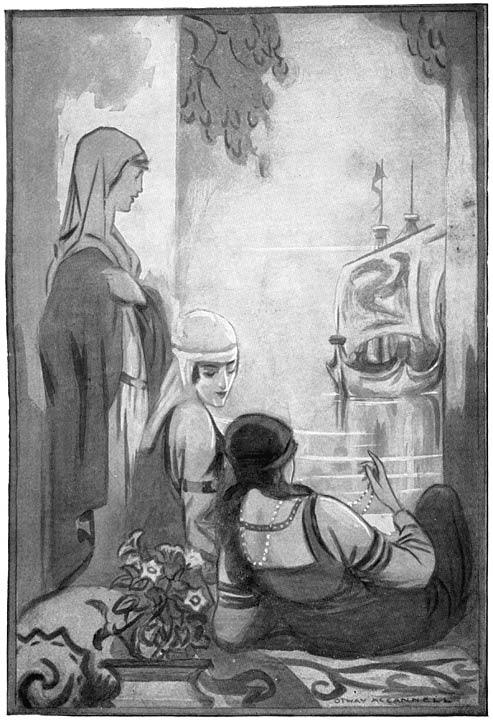
The Three Princesses watch the Approach of the White-sailed Galley
Years passed and at length the princesses became of marriageable age. Although they had been brought up by the discreet Kadiga with the greatest care, and had always been together, their characters were of course very different one from another. Zayda, the eldest, was of an intrepid spirit, and took the lead in everything. Zorayda, the second, had a strong sense of beauty, which probably accounted for the fact that she spent a large portion of her time gazing in the glass, or in the fountain which plashed and sang in the marble court of the castle. Zorahayda, the youngest, was soft and timid, and given to reverie. All three were surpassingly beautiful, and as she gazed upon them the shrewd old Kadiga would shake her head and sigh. When they inquired of her why she did so, she would turn the question aside with a laugh and direct the conversation to a less dangerous topic.
One day the princesses were seated at a casement which commanded a noble view of the heaven-blue Mediterranean, the dreamy waters of which whispered musically to the palm-shadowed shores which skirted the height upon which the towers of Salobreña stood. It was one of those evenings on which we feel it difficult to believe that we are not temporary sojourners in a land of vague deliciousness, where all is beautiful as it is unreal. Mists dyed in the sunset rose like incense from the urns of twilight, hiding the far distances of sea and sky. From between the curtains of sea-shadows there drifted a white-sailed galley, which glided toward the shore, where it anchored. A number of Moorish soldiers landed on the beach, conducting several Christian prisoners, among whom were three Spanish cavaliers richly dressed. These, though loaded with chains, carried themselves in a lofty and distinguished manner, and the princesses could not refrain from gazing upon them with intense and breathless interest. Never before had they seen such noble-looking youths, who had so far only beheld black slaves and the rude fishermen of the coast, so small wonder was it that the sight of these brave cavaliers should arouse commotion in their bosoms.
The princesses remained gazing until the prisoners were out of sight. Then with long-drawn sighs they turned from the window and sat down, musing and pensive, on their ottomans. The discreet Kadiga, finding them thus, learned from them what they had seen, and in answer to their inquiries regarding such beings related to them many a tale of cavalier life in Christian Spain, which only served to heighten the curiosity which the appearance of the captives had excited. But it did not take the sage old woman long to discover the mischief she was doing, and, full of fears for which she could scarcely account, she dispatched a slave to her royal master, with the symbolic message of a basket filled with leaves of the fig and vine, on which lay a peach, an apricot, and a nectarine, all in the early stage of tempting ripeness, which Mohammed, skilled in the Oriental language of fruits and flowers, rightly interpreted as meaning that his daughters had arrived at marriageable age.
Recalling the advice of the astrologers, he resolved to bring the princesses under his immediate guardianship, and at once commanded that a tower of the Alhambra should be prepared for their reception. He himself set out for Salobreña to conduct them thither, and on beholding them, and perceiving how beautiful they were, he felt glad that he had wasted no time in bringing them to Court. So conscious was he of the danger that three such beauties would run that he prepared for his return to Granada by sending heralds before him, commanding every one to keep out of the road by which he was to pass, on pain of death. Then, escorted by a troop of the most hideous black horsemen he could find, he set forth on the journey to his capital.
As the cavalcade was approaching Granada it chanced to overtake a small body of Moorish soldiers with a convoy of prisoners. It was too late for the soldiers to retire, so they threw themselves on their faces on the earth, ordering their captives to do likewise. Among the prisoners were the three cavaliers whom the princesses had seen from the window of the castle of Salobreña, and they, too proud to obey the order to grovel before their pagan enemy, remained standing.
The anger of the royal Mohammed was aroused by this flagrant defiance of his orders, and, drawing his scimitar, he was about to decapitate the unfortunate captives, when the princesses gathered round him and implored mercy for them. The captain of the guard, too, assured him that they could not be injured without great scandal, on account of their high rank, and described to the irate monarch the manner in which these illustrious youths had been taken captive while fighting like lions beneath the royal banner of Spain. Somewhat mollified by these representations, Mohammed sheathed his weapon. “I will spare their lives,” he said, “but their rashness must meet with fitting punishment. Let them be taken to the Vermilion Towers and put to labour.”
In the agitation of the moment the veils of the three princesses had blown aside so that their radiant beauty was revealed. In those romantic times to see was often to love at once, and the three noble cavaliers fell sudden victims to the charms of the royal damsels who pleaded so eloquently for their lives. Singularly enough, each of them was enraptured with a separate beauty; but it would be as impertinent as illogical to ask the reason of this sleight of cunning Dame Nature, who in romance, perhaps, is represented as being more judicious than she really is.
The royal cavalcade now pressed onward, and the captives were conducted to their allotted prison in the Vermilion Towers. The residence provided for the princesses was all that imagination could ask and splendour devise. It was situated in a tower somewhat apart from the main palace of the Alhambra, and on one side was cheered by the prospect of a garden beautiful as the first step into paradise, while on the other it overlooked a deep and umbrageous ravine that separated the grounds of the Alhambra from those of the Generalife. But to the beauties of this delightful place the princesses were blind. They languished visibly, and by none was their indisposition remarked so shrewdly as by old Kadiga, who guessed its cause without any great difficulty. Taking pity upon their forlorn condition, she told them that as she was passing the Vermilion Towers on the preceding evening she heard the cavaliers singing after the day’s labours to the strains of a guitar, and at the request of the princesses she arranged with their jailer that they should be set to work in the ravine, beneath the windows of the damsels’ apartments.
The very next day the captives were given labour which necessitated their presence in the ravine. During the noontide heat, while their guards were sleeping, they sang a Spanish roundelay to the accompaniment of the guitar. The princesses listened, and heard that it was a love ditty addressed to themselves. The ladies replied to the sound of a lute played by Zorayda, the burden of which was:
The rose by the screen of her leaves is concealed,
But the song of the nightingale pierces the shield.
Every day the cavaliers worked in the ravine, and an intercourse was maintained between them and the no less captive princesses by songs and romances which breathed the feelings of either party. In time the princesses showed themselves on the balcony when the guards were wrapped in noonday slumber. But at length this desirable condition of affairs was interrupted, for the three young nobles were ransomed by their families and repaired to Granada to commence their homeward journey. They approached the aged Kadiga, and requested her to assist them to fly with the princesses to Spain. This proposal the old dame communicated to her young mistresses, and finding that they embraced it with alacrity a plan of escape was arranged. The rugged hill on which the Alhambra is built was at that time tunnelled by many a subterranean passage leading from the fortress to various parts of the city, and Kadiga arranged to conduct the royal damsels by one of these to a sally-port beyond the walls of Granada, where the cavaliers were to be in waiting with swift horses to bear the whole party over the borders.
The appointed night arrived, and when the Alhambra was buried in deep sleep the princesses, accompanied by their duenna, descended from their apartments to the garden by means of a rope-ladder—all save Zorahayda, the youngest and most timorous, who at the decisive moment could not endure the idea of leaving her father. The advance of the night patrol which guarded the palace made it necessary for her sisters and Kadiga to fly without her. Groping their way through the fearful labyrinth, they succeeded in reaching the gate outside the walls. The Spanish cavaliers were waiting to receive them. The lover of Zorahayda was frantic when he learned that she had refused to leave the tower, but there was no time to waste in lamentations; the two princesses mounted behind their lovers, Kadiga behind another rider, and, dashing the spurs into the flanks of their steeds, the party galloped off at top speed.
They had not proceeded far when they heard the noise of an alarm from the battlements of the Alhambra, while a lurid watch-fire burst into flame on its topmost turret. Lashing their horses to a frenzy of speed, they succeeded in outdistancing their pursuers, and by taking unfrequented paths and hiding in wild barrancas they were at last so fortunate as to reach the city of Cordova, where the princesses were received into the bosom of the Church and united to their respective lovers.
Mohammed was well-nigh demented at the loss of his daughters, but, rather unnecessarily, took pains to redouble his watch over the one who had remained. The unfortunate Zorahayda, thus closely guarded, repented of her vacillation, and we are told that many a night she was seen leaning on the battlements of the tower in which she was confined, looking in the direction of Cordova. Legend, never very merciful either to heroine or reader, says that she died young, and her melancholy fate gave birth to many a sad ballad, both Moorish and Castilian, so that she was at least successful in inspiring song—a celebrity to which her more fortunate sisters did not attain.
The Story of Prince Ahmed
Once again the ancient city of Granada is the scene of the legend we are about to relate. But, from considerations which we will adduce later, there is good reason to believe the story to be of Persian origin. It recounts the history of Prince Ahmed, surnamed ‘al Kamel,’ or ‘the Perfect,’ because of the beauty and equability of his temperament. At the birth of this prince of happy disposition the Court astrologers predicted that his career would be singularly fortunate, provided one difficulty could be overcome; but that difficulty was sufficiently great to daunt the heart of any monarch, so that we cannot be surprised when we learn that his royal father grew pessimistic regarding his chances of happiness when the wise men informed him that in order to circumvent a cruel fate his son must be kept from the allurements of love until he attained the age of manhood.
The perplexed King acted as most fathers in romances do—that is, he confined his son from his earliest infancy in a delightfully secluded palace which he built for the purpose on the brow of the hill above the Alhambra. This building, which is now known as the Generalife, is surrounded by lofty walls, and here the young prince grew up under the care of Eben Bonabben, an Arabian sage of wisdom and other formidable qualities, which made him a suitable guardian for a budding royalty in such case as Ahmed.
Under the tuition of this grave preceptor the prince attained to his twentieth year totally ignorant of the tender passion. About this time a change came over his habitual docility, and instead of listening attentively to the discourses of Eben Bonabben, he neglected his studies and took to strolling in the gardens of his abode. His instructor, who saw how it was with him, and that the latent tenderness of his nature had awakened, redoubled his care, and shut him up in the most remote tower of the Generalife. In order to interest him in something that would remove his thoughts from speculations which might prove dangerous, he instructed his pupil in the language of birds, and the Prince, taking kindly to this recondite subject, soon mastered it completely. After trying his skill upon a hawk, an owl, and a bat with indifferent success, he listened to the chorus of birds in his garden. It was spring-time, and each and every feathered songster was pouring out his heart in an ecstasy of love, repeating the word again and yet again.
“Love!” cried the prince at length. “What may this love be?” He inquired of Eben Bonabben, who at the question felt his head roll ominously on his shoulders, as if in pledge of what would happen to it did he not avert the question. He informed Ahmed that love was one of the greatest evils which poor humanity has to endure; that it made strife between friends and brethren, and had brought about the ruin of some of the greatest of men. Then he departed in perturbation, leaving the Prince to his own thoughts.
But Ahmed observed that the birds which sang so lustily of love were far from unhappy, and therefore doubted the arguments of his preceptor. Next morning as he lay on his couch, lost in the pursuit of the enigma which had presented itself to his thoughts, a dove, chased by a hawk, flew through the casement and fluttered to the floor. The Prince took up the terrified bird and smoothed its ruffled plumage. But it seemed disconsolate, and on his asking for what it grieved, it replied that its discontent was caused by separation from its mate, whom it loved with all its heart.
“Tell me, beautiful bird, what is this thing called love that these birds in the garden sing of so constantly?”
“Love,” said the bird, “is the great mystery and principle of life. Every created being has its mate. Hast thou spent so many of the precious days of youth without experiencing it? Has no beautiful princess or lovely damsel ensnared thine heart?”
The Prince released the dove and sought out Bonabben. “Miscreant!” he cried, “why hast thou kept me in this abject ignorance—why withheld from me the great mystery and principle of life? Why am I alone debarred from the enjoyment of love?
Bonabben saw that further subterfuge was useless, so he revealed to his charge the predictions of the astrologers and the consequent necessity for the precautions with which his youth had been surrounded. He further assured the prince that did the King learn how his trust had failed his head would pay forfeit. The Prince, horrified to learn this, promised to conceal his knowledge, and this in some measure quieted the fears of the philosopher.
Some days after this episode the Prince was reclining in the garden when his friend the dove alighted fearlessly upon his shoulder. He asked it whence it came, and it answered that it came from a far land, where it had seen a beautiful princess, who, like himself, had been enclosed within the high walls of a secret retreat and kept in ignorance of the existence of love. The knowledge that a being of the opposite sex existed who had been brought up in like circumstances to himself acted like a spark of fire to the heart of Ahmed. He at once wrote a letter couched in the most impassioned language, which he addressed, “To the unknown beauty, from the captive Prince Ahmed,” and this he entrusted to the dove, who promised to convey it to the object of his adoration without a moment’s delay.
Day after day Ahmed watched for the return of the messenger of love, but in vain. At last, one evening the bird fluttered into his apartment, and falling at his feet expired. The arrow of some wanton archer had pierced its breast, yet it had struggled on to the fulfilment of its mission. Ahmed, picking up the little body, found it encircled by a chain of pearls, attached to which was a small enamelled picture representing a lovely princess in the flower of youth and beauty. The prince pressed the picture to his lips in a fervour of passion, and at once resolved upon flight, his object being to seek the original of the portrait, whatever dangers and obstacles might lie in the accomplishment of his purpose.
Seeking the advice of the wise owl, whom he had not spoken to since he had been a beginner in the study of the language of birds, he collected all his jewels, and on the same night lowered himself from the balcony, clambered over the outer walls of the Generalife, and, accompanied by the wise old bird, who had agreed to act as his cicerone, set out for Seville, his purpose being to seek a raven whom the owl knew to be a great necromancer, who might assist him in his quest. In time they arrived at the southern city, and sought the high tower in which the raven dwelt. They found the gifted bird, and were advised by it to go to Cordova and seek the palm-tree of the great Abderahman, which stood in the courtyard of the principal mosque, at the foot of which they would encounter a great traveller, who would give them information regarding the object of their search.
Following the raven’s instructions, they travelled to Seville, and were annoyed to find at the foot of the tree in question an immense crowd, listening attentively to the chattering of a parrot, whose plumage was of the most brilliant green, and whose pragmatical eye held much wisdom. When the crowd had departed, the prince consulted the bird regarding his quest, and was amazed to hear it burst into cries of discordant laughter when it gazed upon the picture.
“Poor youth,” it cackled, “are you another victim of love? Know that this picture you worship so devoutly is that of the Princess Aldegonda, daughter of the Christian King of Toledo.”
“Help me in this matter, good bird,” cried the prince, “and I shall find you a distinguished place at Court.”
“With all my heart,” said the parrot. “All I ask is that it be a sinecure, for we clever folk have a great dislike for hard work!”
Accompanied by the owl and the parrot, Ahmed proceeded upon his journey to Toledo in search of the Princess Aldegonda. Their progress through the stern passes of the Sierra Morena and across the sun-drenched plains of La Mancha and Castile was slow, but at long last they came in sight of Toledo, at the foot of whose steeps the Tagus rushed in brawling cascades. The garrulous parrot at once pointed out the abode of the Princess Aldegonda, a stately palace rising out of the bowers of a delightful garden.
“Ah, Toledo!” cried the owl in ecstasy. “Toledo, thou city of magic and mystery! What spells, what enchantments of ancient wizardry have not been recited among thy carven shadows! City of learning, of strange miracles, of a thousand profundities——”
“City of a thousand fiddlesticks!” piped the parrot. “A truce to your raptures, friend philosopher. O Toledo,” he apostrophized, with wings outspread in mimicry of the owl, “city of nuts and wine, of figs and oil, of banquets, jousts, and enchanting señoritas! Now, my prince, shall I not fly to the Princess Aldegonda and acquaint her with the fact of our arrival?”
“Do so, best of birds,” replied the Prince enthusiastically. “Tell her that Ahmed, the pilgrim of love, has come to Toledo in quest of her.”
The parrot immediately spread his wings and flew off on his mission. He beheld the princess reclining on a couch, and, alighting, he advanced with the air of a courtier.
“Beautiful princess,” he said, with a low bow, “I come as ambassador from Prince Ahmed, of Granada, who has journeyed to Toledo to bask in the light of thine eyes.”
“O joyful news!” cried the princess. “I had begun to doubt the constancy of Ahmed. Hie thee back to him as fast as thy green wings will take thee, and tell him that his poetry has been the food of my soul, and that his letters are engraven on my heart. But, alas! he must prepare to prove his love by force of arms. To-morrow is my seventeenth birthday, in honour of which the King my father is to hold a great tournament, and my hand is to be the prize of the victor.”
Ahmed was delighted with the news which the parrot brought him, but his happiness at finding the princess had remained faithful was shadowed by the knowledge that he would have to do battle for her; for he had not been trained in the exercises of chivalry. In his dilemma he turned to the wise owl, who, as usual, threw much light on the matter, for he unfolded to him that in a neighbouring mountain there was a cave where lay on an iron table a suit of magical armour and near it an enchanted steed that had been shut up there for generations. After a search the cavern was located. A lamp of everlasting oil shed a solemn light among the profound shadows of the place, and by its gleam the armour and the bespelled charger were soon found, as the owl had said. Donning the mail, Ahmed leapt upon the destrier’s back, and with a loud neighing the steed awoke and bore him from the place, the owl and the parrot flying one on either side of him.
Next morning Ahmed proceeded to the lists, which were situated in a large plain near the city. They presented a scene of unparalleled brilliance, and noble knights and lovely ladies had congregated in hundreds to try their skill in arms or display their beauty. But all the latter were quite eclipsed by the Princess Aldegonda, who shone like the moon among the stars. At the appearance of Ahmed, who was announced as ‘The Pilgrim of Love,’ excitement ran high, for he made a most gallant and resplendent figure in his glittering armour and bejewelled casque. He was informed, however, that none but princes might encounter in the tournament, and on learning this he disclosed his rank and name. On hearing that he was a Moslem a universal scoffing arose among the Christian champions, and Ahmed, incensed, challenged the knight who displayed the bitterest enmity. The course was run, and the brawny scoffer tilted out of his saddle. But the prince now found that he had to deal with a demoniac horse and armour. Once in action, nothing could control them. The Arabian steed charged into the thickest of the throng. Down went Ahmed’s opponents before his levelled lance like ninepins, so that the lists were soon strewn with their recumbent forms. But at midday the spell which had been laid upon the charger resumed its power. The Arabian steed scoured across the plain, leaped the barrier, plunged into the Tagus, swam its raging current, and bore the prince, breathless yet avenged, to the cavern, where it resumed its station like a statue beside the iron table, on which the prince laid the armour.
Ahmed’s feelings were most unenviable, for among those whom he had unhorsed in his wild career had been the King himself, the father of Aldegonda, who, on witnessing the overthrow of his guests, had angrily rushed to their assistance. Full of anxiety, he dispatched his winged messengers to gather tidings. The parrot returned with a world of gossip. Toledo, he said, was in consternation; the princess had been carried home senseless, and the general opinion was that the prince was either a Moorish magician or a demon such as tradition said dwelt in the mountain caverns.
It was morning when the owl came back. He had peered through the windows of the palace, and had seen the princess kiss Ahmed’s letter, and give way to loud lamentations. Later, she was conveyed to the highest tower in the palace, every avenue to which was strictly guarded. But a melancholy, deep and devouring, had settled upon her, and it was thought that she was the victim of magic, so that at last a great reward—the richest jewel in the royal treasury—was offered to anyone who should effect her cure.
Now the wise owl chanced to know that in the royal treasury was deposited a certain box of sandal-wood secured by bands of steel, and inscribed with mystic characters known only to the learned few. This coffer contained the silken carpet of Solomon the Great, which had been brought to Spain by exiled Jews. All this caused the prince to ponder deeply. Next day he laid aside his rich attire, and arrayed himself in the simple garb of an Arab of the desert, dyeing his face and hands a tawny brown. Thus disguised, he repaired to the royal palace, and after some delay, was admitted. When the King asked him his business, he boldly claimed his ability to cure the princess, who, he said, was certainly possessed of a devil, which he could exorcise by the power of music alone, as the folk of his tribe were wont to do.
The King, seeing him so confident, immediately conducted him to the lofty tower where the princess lay, the windows of which opened upon a terrace commanding a view over the city and surrounding country. On this terrace the prince seated himself, and began to play on his pipe. But the princess remained insensible. Then, as if chanting an exorcism, he repeated the verses of the letter which he had sent to the princess, in which he had first declared his passion. Rousing, she recognized the words with emotion, and asked that the prince should be brought into her presence. Ahmed was conducted into her chamber, but the lovers, knowing their danger, were discreet, and contented themselves with the exchange of glances more eloquent than speech. Never was triumph of music more complete. The roses returned to the pale cheeks of the princess, and so delighted was the King that he at once requested Ahmed to select the most precious jewel in his treasury. The prince, feigning modesty, replied that he disdained jewels, and desired only an old carpet enclosed in a sandal-wood coffer, which had been handed down by the Moslems who once owned Toledo. The box was immediately brought, and the carpet spread out on the terrace.
“This carpet,” said the prince, “once belonged to Solomon the Wise. It is worthy of being placed beneath the feet of beauty. Let the Princess stand upon it.”
The King motioned his daughter to accede to the Arab’s request, and she at once complied. Then Ahmed took his place beside her, and, turning to her astonished father, said:
“Know, O King, that your daughter and I have long loved one another. Behold in me the Pilgrim of Love.”
He had scarcely spoken when the carpet rose in the air, and, to the consternation of all, the lovers were borne off, and swiftly disappeared.
The magical carpet descended at Granada, where Ahmed and the princess were espoused to one another with fitting splendour. In course of time he reigned in his father’s stead long and happily. But although he had become a king he did not forget the services of his bird friends. He appointed the owl his vizier, and the parrot his master of ceremonies, and we may be sure by these tokens that in all his royal and domestic circumstances he was attended by wisdom and magnificence.
The Paynim’s Promise
A singular story which shows that tolerance and even generosity were occasionally to be found between Moor and Christian in ancient Spain is narrated in connexion with the exploits of Narvaez, the general who commanded the garrison of Medina Antequara, a Moorish town that had fallen into the hands of the Spaniards. Narvaez made the city a centre from which he launched a series of incursions into the neighbouring districts of Granada for the purpose of obtaining provisions and relieving the unfortunate inhabitants of any booty which might happen to be left to them.
On one of these occasions Narvaez had dispatched a large body of horse to scour the surrounding country. They had started on their raid at an early hour of the morning and while it was yet dark, so that by the hour of sunrise they had penetrated far into hostile country. The officer in command of the expedition rode a few bow-shots ahead, and to his surprise suddenly encountered a Moorish youth who had lost his way in the darkness, and who was now returning home. With great boldness the young man faced the Spanish horsemen, but was quickly overpowered, and when they learned from him that the district in which they were was little more than a desert, having been stripped of all its resources by the inhabitants who had abandoned it, they returned to Antequara, where they brought their captive before Narvaez.
The prisoner, a young man of about twenty-three years of age, was of handsome and dignified appearance. He was dressed in a flowing robe of rich mulberry-coloured silk, gorgeously decorated in the Moorish manner, and was mounted on a magnificent horse of the Arab breed. From these indications, Narvaez judged him to be a cavalier of importance. He inquired his name and lineage, and was told that his prisoner was the son of the Alcayde of Ronda, a Moor of high distinction, and an implacable enemy of the Christians. But when Narvaez questioned the young man himself, to his astonishment he found that he was unable to reply to him. Tears streamed down his face, and his utterance was choked by sobs which seemed to rise from a heart overflowing with grief.
“I marvel to see thee,” said Narvaez. “That thou, being as thou art, a cavalier of good race, and the son of a noble so valiant as is thy father, should be thus cast down and weep like a woman, knowing too what are the chances of war and having all the appearance of a brave soldier and a good knight—this surpasses my understanding.”
“I do not weep because I have been taken captive,” replied the youth. “The tears flow from mine eyes because of a much deeper sorrow, compared with which my fallen state is as nothing.”
Struck by the young man’s earnestness, and pitying his position, Narvaez asked him sympathetically to confide to him the cause of his sorrow. The cavalier, touched by the general’s kindness, sighed deeply, and replied:
“Lord Governor, I have long loved a lady, daughter of the Alcayde of a certain fortress. Many times have I fought in her honour against the men of your race. In time the lady came to return my affection, and declared herself willing to become my wife, and I was on my way to her when, by evil chance, I encountered your horsemen and fell into their hands. Thus I have lost not only my liberty, but all the happiness of my life, which I believed I held in my hand. If this does not seem to you to be worthy of tears, I know not for what purpose they are given to the eyes of man, or how to make you understand the misery I am suffering.”
The bold Narvaez was much affected at the pitiful nature of his prisoner’s story, and being a man of sympathetic instincts and generous heart, he at once resolved to do what he could to lighten the captive’s sorrowful predicament.
“Thou art a cavalier of good family,” he said, “and if thou wilt pledge me thy word to return to this place, I will give thee permission to go to thy beloved and acquaint her with the cause of thy failure to be with her this day.”
The Moor gladly availed himself of his captor’s indulgence, gave Narvaez the required assurance, and that same night reached the castle wherein his lady dwelt. Entering the garden, he gave the signal by which he usually signified his presence there, and she immediately came to the trysting-place agreed upon between them. She at once expressed the greatest surprise that he had not arrived at the time he had promised to be with her, and he explained the circumstances which had attended his delay. On hearing what had occurred the lady was cast into the deepest grief, and as her lover was attempting to console her by every means in his power the hour of dawn reminded him of his pledge to Narvaez, and how he had given his word as a soldier and a cavalier to return to his captivity.
“There is nothing left but that I should return,” he said. “I have lost my own liberty, and God forbid that, loving you as I do, I should bear you to a place where yours also would be in danger. We must wait patiently until the time when I can obtain my ransom, when I shall immediately return to you.”
“Before this hour,” replied the lady, “you have given me many proofs that you truly love me, but now you show your attachment more plainly than ever in your desire for my safety, and for that very reason I should be most ungrateful if I did not go with you to share your captivity. Therefore I shall accompany you to the Christian prison for which you are destined. If you must be a slave, so also shall I be.”
The lady then commanded her waiting damsel to bring her jewel-case, and when this had been done she mounted behind her lover. All night they rode, and in the morning they arrived at Antequara, where they presented themselves to Narvaez, who was no less struck with the constancy of the lady than with the honour and fidelity of the young Moorish cavalier. He immediately gave both their liberty, and, loading them with presents and other marks of honour, accorded them permission to return to their own land, providing an escort of troops to accompany them until they had reached a place of safety.
This adventure, the love of the lady, the loyalty of the Moor, and more than all the generosity of the high-souled Christian commander, were greatly celebrated and applauded by the noble Saracens of Granada, and were sung in the lays of their most distinguished poets and chronicled by their annalists. And although this story in every way partakes of the nature of romance, it has the additional merit of being true.
The Dream of King Alfonso
A mysterious story indeed is that which tells of the manner in which Don Alfonso, King of Galicia, one of the Christian states which held out against the Moors, was haunted by a dream which came to him again and again in the watches of the night, and which no one might interpret, until at last he was forced to call to his aid the occult science of those very enemies against whom the vision warned him.
In the year 1086 the territories of Alfonso and other Christian sovereigns were invaded by a vast army of Almoravide Moors, who, sweeping over from Africa, menaced Central and Northern Spain. When he learned of their advance Alfonso was engaged in the siege of Saragossa, but in view of the danger which confronted him he joined his allies at Toledo and prepared to give battle to the invaders, who, numerous in themselves, had been reinforced by the Moors of the various Mohammedan states in Spain. Before leaving Toledo Alfonso was visited by one of those terrible visions of the night which, history tells us, have so often prophesied the fall of nations. It appeared to him that he was mounted on an elephant, and that beside him, on the flank of the great beast, was placed an atambore or Moorish drum, which he beat with his own hands. But the clamours which pealed forth from the instrument were so loud and terrifying that he instantly awoke in terror and amazement. At first he scoffed at the dream as nothing but a nightmare, but when it returned again and again on the succeeding nights of his stay at Toledo he began to feel that it must contain some element of awful warning. Night after night he awoke in great terror, drenched with perspiration, and with the echoes of the Eastern drum thundering in his ear, until at last, in great disquietude, he resolved to ask the advice of the learned men of his Court regarding what the vision might portend.
With this object in view, he summoned to his presence the scholars and sages of his retinue, as well as the bishops and priests, and even the rabbis of the Jews who were his vassals, and who were more profoundly skilled in divination and the interpretation of dreams than any of his Christian subjects. When they had come before him, he related the substance of his dream, which he described very minutely, concluding his narration by saying: “That which most amazes and alarms me in this matter is the peculiarity of the elephant which I see in my visions, and which is an animal not reared in our country nor seen therein. In like manner, the atambore is not of the form and kind which we have in use among us, nor is that either to be seen in Spain. Wherefore do ye consider what these may portend, and give me the signification thereof without delay.”
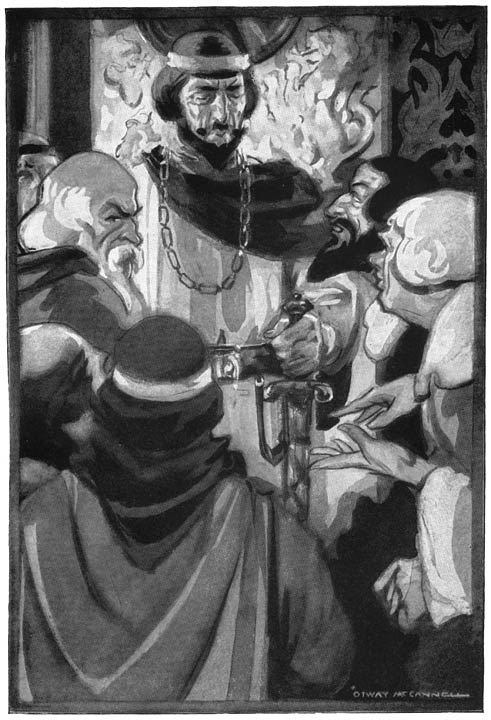
Don Alfonso summons his Sages
The wise men thereupon retired, and having considered the dream, returned to the royal presence. “Lord King,” they said, “we are of opinion that this dream of yours was sent to signify that you shall vanquish these great armies that the Moslems have brought against you, that you shall despoil their camp and plunder it of the riches it contains, and that you shall occupy their territory and return victorious, with great honour and glory. Moreover, we believe that your triumph will be made known through all parts of the East, since the elephant which you nightly appear to bestride can be no other than Juzef Aben Taxfin, King of the Moslems and lord of the far-extending lands of Africa, who, like that animal, has been reared in the deserts of that country. The strangely formed atambore which you have sounded on these many nights implies the fame which shall echo throughout the world, to every part of which it shall carry the knowledge of your illustrious victories.”
Alfonso listened to this interpretation with the utmost attention, and when it concluded he said: “It appears to me that you have gone far from the true interpretation of my dream, seeing that the explanation which my heart gives me is of a widely different kind, for it announces to me nothing better than events of terror and dismay.”
Having thus spoken, the King turned his head, and, looking toward certain Moorish knights who were his vassals, he asked them if perchance they knew of any wise man of their nation who had skill in the interpretation of dreams. They replied that they did know of one such, and that there was in Toledo at that moment a wise man who taught in one of the mosques and who would interpret the vision to the satisfaction of the King.
Alfonso at once commanded that they should bring the sage before him, and in a short space the Moorish cavaliers returned with the man of whom they had spoken, the Faki Mohammed Aben Iza, who, however, sternly refused to interpret the dream of an infidel, and when he learned for what purpose he was required would not even set foot in the palace. The Moorish knights in their dilemma told Alfonso that the Faki’s religious scruples would not permit him to appear in a Christian court, and the King, who well knew the niceties of Mohammedan law, contented himself with their assurance that they would bring him the wise man’s interpretation of the dream. They then entreated the Faki to consider it, and as they pressed him urgently he replied: “Go to the King Alfonso and say that the accomplishment of his vision is very near, and that its significance is after this wise. He shall be vanquished, yea, in a disgraceful defeat, and with great slaughter. He shall fly, with but few of his people, and the victory shall remain with the Sons of the Prophet. Tell him, moreover, that this declaration is derived from the Koran: ‘Know ye not what your God has prepared for him of the Elephant? Hath he not brought his force to nothing and rendered his evil intentions of no avail? See ye not that he hath sent over them the vultures of Babel?’ These words,” continued the Faki, “foretold the downfall of Ibrahim, King of the Abbassides, when he went forth with his army against Arabia, riding on a great elephant. But God sent for his destruction the wild vultures of Babel, who cast balls of glowing fire upon that host and turned his pomp into wretchedness and the vileness of dust. As to the atambore which Alfonso described, that signifies that the hour of his desolation is approaching.”
The Moorish cavaliers, as in duty bound, returned to the King and acquainted him with the prophetic words of the Faki. On hearing them he turned pale, and ejaculated: “By the God of my worship, let this your Al Faki tremble if he hath lied, for be sure that I will make of him a warning.”
Shortly after this King Alfonso assembled his host, an innumerable multitude of foot-soldiers and more than eighty thousand cavalry, nearly thirty thousand of whom were Arabs. With this array he marched to the encounter with King Taxfin and his allies, and came face to face with him near Badajoz, among the groves and plains called Zalacca, about twelve miles from that city. The armies were divided by a river, and across this Taxfin sent an insulting message to Alfonso, bidding him either abjure the Christian faith or acknowledge himself his vassal. When Alfonso read this missive he cast it to the earth in great anger, and, turning haughtily to the envoy, said: “Go and bid Taxfin not to conceal himself in the battle, which if he do not, we shall see each other.”
Certain circumstances affected the combat. Friday was the holy day of the Moslems, Saturday was the Sabbath of the Jews, of whom there were many in the Christian host, and Sunday that of the Christians, and Alfonso had already requested Taxfin that truce should be observed on these days, and the Moor had consented. But Alfonso considered himself justified in attacking at the hour of dawn on the Friday morning. He marshalled his host into two divisions, and set on. The Moorish King of Seville had asked his astrologer to cast a horoscope with the intention of discovering the fate of the day, and as this had been entirely unfavourable to the Moslems they were somewhat disheartened. But as they succeeded in withstanding Alfonso’s first attack, the student of the stars cast another mystical diagram, and on this occasion found his prognostication more auspicious. The King of Seville, inspired by the favourable prophecy, sat down in his pavilion and, taking pen and parchment, dashed off the following verse, which he sent for the inspiration of his ally, Taxfin:
God’s anger on the Christian horde
Sends cruel slaughter by thy sword,
While favouring stars announce to thee
And to thy Moslems victory!
Taxfin was greatly inspirited by these words, and rode up and down his ranks encouraging his men, but he had not much time to do so, for King Alfonso, heading a terrific charge, dashed down on him with all the mail-clad chivalry of Spanish Christendom. A sanguinary and murderous conflict ensued. The Moslems stood their ground bravely, but the heavy cavalry of the Spaniards bore them down, and overwhelmed them on all sides. The Moorish allies of the Christian force now came into action, surrounding and hemming in the Arabs of Andalusia, and the Moslem chroniclers tell us that the darkness produced by that mass of men and horses was so great that those who fought could no longer see each other, and grappled hand to hand, as in an obscure night. At last Taxfin’s forces began to retreat, and broke into disorderly rout, closely pressed by the Christian cavalry. The Moors of Seville alone stood their ground. Taxfin placed himself at the head of his reserve and, charging with great fury, threw his mounted columns directly at the pavilion of King Alfonso. This was but slightly defended, and easily fell a prey to the Moslems, with all its treasure. Alfonso, noting the advance of Taxfin, charged him in flank, and the two principal leaders were soon engaged in furious battle. The Moorish monarch rode among his men, exhorting them to constancy, and crying out that the reward of their valour would be the crown of paradise. As the result of his repeated charges the Christian host began to give way, and on the renewed attack of Taxfin’s allies, who had before been beaten, fled in precipitate rout. Alfonso, seeing that all was lost, and accompanied by five hundred followers only, rode fast before the conquering Moors. It was with difficulty that he made his escape to the city of Toledo, where he arrived with only a hundred men.
From that day King Alfonso never regained heart, and some years later, on learning of the death of his son and the defeat of his people in battle with the infidel, he fell sick and died. So was the prophecy of the Faki fulfilled.
The Prince who Changed Crowns
During the age-long struggle between the Gothic and Arab races in Spain many small kingdoms on both sides rose and fell, the names of which have long since been forgotten. Perhaps two hundred years after the infidels had gained a footing in the Peninsula, it chanced that in the central portion of the country there existed side by side two diminutive kingdoms, or rather principalities, the more northerly of which preserved its Spanish nationality with the most jealous care, while that which existed upon its borders was equally conservative in its Moslem prejudices. At this period the Spanish principality had at the head of its fortunes a prince of exceptional enlightenment and ability, Don Fernando. His training had naturally been of a kind which had led him to regard his Moslem neighbours with the profoundest distrust and dislike. They were, he was told by his instructors, a race of men lost to all humanity, deficient in honour, cruel, malicious, and revengeful—in short, it is not to be wondered at that, having the demerits of his Saracen neighbours so constantly dinned into his ears, the young Fernando began to regard them with the utmost repugnance.
The low range of hills which divided the two principalities rather assisted than hindered the constant raids which Moslem and Christian made upon each other’s territory, as they constituted a description of No Man’s Land, where the forces of either might be carefully marshalled for a lightning foray. In these raids Fernando himself occasionally took part, as it was thought necessary that the prince of a state which lived in a condition of almost constant warfare should be well acquainted with the practical side of military affairs. During one of these constantly recurring miniature invasions, the company which Fernando commanded had ridden far into Moorish territory without encountering any resistance, and, advancing in loose formation and without sufficient care, suddenly encountered an ambuscade of the enemy, who, taking it in flank, succeeded in penetrating its ranks and cutting them in two. The little band of Spaniards, thus separated, fled in opposite directions, and Fernando, accompanied by only a handful of followers, turned his horse’s head in the direction of his own country and galloped out of the range of immediate danger.
The route which he was now forced to take to regain his own dominions necessitated his following a wide détour, and as he and his companions had already ridden far that day their horses shortly became so jaded that further progress was almost impossible. They also became aware, to their dismay, that the foremost of the enemy were now not far distant. In the dilemma in which they found themselves they resolved to sell their lives dearly, as befitted Christian knights, and they were about to dismount from their horses to seek a spot which might afford them some advantage in such a struggle when they beheld, some little way off, a building of rough stone standing on a little eminence. “There, if anywhere,” said Fernando, “we shall be able to make a good defence. Let us secure that position and take full advantage of the shelter it offers us.”
Spurring their beaten horses to a last effort, they soon gained the summit of the little hill. Dismounting, Fernando sought for the entrance to the rather dilapidated building, and having found it, was about to make his way inside, when he was surprised to see a man kneeling on its flagstones, engaged in earnest prayer. His long beard, his patched clothing, and his general appearance signified that he was a Moslem hermit, one of those who had retired from the haunts of men to practise his religious austerities in peace. Fernando was about to address him roughly and bid him begone, when the holy man, hearing the ring of his mailed foot upon the pavement, looked up and asked him what he required.
“Get you gone,” said Fernando, “for we are about to defend this place to the last extremity against your infidel brethren.”
The hermit smiled. “Young man,” he said, “what possible defence can you hope to make in this poor place against the numbers which will shortly surround you? Your sword and that of your companions will be of little more avail than these poor walls, which, almost ruined as they are, would soon be beaten down. Trust me, there is a much better defence against the violence of man than either stone or steel.”
“I know not of what you speak, old man,” said Fernando, “but in those things which you deride, I, as a soldier, have been accustomed to place my trust.”
“Alas,” said the hermit, “that it should be so! Have you not been taught, young man, in your own country that God is a surer defence to those who trust Him than those vain material bulwarks which men of blood erect against one another’s rage? Put your trust in God, I say, and He will be able to succour you, even through the least of His servants.”
“Were it the God of the Christians of whom you speak,” replied Fernando, “I would agree that your words were those of wisdom, but in the mouth of an unbeliever they have naught but a blasphemous ring.”
“Sir Knight,” said the hermit, “you are yet a young man, but as you grow older it will be given you to understand that God is the same in all lands, and that division of His personality is one of the fictions with which the Father of Lies seeks to make enmity between the righteous. Argue no longer, I pray you, but take heed to what I say. This remnant of stone is the last remaining turret of an ancient fortalice, beneath which extends a labyrinth of dungeons. Secrete yourselves speedily in the darkness of this labyrinth, I beg you, so that you may evade your pursuers and regain your own country after nightfall.”
“Have a care, Don Fernando,” cried one of the prince’s comrades. “This infidel seeks to beguile us into a trap, where his countrymen will be able to murder us at their leisure.”
“Not so,” replied the prince, “for I can see that the mind of this good and holy man holds a better purpose toward us, and I willingly yield myself to his care. Lead the way, good father, to the hiding-place of which you speak.” The hermit immediately requested the cavaliers to enter the building, and indicated to them a dark and sloping passage, down which they led their horses. They had scarcely had time to conceal themselves in the gloomy recesses to which it led when with a loud clamour the infidels who had been pursuing them rode up. Their leader challenged the hermit and asked him if he had observed any Christian knights pass that way. “Assuredly no Christian knights have passed this way, my son,” replied the man of God; “go in peace.” The Moslem captain with a grave salutation immediately remounted his horse, and the band swept on.
The hermit having entertained the Christian knights to the best of his poor resources, returned to them within a few hours and told them that darkness had now fallen. “You will now be able,” he said, “to make a safe return to your own land.”
“How can I reward you?” cried Fernando, whose generous heart had been deeply stirred by the old man’s unaffected kindness.
“There is one way in which you can do so, young cavalier,” said the recluse, “and that is by trying to form a better opinion of the men of my race.”
“You ask a difficult thing,” said the prince sadly, “for truth compels me to say that I have heard great evil of the Moors, and but little good.”
“That is not surprising,” said the hermit, with a smile, “since you will readily admit that you have not encountered them otherwise than with sword in hand or as prisoners whose hearts are burning with the bitterness of defeat. Open your mind, young man, or rather pray that its doors, until now closed, should be thrown wide to admit the rays of celestial wisdom. Seek for the best in your enemies, and believe me you will not fail to find it.”
As he spoke, Fernando indeed felt as if the doors of his spirit, until now rusty with prejudice, had been unbarred. “I shall not forget your advice,” he said, “for surely nothing evil can come from one so good and noble,” and with a respectful gesture of farewell he mounted his horse and, followed by his companions, rode away.
He arrived safely in his capital in the early hours of the morning, and having bathed and refreshed himself, sought his audience chamber, where, surrounded by his anxious ministers, he told them of the adventure which had befallen him.