Chapter I · : The Sources of Spanish Romance
Reading edition
Romance, Romance, the songs of France,
The gestes of fair Britaine,
The legends of the sword and lance
That grew in Alemaine,
Pale at thy rich inheritance,
Thou splendour of old Spain!
Anon.
If, spent with journeying, a stranger should seat himself in some garden in old Granada, and from beneath a tenting of citron and mulberry leaves open his ears to the melody of the waters of the City of Pomegranates and his spirit to the sorcery of its atmosphere, he will gladly believe that in the days when its colours were less mellow and its delicious air perhaps less reposeful the harps of its poets were the looms upon which the webs of romance were woven. Almost instinctively he will form the impression that the Spaniard, having regained this paradise after centuries of exile, and stirred by the enchanted echoes of Moorish music which still lingered there, was roused into passionate song in praise of those heroes of his race who had warred so ceaselessly and sacrificed so much to redeem it. But if he should climb the Sierra del Sol and pass through the enchanted chambers of the Alhambra as a child passes through the courts of dream, he will say in his heart that the men who builded these rooms from the rainbow and painted these walls from the palette of the sunset raised also the invisible but not less gorgeous palace of Spanish Romance.
Or if one, walking in the carven shadows of Cordova, think on the mosque Maqsura, whose doors of Andalusian brass opened to generations of poets and astrologers, or on the palace of Azzahra, built of rose and sea-coloured marbles rifled from the Byzantine churches of Ifrikia, will he not believe that in this city of shattered splendours and irretrievable spells the passion-flower of Romance burst forth full-blown?
But we cannot trace the first notes of the forgotten musics nor piece together the mosaic of broken harmonies in the warm and sounding cities of the Saracens, neither in “that mine of silk and silver,” old Granada, nor among the marble memories of Cordova, whose market-place overflowed with the painted parchments of Moorish song and science. We must turn our backs on the scarlet southern land and ascend to the bare heights of Castile and Asturias, where Christian Spain, prisoned for half a thousand years upon a harsh and arid plateau, and wrought to a high passion of sacrifice and patriotism, burst into a glory of martial song, the echoes of which resound among its mountains like ghostly clarions on a field of old encounter.
The Cradle of Spanish Song
The homeland of Spanish tradition was indeed a fitting nursery for the race which for centuries contested every acre of the Peninsula with an enemy greatly more advanced in the art of warfare, if inferior in resolution and the spirit of unity. Among the flinty wastes of the north of Spain, which are now regarded as rich in mineral resources, are situated at intervals luxuriant and fertile valleys sunk deep between the knees of volcanic ridges, the lower slopes of which are covered with thick forests of oak, chestnut, and pine. These depressions, sheltered from the sword-like winds which sweep down from the Pyrenees, reproduce in a measure the pleasant conditions of the southern land. Although their distance one from another tended to isolation, it was in these valleys that Christian Spain received the respite which enabled her to collect her strength and school her spirit for the great struggle against the Saracen.
Roman and Visigoth
The use of Latin as a literary tongue in that part of Spain where the Castilian speech was evolved considerably retarded its development from the condition of a patois to a language proper. Nevertheless it continued to advance. The processes by which it did so are surprisingly obscure, but the circumstance of its literary fixity in the early eleventh century is proof that it must have achieved colloquial perfection at least before the era of the Moorish invasion. The Saracen conquest, by forcing it into the bleak north-west, did it small disservice, for there it had to contend with other dialects of the Roman tongue, which enriched its vocabulary, and over which, ultimately, it gained almost complete ascendancy as a literary language.
The Romance Tongues of Spain
Three Romance or Roman languages were spoken in that portion of Spain which remained in Christian hands: in Catalonia and Aragon the Provençal, Catalan, or Limousin; in Asturias, Old Castile, and Leon the Castilian; and in Galicia the Gallego, whence the Portuguese had its origin. The Catalan was almost entirely similar to the Provençal or langue d’oc of Southern France, and the accession of Raymond Berenger, Count of Barcelona, to the throne of Provence in 1092 united the Catalonian and Provençal peoples under one common rule. Provençal, the language of the Troubadours, was of French origin, and bears evidence of its evolution from the Latin of Provincial Gaul. It appears to have been brought into Catalonia by those Hispani who had fled to Provence from Moorish rule, and who gradually drifted southward again as the more northerly portions of Spain were freed from Arab aggression. The political connexion of Catalonia with Provence naturally brought about a similarity of custom as well as of speech, and indeed we find the people of the Catalan coast and the province of Aragon deeply imbued with the chivalry and gallantry of the more northerly home of the Gai Saber.
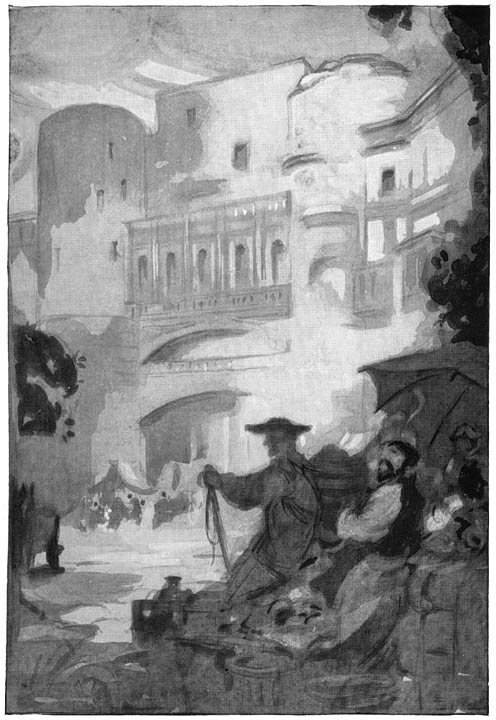
A Glimpse of Old Spain
The Galician, a Romance language which sprang from the same root as the Portuguese, is nearly allied to the Castilian. But it is not so rich in guttural sounds, from which we may be correct in surmising that it has less of the Teutonic in its composition than the sister tongue. Like Portuguese, it possesses an abundance of hissing sounds, and a nasal pronunciation not unlike the French, which was in all probability introduced by the early establishment of a Burgundian dynasty upon the throne. But Galician influence upon Castilian literature ceased at an early period, although the reverse was by no means the case.
The Rise of Castilian
The evolution of Castilian from the original Latin spoken by the Roman colonists in Spain was complicated by many local circumstances. Thus in contracting the vocables of the Roman tongue it did not omit the same syllables as the Italian, nor did it give such brevity to them as Provençal or Galician. Probably because of the greater admixture of Gothic blood among those who spoke it, it is rich in aspirates, and has a stronger framework than almost any of the Romance tongues. Thus the Latin f is in Castilian frequently altered to h, as hablar = fabulari, ‘to speak.’ The letter j, which is strongly aspirated, is frequently substituted for the liquid l, so that filius, ‘a son,’ becomes hijo. Liquid ll in its turn takes the place of Latin pl, and we find Latin planus, ‘smooth,’ appearing in Castilian as llano (pron. lyáh-no). The Spanish ch supplies the place of the Latin ct, as facto = hecho, dictu = dicho, and so on.
Other proofs of Teutonic association are not lacking. Thus the g before c and i, which in Gothic and German is a guttural, has the same character in Castilian. The Spanish conversion of o into ue also resembles the similar change in German, if, for example, we compare Castilian cuerpo and pueblo with the German Körper and Pöbel.
Southward Spread of Castilian
From the period of the defeat of Roderic, “last of the Visigoths,” at the battle of Xerez de la Frontera in 711 until the fall of Granada in 1492, Spain was indeed a land of battles. Almost immediately after their first defeat by Arab arms the armies of the Visigoths were pursued to the north-western limits of the Peninsula, where they, found a rallying-place in the mountains of Biscay and Asturias. There, like the Welsh after the Saxon invasion of Britain, they might have become reconciled to the comparatively narrow area left to them, but the circumstances of their virtual imprisonment served only to unite them more closely in a common nationality and a common resolve to win back their original possessions.
For many generations their efforts were confined to border forays and guerrilla fighting, in which they were by no means uniformly successful, for the fiery courage of the Saracens would permit of no mere defensive policy, and nearly every victory of which the Castilians could boast was counterbalanced by reverses and losses which their inferior numbers could ill sustain. But by degrees their valorous obstinacy was rewarded, and ere a century had passed they had regained the greater part of Old Castile. The very name of this province, meaning as it does ‘the Land of Castles,’ shows that even when regained it was held only by fortifying its every hill-top with strongholds, so that at last this castellated tract gave its name to the race which held it so dearly. Before another twenty years had passed the Castilian warriors had established a footing in New Castile, and from this time onward seem to have been assured of ultimate success.
The fall of Toledo in 1085, after three centuries and a half of Saracen occupation, marked a further epoch in the southern advance of the Castilians, and by the taking of Saragossa in 1118 the tables were turned upon the Arab invaders, who were now driven into a more confined part of the country, to the south and south-west. This circumstance, however, seems to have consolidated rather than crippled their resisting powers, and they had yet to be reckoned with for nearly four centuries ere, with the fall of Granada, Boabdil, or Abu-Abdallah, the last of the Moorish kings, gave up its keys to Ferdinand of Castile, looked his last upon the city, and crossed to Africa to fling away his life in battle.
In these circumstances of constant strife and unrest the Romantic literature of Spain was born. It is by no means remarkable that its development coincided with the clash of arms. Trumpets re-echo in its every close. As it expresses the spirit of a martial race, it was also the nursling of necessity, for from the songs and fables of mighty heroes the knights of Castile drew a new courage and experienced an emulous exhilaration which nerved them on the day of battle. Well might the wandering knight of Castile chant, as in the old ballad:
Oh, harness is my only wear,
The battle is my play:
My pallet is the desert bare,
Border warfare, with its frequent change of scene and constant alarms, was a fitting introduction to errantry.
The Literary Development of Castilian
Castilian, although more than one alien influence impinged upon it, evolved a literary shape peculiarly its own, especially as regards its verse, as will be seen when we come to deal separately with its several Romantic forms. Thus it owed nothing to the literary methods of Provençal or Catalan, though much to their spirit and outward manners. When the courtly and rather pedantic poetic system of the Troubadours encountered the grave and vigorous Castilian, it was ill fitted to make any prolonged resistance. As political causes had hastened their encounter, so they quickened the victory of the Castilian. The ruling power in Aragon had from an early period been connected with Castilian royalty, and Ferdinand the Just, who came to the throne of Aragon in 1412, was a Castilian prince. The Courts of Valencia and Burgos were, therefore, practically open to the same political influences. If our conclusions are correct, it was during the reigns of Ferdinand the Just and Alfonso V (1412–58) that the influence of Castilian first invaded the sphere of Catalan. We find it definitely recognized as a poetic tongue on the occasion of a contest of song in honour of the Madonna held at Valencia in 1474, the forty poems sung at which were afterward collected in the first book printed in Spain. Four of these are in the Castilian tongue, which was thus evidently regarded as a literary medium sufficiently developed to be represented at such a contest. Valencia, indeed, at first wholly Catalan in speech and art, seems to have possessed a school of Castilian poets of its own from 1470 to 1550, who did much to popularize their adopted tongue. But the Catalonians were not minded that their language should lose the literary hegemony of Spain so easily, and they made every endeavour to sustain it by instituting colleges of professional troubadours and vaunting its beauties at their great public contests of song. It was in vain. They had encountered a language more vigorous, more ample in vocabulary, more rich in idiomatic construction, and backed by a stronger political power than their own.
The Poetical Courts of Castile
The evolution of Castilian as a literary language was also assiduously fostered by the scholarly character of many of the rulers of Castile. Alfonso the Wise was himself a poet, and cultivated his native tongue with judiciousness and care, affording it purity and precision of expression. Under his supervision the Scriptures were translated into Castilian, and a General Chronicle of Spain as well as a history of the First Crusade were undertaken at his instance. He made it the language of the law-courts, and attempted to infuse into its verse a more exact spirit and poetical phraseology by the imitation of Provençal models.
The Rise of Romance
The development of Romance in Spain, its evolution and the phases through which it passed, has not, as a theme, met with that painstaking treatment at the hands of English writers on Spanish literature that might have been expected at this late day, when the literary specialist has to search diligently into the remotest corners of the earth if he seek new treasures to assay. Its several phases are rather hinted at than definitely laid down, not because of the poverty or dubiety of the evidential material so much as through the laxity and want of thoroughness which characterize most Britannic efforts at epochal fixation or attempts to elucidate the connexion between successive literary phases. I can scarcely hope to succeed in a task which other and better equipped authorities have neglected, perhaps for sound reasons. But I had rather fail in an attempt to reduce the details of the evolution of Spanish Romance to orderly sequence than place before the reader an array of unrelated facts and isolated tags of evidence which, however interesting, present no definite picture, permit of no reasonable deduction, and are usually accompanied by a theoretical peradventure or so by way of dubious enlightenment.
If we regard the literary map of Europe from the eleventh to the thirteenth century we behold the light shining from two quarters—Jewish-Arabic Spain and France. With the first we have, at the moment, no concern. Its literature was at the time alien and inimical to Christian Spain, which, as we shall see later, did not regard anything Saracen with complacence until its sword crossed no longer with the scimitar. But in France Castile had an illustrious exemplar, whose lessons it construed in its own peculiar manner—a manner dictated both by national pride and political necessity.
With the influence of Southern France we have already dealt. At the era alluded to, Northern France, the country of the langue d’oïl, although in a measure disturbed by unrest, was yet in a much better case to produce great literature than Castile, whose constant vendetta with the Moslem left her best minds only a margin of leisure for the production of pure literature—a margin, however, of which the fullest advantage was taken. The rise of a caste of itinerary poets in France supplied the popular demand for story-telling, and the trouvères of the twelfth century recognized in the glorious era of Charlemagne a fitting and abundant source for heroic fiction such as would appeal to medieval audiences. The poems, or rather epics, which they based upon the history of the Carlovingian period were known as chansons de gestes, ‘songs of the deeds’ of the great Frankish emperor and his invincible paladins, or, to the trouvères themselves, as matière de France, as the Arthurian tales were designated matière de Bretagne, and those based upon classical history matière de Rome.
These chansons were intended to be sung in the common halls of feudal dwellings by the itinerant trouvères, who composed or passed them on to one another. Their subject-matter deals more with the clash of arms than the human emotions, though these are at intervals depicted in a masterly manner. The older examples among them are written in batches of lines, varying from one to several score, each of which derives unity from an assonant vowel-rhyme, and known as laisses or tirades. Later, however, rhyme crept into the chansons, the entire laisse, or batch, ending in a single rhyme-sound.
Castilian Opposition to the Chansons de Gestes
In these poems, which probably originated in the north of France, the genre spreading southward as time progressed, Charlemagne is represented as the great bulwark of Christianity against the Saracens of Spain. Surrounded by his peers, Roland, Oliver, Naymes, Ogier, and William of Orange, he wages constant warfare against the Moors or the ‘Saracens’ (pagans) of Saxony. Of these poems Gautier has published a list of one hundred and ten, a moiety of which date from the twelfth century. A number of the later chansons are in Provençal, but all attempts to refer the entire cycle in its original condition to that literature have signally failed.
But this was not all. The idea that Charlemagne had entered Spain as a conqueror, carrying all before him, was offensive to the highly wrought pride and patriotism of the Castilians, who chose to interpret the spirit of the chansons de gestes in their own way, and, instead of copying them slavishly, raised an opposing body of song to their detriment. Accepting as the national hero of the Carlovingian era an imaginary knight, Bernaldo de Carpio, they hailed him as the champion of Castile, and invented songs of their own in which he is spoken of as slaying and defeating Roland at Roncesvalles at the head of a victorious army composed not of Arabs or Basques, but Castilians.
The Cantares de Gesta
But if the Castilians did not accept the matter of the chansons, they assuredly adopted their form. Their literary revolt against the alien spirit and politics of the chansons seems to have taken place at some time soon after the diffusion of these throughout Spain. A Spanish priest of the early twelfth century wrote the fabulous chronicle of Archbishop Turpin of Rheims, which purported to be the work of that warlike cleric, but in reality was intended to popularize the pilgrimage to Compostella to which it had reference. Many Franks travelled to the shrine, among them trouvères, who in all likelihood passed on to the native Castilian singers the spirit and metrical system of the chansons, so that later we hear of Spanish cantares de gesta, most of which, however, unlike their French models, are lost to us. The famous Poema del Cid, dealing with the exploits of a great Castilian hero, is nothing but a cantar de gesta in form and spirit, and we possess good evidence that many of the late romanceros or ballads upon such heroes as Bernaldo de Carpio, Gonzalvo de Cordova, and Gayferos are but ancient cantares ‘rubbed down,’ or in a state of attrition.
The Chronicles
But if the majority of the cantares de gesta are irreplaceable as regards their original form, we find fragments of them in the ancient chronicles of Spain. Thus the General Chronicle of Spain (c. 1252), which, according to the latest research, is believed to have undergone at least three specific alterations or rearrangements of its text, tells the stories of Bernaldo de Carpio, Fernán González, and the seven Children of Lara, and provides sketches of Charlemagne, while its latter portion recounts the history of the Cid, and at times even appeals to the cantares as its authority for such and such an episode. Many of the passages in the chronicles, too, are obviously copied in their entirety from certain cantares. So strongly, indeed, do they retain the assonant verse-formation typical of the cantares that many of the later balladeers seem easily to have cast them into verse again, especially those relating to Bernaldo de Carpio and the Infantes de Lara, and in this manner they appeared once more in the cancioneros, or collections of folk-songs.
The Ballads
The immortal ballads of Spain have been the subject of the sharpest controversy, and their importance as Romantic material demands special treatment in a separate chapter. Regarding the period to which they belong and their relations to the larger narrative poems and chronicles, we must deal briefly with them here. Some authorities ascribe them to an early age and insist upon their priority to such poems as the Poema del Cid and such chronicles as that of Alfonso the Learned, while others are equally assured of the late date of the greater number. It seems to me that the truth resides in both hypotheses, and that in this case, as frequently in literary navigation, it is wise to steer a middle course. In my view the ballads of Spain are of four fundamental types: those which arose spontaneously in Northern Spain at some time subsequent to the formation of the Castilian language, and which, if we possess any remnants of them at all, have probably come down to us in such a form as would render them unrecognizable to those who first sang them; ballads which are based on passages in cantares de gesta as chronicles; folk-ballads of a later date, more or less altered; and, lastly, the more modern productions of conscious art.
I also believe that the ballads or romanceros are again of two broad classes: those of spontaneous folk-origin, owing nothing to literary sources, and those which are mainly cantares de gesta, or chronicle passages in a lyric state of attrition. With the great body of authorities upon ancient Spanish literature I do not believe that the cantares or chronicles owe anything to the ballads of any age, which seem to me wholly of popular origin. Of course the two classes lastly indicated do not include the more ‘poetic’ or sophisticated ballads written after the ballad became an accepted form for experiments in conscious versification, and it is plain that such efforts could belong to neither category.
No definite proof exists as to the degree of sophistication and alteration which the ballads underwent before their ultimate collection and publication. It would be strange, however, if no ballads of relatively early date had reached us, altered or otherwise, and it seems to me merely a piece of critical affectation to deny antiquity to a song solely because it found its way into print at a late period, or because it is not encountered in ancient MSS., just as it would be to throw doubt upon the antiquity of a legend or folk-custom current in our own day—unless; indeed, such should display obvious marks of recent manufacture. At the same time few of these ballads seem to me to bear the stamp of an antiquity more hoary than, for example, those of Scotland or Denmark.
The ballads thus relegated to the peasantry and lower classes, those of the upper classes who found time for reading were accordingly thrown back upon the chronicles and the few cantares de gesta which had been reduced to writing. But on the destruction of the Moorish states in Spain the increase in wealth and leisure among the upper classes, and the introduction of printing, aroused a demand for books which would provide amusement. A great spirit of invention was abroad. At first it resuscitated the Romantic matter lying embedded and almost fossilized in the chronicles. It is, indeed, but a step from some of these to the romances proper. But Spain hungrily craved novelty, and the eyes of romance-makers were turned once more to France, whose fictional wealth began to be exploited by Spanish writers about the beginning of the fifteenth century.
The Heyday of Romance
Perhaps the first literary notice that we possess of the romance proper in Spain is that by Ayala, Chancellor of Castile (d. 1407), who, in his Rimado de Palacio, deplores the time he has wasted in reading such “lying stuff” as Amadis de Gaul. He might have been much worse occupied, but, be that as it may, in his dictum we scarcely have a forecast of the manner in which this especial type of romance was to seize so mightily upon the Castilian imagination, which, instead of being content with mere servile copying from French models, was to re-endow them with a spirit and genius peculiarly Spanish. Perhaps in no other European country did the seed of Romance find a soil so fitting for its germination and fruition, and certainly nowhere did it blossom and burgeon in such an almost tropical luxuriance of fruit and flower.
The Palmerin series only fed and increased the passion for romantic fiction, so hungry was Spain for a literary diet which seemed so natural and acceptable to her appetite that those who sought to provide her with romantic reading could scarce cope with the call for it. The natural result ensued. A perfect torrent of hastily written and inferior fiction descended upon the public. Invention, at first bold, became shameless, and in such absurdities of distorted imagination as Belianis of Greece, Olivante de Laura, and Felixmarte of Hyrcania the summit of romantic extravagance was reached. But ridiculous and insulting to human intelligence and decent taste as most of these productions were, still they found countless thousands of readers, and there is every indication that publishing in the Spain of the late sixteenth and the seventeenth centuries must have been extremely lucrative. These preposterous and chimerical tales, lacking the beauty and true imaginative skill and simplicity of the older romances, stood in much the same relation to them as a host of imitative novels published in the early years of the nineteenth century did to the romances of Scott. Mexia, the sarcastic historian of Charles V, writing of romance in 1545, deplores the public credulity which battened on such feeble stuff. “For,” he says, “there be men who think all these things really happened, just as they read or hear them, though the greater part of the things themselves are absurd.” So might a critic of our own day descant upon the popular predilection for the cheap novel, or the whole desert of sensation-fodder which pours from the all too rapid machines of the Fiction Trusts.
Still another extravagant and more unpleasant manifestation of the popular craze for romance arose in such religious tales as The Celestial Chivalry, The Knight of the Bright Star, and others of little worth, in which Biblical characters are endowed with the attributes of chivalry and go on adventure bound. The time occupied by the appearance of these varying types, and indeed in the whole latter-day evolution of Spanish romance, was strikingly brief. But half a century elapsed between the publication of Amadis and the most extreme of its worthless imitations. But it is not difficult to account for the rapid manufacture and dissemination of such a mass of literature, good and bad, when we recall that Spain had been for ages the land of active knighthood, that her imagination had been wrought to a high pitch of fervour in her long struggle with her pagan enemies, and that in the tales of chivalry she now gazed upon with such admiration she saw the reflection of her own courtly and heroic spirit—the most sensitive and most fantastically chivalrous in Europe.
Possible Moorish Influence on Spanish Romance
There is indeed evidence—pressed down and flowing over—that the age-long death-grapple with the Saracen powerfully affected Spanish romantic fiction. But was this influence a direct one, arising out of the contiguity and constant perusal of the body of Moorish fiction, or did it proceed from the atmosphere of wonder which the Saracen left behind him in Spain, the illusions of which were mightily assisted by the marvels of his architecture and his art? One can scarcely find a Spanish romance that is not rich in reference to the Moor, who is usually alluded to as a caballero and a worthy foe. But is it the real Moor whom we encounter in these tall folios, which beside our modern volumes seem as stately galleons might in the company of ocean-going tramps, or is it the Saracen of romance, an Oriental of fiction, like the Turk of Byronic literature? The question of the influence of Moorish literature upon Spanish romance has been shrouded by the most unfortunate popular misconceptions. Let us briefly examine the spirit of Arabic literary invention, and see in how far it was capable of influencing Castilian art and imagination.
The history of the development of the Arabic language from the dialect of a wandering desert people to a tongue the poetic possibilities and colloquial uses of which are perhaps unrivalled is in itself sufficient to furnish a whole volume of romantic episode. The form in which it was introduced into Spain in the early eighth century can scarcely fail to arouse the admiration of the lover of literary perfection. As a literary medium its development was rapid and effective. It is, indeed, as if the tones of a harsh trumpet had by degrees become merged into those of a silver clarion whose notes ring out ever more clearly, until at length they arrive at a keenness so intense as to become almost intolerably piercing. This eloquent language, the true speech of the literary aristocrat, has through the difficulty of its acquirement and the bewildering nature of its written characters remained almost unknown to the great mass of Europeans—unknown, too, because the process of translation is inadequate to the proper conveyance of its finer shades and subtler intimations. Even to the greater number of the Arabs of Spain the highly polished verse in which their literature was so rich was unknown. How much more, then, was it a force removed from the Castilian or the Catalan?
Arabic Poetry
The desert life of the Arabs while they were yet an uncultured people, although it did not permit of the development of a high standard of literary achievement, fostered the growth of a spirit of observation so keen as to result in the creation of a wealth of synonyms, by means of which the language became greatly enriched. Synonymous meaning and the discovery of beautiful and striking comparisons are the very pillars of poetry, and within a century of the era of Moslem ascendancy in the East we find the brilliant dynasty of the Abbassides (c. A.D. 750) the generous patrons of a poetic literature which the language was so well prepared to express. Story-telling had been a favourite amusement among the Arabs of the desert, and they now found the time-honoured, spontaneous exercise of the imaginative faculty stand them in good stead. The rapidity of the progress of Arabic literature at this period is, indeed, difficult of realization. Poetry, which we are now assured has ‘no market value,’ was to the truly enlightened upper classes of this people an art of the first importance, more precious than those bales of the silks of Damascus, those gems of Samarkand, or those perfumes of Syria the frequent allusion to which in their legends encrusts them, like the walls of the cavern of Ala-ed-din, with fairy jewels. But words were jewels to the Arab. When Al-Mamoun, the son of Haroun-al-Raschid, dictated terms of peace to the Greek emperor Michael the Stammerer, the tribute which he demanded from his conquered enemy was a collection of manuscripts of the most famous Greek authors. A fitting indemnity to be demanded by the prince of a nation of poets!
But conquered Spain was more especially the seat and centre of Arabian literature and learning. Cordova, Granada, Seville—indeed, all the cities of the Peninsula occupied by the Saracens—rivalled one another in the celebrity of their schools and colleges, their libraries, and other places of resort for the scholar and man of letters. The seventy libraries of Moorish Spain which flourished in the twelfth century put to shame the dark ignorance of Europe, which in time rather from the Arab than from fallen Rome won back its enlightenment. Arabic became not only the literary but the colloquial tongue of thousands of Spaniards who dwelt in the south under Moorish rule. Even the canons of the Church were translated into Arabic, about the middle of the eighth century, for the use of those numerous Christians who knew no other language. The colleges and universities founded by Abderahman and his successors were frequented by crowds of European scholars. Thus the learning and the philosophy if not the poetry of the Saracens were enabled to lay their imprint deeply upon plastic Europe. If, however, we inquire more closely into the local origins of this surprising enlightenment, we shall find it owing even more to the native Jews of Spain than to the Moors themselves.
The phase of Arabian culture with which we are most nearly concerned is its poetic achievement, and the ultimate influence which it brought to bear upon Spanish literary composition. The poetry of this richly endowed and imaginative people had at the period of their entrance into Spain arrived, perhaps, at the apogee of splendour. Its warm and luxuriant genius was wholly antagonistic to the more restrained and disciplined verse of Greece and Rome, which it regarded as cold, formal, and quite unworthy of translation. It surpassed in bold and extravagant hyperbole, fantastic imagery, and emotional appeal. The Arab poet heaped metaphor upon metaphor. He was incapable of seeing that that which was intrinsically beautiful in itself might appear superfluous and lacking in taste when combined with equally graceful but discordant elements. Many critics hasten to reassure us regarding his judgment and discrimination. But even a slight acquaintance with Arabic literature will show that they have been carried away by their prejudice in favour of the subject on which they wrote. In the garden of the Arabian poet every flower is a jewel, every plot is a silken carpet, tapestried with the intricate patterns of the weavers of Persia, and every maiden is a houri, each of whose physical attributes becomes in turn the subject of a glowing quatrain. The constant employment of synonym and superlative, the extravagance of amorous emotion, and the frequent absence of all message, of that large utterance in which the poets of the West have indicated to the generation they served how it might best grapple with problems of mind and soul—these were the weaknesses of the Arab singers. They made apophthegm take the place of message. They were unaware that the fabric of poetry is not only a palace of pleasure, but a great academy of the soul.
The true love of nature, too, seems to have been as much lacking in the Arab as in the Greek and the Roman. He enamelled his theme with the meticulous care of a jeweller. Not content with painting the lily, he burnished it until it seemed a product of the goldsmith’s art. To him nature was a thing not only to be improved upon, but to be surpassed, a mine of gems in the rough, to be patiently polished.
But it would be wrong to refuse to the imaginative literature of the Arabs a high place among the world’s achievements, and we must regret that, for causes into which we cannot enter here, opportunities for development and discipline were not vouchsafed it. As we read the history of the Arabian states with their highly developed civilization, their thronged academies, and their far-flung dominions, reaching from Central Asia to the western gates of the Mediterranean, and turn, to-day to the scenes where such things flourished, we must indeed be unimaginative if we fail to be impressed by the universal wreck and ruin to which these regions have been exposed. The great, emulous, and spirited race which conquered and governed them gathered the world to its doors, and the rude peoples of Europe clustered about its knees to listen to the magical tales of unfolding science which fell from its lips. From the desert it came, and to the desert it has returned.
Djamshîd, the palace is a lions’ lair
Where ye held festival with houris fair;
The desert ass bounds upon Barlaam’s tomb:
Where are the pomps of yesterday, ah, where?
Moorish ‘Fashion’ in Spanish Romance
Perhaps the best measure of the decline of Arabic as a spoken language in Spain is the fact that the authors of many romances declare them to be mere translations from the Arabic—usually the writings of Moorish magicians or astrologers. These pretensions are easily refuted by means of internal evidence. But regarding the question broadly and sanely, Spanish literature could no more remain unaffected by Arab influence than could Spanish music, architecture, or handicrafts. All such influences, however, were undoubtedly late, and, as regards the romances, were much more ‘spiritual’ than ‘material.’ Christian Spain had held off the Saracen for eight hundred years, and when at last she consented to drink out of the Saracen cup she filled it with her own wine. But the strange liquor which had brimmed it before left behind it the mysterious odours and scents of the Orient, faint, yet unmistakable.
The Type of Spanish Romance
The type of Spanish romance at its best is that in which the spirit of wonder is mingled with the spirit of chivalry. Old Spain, with her glorious ideas of honour, her finely wrought sense of chivalry, and her birthright of imagination, provided almost a natural crucible for the admixture of the elements of romance. Every circumstance of climate and environment assisted and fostered the illusions with which Spanish story teemed, and above all there was a more practical interest in the life chivalric in Spain than, perhaps, in any other country in Europe. The Spaniard carried the insignia of chivalry more properly than Frenchman or Englishman. It was his natural apparel, and he brought to its wearing a dignity, a gravity, and a consciousness of fitness unsurpassed. If he degenerated into a Quixote it was because of the whole-hearted seriousness with which he had embraced the knightly life. He was certainly the first to laugh when he found that his manners, like his mail, had become obsolete. But even the sound of that laughter is knightly, and the book which aroused it has surely won at least as many hearts for romanticism as ever it disillusioned.
The history of Spanish conquest is a chronicle of champions, of warriors almost superhuman in ambition and endurance, mighty carvers of kingdoms, great remodellers of the world’s chart, who, backed by a handful of lances, and whether in Valencia, Mexico, Italy, or Araucan, surpassed the fabulous deeds of Amadis or Palmerin. In a later day the iron land of Castile was to send forth iron men who were to carry her banners across an immensity of ocean to the uttermost parts of the earth. What inspired them to live and die in harness surrounded by dangers more formidable than the enchantments of malevolent sorcerers or than ever confronted knights-errant in the quest of mysterious castles? What heartened them in an existence of continuous strife, privation, and menace? Can we doubt that the hero-tales of their native land magically moved and inspired them—that when going into battle the exploits of the heroes of romance rang in their ears like a fanfare from the trumpets of heralds at a tournament?
And as we gat us to the fight
Our armour and our hearts seemed light
Thinking on battle’s cheer,
Of fierce Orlando’s high prowess,
Of Felixmarte’s knightliness