Front matter (continued 4)
Reading edition
If a faint—ever so faint—hope survived in Helen's mind that her stepmother's specious assurances of good-will to her and devotion to her father were to be credited, this faded upon her first visit to the yacht. In the cabin where she herself had once reigned as queen she found Mrs. Carstairs, coarsened, indefinably repellant, although still superb in bloom and with a Rubens lady's plenitude of physique. Around her were grouped two or three men, making up the party of which Helen was expected to be the bulwark of respectability. One of them, a Mr. Danielson, Helen disliked promptly and instinctively; none would she have admitted into the circle of her acquaintances at home. When Mr. Carstairs, after some delay, made his appearance, Helen was shocked beyond measure to behold in him a mere weary wraith, beside whom his wife seemed to flaunt her beauty and splendid health with insolence. His greeting of his daughter was indifferent, abstracted. She found it impossible to have a word alone with him. The thought of the cruise before her lay like ice on Helen's heart.
Before Mr. and Mrs. Carstairs had spent a week in Cannes the lady declared it to be a poky hole and wished she had gone to Nice. To Nice they accordingly repaired, and in due course of time sailed for Naples. While Mrs. Carstairs rattled and joked noisily with her other guests, she reserved for the handsome cad at whom Helen had taken special umbrage a reserve of manner more suspicious to an interested looker-on. To Helen, a petty agony of the cruise was that Mr. Danielson should conceive himself obliged to devote most of his leisure hours to attendance upon the owner's daughter, refusing with fatuous persistency to be shaken off. A few brief scornful words of remonstrance on this subject, addressed to her stepmother, were met by the laughing assurance that there was really nothing for Helen to apprehend, and that a man so universally run after as was Mr. Danielson, by what Mrs. Carstairs called the "fair sex," must meet the risk of having his casual attentions misinterpreted at times.
Proud, wounded, scornful, feeling that her standard of life had dropped to an unendurable point, Helen got into the habit of keeping to herself as much as practicable. At Naples she would take her own maid and absent herself for hours from the yacht and its dubious company. To her father there was actually no chance of being what she had hoped. He was mostly captious, preferring to be left alone when his wife did not vouchsafe him her companionship—which was now a rare event. The great Mr. Carstairs was, indeed, socially a cipher among these half-breeds, who drank his wines and allowed him to pay their expenses of travel.
Miss Bleecker, under the infatuation of Mrs. Carstairs' liberal money-spending, of their luxurious living and continual seeking of pleasure and excitement in which she was included when, as usual, Helen refused to go—became as a broken reed in support of her charge's movements. Poor old Eulalie, with some sense of the loss of refined surroundings they had sustained, and a hearty dislike of the imperative chaperon, ranged herself exclusively upon the side of her young lady—refusing to fraternize with Mrs. Carstairs' maid, whom she regarded as a second-rate creature in every way, and going through the routine of life in general with a dogged determination to endure unto the end.
A day came at last when Miss Carstairs went out to Pompeii with her maid, instead of to the museum in Naples, where she had announced her intention of spending the afternoon.
She left Eulalie sitting upon an immemorial stone and wandered off alone through the beautiful sad place. To the guardian, who would fain have followed her, she gave a piece of money and a gracious smile, explaining that she knew it all by heart, and wanted only to gain a general impression of the dead city on that day of radiant spring. She had been standing for some time near the tomb of Mamia, looking out over the bay and mountains of Castellamare melting together in sunshine, and, recalled to the present by the lateness of the hour, started to walk back to where she had left the monumental Eulalie.
Her resolution to leave the yacht, to abandon the party, and if needs be to forfeit all that her acquiescence had secured for her, was now definitely taken. To avoid discussion, she would simply ask her father to allow Miss Bleecker and herself to go up to Rome, where Mr. Carstairs could never abide visiting, on the ground that he did not like living over catacombs and being face to face with so many things already done for. He knew Helen's tender passion for the Imperial City, and might excuse her from going on with them to Sicily.
From Miss Bleecker she felt sure of meeting fierce and stubborn resistance to her plan. The dream of Miss Bleecker's life had been a cruise in the "Sans Peur," and it was hardly to be supposed she would easily relinquish it. But Helen felt that upon occasion she could be stubborn too. Any clash of wills, and subsequent victory for her, was worth undertaking, to rid her of the offensive companionship of Mrs. Carstairs—and one other.
She could not be sure of what she suspected between them. She scorned to make herself assured. She could not stoop to the miserable method necessary to the acquirement of dread certainty. And yet "she was walking every day with bare feet on a burning pavement without feeling the burn."
Passing with noiseless step before a house-wall arising like a screen before her path, she paused for a moment to enjoy one last gaze at the pageant of sea and sky in the light of waning day. In this brief time the sound of her own name spoken by low voices behind the ruined wall forced themselves upon her hearing. They were those of her stepmother and the man Danielson.
Two phrases interchanged, but they told Helen all. She could never again indulge in the misery of doubt.
She stood for an instant as if overtaken by the lava flow that had devastated the homes of seventeen centuries ago surrounding her. The one despairing, driving impulse was to steal away unseen by the woman who dishonored her dear father's name. Helen thought she had rather fall down and die and become embedded with the dust of ages than go back to face Mrs. Carstairs and let her know she had found her out.
As the couple, without discovering her neighborhood, moved in an opposite direction, Mr. Carstairs' daughter took wings to her feet and flew to pick up Eulalie and find the cab they had left before the Hotel Diomed. The maid, sluggish though were the workings of her mental part, saw that her mistress had had a fright, and blamed herself for losing sight of her. Helen's cheeks were white, her hands shook as though palsied, as she sprang into the cab and bade the man drive fast, fast, back toward the town. She wished, at all events, to avoid being caught up with or passed by the pair, who could not at that hour linger much longer within the enclosure.
During the long joggling drive through interminable stony streets, encumbered by the populace of the Neapolitan suburbs, performing their domestic avocations out of doors, she came to a desperate conclusion. She was of age sufficiently mature to act for herself. She could not, would not, give her reasons to her father. But she would carry out her recent determination to leave the yacht at once, forfeit the price that had been paid her to be an infamous blind, and, at any risk, sever her present connection with Mrs. Carstairs.
Helen possessed the American woman's promptitude in action. She drove with Eulalie to an hotel formerly frequented with her father, engaged a room for the night, and sent the maid to the yacht with a note requesting Miss Bleecker to come to her. The interview resulting with her estimable chaperon was perhaps one of the most painful of her experience. The lady, to whom she gave in explanation of her resolve a bare statement that she could no longer endure the trial of life with her stepmother, exhausted herself in remonstrance and reproach. She pointed out to Helen that the money from her father could still be, and no doubt would be, withdrawn upon announcement of Miss Carstairs' extraordinary move. Helen declared that, well aware of this fact, she was prepared to live on the small income coming to her from her mother's estate. Miss Bleecker reminded her that her father was in evidently wretched health, and that no whim or temper should stand between him and his daughter's attendance at his side. Helen, blushing scarlet, with tears in her eyes, recalled to Miss Bleecker that she had not been allowed access to her father's own cabin since they had been together on the cruise, and that, furthermore, he did not appear to want her. Miss Bleecker called Heaven to witness that she had no patience with family jars, had no axe to grind on her own account, but that if Helen persisted in her wilful determination she should feel it her bounden duty not to forsake poor Mrs. Carstairs if wanted to remain.
That evening, between nine and ten, Mrs. Carstairs called upon Miss Carstairs, but was not received. Helen sent back, in a hotel envelope, her stepmother's card, across which she had written these words:
"I happened to be at Pompeii this afternoon, but no other than myself shall know under what circumstances you also were there. It is enough that we must part."
Next day Mrs. Carstairs announced to her guests that they were sailing for Sicily, and as Miss Carstairs did not desire to go farther South, she had decided to return by train to the Riviera, to visit her friend, Miss Winstanley, at Cannes, and would rejoin the "Sans Peur" later, somewhere in the Mediterranean. Then the "Sans Peur" steamed gallantly away, bearing Miss Bleecker, now installed as companion to the owner's lady, and Mr. Carstairs, keeping his cabin, it was said, with a bad attack of some trouble undeclared.
The same evening, as Helen was about taking her train for Genoa and the Riviera at the Stazione Centrale, she met, face to face on the platform, Lord Clandonald and M. de Mariol, returning by way of Corfu, Brindisi and Naples from the Peloponnesus, where they had finally brought up after their ramble in Eastern Europe. The two men greeted her with cordial courtesy, receiving in sum the explanation of her presence made public by Mrs. Carstairs. Mariol, from whom she shrank a little, in the fear that he might remember against her with rancor the refusal of his addresses, showed no consciousness that this episode had occurred between them. He was his old self, gentle, sympathetic, with an exquisite intelligence in dealing with her such as no other man had exhibited. He saw her into her own compartment with her maid, and before bedtime returned there several times, to take the seat vacated by Mlle. Eulalie, who had carried her accustomed headache to an open window in the corridor.
Before they had talked ten minutes Helen realized that her great crisis was understood and felt by him. In her overstrained and overburdened state the relief of finding a soul in tune with her desolate one was infinite. She let him know just as much as was necessary of the impelling cause of her action, and also that in accepting Miss Winstanley's invitation in a recent letter to return to Cannes, "if only to see the spring flowers," she was doing so until she could make up her mind just how to readjust her life to altered circumstances.
M. de Mariol said little, but thought much, after he had left Miss Carstairs for the night. Clandonald had come once to look after both of them, and their talk had turned into cheerful channels. Both men were brown and healthy and in good spirits, Mariol on his way to Paris, Clandonald to Cannes, to visit his good aunt. They touched upon the subject of the Winstanleys' rise into fortune and worldly vogue, Clandonald saying that Lady Campstown had written him of Miss Winstanley's approaching marriage with Mr. Glynn. In his frank, untroubled face Helen failed to discern any symptom of corroding care, and once more she registered an experience of the brevity of men's attachments when their object is removed.
During the day's journey that followed, dashing in and out of tunnels, catching glimpses of Paradise cut short by the blackness of the Inferno—or, as some one has aptly said, "Travelling through a flute and seeing daylight through its stops"—M. de Mariol absorbed the chief part of Miss Carstairs' society, putting forth for her the best of his rare powers of charm and companionship. When Clandonald and herself finally left the train at Cannes, and Mariol went on his way Paris-wards, Helen breathed a genuine sigh of regret for a void not to be filled.
The welcome she received from the Winstanleys went far toward reconciling Miss Carstairs to the necessity for a continuance of interest in human existence. Those warm and simple-hearted people, refusing to allow her to stop at an hotel alone with her maid, opened their home to her with rejoicing hospitality. Nothing that she had ever seen of a kindred nature seemed to her as broad and warm as their delight in offering her a shelter. Posey's quick wit divined that a terrible break had occurred between Helen and her father's party; her delicacy withheld all questions as to its cause. It was enough that Helen Carstairs, to whom she had looked up with the veneration of a devotée on his knees before his shrine, had come upon a time of sorrow, of disillusion, of deep and lasting despondency, and that it was Posey's privilege to afford her protection and sympathy until the dark hour was past. It never entered into her generous nature to draw the contrast between the days, not so long past, when Helen had kept her at arm's-length, and she was the outsider. Nothing that she could do was too much to cheer Helen, to make her feel one of their innermost circle of home, more than a welcome, a cherished guest.
In this atmosphere of tender prévenance Helen's bruised spirit quickly recuperated. She did not relax in her intention to make a small independent home for herself somewhere, a condition of things her father's continued silence seemed to bring ominously near. She had no illusions as to the fact that Mrs. Carstairs had represented her conduct to her father in the most unfavorable, unpardonable light. A little while she would remain as the Winstanleys' guest, then would tell Posey that she had found it obligatory to shift for herself and to live upon far less than she had ever done before.
The means of escape from her impasse came to Miss Carstairs from an unexpected quarter. Three days after her arrival at Reine des Fées, while sitting with Posey in the orange walk, a letter was handed her addressed in M. de Mariol's handwriting.
Helen blushed violently, then grew pale, as she laid it aside to read in private. She felt that it must contain a renewal of his former offer of marriage, and this time the old feeling of unfitness was lacking. She was conscious only of the great unselfishness and generosity which this man of intellectual distinction and wide renown had always shown to her. She could see now that life is possible without either the thrills of young passion or the costly material pleasures that wealth provides. Her future, as the wife of M. de Mariol, would be assured of certain elements of happiness quite apart from the demands of her past, but on the whole as satisfying to a reasonable being. He had told her that his means enabled him to be independent of the charge of fortune-hunting. He knew that she was now, by her own act, almost impoverished, and yet he still wanted her. He was well-born, admirably bred, in a social surrounding that would continually interest her, and was, as always, a true and loyal gentleman. Above all, her future home would be far removed from the unspeakable black cloud that must hang over it in America. And yet——
Posey's happy voice sounded in her ear. "You aren't going to read your letter, now? Then you'll let me talk? You haven't forgotten that we're dining to-night at Villa Julia? Do you think I had better wear my rose chiffon, or the little white crêpe de chine with silver embroideries that came from the bazaar in Cairo? It was so strange Lord Clandonald should have taken the hour to call yesterday, when we were sure to be at the Golf Club with all the world. You say he looks well, Helen? Bigger, browner, stronger? I have been thinking all yesterday and to-day of dear Lady Campstown's joy in his return. When she heard he was coming she quite forgot me, and my poor diminished shade crept into insignificance. With her own dear little thin hands she smoothed his bed-linen, and put flowers on his dressing-table. Ah, how much love means, Helen! It's been growing on me every day, that all the rest is poor flimsy stuff.... I think Lady Campstown has made me over, and my breast swells in gratitude to her. I even love daddy better for loving her.... If I can only end by loving John as much as I love them!"
"Posey!" said her friend, shivering.
"Don't say you feel the mistral, Helen. It simply can't get to us in this sheltered spot. Dear, I wish you'd be happy, too. For some reason that I can't tell, I'm simply bubbling over to-day. One of my wild fits, I reckon. It began when I got your wire saying you were actually going to be good enough to come and stay with me, without that hateful old Bleecker—there, I feel better. 'Celà soulage!' as the woman in that play at the Gallia said when she had boxed her husband's ears—and then, and then——"
"Posey!" repeated Helen, with a sort of awe in her voice.
She had noted, with astonishment and pain, the girl's uncontrollable delight at the knowledge of Clandonald's actual vicinity to her. She had watched her, all the day before, fluttering with excitement and expectation, dropping for a while into bitter disappointment when they had returned home, to find only his cards!
"Helen, you think I'm impatient for this evening to come, but I'm not. I can wait perfectly well to see Lady Campstown with her 'boy.' But you know how the person somebody you love is always talking about and waiting for, seems the one you want most to see. Not a day this winter that the old darling hasn't talked to me of 'Clan.' I believe I know about every incident of his life, except the gloomy ones connected with his marriage—his first pony, his scarlet fever, all the rest of it——"
Helen's anxious brow cleared.
"I suppose it's natural, but you mustn't forget, my dear, that he's very handsome and charming, and your fancy took a little turn that way on shipboard—and that you are soon to be married to John Glynn."
Posey heaved a long, genuine sigh.
"I don't forget. I'm all right for John, only I wish I could be free a little longer. I should think you'd know nothing would tempt me to be in love with a man whose wife isn't dead. Anyhow, I told John every single thing that ever passed between Clandonald and me, not the tiniest thing hidden. Of course John saw I couldn't help being more interested, in a certain way, in Clandonald than in any man I ever saw before."
"Not of course, Posey," said Helen, half smiling. "There are even some people who might consider the man you have more 'interesting' than the man you might have had."
"Oh! John is a darling. Everybody knows that, but their looks are not to be compared—why, Helen, he's not as tall as Clandonald by several inches—he hasn't that beautiful set of the head upon the shoulders, just such as I should think a king would have—and that rich, thick brown hair—Helen, it's really dreadful how thin John's hair is getting on the top."
Helen dropped her book upon the ground.
"Don't, Posey," she exclaimed, almost sharply. "It isn't worthy of you to talk such nonsense."
"Ah, well," said the girl, mischievously, "I feel like saying those little things sometimes, it seems to relieve the tension.... Helen, don't look at me with such a face," she added, with sudden gravity. "It almost makes me think that though John is going to marry me, you haven't entirely stopped caring for him.... How pale you are! You frighten me! ... You know you do, you know you do, and he—? How could he love me when he had you near? I see it all now. He would like to get you back; he has never really wanted me, and I'm only to be taken because of his duty to my father."
The April mood had changed. Great drops of crystal welled into her blue eyes and dropped upon her cheeks. Impelled by desperate resolve, Helen sprang upon her feet.
"Don't cry, dear. Don't cry, my darling Posey. You are over-nervous, and it isn't wise for us to prolong a talk like this. I will leave you for a little while alone, to go in and read my letter, and when we meet again at luncheon, I may have something to tell you about myself that will take away all fear of my ever coming between you and your John Glynn."
CHAPTER X
Clandonald had now been two whole days in Cannes without treating himself to a glimpse of the young woman with whom he had parted in a fog off Liverpool. And yet this was not through indifference, or forgetfulness, for in all his wanderings the image of the fair American, his "Goddess of Liberty," as he liked to think of her, had gone with him persistently, in spite of the unpleasant fact that he knew her to be engaged to, and now on the point of matrimony with, another man. Even Mariol had not found out how keenly the news of the forthcoming nuptials of Miss Winstanley and Mr. Glynn had cut into his friend's sensibilities. Rather than meet her, Clandonald would fain have avoided the Riviera altogether, to go on direct to London, but for the pleading image of his dear old aunt, who was counting upon him to come to her. Nobody suspected that in a long, flat pocket-book of Viennese leather, presented to him at parting by Lady Campstown—and for a wonder in woman's gifts, actually available by the male recipient—he carried a picture of Posey, cut out of an English illustrated paper, found in a wayside inn in Roumania, among other "Beauties of the Day and Hour." It was a charming characteristic pose in which the photographer had caught her, and the gown and coiffure showed the girl's advance in worldly style and knowledge of how to make the most of her advantages. Here, indeed, would have been a Lady Clandonald, amply equipped to take her place in the picture gallery of Beaumanoir among the beauties of their line! And in her frank young face he could read no trace of the unwholesome tastes and proclivities that had wrecked him through Ruby Darien. It was a folly, a childish weakness, to treasure this scrap of paper in his breast pocket close over his heart, and he had resolved that he would soon violently dispossess himself of the same by casting it in the fire. Let him meet her once again, have speech with her in the ordinary way, realize that she was entirely absorbed in preparations for her union with another, and it would be easier to be done for good and all with this strange, obstinate, enduring obsession.
It was not the best atmosphere for a man in his state of mind to find himself in daily intercourse with his impulsive old aunt, whose life had been for weeks and months saturated with the influence of Posey's personality. Although Lady Campstown honestly believed herself to be doing everything that feminine tact and zeal could inspire to extol to him the desirability of Helen Carstairs as a wife, she was really setting forth Posey's charm from morning until night. She told Clandonald how the girl had first come to her, tall and nymph-like, through the avenue of palms, with violets, white and blue, clustered around her footprints. How, immediately, her first distaste of the dreaded American neighbor had been swept away in the girl's sweet appeal to her friendship; how she had then only done for her what she would have had another woman do, in like case, for her own Lucy, had she lived. And how, little by little, she had grown to wait upon Posey's daily coming, to laugh with her, to sympathize in her needs and perplexities, until she counted a day lost when Miss Winstanley did not appear to irradiate it.
"At the same time, my dear," the dowager said, interrupting herself, "I am not going to pretend that there are not other girls in the world as engaging and lovable as she. Miss Carstairs, for example, is—er—most distinguished in her appearance, and has admirable manners. Posey tells me that her friend Helen is so highly educated she makes her feel as ignorant as a street Arab. Of course, that's only the child's American habit of exaggeration. She really reads and studies part of every day, and her literature teacher, Miss Barton, says Miss Winstanley's memory for facts and grasp of ideas is something quite out of the common. As I was saying, Helen Carstairs is just the kind of person I should think would bear transplanting into English life. She is so simple and unemotional and self-contained. When you go to Heine des Fées to call—when did you say you were going to call, Clan dear?"
"I don't think I said, Aunt Lucy," answered her nephew, with a twinkle in his eye.
"Ah, well, dear, probably it will be to-day, as you have now had time to draw breath after telling me all about your travels. You must have had a very pleasant journey from Naples in company with Miss Carstairs."
"Yes, very pleasant, what Mariol would let me have of her. He was very absorbent, it must be said. You know I told you once, long ago, that I believed good old Mariol had actually knocked under to a fair Yankee, and I have now every reason to believe that this lady is the object of his secret cult."
"I never heard of such a thing!" exclaimed Lady Campstown, for her, almost sharply. "I can't imagine a more unsuitable idea. These marriages with Frenchmen rarely turn out well. At least, unless the man has a title and a château, and the foreign wife would have some interests in the country. A mere brilliant, drifting, scoffing creature like M. de Mariol—! Think of that book of his I found on your table and tried to read. Why, there were ideas in it that made my hair stand on end."
"Moral: Aunt Lucys shouldn't carry off the French books they find on their nephews' tables," answered he, teasingly. "It is a fact, however, that Miss Carstairs seemed to find extreme satisfaction in her long-continued duet with my clever chum. It was as much as I could do to get a word in edgewise."
"I am surprised, and I must say a little put out, Clan. I shouldn't think you'd have given her up like that to any man, however friendly he might be."
"To give up argues to have had. And I cannot truly claim to have established any monopoly in the young lady's society. Aunt Lucy, dear, I won't tease you any more. As our American friends say, 'you've been barking up the wrong tree.' It was never Miss Carstairs that turned my poor, weak brain. I admire, esteem her cordially, and think Mariol would get an ideal wife if she would smile on him—but love her—never in this world."
"But you said I might think what I pleased as to your being spooney about an American girl, that day you brought her to Beaumanoir and afterward told me you had decided to go away again. It was virtually acknowledging that you loved her, and but for the abominable interference of a person who shall be nameless, would have pressed your suit."
"They said that in Lord Byron's days, Aunt Lucy, or was it Miss Edgeworth's? And you have been dwelling on that rash admission of mine, and building air castles with me and Miss Carstairs looking out of the windows all these months in consequence? No, best of aunties, you are horribly out of focus. You've got hold of the wrong person altogether. I don't in the least mind letting you know that I made all kinds of a fool of myself on that voyage over last October. I dreamed dreams never to be realized. And, as the powers of mischief willed it, Ruby seeing my name announced for that sailing, had taken a second-class passage on the same ship, with the laudable hope of 'making it hot for me,' she said. She succeeded but too well. She peppered an innocent young girl with vile anonymous notes that made her shun the sight of me. After I got to town, she wrote to me directly, and to buy her off I made certain sacrifices I could ill afford. As far as I know to the contrary, I did buy her off. I count any money well spent that would keep shame and sorrow out of the life of the girl I set out to champion. She never knew of it, she very likely wouldn't care. She probably went on her straight, clean path of life, and forgot everything connected with me. Yes, it was an American girl, Aunt Lucy, but she wasn't Helen Carstairs."
"My poor boy, my darling Clan," began the dowager, then choked and remained silent.
"I know you'll never ask me who it was, dear, so I'll make haste and put you out of your misery. Did it never occur to you that your admiration for Miss Winstanley might be a family failing?"
"Oh! not that, Clan. Never that! To think you got so near anything that would have given me such pure joy——"
"I didn't get near, that was just the trouble. I believe she liked me, perhaps better than any other man on board, till Ruby's doings came between us. But she gave me unmistakably to understand there could be nothing again after we parted then. Of course, when I heard later that she was engaged to this man Glynn——"
"Who is really a fine, manly fellow, Clan; you couldn't help liking him. But, oh! why couldn't he have fancied the Carstairs girl and left my Posey for you? And, my dear, it is just a marvel to me. Posey, who is as open as a spring morning when there isn't a cloud in the sky; Posey, who never prevaricates or hesitates about the truth, how could she let me go on, day after day, hour after hour, talking about you——"
"A fine evidence of her polite endurance, Aunt Lucy. Poor Miss Winstanley!"
"How could she, I say, without giving me the least little hint that you had fallen in love with her?"
"I suppose because she considered that my secret."
"Now that I think it over, it seems to me that she almost always managed to turn the conversation in your direction. She certainly showed the utmost relish in whatever I had to tell her, good, bad or indifferent."
"There was no occasion for the use of either of the two last adjectives, when I was your subject," said Clandonald, looking at her with tenderness, more touched than he chose to show.
"No, my dear, there wasn't, I must say. Oh! Clan, it all comes back to me with a rush. Why, Posey has been just living on talk of you and reminiscences of you ever since we have been together. And I thought it was only I!"
"Take care, Aunt Lucy," the man said, getting up to stride back and forth across the room. "This is dangerous doctrine you're preaching, when Miss Winstanley's wedding-day is set."
"God forgive me, so it is," answered Lady Campstown, the tears rushing into her eyes.
"Let us make a pact, will you?" said Clandonald, stopping presently. "I have gone over and left my pasteboards in due form at Reine des Fées, at a time when you told me the ladies were likely to be at the Golf Club."
"Yes, and I was really quite put out about it, but I see now that it was better so."
"And I shall meet the young lady at dinner here this evening, according to your plan. There will be several outsiders. I shan't have much chance to speak with her, and after that——"
"Clan, don't suggest that you will leave me after that. Indeed, I couldn't stand it; you positively must stay. I should tell you that you won't run much chance of seeing Posey privately, in any case. She's tremendously taken up with fitters and people who come down from Paris to bring things for her to see. Besides, Miss Carstairs isn't in good spirits, I find, and no wonder—I believe she just broke and ran away from that dreadful vulgar stepmother. We heard enough of Mrs. Carstairs' doings the little time she was here to be thankful she took herself off. There's trouble brewing for the husband, if all one is told is true. Posey watches over Helen like a mother-bird, and hardly leaves her. Besides, they are expecting at any day or time the return of Mr. Glynn. He hasn't cabled, but it was understood he was to get aboard the first available ship sailing for Cherbourg or the Mediterranean ports the hour after he finished some critical business he had on hand for his chief. (The way these Americans fly fairly takes one's breath away!) So there is no reason for you to go from here, if you think there's to be any embarrassment resulting from your meeting with her. The days will glide on fast enough to the wedding!" she ended with a deep and heartfelt sigh.
"I don't want to run in face of the enemy, indeed," he said, trying for a more cheerful face. "I think I'll stroll out in the garden and smoke a pipe, and try and settle my perturbed spirit. And you, dear, what will you do with yourself this afternoon?"
"The carriage is ordered, soon, for a round of visits I have to make. How much rather had I spend the time, as I often do at this hour, going in through the green door to sit with Posey in the orange walk—near the fountain with the broken-nosed Triton, you remember. It's her favorite spot, and nothing but rain will prevent her sitting there for an hour with her book or work."
"Then I'll see you at tea-time, if not before."
"I'll be back, you may trust me. Nothing I dislike more than having my tea out, at houses where a woman sits behind a little table, talking to everybody that comes, and mixing the most abominable doses of half-cold tea, and too much cream and sugar, for her unoffending guests, forgetting whether the water boils or the tea-pot has stood too long! Keep to the bamboo walk, my dear, the mistral is blowing hard to-day, and you're not like me, acclimatized to it. Down there you'll be sheltered and private, and can smoke your pipe in peace."
Clandonald had hardly left his aunt standing before the fireplace in her sunny drawing-room, pondering upon the surprising intelligence he had communicated, when Lady Campstown's parlor-maid came in with a rather frightened face.
"Well, Parks, what is it? Have you broken a piece of my old Sèvres in putting out the dessert service, or has pussy had a fit?"
"It's only, my lady," said the girl, haltingly, "that the—er—lady you gave us orders not to admit has driven up to the gate in a cab, and insists upon seeing you on business of the highest importance, so she says."
"You mean the person calling herself Mrs. Darien?" asked the dowager, in icy tones.
"That were the name, your ladyship."
"What can I do?" passed through Lady Campstown's much-perturbed and angered brain. "Clan's being here complicates matters dreadfully. She is quite capable of making a scene that will echo through the neighborhood. I have declared that I will not again hold speech with her. If she were herself, I believe even she would not push into my house and presence. The horrible fear is that she is not herself, but under the influence of drink. In that case I must get old Rosa, who loves her still, to take her off quietly.
"Say that Lady Campstown will see Mrs. Darien for ten minutes before she goes out to keep an engagement. And, Parks, tell the cab to wait. Not outside the front gate, but in the lane at the bottom of the garden. And, Parks, send Rosa to me at once."
The Provençal servant, called Rosa, with a rather pale and guilt-stricken face and manner, came hastily into the drawing-room, stepping back to hold open its door for Mrs. Darien, who followed close upon her heels.
"Stop where you are, Rosa," said the mistress of the dwelling, now the great lady in every muscle and fibre of her stately little form. She spoke in the woman's own tongue, and her low, clear voice was charged with indignant emphasis. "From this lady's appearance in my house, I assume that she is in some degree irresponsible for her actions, and that she needs a caretaker to escort her back whence she came. I desire you to make yourself ready to go with her, now, directly, without delay, and not to return under my roof until you can report to me that you have done so."
"No such great hurry, Aunt Lucy," said Mrs. Darien, with careless insolence. "I'm really in a very normal and pacific state of mind, considering the way the mistral is blowing, and that I, last night, spent my last sou at Monte Carlo, and will be turned out of my room at Nice if I can't pay for it before a couple of days have passed."
"You can stoop to ask me for money?" said Lady Campstown, in English.
"When one's flat on the ground one hasn't to stoop, you know," answered the visitor, calmly arranging the folds of her veil drawn over a cheap plumed hat, under which a chalk-white countenance with gleaming eyes revealed itself menacingly. "I chanced to see in the local paper that Clan had arrived to stop with you, and so simply timed my visit when you would feel most impelled to pay to get rid of me. What, for instance, if he were to step in at this moment, through that window into the garden? Wouldn't it be rather cheap at the price to see the last of me for a couple of hundred francs or so?"
Lady Campstown, with a swelling heart, walked over to her escritoire, unlocking a compartment thereof to take out two bank-notes of the amount indicated. She despised herself for the action, but could not trust her voice to speak.
"Thanks, so very much," said Ruby, superbly putting her gains into a bag of gilded meshes hanging at her waist. "And as I see you flashing the lightning of your virtuous eye upon that poor, shuddering numbskull of a Rosa there, let me at least exonerate her from any complicity in the arrangement for my visit here to-day."
"I have heard that you have been seen lately in the lane below my garden," exclaimed the dowager hotly, "and that some one in my household is under suspicion of having been holding conversation with you in the bamboo walk. I can only say that if this happens again Rosa goes out of my service on the minute."
Ruby, who had been covetously looking around the luxurious, familiar room, shrugged her shoulders indifferently.
"I suppose I must not detain you," she said conventionally, turning to withdraw. "But since you have suggested it, I would be really quite glad to have Rosa escort me back to my hotel. The effort of coming here—perhaps the force of old associations—has proved something of an ordeal to me. My heart is rather spinning around, and I am not altogether sure I can answer for the strength necessary to support my legs on the retreat."
"Go, Rosa, put on your hat and jacket as I bid you, and accompany Madame," said Lady Campstown, nervously anxious to end the scene at any cost. A fuller view of Mrs. Darien's face had showed her the awful extent to which time and an evil life had ravaged it. She would not look at her a second time, but, shuddering, walked away to the window and set it wide open, standing with her back to the offender, in speechless disgust and misery.
To be one minute unobserved was enough for Ruby Darien. She had been standing near a little cabinet, on a shelf of which was accustomed to lie Lady Campstown's own especial pass-key through the little green door into the garden of Reine des Fées. Since the occupation of the place by tenants this had not been used. But things were not wont to change their position often at Villa Julia, and the key still lay in its old corner undisturbed. Ruby's nimble fingers closed upon and transferred it to the interior of her little gilded bag, while Lady Campstown, resolved not to speak to her visitor again, kept her position at the window.
"I suppose, then, I may go?" said Ruby, laughing softly. "In view of your inhospitable attitude, I have really no excuse for lingering. Au revoir, Aunt Lucy. I will return to you your old Rosa unspotted by the world. And if it will add to Clan's pleasure to hear I am near him, give him my compliments."
CHAPTER XI
Clandonald, meantime, was walking up and down in the bamboo avenue, chewing the cud of sweet and bitter fancy. Lady Campstown's loving babble had put him in possession of an idea that haunted him like sweet music. "Posey has been fairly living on talk of you and reminiscences of you ever since we met." With all due allowance for the predisposition of the kind speaker in his favor, there was a suggestion of conviction in her manner that he could not forget or put away. Was ever flattery so subtly delicious as this thought? The fine stern resolution he had made to flee from Posey's vicinity seemed to take to itself wings and vanish in thin air. What? Go without seeing her once alone, without thanking her for her kind thought of him, her mission of ministration to his relative in his absence? It would be a truly unheard-of thing to do. He even chose to forget the swiftly advancing marriage—the betrothed lover who was doubtless now upon the ocean, speeding as fast as steam could bring him to make sweet Posey his. Nothing weighed, nothing counted, beside Clandonald's strong, overpowering desire to look upon her face, to touch her hand again, to have her clear eyes search the recesses of his soul.
In two words, he had come down off his high horse, and was now madly anxious to get inside the Reine des Fées garden on the chance of finding Miss Winstanley sitting alone in the spot indicated by his aunt as her favorite retreat at that hour of the day—the orange walk, near the fountain with the broken-nosed Triton. It was one of the most secluded spots about the grounds, he remembered. Anything might happen there and the inhabitants of the villa be none the wiser for it. What good fortune if he should have the luck to find her alone and undisturbed in this sequestered nook! And even if Miss Carstairs should be with Posey, he would trust to her woman's tact to leave them alone for a little talk.
With an artful affectation of going toward the town, he proceeded to stroll down the walled street for a bit, then turning, doubled on his tracks, and went in at the large gate of the Villa Reine des Fées, inquiring of the woman who sat in the vine-wreathed doorway of the lodge playing dominoes with an old, old man, and who admired milord Clandonald greatly, whether "the ladies" were at home. Upon receiving from her a smiling assurance that she knew them to be somewhere about the grounds, since her husband, the gardener, had just then called to Miss Winstanley where she sat in the orange walk, to receive some orders about a new flower-bed, he bowed, thanked his informant, and took his way to the designated spot.
Clandonald had regained his boyish beauty after so many days in the saddle and nights under the stars. His complexion was well with healthy blood, the haggard look had fled from his eyes, his magnificent form was in perfect condition, his heart beat like a schoolboy's beneath his summer flannels. As he walked on with a rapid, springing step, he brandished in his hand a Makila stick of tough Pyrenean wood, of which the handle was formed of a single rounded pebble, and having at the lower end an iron spike—one of the dangerous canes fabricated by the Basque peasants, dear to the heart of Northern Spain, brought by him from Biarritz, long ago, and left hanging by its leathern loop in his aunt's entry, where, as a relic of her nephew, it was religiously preserved. His hat, of fine Panama braid, shaded his eyes from the too glaring ardor of the Provençal sun after the middle of the day.
The gardener's wife, looking after him, smiled appreciatively. She knew his hard luck story, and, like everybody else, hoped that Clandonald had at last emerged again from under the shadow of the undeserved cloud of Ruby Darien. When he had disappeared behind the shrubbery, and was well out of hearing, the good woman curved her hand around her mouth and remarked to her ancient sire, in a patois hard for an outsider to understand, that she hoped at last the Bon Dieu was going to make up to this poor young milord for the troubles He had sent to him—just, for all the world, as if he had been a peasant like themselves!
Clandonald did not notice her further, nor other inhabitant of the enchanted garden than himself, until he arrived through a flowery arch directly in the presence of Miss Winstanley, seated alone upon a marble bench in a niche of glossy green, wiping tears out of her eyes, like a naughty dryad put in a corner for punishment.
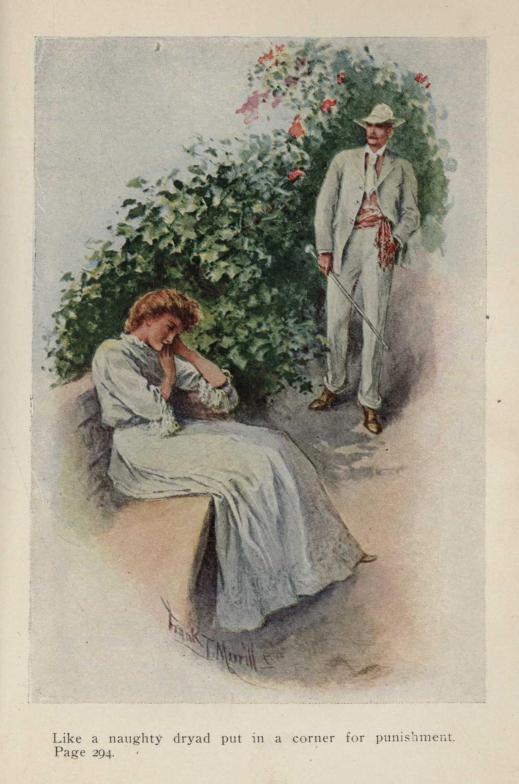
Like a naughty dryad put in a corner for punishment.
At the same moment, ascending the hill from the town, came another young man, whose destination also was the orange walk, where Posey sat disconsolate. John Glynn, finding at the last moment in New York that he could get a quick passage to Genoa by an ocean greyhound put on for an occasion, had returned to Europe several days before he was expected, and neglecting to wire from Genoa, expected to take his friends here by surprise. He had walked from the station, entering the villa grounds from the lower gate. It seemed to him something queer was inspiring the forces of Nature that afternoon. A strange, weird, exciting wind was astir under brilliant sunshine—a wind to provoke and condone any act of nervous irritability. Glynn felt glad to take refuge from its fury by pausing under a great eucalyptus at the foot of the garden, and resting there a while.
All during his quick eight days' passage across the southern route of the Atlantic, he had been alternately drawn and repelled by the consideration of his forthcoming marriage. At the idea of his benefactor, the maker of his fortunes, the dear confiding old man whom he could never repay for benefits conferred, he felt ready to march up to the church door and surrender himself to Posey without a look behind. But it was different when the reverie centred upon the young girl whose innocent thoughts were translated into words as fast as her impulse gave them birth, whose fun and daring, joy and pain, succeeded each other like ripples on a summer sea; he wondered if he had a right to make of her an unloved wife.
For since that fateful hour when he had sat close to Helen in the railway train, and since their meeting at the wayside chapel on the hill, their hearts pulsing together, their thoughts yearning each toward the other, stern resolve forcing them apart, he had known that to say he would cease to love Helen had not made it any better with him, as far as the only woman he had ever desired to marry was concerned. Absence from her, a voyage to and from America, tough work which he had surmounted successfully, a negotiation so skilfully concluded that it had saved Mr. Winstanley grave loss, none of these circumstances had lessened his passionate yearning for her whom he had first held in his arms and kissed as his future wife. When, after one of these outbursts of feeling for Helen, he thought of Posey, it was always with keen shame and abiding pity; it did not seem to him that he was "playing fair"—and yet, here he was, back again at Cannes, the day of the wedding was shortly to be set, and, as Posey's husband, he was to enter upon a career in his native country, the breadth and magnitude of which would surpass the fondest dreams of his ambitious boyhood.
So strong had been the current of inclination turning him from his destined way, that he had actually come afoot from the station, and sent his belongings by a cab, rather than expedite his progress to Reine des Fées by driving. He had no idea that Helen had become a temporary inmate of the establishment. His one letter received from Posey during his swift run home, had described her friend as having sailed away on the "Sans Peur," in company with that "utterly odious Mrs. Carstairs," and "looking so sad and spiritless it wrung one's heart to see her."
Helen in Naples or Sicily, even if he knew her to be far from happy, was better than Helen in Cannes, looking on at his wedding with Posey!
If Glynn could have suspected that at the identical moment, when he was sitting under the eucalyptus tree trying to screw his courage to pushing boldly up the hill, Miss Carstairs was at the writing-table in her room, inditing with hot hands and desperate resolve a letter to Mariol, telling him she would be his wife!
But he dreamed of none of the threads of Destiny weaving together that day and hour while the mistral blew fiercely around Villa Reine des Fées. He only thought he would tarry a little while longer, his legs and spirits feeling weighted as if with lead, before announcing himself at the house, the hero of the "happy event" to come.
A third unexpected visitor to the garden now also advanced from the direction of Villa Julia, and moved furtively behind the hedges toward the Triton fountain.
As Ruby had found herself in the lane about to get into her carriage, with Rosa in attendance, she had caught sight of Clandonald lightly striding ahead of her, his evident destination the gilded iron grille opening into the drive of Reine des Fées. Instantly, the burning, unreasoning jealousy of Posey, that had never forsaken Mrs. Darien, sprang up again to madden her into action.
What she desired to do, to say, to accomplish, she knew not, but (the bad wind, no doubt, aiding) an evil spirit in her blood commanded her imperatively to enter and lurk in the forbidden garden, with the hope of hearing or seeing something pass between the two. She knew from public announcement that Miss Winstanley was about to marry Glynn, the man who had supposed he had bought Ruby's forbearance from troubling his fiancée. If any prick of conscience assailed the desperate creature it was at thought of her sworn promise to John Glynn—a promise about to be forfeited in most treacherous fashion—to say nothing of her loss of his indispensable allowance. For, in stealing the key of the green door from Lady Campstown, she had really meant to be more mischievous and offensive than openly aggressive. She intended to keep it until the chance came to give, as she termed it, "that vindictive old hag, Aunt Lucy," a rousing fright, and at the same time, perhaps, satisfy her curiosity as to how things were going on between Clandonald and the Winstanley girl.
And here was her opportunity sooner than she had hoped. She had sharply ordered the alarmed Rosa to keep watch in the cab until her return; had heeded not the woman's beseechings, for the love of all the Saints, not to run this risk of offending Milady Campstown; and had let herself into Reine des Fées by means of the key which Posey had begged Lady Campstown to use at will, now that the green door was kept permanently locked.
To cross the forbidden threshold seemed to inspire Ruby with more rancorous thoughts than ever before. Why should Clandonald, also Glynn, have paid her so heavily to protect this girl, already favored by fortune, whilst she wandered in outer darkness? She hated Posey the more, not only because these two men stood before her, but because Ruby's best endeavor had not seemed to do her material harm; because the girl had ceased being insignificant and was now rich and powerful; and lastly, because Lady Campstown was her best friend.
Ruby knew that by taking the nearer way she would arrive upon the scene before Clandonald could do so, and be safely in ambush watching him. If he were merely to enter the house for a conventional call she could do nothing, and might slip back to rejoin Rosa, unseen. But she counted rather confidently upon what she had ascertained from questioning her tool, that Miss Winstanley and her friend were generally to be found out-doors at this hour of the afternoon.
The sight of Clandonald walking unconcernedly ahead of her, twirling the Makila stick, which she recognized as a souvenir of their joint visit to Biarritz, was as fuel to her flame. He looked so young, so normally vigorous, so full of bounding life; he was so well groomed, so well turned out, as the men were not with whom she associated in the present phase of her existence. How long it was, with the exception of her talk with Glynn, since she had held converse with a clean, wholesome, and courteous gentleman!
And she was so thin, so bloodless, so unbeautiful; her empire over his sex was so nearly gone, she had so little left to hope for!
The immediate result of this contrast between herself and the man who had once taken her, for better, for worse, at the altar, was to make Ruby Darien furiously angry. As Clandonald passed out of her sight, between the ivied walls of the steeply descending street, she felt that she would have liked to spring upon him like a panther, and—ah! it was better that he had passed on!
Clandonald, as has been said, had unexpectedly stepped in through an arch of crimson ramblers, to find Posey, whom Helen Carstairs had just left to go in to write her letter to Mariol, weeping alone, and lovelier than even he had remembered her.
If Miss Winstanley had been on her guard, or chatting with a friend, or sitting with her book and looking up with a pleasant smile as he drew near, Lord Clandonald might not have forgotten himself, as he now unquestionably did!
Without a moment's forethought, following out the impulse one has to console a child whom one finds in distressful solitude, he made toward her a buoyant movement, taking her hand in both of his, and dropping upon the bench beside her.
In her present period of believing herself, as it were, deserted by John and Helen, who, so fitted for one another, had, figuratively, soared away out of her ken upon a rosy cloud, the girl welcomed Clandonald with lips and eyes too eloquent to be mistaken. Feeling that he must speak, knowing that he ought to choose his words most carefully, he ended by doing nothing of the kind.
"Oh, please don't cry!" he simply said. "You are too dear and lovely ever to shed a tear! If you were mine——"
In books it is where people make the beautiful set speeches that come out just right as to semicolons and periods, besides fitting exactly into place in conversation. In real life, under strong emotion, things are said brokenly that often have neither grammar, rhyme nor reason. This man certainly never meant to make love to this girl out of a clear sky. But his voice, his face, his manner, were all those of a lover such as Posey had not known in her brief experience. And the worst of it was, the same unaccountable, unbidden feeling of delight again rushed over her that she had felt for him upon the ship. It seemed sufficient for him to be near her for that to tingle in her veins! She thought he was the brightest, noblest object her eyes had ever rested upon, not a mere faulty man idealized. In plain words, "the old, old story was told again" in the garden of Reine des Fées!
But Posey had gained in self-control since her experience of the world. She checked the radiant return movement toward Clandonald, who, also pulling himself together, guiltily arose and stood at some distance away from her, holding his hat like a shy schoolboy, without saying another word.
"I'm not crying," she remarked, somewhat untruthfully. "I'm only thinking over a sad sort of talk I've just had with my friend, Miss Carstairs, who's staying with me, as you know. She told me, by the way, you'd been so nice to her on the journey, and so had M. de Mariol. We were sorry to miss you yesterday, and are looking forward to the dinner this evening. I didn't think you would call again to-day."
"Neither did I," he said, "but when it came to waiting for my aunt's dinner hour I had to. I hope you won't mind my taking the short cut to Paradise, without ringing at your front door. It got me here the sooner, see? And as my aunt had happened to let fall that you always came to the Orange Walk about this time, I ventured upon the liberty. But I didn't dare expect such good luck as finding you quite alone."
"Helen has just left me," she answered, a little confused by his ardent gaze. "I can see that it astonished you to find me so much grander than I was. But for me, I'm already used to it. Oh! Do you know, I had the greatest satisfaction yesterday. That Mrs. Vereker, who snubbed me so on the ship, you remember, and that stuffed image of a Mr. Brownlow, were both lunching at the Gold Club, at a table by themselves; and seeing us with some people they thought 'worth while,', came up and spoke to me, almost humbly!"
"How did you treat them in return?"
"I said, 'Oh! really. Are you in Cannes?' And then the Grand Duke asked me some question, and I turned away to him. If the Grand Duke hadn't happened to be there it would have been no fun at all. You see how wicked and worldly I have grown. Then Mr. Brownlow asked if he might call at Villa des Fées, and I said we were so much engaged we hadn't any day at home. Mrs. Vereker is dying to know Lady Campstown, who doesn't care whether she meets a leader in New York or a leader in Allison's Cross Roads. I won't ask you to tell me about your travels, for darling Lady Campstown has read me every line of your late letters, and even some you wrote her as a boy. I know how you stroked the crew of that splendid boat-race at college, and when you shot the lion on the Upper Nile, and what you ate in South Africa. After my talks with her this winter I used to go home thinking you certainly the biggest and greatest and bravest person in the world!"
Her girlish raillery seemed to him the most delicious fooling. He tossed his hat and stick into the flower-border behind them, and dropped again upon the bench beside her. Beside the cool green shadow of their verdurous niche, the sunshine seemed to lie on the marble pavement beyond, like a slab of gold, the mad wind whistling outside harmless. And neither noticed that Mrs. Darien, who had been standing dark with menace, still as Fate, in the shrubbery at their rear, had leaned over and possessed herself of the dangerous Makila stick.
A few moments later, Glynn, where he sat down in the lower garden, heard Posey scream once, then silence.
He sprang up and flew to the spot whence the sound issued, some under-gardeners reaching it at the same time. They found Miss Winstanley upon her feet, with horror in her eyes, Lord Clandonald endeavoring to lift from the ground the form of a senseless woman, his right arm hanging helpless, an ugly bleeding wound upon his brow.
"It's all right!" he exclaimed to them grimly. "This person attacked Miss Winstanley, and I caught the blow, that's all."
"Oh! John, John, how thankful I am to see you!" cried Posey. "Help Lord Clandonald, please; he is badly hurt. It is Mr. Glynn, Lord Clandonald, and for my sake you must let him serve you."
Clandonald, wavering upon his feet, was glad to be assisted to the bench where they were sitting when Mrs. Darien aimed her deadly blow. But he retained sufficient understanding to thank Glynn, and urge on him the necessity of having the woman, who had been evidently overtaken by some kind of a seizure, removed quietly from the place, and put in charge of Lady Campstown—"who will understand." After which brief direction, he uttered one sigh, and fainted.
So Helen found the little group whom tragedy had grazed! Posey, holding Clandonald's head in her arms, his limp body lying across the seat! Helen was carrying in her hand the letter she had come outside to show Posey, in fulfilment of her promise to the girl—the letter to Mariol, telling him she would be his wife!
To her, with a hurried explanation of the affair and of his presence there, Glynn consigned Posey, who seemed scarcely conscious of where she was and what had happened, begging Miss Carstairs to take her to her room. Before all things, it was desirable that Miss Winstanley's name should be kept out of the business, which he believed would end favorably for Clandonald. Helen led her away, obedient as a child, although trembling violently, and holding her hand over a spot upon the breast of her white gown where Clandonald's blood had stained it.
Glynn, fetching some water from the fountain, soon brought Mrs. Darien's victim back to consciousness. Clandonald's first act was to look about for the murderous weapon, and ask Glynn to suppress it; his second to eagerly question the two gardeners, who, having borne Mrs. Darien away, had now returned with remedies from the servants at Villa Julia, secured under pretence that one of their number had met with an accident.
"Quant à la dame, milor," said one of these men, who had been for a long time on the place and knew very well the skeleton in his neighbor's closet. "It was not found necessary to trouble Milady Campstown with her. The housemaid, Rosa, was waiting in the cab, much frightened, since she thought that Madame Darien had looked exceedingly ill when she went into the garden against Rosa's advice. Madame Darien had revived and bidden the men assist her into her carriage, and the housemaid had driven off with her to the station. It was not needful to tell anyone else what occurred, since, the Virgin be praised, no serious harm appeared to have been done."
Glynn, whose French fell short in moments of emergency, tried to explain to the men that his and Mr. Winstanley's gratitude for their excellent service and consideration would continue to be remembered substantially in proportion to their reticence upon the subject. He emphasized it by a transfer of gold to each brown right hand, which the Provençals received with blushes of becoming modesty.
"And now, you will go back to your work, comprehendez vous?" added John, "leaving me to conduct ce monsieur to Villa Julia, explaining that a branch fell from a tree across his cheek and arm!"
Clandonald smiled wanly.
"That will do for a stop-gap," he said. "But I have my fears that the woman who committed this unexplained assault will again be heard from on the subject. I fancy you know, Mr. Glynn, who she is, and that Miss Winstanley has been for months an object of her virulence."
"I should tell you," said Glynn, while aiding him to get upon his feet, "that I had some experience of Mrs. Darien upon my former visit to Cannes. I, in fact, then found it better to go to her lodgings in Nice, and try to perfect a little arrangement for Miss Winstanley's protection. That, it seems, has failed."
"The person is irresponsible," answered Clandonald, a dark flush, coming into his face. "And, I am afraid, incorrigible."
"All the same, I am going to ask your permission to interfere so far as to look her up again to-night."
"You know that is what I most want?"
"I think so. I put myself in your place."
"More than that no man can do for another," said Clandonald warmly.
After Glynn had gotten him into his own bedroom, called up his servant, and telephoned for the family physician of Lady Campstown (who, herself, remained still fortunately absent upon her round of calls), they parted like friends of years.
CHAPTER XII
There was no little dinner at Villa Julia that evening. Clandonald, wretched and feverish, tossed upon his bed. Posey's white face and strained expression of anxiety kept the other villa in a state of suspended animation while Glynn, in the motor car, was running over to Nice on business not stated.
Helen Carstairs met him early next morning upon the terrace, at his request.
"How has she slept?" he asked eagerly.
"Like a tired baby. Toward morning she awoke sobbing, and I soothed her till she fell asleep again. Just now, when I went into her room with the news that Lord Clandonald also had passed a good night, she was very much more like herself—gentle, yet plucky, and determined to keep up."
"I hate a nervous shock for an impressionable woman. Thank God, it is all no worse! Suppose you and I had happened not to be with her—it makes me sick to think of it! Helen, this isn't the time to beat about the bush to find phrases. Tell me the honest truth. Does Posey love Clandonald?"
"I think so. But she has fought against it from the first. Don't let your sympathy with her at this moment lead you to any rash act of renunciation. She is so young. She will get over it. Besides, she has told me most positively that she could never bring herself to marry a man whose divorced wife is living."
"If that is the only obstacle, it need not count," said Glynn gravely. "The woman who called herself Mrs. Darien died last night—and a blessed solution it is to a miserable snarl. She went back with the housemaid to her hotel in Nice, and they got her into bed. By the time I reached the place the woman, crying bitterly, came down to tell me 'her ladyship' was dead. It was apoplexy—the second attack—precipitated by her insane passion of jealousy of Posey."
"Thank Heaven, it wasn't a murder she had to carry with her into eternity! Our poor darling, Posey—if that horrid flint had struck her in the head where the woman aimed to hit—I can't bear to think of it——"
"Don't. We have shaved the narrow edge, but have escaped. Helen, one of the strangest things that ever happened to me was that Mrs. Darien left in the blotter on her table a sealed letter addressed to me. I took possession of it by showing the landlord and the doctor my visiting card. I don't know what they thought of me. I don't much care. In it she asked my pardon for breaking her pledge to me. Said she was tempted beyond resistance to return to Villa Reine des Fées, that she was dead broke, desperate, expected to die suddenly some day, and wanted me to know that if she ever could have gone straight again it was because of the way I had trusted her."
"But your trust was in vain," said Helen, with the hardness of most good women toward bad ones. "Therefore I can feel no sentiment for her but one of thankfulness that she is out of your hands, in Higher ones."
They walked back and forth for a few moments in the crisp morning air, Nature smiling as she always does after the poignant scenes enacted in her sight. Mr. Winstanley, who was having his breakfast in the rose-wreathed loggia upstairs, and from whom the incident of the attack on Posey had been kept, saw them and waved his kind hand cordially.
Glynn stopped.
"It's no use, Helen. All the things I long for upon earth would lose their flavor at the cost of ingratitude to him. Even if Posey does believe that she cares most for Clandonald—and if you had heard the words the poor child spoke when she held him, without life, bleeding, against her heart, you would not doubt it—it is not I who can withdraw from my pledge to her."
Helen could not speak. She was thinking of that letter to Mariol, not yet sent. Although she felt now that Glynn meant to keep to his engagement at all costs, she was sure she could never send it; that Mariol's brief mirage of winning her must fade into the desert sands of friendship, if he would be content with that.
During the days that ensued she kept almost altogether with Posey, who was not allowed by her physician to leave her room. And as Helen was in the act of making up her mind to go to Paris to enter as a boarder in the family of a governess of former days, who now gave shelter to art students and girls whose voices were in training for the stage, she received a startling telegram.
It was from her father at Taormina, requiring her presence there without delay. "I am alone and ill," were the magic words that sent her speeding back to him, to find the hapless gentleman deserted by his wife, whose affair with Danielson had ended in guilty flight! Aged, mortified, broken, clinging to Helen in his humiliation, Mr. Carstairs had yet made short work of ridding himself of the unwelcome visitors who had preyed upon his money, while deriding him for a blind old fool not to have seen before the condition of affairs. In the flotsam of the wreck Miss Bleecker, too, floated off, Helen refusing to see her or listen to explanations, and Mr. Carstairs making short work of her prayer to be allowed to remain with poor darling Helen in this awful time.
At last, then, she was again alone with her father, free to cheer and comfort his life with her best endeavors, a new object given to her for daily care and sacred ministration. Mr. Carstairs would not hear of dallying in the hateful spot where his shame had come to him. He insisted that the "Sans Peur" should take them to an English port, whence they might embark immediately for home. And Helen had reluctantly to acknowledge that the only medicine for a wrong and grief like his was a return to the life of great affairs, in which he was signally a leader.
At Liverpool, where she had landed so listlessly the previous autumn, Miss Carstairs received a letter of loving farewell and God-speed from Posey Winstanley at Cannes. The girl could not keep out of her phrases of affection the note of common sense, which made Helen's humiliating experience a subject of ultimate rejoicing by her friends. She was sure that Helen was going home to new happiness, new occupation, a generally broadening horizon. In the continual circling of moderns around this little globe the friends were sure to meet again, "early and often," Posey prayed. She had entirely regained her health, the weather was getting piping hot, Reine des Fées was too dreadfully dull now that dear John Glynn had gone back "for good" to his office in New York; even Lady Campstown had been taken off by Lord Clandonald for a visit to Beaumanoir; and lastly—it was on the cards that Mr. Winstanley and Posey might also soon go to make acquaintance with England in the Spring.
No word of her marriage. While Helen was pondering upon this theme a steward brought her another letter that had been taken out of a later mail-bag. It was a mot d'adieu from Lady Campstown, containing, among other items of information, a statement that Posey's wedding was "indefinitely postponed."
The perennial Miss Bleecker, although smarting still under the contemptuous dismissal given her by Mr. Carstairs at Taormina, was next seen that Spring at Cadenabbia, hanging on, rather miserably, to the skirts of Mrs. Vereker. The two ladies, waiting there for Mr. Vereker (who had been walking barefoot at Brixen, in wet grass), were heard to bicker continually, to the discomfort of all within earshot. In due time they were joined by and accompanied Mr. Vereker to a new cure he had heard of, at a place in Switzerland, where the régime consisted of skim milk and electricity.
The hotel which sheltered the party proved to be situated upon a sylvan hill-top, surrounded by a park stocked with tame deer, with "Verboten" placarded over every spot where one most desired to go. A merry Swiss lad was hired by the management to jodel in an adjacent grove, but there were no visible cows. One beheld, instead, a flock of theatrical sheep, perpetually conducted up and down verdant slopes by a shepherd and a dog. Also, a band of native singers, the men in tweeds and Derby hats, the women in custom-made blouses and gored skirts, who came often to warble disconsolately upon the terrace. There was even a cuckoo sequestered in the woods, of which Miss Bleecker snappishly complained, as a horrid clock, striking all out of order to wake people up at 5 A.M., until some one told her it was the genuine bird of Shakespeare, when she called it a darling little thing.
For a long, long time it rained at this resort, and the guests sat on damp iron chairs in the veranda and looked at where the view had been some weeks before. After that it was grilling hot, and as Mrs. Vereker and Miss Bleecker were obliged to stay on for the completion of Mr. Vereker's treatment, the temper of the party became something too awful for words.
The chief solace of the two ladies was to read French novels and English weekly newspapers. When the "Queen" published, among "Americans in London," a picture of the beautiful Miss Winstanley in her presentation gown, describing the glories of its "white and silver, with lilies-of-the-valley bunched around the train," together with details of the young lady's success in the fashionable world under the sponsorship of Lady Campstown, Miss Bleecker may have been said to have received her punishment for many follies in the past.
A perfect day of early July saw the visit of Miss Winstanley and her father to Beaumanoir, so long projected and so rudely interrupted, at last an accomplished fact. Lady Campstown, who had taken up her residence with her nephew under the supposition that he still needed her care, sat outside, after luncheon, with Mr. Winstanley, between whom and herself an excellent comradeship had sprung up. She saw nothing odd in the old fellow's quaint manners, his homely exterior, his shyness and reverence toward women. She had always liked his having come out of the Southern rather than the Northern portion of the States, feeling, somehow, more in touch with people from below the fabled line of Mason and Dixon than with their aggressively prosperous neighbors. She liked his showing nothing of his wealth and potentiality, and enjoyed his shrewd talk. Above all, it must be said she liked him for being the progenitor of Posey, who had finally wound herself and tangled herself in the dowager's heart-strings, not to be dislodged.
They had been talking of the girl, and the fact that despite her brilliant little sortie into London society, she did not look quite happy—quite herself.
"It will be as well for her when it is all over," said Lady Campstown, plying her knitting-pins. "But I don't think it's done her real harm to have seen things the way we do them. And another year, perhaps—who knows? There are always changes." She ended with a sigh.
"If you are alluding to my daughter's marriage, ma'am," said Herbert Winstanley, speaking with authority and swallowing a lump of final disappointment, "I was wanting a chance to tell you that she's about concluded that John Glynn and she will be better friends than lovers. I had been suspecting something of the kind when she told me—on the Fourth it was, and I had to laugh when she said she chose that day on account of George Washington and the cherry tree, because she couldn't tell a lie. That's Posey, Lady Campstown. Always a laugh on her lip when a tear is in her eye. I saw how hard it went with her to have to rob me of a dear hope. But I reckoned if her mother'd been living it'd not have been let go so far. It's a hard thing for a man of my age to play on a little delicate musical instrument like a girl's heart. It's over, anyhow, and she's written giving Glynn his freedom. I think Posey would like you to know these circumstances, ma'am, seeing you're the best substitute for a mother the little girl has had. She doesn't want you to think her light or triflin' in such things; she tried hard to be loyal to him and me.... But even if she'd loved John well enough to be his wife, there was an obstacle. He had kept company with another young lady first, and they'd been separated by his being poor.... I presume you'll agree that a young fellow who'd once been in love with Miss Helen Carstairs couldn't find giving her up as easy as it seemed."
"So that's the meaning of it all?" cried her ladyship, dropping her knitting, which the Schipperke proceeded to guard as if it were a Dutch baby asleep in a canal-boat. "I often wondered, but could not be sure. I almost thought it was M. de Mariol."
"Well, I shouldn't think that would suit, exactly," said the old man, cautiously nodding his Anglo-Saxon head. "Not but what he's a nice man, the Monseer. But, as things look now, my boy is a better match for Mr. Carstairs' daughter, and John'll feel more sure of himself to ask her again. She's had a hard time, that sweet lady, and I wish her many years of happiness to forget it in. You see, ma'am, my Posey thinks John will ask her again."
Lady Campstown, who had long since resigned herself to see the vision of Helen at Beaumanoir fade from her imagination, here felt a great new jet of hope spring up in her heart and water everything around it. Her withered cheek glowed rosy red, her eyes had a girlish lustre. She hardly presumed to put her thoughts into words, and yet the mild blue orbs of old Mr. Winstanley had fixed themselves upon hers with a singular significance.
"Mr. Winstanley! You have another idea?" she exclaimed, nervously trembling.
"Several, ma'am," said Herbert Winstanley. "You know by this time, I reckon, that your nephew got that bad hurt on the cheek and just missed losing his eyesight, to save Posey from a mad woman. Girls set store by such experiences, I suppose. But long ago, on the steamer, I saw she fancied him mightily.... I won't conceal from you, ma 'am, it isn't what I'd have picked out for Posey. Doesn't seem suitable for such a Hail Columbia sort of girl, now, does it? But Clandonald's a white man, I'll say that for him.... And m' wife set a great store by English people and their homes.... They're staying away a good long time, those young folks.... The doctors threaten I'll have to spend my winters in Cannes, the years that are left to me, but I reckon Villa Rain des Fays is big enough for us all."
When Clandonald and Posey came back at last from seeing the white peacocks they were walking hand in hand, and a great peace had settled upon their faces.
THE END
* * * * * * * *
Other Works by Mrs Burton Harrison
A BACHELOR MAID
12mo, Cloth, $1.25
SWEET BELLS OUT OF TUNE
12mo, Cloth, $1.25
CROWS NEST AND BELLHAVEN TALES
12mo, Cloth, $1.25
A VIRGINIA COUSIN AND BAR HARBOR TALES
16mo, Cloth. $1.25
AN EDELWEISS OF THE SIERRAS
Post 8vo, $1.25
THEOPHANO
Post 8vo, $1.50
HELEN TROY
16mo, Cloth, $1.00
A TRIPLE ENTANGLEMENT
12mo, Cloth, $1.00
THE UNWELCOME MRS. HATCH
12mo, Cloth, $1.25
SYLVIA'S HUSBAND
12mo, Cloth, $1.25
THE CARLYLES
12mo, Cloth, $1.50
THE CIRCLE OF A CENTURY
12mo, Cloth, $1.25
THE ANGLOMANIACS
16mo, Cloth, $1.25
GOOD AMERICANS
12mo, Cloth, $1.25
AN ERRANT WOOING
12mo, Cloth, $1.50
FLOWER DE HUNDRED
12mo, Cloth, $1.25
A DAUGHTER OF THE SOUTH
16mo, Cloth, $1.25