Front matter (continued 2)
Reading edition
"Perhaps, if you and your father are to be in London, you would let me take you out to dinner and cheap seats at the play?"
"Wouldn't I love it? But you can't drag daddy to the theatre, and I'm not like Miss Carstairs, blessed with a chaperon. Do you notice that, as we are getting 'half-seas over,' Miss Bleecker's English accent becomes more pronounced? She is forever talking about when we are 'in town,' and regretting that it is out of the season, because so few of their great friends will be there to welcome them. She calls all the American duchesses by their first names, and the other United States peeresses that she didn't play with in infancy, she must have brought up by hand."
"I am afraid I am too lowly a personage to claim the lady's acquaintance in future," said Clandonald, indifferently. "But I confess I should like, for my friend Mariol's sake, who has conceived a vast admiration for her charge—to manage to ask Miss Carstairs and himself to join you and your father in a run down to Beaumanoir for luncheon, while you are 'in town.' It is pretty, there, in autumn, and there are sure to be some good peaches on the garden wall."
"How adorable!" exclaimed Posey. "Daddy might go to that, if I beg him, but Miss Carstairs—! There's the difficulty. She won't more than look at me. I wonder why you, who are born really higher up in the world than Miss Bleecker and Miss Carstairs, never let me feel that I am only a druggist's daughter!"
"In Athens, they tell you Aristotle kept a chemist's shop," answered Clandonald, laughing. "And I have always understood that some of the most illustrious of the families in New York's Four Hundred were founded upon drugs."
"If it wasn't pills, or capsules, or hair tonic, it was some other kind of merchandise!" said Posey, viciously. "And, anyhow, what does it matter? There was a sentence I copied out of a book of Maarten Maartens, that Mrs. Bartley lent me, about there being no other way of living than either on the money you have earned for yourself, or on the money that other people have earned for you. As long as that simple fact remains, the question will also remain whether money-making is so very contemptible!"
"Try any man living, with an honest chance, and see what he'd answer," said Clandonald with a sigh. "I'd give anything I own for a respectable business that would bring in the cash and the knowledge of how to run it, bien entendu."
"You poor thing!" exclaimed Miss Winstanley, guilelessly. "Why weren't you born in dear America? Of course if you could go stalking around in chain-armor like those ancestors of yours at Beaumanoir, it wouldn't seem so appropriate. But just to look at you as you stand, to-day, I should judge there were the makings of a fair business man in you. Look here, Lord Clandonald, I don't know that I was ever better pleased in my life than by that idea of yours of our going to lunch at Beaumanoir with Miss Carstairs. I don't mind telling you I just adore that girl—and the combination of her company with a moat and yew trees, and wall-peaches, and the chance of seeing English rooks—and Miss Bleecker not 'in it,' I'll be eternally obliged."
"It seems to me the host counts for unflatteringly little," said Clandonald, somewhat piqued.
"I didn't mean to have you think so," answered she with astonishing gentleness, "I was only carried away to forget my manners by realizing so many dreams at once. Indeed, I am glad, or shall be, to meet you again after this voyage. Now, I'm going to ask you something that will make you laugh, perhaps, but please don't. Could you give me the address of a really good place in London where I could get frocks and hats, ready-to-wear, that would keep me from looking like a guy?"
Poor Clandonald winced at thought of just how he had become acquainted with the best faiseuses in London, whose bills he had paid to the uttermost farthing, after the ex-Lady Clandonald had ceased to be. But he could not help smiling at the earnest anxiety of his questioner.
"I think I might help you a little, perhaps, but surely——"
"Surely there ought to be some woman aboard to do it? Of course you think so, but if I could tell you half I've divined, and some things I've overheard from them, you'd know I'd never ask one of them. Why, I heard that old Vereker tabby say to the old Bleecker cat, as distinctly as could be, that I was a freak in clothes and a bounder in manners, and she wondered the captain let me go at large."
"Oh! I say."
"Perfectly true, and I had it out of her by trailing her half-dead husband after me all over the ship, until he hadn't a leg to stand on; and I put a rose in his buttonhole under her very eyes. I've been ashamed of it ever since, but when a girl's got to fight her own battles, what would you have?"
"There should be always some one glad to fight for you," he said, suddenly fired by her proud young beauty in distress.
They had, while speaking, walked down to the dividing rail that cuts off the promenaders of the second cabin from the first-class decks, and for some moments tarried there, Clandonald with his back to it, Miss Winstanley facing him. As the Englishman spoke these unpremeditated words of warm sympathy, for the second time that day there had come into the girl's artless face an expression she certainly had no idea of revealing. It caused Clandonald to pull himself up with a jerk, and stay the vague, rather affectionate, words he had been on the point of uttering, without, perhaps, meaning to have too much importance attached to them. And it was further reflected in the shining green eyes of a second-class passenger in shabby black, standing near by the barrier, wearing a veil of black gauze with large coquettish velvet dots that half concealed her undulated locks of unreasonably ruddy hair!
It was not the first time the green gleam of those watchful eyes had been fixed upon Clandonald and his companions. He had, in fact, been under their close observation whenever practicable since leaving New York harbor, in the course of their owner's predatory walks, as she alternately drew near and receded with graceful feline tread, seeming to look at nothing, yet forever alert where the good-looking, lazy young Englishman was concerned.
The youthful steward who distends himself for the public good by blowing the bugle for lunch was, on this occasion, the agent of Providence to relieve a strained situation. Clandonald could not, in the face of such a blast, go on with his implied offer of championship. The second-cabin passenger glided swiftly back across her little bridge, and was seen no more. Miss Winstanley, announcing herself half-starved, went to her stateroom to wash her hands. And his lordship, to calm his feelings, partook of a certain small, specially reviving, bitter-sweet draught, which his servant had acquired the gentle art of mixing, during their sojourn in San Francisco. On the way into the dining-room, he found Mariol just ahead of him, amid a congerie of stewards hurrying to and from their pantries with their arms full of crockery, and in an atmosphere tinctured with out-rushing odors of cauliflower and curried rice, gave his friend a word of counsel.
"I have been talking with Miss Winstanley," he said. "The truth is, Mariol, the poor girl is being pecked by all these women, until it hurts. You have some friendship, perhaps some influence, with Miss Carstairs. Persuade her to be generous, and take the outsider in. It will cost her nothing, and I'm hanged if I understand why she's been such an icicle, as it is."
"Did Miss Winstanley invite your intercession?" asked Mariol, dodging back from contact with an inclined plane of mutton broth, in a tilting china plate marked with the White Star's emblem, borne aloft by a deeply apologetic steward.
"No. Absolutely no. She'd fight to the last ditch before she'd give in to them. But I have an ulterior motive. I want to ask the two young women with my dear old aunt, Lady Campstown, to play propriety, to come down with you to Beaumanoir some day next week, and if they hardly speak——"
"Under these circumstances, I will engage to attempt the impossible, though whether I achieve it is quite another story. I, too, have been at a loss to fathom Miss Carstairs' apparent intention to ignore our pretty table-mate. I had fancied her too sure of her own position to care about a mere difference in social status. I have found her perfectly amiable. But if, by any chance, the discussion of Miss Winstanley comes up, there is an immediate stiffening of the muscles of the neck and chin, the clear eyes become veiled, and she turns the subject. I could almost fancy, but that they never met before, there was some personal animus between them."
"Tell her the girl is her devoted lover from afar, makes her a model in all things, and that we owe the agreeable modifications of the fair Posey's dress and manner exclusively to Miss Carstairs' example."
"That is a happy suggestion, and may accomplish good results. But did you ever know a man's eulogy of a woman effect anything with her own sex? It is generally successful only in confirming the worst predispositions, and in precipitating animosity where latent antipathy had sufficed. Still, who could resist the exquisite flattery of such imitation as our Posey's of Miss Carstairs? Fix your day for Beaumanoir, my dear chap. I consider our cause gained in advance."
"Do you know, Mariol," said Clandonald as the two men sat down at table, where the ladies had not yet arrived, "I have sometimes fancied that you yourself are getting rather under the spell of the young lady you have engaged to placate in Miss Winstanley's behalf."
"Do you know, Clan, that I never before suspected you of the imaginative gift? Nothing but Jonah's gourd—was it Jonah, and was it a gourd?—that grew up and withered in a night, could have had so little time allotted to its natural development, as a fancy by me for Miss Carstairs."
"That is no argument. I have read of love affairs beginning at the Statue of Liberty and culminating before the Gulf Stream was crossed. There is really no better medium than mid-Atlantic air for the growth of the tender passion. The leisure of a good voyage is like the forty years of Europe compared with the cycle of Cathay."
"It seems to me that you are exculpatory."
"I wish to heaven I might be!" exclaimed Clandonald, smothering his very genuine regret with a forkful of the roast beef of old England pastured upon Western plains.
The talk that morning with Posey Winstanley had awakened in him certain emotions of a simple elementary sort that, in spite of him, still twanged upon his heart-strings, pleasingly. He had, however, been by no means prepared for that upward glance of her childlike orbs when he had offered her his sympathy. While the normal vanity of the male creature thrilled in quickened interest in response to it, his judgment, his sense of responsibility, nay, of honor, called upon him loudly to let the thing go no further. A patent and audacious coquette on the surface, she was at heart a child who had as yet tasted no reality of sentiment for one of the dominant sex, and to whom such reality would inevitably come with extraordinary force.
The whimsicality of her having selected him—a battered plaything of the Fates, who did not want her, who could not indulge in her—for the object of a dawning first passion, struck him hard. He resolved to keep out of her way, and considered how he could have his meals elsewhere, or take to his bed for the remainder of the voyage. The projected luncheon at Beaumanoir should be carried out, and that done, he would have acquitted himself, en galant homme, of all that could be reasonably expected of a travelling Briton toward visiting Americans who had contributed to cheer his voyage across the Atlantic.
To begin the new order of things, he let himself be absorbed in conversation by Miss Bleecker, his pet aversion, who leaning over the table, her ample bosom begarlanded with chains and cords, each one sustaining some necessary implement for the aid of vision, far or near, and all of them entangled, was in her best spirits. She, Lady Channel Fleet, and Mrs. Vereker, had been in their deck chairs since broth and biscuits to the present moment, discussing the American women who had married into the British nobility. The three ancient heads cowled in veils and furry hoods—for the air off the Banks had had in it a tang of ice—had bobbed together during this time with a vivacity of movement suggesting the cinematograph.
Mrs. Vereker's sciatic leg, which it was the mission of her good-looking footman to keep enwrapped with rugs, when he could forego flirting with the ladies' maids, had been frequently exposed to the biting wind, and yet she did not notice it. Lady Channel Fleet, who, with her husband and a maid, had been doing America economically in somebody's private car, at somebody's expense, wisely kept quiet; since, if she shivered, there was no James to wrap her up. Miss Bleecker, more serene, indeed, than Buddha, in her position between a British matron of title and one of New York's leaders, did not feel the cold. Except in a parterre box at the opera (with the best people), she had no greater idea of happiness than such surroundings; with a long, uninterrupted morning in which to rehash old stories and acquire new ones concerning the ladies under discussion, whom she secretly considered the elect of earth.
Lady Channel Fleet, conscious of having had more honors paid to her in America than in the whole course of her undistinguished life at home, was proportionately inclined to be critical of Americans, now she had come away. Her strictures upon their extravagance in living, which she had enjoyed to the top of her bent, the largeness of their houses and the smallness of their grounds, their ridiculous way of running after strangers, and the extraordinary interchange of matrimonial partners among people one knew and visited, were interspersed with various bits of gossip she had been able to pick up in England concerning American peeresses who had not received her at their houses and were, indeed, unconscious of her existence.
It had been rather a bitter pill for Mrs. Vereker, who was hand-in-glove with all these fine people both in England and New York, to have to listen politely to Lady Channel Fleet. But, then, Mrs. Vereker had already stood so much in the line of incivility from the British dames of high place upon whom she had lavished courtesy during their sojourn in the land of the free, that she was a little hardened. She knew that on arrival out, she would go from Claridge's to stop at country houses where Lady Channel Fleet's star would never even faintly rise. She was secure in being able to buy herself a good time and the best of everything wherever she might go, and felt, on the whole, content. Miss Bleecker, on the contrary, who had no such solid foundations as her friend, felt in listening to Lady Channel Fleet as acutely pained as if she were reading one of Mr. Benson's or Mr. Hichens' novels, wherein modern Americans of good society are made to say "Popper" and "real nice." She could hardly imagine how her nation could arise to ignoring these dreadful accusations.
But when Lady Channel Fleet had incidentally let fall that she always presumed Miss Bleecker, from her speech and manner, to be an Englishwoman born, Miss Bleecker had forgiven all. She redoubled her powers of entertainingness, brought out a few newer, racier anecdotes of persons known to all of them, and the luncheon bugle had caught the gossips unawares, making them feel the morning quite too short.
"I suppose we shall see you at Mr. Vereker's little supper this evening, Lord Clandonald?" said the chaperon, suavely. "One knows what to expect in the way of private dainties, when Mr. Vereker entertains—game, wines, patés, caviare put up for him on the Volga, flowers, grapes and melons from his own glass houses, and such turtle soup as only the Vereker chef can send aboard. And to think the poor man has to sit at the head of the table, drinking milk and swallowing little tablets out of his waistcoat pocket, looking gray as a ghost, and thin as a rail, not able to touch a thing of all his delicious spread!"
"Mr. Vereker has been so good as to include me," answered Clandonald.
"I believe most of those at our table are expected," the lady went on, in a hardly lowered voice, "with, of course, one or two exceptions. When Mr. Vereker crosses alone they say his parties are apt to be a little mixed. But with his wife aboard—she is so thoroughly exclusive, one need never fear."
What might have been omitted from the words, was accentuated by a manner of contempt whose objects there was no mistaking. Mr. Winstanley as usual appeared not to be listening to the passing chat; but his daughter lost not a syllable or look; Helen Carstairs, also, fully appreciated the situation. While Posey, with rare self-control, kept her own counsel and remained silent, Miss Carstairs, flushing faintly, spoke so that all present could hear her.
"I'm afraid I'm one of those who fail to appreciate the honor of Mr. Vereker's invitations, ashore or afloat. Who was it who said to be left out by him was a greater compliment than to be placed at his right hand?"
"Helen, I'm surprised to hear you talk such nonsense," began her chaperon briskly, but was interrupted by Posey Winstanley, who with a grateful glance at Helen, spoke in tones as quiet and measured as her own.
"Then I am certainly past getting the benefit of Miss Carstairs' hint, Miss Bleecker, since Mr. Vereker asked me first, before seeing if he could get the others; and I was rash enough to accept."
CHAPTER V
MR. Vereker's little supper proved all that Miss Bleecker had claimed for it in the matter of exotic luxury. American beauty roses, as fresh as if they had bloomed that morning, decked the centre of the board, and a corsage bouquet of royal purple violets lay beside each lady's plate. The unpleasantly pallid host, with skin drawn like parchment over his lean jaws, his hair and mustache unnaturally black, sat at one end, and (to the dismay of Miss Bleecker, who had been made to fit in at the side) Miss Posey Winstanley upon his left, opposite my Lady Channel Fleet in a rumpled cotton blouse, still wearing the turquoise earrings, with the addition of a turquoise chain to hold her eyeglasses.
Posey, in severely plain white voile, with a picture hat and white feathers framing the waves of her splendid hair, thanked her stars that she had had Helen Carstairs' example in dress long enough to profit by it for this occasion. She saw in half a glance that her frock, the result of the best skill of the dressmaker at Alison's Cross Roads, who called her by name in fitting her, could not vie with the dove-colored confection with its all-over embroideries that sat so easily upon Helen's erect form. But she knew that it was unobtrusive, and the little slip of mirror above her washing-stand had told she was at her best.
It had been an ordeal that of dressing while her cross room-mate, who made a virtue of what she called "retiring" early, continued at intervals to extend her head like a turtle's from its shell, and inquire whether Miss Winstanley would be very much longer! Posey was fain to go outside and have the finishing touches put to her toilette by the stewardess, Mrs. Gasher, the bib of whose white apron covered sympathetic interest, since she knew about the supper, and that the ladies to be present were dead set against the beauty of the ship. When she had stuck the last pin, Mrs. Gasher maternally informed Miss Winstanley that she looked pretty enough to beat the Jews, and would find her 'ot water covered with a towel when she came in again to go to bed; and if she couldn't get undone herself, never to mind ringing up Mrs. Gasher.
Under this cheerful inspiration, Posey had marched into the saloon to find the others all in place, an empty chair kept for her at the host's left.
She had been hoping to be next Clandonald—for no reason but that she wanted it. Instead, she had but a cold glance from him across the table, at which she quailed because she thought she read in it displeasure. And immediately he turned back to his conversation with Prince Zourikoff about Silver or Trusts, or Labor, or some of those tiresome things, and looked at her no more. The only consolation for this awful blow was that Helen, sitting between Mariol and Bobby Vane, had smiled at her kindly when she came in late.
Miss Bleecker, beside the Graf von Bau, who occupied the seat to the left of Mrs. Vereker, decided that the world was out of joint. Lord Channel Fleet, at the right of his hostess, looked tired, and when Miss Bleecker effusively addressed him upon topics of contemporaneous interest in London, gave her but scant answers. Graf von Bau, after he had exhausted civilities with the lady of the feast, had but eyes and ears for the spot where Posey had already begun to outdo herself in characteristic nonsense.
"That girl!" said Miss Bleecker, between her teeth, to Mr. Charley Brownlow, a serious-faced, clean-shaven New York clubman of whom the utmost his friends and enemies could find to say was that he was "always everywhere." "It is not enough to defy poor dear Mrs. Vereker, who flatly said she should not be asked, but to make herself so conspicuous. See, every man at table, except you——"
"I don't know her, don't you know? Never met her anywhere," interposed Mr. Brownlow gravely.
"Of course you didn't—as I was saying, every man at table but you, and, I'm glad to see, Lord Clandonald, can look at nothing else. I suppose she went too far with Clandonald, and he wants to put her back in her place. Everybody understands old Vereker's rage for a pretty face, though I, for one, can never see good looks in a common person. It's scandalous the way she's going on to-night. Mr. Vereker's trying to make her take champagne, and she pretending she never drinks it! Poor Lady Channel Fleet, what a trial to sit opposite her! Now, we shall have a fresh batch of stories circulated in London about the way American girls act; and the worst of it is you can never get the English to see the difference between people of our stamp, and hers. Why, I don't believe Lord Channel Fleet and Clandonald take in, at this minute, the enormous distance between my Helen and that impossible young person. What's that they're laughing at? Something saucy she is saying to Lady Channel Fleet, I'll wager."
"What do we do for chaperons, at home, Lady Channel Fleet?" Miss Winstanley was remarking, her head well in the air, and the spirit of mischief securely seated in her eyes. "Well, we don't need 'em greatly at Alison's Cross Roads, where I live; but if there's a party at the other end of town, your best young man generally calls for you in a hack. And when he brings you home again, about three or four in the morning, you give him your latch-key to open the front door, and if you're not tall enough, you get him to turn out the gas in the vestibule before he goes."
"Good Heavens!" ejaculated Lady Channel Fleet, growing purple.
"Why not, I'd like to know?" exclaimed Posey, sturdily. "We consider it awfully swell to be taken that way, and the fellows that can't afford a hack generally bunch together with the girls and all go in the tram; and it's lots of fun, I tell you. Just bully!"
Mrs. Vereker exchanged glances of mute despair with Miss Bleecker and Mr. Brownlow. The others laughed frankly, Clandonald, only, remaining smileless, and Helen Carstairs coloring with a futile desire to arrest Miss Winstanley's progress in confidences.
As well attempt to stay Niagara! A demon of recklessness had possessed himself of John Glynn's promised bride, and poor Posey went from bad to worse, talking continuously, her cheeks flushed to the color of the American beauties lavished upon the table, her eyes glittering defiance; while old Vereker, who had desired nothing better, applauded her every utterance, and urged her to further daring.
"She should stop now," whispered Mariol to Miss Carstairs, who was looking very grave.
"Oh, indeed I think so," answered Helen earnestly.
"For her own sake, if there is no one else whose interests are to be guarded."
Helen started perceptibly. No one else whose interests were to be guarded? What of John Glynn, and where was the friendship Helen had promised to keep for him in lieu of the love she had withdrawn? Impulsively, she leaned forward, caught Posey Winstanley's eye, and into her own beseeching, all-womanly gaze threw an appeal not to be resisted.
Clandonald, who had begun to be sickeningly annoyed by the scene, and as far as possible avoided looking directly at the heroine of the hour, happened to note this little episode. Remembering what Posey had told him of Helen's influence over her imagination, he was touched but not surprised at the younger girl's response. Posey, blushing hotly, drooped her eyes, and in an instant, as if with a garment cast aside, had parted with her aggressive gaiety. During the remainder of the meal she sat dull and spiritless, and at its close, when she had promised to sing one song for them, tried to get out of it and leave the party.
There was a general outcry of remonstrance. Bobby Vane, coming around to lead her to the piano, whispered to her to do her best and silence the tabby chorus. When she finally yielded, and sat down, expectation ran high among Mr. Vereker's faction that the girl would give them something audacious to be remembered.
It was but a "Mammy" chant, she breathed, rather than sang, in a voix d'or that softened all hearts within hearing; and before they could applaud it she struck firmer chords, and began Lockhart's Spanish ballad:
"Rise up, rise up, Xarifa,
And lay your golden cushion down."
The song and its setting were unfamiliar to most of those present. While it lasted, they forgot the grinding of mighty screws that bore the ship ever forward, they heard not the wash of ocean coming through the open ports. They were in ancient days of warlike Spain, and all their sympathy was for the lovely Moorish lady forsaken by false Abdallah. Everybody within hearing was drawn irresistibly to listen in ravished silence. And when for the last time the hapless Xarifa refused to come to the window and "gaze with all the town" at her recreant lover riding by in state, the honors of the evening were clearly for Posey Winstanley. At that moment, all but a few of the audience were prepared to be led or used by her, as one feels when Calvé softens to sing a folk-song of her native land.
Amid the patter of applause Miss Winstanley abruptly arose from the piano, and said she was going out to get a breath of air. There were protestations, but only the host, who looked at her with bleared, enraptured eyes, ventured to ask her to sing again. Then, Mr. Vereker finding his proposition for Lillian Russell's latest success unheeded, allowed the departure of his star, rejecting all offers of companionship, to be the signal for breaking up the affair.
Everybody scattered, the men to the smoking-room, the ladies to their cabins. Helen Carstairs, with her maid in attendance, came back almost immediately, and stood for a moment hesitating in the companion-way of the deck where she had last seen Posey. Here she encountered Clandonald, who, like herself, seemed to be at a loss.
"I am undertaking a formidable task," she said. "To look for a missing person in this ship; but have you chanced to see Miss Winstanley anywhere?"
She saw that his face was clouded, his calm ruffled.
"I myself have been on the same search," he said, brusquely. "But we may as well spare our pains. The young lady in question appears to be at present under charge of Mr. Vereker."
Helen had but time to let her face show the annoyance of her feelings, when out of the clear obscure of the deck beyond, against a background of sky "patined with such bright stars" as never Shakespeare saw, came to them a flying figure. It was Posey, flushed with angry blood, and after her limped their host of the evening, his spectral face wreathed in apologetic smiles.
"Oh! please, Miss Carstairs, may I stay with you?" exclaimed the girl with quivering lips, in her agitation putting herself between Helen and Clandonald, who involuntarily interposed his stalwart form so that none else could approach her. "I didn't realize how late it was when I went out to be by myself in the fresh air."
"Miss Winstanley is just a leetle nervous after her triumphs of to-night," began Mr. Vereker, who had come up with them—smoothly, but ill at ease.
"I am not nervous. I never was in my life," cried the girl, stamping her foot. "It is because—because——"
She ended in a burst of passionate tears.
"Let me go with you to your room," said Helen, gently. "I had wanted to ask you for a little walk, but it is late now, and the deck people are for putting us all to bed."
"High-strung little filly, and green; green as grass," observed Mr. Vereker to Clandonald, as Miss Carstairs disappeared, leading Posey down the corridor. "If you're up to a little poker in the smoking-room, I can tell you a thing or two about our bewitching girl from Dixieland that will amuse you greatly."
"You will excuse me," answered Clandonald, with lightning in his gaze. Mariol, passing in at the moment, saw Vereker shrivel under it and disappear. Clandonald gave his friend a clue to the situation.
"If you had followed your impulse and punched the old sinner's head," commented Mariol, "it might have been a poor return for his hospitality, but a mighty relief to you. However, we can safely leave him to the gods for punishment. He will probably go under to-morrow, with one of his attacks, because he drank champagne for supper. I understand that a trained nurse for him makes part of the Verekers' travelling suite. He will become a horrid elderly infant in her hands. I am glad Miss Carstairs came to the relief. I hope you noticed that fine movement of hers to check the exuberance of the younger girl? I had no time to put your suggestion to enlist her into effect before the thing occurred. And now——"
"Now, I think we may count upon our day all together at Beaumanoir. But till then, and after it, Mariol, I mean to keep my distance from Miss Winstanley."
"The trouble was that you began doing it too suddenly. From the moment she caught sight of your glum countenance at supper the sparkle went out of things for her. But, bon Dieu, what a gift she has, that untrained creature! Somebody ought to take charge of her musical education, and in a few years she would witch the world."
"There is something better for a pure, straightforward being like that to do than to witch the world behind footlights," said Clandonald doggedly. "I can't think of it for her."
"My advice to you is to get off at Queenstown," answered Mariol as they separated for the night.
"You are not sleepy? That's good, for I'm not, either, and I'll just send away Eulalie, and we'll go into my room and talk."
Posey's heart lightened with pleasure as she followed Miss Carstairs inside the pretty bower Eulalie's skill had contrived from her young lady's belongings for the voyage. What a contrast to the half of a dull inside cabin which Mr. Winstanley, in his simplicity, had accepted for Posey from the agent of whom he had purchased places; with the spinster room-mate humped under the bedclothes on the sofa; her clothes and hats hanging overhead distractedly; their steamer trunks and bags encumbering the narrow space between hers and Posey's berths!
Here were unimagined comforts, order, nicety, a little brass bed with flowery curtains, softest pillows and duvets, a bath room opening out, with porcelain tub; an equipment for the toilet that astounded Posey, till then content with her little cotton night-gown trimmed with tatting, her kimono of cheap blue flannel bought ready-made, her one brush and comb, and tooth-brush, and bottle of Sozodont, her knitted slippers, and the steamer-pocket of blue denim with the motto "Bon voyage," presented to her on leaving Alison's Cross Roads by her friend the dressmaker! But she showed no more surprise than an Indian does on his first visit to the glories of the White Father at Washington. Truth to tell, she had already arrived at the stage of development where things tangible have become of secondary importance to feelings and emotions. She had passed, that evening, through so many varying phases of mental experience, that Helen Carstairs' new kindness seemed the opening of the gate of Heaven.
"Now if you feel like it, and think it will do you good," said Helen, installing her in a cushioned chair of Madeira wicker-work, and, herself, perching school-girl fashion on the settee, "you must tell me what troubled you, though I think I can guess."
"He tried to kiss me, that hateful old mummy that I've done nothing but make fun of on the voyage," cried the girl, fiery blushes streaming into her face. "If he hadn't said such fool-words when he did it, I might have thought he was just like old Grandfather Billings of our town, that always dodders along in the sunshine and kisses the girls when they stop to speak to him, thinking they're their own grandmothers. But even Grandfather Billings has never kissed me. I hate it, and never would put up with it from a living soul, so when old Vereker tried it on, I boxed his ears, and boxed to hurt, too, and then I ran away. What business had he following me out on deck, anyway, when I'd said I wanted to be by myself? If daddy knew—but he shan't know, he's too good to trouble, and I reckon I can take care of myself."
She ended bravely, but one glance into Helen's grave, kind face sent her again into tears.
"Oh! Miss Carstairs, don't mind me. Let me be a little while, and I'll promise not to bother you again. After you looked at me that time at supper, I seemed to shrink up into such a poor pretending creature. I saw in a flash how cheaply I'd been 'showing off.' It was mostly to make those people that looked down on me sit up on their hind legs, anyway! I felt common and half-bred beside you, whom I'd been trying so hard to imitate since we came aboard. I do want to be a lady, your kind, I do, I do. Not only for my own sake, and my mother's, who was a real one, but because—if you only knew——"
"I am ready to know," said Helen, after a pause, her voice, in spite of her, curiously flattened.
"I am engaged to marry a man, to whom it will mean everything that I shall be, let me say, all you are. And there's a great reason why I should try to please him in those things. How strange that I should want to tell you such an intimate secret, out of my very heart! But there is no other woman I can talk to, and that look you gave me seemed to open every door within me!"
"I will help you if I can," Helen breathed, rather than spoke. Her spirit, wrestling with the certainty that crushed it, was yet ready to rise to generosity. Was it not what she had bid John Glynn do in the moment of his acutest suffering? Find a younger, fresher, more trustful life-partner than herself, and put swiftly out of mind their disastrous venture together that could not end in happiness! What right had she to be feeling these fierce heart-beats of rebellion against the child's superior claim upon him, these desperate yearnings to have him back again?
"I am ashamed to let you know what will make you think even less of me than you do. When I promised myself to John Glynn—there I've told you his name, but it doesn't matter—I did so because I thought it would make my dear daddy, who was in some sort his guardian and his father's best friend—happier than anything in the world. Also, I was flattered that he should ask me. Down at Alison's, where John lived as a boy, they think he has taken the head of his firm into business with him, and that all New York looks on admiringly. He's about the greatest hero we have after Lee and Davis. He's a splendid man, Miss Carstairs, perhaps you have heard of him? I remember now, daddy said Mr. Carstairs had spoken well of John. When that Lady Channel Fleet had the cheek to say at supper, she considered the American men, as a rule, inferior to their women, and decidedly so to Englishmen, I could have flown at her, and asked her to wait till she'd seen John."
Helen, conscious that something of the same mental protest had formulated itself in her during the same period of provocation, could not forbear a smile. Fortunately, Miss Winstanley, being fairly launched upon her confidence, did not pause for answer or comment.
"You will see, then, that I do honestly mean to be what I ought, to John—that—I have no other wish or fancy—and yet there is another influence that's come without my seeking—one that could not bring me happiness. It frightens me to think of it. I don't know what to do, where to turn. Think of putting the thing of a day and hour against the other, the safe one, the true one! Yes, it frightens me. Miss Carstairs, you are older and wiser than I, tell me what I shall do to conquer it?"
All the voices in Helen's heart sang in chorus, in answer to this simple and pathetic appeal. The voice of joy, the voice of temptation were louder for awhile than the others, but she dared not let them prevail. She had never been a demonstrative person, and the touching of strangers, under no matter what stress of sympathy, was an impossibility to her. She did not, therefore, "lock Posey in a warm embrace" and "kiss her upon the virgin brow," bidding her be of good cheer, as all would yet be well between John Glynn and herself. But she told her, calmly and dispassionately, that it is probable no girl ever grew up to womanhood to escape some errant fancy for a man whom she afterwards thanked God she had not been allowed by Destiny or her parents to marry. She counselled her to indulge in no dreams or reveries or self-questionings about the matter, but to keep to the pledge she had made, and give all her energies to the task of making a good man happy.
Posey brightened wonderfully during Miss Carstairs' little lecture. As she ran off to bed, it was with the joyful step of a freed school-girl and the feeling that she was not altogether steeped in wickedness. Half-way down the corridor, she turned, ran back, and ventured to knock again at Miss Carstairs' door. Her errand was the very feminine one of asking Helen to be so good as to undo "two wretched hooks" in the region of her shoulder-blades; a service she knew Mrs. Gasher would never at that late hour be awake to perform for her. When Miss Carstairs opened the door, standing in the aperture in some surprise to know what was wanted, Posey felt sorry and puzzled to see that her new friend's eyes were filled with tears.
As Miss Winstanley, finally relieved from the apprehension of having to spend the night in a cuirass of white voile with many little pipings of satin and a good deal of scratchy net, crept in like a thief at her own cabin-door, her room-mate roused up and groaned dismally.
"Seems to me I'm to have not a wink of sleep to-night. Just as I'd settled down for my first nap, there came a stupid steward with a note for you. I told him to put it in your berth and go out as quick as he could, and since then I haven't closed my eyes."
"Thank you. I'm sorry you are not resting well," said Posey, still under the influence of her recent gentle mood. "Is it anything you've eaten, do you think?"
"Eaten? I never eat at sea," sniffed the sufferer. "It's my nerves, as usual, and since you've roused me up completely, I'll thank you to mix me another trional powder, and not to turn up the light. While you're about it, you may's well step outside and get my rug off the rail, and put it over my poor feet. Blocks of ice they are, cold feet are constitutional in our family. Humph! Single fold, not double, I don't want to smother. I should think your father'd know better than to let a girl like you go traipsing around a ship alone at this hour of the night. Perhaps, if you'd heard what I did, since I've been lying here trying to count sheep and say the ten table, you'd haul in your horns a bit, and not think yourself such a museum wonder. The people in the next room were talking about you, and I heard the man say as plain as anything: 'If I wanted my daughter to keep her good name, I'd not let her go out on deck at night with that gay old bird, Tom Vereker.' And the woman answered: 'Some people's heads are so turned with vanity and fine company, they don't take ordinary care. It's the talk of all the decks how she's laying herself out to catch that disreputable lord, and he and his French friend calling her "dead easy sport," in the smoking-room.'"
"Did any one say that such words had been actually used about me by either of those gentlemen?" asked Posey, stopping short, her eyes blazing in the dark.
"How do I know all that's said, lying here a wretched victim of nerves, and nobody caring if I live or die?"
"I ask you, only, was it stated that either of those gentlemen said anything approaching to those words of me?"
"For goodness' sake, speak lower, Miss Winstanley, you'll be overheard. Some people have no consideration for others, especially girls at night, when people are trying to fall asleep. If there's a race I consider utterly heartless, it is girls."
"I am not going to let you sleep or rest," went on the avenger, calmly taking off her hat, "till you answer my question in plain words—yes or no."
"N-o-o. I don't know that it was actually said, but the lady inferred that Lord Clandonald and his friend couldn't think anything else, if you continued to give yourself away, as you've been doing."
"Very well! I understand. And, since we are due at Queenstown day after to-morrow, I shall ask you to oblige me by not addressing to me a syllable, good, bad or indifferent, so long as I have the misfortune to remain your room-mate. If we collide with something, and go down, don't even inquire of me where the life-preservers are. And now, since I want to read my note, I mean to turn on the electricity and do so comfortably, and you may wake or sleep, or go on inventing spiteful fables, whichever you prefer. From this moment, I am done with you."
Certainly, Posey knew how to take care of herself. But there was always a swift following of regret and penitence when she had let her clever tongue loose upon an opponent, and while the subdued spinster sobbed under her bedclothes, the girl rather miserably opened one of the ship's envelopes, to find, written upon a slip of paper, in an angular and illegible, but educated, woman's hand these words:
"When next you invite a certain friend of yours to supply you with frocks and hats, take care that it is not within hearing of one who is well acquainted with Lord C——'s limited generosity to the reigning fancy of the hour. Better fix your hopes upon the older and more solvent of your swains. It will pay well, and be a less dangerous game for you."
As the insult burned upon the girl's understanding, it seemed to her that the world must stop revolving then and there. It was her first experience of the poison of anonymous correspondence, that, in an instant, ran through her veins, paralyzing her with shame and humiliation. How could she face daylight and the society of honest folk, with a stain of such suspicion upon her? What had she brought upon her honored father, upon her trustful lover, by exposing herself to such an imputation? Would Helen Carstairs ever speak to her again, if she knew what had been thought and said of Posey Winstanley?
She turned out the light, and cast herself upon her berth. Now, over the tumult of her self-flagellations, arose the actual sound of a mighty wind arising to bear down upon the ship. It had come up suddenly, their room was upon the weather-side, and, in her already nervous state, the sounds seemed the shrieking of all the demons chained in hell. While the spinster, now avenged, snored peacefully through the tumult of elements outside, Posey lay wide-eyed, trembling, imagining all horrors of the sea, and praying for the comfort of Mrs. Gasher's friendly voice.
"If we are to be lost," passed through her mind, despairingly, "everything will be forgotten that has been said of me, and it is better so." She longed to go to her father, but dared not, considering his distance from her, and the unpleasant fact that he shared a stateroom with two other men. The silence of the ship seemed as unnatural as the failure of increase in its motion. The curtain drawn over their doorway swayed ever so slightly back and forth, there was no creaking of timbers or crash of crockery, or rolling of small objects upon the floor. A glass of water left on the washhand-stand was not disturbed in its equilibrium. Surely this was strange, weird, unnatural, with such a tempest raging on the sea!
Now Posey decided that, on the whole, she did not wish to die. Driven by panic, she arose, still dressed as she had been for the supper, and stole out down the long, empty passage-ways upon a tour of investigation, to encounter no living soul save a sleepy night-steward standing under a light, to con an ancient newspaper.
The man looked up sleepily as the unwonted apparition drew near him. He recognized the beauty, and from her pallor and agitation decided she must be ill.
"Anything I can do for you, miss?" he asked politely.
"Oh! no. Nothing whatever," answered Posey hurriedly. "I was only not sleeping well, and feeling a little nervous in the storm."
"Storm, miss?" queried the steward abstractedly, swallowing a yawn.
"Yes, a fearful one. On our side, it blows like mad. Surely you must hear it?"
With the ghost of a smile hovering upon his face, the man walked over and gave a look out into the night.
"It might be half a gale," he said dubiously. "But you see, miss, in these ships we sort o' get out o' the way of knowing what is going on outside!"
Half a gale! Posey's inclination to resent the belittling statement went back to bed with her, but presently her sense of humor got the better of the other poignant emotions, and she laughed at her own alarms, of which the interruption had, on the whole, proved a wholesome one; and at last, completely wearied out, fell into deep sleep, amid the continued howling of the harmless wind.
The gay voyage that had begun so buoyantly passed, at the finish, beneath the shadow of a cloud. The first sight of land gave but a sorry welcome to the new-comers, as it immediately disappeared under a dense curtain of fog. The ship crept up the Irish coast to the melancholy tooting of the siren, answered by other craft, from ocean liners to humble trawlers, made Queenstown toward morning in an interval of clear weather, and, relapsing into the embrace of fog, came next evening finally to anchor for the night at some distance from Liverpool to await a safer opportunity of docking the monster, and letting her passengers ashore. During the dolorous hours preceding their final parting the disappointed passengers, before so friendly, smiling, intimate, seemed to draw away from each other, darkling and afraid. Smiles, jokes, good stories, civil speeches and compliments had been apparently packed up with sea rugs and steamer chairs. The decks, dripping and cheerless, offered no attraction to promenaders, the library was filled to oppression with forms bending listlessly over books that could not hold attention. Every desk held diligent scribblers, glaring suspiciously at each other through the top of the separating screen, their places awaited by more would-be correspondents impatient of delay. In the companion-ways, subdued people huddled together or walked over the unfortunate beings with buckets whose duty it is to swab the sticky linoleum underfoot. A reminiscent odor of their last sea-dinner arose to mingle with suggestions, coming none knew whence, of bilge, fresh paint, tarpaulin and wet ropes. The only thoroughly lively mortals to be seen were the stewards bustling everywhere; the tidy stewardesses, with their cap-streamers flying; and the ladies' maids and valets who hoped to get their charges early to bed, thus advancing their own time of freedom and farewell.
At a comparatively early hour, the usual spaces where passengers assemble were deserted, most people giving up the pretence of being exhilarated by near approach to the British Isles. The dining-saloon displayed still a few groups sitting around the tables sipping from glasses, reading or talking; the smoking-room alone retained its usual features of cards and conviviality.
Here, toward ten o'clock, Clandonald, looking more than commonly bored, arose from a game in which he had not acquitted himself with brilliancy, and strolled outside, alone.
Since the night of the supper, he had not been called upon to put into effect his stern resolution of eschewing Miss Winstanley's society. She had come to her meals late, or early, contriving to avoid more than a passing contact with her acquaintances at table. While the rest of them, notably Bobby Vane, deplored this circumstance, attributing it to a caprice or an indisposition; while Miss Bleecker secretly chuckled with delight that the enemy had so soon struck her colors, and Helen wondered in silence why there was no following up on Posey's part of the promising beginning of a friendship between them; while even the astute Mariol was nonplussed at the young girl's sudden drop in spirit and voluntary abdication of her past as reigning sovereign, Clandonald felt himself a prey to more acute and genuine feeling concerning her than he had ever dreamed of experiencing. So far from going ashore at Queenstown, it was now his ardent wish to stay on the ship till he saw the last of Miss Winstanley at Liverpool; since Mr. Winstanley had announced that instead of running up to town on the special steamer train with their friends, his daughter had taken a fancy to see Wales, and they would accordingly stop over at Chester.
Up to the moment, perhaps, when Clandonald had interposed himself between Posey and her annoyer, it had not occurred to him that he could feel for her anything more than man's honest delight in youth and extraordinary beauty, as well as the titillation that came to his mental part from her amusing indifference to his rank, her straightforward appeal to his comradeship. Even the fleeting revelation in her gaze that had occasioned his resolve to fly, had excited until then in him little more than regret at the misadventure.
When he had brusquely stood himself in Vereker's way, Helen Carstairs had not observed what caused a current of pleasure to run through his veins, and a quick rush of protective tenderness toward Posey to fill and overflow his heart. Involuntarily the girl had pressed nearer to him, slipping her arm through his, and, for the few seconds that this attitude endured, he had wanted never to part with her again!
Then she had started away from him, almost guiltily, and Miss Carstairs had carried her off in tears! From thenceforward a blank, as far as a return to their old relations went! Clandonald, puzzling himself wofully to know what he had done to alienate her, had spent hours in meditation upon the theme. Now that he had lost her, the possession of her guileless friendship, still more of her possible love, had become of supreme value and importance; to win it he was ready to forfeit anything, even to throwing over his excellent and devoted Mariol, whose keen glances worried him, and whose wit and wisdom had temporarily lost their flavor.
And so the last hour of the last evening had come around, and his last chance to speak with her had gone! He knew how it would be on the morrow. Nothing less conducive to an exposition of the tender passion in any of its phases can be found than the landing on a foggy day at Liverpool, with its crowds and coal smoke, its lowering skies, and dingy surroundings, its hustling porters and watermen, the rush and rumble of a great industrial city beginning at the water's edge, after the inspiring solitudes of three thousand miles of salt water.
He would see her only amid a confusion of sights and sounds that would effectually prevent any but the most banal phrases of adieu. She would pass away from him and become as had all the other women he had met, like the dissolving foam wreaths in their track across the Atlantic. He was annoyed with himself for feeling it so much. The thing was out of all reason. Perhaps, after he had speech with her once more, he might better realize what an ass he had been to imagine she cared for him. Things, in short, would adjust themselves on a common-sense footing.
But he could not get speech with her. An overture to that effect, somewhat clumsily conveyed before dinner-time, had been rejected by Miss Winstanley in such terms that Clandonald felt vexed and mortified, wondering what or who could have set her so against him.
And here, at last, when he stepped out on deck, into the glare of the electric lights, intending to return to his own room and prosaically go to bed, the Fates would have it that he ran upon Mr. Winstanley shivering like a true Southron in the raw atmosphere around the ship's anchorage, his daughter clinging to his arm, looking most lovely in her furs, her cheeks of a vivid carmine, the little locks on her forehead drifting and curving in the moist air.
"Pretty dismal lookout, isn't it?" said the old gentleman cheerily. "Kind o' evenin' that makes one think o' a tumbler full of hot Scotch, and a big snappin' wood-fire, with a couple o' little darkies tumblin' over each other to bring in the fat pine knots."
"If I could fly with the crow over in that direction," said Clandonald, pointing toward the invisible shore, "I know of a hearthside not far off, where at least part of those conditions would be fulfilled to me! It is in the house of an uncle of mine, where as a boy I considered it Paradise to go, and still do, sometimes for the shooting. One of those homes of merry England (a misnomer now, I grant you) that you have expressed so kind a desire to see, Miss Winstanley. I sincerely hope, by the way, that you haven't forgotten your promise to persuade Mr. Winstanley to give me a day at Beaumanoir, and that you'll settle upon a date with Miss Carstairs—who has also agreed to honor me—before we leave the ship."
"You are very kind, but our plans are undecided," said the girl, in a low, tremulous tone.
"Seems as if the sea hadn't agreed with daughter this little bit," observed Mr. Winstanley. "She sort o' thinks she'll stop by a few days, along the road, before we get to London. So this is a British fog? A No. 1, I reckon. I hope you won't think me impolite if I call it a regular searcher, sir. At this moment I feel it in the marrow o' my bones. But anything to please the ladies, and when Posey said she'd a headache that wouldn't leave her till she got a turn outside, out we came to admire your English coast scenery, I tell her—Great Scott, Posey, I've gone and done it, now!"
He had been fumbling in his breast pocket for a handkerchief, and drew forth the missing article with a vexed look upon his mild old face.
"Done what, daddy?"
"Left my letter of credit in a coat in the steamer-trunk that was packed for storage in Liverpool. And they've likely carried it out a'ready! I must find that steward right away, dearie, and tip him to hunt it up."
"Let me go with you, please."
"You'd only be in the way. If you want to finish our walk, stay here, and I'll come right back for you. Perhaps Lord Clandonald wouldn't mind——"
"Oh! no, father! I'll stay alone."
The voice was decided, even positive. Clandonald, bowing, moved away in another direction than that taken by Mr. Winstanley.
It was over. He had done with Posey Winstanley and all her kind. If she were so capricious as her actions indicated, this decision was a thoroughly good thing.
But all the same, like Lot's wife, he looked back. Posey had taken out her pocket handkerchief, and was wiping her eyes with the little wisp half the ship had picked up after her. Clandonald, in two strides, returned to her side.
"I am not going to push myself into your company. Just two minutes, and I'll be off. But I think you owe it to me to say why you are treating me like a scoundrel or an impostor."
"Oh! not that, not that!" she cried piteously.
"Have I done anything to forfeit a place among your decent acquaintances since that time you clung to my arm and—I mean since you let me feel that I might stand between you and insult——"
"Nothing. I believe in you just the same, and always shall."
"Thank you for so much, at any rate. But—you believe in me, in spite of what?"
"Oh! Lord Clandonald, how can I say it to you?" she exclaimed, driven to the wall.
"I have stood a good deal of evil speaking in my time," he said, in a grim undertone. "And if it helps to clear the atmosphere between us, I can stand more."
"It is not you only, I, too, have been the victim of cruel and slanderous sayings. I have not told my dear father, who is so unsuspicious. I wouldn't have him suffer as I have for the world. For the last twenty-four hours I have been receiving, in all sorts of odd ways that I cannot trace, anonymous notes about you and me that have cut me to the quick."
"Let me see one of them," he said, growing slightly pale.
"Do you think I'd keep the horrid, poisonous things? Not a half hour since I tore the whole batch into little bits, and threw them overboard. Perhaps ... I ought to tell you, they were written by a woman, who says——"
"Go on, Miss Winstanley."
"—That you wronged her cruelly and ruined her whole life."
"I thought so," he said, between his teeth. His face had grown so dark and bitter that Posey hardly knew the man. "There is only one who could—but how, in God's name, did she get aboard this ship?"
"I suppose the writer thought I would not have courage to tell you—but I always believe in speaking out, you know."
"It may be some low practical joke at our expense," he suggested, his eyes lightening.
"No, even I, who never saw an anonymous letter before, could tell that this is horridly real. Whoever it is, Lord Clandonald, you—and now I—have a desperate enemy. I am threatened with a scene, an exposure, she calls it, that will disgrace me utterly, if I am seen again with you."
"Let me risk it for you! Let me stand between you and all liars, evil speakers and slanderers, for always—" the man exclaimed passionately, then stopped short.
There was that in the girl's look that startled him from his unconsidered speech. The staring white light of the electric globe immediately above them showed the bloom forsaking her young face, the lips trembling violently.
"It proves how little we know of each other that I should let you say such words to one who has no right to hear them," she said, recovering herself to speak in her natural tone. "But if we mayn't be friends, after this, please remember that I have believed you, not your slanderer. Now, as my father doesn't seem to be coming back, and this is not my native air, if it is yours, I will say good-by. We'll be too busy and too cross to want to speak to each other to-morrow morning, even if it were wise. If you meet me again, it will be a different Pamela Winstanley, one who knows more, perhaps, and makes fewer mistakes, but who'll never forget your kindness on this voyage."
Clandonald was bewildered at her rapid change back into the speech of conventionality, her self-control, her determination to put him definitely away from her. His brain was also dizzy with thoughts of the dread presence on shipboard of the one woman he had hoped never to see on earth again. What he might, could or would have answered Miss Winstanley was not said.
They stood together uncertainly for one confusing moment in what seemed a moist gray world, haunted by skulking shadows in tarpaulin, the chill wind of the Channel whipping them, overhead the repeated raucous roar of the fog-horn—and then she was gone, melted away into encompassing gloom! His ship-idyl, his mad brief temptations of a few moments since, were past. He was back again in England with his bitter memories and cheerless future.
To Mariol he gave, before bed-time, an account of the outrage to which Miss Winstanley had been subjected, begging him to try to trace out the offender, and silence her at any cost.
The Frenchman, promising to do this, and relieved at the collapse of his friend's nascent affair with Miss Winstanley, was hardly surprised, on awaking next day, and finding their ship safely alongside her dock in Liverpool, to be told that his lordship, impatient of delay, had gone ashore during the night in the tender that had nosed its way to the fog-bound liner to carry off the mails, leaving his servant to follow with his luggage.
Mariol, after attending unsuccessfully to the business entrusted to him by Clandonald, encountered Miss Carstairs, her chaperon and maid, on deck awaiting the summons to go ashore. He stood by them, commenting with amusement upon the sudden disintegration of the ardent intimacies of the voyage. To judge from appearances, the chief aim of the passengers was now to rid themselves of one another as promptly as possible. People who had sworn fidelity over night were offish, mysterious, absorbed in petty anxieties about customs, telegrams, trains and tips. As usual to inexperienced tourists, the latter question arose to be a cloud that was ultimately to overshadow the glories of European travel. What attendants had been remunerated according to service done, what countenances had darkened, who had seemed satisfied, was discussed in whispers between anxious family groups. Farewell sentiments bestowed upon friends one thought one had seen the last of were found to be superfluous, since the recipients were sure to be found again provokingly popping up everywhere; on the gangway, on the docks, and facing the customs officers. Lucky if one were not to be thrust together with them into the same railway carriage, all to arrive in London hating each other heartily!
M. de Mariol, without appearing to do so, had scanned narrowly the outgoing crowd from the steamer. No trace had appeared, here or elsewhere, of the familiar figure of Clandonald's former wife. A suggestion occurring to him that the excursive Ruby had been last heard of in America, and was probably returning under an alias, made the search in the passenger lists a futile one. Whatever were the facts in the history of this obnoxious and insufferable woman, he must give her up for the present as a bad job. He felt almost inclined to believe that some one else had thrown suspicion upon her, in order to cover a low attack upon Miss Winstanley and Clandonald.
As he and Miss Carstairs started a little later to walk together up the inclined plane leading to the Euston Special, they beheld, in the street, Mr. and Miss Winstanley getting into a four-wheeler laden with archaic trunks, from the window of which Posey waved to them a sober last good-by.
At the same moment they were asked to step aside to give place to an invalid chair containing Mr. Vereker, greenish-gray of complexion, scowling at all the world, and escorted by his nurse and doctor. No vestige remained of the effusive host, the ladies' gallant, the purveyor of choicest scandal from the clubs! His wife and valet, with Mr. Charley Brownlow and a train of servants and porters, brought up the rear of the cortége, pressing importantly forward to reach their private car.
Miss Bleecker, whose soul always melted tenderly to the sorrows of the rich, could not lose this opportunity. Stepping up briskly, she proffered her condolence to the suffering magnate, to be repelled by a savage gesture and a snarl of annoyance at being spoken to, that caused the irate lady to retire in crimson confusion.
She was the more perturbed by the incident, because not only did her dear friend Mrs. Vereker decline to make amends for her husband's ill-manners, but she murmured audibly to Mr. Brownlow that "Sally Bleecker never did know how to stay in the back row." Additionally, the chaperon's discomfiture was increased by the appearance of Lord and Lady Channel Fleet, who with their depressed maid hugging a jewel-case containing the well-known turquoises, were hastening away to the joys of home and their native land. Lady Channel Fleet enjoyed the little scene. She had just whispered to her husband that she'd be thankful to get to their own house, where at last they wouldn't see Americans or hear them talk.
The next acquaintance to pass by Mariol and Miss Carstairs was Prince Zourikoff, who, from between two porters carrying some Aztec images he had secured in Mexico, gave them an abstracted nod to supplement his polite farewell achieved on board. Dear old Graf von Bau was already in the embraces of his loving spouse and two gigantic daughters, who were kissing him violently upon both cheeks, and, attended by a secretary, governess and maid, had come over from Berlin to meet and reclaim their wanderer.
"Thus vanish Miss Winstanley and her little court!" said Mariol in Miss Carstairs' ear. "It is true, Bobby Vane clung to her till forcibly taken possession of by his elder brother, whom the Kenningtons sent down to fetch him safely home. The lad was sufficiently hard hit, and if the young lady had been ambitious of making an English alliance of rank, she might have secured him—to the disgust of the Kenningtons, of course, since Bobby has nothing, and the Winstanleys are evidently in modest circumstances."
"I believe I can surprise you there," said Helen. "As we are all scattering, it can make no difference to any one—certainly on this side the globe," she added, with a faint sigh.
"I like an après coup. Please tell me," answered he, smiling.
"First, tell me something. If you like, that is, if not, let it go. From what you have observed, does it strike you that a friend of Miss Winstanley's would be justified in thinking that Lord Clandonald has fallen in love with her?"
"Lord Clandonald left the ship without making any arrangement for a future meeting with the young lady," said Mariol, diplomatically. "And to my best knowledge, there is no likelihood of his seeing her, unless by chance."
Helen drew a long breath, but not one of relief.
"Because," she went on, "her good old father came yesterday to thank me for some imagined kindness to his daughter, and, in the course of conversation, told me that he had recently become the owner of a large—very large—fortune, but in his desire to protect her from 'interested' suitors, had determined to keep the knowledge of it from her. He asked my advice as to the wisdom of the step, poor soul! I told him that I had had some experience of paternal mismanagement in this regard, in the case of a friend of mine—and that I thought Posey ought certainly to know."
"I agree with you," commented Mariol, astonished, and, for Clandonald's sake, just a tiny bit depressed. "What a difference it would have made on board, had it been suspected that our social sovereign was possessed of a golden foundation for her throne. And since you have mentioned my friend Clandonald's fancy for the young lady——"
"It was rather unfair for me not to have told you at once," interrupted Miss Carstairs, "that I am aware of reasons why such a fancy on his part for Mr. Winstanley's heiress, or of her for him, would have produced disastrous results in America."
"She is, then—" began Mariol, trying to keep the vexation from his voice.
"Mr. Winstanley said that he thought it best for any one interested in his daughter that there should be no concealment of her engagement to marry a man whom she has long known—of whom he thoroughly approves, and that his daughter was willing to have it known. A man whom such a marriage will help in the best way, since when they became engaged, he knew nothing whatever, nor does he now, of her improved fortunes."
"Lucky fellow!" said Mariol, swallowing a grimace. "But I must own to you that the circumstance robs the fair Posey of a good deal of her interest in my eyes. You, Miss Carstairs, are so far removed from their estate of happy barbarism, you are so broad, so far-seeing, you won't object to my suggesting that the image of Miss Winstanley's mate chosen from among her friends of early years does not allure me. He is, in fact, a total extinguisher of my desire to meet her after she shall have become his wife. Now, own that you yourself have a shudder of mild distaste when you think of what he must be!"
"On the contrary," said Miss Carstairs, distinctly, "I have the pleasure of knowing Miss Winstanley's fiancé; and I consider him not only one of the most manly men, but the truest gentleman in the circle of my acquaintance."
"Helen, here is a compartment that will just hold you and me and Eulalie, comfortably, and we will tip the guard to let us have it to ourselves," came in Miss Bleecker's penetrating tones. "Good-by, M. de Mariol, we shall always remember our pleasant voyage, and I shall treasure that clever thing you wrote in my birthday book. Sorry not to have seen Lord Clandonald to say good-by, but we shall all meet again, of course, people always do. Don't forget if you are in town, any time, we are in Curzon Street for a fortnight, and then Paris, Hotel Westminster. Eulalie, you have Miss Carstairs' black jacket? Porter, look out for those umbrellas in the netting, put my dressing bag beside me, the tea-basket overhead—where is the other rug? Oh! I see. Ten pieces, all right, porter, here you are, for you and your mate. What, not enough? Ample, and more than you deserve. Helen, how could you give him another shilling, when you know that is what shows any one with half an eye you are just from the other side?"
CHAPTER VI
The luncheon at Beaumanoir, although lacking the young lady for whose delectation it had been proposed, came off to the satisfaction of at least four of the five people present, viz., Miss Bleecker, whom it had been impossible to omit; M. de Mariol, who, cynicism to the contrary, was delighted with a chance of showing Helen Carstairs the noble old place in a lambent day of mid-October; Helen, herself, frankly pleased with the entertainment; and good old Lady Campstown, whose mind having long set itself upon the thought of her nephew's remarriage with a wealthy American girl, as a happy issue out of all his difficulties, chose to construe the occasion into a presentation to her of the future chatelaine whose dollars were to stop the chinks in Clandonald's ancestral roofs, and her virtues to gild anew the escutcheon dimmed by her unworthy predecessor.
"If she's an American, she'll probably go straight," thought Lady Campstown, after having first informed herself through a New York lady so long resident in London as to suffer acute pangs upon being reminded of the place of her nativity, that Helen's father was "the Mr. Carstairs whom everybody had heard about." When Clandonald had proposed to his aunt to preside over his little party, her ladyship had not dared ask him the direct question that was burning upon her lips. She had contented herself with his answer to her rallying query whether upon his travels he had met any of those wonderful girls from the States the modern novelists write about, that he fancied the supply would always be equal to the demand for that commodity. And when Miss Carstairs, so quiet, lovely and distinguished in mien and manner, appeared amid the faded chintz of the great drawing-room at Beaumanoir, admiring its choice contents with knowledge and without gush, treating Lady Campstown exactly as she ought to be treated, the reality of the old gentlewoman's hopes seemed as near as it was grateful.
Even Miss Bleecker shone in a reflected light, and Lady Campstown pronounced her, afterwards, a most agreeable, chatty person. As she conducted both visitors through the principal rooms of her childhood's home, her little ladyship's frail face and figure seemed to have stepped down for the occasion from a frame of which the gilding had worn away. Helen was in turn charmed by her simplicity and frankness, and the two gravitated together naturally. The men found them in the picture gallery, where Lady Campstown was destined to receive her first disillusion, in the fact that her nephew in asking Miss Carstairs if she were ready to see the white peacocks on their famous strutting ground, invited M. de Mariol to come, too!
But the good aunt utilized her talk alone with Miss Bleecker to speak openly about Lord Clandonald's excellences, his wrongs at the hands of Ruby Darien, his desirable domestic traits, the subjects, in fine, rarely neglected when the female proprietor or backer of a man in the marriage market sees her chance. Lady Campstown was so genuinely unselfish in her desire to build up again the shattered fabric of her dear Clan's life, that another than the pachydermatous Miss Bleecker would have perceived the pathos of the situation, and condoned the openness of the attack. Miss Bleecker, however, was quite on her guard. She did not consider Clandonald anything to jump at in the way of a match for Helen. She was certain of Mr. Carstairs' disapproval; she knew that he could not be brought to supply cash for the palpably exigent repairs at Beaumanoir, and lastly, and more to the point, she had no idea of relinquishing while she could hold it, her comfortable billet as Miss Carstairs' chaperon. But she was aware that Lady Campstown, while possessing but a small and meagre establishment in London, had a pretty villa at Cannes, where she was a personage of undoubted influence and wide acquaintance. And as Miss Bleecker's doctor had advised the air of that favored resort for her relaxed throat, and Helen did not care where they went, Cannes was the secret object of the chaperon's intended movement southward at the season's height.
Therefore, the conversation, while the two elders strolled or sat under immemorial yews, and enjoyed grapes and peaches plucked in an enchanting old walled garden, waxed upon one side, more gracious and evasive, on the other, more perplexed and yet more hopeful. From all she could gather, Lady Campstown was convinced that Helen had been sent by Providence for Clan's regeneration. The hint given on their return to the house, that the American ladies would be in Cannes after Christmas, to remain there until joined probably by Mr. and Mrs. Carstairs in the well-known yacht, "Sans Peur," seemed to fit into her plans. A further suggestion from the dowager, that Miss Bleecker and her charge would allow Lady Campstown to have the pleasure of introducing them to some people and places in the south, came so quickly, and was accepted so suavely, that the stately little lady was herself a little startled and taken aback by it.
At this moment Clandonald and his other guests stepped in through a window opening upon a stone-paved court with fountains and statues and ancient trees, enclosed in walls of ivy and maiden-hair fern, reproducing prettily one of those haunts of Pan at Villa d'Este in Tivoli, adored by a former owner. Helen had been sitting upon a lichen-grown stone bench, too lapped in pure pleasure to want to move. A stable-clock striking somewhere back of shrubberies, had warned her that it was time for them to be thinking of their train up to town; and she rose regretfully.
"It has been a day to string upon Time's rosary," she said to her host, to whom she yielded the greater credit for his hospitality, because she saw that he had been worried and abstracted, and that it was Mariol's continued sparkle of wit and bonhomie that had really lent the occasion its subtle charm.
"It is very kind of you to have been willing to give me so much of your valuable time," he answered, with an effort to throw off what was possessing him, "and it has been a pleasant second chapter of our voyage."
"I wanted to tell you and M. de Mariol before we separate," went on Miss Carstairs, who had all day been trying for an opportunity to bring this in, and failed, simple as the matter seemed, "that I had, this morning only, a letter from Miss Winstanley. They decided, you know, to put off their visit to London till some later date, and have been wandering through the apple country of South Devon, to see the orchards and the cider-making. Some book Mr. Winstanley read had tempted him. They were to stop at Torquay, thence going to Dover and the Continent."
"Very nice—and very American," said Clandonald. "Fancy running after an apple-crop the moment one lands in Britain, because some man has put it into a novel! I hope Miss Winstanley has recovered from her indisposition?"
"She seemed to be well and happy. She asked to be kindly remembered to you and M. de Mariol."
Clandonald's courtesy had taken wings, in the emotion of a deeper sort that overcame him inconveniently. He had hoped to carry off easily this inevitable talk about the girl who had laid so strong a hold upon his broken life. But he said nothing at all, while Mariol, as usual, came to the rescue.
"I have been telling Clandonald the two interesting facts developed by you concerning our Alabama friend," he said, gracefully. "And we both unite in asking you to convey to her our best congratulations upon her intended marriage."
"What a glorious copper beech!" exclaimed Helen, suddenly looking away past its owner to where the trees arose like a fire fountain from velvet sward. "I beg your pardon. I will give her the message when I answer her characteristic letter. Perhaps I ought to have said before that, in a postscript, she asked me to tell you both of her engagement to Mr. Glynn, should I not have already done so."
Lady Campstown, having taken cordial leave of her nephew's guests, whom de Mariol escorted back to their private hotel in Curzon Street, remained over with Clandonald at Beaumauoir for tea. They drank it, thanks to a perfectly warm and well-aired afternoon, under the beech tree extolled by Miss Carstairs. Clandonald's dogs, the only friends of man who do not disappoint or change, clustered around his knee, a homely but human Schipperke gluing her faithful head upon her master's boot. The day, the hour, the pleasant rite, the dear old woman whose thin, pearl-white fingers twinkled among the tea cups as she looked over at him from time to time in a sort of speechless longing, touched and pleased the returned traveller, but could not cheer his melancholy.
Finally Lady Campstown took heart of grace to go to the point direct.
"I'm sorry to see you so down, Clan, my dear boy," she said, in handing him his second cup. "To-day, of all days, when you have had such a charming visitor. I can't tell you how well I am pleased with Miss Carstairs. You must know."
"Delighted, I'm sure, Aunt Lucy," he answered, with refrigerating vagueness. "But to talk of less agreeable subjects, I'm sorry to say Ruby has broken loose again, and is annoying me horribly. Having failed recently to make a scene for me—and another person—after her own heart, she has taken to writing me infernal hypocritical letters, saying she's back in England, stone-broke, ill, penitent, Lord knows what, and must have money."
"The old cry!" exclaimed Lady Campstown hotly. "Don't answer her, Clan, treat her as if you were locked in behind walls, and she in the street, outside."
"Her capacity for inventing malice and mischief is too great. She will find some way to circumvent me. Her price of peace is hard cash, and so for the present, I can breathe free again."
"You have been weak enough——" began his aunt, despairingly.
"I am not the only one involved," he said shortly. "Now, Aunt Lucy, say no more to me about it. I only wished to put you on your guard against any assault she might make upon your compassion."
"I am safe from that!" said the little lady grimly, and indeed, for the moment, she looked so, in her splendid wrath and scorn. Clandonald did not pursue the subject, and something warned her that neither was this the time for pursuance of the light vision of the American girl whom she had fondly pictured taking Ruby's place in the desolate old house. They talked of family matters, of Clan's travels, of things present and to come until Lady Campstown and her maid were obliged to leave. When her nephew had put her into the brougham to go to the station, Lady Campstown rallied her courage for a final appeal.
"You'll drop in for luncheon, tea or dinner whenever you've nothing better, won't you, dear boy?" she asked, surveying him wistfully. "You know I go out so little I'm apt to be always there. I'm to have luncheon on Tuesday, and go to some pictures with these pleasant friends of yours who've just left us; and, Clan, dear, isn't it nice that they're coming to Cannes this winter? Miss Carstairs' father is to be there in the yacht. He must be a very interesting man. Such a power, one can't fail to—oh! thank you, Jenkins" (this to the gardener, arriving with a huge nosegay of late roses and chrysanthemums, and a basket of ruddy peaches), "they are most lovely, I am sure. You will certainly not fail to make me that promised visit in January? It seemed so lonely, last year, nobody inhabiting your room. Come, promise, Clan, and I know you will never break your word!"
"I am afraid, Aunt Lucy," he said, giving her a final loving kiss, "that I had better not promise anything, just now, if I'm to keep up my good reputation in your eyes. Think what you like as to my being spooney about a pretty American. But it is arranged between Mariol and myself—though we can't agree about our destination—that we are to set out for somewhere early next week. Mariol leans toward Tibet, I to the Balkans. To decide it, we shall probably toss up a sovereign. But this much is certain—off we go."
It was not until December, when Lady Campstown was fairly established at Villa Julia, on the slope of the Californie, under house-walls obscured by bougainvillea and arbutilon and Gloire de Dijon roses, that she felt in the least assuaged of her disappointment. She had left London swathed in a yellow fog of appalling density, had run down to Dover in an atmosphere of pea-soup; had found Paris under weeping skies; had traversed France in a murky mist; and only on waking up in Cannes next morning had renewed acquaintance with the sun.
As she looked out of her window, the olives and palms seemed to wave a welcome to the south. The sea laughed in every ripple of its wide expanse, the mountains slept under their veil of azure, the light over all was almost intolerably bright. The flowers that she so well loved, blooming overhead and underfoot, springing from wall crannies, gladdening and glorying every available spot of earth, made her ladyship feel once more like her own even-tempered, happy self!
She had not heard from the wanderers in the Balkans, but had felt resigned that dear Clan had not pushed on to that dreadful far-away Tibet, where men were flayed alive if they happened not to please the rulers upon whose land they were trespassing, which would have been so much worse! She and her maid, and a servant or two brought out from England, occupied themselves for a day in unpacking and readjusting ornaments, putting flowers and plants about the rooms, and looking over the garden, a lovely tiny place where roses ran riot, and palm trees waved their feathered tops or clashed together their spiked leaves with a little metallic ring, when the breeze stirred them from their majestic calm.
There were many finer, many larger, many more cared-for gardens in the town, though none that gave more satisfaction to its owner. Lady Campstown knew and loved every inch of it, but the spot most often resorted to by her, in hot sunshine, was a tunnel cut in a thicket of bamboos terminating her domain, from which a gate led out under the wall of the adjoining lordly pleasure house called "Villa Reine des Fées." Above this wall arose the symmetrical shafts of a cypress avenue, into which, and far beyond it, Lady Campstown had been accustomed to penetrate at will, through a little green door hidden by verdure, placed there for the convenience of the gardeners. The lodge-keeper of this deserted dwelling, to whose child her ladyship had ministered in illness, and all the other employees of the place, had always made welcome the little figure in black, wearing a mushroom hat and carrying a long tortoise-shell stick, who from time to time appeared among the alleys and under the flowery pergolas of a veritable fairyland of trees and turf and shrubs and blossoms.
The dwelling at Reine des Fées, sheltered from prevailing winds by a thick olive grove resting like a gray cloud upon the hillside above it, was of considerable size and pretension. Ascending, by a long flight of white marble steps, the two terraces with their mosaic pavements and marble balustrades, over which orange and lemon trees hung their fruit and flowers, one reached an imposing portal, where roses climbed upon the white façade of the many-windowed house, to fall back in rivulets of bloom. The gardens were a marvel of skilfully massed semi-tropical shrubbery and trees, shutting out the view of other villas and revealing at happy turns vistas of the Mediterranean, the two islands, and the blue jagged line of the Esterels; while tall box-hedges, cypresses, fountains and pergolas wedded the tender grace of Italy to the warm, witchery of Provence.
The place had been originally constructed by a wealthy Russian as a bower for his young wife who had died there in early married life; and for a long time had remained unoccupied, although scrupulously kept up.
Upon the death of the owner it had passed to his younger brother who, intending to live in it according to his luxurious tastes, had put in "lifts," baths, and sundry up-to-date conveniences; had renewed the furniture, china and glass, prepared the stables for many horses, and then vanished from sight of man into a house he had in the Caucasus—melancholy mad!
For two years Villa Reine des Fées had now been in the market for a tenant, yet none had presented himself. Whether or not the house had a name for bringing ill-luck to its inhabitants, or that the price fixed upon it was prohibitively high, it had remained vacant, as before. Lady Campstown could not regret this circumstance.
So long the enchanted ground behind the rose-wall had seemed an annex to her own modest property, she begrudged the idea of its overflowing with noisy gay people, with their dinners and dances, their motor cars puffing up the drive, their tennis matches and tea-parties, piano-practising and perhaps spoiled children and dogs, to invade her sylvan solitudes.
The one fate that Lady Campstown kept in reserve as the most painful that could possibly overtake Villa Reine des Fées, was for it to be inhabited by Americans. Now, upon her return (although recently born again, as it were, to a new sense of the excellent possibilities of her transatlantic kinsfolk!) she learned with dismay, from her gardener, that the house had actually been leased to an American family, who were to arrive the following day! Details of the calamity she could not at first bring herself to acquire. It was enough that her worst fears for her cherished playground were about to be realized. She turned pale at thought of the changes sure to come.
Directly after luncheon Lady Campstown took down her mushroom hat and an Inverness cape that her maid had hung on a peg in the entry, armed herself with her tortoise-shell stick—a gift from Clandonald, by the way—and trotted down the walk of her own garden leading out under the bamboos to the little green door in her neighbor's wall. This was open, and she went in, sadly resolved to make a final pilgrimage to all the familiar spots henceforward to be blocked from her view as effectually as newspaper paragraphs by the ink-marks of a Russian censor.
The day was glorious, earth, sea and sky lustrous with intense sunshine, the air filled with odors of orange-blossom and violet, jasmine and rose, the palms bending gently under a summer breeze. Never had the grounds of Villa Reine des Fées seemed in more perfect order. She gave one glance up at the gleaming house-front above the stately balustrades, and saw that its windows were open, new curtains fluttering in the breeze. In the loggia adjoining the boudoir of the poor little dead princess, wicker chairs, gayly cushioned, were grouped under the rose wreaths. The signs of coming habitation were too evident.
Lady Campstown would not look again. Sorrowfully she directed her steps along the lower terrace, her tortoise-shell stick tapping impatiently upon the renaissance birds and beasts of its pavement. She even hoped not to meet any of the friendly Provençals who worked upon the place, with whom she had been wont to stop and talk about themselves and families, the prospects of the flower-crop for neighboring cultivators, and affairs of the town in general.
At some distance from the house this terrace was rounded into a lookout, commanding a wondrous avenue of palms, their trunks enwrapped in roses and jasmine, at the end of which the hillside fell sharply away, revealing an unimaginably lovely view of the sea and islands. From here, as the visitor now seated herself to gaze her last at a favorite prospect, she saw coming toward her, beneath the arch of palms, between borders of violets, a very tall young woman, modishly attired in white embroidered cloth, with a large white-plumed hat that breathed of the Rue de la Paix, in Paris.
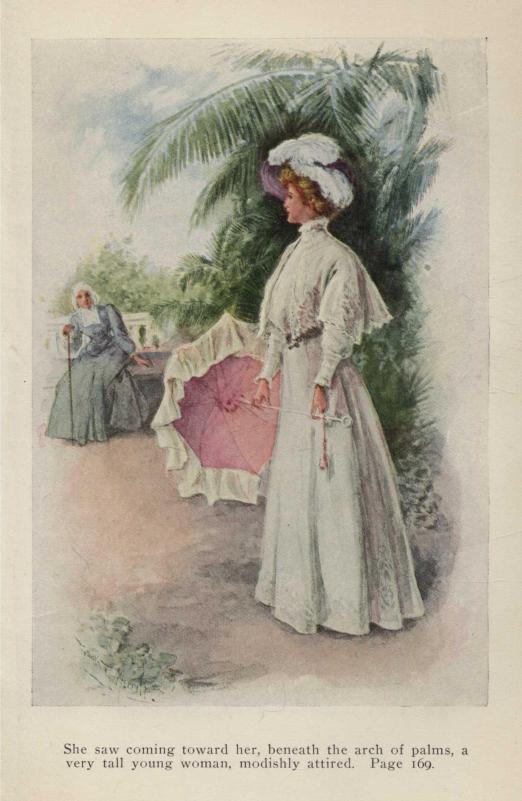
She saw coming toward her, beneath the arch of palms, a very tall young woman, modishly attired.
Lady Campstown wished that she could believe this engaging person to be some one who, like herself, had strayed into Villa Reine des Fées through curiosity—a guest from one of the adjacent smart hotels.
But she could not. She knew in her British soul that it was none other than one of the temporary owners of the property, and that she herself stood revealed a trespasser. In her intense vexation, the dowager arose again, striking her stick on the hot marble underfoot, till two little green lizards scampered away in fright at its sharp resonance.
"I beg your pardon," she said in her well-bred old voice, "I live in the next house, and of course had no idea that the villa was yet inhabited."
"Please don't speak of it," was the surprisingly friendly answer. (The girl was thinking, "Here, surely, is the Fairy Godmother.") "We decided at the last minute to come a day earlier, so anxious were we to get out of gloomy, wet Paris. You see, my father has been very ill, and the doctors rather wanted to hurry him to Provence. We took the night train, arriving this morning, and already he seems to feel the benefit, and is now getting a good sleep."