Front matter (continued 3)
Reading edition
Farewell, where Glenderaterra pours apace Rich music from her thousand upland springs! Thy name, old friend, the Lonscale streamlet sings; King-Shepherd thou of Skiddaw's fleecy race; And still in memory we behold thy face, Lined by laborious morns and evenings.
And on the headstone in Greystoke churchyard, that records Edward Hawell's burial, may be seen the following lines:
Here lies a simple shepherd, one who strove To leave behind a fairer, fuller flock; Lead him, Great Master Shepherd, in thy love, To wells of life from the Eternal Rock!
Before he died he had the comfort of seeing Joseph wedded to as good a daughter-in-law as ever lived. It was but in keeping with the whole life of the household that Joseph should have first met Margaret Roberts at the Gillbanks' clipping. The love for all time that first began at the shearing, went on smoothly till that other Master of the Shears, one men call Death, cut so cruelly the knot that Love in this life had tied. Married in 1886, Joseph was happy as man could be; he was blessed with a son John, and a daughter Sarah Jane.
With plenty of work on the Fells by day for himself, his brother, and his men to do, he yet found time to study at night. He took to politics as his father before him had taken to them, and, having gained confidence in public speaking, he worked hard at his speeches and the preparing of them.
Of books he had not many but good; and he specially delighted in biographies and history. He never tired of reading of the Spacious Times of Great Elizabeth, the History of Wellingtons Wars, or of Nelson's Exploits; and when the Royal Jubilee and Armada Tercentenary came round, no stronger hand or more willing heart was found in the whole neighbourhood to build up the huge bonfire stack on Skiddaw top than Joseph Hawell's. As I write I can see him, the perspiration streaming down his honest face, building away with the peats, and handing up the paraffin, bucket by bucket; and hoping, as he told us then, there was not a man in canny Cumberland but would feel the fiery glow of a patriot's heart that night.
But he will never help us on Skiddaw top more; and never, alas, shall we go to the shepherds' meeting in Wylie Ghyll with him again, or see him at the ram fair, or hear him at a 'yaller' speech day, or sit with him at his own fireside and 'crack' on about the Herdwicks.
It is thought that influenza laid its deadly hand upon him early in the year 1891, and simultaneously he had some ailment of the gums—toothache he called it. It must have been something more serious; he went off to Keswick to see the doctor: the doctor lanced the gum, but the wound took bad ways, and within a day or so the strong man was in bed, weak and delirious.
He wished to be up and after the sheep. Must be about his father's business! And, on a cold Spring day, Friday, February 20th, an angel came to the lonely farmstead of Lonscale, to bid the brave man's spirit fare the way that all who really wish to do that Heavenly Father's business must go uncomplainingly. And still Joseph Hawell's heart was where it had ever been—at home in England. He thought that some strange hands were taking him away by force to another land, and the last words that he spoke were these:
'No! if I must die, I will at least die an Englishman on English ground!' And so he died.
The strong hand of one stronger than man had taken him; and in a few days more, on February 23rd, hands tender and strong, the hands of an affectionate brother and true friends, bore the body of a shepherd, dead in his prime—for he was but 36 years old—down through the cow-pasture and over the gurgling Glenderaterra, and so through the silent Brundholme woods above the wailing Greta away to its rest in English earth beneath the shadow of the old church of St. Kentigern, in the Crosthwaite valley, within sight of that horned hill of Skiddaw he had loved so well. The people of Keswick begged that his body might be carried through their sorrowful town that opportunity might be given of showing sympathy and respect. And many a stalwart yeoman came to the Homegoing. Little they said, but they felt much as they moved in their dark market-carts toward the burial.
'Eh, but what! it's a terrible loss for us all!' 'The best man amang us gone.' 'We all mun ga when t' time comes, but it's hard bearing is this.' 'Niver a handier man wi' t' sheep i' t' whoale forest.' 'Niver a better man clim't t' fell; a decent, stiddy man as iver was; niver heard a wrang word from him.' 'Eh, but! it's past finding out t' way young uns goes, and auld ones stays.' 'Poor lass, she's lost as good a mate as ever woman had.' 'Poor barns, they've lost a fadder afore they kent him.' And so sorrowfully they turned away from the grave, whereon flowers had been strewn and wreaths laid by hands of men who in their common regret forgot all party differences and thought only of Joseph Hawell, as a man the 'Blues and Yellows' were alike proud of in life, and alike determined to honour in death.
I was a traveller in foreign lands when the news of Joseph Hawell's death reached me, and I felt for a moment stunned. As I realised it, it seemed to me as if I did not care to see Skiddaw again. He was a piece of it; and Skiddaw without him would be no Skiddaw at all, such an ideal yeoman shepherd; so tender-hearted to the yeanlings; so true to his mountain flock; such a man among men, honest and upright, reliable; one always knew somehow that if Joe was present, men right and left of him would behave like gentlemen; so high-minded and bent on the 'Just and True'; and, 'as the great ones only are, in his simplicity sublime.' His influence was wider and deeper than he had dreamed of, and I felt that with Joe Hawell a power that had worked for righteousness in a whole fell-side community, had passed as far as visible form goes from the earth.
On reaching home, it was with a sad heart that I neared the solitary fell-side farm that had been so darkened with loss. There was the same kitchen; the fiddle was on the wall; the bacon flitches hung from the rafter; the stuffed heads of the two old favourite shepherd dogs, 'Dainty' and 'Rob,' looked out from under the triumphal arch of sickles from the wall; the gun rested close by; the medicine horn and lambing bottle were in their places, and the old row of books that the father and he had so often turned to for thought and inspiration, were in their shelf—but there was no Joe! Robert took me by the hand and bade me sit on the settle, and he would tell me all about it. The poor wife said nothing, but just rose quietly and began to spread the table and set on tea, and when I urged that I would not have her fash herself so or put herself out of the way for me, she urged that it would have been Joe's wish, and I said no more.
Then the dogs came in. 'Ah,' said Robert, 't' rough un, "Jess," has not forgitten her master yet. She was sair put out o' t' way when my brother lay ill, whined at nights and would not be comforted; and she has only just now, after ten weeks' coaxing, consented to follow me when I go to the Fell.'
JOSEPH HAWELL.
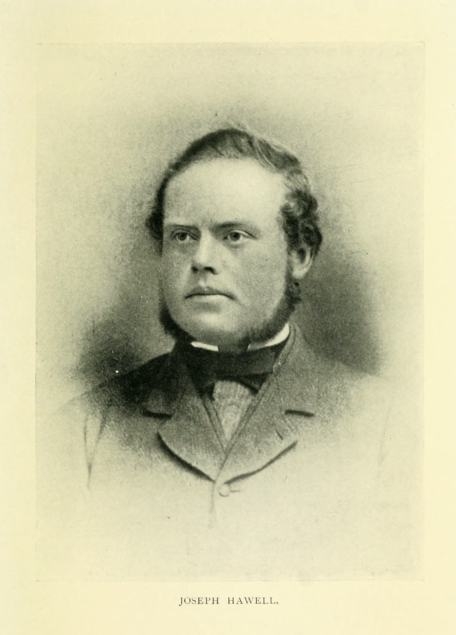
'And did you have no thought of Joseph's worsening,' I said, 'when he took ill?'
'No,' said Robert, 'but rather a strange thing happened just a week before. I am not superstitious, and I said little about it. But I woke early just as it was beginning to be dawn and saw a sad face looking upon me. I knew the face well, it was Joe's wife's sister, and I thought I was dreaming and sat up, and the face still looked very sadly and then faded away, and I felt it must be a vision. I have wondered since if it was meant as a token to us. She was the first person, however, that came to help us when Joe died. It is singular, is it not? Eh dear! but it's a sair heart that I have as I go shepherding now; for it's when I'm amang t' sheep I mostly what seem to miss him. It comes ower me t' warst when I am looking at t' ewes that we used to talk ower together. You would like to see some of the letters, I daresay, we received when poor Joe went.' And saying this, the stalwart man, who loved his brother as tenderly as a woman, put a bundle of letters into my hand.
'But,' said I, as I gave back these precious documents to the owner, 'did he not leave any papers behind him? He is spoken of in one letter as gifted beyond ordinary measure as a public speaker.'
'Well,' replied the brother, 'he left very little in writing; but you know we kept his speeches. They are scattered up and down the newspapers.' And following into the Herdwick-prize room, I soon found myself deep in the speeches Joseph Hawell had from time to time delivered in the political cause he championed.
I asked if he took much trouble in the preparing of his speeches, and I was told that he did; worked hard for nights beforehand, and sometimes, as our greater orators have done, learned a bit of his intended speech by heart. Joseph had as library, up there in the rafter-smoke, some old 17th and 18th century tomes, full of the breath of English spoken pure. English history was his chief study; but 'here,' said the good wife sadly, 'is a book he oft read in, particularly on Sunday afternoons.' It was a magnificent folio copy of The Whole Duty of Man, The Gentleman's Calling, The Art of Contentment, and The Christian Birthright, printed by Norton, at Oxford, in 1695. As I turned over its well-thumbed pages I thought that Joseph Hawell had gone to good models for his masterful English, and had drunk wholesome draughts of goodly thought and wisdom as he studied.
'Did he leave no other written papers?'
'Yes, he left a few songs he wrote from time to time.'
I asked to see them. 'God Save Ireland from Disunion,' was the title of one; another, in rough copy, was a sheep-shearing song.
Had Joseph written anything else? Yes; there was just one letter or two he had left behind him in rough copy, and I was welcome to see them if I cared. I did care; and was rewarded.
He had latterly been a bit troubled in his mind by a friend who had what are called 'free-thinking notions.' And Joe, who was as dead against that kind of cant as any religious cant—and he was, as I can testify, hard upon this latter—had delivered his soul.
The letter was written on February 9th, 1891, and the hand that wrote it was cold and stiff on February 20th. I dare to look upon this letter as the yeoman shepherd's last will and testament. It runs as follows:
'DEAR FRIEND,—I have received your books, and am much obliged. I have not yet got them read thoroughly, but so far they have but caused a reaction in my mind in favour of the Christian religion, and led me to have recourse to some fine old books written more than a hundred years ago, in a bold and intelligent hand, proving that astronomy and science are a powerful proof of the might and majesty of an Almighty Creator.
'Could you follow up your science by winging your way to the highest star of observation, you would there see other skies expanded and other planets and systems established, each giving harmony and perfection of attention to time by the nicest rule. Then wend your way past other ten thousand worlds, and at the end of this vast tour you would still be muddling in the suburbs of creation, only to find that no imagination can fix the limits of His creating hand, and that conceited, ignorant, and insignificant man is absolutely unable to comprehend the grandeur and correctness of His magnificent workmanship. Then am I to be told that the builder of this stupendous structure is incapable of such a paltry performance as taking possession of our souls and restoring our lifeless bodies at His own good will and pleasure?
'I find,' he adds, 'Carlyle's work very instructive, and many of the passages furnish evidence of the existence of the great Disposer of all events.'
I said this should stand as Joseph Hawell's last will and testament. No; there was another letter, written evidently just at the end of last year, in which he begs of a neighbour the loan of a horse and gear to enable him to bring down on a sledge from Lonscale Crag one of the finest single stones there. He wishes to set it up in some field on the farm, and have his father's name upon it and his father's deeds and prowess as a breeder of Herdwick sheep, with a single verse of descriptive poetry beneath, and he feels sure that his friend will lend a hand 'to erect a monument to at least one member of the Hawell family whose stainless, honourable, and straightforward life will always be pointed to with pride by his descendants.'
Joseph Hawell! the horses have gone, and the sledge has brought its heavy burden to the home-farm; and on it are engraved two names instead of one, for there are those who honour the son who would so have honoured his sire. There by that mountain path they both of them knew so well of old is the grey memorial cross set, and on it is carved, in symbol of eternity, the endless knot their Norse forefathers used. A simple verse is engraved at the base.
Those who pass the 'gale' for the meadows of Lonscale, to breast the back of Blencathra, or to climb the slopes of Skiddaw, shall surely learn that our Cumberland mountains still as of old breed men of high purpose and noble endeavour; and that still, from following the sheep, God calls His chosen ones by lives of kindliness, simplicity, and straightforward goodness, to guide their brothers in the path of duty, righteousness, and truth.
A FAMOUS YEW-TREE.
There is a passage in George Fox's Journal that brings one face to face with a brave man of God, reveals the spirit of true martyrdom, and makes one envious of his dazzling courage:
'Now were great threatenings given forth in Cumberland that if ever I came there again they would take away my life. When I heard it, I was drawn to go to Cumberland, and went to the same parish whence these threatenings came, but they had not power to touch me.'
It is a passage that attracts one to the apostle of the leathern-apron, and makes one desire to know the scenes of his life's travail. It was not to be wondered at, therefore, that when one found oneself at Keswick in a neighbouring valley to Lorton, one should wish to visit one of the places ever associated with his memory, and see the spot whence the echoes of the preacher's voice have never died.
Associated with this wish to follow the footsteps of George Fox, was the desire to see the Yew-tree, 'Pride of Lorton Vale,' which, on the day of Fox's sermon, provided seats for the listeners. For the famous yew-trees in the Lake District are becoming each year fewer. It is true that the great yew in Tilberthwaite is still standing, but that famous hollow trunk that kept alive the name of the mission preacher St. Patrick, in Patrick's Dale or Patterdale, has fallen; and the great winter storm of 1883 worked havoc upon Seathwaite's sacred brotherhood:
'Those fraternal four of Borrowdale, Joined in one solemn and capacious grove; Huge trunks!—and each particular trunk a growth Of intertwisted fibres serpentine Up-coiling and inveterately convolved—
are now a wreck,—one fell, the others were riven to pieces.
Here in the Lake District, by command of bluff King Hal, each estatesman was obliged to plant a yew-tree by his homestead, in order that he might never lack of wood for his bow when he was called—as he not unfrequently was called—to the Marches, in defence of the Border. And in many places, long after the homestead has passed away, the solitary yew survives to tell us of the troublous times of old. It was not long since an estatesman sent down to the local museum of Keswick the old oaken bow-chest of his fathers, which, though it has been long used as a meal-ark, by its carving clearly shows it was intended for other use. The family name of Bowman is a common one in Cumberland, and still in our neighbourhood the field-names preserve a memory of the village bowman's prowess, and the 'butts' field is a word of common parlance.
But it is George Fox, the man of peace, that we were most interested in, as we crossed the Keswick Valley and climbed the long slope of Whinlatter to pay a visit to the brave man's preaching place, and it was mere coincidence that that preaching place should be associated with weapons of war.
THE LORTON YEW.
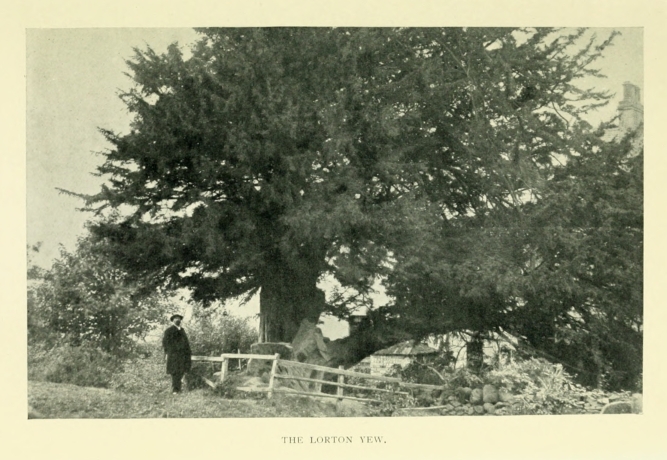
People do not realise how fair a view of the whole Skiddaw range is presented to them as they climb that pass, or they would climb it oftener. The higher one climbs, the higher does Skiddaw appear, and deep-bosomed mountain-side in all its massy grandeur of emerald green and lilac shade in spring, of puce and burnished bronze in autumn, impresses one with its calm and restfulness. The cloud, sure sign of fine weather, rests upon its utmost peak to-day, and irresistibly recalls the lines of Wordsworth's sonnet:
'Veiling itself in mid-Atlantic clouds To pour forth streams more sweet than Castaly,'
while the pleasant farms with the far-off interchange of happy cock-crowing, glitter at our feet, and, like an arm of some great ocean-loch, the white waters of Bassenthwaite come round the precipice of Barf, and sweep out of the shadow of Wythop woods into the September sunshine. On our left rises Grasmoor, haunt of the dottrel, and Hobcarton Crag, beloved of rare mountain flowers. So we crest the long slope and drop down into Lorton, with the hill-sides on our right, golden with gorse against the westering sun. Turning sharply to the left as soon as the village is reached, we pass a kind of pleasant rural street, if that may be called a street which has houses only on the one side of it, and just as we emerge into the country again, find ourself at a spot where the road forks, a portion of it going over a beck bridge into a farm enclosure by a picturesque old water-mill and byre, and a portion of it,—the main road to Loweswater,—bending sharply to the right to go across the valley by the north side of the stream, which is here hidden from view by a long barn building. If we pause at this point we cannot help being struck by the sombre mass of a great yew-tree standing in a pleasant meadow close to the beck, where at one time there was doubtless a ford. This is what Wordsworth described as
'A yew-tree, Pride of Lorton Vale, Which to this day stands single, in the midst Of its own darkness, as it stood of yore, Not loth to furnish weapons for the bands Of Umfraville or Percy ere they marched To Scotland's heaths; or those that crossed the sea And drew their sounding bows at Azincour, Perhaps at earlier Crecy, or Poictiers. Of vast circumference and gloom profound This solitary tree!—a living thing Produced too slowly ever to decay; Of form and aspect too magnificent To be destroyed.'
It is not to-day the noble tree it was when Fox was here, and the prophecy of the poet was only a few years since like to have been made utterly vain. For its form and aspect was so magnificent that its owner sold it to a Lorton wood merchant, and it was just about to be cut down when some memory of Fox's sermon awoke in the breast of a faithful member of the Society of Friends in the neighbourhood, and the wood merchant good-naturedly went off his bargain.
It is true that it shows no signs of decay, but it has suffered loss. Two of its main stems were shattered years ago by a hurricane, and were sawn off at the bole. Let us go along the road to the farm buildings, and turn back down to what now serves for a watering-place for horses. It is thus we shall best get an idea of how 'it stands single, in the midst of its own darkness.'
The branches stretch their shadow over the stream, and the ripple of the sunny talkative beck contrasts strangely with the deep silence of the solemn tree. If we go up to Whinfell Hall and ask a keen observer of nature and plant life about this famous yew, Mr. Wilson Robinson will tell us that he once measured the trunk at its least circumference and found it 23 feet 10 inches, and that, about thirty years ago, a strong south-east gale came with hurricane force down Hope Ghyll, wrenched off one of the side limbs and carried away a third of the tree. Another limb has fallen since then, and yet, shattered and torn, what a magnificent ruin it is, how well worth climbing over Whinlatter Pass to visit.
After gazing up the beck towards the picturesque bridge from which we first surveyed the yew, towards the grand old farmstead and its cluster of sycamores as a background for the bridge, let us go back to the bridge and across into the meadow wherein the 'Pride of Lorton Vale' stands, and, gazing from under the tree towards the west and south, let us wonder at the beauty of faintly bronzed fern on Whiteside, the amethystine lilac of the Grasmoor mass, the far-off cones of Red Pike and High Stile blue above Mellbreak, and far to the west, Herdhouse ghostly grey; all seeming to join in shutting out the world and making the quiet emerald meadow in which we stand a sanctuary for thought and restfulness.
Then let us go back to that day in the year 1653 when George Fox, having narrowly escaped death by a boy's rapier thrust, and with his hand and wrist still smarting from the cruel blow of a rough fellow down at Bootle, where they mobbed him on the previous Sunday, pale and worn came hither to the ford and found already James Lancaster, one of his disciples, who had gone forward as an avant-courier on the way to Cockermouth, busy haranguing the people.
The quiet meadow of to-day was on that day full of armed men. A detachment of Cromwell's soldiers had been told off from Cockermouth to keep the peace—it being known that Fox was on his way to Lorton; and Mr. Larkham, the Congregationalist minister of Cockermouth, and Priest Wilkinson, the Vicar of Brigham-cum-Mosser-cum-Lorton, were probably among the crowd that covered the field and stood by the banks of the stream. 'The people,' we read in Fox's Journal, 'lay up and down in the open, like people at a leaguer.' Fox had seen something of camp life during the late civil war, and he doubtless felt that day that, man of peace though he was, the field of the Lorton yew would be indeed a field of battle for him.
But what interests us most as we gaze upon this venerable tree to-day in these pleasant pastures beside the waters of peace, is not so much the memory of the crowd of Cromwellian soldiers and members of the Church militant who came out that day to 'sorely withstand' George Fox, as the vision of the boughs of this sable and majestic yew-tree filled with the listening ears and eager eyes of those who heard that day the weary and way-worn prophet of the Lord, 'largely declare the word of Life' as he knew it, and 'open the everlasting Gospel to them.' Fox tells us that 'this tree was so full of people that I feared they would break it down.'
Look at it now, and think of it no longer as a broken yew-tree, sown here perchance by some far wandering bird centuries ago, but as a living witness to the power of men who have a living Gospel to declare to win the souls of their fellows, and lead them into communion with God who is a spirit. Men once heard the voice of Fox sound out here, above the babble of the beck and the hum of the multitude and the protests of the Lorton minister, and those who crowded on the yew-tree boughs felt light instead of darkness—sun instead of shadow, was their portion, and we read, 'Many hundreds were convinced that day, and received the Lord Jesus Christ and His free teaching with gladness.'
We are not Quakers, but at least our hearts beat in unison with the earnest teacher of the Truth he knew, to an age that was helped and is still helped by that Truth; and as we leave the field of the tree,
'Not loth to furnish weapons for the bands Of Umfraville or Percy ere they marched To Scotland's heaths; or those that crossed the sea And drew their sounding bows at Azincour,'
we rejoice to think that beneath its sable boughs, the preacher of the way of peace as better than war, once preached a sermon; and we trust, that for many a long year still, 'single in the midst of its own darkness as it stood of yore,' may stand the Lorton Yew.
LODORE AFTER STORM.
Five days of continual tempest and five nights of storm-wind from the Atlantic had tried the nerves and tempers and tested the sleeping powers of all in the Keswick Vale. Nothing like wind to set folks 'fratching'; and that anybody was still on speaking terms with his neighbour argued well for the kindliness of the townsmen and villagers.
At last it would seem as if the wind had blown itself out, and at six o'clock of a grey February evening silence and calm fell upon the sodden, weary vale. But an ominous cloud-pack boiled up over the western hills, and the barometer went down two inches. The cattle were scarcely 'suppered up' for the night in the farmsteads and the shopmen had scarcely clanged down their last shutter, when the wind again awoke, and the hills thundered and the trees groaned, and we knew that America had sent us another cyclone. The hail-showers thrashed the panes, the windows rattled, the chimneys moaned and sighed, and though tired men and women went to bed, it was only to feel their house-walls shake as if an earthquake shock were passing underneath, and only to wonder which would be the first chimney-stack to fall. The wind grew to a hurricane, and people as they lay in sleepless fear upon their beds heard strange voices in the storm—cries of sailors in agony upon a bitter shore or perishing in the deep. Then the wind would be heard to try all round the house and see if perchance a window-frame would give an entrance and indoor havoc be possible; or a slate would whirl up with a crack and come down clattering on the roof and spin off into the darkness.
The dawn broke dimly, and the pastures of the middle vale lay like a wan sea with isles of emerald. Broken boughs hung gaunt and creaking upon the nearest trees, and the Irish yews curtsied and danced and split themselves into a hundred spires of nodding darkness against the angry sky. But the hurricane, however much it might make man cower and fear, had no power upon the thrush, who saw, behind the hurricane light of cheerless morn, the dawn of springtide and love and calm. No storm could
'Quell or disconcert her golden tongue,'
and there, while the wind fluffed her breast to twice its size, she fluted from the swaying holly tree her old familiar call to the slow to 'be quick! be quick!' to the drowsy, to 'pray, get up! get up!' and then to the sad to 'cheer up now! cheer up! cheer up!'
I answered her challenge and arose. The lake from end to end was ridded with foam, and great clouds of water, torn from the surface, were marching from west to east. Borrodale was black with storm. There was no snow on Skiddaw, though the sleet had in a night turned its fine old head grizzled grey, but over Grasmoor and over Grisedale it seemed as if some huge ocean wave had broken and left its froth behind it.
Nearer, however, than on Grasmoor and on Grisedale there was snow. Far down beyond the purpling 'Walla' woodland, lay, in a crevice of the hills between Gowder Crag and Shepherd's Crag, a mighty drift of seeming winter whiteness. That was no gift of winter; it was the gift of the past night's rain. Gazing at it through a good field-glass one could see that the white drift was a falling torrent, and as one gazed one almost, in fancy, heard
'the roar That stuns the tremulous cliffs of high Lodore.'
I knew that they only can see Lodore aright who will brave storm and tempest, for so swiftly does this splendid cataract pour itself away that an hour after the rains have ceased upon the Watendlath fells it dwindles to its natural size, loses its milk-white charm, and ceases to summon the wanderer to its presence. But this morning its spell was potent to touch all hearts, and that white winter wreath of snow and sound called us from far away. Down by the old monks' path we went, that the hoofs of sumpter-mules in the Middle Ages had worn deep into the soft soil;—it was to-day a torrent-bed of bubbling water. On by the village school, where, instead of the pattering of children's clogs upon the doorstep, to-day the Greta's water gushed and fell in miniature cascade. Over the bridge beneath Greta Hall, on which the pencil-makers hung in enforced idleness, for there was too much water to allow the use of the millwheel. 'Brig is pinched to be large eneuf for t' watter to-day,' they cried; and so to the town. 'Dar bon! but thoo bed better keep to lee-side oop street—-slates is fleein' same as leaves i' winter,' said an old friend as he passed me. 'Well, Betty, what such a night have you had?' I said to another old friend at the street corner. 'Loavins me!' she answered, 'but it's been a capper. Cwoal cart was lifted up and clean turned ower befoar my eyes in oor back yard; and I've been up and dressed sin five this morn. What I thowt wi' mysel if anything's goin' to happen, it 'ull not dea fur us all to be naked, and sea I got intil my cleas!'
So up the main street—powdered with broken slates and plaster from the house fronts, and out into the Borrodale road we went. Trees were laid by their heels at the church gate, the holly berries gleamed in thousands by the roadside; the wind had done what in this open winter the birds had failed to do. Thence on to the Great Wood. Fine spruces lay across the road, and the roadmen and woodcutters were busy making passage possible for the cart traffic. Such a scent of Christmas trees they made as they hewed away at the spruce branches one felt oneself a child again, and so with a child's heart forward. All through the purple woodland were white patches in top-most boughs, the wounds that the fierce wind had given them. Only one thing the tempest had been powerless to touch; these were the tender lichens and the velvet mosses on trunk and wall. How they gleamed and shone in the forest twilight! And whilst the boughs clashed and the wood was filled with groans and shrieks and cries, there, by the wall and on the ground and on the tree-stems, in quiet restfulness and silent beauty the fearless mosses grew.
But this was not all the gentle life that seemed to fear no storm, for quavering along from bough to bough a school of long-tailed titmice went in unalarmed pleasure. The wind that shook the oak seemed unable to touch them, and down beside me the tiny wren played his old happy game of hide-and-seek, as if, instead of being lashed by a cyclone, the woods were still as eventide in June.
Cat Ghyll, beloved of Southey, roared at us as we passed, and one heard the wind like a trumpet blowing from the steep of Falcon Crag.
Now clear view was gained of Derwentwater, and one noted that the lake lay in long patches of many colours, here bright green, there slate blue, there brown, here white and wan, but ridged throughout with foam; and suddenly, as if it sprang upward from hidden depths, a water wraith would leap to sight and other spirits would join it, and the whole silver company of ghostlike vaporous forms would come dancing across from the further shore and lose themselves in cloud-like dust upon the land. Or here again would rise a tiny waterspout and spin and spin the water up into mid-air, then march and counter-march, lie down, and rise again. While all the time upon the shore beneath the roadway, waves broke and surge tumbled, with moaning of a troubled sea that might not rest. It was something in such a whirl of sound and hissing of such restless waters to feel far up on the other hand, above the russet grey-green draperies and the lilac shales, the calm of the storm-proof citadel of Falcon Crag. We gained Barrow, and heard the waterfall bellowing in the wood; but it was Lodore that we had set out to see, and Lodore shone white and clear upon its steep only half-a-mile away.
Full sight of Lodore had now been gained, but not before two other cataracts flashing to one channel from Gowder Crag had claimed our wonder, while we watched the water fall, as it seemed, out of heaven, down by the silver birches, down by the silver shale, and turn both to darkness by its white contrast. But what a magnificent rose-red glow those birch trees showed, and how with auburn glory the larches gleamed! how too in silken grey and delicate yellow the ash trees climbed the crags! We went forward, but not till we had noted that, while all the world towards Grange seemed one great grey water-flood, here right in front of the purple-brown cliff in whose cleft lay the white Lodore, stood up a little meadowy hill of verdure green as May—the first home-field of the wandering Viking who pushed his long ship ashore at Ravenglass and made his way over the Styhead Pass to ancient Borrodale. For in this green field still flows the spring where Ketel the Viking, who afterwards gave his name to the Wyke which we call Keswick to-day, drank in the olden time. Ketel's Well, as we gaze upon that emerald mound, takes us back to the ninth century and the first coming of the Norsemen to our dales; and what was it that bade the hardy Norse rover choose to pitch his camp by the spring on yonder hill but that same glorious cataract of Lodore, whose gleaming waters and whose voice of thunder speaks to our heart as it one time spoke to his. Nay, for that weary wanderer over sea, Lodore spoke sweeter things. As he listened to the torrent's voice, there came back memories of his own home-land and all the sound and sight of those fair 'fosses' and those shining 'ghylls' from which he was an outlawed exile.
LODORE AFTER A STORM.
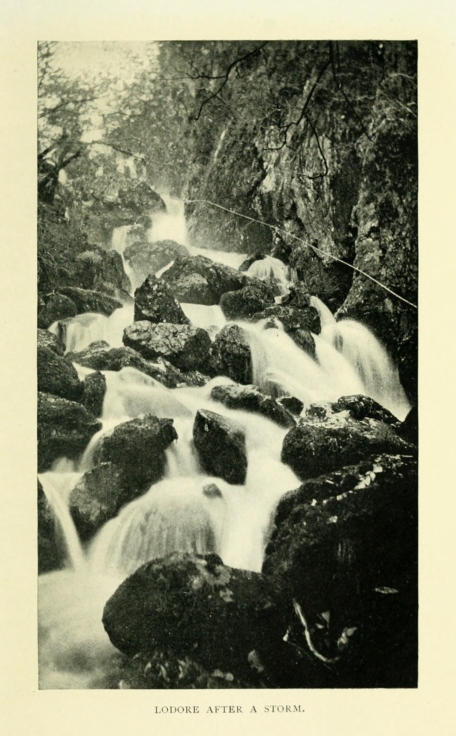
We pass on beyond the hollies, beyond the amber reed-bed, beyond the grey copse, and gain the gate to the Fall. We cross the meadow and enter the wood and stand upon the little platform whence the Fall in its fulness may be seen. What strikes one at once is the majesty of the high-towering crag of Gowder to the left of Lodore. What strikes one next, is the feeling of a certain lack of height in the fall. It does not come rushing over a sheer precipice; it is not cloud-born; one seems to know that somewhere not far off a valley stream is passing along through quiet meadows and woodland, and something of the fierce wildness of its fall is curbed and tamed by the thought. Yet as we gaze to-day so white is the heaven in the rift between the cliffs whence it surges into sight, that a very little imagination enables us to feel as if the whole of that white interspace were foam, and one's heart is stirred. Not in a rift, but from the topmost height we think we see and hear a visionary cataract fall and fall.
Up now through broken boulders, wet with perpetual mist, slippery with sodden leaf of russet gold, up till a double wych elm, or two elms bound in sisterly embrace—as if they had in fear clutched one another as they stood in awe upon the torrent's brink, is gained; there in shelter of a huge rock, emerald-coated, silver-shining with the spray, we shelter from the drenching water-dust and see another view of glorious Lodore. See and hear, for while the milk-white waters flash and swirl around the ebon boulders in mid-fall, we hear the tall upstanding cliffs make echo to their voice—such sound as he who hears can never quite forget. We climb again up by a slippery path only fit for a goat's foot, helped by impending branches, helped more by the thought that yonder one will gain not only the noblest view of the waterfall, but a far outlook over the wide-watered vale to grey-blue western hills, beyond which booms the sea that gave us, on the wings of the wind, all this majesty of sound and motion.
In this hurricane, the salt of that ocean is on one's lips, and if its actual murmurs and the 'scents of the infinite sea' are denied us, at least by proxy they are ours. For as we slowly win our way upward the scent of Lodore fills the air, even as its sound fills our ears. Not the kind of paper-mill scent one knows so well within the locks or by the backwaters of the Thames, but scent born of mountain springs and fellside tarns and peaty meadows—scents as delicate as they are subtle.
We have gained our vantage point for sight and sound. The huge rocks appear like leviathans bobbing their noses through the foam. A tree trunk has fallen, and seems to have been caught and held by the mouth of some vast hippopotamus, who rejoices as the torrent dashes over his vast back. And the sound is not of bellowing behemoth or snorting river-horse. No; but such sound as seems to bring all worlds to unison. Shut your eyes, lean, and listen; you may hear a mighty army tramping by, you may hear the clashing of innumerable bells, you may hear the blare of trumpets, you may hear the shouting of a festal multitude, and ever beneath the deepest harmonies the tattoo of the thundering river-god, the drum-drum-drumming of Lodore.
One cannot wonder that hither in 1802 came Charles Lamb, the lover of the city's roar, to listen and rejoice. Keats, too, in 1816 came hither and went, as Lamb went back, a sadder and a wetter man; but it is of Southey and his two children, his Edith May and his darling Herbert, we think to-day—he who in the autumn of 1809 heard the same stream saying the same things it says to us to-day, and who writing to his brother Tom on board the Dreadnought under date October 18, 1809, said:
'I hope you will approve of a description of the water of Lodore made originally for Edith and greatly admired by Herbert. In my mind it surpasses any that the tourists have yet printed. Thus it runs: "Tell the people how the water comes down at Lodore? Why, it comes thundering and floundering, and thumping and bumping, and jumping, and hissing and whizzing, and dripping and skipping, and grumbling and rumbling and tumbling and falling and brawling, and dashing and clashing and splashing and pouring and roaring, and whirling and curling, and leaping and creeping, and sounding and bounding, and chattering and clattering with a dreadful uproar—and that way the water comes down at Lodore."'
We turned for home; a patch of blue sky shone momentarily above the purple hollow of sound and foam. And though still 'the forest cracked, the waters curled,' a sunbeam showered radiance as it flew by moaning woodland and by silent crag. In the Great Wood all colours of purple, amber, rose, and amethyst leapt out at the passing of that gleam. One could not but compare the marvellous and changeful effects of light and colour to those that, in some enchanted land of mystery, the coloured fires of the wizard of the pantomime call forth, for our children's amazement.
Now all near was dark, while far ahead the witchery of the golden woodland grew. Now Walla Crag stood purple grey, now shone in lucent silver powdered with larch-tree gold, whilst ever on beyond the woody lane, Skiddaw, as blue as solid cobalt, rose calmly up into a wandering storm-white sky. And yet for all this witchery of colour, for all this magic transformation scene, one vision stayed—that far-off wreath of quiet snow,—snow that had turned on nearer view to scent and sound, to life and light and laughter, to power and impassioned loveliness, there in the resonant chasm of Lodore.
A NORTH COUNTRY NIMROD.
We shall never hear again On the fell or in the plain John Crozier's 'Tally-ho!' Never see him through the rain And the sun, with might and main Follow on from crag to crag, while the hounds give tongue below.
Dark the valley east and west, Clouds are on Blencathra's crest. The hunter home has gone: And the Squire they loved the best Now is carried to his rest— Eighty years has Death the huntsman followed hard—the chase is done.
But I think I see him stand— Rough mountain-staff in hand, Fur cap and coat of grey— With a smile for all the hand Of the sportsmen in the land, And a word for all the merry men who loved his 'Hark-away!'
Last hunter of your race! As we bear you to your place, We forget the hounds and horn, But the tears are on our face, For we mind your deeds of grace, Loving-kindness late and early shown to all the village-born.
'It's a dark daay for Threlkett is this un, hooiver! T'ald Squire's gone doon!—girtest Master of t' dogs i' Cummerland sin Jwohn Peel I'se warrant him—an' a gay tiff aid feller an' aw. Deeth has hoaled him at last; but what, he'd bin runnin' gaame fer mair nor eighty year noo. He's bin at Maister-o-hunt job langer nor ony man i' t' whoale counttry, I suppoase, has t' aid Squire. It's sixty-fowr year or mair sin he took t' horn. Eh, my! bit what a heart he hed! Kindest-hearted man i' these parts—niver wad let a nebbor-body want for owt if he thowt he cud dea good by lendin' a hand, and pertikler fond o' t' barns; school children was fit to be mad wid him on treat-daays. And why what, he gat scheul-hoose builded, and laid doon a hoondred poond fer Parish Room, let alean gevin site i' t' village. It's a dark day fer Threlkett, I'se telling ye, and dogs hes lost best friend and t' foxes t' warst enemy they've ivver hed here-aboot.'
We were standing by the Druid's Circle on Castrigg Fell, and as the old yeoman spoke to me I looked across the valley to the great buttressed height of Blencathra—blacker to-day beneath, by reason of the slight snow covering on its summit, and saw in its grove of larches the white house, half-farm, half-mansion, whence the oldest Master of the Hunt, in Britain, had gone for his far journey. Never again would the men who follow the hounds pass through the gate of the Riddings, with the fox and the hound carved in stone on either side of them, to be met and to be greeted by the cheery old Squire on hunting days; never again, after a long day's hunt, would they repair to the Farrier Inn or to the Salutation Inn, mid-village, to wait the coming of the Master 'ere they all 'howked in' to the 'tatie-pot' he had provided them.
There was a time when all the farmhouses for miles round, and every cottage home, was glad, because a Threlkeld man had come to his own again, and I could not help contrasting the gladness of that day, as told us by Wordsworth in his Feast of Brougham Castle, and Song of the Shepherd Lord, with the sadness of this day for all the country side, now that another shepherd-lord had gone unto his own. That shepherd-lord we read
'Was honoured more and more, And ages after he was laid in earth "The good Lord Clifford" was the name he bore.'
They were very different men, that shepherd-lord and this our friend, the Master of the Blencathra Hunt, John Crozier: but both of them had been reared in the same quiet pastoral scene, and among the same fine race of shepherd gentlemen. Both had learned the lesson of this mountain side,—
'Love had they found in huts where poor men lie, Their daily teachers had been woods and hills, The silence that is in the starry sky, The sleep that is among the lonely hills.'
Both men had won the hearts of the simple people far and near, and ages after he is laid in earth, as he will be laid by the side of his beloved wife, in the Threlkeld Churchyard, men will speak of 't'ald Squire,' and enthusiastically tell of his hunting feats, and remember how he loved his native village.
The love of hunting which John Crozier inherited from his father, who lived at Gate Ghyll Farm on Blencathra's side, and who turned over to his son the mastership of what were then spoken of as 'the Threlkeld dogs' in the year 1840, is a passion with our dales' folk which only those who live amongst them can understand.
The 'varmint' is the natural enemy of the shepherd, and this adds zest to the day's sport. In our churchwardens' accounts of old time there appears the item 'A fox head, 21s.,' and though in other chapelries 3s. 4d. appears to have been the price paid, such a scourge must Reynard have become that the churchwardens felt they were justified in giving a whole week's wage for the destruction of one fox. Down at Shoulthwaite and, for aught I know, in other dales a fox trap of masonry existed till of late years, built beehive fashion with a hole in the top. If Reynard ventured in to the bait, which was a fine fat hen, he was a prisoner; try to scale the walls how he might the artful one was foiled; but to trap a fox goes against the grain. There are certain things in which our hunt differs from others. Class distinctions are unknown in the field. The Master of the Hunt knows all by their Christian name. It is a social gathering from daylight to dark. The luxury of horses, too, is unknown. The field are all running huntsmen of the type of old Timothy, of whom Wordsworth wrote, in the year 1800—the childless Timothy who took up his staff, and with the thought of his last child's death heavy upon him could nevertheless not refuse the invitation of 'the horn and the hark! hark-away,' and 'went to the chase with a tear on his cheek.'
On that day when 'Skiddaw was glad with the cry of the hounds,' old Timothy's daughter Ellen had been dead five months or more, or he probably would not have followed the hunt, for there is a kind of etiquette that the hunters in the dales observe, and they would no more go a-hunting within a month after the death of their beloved, than they would miss going to church on the Sunday following the funeral. I remember once being asked by a widower, who was in great sorrow and could not get away from his thoughts, whether he should take what he knew to be the best physic—a day with the dogs. I asked, 'What would your wife have said?' His answer came quite straight: 'She wad hev clapped a bit o' lunch in my pocket, gi'en me ma staff, shut door upon me, and telt me not to show my feace until supper time.' I answered, 'That's enough,' and the man was a new being when he returned from the hunt, more able to wrestle with his sorrows.
The women folk are as keen as their husbands. They tell of a 'woman body' at Wythburn who, joining the hounds in full cry, and finding her skirts in the way, stopped, took a knife out of her pocket, and slit her petticoat in order that with a 'divided skirt' she might the surer be in at the kill. How keen the men are, is shown by the fact that beginning as youngsters to follow the drag, and carrying on a love of the sport through the prime of manhood, they may be still found from 75 to 80 and over, out with the hounds at the call of the horn. Nay, even when their sight fails them, they will follow, and it is on record that a veteran whose eyes were failing him and who had the rare good luck of a vantage ground to see the finish of the hunt, and was so maddened by the hurried and eager account from his companions of how the hunt was going, that he cried out 'Hang thur aid een o' mine! I wish that they wer nobbut out all togidder; I believe I wad see better through t' hooals!'
Fox hunting in the Lake Country tests the sportsman. None but a true lover of the chase would be content to breakfast and get away with the stars (as in winter he oft-times has to do that he may get to the heights before the hounds are loosed)—and, facing all weathers, come back with the stars. He has to battle with storm and tempest. It may be fine in one valley and a roaring blizzard on the other side of the mountain. The old veteran, John Crozier, himself would tell of how he had to lie down on Skiddaw summit in a sudden and blinding snowstorm, and on more than one occasion he and all the hunt have suddenly been enveloped in a thick mist, which made movement almost impossible. And hunting not only tries the heart, it tries the head. A fox gets 'binked,' as they call it, or banked, and some one must go up on an almost inaccessible crag to put in the terrier; and a man must know the country, and the probable run of every fox that gets up in front of the hounds. There is no earth stopping; only the bields are known, and the cunning of Reynard is a secret, to be learnt not only by the huntsman and whip but by every single man in the field. As for the foxes, though the old greyhound breed that John Peel knew—20 lbs. to 29 lbs. in weight—have passed away, the little black-legged Irish fox can give a good account of himself, and from three to five hours and from 25 to 40 miles have not been an uncommon experience of a run.
At the beginning of last century it was not an unusual thing for the hounds to be running 'on the tops' through the night, and the legends of the 'whish-hounds,' or 'spirit-packs' of Cornwall and Devon might very well have been reborn in Borrowdale.
In 1858 took place one of the record runs of the Blencathra pack. The dogs had had already a good morning's work when at noon a big Skiddaw fox jumped up in front of them. He tried to shake off his pursuers by the ordinary hill tactics, but, failing, took to the valley, went by Crosthwaite Church, through Portinscale and Brandelhow, right up Borrowdale, and over the Styhead into Westmoreland. The night fell, but the dogs were heard at Black Hill, marking the fox at an earth. Thence Reynard escaped in the direction of Lancashire, and next day the hounds and the fox were found, the latter dead and the former fast asleep under a crag in Coniston. They must have travelled not far short of sixty miles over the very roughest part of the Lake Country.
The hounds are trained carefully not to break up their foxes, just as they are trained as carefully not to worry sheep; and this latter is done by the farmers walking the dogs in the summer time and taking them, along with their collies, when they go shepherding on the fells.
The packs are small, but every hound is true as steel. The Blencathra huntsman generally unkennels about 11 couples, and so keen are they at their work that three years ago they gave an account of 76 foxes, last year of 46, and this year, up to date, of 43. But the cost of keeping the pack is very small. £200 clears all expenses, and this is partly accounted for by the kindly interest farmers, who are all members of the hunt, take in it, for they walk the dogs free of charge, and some of them are, in addition, subscribers. Very anxious are these men, too, to do their best by the dogs. The hounds are made members of the family, and their tempers and individualities are studied. A farmer would take it very ill if he did not have the same hound sent him at the end of the hunting season. This reacts by making a bond of enthusiastic interest for members of the field in the running of every dog.
Nor can we omit to mention the sense of brotherhood which binds the hunt together. As there is no separation of class, so there is no separation of dress; no buttonholes and fine leather boots. The hunting kit is but a flannel shirt, a pair of trousers rolled up to the knee, over a pair of stout woollen hose, a Tam o' Shanter, and a rough alpenstock. The poorest can afford that, and the richest know no better.
Another bond that unites the members of the Blencathra Hunt is the home-made hunting songs which are sung at the end of the day. There is one written by a Patterdale yeoman, which has a good ring in it:
'Now who could help but follow when notes as sweet as these Are sounding through the valley and borne upon the breeze? Of all the recreations by which our lives are blest, The chase among the mountains is the purest and the best.'
And there is another favourite written by Harper, one of the roadmen in the neighbourhood; while Woodcock Graves' immortal ditty, 'D'ye ken John Peel?' is never better sung than at the annual dinner of the Blencathra Hunt.
I am standing at the Druids' Circle and looking across at Naddle. In the hollow of the ridge is the school of S. John's-in-the-Vale. I remember that the old Squire, John Crozier, got his first learning at that school; and that some years after a poet of more than local fame, John Richardson, became its schoolmaster. He, too, immortalised the Blencathra Hunt, and one of his best songs will, for many years to come, echo the 'tally-ho!' of the late Master of the Hunt:
'The hunt is up, the hunt is up; Auld Tolly's in the drag; Hark to him, beauties, git away, He's gone for Skiddaw Crag. Rise fra ye'r beds, ye sleepy-heads, If ye wad plesser know; Ye'r hearts 't will cheer, if ye bit hear John Crozier's "Tally-ho!"'
That last line calls us back to the man who has carried on, to a century's ending, the Mastership of the pack his father gave him in charge.
A NORTH COUNTRY NIMROD.
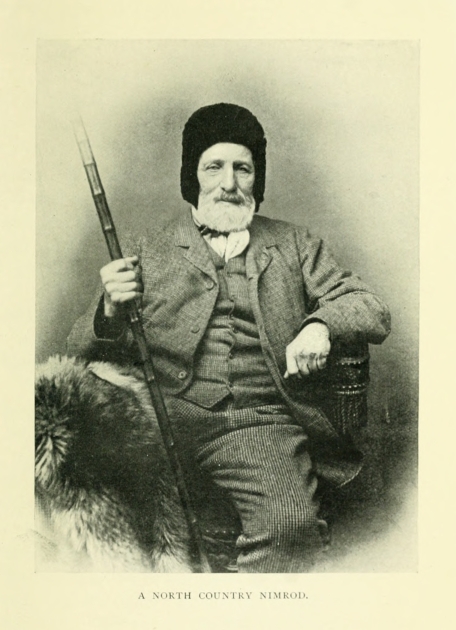
As a lad of 18, John Crozier was already well known as a keen sportsman, as good with his rod in the becks and rivers here about, as he was with his father's hounds, and fond of wrestling as he was of hunting. At that day the pack numbered only six couples. They were kept at the farms all through the year, and were trained to meet at the sound of the Master's horn. The old Squire would often tell how he would stand on Kiln Hill, blow a blast, and watch the beauties racing across the meadows to his call. John Peel, in those days, was still hunting on the other side of Skiddaw, and John Crozier remembered the last time he saw him was under Wanthwaite Crags, where, after a long day's run, he invited the old veteran, who was on his white pony, to come home to supper. 'Nay, nay, John,' said Peel, 'I'se freetened o' gettin' neeted (benighted),' and so went back on his way to Ruthwaite supperless. 'But I'll see thee again,' he added—who knows they may again have met.
The first thing the young Master did was to improve the breed of his hounds, and this he accomplished by getting a strain from John Peel's kennels. How much of Ruby, 'Ranter, Royal, and Bellman, so true,' spoken of in the song, still runs in the blood of the Blencathra pack, I know not. Other strains since then have been introduced, but a hardier pack never breasted a mountain side, and there is not one of them who would not carry on the line himself, if his fellows failed, to the death.
John Crozier once received the following note: 'To J. Crozier, Esq., M.F.H., from Isaac and Edward Brownrigg, of Brownrigg. This hound (Darling) brought a splendid dog-fox, and after a very exciting hunt ultimately caught it in our house field. About an hour afterwards other five dogs came. After being fed they left, but this one would not leave. We intend having the fox preserved.' After carrying on the hounds at his own cost for 30 years, 'the Squire,' as he was always called, at the request of his neighbours, allowed them to become a subscription pack, in the year 1870. There was a general feeling in the dales that it was not fair to allow all the burden to be upon one man, and on the conditions that he would remain Master, and in case of the hunt ceasing, the hounds should be returned to him. A treasurer and secretary were appointed, and the Blencathra Hunt went on merrily as before.
The Master was fortunate in his huntsmen. Joseph Fearon, of honoured memory, was succeeded by Isaac Todhunter, who carried the horn for 25 years. Isaac Todhunter handed it on to John Porter, who for a like time kept up the best traditions of the pack, which Jem Dalton carries on to-day. The names of these past huntsmen, with other members of the hunt, are inscribed on the stone of memorial raised in the Threlkeld Churchyard at the charges of the Squire and a few friends; and that pillar in the King's dale—for of this dale John Crozier was truly king—if it does nothing else, goes to prove that the following of the foxes in the Lake District adds years, even as it adds cheer, to the lives of the dalesmen. Thus, for example, one sees that many of the hunters were fourscore years before they were run to earth; one was 89, another 91, another 95, and a fourth 98.
Up till the past two years the old Master of the hunt presided at the annual hunt dinner, but it was known that his health was failing, and though each week up to the end he kept in touch with all the doings of his pack, he did not leave his house. Still week by week members of the hunt would go up and have a 'crack' with him—always to be received with the same courteous inquiry, 'Well, how about your wives and families, are they well? That's right. Is any news stirring? What about the House last night?' He took the keenest interest in politics up to the end, and that came, not unexpectedly, at two o'clock on a quiet starlit morning, Thursday, 5th March, 1903.
I could not wonder that my old friend the yeoman had said it was a dark day for Threlkeld, for he had lived among his own people, and loved them to the end. How they loved him may be gathered from the fact that two days before he died, a casket containing a book in which every householder in the parish had entered his name, with an illuminated address, full of affection and gratitude, for the friendship towards them of a long life, was brought to the house. 'Ya kna,' said my friend, 'they knew t' aid Squire was house-fast, and they likely thowt 't wad cheer 'im up a laal bit.' He never saw it, for it was thought he was too ill to be 'fashed' with it, and he is beyond all earthly cheering now; 'the Hunter is home from the Hill.'
On the following Monday there was such a gathering together of the dalesmen from far and near as had never been seen in Threlkeld Church, or Threlkeld Churchyard. They sang one of the old Squire's favourite hymns. They bore the coffin to the grave with the veteran's hunting cap and crop and the brush of the last fox killed by his pack upon it, and before and after the service they talked of him kindly, as Cumberland folk ever do of the dead; they spoke of him, not only as the oldest Master of Foxhounds in the land, but as a man who entered into all the social enjoyments of the country-side, and whilst on terms of close intimacy, almost familiarity, with the companions, retained their regard, and in some things set them a good example.
For in an age when the gambling spirit was abroad, it will be remembered that John Crozier never bet a penny in his life. 'I did yance think o' betting a hawpeth o' snaps,' he once said in the vernacular; 'but I kind of considered it ower, and I didn't.' It will be remembered of him, too, that he was against the use of bad language in the field, and that he never would allow, if he could help it, a bit of scandal or 'ill gien gossip.' If he heard one man running down another or passing an unkind judgment, or setting an unkind tale 'agate,' he would jerk out, 'There, noo, thoo mun let that hare sit'—and it sat. 'Ay, ay,' said an old friend as he turned away from the graveyard, 'tho' he said nowt about it, he was a kind o' a religious man, was varra partial to certain hymns, and had his favourite psalms, that he wad gang off quietly to his bit summerhoose most mornings, and tek his prayer book with him. They say t' housekeeper, after her master's death, found t' aid beuk laid open on summerhoose taable, I suppose.'
But as they left the churchyard they all in memory saw the old Master in his sealskin cap, with the lappets about his ears—squarely built and strong, with his alpenstock in hand, as the prefatory verse tells:
But I think I see him stand, Rough mountain staff in hand, Fur cap and coat of grey, With a smile for all the band Of the sportsmen in the land, And a word for all the merry men who loved his 'Hark away!'
And as they thought of what he has been to them for the last 65 years in the Threlkeld vale, they admitted the truth of the following words:
Last hunter of your race! As we bear you to your place, We forget the hounds and horn, But the tears are on our face, For we mind your deeds of grace, Loving-kindness, late and early, unto all the village-born.
A WINTER-DAY ON DERWENTWATER.
If November is the month for cloud effect, December certainly is the month for marvellous dawns and eventides. Then it would appear as if by some generous intent to give the minds of men unwonted tranquillity and to impress all the dwellers in the vales with the thought of perfect restfulness, the sun seems to prepare for his rising a heaven of cloudless silver washed with faintest gold. All the heavy ragged companies of the night-wrack seem withdrawn, and very slowly, while Helvellyn stands lilac-grey against the silver dawn, the sun rolls into sight, kindles the cones of Grisedale and Grasmoor, and bids the heavy dew upon the valley meadows rise up in finest lines of delicate gossamer lawn.
Yesterday, though we had little wind in the valley, one could hear the humming and the roaring of what seemed a tempest in middle heaven, but at night-time heaven and earth were still, and the seven stars in Orion and the Pleiads, 'like fireflies tangled in a silver braid,' shone clear, and we felt that the Frost King had come in earnest. There was no snow on the hills this morning; the leaves at one's feet tinkled as though they were made of iron; I met schoolboys with rosy faces and skates upon their shoulders going off to Tewfit Tarn—the little tarn upon the ridge dividing Naddle from St. John's in the Vale, that always gives our skaters in the Keswick neighbourhood their first winter happiness. Down to the lake I went, and standing at Friar's Crag, saw that part of it was burnished steel and part black ebon water. It was incredible that one night's frost should thus have partly sealed the lake from sight.
A WINTER'S DAY ON DERWENTWATER.
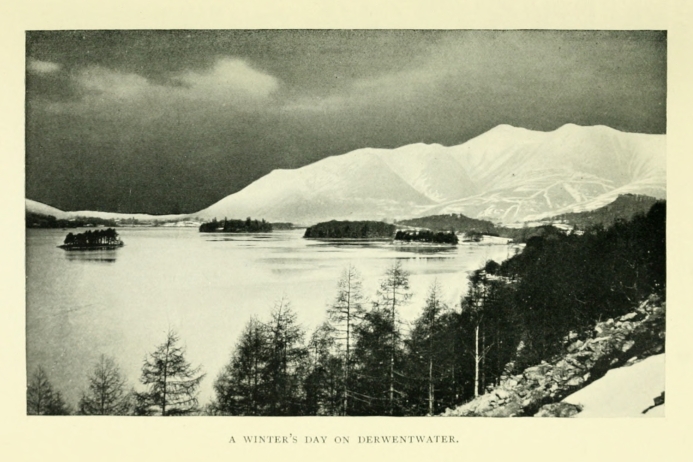
I was bound for Brandelhow to meet the woodman to discuss the felling of certain timber, and through the ice pack, if it were possible, I must needs go. Coasting along round the island, I soon found myself in a narrow inlet of water that stretched half across the lake; tiny spikules of ice that seemed like floating straws were right and left of me in the still water; here and there little delicate fans of ice were passed. These miniature ice-islands were the nuclei round which the freezing mixture would crystallise. Forward across towards Lingholme I steered, and suddenly should have been brought up sharp had not the boat, with good way upon it, crashed right into the ice-floe and shown me how unsubstantial a thing this first ice-covering of the lake was. With every stroke of the oar the boat forged its way with marvellous sound of crash and gride, and one remembered how the Ancient Mariner had heard those 'noises in a swound,' and was able to summon up something of the roar with which the great ice-breakers or steam rams on the Neva crash their way up and down the river to keep the waterway clear for the Baltic shipping. But in a short time the difficulty of rowing became doubled, and if it had not been that one saw clear water ahead one would hardly have ventured forward. Meanwhile in the wake of one's boat one saw how swiftly the little ice-elves repaired the damage one had done by bringing back to its own place and rest each fragment one had displaced, and piecing over with exquisite exactness the breach that one had made.
Now the way was clear, for by some mysterious reason, known only to the water-gods, the shallower the water became as one went shoreward the freer it was of ice. It may have been mere fantasy, but it seemed as if the water so near to freezing was semi-fluid, viscous; always right and left of one swam by the little ice spikules, and the ice fans, with irridescent beauty, floated and shone hard by. Presently another crash was heard, and an ice-belt, only a yard wide, but stretching fifty or sixty yards along, was crashed through, another and another, and so, with alternate noise and silence, one made one's way to Victoria Point, and ran the boat ashore at Brandelhow.
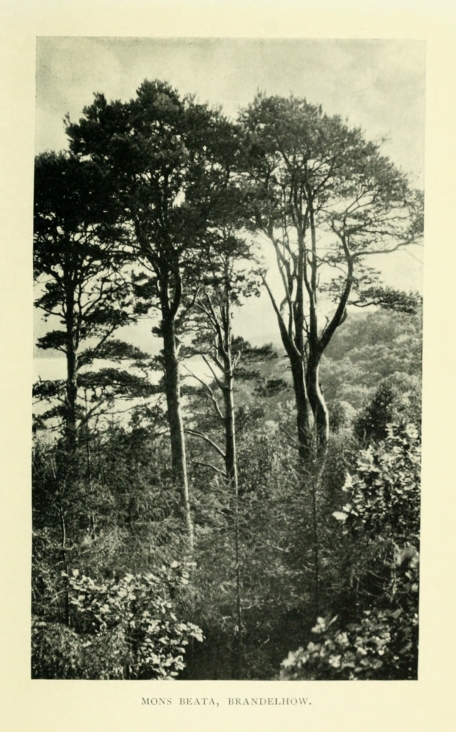
Beautiful as that woodland is in early spring, it seemed that to-day there were more beauties still. The bracken was silver-dusted with frost and shone gold in the sunshine, and the green velvet of the mosses upon tree-trunk and ground only heightened by contrast the rich russet of the fern. I climbed to the russet seat on the rocky knoll above; there, sitting, I watched the gambolling of five squirrels and listened to the crackling as their sharp teeth made short work of the cones and fir-tufts. All these little merry feasters had put on their winter coats, and were much less red of hue than when I watched them last in August. They had put on their winter tails also. I saw none of that curious white flaxen colour which the squirrel in September seems so proud of, as, with a wave of his brush, he dashes out of sight. There, as I watched these miracles of motion and alertness, I thought of Ruskin—how lovingly he had described them. Here was one leaping on to a twig that bent with just enough of swing in it to allow the little fellow to fly through the air to the next bough. Here was another, now running along the sturdier bough that bent not, now dropping five or six feet into a dark-green tuft, now sitting cosily in a forked branch to munch his midday meal, now racing for pure joy and mischief after his brother up a long tree-trunk, the tail sometimes bent in an arch above the tufted ears, again thrown out straight, and now bent and undulating—truly a balancing-pole, if ever one was needed by such expert gymnasts. Children of perfect knowledge of the woodland boughs, fearless as birds and swift as monkeys, the happy family rejoiced in the winter sunshine, as free of care as the cloudless sky above their heads. I moved, and the jay clanged and screamed from among the alders below me, and in a moment the happy family had vanished out of sight, and one saw what an intercommunion of alarm against strange comers birds and beasts must surely have. Dropping down from this happy mount—and truly it has been called Mons Beata—I made my way through crackling fern across the chattering little brooklet to the second rocky height further to the southward. Blencathra lilac-grey and Walla Wood purple-brown and High Seat tawny yellow were reflected with such fidelity in the flood below one that the beauty of two worlds seemed to be given me. The tranquillity of the far-away fells was brought right across the flood to one's feet, a couple of wild duck dashed into the water, and with the ripplings of their sudden descent they set the whole fellside trembling. Looking now towards Cat Bels, one marvelled at the extraordinary beauty of the colour. Never was such bronze and gold seen to make the sky so blue, as one gazed up to the hummock of Cat Bels; whilst, between our rustic seat and the high road, the woodland hollow was filled with colour of gradation from silver-grey to purple-brown, and here and there a beech tree full of leaf or a Scotch fir green and blue gave emphasis to the general tone of softest harmony. Passing on through the larches upon the little height, I gained a third seat, and here the chief charm was the outlook up Borrodale. Immediately in the foreground were young Scotch fir; beyond them the lake glinted in silver through leafless birches. Away up Borrodale, with every variety of lilac melting into purple-grey, ridge beyond ridge, one saw the bossy outliers of the Borrodale ranges stand up in sunny calm; one felt the deep tranquillity of Glaramara and of nearer Honister, the only sound a distant cockcrow from the far-off Ashness farm and the quiet inland murmur of Lodore. The glory of the vale was the wonderful Castle Hill, with its echo of old Rome upon its head, that stood black-purple against the further lilac haze. But as one sat there in silent content a school of long-tailed tits came quavering by. They found abundant food, it would seem, in the Scotch firs close beside me, and what the squirrels had done before to open one's eyes to their miracle of movement these long-tailed titmice did again, for one here, as I sat and watched their happy quest for food. Such balancing, such joyousness, such fiery energy, such swiftness of sight, such whispering of heart's content would have made the saddest man glad and the dullest marvel. As I rose from that seat, with a long look up Borrodale, I could not wonder that our Viking forefathers had called it the Vale of the Borg or Castle, for that Castle Hill in Borrodale must surely have seemed to them a giant's hold, the fittest place for some high fortress-camp, as it had seemed to the Romans of an older day.
If the first height one had ascended was rightly called 'Mons Beata,' and the seat one had last left was placed on a hill that might be called Mons Blencathrae, which gave such fair prospect of Blencathra, surely this fair mount might be called 'Mons Borgadalis,' or the Mount of Borrodale.
I heard a whistle, and to my answering hulloa came a shout. The forester was waiting for me away up there on the highest point of the woodland, not far from the main road and above the Brandelhow mines. Descending swiftly and making my way through the frosty undergrowth, with rabbits scuttling here and there and a soft-winged owl lazily fluttering from a bough above my head, I was suddenly aware by the scent that hung upon the fern that a fox had passed that way. But it must have been in the early morning or 'Brer Rabbit' would not have been about and the jay would have been screaming, and, making the best of my way up to the forester, we soon forgot all about bird and beast in our honest efforts to let in light and give fair outlook to the wanderers who should hither come for rest and thought in succeeding summers.
It is not an easy matter to open up a woodland view—the branch of every tree must be questioned, the joy of 'part seen, imagined part' must be had in mind,—but the work was done at last. We sat down for rest on the woodland seat on the fourth rocky eminence on Brandelhow. It is a seat within only a few yards of the high road, yet so screened from it that it is hardly seen; but it is a hill with so fair a prospect that indeed I think angels might pass the little wicket in the wall and visit those who rest here unawares. There is no better name imaginable for this high resting-place than 'Mons Angelorum.' As I thought thus the great sun rolled beyond the hills and all the vale lay darkened. Cat Bels and Brandelhow went black and grey, while still across the lake Walla and Blencathra lay in full sunshine; but at that moment, unthought of before, there rose a band of angels all along the riverside, and tiny cloudlets swam up into shadow, and again from shadow into sun. The Mount of the Angels was this height rightly called.
'It is likely getting late,' said the forester, 'and if you do not start soon you'll happen hardly get through the ice to-night.'
Down to the boat landing in Victoria Bay I went, and as I went the woodland filled with a mysterious light. I thought of St. Francis and the visions he had seen at Al Verna; the sun was beyond the hills, it had faded now even from Walla Crag, but the light from Brandelhow seemed to leap up from the ground, the larches so dim and dead before gleamed into gold; the red bracken at my feet burned like fire; it was an enchanted woodland; the magic after-glow was the enchanter.
MONS BEATA, BRANDELHOW.
I pushed off from the shore, gained the ice-pack, crashed through it but not without difficulty, and won the dark, clear water beyond. The sun had sunk between Robinson and Grisedale, a dark cloud-bar had filled the heavenly interspace, but there in the gap it seemed as if beneath its heavy eyebrow the eye of God was keeping watch and ward above the quiet land. One had often seen at the seaside the sun sink and the slender pillar of golden light reach downward to the shore, but never had I seen such a magnificent golden roadway laid upon shining water for happy dreams of tired men to follow the flying day, as I saw that eventide upon the silver ice and the darkling flood of tranquil Derwentwater.
WORDSWORTH AT COCKERMOUTH.
It was a difference that arose on the American question, between Sir James Lowther and his law agent and steward, a certain John Robinson, in the year 1766, that was the prime cause of the fact that Wordsworth, the poet, was born here. For John Robinson resigned his stewardship, and young John Wordsworth, then only 24 years of age, 'a man of great force of character and real human capacity,' was appointed in his place to be 'law agent and steward of the manor of Ennerdale.' To that post, which he occupied for the next 18 years, the young man came from the Penrith neighbourhood, bringing with him as his girl wife a certain Ann Cookson, a mercer's daughter, who could boast, through her descent on her mother's side from the Crackanthorpes, of Newbiggin Hall, an ancestry that flowed from as far back as the time of Edward III. She was thus well suited to marry the son of the land agent of Sockbridge, near Penistone, who traced his descent through a long unbroken line of sturdy Yorkshire yeomen away in the Penistone neighbourhood, as far as to the time of the Norman Conqueror. They took up their abode in the substantial house now occupied by Mr. Robinson Mitchell, then lately builded by one Sheriff Luckock. It bears date 1745-46, and is to-day unmarred and unmodernised, remaining much as it was when John Wordsworth became its tenant. We know little of this young John Wordsworth, but he must have been a man 'tender and deep in his excess of love,' for when, after twelve years of happy married life here in the old manor house beside the Derwent, his wife died from consumption, caught, as we are told, by being put into a damp bed in the 'best room' when on a visit to friends in London, he never seemed to recover his spirits, and he himself died six years after her, in the year 1783, on the 30th December, and lies buried at the east end of the All Saints' Church. He lost his way on the fells when returning from some business engagement at Broughton-in-Furness, and was obliged to stay out all night; the chill from exposure brought on inflammation of the lungs, and his strength, sapped by deep domestic sorrow, could not bear up against it. The orphans whom he left, Richard, William, Dorothy, John, and Christopher, four of whom were remarkable in after life, were then removed to the care of their uncle Cookson at Penrith, and Cockermouth knew them no more. We have been allowed, from William Wordsworth's autobiographical notes and his poems, to glean something of those early days. The poet tells us:
Early died My honoured mother, she who was the heart And hinge of all our learnings and our loves, Nor would I praise her, but in perfect love!
We can in fancy see her in earnest converse with Mr. Ellbanks, the teacher of the school by the churchyard, talking about William's 'moody and stiff temper'; we can hear her say 'that the only one of the children about whom she has fears is William; and he will be remarkable for good or evil.' We may note her pinning on the child's breast the Easter nosegay, for the young lad is to go up to the church, to say his catechism. Daffodils I expect the flowers were: years after, in the ecclesiastical sonnets Words worth, speaking of this act of his mother's, writes:
Sweet flowers at whose inaudible command Her countenance phantom-like doth reappear.
Or we can see the father, book in hand, hearing the lad recite the long passages of Shakespeare, and Milton, and Spenser which were insensibly to mould his ear to music, fire his imagination, and make a poet of him.
But when I think of Wordsworth in those childish days I do not go off to the ancient school by the church to hear him stumble through Latin verbs. He was not as happy there as he was at Mrs. Birkett's, the dame's school at Penrith; there was no Mary Hutchinson to keep him company; and he learned, he tells us, when he went to Hawkshead at the age of ten, more Latin in a fortnight than he had learned the two previous years at Cockermouth. No, rather when I want to see the little William Wordsworth at his happiest, I go with him into the old Manor House Terrace garden by the Derwent's side, and see him with his sister, that sister 'Emmeline,' as he called her, chasing the butterfly, or hand in hand peering through the rose and privet hedge at the sparrow's nest, 'wishing yet fearing to be near it.'
Or, follow him with his nurse, he a child of only five years of age, bathing and basking alternate, all the hot August day in the shallows of the mill pool, and leaping naked as an Indian through the tall garden ragwort on the sands, and clapping his hands to see the rainbow spring from middle air. Or I go with him by the river, 'winding among its grassy holmes,' whose voice flowed along his earliest dreams—that Derwent he could never forget—away to the Castle-hold of the barons of old time, Waldeof, Umfraville, Multon, Lucies, and Nevilles, and watch him peering with look of awe into the dark cellar and dungeons, watch him chase the butterfly through the grim courts or climb after the tufts of golden wallflower upon its broken battlements.
But happiest of all was he when with his story book he lay full stretched, as he describes in the Prelude, upon the sun-warmed stones and sandy banks 'beside the bright blue river,' and there feasted his little heart on fairy tale and filled his soul with scenes from wonderland.
Wordsworth was never unmindful of the home of his birth. He left Cockermouth for schooldays at Hawkshead when he was a boy of nine, and though in the holidays, for the next five years, he paid an occasional visit to the place, his chief vacation associations were with Penrith. The Poet's connection with this town ceased at his father's death in 1784, when he was a lad of fourteen; but he never forgot it. From nature and her overflowing soul here in his childhood days he had received so much that all his thoughts were steeped in a feeling of grateful remembrance of it. He visited the home of his childhood occasionally to refresh his heart with a cup of remembrance, and we find a note of a certain visit in Dorothy's letter to Mrs. Marshall. Writing in September, 1807, she says:—'W. and M. have just returned. They were at Cockermouth, our native place you know, and the Terrace Walk—that you have heard me speak of many a time—with the privet hedge, is still full of roses as it was thirty years ago. Yes, I remember it for more than thirty years.'
In 1836 he interests himself in a scheme for building a new church. He writes to his friend Poole, of Nether Stowey, for assistance to this object. He tells him that Cockermouth is in a state of much spiritual destitution, nearly 6000 souls and only 300 sittings for the poor. Wordsworth cared for the poor. 'I have been the means,' he says, 'of setting on foot the project of erecting a new church there, and the inhabitants look to me for much more assistance than I can possibly afford them, through any influence that I possess.'
As a Keswick parson, I gather with pride further on in that letter, that it was the fact of the new church of St. John's having been built there that spurred him on; and that he hopes Cockermouth will do as Keswick has done, and thus excite other towns to follow so good an example.
It is interesting to note that the Cockermouthians of that day were not of one mind in the matter, or the Poet had been misled as to native church feeling; for the inhabitants having a windfall of £2000 given them by the Lord of Egremont that year, to spend as they pleased, preferred a new market place to a new church, and the old Poet writes:—'This was wanted, so we cannot complain.'
But Wordsworth was disappointed and grieved too at the spirit of unkindness shown by some of the people of his native town to his good Lord Lonsdale. I have had access to a MS. letter of Wordsworth's, which shows that the Church-building project fell through, as far as he was concerned, by reason of what he considered the unfair treatment of an offer of help, made by the then Lord Lonsdale to the town, in connection with the church accommodation needed.
So far as I know this was the last public work he attempted to do for the place that gave him birth. But at least we cannot regret that his last effort was in a cause near to his heart, the cause of the religious interests and life of his fellow Cumbrians, the cause of reverence, worship, and godly fear, of 'pure religion breathing household laws,' the cause of the worship and praise of Almighty God, here in his native place.
The seed he sowed, though it lay dormant, did not fall on barren ground; and in a real sense the present All Saints' Parish Church may stand as a monument to the immortal Poet, who then, as ever, championed 'in perilous times the cause of the poor and simple,' and did what he might in his day for church life and piety in the place of his nativity, Cockermouth.
MOUNTAIN SILENCE AND VALLEY SONG.
Once more the Heavenly power makes all things new.
This was the line from Tennyson's poem that kept ringing in my ears, as on the mid-most day of April I wandered out and away across the vale to the skirts of Skiddaw.
Opens a door in Heaven; From skies of glass A Jacob's ladder falls On greening grass, And o'er the mountain walls Young angels pass.
Before them fleets the shower And burst the buds, And shine the level lands, And flash the floods, The stars are from their hands Flung thro' the woods.
No, no! this last couplet was untrue; the anemones had not yet opened their delicate shells, and the blackthorn buds were only dimmest seed-pearls of yellowish lustre. But as I gazed from the fence halfway up Latrigg and watched the Greta flashing, and the great plain fresh-enamelled with the first faint green of spring, a Jacob's ladder was let down from above Scafell and Glaramara, and all the angels that ever came on earth to fill men's hearts with April jollity came trooping downwards. They took on various forms. Some of them became tortoise-shell butterflies that lay in sunny content upon the moist woodland path. Others sailed out of blue air and became glorious peacock butterflies upon whose underwings in blue and black one clearly saw the head and face of human kind sketched in with lustrous powdery pencillings. Other angels ministered to the pink coral glumes of the sycamore; others, again, daintily untwisted the leafage of the wild rose in the hedge; others delighted to unfold the tufts upon the elder. But the angels that seemed to be busiest were those that made the vivid emerald of the 'dog's mercury' contrast with the faded red of the bracken in the woods, and where the purple birches showed against the flowering larches added moment by moment a deeper, ruddier purple to the trees' beauty and a finer flash of green to the surrounding wood to set the purple off.
But all the gifts of the angels of that April morning seemed as nothing when compared with the joy of the sight of one single angel of the spring—he a lustrous-backed swallow who flashed from steel-purple into black and from black to steel-purple, and disappeared from sight behind the larches. I had known of his coming, for a swift-eyed shepherd had seen one of his kind in the valley as early as April 1, but April 13 to the 15th was marked in my calendar as swallowtide, and I had not expected sight of him till this week. Here he was, glossy with African sun, and full of silent message that summer was sure. The chiffchaff would be a-trill and the cuckoo would be calling for a mate within the week. Ah, swallow! swallow! flying north! How much of hope and happiness you bring. Then as I moved through the larchen grove, I heard the titmice whispering that they too were glad, they too felt reassured by sight of the swallow, and one walked on in a kind of consciousness that man and swallow and budding larches were more akin than one had believed, until the joyousness of spring found the selfsame echo in such divers hearts, and that indeed the over-soul was one, the music and the melody one voice. Yes, Wordsworth sang truly when he wrote:
One impulse from a vernal wood May teach us more of man, Of moral evil and of good, Than all the sages can.
I met a child halfway up Latrigg braiding her hat with larch flower. Truly no rubies ever seemed so rich and rare as these which the simple village child had twisted in her hat; her sister had a handful of primroses she was taking to her father in the neighbouring cottage, for he was but slowly recovering from pneumonia, and the child knew by instinct that a breath from a primrose posy would do more for him than all the 'doctors' bottles' in the world.
'You have been up Skiddaw betimes,' I said.
'Ay, ay, sir; you see they've gone to "laate" Herdwicks to-day for lambing-time, and I went up to the Gale with the dogs.'
Herdwicks! Lambing! What did it all mean? Only that those great brown slopes of Skiddaw which till this day have been vocal with flocks and alive with sheep, will by this eventide be as silent as the grave. For between April 10 and April 20 the shepherds know that the Herdwicks will become mothers of their springtide young, and so they will go forth to the fells and upland pastures, to bring their woolly charges down from the mountain heights to the safety and the food and care of the dale-farm enclosures. I overtook the shepherds at the 'Gale,' and went with them. Soon the dogs were seen scouring the fell-side, now disappearing from sight, now coming back to get a signal from their master. A wave of the hand to left or right was all that was needed, and away they went, and slowly and surely they seemed to be able to search out and bring into a close company the Herdwicks from all the heathery waste and grey-bleached mountain hollows.
Then began the home-bringing. Very tenderly and gently did the dogs urge the sheep, heavy with young, down the fell-side slopes. Now and again the shepherd cried, 'Hey, Jack!' and away the collies flew back towards him. 'Ga away by!' and away again the collies flew in a great circle out beyond and behind the sheep. The sheep were a little hustled and came on too fast. Then the shepherd whistled and held up his hand, and the dogs sat like stones till he whistled and waved his hand again. So down from Lonscale and across the gulfy Whitbeck the sheep came. The dogs dashed off to where, through a great carpet of ever-lucent moss, the main fountains break from the hill. They slaked their thirst, then came back slowly to urge the flocks homeward and downward toward the Shepherd's Cross, and so over the Gale to the Lonscale Farm. We stopped at the Cross, and a tall, 'leish,' handsome man, with fair hair and the grey Viking eye, said in solemn undertone, 'Fadder and brudder cud hev been weal content to be wid us on sic a day as this, I'se thinking.' And the mist gathered in his eyes, and he said no more, but just went homeward with the sheep. Ah, yes, that Shepherd's Cross tells of men—father and son—who spent their whole lives in following the Herdwicks on the sides of Skiddaw and Lonscale Fell; wrought for their sheep, thought of them by day and dreamed of them by night, and were as proud, as ever David was, of what they looked upon as the finest life a man need care to live, the mountain shepherd's round of love and toil.
I waved adieu, and up beyond the huts to 'Jenkin' I went. The red fern had been washed into faintest ochre, the heather had grown grey with winter storm, but everywhere beneath the blanched grass one felt new life and tenderest first flush of April green was astir; and as one looked down from 'Jenkin' into the circle of the deep blue hills and the Derwent's perfect mirror, one saw that though the larches were still brown there was an undertone of something, neither brown nor green, that flooded not only the larch woods but the great Latrigg pastures also, and betokened that the spring was even at their doors, and that the fells would soon rejoice with the emerald valley below. Gazing at the vale of Crosthwaite, where still all the trees seem winter white, one was astonished at the darkness of the hedgerows that divided the meadows, and one saw the new fallows shine and swim like purple enamel upon the green flood of the springtide grass. 'Jenkin' was reached, but not until many swathes of lingering snow, black with the smoke of the blast furnaces of the coast and of Lancashire and Yorkshire mills, had been passed. Here at 'Jenkin top' we found two men hard at work 'graaving' peats for the Coronation bonfires on June 26.