Front matter (continued 2)
Reading edition
Dolly: 'What, thou's goin' to be sadly tewed.'
Mrs. Rawlinson: 'Nay. I was nobbut a bit put about at first, but I mean to ask Betty Braithwaite to lend me her beuk as larns yan to mak hundreds and hundreds of things 'at I never heard of, nor naebody else, I wud think.'
As long as I live I shall remember the delightful get-up of this said Mrs. Rawlinson, with her high black cap and flower in it, and her old-fashioned criss-cross shawl, and her spotless white 'brat'; and the way in which she pronounced the word 'omelette' as 'waumlett' convulsed the house.
The second scene in that first act was one that went home to the hearts of all, for if the Westmoreland folk love one thing more dearly than another it is 'a sale.' The sale is really the excitement of the winter time. I believe that if nobody was changing farms they would compel someone in the neighbourhood to pretend that he was, that a sale might be held. It is not the fierce excitement of bidding one against the other that causes the great gathering at the sale, but 'everybody's tied to go,' as they say—bound to go to the sale, just as everybody is bound to go when they are bid to a funeral. It would not be friendly not to do so, and high, low, rich and poor, one with another, meet at the sales, as De Quincey has reminded us, to see one another and to hear how the world is stirring.
The Grasmere Players in this sale scene were all of the manner born, and a young mason played the part of 'Tom Mashiter' (auctioneer) with great delight to himself and to his audience.
'Here's t' fadther and muther and t' dowter he cried, as he put three teapots together. 2s. 6d. for the lot just to get us into the bidding! Here's a pair of copper scales; see how true they hang! Now I durst bet there's not above half a dozen among us as honest as them is. There's not, howiver; and I know who's yan o' the half-dozen; ye can settle the other five amang you. Three an' six. Three an nine. Come, be quick. Nay, I'll not wait. I'll tak some on ye in, ye'll see, if ye don't bid quicker——'
And the scales were knocked down 'mid roars of laughter.
'Here's another good jar, yan o' t' auld fashion, wid a pair o' good lugs to hod by. A penny for it I have bid; who'll say tuppence? Tuppence for you, Sarah. It's a real good un, yan o' t' rare auld-fashioned mak, like me an you, Sarah. I think there's nobbut us two left o' the auld lang-eared breed.'
Then there were quilts sold with a deal of very amusing talk to make them go off. One was in rags and tatters, but the auctioneer suggested that it might do for a sick horse or a sick cow. I was listening with great amusement, and I heard an old fellow beside me say, 'Well, but things is goin' ower cheap,' and in another moment jerked out, 'A penny—here,' and was not a little astonished that his bid was not taken. I only mention this to show you how to the life the whole thing was done, and with what deep interest the spectators gazed upon the play.
In the second act the plot thickens, and the interest centres in the two chief actors of the little play—Aaron Hartley, with his apparently rejected addresses to the statesman's daughter up at Hardcragg Farm, and Betty Braithwaite. Aaron comes into his mother's kitchen, and, as far as any Westmoreland man dare let himself go, allows her to see that things are all up between himself and Betty. He must go off to 'Lunnon,' for he cannot face living on in the dale now, and all the hay grass but one meadow has been got in.
'I think I must be going away, muther, for a bit. I don't see but that you'll mannish finely without me. We've gitten a' the hay in but t' midder, and that'll not take so lang. It's nobbut a light crop, and then it'll be verra slack till bracken time, and what, Jonty's match to make a good start with that if I sudn't be back.'
Just then the farm servant Jonty enters. I believe that he was a coachman in the village, but he was a consummate actor, and his quaint, silent ways and the lifting up of his hand and scratching his head behind his ear when talking were quite admirable. He has had, from youth up, the wish to have something from London, and he tells Aaron that he's 'wonderin' whether he could mannish to bring him a "spead" fra Lunnon' when he comes back; 'but maybe the railway folk wad charge ower dear for carryin' on it.' Aaron chaffs him out of the idea that a 'spead' made in London is better than one made in Kendal, and suggests a nice silk handkerchief. 'I never thowt o' that,' says Jonty; 'that wad be as like as aught.' Libby, the pretty farm servant breaks in here, and says: 'I wish tha would think on it, and not be so ready with thy jacket sleeve.'
'Ye'll not can tell me (says honest Jonty) how much t' silk handkercher'll be until ye've bought it, I doubt; but if ye'll send word I can just send ye the brass in a letter.'
And, saying, 'Well, I mun see all's reet afore goin' to bed,' the faithful farm servant leaves the cottage to go round the byre.
But the actress of the piece throughout is Aaron's mother, Mrs. Hartley. She sits there at her knitting, with her pretty crossover on her shoulders, sair troubled at heart by her son Aaron's love affair; she drops her stitches, for her eyes can hardly keep back the tears, but she seems to know intuitively how much and how little comfort she may give her son, and how far she may insist upon his confidences. The attempt on her part to make it appear as if it did not matter at all and that everything will come right in the end is very bravely done. Fewest words are best.
'Good night, mother,' says Aaron. 'You'll not mind a' I've said.'
'Nay, lad, not I. Good night.'
And so the curtain falls. The second scene in the second act brings Jonty and Mattha Newby (the village tailor) together. Mattha, as I heard, was the son of a village tailor. To-day, evidently from his boyhood's remembrances, he is able to play the tailor's part well. Jonty has been 'wrestling with a dyke' and torn his jerkin, and Mattha volunteers to mend it. A song was introduced into this scene which I had written for the occasion. It ran as follows:
Come! sweet April, whom all men praise, Bring your daffodils up to the Raise, Bid the delicate warbler trill, Come with the cuckoo over the hill Sprinkle the birch with sprays of green, Purple the copses all between; Bend the rainbow, and swell the brooks, Fill the air with the sound of rooks, Rubies lend, for the larch to wear, The lambs are bleating, and May is near.
August comes, and the speckled thrush Sings no more in the lilac bush, Lambs in the meadow cease to bleat, The hills are dim with the noontide heat, From all her hedges the rose is fled, And only the harebell lifts her head; But green are the new-mown vales with grass As if the Spring were again to pass, And children bring from the far-off fell The rose-red heather—the bee loves well,
Comes October with breath more cold, She breathes, and the bracken turns to gold, The cherry blushes as red as blood, The rowan flames in the painted wood, The larch-tree tresses are amber bright, The birch is yellowing up on the height, {82} And over the valley and over the hill A deep hush broods and the sheep are still, But rainbow gossamers fill the air, Tho' the old earth rests, the world is fair.
Now are the mountains winter-white, Helvellyn shines in the clear moonlight; The carollers sing, and the Christmas bells Send sweet messages up the fells; The old folk meet for their Christmas cheer, The young folk skate on the frozen mere; But Spring is coming, the shy buds peep, The snow-drop moves in her long, long sleep, The lemon-light shines on the leafless larch, And the wood grows purple to welcome March.
Fair, how fair, are the changing days That keep us happy beneath the Raise, We who, in honour of Oswald the King, Our 'bearings' still to the Old Church bring, We who here in the silent time Act our part and carol our rhyme. Seasons change, and our hair grows grey, But merrily goes the Grasmere play, And two things stay with us all the year— Love of our valley, and heart of cheer.
It had been prettily set to music by a Grasmere lady, and the two bass voices chimed in with the two last lines in each verse, and Mattha the tailor and Jonty the farm servant gave great effect to the song by the sudden addition of their manly notes. Before the curtain falls on this scene, we learn that the tourist (to whom we were introduced in the first scene), Mr. Augustus Mallister, who has heard that she is an heiress, is determined, if possible, to win the heart of Betty Braithwaite. He knows that Aaron's absence has made her heart grow fonder. He determines to write a letter, which shall be posted in London, purporting to come from Aaron, in which the absent lover declares that he has become engaged to an American girl; and so the curtain falls.
In the last act, and the first scene, there is a pretty passage, although it is a pathetic one, between Mrs. Hartley and the girl Betty Braithwaite, to whom Mrs. Hartley has given Aaron's letters to read—one of them the fatal letter. In the last scene Norman Braithwaite and his wife, an excellent make-up, come in to talk matters over, and the letter from London amongst other things. Jonty remembers how that, on a certain day in August, the tourist chap, 'the fine gentleman' as he called him, had been spouting out a letter about an Aaron getting wed to an American, and they at once seemed to see light and to feel that the letter Mrs. Hartley had received was a forgery. Just at that time Aaron and Betty enter, and one can tell by a glance at them that it doesn't matter how many forged letters have been written in London; they have quite made up their minds to make a match of it. As for Mallister, 'the fine gentleman,' Jonty breaks in:
'Is it Mallister you're talkin' on? We weant see any more o' yon ne'er-do-weel here. I met t' p'liceman going off wid him to Kendal.'
Norman: 'T' p'liceman! What for?'
Jonty: 'It seems he's been wanted for some time. He's been up to some forgery or summat o' that mak.'
Poor Mrs. Rawlinson, 'the fine gentleman's' landlady, enters greatly distressed that the good name of her house has been compromised by letting lodgings to a forger. 'Why,' says she, 'I thought he was a gentleman, wi' his wawmlets to his breakfast, and his late dinners and siclike.' And so with the assertion that there is nothing to wait for and the wedding shall take place at Martinmas, the curtain goes down, and all's well that ends well.
During the acting it was quite plain that the actors themselves were as much interested as those who witnessed the play. 'I was fairly shamed of myself,' I heard one saying, 'to meet with ye when I came off the last time, for the tears on my face, but if you had given me a five pound note I could not have helped it.' Ah, thought I, that was the secret of your acting so well. Now and again an actor in undress would pass down the room to have a look at the others as they performed their parts, and to report. They would come back with much encouragement to their fellow-players with such words as these: 'Eh, but it's a grand company now, and walls is beginning to stream now'; and in truth the heat of the room and the consequent vapour bath was a thing not to be easily forgotten. But if it had been twice as hot, and the hall had been twice as crammed, and the play had been twice as long, one could still have sat with real pleasure to see such perfect acting done with such simplicity and reality to the life. One wished that Will Shakspere could have come along; how he would have blessed these village folk for their truth and their simplicity. And how good a thing, thought I, it is, that there should be a dull time at the English Lakes, so that, without any temptations to extravagance in scenery or setting of the plays—that would inevitably come with a wider public,—these natural dale-folk can delight their fellow-villagers, by dramatic talent as real as it is remarkable.
JAMES CROPPER OF ELLERGREEN.
The pattern life of a public-spirited country gentleman closed, when James Cropper of Ellergreen, with eye undimmed and natural force unabated, entered rest.
Come of an old Viking stock,—for his name is found in the Landnama Bok of Iceland,—he had inherited the best traditions of true philanthropy from his grandfather, who, with Zachary Macaulay, had worked for the emancipation of the slave. In him, too, ran something of the spirit of good old Quaker blood. Whole-hearted Churchman as he was, he loved as the Friends love, simplicity in form and directness in religious expression. In earliest days he had cared for social and industrial problems, and the sorrows of the labouring poor entered into his heart. It was his good fortune to be able, by becoming an employer of labour, in his paper mills at Burneside, to face these problems and to become, as he always wished to become, the father rather than the master of his workmen.
He lived to see Burneside become, under his fostering care, a model village. He lived to see some of his endeavours, notably his idea of Co-operative Stores for the people, find acceptance far and wide. The guardianship of the poor was a sacred trust to him. As Chairman of the Board of Guardians at Kendal for twenty-five years, and as Vice-President of the Northern Poor Law Congress, he both learned and taught wisdom. Almost the last thing he talked with me about was a scheme for caring for that most helpless class of our poorer friends, the pauper imbeciles of Cumberland and Westmoreland.
He was in early days a keen politician, and represented his neighbouring town of Kendal for five years in Parliament. Latterly he had felt that he could not be a partisan, or rather that partisanship dulled sympathies, and though it was a grief to him at the time to leave the House at the redistribution of seats, he found so much more of home politics to hand for him to do, that he ceased to regret it.
When the County Council in Westmoreland met for its first time in 1888, they unanimously elected James Cropper to be their chairman, and to the day of his death his heart was in the work.
The Queen Anne's Bounty Board gave him the chance of helping the church of his love. The late Bishop of Carlisle, Harvey Goodwin, had no truer friend; and the present Bishop Bardsley testified to the constant help to church work in the diocese that this most earnest layman was always willing to bestow.
But it was the cause of education—elementary, secondary, public school, or university—that was nearest to his heart. As one of the Governors of Sedbergh, and Heversham and Kendal Grammar Schools, his counsel was constantly sought. As a believer in women's education, he founded a scholarship at Lady Margaret Hall, Oxford, and a bursary at the Edinburgh Medical School for the training of native Indian women as doctors.
JAMES CROPPER OF ELLERGREEN.
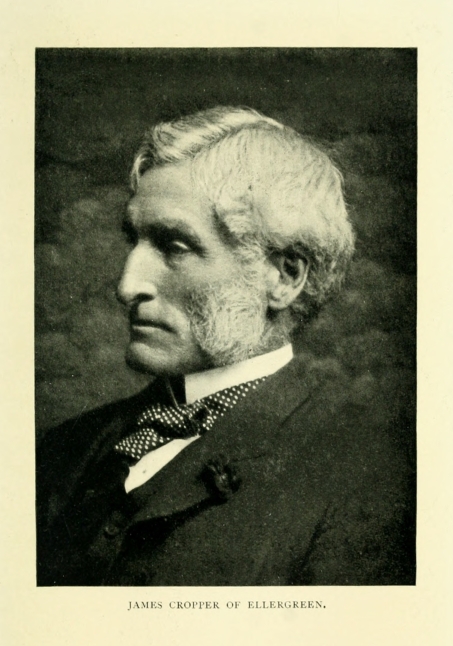
He was Chairman of a Kendal Education Society which anticipated much of the present endeavour of the Code to secure better instruction for elementary teachers. He was never so happy as when he could gather the teachers on the lawn at Ellergreen, and hold counsel with them as to their future aims and their present progress. The idea of a pupil-teachers' centre at Kendal was his, and as Chairman of the County Council he was able to lend it substantial aid. When the Voluntary School Association came into being, he took up the idea warmly, and personally visited every school within his area, and made its wants and its difficulties his own.
There was not a day that this public benefactor did not do something to help his time. And if one asked oneself why it was he had the power to be a pillar of good in his generation, a kind of beacon and standard for higher and happier life in all classes of society round about him, the answer seemed to be that he had a heart which was for ever young, in a body that seemed as if age could not touch it—that his sympathies were not with the past, but with the present and the future; that his enthusiasm for the better time coming never failed him; that he believed that all things work together for good to them that fear God and keep His commandments.
The grace of this abundant hopefulness flowed out in all he did and said. 'Age could not stale his infinite variety,' because he never grew old. To see him with young men or little children was to see him at his best. To know him in his home life was a privilege for which to be thankful.
But deeper than all his spring of hope and sympathy with the young and the new lay the fountain of poetry at his heart. He did not, I think, write poetry, but the love of it was a continual presence. He had the poet's heart, and entered into the poet's mind. For him, the practical public county magistrate and councillor, the spirit of the innermost was the joy of the imagination. This was the secret of his swift sympathy with nature and with man.
We met by appointment in the Tapestry Room of the Spanish Palace at the Paris Exhibition on October 12th, 1900. He was as cheery as ever.
'I have had a delightful week,' he said, 'I wish all my friends could have seen this wonderful exhibition. Yesterday I was at Chartres Cathedral. I never knew what stained glass was before; pray visit Chartres. It is a revelation to one.' Then he turned to the Spanish tapestries and went with deepest pleasure through the historic scenes that the needles of the fourteenth and fifteenth centuries have left on deathless record. He seemed as young-hearted as a boy, and as fresh in his enthusiasm as if this Paris Exhibition was the first he had ever seen, but he was seventy-seven and had seen more than falls to most of us to see, of all this world can show. I did not know as I shook hands and parted that Death already had shaken him by the hand.
That night the sharp pain of pneumonia was upon him. I saw him once again, at the bedside celebration of his last Holy Communion, and then I saw him dead. His beautiful lace without a wrinkle in it with all the look of youthfulness come back—but, alas, without the bloom, beneath that ample crown of snow-white hair which for years past had added such dignity to his refined and kindly presence. As I gazed, the one thought that came to me was this, did ever man pass so little weary, so full of keen interest and unabated enthusiasm after so long a pilgrimage, right up to the doors of that other world where, as we trust, all his fullest powers shall find full play, or enter these gates of life with so little pain?
He died in France and his body was borne across the sea and laid to rest in the valley he held most dear. It seemed as if all Westmoreland and Cumberland had come to Burneside to do him honour at the homegoing.
The coffin, covered with wreaths, was laid upon a simple wheeled bier in front of the doors of Ellergreen, and so taken by hand from the house to the church. It was his wish that no hearse should be used, and that this simpler method of carrying the body to its rest should be employed. Before the procession moved, many of those present came up to the coffin to see the beautiful photograph taken after death; and side by side of it the picture of his bride taken on her honeymoon. Beneath these two pictures were written the words from Christina Rossetti's poem:
'Think of our joy in Paradise When we're together there,'
and beneath this a little note stating that these were the words which he had begged might be inscribed upon his tombstone.
Those who knew how ideal had been their wedded life, knew also how through all the long years of widowerhood and the grief of separation that lent its pathos to his fine face, there had been one sweet music to which he moved—the music of the hope of a sure reunion, that had surely come with joy at last.
The sunlight faded from the near fells, and sorrow filled the air. A single robin sang a note or two and was silent, and the leaves fell audibly to the ground. But all who gazed out east saw the blue Howgills and the further Pennine range shine out like burnished silver and gold, and thought of the glory of that far land to which our friend had gone.
The procession went up the drive and into the lane, and so down into the village, where every head seemed bowed and every home a house of mourning. The service, simple throughout, included his favourite hymn:
'Lord, it belongs not to my care Whether I live or die,'
and at the grave side a third hymn was sung which had been chosen by his daughter as expressive of the continuity of happy life in the world beyond. The bishop pronounced the benediction, the mourners placed their wreaths at the grave side; silently the vast crowd melted away, and left to its long rest the body of one of the most public-spirited servants of the common good that Westmoreland has known. He will be as sorely missed as he will be surely mourned.
A DAY WITH ROMAN AND NORSE.
It was burning June. The sun shone on lake and fell. Skiddaw was cloudless and lifted into the clear heaven its purple lilac shade powdered with the fresh fern and the emerald green of the bilberry. The corn-crake cried in the valley, the throstle whistled from the larch plantation; in and out of the elder-blossom the tireless bees went humming, and the haymakers could hardly get on with their work for gazing at the exquisite beauty of the wild roses on the hedge. In Cumberland, as Southey said, we miss the violet, but we make up for our loss in April and May by the blush roses of the June. They embroider the lanes, they dance upon the hedgerows, they flash against the grey blue waters of the lake, they flutter against the green fellside. Such roses! not faint in colour and scent as we see in the South, but red of heart and filled with fragrance, wonderful wild roses of Cumberland.
What a day of life and loveliness it is! On the old Millbeck Hall door stone up yonder are the words, 'Vivere mori, mori vivere,' but we feel that the living, the living are the hearts that praise, and death is, even by suggestion, out of place here.
To-day as we dash along under Skiddaw to see where Roman and Norseman once had home, we feel that the same beauty was beheld by earlier races, and the wild rose that gladdens our sight was very dear to eyes of far-off generations, and has been a perpetual garden of life and loveliness for all the passing years.
We are going to see the camps of the warriors of old, and we do well to gather and put in hat and buttonhole the emblem of England's warrior saint, the good St. George. As one thinks of the flower, one's mind does not only go back to Pisanello and his picture of St. George away there in the church of St. Anastasia in Verona, but to the hundred shrines wherein are seen that fair Madonna, the Rose of God, whose painters honoured the wilding rose for her sake, and gave it immortality on their canvases. To Roman Catholic and to Protestant alike, how significant and full of tender association is the wild dog-rose of Cumberland! How close it brings the church days of an older time back to the present dwellers in this country, seeing that both on Carlisle's city arms and Carlisle's bishop's coat of arms, the wild rose shines, memorial of the monastery that honoured the Rose of Heaven.
But to-day we are going back to times that antedate those mediaeval church days. We are on visit bent to Roman and Viking who dwelt in sight of Skiddaw—the cleft one, in the days,
'When never a wild-rose men would braid To honour St. George and the Virgin Maid.'
We dash on by Dancing Gate, a farm beyond Scalebeck, with its quaint holly trees, whose sons have never forgotten the art of dancing, on by Mirehouse with its memories of James Spedding and Thomas Carlyle and Alfred Tennyson, on under Ullock slope, and by Ravenstone till we reach an old farmhouse, quaint with its Jacobaean door-pilasters.
'For Orthwaite Hall and Overwater,' said the coachman, 'we should turn off here to the right and go up the Rake,' as he slackened his paces.
There was an old Norse ring about that word 'rake,' for the Icelanders still talk of their sheep 'rachan' just as our Cumberland shepherds do; when the sheep follow one after another along the mountain side, they are hereabouts said to be 'raking,' but though we were bent on a Norse chieftain's home we refused to ascend the Rake. It was very hot and sultry, and we preferred the shady woodland of Bassenthwaite 'parks,' and so drove forward. We passed the Vicarage house and the Bassenthwaite Church, crossed a small stream, and, turning sharply by a deserted chapel towards the village, drove by the village green, thence entering a kind of meadow road, were soon in shadow, and for more than a mile went, beneath bowery oak, and fragrant larch, and gleaming hazel, along this copse-lane sweet with wild woodruff and gay with lychnis, towards the hillside opposite the Dash, where stands Orthwaite or Overthwaite Hall. It is worth while turning for a backward gaze as we ascend the hill; Bassenthwaite and the fells that close round far Derwentwater look nowhere more beautiful than from here.
That little tarn on our left is not Overwater, but it has its history; one hundred sheep went on the ice one wintry day, broke through, and all were drowned. The current superstition is that the pike in that tarn are as large as donkeys; whether before or after the feast of plenty accorded by the mountain sheep is not told.
Here is Orthwaite or Allerthwaite Hall grim and grey, its little Elizabethan window mouldings, its diamond squares of glass, its quaint low-ceilinged dining room. There is a look of drear sadness and of pale sorrow about the quiet half-hall, half-farmstead, and there may well be, for its owner William George Browne, the traveller, went forth therefrom to explore Tartary and Bokhara in the year 1812, and being suspected by the Persian government of sinister design, was, under instruction from headquarters, taken captive beyond the Kizzil Ozan river, blindfolded and barbarously murdered. Poor Browne! he had better have stayed in sight of harmless Skiddaw, but his was the gipsy's mind, and though none knew quite why he journeyed, and his journeys in Africa, Egypt, and Syria show that he travelled more from love of wild roaming than for aught else, home for William George Browne had no attraction in its sound. His was the restless wanderer's heart.
Now we leave the carriage, and while it goes round to pick us up at Whitefield Cottage on the Uldale and Ireby road, we descend into the meadows and find ourselves gazing on a large square entrenchment, at the angles of which were once raised mounds, lying to the south-west of Overwater. No Roman camp this, for Romans did not place their camps in the bottoms, unless they had a secure look-out above them, or a fortified camp on a height near by; and Romans did not when they dug an entrenchment round their camp, throw the earth out to right and left and make an embankment either side their fosse, as it is plain was the case here; besides there is but one entrance to the camp, and that was not the Roman way. No, the camp we are looking upon was probably the kraal or stockaded farmstead of a Norse chieftain, any time between 874 and 950 A.D.
Its owner probably came up the Derwent with Ketel, son of Orme, with Sweyn and Honig or Hundhr, what time they harried Cumberland under Ingolf or Thorolf the Dane. For aught we know, he may have been tempted hither by some sudden surprise-peep he got of the Overwater tarn and neighbouring meadowland, from the heights of Skiddaw, the first time he clomb that double-fronted hill.
It is true that a Roman tripod kettle is said to have been discovered near, but the Romans were not the only nation on the earth that worked in bronze, and knew the advantage of putting legs to their kettles; and both in the museum of Copenhagen and Christiania such tripod kettles may be seen to-day that came from the hands of the Norsemen of old time.
As we gaze across the quiet meadow land to the north-east, we see the high raised hill, where it is more than probable that the Viking chieftains, who here had their steading, 'died into the ground,' as they expressed it, when the death hour came. At any rate that hill is called Latrigg, which may well mean the 'Hlad Rigg' or 'Ridge of the Dead,' and as at Keswick so here, the Vikings may have carried up their dead chieftains for their last long rest to yonder height. It is by some thought possible that the word Latrigg may come from Norse words that signify the 'Lair Ridge,' the ridge of the lair of wild beasts, and doubtless in those early days the farmer who built his stockade had cause to dread other wild beasts than such as now trouble the hen roosts beneath Skiddaw. Now on still nights the shepherd of Underskiddaw may hear the fox of Skiddaw calling across the waters of Bassenthwaite to the red-coated vixen at Barf, and hear her shrill bark answer to his cry, but then the wolf howled and the wild boar prowled, and there was need of stockade not only against man but against the creatures of the wild woodland.
We leave the meadow with its Viking memories, walk on to join our carriage at Whitefield Cottage, thence, driving along towards Uldale and Ireby, see, far off, the common of Ulph the Norseman that was often waked by John Peel's 'horn in the morning,' and, instead of descending into the valley that separates us from that long moor that stretches to Caldbeck, we turn sharply to the left, pass a lonely house of some pretension, and drive by a narrow lane through hedges covered with wild-rose; away to the west, upon surmounting the ridge, we suddenly come in sight of the littoral plain—all peacock green and blue, the Solway flashing in the distance—and the grey hills of bonnie Scotland beyond. We descend the hill and pull up at a lodge gate. "Snittle Garth," says the driver. The very name has a Scandinavian ring about it; we enter the Park and pull up at a pleasant-looking country house.
By courtesy of the owner we pass in front of the garden, gay with its flowers, and full of the sense and sweetness of an English country house. We can hardly gaze at the camp we have come to see, so fair and beautiful is the vision outstretched before us of Bassenthwaite laid in gleaming whiteness beneath the dark hills of Wythop and the purple vastness of Skiddaw, so exquisite the shadowy foldings of the blue hills that take the eye far up beyond the gates of Borrodale to Gimmer Crag, to Great-End and far Sea-fell. But when we look at the camp we have come to see we find ourselves standing on a high plateau, sheltered on north and east and west by rising ground. The site of the camp is rectangular, eighty-three feet by thirty-one; isolated by a trench with regular scarp and counter-scarp. This trench is twelve feet broad at the bottom, twenty feet at the top; the scarp and counter-scarp are each nine feet, and the depth is five feet. The work, to all appearance, is freshly done, and but for the fact that no pottery has been revealed, might well be work of Roman engineers. As we wonder at the quaint oblong island of green carved in the hill side, surrounded by its dry moat, we listen to what the sages say and archaeologists guess about its origin and intent.
'The remains of a mediaeval pleasaunce,' says one antiquarian.
'Not a bit of it,' says another, 'this was no sheet of water for ornament, with an island in its midst, this was a Roman sanitary camp. Hither sick and sorry came the poor fellows, whom the frosts of Cumberland had pinched, or the dews of Cumberland had rheumatised, or the malaria of the Derwent Vale had febrified, or the swords and clubs of the stubborn British had wounded, and here girt round by friendly fence of water, sheltered from the wind, uplifted in this quiet pastoral scene, they built their rough wattle hospital, and prayed to the goddess of health.'
'No, no,' says a third antiquarian, no authority he, and therefore likeliest to be right. 'This was a battle holme. Here in the olden time men met for holm-gauge or wager of battle; on that oval sward was decided, in the sight of the assembled multitude, the feud of families or the strife of tribes.'
We can, as we gaze, conjure up the whole scene, and hear the crash of battle hammer, and see the flame of the circling brand; but the peace of the present subdues the passion of the past, and the sound of the quiet grass-cropping hard by of the unfearful sheep, the song of the thrush from the neighbour sycamore recalls us to such pastoral tranquillity as ill assorts with the stormy drama
'Of old far-off unhappy things And battles long ago.'
Now rejoining our carriage let us drive west, up hill, to the neighbouring Caermote. We shall feel all the time that the tribesmen, gathered at their battle holme, can follow us with their eyes, and wonder what on earth can possess us to leave them with their fierce axe play just going to begin, for the old deserted look-out camp on the slope a mile away. We leave the carriage to descend the hill to the south and await our arrival at the large square double camp of the Romans on the lower slope, and not without many pauses to wonder at fair scene of the seaward plain, we make our way up to the northern peak of Caermote Hill.
This, with its circular rampart, was probably the 'mons exploratorius' of the large double camp on the lower south-eastern slope, and a glorious look-out the Roman legionaries must have had, if on such a day of June they came with their wild roses in their hands to see the sun come with its wild rose over Helvellyn, or move slowly to its setting and turn the whole grey Solway into gold.
Down now we go southward across the pleasant green sward, negotiate one or two rather awkward fences, and bearing a little to the left, towards the main road that runs to Bewaldeth, we soon find ourselves in the midst of ramparts of the quaint double Roman camp. It is a camp within a camp, the larger of the two being about 180 yards by 160 yards square. There is evidence that the cohort that first encamped here must have felt that it was a place of much strategic importance, for they made the road from 'old Carlisle' to Keswick run right through the middle of it. The continuation of this road, though it remains untraced, probably ran along the east side of Bassenthwaite up to the tiny Roman watch camp at the 'Gale,' and so by Guardhouse towards Penrith, and to Causeway Foot, on the road to Ambleside.
They appear also to have felt that they were in a dangerous country when first they rested beneath Caermote, for they circled themselves with a triple rampart and a double fosse.
But not for ever was there to be war at the gates, even in Roman times. The cohort gave way to a 'century,' and the centurion, who remained to keep the way from 'old Carlisle' to Keswick open, was content to trust his safety from attack to the guardianship of a single ditch and rampart; and yet the fierceness of fire and sword must in after times have been felt again at this place. Not many years ago the ruins of some buildings near the north gate of the large camp were discovered, that had once been roofed with lead, but the buildings had been set on fire, and the lead had poured itself away into the ground. There was nothing to suggest that these buildings had been of Roman workmanship, and though it is possible that this was a kind of half-way store-house for the lead miners of Caldbeck, who were sending their mineral booty to the sea, it is quite as probable that at some time or other a farmer had here his 'strength' or 'strong house,' and that 'rievers' from over the Border had made short work of him, and given his farm-stead to the flames.
We leave the Romans of Caermote, and are not surprised to think a sanatorium hard by was necessary for the cohort of old time, if there was as much water in the ground as there is to-day within and without the ramparts. Thence we drive by way of Bewaldeth and the inn by the Bassenthwaite cross-roads, to the shores of what Southey called 'westernmost Wythop.' Hardly are we able to get forward, for the cries of those who are with us in the carriage to draw up, that we may gaze at this or that wild-rose bush in all its tender fluttering beauty. But at last we win our goal—Castle How Inn, near Peelwyke; then scrambling up the hill we inspect the four trenches on the side of the hill looking towards Peelwyke, whence of old time gazed out the hardy Britons upon the Roman camp fires blazing at Caermote.
As we gaze we think not only of Roman times, but of the Viking times also; for down below us lies the wyke or harbour where the first Norsemen who ever came up Derwent from the sea ran their boats ashore.
Who, or whence the Norse ancestor of John Peel, who hewed the trees of the woodland at our feet into planks and built his 'Pride of the lake,' we cannot know, but he probably had friends, Ketel and Ormr, and Sweyn, and Honig and Walla, who would from time to time come across the Crosthwaite Vale and step aboard his galley, and sweep with flying sail or gleaming oar along by the woods of Mirehouse or the shadowy cliffs of Barf to his 'steading' here at Bassenthwaite; and it is more than probable that he and his family 'died into the ground' at Castle How, and there await the glory of the gods and the coming of Odin.
We, as we gaze out south from the How of the Viking, can see plainly to-day the burial ground of other Viking chieftains of the dale on the grey green Latrigg's height; and sadly enough, we think, must they have passed into the dark, if so fair a sun as this shone upon so fair a scene, and the roses and elders were as sweet for them as they are for us to-day.
On now through fragrant briar wood and odorous larch to Keswick, and the ghosts of Britain and Rome and Norway keep pace with our hearts as we go.
ARCTIC SPLENDOURS AT THE ENGLISH LAKES.
The blizzard brought a greater gift of snow to the hills of the English Lake District than had been remembered since 1859. The storm left behind it a bewitching splendour, and Skiddaw and Helvellyn and Glaramara and Grassmoor never shone more fair. Into clear air above the Yorkshire fells the great sun rose. The heavens flushed above Helvellyn, and presently the steep, angular cleft on Grisedale was filled with blue shadow. Then the light splintered upon Causey Pike and Hindscarth, and Scafell shone like a jewel of flame above the sea of deathly white. Five minutes later the blank white snowfield of Derwentwater was changed into a gleaming floor of dazzling light, and all the encircling hills seemed ivory washed with gold. A lilac veil of haze rose from the Crosthwaite Valley and drifted up the snow slopes, growing more gossamer-like as it touched the ridges of the hills, and soon the mountains stood as clear as at the dawn against a cloudless sky.
Such blue of heaven touched the cones of Skiddaw as one sees on a clear May morning above the Oberland peaks, and one wondered why it was that people who have no chance of seeing Switzerland did not take the opportunity of realising a Switzerland in miniature when it was close beside their doors. One reads of excursions to the Palace of Varieties at Manchester and Blackpool. How comes it about that no excursions are planned to such a world of varieties, such ivory palaces of winter's garnishing and nature's building, as, after heavy snowfall, may be found in Cumberland?
The frost was still in the shade within 10 degrees of zero; on Chestnut Hill it had been registered in the early morning as being within 4 degrees. People as they went about the roads felt their feet almost ring upon the snow, and children who tumbled into the powder rose and shook the fine dust from their hair and laughed to find they were as dry as a bone. The rooks above were silent and grave as they sat in solemn conclave on the ash tree at the stable-end and waited for such happy chances as the cook or chicken-man might give them. They were frozen out. Their tools were useless. But the tits were merry enough—blue tit, great tit, and cole tit; how they clung and spun and scooped at the cocoanuts and bones upon their Christmas tree! How the thrush pecked at the suet; how the starling and blackbird gobbled at the softened scraps upon the ground; and how the chaffinch and the robin partook of the crumbs that fell from the rich bird's table, as those crumbs came floating down from suet-lump or cocoanut above!
But we are off for a walk up to that old burial ground of the Viking chieftains from the land of the Frost Giants, which we still call the Ridge of Death—Latrigg of to-day. There, beside the path that leads from the main road, is the golf ground, but golf has been dispossessed by a fitter game for this season, and down the long slide shoot the tobogganers, and up the hill, with glowing faces and in silver clouds of their own breath, the happy people move. As one gazes into the valley another group of people in the neighbouring hollow may be seen hard at work with brush and curling stones, for the Keswick folk are some of them devotees to the rink, and the noise of the curlers fills the air to-day.
We climb Latrigg, noting how the blizzard has swept some of the snow from Skiddaw's western flank, and let the long yellow grasses and umber-coloured heather once more give their beauty of pencilling to the otherwise snow-white damask of their winter cloak. Thence, after far sight of the snow upon the Scotch hills sacred to the name of Cuthbert and the memory of his mission in Strathclyde, and near sight of the island hermitage, like a black jewel in the snow-field of the lake, which keeps the memory of St. Cuthbert's friend Herebert safe in mind, we descend to the vale.
ARCTIC SPLENDOURS AT THE LAKES.
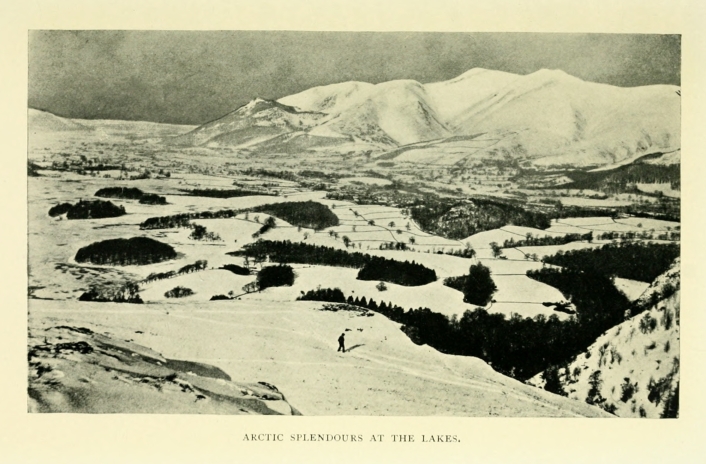
As we descend we have a friendly crack with a shepherd from the high fells, whose dog has cleverly found and 'crowned' a handful of the Herdwick sheep prisoned by a snowdrift against a wall. How did he do this? 'Naay, I cannot tell tha, but I suppose t' dog nosed 'em, ye kna; dogs is wonderful keen scented.' And had the sheep taken hurt? 'Naay, naay; they were safe and warm as could be; they hedn't even begun to woo' yan anudder.' Wool one another, what's that? 'Oh, sheep, poor things, when they git snowbound and hev nowt to eat, teks to eatin' woo' off t' backs, to prevent pinin', ye kna.' So saying, the shepherd goes off, to quest for more, up to the land of loneliness and wintry wild, and I go down into the cheery vale.
How blue the snow is; you might have supposed the fields out 'Wythop' way had been washed with ultramarine; but one's eyes are caught back by the beauty of the snowdrifts by the roadside. These snowdrifts are for all the world as if great waves of milk had curled over to breaking, and at the moment had been fixed or changed into crystalline marble. And now the sun is gathering its glory back into itself, and hangs a globe of flame above 'Whinlatter' Pass. Suddenly the light goes out from all the valley meadows. The day star has sunk behind the hills. But still old Skiddaw flashes back the flame, and shepherds, out Newlands way, can see the bastions of Blencathra glow like molten gold.
For us, as we gaze out south, the range of Helvellyn is the miracle of beauty that holds our eyes. Far off and ghostly for the haze, it lies upon a background of rosy flushing afterglow, and seems to faint into a kind of impalpable phantom of its former strength—becomes no longer solid mountain, but spectral cloud. A light wind blows, and the oak leaves in the hedge tinkle like iron; the farmer calls the horse to get his hay, the wren chirrups or scolds from the wayside bank, and a partridge cries from the near field. Then all is silent and hushed for the coming of the queen. Over the dark pines upon Skiddaw, and above the silver shoulder of the hill, clear-faced and full, the February moon swims up to rule the night. And such a reign of splendour was then begun as I have no words to chronicle. For the heaven above Helvellyn was rosy pink, melting into blue, and the sky above Skiddaw was, or seemed to be, steel azure, and the west beyond the Wythop range was gleaming amber. There, in the midst of that golden sea, shone Venus like a point of silver fire. Sirius rose and scintillated above Helvellyn's ridge, Jupiter looked clear from near the zenith, and Orion girt his starry sword about him in mid-heaven; but it was the Moon who was the queen of all our hearts. It was she who laid her mystery upon the lakes, the hills, the valleys, white with snow; she who made one feel that if sunrise and sunsetting had been fair to-day, the moon-rising in a land of Arctic splendour had been fairer still.
WILLIAM PEARSON OF BORDERSIDE.
It is a pleasant thing for a Cumberland Crosthwaite man to have to speak of a man of the Westmoreland Crosthwaite. It is a special pleasure when one realises how Cumberland helped Westmoreland to give us the gentle mind and life of enthusiasm for Truth and Nature which closed here at Borderside, with 'unbroken trust in God,' and 'in hope of immortal life,' on the 16th December, 1856.
I have read no life that seems to have been so genuinely the fruit of enthusiasm for the poet Wordsworth as was the life of William Pearson. He was ten years the junior of the poet, and survived him six years. We may nevertheless look upon him as a contemporary. He was of the same kind of North yeoman stock, and with greater opportunities might have made himself a name in the annals of literature. As it is, like Elihu Robinson of Egglesfield, like Wilkinson of Yanwath, like the late Wilson Robinson of Winfell, Lorton, Pearson's name was not known far beyond his native valley, but of him, as of the others named, it is truth to say that he was a living monument of what 'the soul of Nature,' if it be received into the heart of man, can do to elevate, to strengthen and refine. Of none other in his simple estatesman rank that I have read of can it be more truly said, that from:
'... Nature and her overflowing soul He had received so much, that all his thoughts Were steeped in feeling.'
Wordsworth once wrote that 'Nature never did betray the heart that loved her'; William Pearson proved by all he said and did that Wordsworth spoke the truth. Wordsworth spoke felicitously of the
'Harvest of a quiet eye That sleeps and broods on its own heart.'
William Pearson gathered that harvest to the full, ere he too, like a shock of corn, was in a full time garnered. Wordsworth declared that
'Who feels contempt for any living thing Hath faculties that he hath never used,'
and William Pearson put that assertion to good proof. Few men in his day and station in this country went down to the grave with larger heart, of wider sympathy and more love for all created things.
William Pearson was born at the Yews in the Winster Vale on the 9th of October, 1780. His father, who died at the age of 81 in the year 1840, was long remembered as a quiet, studious farmer, who would ever read a book at his meals, and made a practice of going afield at nights to gaze upon the heavens. The stars in their courses helped him to reverence and to thought. William's mother—a Little from the Borderland—survived her husband and died at the age of 88 in 1842. While she span at her flax-wheel she used to delight her little son William with folklore stories and fairy tales, but she was chiefly remembered in the village for her bright activity and energy to the last. Many a time, when she was between seventy and eighty years old, on market day morning, though the horse stood saddled at the door, the old lady would say, 'Nay, hang it, I'll never fash wid it,' and would set off on foot to Kendal, with her butter basket containing twenty to thirty pounds of butter, a distance of six miles and a half, and after 'standing the market' and shopping, would walk home again with her purchases.
As a youngster, William's education was left to the wild beauty of his native vale. If ever there was a boy of whom Nature might have said:
'Myself will to my darling be Both law and impulse: and with me The Boy, in rock and plain, In earth and heaven, in glade and bower Shall feel an overseeing power To kindle or restrain,'
it was the boy who went afield with his father as soon as he could toddle, and who in Nature's kindly school got to know by heart and eye the hills and scars of the neighbourhood, the tarns and moorlands, the trotting brooks, the rivers running to the sea, the great estuary and marsh, with all their bird and beast and flower life. He never forgot his first sight of Windermere and Morecambe Bay, nor his first journey up Troutbeck over the Kirkstone Pass; and no sooner had he left home for work elsewhere than he felt that there was only one place on this earth where life was worth living and that was the Winster Vale.
It is true that he went to the Crosthwaite school and proved himself early to be a master of figures. The author who fascinated him then was Defoe. The Memoirs of a Cavalier and Robinson Crusoe were his teachers. From Crosthwaite school he went to Underbarrow and distinguished himself there chiefly for having the pluck to stand up to the big bully and thrash him in defence of the oppressed youngster. He became out of school times an expert and ardent follower of Isaac Walton. Years after, he wrote an appreciative paper which is extant on Walton and Cotton's Complete Angler, which he begins with the sentence, 'Among our most favourite books is The Complete Angler of Isaac Walton.' The boys of Underbarrow noticed that he hugged his garret where the owls built, and was often deep in old romances of Amadis de Gaul and Roncesvalles when others were out and away up the fells. But in the holidays he followed bark-peeling, not so much as that thus he might earn something that would pay for his schooling, as because in the months of May and June when the bark-peelers went to their fragrant task in the woods, there was a fine chance of becoming acquainted with the life-history of many of our feathered visitors that were nesting at that time. In autumn his delight was to be after the woodcocks, and great was his joy,
'With store of springes o'er his shoulder hung, To range the open heights where woodcocks run Along the smooth green turf. Through half the night, Scudding away from snare to snare, he plied That anxious visitation.'
In his copy of Wordsworth's Prelude, the marker, at his death, was found placed at this passage, and he never tired of telling the story of his woodcock adventures.
His first work in life was to act as teacher in the Winster village school; he went thence to be tutor to the four children of a widow body at Cartmel Fell, but at the end of the year gave up teaching to take the place of a grocer's assistant at Kendal.
He was only there a year, but it was an eventful one in William Pearson's life. He made the acquaintance of Benjamin Gough, the blind botanist, and it is possible that he was led by him into enquiry not only into the wonders of plant life, but of the life of that most delicate of all plants, the religious faith of the human soul. It is certain that during this year William Pearson's chief study was the study of the Hebrew Scriptures and the Church Doctrine, and the end of it was that he reasoned and read himself out of Episcopalianism into Unitarianism, as his father had in the past done before him. He found rest to his young soul in the thought of the great Fatherhood of God, and worshipped in the old Presbyterian Meeting House, where sometimes in after years Wordsworth also worshipped, and near by which lie the ashes of the James Patrick of Kendal, who was the original of the Wanderer in The Prelude. It may be fancy, but I like to think that it was in that chapel that the young lad first saw the man whose writings did more for him all through life than any other—I mean William Wordsworth.
From Kendal, William went, as was the wont of many a Kendal apprentice, to a grocer's shop in London, and at the end of three months he returned to the Winster Vale, broken in health from the stifle of London air, and the fact that he had no better resting place after long days of work in a city store than a shake-down underneath the counter. He was now in his twenty-third year. The 'poddish' and fresh air of the Yews set him 'agate' again, and he determined to try Manchester life, and on the 16th March, 1803, he set out for that metropolis of the North. He obtained a situation on the next day after his arrival as clerk in the bank of James Fox & Company, in King Street, and for the next seventeen years he endured
'The fierce confederate storm Of sorrow barricadoed evermore Within the walls of cities.'
How simple and frugal his life was there, we may gather from the fact that out of his first year's stipend of £75 he sent back a deposit to one of the Kendal banks. He was not very happy. He wanted friends of his age 'who united,' as he tells us, 'those first of blessings, virtue and knowledge,' and they were not. 'Indeed, sir,' he writes to James Watson of Kendal, 'I think Manchester, in proportion to its population, very deficient in men of cultivated understanding. Immersed in business, or carried down the stream of dissipation, slaves to "Mammon" and to "Bacchus," they have seldom time for the rational amusement of reading or for the calm pleasure of reflection.'
This seems somewhat priggish, but it was the real and earnest William Pearson who spoke. Sociable as he was, fond of seeing a good play, his chief delight, if he was not out in the fields, was a book that would set him thinking or a poem that would touch his imagination, and Pearson was old beyond his years. He joined the Didactical Society, the Mosley Street Library, subscribed to the News Room and made one or two friends for life.
There in most uncongenial surroundings for seventeen years he stuck to 'the drudgery at the desk's dead wood' with one thought, that a time would arrive when he could come back to his native vale, and live a student's and a naturalist's life in simple competence. As a matter of fact his health broke down after five years of Manchester smoke, and he had to come back in 1808 to the Yews in his native vale for country air and restoration.
He was at this time nothing if not a keen sportsman, and he was, if one may judge from a letter he sent at this time to a Kendal paper, vexed at heart by the vigorous application of the game laws as enforced by the worthies of the local bench. Three young men, who, with nothing but a knob-stick, could run down a hare, had been caught hunting on Cartmel Fell. 'We must pity the Robinsons,' he says, 'young men who can run down a hare, an animal that often escapes the fleetest greyhound, who pursued their sport without fear in the open day, and so generously, that they left a hare with the farmer on whose ground they happened to take it. These fine young men have been made to pay £3 13s. 6d. for their sport. The age of chivalry is indeed gone. The ancient Greeks would have crowned them with laurel, but this is the age of taxation and little men. We are fallen on evil days; we only wish the surveyor and commissioner had heard them at their joyous sport, and had heard their shouts, as we did, which made the old mountains ring again even to Gummershow, to be echoed back from the far-off Coniston Fells.'
It was during his Manchester residence that he became a student of William Wordsworth. It was not fashionable then to care for Wordsworth's poetry, but William Pearson was never without the Lyrical Ballads of 1805, or his copy of Poems by William Wordsworth, of 1807. The young bank clerk, who was often heard muttering, 'I will lift mine eyes unto the hills, whence cometh aid,' felt in these poems 'all the beauty of a common dawn.' He knew that Wordsworth walked on the shining uplands of a noble aspiration, and was the apostle, in a time 'that touched monied worldlings with dismay,' of the simpler life of honest poverty and high endeavour. He felt that in Wordsworth he could find that sympathy with all things, that
'Look to the Uncreated with a countenance Of admiration and an eye of love.'
He knew that Wordsworth had realised the power of Nature to chasten and subdue
'and intertwine The passions that build up our human soul Not with the mean and vulgar works of man But with high objects and enduring things.'
He also knew how Wordsworth taught men the secret of the gentle heart,
'Never to blend its pleasure or its pride, With sorrow of the meanest thing that feels.'
It was this knowledge that soon made him love rather to watch a wild bird than shoot it. One is not surprised therefore to find him constantly referring to Wordsworth's writings, and yet to feel him so eminent as a man that years after, though communing in spirit with him day by day, he could not summon courage to go up the path to Rydal Mount, and abashed at his own boldness for venturing to call, came away from the door of the Rydal poet, without seeing his hero, like a thing ashamed.
It was owing to mutual love and admiration for Wordsworth's poetry that he found in a poor Gorton silk-weaver, Thomas Smith by name, so congenial a companion. The last six years of Pearson's life at Manchester can chiefly be known from the letters that passed between these two friends, which towards the end seem almost to degenerate into a series of begging letters from a poor weaver out of work and 'thrice dispirited.' But this at any rate is seen in their correspondence, that even in abject poverty high thinking is possible, and Wordsworth's poems seem to be medicine for the mind; while on the other hand there is always the ready and generous response of the yeoman of Winster Vale, and such delicacy in act of gift as makes one feel how finely strung, how nobly sensitive was the mind of the benefactor.
Pearson sends Thomas Smith a copy of The Excursion. 'Your tidings about Wordsworth,' says the poor weaver, under date of April 15, 1821, 'I will not call him Mr., he is too great for that, were good tidings indeed; his Excursion I have been longing for ever since it was first published, but the price has been an unsurmountable obstacle to a weaver.'
The two friends unbosom their hearts to one another in these letters, and there is seen something of the deep religious side of Pearson's character in some of them. 'I cannot,' he writes to Smith in 1831, 'conclude without a word about what you write of your being unhappy. Read your Bible. Trust in that Good Being who gave you your existence. Consider the many in your situation who from ignorance and want of education have not the arguments of hope that you have; ... only the wicked need be unhappy; at anyrate do not despair.' And again in 1838, 'I wish I could console you under your troubles. Be thankful you have not a guilty conscience—the greatest of evils. Read your Bible, read Wordsworth, Shakespeare and Milton. Do you go to worship, public, I mean? You have a chapel at the foot of your hill, join yourself to them.'
When Smith lay dying, Pearson wrote a letter full of tender sympathy. 'So long as reason and memory remain, I shall never forget the many delightful hours we have passed together, whether in reading some favourite poet or rambling among the beautiful scenes of Nature.' 'I believe,' he added, 'that seldom have two persons come together more in sympathy than we two, and I have often felt that my separation from you was one of my greatest losses in leaving your part of the country.'
Those rambles he mentions were walking-tours he took in 1817 through Derbyshire, and in 1818 in the Craven country of Yorkshire. He kept journals, and full of delightful observation of men and things they are, redolent of real joy in sunshine and cloud. He writes, 'We walked forward on this delightful morning with vigorous steps. The lark was our constant companion, cheering us overhead with her song, the fresh air of the mountains bathed our cheeks, there was freedom from care and the feeling of liberty
'When the fretful stir Unprofitable, and the fever of the world Hung not upon the beatings of our hearts.'
'We felt something,' he adds, 'of
"That blessed mood In which the burden of the mystery, In which the heavy and the weary weight Of all this unintelligible world Is lightened: that serene and blessed mood In which the affections gently lead us on."
At the end of his Derbyshire journal he says that 'the remembrance of those happy days in Derbyshire will lie in the landscape of his memory, like spots of stationary sunshine; they will be to him and his friend as wells of pure water amid desert sands to which their souls may fly for refreshment hereafter in hours of weariness amid the din of towns and cities and the many shapes of joyless delight.'
Did ever city man take back to city roar and barrenness more quiet and more profit from a country ramble?
In his last letter to Thomas Smith, he spoke of having left the Manchester neighbourhood. In the autumn of 1820 he gave up his work in the Manchester Bank. He never could think of his native vale without a sense of heartsickness; his work was irksome and city life hateful. In his poem to the river Winster dated 1821, he writes:
'And in the heavy time of after life, When buried in the midst of toil and strife In trading towns, if intermission sweet I sought from my dull toil, my fancy fleet Was straight amid thy vernal meads and flowers, Thy hanging fields, wild woods, and leafy bowers. Nor could I think of beauty on this earth, But still 'twas seen with thee—as if thy birth And mine had been together. Now at ease And free to wander whereso'er I please, What charms I find along thy simple stream, Beloved Winster!'
It is no wonder that a yeoman farmer's son who could thus write, should have felt irresistibly drawn from exile in Manchester to his native vale, and we find him back at the Yews, in correspondence, now with the editor of a county paper, now with Miss Wordsworth, now writing a ballad or a poem, now a natural history note, now wandering off down Duddon Vale, and through the Lake District, and now keenly interested in a little dilapidated estate in the Crosthwaite township called sometimes Borderside, sometimes Balderside, or perhaps more accurately in Viking phrase, Bauta-side, and determining to go into the farming line.
He became purchaser of the Borderside estate in 1822; at once he determined to let it for five years, and gave his whole time and the rent to boot, to the improvement of it.
In the summer of the same year that he became an estatesman, he planned a tour into Scotland. Wordsworth wrote him a full and particular itinerary, and William Pearson followed the footsteps of the bard, and really made the same journey as Wordsworth's first excursion to Scotland.
There is an interesting note of the peasants recollection of Burns in Ayrshire, and of the Sabbath manners of certain of the Auchterarder folk, but the journal otherwise is a little tiresome.
The next ten years were spent in the not very profitable work of mending the fences and outbuildings of Borderside, and then of attempting to make its crops pay the rent and leave something over. But in 1841 he 'declined' farming, not without the secret joy of getting back to his mother's house at the Yews, where all his books were stored, and where the Encyclopædia, just bound, was awaiting him.
He had not been idle, he had made the Corn Laws a study, and had concluded that they were unjust, cruel, and impolitic. He had done what he could to get the Kendal folk to abolish the old system of selling fruit by baskets, or paniers containing sixteen quarts, and had introduced the better system of selling by weight.
In the spring of 1842 his mother died, and now, at the age of sixty-two, William Pearson felt free to marry. He married Ann Greenhow of Heversham in May.
He was by instinct a tiller of the ground; he used to say that 'no one felt more dependence upon God than the farmer in his fields.' He turned his attention to fruit culture, planted a large orchard with 300 trees and two lesser ones, and felt that he had not lived in vain. It was during this period that he began making notes of the habits of the bird and beast life round about him. Some observations on the habits of the hedgehog which he sent in 1836 to Mr. Wordsworth were sent by the poet to the members of the Kendal Natural History Society, of which Pearson had been a member almost from the first.
The result of this communication evoked, so Cornelius Nicholson, the then secretary, tells us, so much enthusiasm, that a class was determined on for mutual instruction in the habits and distinctive faculties of birds and beasts. It was Pearson's habit to attend the monthly discussion meeting of this Society, and he thought nothing of setting off after an early tea and walking in nearly seven miles to Kendal and walking back by starlight after the lecture.
It was to this part of his life between the years 1825 and 1833 that belong the glimpses of his intimacy with the Rydal Mount family, as shown by the letters, chiefly from Dorothy Wordsworth, that have been preserved to us. It is clear that William Pearson was a most welcome guest at Rydal. Excursions up Helvellyn are planned with the Wordsworths, and natural history notes are exchanged. The letters are chiefly interesting as giving us hints of the simplicity of the life there, and are often full of thanks to him for a panier of apples, or a leash of partridges, they contain a request for straw for the stables, they seek his advice in purchase of a pony, they send requisition for more potatoes and the like. William Pearson was looked upon as the henchman who could be best trusted to supply the Rydal Mount with farm produce, and it is clear that to do the bidding of the bard and be steward of his stable economics was a real pleasure to him.
He also sent to Dorothy Wordsworth's sick-room just those delightful little nature anecdotes which cheered her in her retirement. He admired and honoured the poet's sister. 'Never,' says he in one of his letters to Smith in 1832, 'have I known a more amiable woman. Her understanding and judgment are of the highest order. I have heard Mr. Wordsworth say that he had been more indebted to her judgment than to that of any other person.'
The correspondence gives little facts and dates of household matters that are interesting to students of the poet's life at Rydal. For example, we learn on May 5, 1830, that on the next day will be finished the new terrace, to the poet's satisfaction; we learn also of Wordsworth's constant trouble from 1833 and onward by reason of the inflammation of his eyes. We hear incidentally how poor a horseman, but how good a walker the poet is, and the simplicities and hospitalities of Rydal Mount are brought before us.
But it was not only as steward of the farm and orchard that Pearson was so truly honoured by the Wordsworths. It was because the poet felt that in him he had a real lover of his art, and a real understander of his poetry and his philosophy. One is not surprised to find that Wordsworth thanked him on the occasion when, in the Kendal paper, the worthy yeoman took up pen in defence of the poet. And those who years after honoured the dead poet's memory—his personal friends, Dr. Davy and others—were grateful to William Pearson when, in 1854, he championed, in a letter full of feeling and knowledge, the Protestantism of the bard, which had been called in question by a lecturer of the Protestant Alliance in Kendal, who had described Wordsworth's poetry as being 'one of the principal means of the revival of priestly domination in the Church of England.'
It is very touching to see how really he valued the friendship of the poet he so well understood and so honoured. 'What claim have I,' he wrote to Dorothy Wordsworth, 'on the notice of a man like your brother? My chief obligations to him for conferring on me his society and hospitable notice I hope I shall feel to the latest hours of my life.' Writing to Wordsworth from Borderside under date 1849, he says, 'I felt very grateful for your letter. On reading the first few lines I was sorry to think how much Mrs. Wordsworth's handwriting had changed, but when I found it was indeed your own hand the tears came into my eyes. I shall preserve this kind memorial and shall not part with it till I part with everything in life.' These were the words of a real hero-worshipper, and he had cause for hero-worship.
What Wordsworth's poetry did to inspire and keep pure and true and serene the heart of William Pearson, it will still do for men of humble country life in the years that are to be. We need to-day more of soul among our farmer folk, we want a vade mecum for the tiller of the soil that shall lift his soul to Heaven. I cannot doubt that if men would study Wordsworth and receive his 'heart into their own,' there would be dignity and happiness added to many a daleside home.
To return to William Pearson. He found the farm life on the whole a happy one. He would not have given it up had he not determined to marry. His orchards prospered, and his hay grass was generally well got. His frugal ways ensured him competency, and all day and every day he was learning more of Nature's secrets, more of the pleasant ways of birds and beasts about him. He was making observations, too, on the changes that had come over the vale of Lythe and the neighbouring fells and common lands, since the packhorse had ceased to be, and the common enclosures and the larch planters had come in.
But his ears were open also to the quaint sayings and superstitions, and his eyes were on the quaint ways and customs of the dalesmen amongst whom he dwelt and moved, and these observations bore good fruit in the paper written in 1841, the year before his marriage, for the Kendal Natural History Society, entitled 'A Sketch of some of the Existing and Recent Superstitions of Westmoreland.'
It was doubtless a source of gratification to William Pearson that the son of the poet should be the officiating minister in Bowness Church the day he led his wife to the altar, in May of 1842. And he must needs have been pleased on his return to Low House after a wedding jaunt through the lakes, to find that Hartley Coleridge, who had called to congratulate him on his marriage, left behind him an impromptu sonnet. It had, as most of Hartley's sonnets have, a little touch of description of the life both of himself and of his friend, the gentle estatesman:
'A little man of solitary life And half an idiot too—more helpless still— Can wish all joy to thee and to thy wife; Thy love must be as constant as thy will. My gentle friend, how happy mayst thou be! Thou hast a wife to pray—and pray with thee.'
During the coming June of 1842 Pearson took his wife to the Continent. He had long planned this trip; writing to his friend Thomas Smith in April of 1841, to tell him of his intended venture on 'that variety of untried being,' marriage, he says that Mr. Wordsworth has advised him to make a Swiss and Italian tour before age renders him unfit for foot-travel, and adds that his future wife 'is an excellent walker, and is quite willing to share the fatigue, and he is sure she will share the pleasure.' There is a note of simplicity in this intention to see the Swiss and Italian lakes afoot—the bridegroom now more than three score years, but a 'young heart travels many a mile,' and William Pearson's heart was young to the last.
Wordsworth supplied him with an itinerary which he faithfully followed. After the tour they stayed on until the spring at Versoix, near Geneva, and his journal shows that he was busy making naturalist notes all the while. There is a touching note in his journal of his delight on getting back to his Westmoreland home. The blue mountains and the well-known fells, and the ivy-covered cottage of Low House, and the happy greetings from beloved friends. These deeply moved him.
There was no suitable house for the happy couple in Crosthwaite, and after staying at Low House for the winter, he went into lodgings at High Crag. Lodgings were not William Pearson's ideal of home life, and though he was a man of sixty-seven he determined in 1847 to build a house on his own estate.
It was a glad day for him when, as he tells us, on the last day of July, 1848, he crept into the bosom of his own cheerful cot 'with measureless content,' a cottage 'unclothed by rough-cast,' as he told Wordsworth, 'but exhibiting a goodly row of chimneys with pretty round tops on square pedestals, the only specimens yet in Crosthwaite of the revived good old fashion.'
We have a poet's description of this Borderside home from the pen of Perceval Graves, who, writing from Dovenest in 1862, thus describes it:
'Red roses flush its native stone, The grassy slope, the rocky mount Are gay with flowers,—a shadowy fount Murmurs with cool delicious tone. Beneath, an orchard far and wide Its blossom on its front displays; Across the valley friendly rays From neighbour houses hail Borderside.'
Here for the next eight years dwelt the refined and thoughtful yeoman, reading such books as he felt he could afford to buy, such books as he could borrow from Kendal, or were lent him by Coleridge or Perceval Graves or Wordsworth; corresponding with such naturalists as Waterton and Gough, such students as Perceval Graves and Dr. Davy, keeping up constant communion with the friends at Rydal Mount; getting hold of the best that could be had of the scientific treatises of the day; dipping here and there into theologic problems; studying his Shakespeare and his Milton, enjoying his Carlyle, his Burns, and his Scott, his Reed's English Literature, impressing, when he met him, such a man as Sir William Hamilton, examining the theories of Agazziz and Brewster as to moraine and glacier action, comparing his own natural history observations with those of Waterton and White of Selborne; and from time to time, when he had returned from some ride on 'Nep' or 'Camel,' his favourite ponies, sitting down to chronicle the beauty of the day's outing, or the wild life of bird and beast he had observed. Amongst the latter must be noted his papers on the partridge and the squirrel, in 1846; on the woodgrouse, that 'new bird' which appears to have come to Colthouse first in the autumn of 1845 (this paper was written in 1850), and again on the hagworm, 1852; 'Notes on Characters and Habits of Domestic Animals, 1854'; and 'A few Recent Notices in Natural History, 1855.'
All Pearson's prose has a dignity and simplicity and directness that makes one realise he had been a reader of the masters of English style, but it makes one feel also that he is a poet at heart, as he writes his prose. Take for example his account of the glede or kite—alas! long vanished from our land, though nesting at the ferry as late as the beginning of last century;—'I have seen,' says he, 'the glede and his beautiful flight, no words of mine can adequately describe it. It was on a windy day in autumn or winter that he generally made his appearance. Imagine a bird measuring five feet between the tips of his wings. To glide along it required apparently no mechanical effort, no fluttering of the wings, not the tremor of a feather. It was not flying but sailing on the bosom of the air, as if by an effort of the will, such ease, such grace, such dignity.'
The evenings at Borderside were spent in reading. A mellow musical voice with much feeling in it, would render a passage from some favourite poet, and as often as not the old man's voice would falter and he would say, 'I cannot go on,' and with tears rolling down his cheeks he would put the book down. Perceval Graves, his great friend of the later years, would ofttimes come over for high discourse and heart communion from Dovenest to Borderside. He described those pleasant visits thus:
'And when our cheerful meal was o'er, A meal which friendship seemed to bless And elegance and homeliness With charm we scarce had known before.
How swiftly flew the hours away, As thought and feeling deeply stored By mind and heart all forth were poured In loving faith and lively play!'
The summer of 1856 was memorable for a waterspout that fell in hay-time on the 8th of August, upon Carnigill, near Borrow Bridge; we who travel by the L.N.W.R. from Tebay to the south can still see the wounds upon the mountain side the fury of the torrent made. The phenomenon was minutely described by the old meteorologist in a letter to Mr. Davy. It was the last August he would see.
The long walks over fell and moor gave way to pony-back, and pony-back gave way to a carriage. It was clear to all who knew that delicately chiselled face and noble brow of the yeoman poet and naturalist, that with all his mental powers clear and his eye undimmed, his natural strength was abating. In the spring of 1856 the Winster folk noticed that though he visited, as was his wont, all the orchards for miles round, he visited them in his gig, and men knew by his constant cough that his old enemy, bronchitis, was pressing him sore. But every sunny day found him sitting with his book under the shadow of the famous ash tree at Borderside, and still at night time, if the stars were clear, they saw a tall figure wrapped in a plaid, and stick in hand, pacing slowly the garden path, before the door was shut and lights went out.
As for his own light, that went out, painlessly almost as it seemed, on December 16th. A day or two before, he had gone to the window of his sick room, and said, 'In another month the snowdrops will be here.' The snowdrops came, but alas! for eyes of others almost too dim for tears to see them. On the day of his death, or more properly, his falling on sleep, the sunset brightened in the west, and the dying man with the instinct of an observer keen to the last, turned his face to the window to see the glory grow. Then he sighed and passed to other glory beyond all sunsetting.
Of his work that remains, little need be said. It is always thoughtful, accurate of observation, pure in style, refined in diction, and delicate in poetic appreciation. One much regrets that he who had in 1808 espoused the 'Terza Rima' should have so soon quitted the sonnet's scanty plot of ground and left so few examples of his work. Amongst the miscellaneous papers and letters on natural history that remain are three which we of this county cannot be too thankful for. One is a paper 'On certain changes that have taken place of late years in a part of the Lake District,' with its notes of 'pack-horse-routes,' 'implements of primitive husbandry,' 'the introduction of larch planting,' 'commons enclosure,' and with its interesting account of the ancient Lythe Marsh.
Another is a paper in form of six letters to Thomas Gough containing 'notes on a few subjects in the natural history of Crosthwaite and Lythe, and the valley of Winster.' He prefaced this series of letters with an apparent quotation which really was his own saying and which, as a lover of St. Francis and of all his true followers, I dare to repeat.—'These lonely denizens of the earth, our fellow pilgrims on the journey of life, have their appointed tasks as we have, set out by the great Creator.' There spoke the heart of the wise old Winster estatesman, who long had known the bond of love that binds the travailing creation into one, who as he moved among his brother birds and flowers, and felt the glory of his brother sun, or of his sister the homeside fire, also then
'With bliss ineffable Could feel the sentiment of Being spread O'er all that moves and all that seemeth still O'er all that leaps and runs and shouts and sings Or beats the gladsome air, or all that glides Beneath the wave, yea, in the wave itself And mighty depth of waters.'
The last two papers to be mentioned are 'The Sketches of some of the existing and recent Superstitions of Westmoreland': most valuable these are, as written just in the nick of time. The two generations that have passed since he collected his material and penned his notes, have ceased to hand on the traditional sayings and become too matter of fact to be 'boddered wid sic things as Charms or Boggles or Dobbies or Barguests or Wisemen or Witches.'
There is no one in the county of Westmoreland to-day who would care to take their children when plagued with the kink-cough up to Cartmel-fell, on chance of clipping a hair from the cross on an ass's back and then tying it round the bairn's neck as a sovereign remedy for the troublesome whoop.
But if it had not been for William Pearson I doubt if we should have known that the Winster dalesfolk, notwithstanding that the Cross was set here in the clearing so many centuries ago, were actually fire-worshippers and carrying on the rites of Baal with their Beltane-fires as late as the year of Our Lord 1840. Pearson tells us he talked with a farmer who had actually been present at the sacrifice by fire of a calf in this neighbourhood, and that there were two places within the memory of men then living, Fell Side in Crosthwaite and Hodge Hill on Cartmel-fell, where, to prevent the death of calves after birth, large fires were kindled in the open air near to the farm house and a living calf laid upon them and burnt to death.
As for the reality of this superstitious relic of sun-worship, in the year 1840, William Pearson actually witnessed it here in Crosthwaite, and, with a quotation from his paper upon this point, I will close this notice of his life and work:
'The Need Fire has again made its appearance. There is at present a rumour of a dreadful epidemic among cattle, which has shown itself in different places in this part of our country, to which it has been coming slowly up from the South, where it prevailed last summer. On Sunday afternoon, the 15th of last November, returning from Kendal by way of Brigsteer, when I reached the brow of the hill that overlooks that pleasant village, and from whence there is a glorious prospect, I was somewhat surprised to see, in Crosthwaite, two or three large masses of white smoke "rising up like the smoke of a furnace." I thought it was lime-burning, from some kilns that are not usually occupied. But when I reached Crosthwaite, I found myself in the immediate neighbourhood of one of these "smokes," which was rising very thickly below the Church Tower. I enquired of a young woman standing in the road what was the meaning of all this smoke. "Oh," said she, "it is the Need Fire." Well, thought I, much as I have heard of it, I have never seen the Need Fire. I will not miss this opportunity of having ocular evidence of all its mysteries. On reaching che spot, I found the fire burning in the narrow lane called Kirk Lane, within about twenty yards of the Kirk Tower, and about half a dozen cattle huddled together and kept close to the fire, and amongst the smoke, by a number of men and boys standing on each side of them, in that narrow lane. Sometimes they drove them through the fire, and such was the thickness of the smoke that I could scarcely perceive the actors in this strange ceremony—men and cattle. "So," said I, "you are giving them a smoke." "Yes," replied the owner of the cows, "we wish to be like our neighbours." "But have you got the real Need Fire?" "Yes, we believe so, it came down Crook yesterday." Now I had heard that it had been at Low Levens a few days before, so that this superstitious fire was evidently moving about in all directions through the length and breadth of the land: nor do they appear to give it any rest, even on Sundays!'
JOSEPH HAWELL, A SKIDDAW SHEPHERD.
Did you know Joseph Hawell of Lonscale?
Nearly everybody within sight of Skiddaw did, and knew him to honour him and to speak well of him.
Not a ram-show nor a Herdwick prize show, not a clipping feast nor shepherd's meeting, but 'kenned' Joseph Hawell; and of later years most of the 'Yellow' or Conservative meetings in the district had seen his manly form and heard his manly words in what he used to call 'the national cause.' For Joseph Hawell was a Conservative and a Unionist; 'thoro'-bred' he used to say, for his father and his mother had felt as he did in matters political, and he thought 'they had mixed a laal bit yaller wid his poddish' when he was a boy. At any rate he would have liked well enough to have branded his fleecy Skiddaw darlings with the words 'For King and Country,' and used a yellow 'dip' if such had been in existence.
I knew his old father—him of Longlands in Uldale—later of Lonscale; and a better informed man, a man, that is, better read in the news of the day, was hardly to be found in the farm-houses round Keswick. So like Dean Stanley of Westminster he was in face that I would introduce him to my friends as 'the Dean,' and by his side, as he 'cracked' on the things of state, sat usually one of the sweetest-faced, gentlest-natured of women, his good wife, whose maiden name was Jane Walker, of Stockdale. They had married in the 'fifties' of last century, and she had borne him five children—John, Jane (who died in girlhood), Robert, Joseph, and Ann.
Joseph was a Christmas present to the old oak cradle at Longlands Farm, for he was born on the 24th December, 1854; and he grew up, with John and Robert, to be as passionately fond of sheep as his father. Never a boy for books much at school, he still as a youngster was ever fond of helping on the Fell, and of training the shepherd's dogs; and rare training he had himself.
His father had, from a present of ten gimmer lambs, given him by his father when he was a young man, reared up quite a fine race of the blackfaced Herdwicks, and was, by the time the lads could bear him company, flockmaster of 500 sheep on Frozen Fell and Wylie Ghyll, and of 300 in the Forest, as it is called—the great heathery waste in the basin at the back of Skiddaw.
Joseph grew up strong and lusty as a shepherd should grow, and together with his brothers, took to wrestling as all shepherds in Cumberland ought to do; but the lads, as they grew up, became so fond of the sheep and so devoted to their father, that as soon as he, seeing that they were likely to be drawn into the ring, and to lose some of their interest in the Herdwick sheep, begged them to give up the wrestling, they gave it up; and henceforth these brothers' one aim in life seemed to be how they could most help their father to improve the Herdwick breed, and maintain his honour as a shepherd.
In 1869 the family migrated from Uldale to the secluded farm on Col. Watson's estate, between Lonscale and Saddleback; and what success the Hawells, father and sons, obtained as breeders of pure Herdwicks can be seen by any who will call to-day at the Farm, and ask to be shown the prizes and cards that literally cover the walls from floor to ceiling.
The old man, who had struggled with storm on Skiddaw through his laborious life, failed in health, suffered as shepherds often do from terrible rheumatism, and was troubled with asthma. At last he felt obliged to leave the ingle-nook and take to his bed upstairs; but his love of the shepherd's life was still so strong upon him that a few days before he died he insisted on seeing one of the prize Herdwick rams, and the sons had a tough job to get it to 'clim' the 'stee' and stand in the presence of the dying man. The old man felt death coming upon him shortly after, but he told those who watched they need not trouble to fetch the doctor, as he knew his hour had come, and he was ready to 'gang' home.
I wrote this sonnet at the time of his death:
The sheep are bleating in the fell-side field, The kine call sadly from the homestead near, But thou art far away, thou dost not hear. A greater Shepherd, for thy feet, doth wield The rod that thro' the vale of death can yield Sole comfort. Round thy bed and round thy bier The trophies of thy hand in letters clear, Speak; but we speak not: grief our lips has sealed.