Chapter IV · (continued 2)
Helene Meyer-Franck translation
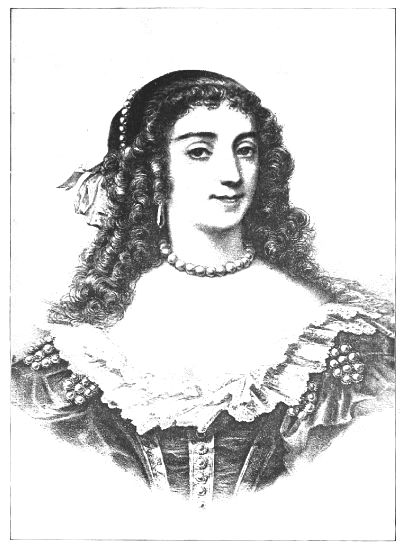
DUCHESSE DE CHEVREUSE
Retz completed the portrait: "She loved without any choice of objects for the simple reason that it was necessary for her to love some one; and when once the plan was laid it was not difficult to give her a lover. But from the moment when she began to love her lover, she loved him faithfully,—and she loved no one else." She was witty, spirited, and of a very vigorous mind. Some of her ideas were so brilliant that they were like flashes of lightning; and some of them were so wise and so profound that the wisest men known to history might have been proud to claim them. Rare genius and keen wits which she had trained to intrigue from early youth had made her one of the most dangerous politicians in France. She had been an intimate friend of Anne of Austria, and the chief architect of the Chalais conspiracy. After the exposure of the conspiracy, Richelieu sentenced her to banishment for a term of twenty-five years, and no old political war-horse could have taken revenge sterner than hers. She did not rest on her wrongs; her entrance upon foreign territory was marked by the awakening of all the foreign animosities. Alone and single-handed, the unique Duchess formed a league against France, and when events reached a crisis she had attained such importance in the minds of the allies that England, though vanquished and suing for peace, made it a condition of her surrender that the Duchesse de Chevreuse, "a woman for whom the King of England entertained a particular esteem," should be recalled to France. Richelieu yielded the point instantly; he was too wise to invest it with the importance of a parley; he recalled the woman who had convened a foreign league against her own people, and eliminated the banishment of powerful women from his list of penalties. He had learned an important political lesson; thereafter the presence of the Duchesse de Chevreuse was considered in high diplomatic circles the one thing needful for the even balance of the State of France. After the Spanish intrigue, which ended in Val de Grâce, the Cardinal, fearing another "league," made efforts to keep the versatile Duchess under his hand, but she slipped through his fingers and was seen all over France actively pursuing her own peculiar business. (1637.)
The Duchesse de Chevreuse once traversed France on horseback, disguised as a man, and she used to say that nothing had ever amused her as well as that journey. She must have been a judge of amusements, as she had tried them all. When she ran away disguised as a man, her husband and Richelieu both ran after her, to implore her to remain in France, and, in her efforts to escape her pursuers, she was forced to hide in many strange places, and to resort to stratagems of all kinds. In one place where she passed the night, her hostess, considering her a handsome boy, made her a declaration of love. Her guides, deceived by her appearance gave her a fair idea of the manners worn by a certain class of men when they think that they are among men and free from the constraint of woman's presence. On her journeys through Europe, she slept one night or more in a barn, on a pile of straw, the next night in a field, under a hedge, or in one of the vast beds in which our fathers bedded a dozen persons at once without regard to their circumstances. Alone, or in close quarters, the Duchesse de Chevreuse maintained her identity. Hers was a resolute spirit; she kept her own counsel, and she feared neither man nor devil. Thus, in boys' clothes, in company with cavaliers who lisped the language of the Précieuses, or with troopers from whose mouths rushed the fat oaths of the Cossacks, sleeping now on straw and now with a dozen strangers, drunk and sober, she crossed the Pyrenees and reached Madrid, where she turned the head of the King of Spain and passed on to London, where she was fêted as a powerful ally, and where, incidentally, she became the chief official agent of the enemies of Richelieu.
When Louis XIII. was dying he rallied long enough to enjoin the Duchesse de Chevreuse from entering France.[110] Standing upon the brink of Eternity, he remembered the traitress whom he had not seen in ten years. The Duchesse de Chevreuse was informed of his commands, and, knowing him to be in the agonies of death, she placed her political schemes in the hands of agents and hurried back to France to condole with the widow and to assume the control of the French nation as the deputy of Anne of Austria. She entered the Louvre June 14, 1643, thinking that the ten years which had passed since she had last seen her old confidante had made as little change in the Queen as in her own bright eyes. She found two children at play together,—young Louis XIV. and little Monsieur, a tall proud girl with ash-blonde hair: La Grande Mademoiselle, and a mature and matronly Regent who blushed when she saluted her. One month to a day had passed since Louis XIII. had yielded up the ghost.
The Duchesse de Chevreuse installed herself in Paris in her old quarters and bent her energies to the task of dethroning Mazarin.
The Palatine Princess, Anne de Gonzague, was a ravishingly beautiful woman endowed with great executive ability. "I do not think," said Retz, "that Elizabeth of England had more capacity for conducting a State." Anne de Gonzague did not begin her career by politics. When, as a young girl, she appeared in the world of the Court, she astonished France by the number and by the piquancy of her adventures. She was another of the exalted dames who ran upon the highways disguised as cavaliers or as monks. No one was surprised no matter when or where he saw Anne de Gonzague, though she was often met far beyond the limits of polite society. Fancy alone—and their own sweet will—ruled the fair ladies of those heroic days. During five whole years Anne de Gonzague[111] gave the world to understand that she was "Mme. de Guise, wife of Henri de Guise, Archbishop of Rheims" (the same Henri de Guise who afterward married Mme. de Bossut).
Having passed for "Mme. de Guise" sixty months, the Lady Anne appeared at Court under her own name "as if nothing had happened," reported Mademoiselle. Whatever may have here "happened," Anne de Gonzague reappeared at Court as alluring as in the flower of her first youth; and, as the Chronicle expressed it: "had the talent to marry herself—between two affairs of womanly gallantry—to the Prince Palatine,[112] one of the most rabidly jealous of gentlemen," because, as the pious and truthful Bossuet justly remarked, "everything gave way before the secret charm of her conversation." When nearly thirty years of age she obeyed the instincts of her genius and engaged in politics, with other politically inclined ladies, including Mme. de Longueville, whose only talent lay in her blonde hair and charming eyes.
Despite the poverty of her mental resources, Mme. de Longueville was a natural director of men, and she was but one of a very brilliant coterie. The prominent and fiery amazons of the politics of that epoch are too historically known to require detailed mention. They were: the haughty, dazzlingly superb, but too vicious and too practical in vice, Montbazon; the Duchesse de Chatillon (the imperious beauty who had her hand painted upon a painted lion whose face was the face of the great Condé), and many others who to the measure of their ability played with the honour and the lives of men, with Universal Suffrage, and with the stability of France, and who, like La Grande Mademoiselle, were called from their revelries by the dangers which threatened them.
The daughter of Gaston d'Orléans had grown up firmly convinced that the younger branch of the House of Paris (her own branch) could do anything. That had been the lesson taught for more than a century of history. From Charles VIII. to Louis XIII. the throne had been transmitted from father to son but three times; in all other cases it had passed to brothers or to cousins. The collaterals of the royal family had become accustomed to think of themselves as very near the throne, and at times that habit of thought had been detrimental to the country. Before the birth of Louis XIV. Gaston d'Orléans had touched the crown with the tips of his fingers, and he had made use of his title as heir-presumptive to work out some very unsavoury ends. After the birth of his nephews he had lived in a dream of possible results; he had waited to see what "his star" would bring him, and his hopes had blazed among their ashes at the first hint of the possibility of a change. When Louis XIV. was nine years old he was very sick and his doctors expected him to die; he had the smallpox. Monsieur was jubilant: he exhibited his joy publicly, and the courtiers drank to the health of "Gaston I." Olivier d'Ormesson stated that the courtiers distributed all the offices in the King's gift and planned to dispose of the King's brother. Anne of Austria, agonising in prayer for the life of the King, was horrified to learn that a plot was on foot to abduct little Monsieur. She was warned that the child was to be stolen some time in the night between Saturday and Sunday. Maréchal de Schomberg passed that night on his horse, accompanied by armed men who watched all the windows and doors of the palace. When the King recovered Monsieur apologised for his conduct, and the sponge of the royal forgiveness was passed over that episode as it had been over many others. Under the Regency of Anne of Austria the Court was called upon to resist the second junior branch, whose inferiority of pretensions was more than balanced by its intelligence and audacity.
The pretensions of the Condés had been the cause of one of Mazarin's first anxieties. They were vast pretensions, they were unquestionably just, and they were ably sustained by the father of the great Condé, "Monsieur le Prince," a superior personage whose appearance belied his character. People of his own age remembered him as a handsome man; but debauchery, avarice, and self-neglect had changed the distinguished courtier and made him a repulsive old man, "dirty and ugly."[113] He was stoop-shouldered and wrinkled, with great, red eyes, and long, greasy hair, which he wore passed around his ears in "love-locks." His aspect was formidable. Richelieu was obliged to warn him that he must make a serious attempt to cleanse his person, and that he must change his shoes before paying his visits to the King.[114] His spirit was as sordid as his body. "Monsieur le Prince" was of very doubtful humour; he was dogged, snappish, peevish, coarse, contrary, and thoroughly rapacious. He had begun life with ten thousand livres of income, and he had acquired a million, not counting his appointments or his revenues from the government.[115] His friends clutched their pockets when they saw him coming; but their precautions were futile; he had a way of getting all that he desired. Everything went into his purse and nothing came out of it; but where his purse was not concerned Monsieur le Prince was a different man; there he "loved justice and followed that which was good."[116] He was a rigorous statesman; he defended the national Treasury against the world. His keen sense of equity made him a precious counsellor and he was an eminent and upright judge. His knowledge of the institutions of the kingdom made him valuable as State's reference; he knew the origins, the systems, and the supposititious issues of the secret aims of all the parties.
The laws of France were as chaotic as the situation of the parties, and no one but a finished statesman could find his way among them; but to Monsieur le Prince they were familiar ground. Considerable as were his attainments, his children were his equals. Mme. de Longueville, though shallow, was as keen a diplomat as her father, and by far more dangerous; the Duc d'Enghien was an astute and accomplished politician. The world considered the Condés as important as the d'Orléans', and fully able to meet the d'Orléans' on the super-sacred footing of etiquette. We shall see to what the equality of the two families conducted them. Struggles between them were always imminent; their quarrels arose from the exigencies of symbolical details: the manner of the laying of a carpet, the bearing of the train of a State robe, et cetera. Such details seem insignificant to us, but that they do so is because we have lost the habit of monarchical traditions. When things are done according to hierarchical custom, details are very important. At every session of the King's Council "peckotings" passed between Gaston d'Orléans and Monsieur le Prince and an attentive gallery looked on and listened. But something of sterner stuff than "peckotings" was the order of the day when the Court met for a ceremonious function; material battles marked the meetings between Mlle. de Montpensier and Mme. la Princesse de Condé; Mme. de Longueville was brave, and La Grande Mademoiselle was not only brave, but fully determined to justify her title and defend her honour as the Granddaughter of France. The two princely ladies entered the lists with the same ardour, and they were as heroic as they were burlesque. The 5th December the Court was scheduled to attend a solemn Mass at Notre Dame, and by the law of precedence Mademoiselle was to be followed by Mme. la Princesse de Condé. The latter summoned her physician who bled her in order to enable her to be physically incapable of taking her place behind Mademoiselle. Gossips told Anne-Marie-Louise of her cousin's stratagem, and Mademoiselle resorted to an equally efficient, though entirely different, means of medical art calculated to make bodily motion temporarily undesirable, if not impossible. Mademoiselle was determined that she would not humiliate her quality by appearing at Mass without her attendant satellite (Saint Simon would have applauded the sufferings of both of the heroic ladies, for like them he had been gifted by nature with a subtle appreciation of the duties and the privileges of rank), but the incident was not closed. By a strange fatality, at that instant Church came in conflict with State. Cardinal Mazarin, representing the Church, inspired Queen Anne to resent her niece's indisposition. The Queen became very angry at Mademoiselle, and impelled by her anger, Monsieur commanded his daughter to set out immediately for Notre Dame; he told her rudely that if she was too sick to walk, she had plenty of people to carry her. "You will either go or be carried!" he cried violently, and Mademoiselle, much the worse for her stratagem, was forced to yield. She deplored her fate, and wept because she had lost her father's sympathy.
The reciprocal acidity of the junior branches was constantly manifested by fatalities like the event just noted, and by episodes like the affair of "the fallen letters" (August, 1643). Although all the writers of that day believed that the reaction of that puerile matter was felt in the Fronde, the quarrel, like all the other quarrels, was of so senseless a character that it awakened the shame of the nation. The story is soon told: Mme. de Montbazon picked up—no one knew where—some love letters in which, as she said, she recognised the writing of Mme. de Longueville. Her story was false, and Anne of Austria, who frowned upon the gossip and the jealousies of the Court, condemned Mme. Montbazon to go to the Hôtel de Condé and make apologies for the wrong that she had done the Princess. All the friends of the House of Condé were expected to be present to hear and to witness the vindication of Mme. la Princesse.
Monsieur was there [wrote Mademoiselle], and for my part I could not stay away. I had no friendship for Mme. la Princesse, or for any of her friends, but on that occasion I could not have taken a part contrary to hers with decorum; to be present there was one of the duties of relationship which one cannot neglect.
On that occasion the relatives of the family were all in the Hôtel de Condé, but their hearts were not in their protestations, and the Condés were not deceived. The petty scandal of the letters fed the flame of enmity, which Mazarin watched and nourished because he knew that it was to his interest and to the interest of the State to foment the quarrel between the rival cousins. An anonymous collection of "memoirs" says:
Seeing that he was pressed from all sides, the Cardinal thought that the safety of his position required him to keep the House of Orleans separate from the House of Bourbon, so that by balancing one by the other he could remain firmly poised between the two and make himself equally necessary to both. It was as if Heaven itself had dropped the affair of the fallen letters into his hands, and he turned his celestial windfall to such account that the Luxembourg and the Hôtel de Bourbon found it difficult to maintain a decent composure; at heart they were at daggers' points. The Duc d'Orléans and the Duc d'Enghien were regarded as the chiefs of the two hostile parties, and the courtiers rallied to the side of either as their interests or their inclinations led them![117]
Apparently Mazarin's position was impregnable. The world would have been blind had it failed to see that the arguments used by the Prime Minister when he conferred with his sovereign were of a character essentially differing from the arguments generally used by politicians, but it was believed that the Cardinal's method was well fitted to his purpose, and that to any woman—and particularly to a woman who had passed maturity—it would be, by force of nature, more acceptable and more weighty than the abstract method of a purely political economist, and more convincing than the reasons given by statesmen,—or, in fact, any reason.
Anne of Austria had not been a widow four months when Olivier d'Ormesson noted, in his journal, that the Cardinal "was recognised as the All-Powerful." For his sake the Queen committed the imprudences of a love-sick schoolgirl. She began by receiving his visits in the evening. The doors were left open, and the Queen said that the Cardinal visited her for the purpose of giving her instructions regarding the business of the State. As time went on the Cardinal's visits lengthened; after a certain time the doors were closed, and, to the scandal of the Court, they remained closed. At Rueil the Queen tried to make Mazarin sit with her in her little garden carriage. Mazarin "had the wisdom to resist her wish, but he had the folly to accompany her with his hat upon his head." As no one ever approached the Queen with head covered, the spectacle of the behatted minister astonished the public. (September, 1644.) A few weeks later every one in Paris knew that an apartment or suite of rooms in the Palais Royal, was being repaired, and that it was to be connected with the Queen's apartments by a secret passage. The public learned gradually, detail by detail, that Mazarin was to occupy the repaired apartment, and that the secret passage had been prepared so that the Prime Minister might "proceed commodiously" to the royal apartments to hold political conferences with the Queen. When everything was ready, the Gazette (19th November) published the following announcement:
The Queen in full Council made it plain that, considering the indisposition of Cardinal Mazarin, and considering that he is forced, with great difficulty, to cross the whole length of the great garden of the Palais Royal,[118] and considering that some new business is constantly presenting itself to him, and demanding to be communicated to the Queen, the Queen deems it appropriate to give the Cardinal an apartment in the Palais Royal, so that she may confer with him more conveniently concerning her business. Her Majesty's intention has been approved by Messieurs, her ministers, and with applause, so that next Monday (21st November), his Eminence will take possession of his new residence.
The Queen's indiscretion won the heart of the favourite, and he longed for her presence. Twice, once at Rueil and once at Fontainebleau, he displaced La Grande Mademoiselle and installed himself in her room at the Queen's house. The first time that Mazarin supplanted Mademoiselle, the haughty Princess swallowed the affront and found a lodging in the village, but the second time she lost her patience. "It is rumoured in Paris," wrote d'Ormesson, "that Mademoiselle spoke to the Queen boldly, because the Cardinal wished to take her room in order to be near her Majesty." (September, 1645.)
Some historians have inferred that the Queen had been secretly married to her Minister. We have no proof of any such thing, unless we accept as proof the very ambiguous letter which the Cardinal wrote to the Queen when he was in exile. In that letter he spoke of people who tried to injure him in the Queen's mind. "They will gain nothing by it," wrote Mazarin; "the heart of the Queen and the heart of Mazarin are joined[119] by liens which cannot be broken either by time or by any effort,—as you yourself have agreed with me more than once." In the same letter he implores the Queen to pity him: "for I deserve pity! it is so strange for this child to be married, then, at the same time, separated from ... and always pursued by them to whom I am indebted for the obstacles to my marriage." (27th October, 1651.) These words are of obscure meaning, and they may as easily be interpreted figuratively as literally. They who believed that the Queen had married Mazarin secretly must have drawn their conclusions from the intimate fondness of her manner. Anne of Austria was infatuated, and her infatuation made it impossible for her to guard her conduct; her behaviour betrayed the irregularity of the situation, and it is probable that her friends were loth to believe that anything less than marriage could induce such familiarity. However that may have been, Mazarin's letters give no proof of marriage, nor has it ever been proved that he claimed that he had married the Queen.
When judgment is rendered according to evidence deduced from personal manners, changes in time and in the differences of localities should be considered. Our consideration of the Queen's romance dates from the period of the legitimate, or illegitimate, honeymoon. (August, 1643, or within six weeks of that time.)
The public watched the royal romance with irritation. Having greeted the Mazarin ministry with a good grace, they (the people) were unanimously seized by a feeling of shame and hatred for the handsome Italian who made use of woman's favour to attain success. The friends of the Queen redoubled their warnings, and retired from the royal presence in disgrace. One of her oldest servitors, who had given unquestionable proof of his devotion,[120] dared to tell her to her face that "all the world was talking about her and about his Eminence, and in a way which ought to make her reflect upon her position." ... "She asked me," said La Porte, 'Who said that?' I answered, 'Everybody! it is so common that no one talks of anything else.' She reddened and became angry."[121] Mme. de Brienne, wife of the Secretary of State, who had spoken to the Queen on the same subject, told her friends that "More than once the Queen had blushed to the whites of her eyes."[122] Every one wrote to the Queen; she found anonymous letters even in her bed. When she went through the streets she heard people humming songs whose meaning she knew only too well. Her piety and her maternity had endeared her to the common people, and they, the people, had looked indulgently upon her passing weaknesses; but now things had come to a crisis. One day, when the Regent was attending a service in Notre Dame, she was surprised by a band of women of the people, who surrounded her and fell at her feet crying that she was dissipating the fortune of her ward. "Queen," they cried, "you have a man in your house who is taking everything!"[123]
The fact that the young King was being despoiled was a greater grief to the people than the abasement of the Queen. It must be avowed that Mazarin was the most shameless thief who ever devoured a kingdom in the name of official duty and under the eyes and by the favour of a sovereign. His cry was the cry of the daughters of the horseleech. It was understood that Mazarin would not grant a service, or a demand of any kind, until his price had been put down, and in some cases the commission was demanded and paid twice. Bussy-Rabutin received a letter commanding him to "pay over and without delay" the sum of seven hundred livres. The letter is still in existence. Condé wrote it and despatched it, but it bears his personal endorsement to the effect that he had been "ordered" to write it. Montglat states that Anne of Austria asked for a fat office for one of her creatures, that the office was immediately granted, and that the appointee was taxed one hundred thousand écus. Anne of Austria was piqued: she had supposed that her position exempted her from the requirements of the ministerial tariff; she expostulated, but the Cardinal-Minister was firm; he made it clear, even to the dim perceptions of his royal lady, that the duties of the director of the French nation ranked the tender impulses of the lover. Patriotic duty nerved his hand, and the Queen, recognising the futility of resistance, trembling with excitement, and watering her fevered persuasions with her tears, opened her purse and paid Mazarin his commission. By a closely calculated policy the State's coffers were subjected to systematic drainage, the national expenses were cut, and millions, diverted from their regular channels, found their way into the strong box of the favourite. The soldiers of France were dying of starvation on the frontiers, the State's creditors were clamouring for their money, the Court was in need of the comforts of life[124]; the country had been ravaged by passing armies, pillaged by thieving politicians, harrowed by abuses of all kinds. The taxes were wrung from the beggared people by armed men; yet "poor Monsieur, the Cardinal," as the Queen always called him, gave insolently luxurious fêtes and expended millions upon his extravagant fancies. No one cared for his foreign policy. Would political triumphs bring back the dead, feed the starving, rehabilitate the dishonoured wives and daughters of the peasants, restore verdure to the ruined farms?
The Queen's anxiety to create an affection strong enough to blind the eyes of her courtiers to her intimacy with Mazarin had inspired her with a desire to lavish gifts. "The Queen gives everything" had become a proverb; the courtiers knew the value of their complaisancy, and they flocked to the Palais Royal with petitions; offices, benefices, privileges, monopolies either to exploit, to concede, or to sell were freely bestowed upon all who demanded them. Each courtier had some new and unheard-of fancy to gratify, either for his own pleasure or for the pleasure of his friends; anything that could be made visible, anything that could be so represented as to appear visible to the imagination, was scheduled in the minds of the courtiers as dutiable and some one drew revenues from it. One of the ladies of the Court obtained from the Queen the right to tax all the Masses said in Paris.[125] "The 13th January, 1644, the Council of the King employed part of its session in refusing 'a quantity of gifts' which the Queen had accorded, and which were all of a character to excite laughter." The royal horn had ceased to pour; the Queen's strong-box was empty. The courtiers knew that there was nothing more to gain; one and all they raised their voices, and the threatening growl of the people of Paris echoed them. The day of reckoning was at hand; had Anne of Austria possessed all that she had given to buy the indulgence of her world, and had she willed to give it all again, she could not have stilled the tumult; to quote Mme. de Motteville's record: "The people's love for the Queen had diminished; the absolute power which the Queen had placed in the hand of Mazarin had destroyed her own influence, and from too fondly desiring that the Parisians should love her lover she had made them hate him." In the beginning of the Regency Mazarin had been popular; after a time the people had lost confidence in him, and the hatred which followed their distrust was mingled with contempt.
Mazarin had emptied the treasury of France. No better statement of his conduct was ever given than Fénelon gave his pupil, the Duc de Bourgogne, in his Dialogues des Morts. Mazarin and Richelieu are the persons speaking. Each makes known the value of his own work; each criticises the work of the other. Mazarin reproaches Richelieu for his cruelty and thirst for blood; Richelieu answers:
"You did worse to the French than to spill their blood. You corrupted the deep sources of their manners and their life. You made probity a mask. I laid my hand upon the great to repress their insolence; you beat them down and trampled upon their courage. You degraded nobility. You confounded conditions. You rendered all graces venal. You were afraid of the influence of merit. You permitted no man to approach you unless he could give you proof of a low, supple nature,—a nature complaisant to the solicitations of mischievous intrigue. You never received a true impression. You never had any real knowledge of men. You never believed anything but evil. You saw the worst in a man and drew your profit from it. To your base mind honour and virtue were fables. You needed knaves who could deceive the dupes whom you entrapped in business; you needed traffickers to consummate your schemes. So your name shall be reviled and odious."
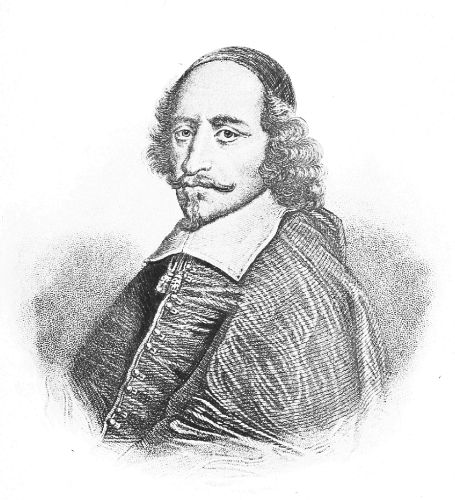
CARDINAL MAZARIN
This is a fair portrayal, as far as it goes; but it shows only one side (the worst side) of Mazarin's character. The portrait is peculiarly interesting from the fact that it was especially depicted and set forth for the instruction of the great-grandson of the woman who loved Mazarin.
It is probable that stern appreciation of the duty of the representative of Divine Justice primed the virulence of the pious Fénelon, when he seated himself to point out an historical moral for the descendant of the weak Queen who sacrificed the prosperity of France on the altar of an insensate passion.
La Grande Mademoiselle was one of Mazarin's most hostile enemies, and her memoirs evince unbending severity. The weakness of her criticism detracts from the importance of a work otherwise valuable as a contemporary chronicle. She regarded Mazarin's "lack of intelligence" as his worst fault. She was convinced that he possessed neither capacity nor judgment "because he acted from the belief that he could reject the talents of a Gaston d'Orléans with impunity. His conduct to Princes of the Blood proved that he lacked wisdom; he stinted the junior branches of their legitimate influence; he would not yield to the pillars of the throne the power that belonged to them by right; he thrust aside the heirs-presumptive, when he might have leaned upon them! Manifestly he was witless, stupid, unworthy the consideration of a prince."
Mademoiselle asserted that Mazarin deserved the worst of fates and the scorn of the people. She believed that many evils could have been averted had Monsieur been consulted in regard to the government of the kingdom. She affirmed that it was her conviction that all good servants of the Crown owed it to their patriotism to arm and drive the Cardinal across the frontier of France. That was her conception of duty, and it smiled upon her from all points of the compass.
Not long before the beginning of the Fronde, the fine world of Paris, stirred to action by the spectacle of the royal infatuation and by the subjection of the national welfare to the suppositive exigencies of "the foreigner," embraced the theory of Opposition, and to be of the Opposition was the fashion of the hour. All who aspired to elegance wore their rebellion as a badge, unless they had private reasons for appearing as the friends of Mazarin. The women who were entering politics found it to their interest to join the opposing body.
Politics had become the favourite pastime of the highways and the little streets. Men and women, not only in Paris, but in the châteaux and homes of the provinces, and children—boys and girls—began to express political opinions in early youth.
"Come, then, Grandmamma," said little Montausier to Mme. de Rambouillet, "now that I am five years old, let us talk about affairs of State." Her grandmother could not have reproved with a good grace, because her own "Blue Room" had been one of the chief agents responsible for the new diversion just before the Fronde. A mocking but virile force arose in the Opposition to check the ultra-refinements of the high art, the high intellectual ability, and the other superfine characteristics of the school of Arthénice. The mockery of the Opposition was as keen and its irony was as effective as the mental sword-play of the literary extremists. Wit was its chief weapon and its barbed words, and merry yet sarcastic thrusts had power to overthrow a ministry. The country knew it and gloried in it. The people of France would have entered upon revolution before they would have renounced their "spirituality." In the polemics of the new party the turn of a sentence meant a dozen things at once; a syllable stung like a dagger. Frenchmen are the natural artists of conversation, and they never found field more favourable to their art than the broad plains of the Opposition. Avowed animosity to the pretensions of the pedants and light mockery of the preciosity of the Précieuses offered a varied choice of subjects and an equally varied choice of accessories for their work. The daring cavaliers of the Opposition passed like wild huntsmen over the exhausted ground, with eyes bent upon the trail, and found delicate and amusing shades of meaning in phrases scorned and stigmatised as "common" by the hyper-spiritual enthusiasts of the Salons.
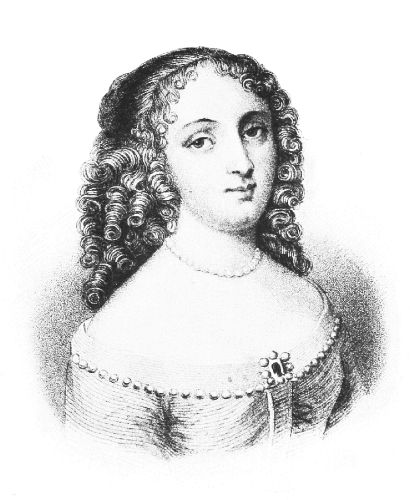
MADEMOISELLE DE MONTPENSIER
FROM A STEEL ENGRAVING
In the exercise of free wit, the women of the new political school found an influence which before their day had been monopolised by the polemists of the State's Councils. They—the women of the Opposition—swept forward and seized positions previously held by men, and since then, either from deep purpose or from pure conviction, they have held their ground and exercised their right to share, or to attempt to share, in the creation and in the destruction of governments. Mademoiselle followed the fashion of the day when she frequented the society of people who were in disgrace at Court. She ridiculed the King's Minister, and as she was influential and popular, outspoken and eager to declare her principles, she was called an agitator, though in the words of Mme. de Motteville, "she was not quite sure what she was trying to do." Mazarin, whom Mademoiselle considered "stupid," had entangled the wires of the cabals and confused the minds of the pretenders with such consummate art that the keenest intriguers gazed in bewilderment upon their own interests, and doubted their truest friends. For instance, Monsieur, who had mind and wit "to burn," could not explain, even to himself, why he repudiated Mademoiselle when she quarrelled with the second junior branch. He knew that he was jealous of his rights and of all that belonged to him; he knew that the power of the Condés was a menace, that his daughter was a powerful ally for any party, that her championship was, and always had been, his strongest arm against an unappreciative world, and after one of the senseless exhibitions of anger against Mademoiselle to which Anne of Austria, impelled by Mazarin, frequently incited him, he asked himself why he maltreated his daughter when she resisted the usurpations of his hated cousins, the Condés.
"Why," he queried piteously, "should I plunge the knife into my own breast?"
Why he did so, and why many another as astute as he moved heaven and earth to effect his own downfall was the secret of Mazarin.
Mademoiselle wept bitter tears for the loss of her father's friendship; then she arose in her pride, resolved to tread the path of life alone, according to her independent will. She was twenty years old and in the fulness of her beauty. She described her appearance with complaisancy[126]:
I am tall; I am neither fat nor lean; I have a graceful and freely moving figure, and my bearing is natural and easy. My bust is well formed. My hands and feet are not beautiful, but there is great beauty in their flesh, and the flesh of my throat is also very pretty. My leg is straight, and my foot is well formed. My hair is a beautiful ash-blonde. My face is long, and its contour is fine. The nose is large and aquiline. The mouth neither large nor little, but distinctly outlined and of a very agreeable form. The lips are the colour of vermilion. My teeth are not handsome, but neither are they horrible. My eyes are blue, neither large nor small, but brilliant, gentle, and proud, like my mien. I have a haughty, but not self-glorified air; I am polite and familiar, but of a manner to excite respect rather than to attract the lack of it. I am indeed very indifferent about my dress, but my negligence does not go as far as untidiness. I hate that! I am neat, and whether I am laced or loosely robed, everything that I wear looks well. This is not because I do not look incomparably better with tightly fitting garments, but it is because negligence and loose garments sit less ill upon me than upon another, for I may say, without boasting, that I become whatever I put on better than anything that I put on becomes me.... God ... has given me unparalleled health and strength. Nothing breaks me down; nothing fatigues me; and it is difficult to judge of the events and the changes in my fortunes by my face, for my face rarely shows any change. I had forgotten to say that I have a healthy complexion, which is in accord with what I have just said. My tint is not delicate, but it is fair, and very bright and clear.
Before the lessons of experience and evil fortune changed Mademoiselle's handsome face, she was thus vivaciously described by an anonymous contemporary:
This Princess of the blood of kings and of princes is haughty, daring, and of a courage much more like the courage of a man than is commonly found in woman. It may be said with truth that she is an amazon, and that she is better fitted to carry a lance than to hold a distaff. She is proud, enterprising, adventurous, quick, and free of speech. She cannot bear to hear anything contrary to her own opinion. As she has never loved either the King's ministers or her father's ministers, she has avoided them; because had she received them in her home, or frequented their society, civility would have constrained her to show them deference. Her humour is impatient, her mind is active, and her heart is ardently set upon whatever she undertakes. As to dissimulation, she does not know the meaning of the term. She tells what she thinks, careless of the opinion of the world.
She was described in divers ways, according to the impressions of her associates. One said that her manner gave evidence of serious reflection; another called her too vivacious. It was supposed that she had been the first to assert that the soul ought not to be susceptible to love, and therefore her admirers sang to her of the aversion felt by Pallas for the allurements of Venus. Mademoiselle had said:
"Je n'ai point l'âme tendre."
and she had meant what she said, and been glad to have it known that she was heart-free.
She was blamed for her rude manners and for her outbursts of anger. When she declared that she longed to go to war with the soldiers her critics laughed at her pretensions. It was generally believed that her faults were numerous, and that she had few of the qualities considered desirable in woman; but no one ever called her petty, cowardly, or false. La Grande Mademoiselle was never a liar; she never betrayed friend or foe. She was brave and generous; and it was not her fault if when nature placed her soul in the form of a woman it gave her the mien and the inclinations of a man.