Book 6 — Chapter VI. IN WHICH THE AUTHOR DISCOURSES VERY INGENUOUSLY OF HIMSELF—AFTER WHICH IS TO BE FOUND MUCH INTERESTING HISTORY ABOUT PETER THE HEADSTRONG AND HIS FOLLOWERS.
Reading edition
As my readers and myself are about entering on as many perils as ever a confederacy of meddlesome knights-errant wilfully ran their heads into, it is meet that, like those hardy adventurers, we should join hands, bury all differences, and swear to stand by one another, in weal or woe, to the end of the enterprise. My readers must doubtless perceive how completely I have altered my tone and deportment since we first set out together. I warrant they then thought me a crabbed, cynical, impertinent little son of a Dutchman; for I scarcely gave them a civil word, nor so much as touched my beaver, when 195I had occasion to address them. But as we jogged along together on the high road of my history, I gradually began to relax, to grow more courteous, and occasionally to enter into familiar discourse, until at length I came to conceive a most social, companionable kind of regard for them. This is just my way: I am always a little cold and reserved at first, particularly to people whom I neither know nor care for, and am only to be completely won by long intimacy.
Besides, why should I have been sociable to the crowd of how-d’ye-do acquaintances that flocked around me at my first appearance? Many were merely attracted by a new face; and having stared me full in the title-page, walked off without saying a word: while others lingered yawningly through the preface, and, having gratified their short-lived curiosity, soon dropped off one by one. But, more especially to try their mettle, I had recourse to an expedient, similar to one which we are told was used by that peerless flower of chivalry, King Arthur; who, before he admitted any knight to his intimacy, first required that he should show himself superior to danger or hardships, by encountering unheard-of mishaps, slaying some dozen giants, vanquishing wicked enchanters, not to say a word of 196dwarfs, hippogriffs, and fiery dragons. On a similar principle did I cunningly lead my readers, at the first sally, into two or three knotty chapters, where they were most wofully belabored and buffeted by a host of pagan philosophers, and infidel writers. Though naturally a very grave man, yet could I scarcely refrain from smiling outright at seeing the utter confusion and dismay of my valiant cavaliers. Some dropped down dead (asleep) on the field; others threw down my book in the middle of the first chapter, took to their heels, and never ceased scampering until they had fairly run it out of sight: when they stopped to take breath, to tell their friends what troubles they had undergone, and to warn all others from venturing on so thankless an expedition. Every page thinned my ranks more and more; and of the vast multitude that first set out, but a comparatively few made shift to survive, in exceedingly battered condition, through the five introductory chapters.
What, then! would you have had me take such sunshine, faint-hearted recreants to my bosom at our first acquaintance? No, no; I reserved my friendship for those who deserved it, for those who undauntedly bore me company, in spite of difficulties, dangers, and fatigues. And now, as to those who adhere 197to me at present, I take them affectionately by the hand. Worthy and thrice-beloved readers! brave and well-tried comrades! who have faithfully followed my footsteps through all my wanderings,—I salute you from my heart,—I pledge myself to stand by you to the last, and to conduct you (so Heaven speed this trusty weapon which I now hold between my fingers) triumphantly to the end of this our stupendous undertaking.
But, hark! while we are thus talking, the city of New Amsterdam is in a bustle. The host of warriors encamped in the Bowling Green are striking their tents; the brazen trumpet of Antony Van Corlear makes the welkin to resound with portentous clangor; the drums beat; the standards of the Manhattoes, of Hell-gate, and of Michael Paw, wave proudly in the air. And now behold where the mariners are busily employed hoisting the sails of yon topsail schooner, and those clump-built sloops, which are to waft the army of the Nederlanders to gather immortal honors on the Delaware!
198
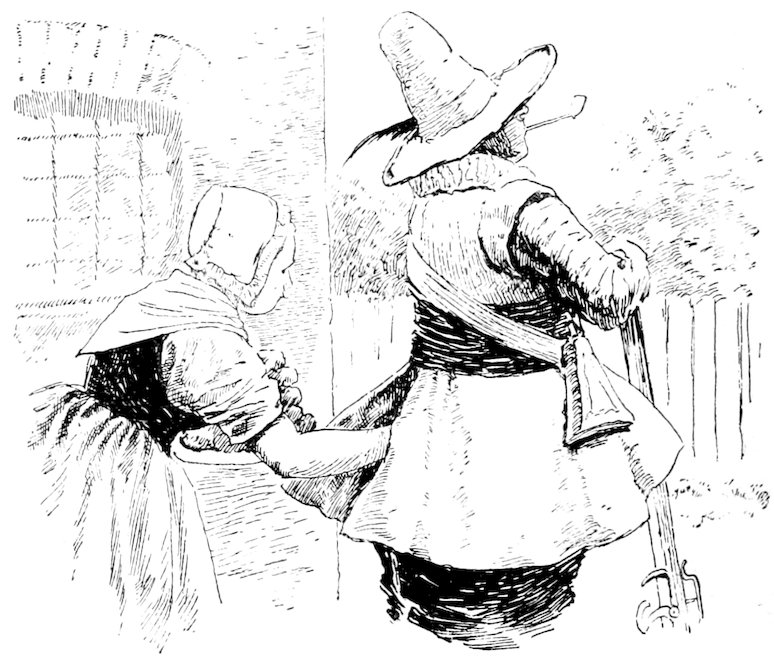
“CRAMMED THE POCKETS OF HER HERO WITH GINGERBREAD AND DOUGHNUTS.”
The entire population of the city, man, woman, and child, turned out to behold the chivalry of New Amsterdam, as it paraded the streets previous to embarkation. Many a handkerchief was waved out of the windows; many a fair nose was blown in melodious sorrow on the mournful occasion. The grief of the fair dames and beauteous damsels of Granada could not have been more vociferous on the banishment of the gallant tribe of Abencerrages than was that of the kind-hearted fair ones of New Amsterdam on the departure of their intrepid warriors. Every love-sick maiden fondly crammed the pockets of her hero with gingerbread and doughnuts; many a copper 199ring was exchanged, and crooked sixpence broken, in pledge of eternal constancy; and there remain extant to this day some love-verses written on that occasion, sufficiently crabbed and incomprehensible to confound the whole universe.
But it was a moving sight to see the buxom lasses, how they hung about the doughty Antony Van Corlear,—for he was a jolly, rosy-faced, lusty bachelor, fond of his joke, and withal a desperate rogue among the women. Fain would they have kept him to comfort them while the army was away; for, besides what I have said of him, it is no more than justice to add, that he was a kind-hearted soul, noted for his benevolent attentions in comforting disconsolate wives during the absence of their husbands; and this made him to be very much regarded by the honest burghers of the city. But nothing could keep the valiant Antony from following the heels of the old governor, whom he loved as he did his very soul; so, embracing all the young vrouws, and giving every one of them that had good teeth and rosy lips a dozen hearty smacks, he departed, loaded with their kind wishes.
Nor was the departure of the gallant Peter among the least causes of public distress. Though the old governor was by no means indulgent 200to the follies and waywardness of his subjects, yet somehow or other he had become strangely popular among the people. There is something so captivating in personal bravery, that, with the common mass of mankind, it takes the lead of most other merits. The simple folk of New Amsterdam looked upon Peter Stuyvesant as a prodigy of valor. His wooden leg, that trophy of his martial encounters, was regarded with reverence and admiration. Every old burgher had a budget of miraculous stories to tell about the exploits of Hardkoppig Piet, wherewith he regaled his children of a long winter night, and on which he dwelt with as much delight and exaggeration as do our honest country yeomen on the hardy adventures of old General Putnam (or, as he is familiarly termed, Old Put) during our glorious Revolution. Not an individual but verily believed the old governor was a match for Beëlzebub himself; and there was even a story told, with great mystery, and under the rose, of his having shot the devil with a silver bullet one dark stormy night, as he was sailing in a canoe through Hell-gate,—but this I do not record as being an absolute fact. Perish the man who would let fall a drop to discolor the pure stream of history!
201
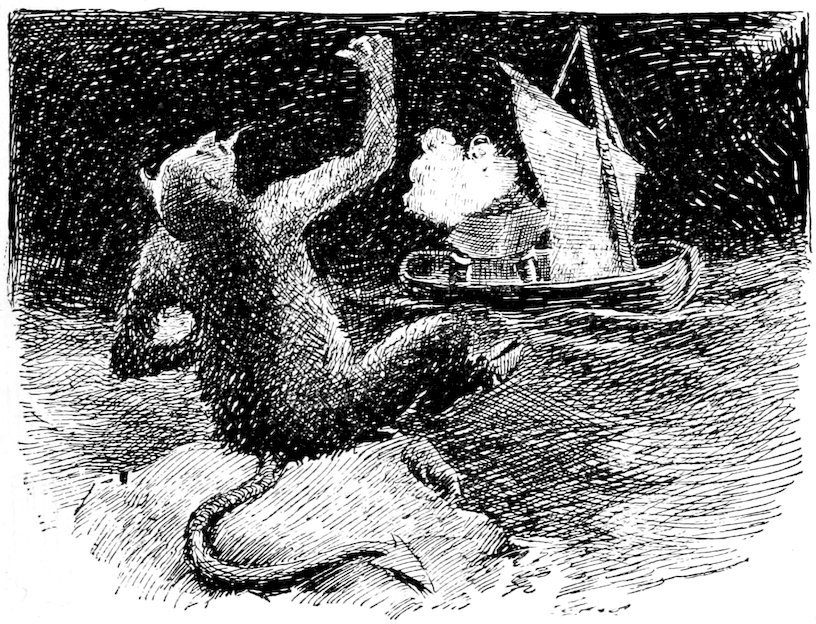
“HAVING SHOT THE DEVIL WITH A SILVER BULLET ONE DARK STORMY NIGHT.”
Certain it is, not an old woman in New Amsterdam but considered Peter Stuyvesant as a tower of strength, and rested satisfied that the public welfare was secure so long as he was in the city. It is not surprising, then, that they looked upon his departure as a sore affliction. With heavy hearts they dragged at the heels of his troop, as they marched down to the riverside to embark. The governor, from the stern of his schooner, gave a short but truly patriarchal address to his citizens, wherein he recommended them to comport like loyal and peaceable subjects,—to go to church regularly on 202Sundays, and to mind their business all the week besides. That the women should be dutiful and affectionate to their husbands,—looking after nobody’s concerns but their own,—eschewing all gossipings and morning gaddings,—and carrying short tongues and long petticoats. That the men should abstain from intermeddling in public concerns, intrusting the cares of government to the officers appointed to support them,—staying at home, like good citizens, making money for themselves, and getting children for the benefit of their country. That the burgomasters should look well to the public interest,—not oppressing the poor nor indulging the rich,—not tasking their ingenuity to devise new laws, but faithfully enforcing those which were already made,—rather bending their attention to prevent evil than to punish it; ever recollecting that civil magistrates should consider themselves more as guardians of public morals than rat-catchers employed to entrap public delinquents. Finally, he exhorted them, one and all, high and low, rich and poor, to conduct themselves as well as they could, assuring them that if they faithfully and conscientiously complied with this golden rule, there was no danger but that they would all conduct themselves well enough. This done, he gave them a paternal 203benediction, the sturdy Antony sounded a most loving farewell with his trumpet, the jolly crews put up a shout of triumph, and the invincible armada swept off proudly down the bay.
The good people of New Amsterdam crowded down to the Battery,—that blest resort, from whence so many a tender prayer has been wafted, so many a fair hand waved, so many a tearful look been cast by love-sick damsel, after the lessening bark, bearing her adventurous swain to distant climes!—Here the populace watched with straining eyes the gallant squadron, as it slowly floated down the bay, and when the intervening land at the Narrows shut it from their sight, gradually dispersed with silent tongues and downcast countenances.
A heavy gloom hung over the late bustling city: the honest burghers smoked their pipes in profound thoughtfulness, casting many a wistful look to the weather-cock on the church of St. Nicholas; and all the old women, having no longer the presence of Peter Stuyvesant to hearten them, gathered their children home, and barricaded the doors and windows every evening at sundown.
In the meanwhile the armada of the sturdy Peter proceeded prosperously on its voyage; 204and after encountering about as many storms, and water-spouts, and whales, and other horrors and phenomena as generally befall adventurous landsmen in perilous voyages of the kind, and after undergoing a severe scouring from that deplorable and unpitied malady called seasickness, the whole squadron arrived safely in the Delaware.
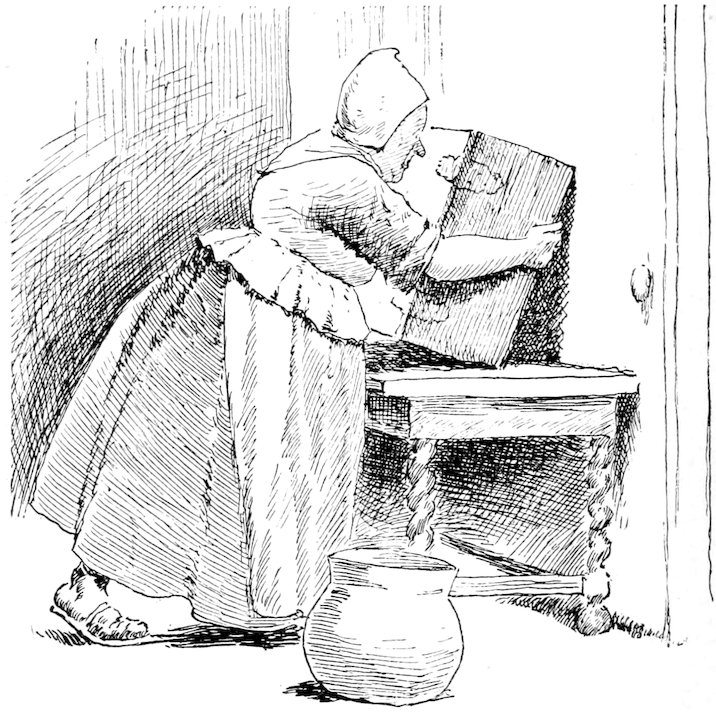
“BARRICADED THE DOORS AND WINDOWS EVERY EVENING AT SUNDOWN.”
Without so much as dropping anchor and 205giving his wearied ships time to breathe, after laboring so long on the ocean, the intrepid Peter pursued his course up the Delaware, and made a sudden appearance before Fort Casimir. Having summoned the astonished garrison by a terrific blast from the trumpet of the long-winded Van Corlear, he demanded, in a tone of thunder, an instant surrender of the fort. To this demand, Suen Skytte, the wind-dried commandant, replied in a shrill, whiffling voice, which, by reason of his extreme spareness, sounded like the wind whistling through a broken bellows,—“That he had no very strong reason for refusing, except that the demand was particularly disagreeable, as he had been ordered to maintain his post to the last extremity.” He requested time, therefore, to consult with Governor Risingh, and proposed a truce for that purpose.
The choleric Peter, indignant at having his rightful fort so treacherously taken from him, and thus pertinaciously withheld, refused the proposed armistice, and swore by the pipe of St. Nicholas, which, like the sacred fire, was never extinguished, that unless the fort were surrendered in ten minutes, he would incontinently storm the works, make all the garrison run the gauntlet, and split their scoundrel of a commander like a pickled shad. To give this 206menace the greater effect, he drew forth his trusty sword, and shook it at them with such a fierce and vigorous motion, that doubtless, if it had not been exceedingly rusty, it would have lightened terror into the eyes and hearts of the enemy. He then ordered his men to bring a broadside to bear upon the fort, consisting of two swivels, three muskets, a long duck fowling-piece, and two brace of horse-pistols.
In the meantime the sturdy Van Corlear marshalled all the forces, and commenced his warlike operations. Distending his cheeks like a very Boreas, he kept up a most horrific twanging of his trumpet,—the lusty choristers of Sing-Sing broke forth into a hideous song of battle,—the warriors of Breuckelen and the Wallabout blew a potent and astonishing blast on their conch shells,—altogether forming as outrageous a concerto as though five thousand French fiddlers were displaying their skill in a modern overture.
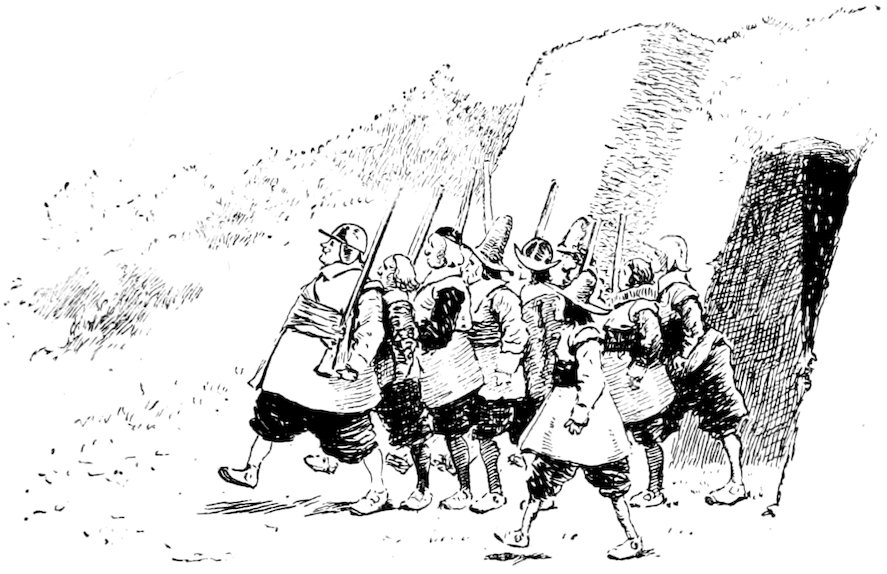
Whether the formidable front of war thus suddenly presented smote the garrison with sore dismay,—or whether the concluding terms of the summons, which mentioned that he should surrender “at discretion,” were mistaken by Suen Skytte, who, though a Swede, was a very considerate, easy-tempered man, as a 207compliment to his discretion, I will not take upon me to say; certain it is he found it impossible to resist so courteous a demand. Accordingly, in the very nick of time, just as the cabin-boy had gone after a coal of fire to discharge the swivel, a chamade was beat on the rampart by the only drum in the garrison, to the no small satisfaction of both parties, who, notwithstanding their great stomach for fighting, had full as good an inclination to eat a quiet dinner as to exchange black eyes and bloody noses.
“MARCHED OUT WITH THE HONORS OF WAR.”
Thus did this impregnable fortress once more return to the domination of their High Mightinesses. Skytte and his garrison of twenty men were allowed to march out with 208the honors of war; and the victorious Peter, who was as generous as brave, permitted them to keep possession of all their arms and ammunition,—the same on inspection being found totally unfit for service, having long rusted in the magazine of the fortress, even before it was wrested by the Swedes from the windy Van Poffenburgh. But I must not omit to mention that the governor was so well pleased with the service of his faithful squire, Van Corlear, in the reduction of this great fortress, that he made him on the spot lord of a goodly domain in the vicinity of New Amsterdam,—which goes by the name of Corlear’s Hook unto this very day.
The unexampled liberality of Peter Stuyvesant towards the Swedes, occasioned great surprise in the city of New Amsterdam,—nay, certain factious individuals, who had been enlightened by political meetings in the days of William the Testy, but who had not dared to indulge their meddlesome habits under the eye of their present ruler, now, emboldened by his absence, gave vent to their censures in the street. Murmurs were heard in the very council-chamber of New Amsterdam; and there is no knowing whether they might not have broken out into downright speeches and invectives, had not Peter Stuyvesant privately 209sent home his walking-staff, to be laid as a mace on the table of the council-chamber, in the midst of his counsellors; who, like wise men, took the hint, and forever after held their peace.
jolly man in a nightcap or baker's hat, smiling while holding out a tray of freshly baked rolls."
210