Book 6 — Chapter V. DESCRIBING THE POWERFUL ARMY THAT ASSEMBLED AT THE CITY OF NEW AMSTERDAM—TOGETHER WITH THE INTERVIEW BETWEEN PETER THE HEADSTRONG AND GENERAL VAN POFFENBURGH, AND PETER’S SENTIMENTS TOUCHING UNFORTUNATE GREAT MEN.
Reading edition
While thus the enterprising Peter was coasting, with flowing sail, up the shores of the lordly Hudson, and arousing all the phlegmatic little Dutch settlements upon its borders, a great and puissant concourse of warriors was assembling at the city of New Amsterdam. And here that invaluable fragment of antiquity, the Stuyvesant manuscript, is more than commonly particular; by which means I am enabled to record the illustrious host that encamped itself in the public 182square in front of the fort, at present denominated the Bowling Green.
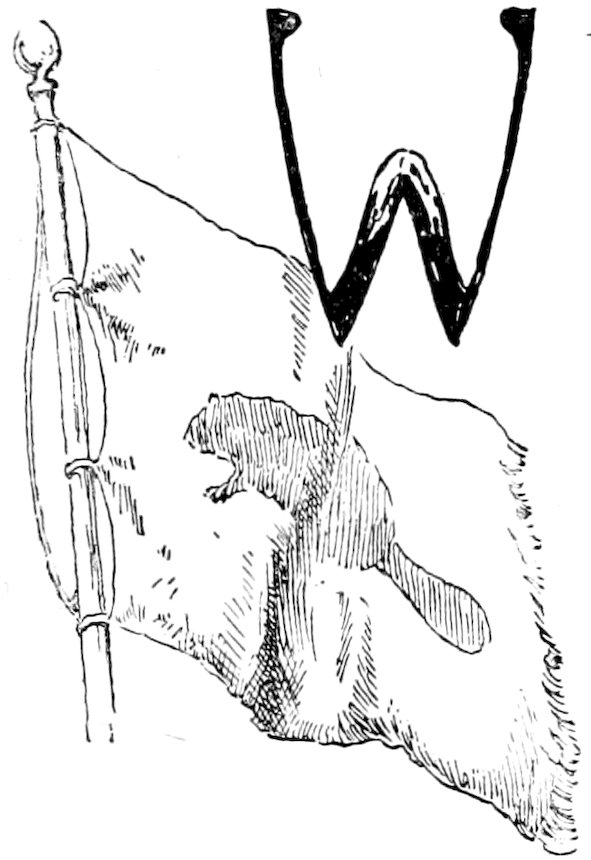
In the centre, then, was pitched the tent of the men of battle of the Manhattoes, who, being the inmates of the metropolis, composed the life-guards of the governor. These were commanded by the valiant Stoffel Brinkerhoff, who whilom had acquired such immortal fame at Oyster Bay; they displayed as a standard a beaver rampant on a field of orange, being the arms of the province, and denoting the persevering industry and the amphibious origin of the Nederlanders.[15]
On their right hand might be seen the vassals of that renowned Mynheer, Michael Paw,[16] who lorded it over the fair regions of ancient Pavonia, and the lands away south even unto 183the Navesink mountains,[17] and was moreover patroon of Gibbet Island. His standard was borne by his trusty squire, Cornelius Van Vorst; consisting of a huge oyster recumbent upon a sea-green field; being the armorial bearings of his favorite metropolis, Communipaw. He brought to the camp a stout force of warriors, heavily armed, being each clad in ten pair of linsey-woolsey breeches, and overshadowed by broad-brimmed beavers, with short pipes twisted in their hat-bands. These were the men who vegetated in the mud along the shores of Pavonia, being of the race of genuine copperheads, and were fabled to have sprung from oysters.
At a little distance was encamped the tribe of warriors who came from the neighborhood of Hell-gate. These were commanded by the Suy Dams, and the Van Dams,—incontinent hard swearers, as their names betoken. They were terrible-looking fellows, clad in broad-skirted gaberdines, of that curious-colored cloth called thunder and lightning,—and bore as a standard three devil’s darning-needles, volant, in a flame-colored field.
184
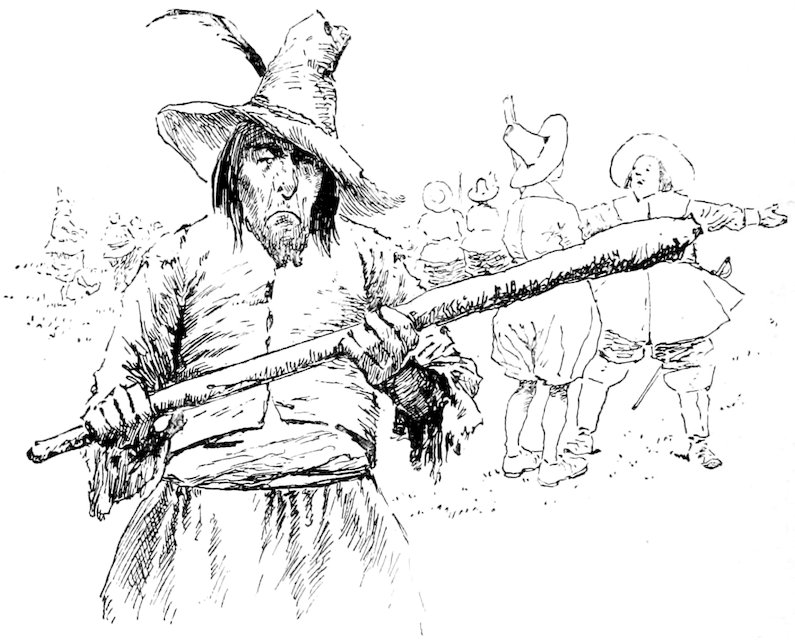
“THESE WERE OF A SOUR ASPECT.”
Hard by was the tent of the men of battle from the marshy borders of the Waale-Boght[18] and the country thereabouts. These were of a sour aspect, by reason that they lived on crabs, which abound in these parts. They were the first institutors of that honorable order of knighthood called Fly-market shirks, and, if tradition speak true, did likewise introduce the far-famed step in dancing called “double trouble.” They were commanded by the fearless 185Jacobus Varra Vanger,—and had, moreover, a jolly band of Breuckelen[19] ferry-men, who performed a brave concerto on conch shells.
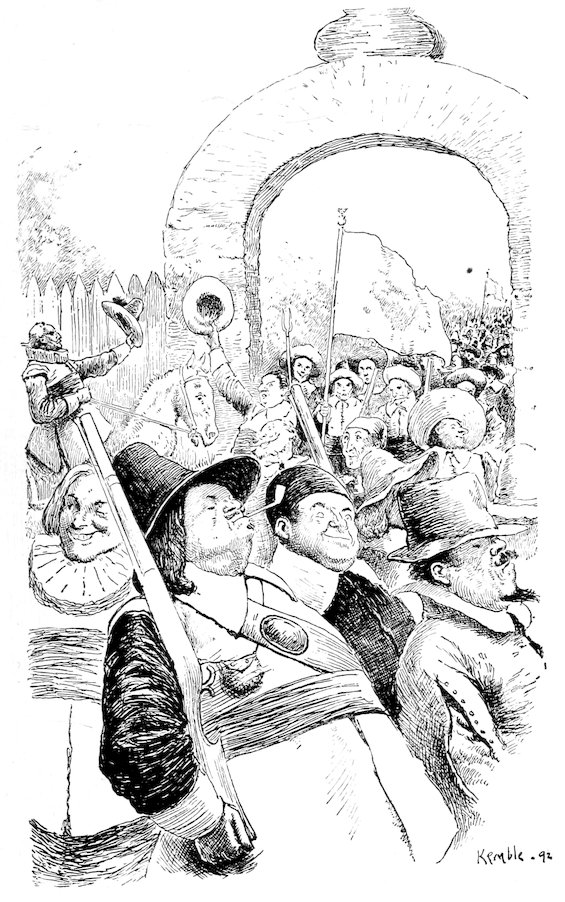
“AS THEY DEFILED THROUGH THE PRINCIPAL GATE THAT STOOD AT THE HEAD OF WALL STREET.”
186But I refrain from pursuing this minute description, which goes on to describe the warriors of Bloemen-dael, and Weehawk, and Hoboken, and sundry other places, well known in history and song; for now do the notes of martial music alarm the people of New Amsterdam, sounding afar from beyond the walls of the city. But this alarm was in a little while relieved, for lo! from the midst of a vast cloud of dust, they recognized the brimstone-colored breeches and splendid silver leg, of Peter Stuyvesant, glaring in the sunbeams; and beheld him approaching at the head of a formidable army, which he had mustered along the banks of the Hudson. And here the excellent but anonymous writer of the Stuyvesant manuscript breaks out into a brave and glorious description of the forces, as they defiled through the principal gate of the city, that stood by the head of Wall Street.
First of all came the Van Bummels, who inhabit the pleasant borders of the Bronx: these were short fat men, wearing exceeding large trunk-breeches, and were renowned for 187feats of the trencher. They were the first inventors of suppawn, or mush and milk.—Close in their rear marched the Van Vlotens, of Kaatskill, horrible quaffers of new cider, and arrant braggarts in their liquor.—After them came the Van Pelts of Groodt Esopus, dexterous horsemen, mounted upon goodly switch-tailed steeds of the Esopus breed. These were mighty hunters of minks and musk-rats, whence came the word Peltry.—Then the Van Nests of Kinderhoeck, valiant robbers of birds’-nests, as their name denotes. To these, if reports may be believed, we are indebted for the invention of slap-jacks, or buckwheat-cakes.—Then the Van Higginbottoms, of Wapping’s creek. These came armed with ferules and birchen rods, being a race of schoolmasters, who first discovered the marvellous sympathy between the seat of honor and the seat of intellect,—and that the shortest way to get knowledge into the head was to hammer it into the bottom.—Then the Van Grolls of Antony’s Nose, who carried their liquor in fair round little pottles, by reason they could not bouse it out of their canteens, having such rare long noses.—Then the Gardeniers of Hudson and thereabouts, distinguished by many triumphant feats, such as robbing watermelon-patches, smoking rabbits 188out of their holes, and the like, and by being great lovers of roasted pigs’ tails. These were the ancestors of the renowned congressman of that name.—Then the Van Hœsens, of Sing-Sing, great choristers and players upon the jews-harp. These marched two and two, singing the great song of St. Nicholas.—Then the Couenhovens, of Sleepy Hollow. These gave birth to a jolly race of publicans, who first discovered the magic artifice of conjuring a quart of wine into a pint bottle.—Then the Van Kortlandts, who lived on the wild banks of the Croton, and were great killers of wild ducks, being much spoken of for their skill in shooting with the long bow.—Then the Van Bunschotens, of Nyack and Kakiat, who were the first that did ever kick with the left foot. They were gallant bushwhackers and hunters of raccoons by moonlight.—Then the Van Winkles of Haerlem, potent suckers of eggs, and noted for running of horses, and running up of scores at taverns. They were the first that ever winked with both eyes at once.—Lastly came the Knickerbockers, of the great town of Schaghtikoke, where the folk lay stones upon the houses in windy weather, lest they should be blown away. These derive their name, as some say, from Knicker, to shake, and Beker, a goblet, indicating thereby 189that they were sturdy toss-pots of yore; but, in truth, it was derived from Knicker, to nod, and Boeken, books: plainly meaning that they were great nodders or dozers over books. From them did descend the writer of this history.
Such was the legion of sturdy bush-beaters that poured in at the grand gate of New Amsterdam; the Stuyvesant manuscript indeed speaks of many more, whose names I omit to mention, seeing that it behooves me to hasten to matters of greater moment. Nothing could surpass the joy and martial pride of the lion-hearted Peter as he reviewed this mighty host of warriors, and he determined no longer to defer the gratification of his much-wished-for revenge upon the scoundrel Swedes at Fort Casimir.
But before I hasten to record those unmatchable events which will be found in the sequel of this faithful history, let me pause to notice the fate of Jacobus Van Poffenburgh, the discomfited commander-in-chief of the armies of the New Netherlands. Such is the inherent uncharitableness of human nature, that scarcely did the news become public of his deplorable discomfiture at Fort Casimir, than a thousand scurvy rumors were set afloat in New Amsterdam, wherein it was insinuated 190that he had in reality a treacherous understanding with the Swedish commander; that he had long been in the practice of privately communicating with the Swedes; together with divers hints about “secret-service money.” To all of which deadly charges I do not give a jot more credit than I think they deserve.
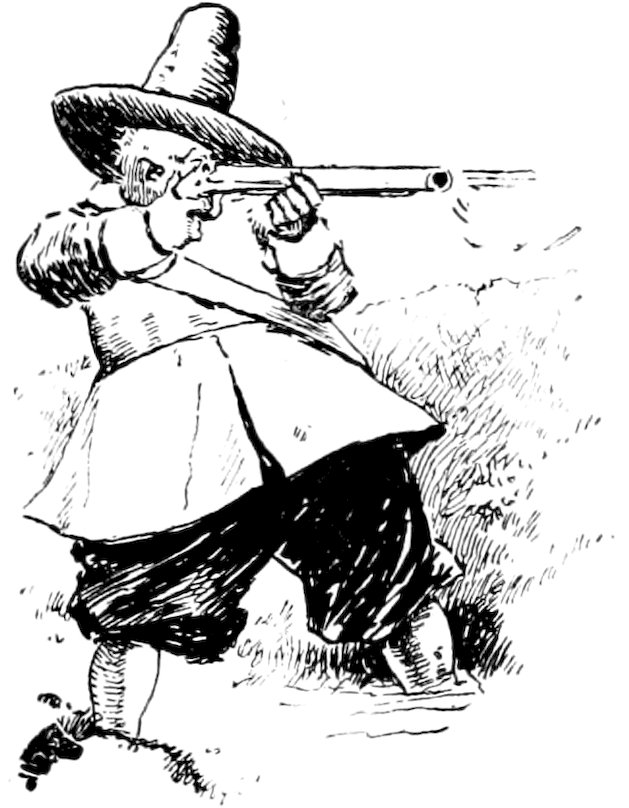
Certain it is, that the general vindicated his character by the most vehement oaths and protestations, and put every man out of the ranks of honor who dared to doubt his integrity. Moreover, on returning to New Amsterdam, he paraded up and down the streets with a crew of hard swearers at his heels,—sturdy bottle-companions, whom he gorged and fattened, and who were ready to bolster him through all the courts of justice,—heroes of his own kidney, fierce-whiskered, broad-shouldered, colbrand-looking swaggerers,—not one of whom but looked as though he could eat up an ox, and pick his teeth with the horns. These lifeguard-men quarrelled all his quarrels, were ready to fight all his battles, and scowled at every man that turned up his nose at the general, as though they would devour him alive. Their conversation was interspersed with oaths like minute guns, and every bombastic rodomontade was rounded off by a thundering 191execration, like a patriotic toast honored with a discharge of artillery.
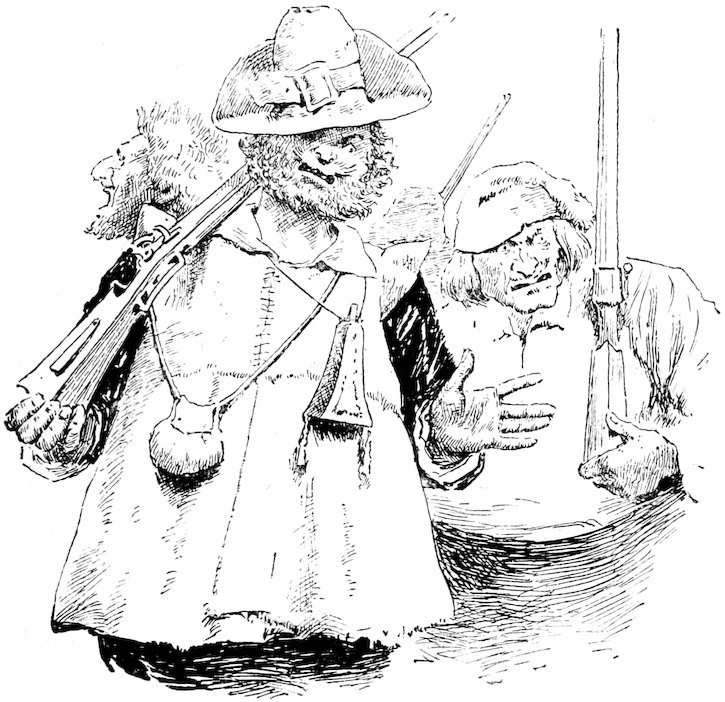
“A CREW OF HARD SWEARERS.”
All these valorous vaporings had a considerable effect in convincing certain profound sages, who began to think the general a hero of unmatchable loftiness and magnanimity of soul, particularly as he was continually protesting on the honor of a soldier,—a marvellously high-sounding asseveration. Nay, one 192of the members of the council went so far as to propose they should immortalize him by an imperishable statue of plaster-of-Paris.
But the vigilant Peter the Headstrong was not thus to be deceived. Sending privately for the commander-in-chief of all the armies, and having heard all his story, garnished with the customary pious oaths, protestations, and ejaculations,—“Harkee, comrade,” cried he, “though by your own account you are the most brave, upright, and honorable man in the whole province, yet do you lie under the misfortune of being damnably traduced, and immeasurably despised. Now, though it is certainly hard to punish a man for his misfortunes, and though it is very possible you are totally innocent of the crimes laid to your charge, yet as heaven, doubtless for some wise purpose, sees fit at present to withhold all proofs of your innocence, far be it from me to counteract its sovereign will. Besides, I cannot consent to venture my armies with a commander whom they despise, nor to trust the welfare of my people to a champion whom they distrust. Retire, therefore, my friend, from the irksome toils and cares of public life, with this comforting reflection, that, if guilty, you are but enjoying your just reward, and if innocent, you are not the first great and good man 193who has most wrongfully been slandered and maltreated in this wicked world,—doubtless to be better treated in a better world, where there shall be neither error, calumny, nor persecution. In the meantime let me never see your face again, for I have a horrible antipathy to the countenances of unfortunate great men like yourself.”
194