HENRY GILBERT. (continued 5)
Reading edition
'Hence from my sight, unfeeling girl!' cried the countess in anger. 'There is no one in the world to compare with my dead lord in beauty, in strength, and in prowess. Get thee gone!'
Without a word Elined turned and went from the room. But she had not gone far before she heard the countess coughing behind her, and on looking back her mistress beckoned to her.
'You are indeed hardhearted, Elined,' said she, 'to think to leave me in my grief, and in my need of good counsel. I will overlook thy cruelty if, as you say, you have been absent for my advantage. What mean you by that?'
'This is my meaning,' said Elined. 'Thou knowest that without a man of knightly prowess and bravery, thou canst not hope to guard the fountain and keep these wide dominions in the power of thyself. Thou art the prey and booty of any bold bandit lord that chooses to make war upon thee, and to capture and wed thee. And dost thou forget the wiles and treachery of thy old lover whom thou hast flouted, Sir Dewin of Castle Cower? Hath he not sworn to take thee and thy kingdom, sooner or later, by fair means or by foul? Therefore it behoves thee at once to find a noble and generous knight, courtly and worshipful, who will guard thee and love thee, and hold down the turbulent lords, thy vassals and thy neighbours.'
'Hard will such a task be,' sighed the countess, 'for the Earl Cadoc was a man among men.'
'Yet I will wager to find thee such another, even excelling him in knightly prowess, in beauty of person, and for love and devotion to thee more than his equal,' replied Elined, who remembered that the dead earl had not been over tender to his gentle countess on many occasions.
'And where couldst thou find this paragon?' said the countess, flushing a little at the reminder of her late lord's neglect.
'At the court of King Arthur,' replied Elined; 'for there are to be found the peerless knights of the world, men of their knightly words, and devoted to love and war.
'If it be that I must think of wedding again so soon,' sighed the countess, 'go then to King Arthur, and find me such a knight. But let him be gentle as well as brave, with fine and courtly manners—a man, indeed, whom I can really love.'
Elined went and kissed the flushing cheek of her mistress.
'Trust me for that,' she said gently. 'I would do that as much for myself as for thee, my dear Carol. For did it not often go to my heart to see thee pine for gentle speech and affection, and sorrow at the harsh words thou didst suffer? I will set forth at once to Caerleon, and him that I bring shall be worthy of thee. And all others that may come and woo thee, do thou keep at arm's length until I return.'
Elined departed from the castle, but she did not go beyond the town. It was in her mind to lie hidden for as long a time as it would take her to go to Caerleon and return therefrom. Meanwhile, going about disguised, she would be able to see what the many lords were doing who would essay to woo the countess, seeing that, lovely and rich as she was, she would be a splendid prize.
And things happened as she had foreseen. Every day there came into the town one cavalcade or more, with some baron or earl in flashing armour at the head of his vassals, come to try his fortune and to win the lovely Countess of the Fountain, and to possess her wide dominions.
Daily the countess was compelled to receive fresh comers in audience, and while with deft excuses she kept each at arm's length, they crowded her audience-chamber, proud and insolent, humble or crafty, eyeing each other with high looks, each prepared to slay his rival if the need arose.
At last there came an earl who, as he came up the street at the head of a large company of knights, seemed to shine like the sun. For his armour was all of gold, and jewels were about his neck, and on his girdle and his wrists. Every toss of his destrier's head dazzled the eyes with the fountain of flashing lights given off by the jewels which adorned the cloth of gold about its head.
This knight called himself the Earl of Drood, but Elined was in the crowd of gaping townspeople that saw him enter, and she knew him for the old insolent lover of her mistress, whom the countess had ever despised, Sir Dewin of Castle Cower.
Sir Dewin disguised himself so that the countess did not know him. She received him in audience, and though she was startled by the magnificence of his dress, and a little moved by the gentleness of his manner, she felt that she feared and distrusted him.
The next day he craved to see her again, and then said:
'Fair and noble lady, so deeply doth thy beauty move me, that I am eager to put to the test swiftly the question whether I or some other happier knight among these noble gentlemen shall obtain thy hand. Therefore I crave permission of thee to proclaim a joust between all these knights that sue for thee, and the winner among them all shall be he that thou shalt wed.'
'Sir,' said the countess with great dignity, 'it is not for thee to order here, but for me. I wish nothing to be done for the space of nine days, and then will I make my choice.'
At which Sir Dewin, though full of rage, must needs seem content. And the countess hoped that, in the space she had named, Elined would have returned with the knight of her choice, and she herself could choose him for her lord, if she thought he was the man whom she could most trust and love.
But Sir Dewin wrought upon many of the suitors who were of his mind, and they resolved that, will she, nill she, the countess must needs abide by a contest between all her wooers to be holden on the tenth day.
And on the tenth day all the knights, barons, and earls met together in full armour in a broad green jousting-place beneath the windows of the countess, and having made the rules of contest, and committed them to the seneschal of the countess, they prepared to prove which among them all was the knight of most prowess.
Then there was fierce hurtling to and fro of knight against knight, and lances splintered, horses reared, knights fell wounded or dead, and were dragged away. And for long, among the ninety-nine knights that there jousted, none of the crowds who looked on could see which were they who were gaining the day.
From her window the countess watched with a sorrowing and dreading heart; for Elined had not yet returned, and therefore the countess must be the prize of one of these suitors who had pestered her, and none of whom she cared for.
Then, when the dust of the jousting had a little cleared, and the knights had withdrawn to the sides of the lists, to breathe and rest awhile, it was seen that twelve remained of the ninety-nine.
The countess, looking from her window, knew them all from the devices on their shields, and none of them were men she favoured. Some she knew were evil men, yet, as knights, were powerful in jousting. And she dreaded which of them should be the victor, to be her lord and master.
Then the knights hurtled together again, and as one after the other was unhorsed by stronger opponents and went from the field, she went pale with fear and anxiety.
At last there were but two, and these were Sir Dewin, whom she knew as the Earl of Drood, and the other was a knight in blue armour, with a shield on which was painted a hillock or mound. And she knew him to be a man named Sir Daunt, or the Knight of the Mount, a man of fierce temper, quarrelsome and cruel.
The countess could have swooned with terror, for she knew that now she was doomed to an unhappy life, whichever of these knights prevailed. For though the Earl of Drood was soft and gentle in speech and manner, she feared that this but covered a wicked heart.
She could hardly bear to look as she heard these two, the last of all the ninety-nine, crash together in the midst of the jousting-ground. And she heard the cries of the onlookers.
'The blue knight's the better man! How he heaves with his sword! Ah, the golden knight is down!'
And looking from her window the countess saw the earl was lying wounded, and the Knight of the Mount stood over him. Then the earl surrendered and was carried off the field.
The great shouts that saluted the victor made the countess turn faint and sick with dread, so that she fell back among her handmaidens in a swoon. But, quickly recovering, she stood up, resolved to meet her fate with proud dignity.
In a few moments the door opened and the arras was pushed aside, and the groom of the chambers announced with a shout:
'The Knight of the Mound, victorious in the joust, craves leave to greet our lady the countess.'
The lady bowed assent, trembling in every limb. Then the groom stepped aside, and into the chamber came a comely gentleman, clad in purple tunic, rich with chains and jewelled belt.
But it was not the knight whom the countess had expected, but a stranger, with a courtly and gentle manner and a winning smile.
Then from behind him came Elined, full of smiles, with a look of triumph in her eyes.
'My lady,' she said, bowing low, 'this is the knight, Sir Owen of Wales, from the court of King Arthur, whom I have brought to protect you and wed you. He hath just proved himself the doughtiest among a hundred.'
The terror of the countess was changed instantly into joy, and she put forth her hand, and Sir Owen bent and kissed it, and she led him to the window seat, and commanded Elined to sit with them. And they spoke full joyously together, for the countess was much taken with the noble and gentle bearing of Sir Owen, and admired him because he had proved himself the best man of all her wooers.
In a few days she sent for the bishops and priests, and her nuptials with Sir Owen were celebrated with such feasting that all the country was full of merriment and joy. And the men of the earldom came and did homage to Owen, and he became the Earl of the Fountain.
In a little while thereafter Sir Owen told his lady that it was he who had chased the soul from the body of her former lord. But the countess was not vexed by the knowledge, for Sir Owen loved her greatly, and with all tenderness and honour, and never had the countess been so happy with Earl Cadoc as she was with Owen.
Thereafter Earl Owen defended the fountain with lance and sword against all who ventured to challenge him in his earldom. And the knights who were thus conquered he held to ransom, and the money he thus obtained he divided equally among his barons and knights. Never had they had so generous a lord, nor one of such prowess and knightly worth. And all his subjects loved Earl Owen passing well.
Thus for three years in all happiness and quiet did Owen and the countess dwell. Sir Dewin of Castle Cower had not power to hurt them, nor did any other evil light upon them.
But at the end of this space, towards the close of a summer's day, Sir Owen, by the magic whereby it was made known to him, knew that there was a knight who challenged him at the fountain. So, putting on his sky-blue armour, he went forth and found the knight.
They rushed together, and the strange knight was overthrown. But others who were with him took him away, and Sir Owen waited. But none other challenge was made, and in the twilight he retired, resolved to attend next day in case any others desired to challenge him.
In the morning the same knight came forth from the company of knights which was among the trees about the fountain. And so fiercely did Sir Owen assail him that the head of his lance broke the helmet of the stranger and pierced the flesh to the bone. Again his companions carried him off.
Then other knights came forth and had to do with Sir Owen, but all were overthrown. At length came one having over himself and his horse a rich satin robe of honour, and Sir Owen knew that he must be a man of great dignity, big of body and of knightly prowess.
They fought together that evening and half through the next day, but neither could obtain the mastery. And about noon they took still stronger lances and fought most stubbornly. At length they came so furiously together that the girths of their horses were broken and both were borne to the ground.
They rose up speedily and drew their swords and resumed the combat; and all those that witnessed it felt that they had never seen such a battle of heroes before. And suddenly with a blow fiercely strong and swiftly keen, Sir Owen cut the fastenings of the strange knight's helm, so that the headpiece came off.
With a cry Sir Owen dropped his weapon, for he knew that this was Sir Gawaine, his cousin.
'My Lord Gawaine,' he said, 'the robe of honour that covered thee prevented my knowing it was thee with whom I fought. Take my sword and my arms, for I yield me to thee.'
'Nay, Sir Owen,' said Gawaine, 'take thou mine, for I am at thy mercy.'
Then came forward King Arthur, and Sir Owen knew him and kneeled before him and kissed his hand, and then embraced him. And there was much joy between all the knights and Owen, for all had feared that he had been slain, and the king in despair had come upon this adventure to learn tidings of him.
Then they all proceeded to the castle of the countess, and a great banquet was prepared, with joustings and hawking parties and games. They stayed three months in great happiness and diversion.
At last, when King Arthur prepared to depart, he went to the countess and besought her to permit Owen to go with him for the space of three months, that he might renew his friendships at the court at Caerleon. And though it made the countess sorrowful to lose the man she loved best in all the world, she consented, and Owen promised to return even before the time appointed.
So King Arthur returned to Caerleon with Sir Owen, and there was much feasting and diversion to welcome him. And his kindred and friends tried to make Owen forget the countess and his earldom, but they could not. For she was the lady he loved best in the world, and he would liefer be with her, to guard and cherish her, than in any other place on the surface of the earth.
One night, as the court sat after dinner over the mead cups, a juggler came into the hall and performed many tricks, and there was much laughter and gaiety at his merry quips and jests. And he craved that he might search the hands of each lord and lady present, so that he could tell them if they would be happy in love.
He began with Sir Kay, and so along the board, uttering merry thoughts on all, but speaking with serious and solemn looks, until he came to Sir Owen. And he looked long and earnestly at the marks in that knight's palm, and then said, in a croaking voice:
'A night and a day, a night and a day! Thou'lt grieve for thy love for ever and aye.'
None knew what this might mean, and they marvelled to see how pale went the face of Sir Owen.
For he had suddenly remembered the words of Decet the troll-man, who had said, 'Beware thee of leaving the side of her that shall love thee for more than a night and a day, or long woe shall find thee.'
Instantly Sir Owen rose from the board and went out. Going to his own abode he made preparations, and at dawn he arose and mounted his horse, and set forth swiftly to go to the dominions of the countess. Great was his fear that some evil had befallen her in consequence of his leaving her unprotected from the evil powers of Sir Dewin.
He rode hard and fast northwards through the wild and desolate mountains, until he saw the sea like burnished lead lying on his left hand.
Then he turned his horse's head away and rode far into the deep heart of the land. But though he knew the way passing well, he could not find the road now, and wandered up and down the lonely moorlands and the dark forest rides, baffled and wearied, heartsick and full of dread.
Thus he wandered, for ever seeking the way, and trying this one and that, until all his apparel was worn out, and his body was wasted away and his hair was grown long. And at length, from misery and hopelessness, he grew so weak that he thought that he must die.
Then he descended slowly from the mountains, and thought to find a hermit, to whom he might tell all his misery before he died. But he could not find any harbourage, and so he crawled to a brook in a park, and sat there wondering why this evil fate had been visited upon him, and grieving that now his beloved countess must be in wretchedness and sorrow by reason of his forgetting, and that never more could he hope to see her and tell her how grieved he had been to cause her such pain.
Then in a little while he swooned under the heat of the sun, from hunger and weakness, and lay half in and half out of the brook.
It befell that a widowed lady, to whom the brook and the land belonged, came walking in the fields with her maids. And one of them saw the figure of Sir Owen and, half fearful, she went up to him and found him faintly breathing.
The widow lady had him taken into the farmstead of one of her tenants, and there he was tended carefully until he came again to his senses. And with the good care, meat, drink, and medicaments, he soon began to thrive again.
He asked the man of the house who it was that had brought him there.
'It was our Lady of the Moors,' said the man sadly. 'And though she is herself in sore straits and narrowly bestead by a cruel and oppressive earl, who would rob her of these last few acres, yet she hath ever a tender heart for those in greater distress than herself.'
'It grieves me,' said Sir Owen, 'that the lady is oppressed by that felon earl. He should be hindered, and that sternly.'
'Ay,' said the man, 'he would cease his wrongful dealing if she would wed him, but she cannot abide the evil face of him.'
Ever and anon the Lady of the Moors sent one of her maidens to learn how the stranger was progressing, and the maiden came one day when Sir Owen was quite recovered, and she was greatly astounded to see how comely a man he was, and how straight and tall and knightly was his mien.
As they sat talking, there came the jingle and clatter of arms, and, looking forth, Sir Owen saw a large company of knights and men-at-arms pass down the road. And he inquired of the maiden who these were.
'That is the Earl Arfog and his company,' she said sadly. 'And he goeth, as is his wont, to visit my mistress, and to insult her, and to treat her unmannerly, and to threaten that he will drive her from the one remaining roof-tree she possesses. And so will he and his knights sit eating and drinking till night, and great will be my lady's sorrow that she hath no one to protect her.'
They talked of other things for a while, and then said Sir Owen:
'Hath thy mistress a suit of armour, and a destrier in her possession?'
'She hath indeed, the best in the world,' said the maiden, 'for they belonged to her late husband, the Lord of the Moors.'
'Wilt thou go and get them for me for a loan?' he asked.
'I will,' said the maiden, and wondered what he would do with them.
Before the day was passed there came a beautiful black steed, upon which was a beechen saddle, and a suit of armour, both for man and horse. And Owen armed himself, and when it was dark he went forth and stationed himself under a great oak, where none could see him.
When the earl, elated with insolence and wine, came back that way, shouting and rolling in his saddle, Owen marked him as he rode. He dashed out at him, and so fiercely swift was he, and so heavy were his blows, that he had beaten to the earth those who were beside the earl, and the earl he had dragged from the saddle and laid him across his crupper, before the earl's companions were aware of what was done.
As the countess sat in hall, sadly thinking how soon the craven earl would thrust her out of her home, there came the beat of hoofs, the great door of the manor swung open, and a tall knight in black armour strode in, thrusting another knight before him.
'I am the stranger whom ye rescued from death, my lady,' said Sir Owen, bowing, 'and this is thy rascally enemy, the Earl Arfog. Look you, churl in armour,' said Owen, shaking the other till every piece of steel upon him rattled, 'if you do not instantly crave pardon humbly of this lady, and restore unto her everything you have robbed of her, I swear to you, by the name of the great Arthur, I will shear your head from your shoulders.'
In great terror the earl, who, since he oppressed women, was an abject coward, sank upon his knees and promised to restore all he had ever taken from the lady, as a ransom for his life; and for his freedom he would give her many rich farms and manors, and hostages as surety.
Two more days Sir Owen stayed at the manor to see that these things were duly performed, and then he took his departure.
'I would that you could stay with us,' said the lady, who was sweet and gentle, with kindly eyes and a soft voice.
'Lady, I may not,' said Sir Owen. 'I seek my dear wife and her dominions, and have been seeking them these many months. But I fear me some evil necromancy hath been reared against me, so that I may not find her again, and she must be in much sorrow and misery in my absence. And if I never see my lady in life again, yet must I seek for her until I die.'
'What is the name of your lady and of her dominions?' asked the lady.
'She is the Lady Carol, Countess of the Fountain,' answered Owen. 'Do you know aught of her, and in which direction her lands lie?'
The lady caused inquiries to be made, and her foresters said that the lady's lands of the fountain lay fifteen leagues beyond the mountains, and that his way lay through the Wisht Wood, the Dead Valley, and the Hill of the Tower of Stone, and only a knight of great valour could hope to win through these places, which were the haunt of warlocks, wizards, and trolls, and full of magic, both black and white.
Joyously Sir Owen mounted his horse, glad to learn that now he might hope to find his countess again, and the Lady of the Moors wished him Godspeed, and looked after him long and earnestly till he disappeared into a forest.
He journeyed three days through the Wisht Wood, and many were the dreadful things he saw and heard there, and great eyes, green and black and yellow, peered at him from the bushes as he sat over his fire at night. But he clasped the blue stone which the troll Decet had given him, and naught could hurt him.
On the fourth day he descended into the Dead Valley. And here he was like to die, for the air was so thick, and filled with the poison of witches who haunted there at night, that if he had not ridden fiercely and fast through its deathly vapours, he could not have reached the slopes of the Hill of the Tower of Stone, where the air was pure and blew out of the clean sky.
Long and toilsome and exceedingly steep was the way up the side of the mountain, and many times Sir Owen thought he would have to sink down for sheer weariness. And it was dark night before he reached level ground, and he could not see where he was or what place he was in.
But having said his prayers, fed his horse, and eaten from the scrip which the Lady of the Moors had made up for him, he lay down beside a thick bush and slept soundly.
Many were the terrible sounds that came from far below, where fierce witches and warlocks battled and tore each other in the Dead Valley; but Sir Owen was so overcome that he awoke not. And just as the morning broke, a great serpent issued from a rock near where he lay and crept towards him to slay him.
Sir Owen still lay asleep, and the huge creature reared his head to strike. But at that moment a great brown bear, that had sat near Sir Owen through the night, leaped forward with a fierce growl, and gripped the serpent by the head. And the serpent hissed and writhed.
With the noise of the struggle Sir Owen awoke, and marvelled to see the two animals closed in deadly combat. He drew his sword and slew the serpent, and having wiped his weapon, he went to his horse and led it forward.
But the bear followed him and played about him, as if it was a greyhound that he had reared. And Sir Owen stopped and said:
'This is a marvel, sir bear, that you would follow me gambolling, because I slew the serpent. Are ye so grateful, then, or is it that ye have been captive unto men, and are fain to see one in this desolate waste?'
The bear gambolled as if pleased to hear him speak, and went on a little way and looked back as if to see that the knight was following. And when Sir Owen would go another way, the bear stamped his foot, so that at length, with a laugh, Sir Owen said he would follow the way he wished.
Wild was that place and rocky, full of great boulders and with deep pits obscured by bushes. Full irksome was it to pass through, for besides the slipperiness of the way, the sun shone pitilessly down, and its heat was returned by the hard rocks. And there was no water.
If the bear had not led him, Sir Owen would have missed his footing many times, and been hurled down one of the many chasms that yawned everywhere.
At length Sir Owen became faint with hunger, and he dismounted and tethered his horse to a leafless thorn. Then he went and lay in the shadow of an enormous rock that reared up like a huge tower. And the bear looked at him for a little while and then disappeared.
Sir Owen wondered sadly whether he should ever win through the perils that encompassed him, and see again the lady whom he loved best in all the world. And weak with famine, he doubted whether he should not leave his bones to bleach beside the great rock.
Then he looked, and saw the bear coming towards him, and it carried a roebuck, freshly slain, which it brought and laid at Sir Owen's feet. The knight sprang up with a glad cry, and struck fire with his flint, and the bear brought dried sticks, and soon a fire was blazing, and juicy collops were spluttering on skewers before the fire.
When Sir Owen had finished eating, the bear seemed to wish him to follow him, and the bear led him to a brook in a little green patch, and there the knight quenched his thirst.
By now it was twilight again, and Sir Owen made up the fire and prepared himself to slumber; and the bear lay down beside him and blinked at the fire like a great dog.
The knight saw the sun far in the west dip beneath a cloud, and a cold wind blew across the waste. And then he heard a sigh from somewhere behind him, and then another and again a third. And the sound seemed to come from within the towering stone.
He cried out, 'If thou art a mortal, speak to me! But if thou art some evil thing of this waste, avaunt thee!'
A voice, soft and sad, replied, 'A mortal I am indeed, but soon shall I be dead, and as cold as the stone in which I am imprisoned, unless one man help me.'
The stone was so thick that the voices of both were muffled, so that neither recognised the other.
Sir Owen asked who it was who spoke to him.
'I am Elined, handmaiden to the Lady of the Fountain,' was the reply.
'Alas! alas!' cried Sir Owen. 'Then if thou art in so sore a pass, thou who wouldst guard my lady till thy death, surely my dear lady is in a worse pass? I am Owen, who won her in the jousts, and by evil fortune left her for more than a night and a day, and never have I been able to find my way back to my beloved lady. Tell me, damsel, what evil hath befallen her, and how I may avenge it instantly?'
'Glad I am, Sir Owen,' cried the maiden joyfully, 'to hear thou art still in life, and that thou wert not faithless, as the evil Sir Dewin said thou wert. 'Twas his evil magic that changed the landscape as thou didst ride, and so hid the way from thee. Naught evil hath my lady suffered yet, nor never will now if thou canst save me this night. But he hath changed my brother, Decet of the Mound, into some monstrous shape, and me he hath chained within this stone. Yet for seventy-seven days my magic kept him from doing further ill to my lady and me; and that space ends this midnight. Therefore am I glad that the good fate hath led thee here. Now go thee and hide, until Sir Dewin and his two evil sons come. And when they would make a fire whereon to burn me, do thou cut them down and burn them, for so shall all their evil power be stayed.'
Much as Sir Owen wished to ask how his countess had fared through the time of his absence, he stole away, after he had stamped out his fire.
Towards midnight there came a great roaring wind, and a shower of hailstones, and thunder and lightning, and he saw three great black shapes descend from the sky. And he knew that these were the evil wizard knights, Sir Dewin and his two sons. They alighted upon the hill near the Tower of Stone, and took the shapes of men.
Instantly they began to gather wood and to make a huge heap. And Sir Dewin made witchfire, and began to light the pile.
Then Sir Owen crept up in the dark, and the bear went with him. And as the wizard bent to light the fire, Sir Owen raised his sword and chopped off the wizard's head, so that it hopped into the fire.
The bear had gone behind the two sons and now clawed them together, and though they struggled fiercely to get loose, the bear hugged them so tightly that they could not move. And Sir Owen slew them both with his sword.
Then together they heaped the three evil warlocks on the fire and saw them burn. And when the last of them was consumed in the fierce heat of the fire, Sir Owen felt a hand seize his, and, turning, he marvelled to see Decet the Moundman smiling into his face.
'Good luck hath been thy guide, sir knight,' said the troll, 'and thou hath released me from the evil dumb shape into which this wizard did change me. But all the happiness that hath been thine and shall be thine again, thou owest to thy constancy and thy devotion to the lady thou lovest best.'
'Glad am I, good troll, to see thee again,' said Sir Owen, 'and glad shall I be to see my dear lady again. Now let us release her faithful handmaiden, thy sister.'
With the master words which move the living rock, the troll caused the stone to open, and Elined stepped forth, exceeding glad to see Sir Owen and her brother again, and to feel the free air upon her cheeks.
When it was morning they went on their way with great gladness. And when they reached the City of the Fountain, the countess could not speak for joy, and all her sadness fled, and in an hour her happiness was greater than her misery had been for all the months of her sorrow.
The bells throughout the city were set ringing, and there was public rejoicing through the length and breadth of the land, for all were glad exceedingly that their dear lady was happy, and that their lord was come to his own again.
Never again did Sir Owen leave his lady while she lived. Elined was advanced to the place of Chief Lady of the Household, while Decet was made Head Huntsman, because he loved the forest, and knew the ways of every bird and beast that lived therein.
IX
OF SIR LANCELOT AND THE FAIR MAID OF ASTOLAT
It befell on a time that King Arthur made proclamation of a great joust and tournament which should be holden at Camelot fifteen days after the Feast of the Assumption. The noise of it went forth throughout all the king's dominions, and knights and barons, and earls and kings, made haste to get them ready to go thither.
Sir Lancelot had but lately been sore wounded, and told the king that he could not hope to be at the joust, for fear that his wound might break forth afresh. The king was much aggrieved thereat, and would fain have made proclamation to put off the joust, but that many knights were already set forth from distant places, and great would be the disappointment.
Therefore, on the day that the king was to journey from London to Camelot, he set forth with a heavy heart. For though he knew there would be many a brave onfall and stout bickering, yet, as Sir Lancelot had become the most valiant knight in all the island of Britain, the king had greatly desired that the knight should show how he excelled all the doughty warriors that would come from all parts.
When all the knights had gone from the king's palace in London, Sir Lancelot pined in the great hall. The chatter of the ladies and the tricks of the pages became irksome to him, and he began to think how gay must be the company of the knights of the Round Table, as they rode through the leafy country ways towards Camelot, with the great Arthur at their head.
'I will see the king's leech,' he said to himself, 'and bid him give me some medicament that shall strengthen my wound. For I cannot abide that I stay here like some toothless old hound, while his fellows are gone to the hunting.'
So Sir Lancelot betook him to the lodging of Morgan Todd, the king's physician, but found that he too had gone with the king.
When Sir Lancelot was turning away, sore aggrieved and angry, the man that had opened the door to him cried:
'Be not vexed, Sir Lancelot, for I wot well you would rather go with the king than nurse that wound of thine. Come down, then, and let me advise thee.'
Sir Lancelot, thinking this would be the chief disciple or pupil of Morgan Todd, dismounted, and followed the man that had spoken, who was old and thin and gnarled, with beady black eyes. When he had examined Sir Lancelot's wound, the old man smiled strangely, and said:
'If ye take but common care of thy wound, 'twill not break out again, but your heart was ever bigger than thy wit, sir knight. Thou wilt do more than any other knight, and in thy strength ye may well maim yourself.'
'Then I may go to Camelot, to the jousting?' asked Sir Lancelot.
'Ay, ye may go,' said the leech. 'But hearken. Stay not on thy way at Astolat. If ye do so, ye shall leave so great a wound there on one that will not harm thee, that the ill shall cause thee woe out of all measure.'
'Keep thy counsel, good leech,' said Sir Lancelot with a laugh. 'I hurt none that desire not my hurt. And, for the rest, I will take the adventure that God will send me.'
Sir Lancelot set out forthwith, thinking naught of what the leech had said. By eventide he came to Astolat, and, looking about for a lodging, he suddenly remembered the words of the leech.
'I will beg a lodging outside the town,' he said, gravely smiling. 'So I do not stay in the town, I may escape the ill which the old croaker spoke of.'
He saw the manor-house of a baron beside the way, and begged a lodging there for the night, which was freely and most courteously granted unto him. The baron was an old man, of reverend aspect, named Sir Bernard, and he welcomed Sir Lancelot warmly, though he knew him not.
At meat they were all very merry, and with Sir Bernard were his two sons, handsome youths, but lately made knights. There was also a young damsel, named Elaine the Fair, the daughter of Sir Bernard; but Sir Lancelot, though he saw how sweet and gentle she was, noted her not overmuch. Neither she nor Sir Lavaine, the younger son, could bear to take their eyes from the face of Sir Lancelot; for there was so magnificent yet gentle an air about the great knight, that they deemed he must be some very brave and noble warrior.
Sir Lancelot told them it was in his mind to go to the jousts at Camelot. Laughingly he turned to Sir Bernard, and said:
'Fair sir, I would pray you to lend me a shield that may not be greatly known, for mine has been too much seen by warriors.'
'Sir,' replied the old baron, 'I will gladly give you your desire, for I am sure you are one of the likeliest knights of the world. This, my eldest son, Sir Tirre, whom you see hath yet the pallor of sickness, was hurt on the day on which the great Sir Tristram of Lyones gave him knighthood, and as he cannot now ride, ye shall have his shield.'
'Sir, I thank you,' replied Sir Lancelot, 'for showing me such friendship.'
'And I would crave a service of you,' went on Sir Bernard. 'My younger son here, Sir Lavaine, is eager to go out with some knight of proved valour and prowess; and as my heart goeth unto you, and believeth ye to be a knight of great nobility, I beseech you that you let him ride with you to-morrow.'
'I shall be pleased, indeed, to have the young knight to ride with me,' replied Sir Lancelot.
'Would it please you, sir,' asked Sir Bernard, 'to tell us your name?'
'Not at this time, sir,' replied Sir Lancelot, 'but if God give me grace at the jousts, and I win honour there, I will of a surety return and tell you.'
Sir Lancelot, with his nobleness and courtesy, and his tales of fair ladies and brave knights, so won upon them all, that it was late ere they each departed to their beds. The maiden Elaine thought that she had never seen or heard of a knight so full of gentleness, yet withal so martial of mien, as this stranger who would not tell his name.
In the morning Sir Lancelot made himself ready to depart, and the maid Elaine lingered long about her brother, and would never say that she had really buckled the last strap of his armour. Then, when at length she could keep them no longer, she came up to Sir Lancelot, with a face all pale and red by turns, yet striving to laugh away her fear.
'Sir,' she said, 'I wish you noble deeds at the jousts and much fame. Sir, I have never had a knight wear favour of mine. Therefore, lord, will you wear a token of mine in your helm for good fortune?'
Lancelot looked down into the lovely face and smiled:
'Fair damsel,' he said gently, 'if I granted you that, I should do more for you than ever I have done for any dame or damsel living.'
At that she thought he refused, and the tears sprang like jewels into her blue eyes, and she turned away.
Sir Lancelot was grieved to think his refusal hurt one that seemed so sweet and gentle. Then he remembered that he desired to go to the jousts disguised, and he bethought him that if he wore a lady's token in his helm, no one would recognise him, for all knew that never would he consent to wear such things in joust or tournament, as was the custom of many knights.
'Stay, fair damsel,' he said kindly, 'I will grant you to wear a token of yours upon my helm. Therefore, bring it me.'
Instantly the face of Elaine shone with joy and pride as she looked up quickly at the great steel-clad figure on the horse beside her. Then, quickly running, she brought what she had in her mind he should wear.
'See,' she said, giving it into his hand, 'it is a sleeve of mine, of scarlet samite, embroidered with great pearls.'
'I will wear it at the jousts, fair maiden,' said he, 'for the sake of the kindness you and yours have shown me. And will you keep the shield which is mine own against the time when I shall return? For I will take thy brother's.'
'I will keep it in my own room,' said Elaine, 'and will see that it doth not tarnish.'
Then Sir Lancelot and young Sir Lavaine rode forth, each bearing a white shield, as if both were young knights who had not yet done some deed, in memory whereof they could blazon a device upon their shields.
So they rode to Camelot, where they found the narrow streets of the little town packed with the press of knights, dukes, earls and barons come to take part in the jousts. Sir Lancelot got them lodgings with a rich burgess, and so privily and closely did they keep the house that none knew that they were there.
On the day of the jousts the trumpets began to blow in the field where they should be held. King Arthur sat on a great scaffold which was raised at one end, to judge who did best in the jousting. So great was the press of folk, both noble and common, earls and chiefs, that many did marvel to think that the realm of Britain held so many people.
The knights held themselves in two parties and went to either end of the lists. Some called themselves the band of Arthur, and would fight all comers; and among them was Sir Palomides, Sir Conn of Ireland, Sir Sagramore, Sir Kay the seneschal, Sir Griflet, Sir Mordred, Sir Gallernon, and Sir Saffre, all knights of the Round Table. On the other side were the King of Northgales, the King of Swordlands, Sir Galahalt the Proud, and other knights of the north. These were the smaller party, yet were they very valiant knights.
Sir Lancelot made him ready with the others, and fashioned the red sleeve upon his helm. But it was in his mind to see which party fared the worse before he would choose his part; for ever Sir Lancelot liked a task which was not easy.
So he rode forth with Sir Lavaine into a little wood upon a knoll, whence they could look into the lists and see the knights hurtle and crash together. Soon they saw the knights of King Arthur's band come against the northern knights, and many of the latter were smitten down. Then he saw how the King of the Northgales and the King of Swordlands with a few knights made a bold and brave stand against the many knights of King Arthur's Round Table.
'See,' said Sir Lancelot to Sir Lavaine, 'how that company of knights hold out against that great press! They are like brave boars in the midst of the hounds.'
'Ye say truth,' said Sir Lavaine; 'they are indeed brave souls.'
'Now,' said Sir Lancelot, 'if you will help me a little, you may see that great company go back more quickly than they came forward.'
'Sir, spare not,' said the young knight, 'and I will do what I may.'
Sir Lancelot spurred forward into the lists, and so fierce was his onslaught and so hard was his blow that with one spear he overthrew Sir Sagramore, Sir Kay, Sir Griflet and Sir Saffre, and with another spear he smote down five others. Thereupon the northern knights were much comforted, and greeted the strange knight full courteously, though they wondered that he had but a white shield.
Then the band of Arthur's knights took counsel and gathered together Sir Bors, Sir Ector de Maris, Sir Lionel, Sir Blamore and five others. These were all mighty knights and all were great fighters and close kin to Sir Lancelot. They resolved to rebuke the two stranger knights with white shields whom they knew not; and chiefly him with the lady's sleeve upon his helm did they seek to bring to the dust.
Again the knights hurtled mightily together, and Sir Bors, Sir Ector, and Sir Lionel drove at Sir Lancelot, and so great was their force that they smote Sir Lancelot's horse to the ground. By ill hap, the spear of Sir Bors pierced through his cousin's shield into his side, and the head of the lance broke off and remained in the wound.
Then Sir Lavaine, seeing his friend prone, did mightily assault Sir Mordred, who was on the other side, and hurled him to the ground; and, bringing Sir Mordred's horse to Sir Lancelot, he helped him to mount.
Sir Lancelot was exceeding wroth, and took a great strong spear, and smote Sir Bors, both horse and knight, to the ground; and likewise he served Sir Ector and Sir Lionel, and four other knights. The others retreated, for they feared his great strength.
'I marvel who is that knight that hath the red sleeve in his helm?' said King Arthur to Sir Gawaine, who sat with him.
'Sir,' said the other, 'he will be known ere he depart.'
When the king caused the trumpet to sound the end of the day's jousting, the heralds cried that the prize was to go to the knight with the red sleeve. But when the northern knights came to Sir Lancelot and would have him go to the king and take the prize, he said:
'Fair lords, let me depart, I pray you. For I have bought my victory with my life; and now I would rather have quiet than all the wealth of the world.'
Forthwith he galloped away with Sir Lavaine until they came to a great forest; and then Sir Lancelot groaned and said he could no further go, and forthwith he fell from his horse in a great swoon. Sir Lavaine went to find water in the wood, and had to go far ere he found it. But presently he saw a clearing, and there was a little hermitage and a stream running by. Sir Lavaine called the hermit, who was a man full reverend and noble of aspect, and told him how his friend lay in a deathly swoon.
In a little while they had brought Sir Lancelot to the hermitage, where the hermit took out the head of the spear and bound up the wound and gave to the knight a strong cordial. Anon he was refreshed and came to his senses again.
At the lodging of the king in Camelot, men spoke of the jousts, and wondered who might be the knight who had won the prize and who had been injured, as the northern knights had reported. Though King Arthur had it in his mind that it had been Sir Lancelot, he hoped it was not, for it grieved him much to think that Sir Lancelot was so badly wounded.
Next day the court journeyed towards London, and rested for the night at Astolat; and the town being full, it chanced that Sir Gawaine went to the manor of Sir Bernard, which lay just outside the city. When he had dined, the old knight Sir Bernard began to speak to him, and to ask who had done the best at the jousts at Camelot.
Ever since he had arrived, Sir Gawaine had seen how the fair girl, the daughter of the knight, who had attended upon him, was pale and thoughtful; and now she looked white and red by turns as he began to speak.
'There were two knights,' said Sir Gawaine, 'who each bore a white shield, and one had a red sleeve upon his helmet.'
Sir Gawaine saw how the damsel clasped her hands together, and her face lit up with a great light and her eyes were bright and proud.
'And I swear that never saw I so valiant and stout a knight as he,' said Sir Gawaine. 'For I dare swear that he beat down twenty knights of the Round Table, and his fellow also did well.'
'Now, blessed be God,' said the fair maid of Astolat, with a great cry of joy, 'that the good knight sped so well; for he is the one man in the world whom I have ever loved, and truly he shall be the last man that ever after I shall love.'
'Then do ye know his name?' asked Sir Gawaine.
'Nay, I know it not,' said Elaine, 'nor whence he came. But I know that I love him and none other.'
Then they told Sir Gawaine how they had first had knowledge of the strange knight; and the damsel said that he had left her his shield in place of the white one he had taken, so that none should know him. Sir Gawaine begged that she would fetch it from her chamber.
Elaine brought it and drew it from the case of leather in which she had wrapped it, and said, 'See, there is no spot of rust upon it, for I have cleaned it with my own hands every day.'
'Alas,' said Sir Gawaine, when he saw the device upon the shield, 'now is my heart full heavier than it hath ever been.'
'Why, oh why?' cried Elaine, and stood pale and breathless.
'Is the knight that owneth that shield your love?' asked Gawaine.
'Yes, truly,' said the maiden, 'I love him'; and then sadly she said, 'but would that he should tell me that I was also his love.'
'How ever that be,' said Sir Gawaine, 'you should know that you love the noblest knight in all the world, the most honourable and one of the most worth.'
'So thought me ever,' said the maid of Astolat, proudly smiling; 'for never have I seen a knight that I could love but that one.'
'And never hath he borne token or sign of any lady or gentlewoman before he bore thine,' said Sir Gawaine.
At these words the maid Elaine could have swooned for very joy, for she deemed that Sir Lancelot had borne her token for love of her. Therefore, she was cast more deeply in love with him than ever.
'But I dread me,' went on Sir Gawaine, 'for I fear we may never see him in this life again.'
'Alas! alas!' cried Elaine, throwing herself at the feet of the knight, and clutching his arm tightly, while she gazed with terror into his face. 'How may this be? oh, say not—say not that he is—is——'
She could not say the word, but Sir Gawaine made answer.
'I say not so, but wit ye well that he is grievously wounded.'
'Alas!' cried Elaine, 'what is his hurt? Where is he? Oh, I will go to him instantly.'
She rose, wildly ringing her slender hands.
'Truly,' said Sir Gawaine, who, though a great warrior, was a slow talker, and had no thought of the sorrow of the poor maid, 'the man that hurt him was one that would least have hurt him had he known. And when he shall know it, that will be the most sorrow that he hath ever had.'
'Ah, but say,' cried Elaine, 'where doth my lord lie wounded?'
'Truly,' replied Gawaine, 'no man knoweth where he may lie. For he went off at a great gallop, and though I and others of King Arthur's knights did seek him within six or seven miles of Camelot, we could not come upon him.'
'Now, dear father,' said the maid Elaine, and the tears welled from her eyes, 'I require you give me leave to ride and seek him that I love, or else I know well that I shall go out of my mind, for I may never rest until I learn of him and find him and my brother Sir Lavaine.'
So the maid Elaine made her ready, weeping sorely, and her father bade two men-at-arms go with her to guard and guide her on her quest.
When she came to Camelot, for two days was her seeking in vain, and hardly could she eat or sleep for her trouble. It happened that on the third day, as she crossed a plain, she saw a knight with two horses, riding as if he exercised them; and by his gestures she recognised him at length, and it was her brother. She spurred her horse eagerly, and rode towards Sir Lavaine, crying with a loud voice:
'Lavaine, Lavaine, tell me how is my lord, Sir Lancelot?'
Her brother came forward, rejoicing to see her, but he asked how she had learned that the stranger knight was Sir Lancelot, and she told him.
'My lord hath never told me who he was,' said Lavaine, 'but the holy hermit who hath harboured him knew him and told me. And for days my lord has been wandering and distraught in his fever. But now he is better.'
'It pleaseth me greatly to hear that,' said Elaine.
When Sir Lavaine took her into the room where lay Sir Lancelot so sick and pale in his bed, she could not speak, but suddenly fell in a swoon. And when she came to her senses again she sighed and said:
'My lord, Sir Lancelot, alas, why are ye in so sad a plight?'
Therewith she almost swooned again. But Sir Lancelot prayed Sir Lavaine to take her up and bring her to him. And she came to herself again, and Sir Lancelot kissed her, and said:
'Fair maid, why fare ye thus? It hurts me to see your sorrow, for this hurt of mine is of little account to cause you to grieve in this wise. If ye come to minister to me, why, ye are truly welcome, and ye shall quickly heal me, by the grace of God, and make me whole again.'
'I would gladly serve you till you are well again,' said the maid.
'I thank you, fair Elaine,' replied the knight, 'but I marvel how ye knew my name?'
'It was by Sir Gawaine, fair lord,' said the damsel, 'for he lodged at my father's house and saw your shield.'
Sir Lancelot's heart was heavy at these words, for he foreboded sorrow from this adventure.
Afterwards the maid Elaine never went from Sir Lancelot, but watched him day and night, and gave such comfort to him that never woman did more kindly nurse a wounded man than she.
Sir Lancelot was full courteous and kindly in his turn, never giving more trouble than he could avoid; both were of good cheer and merry together, for Sir Lancelot deemed not as yet that the maid loved him deeply, and the maid was glad to be with him and to do him all the service that she could.
Then in a little while came Sir Bors, the knight who had wounded Sir Lancelot, who was also his cousin, and Sir Bors lamented sorely that his had been the arm that had given his kinsman so sore a wound. But Sir Lancelot prayed him not to grieve, and said:
'I have that which I deserved, for in my pride I was nigh slain, for had I given thee, my cousin, warning of my being there, I had not been hurt. Therefore, let us leave off speaking thereof, and let us find some remedy so that I may soon be whole.'
'Fair cousin,' said Sir Bors, as he leaned on the bed, speaking in a low voice, 'there is one nigh thee, or I am much in error, that will not know whether to be glad or sorry when thou shalt be hale enough to ride away.'
'What dost thou mean?' asked Sir Lancelot.
'Is this she that is so busy about thee—is she the lady that men call the Lily Maid of Astolat?'
'She it is,' replied Sir Lancelot, 'and kindlier nurse hath never man found.'
'It is easy to see she loveth her task,' said Sir Bors, and he was full of pity and kindness for the fair meek maid, 'seeing that she loveth thee.'
'Nay, man, nay, that cannot be,' said Sir Lancelot, half angry, half denying. 'She hath come to me because I was sick, and because I wore her token in my helm, that's all.'
'Wise art thou in all knightly prowess, Sir Lancelot,' said Sir Bors, 'and full courteous and kindly art thou to all ladies and damsels. But I fear thou knowest not the heart of this fair maid. For it hath been easy for me to see by her looks this way how she is jealous of my talking to thee, and I know from her diligence about thee that she loveth thee with all her heart.'
'If that be so, then, by Heaven, I sorrow it is so,' said Sir Lancelot heavily. 'And I must send her from me forthwith.'
'Why shouldst thou do that, fair cousin?' said Sir Bors. 'She is a passing fair damsel and well taught, and I would that thou couldst love her in return. But as to that, I may not nor dare not counsel thee. For I know that love blows where it listeth and will be forced by none.'
'It repenteth me sorely,' said Sir Lancelot, and he was heavy in spirit thereafter, and was eager to get whole again and to go away.
In four or five days he made a plot with Sir Bors, that he should rise and clothe himself in his armour and get upon his horse, and in this way show to the hermit and to the maid Elaine that indeed and in truth he was strong enough to ride forth. Therefore they made excuses and sent both the hermit and the maid away into the forest to gather herbs.
Sir Lancelot rose from his bed, and Sir Bors helped him to put on his armour and to mount his horse. And so eager was the knight to feel that he was hale again that he put his lance in rest and spurred his horse, and so furiously did he ride across the mead, as if he rode at a knight, that of a sudden his wound broke out again, and he swooned and fell from his horse to the ground.
Sir Bors and Sir Lavaine made great sorrow and dole as they raised him and carried him back to the hermitage. It befell that Elaine, who had not gone far, heard their cries and came running swiftly, and seeing Sir Lancelot borne between them pale as with death, she cried and wept and kneeled beside him, and put her arms about his neck and kissed him many times, and called to him to wake him.
'O traitors that ye are,' she cried to her brother and to Sir Bors, 'why have ye let him go from his bed? Oh, if ye have slain him I will denounce you for his murderers.'
Therewith came the holy hermit and was right wroth, and they put Sir Lancelot to bed again, and the hermit stanched the wound and gave the knight a cordial, so that he awoke out of his swoon.
'Why have you put your life in jeopardy thus?' asked the hermit.
'For that I weary of being here,' said Sir Lancelot, 'and I would ride forth again.'
'Ah, Sir Lancelot,' said the hermit, 'your heart and your courage will never be done till your last day. But now ye must do as I command, and stay till I say ye are hale again.'
Soon after this Sir Bors departed, and the hermit promised that if he came back in a month, Sir Lancelot would be ready to depart with him. Thus Sir Lancelot stayed in the hermitage, and ever did the fair maid Elaine labour with diligence day and night to heal and comfort him, and to keep the time from wearying him. And never was child meeker to her parent, nor wife kinder to her husband, nor mother sweeter and more tender to her child, than Elaine was to Sir Lancelot.
The knight sorrowed that this was so; and he ever bore himself courteous, but not familiar in speech, for it grieved him that he had no love in his heart for her, however deep might be her love for him.
When the month was over, Sir Bors returned and found Sir Lancelot walking about the forest, hale and strong again and eager to be riding.
In a day they all made them ready to depart from the hermit, and to go to King Arthur's court, which was then in London. The Lily Maid went with them, sad that all her loving care was now ending, but glad to see the noble air with which Sir Lancelot bestrode his horse, and thankful that sometimes, as they rode upon their way, he turned to her smiling gravely, and spoke of the bright sunlight, the birds and trees they saw, and the company and travellers they passed.
Then they came to Astolat, and Sir Bernard gave them all great welcome, and they were well feasted and well lodged.
On the morrow, when they should depart, the maid Elaine was pale and very quiet, until Sir Lancelot came into the hall to say farewell. Then the maid, bringing her father and her two brothers with her, went up to Sir Lancelot and said:
'My lord, now I see that ye will depart. But oh, do thou have mercy upon me, for I must say that which damsels and gentlewomen are not used to say.'
Sir Lancelot with grave sad face looked at her and knew what she would say, and in very heaviness of spirit replied:
'Lady, it grieves me that I have unwittingly put such grief upon you.'
'O fair and gracious knight, suffer me not to die for love of you,' cried Elaine, and looked most piteously and wanly upon him. 'Oh, I would have none but you to be my husband.'
'Fair damsel,' replied Sir Lancelot, 'heavy is my grief to refuse you, but I have not turned my mind to marriage.'
'Alas,' said Elaine, and smiled sadly, 'then there is no more to be said.'
'Fair maid, I would that you will seek some knight more worthy of you,' said Sir Lancelot. 'When I am gone, do you set your heart upon some friend or kinsman; and for all the kindness ye have shown me, I will settle upon you a thousand pounds yearly.'
'Oh, of all this,' said the Lily Maid, 'I will have none; for if ye will not love me, wit ye well, Sir Lancelot, my happy days are done.'
'Say it not, fair maid,' said the knight, 'for many years and much love should be yours.'
But with a cry Elaine fell to the ground in a swoon, and her gentlewomen bore her into her chamber and sorrowed over her.
In great heaviness Sir Lancelot would depart, and went to his horse to mount it; and Sir Lavaine went with him.
'What would you do?' asked Sir Lancelot of him.
'What should I do,' said Sir Lavaine, 'but follow you, unless you drive me from you?'
'I cannot do that, so come with me,' said Sir Lancelot.
Then came Sir Bernard unto the knight and said, lifting his grey head and wrinkled and reverend face to Sir Lancelot as he bestrode his horse:
'Sir, I think my daughter Elaine will die for your sake. For ever was she quiet, but strong in mood and of a very fond heart.'
'It must not be,' said Sir Lancelot, 'but do thou cheer her, and when I am gone she will forget me. Never did I do or say aught but what a good knight should, and never made as if I cared for her. But I am right sorry for her distress, for she is a full fair maid, good and gentle, and sweet of voice and mood.'
'Father,' said Sir Lavaine, 'my sister Elaine doeth as I do. For since I first saw my lord Lancelot, I could never depart from him, nor never will if I may follow him.'
Night and day did the fair maid Elaine sorrow in silence, so that she never slept, ate or drank. At the end of ten days her ghostly father bade her leave such grief and change her thoughts.
'Nay,' she said, 'I may not, and I would not if I could. And I do no sin to love the most peerless knight in all the world, the most gentle and courteous of men, and the greatest in all nobility. Therefore, as I know I may not live, do thou shrive me, good father, for I must needs pass out of this world.'
Then she confessed her sins and was shriven. And anon she called her father and her brother, Sir Tirre, and begged that they would do as she desired as to her burial, and they promised.
In a little while she died, and a letter was put into her cold hand, and she was placed in a fair bed, with all the richest clothes she had about her. Then they carried her on the bed in a chariot, slowly, with many prayers and with much weeping, to the Thames, and there they put her and the bed in a barge.
Over all the bed and the barge, except her fair face, was placed a cloak of black samite, and an old and faithful servant of the house stepped into the barge to guide it.
They let it go from them with great grief, and the aged man steered it down the river towards London, where was the court of Arthur.
It happened that, as the king and his queen were looking from a window of the palace which looked upon the Thames, they saw the black barge, and marvelled what it might mean.
The king made the barge to be held fast, and took the queen's hand, and with many knights went down to the water's edge, and there they saw a fair gentlewoman lying on a rich bed, and she lay as if she slept.
The king took the letter gently from the fair hand which held it, and went into his court, and ordered all his knights to assemble, and then opened the letter and read what was written. The words were these:
'Most noble knight, my lord Sir Lancelot du Lake, now hath death come to me, seeing that you would not give me your love. Yet do thou do this little thing I ask, now that I am dead, for I ask thee to pray for my soul and to bury me, and think of me sometimes. Pray for my soul and think of me, as thou art a knight peerless and most gentle.'
Sir Lancelot heard it word by word and went pale as ashes, so that men marvelled to see his sorrow. When it was finished, he said:
'My lord, King Arthur, wit ye well that I am right heavy for the death of this fair damsel. God knoweth that I was never causer of her death by my will, as her brother Sir Lavaine here will avouch for me. She was both fair and good, and exceeding kind to me when I was wounded; but she loved me out of all measure, and of that I was sore heavy.'
'Ye might have loved her,' said the queen, weeping for sorrow at the hapless fate of one so fair and fond.
'Madam,' said Sir Lancelot, 'I could not be constrained to love her, but I sorrow for her death exceedingly.'
'Truth it is,' said the king, 'that love is free and never will be forced, for all the prayers that may be said to it. But thou wilt of thy worship bury this fair maid, Sir Lancelot?'
'That will I do,' said the knight, 'and in all richness and solemnity.'
Thus was it done, and all the knights of the Round Table sorrowfully followed the body of the fair Elaine to the grave.
On her tomb in letters of gold both thick and deep were set the words:
'Here lieth the body of Elaine, the Lily Maid of Astolat, who died of a passing great love'
X
HOW THE THREE GOOD KNIGHTS ACHIEVED THE HOLY GRAAL
Now the time drew nigh which had been foretold by Merlin, before he had been snared by a greater wizardry than his, and buried alive beneath the great stone in the forest of Broceliande.
He had prophesied that, with the coming of King Arthur, the island of Britain should grow in strength and fame, and her knights should be more valiant and more pure in word and deed than the knights of any other land. But that, in a little while, they would become proud, and finding that none could withstand them, they would use their strength evilly.
To the court of King Arthur, as he sat in London, came tidings of how his barons warred with each other in remoter parts of his dominions, seizing the strong castles of each other, putting one another to death, and forsaking the ways of the Holy Church of Christ and turning to the idolatry of the old British pagans, some of whom still lurked and performed their evil rites in the desolate and secret places of the forests and the hills.
The heart of the king was heavy as he sat thinking, and he wondered why this evil was entering into the hearts of his knights and barons. He resolved to take good counsel, and therefore commanded his clerk to come to him and bade him write down all his thoughts.
Then he gave the letter to a trusty knight, named Sir Brewis, and bade him take it to the Archbishop of Britain, where he sat, an old and feeble man, in his great cathedral of St. Asaph, far on the verge of the western sea. He was the king's kinsman, and already known for his great sanctity as St. David. In a month the knight brought back the answer, which was in these words:
'The time draws nigh for the trial and testing of Britain. Three good knights shall come to you, and you must pray that their spirit shall spread like fire in the hearts of all your knights. You shall have all my prayers, dear kinsman, and I bid you say to all your knights, "Watch and Pray."'
A few days later, when the king sat in hall before the great fire, for it was passing cold and the wintry wind snarled at the windows, the great door was flung open, and into the hall came three men bearing a wounded knight in armour upon his shield. When they had set him down, the knights that were with the king knew him for Sir Kay the seneschal, and Sir Kay looked sourly about him, and bade those that carried him take him to his pallet and fetch a leech, and not stand gaping like fools.
'How now,' said Sir Gawaine, 'who hath tumbled thee, Sir Kay?'
'A fool whose head I will rase from his shoulders when I am hale again,' snapped Sir Kay, as he was borne away to his bed.
Then into the hall came a troll, and after the troll came a knight dressed all in white armour, who, going towards the king, knelt at his feet.
'Sir,' the knight said, 'I would that ye make me a knight.'
'Of what lineage have ye come?' asked the king.
'I am the only son left to my mother,' replied the knight, 'and she is the widow of Earl Evroc of the Wolds.'
'Ah,' said the king, and frowned, 'was he one of those turbulent lords of the north that now slay and war as if they were kin to the pagans, and threaten to bring ruin into my kingdom?'
'Nay, lord,' said the young knight, 'my father hath been dead these twenty years.'
'Then what is your name? What have ye done to deserve knighthood?' asked the king, who was angry at the hurt his old friend and foster-brother Kay had received.
'Sir, I am Perceval who slew the Dragon Knight, and I am not yet made a knight.'
All those that stood there cried out in joy, and King Arthur raised the young knight from his knees and kissed him on both cheeks.
'Fair young warrior, I knew ye not,' said the king, 'and I repent me my churlish speech. We all have heard your great deeds, and much have I longed to see ye, and many reproaches gave I to Sir Kay, whose churlish manner thrust you from my hall.'
'Sir,' said Perceval, when he had clasped the hands of the knights, all of whom were eager to know him, 'I vowed that I would not come to you until that I had avenged the blow which Sir Kay had given to my good friend Tod, who is my squire, and good fortune brought Sir Kay to me, or perhaps it was the will of Heaven. For as I came riding hitherwards this morning, I saw in the snow where a hawk had torn a thrush, and the blood lay on the whiteness of the ground. I stopped and gazed upon it, for I thought of the white life of Christ who gave His blood to save us all. Then I wondered whether the blood that He had shed upon the cruel Cross would ever be so pitiful a thing in men's minds that this dear Britain of ours would be rid of the evil which seems to be creeping into it, and in place thereof would turn as white as the sheets of snow that now lay over all the fields and ways. As I thought thus, I sank deeper and deeper in my thoughts. Suddenly I felt one strike me on the arm with the flat of his sword. I turned and saw a knight, who asked me why I gaped like a mooncalf at the torn bird. I told him it was my pleasure so to do. He asked if it was my pleasure to have to do with him, but I said I would liefer pursue my thoughts again. Nevertheless, he would not let me in quiet, and I drew my sword and beat him in my anger to the ground. When my squire unlaced his helm he knew him for Sir Kay, and told some passing men to bear him unto the court.
'So have I punished him both for the insult to my friend and squire and to myself.'
Men marvelled at the quiet speech and gentle looks and manners of one whose fame for great deeds was in all men's mouths; and Sir Gawaine said:
'Of a truth, young chieftain, it had served Sir Kay rightly if ye had slain him, and he should thank thee for sparing him.'
The other knights agreed that Sir Kay had done most unknightly in thus picking a quarrel with one who had not offended, and he had merited defeat.
Thereupon King Arthur knighted Perceval, and they made him great cheer and welcome; and the king knew in his heart that this was one of the three good knights whom St. David had spoken of, and he wondered who were the other two.
It chanced that seven nights before, the good Sir Bors had fared forth from the court of Arthur to seek knightly adventures. And his spirit was joyful as he rode, for he felt that some great adventure was to come to him, howbeit he knew not why he felt this was to be.
Northward he fared through the land, and the snow had not yet fallen, but so mild was the season that men's thoughts had stirred towards spring. For many days he journeyed and the ways were more lonely, the country more desolate, the rocky hills more bare. He wondered why it was that the land seemed so forsaken, as if the folk had long since left the fields to become solitary wastes.
At length it befell that one evening he could find no place wherein to shelter for the night; there was no hermit's cell nor castle nor knight's hold through all the way by which he had come that day. Towards twilight he came upon a wide moor, and the cold moon peered at him over the distant mountains. Far in the midst of the waste he saw a great pile, as of a castle, and pricked his horse towards it.
It was indeed a castle, but its walls were broken and mossy, as if long years had passed since it housed fire and gay company. He rode over the drawbridge into the great courtyard, and the echo of his horse's hoofbeats was the only sound that greeted him.
He sought the upper chambers, and found in one a rough bed of fern leaves, and, having supped from the scrip he carried with him, he composed himself to sleep, glad that at least a roof and thick walls shielded him from the freezing cold which now swept over the land.
Forthwith he slept; but at midnight he awoke and found it was deeply dark, and looking to the arrow slit in the wall he sought some friendly star. As he looked, a great red light burst through, and with that there came, thrusting fiercely, a great spear like a long flame, which darted at him, and then stayed just before him. The point of it burned blue and dazzling.
As he lay marvelling, the spear went back a space; then he grasped his sword that lay beside him, but before he could defend himself the flaming spear dashed forward again and smote him in the shoulder.
Then the spear went back and the chamber was deep dark again, and for very pain Sir Bors lay and groaned. Nor could he sleep more that night. When it was dawn he arose, thinking to ride forth, but when he went down into the courtyard to saddle his horse in the stable, he marvelled to see that where there had been an open ruined gateway the night before, was now a great black oaken door, spiked and bolted.
For a long time he essayed by every means to get himself out of that castle, but he could not find a way. Yet never did he hear or see aught that showed that any one lived there. Many times he went throughout the place, but never found aught but ruin and emptiness, and the dust and darkness of long neglect everywhere.
When three days had gone, Sir Bors was faint with the pain of his wound and the hunger with which he suffered. Then, as he sat beside his horse in its stall, he suddenly heard the clank of armour, and going forth into the courtyard saw a knight all armed, with his shield on his shoulder and his sword naked in his hand.
Without a word the stranger darted at him, and hardly did Sir Bors have time to dress his shield; and then they lashed mightily at each other, and thrust and hewed sorely. Thus for half the day they fought, and so fiercely that soon Sir Bors had many wounds, so that blood oozed from the joints of his armour. But the other knight seemed to be unharmed, and never seemed to breathe heavily. Then Sir Bors became extremely wroth, and beat so fiercely upon the other that he pressed him always backward until the stranger was nigh to the door of a chamber which opened into the courtyard; and suddenly he dashed backwards into the chamber and shut the door.
Nor would he come forth, for all that Sir Bors called him coward and recreant. Nor would he answer one word, nor had he said one word since Sir Bors had seen him.
After some time Sir Bors resolved to go back and rest himself beside his horse, for his great wounds burned him sorely; but as he turned, suddenly, without a sound, the stranger knight dashed forth, and struck a felon blow at the good knight's neck. But Sir Bors was aware of him in time and defended himself full well.
So fiercely did Sir Bors lay on, that soon the other was beaten to his knees, and then the good knight rushed at him to hurl him headlong and to slay him. Suddenly the other knight seemed to fall together as if dead; but the armour sounded hollow as it fell, and Sir Bors marvelled.
Swiftly he hacked the fastenings of the helm and tore it from the neck armour. Then a great fear seized and shook him. The armour was empty!
He knew then that he had fought with a demon. He crossed himself and prayed, and weak with deadly fear and his wounds, he went into the stall and sat beside his horse, and marvelled how he could win with life from the fell power that seemed to hold him prisoner.
Suddenly, from a dark cavernous hole in the dungeons, came a great boar, with curving tusks keen as sword-blades, and rushed at Sir Bors full fiercely. Hardily did the knight defend himself from the strength and the fierce rushes of the great beast. The boar with its long tusks tore the shield from the grasp of Sir Bors, and slashed his shield arm sorely, and then Sir Bors was wroth, and with a very fierce blow he smote off the boar's head. Immediately thereupon, with the pain of his many wounds and the weakness of his famine, Sir Bors fainted, and lay upon the frozen snow as one dead. For long he stayed thus ere he revived, and then he rose and dragged himself into the stall where lay his horse, half dead with hunger, before an empty manger.
All that night Sir Bors lay in a sad pass, for he thought that now he would never see dawn again in life. He prayed and commended his soul to God, and confessed his sins and prepared himself for death as behoved a good knight; and thereafter he slept sweetly.
At the dawn he awoke, exceeding hungry, and looking forth into the court he had it in his mind to carve meat from the dead boar. But he was astounded beyond measure to find that it was not there. In its place was a great trencher of steaming hot collops of meat, and toasted bread, with hot milk in great plenty.
Sir Bors ran towards the food, and so ravenous was his hunger that he would have devoured it instantly. But he bethought him before he had placed any of it to his lips, and dropping it he crossed himself and ran back into the stall and tried not to look forth. He knew that the food was placed there by some fell fiend or demon to tempt him, and if he ate of that unholy food, his soul would be for ever lost.
Anon sweet voices sounded in the courtyard as if to attract him forth, and the smell of the hot food was wafted strongly into the stable. The fiends themselves could not enter, for there was a horse-shoe hung in the proper way upon the lintel of the door, and, moreover, Sir Bors had stuck his sword-point in the ground, and the holy sign of the cross prevented the evil things from crossing the threshold.
All that day did Sir Bors lie half dying, while the fiends tempted him, but the knight was too strong and manful of soul to yield, and would liefer die than become the slave of the powers of the Netherworld.
Then in the twilight he commended his soul to God, for he felt near to death. When he had finished his prayer, he heard great and horrible cries in the court as of rage and disappointment. Then came an old man at the door of the stable, white of hair and very reverend; and he came and put his hand upon Sir Bors' head and spoke mildly and said:
'Good and faithful knight, sorely tried have ye been, and now you shall have no more adventures here. Full worshipfully have ye done and better shall ye do hereafter. And now your wounds shall be healed and ye shall have good cheer until to-morrow.'
Therewith there was all manner of sweetness and savour in the place, and Sir Bors saw as in a mist a shining vessel borne by a wondrous maiden. He knew that this was the Holy Graal; and he bowed his head, and forthwith he was whole of his wounds.
On the morrow he departed after a night's sweet sleep, and rode to Arthur's court and told of his adventures.
The king and queen and all the fellowship of the Round Table were passing glad to see Sir Bors whole and well, and they made much of him, for they felt that he would do things of great renown.
Then at the feast of Pentecost went all the court to the minster to hear their service; and when they returned to the palace the king ordered that dinner should be prepared in the hall of the Round Table, for this was one of the days when he was wont to assemble all his knights at a great feast of knighthood.
While they waited for the horn to sound, warning them that the meal was ready, one came running to the king, saying that a thing of marvel had happened. And Arthur went to the hall of the Round Table with his knights, and there in the seats about the great circular board they found letters of gold written, which said, 'Here should sit Sir Bedevere,' or 'Here should sit Sir Gawaine,' and thus was the name of a knight written in every seat.
In the Siege, or Seat, Perilous, where twice or thrice a reckless knight had dared to sit, but only to be struck dead by a sudden flashing blow of mystery, there were written the words, 'In the four hundredth and fourth and fiftieth year after the passion of our Lord, shall he that shall fill this seat come among ye.'
All the knights marvelled and looked each at the other.
'It seemeth me,' said Lancelot, 'that this is the very day on which this seat shall be filled by him for whom it is appointed, for this is the four hundred and fifty-fourth winter since Christ died on the rood.'
It was seen that on each side of the Siege Perilous was written, on the right one, the name of Sir Perceval, and on the left one, the name of Sir Bors.
Then the horn was sounded to dinner, and each knight took the seat appointed for him, and young knights served them. All the sieges round the table were filled except the Siege Perilous.
Men ate and drank soberly, for they felt that an adventure strange and marvellous should happen that day, and so indeed it befell.
For when they had eaten, and the priest was saying in a great silence the grace after meat, suddenly a shrill wind sounded without, and all the doors and windows shut fast. Men looked at each other in the twilight thus caused, and many a face was white with fear.
Then the door opened and an old and reverend man entered, white of beard and head, and clothed also in white; and Sir Bors knew him for the same who had come to him at the Castle of Fiends. By the right hand the ancient man brought a young knight, clad in red armour, with a sword at his side, but with no shield.
'Peace be with you, fair lords,' said the old man. Then turning to the king he said:
'Sir, I bring here a young knight, the which is of king's lineage, whereby the marvels of this court shall be accomplished, and the trial of this thy kingdom shall be brought to a happy end, if that may be. And the name of him is Galahad.'
'Sir,' said the king, 'ye be right welcome and the young knight with you.'
The old man made the young knight unarm him, and he was in a coat of red sendal, and bare a mantle that was furred with ermine. Then was the young man led by the reverend man to the Siege Perilous, and sat him thereon, and men marvelled to see that the death-stroke did not flash like lightning and slay him.
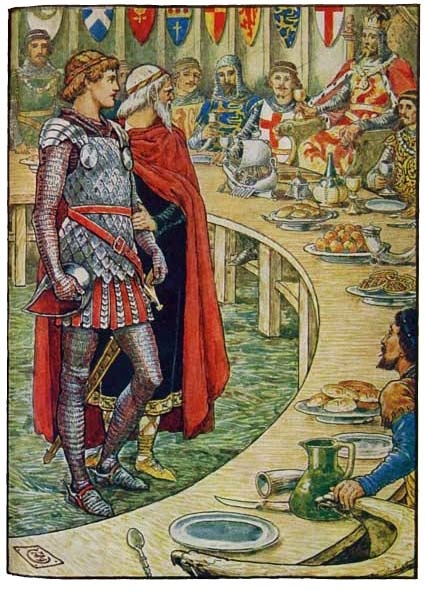
SIR GALAHAD IS BROUGHT TO THE COURT OF KING ARTHUR
'Sir,' said the old man to him, 'wit ye well that that is your seat. For you are he that shall surely achieve the Holy Graal, and such of these your fellows as are pure in heart and humble shall achieve it with you.'
'Sir,' said the king, 'if it may be that ye know, will ye tell us what my knights must do to achieve the Holy Vessel, and thus bring peace into my kingdom in place of war? For many of those that are kings and barons under me are warring with each other, and threaten to rend this island of Britain, and some are forsaking Christ and are turning to the evil faith and cruel worship of the pagan gods of Britain. And it goeth to my heart to know this, and I have much dread.'
'Sir king,' said the old white man, 'none may tell you what shall be the end of this quest of the Holy Graal, but I can tell you and these your knights what they must do to save this land from the ruin which doth threaten it. Ye know that the Holy Vessel was that wherein Christ ate the lamb on the Thursday before he was hung upon the Cross. And Joseph of Arimathea did bring it here to Britain, and here hath it been for more than four hundred and fifty winters. And while ye and your kingdom did love Christ and did do His word, the Sangreal stayed within your borders. But now ye war with each other, and are evil livers and full of pride and mastery, and if ye do not repent and stay your dishonour, then shall the Holy Vessel pass from Britain, and ruin and death and civil war shall stalk through the land and leave it desolate.'
Having spoken thus, the old man went from the hall, and none stayed him; for too many there were who knew that they had been the evil livers at whom his words had pointed.
Then uprose Sir Gawaine, who was a faithful knight and true man to his king, though a proud one and a hasty. He was filled with sorrow for the ruin that threatened his fair land.
'Now I do here avow,' he said, 'that to-morrow, without fail, I shall set forth, and I shall labour with all the strength of my body and my soul to go in quest of the Holy Graal, so that if I be fit to see it and to bring it hither, this dear land may be saved from woe.'
So hot were his words that many of the better knights rose also, and raising their right hands did make a like avowal; and those that cared not for the quest felt that they must seem to do as the others did, and so made avowal also, though in their hearts they thought more of pride and earthly power.
'Gawaine, Gawaine,' cried the king, and the great tears stood in his eyes, 'I know ye do right to avow this and to cause these others to avow also; but a great dread is upon me, for I have great doubt that this my fellowship shall never meet again.'
'Fear not,' said Lancelot, 'for bethink ye, my lord, in no better adventure can we find death than in this quest, and of death we are all sure.'
On the morrow the knights armed themselves, and bade farewell to King Arthur and his queen, and there was much weeping and great sorrow. And as the knights rode through the streets of Camelot the crowds stood and wept, both rich and poor. All were full of dread to see so many brave knights depart that never more would return.