HENRY GILBERT. (continued 4)
Reading edition
He dashed with his lance at the one with the iron bar, but the hill-troll slipped away, and brought the great bar with a heavy blow upon his lance, so that it snapped in twain. Then one leaped like a wild cat upon the arm that held the rein, but happily Sir Geraint had drawn his sword, and with one stroke slew him. Then the two others leaped towards him, but the blows of the bar and club he caught upon his shield and slew the troll with the club.
Ere Sir Geraint could draw his sword back from this blow, he felt his horse fall under him, for the dwarf with the iron bar had with one blow broken the beast's back. Quickly avoiding the horse, Sir Geraint dashed at the dwarf, who ran towards the hole in the hill, but ere he could reach it Sir Geraint gave him a blow on the crown of his head, so fierce and hard, that the skull was split to the shoulders.
So then Sir Geraint turned and walked slowly down the hill, for he was dazed, and his old wounds had broken afresh. But he came to where Enid stood comforting the damsel mourning over the dead knight, and when he was there, straightway he fell down lifeless.
Enid shrieked with the anguish of the thought that he was dead, and came and knelt beside him and undid his helm and kissed him many times. And the sound of her wailing reached an earl named Madoc, who was passing with a company along the road from a plundering expedition, and he came and took up Geraint and the dead knight, and laid them in the hollow of their shields, and with the damsels took them to his castle a mile along the road.
Now the earl was a tyrant and a robber, and had done much evil on the borderlands of Geraint, in burning, plundering and slaying, since he had heard that Geraint was become soft and foolish. And he had recognised Sir Geraint while he lay in the swoon, and rejoiced that now he was like to die.
As he rode along he thought that if he could prevail upon the Lady Enid to wed him, he might get much land with her, as the widow of the dead Sir Geraint, future King of Cornwall. And he determined to make her marry him.
When, therefore, he and his host had reached his castle, he ordered the dead knight to be buried, but Sir Geraint he commanded to be laid in his shield on a litter-couch in front of the high table in the hall. So that Sir Geraint should die, he commanded that no leech should be sent for.
While his knights and men-at-arms sat down to dine, Earl Madoc came to Enid and begged her to make good cheer. But, thinking to gain more from secrecy, he did not tell her that he knew who she was, nor did he show her that he knew who was her lord.
'Take off thy travelling clothes, fair lady,' he said, 'and weep not for this dead knight.'
'I will not,' she said, and hung over Geraint, chafing his hands and looking earnestly into his pallid face.
'Ah, lady,' the earl said, 'be not so sorrowful. For he is now dead, and therefore ye need no longer mourn. But as ye are beautiful, I would wed thee, and thou shalt have this earldom and myself and much wealth and all these men to serve thee.'
'I tell you I will rather die with my dead lord, if indeed he be dead,' cried Enid, 'than live in wealth with you or any one.'
'Come, then,' said the earl, 'and at least take food with me.'
'Nay, I will not,' said Enid, 'and never more will I eat or be joyful in life.'
'But, by Heaven, thou shalt,' said Madoc, furious at her resistance to his will.
And he drew her from beside the litter, and forced her to come to the table where his knights sat eating, and commanded her to eat.
'I will not eat,' she cried, straining from his hold towards where Geraint lay, 'unless my dear lord shall eat also.'
'But he is dead already, thou mad woman,' cried the earl. 'Drink this goblet of wine,' he commanded, 'and thou wilt change thy mind.'
'I will not drink again until my dear lord drink also,' said Enid, and strove to free herself from the grasp of the earl.
'Now, by Heaven!' said Madoc wrathfully, 'I have tried gentle means with thee. Let this teach thee that I am not to be baulked of my will.'
With that he gave her a violent blow on the ear, and tried to drag her away out of the hall. And Enid shrieked and wept and cried for help, but none of the knights that sat there dared to oppose their lord.
But suddenly men started up from their seats in terror to see the corpse of Geraint rise from the hollow of the shield. Enid's cries had roused him from his swoon, and his hand as he raised himself felt the hilt of the sword beside him.
He leaped from the litter, and, drawing his sword, he ran towards the earl, who by now had almost dragged Enid to the door. Raising the sword, Geraint struck him with so fierce a blow that he cleft his head in twain.
Then, for terror at seeing what they thought was a dead man rise up to slay them, the knights ran from the hall and left Geraint and Enid alone.
Enid threw her arms about Geraint, her face bright with happiness.
'My dear lord, I thank God thou art not dead, as this man said thou wert. And I pray thy forgiveness for doubting that thou hadst forgotten thy manhood, for of a truth none is so brave, so good as thou art.'
Geraint kissed his wife, smiling wanly the while.
'Sorry I am, my dear wife,' he said, 'that I was swooning when thou hadst need of me. And as for any doubts thou hadst of me, why, let us both forget them from this time forth. And now we must away, ere this lord's men recover their fright and pursue us.'
Enid led him instantly to the stalls where she had seen the horses had been led, and Geraint took the spear and the horse of the knight whom the trolls had slain, and, when he had mounted, he took up Enid from the ground and placed her before him.
Thus they rode out of the castle, and away as rapidly as they could. And now that they were reconciled, much joyful and loving talk was between them.
But night was coming on, and Geraint was weak from his wounds and loss of blood, and Enid was full of trouble for the pain her husband suffered. She prayed fervently that soon they might reach a town where she could obtain help for him.
Suddenly she heard far away in the distance the tramp of horses, and Enid could have wept for sorrow. But she kept her face calm, though her lips trembled, Geraint also heard the beat of the hoofs, and turning in his saddle he looked up, and saw on the skyline of the narrow road the glint of spears between them and the sky.
'Dear wife,' he said, with a faint brave smile, 'I hear some one following us. I will put thee in hiding behind this thicket, and should they slay me, do thou make thy way homeward to my father Erbin, and bid him avenge my death.'
'O my dear Geraint!' said Enid, sobbing, for all her bravery, as she thought that he would surely be slain, and that, after all their trouble, they were not to be allowed to enjoy the happiness of their reconciliation. 'I would liefer die with thee, my dear, dear lord. Let them kill us both, if it is to be.'
'Nay, dear wife,' said Geraint, 'I would not have thee slain. Revenge my death if they slay me.'
So, with many lingering kisses, he set her down upon the road, and saw her hide in the thickets.
By now the gloom of evening had settled upon them, and the sound of trampling horses had rapidly approached. And painfully, by reason of his stiff wounds, Geraint dressed his armour as best he could, and laid spear in rest, and drew his shield before him, and so waited in the dark road.
He heard a single knight riding before the others, and soon saw his figure issue from the gloom with couched lance. And Sir Geraint made him ready also, resolved to sell his life dearly at the last.
But as they began to spur their horses, there came the voice of Enid from the hedgerow beside them. And she cried out piteously in the dark:
'O chieftain, whoever thou art, what renown wilt thou gain by slaying a dead man?'
The stranger stopped his horse, and called out:
'O Heaven, is it my lord, Sir Geraint?'
'Yes, in truth,' said Enid, 'and who art thou?'
'I am the little king!' said the other, and rode swiftly towards Sir Geraint. Then he leaped from his horse and came to the stirrup of his chief.
'My lord,' he said, 'I learned that thou wert in trouble, and came to see if I could aid thee.'
And Enid ran forward with joy at hearing this, and welcomed the little king, and told him in what a hard pass was Sir Geraint.
'My lord and my lady,' said Griffith, 'I thank Heaven sincerely for the favour that I come to you in your need. I learned of thy fight with the trolls and of thy slaying of Earl Madoc, and that thou wert wounded. Therefore I rode on to find thee.'
'I thank thee heartily,' said Sir Geraint, 'and my dear wife also thanks thee. For of a truth I am spent, and must needs get me rest and a leech for my wounds.'
'Then come at once with me,' said the little king, and after he had helped Enid to her place before Geraint, he leaped on his own horse.
'Now thou shalt go to the hall of a son-in-law of my sister which is near here,' said King Griffith, 'and thou shalt have the best medical advice in the kingdom.'
At the hall of the baron, whose name was Tewder, and a most knightly and gentle lord, Sir Geraint and the Lady Enid were received with great welcome and hospitality. Physicians were sent for, and they attended Geraint day by day until he was quite well again.
The fame of his adventures began to spread along the borders of his kingdom, and at length reached his own court. And the robber lords and brigands of the marches, hearing of his deeds, ceased their evil-doing and made haste to hide from his wrath. Also his father Erbin and the host at his court repented of their hard thoughts and sneers concerning him, and praised the strength of his arm, the gentleness of his courtesy, and his justice and mercy.
When Sir Geraint and the Lady Enid returned home, all the people gathered to welcome them. And thenceforth he reigned prosperously, and his warlike fame and splendour lasted with renown and honour and love, both to him and to the Lady Enid, from that time forth.
VII
HOW SIR PERCEVAL WAS TAUGHT CHIVALRY, AND ENDED THE EVIL WROUGHT BY SIR BALIN'S DOLOROUS STROKE
It befell upon a time when King Arthur was Pendragon, or overlord of the island of Britain, that Earl Evroc held an earldom of large dominion in the north under King Uriens. And the earl had seven sons, the last being but a child still at play about his mother's chair as she sat with her maidens in the bower.
Lord Evroc was a valiant and a mighty warrior, ever battling against the hated pagans, when their bands of blue-eyed fierce fighters landed on his coasts. And when peace was on the land, he went about on errantry, jousting in tournaments and fighting champions.
His six elder sons did likewise, and all were famed for their knightly prowess.
But the mother sat at home, sad of mood. For she hated war, and would rather have had her lord and her six tall sons about her in the home. And in her heart she resolved that she would plead with Evroc to let her have her little son Perceval to be a clerk or a learned bard, so that he should stay at home with her and run no risk of death.
The sorrow she was ever dreading smote her at length. For a messenger came one day, saying that Earl Evroc her lord had been slain at Bamborough, in a mighty melée between some of the best and most valiant knights of Logres and Alban, and two tall sons with him.
As the years passed, and her little son began to run, three black days came within a little of each other, for on these days messengers came with the sad news of the death of her other boys. One of them had been done to death by an evil troll on the lonely wastes by the Roman wall, two others were slain by the shores of Humber, repelling a horde of fair-haired Saxon raiders, and the other was killed at a ford, where he had kept at bay six bandit knights that would have pursued and slain his wounded lord.
Then, in her grief, the widow dame resolved that she would fly with her little son, and make a home for him in some wilderness, where never sounds or sights of war or death would come, where knights would be unknown, and no one would speak to him of arms and battles. And thus did she do, and she left the hall where she had lived, and removed to the deserts and wastes of the wilderness, and took with her only her women, and a few boys and spiritless men, too old or feeble to fight, or to think of fighting.
Thus she reared the only son left to her, teaching him all manner of nobleness in thought and action and in learning, but never suffering him to see a weapon, nor to hear a tale of war or knightly prowess.
He grew up loving all noble things, gentle of speech and bearing, but quick to anger at evil or mean actions, merciful of weak things, and full of pity and tenderness.
Yet was he also very strong of body, fleet of foot, quick of eye and hand. Daily he went to divert himself in the great dark forest that climbed the high mountains beside his home, or he roamed the wide rolling moors. And he practised much with the throwing of stones and sticks, so that with a stick he could hit a small mark at a great distance, and with a sharp stone he could cut down a sapling at one blow.
One day he saw a flock of his mother's goats in the forest, and near them stood two hinds. The boy wondered greatly to see the two deer which had no horns, while the goats had two each; and he thought they had long run wild, and had lost their horns in that way. He thought he would please his mother if he caught them, so that they should not escape again. And by his great activity and swiftness he ran the two deer down till they were spent, and then he took them and shut them up in the goat-house in the forest.
Going home, he told his mother and her servants what he had done, and they went to see, and marvelled that he could catch such fleet creatures as the wild red deer.
Once he overheard his mother say that she yearned for fresh venison, but that the hunter who was attached to her house was lying wounded by a wild boar. Always Perceval had wondered what the little dark man did whom they called the hunter, who was always so secret, so that Perceval could never see where he went or when he returned from the forest.
So he went to the hut where Tod the hunter lay sick, and charged him by the love and worship he bore to the countess, that he should tell him how he could obtain fresh venison. And the dwarf told him.
Then Perceval took a few sticks of stout wood, with points hardened by fire, and went into the forest as Tod had told him, and seeing a deer he hurled a stick at it and slew it. And then he brought it home.
The countess was greatly wroth that Tod had taught him how to slay, and she said that never more should the dwarf serve her. And Tod wept, but when he was well again the countess would not suffer him to stay, but said he should leave the hall and never come there again.
She commanded Perceval never to slay any more living things, and the lad promised. But hard was it to keep his word, when he was in the forest and saw the wild things passing through the brakes.
Once, as he strayed deep in the wood, he came upon a wide glade or laund, with two green hillocks in the middle thereof. And feeding upon the grass was a great buck, and it had a silver ring round its neck. Perceval wondered at this beast being thus adorned, and went up to it to stroke it.
But the buck was fierce, and would have gored him with its horns, but Perceval seized them, and after a great struggle he threw the animal, and held it down, and in his wrath he would have slain it with a sharp stick. With that a swarm of little angry trolls poured from the hollow hillocks with great cries, and seizing Perceval would have hurt him.
But suddenly Tod ran among them, and commanded them to release him. And in the end Tod, who came himself of the troll folk, made the little people pass the words of peace and friendship with Perceval, and ever after that the boy went with the trolls, and sported with them in wrestling, running and other games; and he learned many things of great wisdom from them concerning the secrets of the earth and air and the wind, and the spirits that haunt waste places and standing stones, and how to put to naught the power of witches and wizards.
Tod ever bade them treat the young lord with reverence. 'For this is he who shall do great deeds,' he said. 'He shall be a stainless knight, who shall gain from evil the greatest strength, and, if God wills, he shall beat down the evil powers in this land.'
But the lad knew not what he meant, though he was very content to have the trolls for his friends.
One day Perceval was in the forest far up the mountain, and he looked over the blue distance far below across the moor, and saw a man riding on a wide road which he had never noticed before. And the man rode very fast, and as he went the sun seemed to flash from him as if he was clothed in glass. Perceval wondered what he was, and resolved to go across the moor to the road he had seen.
When he reached the road he found it was very broad, and banked on either side, and went straight as the flight of a wild duck right across the moor, and never swerved by the hills or pools, but went over everything in its way. And as he stood marvelling what mighty men had builded it, he heard a strange rattling sound behind him, and, turning, he saw three men on horseback, and the sun shone from them as he had seen it shine from the first horseman.
The foremost checked his horse beside Perceval, and said:
'Tell me, good soul, sawest thou a knight pass this way either this day or yesterday?'
'I know not what a knight is,' answered Perceval.
'Such a one as I,' said the horseman, smiling good-naturedly, for it was Sir Owen, one of King Arthur's knights.
'If ye will tell me what I ask, I will tell you,' said Perceval.
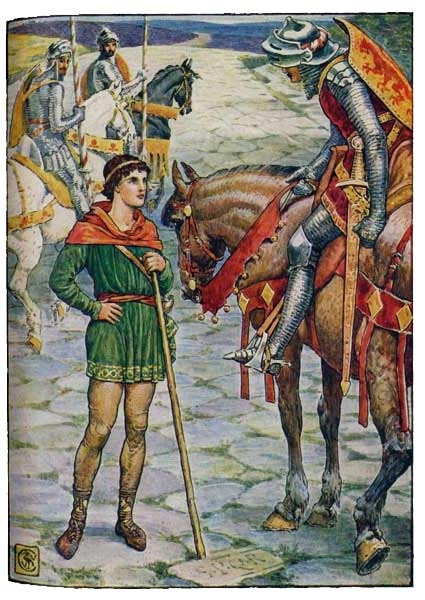
YOUNG PERCEVAL QUESTIONS SIR OWEN
'I will answer gladly,' said Sir Owen, smiling, yet wondering at the fearless and noble air of this youth in so wild a waste.
'What is this?' asked Perceval, and pulled the skirt of the hauberk.
'It is a dress made of rings of steel,' answered Sir Owen, 'which I put on to turn the swords of those I fight.'
'And what is it to fight?'
'What strange youth art thou?' asked Sir Owen. 'To fight is to do battle with spears or swords, so that you would slay the man that would slay you.'
'Ah, as I would have slain the buck that would have gored me,' said Perceval, nodding his head.
Many other questions the youth asked eagerly, as to the arms they bore and the accoutrements and their uses. And at length he said:
'Sirs, I thank you for your courtesy. Go forward swiftly, for I saw such a one as ye go by here but two hours ago, and he flashed in the sun as he rode swiftly. And now I will be as one of you.'
Perceval went swiftly back to his mother's house and found her among her women.
'Mother,' he said, 'I have seen a great and wonderful sight on the great road across the moor.'
'Ah, my dear son, what was that?' she asked.
'They were three honourable knights,' he said. 'And, mother, I will be a knight also.'
With a great shriek his mother swooned away, and the women turned him from the room and said he had slain his mother.
Much grieved was Perceval that he had hurt his mother, and so, taking his store of pointed sticks, he went off into the forest, and strayed there a long time, torn between his love for his mother, and the strange restlessness which the sight of the three warriors had caused in him.
As he wandered, troubled, his quick ear caught the clang of metal, though he knew not what it was. And swiftly he ran towards the sound a long way, until he came into a clearing, and found two knights on horseback doing mighty battle. One bore a red shield and the other a green one.
He looked eagerly at this strange sight, and the blood sang in his veins. And then he saw that the green knight was of slighter frame than the other, and was weakening before the strokes of the red knight.
Full of anger at the sight, Perceval launched one of his hard-wood javelins at the red knight. With such force did it go, and so true was the aim, that it pierced the coif of the knight, and entered between the neck and the head, and the red knight swayed and then clattered to the ground, dead.
The green knight came and thanked Perceval for thus saving his life.
'Are knights then so easy to slay?' asked the lad. 'Methought that none might pierce through the hauberk of a knight, and I sorrow that I have slain him, not thinking what I did.'
'He was a full evil knight,' said the other, 'and deserved death richly for his many villainies and oppressions of weak orphans and friendless widows.'
The knight took the body of the dead knight to be buried in a chapel, and told Perceval he could have the horse. But the lad would not have it, though he longed greatly to possess it, and the green knight took it with him.
Then Perceval went home, sad, yet wild with wonder at what he had done. He found his mother well again, but very sorrowful. And for fear of giving her pain, he did not tell her of the knight he had slain.
She called him to her, and said:
'Dear son of mine, it seems I may not keep thy fate from thee. The blood of thy warlike generations before thee may not be quenched, whatever fond and foolish plans I made to keep thee from knowledge of battle and weapons. Dear son, dost thou desire to ride forth into the world?'
'Yes, mother, of a truth,' said Perceval. 'I shall not be happy more until I go.'
'Go forward, then,' she said weeping, 'and God be with thee, my dear son. And as I have no man who is strong of his hands, thou must go alone, yet will I give thee gold for thy proper garnishing and lodging. But make all the haste ye may to the court of King Arthur at Caerleon-upon-Usk, for there are the best and the boldest and the most worshipful of knights. And the king will give thee knighthood. And wherever thou seest a church, go kneel and repeat thy prayers therein; and if thou hearest an outcry, go quickly and defend the weak, the poor and the unprotected. And be ever tender towards women, my son, and remember that thy mother loves thee and prays for thy stay in health and life. And come thou to see me within a little while.'
And he thanked her, saying he would do naught that should shame her, but would remember all the nobleness of her teaching; also, that he would return to see her within a little while.
Perceval went to the stable and took a bony, piebald horse, which seemed the strongest, and he pressed a pallet of straw into the semblance of a saddle, and with pieces of leather and wood he imitated the trappings he had seen on the horses of the knights.
Then, after taking leave of his mother, he rode forth, sad at first for leaving her in sorrow and tears, but afterwards glad that now he was going into the world to become a knight. And for armour he had a rough jerkin, old and moth-eaten, and for arms he had a handful of sharp-pointed sticks of hard wood.
He journeyed southwards two days and two nights along the great straight road, which went through the deep dark forests, over desert places and over the high mountains. And all that time he ate nothing but wild berries, for he had not thought to bring food with him.
While he was yet but a little way from the court of King Arthur, a stranger knight, tall and big, in black armour, had ridden into the hall where sat Gwenevere the queen, with a few of the younger knights and her women. The page of the chamber was serving the queen with wine in a golden goblet richly wrought, which Lancelot had taken from a knight whom he had lately slain.
The stranger knight had alighted before the chair of Gwenevere, and all had seen that full of rage and pride was his look. And he caught sight of the goblet in the hand of Gwenevere, and he snatched it from her, spilling the wine over her dress and dashing it even into her face.
'Now am I well lighted here,' he said, 'for this is the very goblet which thy robber knight Sir Lancelot reaved from my brother, Sir Wilder. And if any of you knights here desire to wrest this goblet from me, or to avenge the insult I have done your queen, let him come to the meadow beside the ford, and I will slay him, ay, if it be that traitor Sir Lancelot himself.'
All the young knights hung their heads as he mounted his horse and insolently rode out of the hall; for it seemed to them that no one would have done so daring an outrage unless, like Sir Garlon whom Balin slew, he fought with evil magic, so that the strength and prowess of the mightiest knight would be put to naught.
Then Perceval entered the hall, and at sight of him upon his rough piebald horse, with its uncouth trappings, and the old and mouldy jerkin upon the youth, the knights and others broke forth in excessive laughter, as much at the sight as to cover their discomfiture and fear of the knight who had just gone.
But Perceval took no note of their laughter, but rode up the hall to where Sir Kay the seneschal stood, wrathful at the outrage on the queen which he had not dared to avenge instantly. And Perceval looked about and saw a knight more richly dressed than the others, and, turning to Kay, he said:
'Tell me, tall man, is that King Arthur yonder?'
'What wouldst thou with Arthur, knave?' asked Kay angrily.
'My mother told me to seek King Arthur,' responded Perceval,' and he will give me the honour of knighthood.'
'By my faith, thou farmer's churl,' said Kay, 'thou art richly equipped indeed with horse and arms to have that honour.'
Thereupon the others shouted with laughter, and commenced to throw sticks at Perceval, or the bones left by the dogs upon the floor.
Then a dwarf pressed forward between the laughing crowd and saluted Perceval. And the lad rejoiced to recognise him. It was Tod, who had been his friend among the trolls of the mountains, and with Tod was his wife. They had come to the court of Arthur, and had craved harbourage there, and the king of his kindness had granted it them. But by reason of the prophecy which the trolls knew of concerning the great renown which Perceval was to gain, they had been dumb of speech since they had last seen the young man.
And now at sight of him their tongues were loosed, and they ran and kissed his feet, and cried together:
'The welcome of Heaven be unto thee, goodly Perceval, son of Earl Evroc! Chief of warriors art thou, and stainless flower of knighthood!'
'Truly,' said Kay wrathfully, 'thou art an ill-conditioned pair, to remain a year mute at King Arthur's court, and now before the face of goodly knights to acclaim this churl with the mouldy coat, chief of warriors and flower of knighthood!'
In his rage he beat Tod the dwarf such a blow, that the poor troll fell senseless to the ground; and the troll-wife he kicked, so that she was dashed among the dogs, who bit her.
'Tall man,' said Perceval, and men marvelled to see the high look on his face and the cold scorn in his eyes, 'I will have vengeance on thee for the insult and ill-treatment thou hast done these two poor dwarfs. But tell me now which of these knights is Arthur?'
'Away with thee,' shouted Kay, enraged. 'If thou wouldst see Arthur, go to the knight with the goblet who waits for thee at the ford, and take the goblet from him, and slay him. Then when thou comest back clad in his armour, we will speak further with thee.'
'I will do so, angry man,' said Perceval, and amid the shouts of laughter and the sneers of the crowd he turned his horse's head and rode out of the hall.
Going to the meadow beside the ford, he saw a knight riding up and down, proud of his strength and valour.
'Tell me, fellow,' said the knight, who bore on his shield the device of a black tower on a red field, 'didst thou see any one coming after me from the court yonder?'
'The tall man that was there,' said Perceval, 'bade me to come to thee, and I am to overthrow thee and to take from thee the goblet, and as for thy horse and thy arms I am to have them myself.'
'Silence, prating fool!' shouted the knight, 'go back to the court and tell Arthur to come himself, or to send a champion to fight me, or I will not wait, and great will be his shame.'
'By my faith,' said Perceval, 'whether thou art willing or unwilling, it is I that will have thy horse and arms and the goblet.'
And he prepared to throw his javelin-sticks.
In a proud rage the knight ran at him with uplifted lance, and struck him a violent blow with the shaft between the neck and the shoulder.
'Haha! lad,' said Perceval, and laughed, 'that was as shrewd a blow as any the trolls gave me when they taught me their staff play; but now I will play with thee in my own way.'
Thereupon he threw one of the pointed sticks at the knight, with such force and with such sureness of aim that it went in between the bars of his vizor and pierced the eye, and entered into the brain of the knight. Whereupon he fell from his horse lifeless.
And it befell that a little while after Perceval had left the court, Sir Owen came in, and was told of the shameful wrong put upon the queen by the unknown knight, and how Sir Kay had sent a mad boy after the knight to slay him.
'Now, by my troth,' said Owen to Kay, 'thou wert a fool to send that foolish lad after the strong knight. For either he will be overthrown, and the knight will think he is truly the champion sent on behalf of the queen, whom the knight so evilly treated, and so an eternal disgrace will light on Arthur and all of us; or, if he is slain, the disgrace will be the same, and the mad young man's life will be thrown away.'
Thereupon Sir Owen made all haste, and rode swiftly to the meadow, armed; but when he reached the place, he found a youth in a mouldy old jerkin pulling a knight in rich armour up and down the grass.
'By'r Lady's name!' cried Sir Owen, 'what do you there, tall youth?'
'This iron coat,' said Perceval, stopping as he spoke, 'will never come off him.'
Owen alighted marvelling, and went to the knight and found that he was dead, and saw the manner of his death, and marvelled the more. He unloosed the knight's armour and gave it to Perceval.
'Here, good soul,' he said, 'are horse and armour for thee. And well hast thou merited them, since thou unarmed hast slain so powerful a knight as this.'
He helped Perceval put on his armour, and when he was fully dressed Owen marvelled to see how nobly he bore himself.
'Now come you with me,' he said, 'and we will go to King Arthur, and you shall have the honour of knighthood from the good king himself.'
'Nay, that will I not,' said Perceval, and mounted the dead knight's horse. 'But take thou this goblet to the queen, and tell the king that wherever I be, I will be his man, to slay all oppressors, to succour the weak and the wronged, and to aid him in whatever knightly enterprise he may desire my aid. But I will not enter his court until I have encountered the tall man there who sent me hither, to revenge upon him the wrong he did to my friends, Tod the dwarf and his wife.'
And with this Perceval said farewell and rode off. Sir Owen went back to the court, and told Arthur and the queen all these things. Men marvelled who the strange young man could be, and many sought Tod and his wife to question them, but nowhere could they be found.
Greater still was their marvelling when, as the weeks passed, knights came and yielded themselves to King Arthur, saying that Perceval had overcome them in knightly combat, and had given them their lives on condition that they went to King Arthur's court and yielded themselves up to him and his mercy. The king and all his court reproved Kay for his churlish manner, and for his having driven so splendid a youth from the court.
And Perceval rode ever forward. He came one day towards the gloaming to a lonely wood in the fenlands, where the wind shivered like the breath of ghosts among the leaves, and there was not a track or trace of man or beast, and no birds piped. And soon, as the wind shrilled, and the rain began to beat down like thin grey spears, he saw a vast castle rise before him, and when he made his way towards the gate, he found the way so overgrown with weeds that hardly could he push his horse between them. And on the very threshold the grass grew thick and high, as if the door had not been opened for a hundred winters.
He battered on the door with the butt of his lance; and long he waited, while the cold rain drove and the wind snarled.
After a little while a voice came from above the gateway, and glancing up he saw a damsel looking through an opening in the battlements.
'Choose thou, chieftain,' said she, 'whether I shall open unto thee without announcing thee, or whether I shall tell her that rules here that thou wishest to enter.'
'Say that I am here,' said Perceval. 'And if she will not house me for the night, then will I go forward.'
Soon the maiden came back and opened the door for him, and his horse she led into the stable, where she fed it; and Perceval she brought into the hall. When he came into the light and looked at the girl, he thought he had never seen another of so fair an aspect.
She had an old garment of satin upon her, which had once been rich, but was now frayed and tattered; and fairer was her skin than the bloom of the rose, and her hair and eyebrows were like the sloe for blackness, and on her cheeks was the redness of poppies. Her eyes were like deep pools in a dark wood. And he thought that, though she was very beautiful, there was great arrogance in her look and cruelty in her lips.
When Perceval went towards the dais of the hall he saw a tall and stately lady in the high seat, old of years and reverend of aspect, though sorrowful. Several handmaids sat beside her, sad of face and tattered of dress. All welcomed him right kindly. Then they sat at meat, and gave the young man the best cheer that they had.
When it was time to go to rest, the lady said:
'It were well for you, chieftain, that you sleep not in this castle.'
'Wherefore,' said Perceval, 'seeing that the storm beats wildly without and there is room here for many?'
'For this reason,' said the lady, 'that I would not that so handsome and kindly a youth as you seem should suffer the doom which must light upon this my castle at dawn.'
'Tell me,' said Perceval, 'what is this castle, and what is the doom you speak of?'
'This castle is named the Castle of Weeds,' replied the lady, 'and the lands about it for many miles belonged to my husband, the Earl Mador. And he was a bold and very valiant man; and he slew Maelond, the eldest son of Domna, the great witch of Glaive, and ever thereafter things were not well with him. For she and her eight evil sisters laid a curse upon him. And that in spite of this, that he slew Maelond in fair fight, for all that he was a false and powerful wizard. And Domna came to my husband, when he was worn with a strange sickness, and as he lay on his deathbed. And she said she should revenge herself upon his daughter and mine, this maiden here, when she shall be full twice nine years of age. And she will be of that age ere dawn to-morrow morn, and at the hour will the fierce Domna and her fearful sisters come, and with tortures slay all that are herein, and take my dear daughter Angharad, and use her cruelly.'
The maiden who had opened to Perceval was that daughter, and she laughed harshly as her mother spoke.
'Fear not for me, mother,' she cried. 'They will deck me in rich robes, and I shall not pine for fair raiment, as I have pined these ten years with thee.'
The lady looked sadly upon her as she heard her words.
'I fear not, my daughter, that they will take thy life,' she said, 'but I dread this—that they will destroy thy soul!'
And Angharad laughed and said:
'What matter, so it be that I live richly while I live!'
'Nay, nay,' said Perceval, and in his voice was a great scorn, 'it is evil to speak thus, and it belies your beauty, fair maiden. Rather a life of poverty than one of shamefulness and dishonour. Thus is it with all good knights and noble dames, and thus was it with our dear Lord.'
Then turning to the lady, he said:
'Lady, I think these evil witches will not hurt thee. For the little help that I may give to thee, I will stay this night with thee.'
After he had prayed at the altar in the ruined chapel of the castle, they led him to a bed in the hall, where he slept.
And just before the break of day there came a dreadful outcry, with groans and shrieks and terrible screams and moanings, as if all the evil that could be done was being done upon poor wretches out in the dark.
Perceval leapt from his couch, and with naught upon him but his vest and doublet, he went with his sword in hand to the gate, and there he saw two poor serving-men struggling with a hag dressed all in armour. Behind her came eight others. And their eyes, from between the bars of their helms, shone with a horrible red fire, and from each point of their armour sparks flashed, and the swords in their grisly hands gleamed with a blue flame, so fierce and so terrible that it scorched the eyes to look upon them.
But Perceval dashed upon the foremost witch, and with his sword beat her with so great a stroke that she fell to the ground, and the helm on her head was flattened to the likeness of a dish.
When she fell, the light of her eyes and her sword went out, and the armour all seemed to wither away, and she was nothing but an old ugly woman in rags. And she cried out:
'Thy mercy, good Perceval, son of Evroc, and the mercy of Heaven!'
'How knowest thou, hag,' said he, 'that I am Perceval?'
'By the destiny spun by the powers of the Underworld,' she said, 'and the foreknowledge that I should suffer harm from thee. And I knew not that thou wert here, or I and my sisters would have avoided thee. But it is fated,' she went on, 'that thou come with us to learn all that may be learned of the use of arms. For there are none in Britain to compare with us for the knowledge of warfare.'
Then Perceval remembered what he had heard the trolls—the people of the Underworld—say, though he had not understood their meaning. 'The stainless knight,' they said, 'shall gain from evil greater strength, and with it he may confound all evil.'
'If it be thus fated,' he said, 'I will go with thee. But first thou shalt swear that no evil shall happen to the lady of this castle nor to her daughter, nor to any that belong to them.'
'It shall be so,' said the witch, 'if, when the time comes, thou art strong enough to overcome my power. But if thou failest, Angharad is mine to do with as I will.'
Then Perceval took leave of the lady of the Castle of Weeds, and of Angharad. And the lady thanked him with tears for saving their lives, but the girl was cold and scornful and said no word of thanks. Then Perceval went with the witches to their Castle of Glaive.
He stayed with them for a year and a day, learning such knowledge of arms, and gaining such strength, that it was marvel to see the feats which he performed. And while he lived with them they strove to bend him to their wills, for they saw how great a knight he would become in prowess and in knightly deeds. They tempted him every hour and every day, telling him what earthly power, what riches and what great dominions would be his, if he would but swear fealty to the chief witch, Domna, and fight for her against King Arthur and his proud knights.
Perceval prayed daily for strength to withstand the poison of their tongues, and evermore he held himself humble and gentle, and thought much of his widowed mother in her lonely home in the northern wastes, and of the promise he had made her. Sometimes he thought of Angharad, how beautiful she was, and how sad it was that she had so cold a heart, and was so cruel in her words.
Anon the witch Domna came to him, and said that he had now learned all that she could teach him, and he must go and prove himself against greater powers than he had ever yet known. If he prevailed not in that battle, the ladies of the Castle of Weeds would become the prey of the witches, and greater power of evil would they have in the world than ever before. Then she gave him a horse and a full suit of black armour.
So Perceval took the horse, and armed himself and rode forth. And anon he came to a hermit's cell beside a ruined chapel, and he alighted and went into the chapel, and stripped himself, and laid all his armour, his lance, and his sword, before the high altar.
Prayerfully he gave his arms to the service of God, and devoted them one by one to do only knightly and pure deeds, to rescue the oppressed and the weak, to put down the proud, and to cherish the humble.
And as he ended praying, the armour stirred of itself, and though it had been black before, now did the darkness fade from it, and it all became a pure white. While he marvelled, a faint light glowed over hauberk, helm, shield, sword and lance, and there was an exceeding sweet savour wafted through the place. And ghostily, as in a silver mist, he saw above the altar the likeness of a spear, and beside it a dish or salver. And at the wondrous sight his breath stayed on his lips. Then slowly the vision faded from his sight.
He arrayed himself in his armour that was now of a dazzling white, and he rode forth and thought to go towards Camelot, where was the court of King Arthur. But he felt that some power drew him aside through the desolate ways of a hoar forest, where all the trees were ancient and big, and all bearded with long moss.
In a little while he saw a vast castle reared upon a rock in the midst of the forest. He rode up to it, and marvelled that it was all so quiet. Then he beat upon the door with the butt of his lance, and the door opened, and he entered into the wide dark hall. On the pallets under the wall he saw men lying as if dead. And in the high seat at the head of the hall sat a king, old and white, but richly clothed, and he seemed dead like all the rest. All were clad in garments of an ancient kind, as if they had lived and died a thousand years agone, yet had not rotted into dust. On the floor, about the wide heap of ashes where the fire had burned, the hounds still lay as if asleep, and on the posts the hawks sat stiff upon their perches.
Much did Perceval marvel at this strange sight, but most of all he marvelled to see where a shaft of light from a narrow window gleamed across the hall full upon a shield hung on the fire-pillar beside the high seat in which the king sat like one dead.
Perceval caused his horse to pick its way through the hall, and he approached the shield. And he saw that it was of shining white, but whiter than the whiteness of his own, and in the centre thereof was a heart. As he sat looking thereat, he marvelled to see that the heart seemed to stir as if it were alive, and began to throb and move as if it beat. Then the whiteness of the shield began to dazzle like to a light that mortal eyes could not bear.
He lifted his hand and took the shield by its strap from the peg on which it hung, and as he did so, a great sigh arose from within the hall, as if at one time many sleepers awoke. And looking round, he saw how all the men that had seemed dead were now on their knees, with bent heads and folded hands as if in prayer.
The king in the high seat stirred and sat upright, and looked at Perceval with a most sweet smile.
'The blessing of God is upon thee, young White Knight,' said he, 'and now is my watch and ward all ended, and with these my faithful companions may I go.'
'Tell me, sir,' said Perceval, 'what means this?'
'I am Marius,' said the king, 'and I was that Roman soldier who took pity of the gentle Saviour dying in His agony upon the rood. And I helped to take Him from the cross. For my pity did God, whom till then I had not known, deal with me in marvellous wise. And this shield was mine, and a holy hermit in a desert of Syria did bless it, and prophesy concerning it and me. I came to this land of Britain when it was full of evil men, warring fiercely together, and all in heathen darkness. I preached the Word of Christ, I and my fellows that came with me, until the heathens rose up and would slay me. And by that time I was wearied and very old, and wished to die. Yet I sorrowed, wondering whether God would do naught to rescue these people from this slavery to the old evil law. Then a man of God came to me at night, a man of marvel, and he caused this castle to be builded in this ancient wood, and he put my shield upon the post, and bade me and my dear friends sleep. 'For,' said he, 'thou hast earned thy sleep, and others shall carry on thy work and reveal the mercy of God and his Christ to these poor heathens, and they shall turn to God wholly. And no evil shall be able to break in upon thy repose. But when, in the distant future, men's hearts are turning to evil again, one that is of the three white knights shall come and take this shield, to ward him in the great battle against evil, and then thou and all that are with thee shall have the restfulness of death thou hast merited. Go then, thou good knight,' went on King Marius, 'fight the good fight against that thing of evil whom the good man spoke of, and may my shield encompass thee and ever guard thee.'
Perceval took the shield and left his own. Turning, he rode back between lines of silent forms bent in prayer. He went forth into the forest some little way, and heard from the castle the singing of a joyful hymn. And, looking back, he saw that the castle had vanished. But still above him and about him was the sound of singing, of a sweetness indescribable, as if they sang who had gained all that they desired.
Then Perceval rode forward till it was night; but never could he get sight of castle or knight's hold or hermit's cell where he could be houselled for the night. So he abode in the forest that night, and when he had prayed he slept beside his good horse until it was day.
Just before the dawn he awoke to the sound of a great rushing wind all about him. Yet marvel it was to see that the trees in that hoar wood did not wave their branches, but all were still.
Then he was aware of a sweet savour which surrounded him, and anon a gentle voice spoke out of the darkness.
'Fair White Knight,' said the voice, 'it is ordained of thee that thou goest to the lands of the King Pellam in the north, where an evil power seeks to turn men from the New Law which Christ brought, and to make them cleave to the Old Law with its cruelty and evil tortures. And there at the Castle of the Circlet thou shalt fight a battle for the Saviour of the world. And whether thou shalt win through all, none know as yet. But in thy purity, thy humility, is thy strength. Fare thee well!'
Much moved at these words, Perceval knelt and prayed, and then, as the dawn filtered through the trees, he mounted his horse and began his long journey to the north.
On the seventh day he crossed a plain, and saw far in the north where the smoke as of fires rose into the clouds, and here and there he saw the fierce red gleam of flames. And he passed through a ford, and then he entered a land all black and desolate, with the bodies of the dead beside the way, unburied, and the houses all broken or burned. In other places the grass and weeds grew over the hearths of desolated homes, and wild beasts made their lairs where homely folk seemed lately to have lived their simple happy lives.
No man or child could be seen anywhere to ask what all this might mean. But one day, as he walked his horse beside a brook, over the long grass, he came upon a poor half-starved peasant who had not strength to run. And the man knelt before him, and bared his breast, and said, 'Strike, sir knight, and end my misery!'
But Perceval raised him in his arms and kissed him, and gave him bread and wine from his scrip, and when the poor man was revived, Perceval asked him what his words meant.
'Ah, Sir White Knight!' said the man, whose tears fell as he spoke, 'surely thou art an angel of heaven, not of the pit, such as have ravened and slaughtered throughout this fair land since good King Pellam was struck by the Dolorous Stroke that Balin made. For of that stroke came all our misery. The sacred relics of the Crucifixion fled our land, our king sickened of a malady that naught could heal, our crops rotted, and our cattle died. Yet did some among us strive to live and do as brave men should in all adversity. But into the land came an evil and a pagan knight, the knight of the Dragon, and he willed that all should scorn and despise the good Christ, and should turn to the old gods of the standing stones and the oaken groves. And those that would not he slew, and their folk he trampled underfoot, and their herds and fields he destroyed and desolated. And I, fair lord, have lost my dear wife and my wee bairns, and I wonder why I fled and kept my life, remembering all I have lost.'
'Take heart,' said Perceval, 'and remember that it is God His mercy that chastiseth, and that while thou hast life thou hast hope. It is a man's duty, a man's nobility, to bear sorrows bravely, and still to work, to do all and to achieve. I think God will not long let this evil knight oppress and slay. In His good time He will cut him down.'
'Fair sir,' said the peasant, 'I thank thee for thy cheer, and I will take heart and trust in God's good time.'
And Perceval rode forward through the blackened land and found the forests burning and the fields wasted. Anon he came to the edge of a plain, and saw a great castle in the distance. And there came to him a damsel, weeping, and when he craved of her to tell him why she mourned, she stayed, and looked at him as if astounded. Then she cried with a great cry of joy.
'Oh, tell me, fair sir, who art thou? Thou hast the white armour which it was foretold the spotless knight should wear, and on thy shield is the Heart as of Him that bled to save the world.'
'I know not what you say,' replied Perceval, 'but my name is Perceval, son of Evroc, and I seek the wicked knight that doeth all this evil.'
'Then thou art the White Knight,' said the damsel, 'and now I pray that God aid thee, for my lady and all this poor land have need of thee. Come thou to my mistress, the lady of the Chaplet.'
Therewith she led him to the castle, and the lady thereof came out to him. She was of a sad countenance, but of a great beauty, though poorly clothed.
'Fair sir,' she said, 'my maiden hath told me who thou art, and I sorrow that one so noble as thou seemest shall essay to overcome the fiend knight of the Dragon. Yet if thou shouldst prevail, all men in this tortured land will bless thee, and I not the least. For daily doth the evil knight slay my poor knights, and cometh and casteth their blackened and burned bodies before my hall. And many of my poor folk hath he slain or enslaved, and others hath he caused to follow his evil worship, and many of my rich and fair lands hath he wrested from me.'
'Therefore, fair lady,' said Perceval, 'I would seek him without delay, for to essay the force of my body upon him, by the grace of God.'
'And shouldst thou conquer,' said the lady, 'with the fiend's death the hallowed relics which King Pellam guarded shall return to bless this land. Now, therefore, go ye towards the Burnt Land beyond the brook, for that is where is the lair of the fiend that doth oppress us.'
Perceval went forward across the plain to a brook, and having forded the water he came to a wide hollow where the ground was all baked and burned, and the trees were charred and black. Here and there lay pieces of armour, red and rusted, as if they had been in a fierce fire; and in one place was the body of a knight freshly slain, and he was charred and black.
Then, as Perceval looked about him, he saw the dark hole of a cave in a bank beside the hollow, and suddenly therefrom issued a burst of horrible fire and smoke, and with a cry as of a fiend a black knight suddenly appeared before him on a great horse, whose eyes flashed as with fire and whose nostrils jetted hot vapours.
'Ha! thou Christian!' cried the knight in a horrible voice, 'what dost thou here? Wouldst thou have thy pretty white armour charred and blackened and thyself killed by my dragon's power?'
Then Perceval saw how the boss of the Black Knight's shield was the head of a dragon, its forked tongue writhing, its teeth gnashing, and its eyes so red and fiendish that no mortal, unless by God's aid, could look on it and live. From its mouth came a blinding flash as of lightning and beat at Perceval, but he held up his shield of the Throbbing Heart, and with angry shrieks the Black Knight perceived that the lightning could not touch the shield.
Then from his side the evil knight tore his sword, and it flamed red as if it was heated in a fierce furnace, and thrusting forward he came and beat at Perceval. But the White Knight warded off the blows with his shield, which the flaming sword had no power to harm.
Then did the Black Knight marvel greatly, for never had a knight, however skilled, withstood him, for either the lightning of the dragon shield had burnt him, or the stroke of his flaming sword had slain him swiftly. And by this he knew that this knight was Perceval.
'Thou knowest not who it is thou fightest,' said the Black Knight, with a scornful laugh. 'Thou must put forth more than the skill thou didst learn of the witches of Glaive if thou wouldst overcome me. For know ye, that I am a fosterling of Domna the witch, and she taught me more than ever she taught you. Now prepare ye to die.'
Then Perceval knew that this indeed was the fight which Domna had foretold, and that if he failed in this, ruin and sorrow would be the lot of many.
And Perceval began to thrust and strike full valorously and skilfully, but naught seemed to avail him. Thus for a long time they went about, thrusting and striking. Always the strength of the Black Knight seemed as unwearied as that of a demon, while Perceval felt his arm weaken, as much from the great strokes he gave, as from the burning fires that darted at him from the dragon shield.
Then Perceval cried in prayer for aid, and asked that if Christ would have this land saved for His glory, strength should be given him to slay this fiendish oppressor.
Forthwith strength seemed to nerve his arm mightily, and lifting his sword he struck at the shield of the knight, and so vehement was the blow that he cut down the shield even to the head of the dragon. Feeling the wound, the dragon gave forth a great flame, and Perceval wondered to see that now his own sword burned as if on fire.
Then, while the Black Knight marvelled at this stroke, Perceval struck at him more fiercely and beat in the other's helm, so that the fiend knight bent and swayed in his saddle. But recovering, he became so wroth that, with his fiery sword, he heaved a mighty blow at Perceval, and cut through his hauberk even to the shoulder, which was burned to the bone.
Ere the other could withdraw himself, Perceval thrust his sword to the hilt into the loathsome throat of the dragon. Thereupon the dragon gave so terrible a cry that the earth seemed to shake with the horror of it. And in its wrath and pain the dragon's head turned upon the Black Knight its master, and vomited forth fire so fiercely, that it scorched and burned him utterly, so that he fell from his horse dead.
Perceval, dizzy and weak from the battle, alighted from his horse, and went towards the knight, that he might slay the dragon. But suddenly he swooned and fell and his consciousness went from him.
When Perceval came to his senses again, he found himself upon a pallet, and the rough walls of a room were about him, while above him was the window, as it seemed, of an abbey or convent. And he was so weak he could not lift his hand.
Some one came to him, and he recognised Tod the troll.
'Ah, good Tod,' said he faintly. 'Where am I?'
'Now God be praised,' said Tod, and smiled joyfully. 'For the nuns feared ye might not win through the poison of your wound which the dragon knight did give you. 'Twas I who had followed you, lord, since that you did leave the hold of the witches, and when you swooned I brought you here, to the convent of the White Nuns. And now that I know ye live, I go to your lady mother to tell her the good news, for she is weary to know tidings of you.'
'Go, good Tod,' said Perceval, 'and say I will come for her blessing when I may mount my horse again.'
When Tod had left him, there came a nun to him, and he knew her for Angharad, who had been so proud and scornful when he left her at the Castle of Weeds. And he asked her how she had fared, and why she was a nun.
'To repent me of my evil mind,' she said. 'For when you left us I did not in my heart thank ye that you had saved my mother and me from death and worse. And the witches came to me and tempted me with riches and power, even as they were tempting you while you were with them. I heard how you withstood them, and I scorned you and hated you and said you would yield some day. And then you left the witches, having learned all their strong powers, yet having withstood them, and I marvelled much. I heard men say you were one of three stainless knights of the world that should achieve the Holy Graal, because of your great humility and purity, and that great honour and glory would be yours, because you put not your trust in your own strength. Then I repented, and would not listen to the evil women. But they followed me, whispering and tempting, and then for terror I sought a holy hermit, and he brought me here, and now am I at peace, and my proud heart is humble.'
'By my faith, sister,' said Perceval, 'I am rejoiced to hear thee. For I thought when I saw thee that thou hadst a proud and a hard heart. But as thou wert a beauteous and lovely maiden I thought much of thee; and had it not been foreordained otherwise, I would have loved thee above all women and wedded thee.'
The sister's pale face flushed.
'Nay, but thou hadst a greater glory in store for thee,' she said. 'For thou shalt find the Holy Graal and restore it to this kingdom, and with it weak men shall forsake their leanings to the old law of hate, and cleave only to Christ and His new law of love.'
'It is as God may will it,' said Perceval.
In a little while he strengthened and rose from his pallet, and fared forth towards the north where his widowed mother sat in her lonely hall, waiting for him whose fame was sweet in every man's mouth.
As he passed through the land, he saw how it had already begun to smile again. Men went to their work unafraid, the corn was brightening on the hills, the cattle lowed, women sang at their work, and children played. And all blessed him as he rode.
Thus was ended at last the sorrow in the land of King Pellam which was brought in by the Dolorous Stroke which Sir Balin had given a generation before.
VIII
HOW SIR OWEN WON THE EARLDOM OF THE FOUNTAIN
Now the young page Owen, who had saved King Arthur from midnight murder at the hand of the evil Sir Turquine, whom Lancelot slew, had tarried at the court of the king, and in prowess and knightly achievements was among the most famous of the knights of the Round Table. And always was he wishful to go on strange adventures, however far might be the country, or dangerous the ways thereto, or cruel and crafty the foes.
One day King Arthur was at Caerleon-upon-Usk, and sat conversing with a few of his knights in the presence-chamber. With him was Sir Owen and Sir Kay, and there was also Sir Conan and Sir Bedevere. The queen sat near them, while her handmaidens stood by the window at needlework.
In a little while Arthur said he would sleep until the horn sounded for dinner. For he had come from London late the night before, and had not had his full rest.
'But,' said he, 'do you, my knights, continue your talk, and tell each other tales as before, and if you are hungry, Kay will give you collops of meat and horns of mead.'
So the king slept on his broad seat of green rushes, over which was spread a splendid covering of flame-coloured satin. And cushions of red satin were under his head.
Kay ordered a page to bring meat and bread and mead, and when the four had eaten, Sir Conan was called upon to tell how he became possessed of a dark bay palfrey, as to which all envied him for its beauty, but concerning which he always put off telling the tale of how he had obtained it.
'You must know,' began Sir Conan, 'that I was the only son of my parents, and the confines of my father's barony in Lothian were too small for my aspiring and my daring. I thought there was no adventure in the world too great for my doing, and when I had fought all the knights who would meet me in my own country, and had slain all the trolls that wrought evil there, I equipped myself in my best armour and set forth to seek greater adventures in deserts and wild regions. And I fared south for many weeks, over desolate mountains and wild and terrible fastnesses of rock and moor, where only the robber seemed to live, and the wild, magic people of the green mounds, and where there was no sound but the song of the lark, the plunge of the beaver and otter in the river, the growl of the brown bear from the rock, and the howl of the wolf at night.
'And I fared through all these terrors unscathed, and one day I came to a high ridge, and saw stretching below me the fairest valley I had ever seen. The grass was green and smooth, the trees were soft and of an equal growth; and a river ran gently through the dale, with a path beside it.
'I followed the path all day until the evening, but met no one, until, as the afternoon was waning, I came suddenly upon a large and massive castle, which shone in the westering sun. And I approached the green before the gateway, and saw two youths with curling auburn hair, clad richly in garments of yellow satin, with frontlets of gold upon their forehead. And they had daggers with jewelled hilts, and these they were shooting at a mark.
'And on a bench a little way from them was a handsome man in the prime of life, of a proud look, clad in a rich mantle.
'I went forward and saluted him, and he returned my greeting with great courtesy. And, rising, he led me into the hall, which, however, was but poorly furnished. And I wondered that the knight and the youths should be so richly clothed, while the hall was scanty.
'Six maidens came forward, and while three took my horse, the others unarmed me, and gave me water wherein to wash, and a dining-robe to put on. And the six maidens were fairer than any I had ever seen. Then we sat down when the meat was ready, and though the food was good, it was simple, and the vessels and flagons upon the table were of silver, but very old and dented, as if they had been long in use.
'And no word was spoken until the meal was ended, and then the knight asked me my name and whither I was going.
'I told him my name, and he told me his. And he was, he said, Sir Dewin of Castle Cower. And I told him that I was faring south seeking any great adventure, so that I might gain glory and renown. "For," I said, "I wish to find a knight who is stronger and more dexterous in arms than I."
'At that he looked upon me and smiled.
'"If I did not fear to distress you too much," he said, "I would show you what you seek!"
'"Tell me," I said, "for I am eager to obtain this adventure."
'"Sleep here to-night," said Sir Dewin, "and in the morning rise early, and take the road to the wood behind the castle. Follow the path till you come to a fountain in a glade. There you will see a large cup, with a chain. Strike the cup with your lance, and you will have the adventure ye desire."
'And Sir Dewin smiled again as if he thought the adventure was one which he deemed was beyond me, and I was angered and soon retired to my pallet. But I could not sleep, for I was eager to rise and meet this adventure, and to come back and mock Sir Dewin for his laughter.
'Before dawn I arose and equipped myself, and mounted my horse, and took my way to the wood, as Sir Dewin had told me. And the road was long and difficult; but at length I came to the glade and found the fountain. On a stone pillar beside it a chain was fastened, and at the end of the chain was a large cup.
'With my lance I struck the cup, and instantly there was a great peal of thunder, so that I trembled for fear. And instantly there came a great storm of rain and of hail. The hailstones were so large and so hard that neither man nor beast could live through that storm, for they would have slain them, so fiercely did they beat. And the way that I escaped was this. I placed the beak of my shield over the head and neck of my horse, while I held the upper part over my own head. Thus did we withstand the storm, though the flanks of my horse were sore wounded.
'Then the sky cleared, the sun came out, and a flock of birds began to sing on a tree beside the fountain. And surely no one has heard such entrancing music before or since. So charmed was I with listening, that I noticed not at first a low rumbling which seemed to come nearer and nearer.
'And suddenly I heard a voice approaching me, and I looked round just as a big knight in sky-blue armour rode swiftly up the valley.
'"O knight," cried he, "what ill have I done to thee, that thou usest me so evilly? Knowest thou not that the storm which thou hast sent by evil magic hath slain my best flocks on the hills, and beaten to death all my men that were without shelter?"
'He came at me furiously. I put my lance in rest and spurred towards him, and we came together with so great an onset that I was carried far beyond the crupper of my horse.
'Then the knight, taking no further notice of me, passed the shaft of his lance through the bridle of my horse, and so rode swiftly away. And it moved me to anger to think he despised me so much as not even to despoil me of my sword.
'Very depressed of spirit was I as I took my way back to the castle of Sir Dewin. And as I passed through the wood I came to a glade, in the midst of which was a green mound. And as I passed it I heard laughter, which seemed to come from the earth. And I heard a voice sneering and mocking me. And I guessed it was the voice of a troll or moundman whom I could not see, who lived in the hillock, and I wonder I did not go mad with the shame of his derision.
'And I had not the spirit to go to try to break into the mound, lest he should work magic and more disaster upon me. So I left that glade, with the sound of his hoarse laughter ringing in my ears.
'I reached the castle of Sir Dewin, and well entertained was I, and rested for the remainder of that day. And full of courtesy was Sir Dewin and his household, for none of them referred to my encounter, and to the fact that I had come back without a horse. And when I rose next day, there was a dark bay palfrey, ready saddled, waiting in the courtyard for me. That horse I still possess, though the sight of him ever brings back the memory of my defeat.
'Verily it seems strange to me that neither before nor since have I ever heard of any person besides myself who knew of this adventure, and that the subject of it should exist within the bounds of the lands of King Arthur, without any other person lighting upon it.'
'It would be well, indeed,' said Sir Owen, 'to go to try to discover that valley and that fountain.'
'Well, indeed,' said Sir Kay sourly, for he had ever been jealous of Sir Owen, even when he had been but a page, 'if thy mouth were not more ready to say more than thou ever carest to do.'
'Thou art worthy of punishment, Sir Kay,' said Gwenevere sharply, 'in that thou speakest thus of a man so tried in prowess and brave deeds as Owen.'
'Fair lady,' said Sir Owen, laughing, 'we take no heed of Kay's raw words. He ever growls like a surly dog.'
At that the king awoke, and asked whether it was not time for meat. And the horn was sounded, and men came in from the tilting-ground and the play-field, and washed, and the king and all his household sat down to dinner.
On the morrow, before dawn, Sir Owen rose privily, and put on his armour and took his horse, and rode out of the town, and for many days rode over mountains, until he saw the sea like a sheet of burnished lead lying on his left hand.
Then he turned his horse's head away, and rode far through wild and distant places, into the heart of the land. And at length he arrived at the valley which Conan had described to him, whereat he rejoiced greatly.
He descended to the path beside the river, and journeyed along it till he came to the castle of Sir Dewin, as Conan had described. And the two youths were on the green before the gate wrestling together, and the tall knight of proud mien was standing by. To Owen it seemed that he was fiercer and prouder-looking than Conan had described. Nevertheless, he returned the salute of Sir Owen courteously and led him into the castle.
Sir Owen was entertained as well as Conan had been, though the hall seemed poorer, the food coarser, and the maidens seemed careworn, and not so fair as his friend had described. After the meal Sir Dewin asked Sir Owen who he was and whither he wended, and Sir Owen replied:
'I have heard of the Knight of the Fountain, and I would fight him and overcome him, if I may.'
Whereat Sir Dewin looked at him with keen fierce eyes, and observed narrowly the build of Sir Owen's body.
'Knowest thou aught of the prize if thou slayest the Knight of the Fountain?' asked Sir Dewin.
'Naught know I of that,' answered Sir Owen; 'but I would seek the adventure, and whatever it will bring.'
At this the knight was silent, and seemed to brood for some moments, with dark and frowning brows. Then he laughed and said:
'Take thou the path thou seest through the wood behind the castle. Follow that till thou comest to a glade wherein is a great mound. There ye will see a stone slab. Knock on that three times, and the troll-man that dwells therein will tell thee thy further way.'
Sir Owen marked how evil was the smile with which Sir Dewin said these words; but Sir Owen thanked him, and then he was shown to his pallet and all retired to rest.
When he arose in the morning Sir Owen found his horse already prepared, and, having put on his armour, he rode forth along the way which the knight had indicated to him. And he came at last to the glade wherein he saw the great mound, with grass growing all over it, as if it were a little hill. In the side he saw a stone slab as if it were a door, and he struck upon it with the butt of his lance.
Three times he struck, and at the third blow he heard a voice, rough and loud, from somewhere above his head.
'Get thee gone,' cried the voice, 'darken not the door of my house, or 'twill be worse for thee.'
Sir Owen could not see who was speaking, for no one was visible.
'I would ask thee the way to the fountain,' he replied. 'Tell me, and I will not trouble thee further, thou surly troll.'
'The fountain?' cried the voice. 'I will save thee thy journey, thou overbearing knight, as I have saved it for others as proud and as would-be valiant, whom my master hath sent to me!'
With that Sir Owen received so hard and fierce a blow upon his headpiece that he was hard put to it to keep his wits and his seat; and looking round he saw the troll, a fierce dark little man, on the very top of the mound, wielding a long thick bar of iron, as thick as a weaver's beam.
Sir Owen thrust at the troll with his lance; but the moundman seized it below the point of steel, and so strong was he, that though Sir Owen drew him down from the top of the hillock, he could not loose it from the little man's hold.
Meanwhile, the troll was beating at Sir Owen with the staff of iron, which, for all its weight and size, he wielded as if it was no more than a stout cudgel. And hard bestead was Sir Owen to shield himself from the smashing blows which rained upon him. At the seventh blow his shield was cracked across and his shield arm was numbed.
Suddenly he dashed his horse forward, and the little man, still holding the lance, was thrown backward upon the grassy slope of his own mound. Swiftly Sir Owen leaped from his horse and drew his sword, and while the troll was rising he dashed at him and wounded him.
But next moment the troll was up, his dark narrow face terrible with rage, for the blood ran down the deer-skin tunic which half covered him. And then the blows of his iron rod came thicker and faster, while he moved so swiftly round about the knight that Sir Owen, though he thrust quickly and fiercely, could not strike him again.
Sir Owen was becoming dizzy and weak, and felt that not for long now could he bear up his dented and broken shield against the blows that must at length smash his arm.
Suddenly the quick movements of the little troll ceased, and he staggered. Then he dropped the iron bar and swayed like a drunken man towards the knight. He fell on his knees before Sir Owen, put his head upon the ground, and clutched the knight's steel-clad foot as if to put it upon his neck. But he could do no more, and so lay panting and spent with exhaustion.
And Sir Owen could not find it in himself to pierce him through with his sword, for the troll's subjection made pity come into his heart.
'Ah, sir troll!' said the knight, panting also, and very fain to rest. 'A brave troll thou art, seeing thou hast used no magic, but hath fought me like a very man.'
'Chieftain,' gasped the troll, 'my heart is like to break, for thou hast tried me sore. Never yet hath a knight that sought the fountain withstood my rod as valiantly as thou hast, and thou hast put my strength all to naught.'
'But I know not why thou didst try to slay me,' said Sir Owen, 'seeing that I did but ask thee to show me my way to the fountain.'
'I am the slave of him that overcometh me,' answered the troll, 'and I must do his bidding. Sir Dewin did conquer me by evil wizardry, and he sent thee to me with the three knocks on my door, whereby I knew he commanded me to slay thee.'
'Well, and what wilt thou do now, valiant troll?'
'I must hide me from the wrath of Sir Dewin,' said the troll, 'until my sore wound is healed. Then will I be thy slave, sir knight, and help thee in whatever adventure thou mayst wish!'
'Get thee gone, then, good troll,' said Sir Owen, with a smile. 'But first tell me my way to the fountain.'
Whereupon the troll showed him the way and gave him certain directions, and then said:
'Chieftain, thou wilt conquer in all thy fighting, and great honour and reward shall be thine. But beware thee of leaving the side of her that shall love thee, for more than a night and a day, or long woe shall find thee. And do thou take this, for it may find thee friends.'
And the troll, whose name was Decet, held towards him a blue stone upon a silver string. The stone burned with the dazzling blue of the lightning flash, when the light caught it.
Sir Owen thanked him, put the string about his neck, and stood watching the troll as he limped, faint and wounded, into the mound that was his home.
Then, picking up his lance, Sir Owen mounted his horse, and rode forward through the wood, thinking of this strange adventure.
When he reached the fountain where a silver cup hung by a silver chain, he filled the cup with water, as the troll had bidden him, and threw it over a pillar of stone that was set beside the fountain. And instantly there came a clap of thunder as if the earth would dash asunder, and after the thunder came the shower, and so fierce and heavy were the hailstones that they would surely have slain horse and rider, but that Sir Owen, as the troll had bidden him, had put his horse's forefeet in the fountain, and kept his own hand therein, whereby the hailstones became thin rain before they touched him.
Then the sky became bright, and the flock of birds descended on the tree and began to sing. But Sir Owen heeded them not, but mounted his horse, dressed his shield and lance, and prepared for the combat.
There came a mourning cry through the wood, and a sky-blue knight on a high-stepping destrier dashed through the trees towards Sir Owen, and came against him, lance in rest. Whereupon Sir Owen put spurs to his horse, and furiously rode against the knight. At the first onset each broke his lance; whereat they drew their swords and lashed at each other most fiercely.
Sir Owen feinted, and then, quickly recovering, he smote the other so hard and stern a blow that the blade bit through headpiece, skin and bone, until it wounded the brain itself.
Then, with a great cry, the blue knight wheeled his horse and fled, with Sir Owen in pursuit. But the other knight's horse was fleeter, and Sir Owen could not overtake him, though he kept within a few yards.
In a little while a great castle, resplendent with new stone, shone before them. The wounded knight thundered across the drawbridge, with Owen close behind him; but when the blue knight gained the street beyond, the portcullis was let fall with a rush. Sir Owen fell from his horse, and looking round he found that the horse had been cut in twain by the gate.
So that Sir Owen found himself, with the forepart of the dead horse, in a prison between the two gates, while the hinder part of the horse was outside. And Sir Owen saw that his death must be very near, for already he saw one of the soldiers who were guarding the gate run after the knight to the castle, as if for orders to slay him.
Looking through the inner gate, he saw a narrow street facing him, with booths and little houses on each side; and coming towards him he beheld a maiden, small but beautiful, with black curling hair and a circlet of gold upon her forehead; and she was of high rank, for she wore a dress of yellow satin, and on her feet were shoes of speckled leather.
She stopped when but a few steps from the gate where the soldiers stood watching Sir Owen; and he saw that her eyes were bent fixedly upon the blue stone which lay on the knight's breast. And he saw that, in the darkness of his prison, it shone with a fierce blue flame.
He looked up and saw the maiden's eyes bent on his, and he seemed to hear the voice of the maiden speaking to him, as clearly as if she stood beside him. In these words she spoke:
'Take that stone which is on thy breast, and hold it tightly in the palm of one hand. And as thou concealest it, so will it conceal thee. Thus wilt thou be able to pass unseen between the bars of the portcullis. And I will wait for thee on the horseblock yonder, and thou wilt be able to see me, though I cannot see thee. Therefore, come and place thy hand on my shoulder, and I shall know that thou art come. And then thou must accompany me to the place where I shall hide thee.'
He saw the maiden turn away and go up the street, and Sir Owen did as the voice had bidden him. And looking down he saw nothing of himself, although he could see the soldiers looking in, and he saw the surprise and then the horror on their faces, as they realised that they had seen him spirited away before their eyes.
Sir Owen passed between them and rejoined the maiden, as she had bidden him. He went with her, still invisible, and she led him to a small house, and in it was a large and beautiful chamber, all painted with gorgeous colours, and well furnished. And there she gave him food, and he rested securely until late in the afternoon.
Then, as he looked out of the window upon the wall of the castle, which towered dark and high above him, he heard a clamour and sounds of a mourning coming from it. He asked the maiden the cause of it.
'They are administering extreme unction to the Lord Cadoc, who owns the castle, for he hath been wounded.'
'And who art thou, that thou shouldst save me who am a stranger?' he asked of the maiden.
'My name is Elined,' said the maiden, 'and since thou bearest the Blue Stone of the Little Folk, I must aid thee all I can.'
At that time she would tell him no more, but shortly left him to his rest, saying she would come to attend upon him again at the dawning.
In the silence and darkness of the night Sir Owen awoke by reason of a woful outcry and lamenting; and then he knew that Earl Cadoc, the Knight of the Fountain, was dead from the wound he had given him.
Soon after dawn he arose and clothed himself; and looking out of the window he saw the streets filled with a great host of people in black, and the weeping and the mourning were pitiful to hear. Knights, with their armour craped, rode in great companies before; then came the men-at-arms with weapons reversed; then the ladies of the household, and after these the priests came, and in their midst was the bier.
And over it was a veil of white linen, and wax tapers burning beside and around it, and of the gentlemen who supported the bier on their shoulders none was lower in rank than a powerful baron, owning broad lands and great companies of retainers.
Last of all there came a lady walking behind the bier. And though her face was stained with the many tears she had shed, and was pale with sorrow, Sir Owen thought he had never seen so beautiful a lady, or one so gentle and kind of mien.
Deeply he sorrowed because he had caused the death of her lord, inasmuch as it had given her such grief.
Her hair, yellow and long and curled, hung dishevelled about her shoulders, and her dress of rich yellow satin was torn, and across it was a wide sash of black velvet. And it was a marvel that she could see how to walk, for the tears filled her eyes.
Sir Owen could not take his gaze from her, and love and pity for her filled his mind.
When the procession had passed out of the town the maiden Elined came into the room, and Sir Owen asked her eagerly who was the lady he had seen.
'Heaven is my witness,' replied Elined, 'but she is the fairest and the sweetest and the most noble of women. She is my beloved mistress, and her name is Carol, and she is Countess of the Fountain, the widow of him thou didst slay yesterday.'
'I sorrow for that,' said Owen, 'for I have seen her grief. But, verily, she is the woman that I love best. And if my hand hath wounded her grievously, my arm would more willingly protect her.'
'Indeed, thou art brave and bold, sir knight,' said the maiden, 'and much may you win, if you are as faithful in your service and devotion to her as you have been in the service of your king, the great Arthur.'
And when it had passed midday, Elined said to Sir Owen:
'You must keep this chamber while I go and woo for thee. Stir not out into the city lest ill befall thee.'
Elined went to the castle and found all was in confusion, with mourning and lamentation. Her mistress she found sitting listlessly looking from the window with pale sorrow on her face; and to Elined's greeting she would respond not.
'It astounds me,' said Elined at length, 'to find you giving yourself up to unavailing sorrow in this way.'
'It astounds me also,' said the countess reproachfully, 'that in my time of trouble and affliction, you, whom I have enriched and favoured beyond all my handmaidens, should desert me. If I did not love thee, I should order thee to be executed.'
'It was for thy advantage that I was absent,' said Elined. 'I reproached not thy grief when thy lord lay dying, but now you have yourself to think of. Yet you seem more willing to live with the dead than to take heed what may happen to yourself in a few hours. I would have thee remember that a live dog is better than a dead lion.'