"Kilgorman" (continued 6)
Reading edition
Had Captain Swift’s health been equal to his gallantry and tact all might even yet have gone well. But he came on board ill, and two days after we sailed he was confined to his berth with a dangerous relapse, and the fate of the Zebra was left in the hands of the worst possible man for the duty—Mr Adrian, the first lieutenant.
Chapter Twenty Nine.
Mutiny.
A week of light and fickle winds brought us through the Channel and well on our way to Yarmouth Roads, off which we understood Admiral Duncan was lying. As we passed the Downs, strange and ugly rumours of trouble ahead met us. One night, as we lay anchored waiting for our wind, I was on deck at my watch when I caught the sound of oars approaching the Zebra. Shortly after several missives were pitched on deck, one of which alighted just at my feet.
I examined it with some curiosity. It was a bundle of printed papers addressed to the sailors of England, calling upon them to insist on the redress of grievances, and to stand by their brethren who at that moment were in a state of mutiny at the Nore. Other papers described the success which had attended a similar mutiny at Spithead a week or so previously. Another was a flaring proclamation, signed “Parker, President,” on board H.M.S. Sandwich at the Nore, announcing that the fleet was in the hands of the men; that all the obnoxious officers were under arrest; that the Thames was under strict blockade; that conditions had been offered to the Admiralty; and that, if these were not accepted within a given time, it was the intention of the leaders of the mutiny to put to sea and hand the ships in their possession to the enemy. Further, it was stated that the fleet at the Nore was being daily recruited by deserters from the North Sea squadron and elsewhere; that arms and supplies were abundant; and that England was at the mercy of those whom up till now she had treated as veritable slaves. And so on.
All this greatly troubled me; for, from what I knew of the crew of the Zebra, such seditious stuff furnished just the fuel required to set the spirit of the men in a blaze. The other missives thrown on board, no doubt containing the same or similar matter, had pretty certainly fallen into the hands of those who would read the call to mutiny with different eyes from mine. If so, the mischief was already far gone.
I hastened with my papers to Lieutenant Adrian, who glanced over them contemptuously.
“All bunkum and wind,” said he, pitching them into a corner. “We have heard this sort of thing before.”
“If it is true, sir,” I ventured to say, “that the ships at the Nore have mutinied, we had better give them a wide berth, for it’s a catching thing.”
“Pooh! there’s no more in it than the cat and a noose or two at the yard-arms can cure,” said he. “However, keep your eyes open, Mr Gallagher, and report the first sign of mutiny. There’s nothing like nipping it in the bud.”
For all the lieutenant’s assumed indifference, further consultation with the captain and the other officers resulted in some needful precautions being taken. The watches were increased, the ammunition was placed under extra guard, and picked men were told off to man the helm. As the south-easterly breeze was rising, too, orders were given to weigh anchor at once and put to sea.
The men obeyed the orders to set sail in a sullen, mechanical way, which did not grow more hearty as they saw that every officer carried his pistol in his belt, and watched the execution of every command with suspicious keenness.
It was only when the order to turn in gave them the opportunity of congregating in larger numbers and discussing the proclamation that they took heart, and arrived at something like a united policy. Had I had my own way that night, convinced as I was of the inevitable outcome of delay, I would have clapped down the hatches and left them there to deliberate till doomsday, or such time as they chose to beg for release on the captain’s terms. As it was, there was nothing to do but to speculate moodily on what the morrow would bring forth, and meanwhile make what use we could of the favouring breeze to put as many leagues as possible between ourselves and the treasonable neighbourhood of the Nore.
The worst of it was that the honest grievances of the seamen were so patent, and the injustice they suffered at the hands of officers like Lieutenant Adrian so flagrant, that had they been fairly stated and fairly met nothing but good could have come of it. But put forward as they were likely to be by a crew like ours, and encouraged and fomented by agitators such as those who had drawn up the proclamation, what issue was probable but one of desperate struggle and probably bloodshed?
It was plainly seen, when hands were piped next morning, that the temper of the men had changed for the worse. As they strolled indolently up on deck, and glanced up at the well-set sails, and saw the bows pointing due north, and as their eyes fell on the bright pistols and side-arms at the officers’ belts, it was evident they were in some doubt as to what course to pursue.
They talked together in surly groups, arguing probably that on the high sea, away from support, and in the presence of a forewarned and forearmed body of officers, their chances of seizing the ship were not promising; and one or two were bold enough audibly to regret their folly for not having struck their blow and hoisted the red flag while the Zebra lay in friendly company in the Downs.
Finally, as I supposed, it was decided to wait till we reached Yarmouth Roads, and claim the support of the mutineers there. Meanwhile orders were obeyed with ominous silence; and worse still, the few loyal men on whom the officers had counted to stand by them were got at and drawn into consultation with their messmates, and some of them were seduced into taking part with the malcontents.
Next afternoon we sighted sails to northward; but as just then the breeze fell dead, we were unable before nightfall to ascertain whether they were ships of Admiral Duncan’s squadron or not. While Lieutenant Adrian was deliberating with the other officers as to whether we should put off a boat to get word of them, the men came aft in a body and demanded a conference.
Their spokesman was an Irishman whom I recognised as one of the new hands brought on board at the last moment off Dublin. He was a glib, noisy fellow, clever most likely at anything but seamanship, of which he knew nothing, and very little acquainted with the seamen’s grievances of which he elected himself to speak.
Lieutenant Adrian, who was in an ill-enough temper at the time, ordered him to take himself and the dogs at his heels to the place they came from, unless he wanted to taste the lash.
The men, who had expected some such reception, stood their ground, and ordered Callan, for that was the leader’s name, to say on.
“It’s not yourself we need to speak to,” said Callan, “it’s the captain. Let us see him.”
“My lads,” said the ship’s surgeon, who was one of the officers present, “you are like enough to see your captain in his shroud before morning, for he is this moment at death’s door.”
“So much the worse,” replied Callan. “There was hope of justice out of Captain Swift; there’s none at all out of the lieutenant.”
“There’s precious good hope of a rope’s end,” retorted the enraged lieutenant hotly.—“Mr Gallagher, see that the fool is put in irons at once, and any one else that joins with him. We’ll soon put an end to this, even should a man dangle at every yard-arm for it!”
The only reply to this was a cheer from the men, and, what was quite unexpected, a sudden click of pistols as they drew up in two lines across the deck.
“Look’ee here, Mr Adrian,” said Callan, “we’re not the fools you take us for. While you have been drinking, we have not been idle. The powder-magazine is ours, and the forward guns are loaded and primed and turned this way.—Stand aside, lads, and let them see for themselves.”
The ranks opened, and sure enough in the forecastle we could see the muzzles of two twenty-four pounders pointed at the quarter-deck, and manned by some of the very men of whose loyalty until yesterday there had been least question.
Lieutenant Adrian, although a bully and a brute, was not lacking in animal courage, and betrayed no sign of dismay at this discovery.
“If you think we are to be frightened, hang you,” said he, “you are much mistaken. What is it you want?”
A coarse laugh greeted this tame ending to his speech. One old tar put himself forward before Callan could reply.
“It’s like this,” said he, with a salute. “We mean no disrespect to the captain or the service, but—”
“Hold your tongue,” said Callan, pushing him aside.—“What do we want? That’s easy told.”
And he took a paper from his pocket and read:—
“First. The first lieutenant, the third lieutenant, the master, the master’s mate, the boatswain, and Midshipmen Gamble and Brock, to leave the ship and be put ashore.
“Second. The ship to be taken to the Nore, and placed under the orders of Admiral Parker.
“Third. The remaining officers either to take the oath or be placed under arrest.
“Fourth. Two delegates, chosen by the men, to attend the admiral’s council, and act and vote on behalf of the ship.”
Lieutenant Adrian listened with an ill-concealed smile, in which, I confess, he was by no means alone.
“And what if we reject your precious first, second, third, and fourth piece of infernal impudence?”
“Then we shall take what we want without asking,” replied Callan with cool effrontery. “You may take an hour to decide.—Come, boys.”
The men gave another cheer, and retired singing “Rule, Britannia.” They left, however, a strongly-armed picket to cut off access from the quarter-deck to the rest of the ship.
The night was still dead calm, and the Zebra lay like a log in the sea, her sails drooping, and her head swinging idly with the tide.
“Well?” inquired one or two, looking at Lieutenant Adrian.
“Well?” retorted that officer. “If you want to know what I intend to do, I mean to drink a bottle of port below. There is but one answer to give, and nothing to discuss. So you may fetch me in an hour.”
“Shall we tell the captain?” asked Mr Felton, the second lieutenant, who, if he had only been superior to Mr Adrian, would have seen us through the crisis with more credit than we were likely to get.
“Certainly not,” said the doctor authoritatively. “The consultation in his cabin yesterday was a fatal mistake as far as he is concerned. Let him at least die in peace now.”
“How many loyal men do we muster, Mr Gallagher?” said Mr Felton.
“Twenty-five, all told, sir,” replied I. “We cannot count on any of the men for certain, though one or two may join us if it comes to a fight.”
“It will certainly come to that,” said Mr Felton quietly. And no one entertained the least question on that score.
“We have one ally more,” observed the master, who had for some time been sniffing the night air. “Unless I mistake, there’s a sou’-wester coming up in a jiffy.”
“I think you are right, master,” said Mr Felton. “That will put us over to the Dutch side, anyhow.”
“And there’s another ally yet, sir,” said I. “They’ve got possession of the two casks of rum that were last shipped at Dublin.”
“In that case,” said the second lieutenant, laughing, “we may count on a full hour before we are disturbed. If we are to make a fight of it, let it be a good one. Gentlemen,” said he, addressing the company, “the quarter-deck is still ours; twenty-five loyal men are a match for two hundred and fifty scoundrels any day. Bring the stern-guns into position, and throw up a barricade here. Look to your pistols and swords, and don’t waste bullets or powder. The worst they can do is to blow the ship up, and that they won’t do.—Master, you were right about the breeze. Bring her round as soon as she moves.—And some of you young gentlemen,” said he to the midshipmen, “be ready to bear a hand aloft with the sails.—Mr Gallagher, watch your chance of getting round to the forecastle and doctoring the guns there. You are not a new hand, I hear, at such a job.—Now, gentlemen all, we can but die once; let us do it well while we are about it.”
This spirited address had a great effect, and whatever sense of helplessness had been caused by the disparity of our numbers and the strong position of the mutineers, gave way to a desperate resolve to give a good account of ourselves before we yielded up the ship.
I could not help believing that some of the older and more experienced hands, though now borne down by the general feeling of insubordination, would side with us if only we could show a strong hand. If so, there would not be seamanship enough in the rest to set a topsail or read a chart; and every moment the breeze was freshening and promising us a lively morning.
The Zebra still hung listlessly in the water, but any moment now she might get under way. There was no time therefore to be lost in getting unobserved at the forward guns, which I was convinced was only to be done by dropping overboard and swimming round to the stem, where there was sufficient hanging tackle to help oneself on board with.
I secured the services of the master’s mate in this perilous venture—a tough sea-dog who was ready for anything, provided it was out of the commonplace. This business, I promised him, would at least be that.
The quartermaster had charge of the helm.
“Look alive, my lads,” said he, as we prepared to let ourselves overboard; “her head may go round any moment. As she lies you can drop on to it easy. Take a line with you, and pay out as you go, as you’ll need it to come back by. Over you go.”
We secured our pistols as best we could against the water, and then one after the other dropped over the stern and struck out for the peak. The ship was already beginning to sway on the breeze, and once or twice as we kept close under her side we were in peril of being sucked under or else crushed down by her lurches. However, we managed to reach the hanging tackle below the bowsprit without misadventure; and making fast the end of the line we carried, so that it hung close on the water-line from stem to stern, we began to haul ourselves, with our knives between our teeth, up into the shrouds.
While we were doing so the ship swung round into the wind, and began to move through the water.
As soon as we got our heads level with the gunwale we could dimly see the forecastle deck before us, and the breeches of the two twenty-four pounders, pointed astern. There was a man in charge of each. The two sat on the deck, with a can of liquor between them, playing dice in a quarrelsome, half-tipsy way. The rest of the company were assembled on the middle deck, and, to judge by the sounds, were deep in the discussion of their rum and their grievances.
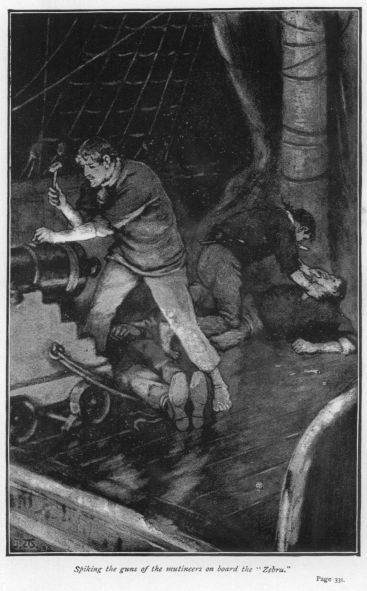
I gave my comrade a signal, and next moment we sprang noiselessly on board, and had the two gunners overpowered, gagged, and made fast before they could utter a sound or reach for their arms.
Then without losing a moment we drove our nails into the touch-holes of the guns, trusting to the noise of the revellers and the dash of the water at the bows to drown the sound of the hammer. This done we dropped overboard, each with a prisoner, as quietly as we had come, and with the aid of the line reached the stern in safety, and found ourselves once more on the sanctuary of the quarter-deck.
Scarcely had we done so when we became aware of a movement among the enemy. So busily occupied had they been in their debauch that they had not noticed the change in the weather, or the advantage which had been taken of it to put the ship under way. As it was, they might have even allowed that to pass, supposing it only brought them nearer to Yarmouth Roads, when one of the old salts in their number pronounced that the new wind was from another quarter, and that instead of closing in with the admiral’s fleet off Yarmouth the Zebra was running for the open sea with a strong south-wester astern.
Finding themselves thus hoodwinked, and already excited by drink, the leaders, and as many of the men as could be enticed from the liquor, came once more aft and demanded another interview.
The quarter-deck, except for the sentries, the watch, and the men at the guns, was comparatively deserted, the officers having retired below until the hour allowed by the enemy had expired.
The senior officer present was Mr Felton.
“Quartermaster,” said he, as he stepped up to the helmsman, “how does she sail?”
“Nor’-east by east, sir. Making ten knots an hour.”
“Keep her so.—Mr Gamble,” said he, turning to a midshipman, “have the goodness to go to my cabin at once and fetch the magnet you will find lying in the drawer of my desk.”
In a minute Mr Gamble had performed his errand. Mr Felton meanwhile had lifted the cover of the compass-box, into which he now inserted the small magnet, so that it pulled the needle a quarter of the circle round, and made it appear that our course was due north.
“That should give us time,” said he as he replaced the cover. “The land-lubbers will know no better.—Use your pocket-compass, quartermaster, and keep her as she is.—Now, my man,” said he, addressing one of the loyal marines who had been standing sentry, “what is it?”
“If you plaze, sir, the hounds beyant there want a word with yez.”
“Tell them the hour is not yet up, and that Mr Adrian is below.”
“Sure I told them so, and Callan, he’s their talking man, says he must see yourself, or there’ll be mischief.”
“Very good,” said Mr Felton. “Pass the word below for all hands on deck; and let every man go quietly to his place.—Marine, allow Callan on the quarter-deck.”
But Mr Callan was not tipsy enough to fall into such a trap, and insisted on the honours of war and the word of a gentleman that he and three of his followers should be allowed safe-conduct, hinting at the same time that the forward guns were still in position, and that any attempt to break parole would be visited with ugly consequences.
Lieutenant Felton gravely gave the necessary assurance, whereupon, ordering their followers to wait below, Callan and three comrades, as tipsy as himself, staggered up the ladder.
“Now, sir, what is the matter?” demanded Mr Felton.
“Matter? The ship’s on the wrong tack. You’re sailing her out to sea; and if she’s not put round at once, we’ll put her about for you.”
Mr Felton laughed.
“Not so easy to sail out to sea in this wind as you think, my lad. I wonder, now, if you really know what direction we are going in.”
One of the four replied, “Nor’-east,” unless he was mistaken.
“Bless me,” said the officer, “and these are the men who pretend to speak in the name of the British seaman! I should prefer to take the word of the compass against yours in a cap of wind, my fine fellow, any day. Nor’-east, indeed!”
“The compass will say the same as us; or maybe we’re a point more to eastward.”
“You can satisfy yourself as to that if you please,” said Mr Felton dryly.—“Mr Gallagher, take these men and show them the compass. It will be a lesson to them in navigation.”
The laughter of the company succeeded in effectually damping the confidence of our amateur seamen as they slowly followed me abaft.
“Steer gingerly round these guns,” said I, as we passed the two guns which had been brought to bear on the forecastle; “they’re loaded. Gently now; it’s not so steady walking on a deck as round the Newgate exercise-yard. Come away now.—Quartermaster, show a light on the compass here for these gentlemen. They have come to give us a lesson in seamanship.”
“Compass!” said the quartermaster with a chuckle. “Ain’t the stars good enough for you? Who but a landlubber ever needed to look at a compass to see which way the wind blew? However, look away; and if it’s a point out of due north call me a Dutchman.”
The men peered stupidly over the compass.
“It’s north, sure enough,” growled the only man of the party who was at all weatherwise. “I could have sworn it was nor’-east or more.”
To encourage him I tapped the glass.
“We could make it nor’-east for you by putting a spring on the needle, if that’s what you want,” said I with a laugh.
Callan and the others looked wisely at the mendacious instrument, and then began to sheer off with the best grace they could.
“We should be in Yarmouth Roads at this rate by daybreak,” said he, “provided they play us no tricks.”
“We’ll see to that,” said the old salt. “Now we know she’s sailing north we’ll see she keeps so, or there’ll be the mischief in it.”
“Come away now,” said I, “your friends will be missing you; and what will become of your first, second, third, and fourth without you?”
It did not tend to raise the spirits of the four noble mariners as they passed round the guns to hear the laughter and cries of “nor’-east by east it is, sir,” which greeted their passage. Nor did they quite recover till they returned to the arms of their comrades, who bore them off with the glorious news that a fresh cask of rum had been broached, and that the lights of Yarmouth were already visible on the horizon.
Chapter Thirty.
“Battle and murder and sudden death.”
It was past midnight, and in two hours the summer night would be past. After that, further mystification as to our course would be impossible; but could we hold on till then, with half a gale of wind behind us, we should be well over to the Dutch side, and clear at any rate of the mutinous atmosphere which infected Yarmouth Roads and the Nore.
The men, having, as I supposed, satisfied themselves that the Zebra was being sailed according to their own directions, decided to wait till daylight, by which time they counted on the encouragement and company of the Yarmouth mutineers, before they finally hoisted the red flag and took possession of the ship. Meanwhile they applied themselves assiduously to the liquor, an indulgence which, in the case of a good many of the land-lubbers of their company, must have been seriously spoiled by the rolling of the ship and their first acquaintance since we left Dublin with really dirty weather.
I reckoned that we were some twelve leagues from the Dutch coast, with the wind shifting westerly and sending heavy seas over our counter, when the grey dawn lifted and showed us a waste of water, with nothing visible but a single speck on the eastern horizon.
After close scrutiny we concluded this to be one or more sail beating up against the gale; but whether they were Dutch or English, it was too soon to say.
“Keep her as she is,” said Mr Adrian; “and, Mr Gallagher, pipe all hands. The sooner we come to an understanding with these fiends the better.”
I obeyed. A few of the old tars instinctively turned up to the call, but seeing all decks but the quarter-deck deserted, they remembered themselves and went off to look for their comrades.
Presently an uneasy group assembled on the forecastle, many of them showing traces of the mingled drunkenness and sea-sickness of the night. We could see them scanning the horizon with their glasses, and slowly awaking to the discovery that instead of being in the arms of the confederacy of “the Republic afloat” (as one of the proclamations had called it), the Zebra was scudding over the high seas.
There was an angry consultation, and shouts to those below to turn up. About half the number obeyed, though many of these were fit only to lie helplessly about the deck. A more miserable crew you never beheld.
“Hands aloft! Take in the main-topgallant sail!” cried Mr Adrian, and the order was shouted forward.
Not a man moved, except Callan, who came to the forecastle rail, and holding up a pistol, shouted back,—
“Surrender the ship, or we fire!”
Mr Adrian’s reply was to repeat the order just given, and draw his pistol.
One of the mutineers, sent forward by the leaders, advanced to the mainmast with a red flag in his hand, which he proceeded to fasten to the flag-lines and to hoist, bringing down the Union flag as he did so.
Mr Adrian levelled his pistol. There was a sharp, clear ring above the noise of the gale; the man flung up his arms, uttered a yell, and rolled over on the deck.
“Stand clear!” cried Callan, waving his men on either side of the forecastle guns. “Fire, my lads!”
There was a silence. No one on the quarter-deck stirred. Those on the forecastle who had stood with their faces our way, expecting to see the effect of the volley, looked round impatiently to see why the guns were mute.
Then came a cry of “Spiked!” followed by a howl of dismay as the contents of one of our quarter-deck guns crashed with a dull, savage roar on to the forecastle.
When the smoke cleared we saw a ghastly sight. Men lay in all directions—some blown to pieces, some groaning in pools of blood, some dragging themselves with livid faces to a place of shelter.
For my own part, I dreaded to hear Mr Adrian give the order to fire the second gun. The only thing which prevented it was the sudden clearing of the forecastle. All who could rushed to the main-deck, where at least they were below the range of the deadly grape.
Here Callan, who had escaped unhurt, called on his men to form, which they did in three straggling lines across the deck, howling execrations and flourishing their knives in our direction.
Before they could advance—before, indeed, those of them who carried pistols could fire—Mr Adrian, who had ranged us up behind the barricade, gave the signal to present arms and fire.
It was a volley almost as deadly as the first. Callan sprang a foot or two in the air, and fell back shot through the heart. The front rank of the mutineers went down like ninepins, and those behind fell back a pace in consternation, “Reload! Mark your men!” cried Mr Adrian, whose face was savage and as hard as a flint.
The wretches gathered themselves together after a moment’s hesitation, and stepping over the fallen bodies of their comrades, advanced with a half-hearted rush for the quarter-deck.
“Present! fire!” cried Mr Adrian.
Once more man after man went down dead or wounded, and the deck was strewn with bodies. A heavy sea at the moment broke over the quarter, sweeping the deck and clashing living and dead in a heap into the lee-scuppers. A few stood still, eyeing dubiously first one another, then the quarter-deck, then the waves as they broke across the waist.
“Reload! Mark your men!” cried Mr Adrian again, with a curl of his lips.
The mutineers heard the command, and dropping their weapons, retreated in a panic to the hatchways.
“Fire!” said Mr Adrian; “and after them, some of you, and make fast the hatches.”
The first order was not obeyed. It had been bad enough, in defence of the ship, to fire on one’s own shipmates, but to fire on their backs was too much; and Lieutenant Adrian probably understood as much when he saw that we all preferred his second order to his first.
It was a short business making good the hatchways, after first driving below the few stragglers who lingered above board. Then we had leisure to take stock of the execution our volleys had effected. Eleven men, including Callan and two of his fellow ringleaders, were dead. Eight more were mortally wounded, and thirty-eight lay hurt, some badly, some slightly. We lost no time in throwing the dead overboard, and carrying those most in need of succour out of the reach of the waves. Tarpaulins were spread for the rest till a place could be found for them in some of the after-cabins.
The doctor (who reported that Captain Swift had breathed his last while the engagement was at its height) did what he could to dress the wounds of the sufferers, and impressed the services of one or two of the handiest of the men present as assistants.
Just then, however, with the gale threatening every moment to snap the masts, it was even more important to get hands aloft to shorten sail. The midshipmen and officers gallantly undertook this difficult task, but not in time to save the main-topgallant mast, which fell with a crash, carrying away the purser and the boatswain’s mate, and fouling the rigging below with its wreck. No sooner was this cleared, and the top courses taken in, than the man who had been for some moments conning the strange sails on the horizon reported,—
“Two Dutchmen, sir, thirty-six guns a-piece, bearing this way.”
During the struggle with the mutineers we had almost forgotten the presence of these strangers, and now found them not a league away standing across the wind to meet us.
It was a hopeless venture to meet them, but Mr Adrian preferred it to putting the Zebra about and running away.
“Let them come,” said he; “they can’t do worse than these scoundrels down below. Stand by the guns, gentlemen!”
We obeyed willingly enough. Had Mr Adrian only been a gentleman as well as an officer we could have cheered him. But the vision of his face as he gave the word to mow down his own crew stuck in my memory and robbed me of all the enthusiasm which his present courage deserved.
On we sped, and nearer drew the Dutchmen. Evidently they were cruisers on the prowl for an enemy, or sent to observe the motions of our disorganised fleet. Had we been a sound company we might have held our own against the two of them. But crippled as we were, with our guns unmanned, our ammunition lost, and part of our crew lying wounded on deck, while the rest were prisoners below, we might as well have hoped to capture Rotterdam.
Fate, however, determined our destiny in her own way. Just as we were coming about, and those at the guns were blowing their matches for a first and possibly a last broadside, the Zebra gave a sudden shiver in every timber, there was a dull growl, followed an instant later by a terrific explosion which rent the vessel in twain, and dimmed the sky overhead with spars and smoke, and set the ship reeling on her beam-ends. At the moment, I was in the act of firing the charge of the gun in my care, and remember nothing but the tremendous noise, and finding myself hurled, as it seemed, clear over the breech of the weapon out into the boiling sea.
Instinctively I clutched at a spar within reach, and clung to it. All else I saw and heard as in a dream—the ship heeling over further and further, and the waves leaping on her as she plunged down; the cries and shrieks of the imprisoned wretches who sought to escape from the consequences of their own desperate revenge; the sea strewn with wreckage and struggling swimmers; the first lieutenant’s dying malediction flung into the wind from the quarter-deck; the looming hulls of the two Dutchmen as they hung in the wind and watched our fate. All, I say, passed like a grim nightmare. What woke me was an arm suddenly flung across me, and the white face of Mr Midshipman Gamble looking up at me out of the water.
I hauled him up on to the spar; and the effort to keep him afloat, and save myself from his wild struggles, helped me to find my wits.
“Easy, lad!” said I; “you’re safe enough here. Keep quiet!”
The sound of a voice steadied him, and he ceased his struggles, and let me lash him as best I could to the spar.
The Dutchmen, who had, no doubt, witnessed with anything but pleasure their prey snatched out of their hands, were humane enough to make a show of lowering a boat for the succour of those who still lived. But the heavy sea rendered this a very difficult and dangerous task, and after very little trying we had the dismay of seeing them abandon the attempt and haul off on their course, leaving us to our fate.
You may fancy with what feelings we watched them gradually growing less on the horizon, and realised that we were at the mercy of an angry sea, with no support but a piece of broken timber, and every moment finding ourselves more and more alone, as comrade after comrade gave up the struggle and fell back among the waves.
Presently Mr Gamble, whose leg, I found, had been crushed by the explosion, groaned, and his head fell forward. Three great waves in succession washed over us with the force of a falling wall; and when they had passed, and I looked to my companion, he was dead, with the life simply beaten out of him.
Sorrowfully enough I unlashed him, and let him drop beneath the pitiless water; and then, finding my own strength beginning to fail, I lashed myself under the arms and over the spar, and hung on for dear life. In this posture I spent weary hour after hour watching the waves, and endeavouring to ward off from my head the fury of their onslaught.
About mid-day the gale eased somewhat. I looked about me. Not a sign or vestige remained of the Zebra or her hapless crew. Not a floating thing among the waves caused me to count on the company of a living wretch like myself. Not even a livid corpse across my track served to remind me that I, of all that ship’s company, still clung to life.
Strange visions, as I rose and fell with the heaving sea, floated before my eyes. The gloomy kitchen at Kilgorman, and my mother’s letter gleaming under the hearthstone—the hollow on the cliff’s edge where Tim and I had once fought—Biddy McQuilkin sitting at the fireside in our cabin, setting her cap at my father—Miss Kit with the gun at her shoulder behind the hall-door at Knockowen—the unhappy old man being dragged to the guillotine in Paris—the lumbering barge floating down the Seine—Tim in the light of the lantern at the helm of the Kestrel;—these and many other visions chased one another across my memory, first in regular procession, then tripping one over the other, then all jumbled and mixed together in such chaos that it was Kit who was being haled to the guillotine, and Tim who lay below the hearthstone, and Biddy who navigated the barge.
Presently one vision seemed to hang in my memory longer than the others, and that was the light of the morning sun as it struck on the retreating sails of the brig Scheldt of Rotterdam, standing out to sea off Malin. One by one all my other fancies merged into this—the guillotine changed into a brig, the Kestrel changed into the Scheldt, the Kilgorman kitchen became a deck, and Miss Kit a Dutch skipper. Why was it? Why should everything come back to that one brig in the offing?
Suddenly I understood it. There, as I looked up from my restless raft and followed the gleam of the afternoon sun as it broke through the clouds, I perceived just such another vision in the offing—a brig, with canvas set, and the light glancing on her sails as she laboured over the waves towards me!
She may have been a mile away. By the look of her she was a foreign craft, and may have been a trader coasting between the Dutch ports. Whatever she was, the sight of her put new life into me.
I took my red scarf—the very scarf I had waved so vainly at the Scheldt scarce three weeks ago—and spreading it wide waved it with all the energy of which I was capable. How long the minutes seemed then! If she gave me the go-by, my last chance would go with her. Even as I raised myself to wave, my head reeled, and a dimness clouded my eyes.
Then, with a wonderful bound at my heart, half surprise, half joy, I saw the brig suddenly put about, while a flag waved at her stern showed that my signal had been seen. A minute later the welcome sight of a boat coming towards me assured me that I was saved, and with a cry of thankfulness to Heaven my weary head drooped, and the mist in my eyes became darkness.
What roused me was the consciousness of two strong arms round me, and the taste of liquid fire between my lips. My saviours, who were Dutchmen, had lifted me from the spar, and were plying me with spirits as I lay more dead than alive in the stern-sheets. I looked up. The sails of the brig, flapping against the wind, towered above me, and her dark hull as she swung over us hid the sun. The boat pulled round her stern to reach the lee-ladder. As we passed I glanced up, and my eyes fell on two words, painted in gilt letters—
“Scheldt. Rotterdam.”
Chapter Thirty One.
The highwayman on the Delft road.
The next thing I clearly remember was crawling up on deck, clad in a Dutch sailor’s jacket and cap (I had been stripped for action when I was pitched into the waves out of the Zebra), and seeing a stretch of red-tiled roofs and windmills and tall towers on the bank of the broad stream up which we sailed on the tide. Rotterdam was in sight.
I had lain in a sort of stupor since I was carried on board twenty-four hours ago. The Dutchmen had been kind to me in their rough way, particularly as they took me for a Frenchman. I thought it prudent not to undeceive them, and passed myself off to the skipper as a castaway citizen of the Republic One and Indivisible, which my knowledge of the language made easy.
But, as you may imagine, now that I stood on the deck of the Scheldt, my mind had room for but one thought. Miss Kit—where was she?
Even had her curiosity brought her on deck yesterday to see the rescue of the poor foreigner, she would hardly have recognised in the smoke-begrimed, swollen features of the half-drowned man her old squire and comrade of long ago. Still less would Martin, who had never set eyes on me for four years, discover me. I knew him well enough as I came upon him just then leaning over the bulwark taking an eyeful of Dutch scenery.
He turned round as I approached and nodded.
“Comment vous portez-vous?” said he, using up one of the slender stock of French phrases he had at command.
I replied in French that I did well, and was entirely at monsieur’s service, and madame’s too, for I heard, said I, monsieur did not travel alone.
Martin, who only half-comprehended, looked at me doubtfully, and turned on his heel.
Presently, as I leaned over the port watching the river, I overheard him in conference with the skipper, who spoke imperfect English.
“Convent of the Carmelite Nuns?” said the latter; “that is outside the town some distance. Is mademoiselle to be taken there?”
“Ay; those are my orders.”
“Will she go?”
“She must,” said Martin.
“She has not been very obedient so far,” said the skipper with a laugh. “You have not received much encouragement.”
“What do I want encouragement for,” growled Martin, “from her?”
“Perhaps the encouragement of Mees Norah, her maid, has been enough for you. But I warn you, my young lady will not travel so easily by land as by sea. You will need a troop of horse to take her to the Carmelites, I expect.”
This was said with a sneer at Martin’s qualifications as a squire of dames which that gentleman did not enjoy.
“I can manage my own business,” said he in an unpleasant voice. “I shall take her there in a carriage, and if she resists she will have to find out she is not her own mistress.”
“As you will,” said the skipper. “I thank my stars I have not the task.”
Indeed, I came to learn later on that he had good reason for so wishing. For Miss Kit, as soon as ever she discovered the vile plot which had been practised on her, had retired to her cabin, and held every one on board the Scheldt at arm’s-length except her maid, refusing to see Martin, of the skipper, or any one, and fortifying herself like a beleaguered garrison. Her cabin had a private companion ladder by which she could reach the deck without passing through the men’s quarters, and after the first day or so, the poop was yielded to her as her own territory without protest.
How was I to communicate with her now? I must if possible prevent her incarceration in the convent, from which I knew escape would be difficult.
I retired below and hastily scrawled on a piece of paper the following note:—
“Miss Kit,—The half-drowned man who was taken on board yesterday was he who writes this, and who is ready to die for you. You are to be carried in a coach to-night to the Convent of the Carmelite Nuns. Make all the delay possible before you consent to go, and so give me time to get beforehand on the road, where I will find means to take you to a place of safety.—Your devoted—
“Barry Gallagher.”
This paper I folded, and returned on deck in the hope of finding some means of getting it into my lady’s hands.
Just as I passed the cook’s galley, I came upon Norah, the maid, coming out with a tray on which was a little bottle of wine and a plate of biscuits. As we suddenly met, the tray slipped from her hand and fell to the floor, spilling the contents of the bottle and scattering the biscuits.
“Ach, but you’re clumsy!” exclaimed the damsel.
It was on the point of my tongue to return the compliment in her own language; but I remembered myself, and with a Frenchman’s politeness begged ten thousand pardons.
“Permit that I assist you to make good the damage, mademoiselle,” said I.
This mollified her, and she bade me hold the tray and pick up the biscuits while she went for another bottle of wine.
When she returned, nothing would content me but that I should carry the tray for her to the door of her lady’s cabin, which she graciously permitted, with a coquettish glance at Martin as we passed him on deck.
My agitation, if I betrayed any, was not all due to the fascinations of Miss Norah, and Martin had no cause to be jealous on that score. The truth was, that between the two top biscuits on the dish I had slipped my little note!
“Merci bien, monsieur,” said Norah at the door as she took the tray; “and it’s sorry I am I called you names.”
“Any name from those pretty lips,” began I, but she left me to finish my compliment to the outside of the door.
When we moored alongside the Quai, I renewed my thanks to the Dutch skipper, and offered to return him his coat. But he would not hear of it. Only, said he, if I was disposed to-morrow to lend a hand at unlading, he would consider the trouble of fishing me out of the North Sea sufficiently repaid. This I promised by all means to do; and glad to get free so easily, stepped ashore with the first to land.
As I passed the brig’s poop I thought I saw a face peep from the little cabin window, and after it a little hand wave. I put my own hand to my lips as a symbol both of secrecy and devotion, and taking advantage of the bustle attending on the arrival of a fresh craft, slipped out of the crowd into the street beyond.
Here, among the first, I met a priest, to whom I made obeisance.
“Holy father,” said I in French, “I beg you to direct me to the Convent of the Carmelite Nuns of this town, to which I have a message of importance from Ireland. I am a stranger here, and have but just landed.”
The priest eyed me suspiciously.
“The holy sisters receive no visitors but the clergy,” said he. “I will carry your letter.”
“Alas! I have no letter. My message is by word of mouth, and I am free to impart it to no one but to the lady superior. Does monseigneur suspect me of ill motives in seeking the convent?”
He liked to be called monseigneur; and looking me up and down, concluded the holy sisters had little to fear from me.
“The holy sisters live a mile or so beyond the city, before you come to Overschie, on the road to Delft. You will know the house by the high wall and the cross above the gate.”
“Monseigneur,” said I, “a thousand thanks, and may the saints make your bed to-night;” and I departed along the road he pointed out.
I had not gone far, or reached the open fields beyond the town, when I perceived, grazing at the roadside, a horse with saddle and pillion, such as market folk rode, which had evidently broken tether while its riders were away on some errand at a neighbouring auberge.
Necessity, which knows no law, and made me villain enough to deceive a priest, was hardly likely to stick at borrowing a nag, especially when the safety of my dear young mistress was at stake. It went to my heart to think that the honest couple would have to complete their marketing on foot; but I promised them in my mind that if the beast was one of sense and natural affection, it should find its way home sooner or later when its present task was done.
A short ride now cleared me of the town and brought me on to the road which follows the canal to Delft. It was already dark, and as I ambled past the lofty windmills that skirt the canal, I met scarcely a soul. Presently at a junction of roads I distinguished a little way back from the highroad the roof of a building almost hidden in trees, and closed round with a high wall. A thick, nail-studded gate, surmounted by a cross, marked the entrance. Here, then, was my destination.
I reined in my horse under the deepest shadow of the wall, within view of the portal, and waited. To pass the time, I took from my pocket the pistol which had lain there all the while I was in the water, and drawing the wet charge, replaced it with powder and shot which I had taken the precaution to provide myself with before I left the Scheldt.
Then it occurred to me, if I was to play highwayman, I could do it more securely out in the solitary road than within earshot of the holy sisters, who might harbour within their precincts watch-dogs, human or animal, who could spoil sport of that kind.
So I rode a little way back on my steps and halted under a clump of trees at the cross-roads, straining my ears impatiently for the noise of wheels.
Nearly an hour elapsed before they came, and I concluded Miss Kit must have taken my advice and given her custodian a bad time of it before she permitted herself to be conducted from the ship to the vehicle. Now the wheels advanced rapidly, and the frequent crack of the driver’s whip showed that Martin was trying to make up for lost time.
I could see as they approached that the two men were on the box, leaving the inside to the ladies. The driver was evidently pointing out the roof of the convent, dimly visible among the trees, and a face at the open window was peering out in the same direction.
At that moment I darted out of my hiding-place, and firing my pistol in the air, but near enough to the driver’s ears to make him jump, shouted gruffly,—
“Haltez là!”
The horse came up short on his haunches. The terror-stricken men gaped round in a dazed way and tumbled off on the far side of the coach, while the maid within uttered a loud scream. But almost before any of them knew what had happened, I was bending beside the face at the window.
“Quick, Miss Kit, mount behind me.” And passing my arm round her, I drew her through the window and set her on the pillion behind me; and next moment we were galloping away as fast as the beast could carry us, with her dear arms clasping me, and her breath coming and going in quick tumult on my neck.
For a mile we rode thus without a word, when I heard her give a little laugh.
“What is it?” I asked.
“What a trouble for Martin!” said she, “He has Norah to console him.”
“I am not jealous of Norah.”
And I thought her arms held me a little firmer.
“How well you managed it,” said she in a little. “I was terrified too, just at first. Where are we going?”
“To Biddy McQuilkin’s, at the Hague.”
“Biddy McQuilkin’s!” exclaimed she, with a start of surprise. “Surely she is dead.”
“So I thought; but she is not. She keeps an inn at the Hague; and has orders from one in high authority among the Irish rebels to take care of you.”
“As a prisoner?”
“Surely not; as a lady.”
She sighed.
“One peril never seems to be past,” said she, “but a new one looms ahead.”
“Courage,” said I. “Providence that saved you from the old peril will save you from the new.”
“Ah, Barry,” she said gently, “I begin to wonder if your name spells Providence to me. On that hateful ship I wondered often what had become of you. When I saw behind us at Malin a red flag waved on the cliff-top, I said, Could that be you, but for once too late to help?”
“It was,” I replied.
“I knew it!” she exclaimed almost triumphantly, “Night by night as we sailed further and further from home, I prayed Heaven to send you. Once when an English warship crossed our path, I pictured you among the crew, and wished they might capture us. Then when I got that wonderful little letter among the biscuits I knew my prayer was answered; and I troubled myself about nothing but to do your bidding. Poor Martin,” and she laughed again, “he was the sufferer by that.”
You may fancy if her voice across my shoulder that night was not music in my ears! It humoured her to talk of all the perils we had encountered together, and of the ups and downs in our lots since that first day I brought her in the boat from Rathmullan to Knockowen. Then she spoke of her father and the peril he was in, and of the feuds and dangers that beset our distracted country. From that we came to talk of my adventures, and of Tim. But I could not find it in my heart to tell her of the paper under the hearth at Kilgorman, or of the villainy by which her father came into the estates he now held.
Near the end of our talk I mentioned that I had seen Captain Lestrange in Derry.
She was silent a little, and then said,—
“He is the man my father says I must marry.” This was a speech I found no ready answer to, except a mumbled, “He is a fortunate man.”
“He does not think so,” said Miss Kit with a laugh. “He is good and kind, but he loves his liberty more than any woman.”
“And what says my little lady to that?” I faltered.
“Vive la Liberté,” said she. “Heigho, Barry, are we nearly there?”
We were past Delft, where no one supposed but we were a belated pair of market folk trudging home. Our horse had dropped into a leisurely jog, and the morning sky was beginning to show streaks of grey.
“Are you weary?” said I, putting my hand on the little arm that held me round.
“No, Barry, I am very happy so,” said she; and after that we were silent till the stars began to fade and the towers and spires of the Hague loomed ahead against the northern sky.
Despite our loitering, it was still early when we found ourselves in the streets of that city, inquiring for the auberge of the “White Angel.” After some trouble, we were directed through the town to the road that leads to the little fishing village of Scheveningen, two miles beyond the Hague, where, just as we came in sight of the sea, a little wayside inn with a swinging sign of a heavenly body in a snowy robe told us we had at last found our journey’s end.
No one was astir, but our knocking brought a groom on the scene, who rather surlily admitted us to the stable-yard.
“Tell madame she is wanted at once; I bear a message from Lord Edward, tell her.”
Here a head looked out from a window, and madame’s voice called out in broadest brogue,—
“Lord Edward, is it? And who might you be yourself?”
“I’m Barry Gallagher, Biddy. Put on your clothes, like a decent soul, and let us in.”
Biddy obeyed with an alacrity which led us to doubt whether her toilet below the shawl she wore had been very elaborate.
On the sight of me, still more of my fair charge, she broke out into a tumult of Irish welcome.
“Arrah, darlints, sure it’s glad I am to see you; and it’s expecting you I’ve been, for didn’t Lord Edward send me word to look to the young leddy? Come away, honey; for you look as white as the painted angel beyant there. So they sneaked you away, did they? And all because his honour was hanging the boys. Never ye fear, dearie, you’ll be safe with old Biddy, even if the whole of the United Irishmen come after you.—And you, Barry, you’re welcome too, though your father Mike wouldn’t let me be mother to you. Dear, oh. There’s many changes to us all since then. The last time I set eyes on yez ’twas in Paris, and little I looked to see you again when they had us all to the prison. And where’s Tim at all? He’s the boy, and a rale gentleman.”
“Give us some food, Biddy dear,” said Miss Kit, “and tell us all the news to-morrow.”
“’Deed I will,” said the good soul, and she bustled about till the whole household was awake to give us breakfast.
I waited only to allay my hunger, and then rose.
“Good-bye just now, Miss Kit,” said I.
Her face fell.
“Oh,” said she, “you’re not going to leave me, Barry!”
“Till to-night. I am pledged to pay the Dutchman for saving my life by working for him this day. After that—”
“Oh, go,” said she, holding out her hand, “for he deserves all the thanks in the world for saving you for me.”
She blushed as she saw how I lit up at the words, but left her hand in mine as I raised it to my lips.
“Farewell, my dear Barry,” said she. “Heaven bless you, and bring you safely back!”
All the world then seemed turned to brightness, and I stepped out like a man who treads on air. But at the door I remembered myself enough to return and seek Biddy in her kitchen.
“Biddy,” said I, “tell me one thing, as you will answer for it at the last day—which of us two, Tim or I, is the son of Mike Gallagher, and which is the son of Terence Gorman?”
She turned very white and sank into a chair. But I had no time to parley, and I urged her to speak.
“As I hope for salvation,” said she, and her breath came hard and her bosom heaved fast, “the one of you that has the mole between his shoulder-blades is the Gorman’s boy.”
“It is Tim then,” I exclaimed, and hastened to my horse.
Chapter Thirty Two.
Dutch justice.
I should be no better than a hypocrite were I to deny that, as I rode my weary, borrowed nag back that morning along the Delft road, there shot in and out of the turmoil of my feelings a sharp pang of disappointment.
It was no disloyalty to Tim; it was no greediness for name and wealth. It was but the dashing of a passing hope that I might find myself, after all, a gentleman, and so prove worthy to be regarded by Miss Kit as something more than a trusty servant. As a Gorman, and her cousin, I might claim her with the best of her suitors. As the son of Mike Gallagher, boatman and smuggler, myself but a plain boatswain, how durst I suppose, for all her kindness and gentleness, she could comprehend me in the ranks of her equals?
Yet to serve her was something—to have snatched her from the scoundrel Martin, and set her in a safe place, was some little triumph to set against the disappointment of Biddy’s news; and as I jogged Delft-ward that morning, I fell to considering how best I could help her to her home and Tim into his estate.
More people were about now than when I rode last, and some opened their eyes to see a sailor on horseback. But I answered no questions and halted for no parleys. At Delft I hoped to find a road round outside the town, fearing lest I might encounter the owners of the nag on the streets. But I found no way except that straight through the midst of the town.
As I crossed the market-place two soldiers accosted me and ordered me to dismount and give an account of myself. As they spoke only Dutch, and I knew none of the language, it was hard for us to understand one another. But the feel of their muzzles on my ears convinced me I had better obey; and abandoning the luckless animal, I was conducted to the guard-house and there locked up until business hours.
I demanded, in the best French I could muster, on what charge I was thus laid by the heels.
My captors grunted by way of answer, and searched my pockets, from which they drew my pistol and the little leather case containing my mother’s letter.
I repeated my question in English, at which they pricked their ears, spoke something to one another in which the word “spy” occurred, and clapped irons on my ankles.
Evidently then my crime was not horse-stealing, but that of being an English spy, which meant, I supposed, a volley at ten paces before noon. So here was an end to the business of Miss Kit, my sweetheart, and Tim, my brother.
I confess, as it all dawned on me, I found myself smiling over my big hopes and resolves of an hour ago. But I had long enough to wait to lose all sense of humour, and sink into the most woeful depths of despair. It always happened so. The cup was ever at my lips, and as often rudely dashed aside. My little mistress had never before spoken so gently; my mother’s dying charge had never been nearer fulfilment. And now, what could be further from my reach than either? How I execrated that ill-starred jade, and the Dutch skiver, but for whom I might at this moment have been my own master.
In due time I was marched into the burgomaster’s presence, and deemed it wise to make no further mystery of myself. I demanded an English interpreter, unless the magistrate would hear me in French, which latter he graciously agreed to do.
“Sir,” said I, “my name is Gallagher; I am an Irishman, a servant of King George, and a sailor in Admiral Duncan’s fleet. I am, as I believe, the sole survivor of the wreck in mid-sea of his Majesty’s ship Zebra, foully blown up by her mutinous crew. I was picked up by the Dutch brig Scheldt, now lying at Rotterdam. I am no spy. I rode last night to visit an acquaintance—a countrywoman at the Hague—and am on my way now to fulfil my promise to the skipper of the Scheldt to give him a day’s labour in unlading his brig in return for his kindness to me. The sailor’s coat and cap I wear were given me by him.”
The magistrate heard my story attentively, and not altogether unfavourably.
“Admiral Duncan’s fleet,” said he, “is in arms against the Dutch republic.”
“It is,” said I.
“How many sail does he muster?” demanded my judge.
“I cannot tell you, mynheer,” said I.
“Where do his ships lie?”
“Mynheer,” said I, “would you expect a Dutch sailor to betray his country to an English magistrate? I refuse to answer.”
He frowned, less at my refusal than at the terms in which it was couched.
“Give me the name of your acquaintance at the Hague,” said he, changing the subject.
I gave him Biddy’s name.
“What was your business with her?”
“I never expected to land on Dutch shores, and so had no special business; but finding myself here, I sought her out.”
This all seemed fair enough; and the burgomaster, who was an honest man and blessed with true Dutch stolidity, after consulting with his clerk and colleague, informed me that inquiries would be made, and that meanwhile I should remain in custody.
To my request to be allowed to send a letter to Biddy he returned a flat and suspicious refusal. Nor, till my case stood clearer, would he order the removal of the irons. So for the next twenty-four hours I lay in a damp cell, with black bread and water to support my spirits, and the thought of my little mistress to carry me through the weary hours.
About noon next day I was again summoned to the burgomaster’s court, where, among the curious crowd assembled to see the supposed English spy, I recognised not only the Dutch skipper, but Martin. Biddy was not there.
The burgomaster wore an air of sternness and self-importance which boded no good.
“Captain Koop,” said he to the skipper, “identify the prisoner.”
“Most worshipful,” replied the sailor, “this is the man we picked up, who said he was a Frenchman, wrecked in the French ship Zèbre.”
“Was that true?” said the judge to me.
“Mynheer, I told you my tale yesterday. I am no Frenchman.”
Then Martin was called forward, and looked hard at me with his sinister eyes. An interpreter explained the burgomaster’s questions.
“Witness, you state you know the man Gallagher. Is this he?”
“Now I look at him—yes; but I did not know him before with his beard.”
“Is he a sailor in the service of the English Government?”
“He is; and no friend to the Irish people, for whom the Dutch republic is fighting. More, by tokens, your honour,” added Martin through the interpreter, “now I know him, I know who it was who last night carried away a certain Irish lady under my protection while on her way to the Convent of the Carmelite Nuns.”
“What do you say to that?” said the burgomaster to me, with a look of horror, for he was a stout Catholic.
“I don’t deny it,” said I, curtly; “nor do I deny that this blackguard, instead of trying to defend the lady, tumbled all of a heap with fright off the carriage-box on to the road when I accosted him.”
The interpreter smiled as he translated this, and Martin looked round not too well pleased.
“Where is the lady?” demanded the burgomaster.
“That is my affair,” said I. “She was carried away from her home by this man against her will. She was rescued from him by me with her own good will, and is now safe.”
“With your friend at the Hague, doubtless?”
I made no answer.
“Inquiries have been made as to this friend. She is known, but has disappeared since yesterday.”
“What!” I exclaimed, “Biddy gone? And what of—”
“In company with a young lady,” said the burgomaster, eyeing me sternly. “Prisoner, I demand to know where these persons have gone.”
“I do not know,” said I, and my own bewilderment might have answered for my sincerity.
“I do not believe that,” said the burgomaster. “A messenger arrived at her inn with a letter early yesterday, and she and the lady left, it is said by boat, soon after. Do you deny that you sent that message?”
“I do.”
“Do you deny that you know who did?”
“I do.”
“Do you deny that you know where they have gone?”
“I do,” retorted I; “and, if it please your worship, what has all this to do with whether I am a spy or not?”
“This, that a man who has lied in one particular is not to be believed in others. The same reason which induced you to pass yourself as a Frenchman may explain your refusal to say where the woman McQuilkin has gone. Her house is known to be a resort of spies and foreigners of doubtful character, and your connection with her, and the abduction of the young lady, and your refusal to give any information, are strongly against you.”
I am not learned in Dutch logic, and was not convinced now; but apparently my judges were, for I was ordered to be handed over to the military authorities of Amsterdam as a prisoner of war, suspected of being a spy, for them to deal with me as they might consider best.
Before I departed, the burgomaster handed me back my mother’s pocket-book, the contents of which he had had translated, and which he was good enough to say appeared not to be incriminating. My pistol he detained for the service of the Dutch republic.
The military authorities at Amsterdam were far too busy to attend to my affairs. They were in the midst of equipping an armament to land on Irish shores and strike at England with the cat’s-paw of an Irish rebellion. The place was full of Irishmen, some of whom honestly enough looked to see their country redeemed by Dutch saviours; others, hungry hangers-on, seeking what profit to themselves they could secure from the venture. A few faces, even during the short time I was kept waiting in quarters, seemed familiar to me as of men I had seen in former days in the secret conclaves at my father’s cabin or under his honour’s roof, and one or two I was certain I had seen that day in Dublin not long since when I was present at a meeting of the United Irishmen.
Little I knew then or for months after that among these very faces, had I looked long enough, I might have seen that of Tim, my brother, or (must I say now?) my brother that was, before he became Tim Gorman of Kilgorman.
But, as I said, the authorities were too busy to inquire into my case, and, taking the word of the Delft burgomaster, locked me up with a batch of other English prisoners to await the issue of the coming war.
For three months I languished here in a dismal dungeon in dismal company and fed on dismal fare. But I who had lodged in the Conciergerie at Paris in “the terror” could afford to think my Dutch hosts lavish in their comforts.
Once and again some new captive brought us news from outside, the purport of which was that the great Irish expedition, after lying for weeks and weeks at the Texel, held prisoner there by the unyielding west wind and by Admiral Duncan, had collapsed like a burst bubble. The troops had all been landed, the ships had returned to refit, and the pack of Irishmen, seeing the hunt up in this quarter, had gone off in full cry to Paris. If the Dutch ventured anything now, it would be against England, and on their own account.
One day towards the end of September a great surprise broke the tedium of our captivity. Our jailer brought an announcement that an exchange of prisoners was in contemplation, and that some twenty of us might reasonably hope to see our native land again in a few days. Whether the fortunate score would be selected according to rank or to seniority of captivity would depend on the prisoners handed over by Admiral Duncan.
It was a pleasing subject of speculation with me, as you may guess. For were the selection to be by seniority, I was excluded; if by rank, as a petty officer in a company which largely consisted of common seamen, I might count with tolerable certainty on my liberty.
The few days that intervened were anxious and wearisome. Should I miss my chance, I had nothing to look for but a prolongation of this wretched existence, with perhaps an ounce of lead, when all was said and done, to end it. If, on the other hand, luck were to favour me, a week hence, who could say, I might be by my little mistress’s side at home; for I made no doubt that when I came to inquire at the “White Angel,” as I certainly would do, I should find that Biddy had taken her thither, or, if not there, at least to some safe place at which I could hear of her.
In due time came the end to our suspense. The twenty were appointed by rank, and I marched one fine evening out of that wretched dungeon a free man—stay, not quite free. There was no slipping away to the Hague and the “White Angel;” no walking through the port of Amsterdam to inspect the enemy’s preparations. We were marched, under arrest, with an escort, in the dark of night, to some little fishing-station among the dunes, where we found an English lugger, attended by two armed Dutch boats, waiting to receive us. On this we embarked, bidding farewell to our captors; but not until the white cliffs of Margate appeared on the western horizon did our Dutch convoy sheer off and leave us in English waters in undisturbed enjoyment of English liberty.
Yet even so, did I still harbour a thought of returning home or seeking the lost, I was destined to disappointment. For from Margate we were marched direct to Sheerness, and there inspected by Lords of the Admiralty, who, without ceremony, told us off to fill vacancies in ships at that moment engaged in active service, promising us, when the present troubles were over, to recompense our hardships and services in some better way.
I found myself under orders to sail forthwith to Yarmouth, there to report myself on board the Venerable, the flag-ship of Admiral Duncan himself.
An Admiralty cutter was just then sailing with despatches for the fleet, and on it I embarked the same afternoon, and found myself in Yarmouth Roads next morning.
The admiral’s fleet was all in a flutter; for news had only just come that the Dutch admiral, taking advantage of the temporary withdrawal of the English ships from the mouth of the Texel (for Admiral Duncan, after his long cruise there, had been compelled to return to refit his squadron), was setting sail at last, and determined to venture an engagement in the open. Our fleet was wild with joy at the news—as wild as the greyhound who for hours has been straining at his leash with the hare in view is to feel his collar thrown off.
Signals were flying from every mast-head. The last of the barges and bumboats were casting loose. The dull thunder of a salute came from the shore, the yards were manned, sails were unfurling, and the anchor chains were grinding apeak.
At such a moment it was that the Admiralty cutter hove alongside of the Venerable, and I found myself a few minutes later lending a hand to haul to the mast-head the blue flag of that most gallant of sea-dogs, Admiral Duncan.
Chapter Thirty Three.
The famous fight of October the Eleventh.
My readers do not, I hope, expect from me a full, true, and particular account of the glorious sea-fight of October 11, 1797, off Camperdown; for if they do, they will be sadly disappointed. Indeed, it seems to me, the worst person to describe a battle is one who has fought in it. For if he does his duty, he has no eyes for any business but his own; and as to seeing what is happening along the entire line at any time, it would take an eagle poised in mid-air, with eyes that could penetrate a cloud of smoke, to do it honestly. I am no eagle, and my eyes can carry no further than those of any other plain mortal. I can tell only what I saw. For the rest, the eagles have written their story in books, where any one can read all about the famous victory—and more than all.
There was little time to observe anything in the bustle of our putting out from Yarmouth. The ship was not yet clear of the confusion of her hurried refitting and revictualling. Stores lay about which needed stowing; there were new sails to bend and old ropes to splice; there were decks to swab and guns to polish, hammocks to sling, and ammunition to give out. Yet all worked with so hearty a will, and looked forward so joyously, after eighteen weeks’ idleness, to a brush with the enemy, that before sundown all was nearly taut and ship-shape. If anything could help, it was the kindly nod and cheery word of our admiral himself as he paced to and fro among us. A beautiful man he was—a giant to look at, and as gentle as he was tall; yet with a flash in his eye, as he turned his face seaward, that told us that there was not a man in the ship who looked forward with more boyish eagerness to the brush ahead than he. Though it was but for a week, I hold it to this day something to be able to say that I have served under Duncan.
Had I been in the mood to stand on my dignity, I might have felt affronted to find myself set to do ordinary seaman’s work on board the Venerable. For in the hurry of our setting out from Yarmouth there was time neither to report myself nor to choose my work. I was no sooner on board than I was hurried forward to set the fore-courses; and no sooner was that done than a mop was put into my hands to swab the main-deck; and no sooner was that done than I was told off to carry stores below. At any rate, it was better than a Dutch prison, and, thought I, a common sailor under Duncan is better than a lieutenant under Mr Adrian. Time enough when prizes were towed into port to stand out for dignities.
The next day, the tenth, despite the strong north-wester, our fleet, which numbered fourteen sail of the line, held well together for the Texel, picking up one or two fresh consorts during the day, and beating about now and again in expectation of news of the longed-for enemy. We saw nothing but a few merchantmen; and the admiral was beginning to fear that, after all, the Dutchmen had given us the slip, and made off to join forces with the French fleet at Brest, when an armed lugger, flying a signal, hove in sight, and reported that the Dutch admiral was only a few leagues away to the south.
The joy on board was indescribable; and as night closed in, and we stood out on the starboard tack, the certainty that daybreak would discover the enemy was almost as great a cause for jubilation as if we had already won our victory.
Eager as we were, however, the admiral ordered all of us who were not on the watch below, charging us to get sleep while we could, and lay provender on board, for we had hungry work before us.
The first lieutenant called me to him as I was turning in.
“Mr Gallagher,” he said, “I have only just had time to go over the names of the last comers in the ship’s books. I see you hold rank as a warrant-officer.”
“I was boatswain to the Zebra, sir,” said I.
“So I see. It does you credit that you have worked so cheerfully at the first work that came to hand. But to-morrow we shall want our best men at their right posts. The Venerable has a boatswain already; but Captain Fairfax has ordered me to look up double hands for the helm. Be good enough to report yourself to the sailing-master at daybreak. We have our work cut out for us, I fancy, and much will depend on the smartness with which the admiral’s signals are read and his ship handled. So you may take the duty as a compliment, Mr Gallagher; and good-night to you.”
I turned in that night still better pleased with the service than ever.
At daybreak, as we came on deck, the first thing we spied to leeward was some of our own ships bearing down on us with signals flying of an enemy in sight; and not long after, the line of the enemy’s fleet, straggling northeast and south-west, came into sight, hauled to the wind and evidently awaiting us. We counted over twenty of them; and with the additions that had joined us in the night, we were just as many.
The sea was rolling heavily, and a good many of our ships were lagging. So, as we were already near enough to the Dutch side, the admiral ordered sails to be shortened till the slow coaches came up, which they did not too smartly.
I reported myself to the sailing-master as directed, and soon found myself one of four in charge of the helm. After that I saw very little of the famous battle of Camperdown, for I had no eyes or ears for anything but the admiral’s signals. We waited for our ships to get into their proper stations till we could wait no longer.
“Confound them!” growled the quartermaster, a fresh, cheery salt at my side, as one or two sail still dawdled on the horizon, “These lubbers will spoil all. The Dutch are shallow sailers, and they’ll have us on the flats before we are ready to begin. What is the ad— Ah, that’s better. Up she goes! Smart now and have at them!”
This jubilant exclamation was in response to a signal to wait no longer, but bear down on the enemy, every vessel being ordered to engage her opponent as best she could.
Up went the helm, round went the yards, and away sped the Venerable, and with her the rest of the British fleet, full tilt at the Dutchmen. I learned more of the battle from the ejaculations of the quartermaster at my side than from my own observation.
“Confound the mist!” growled he as we reached out for the line. “They won’t see the signal to cut the line and get to leeward. Take my word for it, mate, those Dutch dogs will pull us in on to the shallows before we know where we are.”
Suddenly the thunder of guns on our right proclaimed that the action had begun in good earnest.
“That’s the vice-admiral,” said the boatswain, “at it already, and he’s making a hot corner down there. Ease her up a bit now. There’s the Dutch admiral’s ship the Vryheid. It’s her we’re going for.”
A sudden order came astern.
“Run under her stern?—right you are,” said the quartermaster. “Keep her down more, my lads.—Lie as you are, my beauty,” said he, apostrophising the Vryheid, “and we’ll blacklead you somehow.”
“What’s that ship astern of her about?” said I. “She’s closing up.”
So she was. Before we could slip through and get under the Vryheid’s stern, she had neatly swung up into the gap, blocking us out, and leaving us to put our helm hard a-port to avoid running in on the top of her.
“Neatly done, by the powers,” said the quartermaster; “but Duncan will make her smart for it. Ah, I thought so,” as the Venerable shook from stem to stern and poured the broadside intended for the Vryheid into the stern of the intruder instead. “Take that, my lass, and don’t push in where you’re not wanted again.”
It was a tremendous thunder-clap; and the States-General—that was the name of the intruder—with her rigging all in shivers, and her stern-guns knocked all on end, was glad enough to bear up and drop out of line before she could get a second. This suited our admiral excellently, for it enabled him to cut the enemy’s line and bring the Venerable snugly round on the lee-side of Admiral De Winter’s ship, his originally chosen antagonist.
Then all was thunder and smoke. The Venerable shook and staggered under the crushing fire which struck her hull. But for every broadside she got she poured two into the masts and rigging of her opponent. More than once, as the two ships swung together, with yards almost locked, we had to duck for our lives to escape the falling spars of the Dutchman. I can remember once and again, as the Vryheid lurched towards us, seeing her deck covered with dead and wounded men; and every broadside she put into us left its tale of destruction among our fellows.
Presently, with a crash that sounded even above the cannon, down came her mainmast by the board, and the British cheers which greeted the fall were even louder still.
But if we reckoned on having done with her, we were sorely mistaken; for three other Dutchmen just then hove up to their admiral’s help, and for a quarter of an hour the Venerable had as hot a time of it as ship ever lived through. There was not much for us at the helm to do but stand and be shot at; which we did so well that when at last (just as the mizzen-mast of the Vryheid followed the example of her mainmast) the order came to haul off and wear round on the other tack, I found myself the only one of four to answer, “Ay, ay,” and ram down the helm. The quartermaster, poor fellow, lay at my feet, shot nearly in two; while of our other two mates, one was wounded, with an arm shot away, another stunned by a falling timber.
It was a job to get the ship round; and when we did, there was the Vryheid, with her one mast left, waiting for us as saucy as ever. After that, all passed for me in even a greater maze than before; for a bullet from the enemy’s rigging found me out with a dull thud in the shoulder, and sent me reeling on to the deck. I was able after the first shock to stumble up and get my hands upon the helm; but I stood there sick and silly, and of less use than the poor quartermaster at my feet.
I was dimly conscious of a din and smoke, like the opening of the gate of hell. Then, through a drift in the smoke, I could see the tall form of the Dutch admiral standing almost alone on his quarter-deck, as cool as if he were on the street at Amsterdam, passing a word of command through his trumpet. Beyond him I caught a glimpse of the low Dutch sand-hills, not two leagues to leeward. Then, away to our right, came the faint noise of British cheers above the firing. Then some one near me exclaimed, “Struck, by Saint George!” and almost directly after the firing seemed to cease, and our fellows, springing on to the yards and bulwarks, set up such a cheer that the Venerable shook with it. I tried to get up my head to see what it was all about, but as I did so I tumbled all in a heap on the deck—and the battle of Camperdown was finished for me.
It was nearly dark when I came to between decks, with a burning pain in my shoulder and my mouth as dry as a brick. The place was full of groaning men, some worse hit than myself, and one or two past the help of the surgeon, who slowly went his round of the berths. By the time he reached me I did not much care if he were to order me overboard, so long as he put me out of my misery.
But, after all, mine was a simple case. There was a bullet in me somewhere, and a few bone-splinters were wandering about my system. Apparently I could wait till my neighbour, whose thigh bone was crushed, was seen to. So while he, poor fellow, was having his leg cut off, and beginning to bleed to death (for he didn’t outlive the operation an hour), I lay, with my tongue glued to the roof of my mouth, groaning.
“Ah, Mr Gallagher,” said the first lieutenant, as he came the round, “they picked you out, did they? Nothing much, I hope? It’s cost us a pretty penny in dead and wounded already.”
“And we beat them?” groaned I.
“Beat? We made mincemeat of them! Haven’t we the Dutch admiral a prisoner on board this moment, playing cards with Admiral Duncan in his cabin as comfortably as if he was in his own club at the Hague?”
“Could you give me some water?” I asked, with a sudden change of the subject.
“Surely; and, Mr Gallagher, I’ll see you again before we land, and won’t forget to put your name forward.”
When at last the doctor came, I saved him a good deal of trouble by swooning away the moment he touched my wound, and remained in that condition, on and off, till I heard the anchor running out at the bows, and understood from those who lay near that we were at the Nore.
Had I wanted any further proof of our arrival in English waters, the shouting and saluting and bustle and laughter all around left no doubt of it.
“Come, lad,” said the lieutenant, standing over me, while two sailors set down a stretcher beside my berth, “the tender’s alongside to take you poor fellows ashore. The doctor says you must go to hospital, and they’ll have another look for the bullet there. So keep up heart, man. Here are your papers, and a good word thrown in from the admiral himself, bless him!”
The pain of being lifted on to the stretcher and carried on deck was almost beyond endurance, yet I could hardly help, as I passed the cheering crowd of our fellows, giving a faint “hurrah” in time with theirs. For our noble old admiral stood on the gangway, with a kind word for every one, especially the wounded.
“Never say die, my brave lad,” said he, as I was carried by; “you stuck to your post bravely.—Steady, men,” added he, as the two bearers broke step for a moment; “the poor boy has had jolting enough without you.—God bless you, my fellow!”
And so I parted company with the bravest and kindliest gentleman I ever came across.
Every one ashore was wild with the news of the great victory, and we poor cripples were escorted to the hospital like heroes. I wished, for my part, I had been allowed to get there quietly, for the horses of our waggon started and winced at the noise of the shouting and music, so that my poor shoulder was all aflame long before I got to our journey’s end, and I myself in a high fever.
The doctors had a rare bullet-hunt over my poor body; and when it was found, there were bone-splinters still harder to get at. The result was that when I was at last bound up and left to mend, I was so weak and shattered that for weeks—indeed, for nearly three months—I lay, sometimes in a fever, sometimes recovering, sometimes relapsing, sometimes recovering again, till I found myself one of the veterans of the hospital.
What, during those weeks, were my fevered dreams you may guess. In fancy I was hunting through the world for Miss Kit; and as sure as I found her, Tim appeared and claimed my help; and ere Tim could be helped, my little mistress had vanished again and a new search was begun—now in Ireland, now in Paris, now in Holland, now up and down the blood-stained deck of the Zebra. But it all ended in naught; and I turned over wearily on my pillow, sick in body and mind, and longing, as prisoner never longed, for wings.
Glad enough I was when one day, early in January, the doctor pronounced me cured, and put me on board a ship for Dublin, there to report myself to the Admiralty, and take my new sailing orders.
“But first,” said I to myself, “cost what it may, I will have a peep at Fanad.”
Chapter Thirty Four.
A step up the ladder.
A strange thing befell me as soon as I landed in Dublin. I was prowling along the quay, wondering whether I should present myself then and there at the Admiralty, or take French leave for Donegal while I was free and had money in my pocket, when I was startled out of my wits by what seemed to be a veritable ghost in my path. Unless I had been certain that I was the only survivor out of the ill-starred Zebra, I could have sworn I saw Mr Felton, the second lieutenant, leaning over the rails, watching the dressing of a smart-looking revenue cutter that lay out in the water-way. The more I looked the less like a ghost did he appear, until at last I ventured to walk up to him with a salute.
“Good-morrow, Lieutenant Felton,” said I.
“Captain, if you please,” said he, turning round. “What! is that you, Gallagher, or your ghost? I thought I was the only man that saved his life out of that fated ship.”
“I thought the same of myself, till this moment,” said I.
“I hung on to a cask for close on twenty-four hours, till an English lugger picked me up. But I’ll tell you of that later. Where do you spring from?”
“From hospital; I was on Duncan’s ship at the battle of Camperdown—”
“You were! Lucky dog!” interjected he.
“Where I got a crack in the shoulder, and am only just out.”
“And what are you going to do?”
“I am going to report myself at the Admiralty, and apply for a berth. I have my papers, and a letter from the admiral himself.”
“It strikes me they’ll have to build a ship for you,” said he, with a laugh; “for, supposing you to be dead, I gave such an extravagantly glowing account of your conduct on the Zebra, that I dare swear they’ll want to make a vice-admiral of you straight away. But what do you say to serve under me? Just at the time when I called at the Admiralty they had received a pressing request from the Customs to find them an officer to take charge of a cutter—there she lies,” pointing to the smart craft he had been inspecting; “and they gave me the offer, and I took it. And I’m on the look-out for a few smart hands, especially a first officer.”
“Nothing would suit me better,” said I, “if I can get the proper step. I’m only a boatswain, you know.”
“That will not be difficult with the papers you have got and your record. At a time like this they are not stiff about promotion, provided they get the proper men. So come along and beard the lions at once.”
“There’s one thing, sir,” said I, “that I must do before I can join any ship—I must take a run home to Donegal, to—”
“Donegal! why, that’s where we’re ordered to, man. There’s a gang of smugglers on the coast between Inishowen and Fanad that we’ve got to catch; and if that’s near your home—”
“Near!” I exclaimed; “sure it is my home. I know every creek and shoal of the coast in the dark.”
“That settles it,” said Captain Felton, thumping me on the back; “you are the man I want, and I’m the man you want. Come away!”
As he had predicted, my papers, and especially Admiral Duncan’s letter, added to the previous favourable reports of Captain Swift and Mr Felton, stood me in good stead with the authorities, especially just then when there was a dearth of men to fill all the vacancies caused by the war. I was told to call again on the following day, when, to my astonishment, I was handed a commission appointing me a lieutenant in his Majesty’s navy, and a letter of recommendation to the Customs for appointment to the Gnat, Captain Felton’s cutter.
With a bound of joy I found myself, by some strange shifting of the luck, a gentleman and an officer after all—humble and poor indeed, but entitled to hold my head with the best; and what was more—and that sent the blood tingling through my veins—no longer beyond the range of my little mistress’s recognition as a suitor. A paltry distinction if you will, and one in name only; for the gentleman is born, not made by Admiralty warrants; and had I been a cur at heart, no promotion could have made me otherwise. But if at heart I was a gentleman, this new title gave me the right to call myself one, and opened a door to me which till now I had thought fast shut.