"Kilgorman" (continued 4)
Reading edition
Happily for us his hotel had been visited by the police only the night before—ere the travellers arrived—and he had not yet exposed their names on his list. But it was known that the baggage, delivered last night, bore the name of the suspected Cazin, and that was enough to ruin us all.
You may fancy the distress of the ladies at this news. All they could do was to hand one of their little rolls of assignats to the landlord, and promise that within an hour he should be rid of them.
“But the baggage,” said mine host, who, in the midst of his perturbation, saw his way to a solatium for himself; “I must detain that, and hand it over if required.”
“But it is not Monsieur Cazin’s; it is my lady’s, who is no connection of the suspect,” said I.
“If the ladies cannot part with their baggage,” said mine host, fumbling the notes, “they must remain here with it. I confiscate it in the name of the Republic One and Indivisible.”
It was no use arguing or appealing; our only hope lay in civility.
“Citizen host,” said I, “is quite right, and the ladies are grateful for his consideration. Their name is Lestrange. They know nothing of Citizen Cazin or his baggage, and they bid adieu to the Hotel Lambert forthwith.”
The cunning landlord, having gained his ends, returned to his civility.
“The ladies,” said he, “are wise. But they will do well to put on the garments of plain citoyennes, which I can provide, in exchange for what they wear; otherwise they may be traced. That done, they will do well to leave my poor house on foot with the young Citoyen Lestrange,” (here he pointed to me), “and forget to return.”
It was good advice, though it went to my heart to see my mistresses further robbed. But when presently they appeared in the plain garb of common Parisiennes I confess I felt relieved, for no one who saw them would suspect them of being foreign ladies, though any one would be bound to admit they were two very fair women. As for me, I was not long in bartering my livery coat for the blue blouse of a workman; and thus that afternoon, as the light was beginning to fail, and all the world was talking of the execution of the beautiful Madame Roland, which was to take place in the morning, three humble persons quitted the side door of the Hotel Lambert and bent their steps dolefully towards the bridge that led across to the Quai near the Island of the City, once known as Quai Necker.
We hoped that here at least we should find a retreat until it was possible to consider what next should be done.
Leaving the ladies to inspect the stalls which lined the river, I ascended first to announce their arrival; but half-way up the long stairs I encountered a middle-aged woman with sour, haggard face, who demanded my business.
“I desire to see Madame Lestrange, who lives on the highest stage,” said I.
“Madame Lestrange lives there no longer,” said she with a shrug. “Last night she and her husband and their servant were put under arrest on the accusation of Deputé Duport, for holding connection during his life with the traitor Sillery.”
“Arrested!” exclaimed I, staggered at the news.
“Arrested,” said she dryly, “and are now at the Austin Convent. To-morrow, perhaps, we may hear of them at the Place.”
This was too terrible, but I durst not betray my horror.
“Then,” said I, “if that is so, the top stage is vacant. I am seeking lodgings for my mother and sister and myself, and had hoped Madame Lestrange could have helped me.”
“The top floor is vacant,” said the woman, brightening up, for the calamity of the day had robbed her of her tenants, “to any one who can pay five francs a week.”
“We can do that,” said I, “and can pay you in advance.”
“Enough,” said the woman, holding out her hand greedily.
I brought the ladies up, breaking the news about their kinsfolk on the way, and imploring them to keep up appearances. The landlady scrutinised them sharply, and demanded what their occupation was.
“We are seamstresses, my child and I,” said my lady; “and my son earns what he can at the stables.”
“If you are good workers,” said the woman, “I can give you some employ. Come up and see your rooms.”
It was a sad introduction, that of these delicate ladies to the squalid apartments of their arrested kinsfolk. But they kept up bravely; only when the woman departed with her first five francs in her hand, they fell on the little shabby sofa and broke into tears.
But miserable as we were, we were at least safe for a while; and as the weeks followed one another—terrible weeks for Paris—we grew not only more reconciled to our lot, but sometimes almost happy.
We gave ourselves the name of Regnier, and in a little time our sour landlady fulfilled her promise of finding work for the ladies’ needles. As for me, I lit on occupation close by, with a man who let horses for hire, and here once more I found myself engaged in the old familiar occupation of the Knockowen days. The ladies rarely ventured out, and when they did it was usually after dark, and always under my escort.
Somehow or other our common lot, the common garb we wore, and the common dependence we felt on one another, made our make-believe little family into something very like a real one. When the day’s work was done, and the candle was lit and the log thrown on the fire, it was hard not to forget that I was after all only a poor serving-man to these two ladies. They were so grateful and gentle to me, and my little lady’s eyes, when sometimes they met mine, were wont to light up so brightly, that, had I been less strict with myself, I should have been—tempted, many a time, to presume on all this kindness, and give myself the airs and privileges of an equal. But Heaven kept me in mind of what was due to her; and though I loved her secretly, she was always my little mistress when we were together.
I was not long in hearing, among other things, the news of what had happened at Knockowen since I left. When my overturned boat had drifted ashore, they all set me down as dead, some with regret, some with indifference, some with relief.
Among the latter, I guessed, was his honour, who never took kindly to me, and bestowed more dislike on me, I always thought, than my importance deserved. However, my absence did not make much difference.
“It was dreadful after you had gone,” said my little mistress. “We never knew what would happen next. Father could not keep friends with both sides, and yet he durst not break with either. The house was fired into from time to time by the Leaguers; and yet he continued to obey their biddings and wink at all the smuggling of arms and secret drilling that went on, which he, as a magistrate, ought to have stopped. Oh dear, it was hard to know what to wish! And one day he was summoned by some other magistrates to lead a party to capture the crew of a smuggling ship. He sent Martin off secretly to give them warning; but somehow Martin failed to deliver his message in time, and the smugglers were caught. Then he was in dread lest they should betray him, and used all his efforts to let them escape. Then, when one night they broke bonds, he led a hue and cry after them for appearance’ sake, but, of course, in a wrong direction, and in consideration of all this he was let alone by the League. Mr Cazin then came over and stayed at Knockowen a week, collecting all the arms he could get, and making himself polite to mother and me. My father, who desired to be rid of us that he might follow his own plots, saw a way, at last, of getting out of his difficulty, and handed the Frenchman over a large number of guns which had been intended for the Donegal men, on condition he would see us safe to Paris.”
“And where is his honour, meanwhile?” I asked.
“I can’t say, Barry. Not, I think, at Knockowen. He has written us not a line, though we have written several times to him. I sometimes wish we were safe back at home,” said she with a sigh.
Well might she wish it, for that winter Paris was a hell upon earth!
For a time I succeeded in keeping away the shadow of “the terror” from that little top storey in the Quai Necker. The ladies knew that blood was being shed, that liberty was being extinguished, that holy religion was being spurned, in the world below them. But the tumbrels that made their daily ghastly journey did not pass their way. They heard nothing of the roll of drums, of the shrieks of the mob, of the dull crash of the knife, of the streams of blood, in the Place. They saw nothing of the horrors of the prison-houses, in which, day by day, and week by week, the doomed citizens made their brief sojourn on the road to death. They did not even know, as I did, that one evening, in one of the sad batches which rode from the Austin Convent to the Conciergerie, and next morning from the Conciergerie to the guillotine, rode a broken-down couple called Lestrange, and beside them, in the same cart, the ci-devant Citizen Cazin.
As the Citoyennes Regnier sat patiently and knitted red caps for the blood-drunken citizens without, their gentle ears may have caught occasional shouts and rushings of feet, and they may have guessed something of the tragedies that were being enacted below. But they kept their own counsel, and looked out seldom from the little window, and talked in whispers of the shadows that flitted across Lough Swilly, and the happy life that was to follow after all this buffeting and exile.
Alas! that was not to be yet. For all their courage, their cheeks grew daily more pale; and into that little damp, cold attic, from which they never ventured except at night, and where, as poverty gradually entered by the window, the fire went out on the hearth, the stress of “the terror” at last penetrated.
Our hostess, the grim woman of whom I spoke, was the first to lose nerve, and during the day, when I was away, would come and retail some of the horrors she herself had witnessed. I could tell by their blank looks when I returned that some one had been tampering with their peace, and I fear the warmth with which I expostulated with the disturber did us all no good.
Another day, also when I was absent, the police made a visitation; and though my two mistresses passed muster, they carried off one shrieking victim from the floor below—a widow, whose only crime was that her husband had once been in the service of his king. Her cries of terror, as they dragged her to her doom, rang in my lady’s ears for weeks, and unnerved her altogether.
A still worse fright befell them, one early morning, when we sought the fresh air in the direction of the Champ de Mars, where I hoped we should be safe from crowds of all kinds. At a turning of the road we suddenly encountered, before there was time to avoid it, the most terrible of all crowds—that which escorted a condamné to his execution. It was in vain I tried to draw the ladies aside; the mob was upon us before we could escape. I had seen many a Paris mob before, but none so savage or frantic as this. The poor doomed man, one Bailly (as I heard afterwards, formerly a mayor of Paris), stood bare-headed, cropped, with hands tied behind him, and with only a thin shirt to protect him from the cold. His face, naturally grave and placid, was so marred and stained with mud and blood as to be almost inhuman. At every step of the way the people hurled dirt and execrations upon him, laughing at his sorry appearance, and goading on one another to further insult. By sheer force they were carrying him, guillotine, executioner, and all to a great dirt-heap by the river-bank, where only they would permit the deed of death to be performed.
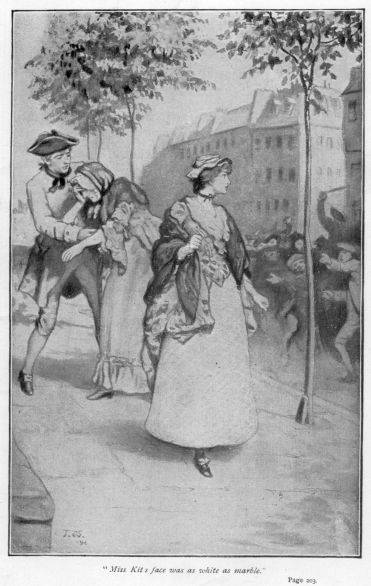
Just as this ghastly procession passed us, a missile, better aimed than most, sent the poor wretch staggering to his knees, and in the rush that followed he was happily hidden from our sight.
But the two poor ladies had seen enough. Miss Kit’s beautiful face was white as marble, her lips quivered, and her hands clenched in a spasm of self-control. Her mother, less strong, tottered and fell heavily on my arm in a faint.
It was a terrible position just then, for to be suspected of pity for a condamné was an offence which might easily place the sympathiser on the tumbrel beside the victim. I observed one or two faces—brutal, coarse faces—turned our way, and overheard remarks not unmingled with jeers on the lady’s plight. Happily for us, a new humour of the crowd, to make their poor prisoner dismount and carry his own guillotine, swept the crowd in a new direction, and in a moment or two left us standing almost alone on the path.
It was some time before my lady could recover enough to leave the place. Still longer was it before we had her safe in the attic on the Quai Necker; and ere that happened more than one note of warning had fallen on my ears.
“Save yourselves; you are marked,” whispered a voice, as we came to the Quai.
I looked sharply round. Only a lame road-mender was in sight, and he was too far away to have been the speaker. The voice was that, I thought, of a person of breeding and sympathy, but its owner, whoever he was, had vanished.
“There they are,” said another voice as we entered the doorway.
This time I saw the speaker—a vicious-looking woman, who stood with her friend across the road and pointed our way with her finger.
“So,” thought I, as Miss Kit and I carried our fainting burden up the stairs, “we have at least one friend and one enemy in Paris.”
Not a word did my little mistress and I exchange as we laid my lady on the bed, and took breath after our toilsome ascent. She tried to smile as I left her to the task of restoration, and retired to my kitchen to prepare our scanty breakfast.
While thus occupied I was startled by a tap at the window, followed by a head which I recognised as that of the road-mender I had lately seen. He must have crawled along the parapet which connected the houses in our block, or else have been waiting where he was till he could find me alone.
His cap was slouched over his eyes, and his face was as grimy as the roads he mended. His finger was raised eagerly to his lips as he beckoned to me to open the sash.
An instinct of self-preservation impelled me to obey. He clambered in and shut the window behind him. Then, turning to face me, I encountered a double shock. The lameness had gone; the figure was erect; the face, in spite of its grime, was youthful and handsome! That was the first shock. The second was even greater. For I suddenly recognised in the form that stood before me my old acquaintance, Captain Lestrange himself.
Chapter Nineteen.
The courtyard of the Conciergerie.
“Hush!” said Captain Lestrange, before I could utter a word. “The ladies are not safe here; they are marked down by the spies. They must escape at once.”
“My lady is still in a faint,” said I.
“Faint or no, she must come. Tell them I am here.”
He spoke as a soldier with authority; and a pang of jealousy smote me as I looked at his handsome presence in spite of its disguise.
I went to my lady’s room and announced him. She lay half stupified, with her eyes open, her bosom heaving, and a choking sob in her throat. Miss Kit kneeled at the bedside and held her hand.
Both were too numb and dazed to express much amazement at the news I brought; and when Captain Lestrange followed me in, no breath was wasted on empty greetings.
“I lodge in an attic six houses away. If you could only get on to the roof,” said he, “you would reach it easily.”
“We are not far from the roof already,” said I, pointing to a corner of the ceiling through which, even as we spoke, flakes of snow were drifting into the room.
Captain Lestrange took a log of fuel and poked the hole, till it was large enough to let a person through.
He bade me tear the sheet, make a band of it, and fasten it round my mistress, while he clambered through my window on to the roof. It was a perilous climb, but the captain was lithe and active as a cat. In a minute we saw him looking in through the hole in the ceiling.
“Now hand me the end of the band,” said he, “and come here and help me to haul.—Nerve yourself, cousin, and all will be well.”
Between us, we had no difficulty in drawing the poor lady through the opening on to the roof; and when we let down the band for Miss Kit, her light, little form followed readily enough.
“Down,” said the captain, crouching in the gutter of the parapet and beginning to crawl along it.
We followed painfully and slowly, finding the journey very long, and expecting any moment to hear the pursuer behind.
Presently we came to a halt, and saw our conductor remove some slates and discover an opening into the house below.
Once more the linen band came into requisition. The ladies were lowered into the room. The captain and I paused to set the slates, so that no one should be able to detect the place of our entrance. Then he swung himself over the parapet on to the ledge of the little window below, bidding me follow. Next moment we stood, all four of us, in a tiny chamber, no bigger than a cupboard, with nothing in it but a little bed, a chair, and a shelf, on which stood a loaf and a bottle of wine.
“Welcome to my humble quarters, cousins,” said he. “They are neither large nor water-tight, but I natter myself they are airy and command an extensive view. We will be safe here till night, but then we must seek something more spacious and secluded.”
And with all the grace in the world, he poured out a glass of wine for my lady and begged her to drink it.
Presently Miss Kit said, with the first smile I had seen on her face that day,—
“I am too bewildered to ask questions, otherwise I should like to know how all this has come to pass.”
“Not now,” said he. “I am as bewildered and perplexed as you are.—Gallagher, go to your daily work, but return early; and bring with you,”—here he handed me a gold piece—“provisions for a journey.”
It was hard to be dismissed thus at a moment of peril. But my little lady’s words and the smile that accompanied them made up for it.
“Yes. Come back early, Barry. We shall feel short of a protector while you are away.”
And she held out her hand, which I kissed with a glare at the captain, who only laughed, and said,—
“Don’t forget the provisions.”
Little I thought as I groped my way down the tumble-down staircase how many weary months were to elapse before I was to hold that gentle little hand in mine again.
I had reached the stables, and was rubbing down a spent horse, when I became aware that a woman was standing at the gate. I recognised her at once as the woman who had pointed us out that morning when we entered our house, and my heart filled with forebodings as I saw her.
It was a relief when my employer presently ordered me to take a horse round to the house of a citizen in the suburbs. The woman had gone when I started, and after half-an-hour’s trot I almost dismissed her from my mind. My orders were, after delivering the horse at its destination, to return on foot, calling on my way at the hay merchant’s with an order. This I duly performed; and was hastening back by way of the Rue Saint Honoré, when two muskets were suddenly crossed in front of me, and a harsh voice said,—
“Regnier, you are arrested by order of the Committee of Public Safety.”
“On what charge?” faltered I.
“On the accusation of the Citoyenne Souchard, who denounces you as the friend of royalism and of the miscreant Bailly.”
“I am no friend of either,” I exclaimed. “I do not—”
“Silence! march!” said the soldier.
Resistance was hopeless, escape impossible. In a daze I marched on, pointed at and hooted at by the passers-by, amid cries of,—
“A bas les mouchards! Mort aux aristocrates!” (Saint Patrick! that I should be taken for an aristocrat.) “Vive la guillotine!”
I cared not what became of me now, but when presently my conductors actually turned towards the Island of the City, and I caught sight of the high roofs of the houses on the Quai Necker, a wild hope of seeing my little mistress once more took hold of me. Alas! it was but for a moment. The cold muzzle of the soldier’s gun recalled me to myself.
I longed to know if the accuser, who seemed to know my name and all my movements, had joined the names of the ladies in my denunciation. If so, woe betide them and all of us. In the midst of my trouble the one thought that cheered me, despite the pang of jealousy that came with it, was that they were not without protection; and that Captain Lestrange, who had shown himself so ready of resource in the morning, might succeed even without my help in rescuing those innocent ones from the bloody hands of “the terror.”
A chill went through me when it dawned upon me at last that I was being conducted to the fatal Conciergerie—that half-way house between life and death towards which so many roads converged, but from which only one, that to the guillotine, led.
An angry parley took place at the door between the jailer and my captors.
“Why here?” demanded the former; “we are packed to the bursting point.”
“To-morrow you will have more room by fifty,” said the other.
“This is not to-morrow,” growled the hard-worked official.
“The détenu is your parishioner,” said the soldier.
“It is scandalous the slowness with which the Committee works,” said the jailer. “Fifty a day goes no way; we want one hundred and fifty.”
“You shall have it, Citizen Concierge. Patience!—Now, Regnier, enter, and adieu,” said he, with a push from the butt-end of his gun.
Beyond entering my name and assigning me my night’s quarters, no notice was taken of me by my jailers. I was allowed to wander on into the crowded courtyard, where of the hundreds who prowled about like caged animals none troubled themselves so much as to look up at the new unfortunate. Men and women of all sorts were there: gentlemen who held themselves aloof and had their little cercle in one corner, with servants to attend them; rogues and thieves who quarrelled and gambled with one another, and made the air foul with their oaths; terrified women and children who huddled together for shelter from the impudent looks and words of the ruffians, who amused themselves by insulting them. Sick people were there with whom it was a race whether disease or the guillotine would claim them first. And philosophers were there, who looked with calm indifference on the scene, and jested and discussed among themselves.
Among this motley company I was lost, and, indeed, it would have troubled me to be anything else. I found leaning-room against the wall, and had no better wish than that the promised fifty who to-morrow were to feed the guillotine might count me in their number.
As soon as the short February day closed in, we were unceremoniously ordered within doors. Some of the more distinguished and wealthy retired to their private apartments; the women (though I heard they were not always so fortunate) were shut up in quarters of their own. Others retired in batches to chambers, for the use of which they had clubbed together in bands of twenty or thirty. The rest of us, comprising all the poorer prisoners, were huddled into great foul, straw-strewn rooms to sleep and pass the night as best we might.
Rough countryman as I have been, the thought of those nights in the Conciergerie turns my stomach even now. The low ceiling and small windows made the atmosphere, laden as it was with dirt of all sorts, choking and intolerable. The heat, even on a winter night, was oppressive. The noise, the groaning, the wrangling, the fighting, the pilfering, were distracting. Only twice in the night silence, and that but for a few moments at a time, prevailed.
Once was when the guard, accompanied by great dogs, made their nightly round, kicking us who lay in their way this side and that, and testing every bar and grating of our prison with hammers and staves. For the sake of the dogs, who were stern disciplinarians, we kept the peace till the bolt was once more turned upon us.
The other time the hush was of a more terrible kind, as I discovered that first night. A jangle of keys without imposed a sudden lull on the noise. The door opened, and in came the concierge and his turnkeys. Every eye turned, not on the man or his myrmidons, but on the paper that he held in his hand. It was the list of prisoners who to-morrow were to appear before the Tribunal—that is to say, of the victims who the day after to-morrow were to ride in the tumbrels to the guillotine.
A deadly silence prevailed as the reading proceeded, broken only by the agonised shriek of some unfortunate, and the gradual sighs of relief of those whose names were omitted.
The ceremony over, the door (on the outside of which a turnkey had chalked the doomed names) swung to, and all once more was noise and babel. The victims drew together, embracing their friends and uttering their farewells. The others laughed louder than ever, like schoolboys who have escaped the rod. Morning came, and with it the summons. Those who quitted us we knew we should never see again. They would spend that night in the dungeon of the condamnés; the next day the lumbering roll of the tumbrels would announce to us that they were on their way to the Place de la Revolution.
The first night, I confess, I was disappointed that the fatal list did not contain my name; but as days, and then weeks, and then months passed, the love of life rose high within me, and I grew to tremble for that which I had once hoped for. Day by day I scrutinised the new arrivals in the vague expectation of seeing among them those I loved best. But they never came.
I made few, if any, acquaintances, for I resolved to keep my mouth shut. Spies, I knew, infested the prisons as they did the streets, and many a chance word uttered in the confidence of the dungeon was reported and used as evidence against the victim. Now and again we were thrown into excitement by the arrival in our midst of some notable prisoner, before whose name, a few short weeks since, all Paris, nay, all France had trembled, but who now was marked down and doomed by his rivals in power. And sometimes rumours of convulsions without penetrated the walls of our cells, and made us hope that, could we but endure a while, the end of “the terror” was not far distant.
I remember one night when a new prisoner whispered to me that the great Robespierre, at whose nod any head in Paris might drop into the dreadful basket, had been blown upon within the walls of the Convention itself.
“Death is marked on his face,” said he; “and when he falls there is hope for us, for the people are sick of blood.”
Alas! this same poor whisperer heard his name called out that very night, and fell grovelling at my side, as if I could help him.
Still my name was held back. Either they had overlooked it in the crowd, or had marked it through as dead already, or considered it less important than others who had more pressing claims on the executioner’s knife.
Hope rose within me. I became so used to being passed that I ceased to expect anything else, and only counted the days till the blood-red cloud should have drifted past and left me free.
When, therefore, on the very night that news had come in that Robespierre had indeed fallen, and was even then before his judges, I heard the name “Regnier” read off the fatal list, I broke into a cold sweat of amazement and terror, and fancied myself in a dream.
My name was the last on the list. With a dreadful fascination I watched the turnkey chalk it on the door and the governor fold up his paper and stick it in his belt. Then as they turned to the door despair seized me. But before they could leave, a sudden clamour at the far end of the room detained them. One of the condemned, driven mad by the announcement of his doom, had sprung to the window and was tearing at the bars with such superhuman force that they promised at any moment to yield.
The jailer and his men made a dash to seize him, and in that moment I slipped out of the half-closed door, stopping only to wipe out my name with my cap as I passed, and crept into the courtyard.
No one could have seen my departure, for though I lay hid an hour under the shadow of the wall, and even saw the jailer and his men cross the court, there was no hue and cry or alarm of an escape. Nor, I surmise, did any one even of my fellow-prisoners, distracted as they were by their own concerns and the excitement of the madman’s attempt, miss me.
My only hope now lay in patience and prudence. To scale the wall I knew was impossible. To steal through the governor’s office would mean instant detection. But to wait where I was was my only chance.
I had studied the ways of the place enough to know that on the stroke of six the outer gates swung open to admit the carts which were to carry to the scaffold the victims of the day. I knew, too, since the horse-master I had served had often supplied carts on an emergency, that these vehicles were usually sent in charge of common carters, one man often being in charge of two or three. These men, having deposited their carts in the yard, were wont to go off to breakfast and return in an hour to convey their freight under an escort of Guards to the place of execution.
Their daily arrival was now so common an occurrence that it attracted little attention inside or out. Indeed, the gate was often left standing open a minute or two while some parley was taking place; for no prisoners were allowed in the court till after the departure of the procession, and no precautions therefore seemed necessary for closing it with special celerity.
This, then, was my hope. Could I but lie perdu beside the gate till the time of opening, I might in a happy moment slip out. As if to favour me, a cart of straw intended for the floors of the prison rooms had been admitted into the court the night before, and stood drawn up close to the gate. It was not difficult to conceal myself at the tail of this, under the straw, and so remain unseen, not only by the carters that entered, but by the turnkey that let them in. By equal good fortune, the owner of the cart had left his coat and whip and cap behind him, thus giving me just a disguise that suited me best.
The night—it was July then—seemed interminable; and with morning a drenching rain set in that found its way through the straw and soaked me to the skin. I heard the city without gradually waking up. Market-carts rumbled in the roads, the shrill cry of the street vendors sounded in the air, and above all was the heavy splash of the rain.
At last a long low sound fell on my ear, which I knew only too well to proclaim the approach of the carts crawling in our direction. Nearer and nearer they came till they stopped at the gate, and the familiar bell tolled out. I heard the footsteps of the warder plashing across the yard, growling at the rain. Then I heard the grating of the bolts as they were slowly drawn back, and the creaking of the gates on their hinges. Then the rumble began again, and one by one the carts drew up into the yard. There were eight of them, and as I peeped out I could see that the last three were all in charge of one driver, who rode on the leader. The warder, impatient to return to shelter, called to this man to see the bolts made fast after him, which the man, a surly fellow and hardly sober, grumblingly promised to do at his own convenience.
Now was my chance. I slipped from my hiding-place, clad in the driver’s blouse and peaked cap, with a whip over my shoulder and a straw between my lips, and strolled quietly and to all appearance unconcernedly out into the street. If any saw me come out, they probably set me down as one of the tumbrel drivers on his way to breakfast, and paid me no more heed than such a fellow deserved; indeed less, for on that day of all others Paris was in a tremendous ferment. The tocsin was ringing from the steeples, there was a rush of people towards the Tuileries, and cries of “A bas Robespierre”—the most wonderful cry Paris had heard yet.
In the midst of it all I walked unchallenged to the Quai Necker. Alas! any hopes I had of comfort there were vanished. The familiar top storey stood empty, with the hole still in the roof, and six doors away, where I had left them last, the attic was empty too.
Chapter Twenty.
A voice in the dark.
All Paris seemed up that morning, hurrying to the scene of the day’s wonder. There was a rumour of fighting in the streets, of guns being pointed against the sacred doors of the Convention, of tyrants fallen and heads to fall. To Paris, sick of blood and strained by terror, it seemed like the end of all things, and the people with one accord rushed eastward to witness the dawn of their new revolution.
I, who had had enough of revolutions, wandered disconsolately westward along the river-bank till the rush was over and the sounds behind me grew faint in the distance. Where next? I asked myself. Whether Citizen Robespierre fell or not, there was not much quarter to be hoped for by a runaway from the Conciergerie. Paris was a rat-trap still, and though large, I should be cornered sooner or later.
As I ruminated thus, I came to a bridge below which was moored a barge, laden with goods and spread over with its great waterproof sheet, ready to drop down the stream. How I envied the two men in charge of her, to whom the barrier of the city would offer no obstacle, and who were free to go in and out of the rat-trap as they pleased!
Apparently they were not so sensible of their good fortune as I was, for they were quarrelling angrily, and filling the air with their insults and recriminations.
“Villain! robber!” I heard one say, who seemed to be assistant to the other, “I demand what is due to me.”
“It will be paid you at Rouen, fool,” said the other.
“I shall not be there to receive it,” snarled the other. “I will have it here, or nowhere.”
“What, you will dare to desert! It is treason against the Republic whom we serve. I will denounce you.”
“Idiot, I defy you,” exclaimed the man, stripping off his jersey and flinging his red cap on the deck. “I spit on your Republic which does not pay its debts!”
“I promise you shall receive all arrears at Rouen,” replied the other. “I am under penalties to reach Havre in a week.”
The mutineer laughed savagely.
“Pay me what you owe me, and you shall reach it.”
“At Rouen,” persisted the skipper.
“No! here, I tell you.”
The skipper’s reply was to make a grab at his companion, who, however, was quick enough to elude him and jump ashore.
“There, thief and robber, villain and assassin, I wash my hands of you! I have done with you. Reach Havre when you like. Adieu!” and he spat at the barge.
The skipper looked as if he would have followed him, but thought better of it. He shrugged his shoulders and pulled out a cigar. The other, after standing insultingly on the bank for some minutes, heaping all sorts of imprecations and taunts on his late employer, swaggered away, and was presently caught up in a knot of belated sightseers hastening to the scene of the insurrection.
I waited till the coast was clear, and then descended to the river side.
“Citizen bargee,” said I, with a salute, “do you want a man to-day?”
The skipper looked up at me and took his cigar from his lips.
“Can you sail a barge?” said he.
“Ay, and tow it too if you like,” said I. “And as for wages, suit yourself, and give me what you like at the journey’s end.”
“I serve the Republic,” said the man.
“Vive la République,” said I. “She does not desert her sons.”
“Your name?” demanded he. “Belin,” said I, inventing a name for the occasion. “You are engaged, Belin,” said the skipper; “we start this minute.”
With a grateful heart I stepped on board and busied myself with casting loose the rope.
“Observe, Belin,” said my new master, noticing approvingly that at least I knew how to handle a rope, “your name under me is Plon, that of a vagabond scoundrel who has just deserted me, and who is named on the way-bill. There are his jersey and his cap; put them on, and keep your counsel.”
“Pardon, my captain,” said I, when I had obeyed him, “what is our business for the Republic?”
“We carry coats and boots for the Army of the North.”
“Long live the Army of the North,” said I devoutly.
We soon reached the bridge which marked the boundary of the city. Here our bill of lading was carefully scrutinised, and our cargo inspected to make sure we carried no fugitive hidden in the midst of it.
As for me, I took my skipper’s advice, and sat smoking my cigar and saying nothing while the ceremony lasted.
But when at length we were ordered to pass, you may guess how thankfully I cast off the rope and found myself gliding down the quick current of the Seine out of that horrible city in which for nearly a year I had been cooped, expecting every day to be my last I showed my gratitude by undertaking any hard work my skipper chose to put upon me; and when he found me so willing, and on the whole so handy, he was content enough, and we became tolerably good messmates. Only I had learned enough to keep my mouth pretty close respecting matters which did not concern me. I professed to know very little of what had passed in Paris during the past few months, and in what I did to agree entirely with the opinions of Citizen Benoit, my captain. I cumbered him with few questions or opinions of my own, and was never backward to take an extra watch or trudge an extra mile on the bank beside the occasional horses which here and there we engaged to help us on.
It was a tedious and dull journey, threading our way through endless twists and between numerous islands, halting only between the late summer dusk and the early summer dawn, quitting our barge only in search of provender or a horse, parleying only with officials and returning barges.
One or two of the skippers on the latter inquired of Benoit what had become of his former assistant, and alarmed me somewhat by questioning me as to my previous calling. But my skipper’s explanation was generally enough, and I was admitted into the noble fraternity of Seine bargees without much objection. The few who did object sailed the other way, so that their objection mattered little.
Our longest stay was at Rouen, where once more my master reminded me that I was Citizen Plon, and that my policy was to hold my tongue and lie low.
The police here were very suspicious, and insisted on searching our cargo thoroughly for fugitives, of whom reports from Paris said there were a good many lying hid in boats and barges.
However, they found none with us. How I toiled and sweated to assist their search! and what a reputation poor Plon acquired for zeal in the service of the Republic One and Indivisible!
After leaving Rouen we used our sail a good deal in the broad reaches of the river. Monsieur Benoit (who had quite forgotten my pay) was good enough to compliment me on my skill in handling canvas, and as we neared our destination his civility became almost embarrassing. He sought to engage me as his permanent lieutenant, and promised to make all sorts of excellent reports on my behalf to the officials. I humoured him as best I could; but the scent of the sea-breezes as we gradually reached the wide estuary and saw before us the masts and towers of the city of Havre, set me longing for old Ireland, and determined me, Benoit or no Benoit, to set my foot once more on Fanad.
I requested of Benoit a few days’ leave of absence, after our stores were duly delivered at the depôt, which he agreed to on the understanding that my wages should not be paid me till I returned to the barge. In this way he imagined he made sure of me, and I was content to leave him in that simple faith.
But now, as I wandered through the squalid streets of the city of Havre, and looked out at the great Atlantic waves beating in on the shore, I began to realise that France itself was only a trap on a larger scale than Paris. True, I might possibly find a berth as an able-bodied sailor on a French ship; but that was not what I wanted. As for English ships, it was a time of war, and none durst show their prows in the harbour, save under a false flag. Yet the longing for home was so strong in me, that I think, had I found one, I would even have seized a small rowing-boat and attempted to cross the Channel in it single-handed.
For two days I prowled hither and thither, vainly looking for a chance of escape, and was beginning to wonder whether after all I should have to return to Benoit, when I chanced one evening on a fellow who, for all his French airs and talk, I guessed the moment he spoke to be an Irishman. He was, I must confess, not quite sober, which perhaps made him less careful about appearances than he should have been.
It was on the cliffs of La Hève we foregathered. He was walking so unsteadily on the very margin that I deemed it only brotherly to lend him an arm.
“Thank you, my lad,” said he, beginning the speech in French, but relapsing into his native tongue as he went on; “these abominable French cliffs move about more than the cliffs at Bantry. Nothing moves there—not even custom-house runners. Bless your dear heart, we can land our bales there under their very noses! Steady, my friend, you were nearly slipping there. You French dogs never could walk on your hind legs. There she lies, as snug and taut as a revenue cutter, and just as many teeth. What did I come ashore for now? Not to see you, was it? ’Pon my word, monsieur, I owe you a hundred pardons. I quite forgot. You look a worthy fellow. I press you into the service, and the man that objects shall have an ounce of lead through him. Come, my lad, row me aboard. The anchor’s apeak, and we’re off for the ould country, and a murrain on this land of yours!”
So saying he stumbled along, down a zigzag path that led to the foot of the cliff, where lay moored a small boat and two men in her.
“Belay there, hearties! I’ve got the villain. Clap him in irons, I say! He tried to send me over the cliff, but— how are you, my friend? Give us your hand. You’re one of the right sort.—Pull away, boys. The wind’s in the east, and the tide’s swung round the cap. This time to-morrow we shall be scraping the nose of ould Ireland—glory to her!”
The men, who evidently were used to their captain’s eccentricities, made no demur, and laid on with their oars. Presently I volunteered to lend a hand, which was readily accepted. The captain meanwhile lay in a comfortable slumber in the stern-sheets, uttering occasional greetings to the world at large, and to me in particular.
“Where does she lie?” said I presently to the man in front of me in plain English.
He turned round sharply.
“What! you’re not a Frenchman then?” said he.
“Heaven forbid! I’m as good an Irishman as you.”
“How came you to know Captain Keogh?”
“Sure he found me out and engaged me.”
“It’s no lie,” gurgled Captain Keogh from the bottom of the boat. “I should have been over but for him. Enter him as sailing-master or cook, for he’s the right sort.”
“We’re for the Kestrel. She lies a mile or two up the coast, with a cargo for Bantry.”
“Lace; I know that. I’ve been in the business before,” said I.
This completed my recognition as a proper shipmate, and no more questions were asked.
When we reached the Kestrel it was pitch dark, but we could tell by the grating of the chain as we came up that no time was to be lost in getting under way.
Not a light was shown, only a whistle from our men, answered by another from the ship and a voice over the bulwarks,—
“Boat ahoy!”
“Kestrel ahoy!” sang out our men, and in a moment a rope was thrown to us and we were alongside.
Captain Keogh, happily asleep, was hauled up the gangway, and we followed.
“A new hand, lieutenant,” said my comrade, pointing at me with his thumb over his shoulder.
“All right. Send him forward to help with the anchor.”
At the sound of this voice in the dark I staggered like one struck. It called to mind days spent under the drifting clouds at the edge of Fanad, boyish quarrels and battles, winter nights over the peat fire of our little cabin. Who but Tim had that ring in his voice? Whose voice, if it was not his, could set my heart beating and swelling in my breast so that I could scarcely hold it?
Just now, however, I was hurried forward to the business of weighing anchor, and the lieutenant had gone aft to take charge of the helm.
In a minute or two the Kestrel floated free on the water. The sails spread out to the wind, the welcome splash of the bows proclaimed that we had way on us already, and the twinkling lights of Havre in the distance reminded us that France, land of terrors, was dropping astern at every pitch we took.
But the excitement of all this was as nothing to the echo in my ears of that voice in the dark.
Chapter Twenty One.
The wreck of the “Kestrel.”
The crew of the Kestrel consisted of less than fifty men, most of them Irishmen. While the work of setting sails and making all snug lasted I had little chance of looking about me, but the impression I formed was that the schooner was not at all worthy of the praise her tipsy captain had bestowed upon her. She was an old craft, with a labouring way of sailing that compared very unfavourably with the Cigale or the Arrow. Her guns, about a dozen in all, were of an antiquated type, and badly mounted, and her timbers were old and faulty. As long as we had a sharp east wind astern we had not much to concern us, but I had my misgivings how she would behave in dirty weather with a lee-shore on her quarter.
That, however, concerned me less just then than my impatience to get a glimpse of the face of the lieutenant. I volunteered for an extra watch for this purpose, and longed for some excuse to take me aft.
Sure enough it came. The same voice rang out again through the darkness:—
“Hand there! come and set the stern light.”
“Ay, ay, sir,” cried I, hurrying to the place.
For the first hour or so after slipping our moorings off Havre the Kestrel had remained in perfect darkness. But now that we were beyond sight of the lights ashore there was no occasion for so dangerous a precaution. I unlashed the lantern and took it down to the galley for a light, and then returned with it to the helm.
As I did so I could not help turning it full on the face of the man at the tiller.
Sure enough it was Tim, grown into a man, with down on his chin, and the weather wrinkles at the corner of his eyes. Every inch a sailor and a gentleman he looked as he stood there in his blue flannel suit and peaked cap; the same easy-going, gusty, reckless Tim I had fought with many a time on Fanad cliffs, loving him more for every blow I gave him. When I thought I had lost him, it seemed as if I had lost a part of myself. Now I had found him, I had found myself.
“Look alive, my lad,” said he.
Without a word I fixed the light in its place. I had never, I think, felt so shy and at a loss in my life.
At last I could stand it no longer.
“Tim, old man, is that really you?”
He staggered at the sound of my voice, just as I had staggered at the sound of his, and let go the helm.
“Saint Patrick! it’s Barry.”
And I felt his hand on my shoulder, and heard him give a little laugh of wonder.
“Fetch that light! Let me have a look at you!”
I obeyed, and it would be hard to say which side of the lantern, as it swung between us, witnessed the greatest wonder.
“Look to the helm,” said I. “She’s falling off a point or two.”
“Ha, ha!” said the joyous Tim, “to think of me manning the helm with you on the ship. Take you it, you dog you, and spin us your yarn.”
“Not till you tell me how you came to life again. I heard the Cigale was lost with all hands.”
“Except one,” said Tim. “Father might have escaped too, but he was so ashamed to have run the ship on the rock that nothing would drag him from her. I held on to a spar for a whole day, and drifted to within a swim of Tory Island, where for a whole month I waited to get across. I heard you had been drowned in the Swilly, and Knockowen was empty, so I made my way to Sligo, and Keogh, an old mate of father’s, gave me a berth on this crock of a boat. As I could talk French and knew something of the business, he called me lieutenant—me that hates the sea like the very mischief, and French lace worse than that! I tell you, Barry, even if I hadn’t found you, this would have been my last voyage. There’s other work for you and me.”
“What work is that?”
“The work of Ireland! There’s a new age dawning there, and you and I will be in it. The chains are dropping right and left, and the poor prisoner is struggling from his knees to his feet. We shall live in a free country of our own before long, Barry, my boy—free because she has learned to help herself, and will remain the plaything or the slave of others no longer. France is free; she has learned to help herself. We in Ireland have our Bastille to storm and our feudalism to destroy.”
He spoke with a glow on his cheeks and a fire in his eyes that quite took me aback, and made it hard to recognise the Tim of old days.
“I could tell you something about this glorious freedom in France,” said I, with a jerk of my head in the direction of that accursed land.
“You shall; and mark me, Ireland will not be a pace behind her.”
“God forbid!” said I.
“But you haven’t told me your story yet,” said he, carrying the lamp back to its place, as if he were the seaman and I at the helm the officer.
Then I told him all, not omitting my love for Miss Kit, or my disgust for the Republic One and Indivisible.
He heard me with evident disquiet.
“I am sorry about the girl,” said he bluntly. “She may be all you say, but Ireland wants you heart and soul just now. It is no time for dancing attendance on ladies.”
“For all I know she lies buried under the guillotine,” said I.
“Oh no, she does not,” said Tim. “She and her mother are back at Knockowen, so I was told a month ago, before we sailed on this voyage.”
I seized his hand so eagerly at this news as almost to startle him.
“Watch her helm, she’s falling away,” said he, almost sharply. “Ay, she’s back, but no nearer your reach for that. I hear Gorman has become a rich man since. The English estates that belonged to the master of Kilgorman have yielded a great profit, and besides that he has got hold of the Lestrange property too. The young lady is an heiress, and this Captain Lestrange you spoke of, who saved them out of Paris, is not likely to lose the chance of getting a wife and his family estates back into the bargain. Don’t be a fool, Barry. You and I are only sailor lads. It does not become us to be hankering after heiresses. But the freedom of Ireland we may and must strive for; and, Barry, brother,” (and what a whack he caught me on my back), “we’ll get it!”
I turned in that night with my head in a whirl. It seemed as if every joy I had was destined to crumble in my hand. No sooner had I found my little lady in Paris than a cruel hand swept us asunder. No sooner had I found my brother than I found him estranged from me in a hopeless cause. No sooner had I heard of the safety of her I loved than I heard she was lifted further out of my reach than ever. I could have wished I had never met Tim again. I should at least have slept better had I lain in my bunk with no thought but that of the French coast dropping league by league astern. Now, even Ireland seemed to have its terrors ahead.
But sleep came to my rescue, and with sleep came courage and hope. Why should I be afraid? What had I to hang my head at? Was I, who had come through a reign of terror, going to mope at troubles in advance? Sufficient unto the day should be the evil thereof!
So I met Tim with a smile in the morning, and asked him to report me to Captain Keogh.
That worthy officer had quite slept off the debauch of last night, and was apparently looking forward to the next, for a bottle of rum stood on the cabin table. He had not the slightest recollection of me, but when he heard I was his lieutenant’s brother, he poured out three glasses and proposed luck all round.
“Sit down, Gallagher,” said he to Tim. “I can’t ask your brother to sit, for the sake of the discipline of the ship; but I’m pleased to see him, and if he’s a handy lad like you I’ll make a seaman of him.”
“Barry’s worth any dozen of the likes of me,” said Tim, “when it comes to sailing. If any one can get an extra tack out of the old Kestrel, he can.”
“Don’t talk disrespectfully of your ship, lieutenant,” said Captain Keogh. “To be sure, the carpenter has been pestering me this morning about the timbers; but I told him he’d probably only make things worse by patching. You can’t put new wine into old bottles, you know,”—here he poured himself out a fresh glass—“and we shall hold well enough together till we reach Bantry.”
“Sligo,” said Tim.
“Well, Sligo. We must keep clear of French privateers and give the coast a wide berth. That’s the very thing. This wind must have been turned on to suit us. I positively thought the Kestrel was sailing fast to-day.”
“She’s well enough as she is, but if we get into dirty weather, we ought to run in for the nearest port we can reach.”
“We are much more likely to run into dead calms, and have to sit whistling for the wind—dry work at best, but in this weather terrible.” And he gulped down his rum, and nodded a dismissal.
The captain’s forecast, as it turned out, was pretty near the mark. Off the Cornish coast we fell into a succession of calms, which kept us practically motionless for half a week. Even the light breezes which would have sufficed to send the Arrow spinning through the water, failed utterly to put way upon our cranky tub; and every day the carpenter was growing more persistent in his complaints. At last Captain Keogh ordered him to do what he pleased so long as he held his peace, whereupon the sound of hammering and tinkering might be heard for a day across the still water.
During these lazy days, Tim and I talked a great deal. He was full of visions and hopes of an emancipated Ireland, and all the glories which should belong to her.
“Think of it, Barry. Every man’s land will be his own. We shall have our own army and navy. There will be no England to tax us and bleed us to death. We shall have open arms for the friends of liberty all the world over. Irishmen will stay at home instead of carrying their manhood to foreign climes. Nay, we shall stand with our heel on the neck of England, and she who for centuries has ground the spirit out of us will sue to us for quarter.”
“How will you manage all this?” said I.
“The people are armed, only waiting the signal to rise and throw off the yoke. England is not ready, she is beset on all sides, her fleet is discontented, her armies are scattered over Europe, her garrison in Ireland is half asleep. Our leaders are only waiting their time, and meanwhile Irishmen are flocking to the banner daily. And more than that, Barry,” added he, with a thump on the bulwark, “at the first blow from us, France will be ready to strike for our liberty too. I know that for certain, my boy.”
“France!” said I. “If there are innocents to be slaughtered, and blood to flow, and fiends to be let loose, you may depend on her.”
“She at least is more our friend than men like Gorman, who one day, when they are poor, with nothing to lose, are for the people, and the next, when they are rich, are for the crown and the magistrates and the Protestant ascendency. It will be a sorry look-out for such as these when we come into our own.—There comes a breeze surely!”
“South-easterly,” said I; “that will suit us.”
It was a moderate breeze only, but it brought us on our way opportunely, until one day, as we looked out, there was land on our weather-beam.
Then fell another calm, longer and more dead than the last. The sea was like glass, the horizon hazy, and the heat oppressive. The carpenter, as now and again he looked up at the lifeless sails, muttered between his teeth.
“I hear,” said Tim, “our timbers above the water-line have sprung here and there. The old tub is quite rotten, and every day we lie idle like this she grows worse.”
“This time to-morrow, by all signs, we shall not be lying idle,” said I, glancing up at the metallic sky, and following the line of a school of porpoises as they wheeled across our stern.
“So much the better. We must run before the wind wherever it comes from. We could not live through a cross-sea for an hour.”
The storm came sooner than I expected. The metallic sky grew overcast, and a warning shudder fell over the still surface of the water. Then a sudden squall took us amidships, and sent us careening over on our beam, before we even knew that the calm was at an end.
We had no more than time to shorten our courses and turn her head, when the tempest struck us from the south-west, lashing up the sea at our stern, and making our cranky masts stoop forward and creak like things in mortal pain.
The carpenter’s face grew longer than ever.
“For mercy’s sake, captain,” said he, “keep her in the wind, or she’ll crack to pieces. You can’t afford to take a point. We’re only sound under calm water-line; above it, she’s as thirsty as a sieve.”
“More shame to you,” growled Captain Keogh. “We’re all thirsty here.”
“You’ll have water enough presently,” muttered the carpenter to himself as he went below.
“Gallagher, you and your brother take the helm. Keep her out a taste, whatever yonder fool says. My! she’s spinning along for once in a way. At this rate we shall make Achill by night.”
“Better try for Galway, sir,” said I.
“Hold your tongue, you French fool,” cried the captain, who was greatly excited. “Save your advice till it’s asked, or go aloft.—I tell you,” said he, turning to Tim, “it’s Sligo or nowhere. There’s not a cruiser there to interfere with us, or an exciseman that we can’t square. I reckon there’s profit enough in this lace to pay an admiral’s prize-money. Galway! You might as well try to land at London Bridge.”
Here the carpenter once more rushed on deck. He looked up at the canvas, then at the compass, then at the helm.
“I declare, after what I told you, you’re two points out of the wind, sir. The ship won’t stand it, I tell you. She’s leaking already. You need all that canvas down, and only your jibs and foresails; and even then you must let her run.”
Captain Keogh turned upon him with a torrent of abuse.
“Saints help us! Am I the captain of this ship, or are you, you long-jawed, squint-eyed, whining son of a wood-chopper you? First it’s a French stowaway wants to tell me my business, then it’s you. Why doesn’t the cabin-boy come up and take charge of the ship? Way there take in the courses, and let the helm go. Give the fool what he wants, and give me a dram for luck.”
All that day we flew through the water in front of as fierce a south-wester as I was ever out in. The carpenter reported that the pumps were holding their own and no more, but that a dozen cross-seas would split us open like rotten medlar. When night fell, the weather promised to grow worse, and the rain and hail at our backs made it almost impossible to keep up our heads.
“It’s all very well,” said Tim, who had been down to the cabin to inspect the chart, “but this can’t go on. We’ve had water-room all day, but I reckon we are closing in on the land every yard now, and if we don’t put out her head we shall find ourselves on the Connemara coast.”
“Better run for Galway, and say nothing,” said I.
“Too late now. I wish we had.”
“Out she goes then,” said I; “it’s a question between going down where we are or breaking to pieces against Slyne Head.”
“That’s just it,” said Tim. “The captain’s dead drunk below. Call all hands aft, Barry; let them choose.”
The men crowded aft, and Tim spoke to them.
“We’re in for an ugly night, my lads, and we’re on a rotten boat. The carpenter says, unless we run before the wind, we shall go to pieces in half-an-hour. I say, if we do run, we shall be on Slyne Head in two hours. Which shall it be? I don’t mind much myself.”
“Put it to the vote,” said one.
So a vote was taken, and of forty men who voted, twenty-five were for death in two hours, and fifteen for death in an hour.
“Very good,” said Tim. “Get to your posts, and remember you are under orders till we strike. Then shift for yourselves; and the Lord have mercy on us all!”
“Amen!” said the sailors, and returned to their duties.
It was a terrible night, and, to make matters worse, as black as pitch. We should not even have the help of daylight for meeting our doom.
“Barry,” said Tim, “I don’t think we shall both perish. If it’s I, promise me you will fight for Ireland till she is free.”
“If you die, Tim, I don’t care what I do. I promise. And if I die, promise me—”
“Not to go near that girl?”
“No,” said I, with a groan.
“What, then?”
“Search below the great hearth at Kilgorman, and do whatever the message you will find there bids you. It is not my message, but our mother’s.”
“I promise that. But hold on now,” said he, catching me by the arm, “the old ship’s beforehand with us. She’s going to pieces before we reach shore.”
Sure enough she was. The rough water into which we were plunging loosened her already warped timbers, and she gradually ceased to rise on the waves, but settled down doggedly and sullenly as the water poured in on this side and that and filled her hold. Captain Keogh, suddenly roused to his senses, staggered on deck, and took the helm, not for any good he could do, but from the sailor’s instinct to be at his post at the end.
All hands came on deck, and the order was given to lower the boats. For the credit of these Irishmen be it said that no man stepped in till he was ordered by name. The first boat capsized before she even reached the water, and swung with a crash that shivered her against the side of the ship. The other was more fortunate, and got clear just before we foundered.
Tim, who might have joined it, preferred to stand by me. The other men provided themselves with spars or corks, and prepared for the end.
“Keep near me,” said Tim with a tremble in his voice, not of fear but of affection.
That was all I heard; for at that moment the Kestrel gave a dive forward, which cleared her decks, and sent her, captain, lace, and all, to the bottom.
“Jump!” cried a voice at my side.
I felt an arm round me as the water closed over us; and when, struggling hard against the suck of the foundering ship, I rose to the surface, Tim was beside me with one arm still round me, the other clinging to a floating spar.
Chapter Twenty Two.
On His Majesty’s Service.
How long Tim and I clung to the spar I know not. The next thing I remember was opening my eyes and finding myself in the bottom of a boat crowded with men from the Kestrel. The sea was running mountains high, and the boat, without rudder or oars, was flung like a cork from wave to wave. The dawn was just beginning to show in the sky, and the thunder of surf and wind was deafening.
“Where is Tim?” said I.
No one heard me, or, if they heard, heeded me. I raised my head and looked anxiously from one to another of my comrades.
“Where is Tim?” I asked again, louder, and with a pluck at the sleeve of the man nearest me.
“Where all the rest are,” replied the man, “if you mean the lieutenant.”
I crawled from where I lay and came beside him on the bench.
“Drowned?” I asked.
“There was only room for one of you when we picked you up. He made us take you, and it was all we could do to get you aboard.”
“And Tim?”
“We gave him a rope to lash him to his spar, and lost sight of him.”
Half-drowned and bruised as I was, this blow sent me back to the bottom of the boat like one already dead. What had I to live for now?
When I came to myself next a change had come over the scene. The sea had quieted down, the afternoon sun was striking across the waves, and ahead of us, on the northern horizon, was a low, grey line of coast.
But it was not at that that all eyes were turned, but at a noble-looking ship hove-to in the offing, not a mile away, and flying a signal from her peak.
Our men had sighted her an hour ago, and rigged up an oar with a rag at the end, which the ship had observed. And what all eyes were now intent on was her pinnace, as she covered the distance between us.
It was always my luck to be rescued when I had least heart for life, and I confess if I had seen the boat capsize that moment I should have been well enough pleased.
But she had no notion of capsizing. Long before she came up we could see that she was manned by smart English blue-jackets, and belonged to a line-of-battle ship in the king’s navy—one of the very ships, no doubt, that Captain Keogh had been so anxious to avoid in Galway Bay.
Half-an-hour later we were on the shining deck of his majesty’s ship Diana, thirty-eight guns, standing out, with all sails set, for the wide Atlantic. My comrades were too thankful to find themselves alive, with food to eat and dry clothes to put on, to concern themselves as to the ship’s destination. But I, who yearned to know and share the fate of those I loved, groaned as I saw the coast-line drop astern, and realised that, after all, I was as far from home as ever.
As soon as we were revived and fed—and I am bound to confess we were humanely treated in that respect—a ship’s officer came forward and questioned us.
I, as brother to the lieutenant, was put forward to answer; and I told him all, not omitting our contraband cargo, or the manner of my own joining the Kestrel.
“Well, lads,” said the officer, “you’ve paid for your bit of fun. If the Diana had had her full complement of men, you might have been whistling in the breakers still. Now you belong to his Majesty, and your names are entered on the books of his ship. It’s more than you deserve, but that can’t be helped. Report yourselves to the boatswain.”
“Begging your pardon,” said I, “I have business in Ireland that presses, and—”
“Hold your tongue, sir,” said the officer, turning on his heel.
The land was now out of sight; the ship’s course was due west; every sail was full. The boatswain’s whistle was calling to quarters. Tim, and Miss Kit, and Fanad, and Kilgorman were part of an ended life. There was nothing for it but to grin and bear it.
So I reported myself, and wrote my name on the books, and became a servant for life of his Majesty.
Now it is no part of my story to relate all that happened to me during the year or two that followed. Not that it was without adventure or peril, or that it would not bear the repetition. On the contrary, if I only knew how to write a book (which none of those who read what I have written so far would be cruel enough to impute to me), I could fill a volume with adventures which not many sea-dogs could show a match to.
But somehow those years, save in a few particulars, never seemed to rank as part of my life. Just as when you come to the old cabin at Fanad, and want to reach Kilgorman, you find a mile or two of water in your way, which, though it has to be traversed, belongs neither to one side nor to the other, so I reckon those years as years by themselves, making only a break in the coast-line of my story.
The Diana, spent most of her time in foreign waters, whither no news of any of those I desired to hear of reached me. For a year we cruised in the West Indies, fighting Frenchmen and yellow fever and pirates. Then a summons came to take a convoy into Indian waters, where we were engaged in protecting English merchantmen from the depredations of French and Spanish privateers. Then, just as the welcome order to return to Europe arrived, an engagement in the Persian Gulf disabled us, and compelled us to put into the nearest port for repairs. And before we were fit to sail again, a sudden demand for reinforcements in the West Indies called us back there, where we fought the Frenchmen every other day.
That was the one part of the business I liked best. Every broadside we poured into the enemy helped to wipe out my scores against the Republic One and Indivisible. I am told I distinguished myself more than once in the course of the cruise, though I can take little credit to myself for disinterested gallantry if I did. I had only to call to mind the vision of my dear little mistress as I saw her last, pale and scared in the squalid attic in the Quai Necker, with her bright eyes turned on mine, with her hand on my arm, and her voice, “Come back early, Barry,” to make a demon of me, as with my cutlass in my teeth I sprang on to the enemy’s rigging, and dashed for his hatchways.
I cared so little for my life in those days that I was ready for any reckless or desperate adventure, and was pretty sure to be selected as one of the party when any specially critical exploit called for volunteers. If I bore a charmed life it was no credit of mine, and if I had more than my fair chance of distinguishing myself it was because the adventure always comes to the adventurous, not that I was greedy of what belonged to others.
On one occasion—it was an evening towards the end of our long term of service in foreign waters—I found myself not only lucky but famous, in a way I had never dreamed of. We were lying off Chanson, a French island, embayed by a strong gale of wind, and uncomfortably near the range of a fort, with which for some hours we had been exchanging distant shots of defiance. Captain Swift, our commander, would have liked, had it been possible, to secure himself more sea-room; but as the wind then blew it did not seem safe to attempt to shift our anchorage, and incur the risk of getting further under the guns than we were.
Captain Swift was in the act of debating with his officers as to the advisability of sending an expedition ashore to deal with the fort, when the look-out man announced two French sail in the offing bearing down on us.
This decided the question. To stay where we were was to wait to be caught between the two fires of the ships and the fort. We must get out of the bay somehow, and to do it we must make a desperate effort to silence the fort.
Two boats were ordered out, each in charge of a midshipman and a petty officer. Twenty men were told off for each boat. Our instructions were, as soon as night fell, to put off for shore, land at two different points a mile apart, and approach the fort from opposite sides. The Diana, meanwhile, was to slip her cables and attempt the perilous feat of warping out of the bay, so as to be ready for the French ships.
Much depended on the promptitude and success with which the expeditionary force tackled the fort. For if morning dawned with its guns on our lee-side and the two enemies to windward, there was little chance of getting out of the dilemma.
The lieutenant in charge of the first boat selected me among his crew. With cutlasses and pistols in our belts, a coil of rope over our shoulders, and spiking gear handy, we took our places silently, and waited impatiently for the dark. The sun as usual in those parts toppled down suddenly into the sea, and almost before the last edge of his orb dipped, we were on our way for the shore. Our only difficulty in landing was the heavy surf, which nearly stove in our boat. We managed to beach it, however, without much damage, and then started at a run for our destination.
Before we reached it we heard shouts and the sharp crack of muskets, which told us our manoeuvre had been detected and prepared for.
Then followed a regular race, led by the officers. While some fell, others would get in; but that we should all return to the Diana was not to be hoped for.
The guns of the fort were so placed that once under them they could do little harm. Our danger came from the enemy’s infantry, who were evidently in reserve to protect the guns.
Now I had spent part of the day in carefully studying the fort through a telescope, and had come to the conclusion that a few nimble fellows, by aid of ropes and the trees whose branches almost overhung the wall behind, could enter it by the rear, and possibly, by creating a diversion in that quarter, help the main body who attacked it from the front. As soon as the order for a rush was given, I called on a few of my comrades—among them one or two of the Kestrel men—to follow me and make the attempt. We made a long détour, and, as I expected, found little or no difficulty in reaching the trees.
Once up these, it was not a very difficult feat to swing ourselves on to the top of the broad wall and so gain the yard, where we could even now see the gunners hard at work.
“Now, lads,” whispered I, “each pick your man, fire when I give the signal, and then for the guns.”
There were but six guns, each manned by two men, and so intent were they on the attack in front that they had not so much as the tail of an eye for the rear. There were five of us in all. We kept well in the shadow till we covered each our man. Then I gave the signal. The pistols rang out, followed by a loud British cheer, as we rushed forward, cutlass in hand, on the gunners. Aided by darkness and surprise, and the good aim of our first volley, we were soon on equal terms as regarded numbers; and after that there was of course no question as to whom the guns belonged. Two of our fellows were killed and one wounded, leaving but me and one other to haul down the French flag.
Our orders had been to spike the guns, but as things had turned out it seemed better now to hold them, and if possible turn them on the enemy. All had been done so quickly that those without knew nothing of what had happened. We could hear the firing grow feebler and more distant, and guessed that our men had been outnumbered, and were being chased down to their boats. In the present darkness we could do nothing to help them; for even if we could have lowered the guns enough to cover them, our shot might have hurt them more than the enemy.
Our only hope was in the faint glow of dawn on the horizon, and the prospect, in a few minutes, of sufficient daylight to work by. Meanwhile we loaded, and reconnoitred the fort, in readiness for the moment of action.
Day came at last, and showed us the Diana with the two French ships close-hauled, trying to keep their weather-gage. Our men ashore were still hemmed in between the fort and the troops, who, now we came to look at them, were posted in force behind some earthworks which commanded the passage from the shore to the fort. One of our boats was stove in, and the other was in the hands of the enemy.
Without a glass it was hard to read the signals on the Diana; but she must have noticed that the French flag on the fort was down, for we saw her set her sails and prepare to meet her two assailants in the open. If she could only get the weather-gage, we would startle the Frenchmen in a way which would amaze them.
As for our own fellows ashore, a pounding shot from one of our guns, which we contrived to lower sufficiently to command the earthworks, soon apprised them what was in the wind, and with a rush they made for the now friendly fort. The enemy followed, but too slowly to prevent their entrance. The few shots they sent were wild and high. Only one took effect, and that, alas! was on my faithful comrade; so that when the gate was opened, I was the only man left to hand over the fort to his Majesty’s officers.
After that, we made short business of the Republic One and Indivisible in the island of Chanson. The Diana slipped out cleverly in the wind’s eye, with a broadside a-piece to her opponents, who, when they found themselves caught between the two fires, thought better of their enterprise, and tried to get out of it.
Only one of them succeeded; and our fellows spent a merry morning and afternoon with the other, boarding her and running the king’s flag to the top of her mainmast.
This adventure—though, as I say, I deserved no more credit for it than the score of gallant fellows who lost their lives—gained me no small renown; and when presently the Diana was ordered home to British waters, one of the first pieces of news that met me when we landed at Portsmouth was that I had been recommended to the Admiralty as a suitable person to receive his Majesty’s warrant as boatswain to my ship. Meantime, as necessary repairs to the Diana would necessitate a full month in dock, leave of absence for a week or two was granted to most of her crew in consideration of their long service.
Chapter Twenty Three.
Lord Edward.
Captain Swift, himself an Irishman, when he understood that I was desirous of spending my leave of absence in Donegal, was gracious enough to appoint me his secretary for the time being, and thus made easy what might otherwise have been a difficult journey. The captain’s destination was a few miles south of Derry, where his family resided, so that I was brought well on my way.
Our journey took us through Dublin, in which city the captain remained some days, to confer with the naval authorities there as to the future service of the Diana in Irish waters. During that short halt I had time to look about me, and form some impressions of a place of which I had so often heard but never yet seen.
I am not going to trouble my readers with those impressions. Indeed, when it came to looking about me, I found my attention taken hold of by matters far more important than streets and edifices.
On the day before our departure for the north, one of my first errands was to the coach-office, to engage places for the captain and myself for the journey. I had done this, and was about to quit the yard, when a private travelling coach, evidently about to start (for it was piled with baggage on the top), drew up at the gate, to take on board a sack of corn for the horses.
It was evidently the equipage of a wealthy man. Two passengers were inside—a lady and a gentleman—both well cloaked, for it was a cold spring day. I could not see their faces, and should probably not have troubled myself twice about them, but for two strange incidents which happened, just as, having taken up what they called for, the carriage started on its journey. A man on the pavement, who had evidently been watching the halt, uttered a howl of execration and shook his fist at the window. A moment after, a young gentleman of military bearing, mounted on a grey horse, cantered up the road and overtook the coach on the other side. He carried a small bunch of flowers, which he stooped to pass in at the window to the lady, receiving in exchange a wave from one of the prettiest hands I ever saw. Next moment the coach was rattling down the street; and the gentleman having accompanied it a short distance, kissed his hand and wheeled up a side street and disappeared.
Unless I was greatly deceived, that gentleman was Captain Lestrange.
“Who are the travellers?” said I to the man who had shaken his fist.
He was apparently a countryman, dressed in an old frieze coat, with a slouching hat.
He ground his teeth as he turned on me.
“The greatest villain on earth,” said he. “I know him.”
“I suppose so,” said I, “or you would hardly excite yourself about him.”
“Excite, is it? Man, dear, if there is a Judas on this earth, that’s him! Excite? you’d be excited too.”
The man talked like one tipsy, but I did not think it was with drink.
“What has he done to you?” said I.
“Done? Isn’t that the boy who’s lured us all on, and then comes to Dublin to denounce us? Man alive, did you never hear of Maurice Gorman in your life?”
It was as much as I could do to stand steady under this shock.
“I was never in Dublin before,” said I; “how should I? Is he an Englishman?”
“Englishman? he’s worse. He’s an Irish traitor, I tell you, and feeds on the blood of his people. He was the toad that made fools of us all, and wormed himself into our secrets, and then turned and stabbed us in the back. But we’re not dead yet. We’ll be even with him.”
“Where has he gone now?” said I.
“Away home with his girl, who’s as bad as himself. Sure, you saw her coquetting with the young dandy just now. He’s in the very middle of the nest of vipers that are plotting to grind the life out of Ireland. Maybe,” said he, stopping suddenly and looking hard at me, “you’re one of that same nest yourself?”
“God forbid!” said I; “I love Ireland.”
“That’s good hearing. You’re one of us?”
“Of the friends of my country, yes.”
“A sworn friend?”
“I was sworn, yes,” said I, determined at all cost to hear more of the business.
“Come this afternoon to the printer’s house in Marquis Street; you’ll hear more of Gorman then, maybe. Pikes and hemp is the word. No questions will be asked—not if you are Ireland’s friend.”
“I’ll be there,” said I; “and God save Ireland!”
“Amen!” said he, and we parted.
It was, as I learned presently, the babbling of foolish talkers like this poor fellow that wrecked the Irish conspiracy.
As for me, I confess I felt misgivings. I was a servant of his Majesty, and had no business with secret conspiracies. Yet, when a life so precious to me was at stake, how could I help trying to do something to save it? Besides (and this salved my conscience a little), had I not promised Tim, in the last hour I was with him, to strike a blow for my country?
For hours that morning I paced the streets of Dublin debating with myself, trying to reconcile dishonour with honour, and love with duty; determining one hour to fail in my appointment, in another to keep it and report all I heard to the government.
Finally, anxiety and curiosity got the better of me, and at the appointed hour I stood at the door of the printer’s office in Marquis Street.
No one challenged me as I entered or passed through the outer shop, where a lad was at work folding pamphlets. But at the inner door, leading to the press-room, a little shutter slid back and a face looked out.
“Pikes and hemp,” said I.
“Name.”
“Barry.”
“Pass, friend.”
I found myself in a large apartment, in one corner of which stood the printing-press, and in another an iron table and a can of ink.
My friend of the morning, looking restless and haggard, was there, and greeted me, I thought, somewhat anxiously, as though he doubted the prudence of his invitation. He did not, I am sure, feel more anxious than I, who every moment found the act in which I was engaged more intolerable.
At last, when about a hundred men, most of them of the class of my friend, had dropped in silently, and stood talking in knots, awaiting one further arrival, I could stand it no longer.
“I told you a lie this morning,” said I in a low voice to my companion; “I am not sworn.”
He turned as white as a sheet.
“Then you are here to betray us?”
“No,” said I. “Let me go, and no one shall hear a word of this.”
“You cannot go,” said he excitedly, “it would be death to me if it were known, and to you too. Stay where you are now.”
“I don’t want to stay,” said I; “I was a fool to come.”
“You will be still more a fool to go,” said he. “Sit down; eyes are on us already. Life may be nothing to you, but it is everything to me.”
He spoke so eagerly, almost piteously, that I felt sorry for him, and for his sake more than my own took the seat at his side.
At that moment there entered the room a noble-looking young man, at sight of whom every one present rose to his feet and uncovered.
“It’s Lord Edward himself!” exclaimed my companion, still trembling.
Lord Edward! I had heard of him before. It was he whose letter I had carried four years ago to Deputé Duport on behalf of the unfortunate Sillery; and it was he on whom just now the eyes of all Irish rebels were turned for guidance and hope in the desperate enterprise on which they were embarked.
There was something fascinating in his open frank countenance and the half reckless, joyous air with which he carried himself. The assembly, which, till he arrived, had been sombre and mysterious, lit up under his presence into enthusiasm and eagerness.
He had news to give and receive; and as I sat and listened I came to learn more of the state of Ireland in half-an-hour than a week in Dublin would have taught me.
The fuel was ready for the torch. The United Irishmen were organised and drilled in every county. The English garrison was becoming day by day more slack and contemptible. What traitors there were were known and marked. The dawn was in the sky. A little more patience, a little more sacrifice, a little more self-restraint, and the hour of Ireland’s liberty would soon strike.
But it was not in generalities like these that the speaker moved my admiration most. It was when the meeting came to consider the state of the rebel organisation in various parts that the soldier and general shone out in him, and convinced me that if any man could carry the movement through he would. The present meeting, as I understood, consisted of delegates from the north, where people were beginning to grow impatient for the signal to rise; and where, as some one boasted, one hundred thousand men were ready even now to move on Dublin and drive the English garrison into the sea.
“What of the Donegal men?” inquired Lord Edward, looking at a paper before him. “I see there is a question of treachery there.”
“By your lordship’s leave,” said my companion, starting up, “I denounce Maurice Gorman of Knockowen as a traitor to the cause. He has been in Dublin within the last week in conference at the Castle.”